
Park Forest City Zoning Code
ARTICLE III
- USES
§ III-1 - General Provisions
A.
Purpose. The purpose of this Article is to establish the uses of land allowed by this Ordinance.
B.
General Standards. The following standards apply generally to the uses allowed by this Ordinance.
1.
Federal, State, and Local Requirements. All uses shall comply with relevant federal, state, and local requirements including licensing, health, and safety standards.
2.
Number of Principal Uses. A lot may contain more than one principal use.
3.
Principal, Accessory, and Temporary Uses. Each use may function as a principal, accessory, or temporary use on a lot, unless otherwise specified.
4.
Uses within Enclosed Buildings or Structures. Each use shall be located within an enclosed building or structure, unless otherwise specified in this Ordinance. All buildings and structures shall comply with the applicable requirements of this Article and Article IV (Zoning District Regulations).
5.
Exempt Public Uses. The following public uses are allowed to be erected, constructed, altered, or maintained in any zoning district:
a.
Traffic signals, fire hydrants, and other similar public safety devices.
b.
Utility poles, wires, mains, drains, pipes, conduits, and cables necessary for public services.
C.
Interpretation. Some of the uses included in this Article are defined as broad, generic categories that contain a group of similar uses. See § XII (Definitions) for definitions of the uses included in this Article.
1.
Unlisted Similar Use. If a use is not listed in this Article, but is similar in nature and impact to a permitted or special use allowed within a zoning district, the Zoning Administrator may interpret the unlisted use as an allowed use.
a.
The unlisted use shall be subject to any use standards that apply to the similar allowed use.
b.
The Zoning Administrator may interpret the unlisted use as requiring the approval of a special use permit if the similar allowed use requires the approval of a special use permit.
2.
Unlisted Dissimilar Use. If a use is not listed and cannot be interpreted as similar in nature and impact to a permitted or special use, the use is not allowed and may only be approved through an amendment of this Ordinance (refer to § VIII-3.E (Zoning Text and Map Amendment)).
(Ord. No. 2078, 12-11-17)
§ III-2 - Use Table
A.
Use Table. Table III-2-A. Use Table establishes the uses allowed in each zoning district. Each use is given one of the following designations for each zoning district.
1.
Permitted Use ("P"). A "P" indicates that a use is allowed by right within the designated district provided that it meets all applicable use standards set forth in § III-3 (Use Standards).
2.
Special Use ("S"). An "S" indicates that the use requires the approval of a special use permit (refer to § VIII-3.C (Special Use Permit)) in order to be allowed within the designated district, provided that it meets all applicable use standards set forth in § III-3 (Use Standards).
3.
No Designation. The absence of a letter (a blank space) or the absence of the use from the table indicates that the use is not allowed within the designated district.
B.
Use Standards. Uses that are designated as "Permitted Uses" or "Special Uses" may have use standards that must be met, as established in § III-3 (Use Standards).
Table III-2-A. Use Table
(Ord. No. 2078, 12-11-17; Ord. No. 2132, § 3, 12-9-19; Ord. No. 2157, § 3, 4-19-21; Ord. No. 2186, § 3, 11-21-22)
§ III-3 - Use Standards
The following standards apply to uses as designated in the "Use Standards" column of Table III-2-A. Use table.
A.
Adult Use.
1.
Minimum Spacing. An adult use shall not be located within 500 feet of any residential district, school, place of worship, or another adult use.
2.
Site Design. An adult use shall be designed, located, and operated so that the public health, safety, comfort, convenience, and general welfare will be protected.
3.
Property Value. An adult use shall not cause substantial injury to the value of other property in the neighborhood in which it is located.
4.
Public Expense. An adult use shall not cause additional public expense for fire or police protection.
5.
Off-Site Observation. An adult use shall not be conducted in a manner that permits the observation of material relating to specified sexual activities or specified anatomical areas from any right-of-way or adjacent property.
B.
Animal Boarding or Animal Hospital.
1.
Location. An animal boarding facility or animal hospital shall not be allowed directly adjacent to any residential use.
2.
Outdoor Boarding. Two outdoor dog runs per establishment are allowed. All outdoor animal boarding facilities shall be located in the interior side and/or rear yard and shall be enclosed with an opaque fence that is a minimum height of six feet.
3.
Noise. Noise shall be managed so as not to create a public nuisance for surrounding properties in compliance with § III-6.A (Noise) and all other local noise regulations.
C.
Brewery/Distillery.
1.
Size. The brewery and/or distillery shall be no greater than 20,000 square feet in area.
2.
Beverage Sales. No more than 25 percent of the gross floor area may be dedicated to the retail sale of alcoholic and/or non-alcoholic beverages for either on-site or off-site consumption. The brewery and/or distillery shall not produce alcoholic and/or non-alcoholic beverages on site in quantities that exceed 930,000 gallons per year.
D.
Car Wash.
1.
Stacking Spaces. Stacking spaces associated with a car wash must comply with the requirements of § V-8 (Vehicular Stacking Requirements).
2.
Screening. The street frontage adjacent to any outdoor car wash area shall be screened in accordance with the requirements of § VI-5.C (Parking Lot Perimeter Landscape Yard).
3.
Drainage. Drainage from a car wash shall not drain onto adjacent properties, into the right-of-way, or into stormwater catchments.
E.
Community Garden.
1.
Site Design. The community garden shall be designed and maintained to minimize the amount of water and/or fertilizer that drains or runs off onto adjacent property.
2.
Sales. There shall be no retail sales of any products on-site.
F.
Community Residence.
1.
Number of Residents. The maximum number of residents allowed in each community residence, including live-in staff, shall be in accordance with the applicable versions of the International Building Code, International Residential Code, or the International Property Maintenance Code, adopted in Section 18-31 of Park Forest Code of Ordinances.
G.
Currency Exchange or Payday Loan Establishment—Minimum Spacing. A currency exchange or payday loan establishment may not be located within 1,000 feet of another currency exchange or payday loan establishment.
H.
Day Care Home.
1.
Residential Character. The location and operation of the facility shall not alter the residential character of the neighborhood, and the facility shall incorporate a residential design that is compatible with the surrounding neighborhood.
2.
Residency of Operator. The day care home shall be the primary residence of the occupant.
3.
Employees. Additional non-resident employees are allowed to work in a day care home.
4.
Space Limitation. No more than 50 percent of the total square footage of the dwelling unit may be used for day care uses.
5.
Minimize Adverse Impacts. The design of the facility shall minimize traffic congestion, pedestrian hazards, noise, and other adverse impacts on surrounding properties.
I.
Drive-Through Facility. Refer to Figure III-3-A. Drive-Through Facility.
1.
Location. The drive-through facility shall be located on the interior side or rear façade of the principal structure.
2.
Screening. The drive-through facility shall be screened from view of the street by building and/or landscape screening in accordance with the requirements of § VI-5.C (Parking Lot Perimeter Landscape Yard). Screening shall be designed in such a way as to avoid interference with visibility or access.
3.
Design Standards. Drive-through facilities shall be constructed in accordance with the requirements of § V-1.C.4 (Materials).
4.
Stacking Spaces. Drive-through facilities shall provide stacking spaces in accordance with the requirements of § V-8 (Vehicular Stacking Requirements).
Figure III-3-A. Drive-Through Facility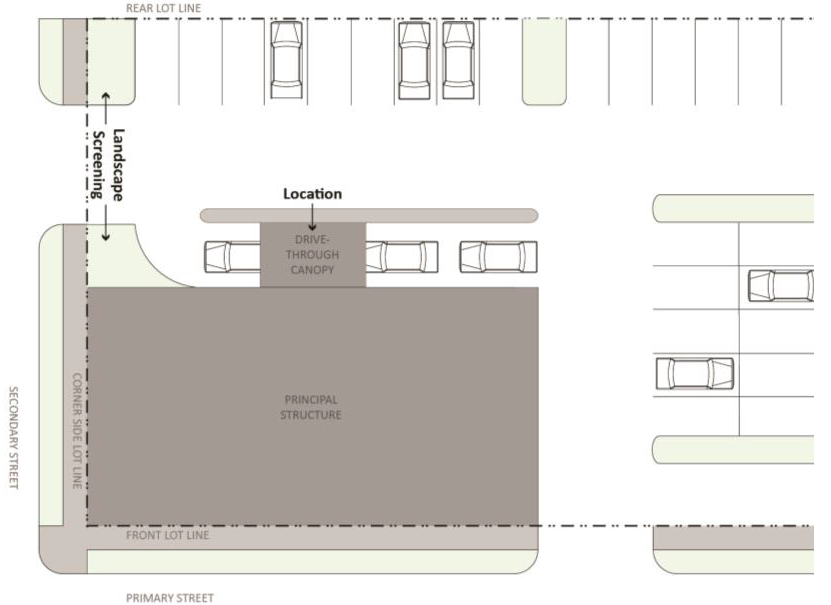
J.
Gas Station.
1.
Location. A gas station shall only be located on a corner lot.
2.
Minimum Street Frontage Requirement. Gas stations shall be exempt from the minimum street frontage requirements established in Article IV (Zoning District Regulations).
3.
Light Pollution. Lighting shall be designed with luminaires recessed under the canopy to minimize light pollution. The illuminance of the canopy shall not exceed ten foot-candles as measured at any location on the lot.
4.
Screening. Street frontage not occupied by building or driveways shall be improved with landscape screening in accordance with the requirements of § VI-5.C (Parking Lot Perimeter Landscape Yard).
K.
Government Facility. Fire stations and public works facilities are exempt from the maximum driveway widths established in § V-9 (Driveways).
L.
Indoor Entertainment or Recreation.
1.
Minimize Adverse Impacts. The location of entrances and exits, service areas, and parking and loading docks shall minimize traffic congestion, pedestrian hazards, and adverse impacts on surrounding properties.
2.
Noise. Any noise associated with the facility shall be managed so as not to create a public nuisance for surrounding properties and shall comply with § III-6.A (Noise) and all other local noise regulations.
M.
Live/Work Dwelling.
1.
Uses. Examples of occupations allowed in live/work dwellings include artist, consultant, counselor, craftsperson, designer, sale of commodities, tutor, writer, and instructor of music, craft, or fine art.
2.
Residency of Operator. The live/work dwelling shall be the primary residence of the property owner. A portion of a live/work dwelling may be leased separately to another occupant as a work space.
3.
Employees. Two additional non-resident employees are allowed to work in a live/work dwelling.
4.
Space Limitation. No more than 50 percent of the total square footage of the dwelling may be used for residential uses. All activities associated with the live/work dwellings shall occur entirely within the dwelling unit.
5.
Front Yard. The front yard of a live/work dwelling may be used for product display during business hours.
N.
Medical Marijuana Dispensary.
1.
Compliance with State Regulations. Medical marijuana dispensaries must comply with all applicable rules and regulations enacted by the State of Illinois, including licensing and registration requirements and minimum spacing of 1,000 feet from preschools, elementary schools, secondary schools, day care centers, and day care homes.
2.
Minimum Spacing. A medical marijuana dispensary shall not be located within 500 feet of another medical marijuana dispensary.
3.
Security. The site design shall incorporate adequate security measures, such as exterior lighting, surveillance cameras, and/or fencing.
O.
Motor Vehicle Rental. In the C-2 District, the outdoor storage of vehicles is prohibited.
P.
Motor Vehicle Repair and/or Service.
1.
Outdoor Storage. Disabled or inoperable vehicles and those awaiting pick-up may be stored outdoors if the following conditions are met:
a.
Location. Outdoor storage of vehicles is prohibited in the front yard.
b.
Screening. To the extent practicable, storage areas shall be screened from view of the street by building and/or landscape screening in accordance with the requirements of § VI-5.C (Parking Lot Perimeter Landscape Yard).
c.
Storage Duration. Motor vehicle repair and/or service facilities may not store the same vehicles outdoors for more than 20 days.
d.
Striped Parking Spaces. Vehicles must be stored in striped parking spaces in accordance with § V-6.C (Striping).
2.
Service Bays. In the C-2 District, vehicular service bays shall not be located on the front façade of the building.
3.
Outdoor Activities. All repairs must occur inside an enclosed building.
Q.
Motor Vehicle Sales.
1.
Screening. The street frontage adjacent to any outdoor sales and display area shall be improved with landscape screening in accordance with the requirements of § VI-5.C (Parking Lot Perimeter Landscape Yard).
2.
Light Pollution. The illuminance of any outdoor sales and display area shall not exceed ten footcandles as measured at any location on the lot.
R.
Off-Street Parking Garage. In the C-2 District, a use listed in Table III-2-A. Use Table as an allowed commercial, civic, or institutional use must occupy the first 30 feet of building depth on the ground floor along a minimum of 50 percent of the street-facing façade (refer to Figure III-3-B. Off-Street Parking Garage).
Figure III-3-B.
Off-Street Parking Garage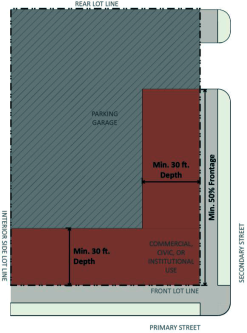
S.
Off-Street Parking Lot.
1.
Location. The off-street parking lot shall not be located on a corner lot.
2.
Screening. The requirements of § VI-5.C (Parking Lot Perimeter Landscape Yard) shall apply to all off-street parking lots.
T.
Outdoor Dining.
1.
Location. Outdoor dining shall be located on private property unless otherwise allowed by the Village. Outdoor dining shall not be located in any yard that is adjacent to a residential use or district unless the outdoor dining is separated from the residential use by an alley.
2.
Sidewalk Clearance. A minimum of four feet of sidewalk clearance must remain available for pedestrians.
3.
Parking Lot Clearance. Outdoor dining shall not interfere with the drive aisles and parking spaces of a parking lot.
U.
Outdoor Entertainment or Recreation.
1.
Minimize Adverse Impacts. The location of entrances and exits, service areas, and parking and loading docks shall minimize traffic congestion, pedestrian hazards, and adverse impacts on surrounding properties.
2.
Noise. Any noise associated with the facility shall be managed so as not to create a public nuisance for surrounding properties and shall comply with § III-6.A (Noise) and all other local noise regulations.
V.
Pawn Shop—Minimum Spacing. A pawn shop may not be located within 1,000 feet of another pawn shop.
W.
Planned Unit Development. Refer to the requirements of § VIII-4 (Planned Unit Developments).
X.
Preschool, Elementary, or Secondary School—Minimize Adverse Impacts. The location of entrances, exits, service areas, parking areas, and loading areas shall minimize traffic congestion, pedestrian hazards, and adverse impacts on surrounding properties.
Y.
Solar Farm.
1.
Impervious Coverage. Fixed solar panels shall be considered impervious surface as part of the calculation of the impervious coverage limitations.
2.
Setbacks. Solar farms are allowed a minimum setback of five feet for all yards.
3.
Screening. If solar farms are enclosed by a fence, the fence shall be a minimum height of eight feet located along the lot lines of the facility. Solar farms may be developed without a fence as well.
a.
Materials and Construction. The materials and construction of the fence shall be in accordance with § III-4.C.6.c (Materials and Construction).
b.
Landscape Elements. Fences located adjacent to the front or corner side lot line shall be landscaped in accordance with the standards of § VI-5.C.2.c (Landscape Elements).
4.
Grid Interconnection. The applicant must provide evidence that the appropriate electric utility has been informed of the applicant's intent to install a solar farm with a grid interconnection.
5.
On-Site Power Lines. On-site power lines shall be installed underground to the greatest extent practical.
Z.
Urban Agriculture.
1.
Site Design. Urban agriculture facilities shall be designed and maintained to minimize the amount of water and fertilizer that drains or runs off onto adjacent property.
2.
Keeping of Animals. The keeping of animals, other than fish used for indoor aquaculture and aquaponics, is prohibited from urban agriculture uses.
3.
Material Storage. All material, equipment, and tools used within the facility must be stored in an enclosed structure when not in use.
4.
Sales. Retail sales of goods produced on site is allowed.
AA.
Utility—Screening. The street frontage adjacent to the utility shall be treated with landscape screening in accordance with the requirements of § VI-5.C (Parking Lot Perimeter Landscape Yard).
BB.
Wireless Telecommunication Facility and/or Tower.
1.
General Requirements. All wireless telecommunication facilities and towers shall be subject to the following.
a.
Lighting. A wireless telecommunication facility or tower shall not include lights unless required by the Federal Communications Commission, the Federal Aviation Administration, or the Village.
b.
Signs. A wireless telecommunication facility or tower shall not display signs except that such facilities or towers may include information required for government regulation, such as Federal Communications Commission registration information.
c.
Screening. A wireless telecommunication facility or tower shall include landscape screening in accordance with the requirements of § VI-6.C (Buffer Yard Requirements), except that a required fence shall be a minimum of eight feet and maximum of ten feet in height.
2.
Wireless Telecommunication Facility.
a.
Height. The maximum height of a wireless telecommunication facility shall be 12 feet.
b.
Use. A wireless telecommunication facility may house equipment and supplies for operation of a wireless telecommunication tower. Such facility shall be unstaffed and shall not be used for equipment that is not used as part of the operation of the facility.
3.
Wireless Telecommunication Tower.
a.
Height. The maximum height of a wireless telecommunication tower shall not exceed the minimum height required to function satisfactorily, but in no circumstances shall it be greater than 100 feet.
b.
Design. A wireless telecommunication tower shall be designed to accommodate at least three telecommunication providers and their accompanying wireless telecommunication facilities. A wireless telecommunication tower shall have a galvanized gray or silver finish unless otherwise required by the Federal Communications Commission, the Federal Aviation Administration, or the Village.
CC.
Adult Use Cannabis Business Establishment.
1.
Purpose and Applicability. The purpose and intent of this subsection is to regulate business establishments that cultivate, process, dispense, and transport adult-use cannabis in order to promote the public health, safety, comfort, and welfare of the citizens of the Village. Such establishments shall comply with all regulations provided in the Cannabis Regulation and Tax Act (P.A. 101-0027) (Act), as it may be amended from time-to-time, regulations promulgated thereunder, and the regulations provided below. In the event that the Act is amended, the more restrictive of the state or local regulations shall apply.
2.
Special Use Required. No adult-use cannabis business establishment shall operate without first obtaining a special use permit in accordance with the provisions of § VIII-3.C. In addition to the standards in § VIII-3.C., the following components of the adult-use cannabis establishment shall be evaluated based on the entirety of the circumstances affecting the particular property in the context of the existing and intended future use of the properties:
a.
Impact of the proposed facility on existing or planned uses located within the vicinity of the subject property.
b.
Proposed structure in which the facility will be located, including co-tenancy (if in a multi-tenant building), total square footage, security installations/security plan, interior and exterior lighting plan, and building code compliance.
c.
Hours of operation and anticipated number of customers/employees.
d.
Anticipated parking demand and available private parking supply.
e.
Anticipated traffic generation in the context of adjacent roadway capacity and access to such roadways.
f.
Site design, including access points, internal site circulation, and landscaping plan.
g.
Proposed signage plan, which must comply with the applicable Village and State code requirements.
h.
Odor control plan which adequately provides for the ongoing safe operation of the establishment and minimizes any adverse impacts to abutting properties from odor-emitting activities to be conducted on site.
3.
Location. No adult-use cannabis business establishment may be located within 500 feet of the property line of a pre-existing public or private preschool or elementary school, a public or private secondary school, a day care center, or a day care home ("protected uses"). In multi-tenant buildings, the property line is defined as the building walls of the protected use, including any outdoor area set aside for the protected use.
4.
Additional Sales. No adult-use cannabis business establishment may conduct any sales or distribution of cannabis or cannabis-infused products other than as authorized by the Act.
5.
On-Site Consumption. Under no circumstances shall on-site consumption of cannabis or cannabis-infused products be permitted at any adult-use cannabis business establishment or any other public space or registered business.
6.
Co-Location of Adult-Use Cannabis Business Establishments.
a.
No adult-use cannabis business establishment may co-locate with a non-cannabis business.
b.
Any adult-use cannabis dispensing establishment may co-locate with an adult-use cannabis craft grower or an adult-use infuser as indicated in Table III-2-A (Use Table), provided the appropriate licenses are issued consistent with Chapter 6 of the Municipal Code, and all requirements of the Act are met.
c.
Adult-use cannabis craft growers and/or adult-use infusers that apply to locate in the C-2 or C-3 zoning districts must co-locate with an adult-use cannabis dispensing establishment.
d.
Adult-use cannabis infusers and craft growers located in the C-2 and C-3 zoning districts are limited to no more than 14,000 square feet.
7.
Security. Petitioner shall install building enhancements, such as security cameras, lighting or other improvements, as set forth in the Special Use Permit, to ensure the safety of employees and customers of the adult-use cannabis business establishment, as well as its environs. Said improvements shall be determined based on the specific characteristics of the floor plan for an Adult-Use Cannabis Business Establishment and the site on which it is located, consistent with the requirements of the Act.
8.
Parking Requirements. For purposes of determining required parking, adult-use cannabis business establishments shall be classified in the following manner based on Table V-2-A. Off-Street Parking Requirements.
a.
Adult-Use Cannabis Craft Grower shall be classified as Heavy or Light Manufacturing.
b.
Adult-Use Cannabis Cultivation Center shall be classified as Heavy or Light Manufacturing.
c.
Adult-Use Cannabis Dispensing Organization shall be classified as a Retail Goods Establishment.
d.
Adult-Use Cannabis Infuser Organization or Infuser shall be classified as Heavy or Light Manufacturing.
e.
Adult-Use Cannabis Processing Organization or Processor shall be classified as Heavy or Light Manufacturing.
f.
Adult-Use Cannabis Transporting Organization or Transporter shall be classified as Heavy or Light Manufacturing.
9.
Affirmation of Compliance. Petitioner shall file an affidavit with the Village affirming compliance with § III-3.CC, any additional conditions established by an approved Special Use Permit, any conditions established by an approved cannabis license pursuant to Chapter 6 of the Municipal Code, and all other requirements of the Act.
DD.
Light Manufacturing.
1.
Retail Space Required. A light manufacturing use in the C-2 or C-3 zoning district must include a minimum of 500 square feet of retail space. This may include dining or showroom space, but is not limited to those uses.
2.
Design Standards. Light manufacturing uses in the C-2 or C-3 zoning districts must comply with all applicable parking, landscaping, and signage design standards. Particular attention must be paid to § V-7 (Loading Facility Requirements), § VI-6 (Buffer Yards), and § VI-8 (Outdoor Lighting).
EE.
Retail Tobacco Store.
1.
Location. No retail tobacco store may be located within 100 feet of the property line of a pre-existing public or private preschool or elementary school, a public or private secondary school, a day care center, or a day care home for persons under the age of 18 years ("protected uses"). In multi-tenant buildings, the property line is defined as the building walls of the protected use, including any outdoor area set aside for the protected use.
2.
Sales. Licensed dealer must provide annual sales and percentage of sales derived from the sale of loose tobacco, cigars, cigarette, pipes, et cetera.
3.
Entrance Prohibited. Entrance shall not be permitted to anyone under the age of 21.
FF.
Smoking Lounge.
1.
Location.
a.
No smoking lounge may be located within 100 feet of the property line of a pre-existing public or private preschool or elementary school, a public or private secondary school, a day care center, or a day care home for persons under the age of 18 years ("protected uses"). In multi-tenant buildings, the property line is defined as the building walls of the protected use, including any outdoor area set aside for the protected use.
b.
No entrance shall be located within 15 feet of any entrance to an enclosed area in which smoking is prohibited.
2.
Sales. Licensed dealer must provide annual sales and percentage of sales derived from the sale of loose tobacco, cigars, cigarette, pipes, et cetera.
3.
On-Site Consumption. On-site consumption of tobacco products may occur if the business is in good standing with a valid business registration and valid tobacco dealer license. Building codes for proper ventilation must be followed. All efforts should be made by the smoking lounge operator to neutralize odor and smoke from leaving the premises.
4.
Entrance Prohibited. Entrance shall not be permitted to anyone under the age of 21.
(Ord. No. 2078, 12-11-17; Ord. No. 2132, § 4, 12-9-19; Ord. No. 2157, § 4, 4-19-21; Ord. No. 2165, § 3, 10-18-21; Ord. No. 2186, § 4, 11-21-22)
§ III-4 - Accessory Structures and Uses
Accessory structures and uses shall be subject to the requirements of this Section.
A.
General Provisions for Accessory Structures. Accessory structures shall be subject to the following standards, unless otherwise established by this Ordinance.
1.
Construction Phasing. No accessory structure shall be constructed prior to the construction of the principal building to which it is accessory.
2.
Location. Accessory structures may be located in the front, corner side, interior side, and rear yards. The location of accessory structures must provide access to utility easements.
3.
Height. The maximum height of an accessory structure shall be 14 feet.
4.
Setbacks. Accessory structures shall be located a minimum of five feet from any rear lot line and three feet from any interior side lot line.
B.
Accessory Structures Table. Table III-4-A. Accessory Structures establishes the accessory structures allowed in each zoning district. Table III-4-A is not an exhaustive list of accessory structures that may be located within the Village. Each structure is given one of the following designations for each zoning district.
1.
Permitted ("P"). A "P" indicates that the accessory structure does not require a building permit and is allowed by right within the designated district provided that it meets all applicable standards set forth in this Section.
2.
Permitted with Building Permit ("B"). A "B" indicates that the accessory structure requires the approval of a building permit in accordance with Chapter 18 (Building and Building Regulations) and shall meet the use standards set forth in this Section in order to be allowed within the designated district.
3.
No Designation. The absence of a letter (a blank space) indicates that the structure is not allowed within the designated district.
4.
Use Standards. Accessory structures that are designated as "Permitted" or "Permitted with Building Permit" may have use standards that must be met, as established in § III-4.C (Use Standards for Accessory Structures).
Table III-4-A. Accessory Structures
C.
Use Standards for Accessory Structures. The following standards apply to accessory structures designated as permitted ("P") or permitted with building permit ("B") or permitted with special use permit ("S") in the districts noted in the "Use Standards" column of Table III-4-A. Accessory Structures.
1.
Apiary. Bees may be kept in apiaries in accordance with the following standards.
a.
Permit and Registration. Prior to erecting an apiary, an applicant must provide written notice to all adjacent property owners and obtain a permit from the Zoning Administrator. Such permits must be renewed annually. Apiaries must be registered with the Illinois Department of Agriculture and inspected as required. Proof of completed inspection shall be submitted to the Zoning Administrator within 30 days of inspection.
b.
Location.
(1)
Apiaries are allowed in the rear yard of any single-family use in the R-1, R-2, or R-4 District.
(2)
Apiaries are allowed in the rear yard of any use in the C-3 or M Districts.
c.
Setback. Apiaries shall be located a minimum of ten feet from any lot line and a minimum of ten feet from the principal structure on the lot.
d.
Number.
(1)
A maximum of two hives are allowed per zoning lot in the R-1, R-2, and R-4 Districts.
(2)
A maximum of six hives are allowed per zoning lot in the C-3 and M Districts.
e.
Safety. Beekeepers shall requeen colonies that exhibit unusually aggressive behavior, such as stinging or swarming, and shall ensure that a source of water is accessible on the zoning lot within 50 feet of the apiary.
f.
Maintenance. Apiaries shall be maintained so as not to become a nuisance. Colonies shall be maintained in movable-frame hives with adequate spacing and management techniques to avoid overcrowding and swarming.
g.
Screening. Apiaries shall be screened to provide a flyway barrier. Such screening shall be at least six feet tall, and consist of a solid fence, vegetative barrier, or combination thereof. The entrance to the apiary shall include a latched gate that shall remain closed when a beekeeper is not present.
h.
Sales. There shall be no retail sales of any products on-site.
2.
Ball Court—Location. Ball courts are allowed in the rear yard, except that one fixed basketball standard and backboard shall be allowed in any yard in the R-1, R-2, R-3, and R-4 Districts.
3.
Chicken Coop. Chickens may be kept in chicken coops, chicken runs, and similar structures in accordance with the following standards.
a.
Permit. Prior to erecting a chicken coop, chicken run, or similar structure, an applicant must obtain a chicken coop permit from the Zoning Administrator and provide notice to all adjacent property owners. Such permits must be renewed annually.
b.
Height. The maximum height of a chicken coop shall be eight feet.
c.
Size. The chicken coop and run, combined, must total a minimum of four square feet per hen, with a minimum of one square foot per hen allocated to the coop, and a minimum of three square feet per hen allocated to the run.
d.
Location.
(1)
Chicken coops, chicken runs, and similar structures are allowed in the rear yard of any single-family, elementary, or secondary school use in the R-1, R-2, or R-4 District.
(2)
Chicken coops, chicken runs, and similar structures are allowed in the rear yard of any urban agriculture use in the C-3 or M Districts.
e.
Setback. Chicken coops shall be located a minimum of 10 feet from any lot line and a minimum of 10 feet from the principal structure on the lot.
f.
Number—First Year. No more than four hens are permitted per zoning lot during the first application year (12 calendar months) in all zoning districts. There is no limit on the number of chicks, age six months or younger, that may be kept. This requirement does not apply to Elementary or Secondary School uses in permitted residential districts. The Zoning Administrator will determine the maximum amount of hens based on the chicken coop site plan and operational plan provided to the Village with the Chicken Coop application. Roosters are not permitted in any zoning district or under any land use.
g.
Number—Subsequent Years. After one year (12 calendar months) of owning four hens, an applicant in the R-1, R-2, C-3, and M zoning districts may submit an application to increase the number of hens to no more than eight hens. The Zoning Administrator shall approve this application if no substantiated complaints have been received by the Village regarding the applicant's hens in the previous 12-month period. Applicants in the R-4 zoning district may not have more than four hens at any time. This requirement does not apply to Elementary or Secondary School uses in permitted residential districts. The Zoning Administrator will determine the maximum amount of hens based on the Chicken Coop site plan and operational plan provided to the Village with the chicken coop application.
h.
Perimeter fence. The rear yard of any property where hens are kept must be fenced with a minimum four-foot high fence. The Zoning Administrator may require higher minimum fences for Elementary or Secondary Schools based off of the submitted Chicken Coop Application, site plan, and operational plan.
i.
Maintenance. Chicken coops, chicken runs, and similar structures shall be maintained in a manner that provides adequate lighting and ventilation, and protects chickens from cold weather, precipitation, rodents, predators, and trespassers. Chicken coops, chicken runs, and similar structures must be maintained in a sanitary condition and shall be cleaned of droppings, uneaten feed, feathers, and other waste so as not to become a nuisance.
j.
Sales. There shall be no retail sales of any products on-site.
k.
Slaughter. On-site slaughtering of chickens is prohibited.
4.
Compost Bin.
a.
Enclosure. Compost must be contained in a fully enclosed receptacle with a tightly fitted lid.
b.
Maintenance. Compost bins must be maintained in a sanitary condition so as not to become a nuisance. Compost may not contain sewage, meat, bones, or grease.
5.
Deck or Patio.
a.
Location. Decks and patios are allowed in all yards.
b.
Setback. The deck or patio shall conform with the setback requirements for the zoning district in which it is located, except that a deck or patio may encroach up to ten feet into the required rear yard in the R-1, R-2, R-3, and R-4 Districts.
6.
Fence or Wall. The following requirements apply to fences and walls unless otherwise specifically established in this Ordinance. Refer to Figure III-4-A. Fence or Wall.
a.
Location. Fences and walls, including all posts, bases, and other structural parts, shall be located completely within the boundaries of the lot on which it is located.
(1)
Front Yard, Interior Side Yard, and Rear Yard. Fences and walls are allowed in the front yard, interior side yard, and rear yard.
(2)
Corner Side Yard. Fences and walls are allowed in the corner side yard between the front façade of the principal structure and the rear lot line.
b.
Height. The maximum height of a fence or wall shall be three feet in the front and corner side yard, and eight feet in an interior side or rear yard. The maximum height of a fence or wall shall be measured from the ground at the base of the fence or wall.
c.
Materials and Construction. The following requirements for materials apply to the construction of fences, walls, and any associated gates.
(1)
Allowed Materials. Fences and walls may be constructed of treated wood, simulated wood, vinyl, metal, chain link with or without slats, metal mesh, corrugated metal, brick, stone, cinderblock, and concrete block.
(2)
Prohibited Materials. Fences shall not be constructed of, barbed wire, or razor wire, except in the C-3 and M Districts, in which fences may be constructed of razor wire or barbed wire with prior written Zoning Administrator approval.
(3)
Construction. Both sides of a fence or wall shall be similar in construction, design, and appearance. The finished side of a fence or wall shall face outward from the lot so that all posts are located on the property owner's side of the fence or wall.
Figure III-4-A. Fence or Wall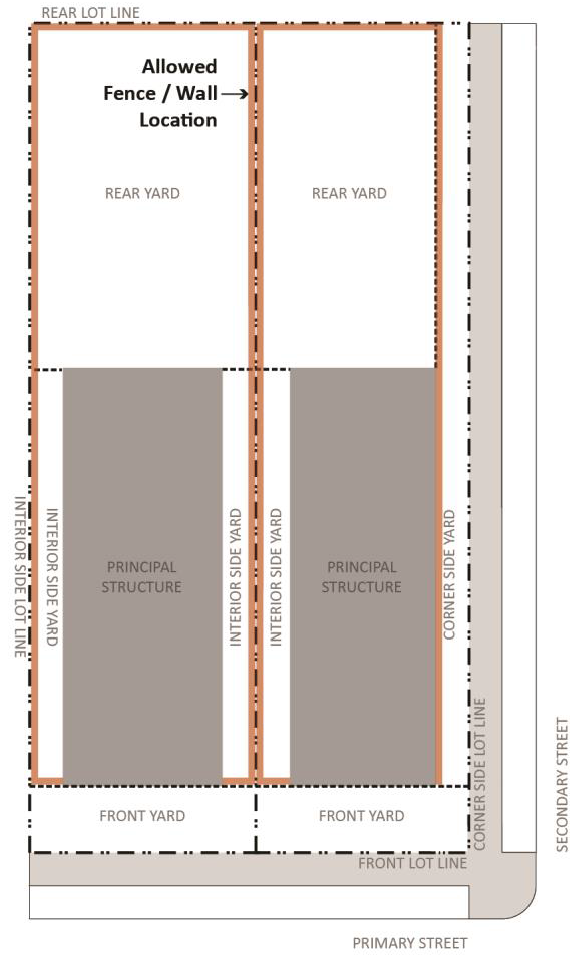
7.
Flag Pole.
a.
Location. Flag poles are allowed in all yards.
b.
Number.
(1)
A maximum of one flag pole is allowed per zoning lot in the R-1, R-2, R-3, and R-4 Districts.
(2)
A maximum of three flag poles are allowed per zoning lot in the C-1, C-2, C-3, and M Districts.
8.
Garage. These standards apply to detached garages only. Attached garages are considered part of the principal structure and must comply with the requirements of Article IV (Zoning District Regulations).
a.
Location. Garages are allowed in the interior side yard and rear yard between the principal structure's rear façade and the rear lot line.
b.
Height. The maximum height of a garage shall be 16 feet.
c.
Area. The maximum area of a garage shall be 750 square feet.
d.
Use of Garages. The area above vehicle parking spaces in a detached garage shall not be used as habitable space, and may not contain a kitchen, bathroom, or sleeping area. In an attached garage, such space may be used as habitable space with a kitchen, bathroom, and/or sleeping area for an accessory dwelling unit in accordance with § III-4.D.1 (Accessory Dwelling Unit).
9.
Gazebo.
a.
Location. Gazebos are allowed in the rear yard only.
b.
Height. The maximum height of a gazebo shall be 12 feet.
c.
Design. Each side of a gazebo shall be at least 25 percent open.
10.
Greenhouse or Shed.
a.
Location. Greenhouses and sheds are allowed in the interior side and rear yards only.
b.
Area. In the R-1, R-2, R-3, and R-4 Districts, the maximum area of a greenhouse or shed shall be 120 square feet.
11.
Hoophouse.
a.
Use Limitation. Hoophouses are allowed in conjunction with urban agriculture, nursery, community garden, and residential uses only.
b.
Area. In the R-1, R-2, R-3, R-4, C-1, and C-2 Districts, the maximum area of a hoophouse shall be 84 square feet. In the C-3 and M Districts, the maximum area of a hoophouse shall be 300 square feet.
c.
Height. In the R-1, R-2, R-3, R-4, C-1, C-2, C-3, and M Districts, the maximum height of a hoophouse shall be eight feet.
12.
Mechanical Equipment.
a.
Location. Ground-mounted mechanical equipment shall be located in the interior side yard or rear yard and shall be located at least five feet from the rear and interior side lot lines. Roof-mounted mechanical equipment shall be located a minimum of six feet from any supporting wall to facilitate safe access.
b.
Deemed Conforming. Notwithstanding § III-4.C.12.a (Location), existing ground-based mechanical equipment that is located in a setback where it is not permitted as of the effective date of this Ordinance shall be considered legally conforming and may be replaced and repaired. Such conforming status shall expire if the principal structure is demolished.
13.
Outdoor Storage.
a.
Location. Outdoor storage shall be located on an improved surface in the interior side yard or rear yard.
b.
Height. Outdoor storage materials shall not exceed eight feet in height.
c.
Uses. Outdoor storage is allowed for the following uses: gas station, heavy manufacturing, light manufacturing, motor vehicle rental, motor vehicle repair and/or service, motor vehicle sales, and nursery. Outdoor storage may be allowed for additional uses with prior written Zoning Administrator approval.
d.
Screening. The requirements of § VI-7 (Screening Requirements) shall apply to outdoor storage.
14.
Rain Garden.
a.
Location. Rain gardens are allowed in all yards.
b.
Setback. Rain gardens shall be located a minimum of two feet from any lot line.
c.
Loose Soil. Loose soil associated with a rain garden must be covered or confined so that the soil is not moved from the lot, particularly after each growing season.
15.
Satellite Dish. Location. Satellite dishes are allowed in any yard, on any façade of a building, or the roof of a building.
16.
Small Wind Energy System. Small wind energy systems are structures that consist of a wind turbine, tower or mounting device, and associated control or conversion electronics intended to reduce on-site consumption of utility power. Systems may be roof-mounted or ground-mounted in accordance with the following standards.
a.
General Requirements. All small wind energy systems shall be subject to the following.
(1)
Building Permit Application. The application for a building permit shall include drawings of the wind turbine structure, including the tower, base, footings, and location on the site, and of the electrical components in sufficient detail to determine whether the proposed system conforms to pertinent electrical codes.
(2)
Capacity. Systems shall have a rated capacity of 100 kilowatts or less.
(3)
Noise. Systems shall not exceed 60 dBA, as measured at the closest lot line. This level may be exceeded during short-term events such as utility outages and/or severe storms.
b.
Roof-Mounted System. Roof-mounted systems shall adhere to the following.
(1)
Districts. Roof-mounted systems are allowed in all zoning districts.
(2)
Location. Systems are allowed on the interior side roof or rear roof of a principal structure. Systems on an accessory structure, such as a garage, gazebo, greenhouse, shed, or other structure may be approved by the Zoning Administrator.
(3)
Height. The maximum height of a roof-mounted system shall be 15 feet above the height of the principal or accessory structure to which the turbine is mounted.
c.
Ground-Mounted System. Ground-mounted systems shall adhere to the following.
(1)
Districts. Ground-mounted systems are allowed in the C-1, C-2, C-3, and M Districts.
(2)
Location. Systems are allowed in the interior side and rear yards.
(3)
Height. The maximum height of a ground-mounted system shall be the height limit of the applicable zoning district.
(4)
Setback. All components of a ground-mounted system (such as the tower, blade, and guy wire anchors) shall be located a minimum of ten feet from any lot line.
(5)
Clearance. A ground-mounted system shall have a minimum of 15 feet of ground clearance.
17.
Solar Energy Collection System. Solar energy collection systems may be roof-mounted or ground-mounted in accordance with the following standards.
a.
Roof-Mounted System. Roof-mounted systems shall adhere to the following.
(1)
Districts. Roof-mounted systems are allowed in all zoning districts.
(2)
Height. The maximum height of a roof-mounted system shall be five feet above the overall height of the principal or accessory structure to which the system is mounted.
b.
Ground-Mounted System. Ground-mounted systems shall adhere to the following.
(1)
Districts. Ground-mounted systems are allowed in all zoning districts.
(2)
Location. Ground-mounted systems are allowed in the interior side and rear yards.
(3)
Height. The maximum height of a ground-mounted system shall be the height limit of the applicable zoning district.
18.
Swimming Pool. The following standards apply to swimming pools with a maximum depth equal to or greater than 24 inches.
a.
Building Code. The installation or replacement of a swimming pool shall comply with all requirements of the International Building Code, including those for swimming pool enclosures and safety devices.
b.
Location. Swimming pools are allowed in the rear yard, but shall be located at least ten feet from the rear lot line and shall not extend into the corner side or interior side yards.
c.
Height. Above-ground pools shall not exceed six feet in height.
d.
Distance from Other Structures. A swimming pool shall be a minimum of five feet from any other structure or building on the lot, with the exception of an attached permanent deck or patio. A swimming pool shall not be in close proximity to any utility lines or cables, as determined by the Zoning Administrator.
19.
Vegetable Garden.
a.
Location. Vegetable gardens are allowed in all yards, but shall be limited to 50 percent of the pervious area of the front yard and corner side yard.
b.
Height. The maximum height of a raised planting beds shall be three feet. The maximum height of a hoophouse shall be in accordance with § III-4.C.11.c (Height).
c.
Setback. Vegetable gardens shall be located a minimum of two feet from any lot line.
d.
On-Site Sales. On-site sales of vegetables or any other goods associated with a vegetable garden are prohibited.
e.
Loose Soil. Loose soil associated with a vegetable garden must be covered or confined so that the soil is not moved from the lot, particularly after each growing season.
20.
Wireless Telecommunication Antenna.
a.
General Requirements. Wireless telecommunication antennas shall meet the general requirements for wireless telecommunication facilities and/or towers in § III-3.BB.1 (General requirements).
b.
Height.
(1)
A wireless telecommunication antenna shall not increase the height of any building or structure on which it is mounted by more than ten percent.
(2)
A wireless telecommunication antenna mounted to a wireless telecommunication tower shall not cause the height of the tower to exceed 100 feet.
c.
Stealth Design. All wireless telecommunication antennas shall utilize stealth design to blend into the surrounding environment, including those co-located on a wireless telecommunication tower.
(1)
A wireless telecommunication antenna must be enclosed, camouflaged, screened, or obscured so that it is not readily apparent to a casual observer.
(2)
A wireless telecommunication antenna shall blend into another part of the structure upon which it is mounted, such as a rooftop, tower, spire, or other similar feature.
21.
Small Cell Wireless Facilities.
a.
Exemptions. The Village is exempt from the regulations herein when there is a demonstrated need for telecommunication services provided by the Village.
b.
Applicability. These use standards shall apply to all Small Cell Wireless Facilities located on utility poles and on wireless support structures. Note that there is a Village preference for new wireless support structures to function as street lights as well, where deemed advisable by the Director of Public Works or their designee, or to have the ability to be modified for street light use at the Village's discretion.
c.
Locations.
(1)
Small Cell Wireless Facilities installed on existing utility poles or wireless support structures in the public right-of-way and on private property in the C-3 (Corridor Commercial) and M (Manufacturing) zoning districts shall be permitted uses in compliance with Chapter 106, Article IX of the Village Code and this § III-4.C.21 (Small Cell Wireless Facilities) of the UDO.
(2)
When a utility pole or wireless support structure does not exist in compliance with Section 21.c.(1) above, or when the Small Cell Wireless Facility is proposed on private property in the C-1, C-2, R-1, R-2, R-3, or R-4 zoning districts, a Small Cell Wireless Facility shall require Special Use Permit approval in compliance with Article VIII.3.C. (Special Use Permit).
d.
Conditions.
(1)
All Small Cell Wireless Facilities shall comply with the application procedures established in Chapter 106, Article IX of the Village Code.
(2)
Maximum Number of Antennas: Not more than one Small Cell Wireless Facility shall be located on a single pole or structure.
(3)
Surface Area of Antenna:
i.
The Small Cell Wireless Antenna, including Antenna panels, whip Antennas or dish-shaped Antennas, shall not have a surface area of more than six cubic feet.
ii.
No single dimension of the Antenna or associated equipment shall exceed six feet.
iii.
Omnidirectional or whip Antennas shall not extend more than six feet from the pole.
iv.
Small Cell Wireless Facilities located on street light poles or traffic control structures shall not block light emanating from the street light or traffic control fixture or otherwise interfere with the purpose of the street light or traffic control fixture.
v.
All Small Cell Wireless Facilities shall be installed in accordance with all applicable Village codes. No wiring or cabling shall interfere with any existing wiring or cabling installed by the Village, a utility, or a wireless services provider.
vi.
Small Cell Wireless Facilities collocated on Village-owned utility poles may not use the same power or communication source providing power and/or communication for the existing infrastructure. The wireless provider shall coordinate, establish, maintain, and pay for all power and communication connections with private utilities.
e.
Design Standards.
(1)
Overall Size: The smallest suitable small cell antennas, equipment, and facilities available for industry use shall be utilized for all installations.
(2)
Stealth Requirement: The use of stealth technology in the location and construction of Small Cell Wireless Facilities is required whenever and wherever possible. Stealth technology means using the least visually and physically intrusive design and equipment to employ methods that blend into surroundings and not be visible; and to minimize adverse aesthetic and visual impacts on the right-of-way, property, building, and/or other facilities adjacent to, surrounding, and in generally the same area as the requested location of such Small Cell Wireless Facilities.
(3)
Small Cell Wireless Facilities, including but not limited to antennas, equipment enclosures, mounting brackets and hardware, mounting posts, cables, and shrouds, shall be of a color that is identical to the utility pole or wireless support structure or of a neutral color compatible with the color of the utility pole or wireless support structure and any surrounding elements so as to camouflage or conceal their appearance, create consistency among right-of-way infrastructure, and to make such Small Cell Wireless Facilities as unobtrusive as possible. The use of reflective material is prohibited. The Director of Public Works or their designee may approve compatible color schemes and/or alternative measures for concealment if the Director or their designee determines that the optional measures will be at least as effective in concealing the Small Cell Wireless Facilities as the measures required in this Article. Anti-graffiti finishes shall be applied to all Small Cell Wireless Facilities that may be reachable from ground level.
(4)
Maximum Height: The top of the highest point of the antenna shall not extend more than ten feet above the highest point of the existing pole or structure.
(5)
Minimum Height: The bottom of the lowest point of the Antenna shall not be lower than 12 feet above grade.
(6)
Minimum Equipment Height: The operator of a Small Cell Wireless Facility shall, whenever possible, locate the base of the equipment or appurtenances at the highest height possible on the pole or structure, but no lower than nine feet above grade.
(7)
Pole Visual Interference: Small Cell Wireless Facilities shall not interfere with or block any existing signage or other Village installations (banners, holiday dÉcor, flowers, etc.) located on a pole.
(8)
Extensions: Small Cell Wireless Facilities attached to the utility pole or wireless support structure shall be attached using rigid steel clamping mounts or stainless steel banding to the exterior of any metal pole. All mounts and banding shall be of the same color as the utility pole or wireless support structure, except as otherwise approved by the Director of Public Works or their designee. Care should be taken to integrate the mounting elements into the Small Cell Wireless Facility design. Through-bolting or use of lag bolts on Village-owned utility poles is prohibited.
(9)
Wires and Cables: Any wiring and cables associated with a Small Cell Wireless Facility must be run through the hollow interior of the pole or structure. If proven to be infeasible to run inside of the pole or structure, all wiring and cables shall be covered with an appropriate cover or cable shield. No exterior wires or cables shall be visible under any circumstance.
(10)
Guy Wires: No guy or other support wires shall be used in connection with a Small Cell Wireless Facility unless proposed to be attached to an existing utility pole that incorporated guy wires prior to the date that a Petitioner has applied for a permit. No additional guy wires shall be added to a utility pole or wireless support structure for the purpose of supporting a Small Cell Wireless Facility. If additional guy wires are required for structural integrity reasons, the utility pole or wireless support structure shall be required to be replaced to be self-supporting and structurally sound without the use of guy wires.
(11)
Decorative Light Poles: Locating Small Cell Wireless Facilities on a decorative column, lantern, or similar light pole located within DownTown Park Forest, public parks, and other locations where decorative light poles have been installed, shall be discouraged for visual and aesthetic enhancement reasons. Alternatives to utilizing these decorative light poles should be used, including the installation on private property. When collocated on decorative light poles, a Small Cell Wireless Facility shall keep the existing appearance of the light pole and any extensions shall be disguised in a manner similar to the design and appearance of the pole. Due diligence shall be required to indicate proper structural integrity and non-interference with signage or other Village installations (banners, holiday dÉcor, flowers, etc.) located on a pole.
(12)
All new or replacement street light poles and pole foundations shall conform to the Village's standards and specifications for street light design and construction, including the design standards established in this Article. This work shall be approved by the Director of Public Works or their designee as part of the application process.
(13)
If a new wireless support structure is approved by the Director of Public Works or their designee, it shall be designed to minimize the visual and aesthetic impact of the new vertical element and associated Small Cell Wireless Facilities upon the surrounding area and shall blend in with the surrounding streetscape with minimal visual impact. This work shall be approved by the Director of Public Works or their designee as part of the application process.
(14)
Undergrounding: Any mechanical equipment or antenna equipment associated with a Small Cell Wireless Facility that cannot be located on the pole or structure because of structural reasons or because of other restrictions, such as height and size allowances, shall be concealed underground. When located in a public right-of-way where other utilities are not required to complete the same undergrounding requirements, mechanical equipment shall not be required to be placed underground. If the undergrounding of equipment is not possible, feasible or required as stated above, as determined by the Department of Public Works, equipment shall be mounted within a concealment box designed as a decorative pole base or within unobtrusive equipment enclosures mounted directly to the pole. Any ground mounted equipment shall not create a safety or tripping hazard, shall ensure any walkways remain in compliance with all state and federal accessibility laws and shall be constructed in compliance with all Village right-of-way ordinances and design standards.
(15)
Screening: Additional landscaping and fencing shall be required to help mitigate the effects of any ground-mounted equipment not feasible to be located underground. This shall include screening all visual appearance of the equipment from roadways and pedestrian facilities. This screening may be used in conjunction with other stealth methods. This may be required by Village staff as part of any permit approval for permitted uses or by the Planning and Zoning Commission and Village Board as required for any Special Use Permit.
(16)
Burial or Removal of Utility Poles: If a utility pole with a Small Cell Wireless Facility is planned to be buried or removed and is no longer required for a utility or public purpose, then the Small Cell Wireless Facility and all associated equipment shall be removed by the carrier within 90 days of notice from the Village or organization which owns/operates the utility pole. The Small Cell Wireless Facility may apply to be relocated to another nearby site in compliance with this Section and with Chapter 106, Article IX of the Village Code. No Small Cell Wireless Facilities shall be permitted to be placed on utility poles with active studies, plans or permits to be replaced or buried.
(17)
Illumination: Small Cell Wireless Facilities shall not be artificially illuminated or marked, except as required by law.
(18)
Signage: A four- by six-inch plate with the wireless provider's name, location identifying information, and emergency telephone number shall be permanently affixed to the Small Cell Wireless Facility equipment enclosure or shroud. Any manufacturer logos or decals that may be visible to the public shall be removed or painted over. No other signage or advertising shall be visible on any part of the Small Cell Wireless Facility, except as required by law.
(19)
Upon completion of the installation of any small cell wireless facility, the telecommunications provider shall be responsible for full restoration of the site to pre-construction conditions.
D.
Accessory Dwelling Units and Home Occupations. Subject to building permit approval, accessory dwelling units are permitted in the R-1 and R-2 Districts, and home occupations are permitted in all residential zoning districts, provided that the following standards are met for each type of use.
1.
Accessory Dwelling Unit.
a.
Location. An accessory dwelling unit is permitted as part of the existing principal structure on the zoning lot, such as an attic, basement, or attached garage.
b.
Number. One accessory dwelling unit is permitted per single-family dwelling unit.
c.
Size. An accessory dwelling unit may not exceed 40 percent of the gross floor area of the principal structure on the lot, or 800 square feet, whichever is less.
d.
Occupancy. On lots with accessory dwelling units, the property owner must maintain his or her permanent residence in either the principal structure or the accessory dwelling unit.
e.
Entrances. An accessory dwelling unit may have an entrance from the exterior and/or interior of the principal structure.
2.
Home Occupations. Home occupations shall be subject to the following:
a.
Location. A home occupation may be allowed within any residential use in the Village as part of a principal or accessory structure.
b.
Uses. Examples of allowed home occupations include, but are not limited to, artist, consultant, counselor, craftsperson, designer, tutor, writer, and instructor of music, craft, or fine art.
c.
Sales. No on-site retail or wholesale transactions are allowed.
d.
Hours of Operation. Home occupations with outside visitors may be allowed to operate from 7:00 a.m. to 9:00 p.m.
e.
Residency of Operator. The operator of the home occupation shall reside in the dwelling unit in which the home occupation is located.
f.
Employees. One additional non-resident employee is allowed for a home occupation.
g.
Visitors. A maximum of four visitors (such as clients, customers, and pupils) associated with the home occupation may be present at any given time.
h.
Parking. Any parking needs associated with the home occupation shall be accommodated onsite within an existing driveway or garage.
i.
Deliveries. Deliveries and shipments are not allowed to or from the premises, with the exception of carriers that typically provide service to residential neighborhoods, such as the U.S. Postal Service and/or express shipping services (UPS, FedEx, DHL).
j.
Space Limitation. No more than 25 percent of the total square footage of the dwelling unit may be used for the home occupation. All activities associated with the home occupation shall occur entirely within the dwelling unit.
k.
Signs. Signs for home occupations are permitted in accordance with § VII-4.A (Permanent Signs Exempt from Permit Requirement).
l.
Registration and Fee. Every home occupation shall complete an application for business registration with the Village and shall be accompanied by a required filing fee as established and modified from time to time by § 22-35 (Home Occupations).
(Ord. No. 2078, 12-11-17; Ord. No. 2121, §§ 3—5, 9-23-19; Ord. No. 2146, § 3, 9-21-20; Ord. No. 2232, § 3, 11-18-24)
§ III-5 - Temporary Structures and Uses
Temporary structures and uses shall be subject to the requirements of this section.
A.
Temporary Structures and Uses Table. Table III-5-A. Temporary Structures and Uses establishes the allowed temporary structures and uses for each zoning district. Table III-5-A is not an exhaustive list of temporary structures and uses that may be located within the Village. Each structure or use is given one of the following designations for each zoning district.
1.
Permitted ("P"). A "P" indicates that the temporary structure or use does not require a temporary use permit and is allowed by right within the designated district provided that it meets all applicable use standards set forth in this Section.
2.
Permitted with Temporary Use Permit ("T"). A "T" indicates that the temporary structure or use requires the approval of a temporary use permit (refer to § VIII-3.I (Temporary Use Permit)) and must meet any applicable use standards set forth in this Section in order to be allowed within the designated district.
3.
No Designation. The absence of a letter (a blank space) indicates that the use is not allowed within the designated district.
4.
Use Standards. Temporary structures or uses that are designated as "Permitted" or "Permitted with Temporary Use Permit" may have use standards that must be met, as established in § III-5.B (Use Standards for Temporary Structures and Uses).
Table III-5-A. Temporary Structures and Uses
B.
Use Standards for Temporary Structures and Uses. The following standards apply to temporary structures and uses designated as permitted ("P") or permitted with temporary use permit ("T") in the districts noted in the "Use Standards" column of Table III-5-A. Temporary Structures and Uses. Temporary uses may be located outdoors or within an enclosed building or structure.
1.
Contractor Trailer or Model Unit. Contractor trailers shall be limited to the period of active construction of the project. Model units, including temporary real estate offices, shall be limited to the period of active selling and/or leasing of space in the development, or six months after issuance of the final occupancy permit, whichever is less.
2.
Farmers Market. The following products may be offered for sale at farmers markets: fruits, vegetables, juices, flowers, plants, herbs, spices, dairy goods, meats, baked goods, and/or arts and crafts.
3.
Garage or Rummage Sale. Garage and rummage sales shall be limited to a period of three consecutive days. A maximum of four garage and/or rummage sales shall be allowed for the same residence within a 12-month period in accordance with Chapter 82 (Secondhand Goods).
4.
Mobile Food Facility.
a.
Location. Mobile food facilities may be located on private property, not the public right-of-way.
b.
Litter. The permit holder must keep the area clear of litter and debris during business hours and provide a trash receptacle for customer use if such receptacles are not already provided on site or in the right-of-way.
c.
Alcohol Sales. Sale of alcohol is prohibited.
d.
Outdoor Seating. Outdoor seating may be provided on the site, but no seating may be permanently installed.
e.
Water Connection. A permanent water or wastewater connection is prohibited.
f.
Electrical Service. Electrical service may be provided only by temporary service or other connection provided by an electric utility, or an on-board electrical generator.
g.
Drive-Through. Drive-through service is prohibited.
5.
Sidewalk Sale.
a.
Duration. Sidewalk sales shall be limited to a period of three consecutive days. A maximum of four sidewalk sales shall be allowed for the same retailer within a 12-month period.
b.
Sidewalk Clearance. A minimum of four feet of sidewalk clearance must remain available for pedestrians.
c.
Storage. Merchandise must be stored inside the building during non-business hours.
6.
Temporary Outdoor Entertainment.
a.
Other Local Regulations. Temporary outdoor entertainment shall comply with the requirements of the Municipal Code (Chapter 10 Amusements and Entertainments) and other local regulations.
b.
Temporary Use Permit Application. Approval of the temporary use permit shall be based on the adequacy of the lot area, provision of parking, traffic access, and public safety, as well as the absence of undue adverse impacts on adjacent properties. The temporary use permit application shall include the following:
(1)
Site Plan. As part of the temporary use permit application, the operator of the event must submit a site plan to the Village prior to the event that illustrates the location of major site components and ingress and egress routes for emergency vehicles.
(2)
Proof of State Inspection. The operator of the event shall provide proof that all amusement devices have been inspected and approved by the State of Illinois Department of Labor.
c.
Location. Temporary outdoor entertainment shall not be located directly adjacent to a residential district.
d.
Bulk and Yard Requirements. Temporary outdoor entertainment is exempt from Article IV (Zoning District Regulations).
7.
Temporary Outdoor Sale.
a.
Temporary Use Permit Application. Approval of a temporary use permit for a temporary outdoor sale shall be based on the adequacy of the lot area, provision of parking, traffic access, and public safety, as well as the absence of undue adverse impacts on other properties.
b.
Duration. Temporary outdoor sale uses shall be limited to a period of up to 45 days. The Zoning Administrator may grant additional time or successive permits through the temporary use permit process.
8.
Temporary Storage Container.
a.
Duration. Temporary storage containers shall be located on a lot for a period of no more than 14 consecutive days unless used in conjunction with an approved building permit.
b.
Improved Surface. The temporary storage container shall be located on an improved surface. Containers shall not be permanently attached to the ground, have permanent utility service, or be stacked on top of one another.
(Ord. No. 2078, 12-11-17)
§ III-6 - Environmental Performance Standards
All uses shall comply with the performance standards established in this Section unless any federal, state, county, or local regulation establishes a more restrictive standard, in which case the more restrictive standard shall apply.
A.
Noise. No activity or use shall be conducted in a manner that generates a level of sound, as measured on another property, greater than that allowed by federal, state, county, and local regulations. These limits shall not apply to construction noises, noises emanating from safety signals or warning devices, noises not directly under the control of the owner or occupant of the property, and transient noises from moving sources, such as motor vehicles, railroads, and aircraft.
B.
Odor. No activity or use shall be conducted in a manner that generates odors of such intensity and character as to be harmful to the health, welfare, or comfort of the public. Any such use shall be stopped or modified to remove the odor.
C.
Dust and Air Pollution. Dust and air pollution carried by the wind from sources such as storage areas, yards, roads, equipment, and the like, within lot boundaries, shall be kept to a minimum by appropriate landscaping, screening, paving, wetting, or other acceptable means.
D.
Glare and Heat. No activity or use shall be conducted in a manner that generates glare or heat that may be detected at any point off the lot on which the use is located. Light sources shall be shielded so as not to cause a nuisance across lot lines.
E.
Vibration. No activity or use shall be conducted in a manner that generates earthborn vibration which can be detected at any point off the lot on which the use is located.
F.
Fire and Explosion Hazards. Materials that present potential fire and explosion hazards shall be transported, stored, and used only in conformance with all applicable federal, state, county, and local regulations.
G.
Hazardous, Radioactive, and Toxic Materials. No activity or use shall produce hazardous, radioactive, or toxic material without prior notice to the Village. Notice shall be given to the Village at least 30 days before the operation is commenced. The transport, handling, storage, discharge, clean up, and disposal of all hazardous, radioactive, or toxic materials, including waste, shall comply with applicable federal, state, county, and local regulations.
(Ord. No. 2078, 12-11-17)

