
Park Forest City Zoning Code
ARTICLE VII
- SIGNS
§ VII-1 - General Provisions
A.
Purpose. The purpose of this Article is to establish regulations to govern the display, design, construction, installation, maintenance, and removal of signs. The regulations in this Article shall:
1.
Promote and protect the health, safety, and general welfare of the Village from signs that are unsafe, conflict with traffic control devices, or interfere with motorists, bicyclists, or pedestrians.
2.
To enhance economic development and community activities by promoting the reasonable, orderly, and effective display of signs, and encouraging better communication with the public.
3.
Improve the appearance of signs to create a more attractive economic climate in the Village.
4.
Ensure that signs are compatible with surrounding land uses and architecture.
5.
Discourage signs that are unsightly, inappropriate, or excessive in area or number.
6.
Ensure that the right of free speech is protected for residents and businesses.
(Ord. No. 2078, 12-11-17)
§ VII-2 - General Construction and Design Standards
A.
General Requirements. All signs shall meet the construction and design standards of this Article and of Chapter 18 (Buildings and Building Regulations).
B.
Installation. All signs shall be installed so that necessary supports and braces are an integral part of the sign design.
C.
Location. All signs shall comply with the following standards.
1.
Public Property. Signs may only be placed on public property by a government agency or as authorized by this Article or by the Zoning Administrator. Any sign placed on public property without authorization may be removed without notice.
2.
Private Property. Signs may only be placed on private property with prior consent of the property owner and, if applicable, pursuant to an approved sign permit issued by the Village.
3.
Building Exterior. A sign mounted on the exterior of a building shall not conceal any windows, doors, or unique architectural features. This standard does not apply to window signs.
D.
Illumination. All signs shall comply with the following illumination standards.
1.
Electrical Components. All electrical components used in the construction of a sign shall be installed and maintained as required by Chapter 18 (Buildings and Building Regulations).
2.
Light Level.
a.
LED Lighting. The light level of an illuminated sign lit with LED bulbs shall be no greater than 5,000 nits of luminance from dawn to dusk, and no greater than 150 nits of luminance from dusk to dawn.
b.
Non-LED Lighting. The light level of an illuminated sign lit with bulbs other than LED bulbs shall be no greater than one foot-candle at any time of day as measured at the curb line.
3.
Direct Light and Glare. All sign illumination shall be located, shielded, and directed to illuminate only the sign face and to prevent direct light or glare from being cast upon adjacent rights-of-way and surrounding properties. No sign illumination may be combined with reflective materials, such as mirrors, polished metal, or highly glazed tiles, which would increase glare.
4.
External Illumination. Signs shall be externally illuminated with steady, stationary, fully shielded light sources concentrated on the face of the sign so as not to cause glare.
5.
Neon Signs. Marquee signs may be illuminated with neon. Window signs that are illuminated with neon are allowed in accordance with the standards of § VII-4.A.10 (Window Signs).
6.
Hours of Operation. Illuminated signs shall be turned off from 11:00 p.m. until 6:00 a.m., or 30 minutes after close of business, whichever is later. Uses that remain in operation between 11:00 p.m. until 6:00 a.m. are exempt from this requirement during the period of operation only.
E.
Items of Information. Refer to Figure VII-2-A. Items of Information.
1.
Applicability. The following standards apply to all permanent signs, with the exception of menu board signs.
2.
Limitation. No sign face shall include more than six items of information, except as provided in this section. Each of the following items is considered one item of information: business name, business logo, telephone number, website, slogan, and products or services offered. If the sign advertises products or services, each product or service is considered one item of information. The following exceptions apply:
a.
Street Address. The street address of a business is not considered an item of information.
b.
Electronic Message Signs and Manually Changeable Copy Signs. An electronic message sign or manually changeable copy sign shall be counted as one item of information. A sign that includes an electronic message sign or manually changeable copy sign component shall include no more than three total items of information.
c.
Multi-Tenant Commercial Building Signs. Monument and pole signs for multi-tenant commercial buildings are limited to one item of information per tenant, which may exceed six items of information in total, in addition to the name and address of the development.
3.
Commercial and Non-Commercial Signs. All items of information on a commercial sign must be related to the products and services offered on the premises. This limitation on items of information is not applicable to non-commercial signs.
Figure VII-2-A. Items of Information
F.
Maintenance, Inspection, and Removal.
1.
Maintenance. All signs, support structures, and the area immediately adjacent to signs shall be regularly maintained, including cleaning, repainting, and repairs. No sign may be constructed, erected, or maintained in a manner that is unsafe, insecure, or a danger to the public.
2.
Inspection. The Village may inspect any sign regulated by this Article at any time to determine whether the sign is in need of repair or removal, or whether it is in conformance with the provisions of this Article.
3.
Removal of Unsafe Signs. Any sign that is an immediate peril to persons or property may be removed by the Village without prior notice to the owner thereof. The cost of removal shall be billed to the property owner.
4.
Removal of Obsolete Signs. Any permitted sign may remain in place after a use has vacated the subject premises, provided the sign is left non-illuminated and sign copy is removed within 30 days after the use vacates the premises. If a new on-site use for the sign has not commenced within six months of the previous use vacating the premises, the sign shall be deemed abandoned, and is subject to the provisions of § VIII-5.D.6 (Discontinuation or Abandonment of Nonconforming Signs).
(Ord. No. 2078, 12-11-17)
§ VII-3 - Sign Measurement Standards
The following standards shall control the measurement of sign area and sign height.
A.
Measurement of Sign Area. Refer to Figure VII-3-A. Sign Area Measurement and Figure VII-3-B. Measurement for Signs with Multiple Faces.
1.
Signs with Backgrounds. For signs mounted upon a background, sign area is measured as the entire area of the sign face or background of the sign used to distinguish the sign from the structure upon which it is placed, unless otherwise noted in this Article. Sign area does not include any supporting framework or bracing, unless such framework or bracing is part of the message or sign face.
2.
Signs with Freestanding Letters and/or Logos. For signs consisting of freestanding letters and/or logos, sign area is measured as the total area of the smallest geometric shapes that will enclose each word and graphic in the display. Sign area does not include any supporting framework or bracing, unless the framework or bracing is part of the message or sign face.
3.
Signs with Multiple Faces. For signs with multiple faces, if the interior angle between the sign faces is 45 degrees or less, sign area is the area of one sign face. If the angle between the sign faces is greater than 45 degrees, sign area is the sum of the areas of the sign faces. Sign area does not include any supporting framework or bracing, unless such framework or bracing is part of the message or sign face.
Figure VII-3-A. Sign Area Measurement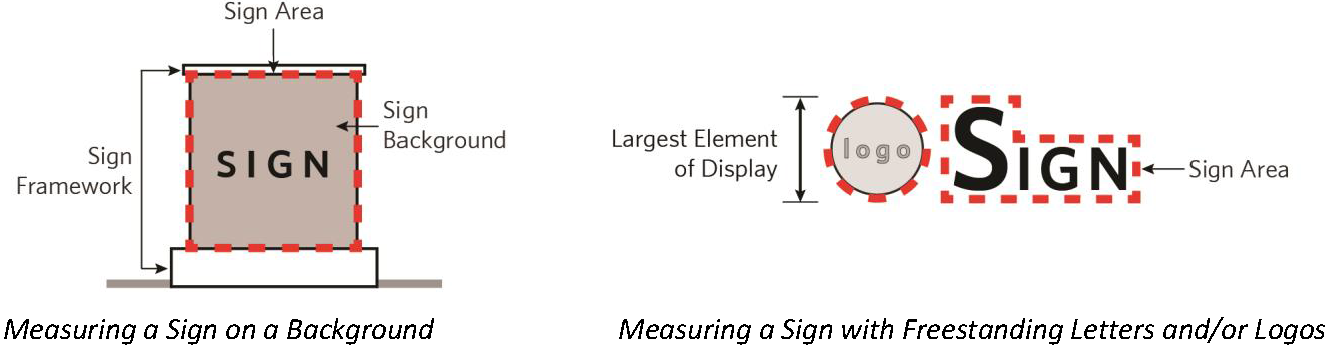
Figure VII-3-B.
Measurement for Signs with Multiple Faces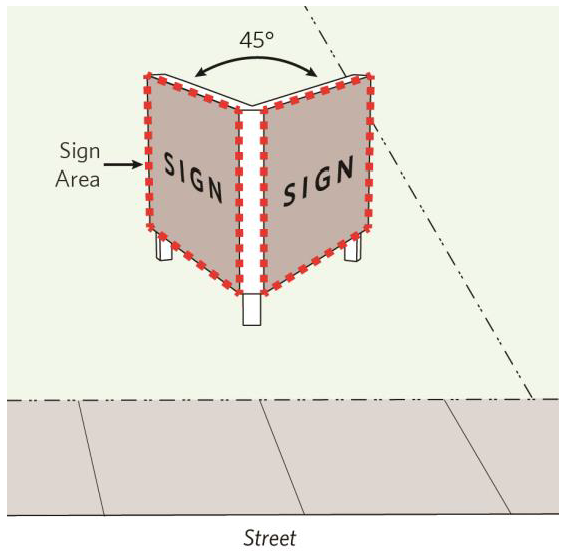
B.
Measurement of Sign Height.
1.
Ground-Mounted Signs. The height of a ground-mounted sign shall be calculated as the vertical distance measured from grade to the highest point of the sign.
2.
Building-Mounted Signs. The height of a building-mounted sign shall be calculated as the vertical distance from the base of the sign face to the highest point of the sign face, unless otherwise noted in this Article.
(Ord. No. 2078, 12-11-17)
§ VII-4 - Permanent Signs
A.
Permanent Signs Exempt from Permit Requirement. The following types of permanent signs are exempt from the sign permit requirements of § VIII-3.H (Sign Permit) and are allowed in all zoning districts provided that they comply with the following standards.
1.
Bicycle parking signs. Bicycle parking signs in accordance with § V-5.D.1.e (Signage) shall not exceed two square feet in area per sign.
2.
Flags. Flags may be hung from flag poles in accordance with § III-4.C.7 (Flag Pole).
3.
Government signs.
4.
Headstones.
5.
Historical markers. Historical markers shall be constructed of bronze or other incombustible materials, and shall not exceed four square feet in area per sign.
6.
Home occupation signs. Home occupation signs shall denote only the name and profession of the occupant or name of the business, and shall not exceed two square feet in area. One wall sign or window sign shall be allowed per lot, and such sign shall not be illuminated.
7.
Miscellaneous information signs.
8.
Parking lot signs. Parking lot signs shall not exceed six square feet in area per sign.
9.
Street address signs. Street address signs shall not be illuminated and shall not exceed two square feet in area per sign.
10.
Warning signs. Warning signs shall not exceed two square feet in area per sign.
11.
Window signs. The following regulations apply to both permanent and temporary window signs.
a.
Location. Window signs are allowed in all non-residential districts on all building façades, and in all residential districts for non-residential uses.
b.
Size. Window signs shall not occupy more than 25 percent of the total ground floor window area on each building façade.
c.
Illumination. Internally illuminated window signs, including neon signs that do not exceed six square feet in area per sign, and electronic message signs that do not exceed four square feet in total area, are allowed only in accordance with § VII-2.D (Illumination).
B.
Permanent Signs with Permit Requirement. The following permanent signs require a sign permit, in accordance with § VIII-3.H (Sign Permit), and shall comply with the following standards.
1.
Awning Signs. Awnings that do not display signs are not subject to the regulations of this Section. Refer to Figure VII-4-A. Awning Sign.
Figure VII-4-A. Awning Sign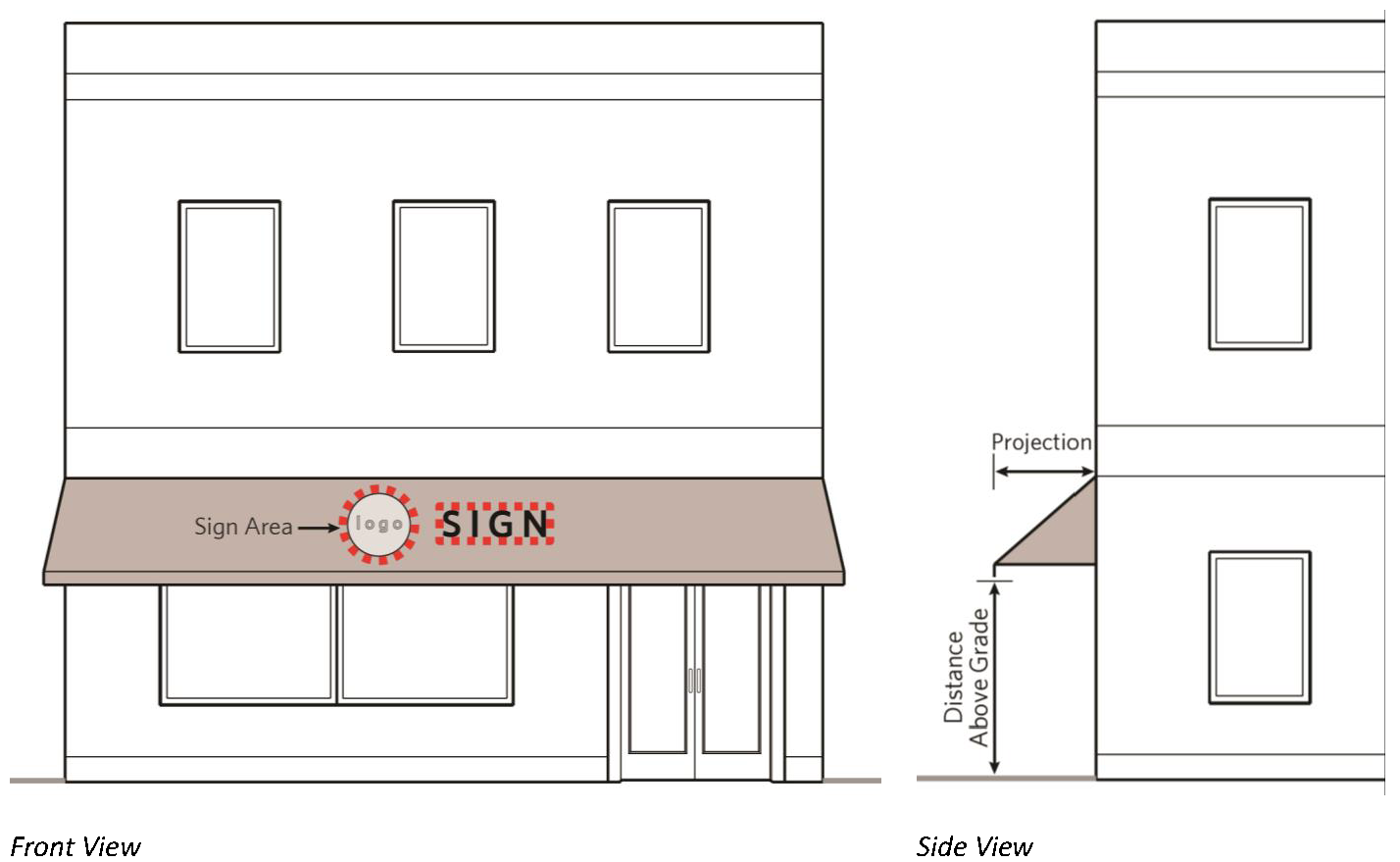
a.
Location.
(1)
Awning signs are allowed in the C-1, C-2, C-3, and M Districts, and in all residential districts for non-residential uses.
(2)
An awning sign may project from the front or corner side façade of the building to which it is attached, but shall not project more than five feet.
(3)
No portion of the awning on which the awning sign is attached shall be located lower than eight feet above grade.
(4)
Awning signs shall be generally aligned with awning signs that are attached to adjacent buildings to maintain a sense of visual continuity.
b.
Size. An awning sign shall not exceed 50 percent of the area of the awning on which it is located. For awnings extending across the building frontage of more than one ground floor tenant, the awning area for each tenant shall be measured from the limits of each building frontage. Awning signs are exempt from the measurement standard of § VII-3.A.1 (Signs with Backgrounds) and shall follow the measurement standard of § VII-3.A.2 (Signs with Freestanding Letters and/or Logos).
c.
Illumination. Externally illuminated awning signs are allowed only in accordance with § VII-2.D (Illumination).
d.
Display Standards.
(1)
Awning signs shall be displayed on standard planar awnings constructed out of durable, weather-resistant material such as canvas, nylon, vinyl-coated fabric, or metal.
(2)
Awning signs shall not be displayed on round, arched, casement, bullnose, bubble, box, or waterfall awnings.
2.
Canopy-Mounted Signs. Refer to Figure VII-4-B. Canopy-Mounted Sign.
Figure VII-4-B. Canopy-Mounted Sign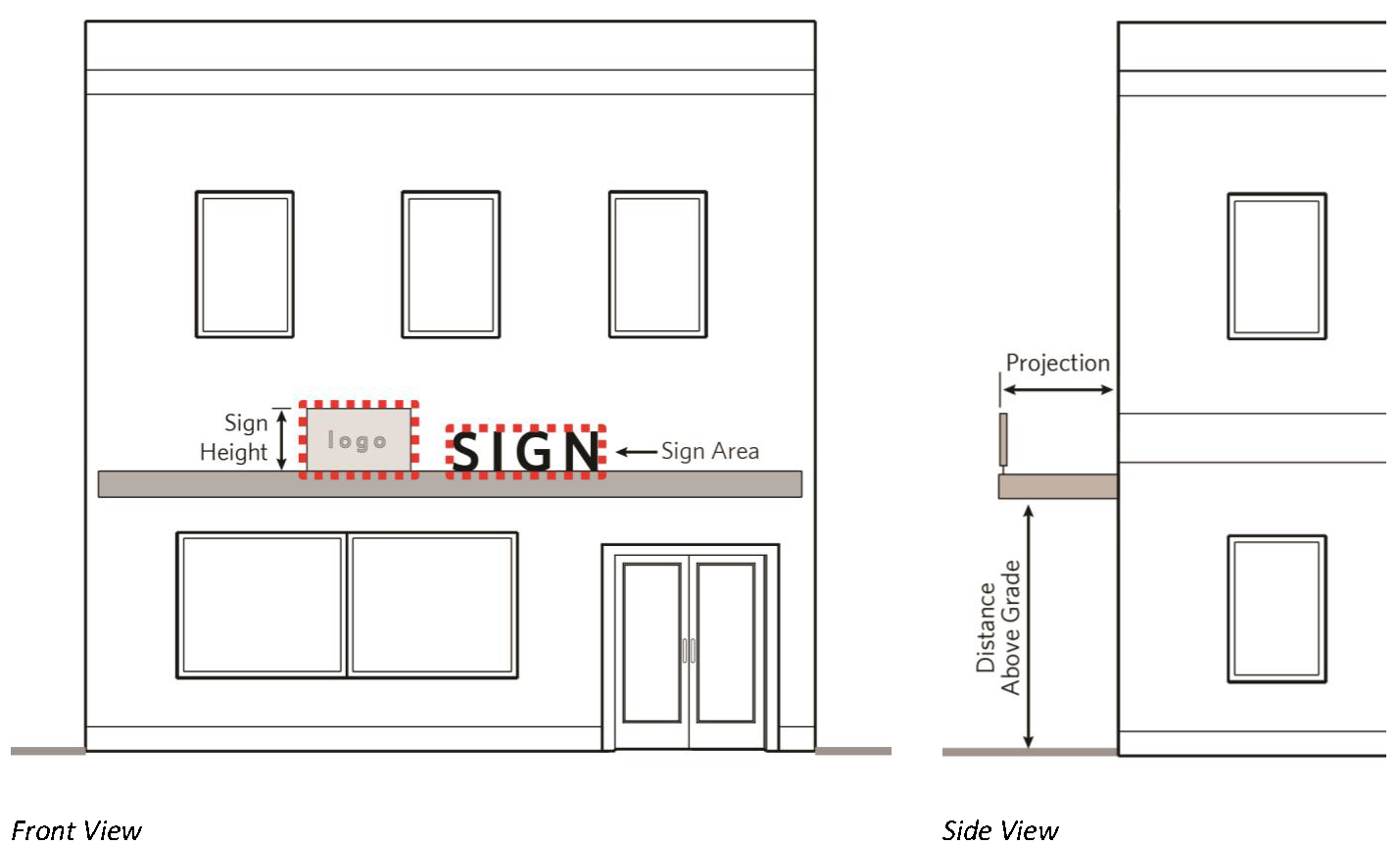
a.
Location.
(1)
Canopy-mounted signs are allowed in the C-1, C-2, C-3, and M Districts, and in all residential districts for non-residential uses.
(2)
The canopy upon which the canopy-mounted sign is displayed may project from the front or corner side façade of the building to which it is attached, but shall not project more than five feet.
(3)
The canopy upon which the canopy-mounted sign is displayed shall be located at least eight feet above grade.
b.
Quantity. One canopy-mounted sign is allowed per tenant entrance.
c.
Size.
(1)
The total area of canopy-mounted signs on the front and corner side façades shall not exceed one square foot of sign area per linear foot of zoning lot frontage as measured along the applicable front or corner side lot line.
(2)
Canopy-mounted signs shall not exceed two feet in height as measured from the top of the canopy.
d.
Illumination. Internally and externally illuminated canopy-mounted signs are allowed only in accordance with § VII-2.D (Illumination).
3.
Directional Signs. Refer to Figure VII-4-C. Directional Sign.
Figure VII-4-C. Directional Sign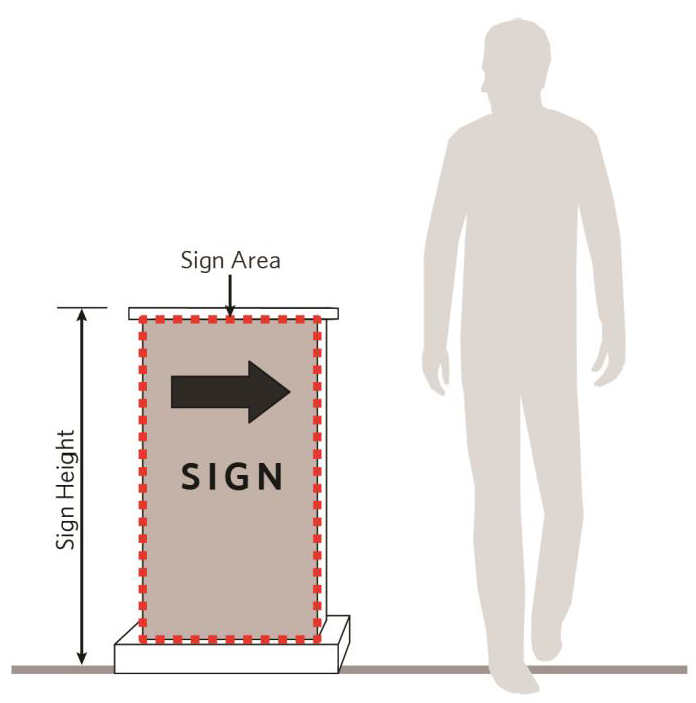
a.
Location. Directional signs are allowed in the C-1, C-2, C-3, M Districts, and in residential districts for non-residential and multi-family uses.
b.
Quantity. Two directional signs are allowed per driveway access from a public street, and one additional directional sign is allowed per intersection of internal driveways on a zoning lot and per drive-through lane located on a zoning lot to identify traffic routing. Directional signs shall not be counted toward any other requirement limiting the number of a particular sign type on a zoning lot.
c.
Size. Directional signs shall not exceed eight square feet in area per sign and four feet in height. No dimension of the sign shall exceed four feet.
d.
Illumination. Internally and externally illuminated directional signs are allowed only in accordance with § VII-2.D (Illumination).
e.
Display Standards. Directional signs shall be displayed as pole signs or monument signs. In the event of a conflict between the provisions of § VII-4.B.3 (Directional Signs) and the applicable provisions of § VII-4.B.7 (Monument Signs) or § VII-4.B.8 (Pole Signs), the provisions of this § VII-4.B.3 shall control.
4.
Hanging Signs. Refer to Figure VII-4-D. Hanging Sign.
Figure VII-4-D. Hanging Sign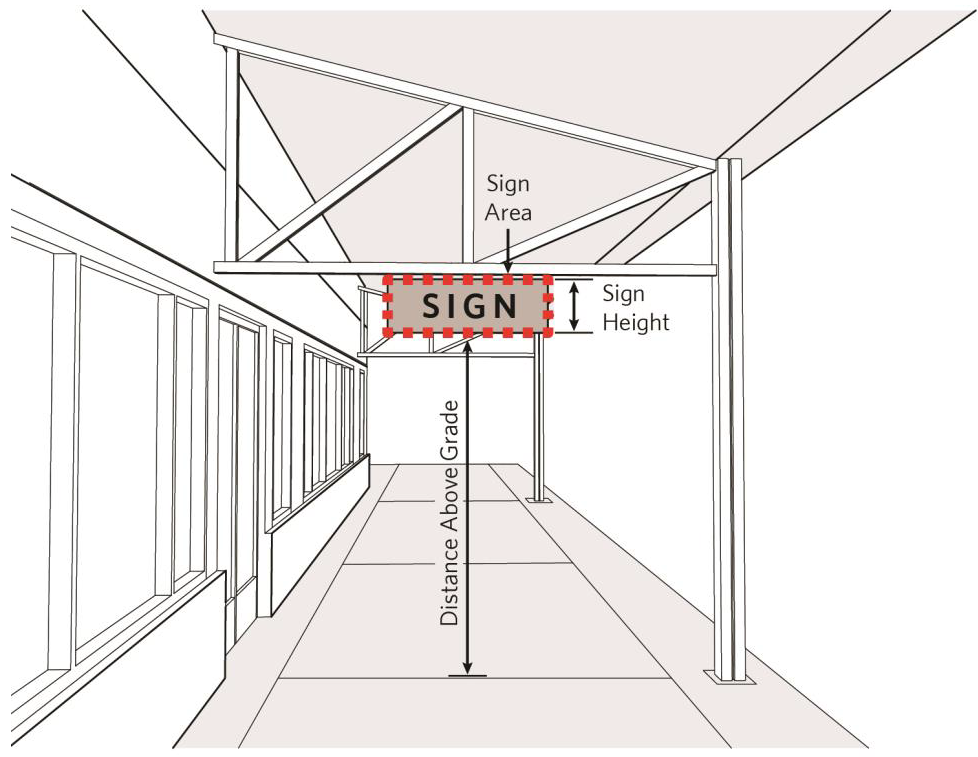
a.
Location.
(1)
Hanging signs are allowed in the C-1 and C-2 Districts.
(2)
Hanging signs shall be located at least 7.5 feet above grade.
(3)
The hanging sign shall be located entirely underneath the awning or canopy to which it is attached.
b.
Quantity. One hanging sign is allowed per street frontage per tenant located on the ground floor.
c.
Size. Hanging signs shall not exceed eight square feet in area per sign.
d.
Illumination. Internally and externally illuminated hanging signs are allowed only in accordance with § VII-2.D (Illumination).
5.
Marquee Signs. Refer to Figure VII-4-E. Marquee Sign.
Figure VII-4-E. Marquee Sign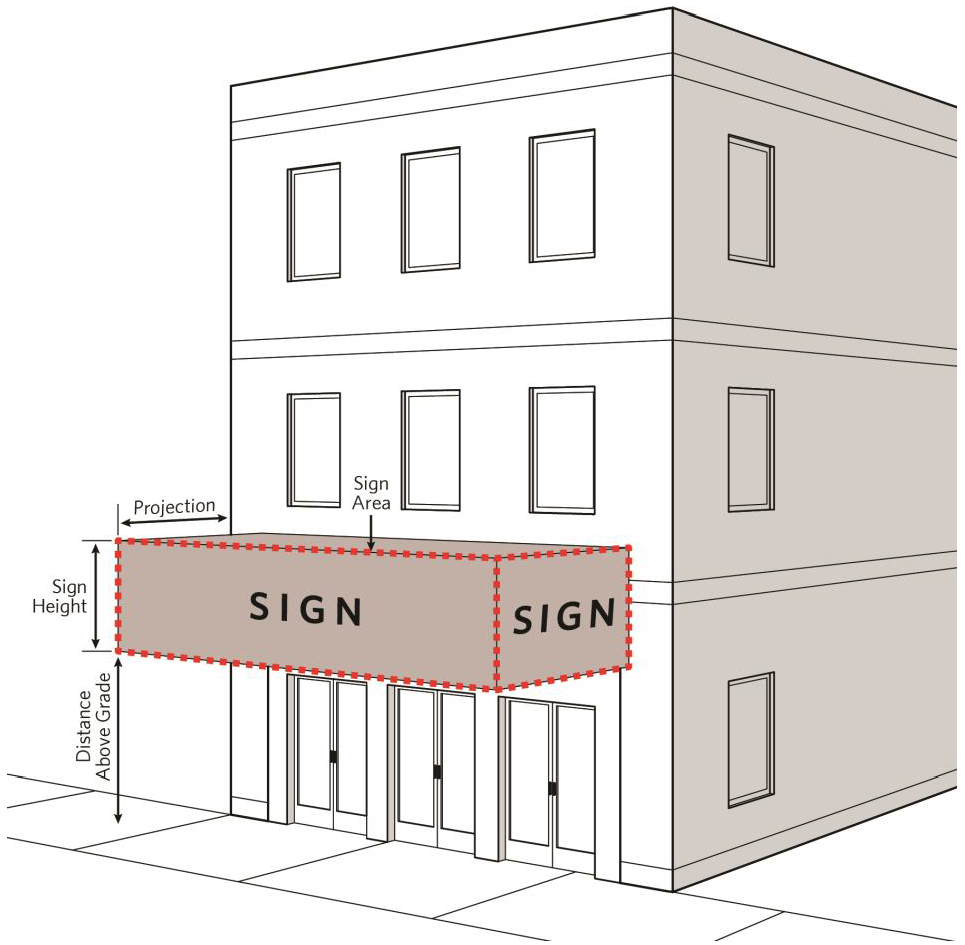
a.
Location.
(1)
Marquee signs are allowed in the C-2 and C-3 Districts.
(2)
A marquee sign may project from the front or corner side façade of the building to which it is attached, but shall not project beyond the curb line.
(3)
A marquee sign must be located a minimum of one foot from the edges of the façade to which it is attached, except for marquee signs that wrap around a building corner.
(4)
Marquee signs shall be located at least eight feet above grade.
b.
Quantity. One marquee sign is allowed per tenant entrance.
c.
Size. Marquee signs shall not exceed eight feet in height, including any individual letters, logos, and/or representation mounted on top of the roof of the marquee.
d.
Components. An electronic message sign or manually changeable copy sign is allowed as a component of a marquee sign, in accordance with § VII-4.B.11 (Electronic Message and Video Display Signs) and § VII-4.B.12 (Manually Changeable Copy Signs).
e.
Illumination. Internally illuminated marquee signs are allowed in accordance with § VII-2.D (Illumination).
f.
Display Standards. A marquee sign shall be supported solely by the building to which it is attached, and shall not be supported by ground-mounted columns or posts.
6.
Menu Board Signs. Refer to Figure VII-4-F. Menu Board Sign.
Figure VII-4-F. Menu Board Sign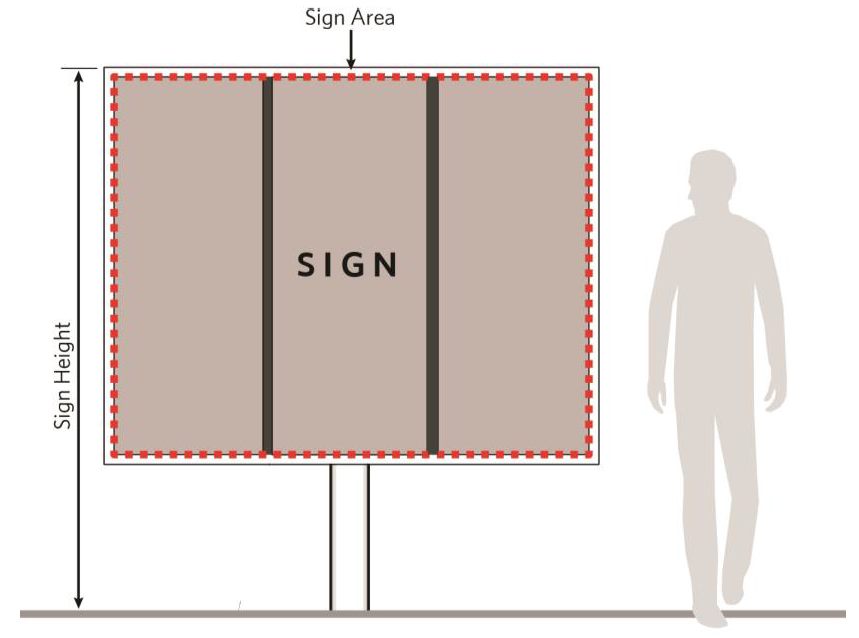
a.
Location.
(1)
Menu board signs are allowed for any drive-through establishment.
(2)
Menu board signs shall be located a minimum of 15 feet from any residential zoning district lot line.
b.
Quantity. Two menu board signs are allowed per drive-through lane.
c.
Size. Menu board signs shall not exceed 50 square feet in area and seven feet in height.
d.
Illumination. Internally illuminated menu board signs are allowed only in accordance with § VII-2.D (Illumination).
e.
Display Standards. Menu board signs shall be displayed as pole signs or monument signs. In the event of a conflict between the provisions of § VII-4.B.6 (Menu Board Signs) and the applicable provisions of § VII-4.B.7 (Monument Signs) or § VII-4.B.8 (Pole Signs), the provisions of this § VII-4.B.6 shall control.
7.
Monument Signs. Refer to Figure VII-4-G. Monument Sign.
Figure VII-4-G. Monument Sign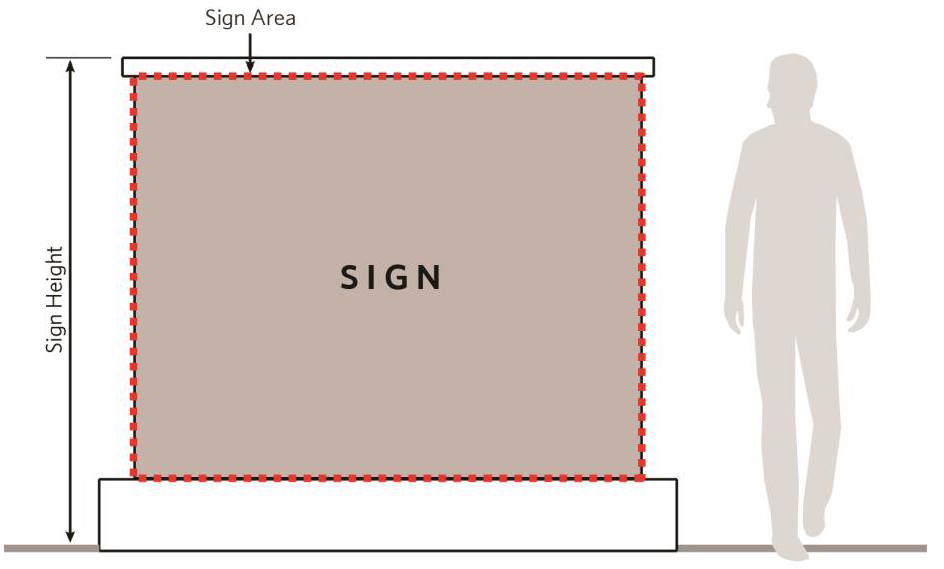
a.
Location.
(1)
Monument signs are allowed in the C-1, C-2, C-3, M, R-3, and R-4 Districts, and in the R-1 and R-2 Districts for residential development identification and non-residential uses.
(2)
Monument signs shall be located a minimum of five feet from any front or corner side lot line, and ten feet from any interior side lot line.
b.
Quantity.
(1)
For zoning lots with less than 300 feet of lot width, one monument sign or one pole sign is allowed per street frontage.
(2)
For zoning lots with 300 feet or more of lot width, two monument or pole signs, or any combination thereof, are allowed per street frontage. A minimum distance of 100 feet is required between any monument or pole signs on a zoning lot.
c.
Size.
(1)
In the C-1 and C-2 Districts, as well as in residential districts when allowed by this Article, monument signs shall not exceed 40 square feet in area per sign and six feet in height.
(2)
In the C-3 and M Districts, monument signs shall not exceed 60 square feet in area per sign and eight feet in height.
d.
Components. An electronic message sign or manually changeable copy sign is allowed as a component of a monument sign, in accordance with § VII-4.B.11 (Electronic Message and Video Display Signs) and § VII-4.B.12 (Manually Changeable Copy Signs).
e.
Illumination. Internally and externally illuminated monument signs are allowed only in accordance with § VII-2.D (Illumination).
f.
Landscaping. All monument signs must be landscaped in accordance with the following:
(1)
For every one square foot of gross sign area, there shall be a minimum of two square feet of landscape area installed surrounding the base of the sign.
(2)
Landscaping shall utilize a variety of plant types to achieve both height variation and color interest throughout the four seasons. To provide diversity, at least three different types of plant material must be installed, excluding turf. Refer to The Morton Arboretum Northern Illinois Tree Species List for preferred plant species.
(3)
All landscape elements shall be kept in good condition and shall have a healthy maintained appearance.
8.
Pole Signs. Refer to Figure VII-4-H. Pole Sign.
Figure VII-4-H. Pole Sign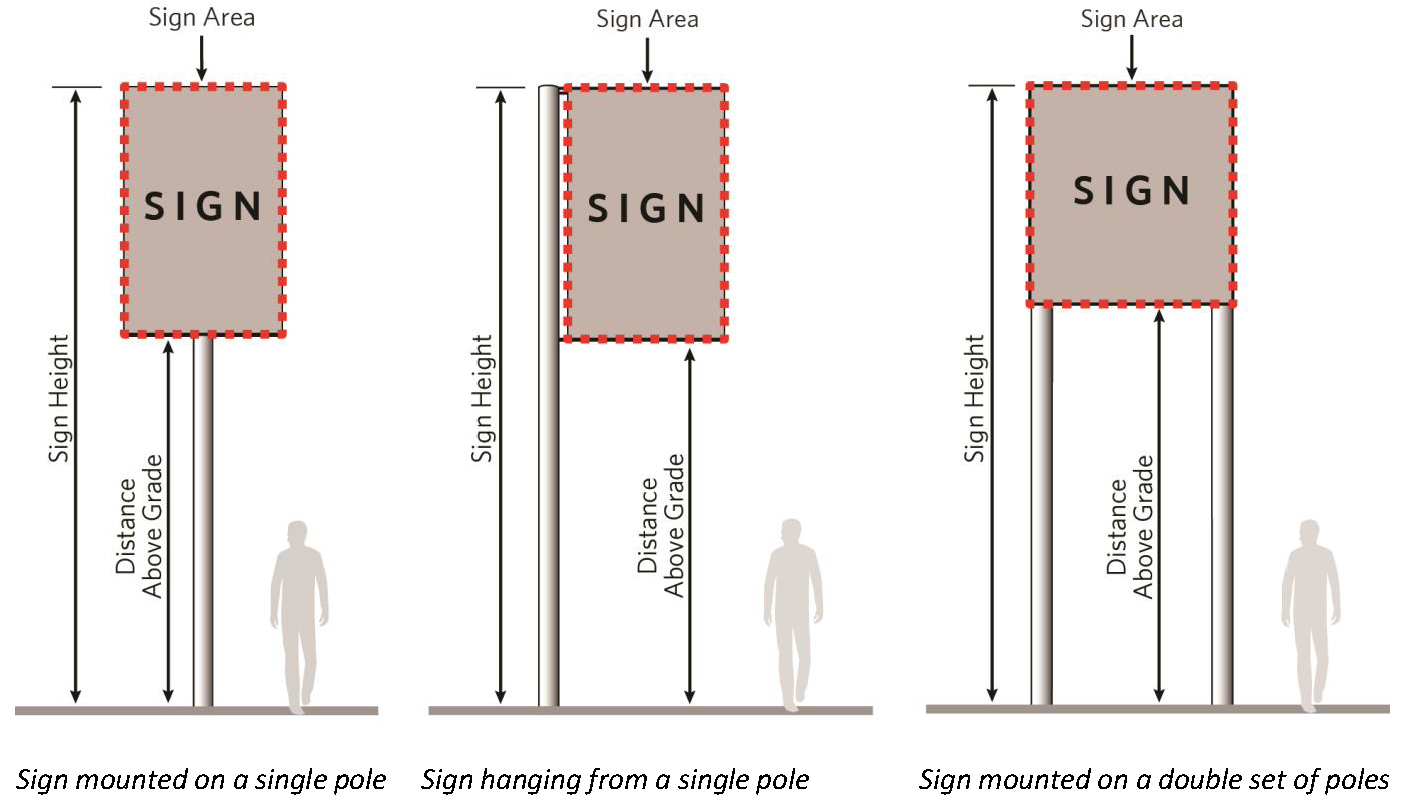
a.
Location.
(1)
Pole signs are allowed in the C-1, C-3 and M Districts, and in residential districts for nonresidential and multi-family uses.
(2)
Pole signs shall be located a minimum of five feet from any front, corner side, or interior side lot line.
(3)
Pole signs mounted on one pole shall be located at least eight feet above grade.
(4)
Pole signs mounted on two poles shall be located at least two feet above grade.
b.
Quantity.
(1)
For zoning lots with less than 300 feet of lot width, one pole sign or one monument sign is allowed per street frontage.
(2)
For zoning lots with 300 feet or more of lot width, two pole or monument signs, or any combination thereof, are allowed per street frontage. A minimum distance of 100 feet is required between any monument or pole signs on a zoning lot.
c.
Size.
(1)
In the C-1, C-3, and M Districts, pole signs shall not exceed 48 square feet in area and 25 feet in height.
(2)
In residential districts, pole signs shall not exceed 30 square feet in area and six feet in height.
d.
Components. An electronic message sign or manually changeable copy sign is allowed as a component of a pole sign, in accordance with § VII-4.B.11 (Electronic Message and Video Display Signs) and § VII-4.B.12 (Manually Changeable Copy Signs).
e.
Illumination. Internally illuminated pole signs are allowed only in accordance with § VII-2.D (Illumination).
9.
Projecting Signs. Refer to Figure VII-4-I. Projecting Sign.
Figure VII-4-I. Projecting Sign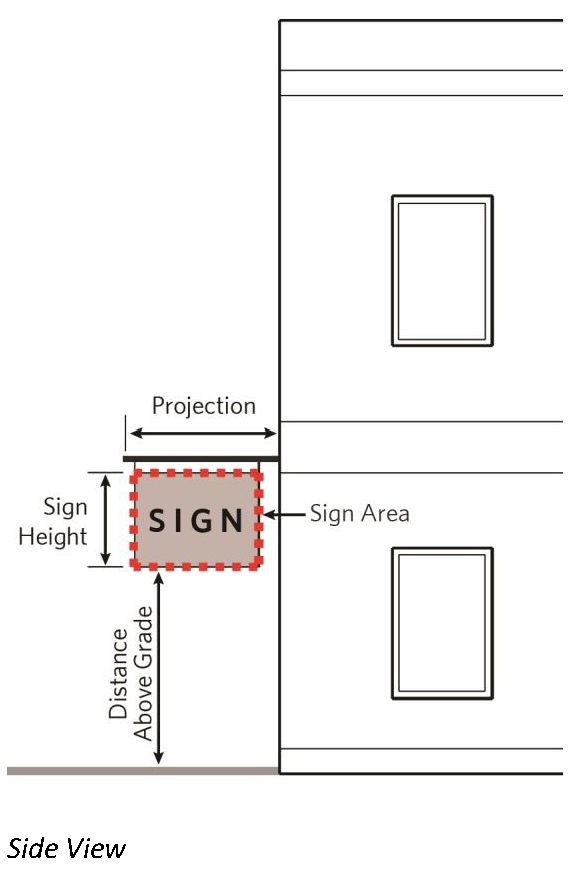
a.
Location.
(1)
Projecting signs are allowed in the C-1, C-2, C-3, and M Districts.
(2)
Projecting signs shall be located at least eight feet above grade.
(3)
A projecting sign shall not project more than five feet from the face of the building to which it is attached, including the area between the sign and the face of the building.
(4)
A projecting sign and its structural supports shall not project above the roof of the building to which the sign is attached. All structural supports shall be attached to the façade of the building, and shall not be attached to the roof.
b.
Quantity. One projecting sign is allowed per street frontage per tenant located on the ground floor.
c.
Size.
(1)
In the C-1 and C-2 District, projecting signs shall not exceed 24 square feet in area per sign and six feet in height.
(2)
In the C-3 and M Districts, projecting signs shall not exceed 32 square feet in area per sign and eight feet in height.
d.
Illumination. Internally and externally illuminated projecting signs are allowed only in accordance with § VII-2.D (Illumination).
10.
Wall Signs. Refer to Figure VII-4-J. Wall Sign.
Figure VII-4-J. Wall Sign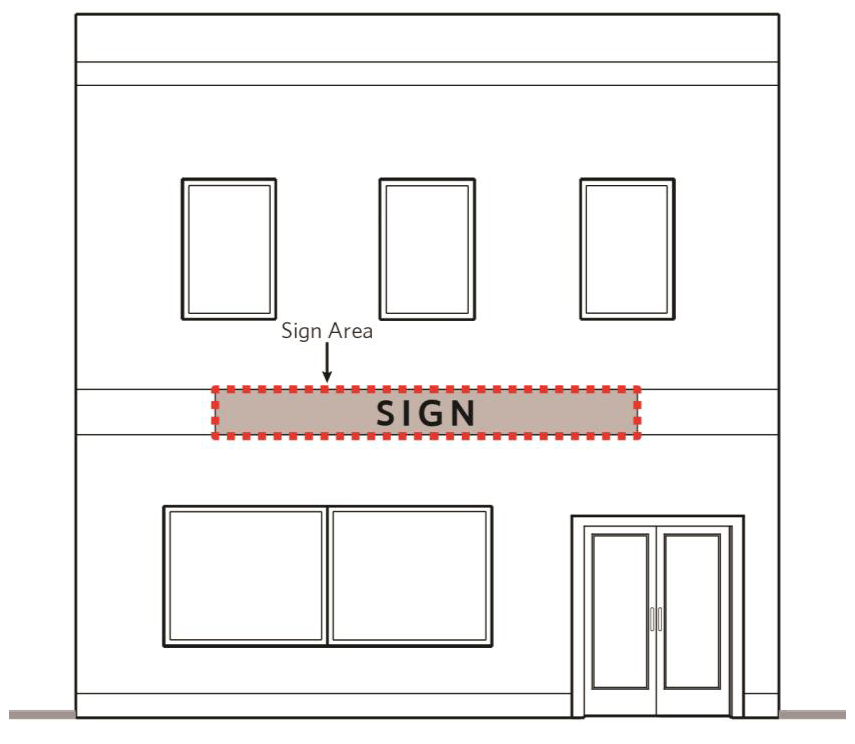
a.
Location.
(1)
Wall signs are allowed in all non-residential districts, and in all residential districts for nonresidential uses.
(2)
Wall signs shall be installed on the building façade at least eight feet above grade and shall not project more than one foot from the face of the building.
(3)
Wall signs shall be located at a generally uniform height throughout multi-tenant commercial developments.
(4)
A wall sign shall not project above the top of the wall to which it is attached.
(5)
Painted wall signs displaying a business name, products, or services may be displayed on building façades facing a corner side, interior side, or rear yard, if such signs are professionally painted. Painted wall signs are exempt from the location standards of § VII-4.B.10.a(2).
b.
Quantity.
(1)
One wall sign is allowed per street frontage per tenant on the ground floor.
(2)
One additional wall sign is allowed per ground floor tenant on the side or rear façade adjacent to an off-street parking lot of the building.
(3)
Wall signs may be located on no more than three façades of a building.
c.
Size.
(1)
The total area of wall signs on the front or corner side façade shall not exceed two square feet of sign area per linear foot of building façade, as measured along the front or corner side façade, or 40 square feet, whichever is greater.
(2)
The total area of wall signs on the rear or interior side façade shall not exceed one square foot of sign area per linear foot of building façade, as measured along either the rear or interior side lot line.
(3)
The allowable wall sign area measured for any façade shall only be applicable for use on that façade, and is not transferable to other façades.
d.
Illumination. Internally and externally illuminated wall signs are allowed only in accordance with § VII-2.D (Illumination).
11.
Electronic Message and Video Display Signs. Refer to Figure VII-4-L. Electronic Message and Video Display Signs.
Figure VII-4-L. Electronic Message and Video Display Signs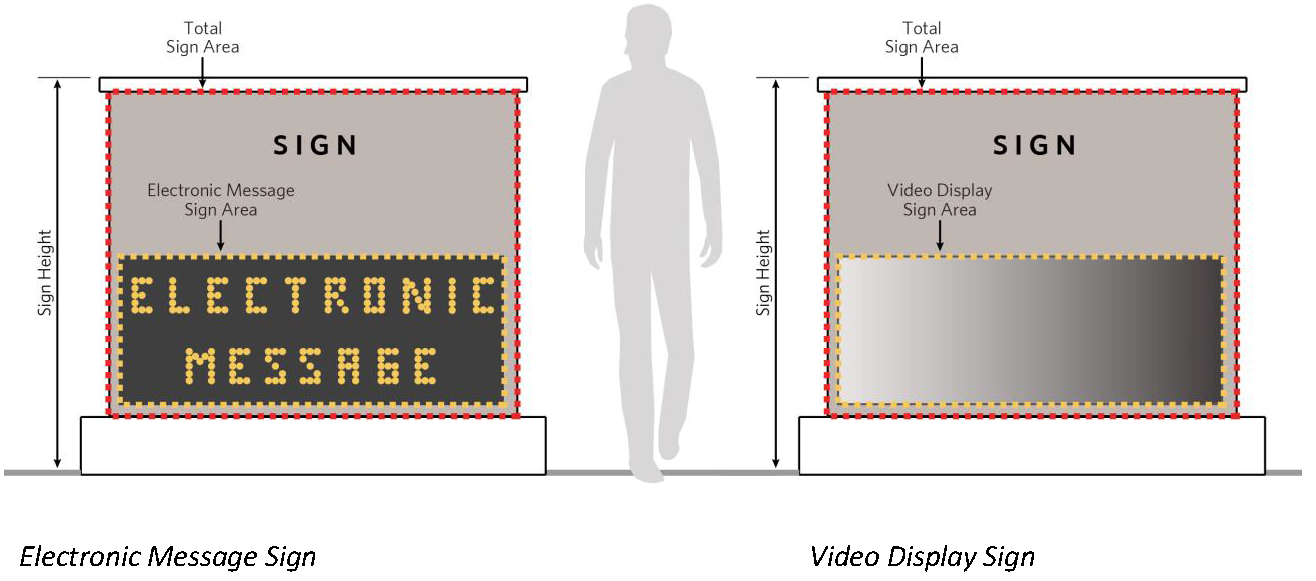
a.
Location.
(1)
Electronic message and video display signs are allowed in the C-1, C-2, C-3, and M Districts, and in all residential districts for non-residential uses.
(2)
Electronic message and video display signs shall be allowed as components of marquee, menu board, monument, pole, or wall signs, or as a window sign as allowed in § VII-4.A.10 (Window Signs). An electronic message or video display sign is subject to the regulations pertaining to the sign type upon which it is located.
b.
Quantity. One electronic message, video display sign, or manually changeable copy sign is allowed per zoning lot.
c.
Size. An electronic message or video display sign shall not occupy more than 50 percent of the total sign area of the marquee, monument, pole, or wall sign on which it is displayed.
d.
Illumination.
(1)
Internally illuminated electronic message and video display signs are allowed only in accordance with § VII-2.D (Illumination).
(2)
Electronic message and video display signs shall display static messages that do not contain a light source that flashes, blinks, strobes, travels, chases, rotates, or changes in intensity, brightness, or color.
(3)
Electronic message and video display signs shall be designed to default to a static display in the event of mechanical failure.
12.
Manually Changeable Copy Signs. Refer to Figure VII-4-M. Manually Changeable Copy Sign.
Figure VII-4-M. Manually Changeable Copy Sign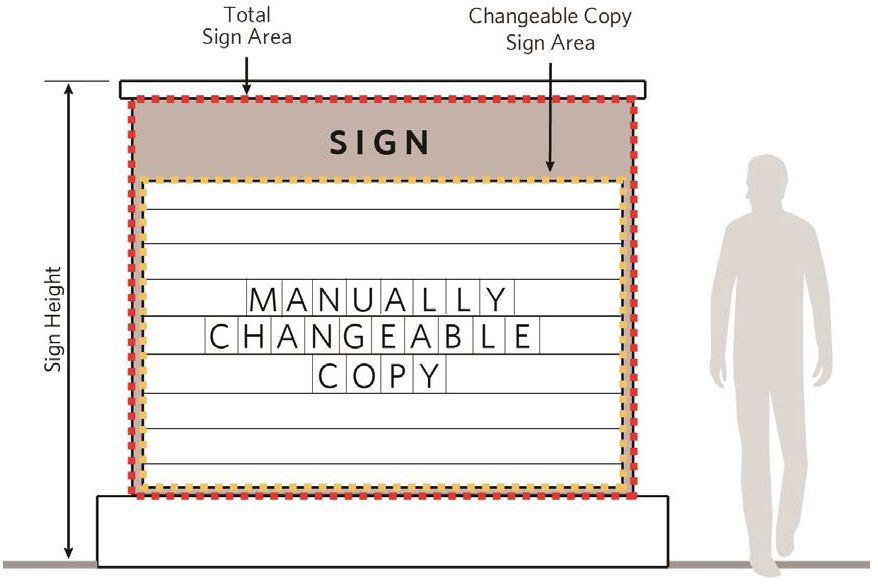
a.
Location.
(1)
Manually changeable copy signs are allowed in the C-1, C-2, C-3, and M Districts, and in all residential districts for non-residential uses.
(2)
Manually changeable copy signs shall be allowed as components of marquee, monument, pole, or wall signs. A manually changeable copy sign is subject to the regulations pertaining to the sign type upon which it is located.
b.
Quantity. One manually changeable copy sign, electronic message sign, or video display sign is allowed per zoning lot.
c.
Size. A manually changeable copy sign shall not occupy more than 80 percent of the total sign area of the marquee, monument, pole, or wall sign on which it is displayed.
d.
Illumination. Internally illuminated manually changeable copy signs are allowed only in accordance with § VII-2.D (Illumination).
(Ord. No. 2078, 12-11-17)
§ VII-5 - Temporary Signs
Temporary signs are allowed in accordance with the provisions of this Section, except that where other Sections of this Article regulate such signs, the more restrictive regulation shall apply.
A.
General Provisions. All temporary signs shall comply with the following standards.
1.
Illumination. Temporary signs shall not be illuminated.
2.
Relation to Products or Services. Temporary commercial signs must be related to the products or services sold on the premises. Temporary non-commercial or political signs shall not be related to the products or services sold on the premises.
B.
Temporary Signs Exempt from Permit Requirement. The following temporary signs are exempt from the sign permit requirements of § VIII-3.H (Sign Permit), and shall comply with the following standards.
1.
A-Frame Signs.
a.
Location.
(1)
A-frame signs are allowed in all non-residential districts, and in all residential districts for non-residential uses and multi-family dwellings.
(2)
A-frame signs may be located on the sidewalk, but at least four feet of sidewalk width must be maintained on the sidewalk so as not to interfere with pedestrian traffic or accessibility.
(3)
A-frame signs must be located within 15 feet of the primary entrance of the business.
b.
Quantity. One A-frame sign is allowed per business.
c.
Size. A-frame signs shall not exceed eight square feet in area and four feet in height.
d.
Display Period.
(1)
A-frame signs may be displayed on a daily basis, but the display shall be limited to business hours. A-frame signs must be stored indoors at all other times.
(2)
A-frame signs shall not be displayed when severe weather conditions exist, such as high winds or heavy snow.
2.
Yard Signs.
a.
Location. Yard signs are allowed in all zoning districts.
b.
Quantity. Four yard signs are allowed per street frontage.
c.
Size.
(1)
In residential districts, yard signs shall not exceed five square feet in area per sign and six feet in height
(2)
In non-residential districts, yard signs shall not exceed 20 square feet in area per sign and eight feet in height.
3.
Window Signs. Temporary window signs do not require a sign permit but shall meet the standards of § VII-4.A.10 (Window Signs).
C.
Temporary Signs with Permit Requirement. The following temporary signs require a sign permit, per § VIII-3.H (Sign Permit), and shall comply with the following standards.
1.
Reserved.
2.
Banner Signs.
a.
Location.
(1)
Banner signs are allowed for non-residential uses in all zoning districts.
(2)
Banner signs shall not project above the roof of the building to which it is attached.
(3)
Banner signs shall not encroach into the public right-of-way.
b.
Quantity. One banner sign is allowed per business, which may be displayed as a pole sign, wall sign, or window sign.
c.
Size. Banner signs shall not exceed 32 square feet in area.
d.
Display Period. Banner signs are limited to a display period of 30 days per calendar year. The Zoning Administrator may approve additional display period for banner signs under special circumstances.
3.
Banner Flag Sign.
a.
Location. Banner flag signs are allowed for non-residential uses in all zoning districts.
b.
Quantity. Two banner flag signs are allowed per business.
c.
Size. Banner flag signs shall not exceed 30 square feet in area.
d.
Display Period. Banner flag signs are limited to a display period of ten days on two occasions per calendar year.
4.
Inflatable Devices. Refer to Figure VII-5-A. Inflatable Device.
a.
Location.
(1)
Inflatable devices are allowed in the C-1, C-2, C-3 and M Districts.
(2)
Inflatable devices shall be ground-mounted, and shall not be mounted to any structure or vehicle.
(3)
Inflatable devices shall be located a minimum of ten feet from the front lot line.
b.
Quantity.
(1)
One inflatable device is allowed per business.
(2)
Inflatable signs may not be displayed simultaneously by adjacent businesses, or by more than one business in the same multi-tenant commercial development.
c.
Size. Inflatable devices shall not exceed 25 feet in height.
d.
Display Period. Inflatable devices are limited to a display period of ten days on two occasions per calendar year.
Figure VII-5-A. Inflatable Device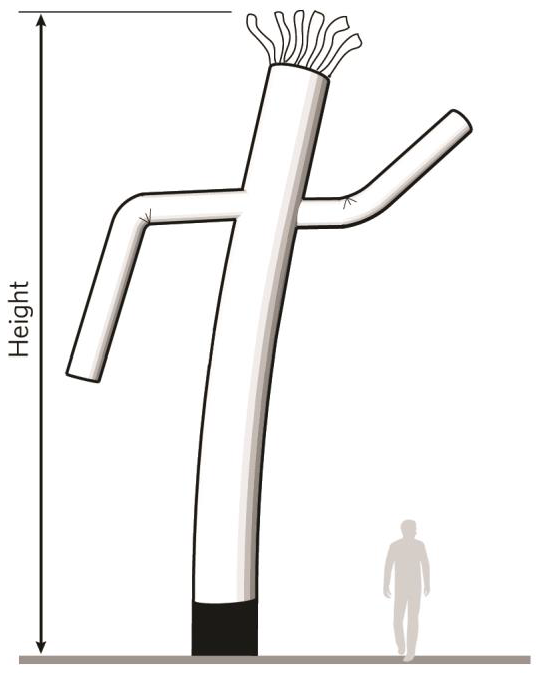
5.
Portable Sign.
a.
Location. Portable signs are allowed for non-residential uses in all zoning districts.
b.
Quantity. One portable sign is allowed per business.
c.
Size. Portable signs shall not exceed 32 square feet in area.
d.
Display Period. Portable signs are limited to a display period of 30 days per calendar year.
(Ord. No. 2078, 12-11-17; Ord. No. 2194, § 3, 2-20-23)
§ VII-6 - Prohibited Signs
It shall be unlawful to erect the following prohibited signs or devices in any zoning district.
A.
Attention getting devices.
B.
Bench signs.
C.
Flashing signs.
D.
Moving signs. No sign or other advertising device shall have moving, revolving, or rotating parts. Moving signs shall not include barber poles, electronic message signs, flags, inflatable devices, pennant signs, and signs displaying time and temperature, street clocks, and other signs as established by this Article.
E.
Obscene signs.
F.
Off-premises signs.
G.
Roof signs.
H.
Signs that interfere with traffic. No sign or other advertising device shall interfere with, obstruct the view of, or be confused with any traffic sign, signal, or device because of its position, shape, illumination, or color.
I.
Snipe signs.
J.
Vehicle signs.
(Ord. No. 2078, 12-11-17)

