
Park Forest City Zoning Code
ARTICLE V
- OFF-STREET PARKING AND LOADING
§ V-1 - General Provisions
A.
Purpose. The purpose of this Article is to ensure an appropriate quantity of vehicular and bicycle parking to support a variety of land uses and transportation modes, minimize impervious surface coverage associated with parking and loading, and provide for adequate site access and loading facilities.
B.
Applicability. The requirements of this Article shall apply to the following:
1.
New developments.
2.
Planned unit developments.
3.
Alteration of an existing principal or accessory structure or a change in use that results in an increase in the number of required parking spaces.
4.
The construction of new parking facilities, loading facilities, drive-throughs, and/or driveways.
5.
The reconfiguration, expansion, or reconstruction of an existing parking lot that results in a total of 15 spaces or more.
C.
General Requirements. The following requirements apply to all parking and loading areas.
1.
Site Plan Review Approval. Site plan review approval is required prior to either the construction of a new parking lot, or the expansion of an existing parking lot that results in a total of 15 spaces or more (see § VIII-3.B (Site Plan Review)).
2.
Occupancy Permit. Off-street parking lots and loading areas required by this Article shall be completed prior to the issuance of an occupancy permit for the uses served by the parking lots and loading areas.
3.
Change in Use. When an existing use is changed to a new use, parking and loading spaces shall be provided as required for the new use. Additional parking and/or loading spaces shall be required in the amount by which the requirements for the new use exceed the existing number of parking spaces. If the number of existing parking spaces is more than the number of spaces required for the new use, the number of parking spaces may be decreased to meet the minimum requirement for the new use.
4.
Materials. All off-street parking lots, loading areas, and driveways shall be constructed using a hard surface, all-weather, dustless material. Drive-through facilities must be constructed of concrete. Semi-pervious materials and permeable pavements may also be used subject to prior written approval of the Zoning Administrator.
5.
Encroachment. Parking lots are allowed to encroach into the required interior side and/or rear yard, but shall be no closer than one foot from any lot line, provided no buffer yard is required, in accordance with § VI-6 (Buffer Yards).
6.
Maintenance Responsibility. All parking and loading areas shall be maintained and kept in good repair by the property owner.
7.
Storage of Trailers, Motorhomes, Boats, and Boat-Trailer Combinations in Residential Districts.
a.
General Provisions. The following regulations apply to the storage of trailers, camping trailers, motorhomes, boats, and boat-trailer combinations in all residential districts.
(1)
No such unit shall be parked or stored in a front yard for longer than 24 hours in any one-week period.
(2)
Unless otherwise specified, no such unit exceeding 22 feet in length, nine feet in height from the ground, or eight feet in width shall be parked or stored on a lot for longer than six days in any calendar year unless housed in a building.
(3)
No more than one such unit per dwelling unit, regardless of size, shall be parked or stored on a lot at any time.
(4)
Trailers shall not be permanently affixed to the ground as a principal or accessory structure.
b.
Regulations Applicable to R-1 and R-2 Districts. In the R-1 and R-2 Districts, trailers, motorhomes, boats, or boat-trailer combinations with dimensions less than those specified in § V-1.C.7.a.(2) may be parked or stored for a period exceeding 24 hours only in a parking space conforming to the requirements of this Section. Such parking space shall be located in a rear or interior side yard.
c.
Regulations Applicable to Parcels in R-3 and R-4 Districts with Only Two Dwelling Units. In any multiple-family residential district for buildings with two dwelling units, trailers, motorhomes, boats or boat-trailer combinations having dimensions less than those specified in § V-1.C.7.a.(2) may be parked or stored for periods exceeding 24 hours only in a parking space conforming to the requirements of § V-1.C.4 (Materials) located to the side or rear of the adjacent dwelling unit; provided, however, the trailer, motorhome, boat or boat-trailer combinations shall not project beyond the front wall of the adjacent dwelling unit, nor parked in any parking court in a multifamily area.
d.
Regulations Applicable to Parcels in R-3 and R-4 Districts with More Than Two Dwelling Units. In all multiple-family residential districts for buildings of more than two dwelling units, no parking or storage of a trailer, motorhome, boat or boat-trailer combination, regardless of size, shall be permitted for longer than 24 consecutive hours in any one-week period, unless housed in a building or an approved storage facility.
8.
Prohibition of Specified Vehicle Types. No tow trucks, road tractors, special mobile equipment, vehicles which transport more than ten passengers or vehicles of the second division, as defined by state statutes, weighing more than 8,000 pounds of gross vehicle weight shall be parked or stored on any residential lot, except in a building, or for the purpose of making a pick-up or delivery, or providing services to the adjacent premises.
9.
Second Division Vehicle Allowance. One vehicle of the second division except those licensed as recreational vehicles, as defined by state statutes, weighing less than 8,000 pounds may be parked or stored on a residential lot in accordance with this section.
(Ord. No. 2078, 12-11-17)
§ V-2 - Required Off-Street Parking Spaces
A.
General Requirements. Off-street parking spaces shall be provided in accordance with the following standards.
1.
Availability of Spaces. All parking spaces approved as part of the issuance of an occupancy permit shall be made available to the residents, customers, employees, guests, and/or other users of the principal use. Spaces shall not be utilized for long-term storage or display of vehicles, materials, or goods.
2.
Accessible Parking.
a.
State Requirement. Accessible parking spaces shall be designed and provided as required by the Illinois Accessibility Code, as amended from time to time, and all additional applicable laws.
b.
Applicability. Accessible parking shall be provided for all off-street parking lots that provide parking for employees, visitors, or both, with the exception of single-family, two-family, and rowhouse dwellings.
c.
Minimum Parking Requirements. The number of accessible parking spaces may be counted toward the total number of off-street parking spaces required. In the event of a conflict between this Section and any applicable state law or regulation, the provision requiring the greatest number of accessible parking spaces shall control.
3.
Off-Premises Parking Facilities. Parking facilities for uses other than single-family, two-family, and rowhouse dwellings may be provided off-premises with prior written Zoning Administrator approval, provided that the following conditions are met:
a.
Location.
(1)
Residential Uses. Any off-premises parking facility must be located within 400 feet, along a pedestrian route, of the nearest principal entrance for the building served.
(2)
Non-residential Uses. Any off-premises parking facility must be located within 800 feet, along a pedestrian route, of the nearest principal entrance of the building for which the parking is required.
b.
Parking Agreement. A written agreement between the landowner and the lessee in a form satisfactory to the Village Attorney shall be executed and recorded in the Office of the Recorder of Deeds of Cook County or Will County. The agreement shall include:
(1)
A guarantee among the landowner and lessee for access to and use of the parking facility.
(2)
A guarantee that the spaces will be provided, maintained, and reserved for the uses served for as long as such uses are in operation.
4.
Maximum Number of Parking Spaces. No use shall provide parking spaces in excess of 125 percent of the required minimum parking amount shown in Table V-2-A. Off-Street Parking Requirements, with the following exceptions:
a.
In residential districts, maximum off-street parking requirements shall not apply to residential uses.
b.
Any use required to provide less than ten parking spaces may exceed the maximum allowable amount, but may not provide more than 15 spaces.
c.
Any use exempt from providing a minimum number of off-street parking spaces shall also be exempt from maximum off-street parking requirements.
d.
With Zoning Administrator approval, the maximum parking amount may be exceeded by up to 50 percent, provided that the area exceeding the maximum is constructed with a pervious surface as approved by the Village.
5.
Tandem Parking. Tandem parking is permitted with the approval of the Zoning Administrator through the site plan review process (see § VIII-3.B (Site Plan Review)).
B.
Computation. Off-street parking spaces shall be calculated using the following standards.
1.
Units of Measurement. The following shall be utilized to calculate the number of required parking spaces.
a.
Gross Floor Area. Unless otherwise stated, parking standards for non-residential uses shall be calculated based on gross floor area (GFA) in square feet.
b.
Occupancy- or Capacity-Based Requirements. Parking spaces required per seat, employee, student, or occupant shall be calculated based on the maximum number of employees on the largest shift, maximum number of students enrolled, or maximum fire-rated capacity, whichever measurement is applicable.
c.
Bench Seating. For uses in which occupants are seated in benches, pews, bleachers, or similar seating facilities, each three feet of such seating shall be counted as one seat.
2.
Fractions of Parking Spaces. When computation of required parking spaces results in a fraction, any fraction of less than one-half shall be disregarded, and any fraction of one-half or more shall be counted as one parking space.
3.
Multiple Uses on a Lot. When there are multiple uses on a lot, the amount of parking required shall be the sum of the parking requirements for each individual use, unless the use qualifies for a parking reduction as established in § V-3 (Parking Reductions) or shared parking as established in § V-4 (Shared Parking).
4.
Use of Off-Street Loading Area. Area allocated to any off-street loading spaces shall not be used to satisfy parking space requirements, portions thereof, or portions of any drive aisles.
C.
Off-Street Parking Requirements. Table V-2-A. Off-Street Parking Requirements establishes the minimum vehicular parking requirements for the listed uses. Any use not specified in Table V-2-A. Off-Street Parking Requirements shall adhere to the requirements provided for the most similar use, as determined by the Zoning Administrator.
Table V-2-A. Off-Street Parking Requirements
(Ord. No. 2078, 12-11-17)
§ V-3 - Parking Reductions
A.
Parking Reductions. The off-street parking requirements established in Table V-2-A Off-Street Parking Requirements may be reduced by the following parking reduction measures, as applicable.
1.
Exemption from Off-Street Parking Requirements. The requirements of Table V-2-A. Off-Street Parking Requirements shall not apply to non-residential uses in existing buildings within the Village's DownTown area, considered for the purposes of this exemption to be the area within the boundaries of Lakewood Boulevard to the north, Orchard Drive to the west, Indianwood Boulevard to the South, and Forest Boulevard to the east.
2.
Proximity to a Commuter Rail Station. Non-residential uses that are located within one-half mile of a commuter rail station, as measured from any point along the lot line, may reduce the total number of off-street parking spaces required by 50 percent.
3.
Proximity to a Bus Stop. Non-residential uses that are located within one-quarter mile of a public transit bus stop with regular, scheduled service, as measured from any point along the lot line, may reduce the total number of off-street parking spaces required by 15 percent.
4.
Proximity to a Municipal Parking Lot. Non-residential uses that are located within 400 feet of a municipally-owned parking lot, as measured from any point along the lot line, may reduce the total number of off-street parking spaces required by 25 percent.
5.
Fee-In-Lieu. A fee-in-lieu of providing parking spaces may be permitted by the Planning and Zoning Commission. The fee required shall be based upon a uniform fee per parking space as established annually by the Planning and Zoning Commission. Such payment shall be placed into a fund to be used by the Village for the acquisition, construction, and maintenance of public off-street parking lots within the same zoning district as the subject use or within adjacent zoning districts of reasonable proximity such that the parking facility could serve the subject use. The property granted the reduction in the number of required off-street spaces shall be credited permanently by ordinance with the number of spaces for which payment was received by the Village.
6.
Electric Vehicle Charging Station. Each parking space used as an electric vehicle charging station may be counted as three off-street parking spaces, provided that the space is reserved exclusively for electric vehicle charging purposes, for a credit of up to ten percent of the total number of required off-street spaces.
7.
Car-Share. Multi-family dwellings that reserve car-share parking spaces may reduce the total number of required parking spaces by five for each car-share space provided. The applicant shall provide documentation of an agreement with a car-share company in a format approved by the Village Attorney. If this agreement should terminate at any point, then the applicant shall either arrange a new agreement with a car-share company to avoid service interruption, or meet the minimum parking requirements established by this Article.
(Ord. No. 2078, 12-11-17)
§ V-4 - Shared Parking
A.
Applicability. For multiple uses that share a parking lot, a reduction of the total required off-street parking spaces may be granted by the Zoning Administrator through site plan review, in an amount determined by the requirements of Table V-4-A. Shared Parking Calculation.
Table V-4-A. Shared Parking Calculation
B.
General Requirements. The following requirements apply to all shared parking arrangements.
1.
Any change in ownership or use shall meet the minimum parking requirements established by this article, or arrange a new shared parking agreement. In the event that such a change should occur, the applicant or property owner must provide written notification to the Zoning Administrator and, within 60 days of that notice, provide a remedy satisfactory to the Zoning Administrator to provide adequate parking or the condition will be considered a zoning violation.
2.
Shared parking may be located off-site provided it complies with the location requirements of § V-2.A.3 (Off-Premises Parking Facilities).
C.
Calculation. Shared parking allows a reduction in the total number of required parking spaces when a parcel is occupied by two or more uses which typically do not experience peak parking demands at the same time. When any land or building is used for two or more uses that are listed in Table V-4-A. Shared Parking Calculation Table, the minimum total number of required parking spaces may be determined by the following procedure:
1.
Multiply the minimum required parking for each individual use by the appropriate percentage listed in Table V-4-A. Shared Parking Calculation for each of the designated time periods.
2.
Calculate a sum for all uses for each of the five time periods (columns). The minimum parking requirement is the highest of these sums.
D.
Special Shared Parking Study. As an alternative to the methodology established in § V-4.C (Calculation), an applicant may submit a special study to the Zoning Administrator to demonstrate that the parking demand for multiple uses is less than the cumulative parking requirements for each individual use. The special study shall be conducted by a qualified professional at the applicant's expense.
E.
Shared Parking Among Lots Under Different Ownership. When a shared parking reduction is applied to uses on lots under different ownership, the following shall be provided to the Zoning Administrator:
1.
A plan that provides for interconnected lots.
2.
Recorded easements that provide:
a.
Cross-access among the parking areas to permit vehicular access, pedestrian access, and parking by the different uses in the connected properties.
b.
Allocation of maintenance responsibilities.
c.
A pedestrian circulation system that connects uses and parking areas.
(Ord. No. 2078, 12-11-17)
§ V-5 - Bicycle Parking
A.
Applicability. Minimum short-term and long-term bicycle parking requirements shall apply to the specified land use categories set forth in Table V-5-A. Bicycle Parking Requirements, provided that those use categories meet the development thresholds listed in § V-1.B (Applicability). If no requirement is listed in Table V-5-A. Bicycle Parking Requirements for a particular use, no bicycle parking is required.
B.
Computation. When the bicycle parking requirement is based on the number of dwelling units, the total number of bicycle spaces required shall be based on the total number of dwelling units in the development.
C.
Minimum Requirement. Where bicycle parking is required, a minimum of two spaces shall be provided.
D.
Bicycle Parking Design. Bicycle parking spaces shall be designed in accordance with the requirements of this Section.
1.
General Design Standards. The following standards apply to all long-term and short-term bicycle parking spaces. Refer to Figure V-5-A. Bicycle Parking Design.
a.
Dimensions. Each bicycle parking space shall have a minimum width of two feet, minimum length of six feet, and minimum vertical clearance of seven feet.
b.
Access. An aisle with a minimum width of five feet shall be provided adjacent to bicycle parking facilities to ensure adequate maneuvering space.
c.
Racks and Structures. Secure racks and supporting structures shall be provided for each bicycle parking space, and shall be designed to accommodate both chain and U-shaped locking devices.
d.
Visibility and Maintenance. Areas used for bicycle parking shall be designed and maintained to be well-lit and reasonably free from standing water, mud, and dust.
e.
Signage. If bicycle parking spaces that are required for non-residential uses are not visible from the street, signage shall be posted indicating the location of such parking.
2.
Long-Term Bicycle Parking. The following standards apply to required long-term bicycle parking spaces, as established in Table V-5-A. Bicycle Parking Requirements.
a.
Location. Long-term bicycle parking shall be located within an enclosed, limited-access area designed to protect bicycles from precipitation and theft, and shall adhere to the following:
(1)
Long-term bicycle parking shall be provided within the building containing the use that it is intended to serve, or within a structure that has a principal entrance no more than 200 feet from a principal entrance to such building.
(2)
Long-term bicycle parking serving multiple uses or buildings may be pooled into a single area, enclosure, or facility.
(3)
Where long-term bicycle parking is located adjacent to vehicular parking or loading facilities, a physical barrier shall be provided to prevent damage to bicycles by other vehicles.
b.
Facilities. Spaces may be provided within the following types of facilities:
(1)
Enclosed spaces within a building, such as bicycle rooms or garages.
(2)
Bicycle sheds, lockers, or other enclosed structures designed to provide secure and fully covered parking for bicycles.
(3)
Bicycle lockers or fixed-in-place containers in which single bicycles may be securely stored and protected.
(4)
Weather-protected spaces that are monitored at all times by an attendant or other security system to prevent unauthorized use or theft.
3.
Short-Term Bicycle Parking. The following standards apply to required short-term bicycle parking spaces, as established in Table V-5-A. Bicycle Parking Requirements.
a.
Location. Short-term bicycle parking shall be located in a highly visible, publicly accessible space within 50 feet of a principal entrance to the building containing the use it serves. For buildings or uses requiring more than eight short-term bicycle parking spaces, some of the required spaces may be located at a greater distance from the entrances, provided that eight short-term spaces are located within 50 feet of any entrance.
b.
Facilities. Spaces shall permit the locking of the bicycle frame and one wheel to the rack, and shall support a bicycle in a stable position without damage to the wheels, frame, or components.
c.
Safe Access. Parking areas shall be located to permit safe travel to and from the facility, which should be easily accessed from the street and protected from motor vehicles.
d.
Spaces Within Right-Of-Way. With the permission of the Village, the property owner may install the required bicycle parking within the public right-of-way.
e.
Credit for Existing Public Parking Facilities. Public bicycle parking spaces may contribute to compliance with required bicycle parking when located adjacent to the property in question.
f.
Fee-In-Lieu. With prior written approval from the Zoning Administrator, a property owner may satisfy the requirement by providing funds for the installation of short-term bicycle parking spaces on public land. The Zoning Administrator shall determine the location and design of such bicycle parking spaces, which may vary from the standards set forth in this Section, and shall determine the necessary cost of such installation. At the Village's discretion, fees may be used to install short-term bicycle parking within the right-of-way adjacent to the subject use, or retained in a fund to support the installation of public bicycle parking within the zoning district of the subject use. In either case, prior to issuance of a certificate of occupancy, the property owner shall enter into an agreement with the Village which sets forth the total cost of installing the required number of bicycle parking spaces, which shall be the amount of funds provided by the owner, the timing by which payments will be made, and each party's responsibilities for ongoing maintenance of the facilities, if applicable.
Table V-5-A. Bicycle Parking Requirements
Figure V-5-A. Bicycle Parking Design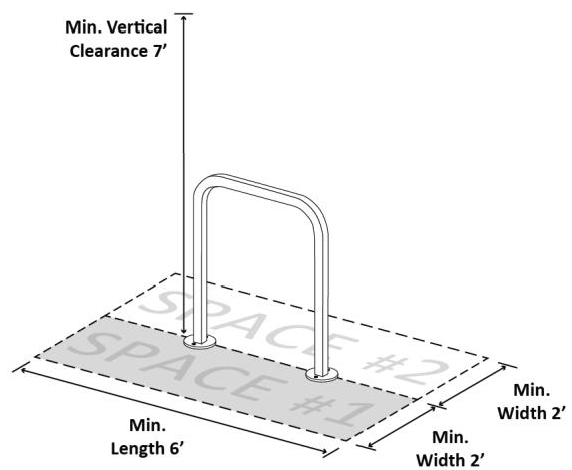
(Ord. No. 2078, 12-11-17)
§ V-6 - Parking Design Standards
A.
Dimensions. All off-street parking aisles and spaces shall be designed in compliance with the requirements established in Table V-6-A. Off-Street Parking Dimensions and Figure V-6-A. Parking Lot layout.
1.
Vertical Clearance. Each parking space shall have a minimum vertical clearance of seven feet.
2.
Compact Spaces. Up to 35 percent of the total off-street parking requirement may be met with compact-sized spaces. Compact spaces shall generally be located in one or more contiguous area, and shall not be mixed with spaces designed for full-size cars if possible.
B.
Access.
1.
Parking Lots. Parking lots shall be designed with adequate means of vehicular access from a driveway, street, or alley in a manner that minimizes interference with traffic movement.
2.
Parking Spaces. Each parking space within a parking lot shall open directly into an aisle or driveway of sufficient width to provide adequate means of vehicular access to the parking space.
C.
Striping. Off-street parking lots shall delineate parking spaces with paint or another permanent, durable material, which shall be maintained in order to remain clearly visible.
Table V-6-A. Off-Street Parking Dimensions
Figure V-6-A. Parking Lot Layout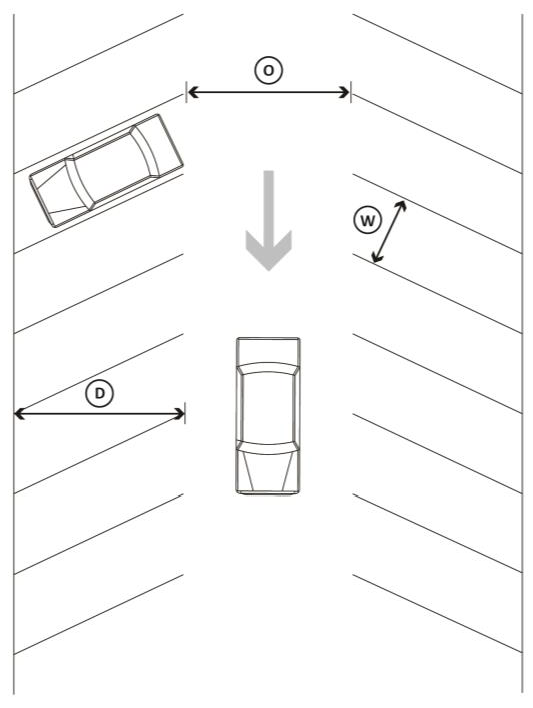
D.
Snow Storage.
1.
Provision for Snow Storage. Snow storage areas shall be provided on or adjacent to all off-street parking areas subject to the standards of this Section to ensure public safety and accommodate transportation.
2.
Obstructions. Snow shall be stored in a manner that does not restrict access, circulation, or sight lines for pedestrians or vehicles at driveways, sidewalks, or other access points. Required off-street parking spaces, driveways, access aisles, and walkways shall not be used for the purpose of snow storage.
3.
Storage in Landscape Areas. Landscape areas shall not be used for snow storage unless designed for that purpose, with non-compacted soils, adequate area to accommodate snow piles, and plantings selected for salt-tolerance and durability.
4.
Storage in Stormwater Management Facilities. Snow should not be stored on top of storm drain catch basins, bioswales, rain gardens, or other stormwater management facilities, as plowed snow can contain pollutants and debris that accumulate in the area and block the system, causing localized flooding.
5.
Off-Site Snow Storage. If appropriate snow storage cannot be accommodated on-site, snow shall be stored off-site, with information on this arrangement submitted to the Zoning Administrator with sufficient detail to ensure adequate safety and parking facilities during snow events.
E.
Wheel Stops. Wheel stops, bumper stops, or curbing shall be permanently and securely installed along the perimeter of the parking lot to prevent vehicle overhang from encroaching on sidewalks, landscape areas, fencing, walls, or buildings. If there is no wheel stop, bumper stop, or curbing, then the adjacent sidewalk must measure a minimum six feet.
F.
Drainage. Off-street parking lots shall be graded for proper drainage, in compliance with Article XI (Stormwater Management), as approved by the Village Engineer. On-site retention and filtration of stormwater shall be provided where practical except as required for conveyance of an overland flow generated from upstream property. Water from the parking area shall not drain across a public walkway.
G.
Landscape Requirements. Parking areas shall meet the applicable requirements of Article VI (Landscape Standards).
H.
Lighting. Parking lots shall meet the applicable requirements of § VI-8 (Outdoor Lighting).
(Ord. No. 2078, 12-11-17)
§ V-7 - Loading Facility Requirements
A.
Applicability. Manufacturing, commercial, civic, institutional, and multi-family uses shall provide off-street loading spaces as established in Table V-7-A. Loading Requirements. The Zoning Administrator may approve a reduction in the minimum loading requirements, or approval for shared use of loading spaces for multiple users, through the site plan review process (see § VIII-3.B (Site Plan Review)).
B.
Computation. Off-street loading spaces shall be calculated on the basis of gross floor area (GFA) in square feet.
1.
Fractions of Loading Spaces. When computation of required loading spaces results in a fraction, any fraction of less than one-half shall be disregarded, and any fraction of one-half or more shall be counted as one loading space.
2.
Maximum Number Required. The maximum number of loading spaces required for any property shall be four spaces.
C.
Dimensions. All required loading spaces shall have a minimum width of ten feet, minimum length of 26 feet, and minimum vertical clearance of 14 feet.
D.
Location. All loading spaces shall be located on the same zoning lot as the use served, unless alternate location has been approved by Zoning Administrator through the site plan review process (see § VIII-3.B (Site Plan Review)).
1.
Interior Side or Rear Façade. Loading facilities shall be located on the interior side and/or rear façade of the building, and shall not project into any required yards. With prior written Zoning Administrator approval, a designated loading area may be located within a drive aisle.
2.
Residential Districts. No loading space shall be closer than 50 feet to any property in a residential district, unless the space is screened by a solid fence or wall with a minimum height of six feet.
E.
Access. Each required off-street loading space shall have appropriate means of vehicular access to a street or alley in a manner that will least interfere with traffic movement. No loading space shall project into or block a street, alley, access drive, or parking area.
F.
Materials. Off-street loading areas shall be paved with a hard surface, all-weather dustless material. Semi-pervious materials and permeable pavements may also be used, subject to the approval of the Zoning Administrator.
Table V-7-A. Loading Requirements
(Ord. No. 2078, 12-11-17)
§ V-8 - Vehicular Stacking Requirements
Refer to Figure V-8-A. Stacking Spaces.
A.
Space Requirements. Each drive-through facility shall provide a minimum of two stacking spaces per bay, with the exception that restaurant uses shall provide a minimum of four stacking spaces per drive-through lane.
B.
Dimensions. All stacking spaces shall have a minimum width of nine feet, as measured from the outermost point of any service window to the edge of the drive-through lane, and minimum length of 18 feet.
C.
Location. Stacking spaces shall be located behind the vehicle parked at the last point of service, such as a drive-through window or car wash bay, and shall be placed in a line within the drive-through lane. Stacking spaces shall be located so that they do not obstruct ingress or egress to the site or to required parking and loading spaces.
D.
Bailout Lane. Drive through lanes shall include a bailout lane, which shall run parallel to the drive through lane, have a minimum width of ten feet, and provide unobstructed exit capability to all vehicles that have entered the drive-through lane. A drive aisle may also serve as the bailout lane provided it meets the requirements of this section.
Figure V-8-A. Stacking Spaces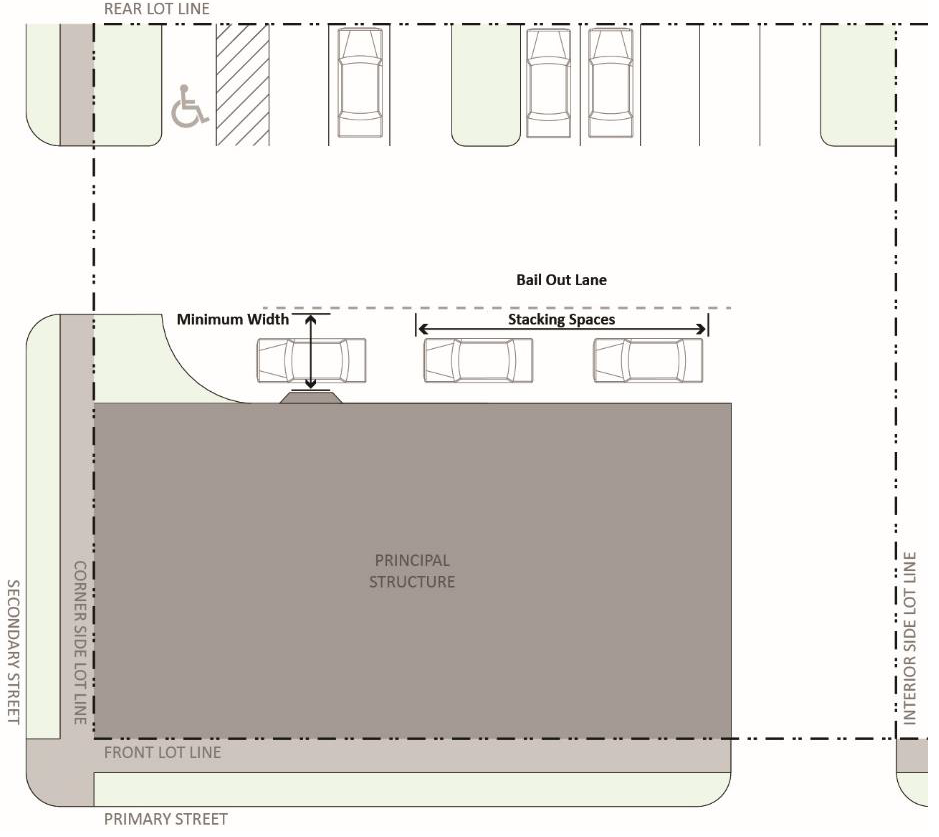
(Ord. No. 2078, 12-11-17)
§ V-9 - Driveways
Driveways providing access to a property from a street, alley, or other vehicular right-of-way shall adhere to the following.
A.
Location. Driveways are permitted to encroach into the required interior side and/or rear yard, but shall be no closer than one foot from the interior side lot line, except when the driveway provides shared access for two adjacent properties.
B.
Quantity. One driveway per street frontage is allowed, provided that the minimum frontage requirements established in Article IV (Zoning District Regulations) are met. Lots with a street frontage of at least 150 linear feet of frontage may incorporate one additional driveway along that frontage. On properties for which more than one driveway is permitted, the distance between the driveways shall be a minimum of 50 feet.
C.
Driveway Width. Driveways shall be constructed in compliance with Table V-9-A. Maximum Driveway Width. Driveway width shall be measured at the lot line.
D.
Visibility. No building, structure, sign, or landscape element shall obstruct the area between 2.5 feet and eight feet in height within the sight triangle area on each side of any driveway. Beginning at the intersection of the driveway with the lot line, the sight triangle shall be formed by measuring ten feet along the lot line in the opposite direction of the driveway and ten feet along the driveway in the opposite direction of the lot line, then connecting the endpoints of the lines across the subject property (refer to Figure V-9-A. Visibility at Driveways).
E.
Sidewalk and Driveway Intersection. In locations that are crossed by a driveway, a sidewalk constructed of a permanent, concrete surface with a minimum width of five feet must be provided. In locations that a sidepath is crossed by a driveway, the provided sidewalk may be constructed of a material other than concrete that is a continuation of the adjacent sidepath material. In all instances, driveway aprons installed within the right-of-way shall be constructed of concrete material. The sidewalk shall remain level across the driveway with a running slope not to exceed the grade of the adjacent roadway, and a cross slope not to exceed two percent. Refer to Figure V-9-B. Sidewalk and Driveway Intersection Designs.
F.
Driveway Aprons. The construction of a new driveway apron is the responsibility of the property owner.
G.
Driveway Parking. Single-family, two-family, and rowhouse dwellings are permitted to park on private driveways, provided that the parked vehicle does not encroach into the right-of-way.
H.
Shared Driveways. Adjacent single-family, two-family, and rowhouse dwellings that share a common driveway are permitted a maximum driveway width of 30 feet at the property line.
Table V-9-A. Maximum Driveway Width
Figure V-9-A. Visibility at Driveways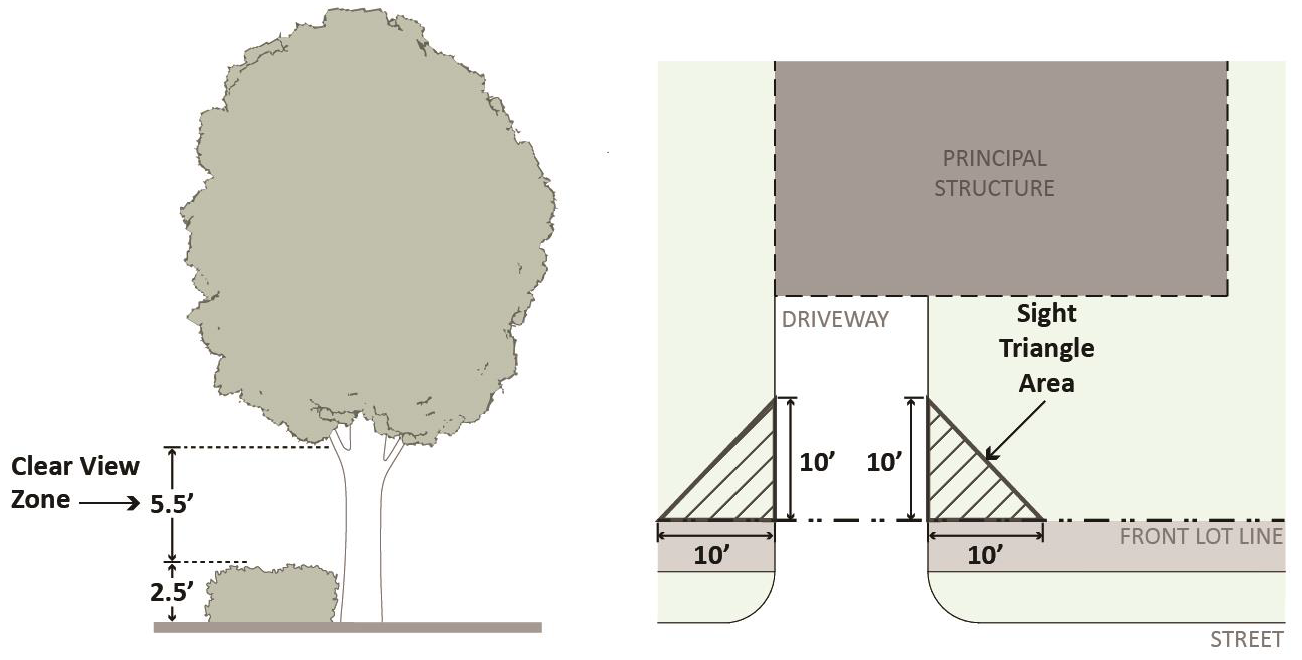
Figure V-9-B. Sidewalk and Driveway Intersection Designs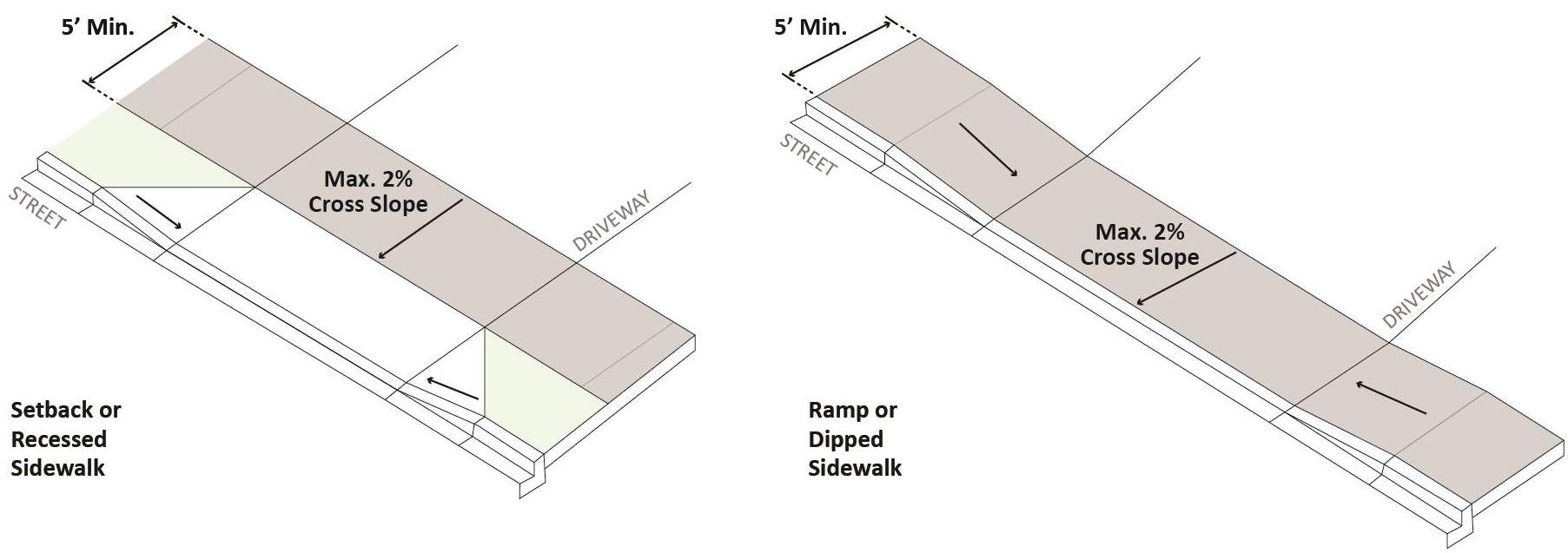
(Ord. No. 2078, 12-11-17; Ord. No. 2121, § 7, 9-23-19)

