
Park Forest City Zoning Code
ARTICLE VI
- LANDSCAPE STANDARDS
§ VI-1 - General Provisions
A.
Purpose. The purpose of this Article is to establish landscape requirements that will enhance the Village's character and livability, improve air quality, reduce the heat island effect, improve water quality, reduce the rainfall volume conveyed to storm sewer systems, and provide for transitions between zoning districts.
B.
Applicability. The requirements of this Article apply to the following:
1.
New developments that require site plan review approval.
2.
Planned unit developments.
3.
The construction of any new parking lot of 15 spaces or more.
4.
The expansion or reconstruction of any existing parking lot that results in a total of 15 aggregate spaces or more.
5.
Tree preservation in accordance with the applicability standards of § VI-2 (Tree Preservation).
6.
Street trees in accordance with the applicability standards of § VI-4 (Street Trees).
7.
Buffer yards in accordance with the applicability standards of § VI-6 (Buffer Yards).
8.
Screening in accordance with the applicability standards of § VI-7 (Screening Requirements).
C.
Occupancy Permit. The requirements of this Article shall be met and landscape elements shall be fully installed prior to the issuance of an occupancy permit.
1.
Seasonal Conditions. If seasonal conditions preclude the completion of landscape installation, the applicant shall provide the Village with a letter of credit, escrow, performance bond, or other surety as approved by the Zoning Administrator equal to 125 percent of the remaining costs of installation, as estimated by a qualified landscape architect or similar professional, in order to receive an occupancy permit.
2.
Permit Revocation. Failure to implement the approved landscape plan or maintain installed landscape elements shall be cause for revocation of the occupancy permit and/or the application of fines and penalties. All landscape elements are subject to periodic inspection for compliance with the approved landscape plan.
D.
Landscape Plan. A landscape plan shall be submitted to the Village as part of any site improvement that meets the criteria of § VI-1.B (Applicability), and shall be approved by the Zoning Administrator. The landscape plan shall be evaluated and approved based on the standards included in this Article VI (Landscape Standards).
1.
Licensed Landscape Architect. The landscape plan shall be prepared and stamped by a licensed landscape architect registered in the State of Illinois if the project meets the criteria of § VI-1.B (Applicability).
2.
Contents. The landscape plan shall contain the following:
a.
Location and dimensions of all existing and proposed structures, parking stalls, landscape islands, buffer yards, street lights, utilities, easements, and other site elements.
b.
Location, quantity, size, spacing, and name, both botanical and common, of all existing plant material, including trees and plant material in the right-of-way. The landscape plan shall indicate whether existing plant material will be retained or removed (refer to § VI-2 Tree preservation).
c.
Location, quantity, size, spacing, and name, both botanical and common, of all proposed plant material.
d.
Planting details for all plantings and best management practices (BMPs), including type and quantity of soil.
e.
Existing and proposed grading of the site indicating contours at one-foot intervals.
f.
Elevations of all fences and retaining walls proposed for the site.
g.
Location of snow storage areas. (See § V-6.D (Snow Storage)).
h.
Information on how existing trees will be preserved and protected during site development.
i.
Construction information, including temporary roads, construction equipment points of access, location of staging areas, material storage, and other related activities.
3.
Operations and Maintenance Plan. Maintenance of all elements of a landscape plan located on private property shall be the responsibility of the property owner. Prior to approval of a landscape plan, an Operations and Maintenance Plan including detail on the maintenance procedures to ensure ongoing compliance with this Article must be signed by the owner, notarized, and submitted to the Village.
E.
Credit for Existing Vegetation. The Village Arborist may credit existing vegetation toward the required buffer area, tree canopy coverage area, and/or landscape element requirements, provided that the existing vegetation is in good health, an acceptable species, and meets all applicable specifications of this Article.
(Ord. No. 2078, 12-11-17)
§ VI-2 - Tree Preservation
A.
Applicability. Existing trees shall not be removed, wholly or in part, unless approved by the Zoning Administrator.
1.
Procedure. The Zoning Administrator's approval shall be evidenced in writing, specifying the tree for which removal is permitted. Such written approval is not required if the removal is performed by Village employees, contractors, or agents.
2.
Criteria for Removal of Mature Trees. The Village Arborist must determine that one of the following criteria apply prior to granting approval to remove a mature tree:
a.
The tree is dead, dying, diseased, or a threat to public health or safety.
b.
The tree interferes with the provision of public services or is a hazard to traffic.
c.
The location of the tree prevents development or redevelopment that cannot be designed to protect the tree.
3.
Requirement to Move Trees. Existing trees that may be removed per the criteria of § VI-2.A.2 shall be moved from existing locations and replanted, if determined by the Village Arborist to be of high quality or high value to the Village. Due to the difficulty of moving mature trees, any tree that is moved and replanted shall be periodically inspected to ensure the health of the tree. If the tree does not survive, it must be replaced in accordance with § VI-2.B (Replacement Standards).
B.
Replacement Standards. Mature trees to be removed shall be replaced in accordance with the following standards. Refer to Figure VI-2-A. Tree Measurement and Table VI-2-A. Tree Replacement Rates.
1.
Replacement Rate. The tree to be removed shall be replaced within one year of the date of approval, or the applicant shall immediately pay the Village an amount equal to the full value of the tree to be removed, at the option of the Zoning Administrator.
a.
Any tree approved for removal by the Zoning Administrator prior to its removal shall be replaced at the rate specified in Table VI-2-A. Tree Replacement Rates.
b.
In the event that a tree is destroyed, damaged, or removed during the construction process, without prior Zoning Administrator approval, such tree shall be replaced at three times the applicable rate specified in Table VI-2-A. Tree Replacement Rates.
2.
Tree Valuation. The full value of the tree shall be determined by the Village Arborist in accordance with appraisal methods developed by the Council of Tree and Landscape Appraisers and published by the International Society of Arboriculture in the Guide for Plant Appraisal.
Figure VI-2-A. Tree Measurement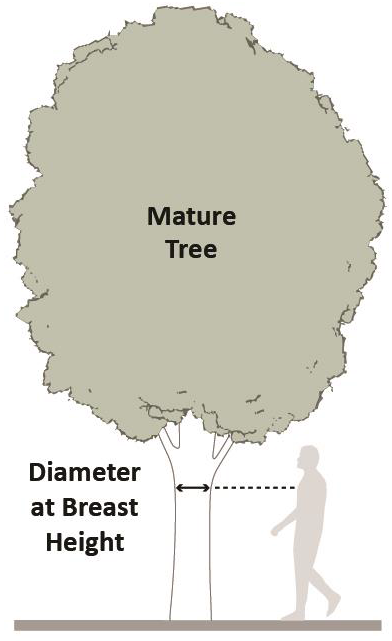
Table VI-2-A. Tree Replacement Rates
(Ord. No. 2078, 12-11-17)
§ VI-3 - Design, Installation, and Maintenance
A.
Design and Installation.
1.
National Standards. All landscape elements shall be installed in accordance with the practices and procedures established by AmericanHort. Landscape materials shall be healthy and hardy upon installation, and shall be planted with appropriate soils to ensure sustained growth.
2.
Plant Size Requirements. Landscape materials shall be installed at or above the minimum sizes specified in Table VI-3-A. Required Landscape Material Size at Installation, unless otherwise noted in this Ordinance.
3.
Native Species and Species Diversity. Tree and plant species that are native or naturalized to northeastern Illinois, as well as drought- and salt-tolerant plant materials, shall be used as required by this Article, except for single-family and two-family dwellings. Refer to the Morton Arboretum Northern Illinois Tree Species List for preferred plant species and Table VI-3-B. Native Species and Species Diversity Requirements, for specifications.
4.
Prohibited Planting Material. No materials listed on the Village's Prohibited List of Planting Material shall be permitted in any installation.
5.
Runoff Infiltration. All required parking lot perimeter landscape yards, buffer yards, and landscape islands shall be designed to accept and facilitate stormwater runoff in accordance with Article XI (Stormwater Management) of the Unified Development Ordinance and the Will County Stormwater Management Ordinance.
6.
Irrigation. Permanent irrigation systems are not required but may be installed as recommended by a landscape architect or the Zoning Administrator. All irrigation systems shall be designed to minimize the use of water, comply with the Illinois Plumbing Code, and require submittal of certification that the system is water efficient (e.g. EPA WaterSense certified).
Table VI-3-A. Required Landscape Material Size at Installation
Table VI-3-B. Native Species and Species Diversity Requirements
B.
Maintenance. All landscape elements shall be maintained in good condition at all times to ensure healthy vegetation and an orderly appearance.
1.
Maintenance Responsibility. Landscape elements, such as vegetation and trees, irrigation systems, fences, and walls, shall be maintained with the same care and attention as buildings, parking areas, and other site improvements. The property owner shall be responsible for the maintenance, repair, and replacement of landscape elements to keep them in good condition for the lifespan of the development and/or parking lot.
2.
Surety. A letter of credit, escrow, performance bond, or other surety as approved by the Zoning Administrator, equal to 125 percent of the value of the landscaping shall remain in place for one year after installation to ensure proper maintenance in accordance with this Article.
3.
Ongoing Maintenance. All landscape elements shall be kept in good condition and shall have a healthy and maintained appearance. Any landscape element that is removed due to disease, damage, death, or any other reason shall be replaced within 30 days after the beginning of the growing season, in accordance with the requirements of this Article and the approved landscape plan.
(Ord. No. 2078, 12-11-17)
§ VI-4 - Street Trees
A.
Purpose. The purpose of this Section is to aid in beautifying and shading the Village by providing consistent and appropriately spaced street trees.
B.
Applicability. The requirements of this Section apply to existing and proposed parkway areas adjacent to new developments that require site plan review or planned unit development approval.
C.
Street Tree Requirements.
1.
Frequency. Shade trees shall be installed at a minimum rate of one shade tree per 30 linear feet, with planted trees selected for appropriate size at maturity for the subject parkway width, based on consultation with the Village Arborist and Village Engineer. Trees shall be placed on center, or at a rate that matches the existing tree spacing pattern on adjacent parkways, whichever results in a greater density of tree plantings. Spacing may be adjusted to ensure adequate room for streetlights and utilities, with prior written Zoning Administrator approval.
2.
Species Diversity. It is recommended that not more than five percent of any one species, ten percent of any one genus or 20 percent of any one family be planted within the Village. Broad species diversity within individual streets will result in reduced catastrophic loss due to a disease or pest.
3.
Tree Species Not Permitted. The only tree species that shall be permitted for planting as street trees are those listed on the Morton Arboretum Northern Illinois Tree Species List.
4.
Trunk Diameter. The trunk diameter of street trees at the time of installation shall be a minimum of three inches, measured at a height of six inches above finished ground level.
5.
Structural Soil. A minimum volume of 1,000 cubic feet of structural soil is required per large street tree, and 750 cubic feet per medium street tree, to accommodate subsurface root expansion.
6.
Tree Wells. Tree wells shall be utilized in locations where the sidewalk extends from the back of the curb to the lot line.
7.
Drought and Salt Tolerance. All street trees proposed to be planted shall be drought- and salt-tolerant. Refer to The Morton Arboretum Northern Illinois Tree Species List for preferred plant species.
(Ord. No. 2078, 12-11-17)
§ VI-5 - Parking Lot Landscape
A.
Purpose. The purpose of this Section is to improve the aesthetic appeal of parking lots, minimize impervious surface coverage, and create green space that reduces the heat island effect and facilitates stormwater management.
B.
Tree Canopy Coverage. New, reconstructed, or expanded off-street parking areas resulting in more than 15 spaces shall contain tree plantings located within perimeter yards and interior landscape islands such that a minimum of 40 percent of the parking area hardscape is shaded by tree canopy, including all parking spaces, travel lanes, and other impervious areas not exempted by this Section. Refer to Figure VI-5-A. Tree Canopy Coverage.
1.
Calculation. Coverage credit for each tree shall be calculated using the projected mature width of the canopy. Refer to the Morton Arboretum Northern Illinois Tree Species List for canopy coverage estimates. Coverage credit for trees planted in perimeter landscape or buffer yards shall be credited in the amount that such plantings cover the parking area hardscape.
2.
Loading Areas. Designated loading areas shall not be included in the total hardscape amount for the purpose of this requirement.
3.
Solar Energy Collection Systems. Any portion of this requirement may be met through installation of solar energy systems that provide shade to the parking area, with the approval of the Zoning Administrator, and in compliance with this Ordinance.
4.
Modification of Requirements. The Zoning Administrator may modify shading requirements for sites located under power lines or other obstructions that prohibit strict compliance, and grant credit for new off-site trees provided in lieu of required on-site plantings, where appropriate.
Figure VI-5-A. Tree Canopy Coverage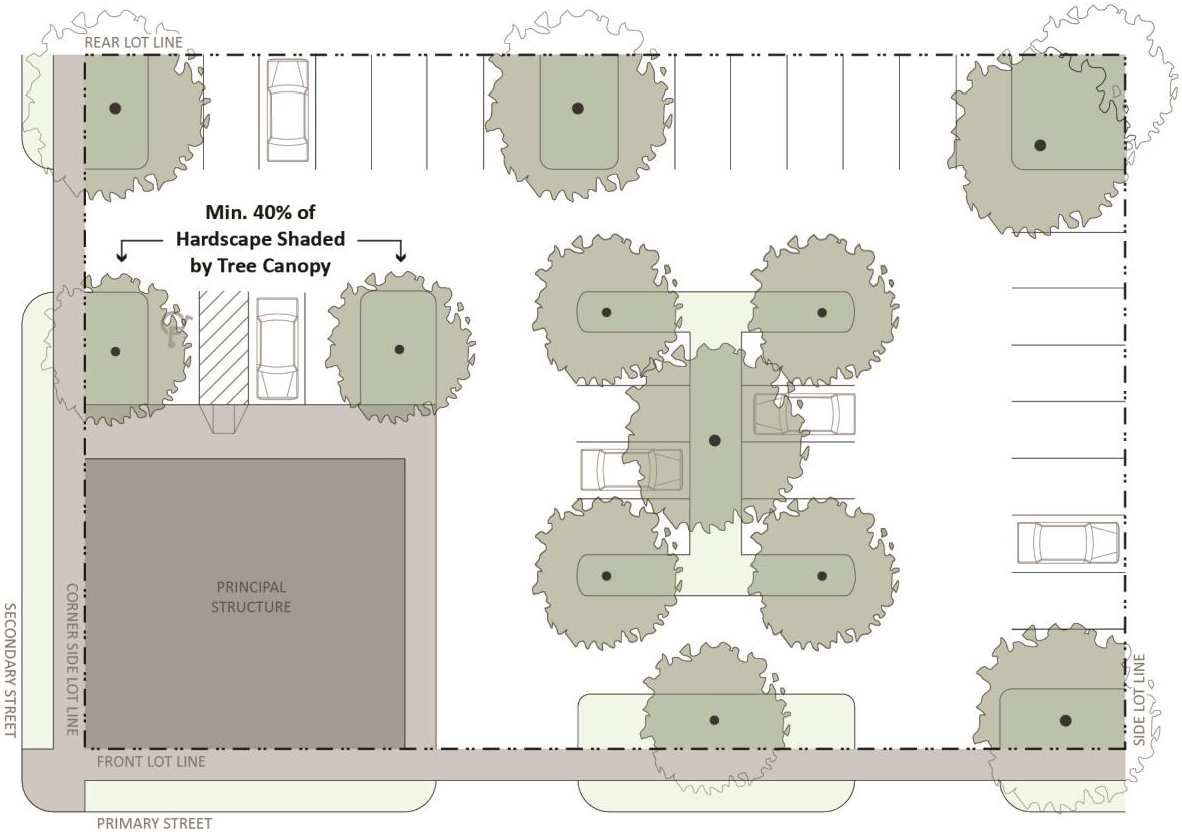
Figure VI-5-B. Location of Landscape Requirements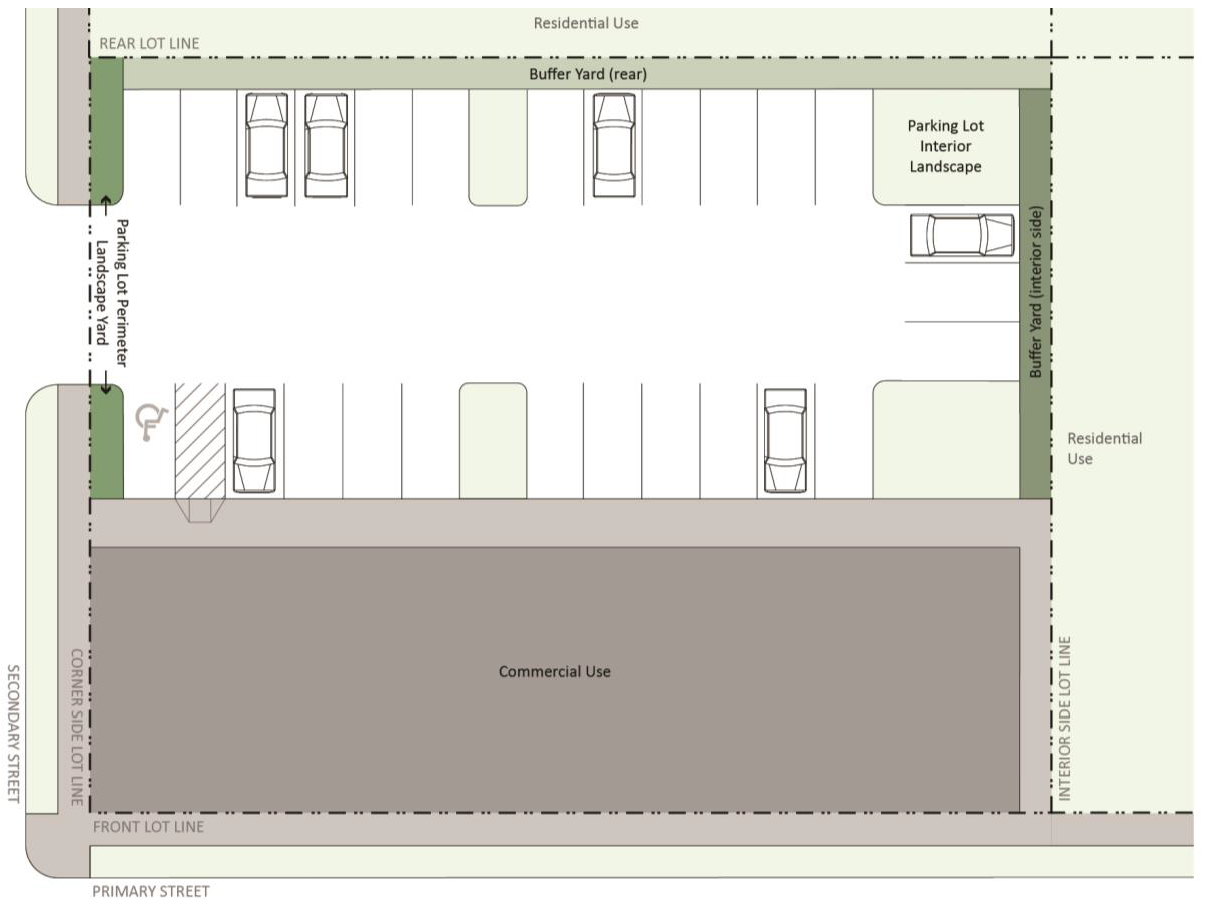
C.
Parking Lot Perimeter Landscape Yard. Refer to Figure VI-5-B. Location of Landscape Requirements and Figure VI-5-C. Parking Lot Perimeter Landscape Yard.
1.
Applicability. The requirements of this Section apply to properties in all zoning districts on which a parking lot is located adjacent to the front or corner side lot line, and to other uses as established in Article III (Uses).
2.
Landscape Requirements.
a.
Location. The parking lot perimeter landscape yard shall be located directly adjacent to the front or corner side lot line.
b.
Minimum Parking Lot Perimeter Landscape Yard. A parking lot perimeter landscape yard with a minimum depth of eight feet is required along the length of the parking lot that abuts the front or corner side lot line, excluding any driveways.
c.
Landscape Elements. The parking lot perimeter landscape yard shall include all of the following:
(1)
A continuous hedge comprised of individual small shrubs of an appropriate species that are adaptable to being grown as a hedge, with a minimum width of 24 inches, spaced 36 inches on center, and maximum height at maturity of 30 to 42 inches.
(2)
One large shade tree per 30 linear feet or one medium shade tree per 25 linear feet of perimeter area, or any combination thereof. Trees may be spaced evenly or grouped.
(3)
Any portion of the parking lot perimeter landscape yard not covered by hedges and trees shall be planted with turf, clump or no-mow grasses, other perennial groundcover, or mulched.
d.
Fence. Fencing is required to further screen the parking lot from view of the street and shall be subject to the following.
(1)
The fence shall be located a minimum of two feet from the back of the parking lot curb to allow for vehicle overhang. The required parking lot perimeter landscape yard shall be located between the fence and sidewalk to provide visual interest from the street.
(2)
The fence shall be a minimum height of three feet and maximum height of four feet. Solid masonry fences shall have a minimum height of two feet, six inches and a maximum height of three feet.
(3)
A paved opening with a minimum width of three feet shall be provided at least every 50 feet to allow pedestrian access to the parking lot.
(4)
The fence shall be at least 30 percent open, unless solid masonry is used.
(5)
Ornamental metal, masonry, and wood are permitted fence materials. Chain link is prohibited.
Figure VI-5-C. Parking Lot Perimeter Landscape Yard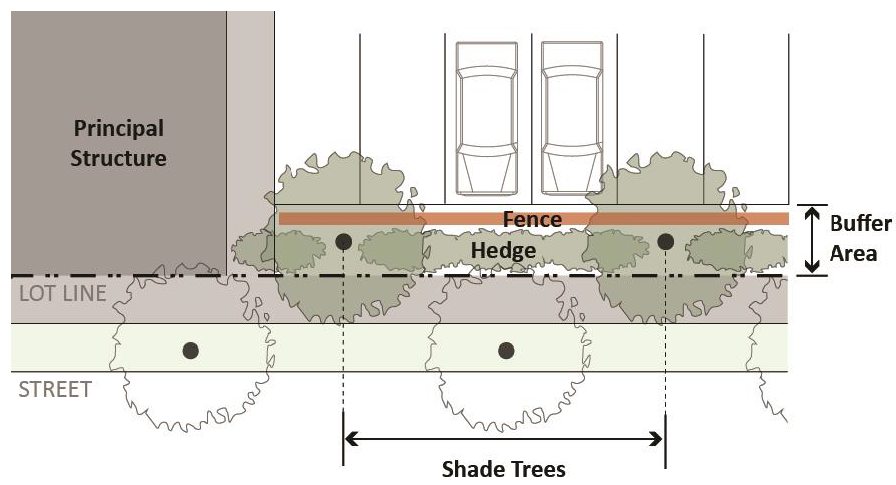
D.
Parking Lot Interior Landscape. Refer to Figure VI-5-D. Parking Lot Interior Landscape and Figure VI-5-B. Location of Landscape Requirements.
1.
Applicability. The requirements of this Section apply to all new parking lots with 15 or more parking spaces, or existing lots that are expanded or reconstructed to contain 15 or more spaces.
2.
Landscape Island Requirements.
a.
Spacing. One landscape island shall be provided for every eight contiguous parking spaces, with no parking rows containing more than eight contiguous parking spaces without an intervening landscape island. All rows of parking shall be terminated by a landscape island or landscape area.
b.
Size. For a single parking row, the landscape island shall have a minimum width of six feet and minimum area of 100 square feet. When double rows of parking are provided, the required landscape islands shall have a minimum width of eight feet and a minimum area of 200 square feet.
c.
Alternate Configuration. In conjunction with landscape plan approval, the Zoning Administrator may permit a different configuration of landscape islands and landscape areas to allow for more efficient site design or permit larger landscape areas that support tree health or stormwater management objectives. However, the overall area and number of plantings required for landscape islands pursuant to this section shall be met.
d.
Trees. A minimum of one shade tree shall be provided per landscape island. Landscape islands provided for double rows of parking shall include a minimum of two shade trees.
e.
Groundcover. A minimum of 80 percent of each landscape island shall be planted with turf or other live groundcover, perennials, or ornamental or native grasses.
f.
Curbing. Landscape islands shall be protected with concrete curbing that has a minimum height of six inches as measured from the parking lot surface. Curbing shall contain inlets to accept drainage, unless it is determined by the Zoning Administrator that inlets would result in greater runoff volume inflow than could be supported by the landscape island. Wheel stops and other alternate landscape protections may be approved by the Zoning Administrator to facilitate certain stormwater management facilities. Refer to Figure VI-5-E. Curb Inlet Design.
Figure VI-5-D. Parking Lot Interior Landscape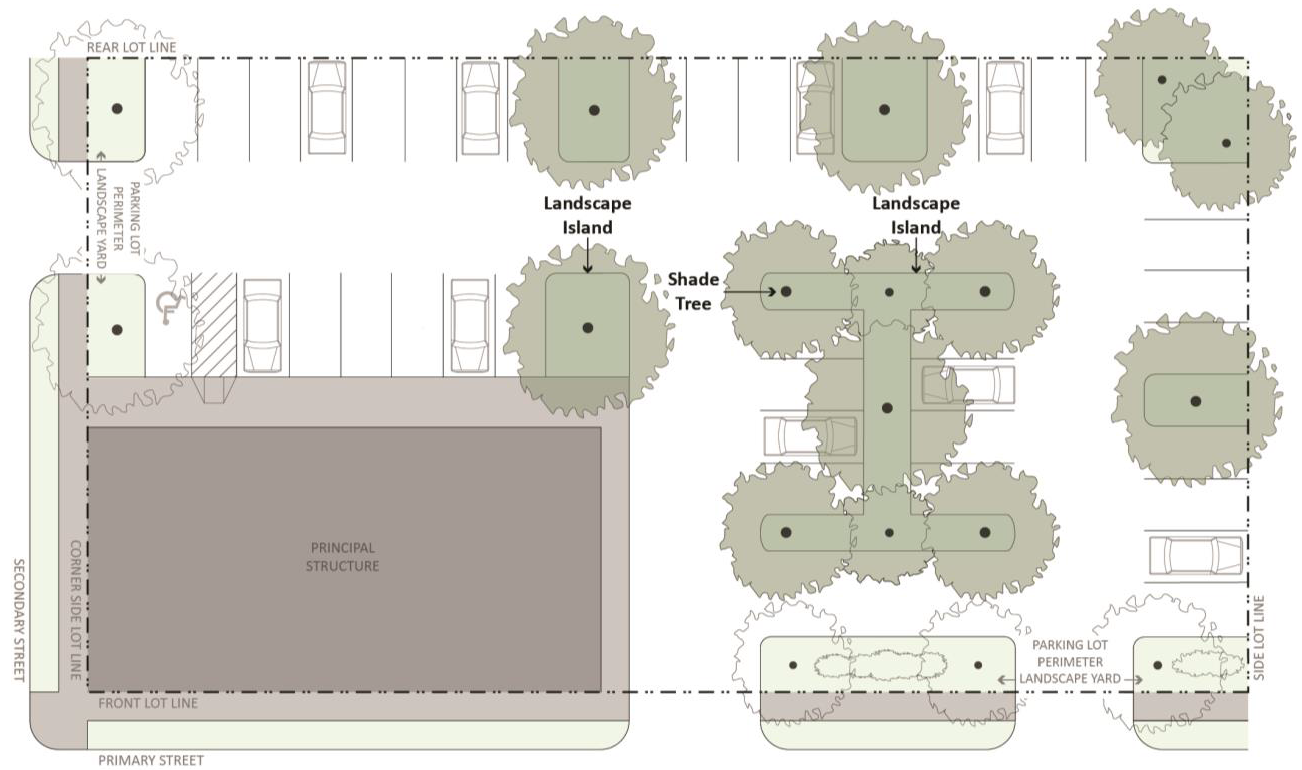
Figure VI-5-E. Curb Inlet Design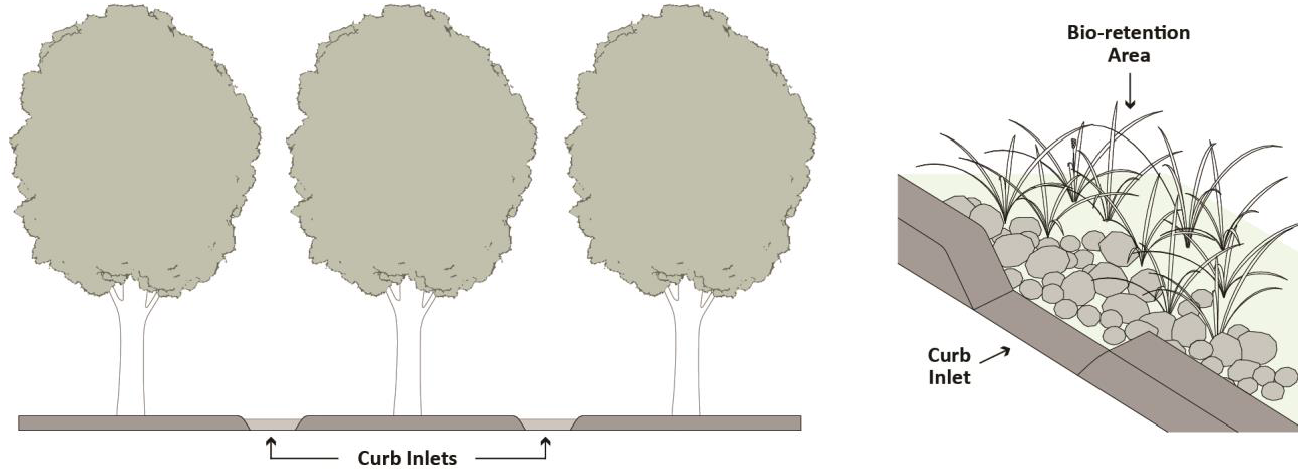
(Ord. No. 2078, 12-11-17)
§ VI-6 - Buffer Yards
Refer to Figure VI-6-A. Buffer Yards and Figure VI-5-B. Location of Landscape Requirements.
A.
Purpose. The purpose of this Section is to buffer more intensive zoning districts and uses from less intensive zoning districts and uses, and to provide for transitions between zoning districts.
B.
Applicability. A buffer yard is required adjacent to lot lines where the proposed development meets one or more of the following criteria. For the purposes of this Section, properties shall not be considered directly adjacent to one another if a public alley or other right-of-way separates the properties. Any reconstruction of existing parking lots of less than 15 parking spaces shall be exempt from buffer yard requirements.
1.
Non-Residential District. The property is located in the C-1, C-2, C-3, or M District and is directly adjacent to property located in the R-1, R-2, R-3, and/or R-4 Districts.
2.
Non-Residential Use in Residential Districts. The property is located in the R-1, R-2, R-3, or R-4 District, contains a non-residential use, and is directly adjacent to a residential use in the R-1, R-2, R-3, and/or R-4 Districts. Parks are exempt from this requirement.
3.
R-3 and R-4 Districts. The property is located in the R-3 or R-4 District, contains a use other than a single-family dwelling, two-family dwelling, live/work dwelling, day care home, community garden, or park, and is directly adjacent to property located in the R-1 and/or R-2 Districts.
C.
Buffer Yard Requirements.
1.
Location. The buffer yard shall be located directly adjacent to the affected interior side and/or rear lot line, along the entire length of the lot line.
2.
Minimum Buffer Yard Area. The buffer yard shall have a minimum depth of eight feet.
3.
Landscape Elements. The buffer yard shall include the following:
a.
A continuous hedge comprised of individual small shrubs of an appropriate species that are adaptable to being grown as a hedge, with a minimum width of 24 inches, spaced 36 inches on center, and maximum height at maturity of 30 to 42 inches.
b.
One evergreen tree for every 15 linear feet of buffer area. Trees may be spaced evenly or grouped. Refer to The Morton Arboretum Northern Illinois Tree Species List for preferred plant species.
c.
Any portion of the buffer yard not covered by hedges and trees shall be planted with turf or other groundcover, or mulched.
d.
A continuous hedge of individual shrubs may be allowed in lieu of providing evergreen trees within a buffer yard with prior written Zoning Administrator approval, provided that the hedge height at maturity is taller than 42 inches.
4.
Fence. Fences in buffer yards are required for uses in all applicable zoning districts, except for residential uses in the R-3 and R-4 Districts.
a.
Location. The fence shall be located along the entire length of the affected interior side or rear lot line.
b.
Height. The fence shall be a minimum of five feet and maximum of eight feet in height.
c.
Opacity. Semi-opaque fencing with a minimum of 30 percent opacity and opaque fencing are permitted.
d.
Materials. Fence materials shall comply with the requirements of § III-4.C.6.c (Materials and construction).
Figure VI-6-A. Buffer Yards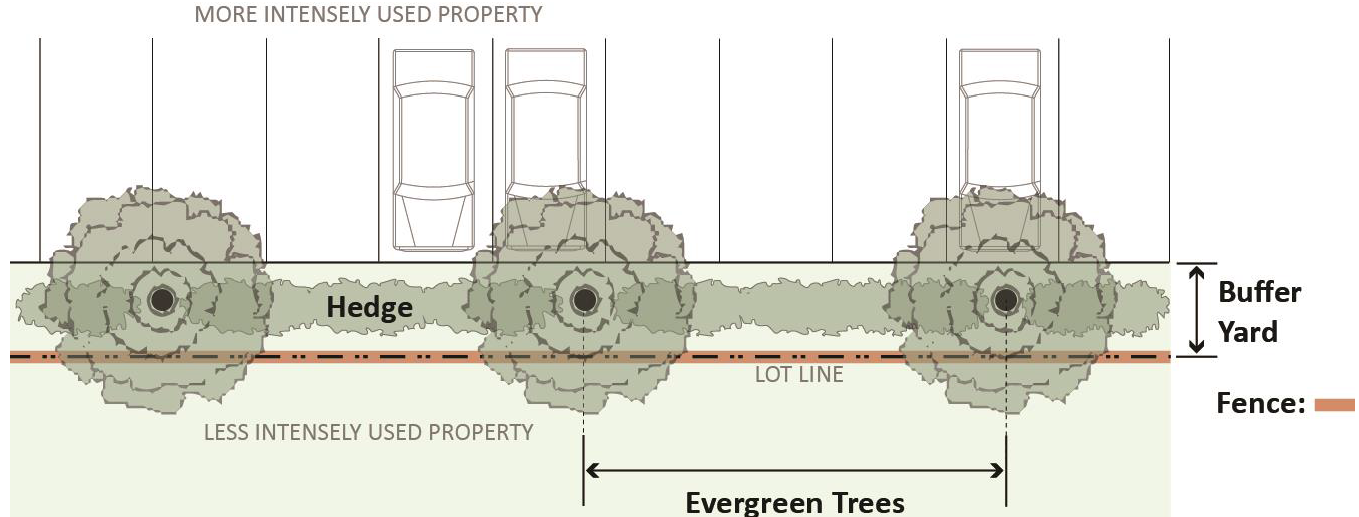
(Ord. No. 2078, 12-11-17)
§ VI-7 - Screening Requirements
A.
Purpose. The purpose of this Section is to screen refuse areas, outdoor storage areas, ground-mounted utilities, and off-street loading areas from view of the street and adjacent properties.
B.
Applicability. The requirements of this Section apply to refuse areas, outdoor storage areas, ground-mounted utilities, and off-street loading areas.
C.
Refuse Area, Ground-Mounted Utilities, and Outdoor Storage Area Screening Requirements. Refer to Figure VI-7-A. Refuse Area, Ground-Mounted Utilities, and Outdoor Storage Screening.
1.
Location. Refuse areas shall be located in the interior side yard or rear yard. Refer to § III-4.C.12 (Mechanical Equipment) and § III-4.C.13 (Outdoor Storage) for standards for mechanical equipment and outdoor storage. Refer to Table III-4-A. Accessory Structures for standards for electrical generators.
2.
Opaque Fence or Wall. The refuse area or outdoor storage area shall be completely screened by an opaque masonry wall or solid or simulated wood fence on three sides, and an opaque gate on the fourth side. The wall of a principal structure may serve as one of the screening walls.
a.
Height. The fence or wall shall have a minimum height of six feet or an equivalent to the height of the refuse or outdoor storage area to be screened, whichever is greater.
b.
Complementary Design. Screening elements should complement the architectural style of the primary building on-site and use building materials similar to those used for the primary building.
c.
Gate. The enclosure of the refuse area or outdoor storage area shall be gated, and remain locked except during times of refuse deposit or collection.
3.
Landscape Elements. Landscape shrubs may be installed on three sides of the area, with plantings located between the fencing and back of curb, and screening the full length of each side.
D.
Off-Street Loading Area Screening Requirements. The area adjacent to any off-street loading areas, shall be treated with landscaping and buffering per the requirements of § VI-5.C (Parking Lot Perimeter Landscape Yard).
Figure VI-7-A. Refuse Area, Ground-Mounted Utilities, and Outdoor Storage Screening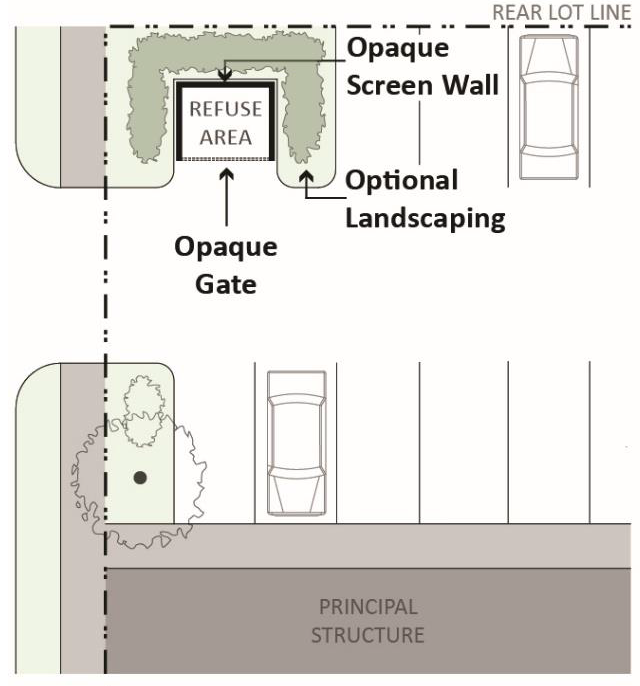
(Ord. No. 2078, 12-11-17)
§ VI-8 - Outdoor Lighting
A.
Purpose. The purpose of this Section is to prevent light trespass, promote energy efficiency, and minimize light pollution.
B.
Applicability. The requirements of this Section apply to all new or replacement outdoor lighting, with the exception of unshielded lighting for holiday decorations or permitted temporary uses as established in § III-5 (Temporary Structures and Uses). The Zoning Administrator may impose reasonable restrictions on the use of such lighting for temporary uses as necessary to protect the health, safety, and welfare of the public.
C.
General Requirements.
1.
Photometric Plan. A photometric plan prepared by a licensed professional shall be approved by the Zoning Administrator prior to installation of outdoor light fixtures for non-residential uses.
2.
Prohibited Lighting. Any outdoor lighting that may be confused with a traffic control device shall be prohibited except as authorized by federal, state, county, or local government. Flashing lights, strobe lights, and laser lights are prohibited.
3.
Design That Prevents Glare. All lighting shall be designed to prevent glare and interference with residential property, and motor vehicle, bicycle, and pedestrian traffic.
4.
Fixtures. All new and replacement outdoor lighting shall employ full cut-off or fully shielded fixtures. The illuminated face of all fixtures shall be parallel to the ground, with the exception of fixtures used for façade illumination as established in § VI-8.C.5 (Building and Structure illumination). The light fixture shall be designed so as not to extend below the fixture housing.
5.
Building and Structure Illumination. Building and structure illumination shall be limited to fully shielded or directionally shielded fixtures directed towards the façade. All light from such fixtures shall be concentrated on the exterior surface of the building or structure being illuminated.
6.
Automatic Lighting Controls. All outdoor lighting on non-residential properties shall be controlled by a photoelectric sensor, occupancy sensor, or timer to automatically reduce outdoor lighting when sufficient daylight is available, and to automatically extinguish lights no more than one hour following the close of business, excluding security lighting.
7.
Energy-Efficient Technology. The use of Light Emitting Diodes (LED) or similar energy efficient technology is required for applicable projects in accordance with § VI-8.B (Applicability).
D.
Illumination Standards.
1.
Illumination.
a.
Non-Residential Uses. Outdoor lighting shall not exceed one foot-candle at any point on a lot line for a lot containing a non-residential use, unless otherwise specified in this Ordinance.
b.
Residential Uses. Outdoor lighting shall not exceed one-half foot-candle at any point on a lot line for a lot containing a residential use, unless otherwise specified in this Ordinance.
c.
Recreational Facilities. The average maintained outdoor lighting level for recreational uses shall not exceed 50 foot-candles, with the exception of golf-related facilities, which shall be limited to a maximum average lighting level of five foot-candles for courses and 20 foot-candles for driving range facilities.
d.
Sign Illumination. Sign illumination shall conform to the provisions of Article VII (Signs).
2.
Height. The maximum height of light poles and building-mounted lighting is established herein unless otherwise required by the Building Code.
a.
Non-Residential Uses. Light poles and building-mounted fixtures shall not exceed 25 feet in height for non-residential uses. Light poles for educational facilities or outdoor recreational facilities shall not exceed 60 feet in height. Outdoor lighting for all outdoor recreation areas is subject to review of building permit and photometric plan.
b.
Residential Uses. Light poles shall not exceed eight feet in height for single-family dwellings, two-family dwellings, and rowhouse dwellings. Light poles shall not exceed 25 feet for multifamily dwellings. Building-mounted fixtures, including under-soffit lighting, shall not exceed 15 feet in height.
(Ord. No. 2078, 12-11-17)

