
Plymouth City Zoning Code
ARTICLE XV
ARC ANN ARBOR ROAD CORRIDOR DISTRICT2
Editor's note— An Ord. of June 7, 2004 amended former Art. XV, §§ 78-160—78-170, in its entirety to read as herein set out. Former Art. XV pertained to similar subject matter and derived from the Zoning Ordinance of Oct. 6, 2003.
Sec. 78-160.- Preamble.
(a)
District established. Recognizing the importance of a viable Ann Arbor Road Corridor with well-planned, quality development, and further recognizing that a unified approach is the most effective, the city and the charter township have jointly established the ARC Ann Arbor Road Corridor District. This zoning district is based upon careful evaluation, study and plans completed by the two (2) communities with considerable input from the corridor businesses.
It has been agreed by both the city and the township, as the foundation for this zoning district, that creation of a common ARC zoning district presents opportunities for intergovernmental coordination, cost savings, consistent land use regulation, sound planning and reflects the traditional spirit of cooperation in the Plymouth community.
It is further acknowledged that creation of the ARC district does not change the independent authorities and powers of each unit of government to adopt, enforce and amend its zoning ordinance; however it is the intent of both bodies in creating this district that the regulations and effect of the ARC remain the same in both the city and the township. Therefore, by mutual agreement, variations which are not approved by both the township and the city are contrary to the intent of this district.
(b)
Boundaries defined. The boundaries of the ARC Ann Arbor Road Corridor District shall be as shown on the zoning map which accompanies this ordinance with all notations, references and other information shown there on and as prescribed on the official zoning maps of the City of Plymouth and Plymouth Charter Township, Wayne County, Michigan.
(Ord. of 6-7-04)
Sec. 78-161. - ARC Ann Arbor Road Corridor District.
(a)
Purpose. The Ann Arbor Road Corridor Zoning District is intended to establish uniform regulations applicable to the use of land, dimensions for building and site development, parking, landscaping and signage which accommodate and promote land uses which are compatible with the desired character of the corridor, and which conserve property values and long term stability of office, commercial and limited light industrial uses along the Ann Arbor Road Corridor. The Ann Arbor Road Corridor District is intended to accommodate a mixture of office, business and limited light industrial uses designed to serve the commercial needs of the general community in an attractive, well designed and functional environment.
(b)
Principal uses permitted. No building or land shall be used and no building shall be erected except for one or more of the following specified uses, unless otherwise provided in this article:
(1)
Medical and dental offices and clinics and other professional offices.
(2)
Administrative, executive and editorial offices.
(3)
Real estate and other general business offices.
(4)
Banks, credit unions, savings and loan associations, and similar financial institutions.
(5)
Schools for arts and crafts, photography and studios for music or dancing; training centers, business schools or private schools operated for profit.
(6)
Private clubs and lodge halls.
(7)
Mortuaries.
(8)
Religious institutions, and other facilities incidental thereto.
(9)
Personal service establishments which perform services on the premises such as: shoe repair, dry cleaning shops (without on-site processing), tailors and dressmakers shops, beauty parlors and barbershops, or any service establishment of an office-showroom or workshop nature of an electrician, decorator, dressmaker, tailor, shoemaker, baker, printer, upholsterer, or an establishment doing radio, television or home appliance repair, photographic reproduction, and similar establishments that require a retail adjunct and are of no more objectionable character than the aforementioned subject to the following provision: No more than five (5) persons shall be employed at any time in the fabrication, repair and other processing of goods.
(10)
Retail establishments whose principal activity is the sale of merchandise in an enclosed building, including sales of groceries, meats, dairy products, baked goods or other foods, drugs, dry goods and notions or hardware.
(11)
Business services such as mailing, copying and data processing.
(12)
Restaurants not serving alcoholic beverages where patrons are served while seated within a building occupied by such establishments.
(13)
Reserved.
(14)
Bus stations.
(15)
Commercial parking garages.
(16)
Public schools.
(17)
Accessory structures and uses customarily incidental to the above permitted uses.
(c)
Special land uses. The following uses may be permitted by the planning commission, subject to the conditions hereinafter imposed for each use, including the review and approval of the site plan by the planning commission; and the imposition of special conditions which, in the opinion of the commission, are necessary to fulfill the purposes of this article; and the procedures and requirements set forth in this article for special land use approval, including a public hearing.
(1)
Any other use not specified as a principal permitted use which the planning commission finds to not be inconsistent with the purposes of this article and which will not impair the present or potential use of adjacent properties.
(2)
Child care centers not including overnight sleeping facilities, subject to the following conditions:
a.
For each child permitted at the maximum licensed capacity of the facility, there shall be provided and maintained a minimum of 500 square feet of outdoor play area. Such play space shall have a total minimum area of not less than 3,000 square feet and shall be fenced and screened from any adjoining lot in any residential district.
b.
All child care facilities shall be registered with or licensed by the State of Michigan where required, and shall comply with the minimum state standards for such facilities, in addition to those standards specified in this article. Proof of compliance shall be provided to the city upon request.
c.
Adequate ingress, egress and circulation shall be provided. Vehicles must be able to easily circulate within and through the site to a designated pick-up/drop-off area without impeding circulation on the site or traffic on nearby roads. Adequate stacking space for the pick-up/drop-off area shall be provided.
(3)
Commercial, medical and dental laboratories, not including the manufacturing of pharmaceutical or other products for general sale or distribution.
(4)
Parochial and private schools.
(5)
Municipal facilities, including municipal or other governmental offices, fire stations, post offices, community buildings, libraries, parks, playgrounds and park-n-ride lots.
(6)
Hospitals and convalescent homes.
(7)
Communication facilities, public utility transformer stations, sub-stations and gas regulator stations without outdoor service or storage yards subject to the following:
a.
A front yard setback of not less than 50 feet shall be provided and two side yards and a rear yard shall be provided, each shall not be less than 25 feet in width.
b.
When a transmission or relay tower, etc. is proposed as part of the facility, the tower shall be so located that it does not present a nuisance to abutting residential properties. The tower shall be so located on the subject property that the distance from the base of the tower to all points on each property line shall be not less than one and one-half (1½) times the height of the tower.
c.
Such use shall be screened and buffered from nearby public rights-of-way and property in accordance with the requirements of this chapter.
(8)
Large scale institutional uses, subject to the following:
a.
The site shall have at least 150 feet of frontage on a major thoroughfare with an existing or planned right-of-way of not less than 120 feet. All ingress and egress to the site shall be directly onto such major thoroughfares.
b.
The site shall be located within one half mile of interchange access to I-275, as measured along major thoroughfares.
c.
All buildings, structures, and parking and loading areas shall be setback a minimum of 100 feet from any abutting residential zoning district. Such setback area shall be heavily landscaped so as to create a complete visual and physical separation between the two unlike land uses, forming an effective screen in compliance with the provisions of this chapter.
d.
Traffic from events (including religious institution worship services), and other large assemblies shall be controlled by the institution or by its agents so as to not create congestion or unreasonable delays on the public street. A schedule of expected frequency of events (including religious institution worship services) and assemblies, a description of the method(s) of traffic control, and a traffic impact study and shall be presented to the planning commission for approval after review and comment on the plan by the police department.
e.
Associated uses on the site such as schools, (if not the primary use) recreation centers, retreat facilities, conference centers, convents, and others shall meet all requirements of this chapter for such uses.
f.
All parking spaces and aisles shall be screened from off-site view by any one or a combination of the following:
1.
Screening mound or berm.
2.
Dense landscaping.
3.
Solid wall with planting strip.
4.
Changes in grade through the use of retaining walls, or topographic features.
Screening shall be in accordance with the requirements of section 78-167.
g.
There shall be no outside loudspeakers or amplified sound outside of a totally enclosed building.
h.
Storage of buses, trucks, and maintenance equipment shall be entirely within a totally enclosed building.
(9)
Hotels and motels subject to the following:
a.
Each hotel or motel shall provide minimum side yards of not less than 25 feet each; minimum rear yard of not less than 35 feet; minimum front yard of 25 feet except that when parking is provided between the building and a street, the minimum front yard and/or side yard shall be not less than 75 feet.
b.
When the front yard and/or side yard abuts a street and is used to provide an access road and/or off-street parking, the area shall be screened in compliance with the requirements of this article.
c.
Each motel or hotel unit shall contain not less than 250 square feet of floor area.
d.
Kitchen or cooking facilities may be provided in new motels or hotels upon demonstration by the applicant that the provisions of all applicable fire prevention and building codes have been met. No existing motel units shall be converted for use of cooking and/or kitchen facilities unless the applicant can demonstrate compliance with all applicable fire prevention and building codes and obtains a certificate of occupancy for each unit being converted.
e.
Where a unit is provided as a residence for the owner or the manager, the following minimum floor area requirements shall be provided: one bedroom unit, 600 square feet; two bedroom unit, 800 square feet; three bedroom unit, 1,000 square feet; four bedroom unit, 1,200 square feet.
(10)
Sales rooms, and/or sales lots for new and/or used automobiles, recreation vehicles or trucks, subject to the following:
a.
Outdoor lighting shall be provided in an amount which shall be sufficient to permit safe movement of vehicles and pedestrians at night. This lighting shall be high pressure sodium, metal halide or other type of lighting approved by the commission which exhibits the same characteristics and qualities of high pressure sodium or metal halide. Outdoor lighting shall be so located and designated as to reflect light away from adjacent single family residential areas and shall comply with the requirements of section 78-204, exterior lighting.
b.
All service and repair facilities shall be contained within an enclosed building except for the storage of repaired and wrecked cars. All areas used to store repaired or wrecked cars shall be located behind the building and screened in compliance with the requirements of section 78-167 of this chapter.
c.
An obscuring wall must be provided when abutting or adjacent districts are zoned for residential use, in accordance with section 78-206 of this article.
d.
No major repair or major refinishing shall be done on the lot.
e.
Where a sales lot for new and/or used automobiles, or trucks, abuts a street, a planting strip shall be established in accordance with section 78-167, specific landscaping, screening and buffering requirements. The planting strip shall comply with the standards for Ann Arbor Road streetscape or parking area buffering based upon the street fronted upon, and shall provide a proper buffer in the determination of planning commission. The required shrubbery plantings may be modified at the discretion of the planning commission, to break up the areas without circumventing the total view of the product.
f.
No loudspeakers for outdoor broadcasting shall be permitted.
g.
Rental facilities for vehicles shall be permitted only as an accessory use to a permitted vehicle sales use under this section.
h.
All outdoor sales or display areas shall be surfaced with asphalt or concrete or other similar dust-proof surface.
(11)
Motorcycle, motorbike, personal watercraft, snow mobile and all-terrain vehicle sales, service, clubs and rental facilities subject to the following:
a.
No motorcycle or motorbike rental, sales, service or motorcycle or motorbike clubs shall be permitted on a parcel of land which is located within 200 feet of a residential district.
b.
Motorcycle or motorbike clubs may be operated only between the hours of 6 a.m. and 12 midnight.
c.
Outdoor storage and/or testing areas shall not be permitted.
d.
All service and repair facilities shall be contained within an enclosed building.
e.
Where a sales lot and/or outdoor display area abuts a street, a planting strip shall be established in accordance with section 78-167, specific landscaping, screening and buffering requirements. The planting strip shall comply with the standards for Ann Arbor Road streetscape or parking are buffering based upon the street the sales lot or display area abuts, and shall provide a proper buffer in the determination of the planning commission. The required shrubbery plantings may be modified at the discretion of the planning commission, to break up the areas without circumventing the total view of the product.
f.
All outdoor sales or display areas shall be surfaced with asphalt or concrete or other similar dust-proof surface.
(12)
Indoor recreation uses such as bowling establishments, court sport facilities, tennis clubs, pool and billiard halls, roller and ice skating rinks, and other general indoor recreation facilities, subject to the following:
a.
The structure housing such facilities shall be located at least fifty (50) feet from any front, rear, or side yard of any residential lot in an adjacent residential district.
b.
Any vehicles or equipment used for servicing the facilities, such as court cleaners or zambonis, shall be stored only inside a totally enclosed building.
c.
The use of any electronic or enhanced sound system shall be contained so as to not present an unreasonable disturbance to the neighborhood in which it is located.
(13)
Theaters, assembly halls, concert halls or similar uses, subject to the following:
a.
All operations shall be conducted within a completely enclosed building.
b.
All buildings shall be set back at least one hundred (100) feet from any residential district.
(14)
Drive-in restaurants and other drive-in establishments excluding outdoor theaters, subject to the following:
a.
Outdoor lighting shall be provided in an amount which shall be sufficient to permit safe movement of vehicles and pedestrians at night. This lighting shall be high pressure sodium, metal halide or other type of lighting approved by the commission which exhibits the same characteristics and qualities of high pressure sodium or metal halide. Outdoor lighting shall be so located and designated as to reflect light away from adjacent single family residential areas and shall comply with the requirements of section 78-204 exterior lighting.
b.
A setback of at least 60 feet from the future right-of-way or street setback line of any street must be maintained.
(15)
Outdoor cafes and eating areas accessory to a permitted restaurant use, subject to the following:
a.
Pedestrian circulation and access to building entrances (both on and off site) shall not be impaired. A minimum of six (6) feet of sidewalk leading to the entrance to the establishment shall be maintained free of tables and other encumbrances. Planters, posts with ropes or other enclosures shall be used to define the area occupied by the outdoor cafe.
b.
The outdoor cafe shall be kept clean, litter-free, and with a well-kept appearance within and immediately adjacent to the area of the tables and chairs. Additional outdoor waste receptacles may be required. Written procedures for cleaning and waste containment and removal responsibilities shall be included with all applications and approved by the planning commission. Preparation of food and beverages is prohibited in the outdoor cafe area.
c.
Tables, chairs, planters, waste receptacles, and other elements of street furniture shall be compatible with the architectural character of the adjacent buildings, subject to planning commission approval.
(16)
Veterinary clinics, animal clinics and animal hospitals subject to the following:
a.
Any building designed or constructed for such uses shall be used for the sole purpose of providing medical care for household pets and shall not be constructed or used as a boarding establishment for household pets.
b.
If animals eligible for treatment at such establishments are kept overnight on the premises or for a period longer than regular professional business hours, then a full-time, duly qualified attendant shall be stationed in charge of said premises.
c.
Open or outdoor runs, kennels or pens shall be prohibited.
d.
In no case shall the disposal of rubbish and litter be conducted in such a manner as to be obnoxious or offensive.
e.
In no case shall there be any harboring of vermin or decaying matter on the premises, and effective provisions shall be made to confine all noise, confusion and odor, if any, to the premises.
f.
The building and ventilation system shall be constructed to prevent any noise and odors emanating from the area used for the treatment and temporary keeping of household pets from reaching the building exterior.
(17)
A storage garage for commercial vehicles used by a business or other activity when located on the same contiguous site therewith and not occupying more than 25 percent of the area of such contiguous site.
(18)
Commercial (major repair or body shop) garages subject to the following:
a.
All operations of the commercial garage shall be conducted entirely within the building except for the storage of repaired and wrecked cars. All areas used to store repaired or wrecked cars shall be screened from view off site in compliance with section 78-296.
b.
All outdoor sales or display areas shall be surfaced with asphalt or concrete or other similar dust-proof surface.
(19)
Commercially used outdoor recreational space for children's amusement parks, miniature golf courses, subject to the following:
a.
The children's amusement park must be fenced on all sides with a four-foot, six-inch wall or fence.
b.
Adequate parking shall be provided off the road right-of-way and shall be fenced with a four-foot, six-inch high wall or fence where adjacent to the use.
(20)
Open air display and sales areas, including nursery plants and materials; lawn furniture; playground equipment and swimming pools; garden supplies and similar open-air displays, subject to the following conditions:
a.
The storage and/or display of any materials and/or products shall meet all setback requirements applicable to a building, and shall be screened from view off-site.
b.
All loading and parking shall be provided off-street.
c.
The storage of any soil, fertilizer, or other loose, unpackaged materials shall be contained so as to prevent any affects on adjacent uses.
d.
Outdoor display and sales of lumber and coal yards, building material sales establishments, junk yards, used auto parts or wrecking establishments shall not be permitted.
e.
All outdoor sales or display areas shall be surfaced with asphalt or concrete or other similar dust-proof surface.
(21)
Auto wash facilities subject to the following:
a.
In the case that an auto wash facility includes the storage and/or sale of gasoline as part of the operation, the requirements of subsection (c)(23) of this section shall also apply.
b.
All washing facilities shall be completely within an enclosed building.
c.
Vacuuming facilities may be outside the building, but shall not be in the front yard and shall not be closer than 100 feet from any residential district. Where such facilities are located in a side or rear yard abutting a street, such use shall be screened from the street by one or a combination of the following:
1.
A solid wall of at least four feet in height and six to eight-foot wide planting strip on the street side. Such planting strip shall contain as a minimum, one deciduous small ornamental tree for every twenty lineal feet of planting strip required.
2.
Mounding or berming of not less than four feet in height with side slopes no steeper than 3:1 (three feet horizontal to one foot vertical). A minimum of one (1) deciduous small ornamental tree shall be planted for every 20 lineal feet of berm or mound.
d.
Driveway entrances into the auto wash structure shall be from within the lot and no entrance into the building shall be directly from a street or alley. No alley shall be used as a means of serving an auto wash facility. Drains shall be provided at all entrances and exits at the street setback line. Auto wash facilities shall not, in general, be located within 200 feet of an intersection of any two roads when either of the two roads is considered to carry moderate to heavy traffic levels.
e.
A hard surfaced driveway of either one or more lanes shall be constructed on the site in such a manner as to provide a continuous movement of cars into the wash rack.
f.
The driveways, so provided, shall be not less than 12 feet wide for a single lane and not less than 12 additional feet, in width, from each additional lane.
g.
The use of steam in the cleaning process shall be permitted when confined within an enclosed building.
h.
Outdoor lighting shall be provided in an amount which shall be sufficient to permit safe movement of vehicles and pedestrians at night. This lighting shall be high pressure sodium, metal halide or other type of lighting approved by the commission which exhibits the same characteristics and qualities of high pressure sodium or metal halide. Outdoor lighting shall be so located and designated as to reflect light away from adjacent single family residential areas and shall comply with the requirements of section 78-204, exterior lighting.
i.
All cars required to wait for access to the facilities shall be provided space off the street right-of-way in accordance with the provisions of section 78-163.
(22)
Minor automotive repair, such as muffler shops, shock absorber replacement shops, tire stores, undercoating shops, minor engine repair and small engine repair, subject to the following conditions:
a.
Access to such use shall be directly to a major or collector street.
b.
Outdoor storage of parts or materials shall be prohibited.
c.
Vehicles shall not be allowed to be stored outside the building for more than 24 hours unless awaiting repair for which a work order, authorized by the owner of the vehicle, is posted in the vehicle so as to be visible from outside the vehicle and not to exceed seven days. Space for vehicles awaiting repair shall be designated on the site plan and shall be screened as determined necessary by the planning commission.
d.
Areas for off-street parking required for customer use shall not be utilized for the storage of vehicles awaiting repair.
e.
All vehicle servicing or repair, except minor repairs such as, but not limited to, tire changing and headlight changing shall be conducted within a building.
f.
Suitable containers shall be provided and utilized for the disposal of used parts and such containers shall be screened from public view.
(23)
Gasoline service stations subject to the following:
a.
Gasoline service stations shall provide a front yard and side yards of not less than 20 feet each. No part of a service station canopy shall extend into a required yard.
b.
Gasoline service stations, including any part of the facade, and other structure or part of any other structures on the same lot, shall not exceed 25 feet in height.
c.
Open space on the gasoline service station site may be used for parking or maneuvering of vehicles being serviced, waiting to be serviced or serviced vehicles waiting to be picked up. The use of the open space for parking of vehicles for storage, sale or rental or for any other use other than that defined in the definition of gasoline service station under this chapter is prohibited.
d.
Hoists or other equipment used in servicing of motor vehicles shall be located within an enclosed building.
e.
Pump islands shall be setback not less than 25 feet from the street setback line of any street to which the pump island is perpendicular and 19 feet from the street setback line of any street to which the pump island is parallel and not less than 19 feet from any residential boundary line. Additional setback may be required if determined necessary by the planning commission to provide for adequate site circulation and maneuvering. The setback areas shall include a minimum ten-foot planting strip located along and between the street setback line and the pump islands. No servicing shall be permitted on any vehicle while said vehicle is resting wholly or partly on a sidewalk or on a public street or highway right-of-way.
f.
No gasoline service station, service garage, auto wash facility, or other establishment where gasoline is stored and sold, which because of their nature unavoidably invite vehicle traffic, depend on standing vehicles while awaiting service and route such traffic across curb lines and sidewalks, shall be located—and no property shall be used as such—nearer than 100 feet in any direction as measured from any point on the property line of any religious institution, school (public or parochial), police station, fire station or buildings used for public assembly and 500 feet from any hospital.
g.
Gasoline service stations shall be located on a plot of ground having frontage of not less than 150 feet as measured from the street setback line. When the gasoline service station is located on a corner lot the minimum frontage of 150 feet shall apply to frontage on both streets as measured from the street setback line. Each gasoline service station shall, in addition to the minimum frontage requirement, provide a minimum area of not less than 15,000 square feet. Such station shall be composed of the building housing the office and the facilities for servicing, greasing and/or washing and the pumps for dispensing gasoline. Such facilities shall contain not more than five units (as defined below). Any station designed for more than five units shall provide an additional area of 3,000 square feet for each additional unit. For the purpose of this section, a unit shall mean (a) a set of pumps or (b) a stall for one vehicle within the building for servicing, greasing or washing.
h.
All gasoline and other combustible fuels used to propel internal combustion motors shall be stored in compliance with the all applicable state, federal and municipal codes.
i.
There shall be provided, on those sides abutting or adjacent to a residential district, a six-foot completely obscuring wall, consistent with the requirements of section 78-167.
j.
Outdoor lighting shall be provided in an amount which shall be sufficient to permit safe movement of vehicles and pedestrians at night. This lighting shall be high pressure sodium metal halide or other type of lighting approved by the commission which exhibits the same characteristics and qualities of high pressure sodium or metal halide. Outdoor lighting shall be so located and designated as to reflect light away from adjacent single family residential areas and shall comply with the requirements of section 78-204, exterior lighting.
k.
All restroom doors shall be shielded from adjacent streets and residential districts.
l.
Gasoline service stations with restaurant or "fast food" facilities (with or without drive-through) and/or convenience store and/or car wash facilities shall meet all separate chapter standards for these individual uses. Additionally, stacking, service and circulation lanes, and parking for the individual uses shall be designed and laid-out so as to minimize the potential for traffic circulation and vehicle-pedestrian conflicts. Landscaped islands and buffer strips shall be used to separate and screen stacking and service lanes.
m.
Outside storage and display shall be limited to small quantities of oil and other supplies needed for servicing at the pumps. No retail sale items such as soda pop, windshield solvent, landscape mulch or other merchandise shall be displayed or sold outside. All outdoor storage and display areas must be identified on the site plan and approved by the planning commission.
(24)
Arcades and any commercial establishment in which the primary purpose of such establishment is the operation of mechanical or electrical amusement devices subject to the following:
a.
All activities shall be conducted entirely within a building.
b.
No such business shall be open for business between the hours of 12 midnight and 9:00 a.m.
c.
The building housing such use shall be so constructed and maintained as to insure that all interior noises shall be kept from reaching the building exterior.
d.
The planning commission shall review the proposed use to determine the need for bicycle parking spaces. Said spaces shall be designed to permit the orderly parking of said bicycles and permit them to be secured. These parking areas shall be so located as to prevent the disruption of on-site and off-site pedestrian and automobile traffic flow.
e.
Any part of the lot occupied by such use shall not be located within 300 feet of any residential district or within 500 feet of the property line of any public, parochial or private school.
f.
Locations for any such establishment shall be confined to major thoroughfares as defined in the future land use plan. Access from a street other than a major thoroughfare shall be prohibited.
(25)
Drive-through restaurants or drive-through facilities, accessory to any principal permitted use in the ARC District, subject to the provision of a separate stacking lane designed to accommodate the minimum number of stacking spaces required under section 78-163(a)(11) Table of Parking Requirements. Required stacking shall be positioned in such a manner that stacking will not interfere with vehicular traffic on site, on the adjacent roadway, or entering or leaving the site and the stacking lane shall be striped or otherwise delineated on site. Adequate maneuvering room shall be provided to allow vehicles to by-pass or leave the stacking lane as determined by the planning commission. No eating shall be permitted while on site and in a parked vehicle. A sufficient number of outdoor litter receptacles shall be provided to prevent blowing paper and other material moving off site onto surrounding properties. The drive-through service speaker location and/or amplification shall not cause noise that is audible from adjacent residences.
(26)
Limited uses of a wholesale, warehousing or light industrial nature, subject to the following conditions:
a.
General conditions:
1.
External physical effects shall be restricted, so as to protect nearby uses from hazards, noise, and other radiated disturbances.
2.
Such uses shall be located only in the general vicinity of the railroad tracks, described as east of the Plymouth City Hall site to the westerly boundary of the railroad right-of-way on the north side of Ann Arbor Road, and east of General Drive to the westerly boundary of Arbor Village Subdivision on the south side of Ann Arbor Road.
3.
Each use shall be conducted within a completely enclosed building.
b.
Uses permitted under this classification shall be as follows, and shall be further subject to the specific standards listed:
1.
Wholesale and warehousing businesses, storage buildings, resale shops, commercial laundries, cleaning establishments and frozen food lockers.
2.
The manufacture, assembly, compounding, processing, packaging, treatment or testing of such products as bakery goods, candy, soap (cold mix only), cosmetics, pharmaceutical, toiletries, dairy and food products, hardware and cutlery; tool, die, gauge and machine shops. The manufacturing, processing and assembling from basic raw materials shall be prohibited.
3.
The manufacture, assembly, compounding, processing, packaging, treatment or testing of articles of merchandise form the following previously prepared materials which have been manufactured elsewhere: bone, cellophane, canvas, cloth, cork, feathers, felt, fiber, fur, glass, hair, horn, leather, paper, plastic, precious or semi-precious metals, or stones, sheet metal (excluding large stampings such as automobile body panels), ferrous and non-ferrous metals (excluding large casting and fabrications), shell, textiles, tobacco, wax, wire, yarn, wood (excluding saw and planting mills) and paint (not employing boiling process).
4.
Research, testing, laboratory and office uses related to permitted industrial operations.
5.
The manufacture of pottery and figurines or other similar ceramic products using only previously pulverized clay and kilns fired only by electricity or gas.
6.
Manufacture of musical instruments, toys, novelties and metal or rubber or other small molded rubber products (not including pneumatic tires).
7.
Manufacture or assembly of electrical appliances, electronic instruments and devices, radios and phonographs.
8.
Laboratories—Experimental, film, or testing.
9.
Communication facilities with buildings, public utility buildings, telephone exchange buildings, electric transformer stations and substations and gas regulator stations, communication and relay stations without outdoor storage subject to the following:
A front yard setback of not less than fifty (50) feet shall be provided (irrespective of the yard requirements of the district) and two side yards and a rear yard shall be provided; each of which shall not be less than twenty-five (25) feet in width.
10.
Research and industrial parks subject to the following:
(i)
The research and industrial park shall be platted as an industrial subdivision.
(ii)
All permitted uses allowed under subsection 78-161(c)(26)b.1.—9. shall be allowed in an approved research and industrial park without separate special land use approval.
(iii)
The industrial park shall meet the following area, lot and yard requirements:
* The height of a building may be increased one (1) foot for each one (1) foot by which its setback is in excess of the required yard setbacks, up to a maximum height of forty-five (45) feet.
(iv)
All setback areas shall be landscaped with lawns, trees, shrubs, and/or other plantings, and may include reflecting pools, retaining walls and other landscape construction harmonious with the overall landscape scheme. Parking and loading areas may be located in side and rear setback areas but shall be prohibited from the front yard setback. Parking and loading areas shall be screened in compliance with this article.
11.
Accessory structures and uses customarily incidental to the above permitted uses, excluding outdoor storage.
(27)
Bars and lounges or restaurants serving alcohol subject to the following:
a.
The bar, lounge, or restaurant serving alcohol shall be restricted to a specific size and square footage. Any increase in square footage or expansion of restaurant operations which serve alcoholic beverages shall be subject to a new or amended special land use permit.
b.
The community development director shall request a report from the city's director of public safety regarding the possible impacts of the establishment serving alcoholic beverages. The planning commission shall consider this report in their evaluation of the request for special land use approval.
(d)
Development requirements.
(1)
Required conditions. Unless otherwise noted, buildings and uses in the ARC Ann Arbor Road Corridor District shall comply with the following requirements:
a.
The following requirements shall apply to all businesses and uses except for permitted limited wholesale, warehouse and light industrial uses:
1.
All such businesses shall be retail or service establishments dealing directly with consumers. Manufacturing of products for wholesale distribution off of the premises is not permitted.
2.
All goods produced and services performed on the premises shall be sold at retail on the premises where produced.
b.
All business, servicing, or processing, shall be conducted entirely within a completely enclosed building except where specifically permitted by this article.
c.
There shall be no outside storage of goods, inventory, or equipment unless otherwise permitted by this article.
d.
Commercially used or licensed vehicles used in the normal operation of a permitted retail or service use on the site shall be parked in non-required parking spaces and the rear only. Such vehicles shall not be parked in a manner to be used as an advertisement and shall be screened from view off-site. This provision shall also apply to operable vehicles that are moved on and off of the site on a regular basis.
e.
Development in the ARC District shall comply with the access and service road requirements in section 78-164.
f.
All exterior walls of every building hereafter erected, extended or whose exterior is structurally altered, which faces a street or which is adjacent to property zoned or used as residential shall be designed, treated and finished in a uniform manner consistent with the exterior of the front of the building. Such buildings which are erected, extended or structurally altered, shall be designed to compliment the Ann Arbor Road streetscape through means which include but are not limited to use of brick, stone, black wrought iron accents, peaked roof elements, building architectural detail to enhance door and window openings, and other elements approved by the planning commission.
g.
Compliance with the environmental performance standards of this chapter is required for all uses.
h.
All yard and open space areas in the ARC District shall be graded in a manner which shall avoid the ponding of stormwater unless said conditions have been designed to occur as part of a storm detention plan which has been approved by the municipality and such grading shall comply with the engineering design standards for the municipality prior to issuance of a permit.
i.
All structures shall be readily accessible by fire and emergency vehicles and shall comply with the city's fire prevention ordinance.
j.
Sidewalks shall be provided along all public street frontage and within the interior of the project boundaries. Interior walks shall be a minimum four feet in width except where such walk directly abuts a parking area. In cases where sidewalks abut a parking area, the minimum width required shall be six feet. Sidewalks located along public streets shall be five feet in width. All sidewalks both exterior and interior shall conform to the standards as established by the city.
k.
The method of trash pick up shall be presented to the planning commission for approval. If dumpsters are proposed they shall be screened in a manner acceptable to the planning commission.
l.
All fencing and/or screening walls required and approved by the planning commission as part of special land use approval and/or site plan approval shall be permitted.
m.
Protective or security fencing shall be considered a structure enclosing a piece of land or separating contiguous land either in whole or part, serving the purpose of preventing intrusion onto or across a lot of record or any parcel or tract of unplatted land from without or straying from within. The following shall govern the height, location and placement of protective or security fencing:
1.
Permit required. In the ARC District, it shall be unlawful for any person to build, repair or relocate a protective or security fence without first having secured a fence permit therefore from the building department.
2.
Maximum height. The maximum height of a protective or security fence shall be four (4) feet, except as otherwise provided herein. For uses subject to special approval, the planning commission may permit protective or security fencing not to exceed six (6) feet in height.
3.
Material. Fences shall not be constructed of old or used material unless such material shall be reasonably sound in the judgment of the building department. Fences shall not be made of or contain barbed wire, electric current or charges of electricity or sharp or pointed projections of any kind; provided if such fence is constructed of pickets, the pickets shall be made of not less than one-inch by three-inch material and shall have an angle at the top of not less than 90 degrees. The fence shall comply with the requirements of the building code. Cyclone fencing or cyclone fencing with plastic or other types of strips intertwined or otherwise attached to the fence shall be prohibited.
4.
Placement. No fence shall be built closer to the street than the front setback line applicable to the premises pursuant to Section 78-162, provided however, that no fence shall be built closer to the street than the established front building line along said street or in front of the building closest to the street on the fenced premise.
n.
Exterior lighting shall be subject to the requirements of section 78-204, exterior lighting.
(2)
Site plan review. Site plan review and approval is required for all uses in accordance with the requirements of Article XX, Site Plan Review.
(3)
Other development requirements.
a.
Unless specifically modified by this article, all uses shall comply with all standards and requirements of this chapter.
b.
Off-street parking for all uses shall be as specified in section 78-163.
c.
Off-street loading and unloading shall be as specified in section 78-163.
d.
Screening and land use buffers for all uses shall be as specified in section 78-206.
e.
Signs for all uses shall be as specified in section 78-206.
(Ord. of 6-7-04; Ord. No. 2013-04, § 5, 10-7-13; Ord. No. 2026-02, 3-2-26)
Sec. 78-162. - Schedule of regulations.
(a)
Area, height, bulk and placement requirements.
(1)
All buildings and uses in the Ann Arbor Road Corridor District are subject to the area, height, bulk, and placement requirements as follows:
a.
For all buildings and uses, except those uses permitted by special approval under section 78-161(c)(26) (light industrial uses, warehouse and limited wholesale) the following shall be required:
b.
For uses permitted by special approval under section 78-161(c)(26) (limited wholesale, warehouse and light industrial uses) of the Ann Arbor Road Corridor District, the following shall be required:
(b)
Notes to schedule.
(1)
When parking is furnished between the building and the street, a front yard of not less than (75) feet shall be provided.
(2)
When a side yard is adjacent to a residential use, a side yard of not less than twenty (20) feet shall be provided.
(3)
Side yards are not required along an interior side parcel line, where all walls of buildings abutting such interior side parcel line are wholly without windows or other openings and are of fireproof construction, but if the side wall is not of fireproof construction, a side yard of not less than ten (10) feet shall be provided. When an interior business parcel abuts a residential parcel, a side yard of not less than twenty (20) feet shall be required in addition to the required screening and land use buffer. The planning commission may require additional setbacks based on its review. The planning commission shall review the aesthetic impact of such walls and may require visual enhancement.
(4)
When parking is furnished in the side yard on the street side of a corner parcel, a side yard of not less than 75 feet shall be provided.
(5)
When such a use is adjacent to a residential district and not separated there from by a street, a side yard and/or a rear yard of not less than 75 feet shall be provided.
(6)
The commission shall have the authority to approve an increase in building height up to a maximum of 38 feet, provided the building does not exceed two stories and conforms with one of the following criteria:
a.
The additional height is necessary to achieve two stories due to the particular nature and functions of the approved use.
b.
The additional height is necessary to accommodate architectural features that enhance the character of the building and the district.
(Ord. of 6-7-04)
Sec. 78-163. - Parking requirements, layout, standards, and off-street loading and unloading.
(a)
Off-street parking requirements. Within the Ann Arbor Road Corridor zoning district, off-street parking facilities for the storage or parking of self-propelled motor vehicles for the use of occupants, employees and patrons of the buildings hereafter erected, altered or extended after the effective date of this Article, shall be provided and maintained as provided herein and in accordance with subsections (b) and (c). Such space shall be maintained and shall not be encroached upon so long as said main building structure remains, unless an equivalent number of such spaces are provided elsewhere in conformance with this article.
(1)
Parking space versus loading space and stacking space. Loading space as required in subsection (c) of this section, stacking spaces as required per this article and parking spaces as required in subsection (a) of this section shall be considered separate and distinct requirements and as such shall be considered as separate components on the proposed site plan. In no case shall facilities provided to satisfy the requirements of this article or chapter for one component to be construed as meeting the requirements for another required component.
(2)
Fractional requirements. When units or measurements determining the number of required parking spaces result in a requirement of a fractional space, any fraction up to one-half shall be disregarded and fractions including one-half and over shall require one (1) parking space.
(3)
Barrier free parking spaces. Barrier free parking spaces shall be required and included as part of the total parking space requirement of subsection (a)(11) of this section. A barrier free space shall mean a parking space eight feet wide with a five-foot aisle and shall be marked off in blue handicapper paint. A sign located approximately six feet above grade inscribed with the international wheelchair symbol or a reasonable facsimile thereof shall identify the handicapper space.
Barrier free parking space requirements shall be in accordance with the Michigan Department of Labor, Construction Code Commission, Barrier Free Design Division. A summary of parking space requirements is listed below:
Barrier free spaces shall be located as close as possible to elevators, ramps, walkways and entry areas. Where a curb exists between a parking lot surface and a sidewalk surface, an inclined curb approach or a curb cut with a gradient of not more than one (1) foot in twelve (12) feet and a width of not less than four (4) feet shall be provided for wheelchair access.
(4)
Existing use—Increase in floor area. When a use requiring off-street parking is increased in floor area and such use is located in a building existing on or before the effective date of this ordinance, additional parking space for the additional floor area shall be provided and maintained in amounts hereinafter specified for that use.
(5)
Usable floor area. For the purpose of applying the requirements of subsection (a)(11) of this section, "usable floor area" shall be as follows:
a.
In the case of office, merchandising or service types of uses excluding shopping centers, usable floor area, shall equal the sum of the gross horizontal floor area of the several floors of the building measured from the exterior walls used or intended to be used by tenants, or for service to the public or customers, patrons, clients or patients. This shall include-areas occupied by fixtures and equipment used for display or sales of merchandise.
b.
Usable floor area shall not include area used principally for non-public purposes, such as storage, incidental repairs, processing or packaging of merchandise, shop windows, offices incidental to the management or maintenance of stores or buildings toilets or restrooms, utilities or areas for dressing, fitting or alterations.
c.
Applications for approval of required parking shall clearly indicate through the use of floor plans and calculations the area designated as "usable area" above and the use of areas not considered as "usable floor area". If such information is not submitted, parking requirements shall be based on eighty (80) percent of the sum of the gross horizontal floor area of the several floors of the building measured from the exterior faces of the exterior walls.
d.
In the case of shopping centers, usable floor area shall be based on eighty (80) percent of the sum of the gross horizontal floor area of the several floors of the buildings occupied by the shopping center measured from the exterior faces of the exterior walls. However, if floor plans and calculations of usable floor area are submitted which demonstrate otherwise, usable floor area may be adjusted accordingly.
(6)
Parking location.
a.
One and two family dwellings. Parking facilities for one (1) and two (2) family dwellings shall be located on the same lot or parcel as the dwelling they are intended to serve. Said facilities shall consist of a driveway, parking strip, parking space and/or private garage. No parking shall be permitted elsewhere on the lot or abutting public right-of-way except upon a paved street where such parking is otherwise permitted.
b.
Other residential uses including multiple family. The off-street parking facilities for other residential uses including multiple family shall be located on the same lot or parcel as the building they are intended to serve. In the case of multiple family residential and similar uses where there are several buildings on one parcel, the required parking shall generally be located within three hundred (300) feet of the building that it is intended to serve.
c.
All other uses.
1.
Off-street parking for other than residential use shall be either on the same lot or within three hundred (300) feet of the building it is intended to serve, measured by public right-of-way from the nearest point of the building to the nearest point of the off-street parking lot. When any required off-street parking is provided, not upon the same lot, but on a lot within three hundred (300) feet of the building it is intended to serve, documentation meeting the requirements for recording at the Register of Deeds, shall be provided reflecting that the ownership of the parcel (upon which parking is located) has given to the owner of the parcel (upon which the building requiring the parking is located), a permanent right of use for the required number of parking spaces.
2.
Whenever the township board or city commission shall establish off-street parking facilities by means of a special assessment district or other means, or the board or city commission approves, after recommendation by the planning commission, of a joint off-street parking facility cooperatively developed by a number of property owners, the board or city commission may determine upon completion of said facility that all buildings erected or uses established thereafter within the special assessment district or districts or on properties owned by the cooperating property owners at the time of completion of the facility, shall be exempt from the requirements of this section for supplying off-street parking facilities on their individual lot, parcel or site.
(7)
Use not mentioned. In case of any building, structure or premises, the use of which is not specifically mentioned herein, the provisions for a use which is so mentioned and to which said use is similar, as determined by the planning commission, shall apply.
(8)
Collective parking facilities. Nothing in this section shall be construed to prevent collective provisions of off-street parking or loading facilities for two (2) or more buildings or uses, provided collectively, such facilities shall not be less than the sum of the requirements for the various individual uses computed separately in accordance with the table.
(9)
Extension of building into existing parking lot. Nothing in this section shall prevent the extension of, or an addition to, a building into an existing parking area, which is required or the original building, when the same amount of space taken by the extension or addition is provided by an enlargement of the existing parking lot, or an additional area located on the same lot or parcel as the building said facility is intended to serve.
(10)
Continuing character of parking obligation. The requirements for off-street parking applicable to newly erected or substantially altered structures, shall be a continuing obligation of the owner of the parcel on which any such structure is located so long as the structure is in existence.
a.
It shall be unlawful for an owner of any building affected by this article to discontinue, change or dispense with, or to cause the discontinuance, sale or transfer of such structure, without establishing alternate parking space which meets with the requirements of and is in compliance with this article and chapter.
b.
It shall be unlawful for any person, firm or corporation to use such building without acquiring such land for vehicle parking which meets the requirements of and is in compliance with this article and chapter.
(11)
Table of parking requirements. The amount of required off-street parking space for new uses or buildings, and additions or alterations to existing buildings, as specified in preceding paragraphs, shall be determined in accordance with the following table. The space so required shall be stated in the application for a building permit and certificate of occupancy and shall be a continuing obligation of the owner, except as provided in subsection (a)(9) of this section.
(b)
Requirements for the development, maintenance and layout of parking facilities. In all instances, except private residences, where off-street parking facilities are required or where vehicular parking is provided as an accessory to the lawful use of property, such off-street parking facilities shall be designed, constructed and maintained subject to the following regulations:
(1)
An application for site plan approval to construct a parking lot shall be submitted to the municipality, in compliance with Article XX, which shall issue a permit for said lot after necessary reviews and the following mandatory provisions have been provided for:
a.
Adequate ingress and egress shall be provided to meet approval of the planning commission and the agency having jurisdiction of the road right-of-way. Additionally, driveway location, spacing and design shall meet the standards of section 78-164, access management and driveway standards, and this chapter.
b.
The lots shall be graded and proper drainage facilities provided to dispose of all surface water to meet the approval of the building department or municipal engineer.
c.
Such parking lot, including areas for ingress and egress, shall be constructed in compliance with the standards as adopted by the building department. This minimum specification shall not be construed as a substitute for sufficient pavement thickness where traffic conditions and/or soil conditions require more substantial pavement designs.
(2)
Screening and land use buffers are provided as specified in sections 78-165, 78-166 and 78-167.
(3)
Such parking lots shall be used solely for parking private passenger vehicles for periods of less then one (1) day and no commercial activity, such as washing, greasing, sale or merchandise, repair work or servicing or any kind, shall be done thereon.
(4)
Lighting shall be provided and so arranged and designed as to reflect light away from any residential use adjacent to the area and in an amount which shall be sufficient to permit safe movement of vehicles and pedestrians at night. Lighting shall further comply with the standards of the municipality and this chapter for exterior lighting. Parking lot lighting shall be extinguished no later than one-half hour after the closing of business transacting hours. This shall exclude minimum lighting levels required for parking lot security. When such property is closed at night so that no vehicles may enter or leave, then no lighting need be provided. Lighting fixtures shall use high pressure sodium lamps or other lighting methods approved by the planning commission. Where the proposed project is part of a larger project, the type of lighting (high-pressure sodium, metal halide or approved equivalent) should be consistent throughout the project.
(5)
Concrete curbs or other features as approved by the planning commission shall be provided and maintained to protect against damage to adjoining properties and planting areas.
(6)
All parking spaces shall be provided adequate access by means of maneuvering lanes. Maneuvering directly onto a street shall be prohibited.
(7)
Ingress and egress to a parking lot located in an area zoned for nonresidential uses shall not be across land zoned for single family residential uses.
(8)
Plans for the development of any such parking lot must be approved by the building department before construction is started.
(9)
All parking areas shall be maintained so that the surface of the lot shall be safe and clean. Cracks, pot holes or litter found on the lot shall be repaired and/or removed after notification by the building inspector.
(10)
All parking facilities and business establishments shall keep the exterior lot and grounds free of debris and flying paper.
(11)
No land shall be used for parking purposes until approved by the building department; provided whenever the lot does not meet the specifications and/or regulations set forth in this article, the building department shall give notice to the property owner to correct the same within a specified time, and if such corrections are not made in accordance with such notice, he shall order the lot closed forthwith; and such land or lot shall not be used for parking until corrections have been made and approved by the building department.
(12)
All parking lots shall be striped and maintained showing the individual parking bays. Said stripes shall conform with the minimum layout requirement as found in subsection (b)(13) of this section and the approved layout plan.
(13)
Plans for the layout and striping of off-street parking lots shall comply with the following minimum requirements:
Parking Lot Dimension Regulations
(14)
Stacking spaces shall be ten feet wide by 20 feet long.
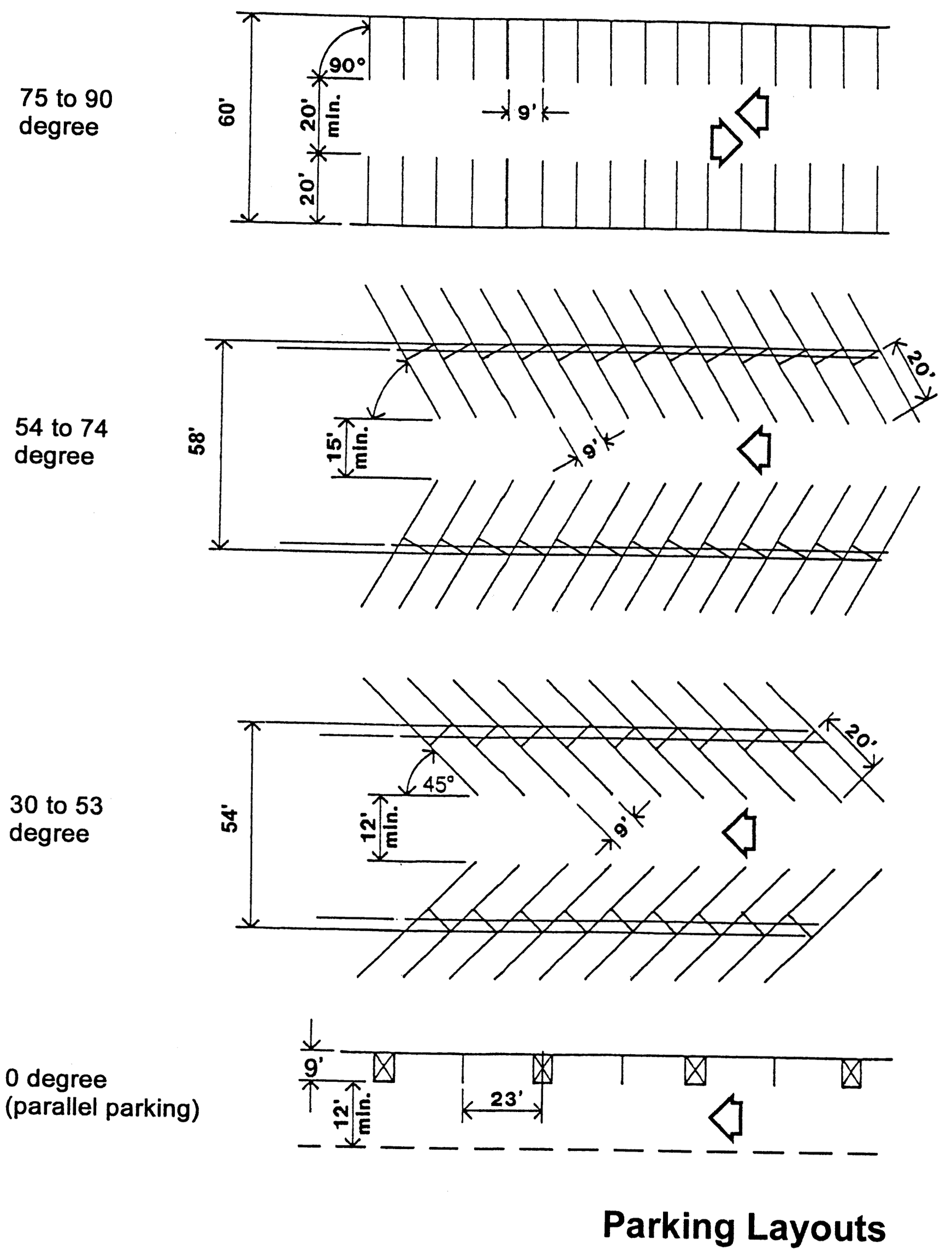
Parking Layouts
(c)
Off-street loading and unloading. On the same premises with every building, structure or part thereof, erected and occupied for manufacturing, storage, warehouse, goods, display, department store, wholesale store, market, hotel, hospital, mortuary, laundry, dry cleaning or other uses similarly involving the receipt or distribution by vehicles of materials or merchandise, there shall be provided and maintained on the same lot adequate space for standing, loading, and unloading services in order to avoid undue interferences with public use of the streets or alleys and parking areas. Such space, unless otherwise adequately provided for in the determination of the planning commission as provided below, shall include a ten (10) foot by fifty (50) foot loading space, with a fourteen (14) foot height clearance and shall be provided according to the following table:
Required Loading Spaces
The planning commission may modify the above dimensions and requirements upon making the determination that another standard would be more appropriate because of the number or type of deliveries experienced by a particular business or use as demonstrated on the site plan.
The location of loading and unloading areas shall be reviewed at the time of site plan submission to ensure that adequate protection is afforded to adjacent districts, in particular, residential districts from noise and other disruptive elements normally associated with such facilities.
(Ord. of 6-7-04; Ord. No. 2026-02, 3-2-26)
Sec. 78-164. - Access management and drive-way standards.
(a)
Statement of purpose. The purpose of this section is to provide access standards which will facilitate through traffic operations, ensure public safety along roadways, and protect the public investment in the street system; while providing property owners with reasonable, through not always direct, access. The standards are specifically designed for streets whose primary function is the movement of through traffic, as opposed to local streets whose primary function is access to adjacent properties.
(b)
Application of standards.
(1)
The standards of this section shall be applied to the Ann Arbor Road Corridor Zoning District.
(2)
The access standards contained herein shall be required in addition to, and where permissible shall supersede, the requirements of the Michigan Department of Transportation (MDOT).
(3)
The standards contained in this section 78-164 shall apply to all uses, except permitted single-family and two-family dwelling units.
(4)
For expansion and/or redevelopment of existing sites where the planning commission determines that compliance with all standards of this section is unreasonable, the standards shall be applied to the maximum extent possible. In such situation, suitable alternatives which substantially achieve the purpose of this section may be accepted by the planning commission, provided that the applicant demonstrates all of the following apply:
a.
Size of the parcel is insufficient to meet the dimensional standards.
b.
The spacing of existing, adjacent driveways or environmental constraints prohibit adherence to the access standards at a reasonable cost.
c.
The use will generate less than five-hundred (500) total vehicle trips per day or less than seventy-five (75) total vehicle trips in the peak hour of travel on the adjacent street, based on rates developed by the Institute of Transportation Engineers.
d.
There is no other reasonable means of access.
(c)
General standards for driveway location.
(1)
Driveways shall be located so as to minimize interference with the free movement of traffic, to provide adequate sight distance, and to provide the most favorable driveway grade.
(2)
Driveways, including the radii but not including right turn lanes, passing lanes and tapers, shall be located entirely within the right-of-way frontage, unless otherwise approved by the Michigan Department of Transportation and upon written certification from the adjacent property owner agreeing to such encroachment.
(d)
Standards for the number of commercial driveways. The number of commercial driveways shall be the minimum necessary to provide reasonable access for regular traffic and emergency vehicles, while preserving traffic operations and safety along the public roadway. A single means of direct or indirect access shall be provided for each separately owned parcel. Where possible, this access shall be via a shared driveway or a service drive. Where it is not possible to provide shared access, this access may be by a single driveway. Additional driveways may be permitted for a property only under one of the following:
(1)
One (1) additional driveway may be allowed for properties with a continuous frontage of over 500 feet, and one additional driveway for each additional 500 feet of frontage, if the planning commission determines there are no other reasonable access opportunities.
(2)
Two one-way driveways may be permitted along a frontage of at least 125 feet, provided the driveways do not interfere with operations at other driveways or along the street.
(3)
The planning commission may determine addition driveways are justified due to the amount of traffic generated by the use without compromising traffic operations along the public street, based upon a traffic impact study submitted by the applicant.
(e)
Driveway spacing standards.
(1)
Between driveways: The minimum spacing between two (2) commercial driveways on the same side of the road shall be based upon posted speed limits along the parcel frontage. The minimum spacing indicated below are measured from centerline to centerline.
Driveway Spacing Standards
(2)
Insufficient street frontage: For sites with insufficient street frontage to meet the above criterion, the planning commission may require construction of the driveway along a side street, a shared driveway with an adjacent property, construction of a driveway along the property line farthest from the intersection or require a service/frontage road.
(3)
Offsets: To reduce left-turn conflicts, new commercial driveways should be aligned with driveways or streets on the opposite side of the roadway where possible. If alignment is not possible, driveways should be offset a minimum of two hundred fifty (250) feet along an arterial roadway and one hundred fifty (150) feet along other roadways. Longer offsets may be required depending on the expected inbound left-turn volumes of the driveways, or sight distance limitations.
(4)
Spacing from intersections: Minimum spacing requirements between a proposed commercial driveway and an intersection either adjacent or on the opposite side of the street may be set on a case-by-case basis by the planning commission during site plan review but in no instance shall be less than the distances listed below. The following measurements are from the near edge of the proposed driveway, measured at the throat perpendicular to the street, to the near lane edge of the intersecting street or pavement edge for uncurbed sections.
Minimum Commercial Driveway
Spacing From Street Intersections
For sites with insufficient street frontage to meet the above criteria, the planning commission may require construction of the driveway along a side street, a shared driveway with an adjacent property, construction of a driveway along the property line farthest from the intersection or require a service/frontage road.
(f)
Standards for shared driveways and service/frontage roads. The use of service roads, in conjunction with driveway spacing, is intended to preserve traffic flow along major thoroughfares and minimize traffic conflicts, while retaining reasonable access to the property. Where noted above, or where the planning commission determines that reducing the number of access points may have a beneficial impact on traffic operations and safety while preserving the property owner's right to reasonable access, access from a side street, a shared driveway or service road connecting two or more properties or uses may be required. In particular, service drives, frontage roads or parking lot maneuvering lane connection between lots or uses may be required in the following cases:
(1)
Where the driveway spacing standards of this section can not be met.
(2)
When the driveway could potentially interfere with traffic operations at an existing or potential traffic signal location.
(3)
The site is along a portion of Ann Arbor Road where there is congestion or a relatively high number of accidents.
(4)
The property frontage has limited sight distance.
(5)
The fire department recommends a second means of emergency access.
(g)
Commercial driveway design. Commercial driveways shall be designed according to the standards of the MDOT and in accordance with the following:
(1)
For high traffic generators, or for commercial driveways along roadways experiencing or expected to experience congestion, all as determined by the planning commission, two (2) egress lanes may be required (one (1) being a separate left turn lane).
(2)
Where a boulevard entrance is designed by the applicant or planning commission, a fully curbed island shall separate the ingress and egress lanes. The radii forming the edges on this island shall be designed to accommodate the largest vehicle that will normally use the driveway. The minimum area of the island shall be one hundred eighty (180) square feet and the minimum width ten (10) feet. The planning commission may require landscaping on the section outside the public right-of-way. Such landscaping shall be tolerant of roadway conditions. Direct alignment of boulevard entrances is discouraged.
(3)
All commercial driveways shall provide an unobstructed clear vision between a height of three (3) feet and ten (10) feet in a triangular area measured ten (10) feet back from the point of intersection of the driveway and the street right-of-way.
(h)
Modification of standards for special situations. During site plan review the planning commission shall have the authority to modify the standards of this section 78-164 upon consideration of the following:
(1)
The standards of this section would prevent reasonable access to the site.
(2)
Access via a shared driveway or service/frontage road is not possible due to the presence of existing buildings or topographic conditions.
(3)
Roadway improvements (such as the addition of a traffic signal, a center turn lane or bypass lane) will be made to improve overall traffic operations prior to project completion, or occupancy of the building.
(4)
The use involves the redesign of an existing development or a new use which will generate less traffic than the previous use.
(5)
The proposed location and design is supported by the MDOT as an acceptable design under the existing site conditions. The planning commission may also request the applicant provide a traffic impact study to support the requested access design.
(6)
The modification shall be of the minimum amount necessary, but in no case shall spacing of a full-access driveway be less than sixty (60) feet, measured centerline to centerline.
(7)
Where there is a change in use or expansion at a site that does not comply with standards herein, the planning commission shall determine the amount of upgrade needed in consideration of the existing and expected traffic pattern and the capability to meet the standards herein to the extent practical.
(Ord. of 6-7-04)
Sec. 78-165. - Landscaping standards.
(a)
Installation.
(1)
All landscaping shall be installed in a manner consistent with accepted planting procedures and the approved landscape development plan. This shall include the quantity, size, type and location of plantings proposed.
a.
Major deviations as to quality, type, size and location of plant materials from the original approved landscape development plan shall require submission and approval in the same manner as provided in this article for the original submission.
b.
Minor revisions or deviations from the approved landscape development plan may be permitted if approved by the chief building official or municipality's designated expert. In reviewing such changes, the chief building official shall ensure that the changes do not constitute a whole-sale change of the landscape development plan and are consistent with the spirit and intent of this article and the previously approved development plan or site plan.
c.
The planting operations and installation shall conform to the standards and details adopted by the municipality.
(2)
Installation of all landscaping, screen walls, etc. shown on the approved landscape plan shall be made prior to issuance of a certificate of occupancy for the proposed development; subject to the following:
a.
If it is determined that the installation of the landscape materials, screen walls, etc., would be jeopardized by weather conditions, a temporary certificate of occupancy may be issued provided that the developer submits to the building department a cost estimate for the completion of the landscape plan and provides to the municipality a cash deposit, certified check or irrevocable letter of credit in the amount of the approved cost estimate.
b.
In no case shall a certificate of occupancy or a temporary certificate of occupancy be issued without the aforementioned submission or completion of the installation. It shall be the responsibility of the chief building official to see that this policy is carried out. At the time of submission of the cash deposit, certified check or irrevocable letter of credit, the chief building official shall indicate the completion date for the installation of all landscaping, screen walls, etc.
c.
Failure to comply with the completion date shall result in forfeiture of the deposit to the municipality and shall not release the developer from the obligation for installation and completion of the landscaping consistent with the approved plan. The chief building official may, however, grant one extension for 60 days after the written request from the developer, provided circumstances warrant such an extension.
(b)
Materials.
(1)
All plant material shall:
a.
Conform to size and description set forth in the current edition of "American Standard for Nursery Stock" sponsored by the American Association of Nurseryman, Inc. and approved by the American National Standards Institute, Inc. (ANSI).
b.
Be true to name in conformance to "Standardized Plant Names", established by the American Joint Committee on Horticultural Nomenclature, or other source accepted by the city.
c.
Be typical of its species or variety, have normal habit of growth, well-branched and densely foliated when in leaf.
d.
Be of sound health, vigorous and uniform in appearance with a well developed root system and free from disease, insect pests, eggs or larvae.
e.
Be freshly dug and nursery grown.
f.
Be chosen according to soil, climatic conditions and environmental factors for the proposed development.
(2)
Trees shall have straight trunks with leaders intact, undamaged and uncut.
(3)
The following trees, because of various problems, shall not be considered as being of a desirable quality, and therefore shall, in most cases, not be permitted. This does not preclude the use of existing trees if it can be shown that the removal of the tree would result in a substantial loss of screening and/or buffering of adjacent lands, uses or public rights-of-way.
a.
Acer negundo - Box Elder
b.
Ulmus varieties - Elm varieties
c.
Aesculus varieties - Horse Chestnut
d.
Populus varieties - Poplar varieties
e.
Salix varieties - Willow varieties
f.
Catalpa varieties - Catalpa varieties
g.
Ailanthus altissima - Tree of Heaven
h.
Elaeagnus varieties — Olive varieties
i.
Ginkgo biloba — Ginkgo (female only)
j.
Fraxinus varieties — Ash varieties
(4)
Lawn areas shall be planted in species of grass normally grown as permanent lawns in southeast Michigan. Grass may be sodded or hydro-seeded and mulched, except that solid sod shall be used in swales or other areas subject to erosion. Sod or seed shall be clean, free of weeds and noxious pests or disease.
(5)
Ground covers used in lieu of grass in whole or part shall be planted in such a manner as to present a finished appearance and reasonably complete after one complete growing season.
(6)
Stone and synthetic materials shall not be used as a groundcover.
(7)
Mulch: Planting beds shall present a finished appearance, with shredded hardwood bark mulch or similar natural material at a minimum depth of three (3) inches. Mulch used around trees and shrubs shall be a minimum of four (4) inches deep, and shall be pulled one (1) inch away from three trunks.
Pine bark mulch shall be prohibited. An effective edge treatment must be provided to minimize the migration of mulch.
(8)
Hedges, where provided, shall be planted and maintained so as to form a continuous, unbroken, solid, visual screen within one full planting season. Where plants are to be used as a hedge for screening purposes, the maximum spacing will have to be determined by the plant proposed.
(9)
Topsoil: A minimum four (4) inches of topsoil shall be provided for all lawn areas, ground covers and planting beds.
(10)
Artificial plant material shall be prohibited.
(11)
Landscaping shall be located and maintained in a manner that minimizes conflicts with overhead or underground utilities.
(12)
Existing vegetation to be preserved shall be protected during construction through the use of temporary fencing around the drip line.
(13)
Where pavement and landscape areas interface, adequate measures shall be taken to protect plants from vehicle encroachment.
(14)
Tree sizes are determined using the following two definitions: Caliper shall be defined as the diameter of the trunk of a tree at eighteen (18) inches above the ground. Diameter breast height (D.B.H.) is the diameter in inches of a tree measured at 4½ feet above the existing grade.
(15)
Minimum sizes of plant material:
a.
Deciduous shade trees: Shall be species having a trunk which can be maintained with over seven foot clear stem. Deciduous trees shall have a minimum caliper of three (3) to three and one-half at the time of planting.
b.
Deciduous small ornamental trees: Small ornamental trees shall be a minimum caliper of two inches at time of planting, or six feet in height in clump form.
c.
Evergreen trees: Evergreen trees shall be a minimum of eight feet in height at time of planting.
d.
Deciduous shrubs and upright evergreen shrubs: Shall be a minimum of thirty inches in height at the time of planting.
e.
Spreading evergreen shrubs and dwarf species shrubs: Shall be a minimum of eighteen (18) to twenty-four (24) inches in height or five (5) gallon container size at time of planting.
f.
Vines: Vines shall be a minimum of thirty (30) inches in length after one (1) growing season and may be used in conjunction with fences, screens, or walls to meet buffer requirements.
(c)
Variety of plant material sizes at installation.
(1)
To ensure adequate variety, and to avoid monotony and uniformity within the site, the overall landscape plan shall comply with the following:
(2)
Modifications: For specific landscape installations that require uniformity of plant size, such as hedges, mass plantings of shrubs as ground cover, and plants used as ornamental design accents, the planning commission may approve variations in the above percentages. Also, for reforestation, wooded area infill, and other applications determined appropriate by the planning commission, small caliper, park-grade trees may be approved.
(d)
Maintenance.
(1)
The owner of the property shall be responsible for all maintenance of site landscaping as follows:
a.
Landscape maintenance procedures and frequencies to be followed shall be specified on the landscape plan, along with the manner in which the effectiveness, health and intended functions of the various landscape areas on the site will be ensured.
b.
Landscaping shall be kept in neat, orderly and healthy growing condition, free from debris and refuse.
c.
Pruning shall be minimal at the time of installation, only to remove dead or diseased branches. Subsequent pruning shall assure proper maturation of plants to achieve their approved purpose.
d.
All dead plant material shall be removed and replaced within six (6) months after it dies or in the next planting season, whichever occurs first. For purposes of this section the planting season for deciduous plants shall be between March 1 and June 1 and from October 1 until the prepared soil becomes frozen. The planting season for evergreen plants shall be between March 1 and June 1. Plant material installed to replace dead or diseased material shall be as close as practical to the size of the material it is intended to replace.
(2)
The approved landscape plan shall be considered a permanent record and integral part of the site plan approval. Unless otherwise approved in accordance with the aforementioned procedures, any revisions to, or removal of, plant materials will place the parcel in non-conformity with the originally approved landscape plan and shall be viewed as a violation of this chapter and the agreed upon terms of the final site plan approval.
(3)
The developer, at the time of submission of the final site plan approval, shall demonstrate to the planning commission that adequate provisions have been made to supply water to all landscape areas, including right-of-way. This shall be accomplished by installation of an in-ground irrigation system to provide water for the landscape areas where specified. The commission shall have the authority to waive or modify this requirement where it determines that such action would be in accordance with the purpose and objectives of this article.
A contract for maintenance of all landscape areas may be required by the building department.
(Ord. of 6-7-04)
Sec. 78-166. - Character of landscaping, screening or buffering areas.
(a)
The selection and placement of plant materials shall be such that the general maintenance and upkeep of the areas shall be low so that the success of the planting area can be anticipated without placing undue hardship on the landowner or leasee.
(b)
Where landscape treatment is required for screening purposes, the planning commission shall insure that the plan proposed meets the following objectives.
(1)
The proposed plan effectively forms a complete visual and physical separation between the two (2) unlike land uses.
(2)
The proposed plan forms a transition zone between the unlike uses and affords sufficient protection and is compatible with the character of the adjacent residential area.
(3)
The proposed plan effectively reduces the adverse effects of the proposed use, in particular, glare of headlights, lighting from parking areas, noise, unsightly areas such as trash pickup points and contrasting views such as parking areas and access drives.
(c)
When the landscape treatment is required as a buffer or green area, the planning commission shall insure that the plan proposed meets the following objectives:
(1)
The proposed plan breaks up the area and the proposed plant material creates a partial visual separation.
(2)
The proposed plan forms a transition zone which helps break up the visual pattern of paving areas.
(3)
The proposed plan, through the use of plant material, creates a ground and overhead area which consists of plant material which is more compatible with the general character of the community and the residential districts.
(Ord. of 6-7-04)
Sec. 78-167. - Specific landscaping, screening and buffering requirements.
(a)
Intent. The ARC, Ann Arbor Road Corridor District was established for the express purpose of facilitating implementation of the Ann Arbor Road Corridor Design Plan. The Ann Arbor Road Corridor Design Plan proposes the installation of specific landscaping and design elements along the sides of Ann Arbor Road to act as a unifying streetscape. Consistency in these streetscape features, materials and colors is essential to achieving the community's desired aesthetic character, economic enhancement and revitalization, and to support the public health, safety and welfare.
Therefore, compliance with the following specific standards shall be required in conjunction with any site development, redevelopment, alteration or expansion or re-occupancy of a vacant building on an ARC site.
(b)
Ann Arbor Road streetscape.
(1)
Ann Arbor Road streetscape as required herein shall be provided:
a.
Along all Ann Arbor Road frontage; and
b.
Along other streets within the boundaries of the ARC District, where such streets have a street setback of fifty (50) feet or greater.
(2)
Compliance with prototype: Landscaping and streetscape improvements, shall be provided including but not limited to the colored stamped concrete verge, street trees, perennials, decorative fencing and brick piers, sidewalk and shrubs, and shall be consistent with the standards and requirements of the Ann Arbor Road Streetscape Prototype, "Ann Arbor Road Standard Design Details," dated October 16, 2003 (see Section 78-171), and as may be modified from time to time.
(3)
Tree and shrub quantities: Deciduous shade trees shall be planted along the length of the site frontage, in an amount equal to minimum of one (1) street tree per forty (40) feet or fraction thereof of site frontage.
(4)
Design flexibility: Within the intent of this article, the planning commission may approve alternatives it determines to be necessary to accommodate peculiar circumstances or unforeseen problems, or to carry out the spirit, intent and purposes of this article. Further, where streetscape elements have been accomplished along Ann Arbor Road by means of earlier development which substantially accomplish the overall design objectives, the planning commission may modify the requirements to reflect those earlier improvements.
(c)
Interface with residential use or district.
(1)
Where the Ann Arbor Road Corridor District, is adjacent to any single family, two family, or multi-family residential use or district.
Screening shall be provided consistent with the objectives of this article and shall be accomplished by-a solid wall with planting strip.
a.
The solid wall shall be consistent with the standards and requirements of the Ann Arbor Road Streetscape Prototype, "Ann Arbor Road Standard Design Details," dated October 16, 2003 (see Section 78-171), and as may be modified from time to time. The solid wall shall be located at the property line with a planting strip six (6) to eight (8) feet wide abutting the base and on the interior side of the wall. The planting strip shall be planted with deciduous shade trees planted thirty-five (35) feet on center.
b.
In general, to achieve the appropriate master planned interface, the solid wall must be provided consistent with the above standards. Within the context of these standards and the ARC District, the planning commission may approve modifications it determines necessary to address unusual circumstances.
(d)
Other areas requiring screening and/or buffering.
(1)
General standards. Other site uses and functions which require screening and/or buffering shall provide that screening and/or buffering based on the general standards below. All screening or buffering provided shall be related, consistent and compatible with the overall Ann Arbor Road design.
a.
Solid wall with planting strip. A solid wall shall be at least six feet in height, constructed of brick with a pre-cast concrete cap. The solid wall shall be located at the property line with a planting strip six to eight feet wide abutting the base and on the interior side of the wall. The planting strip shall be planted with deciduous shade trees with a minimum caliper of three to three and one-half inches, and planted 35 feet on center.
b.
Screening mound or berm. A screening mound or berm shall have a minimum height of five to six feet with side slopes no steeper than 3:1 (three feet horizontal to one foot vertical). The top of all berms shall have a level horizontal area of at least three feet in width.
The mound or berm shall be designed and graded in a manner which will blend with existing topography, shall be graded smooth, and shall be appropriately sodded, hydro-seeded, and mulched, or planted. Included as part of the mound or berm shall be deciduous shade trees, small deciduous ornamental trees, evergreen trees and/or shrubs planted along the berm area.
c.
Evergreen screen. Evergreen screens shall consist of evergreen trees with year-round screening characteristics. Such trees shall be planted ten to 15 feet on center in two staggered rows ten feet apart.
d.
Other screening may be considered if it will provide, in the opinion of the planning commission, the same screening effect and the objectives specified in section 78-165, character of landscaping, screening or buffering areas.
(2)
Public utilities.
a.
Communication facilities (not including buildings), public utility transformer stations, sub-stations, and gas regulator stations shall be screened.
The screen shall be reviewed by the planning commission to insure that it accomplishes the following objectives:
1.
The proposed screen effectively separates the proposed facility from the public right-of-way and the view of the general public.
2.
The proposed screen effectively establishes some form of separation and human scale between the proposed facility and abutting public walks.
b.
Screening shall meet the aforementioned objectives and shall be accomplished by any one or a combination of the following:
1.
Screening mound or berm.
2.
Solid wall with planting strip.
3.
Fence with evergreen screen.
(3)
Service areas screening.
a.
For purposes of this section, service areas are outdoor areas intended to be accessed by vehicles for purposes of supporting the principal use, including loading/unloading, deliveries, waste disposal and utility services.
b.
All service areas shall be screened or buffered in a manner as determined necessary by the planning commission to meet the aforementioned objectives of this article and shall meet the following specific objectives:
1.
Service areas shall be completely screened from adjacent residential areas and screened as determined necessary by the planning commission from view of the public right-of-way.
2.
All screening shall be contained within the subject property.
3.
Service areas shall be screened by appropriate plant materials, and/or architectural materials, such as a decorative wall, or a combination of both, to meet the screening objectives of this section.
(e)
Parking area screening.
(1)
All off-street parking areas and vehicular use areas shall be screened or buffered in a manner which meets the following specific objective:
a.
Off-street parking and vehicular use areas shall be buffered in a manner that separates the proposed facility from views as seen from the public right-of-way and creates a scale more appropriate to the individual and pedestrian.
b.
All screening or buffer areas shall be contained within the subject property.
(2)
Screening or buffering shall meet the aforementioned objectives of this section and article and shall be accomplished by the following options:
a.
A minimum ten-foot buffer area between the off-street parking and/or vehicular use area and the street setback line to include one tree per 40 feet or fraction thereof of street frontage of the parking lot and plantings of at least ten shrubs for every (30) feet or fraction thereof of street frontage of parking lot.
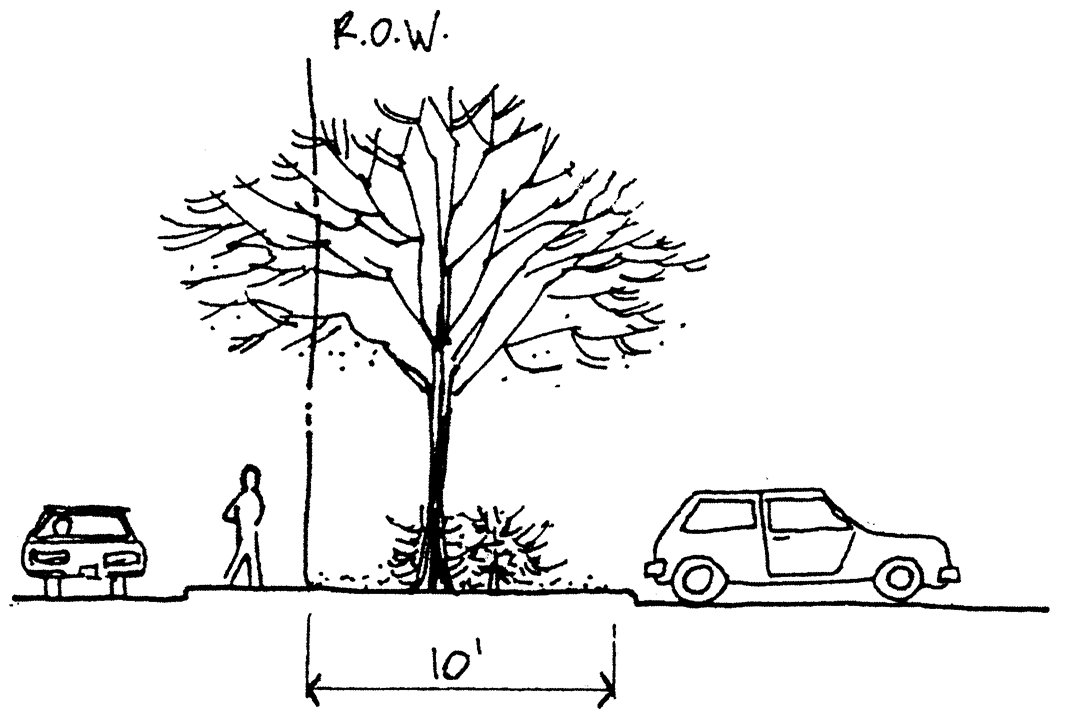
10-foot buffer
b.
A minimum 20 foot buffer area between the parking lot and the street setback line to include a three-foot high berm not exceeding 33 percent slope and a minimum of one tree for every 40 feet and five shrubs for every 30 feet or fraction thereof of street frontage of the parking lot.
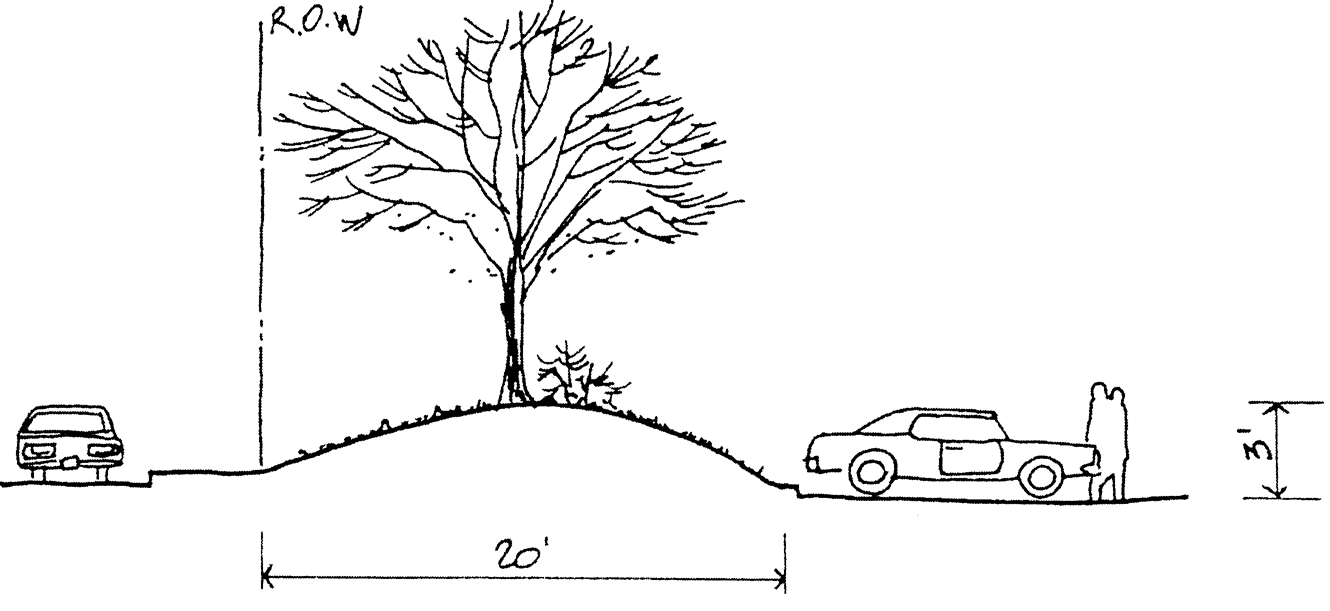
20-foot buffer
c.
A minimum six-foot buffer area between the parking lot and the street setback line to include a 36-inch high decorative metal fence. The fencing shall contain four-inch spacing between metal pickets with masonry pilasters spaced 24 feet apart, capped, and at least 16 inches to 21 wide. The minimum landscaping required in conjunction with the metal fence is one tree for every 40 feet and five shrubs for every 30 feet or fraction thereof of street frontage of parking lot.
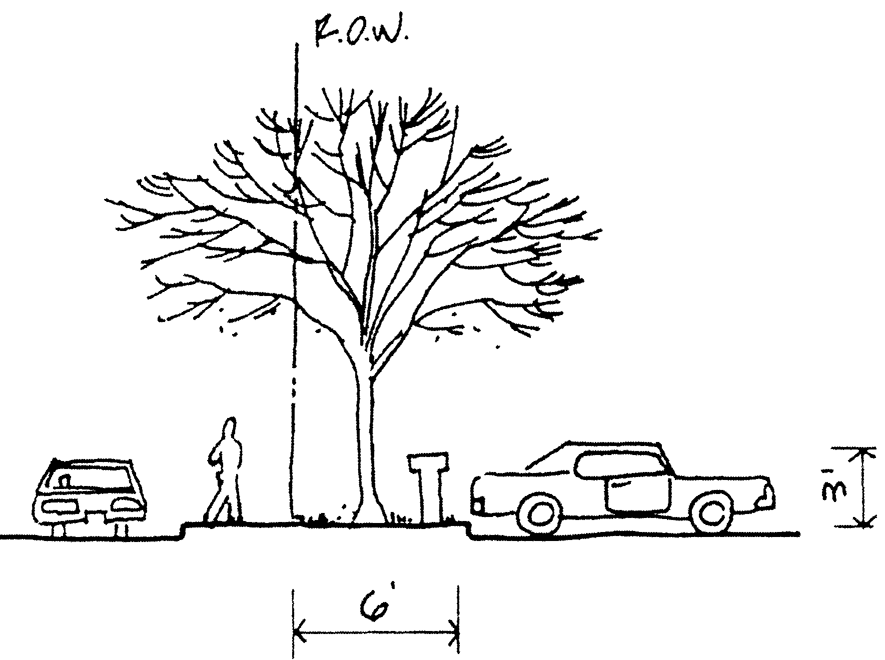
six-foot buffer
d.
A minimum four-foot buffer area between the parking lot and the street setback line to include a thirty-six-inch high masonry screening wall in conjunction with the minimum landscaping requirement of one tree for every 40 feet or fraction thereof of street frontage of the parking lot. The wall shall be constructed of brick or masonry block and shall also include a concrete stone or masonry cap providing one-half-inch reveal on both sides.
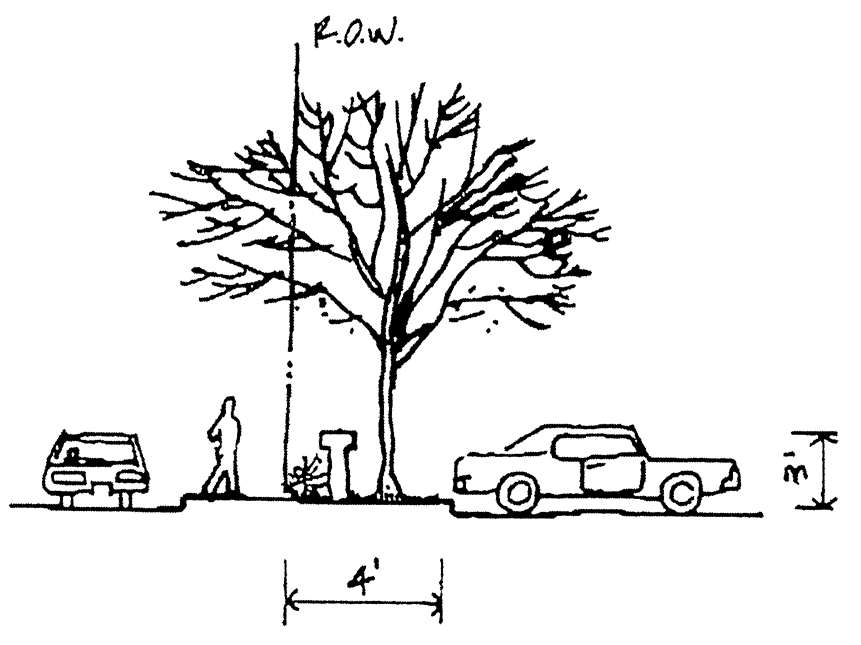
four-foot buffer
(3)
Screening and buffering options are summarized in the following chart:
Parking Area Screening
(4)
If the off-street parking and/or vehicle use area is located such that it requires Ann Arbor Road streetscape in accordance with section 78-167(b)1. then section 78-167(d)4.b., above, shall not apply.
(Ord. of 6-7-04)
Sec. 78-168. - Interior parking lot landscaping.
(a)
Parking lot landscaping.
(1)
Off-street parking areas containing twenty-five (25) or more parking spaces shall provide internal landscaping, other than that required in a buffer zone or along the street frontage, protected by a raised standard or rolled concrete curb, in accordance with the following:
a.
25 through 100 spaces: One canopy/deciduous tree and 100 sq. ft. of landscaped area per ten spaces, rounded upward.
b.
101 through 200 spaces: One canopy/deciduous tree and 100 sq. ft. of landscaped area per 12 spaces, rounded upward.
c.
201 spaces or more: One canopy/deciduous tree and 100 sq. ft. of landscaped area per 15 spaces, rounded upward.
(2)
The minimum size of a landscaped area shall be 60 sq. ft. and at least six feet in width.
(3)
Landscaped areas shall be covered by grass or other living ground cover.
(4)
Required trees shall be located to minimize potential damage by vehicles.
(5)
The internal landscaping shall be located and designed to direct traffic flow, particularly near site entrances. Additional landscaping shall be dispersed through the lot to define vehicular circulation, improve site aesthetics, provide shade, and installed such that, when mature, it does not obscure traffic signs, fire hydrants, lighting, drainage patterns on site or adjacent properties, or obstruct vision for safety of ingress or egress.
(Ord. of 6-7-04)
Sec. 78-169. - Signs.
(a)
Purpose. The purpose of these sign regulations is to provide for a unified approach to managing the size, placement, number and appearance of signs within the Ann Arbor Road Corridor District. Within the framework of the long term cooperative effort between the City and Charter Township of Plymouth, this section is intended to promote a balance between business advertising needs, the aesthetic recommendations of the Ann Arbor Road Plan and design guidelines, and the safety needs of the passing motorist.
(b)
Definitions:
(1)
Abandoned sign: A sign which, for ninety (90) consecutive days, fails to direct a person to or advertise a bona fide business, tenant, owner, product or activity conducted, or product available on the premises where such a sign is displayed.
(2)
Awning: A protective, roof-like covering, attached to the face of a building, as might be located over a window or door.
(3)
Awning or canopy sign: A sign which is painted on, printed on or attached flat against the surface of an awning.
(4)
Business center: A group of two (2) or more contiguous stores, businesses or offices, research facilities or industrial facilities developed as a planned complex which collectively have a name different from the name of any individual business, are under common ownership or management and share common parking areas, pedestrian areas, are linked architecturally or otherwise present the appearance of one (1) development site. Business centers may include shopping centers and other multi-tenant buildings.
(5)
Canopy: A roof-like architectural structure, typically attached to the face of a building, and used to provide protection from the elements (e.g., a canopy over a walkway or a gas station canopy).
(6)
Changeable copy sign: A sign that is designed so that the message can be changed, by physically replacing letters or by electric or electronic means.
(7)
Construction sign: A ground or wall sign listing the name of the project developers, contractors, engineers, or architects on the site being developed.
(8)
Directional sign: A ground sign located at the entry and/or exit of a business or commercial establishment which facilitates traffic flow.
(9)
Directional sign, off-premises: A monument sign, the sole purpose of which is to direct traffic to one (1) or more commercial businesses which are located on premises without frontage on or visual exposure to a major thoroughfare or collector road. Such businesses shall front on a road or easement which is used for their primary public ingress and egress from the major thoroughfare or collector road. The purpose of the off-premises directional sign is to facilitate the flow of traffic, encourage the concentration of commercial uses, discourage strip commercial development, and not to advertise the business or products or services offered, (however, directional signs may have the logo and/or name of the business to which the sign relates).
(10)
Festoon sign: Banners, pennants, incandescent light bulbs, or other such temporary features which are hung or strung overhead and which are not an integral, physical part of the building or structure they are intended to serve.
(11)
Flashing, animated, or moving sign: A sign that has intermittently reflecting lights, or signs which use intermittent, flashing, scintillating, or varying intensity of illumination to create the appearance of movement, or a sign that has any visible portions in motion, either constantly or at intervals, whether caused by artificial or natural sources.
(12)
Ground sign: A sign supported by one (1) or more uprights, poles, braces, or a masonry base, or a monument placed in or upon the ground surface and not attached to any building. Ground signs shall include monument and pole signs.
(13)
Inflatable sign: A sign that is either expanded or its full dimensions are supported by gases contained within the sign, or a sign part, at a pressure greater than atmospheric pressure.
(14)
Illuminated sign: A sign that is illuminated by a direct or indirect source of light so shielded that no direct rays from it are visible from any public right-of-way or from the abutting property.
(15)
Institutional bulletin board: A structure containing a surfaced area upon which is displayed the name of a religious institution, school, library, community center or similar institutions, and the announcement of its services or activities.
(16)
Marquee. A roof-like structure, often bearing a sign, projecting over an entrance to a theater.
(17)
Marquee sign: A sign attached to a marquee projecting from and supported by the building.
(18)
Menu board or order board: A sign which is intended to service patrons using a drive-thru facility.
(19)
Monument sign: A ground sign that is mounted on a base which is in contact with or close to the ground. The base of a monument sign shall be no less than 75 percent of the greatest horizontal dimensions of the sign face, and the vertical separation between the lowest point of the sign face and the highest point of the sign base shall be no greater than 12 inches.
(20)
Monument sign base: The lower part of a monument sign which may appear as a separate architectural feature, and serves as its ground support.
(21)
Neon sign: A sign consisting of glass tubing, filled with neon or another gas, which glows when electric current is sent through it.
(22)
Nonconforming sign: Any advertising structure or sign which was lawfully erected and maintained prior to the effective date of this ordinance, and any amendments thereto, and which fails to conform to all applicable regulations and restrictions of this chapter.
(23)
Off-premises sign: A sign which contains a message unrelated to a business or profession conducted on the premises, or to a commodity, service or activity, not sold or offered upon the premises where such sign is located.
(24)
Panel sign: A sign whose letters and/or symbols are on a panel contained within a frame, incorporated into a framed background which is an integral part of the sign. This definition is intended to distinguish between panel signs and signs consisting of individual freestanding letters and/or symbols.
(25)
Permanent window sign: A window sign that is constructed of materials that do not require replacement on a frequent basis (in contrast to temporary paper window signs).
(26)
Pole sign: A ground sign that is mounted on a freestanding pole(s) or other support(s) with a clear space of 8 feet or more between the bottom of the sign face and the grade.
(27)
Political sign: Means a temporary sign, whose message relates to a candidate for political office, to a political party, to a political issue, or an ideological opinion.
(28)
Portable sign: A freestanding sign not permanently anchored to secure to either a building or the ground, such as, but not limited to trailers, "A" frame and "T" shaped sign structures, including those mounted on wheeled trailers.
(29)
Premises: Any lot or parcel of land, or building or site as otherwise used in this ordinance; a unit of contiguous real property under common ownership.
(30)
Projecting wall sign: A sign that is attached to and projects from a building wall at an angle of up to 90 degrees. Panel and frame which projects from the wall at an angle or 90 degrees, by no more than four feet from the building, or one-third of the sidewalk width, whichever is less. Angular projection at the corner of a building is prohibited. Projecting wall signs shall clear sidewalk by at least ten feet and shall not extend vertically beyond the window sill of the second story. Projecting wall signs should be spaced at least 25 feet apart, shall not be internally illuminated and shall not contain changeable copy. A projecting wall sign does not include canopy, awning, roof, marquee, or internally illuminated signs.
(31)
Real estate sign: A temporary non-illuminated sign for the purpose of advertising or promoting the sale, lease or rental of real estate. A permanent leasing sign is a real estate sign that is erected for an indefinite period of time for the purpose of offering space in a building for lease.
(32)
Roof sign: A sign erected, constructed and maintained wholly upon or over the roof of any building, with its principal support on the roof structure. For purposes of this section, any architectural element which is used on the wall of a structure to give the appearance of a roof line similar to a mansard, gambrel or other roof type, shall be considered as a roof. A vertical plane or fascia which is attached to and located below the angled plane of a slope roof and which is less than 6 inches in height shall be considered part of the roof.
(33)
Service club entrance sign: A sign, usually located along the main entrance ways to a community, displaying the names of service clubs and organizations, their meeting schedule and usually including the service club symbol or logo. The name of the community and a short salutary message may also be included.
(34)
Sign: Any name, identification, description, object, device, structure, display or illustration which is affixed to, or painted, or represented directly or indirectly upon a building, structure or piece of land, and which directs attention to an object, product, place, activity, person, institution, service, event, organization, or business by any means, including words, letters, figures, design, symbols, fixtures, colors, illumination or projected images.
(35)
Signable area: A continuous surface or wall unobstructed by windows, doors and other major architectural details. The signable area shall equal the area of (a × b) or (c × d) or (e × f) in the following illustration, at the choice of the applicant.
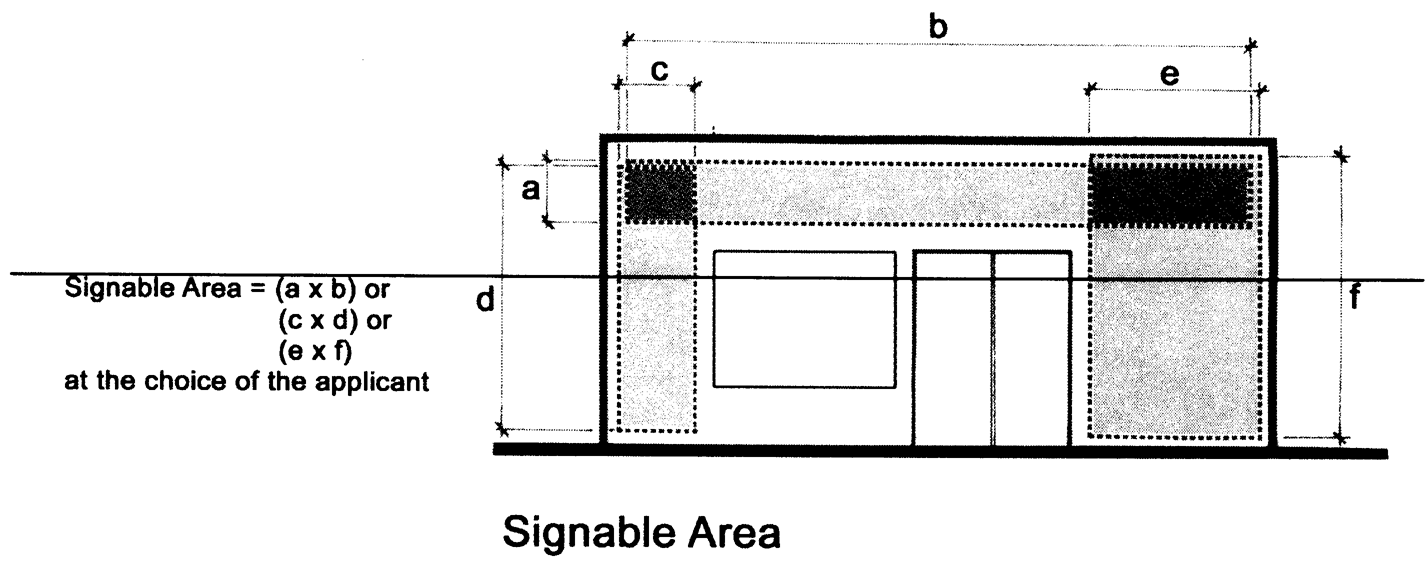
Signable Area
(36)
Temporary sign: Any sign regardless of size and materials that is not permanently fastened to any structure, such as posts with permanent footings, and that is limited in duration to thirty (30) days, except as otherwise specified. Temporary signs include paper window signs, inflatable signs, banners and pennants.
(37)
Time-temperature sign: A sign which displays the current time or outdoor temperature or both and which displays no material except for the name of a business, product or service.
(38)
Underhanging sign: A sign that is located on the underside of a canopy or walkway, typically for the benefit of pedestrians.
(39)
Vehicle business sign: A sign painted or attached to a vehicle which is located on premises primarily for purposes of advertising the business, or product for sale on the premises. Commercially licensed vehicles which are generally used daily off-site are not included in this definition.
(40)
Wall sign: A sign which is attached directly to or painted upon a building wall which does not extend above the height of the wall to which it is attached nor more than twelve (12) inches therefrom, with the exposed face of the sign in a plane parallel to the building wall. Included in the definition of wall signs are signs mounted above the eave line, but not extending above the roof peak and signs mounted flat against the building fascia, provided the sign does not protrude beyond any boundary of the fascia.
(41)
Window sign: A temporary or permanent sign painted on or affixed to a window surface, suspended so as to hang more or less parallel with the window surface, or otherwise displayed in a manner intended to be viewed from outside the window.
(c)
General standards. The following general standards shall apply to signs in the ARC, Ann Arbor Road Corridor District:
(1)
Measurement of sign area: The entire area within a rectangle or square enclosing the extreme limits of writing, representation, emblem, or any figure of similar character, together with any frame, tower, or other material or color or internally illuminated area forming an integral part of the display or used to differentiate such sign, shall be included in the measurement. Such signs shall be deemed to be a single sign whenever the proximity, design, content or continuity reasonably suggests a single unit, notwithstanding any physical separation between parts.
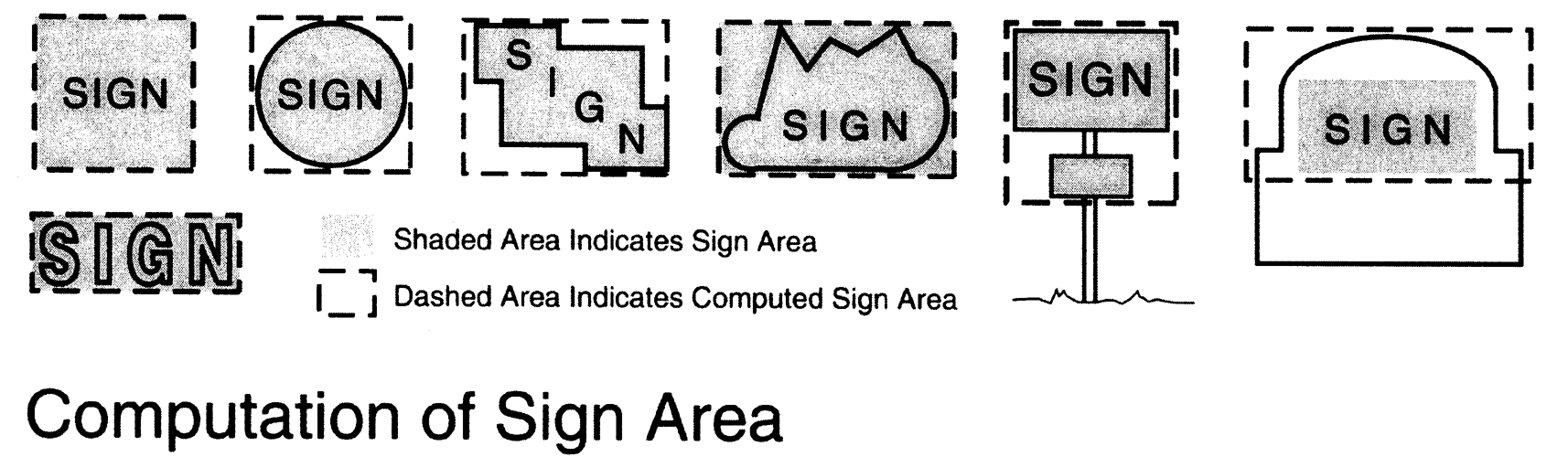
Computation of Sign Area
a.
Where a sign has two or more faces, the area of all faces shall be included in determining the area of the sign, except that where two such faces are placed back to back and are at no point more than two feet from one another, the area of the sign shall be taken as the area of one face, if the two faces are of equal area, or as the area of the larger face, if the two faces are of unequal area.
b.
For ground signs, the area shall include the entire area of the sign upon which copy, lettering, drawings or photographs could be placed, excluding necessary uprights or supports. For monument signs, the base of a monument sign shall be excluded from the calculation of sign area for a distance to 30 inches above grade. Streetscape and landscape features which in the determination of the planning commission, are an integral part of the sign design shall also be excluded from the calculation of sign area.
c.
For internally-illuminated awnings or canopies, the entire flat surface of the awning or canopy upon which the message is written shall be included in the sign area calculation. Signs mounted on awnings and canopies that are not internally-illuminated shall be subject to the sign area standards of measurements specified in paragraph (a), above.
d.
For paper window signs the area shall include, the entire area of the paper. Where adjacent paper window signs are within eight inches of each other, they shall be measured as a single sign.
(2)
Sign setback: Where it is specified that a sign must be setback a minimum or other certain distance from property lines, street setback lines or public right-of-way lines, such distance will be measured from the portion of the sign structure nearest to the specified line. For purposes of this measurement, the property lines, street setback lines and public right-of-way lines extend perpendicularly from the ground to infinity.
(3)
Sign height: The height of a ground sign shall be the distance from the average level of the ground or pavement directly below the sign to the highest point of the sign structure, including any supportive or decorative appendages, without including any berm landscaping, grading, or artificially or unnaturally constructed raised portion of land at the point of measurement.
(4)
Underground wiring: Where illumination is desired, underground wiring shall be required for all signs not attached to a building.
(5)
Sign Lettering. Any sign which is proposed to include letters, symbols, emblems or other figures of similar character, which are larger than 16 inches, shall require planning commission approval.
(d)
Prohibited signs. Except as permitted by Article XIX, the following signs shall be prohibited:
(1)
Festoon signs.
(2)
Signs which incorporate in any manner any flashing of intermittent lights.
(3)
Inflatable signs, except as provided in Article XIX.
(4)
Off-premises advertising signs.
(5)
Portable signs.
(6)
Roof signs. For the purpose of this section, any architectural element which is used on the wall of a structure to give the appearance of a roof line similar to a mansard, gambrel or other roof type shall be considered the same as a roof and no sign shall be permitted upon it. A vertical plane or fascia which is located below the angled plane of a sloped roof or roof element and which is less than six inches in height, shall be considered part of the roof and not used for signage.
(7)
Vehicle business sign.
(8)
Banners, pennants, spinners and streamers, except as provided in section 78-169(e)(14) and (f)(8) for banners.
(9)
Any sign which revolves or has any visible moving part, visible revolving parts or visible mechanical movement of any description or other apparent visible movement achieved by electrical, electronic pulsations, or by mechanical means, including intermittent electrical pulsations, or by action of normal wind currents, except those actions associated with street time/temperature signs.
(10)
A sign or sign structure which is determined by the building official to be:
a.
Is structurally unsafe.
b.
Constitutes a hazard to safety or health by reason of inadequate maintenance, dilapidation or abandonment.
c.
Is not kept in good repair.
d.
Is capable of causing electrical shocks to persons likely to come in contact with it.
(11)
Any sign which by reason of its size, location, content, coloring or manner of illumination, constitutes a traffic hazard or a detriment to traffic safety by obstructing the vision of drivers, or by obstructing, or detracting from the visibility of any traffic sign or control device on public streets and roads.
(12)
Any sign which obstructs free ingress to or egress from a required door, window, fire escape or other required exit.
(13)
Signs which make use of such words as "Stop", "Look", "Danger", or any other words, phrases, symbols or characters in such a manner as to interfere with mislead or confuse vehicular traffic.
(14)
Any sign unlawfully installed, erected or maintained.
(15)
Any sign now or hereafter existing which advertises a product, service or business no longer available at that location, including abandoned signs.
(16)
Wall panel signs.
(17)
Pole signs.
(18)
Electronic or electric changeable copy signs, except as permitted time-temperature signs.
(19)
Neon or string lights used to highlight architectural features or to frame a window or door, except as may be permitted under section 78-204, exterior lighting.
(20)
Any type of sign not expressly permitted.
(e)
Area, height, placement and other regulations for permitted signs.
(1)
Ground signs.
a.
Type. All ground signs shall be monument signs.
b.
Location. Ground signs shall be located wholly within the boundaries of the property to which the sign relates, exclusive of the street setback or road right-of-way area.
c.
Setback. On premises with street frontage less than 200 feet, ground signs shall be setback a minimum of five feet from the existing right-of-way or street setback line, whichever is greater. On premises with a street frontage of 200 feet or greater, ground signs shall be setback a minimum of ten (10) feet.
d.
Sign area.
1.
On premises with street frontage less than 200 ft., the maximum sign area shall be 25 square feet at the five-foot setback line. However, the maximum sign area shall be permitted to increase one square foot for each additional foot of setback, to a maximum area of 42 square feet. The base of a monument sign shall be excluded from the calculation of sign area for a distance of 30 inches above grade.
Maximum Sign Area
Premises With Street Frontage Less Than 200 Feet
2.
On premises with a street frontage of two hundred (200) feet or greater, the maximum sign area shall forty-two (42) square feet at the ten (10) foot setback line. However, the maximum sign area shall be permitted to increase based upon each additional foot of setback, to a maximum area of sixty (60) square feet in accordance with the following chart. The base of a monument sign shall be excluded from the calculation of sign area for a distance of thirty (30) inches above grade.
Maximum Sign Area
Premises With Street Frontage 200 Feet or Greater
e.
Height. The maximum height shall be as follows:
1.
On premises with a street frontage less than 200 feet: Eight feet.
2.
On premises with a street frontage of 200 feet or greater: Ten feet.
f.
Number. One ground sign shall be permitted per street frontage on any parcel. However, only one sign shall be permitted on lots having frontage on more than one street if a single sign can be located such that it is visible from both streets. In multi-tenant buildings or shopping centers, the sign area may be allocated for use by individual tenants.
g.
Planning commission review; design standards. The planning commission shall review all ground sign applications to assure compliance with the design, placement and dimensional standards of this article. The following design standards shall apply:
1.
Monument signs shall have a brick base or an approved equal subject to planning commission approval. Signs shall harmonize with the Ann Arbor Road Streetscape materials, and be incorporated into the streetscape design. Brick shall be Wyandotte Modular consistent with the standards and requirements of the Ann Arbor Road Streetscape Prototype, "Ann Arbor Road Standard Design Details," dated October 16, 2003 (see section 78-171), and as may be modified from time to time.
2.
The base of any ground sign shall be landscaped to create a year round buffer for the sign.
3.
Lettering style shall be clean and simple to assure readability and shall be in harmony with the style of architecture of the building. Generally, no more than two different fonts shall be used on each sign.
4.
It is the intent of this article to require signs to be in harmony with the building color and architecture therefore generally no more than three colors may be used per sign and one (1) uniform, background color. Established company logos are exempt from color limitations. An established company logo is one that has historically been used as a symbol representing the company. For the purposes of this regulation, black and white shall be considered colors.
5.
Sign messages shall be located at least 30 inches above the ground to allow for snow accumulation and plant growth.
h.
Changeable copy signs. Changeable copy ground monument signs shall be permitted, subject to all of the requirements for ground signs specified herein, and the following additional requirements:
1.
Letter height shall not exceed four inches.
2.
Electronic or electric changeable copy signs are not permitted.
3.
The area of the changeable copy sign shall be counted toward the maximum ground sign area.
4.
The base of the sign shall be brick, with limestone capped brick piers on the two ends of the sign. The changeable copy sign shall not project above the brick piers by more than one-half of the message area's height.
(2)
Wall signs.
a.
The maximum wall sign area permitted shall be 50 percent of the signable area, up to a maximum wall sign area of 42 square feet. On a premises with an Ann Arbor Road street frontage of 200 feet or greater, permitted wall sign area shall be 30 percent of the signable area, up to a maximum of 90 square feet (see Table).
Maximum Wall Sign Area
Individual Letters
Maximum Wall Sign Area
200 ft. or Greater Frontage on Ann Arbor Road
In the case of a wall sign which advertises more than one business or tenant, the maximum permitted sign area shall be allocated between the businesses or tenants.
b.
Maximum height of a wall sign shall be the height of the wall to which the sign is attached, not to exceed 35 feet.
c.
One wall sign shall be permitted on each facade which has a separate public means of ingress and egress.
In the case of a building with more than one tenant, such as a shopping center or business center, one wall sign shall be permitted for the center itself and for each tenant that has its own separate door to the outside to provide public access.
d.
Tenants that occupy a corner space in a multi-tenant structure shall be permitted to have one sign on each facade of the building which has a separate direct pedestrian access to that office or business establishment from the outside. Where several tenants use a common entrance in a multi-tenant structure, only one wall sign shall be permitted, but the total sign area should be allocated on an equal basis to all tenants.
e.
Where separately owned businesses occupying a single building on a single parcel of land (such as a multi-tenant building, business center or shopping center) use individual wall signs, all such signs on the building or within the center shall be of a common style, e.g., individual freestanding letters shall be utilized with other signs composed of individual freestanding letters,
f.
Panel signs shall be prohibited, except that the planning commission may permit panel signs upon finding that other types of permitted signs would not be practical or feasible because of the shape, character or configuration of the building or site and/or because of the nature of the message being conveyed.
(3)
Projecting signs. Instead of wall or marquee sign, a business may be permitted to have a projecting sign, subject to the following specifications:
a.
The maximum area of a projecting sign shall be 25 square feet on buildings located ten feet or less from the street setback line. The maximum area of a projecting sign shall be permitted to increase one square foot for each additional foot of setback greater than ten feet to a maximum area of 42 square feet.
b.
One projecting sign shall be permitted on each facade which has a separate public means of ingress and egress.
c.
Projecting signs shall be permitted only on zoning lots of 50 feet or more on the side on which the sign is to be mounted.
d.
Projecting signs shall extend no higher than the height of the wall to which the sign is attached and no higher than the window sill of second story windows. Eight feet, six inches of clearance is required beneath projecting signs.
e.
Signs must project at a ninety-degree angle to the building surface to which it is attached. Angular projection at the corner of a building is prohibited.
f.
Signs shall not project more than five feet over the property line and more than four feet from the face of the building or one-third of the sidewalk width, whichever is less.
g.
Projecting signs shall be attached directly to a building through building mounts or hung from a mast arm. These support members may also include decorative appurtenances, but external bracing such as guy wires and metal framework shall be prohibited.
h.
Projecting signs shall be spaced a minimum of 25 feet apart.
i.
Projecting signs shall not be internally illuminated.
j.
Projecting signs shall not contain changeable copy.
(4)
Underhanging signs. Where the roof structure of a building containing more than one business is extended over a walkway along the outer edge of the building, one pedestrian oriented underhanging sign may be permitted for each business in the building provided:
a.
All signs are of identical size, shape, lettering style, and color scheme.
b.
All signs shall contain the name of the business only.
c.
Maximum of six square feet.
(5)
Awning, canopy and marquee signs. Instead of a wall or projecting sign, a business may be permitted to have an awning, canopy or marquee sign, subject to the following specifications:
a.
Marquee signs may be permitted, subject to the following:
1.
Maximum area shall not exceed 50 percent of the signable area up to a maximum of 42 square feet. For this purpose, signable area shall be calculated as if the marquee did not exist.
2.
Placement—Marquee signs may be positioned in one of two ways as follows:
(i)
The display surface of the sign shall be attached flat against, and not extending beyond, the vertical surface of the marquee structure.
(ii)
Individual cut-out letters mounted on top of the marquee edge and parallel to it.
3.
Maximum height—No portion of a marquee sign shall be higher than the top of the marquee or the eave line of a building.
b.
Awning and canopy signs. Awning and canopy signs may be permitted, subject to the following:
1.
The maximum area shall not exceed that which is permitted for a wall sign, based on using the vertical face of the awning or canopy for calculation of signable area.
2.
Placement. Awning and canopy signs shall be affixed or attached flat against a vertical surface of the awning or canopy, and shall not extend above, below or beyond the vertical surface of the awning or canopy.
3.
Maximum height. No portion of an awning or canopy sign shall be higher than the eave line of the building.
(6)
Window signs.
a.
A maximum of 20 percent of the glass surface of the window segment in which the sign is located may be used for window signs.
b.
No such signs shall be permitted in windows above the first story.
c.
No more than two temporary window signs shall be permitted.
(7)
Flags. Flags bearing the official design of a corporation or award flags subject to the following:
a.
Such corporation or award flags shall be displayed on flag poles only. Attachment to any other site fixture or feature shall be prohibited.
b.
A maximum of two such flags shall be permitted for each flag pole provided.
c.
The maximum number of flag poles permitted per individual business shall be determined in accordance with the following table:
Maximum Number of Flag Poles Permitted
d.
Placement of flag poles shall be in a manner and location subject to the following requirements:
1.
The placement shall not impact adjacent properties, in particular, those of a residential nature.
2.
The height of flagpoles shall conform to the height restrictions of the ARC District for buildings and structures. A flagpole shall be deemed to a structure under all provisions of this article. Flagpoles shall comply with the setback requirements for structures.
3.
The placement shall not constitute a traffic or pedestrian hazard or impair vehicular or pedestrian traffic.
4.
The size, content, coloring or manner of illumination of said flags shall not constitute a traffic or pedestrian hazard or impair vehicular or pedestrian traffic flow.
5.
No flag shall be permitted to project into the road right-of-way at full extension of the flag.
e.
Flag poles shall not be located on the roof of a building.
(8)
Directional signs. Directional signs intended to assist vehicular traffic flow subject to the following:
a.
On-premises directional signs.
1.
Directional signs shall not exceed two square feet per side, nor exceed two sides.
2.
Said signs may incorporate a corporation or business logo provided the main theme of the sign shall be to facilitate vehicular traffic flow.
3.
Placement shall be within the subject property; no such signs shall be permitted within the street setback area or right-of-way.
4.
The size, content, coloring, placement or manner of illumination shall not constitute a traffic or pedestrian hazard or impair vehicular or pedestrian traffic flow.
5.
Directional ground signs shall not exceed a height of six feet and may be located one at each driveway entrance.
6.
No more than one directional wall sign may be located at each building entrance.
b.
Off-premises directional signs.
1.
In order to encourage the clustering of businesses, and minimize strip commercial development in accordance with the community master plan, while still allowing necessary and reasonable identification of businesses, facilitating the orderly flow of traffic, and avoiding unnecessary proliferation and excessive size of signs on major thoroughfares, off premises directional signs may be permitted on a limited basis.
2.
Off-premises directional signs are permitted only upon review and approval of the planning commission, subject to compliance with the following conditions:
(i)
Approval of the sign would serve to further the purposes specified in section 78-169(e) above.
(ii)
The planning commission shall determine that the ARC zoned business has no frontage or access from a major thoroughfare; the premises of said business are within 1,200 feet of said thoroughfare; said business is not visible from a major thoroughfare, or is visible from a major thoroughfare but with no clear indication of how to access the business; and that adequate identification of the business and direction of traffic to the business would not be possible without an off-premises directional sign.
(iii)
No off-premises directional sign shall be permitted without a recorded easement or executed agreement that accomplishes all of the following:
(a)
States that the owner of the parcel on which the sign is to be placed grants permission for the off-premises directional sign to be located on the parcel,
(b)
Stipulates which parcel(s) are entitled to use of the off-premises directional sign, and
(c)
Specifies how the sign is to be maintained and establishes a means to assure that maintenance runs with the life of the sign.
(iv)
Off-premises directional signs shall be located only on land zoned ARC and direct traffic to only land also zoned ARC.
(v)
Off-premises directional signs shall be permitted only at the intersection of the access road for the business and a major thoroughfare, and only one such sign permitted at each intersection. The business access road may be a public street, private road, or recorded access easement over which the general public has ingress/egress rights. Said sign shall be in reasonable proximity to the intersection to enable the sign to direct traffic to the site of the business being identified by the sign. If multiple businesses served by the same access road require the use of the same intersection for an off-premises business directional sign, the same sign shall be used.
(vi)
Off-premises directional signs shall be located entirely on private property and no closer than 30 feet from the centerline of the street, private road, or recorded access easement which provides access to the business. The sign shall be located a minimum of 60 feet from the centerline of the major thoroughfare. The sign location shall comply with all other setback and visibility requirements of the municipality.
(vii)
Off-premises directional signs shall be monument signs with the minimum dimensions necessary to accomplish the purpose of directing traffic; however, in no case shall the sign area and height exceed the following dimensions.
The base of an off-premises directional sign shall be excluded from the calculation of sign area for a distance of 30 inches above grade.
(viii)
Space shall be allocated on the sign to allow identification of all businesses which use the same access road to use the off-premises directional sign. A common font and no more than one uniform background color shall be used. The sign shall state only the name of the business(es) being identified. A directional arrow may also be included on the sign. The sign base shall be of brick or decorative masonry block.
(ix)
The ground within (5) feet of the base of the off-premises directional sign shall be landscaped in low shrubbery, ground cover or flowers, and said landscaping shall be maintained in presentable condition.
(x)
Off-premises directional signs may be illuminated provided the illumination creates no perceptible glare on private property at a distance greater than ten feet from the sign and on public streets and the access drive.
3.
The off-premises directional sign shall be maintained in a sound and presentable condition. If a business that is identified on the off-premise directional sign ceases to exist at its location or changes its name, the appropriate deletion or change to the copy of the sign shall be made within 30 days of the change in the business.
4.
The existence of an off-premise directional sign shall not affect the permission of any other signage that is otherwise permitted by the municipality, including the following:
(i)
Any other signage on the same parcel as the off-premises directional sign.
(ii)
Any other signage on the same parcel as the business identified by the off-premises directional sign.
(9)
Menu and/or order board. Menu and/or order board for a drive-thru facility subject to the following:
a.
Said signs shall be located on the interior of the lot or parcel and shall not be readable from the exterior of the lot.
b.
Said signs shall be intended to service the public utilizing the drive-thru facilities only.
c.
The placement shall not constitute a traffic or pedestrian hazard or impair vehicular or pedestrian traffic flow in any manner.
d.
The size, content, coloring or manner or illumination shall not constitute a traffic or pedestrian hazard or impair vehicular or pedestrian traffic flow.
e.
The volume on order boards shall be maintained at the minimum level necessary so that it is audible to users, so as to minimize extraneous noise traveling off the site.
(10)
Institutional bulletin boards. Institutional bulletin boards which comply with the standards for ground signs, herein.
(11)
Political signs. Political signs subject to the following:
a.
Political signs are permitted in any use district provided they do not exceed four square feet in area per side or four feet in height.
(12)
Real estate signs. Real estate signs subject to the following:
a.
Temporary real estate signs.
1.
Such signs shall be limited to ground or wall signs only. One sign shall be permitted per parcel, regardless whether the property is represented by more than one real estate agency.
2.
Maximum sign area shall not exceed 42 square feet.
3.
Sign height shall not exceed four and one-half feet for a ground sign or eight feet for a wall sign.
4.
Placement shall be wholly within the property boundaries to which the sign pertains.
5.
The sign may be erected at the time the property is offered for sale and shall be removed within ten days of the sale or lease of the property.
b.
Permanent leasing signs. Permanent leasing signs erected for a period of one year a longer shall be subject to the following:
1.
If the permanent leasing sign is a ground sign, it shall be a monument sign and it shall be subject to the location, setback, and other applicable standards in section 78-170(e)(1).
2.
If the permanent leasing sign is a wall sign, it shall be subject to the applicable standards in section 78-170(e)(2).
3.
Permanent leasing signs shall comply with the maximum sign area and sign height requirements that apply to temporary real estate signs.
4.
Such signs shall be maintained in good repair, and shall be replaced or renovated when weathered or worn.
(13)
Temporary construction signs. Temporary construction signs subject to the following:
a.
Such signs shall be limited to ground or wall signs. One sign shall be permitted per street frontage.
b.
Total area of all temporary construction signs on a premises shall not exceed 32 square feet.
c.
Sign height shall not exceed four and one-half feet for a ground sign or eight feet for a wall sign.
d.
Placement shall be wholly within the property boundaries to which the sign pertains.
e.
The sign shall not be erected prior to issuance of a building permit for the proposed construction project and shall be removed upon issuance of a certificate of occupancy.
(14)
Banners. Banners used to draw attention to vehicle dealerships are permitted, provided that there is a maximum of one banner on each pole, and provided that they have no written message or corporate identity. Each banner shall not exceed a maximum area of 20 square feet.
(f)
Permit required; permit exemptions. Except as noted in this sub-section, all signs shall require a permit prior to installation. The following signs shall be permitted without obtaining a sign permit:
(1)
Street address signs (required). For purposes of identification by emergency personnel (fire, police, EMS) all businesses, offices, and industrial buildings shall prominently display their street address on the front side (facing the street) of their building or upon freestanding signs or building entranceways. All street addresses shall be in Arabic numerals, each numeral shall be large enough to be easily read from the street, but in no event smaller than four inches high by two and one-half inches wide, except for numeral one which shall have a width in proportion to its height. Street address signs shall not exceed three square feet in area. All numerals shall contrast with the surface they are applied to (light numerals on dark surfaces, dark numerals on light surfaces) shall be mounted high enough to be seen from the street, and shall not be obstructed from view by trees, shrubs or any other material. If the business cannot be seen from the street, an additional street address sign shall be displayed in an area where it can be seen from the street. Street address signs shall not be counted in the maximum sign area or maximum number of signs allowed on a parcel.
(2)
Name plates identifying the occupant or address of a parcel of land not exceeding two square feet in area.
(3)
Window signs not exceeding two square feet in area indicating the hours of operation for a business, and whether a business is open or closed.
(4)
Memorial signs or tablets, names of buildings and date of erection, when cut into any masonry surface or when constructed of bronze or other incombustible material.
(5)
For sale signs attached to vehicles.
(6)
Flags bearing the official design of a nation, state, municipality, educational institution or non-profit organization.
(7)
Traffic safety and control signs erected by or on behalf of a governmental body, or other municipal signs such as the following: legal notices, railroad crossing, danger and other emergency notices as may be approved by the municipality.
(8)
Community special event signs including municipal streetscape banners approved by the municipality.
(9)
Private traffic control signs which conform to the requirements of the Michigan Manual of Uniform Traffic Control Devices published in accord with Section 508 of Public Acts 300 or 1949, as amended.
(10)
Park and playground signs.
(11)
Political signs, subject to the requirements in section 78-170(e)(11).
(12)
Temporary real estate signs.
(13)
Any sign required by the municipality to be posted.
(14)
Community entrance and streetscape signs erected by the municipality.
(g)
Nonconforming signs.
(1)
Any sign lawfully existing at the time of the adoption of this amendment which does not fully comply with all provisions shall be considered a legal nonconforming sign and may be permitted to remain as long as the sign is properly maintained and not detrimental to the health, safety and welfare of the community.
(2)
Continuance: Nonconforming signs shall not:
a.
Be expanded or changed to another nonconforming sign;
b.
Be relocated, or altered so as to prolong the life of the sign, or so as to change the shape, size, type, placement, or design of the signs structural or basic parts;
c.
Be enhanced with any new feature including the addition of illumination;
d.
Be repaired, except if such repair brings the sign into conformance with this ordinance, if such repair involves any of the following:
1.
Expense which exceeds 50 percent of the sign's appraised value as determined by the designated municipal official;
2.
Necessitates the replacement of both the sign frame and sign panels;
3.
Replacement of the signs primary support pole(s) or other support structure;
4.
For signs without framework for sign panels, requires replacement of the sign panels;
e.
Be replaced;
f.
Be re-established after the activity, business, or use to which it related has been discontinued for 90 days or longer.
(3)
Permitted modification. The following modifications may be permitted:
a.
A change solely in the wording of the copy; and
b.
Routine repair to maintain the sign in a safe and aesthetic condition exactly as it existed at the time of the enactment of this amendment.
(4)
Elimination of nonconforming signs. The municipality may acquire by purchase, condemnation, or by other means any nonconforming sign which it deems necessary to preserve the health, safety, and welfare of the community's residents.
(h)
Modification to sign requirements. In consideration of the overall site and building design, the planning commission may modify the specific sign requirements outlined herein, provided that any such adjustment is in keeping with the intent of this section and the article in general. In determining whether a modification is appropriate, the planning commission shall consider the following:
(1)
Topographic features or other unique features of the site that create conditions under which strict application of the sign regulations would be impractical or infeasible.
(2)
Vehicular circulation, site access, and motorist visibility as related to sign placement and traffic safety.
(3)
Impact of proposed modifications on surrounding properties.
(4)
The extent to which the public benefit intended by the sign regulations could be better achieved with a sign that varies from the requirements specified herein.
(i)
Variances. The zoning board of Appeals (ZBA) shall have authority to vary the restrictions relating to the ARC District upon finding that practical difficulties exist and that the strict application of this article would place the applicant at a substantial and significant disadvantage with respect to other signs controlled by the article. Comparisons to existing nonconforming signs shall not be considered by the ZBA.
(j)
Non-commercial message permitted. Anything in this chapter to the contrary notwithstanding, a sign structure permitted in this chapter as an on-premise advertising sign or an off-premises advertising sign may contain a non-commercial message.
(Ord. of 6-7-04; Ord. No. 2008-03, §§ 2, 3, 8-4-08)
Sec. 78-170. - Amendments.
(a)
Purpose. The purpose of this section is to provide for coordination by which the city and the township may amend the text and/or district boundaries of the ARC, Ann Arbor Road Corridor District. Amendments which would affect the continuity of the boundaries, or uniformity of the district's regulations by creating differences between the city and township lands, are contrary to the intent of the ARC District.
(b)
Amendment requirements. The township board or the city commission may, from time to time, on recommendation from its respective planning commission, on its own initiative or on petition, amend, supplement, modify or change the district boundaries or regulations herein, pursuant to the authority of its respective enabling legislation (Michigan P.A. 184 of 1943, as amended, or Michigan P.A. 207 of 1921, as amended). Amendments to the text of the ARC District and amendments which would remove land from the ARC District shall require approval of both the City Commission and Township Board. Amendments which would add land to the ARC District shall require approval from only the municipality having jurisdiction over that land.
(Ord. of 6-7-04)
Sec. 78-171. - Ann Arbor Road standard design details.
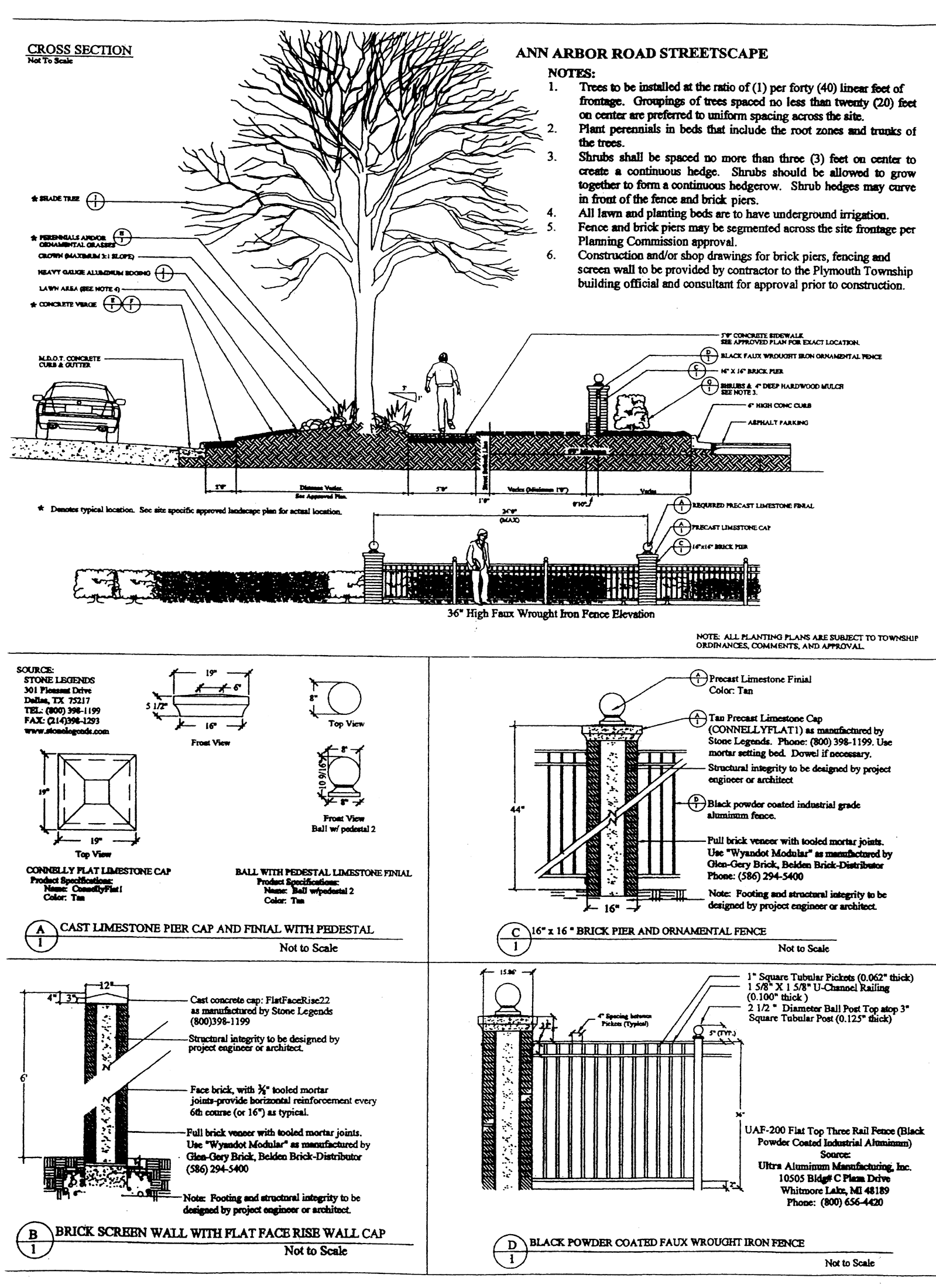
Ann Arbor Road standard design details (1)
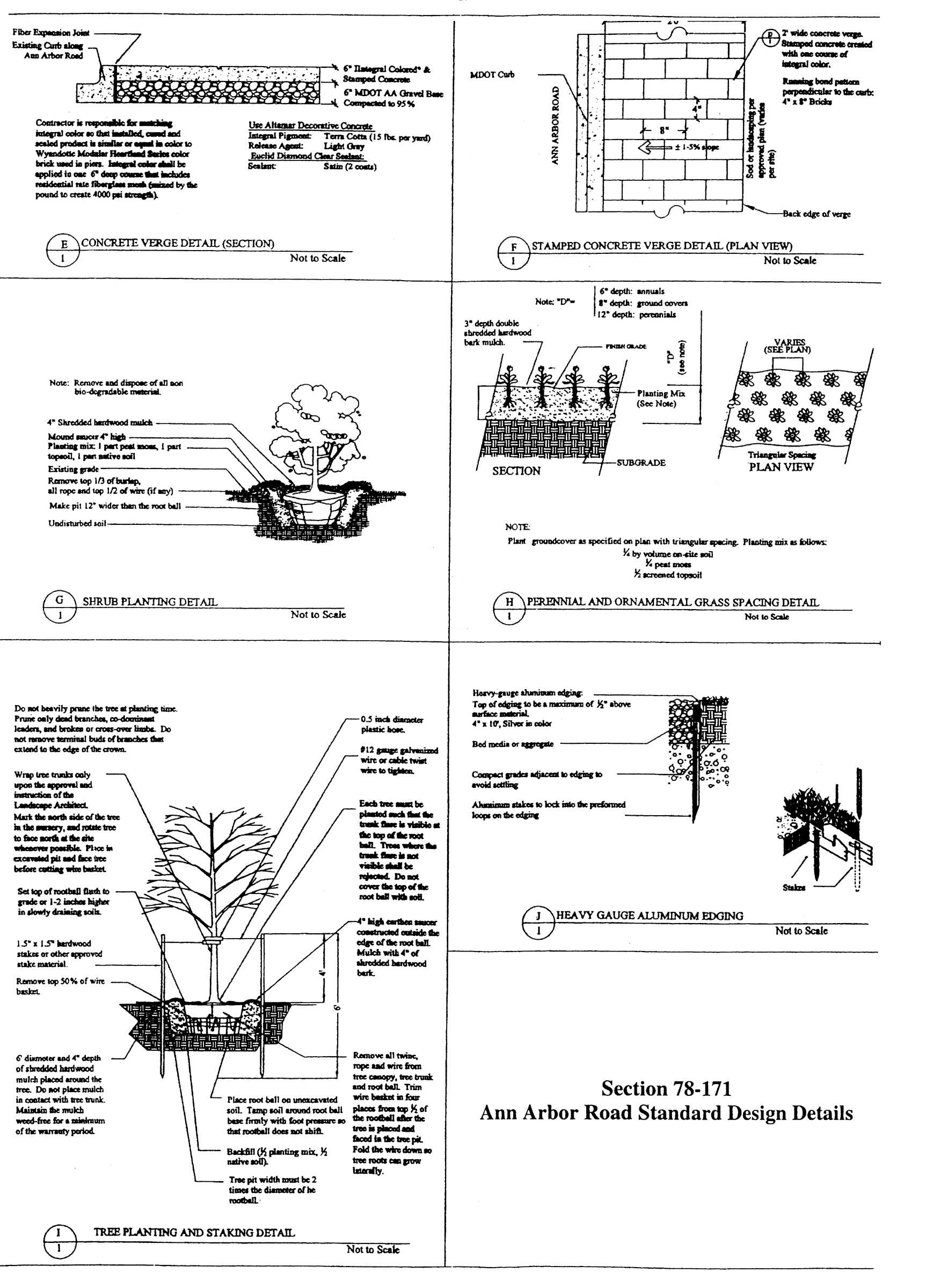
Ann Arbor Road standard design details (2)

