DEFINITIONS
The following rules of construction apply to the text of this chapter:
(1)
The particular shall control the general.
(2)
In the case of any difference of meaning or implication between the text of this chapter and any caption or illustration, the text shall control.
(3)
The word "shall" is always mandatory and not discretionary. The word "may" is permissive.
(4)
Words used in the present tense shall include the future; and words used in the singular number shall include the plural, and the plural the singular, unless the context clearly indicates the contrary.
(5)
A "building" or "structure" includes any part thereof.
(6)
The phrase "used for" includes "arranged for," "designed for," "intended for," "maintained for" or "occupied for."
(7)
The word "person" includes an individual, a corporation, a partnership, an incorporated association, or any other similar entity.
(8)
Unless the context clearly indicates the contrary, where a regulation involves two or more items, conditions, provisions, or events connected by the conjunction "and," "or," "either… or," the conjunction shall be interpreted as follows:
a.
"And" indicates that all the connected items, conditions, provisions or events shall apply.
b.
"Or" indicates that the connected items, conditions, provisions or events may apply singly or in any combination.
c.
"Either . . . or" indicates that the connected items, conditions, provisions or events shall apply singly but not in combination.
(9)
Terms not herein defined shall have the meaning customarily assigned to them.
(Ord. of 10-6-03)
The following words, terms and phrases, when used in this chapter, shall have the meanings ascribed to them in this section, except where the context clearly indicates a different meaning:
Accessory use or accessory means a use which is clearly incidental to, customarily found in connection with, and located on the same zoning lot, unless otherwise specified, as the principal use to which it is related. When the word "accessory" is used in this text, it shall have the same meaning as accessory use. An accessory use includes, but is not limited to, the following:
(1)
Garages, storage sheds, radio/television antennae.
(2)
Outdoor swimming pools, hot tubs and saunas for the use of the occupants of a residence, or their guests.
(3)
Domestic or agricultural storage in a barn, shed, tool room or similar accessory building or other structure.
(4)
Storage of merchandise normally carried in stock in connection with a business or industrial use, unless such storage is excluded in the applicable district regulations.
(5)
Storage of goods used in or produced by industrial uses or related activities, unless such storage is excluded in the applicable district regulations.
(6)
Accessory off-street parking spaces, open or enclosed, subject to the accessory off-street parking regulations for the district in which the zoning lot is located.
(7)
Uses clearly incidental to a main use such as but not limited to: offices of an industrial or commercial complex located on the site of the commercial or industrial complex.
(8)
Accessory off-street loading, subject to the off-street loading regulations for the district in which the zoning lot is located.
(9)
Accessory signs, subject to the sign regulations for the district in which the zoning lot is located.
(10)
Common household gardening in a residential district when located only in the rear yard and/or non-required side yard areas. For purposes of this chapter, common household gardening shall include the growing of fruits and vegetables for consumption solely by members of the family residing in the dwelling unit located on the same zoning lot.
(11)
Solar panels, private wind energy conversion systems, television reception antennas and air conditioning units, and satellite dish antennas.
Acoustic music means music that is solely or primarily uses instruments that produce sound through acoustic means, as opposed to electric or electronic means.
Adult foster care facility. A state-licensed establishment that provides foster care to adults. It includes facilities and foster care homes for adults who are aged, mentally ill, developmentally disabled, or physically handicapped who require supervision on an ongoing basis but who do not require continuous nursing care. An adult foster care facility does not include convalescent or nursing homes, homes for the aged, hospitals, alcohol or substance abuse rehabilitation center, residential centers for persons released from or assigned to a correctional facility, or any other facilities which have been exempted from the definition of adult foster care facility by the Adult Foster Care Facility Licensing Act, MCL 400.701, et. seq.; MSA 16.610 (61), et. seq., as amended. The following additional definitions shall apply in the application of this chapter:
(1)
Adult foster care small group home: An owner-occupied facility with the approved capacity to receive 12 or fewer adults who are provided supervision, personal care, and protection in addition to room and board, for 24 hours a day, five or more days a week, and for two or more consecutive weeks for compensation.
(2)
Adult foster care large group home: A facility with approved capacity to receive at least 13 but not more than 20 adults to be provided supervision, personal care, and protection in addition to room and board, 24 hours a day, five or more days a week, and for two or more consecutive weeks for compensation.
(3)
Adult foster care family home: A private residence with the approved capacity to receive six or fewer adults to be provided supervision, personal care, and protection in addition to room and board, 24 hours a day, five or more days a week and for two or more consecutive weeks for compensation. The adult foster care family home licensee must be a member of the household and an occupant of the residence.
(4)
Adult foster care congregate facility: An adult foster care facility with the approved capacity to receive more than 20 adults to be provided with foster care.
Alley means any dedicated public way affording a secondary means of access to abutting property, and not intended for general traffic circulation.
Alteration means any change, addition or modification in construction, type of occupancy or in the structural members of a building (such as walls or partitions, columns, beams or girders), the consummated act of which may be referred to herein as "altered" or "reconstructed."
Apartment means a suite of rooms in a multiple-family building arranged and intended for a place of residence of a single-family or a group of individuals living together as a single housekeeping unit.
Apartment, efficiency, is a dwelling unit consisting of not more than one room in addition to a kitchen and necessary sanitary facilities.
Apartment, one-bedroom unit, is a dwelling unit containing a minimum floor area of at least 450 square feet, consisting of not more than three rooms in addition to a kitchen and necessary sanitary facilities.
Apartment, two-bedroom unit, is a dwelling unit containing a minimum floor area of at least 600 square feet, consisting of not more than four rooms in addition to a kitchen and necessary sanitary facilities.
Apartment, three-or-more bedroom unit, is a dwelling unit wherein for each room in addition to the four rooms permitted in a two-bedroom unit, there shall be provided an additional area of 150 square feet to the minimum floor area of 600 square feet.
Arcade means a building or structure, or any part thereof, which is devoted to the commercial use of amusement devices, pinball machines, electronic tables featuring pool, billiards, bowling, basketball, football, or the like, or electronic games of skill or dexterity utilizing video tapes or video screen or T.V. adaptations, etc., automatic sport devices or tables or similar activities for hire, or for amusement.
Architectural features include,but shall not be limited to steps, window sills, belt courses, brick and/or wrought iron wing walls, chimneys, architraves, pediments, and other similar features.
Attic, finished means the area between the roof framing and the ceiling of the rooms below which has been made occupiable through the use of permanent stairs. No finished attics may exceed ⅓ of the floor area of the story below.
Automobile convenience mart. A place where gasoline, motor oil, lubricants, or other minor accessories are retailed directly to public on the premises or in combination with the retailing of items typically found in a convenience market, carry out restaurant or supermarket.
Automobile repair, major, means the general repair, engine rebuilding, rebuilding or reconditioning of motor vehicles; collision service, such as body, frame or fender straightening and repair; and painting of automobiles.
Automobile repair, minor, means repairs other than major repair including engine tune-up, muffler shops, shock absorber replacement shops, undercoating shops and tire stores.
Average grade means the average elevation of the ground level measured within the front, side, or rear yard, within which a deck patio or terrace is located.
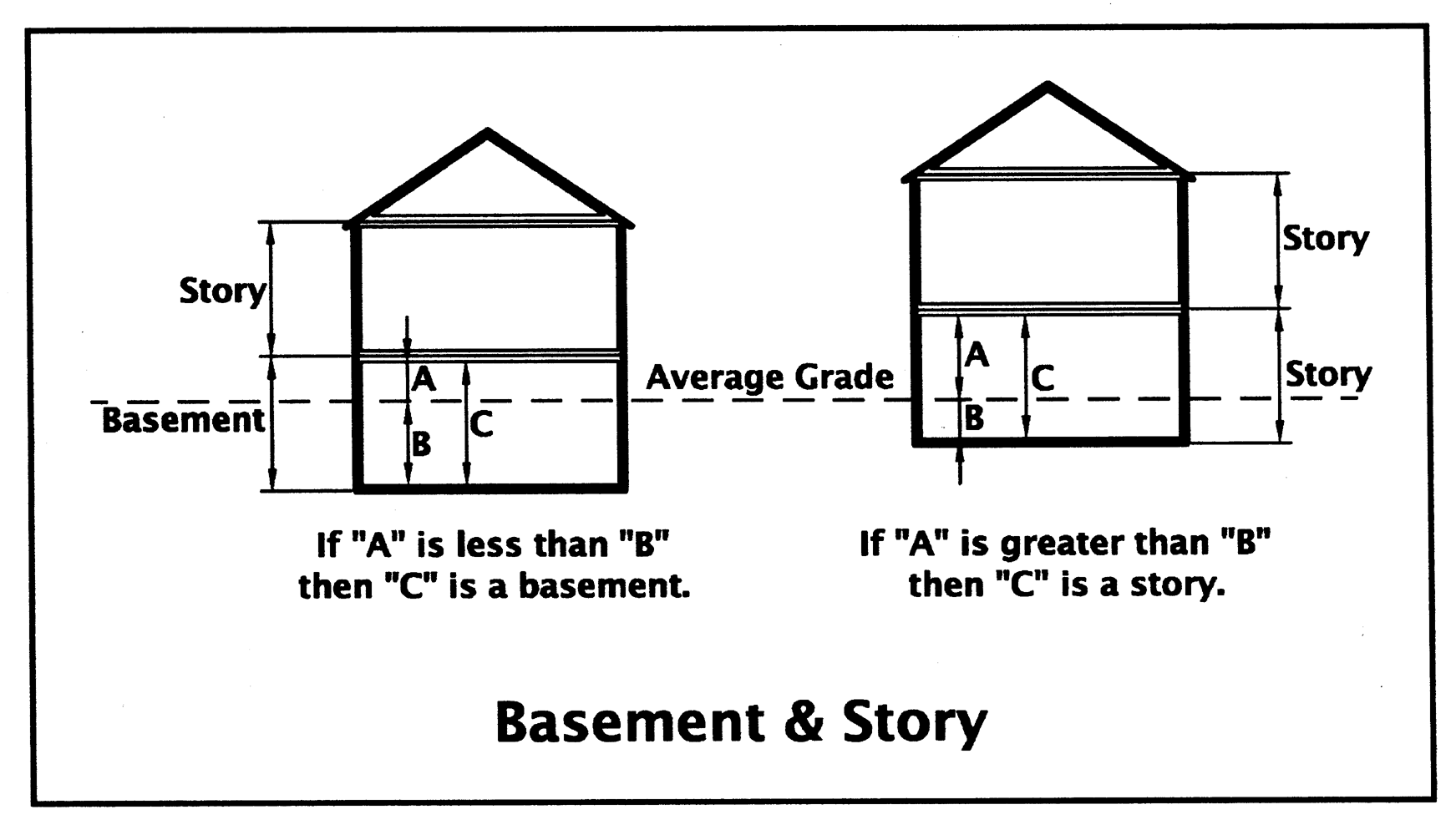
Basement means that portion of a building which is partly or wholly below grade but so located that the vertical distance from the average grade to the floor is greater than the vertical distance from the average grade to the ceiling. A basement shall not be counted as a story.
Bed and breakfast operations provide overnight accommodations and a morning meal in a dwelling unit provided to transient guests for compensation. The bed and breakfast operation shall be subordinate to the single-family use of the dwelling by the owner or primary renter of the premises.
Berm, obscuring, means an earthen mound of definite height and location to serve as an obscuring device in carrying out the requirements of this chapter.
Billboard shall mean:
(1)
A poster panel or painted bulletin and includes any structure panel, board or object designed exclusively to support such poster, panel, or a painted bulletin.
(2)
A surface whereon advertising matter is set in view conspicuously and which advertising does not apply to premises or any use or premises wherein it is displayed or posted.
Block means the property abutting one side of a street and lying between the two nearest intersecting streets (crossing or terminating), or between the nearest such street and railroad right-of-way, un-subdivided acreage, lake, river or live stream; or between any of the foregoing and any other barrier to the continuity of development, or corporate boundary lines of the city.
Building means any structure, either temporary or permanent, having a roof supported by columns or walls, and intended for the shelter, or enclosure of persons, animals, chattels, or property of any kind, excluding play structures.
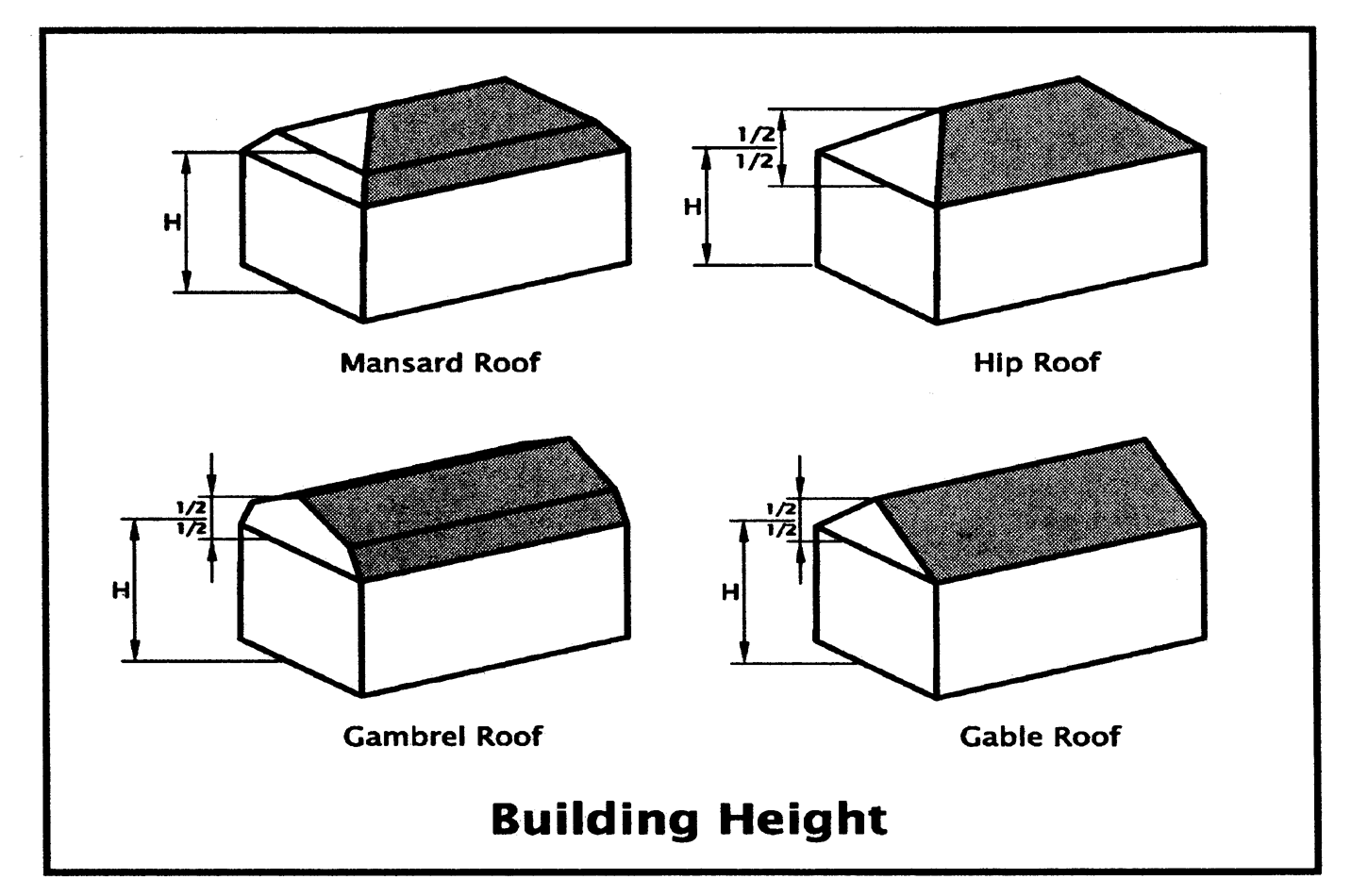
Building height means the vertical distance measured from the average grade plane (based on existing
grades) to the highest point of the roof surface for flat roofs; to the deck line
of mansard roofs; and to the average height between eaves and ridge for gable, hip
and gambrel roofs. Where a building is located on sloping terrain, the height shall
be measured from the average ground level of the grade plane.
Building Height
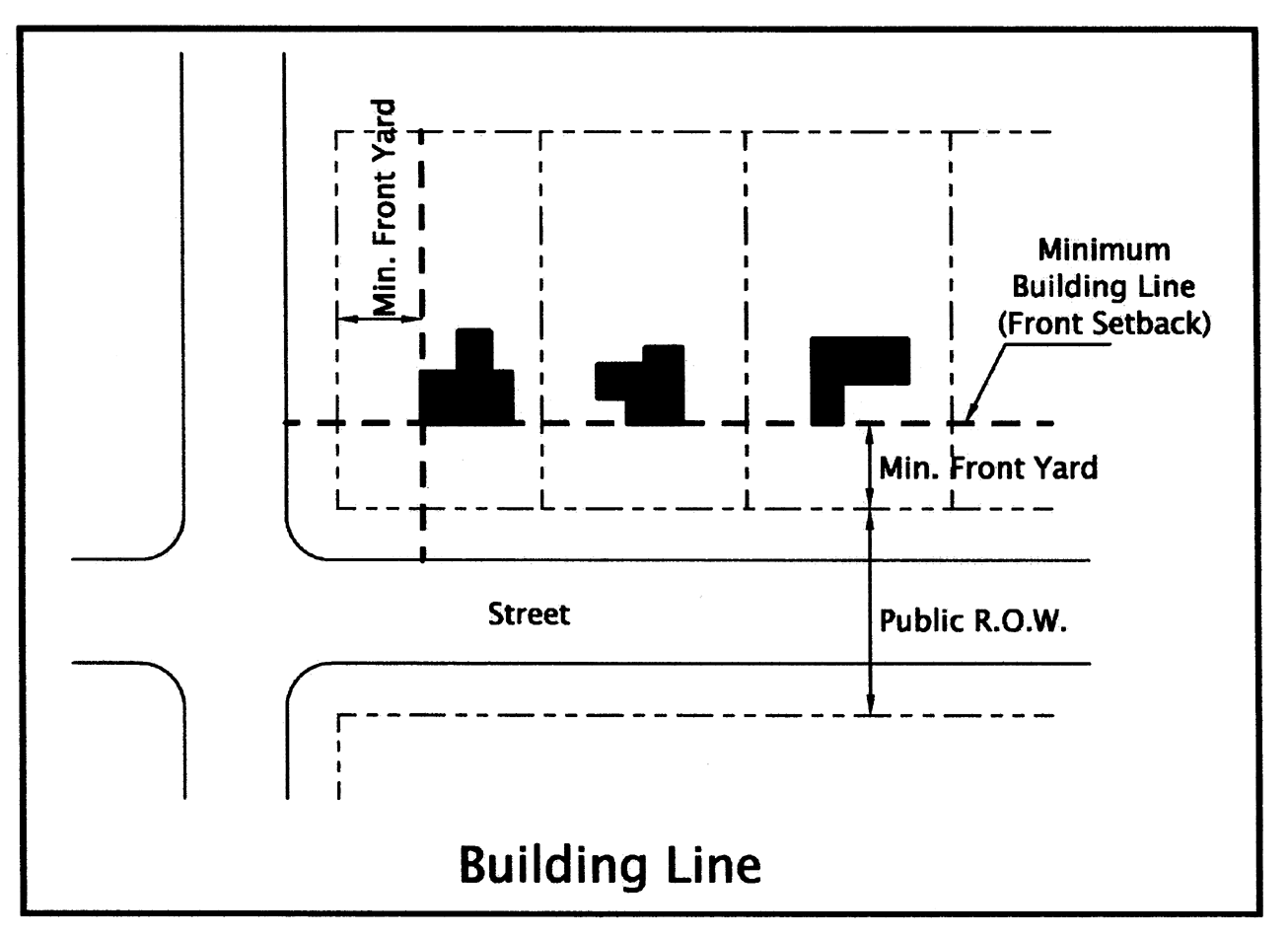
Building line means a line formed by the greatest projecting face of the building, and for the
purposes of this chapter, a minimum building line is the same as a front setback line.
Building Line
Building, main or principal, means a building in which is conducted the principal use of the lot on which it is situated.
CBD means the central business district of the city.
Change of use means an alteration of a lot, parcel, or use which is an intensification of land use which requires additional parking or loading and the submittal of a site plan application.
Child care center: A state-licensed facility, other than a private residence, receiving one or more children for care and supervision for periods less than 24 hours, and where the parents or guardians are not immediately available to the child.
Children's amusement park means an outdoor facility with devices for entertainment of small children including rides, games and items for sale.
Church, synagogue, temple, mosque, or similar religious facility: Any structure wherein persons regularly assemble for religious activity.
Club means an organization of persons for special purposes or for the promulgation of sports, arts, sciences, literature, politics, or the like, but not operated for profit.
Condominium is a building or group of buildings in which individual portions thereof are owned by or offered for sale to separate entities, with common elements owned jointly as prescribed by Act No. 229 of the Public Acts of Michigan of 1963 (MCL 559.101 et seq., MSA 26.50(101) et seq.), as amended.
Convalescent or nursing home means a nursing care facility, including a county medical care facility, that provides organized nursing care and medical treatment to seven or more unrelated individuals suffering or recovering from illness, injury, or infirmity. Nursing home does not include a unit in a state correctional facility. Nursing home does not include one or more of the following: (a) A hospital; (b) A veteran's facility created under Act No. 152 of the Public Acts of 1885, being Sections 36.1 to 36.12 of the Michigan Compiled Laws; or (c) A hospice residence.
Convenience grocery store. A one-story, retail store primarily designed and stocked to sell food, beverages, and other household supplies to customers who purchase a relatively few items (in contrast to a "supermarket"). Convenience grocery stores are designed to attract a large volume of stop and go traffic.
Day care facilities. The following definitions shall apply in the application of this chapter:
(1)
Family day care home: A state-licensed, owner-occupied private residence in which one but not more than six minor children are received for care and supervision for periods less than 24 hours a day unattended by a parent or legal guardian, excepting children related to an adult member of the family by blood, marriage or adoption. It includes a home that gives care to an unrelated child for more than four weeks in a calendar year.
(2)
Group day care home: A state-licensed, owner-occupied private residence in which seven but not more than 12 children are received for care and supervision for periods less than 24 hours a day unattended by a parent or legal guardian, excepting children related to an adult member of the family by blood, marriage or adoption. It includes a home that gives care to an unrelated child for more than four weeks in a calendar year.
Deck means a structure for outdoor residential activities greater than 12 inches above the average grade, and constructed on an elevated foundation which may include joists, beams or posts.
Delicatessen means an establishment where food and beverage items are sold for both off-premises preparation consumption, carry-out and/or on-premises consumption.
Development means the construction of a new building or other structure on a zoning lot, the relocation of an existing building on another zoning lot, or the use of open land for a new use.
District means a portion of the incorporated area of the city within which certain regulations and requirements or various combinations thereof apply under the provisions of this chapter.
Drive-in means an establishment where food, frozen desserts or beverages are sold to the customers in a ready-to-consume state and where the customer consumes food, frozen desserts or beverages in an automobile parked upon the premises or at other facilities provided for customers which are located outside the building.
Drive-through means an establishment so developed that some portion of its retail or service character is dependent upon providing a driveway approach and staging area specifically designed for motor vehicles so as to serve patrons while in their motor vehicles, rather than within a building or structure, for carrying out and consumption or use after the vehicle is removed from the premises.
Duplex means a building divided into two-self-contained dwelling units.
Dwelling unit means a building, or portion thereof, designed for occupancy by single-family for residential purposes and having cooking and sanitary facilities.
Dwelling, single-family, means a building designed exclusively for and occupied exclusively by one family.
Dwelling, two-family, means a building designed exclusively for occupancy by two families living independently of each other.
Dwelling, multiple-family, means a building, or a portion thereof, designed exclusively for occupancy by three or more families living independently of each other.
Erected means built, constructed, altered, reconstructed, or moved upon; any physical operations on the premises which are required for construction, excavation, fill, drainage and the like shall be considered a part of erection.
Essential services means the erection, construction, alteration, or maintenance of underground, surface, or overhead utilities (such as gas, electrical, steam, fuel, water, sewage, or communications) by public utilities or municipal departments. This shall include components of transmission, distribution, collection, supply, and disposal systems such as poles, wires, mains, drains, sewers, pipes, conduits, cables, fire alarms, police call boxes, traffic signals, and hydrants in connection herewith, but shall not include buildings which are not necessary for the furnishing of adequate service by such utilities or municipal departments for the general health, safety, or welfare. Essential services shall not include wireless communication facilities.
Excavation means any breaking of ground, except common household gardening and ground care.
Extended-stay motel. Any building containing six or more guest rooms intended or designed to be used, rented or hired out to be occupied or which are occupied for sleeping purposes for guests and contain kitchen facilities for food preparation including but not limited to such facilities as refrigerators, stoves and ovens.
Family means a single individual or a number of individuals domiciled together whose relationship is of a continuing domestic character and who are cooking and living together as a single, nonprofit housekeeping unit. This shall not include any society, club, fraternity, sorority, association, lodge, coterie, organization, or group of students or other individuals whose relationship is of a transitory or seasonal nature or for the anticipated, limited duration of school terms or other similar determinable period.
Fence means a manmade structure constructed for the purpose of or to have the effect of enclosing the area it is constructed upon or as defined in the city Code.
Filling means the depositing or dumping of any matter onto or into the ground, except common household gardening and ground care.
Floor area, gross. (For purposes of computing parking only) Gross floor area shall be the total square footage, measured from the interior surfaces of the exterior walls. Gross floor area shall include all areas within the exterior walls.
Floor area ratio (FAR) means the ratio of the floor area of a building to its lot area. For example: when a floor area ratio of 0.4 is specified, the floor area of the building constructed on a lot of 6,000 square feet in area is limited to a maximum of 2,400 square feet (or 6,000 x 0.4 or 2,400). The purpose of this ratio is to control the bulk of buildings based on the size of the lot. FAR for residential buildings is calculated using "residential floor area," as defined in this chapter.
Floor area, residential, means the sum of the horizontal areas of each story of the building measured from the exterior faces of the exterior walls or from the centerline of walls separating two dwellings. The floor area measurement shall include any habitable space, bathrooms, toilet rooms, closets, halls, storage or utility spaces and similar areas, and attached garage. Examples of architectural features that are included or excluded in the FAR calculation are shown in the following table:
Examples of Architectural Elements Included/Excluded from FAR Calculation
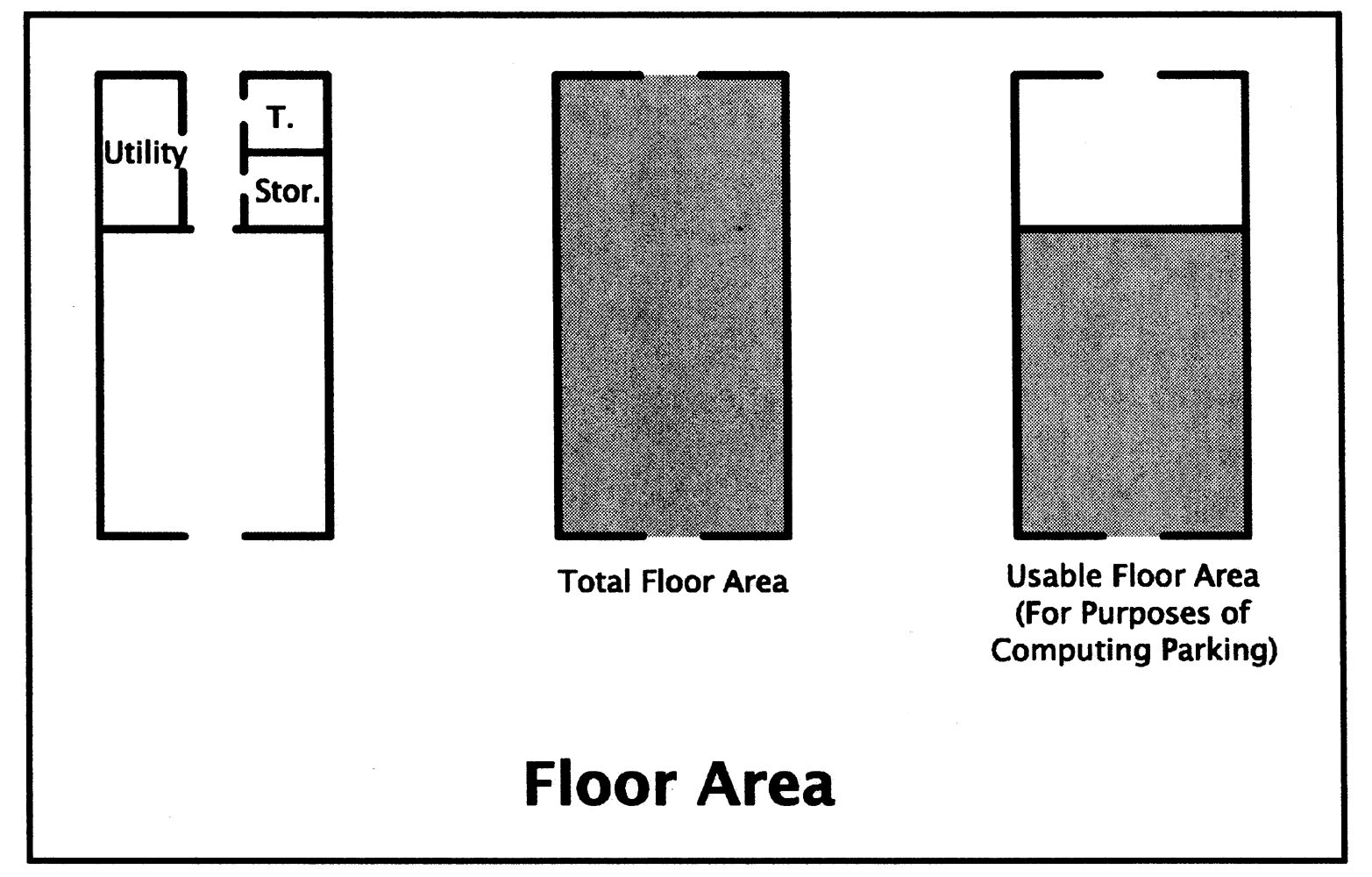
Floor area, usable, for the purposes of computing parking, means that area used for or intended to be
used for the sale of merchandise or services, or for use to serve patrons, clients
or customers. Such floor area which is used or intended to be used principally for
the storage or processing of merchandise, hallways or for utilities or sanitary facilities,
shall be excluded from the computation of usable floor area. Measurement of usable
floor area shall be the sum of the horizontal areas of the several floors of the building,
measured from the interior faces of the exterior walls.
Floor Area
Garage, private, means an accessory building or portion of a main building designed or used solely for the storage of motor-driven vehicles, boats and similar vehicles owned and used by the occupant of the building to which it is accessory.
Garage sale means any sale of personal effects, jewelry, household items, furnishings and equipment belonging to the owner or occupant of the property held in any district by the owner, occupant or his personal representative and/or agent.
Garage, service, means any premises used for the storage or care of motor-driven vehicles, or where any such vehicles are equipped for operation, repaired or kept for remuneration, hire or sale.
Gasoline service station means a place for the dispensing, sale or offering for sale of motor fuels directly to users of motor vehicles, together with the sale of minor accessories and services for motor vehicles, but not including major automobile repair.
Grade means a reference plane representing the ground level adjoining a building or structure.
Grade, existing means the elevation or surface of the ground or pavement as it exists prior to disturbance. This includes both the "natural" grade, where no man-made disturbances have impacted a building site, as well as the existing grade as established by existing buildings, structures and/or pavement.
Grade, finished means the final elevation of the ground surface after development.
Grade plane means a reference plane representing the average of the existing grades or ground level adjoining the building at exterior walls. Where the finished ground level slopes away from the exterior walls, the reference plane shall be established by the lowest points within the area between the building and the lot line or, where the lot line is more than six feet from the building, between the building and a point six feet from the building.
Greenbelt means a planting of trees and shrubs to serve as a screening device between abutting land uses.
Guarantee means a cash deposit, certified check, irrevocable bank letter of credit, surety bond or such other instrument acceptable to the city.
Habitable space means a space in a structure for living, sleeping, eating, or cooking.
Home occupation means an occupation or profession customarily carried on by an occupant of a dwelling unit as a secondary use which is clearly subservient to the use of the dwelling for residential purposes and in which no persons are employed at the dwelling other than the residents of the dwelling unit.
Home improvement center. A facility of more than 30,000 square feet of gross floor area, engaged in the retail sale of various basic hardware lines, such as tools, builders hardware, paint and glass, housewares and household appliances, garden supplies and cutlery.
Hotel, motel means a building containing primarily rooming units with the number of dwelling units being not greater than ten percent of the total number of rooming units, and, with the exception of the unit occupied by the management staff, used only for the accommodation of transients.
Housing, dependent, is a multiple-family housing form with central dining facilities provided as a basic service to each dwelling unit. Each dwelling unit shall not contain cooking facilities, but must contain sanitary facilities.
Housing, independent, is a multiple-family housing form with full facilities for self-sufficiency in each individual dwelling unit.
Improvements means those features and actions associated with a project which are considered necessary by the city to protect natural resources or the health, safety and welfare of the residents of the city, and future users or inhabitants of the proposed project or project area, including parking areas, landscaping, roadways, lighting, utilities, sidewalks, screening and drainage. Improvements do not include the entire project which is the subject of zoning approval.
Junkyard means an area where waste, used or secondhand materials are bought and sold, exchanged, stored, baled, packed, disassembled or handled, including but not limited to: scrap iron and other metals, paper, rags, rubber tires and bottles. A junkyard includes automobile wrecking yards and any open area of more than 200 square feet for the storage, keeping or abandonment of junk.
Kennel, commercial, means any lot or premises on which three or more dogs, cats or other household pets are either permanently or temporarily boarded or bred and raised for remuneration.
Landscape area means an area of ground surface that is planted with live plant material such as turf grass, ground cover, trees, shrubs, hedges, vines, flowers, and other live plant material. Landscape areas may also include other incidental natural materials such as woodchips, boulders, and mulch provided in combination with live plant material.
Large box retail. A singular retail or wholesale user, who occupies no less than 70,000 square feet of gross floor area, typically requires high parking to building area ratios and has a regional sales market. Regional retail/wholesale uses can include, but are not limited to, membership warehouse clubs that emphasize bulk sales, discount stores, and department stores.
Loading space means an off-street space on the same lot with a building, or group of buildings, for the temporary parking of a commercial vehicle while loading and unloading merchandise or materials.
Loft means the space between the roof and the floor of the uppermost story. The floor area of a loft is not more than ⅓ of the floor area of the story below.
Lot means a parcel of land occupied, or intended to be occupied, by a main building or
a group of such buildings and accessory buildings, or utilized for the principal use
and uses accessory thereto, together with such yards and open spaces as are required
under the provisions of this chapter. A lot may or may not be specifically designated
as such on public records.
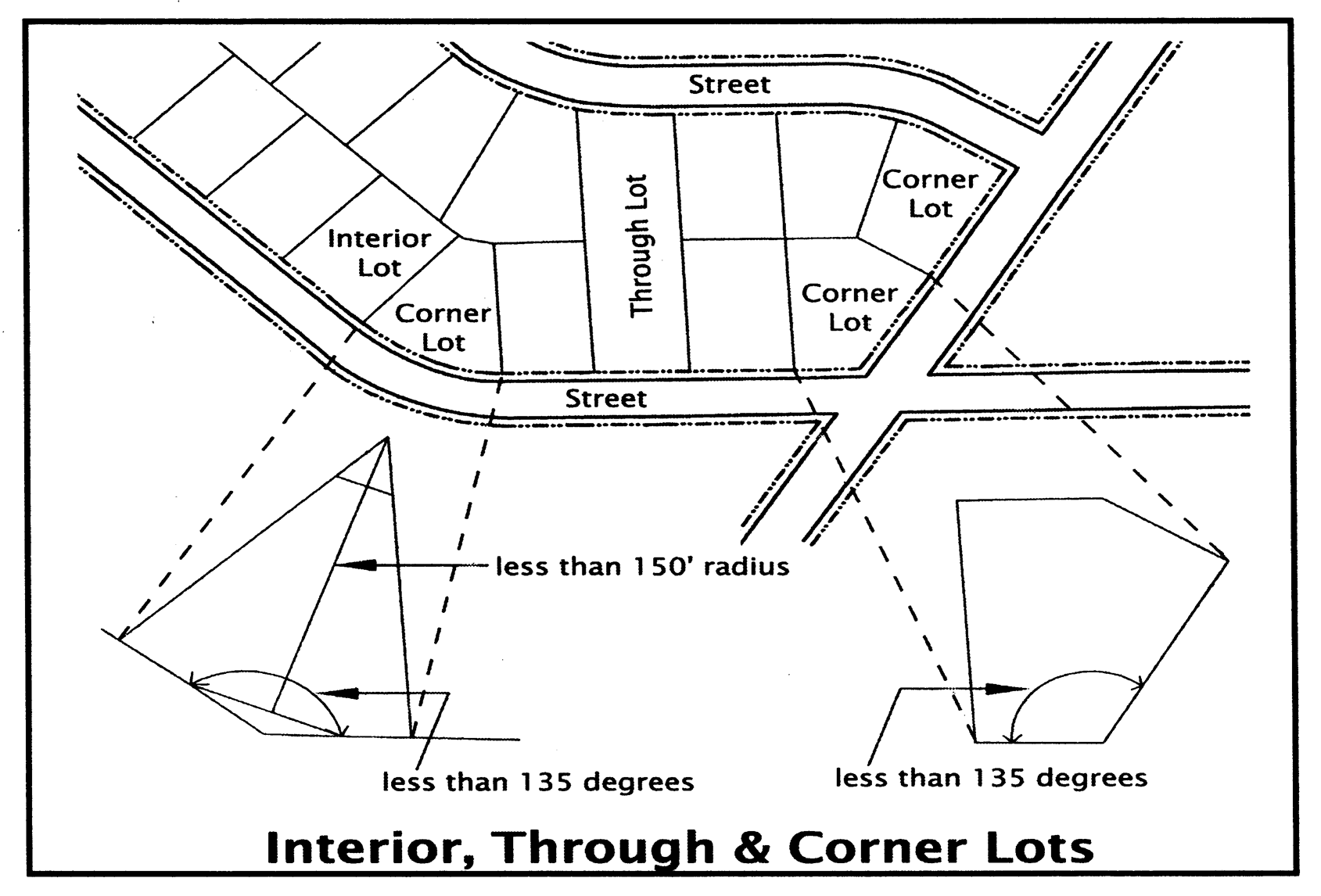
Interior, Through and Corner Lots
Lot area means the total horizontal area within the lot lines of the lot.
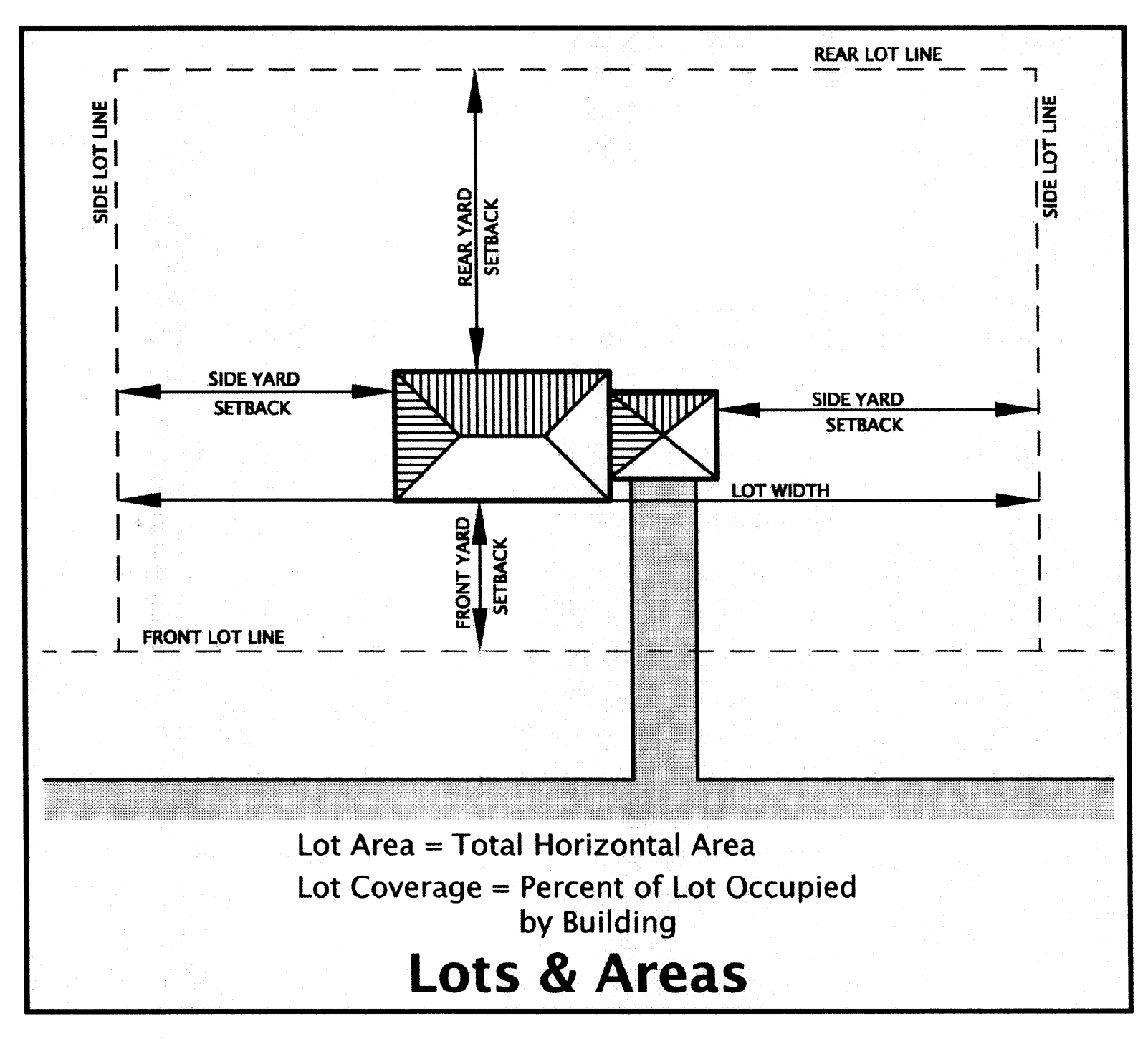
Lots and Areas
Lot, corner, means a lot where the interior angle of two adjacent sides at the intersection of two streets is less than 135 degrees. A lot abutting upon a curved street or streets shall be considered a corner lot for the purposes of this chapter if the arc is of less radius than 150 feet and the tangents to the curve, at the two points where the lot lines meet the curve or the straight street line extended, form an interior angle of less than 135 degrees.
Lot coverage means the part or percent of the lot occupied by buildings including accessory buildings and including but not limited to decks, terraces, pools, outdoor enclosures and similar structures.
Lot depth means the horizontal distance between the front and rear lot lines, measured along the median between the side lot lines.
Lot, interior, means any lot other than a corner lot.
Lot lines means the lines bounding a lot as follows:
(1)
Front lot line, in the case of an interior lot, is that line separating the lot from the street. In the case of a through lot, is that line separating such lot from either street.
(2)
Rear lot line means that lot line opposite the front lot line. In the case of a lot pointed at the rear, the rear lot line shall be an imaginary line parallel to the front lot line, not less than ten feet long lying farthest from the front lot line and wholly within the lot.
(3)
Side lot line means any lot line other than the front lot line or rear lot line. A side lot line separating a lot from a street is a side street lot line. A side lot line separating a lot from another lot or lots is an interior side lot line.
Lot of record means a parcel of land, the dimensions of which are shown on a document or map on file with the county register of deeds or in common use by municipal or county officials, and which actually exists as so shown, or any part of such parcel held in a record ownership separate from that of the remainder thereof.
Lot, through, means any interior lot having frontage on two more or less parallel streets as distinguished from a corner lot. In the case of a row of double frontage lots, all yards of such lots adjacent to streets shall be considered frontage, and front yard setbacks shall be provided as required.
Lot width means the horizontal straight line distance between the side lot lines, measured
between the two points where the front setback line intersects the side lot lines.
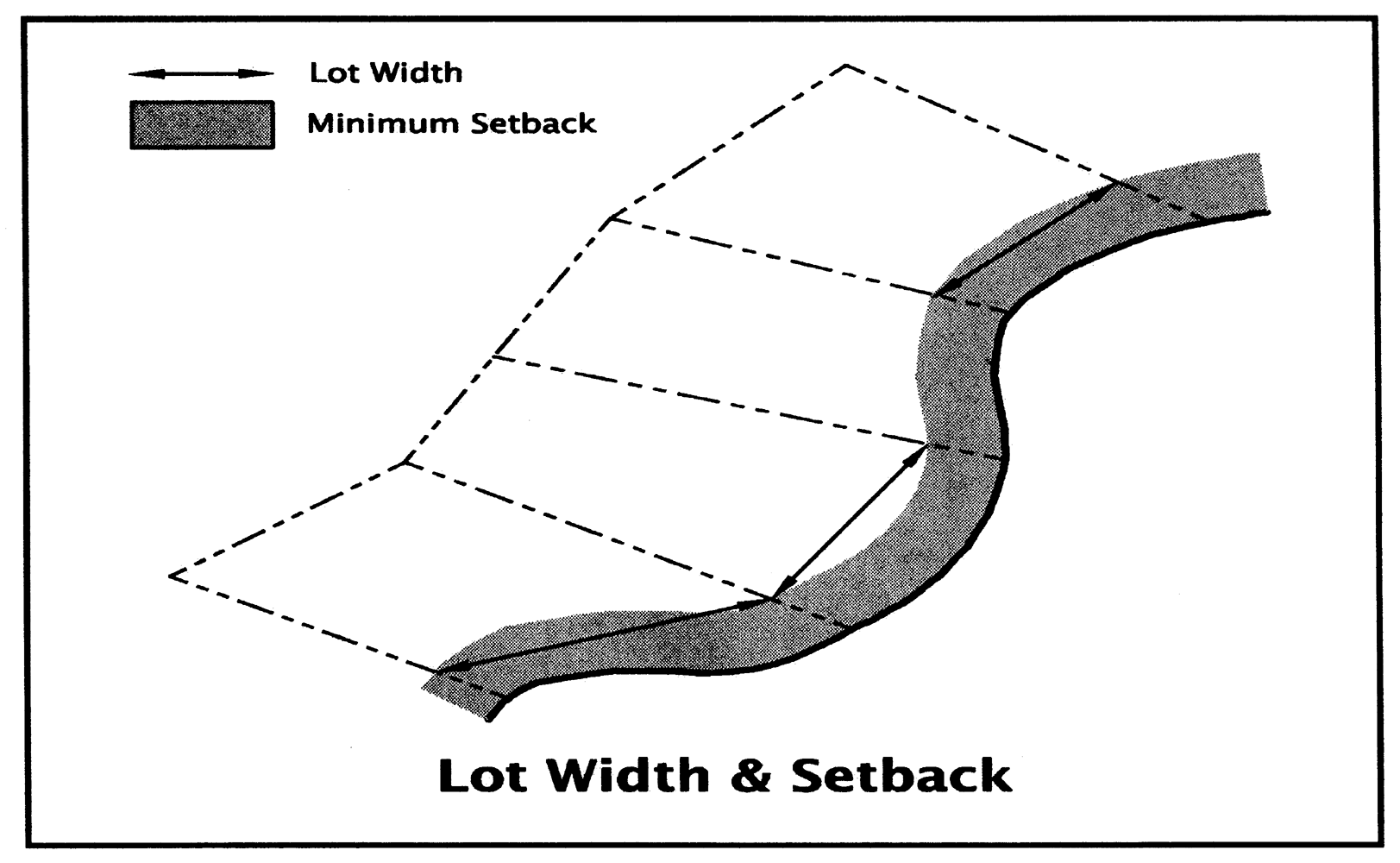
Lot width and Setback
Lot, zoning, means a single tract of land, located within a single block which, at the time of filing for a building permit, is designated by its owner or developer as a tract to be used, developed, or built upon as a unit, under single ownership or control. A zoning lot shall satisfy this chapter with respect to area, size, dimensions and frontage as required in the district in which the zoning lot is located. A zoning lot, therefore, may not coincide with a lot of record as filed with the county register of deeds, but may include one or more lots of record.
Main building means a building in which is conducted the principal use of the lot upon which it is situated.
Main use is the principal use to which the premises are devoted.
Major thoroughfare means an arterial street which is intended to serve as a large volume traffic way for both the immediate municipal area and the region beyond, and is designated as a major thoroughfare, parkway, freeway, expressway or equivalent term on the major thoroughfare plan as contained within the city master plan. These streets comprise the basic structure of the major thoroughfare plan.
Master plan means the comprehensive community plan including graphic and written proposals indicating the general location for streets, parks, schools, public buildings and all physical development of the city, and includes any unit or part of such plan, and any amendment to such plan or parts thereof.
Mechanical amusement device means any machine or device which, upon the insertion of a coin, currency, slug, token, plate or disc, operates or may be operated as a game, of contest of skill or amusement when the element of skill in such operation predominates over chance or luck. It shall include mechanical, electrical, or electronic video games, mechanical grabbing devices, pinball games, mechanical, electrical, or electronic baseball, football, basketball, hockey and similar sports-type games, mechanical, electrical, or electronic card games, shooting games, laser tag, target games, or any other machine, device or apparatus which may be used as a game of skill and wherein the player initiates, employs or directs any force generated by such machine.
Mezzanine means an intermediate floor in any story occupying not less ⅓ of the floor area of such story.
Mini-storage units means storage buildings for lease to the general public for the storage of personal and household effects and for dry storage of office or business effects not including the warehousing of products or supplies.
Mobile home/manufactured home means any building or structure, transportable in one or more sections, which is built on a chassis and designed to be sold as a dwelling with or without a permanent foundation, when connected to the required utilities, and includes plumbing, heating, air conditioning and electrical systems contained in the structure. Mobile home does not include recreational equipment.
Mobile home park/manufactured home community means any plot of ground upon which three or more mobile homes, occupied for dwelling or sleeping purposes, are located.
Motel, see hotel, motel.
Nonconforming structure means a structure, or portion thereof, lawfully existing at the effective date of this chapter (February 11, 1992), or amendments thereto, and that does not conform to the provisions of this chapter in the district in which it is located.
Nonconforming use means a use which lawfully occupied a building or land at the effective date of this
chapter (February 11, 1992), or amendments thereto, and that does not conform to the
use regulations of the district in which it is located.
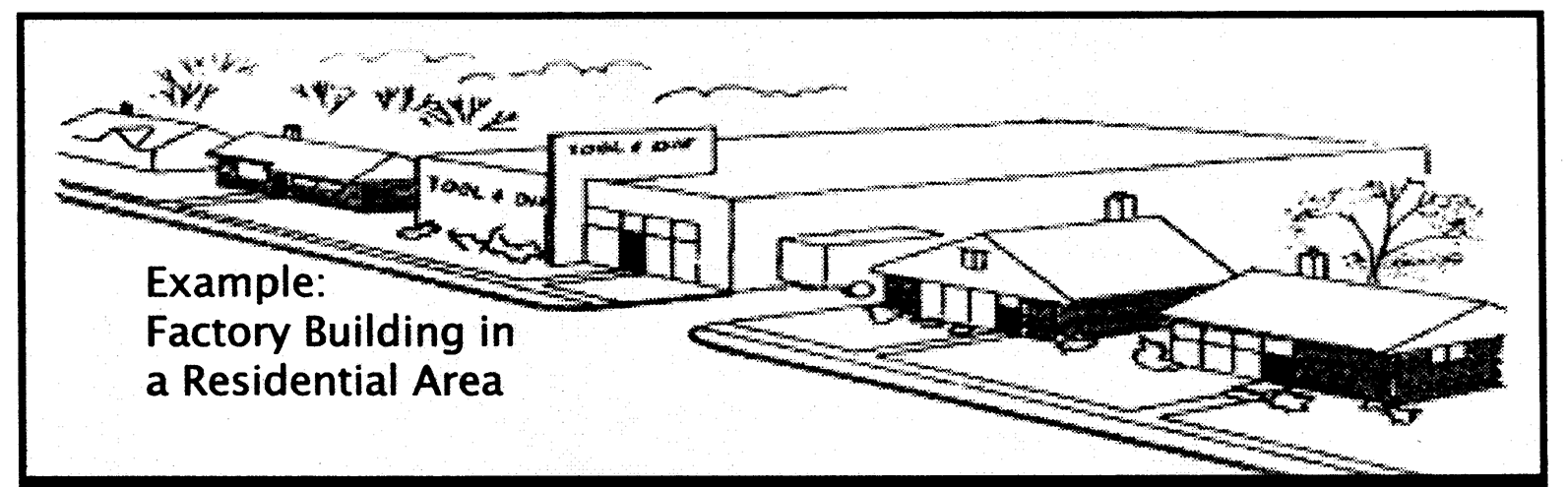
Nonconforming Use
Nursery, plant materials, means a space, building or structure, or combination thereof, for the storage of live trees, shrubs or plants offered for retail sale on the premises, including products used for gardening or landscaping. The definition of nursery within the meaning of this chapter does not include any space, building or structure used for the sale of fruits, vegetables or Christmas trees.
Nursery school means a facility which has as its main objective a development program for preschool children and whose staff meets the educational requirements established by the state.
Nursing home means a nursing care facility, including a county medical care facility, that provides organized nursing care and medical treatment to seven or more unrelated individuals suffering or recovering from illness, injury, or infirmity. Nursing home does not include a unit in a state correctional facility. Nursing home does not include one or more of the following: (a) A hospital; (b) A veteran's facility created under Act No. 152 of the Public Acts of 1885, being Sections 36.1 to 36.12 of the Michigan Compiled Laws; or (c) A hospice residence..
Nuisance factors means an offensive, annoying, unpleasant or obnoxious thing or practice, a cause or source of annoyance, especially a continuing or repeating invasion of any physical characteristics of activity or use across a property line which can be perceived by or affects a human being, or the generation of an excessive or concentrated movement of people or things, such as, but not limited to:
(1)
Noise;
(2)
Dust;
(3)
Smoke;
(4)
Odor;
(5)
Glare;
(6)
Fumes;
(7)
Flashes;
(8)
Vibration;
(9)
Shock waves;
(10)
Heat;
(11)
Electronic or atomic radiation;
(12)
Objectionable effluent;
(13)
Noise of congregation of people; particularly at night;
(14)
Passenger traffic;
(15)
Invasion of non-abutting street frontage by traffic;
(16)
A burned structure,;
(17)
A condemned structure.
Obscuring screen means a barrier constructed for the purpose of controlling sound or view. Requirements for use of and permitted forms of obscuring screens are contained in section 78-206.
Occupancy means any act by an owner or lessee to initiate or continue the proposed and intended use of a structure.
Occupiable space means a space within a structure used for bathrooms, toilet compartments, closets, halls, storage or utility spaces, and similar areas.
Off-street parking lot means a facility providing off-street vehicular parking spaces and drives or aisles for the parking of vehicles.
Open storage means the storage of any materials or objects outside the confines of a building.
Outdoor dining patio means a temporary, street level, exterior area, adjacent to an existing restaurant, generally located in the right-of-way, that is used for seated consumption of food and/or beverages that is operated by the adjacent restaurant and is accessory to the restaurant use.
Outdoor enclosure means a permanent covered structure used for outdoor activities, such as a gazebo, porch, or screened enclosure.
Parking space means an area of definite length and width, such area shall be exclusive of drives, aisles or entrances giving access thereto, and shall be fully accessible for the parking of permitted vehicles.
Patio means a hard-surfaced area or structure not more than 12 inches above the average grade.
Permeable pavement means paving material that absorbs water or allows water to infiltrate through the paving material and then drains directly into the ground. This definition includes permeable pavers, porous concrete, permeable interlocking concrete pavers, concrete grid pavers, porous asphalt, and other material with similar characteristics.
Personal service establishment means a facility used primarily for the provision of personal services to an individual which are related to care and appearance of the body, or the cleaning or repair of privately owned items normally worn or carried on the person.
Porte cochere means an unenclosed, roofed structure located on the same lot, which extends from the principal dwelling over an adjacent driveway that is designed to let vehicles pass under and used for the shelter of those getting in and out of vehicles.
Principal use means the main use to which the premises are devoted and the principal purpose for which the premises exist.
Private surface parking lot means private parking located at ground level.
Public utility means a person, municipal department, board or commission duly authorized to furnish and furnishing under federal, state or municipal regulations to the public: gas, steam, electricity, sewage disposal, communication, telegraph, transportation or water.
Quadplex means a building divided into four self-contained dwelling units.
Recreation/utility vehicle: shall include the following:
(1)
Boats and boat trailers: "boats" and "boat trailers" shall include boats, floats, rafts, canoes, plus the normal equipment to transport them on the highway.
(2)
Folding tent trailer: A canvas folding structure mounted on wheels and designed for travel and vacation use.
(3)
Motor home: A recreational vehicle intended for temporary human habitation, sleeping, and/or eating, mounted upon a chassis with wheels and capable of being moved from place to place under its own power. Motor homes generally contain sanitary, water, and electrical facilities.
(4)
Other equipment: Other recreational equipment includes snowmobiles, all-terrain or special terrain vehicles, utility trailers, dump trailers plus the normal equipment to transport them on the highway.
(5)
Pickup camper: A structure designed to be mounted on a pickup or truck chassis with sufficient equipment to render it suitable for use as a temporary dwelling during the process of travel, recreational, and vacation uses.
(6)
Travel trailer: A portable vehicle on a chassis, not exceeding 36 feet in length or nine feet in width, which is designed to be used as a temporary dwelling during travel, recreational, and vacation uses, and which may be identified as a "travel trailer" by the manufacturer. Travel trailers generally contain sanitary, water, and electrical facilities.
Restaurant. A restaurant is any establishment whose principal business is the sale of food and beverages to the customer in a ready-to-consume state and whose method of operation is characteristic of a carry-out, drive-in, drive-through, fast food, standard restaurant, or bar/lounge, or combination thereof, as defined below.
(1)
Restaurant, carry-out: A carry-out restaurant is a restaurant whose method of operation involves sale of food, beverages, and/or frozen desserts in disposable or edible containers or wrappers in a ready-to-consume state for consumption primarily off the premises.
(2)
Restaurant, drive-in: A drive-in restaurant shall be deemed to be any restaurant designed to permit or facilitate the serving of meals, sandwiches, ice cream, beverages or other food served directly to or permitted to be consumed by patrons in cars or other vehicles parked on the premises, or permitted to be consumed by patrons elsewhere on the site outside the main building.
(3)
Restaurant, fast-food: A fast-food restaurant is a restaurant whose method of operation involves minimum waiting for delivery of ready-to-consume food to the customer at a counter or cafeteria line for consumption at the counter where it is served, or at tables, booths, or stands inside or outside of the structure, or for consumption off the premises, but not in a motor vehicle at the site.
(4)
Restaurant, standard: A standard restaurant is a restaurant whose method of operation involves either the delivery of prepared food by waiters and waitresses to customers seated at tables within a completely enclosed building, or the prepared food is acquired by customers at a cafeteria line and is subsequently consumed by the customers at tables within a completely enclosed building.
(5)
Bar/lounge: A bar or lounge is a type of restaurant which is operated primarily for the dispensing of alcoholic beverages, although the sale of prepared food or snacks may also be permitted. If a bar or lounge is part of a larger dining facility, it shall be defined as that part of the structure so designated or operated.
Retail establishment means a commercial business facility that sells goods directly to consumers.
Right-of-way. A legal right of passage over real property, typically associated with roads and railroads.
Rooftop dining means a temporary, exterior area, located on the roof of an existing restaurant at least one story above grade, that is used for seated consumption of food and/or beverages and is operated by the underlying restaurant and is accessory to the restaurant use.
Room means, for the purpose of determining lot area requirements and density in a multiple-family district, a living room, dining room or bedroom, equal to minimum standards as required by the State of Michigan Building and Residential Codes. A room shall not include the area in kitchen, sanitary facilities, utility provisions, corridors, hallways and storage. Plans presented showing one-, two- or three-bedroom units and including a den, library or other extra room shall count such extra room as a bedroom for the purpose of computing density.
Rooming unit means any room or group of rooms forming a single habitable unit, used for living and sleeping, but which does not contain cooking or eating facilities.
Rooming-house means a building other than a hotel-motel where, for compensation and by prearrangement for a definite period, lodging and meals are provided for more than two persons.
Satellite dish means a structure designed, intended or used to receive communications or other signals from geostationary, communications satellites or other extraterrestrial sources.
Setback means the distance required to obtain the minimum front, side or rear yard open space provisions of this chapter.
Shopping center. More than one commercial establishment, planned, developed, owned, and managed as a unit, with off-street parking provided on the property.
Sign means any display or object which is primarily used to identify or display information about or direct or attract attention to a person, institution, organization, business, product, event, location or otherwise, or any religious, political, social, ideological or other message, by any means which is visible from any public street, sidewalk, alley, park, or public property and is otherwise located or set upon or in a building, structure or piece of land. The definition does not include goods displayed in a window.
For purposes of this chapter, sign shall also include the following terms:
(1)
Sign, abandoned means a sign which, for 90 consecutive days, fails to direct a person to or advertises a bona fide business, tenant, owner, product or activity conducted, or product available on the premises where such sign is displayed.
(2)
Sign area per business site means the allowable signage allocated to a building with one or more tenants who each have a separate means of ingress and egress. Multi-tenant buildings with a shared means of ingress and egress shall be considered one business site.
(3)
Sign, awning means a sign which is applied to or attached flat against the surface of an awning or canopy.
(4)
Sign, banner means a sign of lightweight fabric or similar material, but not including paper or cardboard, which can be easily folded or rolled.
(5)
Sign, bench means an advertising sign placed upon a bench or other seating structure.
(6)
Sign, changeable copy (electronic) means a sign or portion thereof that displays changeable, electronic alphanumeric characters, graphics, or symbols using light emitting displays, fiber optics, light bulbs or other illumination devices within the display area, and are generally manipulated by computer programmable, microprocessor controlled devices. Electronic changeable copy signs include projected images or messages with these characteristics onto buildings or objects. A sign on which the only copy that changes is an electronic indication of time or temperature shall be considered a "time and temperature" portion of a sign and not an electronic changeable copy sign for purposes of this article.
(7)
Sign, changeable copy (manual) means a sign or portion thereof with characters, letters, or illustrations that can be changed or rearranged by hand without altering the structural integrity of the sign.
(8)
Sign, channel letter means individual channel letters that are mounted on a building so that the face of the letter is parallel to the building wall.
(9)
Sign, directional means a sign which indicates the route or location of facilities, services, or activities which are of public interest, and signs denoting the direction of vehicular traffic.
(10)
Sign, directory means a sign that displays the tenant names and locations for a building containing multiple tenants.
(11)
Sign, feather flag means a portable sign of fabric or similar lightweight material that contains a harpoon-style pole or staff driven into the ground for support, supported by means of an individual stand, or attached to a building.
(12)
Sign, festoon means banners, pennants, or other such temporary features which are hung or strung overhead and which are not an integral, physical part of the building or structure they are intended to serve.
(13)
Sign, flag means any fabric or similar lightweight material attached at no more than two corners of the material so as to allow movement of the material by atmospheric changes and which contains distinctive colors, patterns, symbols, emblems, insignia, or other symbolic devices or text. If any dimension of a flag is more than three times as long as any other dimension, it shall be regulated as a banner.
(14)
Sign, flashing, animated or moving means a sign that has intermittently reflecting lights, or signs which have movement of any illumination such as intermittent, flashing, scintillating, or varying intensity, or a sign that has any visible portions in motion, either constantly or at intervals, whether caused by artificial or natural sources. This would include, but not be limited to, electronic or digital displays.
(15)
Sign, ground means a sign which is attached to or part of one or two posts permanently mounted in or on the ground or mounted on a solid base that is on the ground and is not attached to any building or structure.
(16)
Sign, hanging means a sign mounted on the first floor of a building perpendicular to the building facade wall, hung from a metal bracket in a manner that permits it to swing slightly. These signs are small, pedestrian scaled, and easily read from both sides.
(17)
Sign, inflatable means a sign, figure or object that is either expanded to its full dimensions or supported by gases or liquids contained within the sign, figure or object, or part, at a pressure greater than atmospheric pressure.
(18)
Sign, marquee means a sign attached to or part of a permanent roof-like structure projecting above the entrance to a place of assembly, attached to and supported by the building and projecting beyond the wall of the building. These signs are typically manual changeable copy signs.
(19)
Sign, menu board or order board means a sign which serves patrons using a drive-through facility.
(20)
Sign, neon means an internally illuminated sign consisting of glass tubing, filled with neon or another gas, which glows when electric current is sent through it, including faux or simulated neon.
(21)
Sign, nonconforming means any sign which was lawfully erected and maintained prior to the effective date of this ordinance and any amendments thereto, and which fails to conform to all applicable regulations and restrictions of this chapter. Signs for which the zoning board of appeals has granted a variance are exempt and shall not be defined as nonconforming.
(22)
Sign, off-premises means a sign other than an on-premises sign.
(23)
Sign, on-premises means a sign which advertises only goods, services, facilities, events, or attractions on the contiguous land in the same ownership or control which is not divided by a public street and is located on said land.
(24)
Sign, permanent means any sign that is constructed or intended for long-term use and is permanently affixed to its location.
(25)
Sign, pole means a sign mounted on a freestanding pole(s) or other support(s) with a clear space of eight feet or more between the bottom of the sign face and the grade below.
(26)
Sign, projecting means a sign other than a wall sign that is perpendicularly attached to and projects from a structure or building wall not specifically designed to support the sign.
(27)
Sign, roof means a sign which is erected, constructed, and maintained wholly upon or over the roof of any building, with its principal support on the roof structure. For purposes of this section, any architectural element which is used on the wall of a structure to give the appearance of a roof line similar to a mansard, gambrel or other roof type, shall be considered a roof. A vertical plane or fascia which is attached to and located below the angled plane of a slope roof and which is less than six inches in height shall be considered part of a roof.
(28)
Sign, sidewalk means a sign that is freestanding, double-sided sign with lettering painted or applied to the surface, placed at the entrance to a building in a primarily pedestrian environment. This type of sign may include but isn't limited to "A"-frame signs.
(29)
Sign, temporary means a display sign, banner or other advertising device constructed of cloth, canvas, fabric, plastic or other light temporary material, with or without a structural frame, or any other sign intended for a limited period of display that is not permanently anchored to the ground or building.
(30)
Sign, vehicle business means a sign applied or attached to a vehicle which is parked or placed upon premises primarily for purposes of advertising the business or product for sale on the premises. Commercially licensed vehicles which are generally used daily off-site are not included in this definition.
(31)
Sign, wall means a sign which is applied or attached directly to the building wall.
(32)
Sign, window means a sign that is applied, painted, posted, displayed, or etched onto a glazed surface, regardless of opacity or perforation, so that its primary purpose is to be observed from outside the building.
Single housekeeping unit means all of the associated rooms in a dwelling unit available to and occupied by all of the occupants with a single set of cooking facilities also available to and utilized by all of the occupants of the dwelling unit.
Site condominium. A condominium development containing residential, commercial, office, industrial, or other structures or improvements for uses permitted in the zoning district in which located, in which each co-owner owns exclusive rights to a volume of space within which a structure or structures may be constructed, herein defined as a condominium unit, as described in the master deed. The following additional definitions are provided:
(1)
Condominium Act: Act 59, Public Acts of 1978, as amended.
(2)
Condominium documents: The master deed, recorded pursuant to the Condominium Act, and any other instrument referred to in the master deed or bylaws which affects the rights and obligations of a co-owner in the condominium.
(3)
Condominium lot: The condominium unit and the contiguous limited common element surrounding the condominium unit, which shall be the counterpart of "lot" as used in connection with a project developed under the Subdivision Control Act, Act 288 of the Public Acts of 1967, as amended.
(4)
Condominium unit: The portion of a condominium project designed and intended for separate ownership and use, as described in the master deed.
(5)
General common elements: The common elements other than the limited common elements.
(6)
Limited common elements: A portion of the common elements reserved in the master deed for the exclusive use of less than all of the co-owners.
(7)
Master deed: The condominium document recording the condominium project to which are attached as exhibits and incorporated by reference the bylaws for the project and the condominium subdivision plan for the project, and all other information required by Section 8 of the Condominium Act.
Sixplex means a building divided into six self-contained dwelling units.
Stacked flat means a building containing two or more dwelling units with at least one unit entirely or partially above another.
Story means that part of a building, except a mezzanine as defined herein, included between the surface of one floor and the surface of the next floor, or if there is no floor above, then the ceiling next above. A basement shall not be counted as a story. (See illustration for "story" following the definition for "basement" in this Section.)
Story, half, means an uppermost story lying under a sloping roof having an area of at least 200 square feet in area with a clear ceiling height of seven feet, six inches. For the purposes of this chapter, the usable floor area is only that area having at least five feet clear height between floor and ceiling.
Street means a dedicated public right-of-way, other than an alley, which affords the principal means of access to abutting property.
Structure means anything constructed or erected, the use of which requires location on the ground or attachment to something having location on the ground except play structures.
Temporary use or building means a use or building permitted by the zoning board of appeals to exist during a specified period of time.
Terrace means a hard surfaced area for outdoor residential activities raised over 12 inches or more above the average grade, and constructed with an earth embankment or a retaining wall.
Townhome/rowhouse means a building containing three or more dwelling units arranged side by side, separated from each other by a firewall and having separate direct means of egress and ingress to each unit from the outside.
Transition means a zoning district which may serve as a district of transition; i.e., a buffer zone between various land use districts or land use types.
Triplex means a building divided into three self-contained dwelling units.
Use means the principal purpose for which land or a building is arranged, designed or intended, or for which land or a building is or may be occupied.
Wall, obscuring, means a structure of definite height and location to serve as an obscuring screen in carrying out the requirements of this chapter.
Wind energy conversion system (WECS) shall mean any device such as a wind charger, windmill or wind turbine that converts wind energy to a form of usable energy.
(1)
Private WECS shall mean any WECS that is accessory to a principal use located on the same lot and is designed and built to serve the needs of the principal use.
(2)
Commercial WECS shall mean any WECS that is designed and built to provide electricity primarily to the electric utility's power grid.
Wireless communications facilities or facility shall mean all structures and accessory facilities relating to the use of the radio frequency spectrum for the purpose of transmitting or receiving radio signals or other wireless communications services, and include wireless communications equipment, wireless communications support structures, and wireless communications equipment compounds, as defined herein. This may include, but shall not be limited to, radio towers, television towers, telephone devices and exchanges, micro-wave relay facilities, telephone transmission equipment building, and commercial mobile radio service facilities. Not included within this definition are: citizen band radio facilities, shortwave receiving facilities, amateur (ham) radio facilities, private/stand-alone satellite dishes, and governmental facilities which are subject to state or federal law or regulations which preempt municipal regulatory authority. For purposes of this chapter, the following additional terms are defined:
(1)
Attached wireless communications facilities shall mean wireless communications equipment attached to an existing wireless communications support structure or in an existing wireless communications equipment compound.
(2)
Substantial change in physical dimensions means one or more modifications of the height, width, length, or area of a wireless communications facility at a location, the cumulative effect of which is to materially alter or change the appearance of the wireless communications facility.
(3)
Wireless communications equipment means the equipment and components, including antennas, transmitters, receivers, base stations, equipment shelters or cabinets, emergency generators and power supply, coaxial and fiber optic cables used in the provision of wireless communications services, but excluding wireless communication support structures.
(4)
Wireless communications equipment compound means a delineated area surrounding or adjacent to the base of a wireless communications support structure within which any wireless communications equipment related to that support structure is located.
(5)
Wireless communications support structures or support structures shall mean structures designed to support or capable of supporting wireless communication equipment. Support structures within this definition include but shall not be limited to monopoles, lattice towers, utility poles, wood poles, and guyed towers, buildings, or other structures with such design or capability.
(6)
Collocation shall mean the location by two (2) or more wireless communication providers of wireless communication equipment on a common wireless communication support structure.
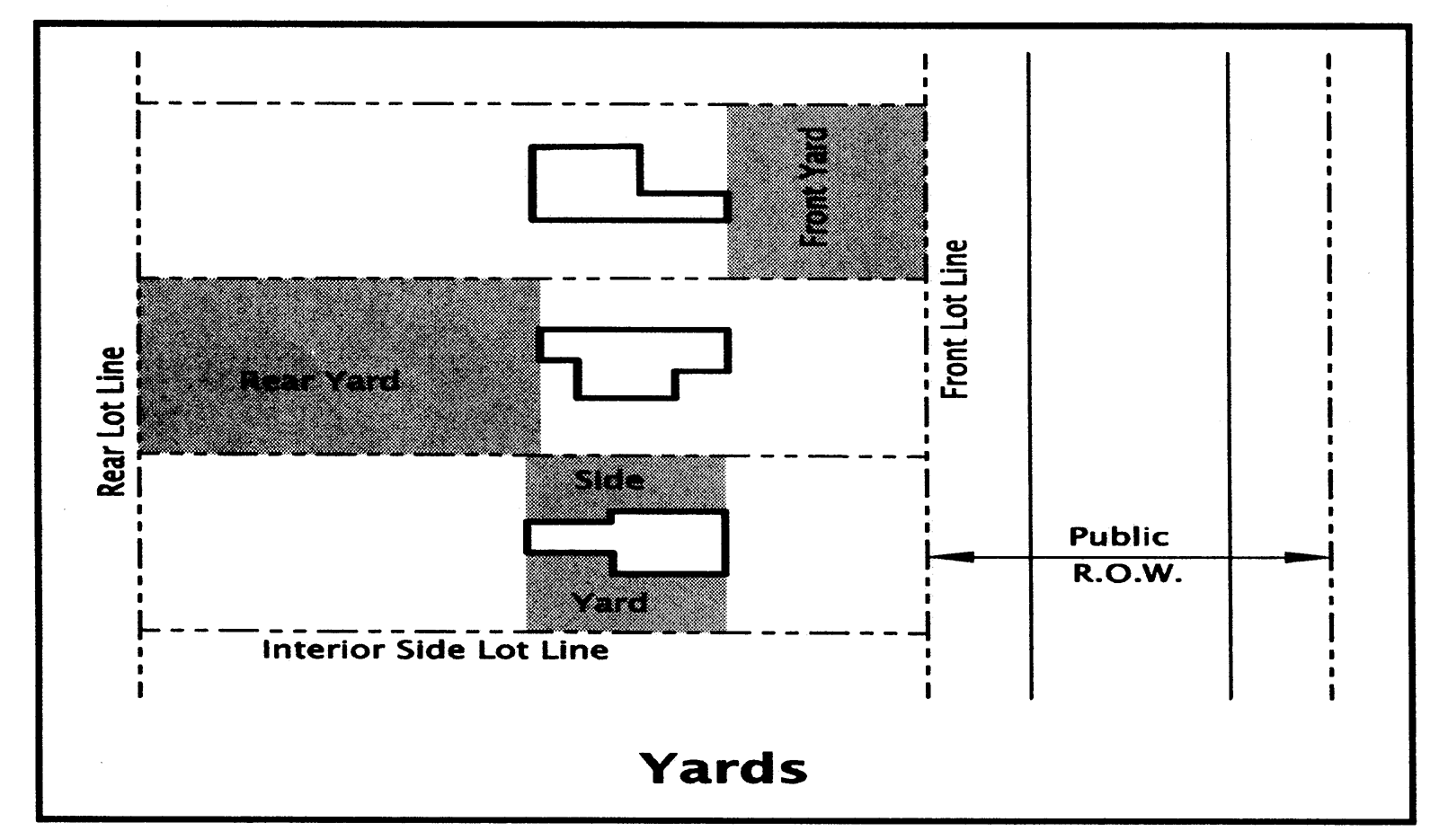
Yards means the open spaces on the same lot with a main building unoccupied and unobstructed from the ground upward except as otherwise provided in this chapter, and as follows:
(1)
Front yard means an open space extending the full width of the lot, the depth of which is the minimum horizontal distance between the front lot line and the nearest point of the main building.
(2)
Rear yard means an open space extending the full width of the lot, the depth of which is the minimum horizontal distance between the rear lot line and the nearest point of the main building. In the case of a corner lot, the rear yard may be opposite either street frontage.
(3)
Side yard means an open space between a main building and the side lot line, extending from the front yard to the rear yard, the width of which is the horizontal distance from the nearest point on the side lot line to the nearest point of the main building.
(Ord. of 10-6-03; Ord. No. 06-03, § 1, 9-5-06; Ord. No. 2007-01, § 2, 5-21-07; Ord. No. 2010-02, §§ 2, 3, 4-5-10; Ord. No. 2012-02, § 2, 1-3-12; Ord. No. 2012-04, § 4, 11-5-12; Ord. No. 2014-03, §§ 2, 3, 2-17-14; Ord. No. 2014-05, § 2, 6-2-14; Ord. No. 16-02, § 2, 7-18-16; Ord. No. 16-06, § 1, 10-17-16; Ord. No. 2017-01, § 1, 1-3-17; Ord. No. 2017-01(A), § 1, 8-21-17; Ord. No. 2020-01, 3-2-20; Ord. No. 2020-04, 9-21-20; Ord. No. 21-03, 11-1-21; Ord. No. 22-04, 12-19-22; Ord. No. 23-01, 1-17-23)
DEFINITIONS
The following rules of construction apply to the text of this chapter:
(1)
The particular shall control the general.
(2)
In the case of any difference of meaning or implication between the text of this chapter and any caption or illustration, the text shall control.
(3)
The word "shall" is always mandatory and not discretionary. The word "may" is permissive.
(4)
Words used in the present tense shall include the future; and words used in the singular number shall include the plural, and the plural the singular, unless the context clearly indicates the contrary.
(5)
A "building" or "structure" includes any part thereof.
(6)
The phrase "used for" includes "arranged for," "designed for," "intended for," "maintained for" or "occupied for."
(7)
The word "person" includes an individual, a corporation, a partnership, an incorporated association, or any other similar entity.
(8)
Unless the context clearly indicates the contrary, where a regulation involves two or more items, conditions, provisions, or events connected by the conjunction "and," "or," "either… or," the conjunction shall be interpreted as follows:
a.
"And" indicates that all the connected items, conditions, provisions or events shall apply.
b.
"Or" indicates that the connected items, conditions, provisions or events may apply singly or in any combination.
c.
"Either . . . or" indicates that the connected items, conditions, provisions or events shall apply singly but not in combination.
(9)
Terms not herein defined shall have the meaning customarily assigned to them.
(Ord. of 10-6-03)
The following words, terms and phrases, when used in this chapter, shall have the meanings ascribed to them in this section, except where the context clearly indicates a different meaning:
Accessory use or accessory means a use which is clearly incidental to, customarily found in connection with, and located on the same zoning lot, unless otherwise specified, as the principal use to which it is related. When the word "accessory" is used in this text, it shall have the same meaning as accessory use. An accessory use includes, but is not limited to, the following:
(1)
Garages, storage sheds, radio/television antennae.
(2)
Outdoor swimming pools, hot tubs and saunas for the use of the occupants of a residence, or their guests.
(3)
Domestic or agricultural storage in a barn, shed, tool room or similar accessory building or other structure.
(4)
Storage of merchandise normally carried in stock in connection with a business or industrial use, unless such storage is excluded in the applicable district regulations.
(5)
Storage of goods used in or produced by industrial uses or related activities, unless such storage is excluded in the applicable district regulations.
(6)
Accessory off-street parking spaces, open or enclosed, subject to the accessory off-street parking regulations for the district in which the zoning lot is located.
(7)
Uses clearly incidental to a main use such as but not limited to: offices of an industrial or commercial complex located on the site of the commercial or industrial complex.
(8)
Accessory off-street loading, subject to the off-street loading regulations for the district in which the zoning lot is located.
(9)
Accessory signs, subject to the sign regulations for the district in which the zoning lot is located.
(10)
Common household gardening in a residential district when located only in the rear yard and/or non-required side yard areas. For purposes of this chapter, common household gardening shall include the growing of fruits and vegetables for consumption solely by members of the family residing in the dwelling unit located on the same zoning lot.
(11)
Solar panels, private wind energy conversion systems, television reception antennas and air conditioning units, and satellite dish antennas.
Acoustic music means music that is solely or primarily uses instruments that produce sound through acoustic means, as opposed to electric or electronic means.
Adult foster care facility. A state-licensed establishment that provides foster care to adults. It includes facilities and foster care homes for adults who are aged, mentally ill, developmentally disabled, or physically handicapped who require supervision on an ongoing basis but who do not require continuous nursing care. An adult foster care facility does not include convalescent or nursing homes, homes for the aged, hospitals, alcohol or substance abuse rehabilitation center, residential centers for persons released from or assigned to a correctional facility, or any other facilities which have been exempted from the definition of adult foster care facility by the Adult Foster Care Facility Licensing Act, MCL 400.701, et. seq.; MSA 16.610 (61), et. seq., as amended. The following additional definitions shall apply in the application of this chapter:
(1)
Adult foster care small group home: An owner-occupied facility with the approved capacity to receive 12 or fewer adults who are provided supervision, personal care, and protection in addition to room and board, for 24 hours a day, five or more days a week, and for two or more consecutive weeks for compensation.
(2)
Adult foster care large group home: A facility with approved capacity to receive at least 13 but not more than 20 adults to be provided supervision, personal care, and protection in addition to room and board, 24 hours a day, five or more days a week, and for two or more consecutive weeks for compensation.
(3)
Adult foster care family home: A private residence with the approved capacity to receive six or fewer adults to be provided supervision, personal care, and protection in addition to room and board, 24 hours a day, five or more days a week and for two or more consecutive weeks for compensation. The adult foster care family home licensee must be a member of the household and an occupant of the residence.
(4)
Adult foster care congregate facility: An adult foster care facility with the approved capacity to receive more than 20 adults to be provided with foster care.
Alley means any dedicated public way affording a secondary means of access to abutting property, and not intended for general traffic circulation.
Alteration means any change, addition or modification in construction, type of occupancy or in the structural members of a building (such as walls or partitions, columns, beams or girders), the consummated act of which may be referred to herein as "altered" or "reconstructed."
Apartment means a suite of rooms in a multiple-family building arranged and intended for a place of residence of a single-family or a group of individuals living together as a single housekeeping unit.
Apartment, efficiency, is a dwelling unit consisting of not more than one room in addition to a kitchen and necessary sanitary facilities.
Apartment, one-bedroom unit, is a dwelling unit containing a minimum floor area of at least 450 square feet, consisting of not more than three rooms in addition to a kitchen and necessary sanitary facilities.
Apartment, two-bedroom unit, is a dwelling unit containing a minimum floor area of at least 600 square feet, consisting of not more than four rooms in addition to a kitchen and necessary sanitary facilities.
Apartment, three-or-more bedroom unit, is a dwelling unit wherein for each room in addition to the four rooms permitted in a two-bedroom unit, there shall be provided an additional area of 150 square feet to the minimum floor area of 600 square feet.
Arcade means a building or structure, or any part thereof, which is devoted to the commercial use of amusement devices, pinball machines, electronic tables featuring pool, billiards, bowling, basketball, football, or the like, or electronic games of skill or dexterity utilizing video tapes or video screen or T.V. adaptations, etc., automatic sport devices or tables or similar activities for hire, or for amusement.
Architectural features include,but shall not be limited to steps, window sills, belt courses, brick and/or wrought iron wing walls, chimneys, architraves, pediments, and other similar features.
Attic, finished means the area between the roof framing and the ceiling of the rooms below which has been made occupiable through the use of permanent stairs. No finished attics may exceed ⅓ of the floor area of the story below.
Automobile convenience mart. A place where gasoline, motor oil, lubricants, or other minor accessories are retailed directly to public on the premises or in combination with the retailing of items typically found in a convenience market, carry out restaurant or supermarket.
Automobile repair, major, means the general repair, engine rebuilding, rebuilding or reconditioning of motor vehicles; collision service, such as body, frame or fender straightening and repair; and painting of automobiles.
Automobile repair, minor, means repairs other than major repair including engine tune-up, muffler shops, shock absorber replacement shops, undercoating shops and tire stores.
Average grade means the average elevation of the ground level measured within the front, side, or rear yard, within which a deck patio or terrace is located.
Basement means that portion of a building which is partly or wholly below grade but so located that the vertical distance from the average grade to the floor is greater than the vertical distance from the average grade to the ceiling. A basement shall not be counted as a story.
Bed and breakfast operations provide overnight accommodations and a morning meal in a dwelling unit provided to transient guests for compensation. The bed and breakfast operation shall be subordinate to the single-family use of the dwelling by the owner or primary renter of the premises.
Berm, obscuring, means an earthen mound of definite height and location to serve as an obscuring device in carrying out the requirements of this chapter.
Billboard shall mean:
(1)
A poster panel or painted bulletin and includes any structure panel, board or object designed exclusively to support such poster, panel, or a painted bulletin.
(2)
A surface whereon advertising matter is set in view conspicuously and which advertising does not apply to premises or any use or premises wherein it is displayed or posted.
Block means the property abutting one side of a street and lying between the two nearest intersecting streets (crossing or terminating), or between the nearest such street and railroad right-of-way, un-subdivided acreage, lake, river or live stream; or between any of the foregoing and any other barrier to the continuity of development, or corporate boundary lines of the city.
Building means any structure, either temporary or permanent, having a roof supported by columns or walls, and intended for the shelter, or enclosure of persons, animals, chattels, or property of any kind, excluding play structures.
Building height means the vertical distance measured from the average grade plane (based on existing
grades) to the highest point of the roof surface for flat roofs; to the deck line
of mansard roofs; and to the average height between eaves and ridge for gable, hip
and gambrel roofs. Where a building is located on sloping terrain, the height shall
be measured from the average ground level of the grade plane.

Building Height
Building line means a line formed by the greatest projecting face of the building, and for the
purposes of this chapter, a minimum building line is the same as a front setback line.

Building Line
Building, main or principal, means a building in which is conducted the principal use of the lot on which it is situated.
CBD means the central business district of the city.
Change of use means an alteration of a lot, parcel, or use which is an intensification of land use which requires additional parking or loading and the submittal of a site plan application.
Child care center: A state-licensed facility, other than a private residence, receiving one or more children for care and supervision for periods less than 24 hours, and where the parents or guardians are not immediately available to the child.
Children's amusement park means an outdoor facility with devices for entertainment of small children including rides, games and items for sale.
Church, synagogue, temple, mosque, or similar religious facility: Any structure wherein persons regularly assemble for religious activity.
Club means an organization of persons for special purposes or for the promulgation of sports, arts, sciences, literature, politics, or the like, but not operated for profit.
Condominium is a building or group of buildings in which individual portions thereof are owned by or offered for sale to separate entities, with common elements owned jointly as prescribed by Act No. 229 of the Public Acts of Michigan of 1963 (MCL 559.101 et seq., MSA 26.50(101) et seq.), as amended.
Convalescent or nursing home means a nursing care facility, including a county medical care facility, that provides organized nursing care and medical treatment to seven or more unrelated individuals suffering or recovering from illness, injury, or infirmity. Nursing home does not include a unit in a state correctional facility. Nursing home does not include one or more of the following: (a) A hospital; (b) A veteran's facility created under Act No. 152 of the Public Acts of 1885, being Sections 36.1 to 36.12 of the Michigan Compiled Laws; or (c) A hospice residence.
Convenience grocery store. A one-story, retail store primarily designed and stocked to sell food, beverages, and other household supplies to customers who purchase a relatively few items (in contrast to a "supermarket"). Convenience grocery stores are designed to attract a large volume of stop and go traffic.
Day care facilities. The following definitions shall apply in the application of this chapter:
(1)
Family day care home: A state-licensed, owner-occupied private residence in which one but not more than six minor children are received for care and supervision for periods less than 24 hours a day unattended by a parent or legal guardian, excepting children related to an adult member of the family by blood, marriage or adoption. It includes a home that gives care to an unrelated child for more than four weeks in a calendar year.
(2)
Group day care home: A state-licensed, owner-occupied private residence in which seven but not more than 12 children are received for care and supervision for periods less than 24 hours a day unattended by a parent or legal guardian, excepting children related to an adult member of the family by blood, marriage or adoption. It includes a home that gives care to an unrelated child for more than four weeks in a calendar year.
Deck means a structure for outdoor residential activities greater than 12 inches above the average grade, and constructed on an elevated foundation which may include joists, beams or posts.
Delicatessen means an establishment where food and beverage items are sold for both off-premises preparation consumption, carry-out and/or on-premises consumption.
Development means the construction of a new building or other structure on a zoning lot, the relocation of an existing building on another zoning lot, or the use of open land for a new use.
District means a portion of the incorporated area of the city within which certain regulations and requirements or various combinations thereof apply under the provisions of this chapter.
Drive-in means an establishment where food, frozen desserts or beverages are sold to the customers in a ready-to-consume state and where the customer consumes food, frozen desserts or beverages in an automobile parked upon the premises or at other facilities provided for customers which are located outside the building.
Drive-through means an establishment so developed that some portion of its retail or service character is dependent upon providing a driveway approach and staging area specifically designed for motor vehicles so as to serve patrons while in their motor vehicles, rather than within a building or structure, for carrying out and consumption or use after the vehicle is removed from the premises.
Duplex means a building divided into two-self-contained dwelling units.
Dwelling unit means a building, or portion thereof, designed for occupancy by single-family for residential purposes and having cooking and sanitary facilities.
Dwelling, single-family, means a building designed exclusively for and occupied exclusively by one family.
Dwelling, two-family, means a building designed exclusively for occupancy by two families living independently of each other.
Dwelling, multiple-family, means a building, or a portion thereof, designed exclusively for occupancy by three or more families living independently of each other.
Erected means built, constructed, altered, reconstructed, or moved upon; any physical operations on the premises which are required for construction, excavation, fill, drainage and the like shall be considered a part of erection.
Essential services means the erection, construction, alteration, or maintenance of underground, surface, or overhead utilities (such as gas, electrical, steam, fuel, water, sewage, or communications) by public utilities or municipal departments. This shall include components of transmission, distribution, collection, supply, and disposal systems such as poles, wires, mains, drains, sewers, pipes, conduits, cables, fire alarms, police call boxes, traffic signals, and hydrants in connection herewith, but shall not include buildings which are not necessary for the furnishing of adequate service by such utilities or municipal departments for the general health, safety, or welfare. Essential services shall not include wireless communication facilities.
Excavation means any breaking of ground, except common household gardening and ground care.
Extended-stay motel. Any building containing six or more guest rooms intended or designed to be used, rented or hired out to be occupied or which are occupied for sleeping purposes for guests and contain kitchen facilities for food preparation including but not limited to such facilities as refrigerators, stoves and ovens.
Family means a single individual or a number of individuals domiciled together whose relationship is of a continuing domestic character and who are cooking and living together as a single, nonprofit housekeeping unit. This shall not include any society, club, fraternity, sorority, association, lodge, coterie, organization, or group of students or other individuals whose relationship is of a transitory or seasonal nature or for the anticipated, limited duration of school terms or other similar determinable period.
Fence means a manmade structure constructed for the purpose of or to have the effect of enclosing the area it is constructed upon or as defined in the city Code.
Filling means the depositing or dumping of any matter onto or into the ground, except common household gardening and ground care.
Floor area, gross. (For purposes of computing parking only) Gross floor area shall be the total square footage, measured from the interior surfaces of the exterior walls. Gross floor area shall include all areas within the exterior walls.
Floor area ratio (FAR) means the ratio of the floor area of a building to its lot area. For example: when a floor area ratio of 0.4 is specified, the floor area of the building constructed on a lot of 6,000 square feet in area is limited to a maximum of 2,400 square feet (or 6,000 x 0.4 or 2,400). The purpose of this ratio is to control the bulk of buildings based on the size of the lot. FAR for residential buildings is calculated using "residential floor area," as defined in this chapter.
Floor area, residential, means the sum of the horizontal areas of each story of the building measured from the exterior faces of the exterior walls or from the centerline of walls separating two dwellings. The floor area measurement shall include any habitable space, bathrooms, toilet rooms, closets, halls, storage or utility spaces and similar areas, and attached garage. Examples of architectural features that are included or excluded in the FAR calculation are shown in the following table:
Examples of Architectural Elements Included/Excluded from FAR Calculation
Floor area, usable, for the purposes of computing parking, means that area used for or intended to be
used for the sale of merchandise or services, or for use to serve patrons, clients
or customers. Such floor area which is used or intended to be used principally for
the storage or processing of merchandise, hallways or for utilities or sanitary facilities,
shall be excluded from the computation of usable floor area. Measurement of usable
floor area shall be the sum of the horizontal areas of the several floors of the building,
measured from the interior faces of the exterior walls.

Floor Area
Garage, private, means an accessory building or portion of a main building designed or used solely for the storage of motor-driven vehicles, boats and similar vehicles owned and used by the occupant of the building to which it is accessory.
Garage sale means any sale of personal effects, jewelry, household items, furnishings and equipment belonging to the owner or occupant of the property held in any district by the owner, occupant or his personal representative and/or agent.
Garage, service, means any premises used for the storage or care of motor-driven vehicles, or where any such vehicles are equipped for operation, repaired or kept for remuneration, hire or sale.
Gasoline service station means a place for the dispensing, sale or offering for sale of motor fuels directly to users of motor vehicles, together with the sale of minor accessories and services for motor vehicles, but not including major automobile repair.
Grade means a reference plane representing the ground level adjoining a building or structure.
Grade, existing means the elevation or surface of the ground or pavement as it exists prior to disturbance. This includes both the "natural" grade, where no man-made disturbances have impacted a building site, as well as the existing grade as established by existing buildings, structures and/or pavement.
Grade, finished means the final elevation of the ground surface after development.
Grade plane means a reference plane representing the average of the existing grades or ground level adjoining the building at exterior walls. Where the finished ground level slopes away from the exterior walls, the reference plane shall be established by the lowest points within the area between the building and the lot line or, where the lot line is more than six feet from the building, between the building and a point six feet from the building.
Greenbelt means a planting of trees and shrubs to serve as a screening device between abutting land uses.
Guarantee means a cash deposit, certified check, irrevocable bank letter of credit, surety bond or such other instrument acceptable to the city.
Habitable space means a space in a structure for living, sleeping, eating, or cooking.
Home occupation means an occupation or profession customarily carried on by an occupant of a dwelling unit as a secondary use which is clearly subservient to the use of the dwelling for residential purposes and in which no persons are employed at the dwelling other than the residents of the dwelling unit.
Home improvement center. A facility of more than 30,000 square feet of gross floor area, engaged in the retail sale of various basic hardware lines, such as tools, builders hardware, paint and glass, housewares and household appliances, garden supplies and cutlery.
Hotel, motel means a building containing primarily rooming units with the number of dwelling units being not greater than ten percent of the total number of rooming units, and, with the exception of the unit occupied by the management staff, used only for the accommodation of transients.
Housing, dependent, is a multiple-family housing form with central dining facilities provided as a basic service to each dwelling unit. Each dwelling unit shall not contain cooking facilities, but must contain sanitary facilities.
Housing, independent, is a multiple-family housing form with full facilities for self-sufficiency in each individual dwelling unit.
Improvements means those features and actions associated with a project which are considered necessary by the city to protect natural resources or the health, safety and welfare of the residents of the city, and future users or inhabitants of the proposed project or project area, including parking areas, landscaping, roadways, lighting, utilities, sidewalks, screening and drainage. Improvements do not include the entire project which is the subject of zoning approval.
Junkyard means an area where waste, used or secondhand materials are bought and sold, exchanged, stored, baled, packed, disassembled or handled, including but not limited to: scrap iron and other metals, paper, rags, rubber tires and bottles. A junkyard includes automobile wrecking yards and any open area of more than 200 square feet for the storage, keeping or abandonment of junk.
Kennel, commercial, means any lot or premises on which three or more dogs, cats or other household pets are either permanently or temporarily boarded or bred and raised for remuneration.
Landscape area means an area of ground surface that is planted with live plant material such as turf grass, ground cover, trees, shrubs, hedges, vines, flowers, and other live plant material. Landscape areas may also include other incidental natural materials such as woodchips, boulders, and mulch provided in combination with live plant material.
Large box retail. A singular retail or wholesale user, who occupies no less than 70,000 square feet of gross floor area, typically requires high parking to building area ratios and has a regional sales market. Regional retail/wholesale uses can include, but are not limited to, membership warehouse clubs that emphasize bulk sales, discount stores, and department stores.
Loading space means an off-street space on the same lot with a building, or group of buildings, for the temporary parking of a commercial vehicle while loading and unloading merchandise or materials.
Loft means the space between the roof and the floor of the uppermost story. The floor area of a loft is not more than ⅓ of the floor area of the story below.
Lot means a parcel of land occupied, or intended to be occupied, by a main building or
a group of such buildings and accessory buildings, or utilized for the principal use
and uses accessory thereto, together with such yards and open spaces as are required
under the provisions of this chapter. A lot may or may not be specifically designated
as such on public records.

Interior, Through and Corner Lots
Lot area means the total horizontal area within the lot lines of the lot.

Lots and Areas
Lot, corner, means a lot where the interior angle of two adjacent sides at the intersection of two streets is less than 135 degrees. A lot abutting upon a curved street or streets shall be considered a corner lot for the purposes of this chapter if the arc is of less radius than 150 feet and the tangents to the curve, at the two points where the lot lines meet the curve or the straight street line extended, form an interior angle of less than 135 degrees.
Lot coverage means the part or percent of the lot occupied by buildings including accessory buildings and including but not limited to decks, terraces, pools, outdoor enclosures and similar structures.
Lot depth means the horizontal distance between the front and rear lot lines, measured along the median between the side lot lines.
Lot, interior, means any lot other than a corner lot.
Lot lines means the lines bounding a lot as follows:
(1)
Front lot line, in the case of an interior lot, is that line separating the lot from the street. In the case of a through lot, is that line separating such lot from either street.
(2)
Rear lot line means that lot line opposite the front lot line. In the case of a lot pointed at the rear, the rear lot line shall be an imaginary line parallel to the front lot line, not less than ten feet long lying farthest from the front lot line and wholly within the lot.
(3)
Side lot line means any lot line other than the front lot line or rear lot line. A side lot line separating a lot from a street is a side street lot line. A side lot line separating a lot from another lot or lots is an interior side lot line.
Lot of record means a parcel of land, the dimensions of which are shown on a document or map on file with the county register of deeds or in common use by municipal or county officials, and which actually exists as so shown, or any part of such parcel held in a record ownership separate from that of the remainder thereof.
Lot, through, means any interior lot having frontage on two more or less parallel streets as distinguished from a corner lot. In the case of a row of double frontage lots, all yards of such lots adjacent to streets shall be considered frontage, and front yard setbacks shall be provided as required.
Lot width means the horizontal straight line distance between the side lot lines, measured
between the two points where the front setback line intersects the side lot lines.

Lot width and Setback
Lot, zoning, means a single tract of land, located within a single block which, at the time of filing for a building permit, is designated by its owner or developer as a tract to be used, developed, or built upon as a unit, under single ownership or control. A zoning lot shall satisfy this chapter with respect to area, size, dimensions and frontage as required in the district in which the zoning lot is located. A zoning lot, therefore, may not coincide with a lot of record as filed with the county register of deeds, but may include one or more lots of record.
Main building means a building in which is conducted the principal use of the lot upon which it is situated.
Main use is the principal use to which the premises are devoted.
Major thoroughfare means an arterial street which is intended to serve as a large volume traffic way for both the immediate municipal area and the region beyond, and is designated as a major thoroughfare, parkway, freeway, expressway or equivalent term on the major thoroughfare plan as contained within the city master plan. These streets comprise the basic structure of the major thoroughfare plan.
Master plan means the comprehensive community plan including graphic and written proposals indicating the general location for streets, parks, schools, public buildings and all physical development of the city, and includes any unit or part of such plan, and any amendment to such plan or parts thereof.
Mechanical amusement device means any machine or device which, upon the insertion of a coin, currency, slug, token, plate or disc, operates or may be operated as a game, of contest of skill or amusement when the element of skill in such operation predominates over chance or luck. It shall include mechanical, electrical, or electronic video games, mechanical grabbing devices, pinball games, mechanical, electrical, or electronic baseball, football, basketball, hockey and similar sports-type games, mechanical, electrical, or electronic card games, shooting games, laser tag, target games, or any other machine, device or apparatus which may be used as a game of skill and wherein the player initiates, employs or directs any force generated by such machine.
Mezzanine means an intermediate floor in any story occupying not less ⅓ of the floor area of such story.
Mini-storage units means storage buildings for lease to the general public for the storage of personal and household effects and for dry storage of office or business effects not including the warehousing of products or supplies.
Mobile home/manufactured home means any building or structure, transportable in one or more sections, which is built on a chassis and designed to be sold as a dwelling with or without a permanent foundation, when connected to the required utilities, and includes plumbing, heating, air conditioning and electrical systems contained in the structure. Mobile home does not include recreational equipment.
Mobile home park/manufactured home community means any plot of ground upon which three or more mobile homes, occupied for dwelling or sleeping purposes, are located.
Motel, see hotel, motel.
Nonconforming structure means a structure, or portion thereof, lawfully existing at the effective date of this chapter (February 11, 1992), or amendments thereto, and that does not conform to the provisions of this chapter in the district in which it is located.
Nonconforming use means a use which lawfully occupied a building or land at the effective date of this
chapter (February 11, 1992), or amendments thereto, and that does not conform to the
use regulations of the district in which it is located.

Nonconforming Use
Nursery, plant materials, means a space, building or structure, or combination thereof, for the storage of live trees, shrubs or plants offered for retail sale on the premises, including products used for gardening or landscaping. The definition of nursery within the meaning of this chapter does not include any space, building or structure used for the sale of fruits, vegetables or Christmas trees.
Nursery school means a facility which has as its main objective a development program for preschool children and whose staff meets the educational requirements established by the state.
Nursing home means a nursing care facility, including a county medical care facility, that provides organized nursing care and medical treatment to seven or more unrelated individuals suffering or recovering from illness, injury, or infirmity. Nursing home does not include a unit in a state correctional facility. Nursing home does not include one or more of the following: (a) A hospital; (b) A veteran's facility created under Act No. 152 of the Public Acts of 1885, being Sections 36.1 to 36.12 of the Michigan Compiled Laws; or (c) A hospice residence..
Nuisance factors means an offensive, annoying, unpleasant or obnoxious thing or practice, a cause or source of annoyance, especially a continuing or repeating invasion of any physical characteristics of activity or use across a property line which can be perceived by or affects a human being, or the generation of an excessive or concentrated movement of people or things, such as, but not limited to:
(1)
Noise;
(2)
Dust;
(3)
Smoke;
(4)
Odor;
(5)
Glare;
(6)
Fumes;
(7)
Flashes;
(8)
Vibration;
(9)
Shock waves;
(10)
Heat;
(11)
Electronic or atomic radiation;
(12)
Objectionable effluent;
(13)
Noise of congregation of people; particularly at night;
(14)
Passenger traffic;
(15)
Invasion of non-abutting street frontage by traffic;
(16)
A burned structure,;
(17)
A condemned structure.
Obscuring screen means a barrier constructed for the purpose of controlling sound or view. Requirements for use of and permitted forms of obscuring screens are contained in section 78-206.
Occupancy means any act by an owner or lessee to initiate or continue the proposed and intended use of a structure.
Occupiable space means a space within a structure used for bathrooms, toilet compartments, closets, halls, storage or utility spaces, and similar areas.
Off-street parking lot means a facility providing off-street vehicular parking spaces and drives or aisles for the parking of vehicles.
Open storage means the storage of any materials or objects outside the confines of a building.
Outdoor dining patio means a temporary, street level, exterior area, adjacent to an existing restaurant, generally located in the right-of-way, that is used for seated consumption of food and/or beverages that is operated by the adjacent restaurant and is accessory to the restaurant use.
Outdoor enclosure means a permanent covered structure used for outdoor activities, such as a gazebo, porch, or screened enclosure.
Parking space means an area of definite length and width, such area shall be exclusive of drives, aisles or entrances giving access thereto, and shall be fully accessible for the parking of permitted vehicles.
Patio means a hard-surfaced area or structure not more than 12 inches above the average grade.
Permeable pavement means paving material that absorbs water or allows water to infiltrate through the paving material and then drains directly into the ground. This definition includes permeable pavers, porous concrete, permeable interlocking concrete pavers, concrete grid pavers, porous asphalt, and other material with similar characteristics.
Personal service establishment means a facility used primarily for the provision of personal services to an individual which are related to care and appearance of the body, or the cleaning or repair of privately owned items normally worn or carried on the person.
Porte cochere means an unenclosed, roofed structure located on the same lot, which extends from the principal dwelling over an adjacent driveway that is designed to let vehicles pass under and used for the shelter of those getting in and out of vehicles.
Principal use means the main use to which the premises are devoted and the principal purpose for which the premises exist.
Private surface parking lot means private parking located at ground level.
Public utility means a person, municipal department, board or commission duly authorized to furnish and furnishing under federal, state or municipal regulations to the public: gas, steam, electricity, sewage disposal, communication, telegraph, transportation or water.
Quadplex means a building divided into four self-contained dwelling units.
Recreation/utility vehicle: shall include the following:
(1)
Boats and boat trailers: "boats" and "boat trailers" shall include boats, floats, rafts, canoes, plus the normal equipment to transport them on the highway.
(2)
Folding tent trailer: A canvas folding structure mounted on wheels and designed for travel and vacation use.
(3)
Motor home: A recreational vehicle intended for temporary human habitation, sleeping, and/or eating, mounted upon a chassis with wheels and capable of being moved from place to place under its own power. Motor homes generally contain sanitary, water, and electrical facilities.
(4)
Other equipment: Other recreational equipment includes snowmobiles, all-terrain or special terrain vehicles, utility trailers, dump trailers plus the normal equipment to transport them on the highway.
(5)
Pickup camper: A structure designed to be mounted on a pickup or truck chassis with sufficient equipment to render it suitable for use as a temporary dwelling during the process of travel, recreational, and vacation uses.
(6)
Travel trailer: A portable vehicle on a chassis, not exceeding 36 feet in length or nine feet in width, which is designed to be used as a temporary dwelling during travel, recreational, and vacation uses, and which may be identified as a "travel trailer" by the manufacturer. Travel trailers generally contain sanitary, water, and electrical facilities.
Restaurant. A restaurant is any establishment whose principal business is the sale of food and beverages to the customer in a ready-to-consume state and whose method of operation is characteristic of a carry-out, drive-in, drive-through, fast food, standard restaurant, or bar/lounge, or combination thereof, as defined below.
(1)
Restaurant, carry-out: A carry-out restaurant is a restaurant whose method of operation involves sale of food, beverages, and/or frozen desserts in disposable or edible containers or wrappers in a ready-to-consume state for consumption primarily off the premises.
(2)
Restaurant, drive-in: A drive-in restaurant shall be deemed to be any restaurant designed to permit or facilitate the serving of meals, sandwiches, ice cream, beverages or other food served directly to or permitted to be consumed by patrons in cars or other vehicles parked on the premises, or permitted to be consumed by patrons elsewhere on the site outside the main building.
(3)
Restaurant, fast-food: A fast-food restaurant is a restaurant whose method of operation involves minimum waiting for delivery of ready-to-consume food to the customer at a counter or cafeteria line for consumption at the counter where it is served, or at tables, booths, or stands inside or outside of the structure, or for consumption off the premises, but not in a motor vehicle at the site.
(4)
Restaurant, standard: A standard restaurant is a restaurant whose method of operation involves either the delivery of prepared food by waiters and waitresses to customers seated at tables within a completely enclosed building, or the prepared food is acquired by customers at a cafeteria line and is subsequently consumed by the customers at tables within a completely enclosed building.
(5)
Bar/lounge: A bar or lounge is a type of restaurant which is operated primarily for the dispensing of alcoholic beverages, although the sale of prepared food or snacks may also be permitted. If a bar or lounge is part of a larger dining facility, it shall be defined as that part of the structure so designated or operated.
Retail establishment means a commercial business facility that sells goods directly to consumers.
Right-of-way. A legal right of passage over real property, typically associated with roads and railroads.
Rooftop dining means a temporary, exterior area, located on the roof of an existing restaurant at least one story above grade, that is used for seated consumption of food and/or beverages and is operated by the underlying restaurant and is accessory to the restaurant use.
Room means, for the purpose of determining lot area requirements and density in a multiple-family district, a living room, dining room or bedroom, equal to minimum standards as required by the State of Michigan Building and Residential Codes. A room shall not include the area in kitchen, sanitary facilities, utility provisions, corridors, hallways and storage. Plans presented showing one-, two- or three-bedroom units and including a den, library or other extra room shall count such extra room as a bedroom for the purpose of computing density.
Rooming unit means any room or group of rooms forming a single habitable unit, used for living and sleeping, but which does not contain cooking or eating facilities.
Rooming-house means a building other than a hotel-motel where, for compensation and by prearrangement for a definite period, lodging and meals are provided for more than two persons.
Satellite dish means a structure designed, intended or used to receive communications or other signals from geostationary, communications satellites or other extraterrestrial sources.
Setback means the distance required to obtain the minimum front, side or rear yard open space provisions of this chapter.
Shopping center. More than one commercial establishment, planned, developed, owned, and managed as a unit, with off-street parking provided on the property.
Sign means any display or object which is primarily used to identify or display information about or direct or attract attention to a person, institution, organization, business, product, event, location or otherwise, or any religious, political, social, ideological or other message, by any means which is visible from any public street, sidewalk, alley, park, or public property and is otherwise located or set upon or in a building, structure or piece of land. The definition does not include goods displayed in a window.
For purposes of this chapter, sign shall also include the following terms:
(1)
Sign, abandoned means a sign which, for 90 consecutive days, fails to direct a person to or advertises a bona fide business, tenant, owner, product or activity conducted, or product available on the premises where such sign is displayed.
(2)
Sign area per business site means the allowable signage allocated to a building with one or more tenants who each have a separate means of ingress and egress. Multi-tenant buildings with a shared means of ingress and egress shall be considered one business site.
(3)
Sign, awning means a sign which is applied to or attached flat against the surface of an awning or canopy.
(4)
Sign, banner means a sign of lightweight fabric or similar material, but not including paper or cardboard, which can be easily folded or rolled.
(5)
Sign, bench means an advertising sign placed upon a bench or other seating structure.
(6)
Sign, changeable copy (electronic) means a sign or portion thereof that displays changeable, electronic alphanumeric characters, graphics, or symbols using light emitting displays, fiber optics, light bulbs or other illumination devices within the display area, and are generally manipulated by computer programmable, microprocessor controlled devices. Electronic changeable copy signs include projected images or messages with these characteristics onto buildings or objects. A sign on which the only copy that changes is an electronic indication of time or temperature shall be considered a "time and temperature" portion of a sign and not an electronic changeable copy sign for purposes of this article.
(7)
Sign, changeable copy (manual) means a sign or portion thereof with characters, letters, or illustrations that can be changed or rearranged by hand without altering the structural integrity of the sign.
(8)
Sign, channel letter means individual channel letters that are mounted on a building so that the face of the letter is parallel to the building wall.
(9)
Sign, directional means a sign which indicates the route or location of facilities, services, or activities which are of public interest, and signs denoting the direction of vehicular traffic.
(10)
Sign, directory means a sign that displays the tenant names and locations for a building containing multiple tenants.
(11)
Sign, feather flag means a portable sign of fabric or similar lightweight material that contains a harpoon-style pole or staff driven into the ground for support, supported by means of an individual stand, or attached to a building.
(12)
Sign, festoon means banners, pennants, or other such temporary features which are hung or strung overhead and which are not an integral, physical part of the building or structure they are intended to serve.
(13)
Sign, flag means any fabric or similar lightweight material attached at no more than two corners of the material so as to allow movement of the material by atmospheric changes and which contains distinctive colors, patterns, symbols, emblems, insignia, or other symbolic devices or text. If any dimension of a flag is more than three times as long as any other dimension, it shall be regulated as a banner.
(14)
Sign, flashing, animated or moving means a sign that has intermittently reflecting lights, or signs which have movement of any illumination such as intermittent, flashing, scintillating, or varying intensity, or a sign that has any visible portions in motion, either constantly or at intervals, whether caused by artificial or natural sources. This would include, but not be limited to, electronic or digital displays.
(15)
Sign, ground means a sign which is attached to or part of one or two posts permanently mounted in or on the ground or mounted on a solid base that is on the ground and is not attached to any building or structure.
(16)
Sign, hanging means a sign mounted on the first floor of a building perpendicular to the building facade wall, hung from a metal bracket in a manner that permits it to swing slightly. These signs are small, pedestrian scaled, and easily read from both sides.
(17)
Sign, inflatable means a sign, figure or object that is either expanded to its full dimensions or supported by gases or liquids contained within the sign, figure or object, or part, at a pressure greater than atmospheric pressure.
(18)
Sign, marquee means a sign attached to or part of a permanent roof-like structure projecting above the entrance to a place of assembly, attached to and supported by the building and projecting beyond the wall of the building. These signs are typically manual changeable copy signs.
(19)
Sign, menu board or order board means a sign which serves patrons using a drive-through facility.
(20)
Sign, neon means an internally illuminated sign consisting of glass tubing, filled with neon or another gas, which glows when electric current is sent through it, including faux or simulated neon.
(21)
Sign, nonconforming means any sign which was lawfully erected and maintained prior to the effective date of this ordinance and any amendments thereto, and which fails to conform to all applicable regulations and restrictions of this chapter. Signs for which the zoning board of appeals has granted a variance are exempt and shall not be defined as nonconforming.
(22)
Sign, off-premises means a sign other than an on-premises sign.
(23)
Sign, on-premises means a sign which advertises only goods, services, facilities, events, or attractions on the contiguous land in the same ownership or control which is not divided by a public street and is located on said land.
(24)
Sign, permanent means any sign that is constructed or intended for long-term use and is permanently affixed to its location.
(25)
Sign, pole means a sign mounted on a freestanding pole(s) or other support(s) with a clear space of eight feet or more between the bottom of the sign face and the grade below.
(26)
Sign, projecting means a sign other than a wall sign that is perpendicularly attached to and projects from a structure or building wall not specifically designed to support the sign.
(27)
Sign, roof means a sign which is erected, constructed, and maintained wholly upon or over the roof of any building, with its principal support on the roof structure. For purposes of this section, any architectural element which is used on the wall of a structure to give the appearance of a roof line similar to a mansard, gambrel or other roof type, shall be considered a roof. A vertical plane or fascia which is attached to and located below the angled plane of a slope roof and which is less than six inches in height shall be considered part of a roof.
(28)
Sign, sidewalk means a sign that is freestanding, double-sided sign with lettering painted or applied to the surface, placed at the entrance to a building in a primarily pedestrian environment. This type of sign may include but isn't limited to "A"-frame signs.
(29)
Sign, temporary means a display sign, banner or other advertising device constructed of cloth, canvas, fabric, plastic or other light temporary material, with or without a structural frame, or any other sign intended for a limited period of display that is not permanently anchored to the ground or building.
(30)
Sign, vehicle business means a sign applied or attached to a vehicle which is parked or placed upon premises primarily for purposes of advertising the business or product for sale on the premises. Commercially licensed vehicles which are generally used daily off-site are not included in this definition.
(31)
Sign, wall means a sign which is applied or attached directly to the building wall.
(32)
Sign, window means a sign that is applied, painted, posted, displayed, or etched onto a glazed surface, regardless of opacity or perforation, so that its primary purpose is to be observed from outside the building.
Single housekeeping unit means all of the associated rooms in a dwelling unit available to and occupied by all of the occupants with a single set of cooking facilities also available to and utilized by all of the occupants of the dwelling unit.
Site condominium. A condominium development containing residential, commercial, office, industrial, or other structures or improvements for uses permitted in the zoning district in which located, in which each co-owner owns exclusive rights to a volume of space within which a structure or structures may be constructed, herein defined as a condominium unit, as described in the master deed. The following additional definitions are provided:
(1)
Condominium Act: Act 59, Public Acts of 1978, as amended.
(2)
Condominium documents: The master deed, recorded pursuant to the Condominium Act, and any other instrument referred to in the master deed or bylaws which affects the rights and obligations of a co-owner in the condominium.
(3)
Condominium lot: The condominium unit and the contiguous limited common element surrounding the condominium unit, which shall be the counterpart of "lot" as used in connection with a project developed under the Subdivision Control Act, Act 288 of the Public Acts of 1967, as amended.
(4)
Condominium unit: The portion of a condominium project designed and intended for separate ownership and use, as described in the master deed.
(5)
General common elements: The common elements other than the limited common elements.
(6)
Limited common elements: A portion of the common elements reserved in the master deed for the exclusive use of less than all of the co-owners.
(7)
Master deed: The condominium document recording the condominium project to which are attached as exhibits and incorporated by reference the bylaws for the project and the condominium subdivision plan for the project, and all other information required by Section 8 of the Condominium Act.
Sixplex means a building divided into six self-contained dwelling units.
Stacked flat means a building containing two or more dwelling units with at least one unit entirely or partially above another.
Story means that part of a building, except a mezzanine as defined herein, included between the surface of one floor and the surface of the next floor, or if there is no floor above, then the ceiling next above. A basement shall not be counted as a story. (See illustration for "story" following the definition for "basement" in this Section.)
Story, half, means an uppermost story lying under a sloping roof having an area of at least 200 square feet in area with a clear ceiling height of seven feet, six inches. For the purposes of this chapter, the usable floor area is only that area having at least five feet clear height between floor and ceiling.
Street means a dedicated public right-of-way, other than an alley, which affords the principal means of access to abutting property.
Structure means anything constructed or erected, the use of which requires location on the ground or attachment to something having location on the ground except play structures.
Temporary use or building means a use or building permitted by the zoning board of appeals to exist during a specified period of time.
Terrace means a hard surfaced area for outdoor residential activities raised over 12 inches or more above the average grade, and constructed with an earth embankment or a retaining wall.
Townhome/rowhouse means a building containing three or more dwelling units arranged side by side, separated from each other by a firewall and having separate direct means of egress and ingress to each unit from the outside.
Transition means a zoning district which may serve as a district of transition; i.e., a buffer zone between various land use districts or land use types.
Triplex means a building divided into three self-contained dwelling units.
Use means the principal purpose for which land or a building is arranged, designed or intended, or for which land or a building is or may be occupied.
Wall, obscuring, means a structure of definite height and location to serve as an obscuring screen in carrying out the requirements of this chapter.
Wind energy conversion system (WECS) shall mean any device such as a wind charger, windmill or wind turbine that converts wind energy to a form of usable energy.
(1)
Private WECS shall mean any WECS that is accessory to a principal use located on the same lot and is designed and built to serve the needs of the principal use.
(2)
Commercial WECS shall mean any WECS that is designed and built to provide electricity primarily to the electric utility's power grid.
Wireless communications facilities or facility shall mean all structures and accessory facilities relating to the use of the radio frequency spectrum for the purpose of transmitting or receiving radio signals or other wireless communications services, and include wireless communications equipment, wireless communications support structures, and wireless communications equipment compounds, as defined herein. This may include, but shall not be limited to, radio towers, television towers, telephone devices and exchanges, micro-wave relay facilities, telephone transmission equipment building, and commercial mobile radio service facilities. Not included within this definition are: citizen band radio facilities, shortwave receiving facilities, amateur (ham) radio facilities, private/stand-alone satellite dishes, and governmental facilities which are subject to state or federal law or regulations which preempt municipal regulatory authority. For purposes of this chapter, the following additional terms are defined:
(1)
Attached wireless communications facilities shall mean wireless communications equipment attached to an existing wireless communications support structure or in an existing wireless communications equipment compound.
(2)
Substantial change in physical dimensions means one or more modifications of the height, width, length, or area of a wireless communications facility at a location, the cumulative effect of which is to materially alter or change the appearance of the wireless communications facility.
(3)
Wireless communications equipment means the equipment and components, including antennas, transmitters, receivers, base stations, equipment shelters or cabinets, emergency generators and power supply, coaxial and fiber optic cables used in the provision of wireless communications services, but excluding wireless communication support structures.
(4)
Wireless communications equipment compound means a delineated area surrounding or adjacent to the base of a wireless communications support structure within which any wireless communications equipment related to that support structure is located.
(5)
Wireless communications support structures or support structures shall mean structures designed to support or capable of supporting wireless communication equipment. Support structures within this definition include but shall not be limited to monopoles, lattice towers, utility poles, wood poles, and guyed towers, buildings, or other structures with such design or capability.
(6)
Collocation shall mean the location by two (2) or more wireless communication providers of wireless communication equipment on a common wireless communication support structure.
Yards means the open spaces on the same lot with a main building unoccupied and unobstructed from the ground upward except as otherwise provided in this chapter, and as follows:
(1)
Front yard means an open space extending the full width of the lot, the depth of which is the minimum horizontal distance between the front lot line and the nearest point of the main building.
(2)
Rear yard means an open space extending the full width of the lot, the depth of which is the minimum horizontal distance between the rear lot line and the nearest point of the main building. In the case of a corner lot, the rear yard may be opposite either street frontage.
(3)
Side yard means an open space between a main building and the side lot line, extending from the front yard to the rear yard, the width of which is the horizontal distance from the nearest point on the side lot line to the nearest point of the main building.
(Ord. of 10-6-03; Ord. No. 06-03, § 1, 9-5-06; Ord. No. 2007-01, § 2, 5-21-07; Ord. No. 2010-02, §§ 2, 3, 4-5-10; Ord. No. 2012-02, § 2, 1-3-12; Ord. No. 2012-04, § 4, 11-5-12; Ord. No. 2014-03, §§ 2, 3, 2-17-14; Ord. No. 2014-05, § 2, 6-2-14; Ord. No. 16-02, § 2, 7-18-16; Ord. No. 16-06, § 1, 10-17-16; Ord. No. 2017-01, § 1, 1-3-17; Ord. No. 2017-01(A), § 1, 8-21-17; Ord. No. 2020-01, 3-2-20; Ord. No. 2020-04, 9-21-20; Ord. No. 21-03, 11-1-21; Ord. No. 22-04, 12-19-22; Ord. No. 23-01, 1-17-23)

