
Plymouth City Zoning Code
ARTICLE XVIII
MISCELLANEOUS PROVISIONS
Sec. 78-200.- Conflicting regulations.
Whenever any provision of this chapter imposes more stringent requirements, regulations, restrictions or limitations than are imposed or required by the provisions of any other law or ordinance, then the provisions of this chapter shall govern. Whenever the provisions of any other law or ordinance impose more stringent requirements than are imposed or required by this chapter then the provisions of such other provision shall govern.
(Ord. of 10-6-03)
Sec. 78-201. - Scope.
No building or structure, or part thereof, shall hereafter be erected, constructed or altered and maintained, and no new use or change shall be made or maintained of any building, structure or land, or part thereof, except in conformity with the provisions of this chapter.
(Ord. of 10-6-03)
Sec. 78-202. - Performance standards.
No use otherwise allowed shall be permitted within any district which does not conform to the following standards of use, occupancy, and operation, which standards are hereby established as the minimum requirements to be maintained within such area:
(1)
Smoke.
a.
Density. It shall be unlawful for any person to permit the emission of any smoke from any source whatever to a density greater than that density described as No. 1 of the Ringlemann Chart.
b.
Exception. Smoke, the shade or appearance of which is equal to but not darker than No. 2 of the Ringlemann Chart for a period, or periods, aggregating four minutes in any 30 minutes shall be permitted.
c.
Method of measurement. For the purpose of grading the density of smoke, the Ringlemann Chart, as now published and used by the United States Bureau of Mines, which is hereby made a part of this chapter, shall be the standard. However, the Unbrascope readings of smoke densities may be used when correlated with Ringlemann's Chart.
d.
Emission from fireplaces used for non-commercial or purpose shall be exempt.
(2)
Dust, dirt and fly ash.
a.
Quantity. No person shall operate or cause to be operated, maintained or cause to be maintained, any process for any purpose, or furnace combustion device for the burning of coal or other natural or synthetic fuels, without maintaining and operating, while using such process or furnace or combustion device, recognized and approved equipment, means, method, device or contrivance to reduce the quantity of gasborne or airborne solids of fumes emitted into the open air, which is operated in conjunction with said process, furnace, or combustion device so that the quantity of gasborne or airborne solids shall not exceed 0.20 grains per cubic foot of the carrying medium at a temperature of 500 degrees Fahrenheit or as regulated the Michigan Department of Environment, Great Lakes, and Energy (EGLE).
b.
Method of Measurement. For the purpose of determining the adequacy of such devices these conditions are to be conformed to when the percentage of excess air in the stack does not exceed 50 percent at full load. The foregoing requirement shall be measured by the A.S.M.E. Test Code for dust-separating apparatus. All other forms of dust, dirt and fly ash shall be completely eliminated insofar as escape or emission into the open air is concerned. The building official may require such additional data as is deemed necessary to show that adequate and approved provisions for the prevention and elimination of dust, dirt and fly ash have been made.
(3)
Open storage. The open storage of any industrial equipment, vehicles and all materials including wastes, shall be provided with an obscuring screen in accordance with the provisions of section 78-296. The extent of such obscuring screen may be determined by the planning commission depending upon the nature of the material to be stored.
(4)
Glare and radioactive materials. Glare from any process (such as or similar to arc welding or acetylene torch cutting) which emits harmful ultraviolet rays shall be performed in such a manner as not to be seen from any point beyond the property line and as not to create a public nuisance or hazard along lot lines. Radioactive materials and waste, including electromagnetic radiation such as X-ray machine operation, shall not be emitted to exceed quantities established as safe by the U.S. Bureau of Standards, when measured at the property line.
(5)
Fire and explosive hazards.
a.
In the I-1 and I-2 districts the storage, utilization or manufacture of materials or products ranging from incombustible to moderate burning, as determined by the fire marshal, is permitted, subject to compliance with the performance standards in subsections (1) through (4) of this section.
b.
The storage, utilization, or manufacture of materials, goods, or products ranging from free or active burning to intense burning, as determined by the fire marshal, is permitted subject to compliance with all other yard requirements and performance standards in subsections (1) through (4) of this section, and providing that the following conditions are met:
1.
Such materials or products shall be stored, utilized, or produced within completely enclosed buildings or structures having incombustible exterior walls, which meet the requirements of the building code of the city.
2.
All such buildings or structures shall be set back at least 40 feet from lot lines, or in lieu thereof, all such buildings or structures shall be protected throughout by an automatic sprinkler system complying with installation standards prescribed by the National Fire Protection Association.
3.
The storage and handling of flammable liquids, liquefied petroleum gases, and explosives shall comply with the state rules and regulations as established by Act No. 207 of the Public Acts of Michigan of 1941 (MCL 29.1 et seq., MSA 4.559(1) et seq.), as amended.
(6)
Noise. Objectionable sounds, including those of an intermittent nature, shall be controlled in accordance with the City of Plymouth Noise Ordinance.
(7)
Odor emissions. No person, wherever located, shall cause or allow the emission of odorous air contaminants from any single source such as to result in detectable odors which are measured in excess of the following limits:
a.
For areas used predominately for residential or commercial purposes, it is a violation if odors are detected after the odorous air has been diluted with seven or more volumes of odor-free air.
b.
In all other land-use areas, it is a violation if odors are detected after the odorous air has been diluted with 15 or more volumes of odor-free air.
c.
When the source is a manufacturing process, no violation of (7)a., and b., herein shall be cited by the city, provided that the best practical treatment, maintenance, and control currently available shall be utilized in order to maintain the lowest possible emission of odorous gases, and, where applicable, in determining the best practical control methods, the city shall not require any method which would result in an arbitrary and unreasonable taking of property or in the practical closing of any lawful business or activity if such would be without corresponding public benefit.
d.
For all areas, it is a violation when odors are detected after the odorous air has been diluted with 127 or more volumes of odor-free air, in which case provisions of (7)c. herein shall not be applicable.
(8)
Wastes.
a.
No waste shall be discharged in the public sewer system which is dangerous to the public health and safety. The following standards shall apply at the point wastes are discharged into the public sewer.
b.
Acidity or alkalinity shall be neutralized within an average pH range of between 5½ to 7½ as a daily average on the volumetric basis, with a temporary variation of pH 4.50 to 10.0.
c.
Wastes shall contain no cyanides. Wastes shall contain no chlorinate solvents in excess of 0.1 ppm; no fluorides shall be in excess of ten ppm; and shall contain no more than five ppm of hydrogen sulphide and shall contain not more than ten ppm of sulphur dioxide and nitrates; and shall contain no more than 25 ppm of chromates.
d.
Wastes shall not contain any insoluble substance in excess of 10,000 ppm or exceed a daily average of 500 ppm or fail to pass a number eight standard sieve or have a dimension greater than ½ inch.
e.
Wastes shall not have chlorine demand greater than 15 ppm.
f.
Wastes shall not contain phenols in excess of 0.05 ppm.
g.
Wastes shall not contain any grease or oil or any oily substance in excess of 100 ppm or exceed a daily average of 25 ppm.
(Ord. of 10-6-03; Ord. No. 2026-02, 3-2-26)
Sec. 78-203. - Plant material and landscaping requirements.
Whenever in this chapter a greenbelt or planting is required, it shall be planted to completion within three months, and no later than November 30, from the date of issuance of a certificate of occupancy if such certificate is issued during the April 1 to September 30 period; if the certificate is issued during the October 1 to March 31 period, the planting shall be completed no later than the ensuing May 31; plantings shall thereafter be reasonably maintained, including permanence and health of plant materials, to provide a screen to abutting properties and including the absence of weeds and refuse. Spacing, as required by this Section, shall be provided in any greenbelt or planting. A permanent certificate of occupancy shall only be issued after inspection and approval of such planting by the city.
(1)
Plant material spacing and size.
a.
Plant material shall not be located within four feet of the property line.
b.
Where plant materials are placed in two or more rows, plantings shall be staggered.
c.
Evergreen trees shall not be less than seven feet in height. When planted informally, they shall be spaced not more than 20 feet on centers. When planted in rows, they shall be spaced not more than 12 feet on centers.
d.
Narrow evergreen trees shall not be less than five feet in height. When planted informally, they shall be spaced not more than 20 feet on centers. When planted in rows, they shall be spaced not more than 12 feet on centers.
e.
Large shrubs shall not be less than 30 inches in height. When planted informally, they shall be spaced not more than six feet on centers. When planted in rows, they shall not be more than four feet on centers.
f.
Small shrubs shall not be less than 30 inches in spread. They shall be planted not more than four feet on centers.
g.
Large deciduous trees shall not be less than 2½ inches in caliper. When placed informally, they shall be planted not more than 30 feet on centers.
h.
Small deciduous trees shall not be less than 1½ inches in caliper. When planted informally, they shall be spaced not more than 15 feet on centers.
(2)
Mixture of materials. A mixture of plant materials (evergreen and deciduous trees and shrubs) is required in all landscape plans as a protective measure against disease and insect infestation. Plant materials used together informally shall meet the on-center minimum spacing requirements:
Minimum Recommended Distances Between Plant Materials
(3)
Parking lot landscaping and screening.
a.
Parking lots which are visible from a public right-of-way (excluding a public alley) shall have the following landscaping between the parking lot and the right-of-way:
1.
A landscaped strip at least ten feet in width or wider as may be required.
2.
One tree for every 30 feet or fraction thereof of street frontage of the parking lot.
3.
Five shrubs for every 30 feet or fraction thereof of street frontage of the parking lot.
Parking Lot Screening from Roadway
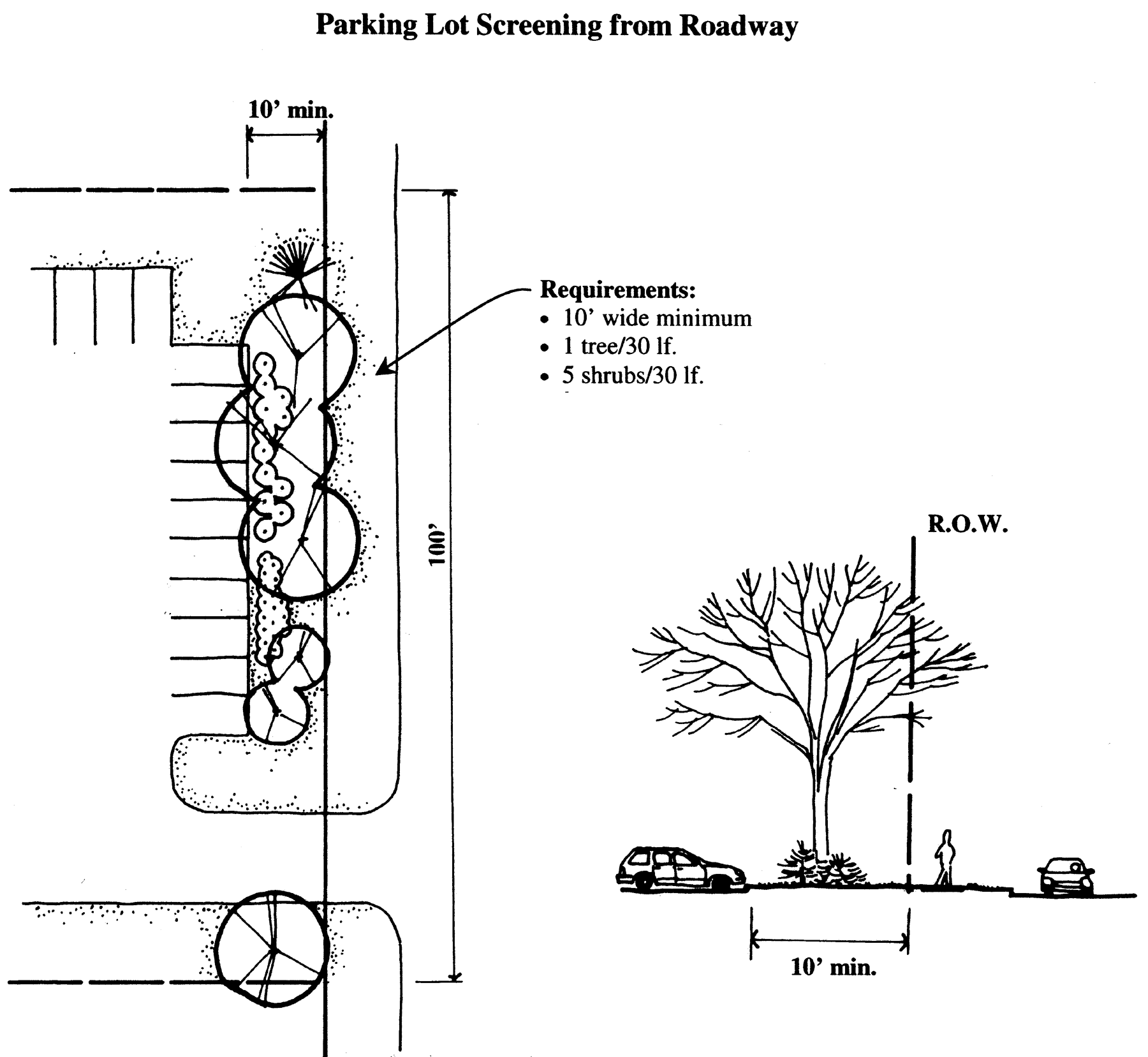
Parking Lot Screening From Roadway
b.
Parking lots of greater than 5,000 square feet shall meet the following landscaping requirements for the interior of the parking lot:
1.
Within the interior of the parking lot there shall be one square foot of landscaped area for each 15 square feet of the parking lot. Greenbelt areas, buffers or landscape strips required in other sections of this chapter shall not be counted towards the requirement of interior parking lot landscaping.
2.
Each interior landscaped area shall have at least 150 square feet.
3.
The landscaped areas shall be located in a manner that breaks up the expanse of paving throughout the parking lot. Parking lot islands shall be a minimum width of six feet in any direction.
4.
There shall be at least one deciduous tree for each 300 square feet or fraction thereof of interior landscaped area. Each individual landscaped area shall contain at least one tree.
Interior Parking Lot Landscaping
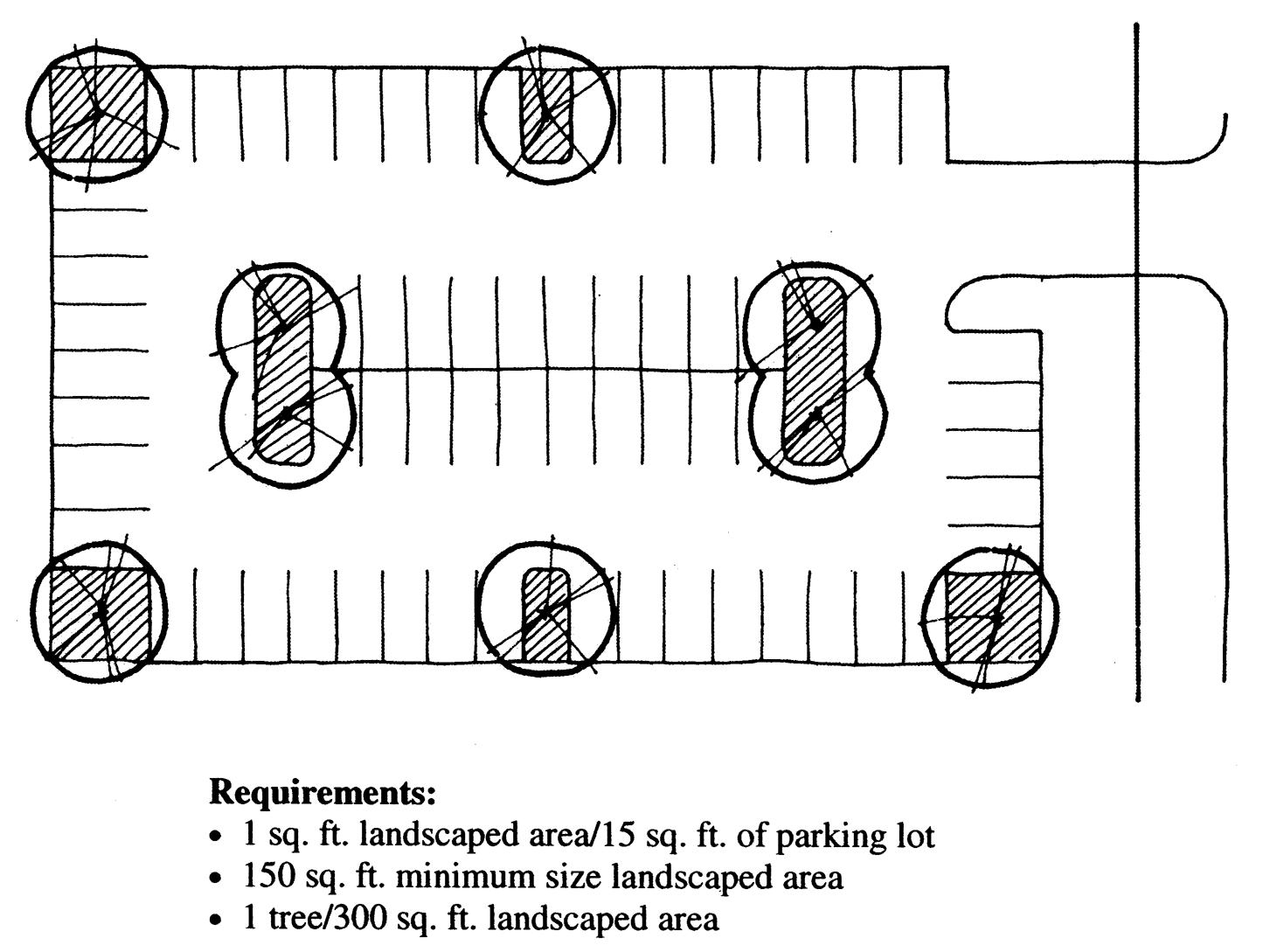
Interior Parking Lot Landscaping
c.
Parking lots of greater than 5,000 square feet, but less than 10,000 square feet, shall have interior landscaping located within the lot or around its perimeter. Perimeter landscaping shall follow the requirements of section 78-203 and walls required in section 78-206 may be replaced by suitable screening or landscaping.
d.
A parking lot of an office, commercial or industrial use adjacent to a public park facility or land principally used or zoned for residential purposes shall have a landscape strip at least 15 feet wide between it and all areas of such park or residential land, as required in section 78-206.
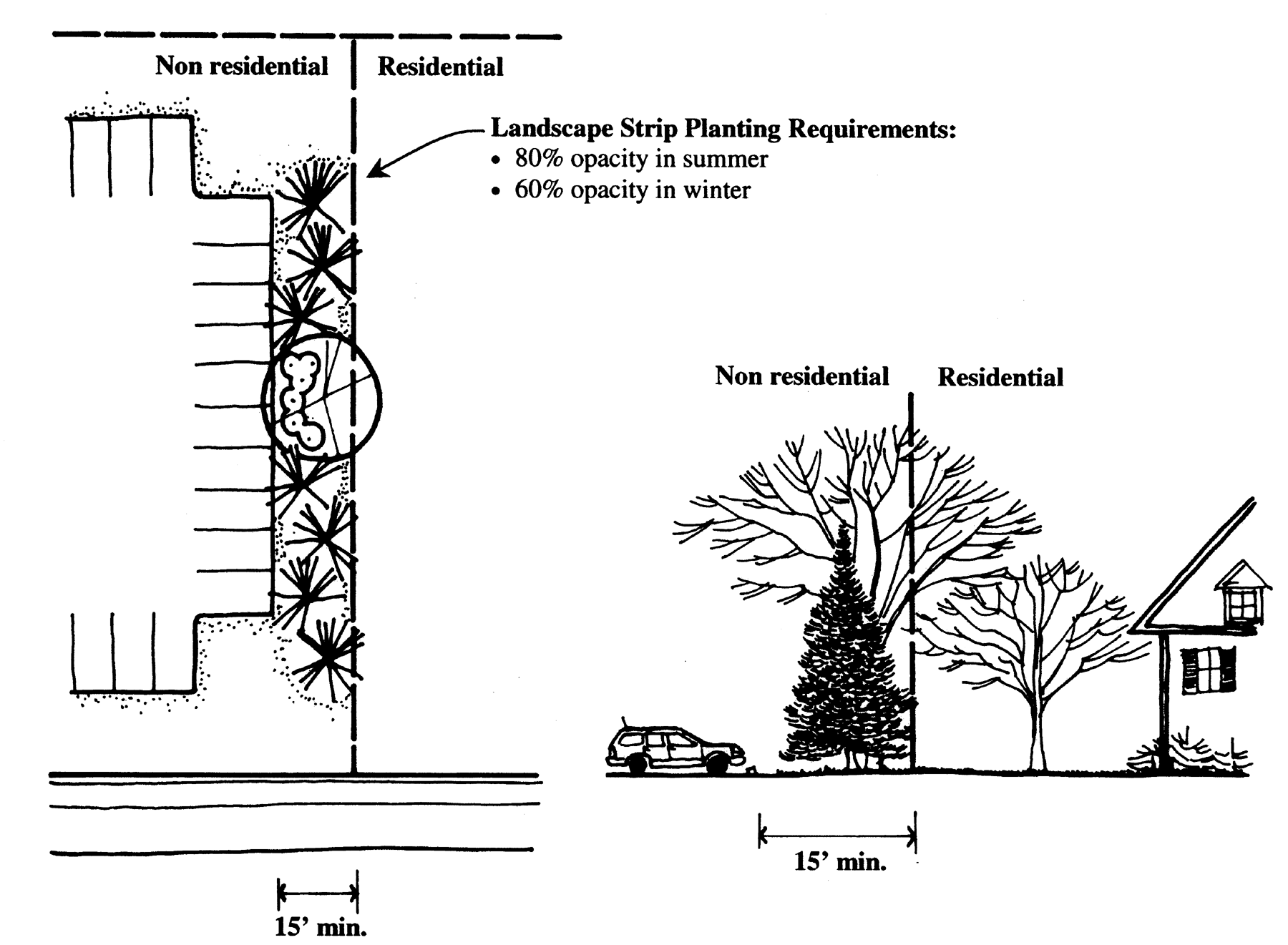
Landscape Strip
(4)
Landscape planting plan review and field inspection.
a.
Whenever in this chapter plantings are required, a plan for planting and landscaping shall be provided showing materials, their location, spacing, size and number as required by this section and other sections of this chapter.
b.
In developments providing open space such as multiple housing developments, open space subdivisions, and cluster housing developments, a plan for landscaping shall include the development proposals for the open space as well as proposals for planting.
c.
Final landscaping and planting plans shall be submitted for review by the city within 60 days of the date of approval of the site plan for the proposed development. A building permit will not be issued until landscaping and planting plans are approved.
d.
Review fees for landscaping and planting plans shall be charged to the applicant in accord with fees established from time to time by resolution of the city commission.
(5)
Suggested plant materials.
a.
Evergreen trees:
Pine (white)
Douglas fir
Fir
Hemlock
Spruce
b.
Narrow evergreens:
Red cedar
Arborvitae
Junipers
c.
Large deciduous trees:
Zelkova
Sycamore
Tuliptree
Kentucky coffeetree
Blackgum
Oaks
Ginkgo (male)
Birch
Linden
Beech
Honey locust (seedless & thornless)
d.
Small deciduous trees:
Hornbeam
Hawthorn
Magnolia
Mountain ash
Redbud
Flowering dogwood
Flowering crabapples (disease resistant varieties)
e.
Large shrubs:
1.
Deciduous:
Lilac
Forsythia
Staghorn sumac
Pyracantha
Flowering quince
Sargent crabapple
Dogwood (silky, red osier, grey)
Cotoneaster (Pekin, spreading)
Common witchhazel
Blackhaw viburnum
Highbush cranberry
American elderberry
2.
Evergreen:
Irish yew
Hicks yew
Mugo pine
Pfitzer juniper
Savin juniper
f.
Medium to small shrubs:
1.
Deciduous:
Fragrant sumac
Japanese quince
Potentilla
Cotoneaster (cranberry, rockspray)
Red chokeberry
Michigan holly
Common ninebark
Arrowwood viburnum
New Jersey tea
Buttonbush
2.
Evergreen:
Dwarf mugo pine
Big leaf winter creeper
Arborvitae
Low spreading junipers (Andora, Hughes, tamarack, etc.)
Spreading Yews (dense, Brown's, Ward, etc.)
g.
Trees not permitted:
Box elder
Ash trees
Willows
Maples
Poplars
Siberian elms
Tree of heaven
Russian olive
(6)
Right-of-way landscaping requirements. The right-of-way adjacent to residentially used properties shall be landscaped with live plant material such as turf grass, ground cover, trees, vines, flowers, and other live plant material. Exceptions are made for sidewalks, approaches to crosswalks, and approaches to driveways.
(Ord. of 10-6-03; Ord. No. 23-01, 1-17-23)
Sec. 78-204. - Exterior lighting.
(a)
Residential lighting standards.
(1)
All outdoor lighting in residential use districts used to light the general area of a site shall be shielded or directed in a manner which reduces glare and shall be so arranged as to reflect objectionable lights away from all adjacent residential districts or adjacent residences.
(b)
Non-residential lighting standards.
(1)
Time period. Required lighting shall be turned off daily from ½ hour before sunrise to ½ hour after sunset.
(2)
Permitted lighting. Only non-glare, color-corrected lighting shall be permitted. In commercial and industrial districts, full cutoff shades are required for light sources higher than 15 feet so as to direct the light onto the site and away from adjoining properties. The lighting source shall not be directly visible from adjoining properties. Lighting shall be shielded so that it does not cause glare for motorists.
(3)
Intensity.
a.
Site lighting. Lighting for uses adjacent to residential properties shall be designed and maintained such that illumination levels do not exceed 0.1 foot-candles along property lines. Lighting for uses adjacent to non-residential properties shall be designed and maintained such that illumination levels do not exceed 0.3 foot-candles along property lines. The light intensity provided at ground level shall be a minimum of 0.3 foot-candle anywhere in the area to be illuminated. Light intensity shall average a minimum of 0.5 foot-candle over the entire area, measured five feet above the surface.
b.
Parking lots. Parking lot illumination levels shall conform to the following standards:
1.
For residential uses, religious institutions, schools and child care facilities, all parking lots must be illuminated at levels of at least 0.4 but not exceed 0.6 foot-candles.
2.
For non-residential uses, illumination levels shall be a function of the size of the parking lot:
(4)
Height. Except as noted below, lighting fixtures shall not exceed a height of 25 feet or the height of the building, whichever is less, measured from the ground level to the centerline of the light source. Fixtures should provide an overlapping pattern of light at a height of seven feet above ground level (See attached diagram). The planning commission may modify these height standards in the commercial and industrial districts, based on consideration of the following: the position and height of buildings, other structures, and trees on the site; the potential off-site impact of the lighting; the character of the proposed use; and, the character of the surrounding land use. In no case shall the lighting exceed the maximum building height in the district in which it is located. More specifically, in industrial districts the height of lighting fixtures may be equal to the height of the principal building on the site on which the lighting is located, provided that such lighting does not exceed 30 feet and is located at least 200 feet from any residential district.
(5)
Sign lighting. Signs shall be illuminated in accordance with the regulations set forth in the adopted sign ordinance, article XIX.
(6)
Site plan requirements. All lighting, including ornamental lighting, shall be shown on site plans in sufficient detail with appropriate photometric studies to allow determination of the effects of such lighting upon adjacent properties, traffic safety, and overhead sky glow. The objective of these specifications is to minimize undesirable off-site effects. Building or roof mounted lighting intended to attract attention to the building and/or use and not strictly designed for security purposes shall not be permitted. Temporary holiday lighting and decorations are exempt from the aforementioned provisions.
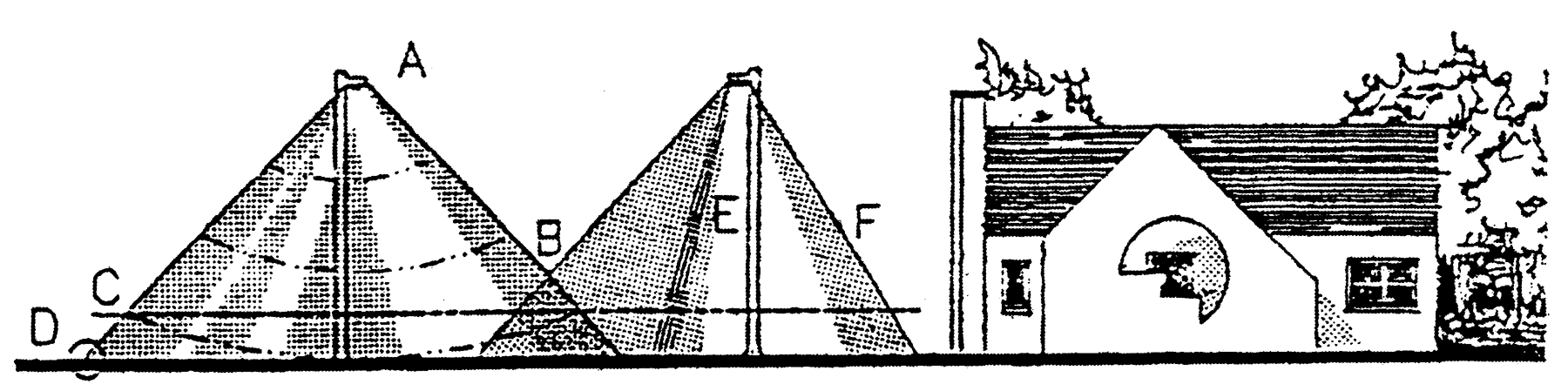
Diagram Notes
A.
Non-glare, color corrected lighting with full cutoff shades for commercial and industrial sites, on daily from a ½ hour after sunset to a ½ hour before sunrise.
B.
Overlapping light pattern at approximately seven feet.
C.
Average minimum light intensity: 0.5 foot-candle, not to exceed a maximum of 20 foot-candles, measured five feet above the surface.
D.
Minimum light intensity at ground level, anywhere on site: 0.3 foot-candle.
E.
Maximum height: Twenty-five feet or height of building, whichever is less, unless modified by planning commission.
F.
Light directed away from adjoining properties. Uses adjacent to residential properties must maintain illumination levels not to exceed 0.1 foot-candles at the property line, and uses adjacent to non-residential properties must maintain levels not to exceed one foot-candle.
G.
For residential uses, religious institutions, schools, and child care facilities, all parking lots must maintain illumination levels of at least 0.4 but not exceed 0.6 foot-candles. For non-residential uses, illumination levels shall be a function of the size of the parking lot (see section 78-204(b)(3)b.)
(Ord. of 10-6-03; Ord. No. 2026-02, 3-2-26)
Sec. 78-205. - Residential entranceway.
In all residential districts, entranceway structures including but not limited to walls, columns and gates marking entrances to single-family subdivisions or multiple housing projects may be permitted and may be located in a required yard, except as provided in section 78-207, provided that such entranceway structures shall comply with all codes of the city, and shall be approved by the building department and a permit issued.
(Ord. of 10-6-03)
Sec. 78-206. - Walls and berms.
(a)
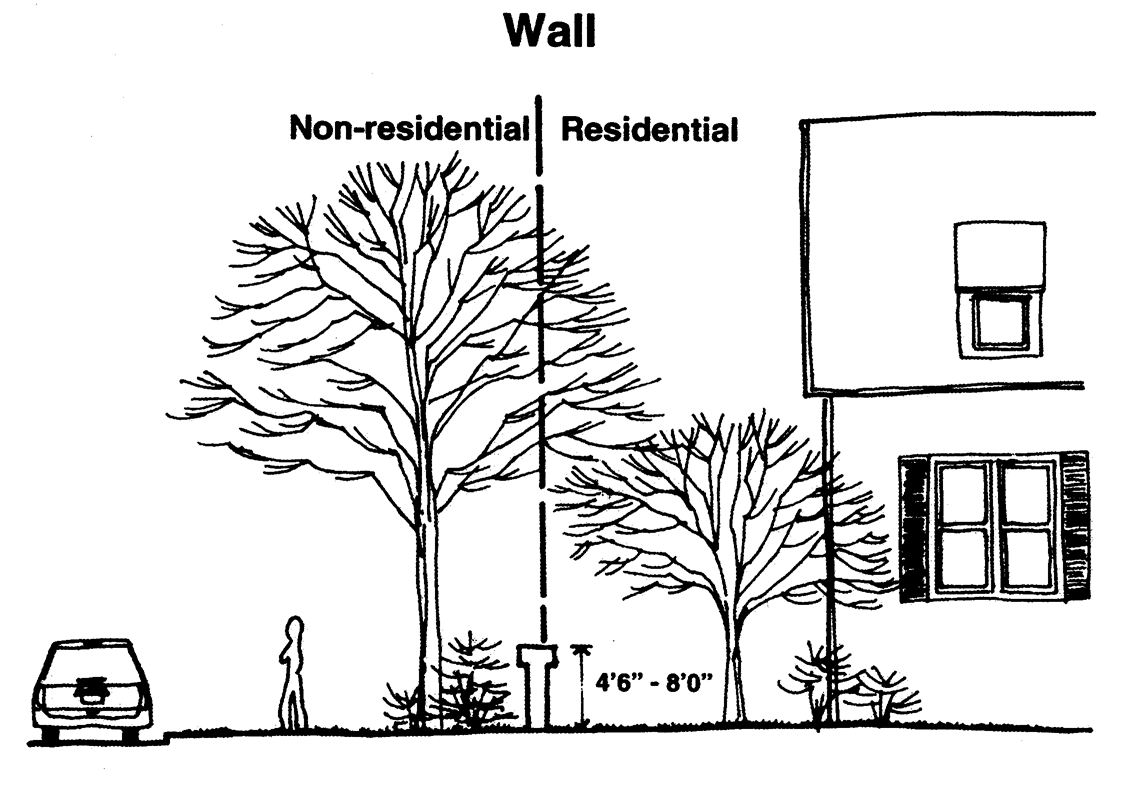
For the use districts and uses listed below, there shall be provided and maintained on those sides abutting or adjacent to a residential district, a screening wall, fence, landscaped berm or landscape strip as required below. The height of the fence, wall, or berm shall be measured from the surface of the parking area or land on the nonresidential side of the wall.
(b)
In the case of variable wall, fence or berm height requirements such as in subsections (a)(1), (4), and (5) of this section, the extent of the obscuring wall, fence, or berm shall be determined by the planning commission on the basis of land usage, provided further that no wall, fence or berm shall be less than the above required minimum.
(c)
Required walls shall be located on the lot line except where underground utilities interfere and except in instances where this chapter requires conformance with yard setback lines. Required walls may, upon approval of the zoning board of appeals, be located on the opposite side of an alley right-of-way from a nonresidential zone that abuts a residential zone when mutually agreeable to affected property owners. The continuity of the required wall on a given block will be a major consideration of the zoning board of appeals in reviewing such request.
(1)
Required walls shall have no openings for vehicular traffic or other purposes, except as otherwise provided in this chapter and except as may be approved by the building official. All walls herein required shall be constructed of face brick or comparable nonporous facing materials and shall be durable, weather resistant, rust-proof and easily maintainable. Wood screen walls or fences shall be cedar, wolmanized or treated wood and may only be used in areas not adjoining parking lots or roadways, and which will not be subject to damage from vehicular traffic. Fences shall comply with the City of Plymouth Fence Ordinance. Solid stockade fences shall be prohibited. Open weave or shadow box style fences which permit air flow shall be permitted.
(2)
Plant materials along a wall or fence shall include at least one tree for each 20 feet or fraction thereof, and shall form a continuous screen from four feet, six inches in height to eight feet in height as required in section 78-206(a).
(d)
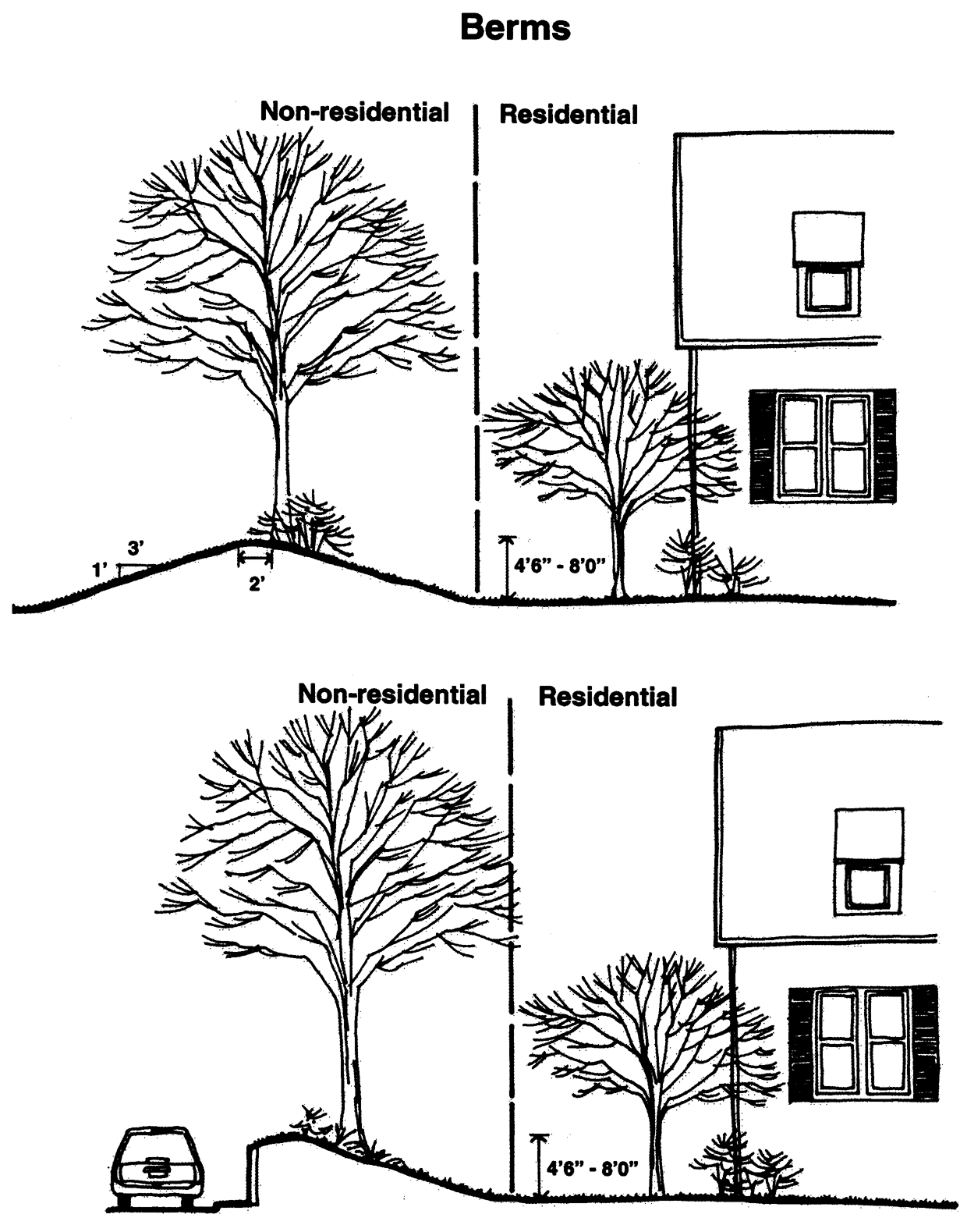
Required berms shall be constructed as landscaped earth mounds with a crest area at least two feet in width. The exterior face of the berm shall be constructed as an earthen slope. The interior face of the berm may be constructed as an earthen slope, or retained by means of a wall, terrace or other means acceptable to the building official. Whenever an earthen slope is provided, it shall be constructed with an incline not to exceed one foot of vertical rise to three feet of horizontal distance.
(1)
Berm slopes shall be protected from erosion by sodding or seeding. If slopes are seeded, they shall be protected with erosion control methods until the seed germinates and a permanent lawn is established. The berm area shall be kept free from refuse and debris and shall be planted with shrubs, trees or lawn and shall be maintained in a healthy, growing condition.
(2)
Plant materials within the berm area shall include at least one tree for each 20 feet or fraction thereof, and shall form a continuous screen from four feet, six inches in height to eight feet in height as required in section 78-206(a). A planting plan and grading plan shall be prepared for the berm and shall be reviewed by the planning commission.
Berms
Berms—Cont'd.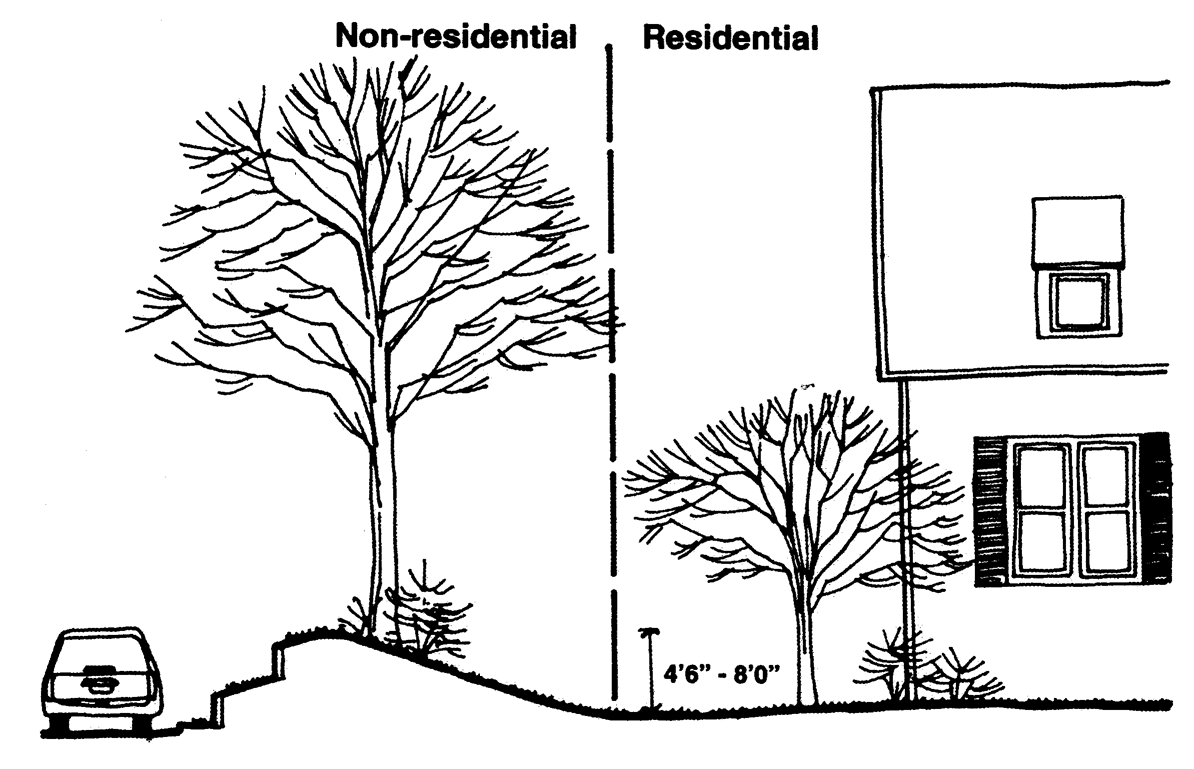
Berms-2
(e)
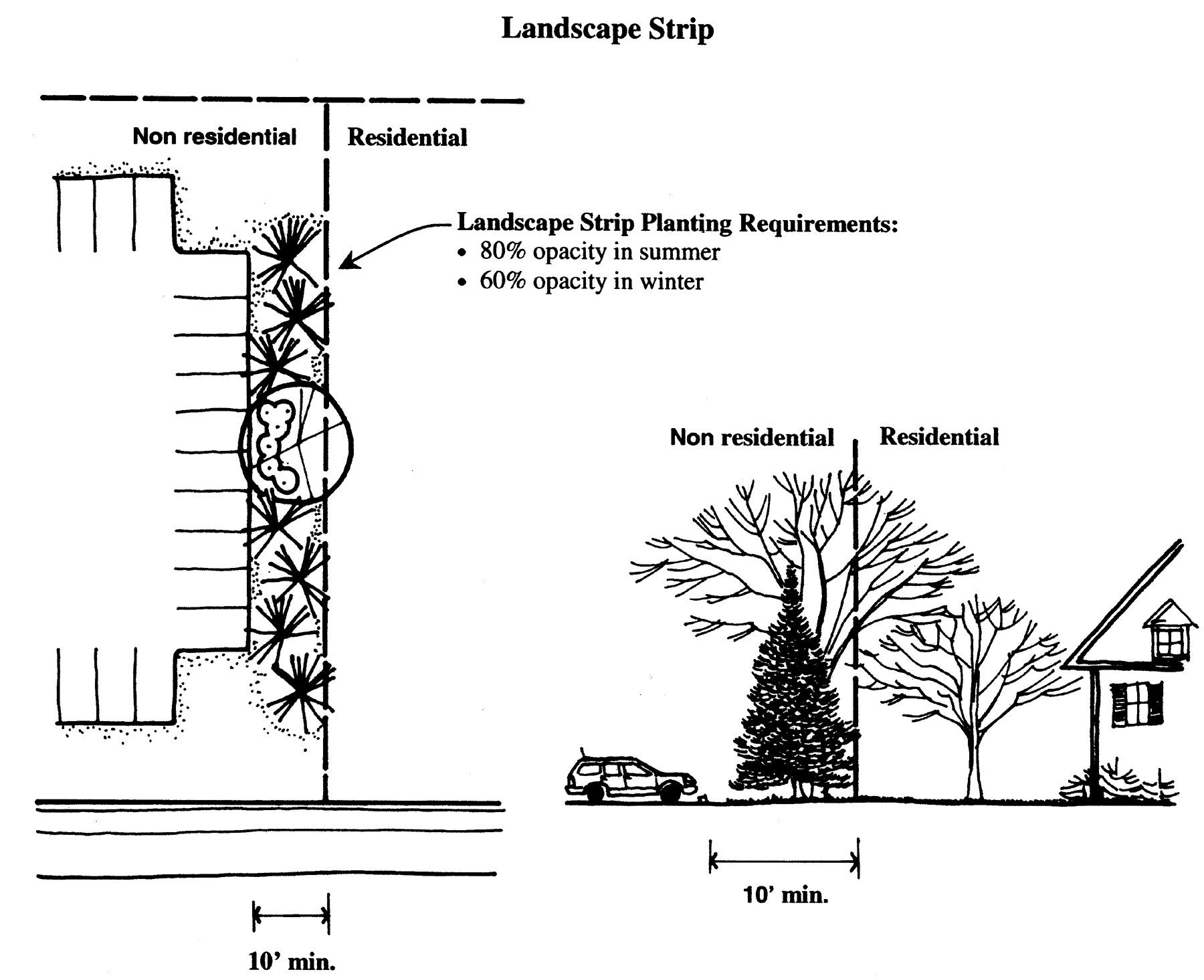
If a landscape strip is used as a buffer between conflicting uses, the landscape strip shall be at least ten feet in width. The landscape strip shall be planted with dense foliage in such manner as to provide a minimum opacity of 80 percent in summer and 60 percent in winter.
Landacape Strip
(f)
The planning commission may waive or modify the foregoing requirements of section 78-206, where cause can be shown that no good purpose would be served and that the waiver or modification would neither be injurious to the surrounding neighborhood nor contrary to the spirit and purpose of this chapter provided that in no instance shall a required wall or berm be permitted to be less than four feet, six inches in height. In those instances where suitable screening will be achieved, the planning commission may allow planting, earth berms, or treated wood walls in place of masonry walls.
(1)
In consideration of request to waive wall or berm requirements between residential and nonresidential districts, or as otherwise required herein, the planning commission shall consider:
a.
Whether or not the residential district is considered to be an area in transition and will become nonresidential in the future based on the adopted master plan.
b.
Whether or not the existing use of land adjacent thereto is such that the obscuring effect of a wall or berm would achieve no substantial screening function.
c.
Whether or not the ground elevation of the site in question and the land adjacent thereto is such that a wall or berm would not be required to provide the required obscuring effect.
(2)
The planning commission may temporarily waive wall or berm requirements for an initial period not to exceed 12 months. Granting of subsequent waivers shall be permitted, provided that the planning commission shall make a determination as hereinbefore described for each subsequent waiver.
(g)
The city may require that suitable maintenance guarantee be provided for the continued maintenance of walls required under this chapter.
(h)
The requirement for an obscuring wall between off-street parking areas, outdoor storage areas, and any abutting residential districts may not be required when such areas are located more than 200 feet distant from such abutting residential district.
(Ord. of 10-6-03; Ord. No. 2011-03, § 1, 1-17-11)
Sec. 78-207. - Corner clearance.
(a)
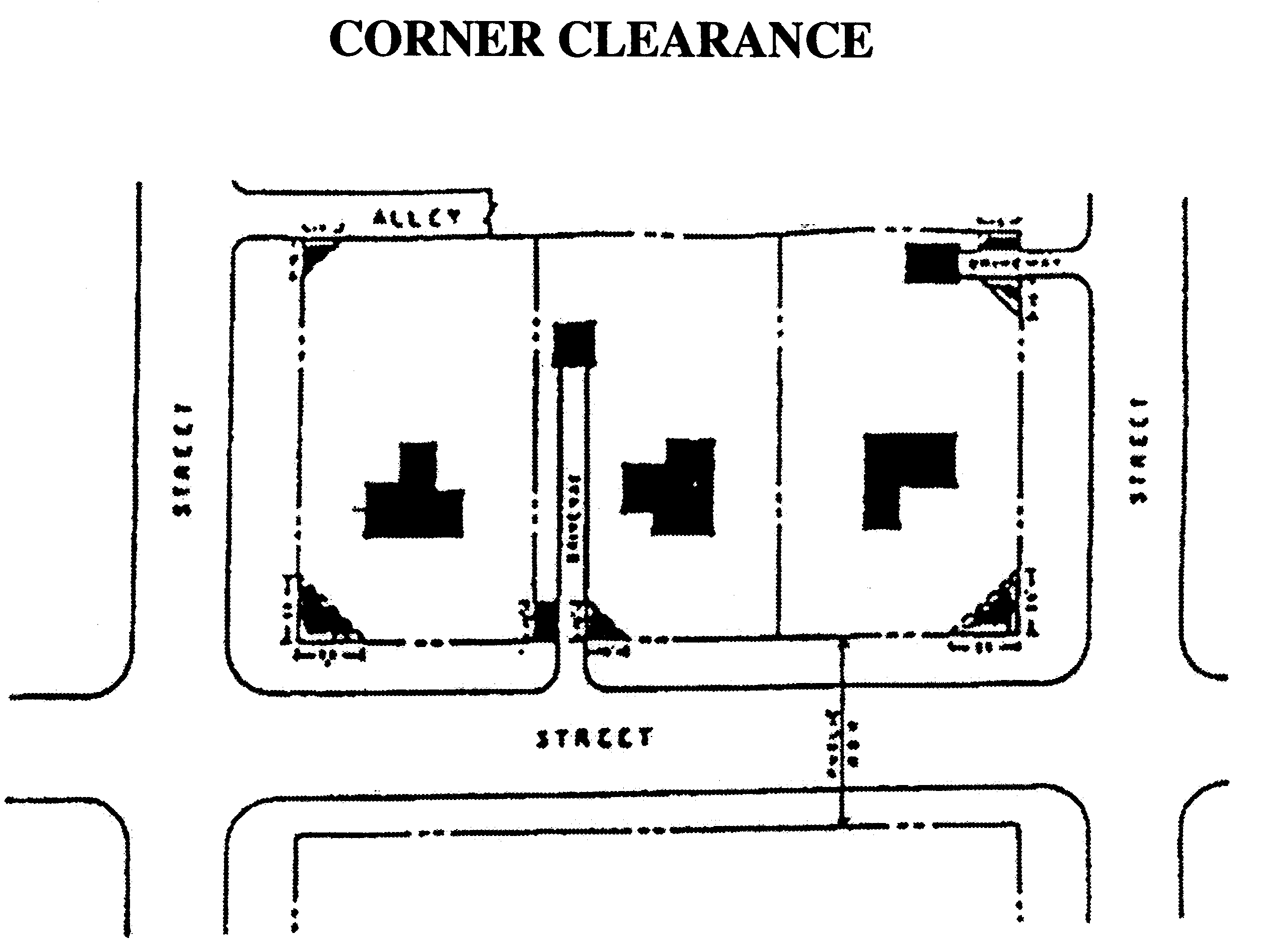
A clear vision area shall be established within the triangular area formed at the intersection of any street right-of-way lines by a straight line drawn between such right-of-way lines at a distance along each line of 25 feet from their point of intersection. Walls, fences, berms, shrubs, hedges or other plantings (excluding trees) and signs in this area shall not exceed 30 inches in height above the average gutter grade adjacent to this area. Trees planted or signs erected within this same area shall not have branches or portions of the sign area lower than eight feet above the average gutter grade.
(b)
The planning commission may require adequate sight visibility, corner clearance and building setback within the B-2 zoning district. This may be required at the intersection of driveways and a public right-of-way in a manner to aid vehicular and pedestrian traffic. A triangular area of unobstructed vision for motorists and pedestrians shall be maintained at the intersection of the street right-of-way and driveway. The triangular area shall comply with Section 78-207 or as modified by the Building Official or Planning Commission for sites where strict compliance is impractical.
(Ord. of 10-6-03; Ord. No. 2007-01, § 5, 5-21-07)
Sec. 78-208. - Residential fences.
Fences or walls are permitted, subject to the paramount provisions of the City of Plymouth Fence Ordinance (Chapter 18, Building Regulations Article X, Fences 18-371—18-380) and subject to the further provisions of this section. If any of the provisions of this section should conflict with the City of Plymouth Fence Ordinance, the stricter provision shall prevail. It is the intent, however, that the following provisions be construed harmoniously with the fence ordinance where possible.
(1)
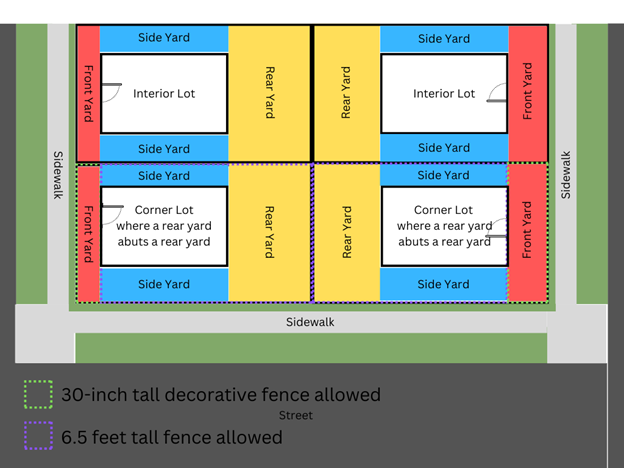
Fences on all lots of record in all residential districts which enclose property and/or are within a required side or rear yard shall not exceed six and one-half feet in height, measured from the surface of the ground, and shall not extend toward the front of the lot nearer than the front of the house or the required minimum front yard, whichever is greater (see Figure 1). In the case of a rear yard abutting a side yard, the side yard abutting a street shall be a continuation of the required front setback on the lot to the rear, and a 48-inch-tall picket fence may project into this area but shall not extend toward the front of the lot nearer than the front of the house (see Figure 2).
Figure 1.
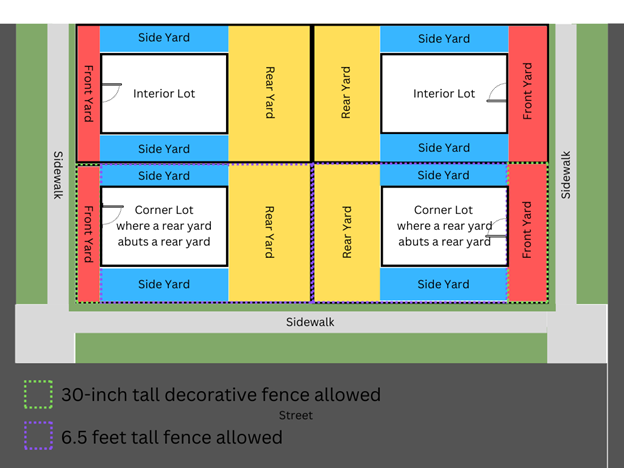
Figure 2.
(2)
Fences on lots of record shall not contain barbed wire, electric current, or charge of electricity. This shall exclude underground electric fences used for pet containment.
(3)
All fences or walls shall be constructed with the finished side exposed to neighboring properties, the support posts placed on the inside, and in a manner which serves to enhance the aesthetic appearance of the neighborhood or surrounding area.
(4)
Posts and finials may extend no more than six inches above the maximum permitted height of a fence.
(5)
Fences for swimming pools shall comply with the regulations of the state construction code.
(6)
No fence, wall, or plantings shall interfere with visibility from a driveway, alley or intersection. All fences, walls, or plantings shall comply with the corner clearance requirements of section 78-207.
(7)
Fences which enclose public or institutional parks, playgrounds, or public landscaped areas, situated within an area developed with recorded lots, shall not exceed eight feet in height measured from the surface of the ground, and shall not obstruct vision to an extent greater than 25 percent of their total area.
(8)
Fences or walls within a required front yard area shall be decorative style only consisting of wrought iron, metal, or pickets and masonry or stone walls. Decorative fences or walls placed within a front yard shall not exceed 30 inches in height. A decorative fence or wall shall contribute to the identification and beauty of the principal building. Chain link fences are not allowed within a required front yard area.
(9)
Walls constructed of masonry, stone or pre-cast materials and constructed within a side or rear yard shall have a maximum height of 30 inches. This shall exclude screening walls constructed between conflicting land uses as specified in section 78-206.
(Ord. of 10-6-03; Ord. No. 2011-03, § 2, 1-17-11; Ord. of 8-7-23)
Sec. 78-209. - Industrial fences.
Fences are permitted in industrial districts as follows:
(1)
Fences shall not be allowed within the front yard of any industry on sites of less than ten acres in size. Fences may be allowed in front yards of sites of ten acres or more after review and approval of the planning commission.
(2)
Fences not to exceed eight feet in height shall be permitted in side and rear yards. Barbed wire shall be allowed on fences not less than eight feet in height in not more than three strands mounted in a "Y" at the top of the fence and shall be permitted provided such "Y" is located to project over the property being fenced.
(Ord. of 10-6-03)
Sec. 78-210. - Street access.
(a)
Any lot created after the effective date of this chapter shall have frontage upon a public street right-of-way or legally recorded access easement at least 60 feet in width, unless a private road of lesser width has been approved by the city commission.
(Ord. of 10-6-03)
Sec. 78-211. - Temporary buildings and structures.
Temporary buildings and structures, including trailers, incidental to construction work on a lot, may be placed on such lot, subject to the following restrictions:
(1)
Temporary buildings and structures may only be used for the storage of construction materials, tools, supplies and equipment, for construction management and supervision offices, and for temporary on-site sanitation, solid waste or fuel facilities, related to construction activity on the same lot.
(2)
No temporary building or structure shall be used as a dwelling unit.
(3)
A building permit for such building or structure shall be issued by the building official prior to installation.
(4)
Temporary buildings and structures shall be removed from the lot within 15 days after an occupancy permit is issued by the building official for the permanent structure on such lot, or within 15 days after the expiration of a building permit issued for construction on such lot.
(Ord. of 10-6-03)
Sec. 78-212. - Home occupations.
A home occupation, defined as an occupation or profession carried on in the home by resident members of the household where such use is clearly incidental and secondary to the principal use of the dwelling as a residence, shall meet the following criteria:
(1)
That such home occupation shall be carried on within the dwelling or within a building accessory thereto.
(2)
That the character or appearance of the residence shall not change and that the home occupation shall not generate more traffic from cars or trucks than normally associated with a residential dwelling.
(3)
That no article shall be sold or offered for sale on the premises, except such as is produced within the dwelling or accessory building or is provided incidental to the service or profession conducted within the dwelling or accessory building.
(4)
The home occupation shall not display or create outside the building any external evidence of the operation of the home occupation, except that there may be one unlighted wall sign, that is not an awning, changeable copy or channel letter sign, not to exceed three square feet in area. Home occupations shall not be permitted freestanding signs.
(5)
The use of the dwelling unit for the home occupation shall be clearly incidental and subordinate to its use for residential purposes by its occupants, and not more than 25 percent of the floor area of the dwelling unit shall be used in the conduct of the home occupation.
(6)
That there shall be no exterior storage of materials or equipment.
(7)
That no nuisance shall be generated by any heat, glare, noise, smoke, vibration, noxious fumes, odors, vapors, gases, chemicals, or matter at any time.
(8)
That no hazard of fire, explosion, or radioactivity shall exist at any time.
(9)
That only members of the household occupying the dwelling shall be employed in the dwelling or accessory building.
(Ord. of 10-6-03; Ord. No. 2012-04, § 10, 11-5-12; Ord. No. 2020-01, 3-2-20)
Sec. 78-213. - Mechanical equipment.
Any mechanical equipment, including water and gas meters, elevator housings, stairways, tanks, heating, ventilation and air conditioning equipment (HVAC), and other similar equipment, located on the roof and any part of a building shall comply with the following standards:
(1)
All such equipment shall be screened by a solid wall, fence, landscaping and/or architectural feature that is compatible in appearance with the principal building.
(2)
Roof-mounted equipment shall not exceed a height of ten feet above the surrounding roof surface, and shall occupy no more than 15 percent of the total roof area.
(Ord. of 10-6-03)
Sec. 78-214. - Essential public services.
The erection, construction, alteration or maintenance of essential public services shall be permitted in any zoning district; it being the intention thereof to exempt such erection, construction, alteration or maintenance from the application of this chapter. Essential services shall be subject to site plan review, article XVII, unless waived by the building official.
(Ord. of 10-6-03)
Sec. 78-215. - Condominium development standards.
The intent of this section is to provide regulatory standards for condominiums and condominium subdivisions similar to those required for projects developed under other forms of ownership.
(1)
General requirements.
a.
Each condominium lot shall be located within a zoning district that permits the proposed use.
b.
Each condominium lot shall front on and have direct access to a public street or a private street approved by the planning commission. Approval for a private street may be conferred by the planning commission in conjunction with article XX, site plan review.
c.
All condominium project plans shall conform to the plan preparation requirements, design, layout, and improvements standards and all other requirements as established in the City of Plymouth Subdivision Regulations.
d.
For the purposes of this ordinance, each condominium lot shall be considered equivalent to a single lot and shall comply with all regulations of the zoning district in which it is located.
(2)
Site plan approval required. Approval of the site plan and condominium documents by the planning commission shall be required as a condition to the right to construct, expand or convert a site condominium project. Preliminary and final approval shall not be combined.
a.
Approval process.
1.
A site plan pursuant to the standards and procedures set forth in article XX of this chapter shall be submitted to the planning commission for review.
2.
The applicant shall submit the condominium documents and master deed to the city staff and consultants for review. The condominium documents shall be reviewed with respect to all matters subject to regulation by the city including without limitation; ongoing preservation and maintenance of drainage, stormwater retention, wetlands, woodlands, and other natural features; maintenance of private roads, if any; and maintenance of stormwater, sanitary, and water facilities and utilities.
All review comments shall be submitted to the building official who shall compile the findings prior to consideration of the site plan for approval by the planning commission.
3.
Following receipt of preliminary approval, the applicant shall also submit to the building official plans in sufficient detail for the city, along with appropriate consultants, to determine compliance with applicable laws, ordinances and design standards for construction of the project.
All review comments shall be submitted to the building official who shall compile the findings prior to consideration of the site plan for approval by the planning commission.
4.
Upon completion of the review of the condominium documents and plans and receipt of the recommendations and findings from city staff and consultants, the site plan shall be submitted to the planning commission for review in accordance with article XX of this chapter.
5.
If the site plan, condominium documents and/or plans conform in all respects to applicable laws, ordinances and design standards, approval shall be granted by the planning commission.
6.
If the site plan, condominium documents and/or engineering plans fail to conform to the ordinance or development standards, final approval shall be denied by the planning commission.
7.
In the interest of insuring compliance with this article and protecting the health, safety and welfare of the residents of the city, the planning commission, as a condition of approval of the site plan, may require the applicant to deposit a performance guarantee as set forth in the zoning code for the completion of improvements associated with the proposed use.
b.
Information required prior to occupancy. Prior to the issuance of occupancy permits for any condominium units, the applicant shall submit the following to the city:
1.
A copy of the recorded condominium documents (including exhibits).
2.
A copy of any recorded restrictive covenants.
3.
A copy of the site plan on laminated photostatic copy or mylar sheet.
4.
Evidence of completion of improvements associated with the proposed use including two copies of an "as-built survey".
c.
Revision of site condominium plan. If the site condominium subdivision plan is revised, the site plan shall be revised accordingly and submitted for review and approval or denial by the planning commission before any building permit may be issued, where such permit is required.
d.
Amendment of condominium documents. Any amendment to a master deed or bylaws that affects the approved site plan or any conditions of approval of a site plan shall be reviewed and approved by the city staff or consultants and planning commission before any building permit may be issued, where such permit is required. The planning commission may require its review of an amended site plan if, in its opinion, such changes in the master deed or bylaws require corresponding changes in the original site plan.
(Ord. of 10-6-03)
Sec. 78-216. - Wireless communication.
(a)
Purpose and intent.
(1)
It is the policy of the city to minimize the overall number of newly established locations for wireless communication facilities and wireless communication support structures within the community, and encourage the use of existing structures for attached wireless communication facility purposes. It is further the purpose and intent of the city to provide for such authorization in a manner which will protect the public health, safety, and welfare and retain the integrity of neighborhoods and the character and aesthetic quality of the community at large. This policy is consistent with the Federal Telecommunications Act of 1996 and PA 110 of 2006, as amended (MCL 125.3514).
(b)
Authorization. Wireless telecommunication facilities may be permitted within the City of Plymouth as either a permitted use subject to administrative review, permitted use subject to site plan approval, or as a special land use according to the following regulations:
(1)
Wireless communication equipment as a permitted use subject to administrative review.
A proposal for attached wireless communication facilities that satisfies the following criteria does not require special land use or site plan approval. Confirmation that these criteria are satisfied shall be determined by an administrative review by the building Official prior to issuance of any construction code permits. Such proposals shall also be reviewed for compliance with the standards and conditions in subsection (c), General regulations, with the certification to identify any items of noncompliance. The wireless facility shall also comply with the following:
a.
The existing wireless communications support structure and/or wireless communications equipment compound are in compliance with this section and, if not, are in compliance with a prior approval under this section.
b.
The proposal will not increase the height of the wireless communications support structure by more than 20 feet or ten percent of its original height (as first erected without any later additions), whichever is greater.
c.
The proposal will not increase the width of the wireless communications support structure by more than necessary to the stated and documented purpose of the increase.
d.
The proposal will not increase the area of the existing wireless communications equipment compound to more than 2,500 square feet.
(2)
As a permitted use subject to site plan approval. In the I-1 and I-2 zoning districts, a wireless communication facility shall be a permitted use subject to the standards and conditions of this section. The following wireless communication facilities shall also be considered a permitted use:
a.
A proposed collocation upon a wireless communication support structure which has been approved by the city for such collocation but which is not permitted by administrative review under subsection (b)(3).
b.
Wireless communication equipment on an existing utility pole structure located within a right-of-way and not previously approved and used as a wireless communications support structure, where there will be no substantial change in physical dimensions of the existing pole.
(3)
As a special land use.
a.
A collocation on an existing structure which does any of the following: increases the height of the support structure by more than 20 feet or ten percent of its original height, increase the width of the support structure or increases the area of the equipment compound greater than 2,500 square feet.
b.
Subject to the standards and conditions set forth in this section, new wireless communication facilities shall be considered as a special land use in any areas outside of the I-1 and I-2 zoning districts.
c.
If it is demonstrated by an applicant that a wireless communication facility, in order to operate, is required to be established outside of I-1 and I-2 districts and that existing structures are not available for collocation in other parts of the city, such wireless communication facilities shall be considered elsewhere in the city as a special land use, subject to the following:
1.
At the time of the submittal, the applicant shall demonstrate that alternative locations cannot reasonably meet the coverage and/or capacity needs of the applicant.
2.
Where feasible, wireless communication facilities shall be of a design such as a steeple, bell tower, water tower, or other form which is compatible with the existing character of the proposed site, neighborhood and general area, as approved by the city.
3.
Locations outside of the I-1 and I-2 districts may only be considered at the following locations, subject to application of all other standards contained in this section:
i.
Municipally-owned sites.
ii.
Other governmentally owned sites.
iii.
Religious or other institutional sites.
iv.
Public or private school sites.
v.
Public utility sites.
4.
If sites are not available in the I-1 or I-2 district, or on parcels identified above in subsection 2(c)(iii), other locations where there is a demonstrated need for service can be considered.
5.
All other criteria and standards set forth below in Subsection c. and d. are met as follows:
(c)
General regulations.
(1)
Standards and conditions applicable to all facilities. All applications for wireless communication facilities shall be reviewed in accordance with the following standards and conditions, and, if approved, shall be constructed and maintained in accordance with such standards and conditions.
a.
Facilities shall not be demonstrably injurious to neighborhoods or otherwise detrimental to the public safety and welfare.
b.
Facilities shall be located and designed to be compatible with the existing character of the proposed site and harmonious with surrounding areas.
c.
Applicants shall demonstrate an engineering justification for the proposed height of the structures and an evaluation of alternative designs which might result in lower heights.
d.
The following additional standards shall be met:
1.
The maximum height of the new or modified support structure and antenna shall not exceed height limits provided in Table 216-1, and shall be the minimum height demonstrated to be necessary for reasonable communication by the applicant and by other entities to collocate on the structure.
Table 216-1
Support Structure Height Limits by Zoning District
Additional height over that which is provided in Table 216-1 may be permitted, in the sole discretion of the planning commission, when it can be demonstrated by the applicant that additional height is required to permit collocation. Evidence of collocation shall be provided by the applicant if additional height over that which is provided in Table 216-1 is requested. The accessory building contemplated to enclose such things as switching equipment shall be limited to the maximum height for accessory structures within the respective zoning district.
2.
The setback of the support structure and accessory structures shall be 200 feet from the boundary of any residentially zoned property. Otherwise, the setback of the support structure and accessory structures shall be 100 feet or a distance equal to one hundred and 125 percent of the height of the support structure (whichever is greater) from an adjacent property boundary and all existing or proposed rights-of-way.
3.
There shall be unobstructed access to the support structure, for police, fire and emergency vehicles, and for operation, maintenance, repair and inspection purposes, which may be provided through or over an easement.
4.
The city shall review and approve the architecture and color of the support structure and all accessory buildings so as to minimize distraction, reduce visibility, maximize aesthetic appearance, and ensure compatibility with surroundings. It shall be the responsibility of the applicant to maintain the wireless communication facility in a neat and orderly condition. If lighting is required by the Federal Aviation Administration, Federal Communications Commission, Michigan Aeronautics Commission, or other governmental agencies, it shall be red between sunset and sunrise, white between sunrise and sunset, and shall blink or flash at the longest permitted intervals, unless otherwise required.
5.
The support system shall be constructed in accordance with all applicable building codes and shall include the submission of a soils report from a geotechnical engineer, licensed in the State of Michigan. This soils report shall include soil borings and statements indicating the suitability of soil conditions for the proposed use. The requirements of the Federal Aviation Administration, Federal Communication Commission, and Michigan Aeronautics Commission shall be submitted by the applicant in the original application for approval. The applicant shall furnish a written certification from the manufacturer or designer of the support system that the support system has been evaluated by a registered professional engineer and that the support system can safely accommodate attached antennas under expected weather conditions.
(2)
Standards and conditions applicable to special land use facilities. Applications for wireless communication facilities which shall be approved as special land uses shall be reviewed, and if approved, constructed and maintained, in accordance with the standards and conditions of this section and in accordance with the following standards:
a.
The applicant shall demonstrate the need for the proposed facility based upon one or more of the following factors:
1.
Proximity to an interstate or major thoroughfare.
2.
Areas of population concentration.
3.
Concentration of commercial, industrial, and/or other business centers.
4.
Areas where signal interference has occurred due to tall buildings, masses of trees, or other obstructions.
5.
Topography of the proposed facility location in relation to other facilities with which the proposed facility is to operate.
6.
A demonstrated need, including deficiency of service, proof of dropped calls, and/or inadequate capacity to accommodate call volume. The city may seek the advice of experts in the field or independent third parties for technical assistance regarding radio frequency engineering.
b.
The proposal shall be reviewed in conformity with the collocation requirements of this section.
(d)
Application requirements.
(1)
Building permit applications shall be required for wireless facilities proposed as a permitted use subject to administrative review.
(2)
A site plan and special land use application shall be required for wireless facilities proposed as a special land use, in accordance with Article XX and Article XXIII.
For wireless facilities subject to special land use application, a site plan shall also include a detailed landscape plan prepared in accordance with section 78-203. The purpose of landscaping is to provide screening and aesthetic enhancement for the structure base, accessory buildings and enclosure. In all cases, fencing of a minimum of six feet in height shall be required for protection of the support structure and security from children and other persons who may otherwise access facilities.
(3)
An application shall include a description of security to be posted at the time of receiving a building permit to ensure removal of the facility when it has been abandoned or is no longer needed, as provided in subsection (f). In this regard, the security shall be posted and maintained in the form of: (1) cash; (2) irrevocable letter of credit; or, (3) other security arrangement found acceptable by the city manager.
(e)
Procedures.
(1)
Review and administrative actions on special land use and site plan approval applications.
a.
The building official shall promptly review special land use and site plan approval applications to determine if they are administratively complete by inclusion of all information required in subsection (d). If the application is not complete, no later than 14 business days after receiving it the building official shall provide a written or electronic notice to the applicant specifying the information necessary to complete the application. Such initial review for completeness by the building official shall be on behalf of the planning commission for special land use and site plan approvals.
b.
The building official shall review supplemental information submitted in response to an incomplete application notice and notify the applicant of any remaining deficiencies.
c.
An application shall be administratively complete upon the building official's determination or the expiration of 14 business days from receipt of the application without a notice to the applicant of deficiencies.
d.
Upon a special land use or site plan approval application being administratively complete, the building official shall promptly schedule it for a planning commission meeting that will allow for a planning commission site plan decision or special land use decision after the required public hearing within the time periods in subsection (e)(2) below.
e.
If the applicant has disclosed professional opinions supporting the application and the building official or planning commission has determined that independent professional review for the city of any such opinion should be performed, the reasonable costs of such review may be assessed to the applicant by a written notice from the building official as a professional review cost to be paid in accordance with the notice.
(2)
Decisions on special land use and site plan approval applications.
a.
The planning commission shall approve or deny a special land use application for a new wireless communications support structure not more than ninety (90) days after it is administratively complete.
b.
For all special land use, site plan applications, and applications subject to administrative review, other than new wireless communications support structures, the planning commission shall approve or deny the application not more than 60 days after it is administratively complete.
(3)
Post-approval costs, fees, and administrative actions. Zoning permits to implement and grant the authority allowed by a special land use or site plan approval for wireless communication facilities, and zoning certificates of use and occupancy for such facilities, shall be issued subject to and conditioned on all of the following:
a.
Any conditions of the special land use or site plan approval.
b.
Payment of any outstanding professional review costs as described in subsection e.1)(e).
c.
Payment of permit fees in an amount established by or in accordance with a Resolution of city commission.
(f)
Removal.
(1)
A wireless communication facility must furnish reasonable evidence of ongoing operation at any time after the construction of an approved tower.
(2)
A condition of every approval of a wireless communication facility shall be adequate provision for removal of all or part of the facility by users and owners upon cessation of operation.
(Ord. of 10-6-03; Ord. No. 2014-03, § 6, 2-17-14; Ord. No. 2026-02, 3-2-26)
Sec. 78-217. - Projections into setbacks.
Projections into setbacks shall be permitted as follows:
*Areaway construction can project above grade no more than 12 inches.
**The portion of a deck which occupies the rear yard setback shall not be converted into any enclosed habitable spaces.
***Generators may project up to four feet into the side yard setback only if one or more of the following conditions are met, as determined by the community development director:
1. The location of windows and/or doors on the rear exterior wall do not provide the clearance dimension required by the adopted mechanical code.
2. The location of trees with a 12-inch DBH or greater do not provide reasonable placement on or near the rear exterior wall.
3. The location of built structures and mechanical equipment such as but not limited to egress windows, exterior or basement stairs, air conditioning condensers, cellar door, chimneys, decks, terraces, pools, porches, do not provide reasonable placement on or near the rear exterior wall. The location of the gas meter shall not be considered mechanical equipment.
(1) Projections containing floor area, including decks, shall be included in the lot coverage calculation. See Sections 78-43 and 78-53 for the front porch exclusion from lot coverage.
(Ord. of 10-6-03; Ord. No. 16-02, § 2, 7-18-16; Ord. No. 2024-01, 3-18-24)
Sec. 78-218. - Foundation walls.
(1)
The exposed foundation wall between the average of finished grades at the center of all walls of the building and the highest portion of the first floor shall not exceed 36 inches from the average grade plane. In case walls are parallel to and within five feet of a sidewalk, the above ground level (average grade plane) for that wall shall be measured at the sidewalk, unless otherwise defined herein. This height limit shall not include areas for walk out basements, window wells or other portions of exposed foundation wall which cannot be reasonably lowered or covered as determined by the building official.
(2)
Elevation measurements of the top of the basement footings shall be provided to the building official by a licensed engineer or surveyor before a backfill inspection can be conducted to confirm that the actual elevations meet the submitted plans.
(Ord. No. 16-06, § 2, 10-17-16)
Sec. 78-219. - Grading, drainage and building grades.
(1)
The ground areas outside the walls of any building or structure hereafter erected, altered, or moved shall be so designated that surface water shall flow away from the building walls in such a direction and with such a method of collection that inconvenience or damage to adjacent properties will not result. Where property is developed adjacent to existing properties previously developed, existing grades of adjacent properties shall have priority. Grades around houses or structures shall meet existing grades in the shortest possible distance, as determined by the building official, but under no circumstances shall exceed 1:4 slopes or 25 percent grades.
(2)
To minimize impacts on contiguous, previously developed, single-family residential property and ensure compatibility for new projects in established residential neighborhoods, the first story elevation height of new structures shall be consistent with the first floor elevation height of contiguous residences, in conformance with other requirements of this ordinance. Any property owner/developer who intends to add fill above the height of the existing contiguous grades shall demonstrate to the building official's satisfaction, that additional fill is not detrimental to surrounding properties in terms of compatibility and drainage.
(3)
A certificate of occupancy will not be issued until final grades are approved by the city building official. A certificate of grading shall be completed by the applicant. When possible, the certificate of grading should show landscaping areas. The building official shall require a certified copy of the grading plan to be submitted by a registered civil engineer or land surveyor.
(Ord. No. 16-06, § 2, 10-17-16; Ord. No. 23-01, 1-17-23)

