
Plymouth City Zoning Code
ARTICLE XIX
SIGNS3
Editor's note—Ord. No. 2020-01, adopted March 2, 2020, repealed art. XIX in its entirety and enacted new provisions to read as herein set out. Former art. XIX, §§ 78-220—78-223, 78-225—78-231, pertained to similar subject matter and derived from Ord. No. 2017-02, adopted Jan. 16, 2017.
Sec. 78-220.- Intent.
The intent of this article is to regulate the location, size, materials, construction, manner of display, maintenance, and removal of signs, except those expressly exempted from regulation by this ordinance. This ordinance has the following objectives:
(a)
Minimize any potential harmful effects on the public health, safety and welfare by ensuring that signs are structurally sound and adequately maintained, minimizing the potential for unsafe traffic conditions due to signage that unreasonably distracts drivers or emulates official traffic signs, keeping signage out of pedestrian and vehicle travel ways, and minimizing glare or vision impairment from sign lighting.
(b)
Protect the constitutionally guaranteed right of free speech.
(c)
Recognize the legitimate needs of business, industry and other activities, through appropriate guidelines, in attaining their identification and informational objectives and promote economic development in the city.
(d)
Preserve the aesthetic quality of roadways and zoning districts by:
(1)
Preventing visual clutter and blight.
(2)
Protecting views.
(3)
Preventing proliferation of signs.
(4)
Avoiding glare, light trespass, and skyglow through the appropriate selection of light fixtures, light location and direction.
(e)
Preserve the character of unique districts by establishing time, place, and manner regulations that reflect the unique qualities of the area, including, but not limited to, historical, aesthetic, natural, and cultural characteristics.
(Ord. No. 2020-01, 3-2-20)
Sec. 78-221. - Signs exempt.
The following signs are exempt from the requirements in this article:
(a)
Flags;
(b)
Legal notices, identification information, or directional signs erected or permitted by governmental bodies or agencies;
(c)
Building or unit addresses;
(d)
Religious symbols or paintings which do not display lettering and do not advertise a business, product or service;
(e)
Decorative holiday displays.
(Ord. No. 2020-01, 3-2-20)
Sec. 78-222. - Signs permitted.
The following signs are permitted, subject to compliance with the requirements in this article:
(a)
Awning sign;
(b)
Banner sign;
(c)
Manual changeable copy sign;
(d)
Channel letter sign;
(e)
Directional sign;
(f)
Directory sign;
(g)
Flag sign;
(h)
Ground sign;
(i)
Hanging sign;
(j)
Marquee sign;
(k)
Menu board or order board sign;
(l)
Monument sign;
(m)
Neon sign;
(n)
On-premises sign;
(o)
Projecting sign
(p)
Sidewalk sign;
(q)
Temporary sign;
(r)
Wall sign;
(s)
Window sign.
(Ord. No. 2020-01, 3-2-20)
Sec. 78-223. - Signs not permitted.
Any type of sign not expressly permitted in section 78-222 is not allowed in any district. Examples of signs that are not permitted include, but are not limited to, the following.
(a)
Abandoned sign;
(b)
Bench sign;
(c)
Feather flag sign;
(d)
Festoon sign;
(e)
Flashing, animated or moving signs, except signs which display of the current time or temperature;
(f)
Electronic or digital changeable copy signs, except signs which display the current time or temperature;
(g)
Inflatable sign;
(h)
Nonconforming sign;
(i)
Off-premises sign;
(j)
Pole sign;
(k)
Roof sign;
(l)
Vehicle business sign;
(m)
Any device erected or maintained which simulates or imitates in size, color, lettering, or design any traffic sign or signal or other word, phrase, symbol, or character in such as manner as to interfere with, mislead or confuse vehicular traffic;
(n)
Any sign which obstructs free ingress to or egress from a required door, window, fire escape or other required exit;
(o)
Any sign that, as determined by the building official or his or her designee, is deemed unsafe, constitutes a hazard, is structurally unsound or not in good repair;
(p)
Any sign unlawfully installed, erected or maintained.
(Ord. No. 2020-01, 3-2-20)
Sec. 78-224. - General conditions.
The following conditions shall apply to all signs erected or located in any use district that are visible from a public right-of-way, private road, public park or residentially zoned property. Where signs are located in the Ann Arbor Road Corridor (ARC) district (section 78-169), if any regulations covered by this section and section 78-169 conflict, section 78-169 shall control and prevail.
(a)
Location:
(1)
Only signs established or permitted by city, county, state or federal government may be located in or project into the public road right-of-way or public property, unless specifically provided otherwise herein.
(2)
Signs shall be placed so as not to obstruct the clear vision or movement of pedestrians, cyclists, or motorists.
(3)
All signs shall be on-premises signs.
(b)
Illumination:
(1)
No sign shall be illuminated by other than electrical means.
(2)
All signs whether internally or externally illuminated shall not interfere with the vision of pedestrians, cyclists, or motorists.
(3)
The light from illuminated signs shall not directly shine into adjacent or abutting properties.
(4)
Illuminated signs adjacent to residentially zoned property shall be designed and maintained such that illumination levels do not exceed 0.1 foot-candles along the adjacent property line.
(5)
No sign shall have blinking, flashing, or fluttering lights or other illuminating devices which have a changing light intensity, brightness or color.
(6)
When signs are externally illuminated, the light source shall be shielded and not visible from a public street or adjacent property.
(7)
The illumination provisions above shall not apply to sign lighting systems owned or controlled by any public agency for the purpose of directing traffic.
(8)
Neon lighting or similar lighting technologies is prohibited outside of the sign.
(9)
Signs affixed or applied to awnings and canopies shall not be back-lit.
(c)
Measurement:
(1)
Sign area. Sign area shall be computed as follows:
a.
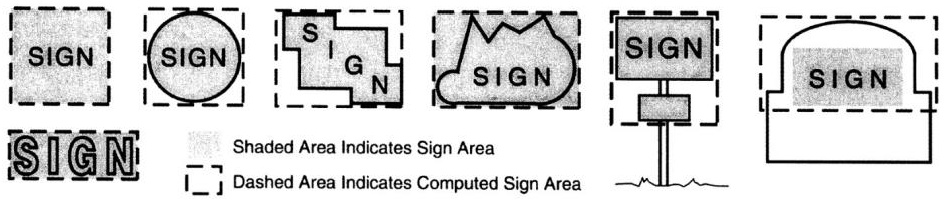
The sign area is measured by enclosing the entire area within a rectangle or square of the extreme limits of writing, representation, emblem, or any figure of similar character, together with any frame, tower, or other material or color or internally illuminated area forming an integral part of the display or used to differentiate such sign. Such signs shall be deemed to be a single sign whenever the proximity, design, content or continuity reasonably suggests a single unit, notwithstanding any physical separation between parts. The graphics below illustrate the measurement of area of various shaped signs:
b.
Wall sign. Where a sign consists of a generally flat surface or sign face on which lettering and other information is affixed, the sign area shall be computed by measuring the entire face of the sign including any framing or borders. Awning signs, channel letter signs, hanging signs, marquee signs, and projecting signs shall be included in the calculation of a wall sign.
c.
Individual letters. Where a sign consists of individual letters and/or logo affixed directly to a building without a supporting structure, the area of the sign shall be computed by measuring the area of the envelope required to enclose the lettering and logo.
d.
Ground sign. The area of a ground sign shall include the entire area of the sign upon which copy, lettering, drawings or photographs could be placed, excluding the base of the sign. Any sign with a solid base that is greater than 30 inches tall as measured from the average grade shall be calculated as part of the sign area.
e.
Two or more faces. Where a sign has two or more faces, the area of all faces shall be included in determining the area of the sign, except that where two such faces are placed back to back and are at no point more than two feet from one another, the area of the sign shall be taken as the area of one face, if the two faces are of equal area, or as the area of the larger face, if the two faces are of unequal area.
f.
Cylindrical sign. The area of a cylindrical freestanding sign shall be computed by multiplying the circumference of the cylinder by its height.
(2)
Sign height. The height of a sign shall be computed as the distance from the base of the sign at average grade directly adjacent to sign base to the highest point of the sign structure, including any supportive or decorative appendages of the sign. Average grade shall be construed to be the lower of:
a.
Existing average grade prior to construction; or
b.
The newly established average grade after construction, exclusive of any filling, berming, mounding, or excavating solely for the purposes of locating the sign.
In cases where the average grade cannot reasonably be determined, sign height shall be computed on the assumption that the elevation of the average grade at the base of the sign is equal to the elevation of the nearest point of the crown of a public street or the grade of the land at the principal entrance to the principal structure on the lot of record, whichever is lower.
(3)
Sign setback.
a.
Signs that are setback from property lines or public rights-of-way will be measured from the portion of the sign structure nearest to the specified line. For purposes of these measurements, the property lines and public right-of-way lines extend vertically and perpendicularly from the ground to infinity.
b.
The distance between two signs shall be measured along a straight horizontal line that represents the shortest distance between the two signs.
c.
The distance between a sign and a parking lot or building shall be measured along a straight horizontal line that represents the shortest distance between the outer edge of the parking lot or building.
(d)
Addresses. For purposes of identification by emergency personnel (fire, police, EMS) all businesses, offices, industrial buildings, apartment complexes, or residences either multiple- or single-family, shall prominently display on the front side (facing the street) of their building or upon freestanding signs or entranceways to all buildings, their street address. Buildings shall have approved address numbers placed in a position to be plainly legible and visible from the street or road fronting the property. These numbers shall contrast with their background. Address numbers shall be Arabic numerals or alphabet letters. Numbers shall be a minimum of four inches (102 mm) high with a minimum stroke width of 0.5 inch (12.7 mm). If the residence or business cannot be seen from the street, an additional street address sign shall be displayed in an area where it can be seen from the street. In all residences with more than one unit, such as apartments, each individual unit shall be clearly marked.
(e)
Nothing in this article shall be construed to prohibit non-commercial messages on signs that are otherwise allowed herein.
(Ord. No. 2020-01, 3-2-20)
Sec. 78-225. - Permanent signs.
The following regulations shall apply to all permanent signs, except where such signs are located in the Ann Arbor Road Corridor (ARC) district. In such cases, if any regulations covered by this section and section 78-169 conflict, section 78-169 shall control and prevail.
(a)
Construction standards.
(1)
All permanent signs shall be designed, constructed and installed in a stable and safe manner in accordance with the city's adopted building and electrical codes.
(2)
All electrical wiring associated with a freestanding sign shall be installed underground.
(3)
All signs attached to a structure shall be designed so that the supporting framework is contained within or behind the face of the sign or within the building to which the sign is attached so as to be totally screened from view.
(b)
Awning sign.
(1)
Signs affixed or applied to awnings or canopies are permitted in RM-1, RM-2, O-1, O-2, B-1, B-2, B-3, I-1, I-2 and for multi-family residential and non-residential uses in the MU district.
(2)
Signs affixed to awnings or canopies shall be considered wall signs and subject to the regulations of wall signs and shall be included in the total amount of sign area permitted for the subject building.
(c)
Changeable copy sign (manual).
(1)
Manual changeable copy signs are permitted in RM-1, RM-2, O-1, O-2, B-1, B-2, B-3, I-1, I-2 and for multi-family residential and non-residential uses in the MU district.
(2)
Manual changeable copy signs affixed to a building wall shall be considered wall signs and subject to the regulations of wall signs.
(3)
Manual changeable copy signs attached to or part of a completely self-supporting structure placed on or below the ground surface and not attached to any building or any other structure, shall be considered a freestanding sign and subject to the regulations of freestanding signs.
(d)
Channel letter sign.
(1)
Channel letter signs are permitted in RM-1, RM-2, O-1, O-2, B-1, B-2, B-3, I-1, I-2 and for multi-family residential and non-residential uses in the MU District.
(2)
Channel letter signs shall be considered wall signs and subject to the regulations of wall signs.
(e)
Directional sign.
(1)
Directional signs are permitted in all zoning districts.
(2)
Directional signs shall not exceed two square feet per side, shall have a maximum of two sides, shall contain no advertising except the business name or logo, and may be illuminated in compliance with section 78-224.
(3)
Directional ground signs shall not exceed a height of six feet and one may be located at each driveway entrance.
(f)
Directory sign.
(1)
Directory signs are permitted in RM-1, RM-2, O-1, O-2, B-1, B-2, B-3, I-1, I-2 and for multi-family residential and non-residential uses in the MU district.
(2)
Directory signs shall be oriented to pedestrian traffic. Directory signs shall not exceed four square feet and shall contain no advertising except the business or tenant names or logos.
(g)
Ground sign.
(1)
Location.
a.
Ground signs are permitted in all zoning districts.
b.
The ground sign shall be set back a minimum of five feet from the road right-of-way, and no closer than five feet from the edge of the principal entrance driveway and all property lines.
(2)
Number of sides. Ground signs shall have a maximum of two sides.
(3)
Number of signs.
Table 78-225-A. Ground Signs—Allowable Number
(4)
Sign height and area. Maximum height and area requirements for ground signs shall be applied within each zoning district according to the following schedule.
Table 78-225-B. Ground Signs—Maximum Height and Area
(5)
Sign base. The support structure for a ground sign shall not exceed 25 percent of the maximum permissible area of the sign measured by viewing the elevation of the sign perpendicular to the sign face, unless otherwise approved during the site plan review process.
(h)
Hanging sign.
(1)
Location.
a.
Hanging signs are permitted in the B-1, B-2, and MU zoning districts for non-residential uses and shall be governed by the following regulations.
b.
The hanging sign must be located in the center third of the storefront/business site or over an entrance door.
c.
Hanging signs shall not be allowed above a street or alley where they could interfere with vehicular traffic.
d.
The maximum distance from the face of the building to the sign edge closest to the right-of-way shall be 30 inches or, if hanging under an awning, the depth of the awning, whichever is less.
e.
Hanging signs shall be spaced at least 20 feet apart.
(2)
Number of sides.
a.
Hanging signs shall have a maximum of two sides.
(3)
Number of signs.
a.
One hanging sign may be permitted for each first-floor business or tenant space with a separate means of ingress and egress.
b.
One hanging sign may be used in addition to a wall sign for each business site. However, hanging signs are not allowed at business sites which display a projecting sign, a freestanding sign, a nonconforming wall sign, or signs which exceed the current allowed square footage for wall signs.
(4)
Sign height and area.
a.
Hanging signs must provide a clear vertical distance of eight feet from the sidewalk and ten feet from any driveway.
b.
The hanging sign may be a maximum of six square feet in area (per side) and shall be included in the total amount of wall sign area permitted for the subject building.
c.
Signage, lettering, or numerals on a hanging sign shall not exceed eight inches excluding letters or digits used as part of a logo.
(5)
Hanging signs shall not be internally illuminated.
(6)
Changeable copy shall not be permitted as part of a hanging sign.
(7)
All hanging signs shall be safely and securely attached by not less than two metal chains, metal brackets, or metal cables which are firmly secured to the structure. No excess chain shall be allowed. In no case shall any hanging sign be attached with wire, string, rope, wood, or secured by nails.
(i)
Marquee sign.
(1)
Marquee signs are permitted in B-2, B-3 zoning districts.
(2)
One marquee sign is permitted per business site with a separate means of ingress and egress.
(3)
A marquee sign may be used in addition to a wall sign for each business site. However, marquee signs are not allowed at business sites which display a hanging sign, projecting sign, freestanding sign, nonconforming wall sign, or signs which exceed the current allowed square footage for wall signs.
(4)
The marquee sign shall not cover more than 50 percent of the front building facade that is above the front entry door, and the area of all faces of the marquee sign shall not total more than 42 square feet and shall be included in the total amount of wall sign area permitted for the subject building.
(5)
The marquee sign may be positioned in one of two ways as follows:
a.
The changeable copy portion surface of the sign shall be attached flat against, and not extending beyond, the vertical surface of the marquee structure.
b.
Individual cut-out letters mounted on top of the edge of the marquee structure and parallel to it.
(6)
No portion of a marquee sign shall be taller than the top of the marquee structure, or the eave line of the building to which the structure is attached.
(j)
Menu board or order board sign.
(1)
Menu board or order board signs are permitted in the O-1, O-2, B-1, B-2, B-3, and MU district to serve drive-through facilities.
(2)
Menu board or order board signs shall be located on the interior of the lot or parcel and shall not be readable from the exterior of the lot.
(3)
Menu board or order board signs shall only service the public using the drive-through facilities.
(4)
The placement, size, content, coloring or manner or illumination of the sign shall not cause a traffic or pedestrian hazard or impair vehicular or pedestrian flow.
(5)
The volume on the menu board or order board shall be maintained at the minimum level necessary so that it is audible to users, but to minimize extraneous noise traveling off site.
(k)
Projecting sign.
(1)
Location.
a.
Projecting signs are permitted in the B-1, B-2, and MU zoning districts for non-residential uses.
b.
A projecting sign may extend from the wall it is mounted to by no more than four feet, or one-third of the sidewalk width, whichever is less.
c.
Projecting signs shall be spaced at least 20 feet apart.
d.
Projecting signs shall not be allowed above a street or alley where they could interfere with vehicular traffic.
e.
Projecting signs must provide a clear vertical distance of eight feet from the sidewalk and ten feet from any driveway.
(2)
Number of sides.
a.
Projecting signs shall have a maximum of two sides.
(3)
Number of signs.
a.
One projecting sign may be permitted for each first-floor business or tenant space with a separate means of ingress and egress.
b.
One projecting sign may be used in addition to a wall sign for each business site. However, projecting signs are not allowed at business sites which display a hanging sign, an awning sign, a ground sign, a nonconforming wall sign, or signs which exceed the current allowed square footage for wall signs.
(4)
Sign height and area.
a.
The projecting sign may be a maximum of eight square feet in area (each side) and shall be included in the total amount of wall sign area permitted for the subject building.
(5)
Projecting signs shall not be internally illuminated.
(6)
Changeable copy shall not be permitted as a part of projecting signs.
(l)
Wall sign.
(1)
Location.
a.
Wall signs are permitted in O-1, O-2, B-1, B-2, B-3, I-1, I-2 and for non-residential uses in the MU district. See section 78-212, Home occupations and section 78-284, Bed and breakfast for sign requirements of those uses.
b.
Wall signs shall be displayed flat against the wall of the building. No signs shall be painted directly on a roof or wall. Wall signs shall not extend more than 12 inches from the face of the building wall.
(2)
Number of signs.
(a)
One wall sign may be permitted for each business or tenant space with a separate means of ingress and egress.
(b)
A wall sign may be used in addition to a projecting or hanging sign, or awning sign for each business site. Wall signs are not allowed at business sites which display a ground sign.
(c)
One wall sign or awning sign shall be permitted on each facade, which has a separate public means of ingress and egress.
(d)
PUD districts. Within all PUD districts, the number and size of wall signs shall be determined by the intended use of the premises, subject to the review and approval of the planning commission, during PUD plan review.
(3)
Sign area.
a.
Within all non-residential zoning districts, the sign area of a combination of awning signs, channel letter signs, hanging signs, marquee signs, projecting signs, and wall signs may not exceed the maximum sign area per table 78-225-C below for each business site with a separate means of ingress and egress.
Table 78-225-C. Maximum Wall Sign Area per Business Site with Single Tenant
Wall signs for multiple tenant shopping centers shall not exceed 25 square feet.
(4)
Channel letter sign. Channel letter signs are considered wall signs. Mounting regulations for channel letter signs, from wall to outermost face, are as follows:
a.
Channel letters with transformers mounted inside the letters shall not extend more than 12 inches from the building wall.
b.
Channel letters with remote transformers shall not extend more than 12 inches from the building wall.
c.
Channel letters mounted on a raceway (channel) shall not extend more than 12 inches from the building wall.
d.
Channel letter signs must provide a clear vertical distance of eight feet from the sidewalk to bottom edge of the sign, but shall not extend over public or private roadways, or parking lots.
(m)
Window sign.
(1)
Window signs are permitted in O-1, O-2, B-1, B-2, B-3, I-1, I-2, and for non-residential uses in the MU district.
(2)
Window signs are permitted in addition to any other type of sign.
(3)
Window signs shall not occupy more than 25 percent of the glass surface of the window area in which the sign is located.
(4)
Window signs shall be located only on the first floor front facade of the building. Buildings on a corner lot shall be permitted window signs on each road frontage.
(Ord. No. 2020-01, 3-2-20)
Sec. 78-226. - Temporary signs.
The following regulations shall apply to all temporary signs, except where such signs are located in the Ann Arbor Road Corridor (ARC) district or are defined as sidewalk signs. In such cases, if any regulations covered by this section and section 78-169 conflict, section 78-169 shall control and prevail.
(a)
Temporary signs. Temporary signs are permitted in all zoning districts according to the following:
(1)
Location.
a.
Temporary signs shall be located only on the sign owner's property or on private property with the owner's permission.
b.
Temporary signs shall be located at least one foot inside the property line of the premises.
c.
Temporary signs shall not be located in any road right-of-way or other public land, and shall not obstruct visibility or movement of pedestrians, bicyclists, and motorists unless otherwise provided for in this section.
d.
Temporary signs shall not be attached to or located on a tree, shrub, or any other plant materials; a utility pole, traffic-control device or on any public land or right-of-way, either by nail, screw, wire, cord, tape or by any other manner whatsoever.
(2)
Number of signs.
a.
Five signs shall be permitted per lot of record.
(3)
Sign area.
Table 78-226-A. Maximum Sign Area, Number and Height—Temporary Signs
a.
The sign area of a temporary sign shall be measured as described in section 78-224.
b.
Temporary sign area permitted for multi-tenant, non-residential buildings (i.e. commercial buildings) shall be allocated amongst tenants by the property owner.
(4)
Display time.
a.
The maximum display time of temporary signs is 60 days unless modified by subsections (i), (ii), (iii), or (iv) below. After this time expires, the sign shall be removed. Once the temporary sign is removed, there shall be a gap of at least 30 days before the display of any new temporary sign on the same lot of record.
i.
When all or a portion of a building or land area on a lot of record is listed or advertised for sale or lease, the maximum display time for temporary signs shall be the duration the building, building unit or land is listed or advertised for sale or lease. In all cases, the sign area limits in table 78-226-A apply.
ii.
When a building is being constructed, and only after a building permit has been issued, the maximum display time for temporary signs shall be the duration of construction activities or until 51 percent of the units or square footage of the project is occupied. In all cases, the sign area limits in table 78-226-A apply.
iii.
If a sale of a property owner's goods is being conducted, and only after the sale has been registered with the city, the displays advertising the sale may be posted no more than one day prior to the sale and must be removed within one day of the end of the sale.
iv.
Acknowledging that there is a need for additional expression of speech prior to a scheduled election, the maximum total allowable area of all temporary signs shall be increased to twice that allowed in table 78-226-A, based upon the zoning district in which the property is located for a period of 60 days prior to and until three days after an election day on which there is at least one ballot item. The maximum area of an individual sign remains as stated in the table above during this period.
(5)
Reserved.
(6)
Temporary signs shall have a maximum of two sides.
(7)
Temporary signs shall be constructed of durable, all-weather materials and designed to remain in place and in good repair so long as they remain on display.
(8)
Temporary signs shall not be illuminated in any manner whatsoever except incidentally by streetlights or house lights.
(b)
Temporary sidewalk sign.
(1)
Location.
a.
Sidewalk signs are permitted in the B-1, B-2 and B-3 districts, and for non-residential uses in the MU district.
b.
Sidewalk signs may be located, per the standards in this section and below, on sites that provide a minimum of six feet of unobstructed sidewalk abutting the principal building where the sign will be displayed.
c.
Sidewalk signs may only be located on the sidewalk in front of the property where the business is located in a manner which is safe for and does not interfere with normal pedestrian traffic or vehicular access. Sidewalk signs shall be placed against the building wall unless placement by a curb line ensures more of an unobstructed pedestrian path like in the case of a tree or other streetscape elements.
d.
Each sign shall be placed outside only during the hours when the business is open to the general public and shall be stored indoors at all other times.
e.
Sidewalk signs shall be moved indoors after accumulation of one or more inches of snow and shall not be placed back on the sidewalk until the entire sidewalk on the side of the street where the business is located is clear of snow.
(2)
Number of sides.
a.
Sidewalk signs shall have a maximum of two sides.
(3)
Number of signs.
a.
One sidewalk sign is allowed for each business that has frontage along a sidewalk and an individual means of ingress and egress, up to a maximum of two signs per multi-tenant building. A single sign may contain advertising for more than one business in the multi-tenant building.
(4)
Sign height and area.
a.
The maximum height of a sidewalk sign shall be four feet, and the maximum width two feet.
(5)
All sidewalk signs shall be constructed of a weatherproof material and shall be kept in good repair.
(Ord. No. 2020-01, 3-2-20)
Sec. 78-227. - Sign permits.
(a)
A sign permit is not required for the following types of signs:
(1)
Street address signs.
(2)
Name plates identifying the occupant or address of a parcel of land not exceeding two square feet in area.
(3)
Window signs not exceeding two square feet in area indicating the hours of operation for a business, and whether a business is open or closed.
(4)
Memorial signs or tablets, names of buildings and date of erection, when cut into any masonry surface or when constructed of bronze or other incombustible material.
(5)
For sale signs attached to vehicles.
(6)
Flags bearing the official design of a nation, state, municipality, educational institution or non-profit organization.
(7)
Traffic safety and control signs erected by or on behalf of a governmental body, or other municipal signs such as the following: legal notices, railroad crossing, danger and other emergency notices as may be approved by the municipality.
(8)
Signs related to a special event approved by the City of Plymouth City Commission.
(9)
Private traffic control signs which conform to the requirements of the Michigan Manual of Uniform Traffic Control Devices published in accord with section 508 of Public Acts 300 or 1949, as amended.
(10)
Park and playground signs.
(11)
One or more temporary freestanding and wall signs on a residential lot of record with a total area of 18 square feet or less, or business site with a total area of 40 square feet or less.
(12)
Any sign required by the municipality to be posted.
(13)
Community entrance and streetscape signs erected by the municipality.
(14)
A change of copy or change of sign face only.
(15)
Signs not visible from a public right-of-way, public park, or residentially zoned property.
(16)
Permanent wall signs that are two square feet in size or smaller affixed to a single-family residence.
(b)
It shall be unlawful for any person to erect, re-erect, alter or relocate any sign unless a sign permit has been first obtained from the building official, except as provided elsewhere in this article. Any permanent sign located in the historic district must also obtain approval from the historic district commission. Any permanent sign that makes use of electricity must also obtain an electrical permit from the building official.
(c)
Site plan review. For new development projects subject to site plan review under the provisions of article XX, the final site plan must provide enough information to determine if the proposed signage meets ordinance requirements.
(d)
Sign permit applications. To apply for a sign permit, an applicant must fill out and submit the relevant sections of the city's building permit application form. The completed and signed application form shall be submitted to the community development department for review and include the following:
(1)
A scaled drawing of each proposed sign, as well as any existing signs that will remain, showing:
(i)
The dimensions of the sign(s), including total area of the sign(s);
(ii)
The height of the sign(s);
(iii)
The design of the sign(s);
(iv)
The writing, emblems and figures on the sign(s) (to measure "sign area"); and
(v)
The type of material used for the sign(s) and support system(s).
(2)
A scaled drawing of any electrical connections.
(3)
A scaled drawing of the site or building, showing the placement of all signs, both existing and proposed. This drawing shall include all the dimensions of the site and/or building.
(4)
Consenting signature of the property owner.
(5)
The sign permit fee paid in accordance with the current fee schedule, as amended.
(e)
Sign permit review and approval. Permits for the erection of signs shall only be issued to property owners and/or assignees qualified to carry on such work. The building official shall issue permits for signs defined in section 78-21 and permitted in article XIX. Any sign which is not explicitly defined in section 78-21 and permitted in article XIX must be approved by the zoning board of appeals before a permit is issued.
(f)
Permit expiration. A sign permit shall become null and void if the work for which the permit was issued is not completed within one year of the date of issuance.
(g)
Sign maintenance. No permit shall be required for ordinary maintenance, repainting, or cleaning of an existing sign. No permit is required for change of message of a sign without change of the structure.
(h)
Inspections. All newly erected signs shall be inspected by the building official. Signs for which a permit is required shall be inspected periodically by the building official for compliance with this article and other relevant ordinances.
(i)
Correction of defects. If the building official, or his/her designee, finds that any sign is unsafe, insecure, improperly constructed or poorly maintained, the sign erector, owner of the sign, or owner of the land shall make the sign safe and secure by completing any necessary reconstruction or repairs, or entirely remove the sign in accordance with the timetable established by the building official.
(Ord. No. 2020-01, 3-2-20)
Sec. 78-228. - Removal of signs.
(a)
Removal of abandoned signs. Abandoned or obsolete signs shall be removed by the owner, agent or person having use of the land, building or structure. Upon vacating an establishment, facility or land, the proprietor shall be responsible for removal of all abandoned or obsolete signs.
(b)
Removal of signs in violation of the ordinance or unsafe signs. The building official, or his or her designee, shall order the removal of any sign erected or maintained in violation of this article except for legal, nonconforming signs. Notice in writing shall be given to the owner of such sign or of the building, structure, or premises on which such sign is located, to remove the sign or bring it into compliance with the ordinance. Failure to remove the sign or to comply with this notice shall be a civil infraction. The city shall also remove any sign immediately and without notice if it reasonably appears that the condition of the sign is such as to present an immediate threat to the safety of the public. Any cost of removal incurred by the city shall be assessed to the owner of the property on which such sign is located.
(Ord. No. 2020-01, 3-2-20)
Sec. 78-229. - Nonconforming existing signs.
(a)
[Existing signs to remain.] Any sign lawfully existing at the time of the adoption of this amendment which does not fully comply with all provisions shall be considered a legal nonconforming sign and may be permitted to remain as long as the sign is properly maintained and not detrimental to the health, safety and welfare of the community.
(b)
Continuance. Nonconforming signs shall not:
(1)
Be expanded or changed to another nonconforming sign;
(2)
Be relocated, or altered so as to prolong the life of the sign, or so as to change the shape, size, type, placement, or design of the signs structural or basic parts;
(3)
Be enhanced with any new feature including the addition of illumination;
(4)
Be re-established after damage or destruction if the estimated expense of reconstruction exceeds 60 percent of the appraised replacement cost as determined by the building official.
(5)
Be repaired if such repair involves any of the following, except if such repair brings the sign into conformance with this article:
(i)
Expense which exceeds 50 percent of the sign's appraised value as determined by the building official;
(ii)
Necessitates the replacement of both the sign frame and sign panels;
(iii)
Replacement of the sign's primary support pole(s) or other support structure;
(iv)
For signs without framework supporting the sign panels, requires replacement of the sign panels;
(v)
Be replaced;
(vi)
Be re-established after the activity, business, or use to which it related has been discontinued for 90 days or longer.
(c)
Permitted modification. The following modifications may be permitted:
(1)
A change solely in the wording of the copy; and
(2)
Routine repair to maintain the sign in a safe and aesthetic condition exactly as it existed at the time of the enactment of this amendment.
(d)
Elimination of nonconforming signs. The municipality may acquire by purchase, condemnation, or by other means any nonconforming sign which it deems necessary to preserve the health, safety, and welfare of the community's residents.
(e)
Electronic changeable copy signs. An electronic changeable copy sign that was established lawfully at the adoption of this amendment shall not change messages more than eight times per day.
(Ord. No. 2020-01, 3-2-20)
Sec. 78-230. - Variances.
The zoning board of appeals (ZBA) shall have authority to vary the restrictions relating to signage upon finding that practical difficulties exist, and that the strict application of this article would place the applicant at a substantial and significant disadvantage with respect to other signs controlled by the article. Comparisons to existing nonconforming signs shall not be considered by the zoning board of appeals.
(Ord. No. 2020-01, 3-2-20)
Sec. 78-231. - Violations and penalties.
It shall be unlawful for any person to erect, construct, maintain, enlarge, alter, move or convert any sign in the city, or cause or permit the same to be done, contrary to or in violation of any of the provisions of this article. It shall be unlawful to erect, construct, enlarge, alter, move or convert any sign regulated by this article, except a sign which is permitted by the provisions of this article. Any person violating any of the provisions of this article shall be guilty of a civil infraction pursuant to section 78-382 of this chapter.
(Ord. No. 2020-01, 3-2-20)

