
Polk County Unincorporated
City Zoning Code
City Zoning Code
CHAPTER 8
SUBDIVISIONS
Section 801 - Purpose and Intent
This Chapter sets forth the procedures for subdividing land, re-subdividing land, reviewing and approving subdivision plats, and the minimum standards for public and private infrastructure and subdivision design.
Section 802 - Applicability
A.
Applicability (Rev. 9/26/01 - Ord. 01-70)
The procedures and standards in this Chapter shall apply to any division of a lot, parcel, or tract of land after the effective date of this Code, which is for the purpose of transfer of ownership, whether immediate or future. The term subdivision includes any re-subdivision. No lot or parcel of land intended for development shall consist entirely of wetland, flood way or flood plain after development.
B.
Exemptions (Rev. 08/07/18 - Ord. 18-057; 02/16/05 - Ord. 05-05; Rev. 3/25/03 - Ord. 03/26; 9/26/01 - Ord. 01-70)
The following subdivisions of land are exempt from the requirements of this Chapter, except for Sections 821 A, B, and D; 822 and 830:
1.
The creation of two lots provided there is no dedication or construction of new roadways and provided the parent parcel has not been divided in the previous three years.
2.
The creation of lots or parcels for bona fide agricultural purposes not involving the dedication or construction of new roadways or reconstruction of existing roads to current County standards.
3.
The combining or reconfiguration of Lots of Record or portions thereof, when the lot area, required access and required width of the resulting lot is not less than the original lots or than allowed by this Code, whichever is less. This exemption applies only when the number of lots is not increased and no new roadways are constructed.
4.
The creation of a residual parcel of a residential parent tract, provided that a restriction is recorded prohibiting the placement of a dwelling unit on the residual unless platted.
Section 803 - General Provisions
A.
Subdivision Types (Revised 3/17/10 - Ord. 10-010)
Two types of subdivisions, minor and major, are outlined in this Chapter. No person, firm, or corporation shall create a subdivision of any land, proceed with the improvement of lots in a subdivision, or construct roadways or install utility services to serve the subdivision until the appropriate procedure and plans are approved.
B.
Minor Subdivision (Revised 3/17/10 - Ord. 10-010)
The procedures for minor subdivisions shall be followed for any division of land not involving the construction of any new roadway or drainage facilities, wetland or flood plain impact or mitigation, or reconstruction of these facilities. The minor subdivision process shall consist of final plat pursuant to Section 806, unless otherwise exempted in Section 802 B.
C.
Major Subdivision (Revised 3/17/10 - Ord. 10-010)
The procedures for major subdivisions shall be followed for any division or re-platting of land that does involve the construction of new roadway, drainage facilities or wetland or floodplain impact or mitigation, or reconstruction of these facilities. The major subdivision process shall consist of construction plan and plat approvals pursuant to Sections 804 and 806 for single-family residential projects, or Sections 704 and 806 for commercial, industrial, or multi-family projects.
Section 804 - Construction Plans
Prior to submission of the final plat, the applicant shall submit construction plans for the installation of improvements that are to be constructed to serve the subdivision. The purpose of the review and approval of construction plans is to ensure satisfaction of the design and specification requirements for the improvements that are to be constructed to serve the subdivision.
A.
Application Requirements (Rev. 3/17/10 - Ord. 10-011; 10/07/09 - Ord. 09-061; 5/20/09 - Ord. 09-023; 9/12/07 - Ord. 07-055; 8/28/02 - Ord. 02-56; 7/25/01 - Ord. 01-57; 9/26/01 - Ord. 01-70)
All construction plans shall be submitted to the Land Development Division in the required number of copies and shall conform to specifications and requirements of this Code. Construction plans shall be prepared and certified for all improvements by a state licensed professional engineer. All revisions shall be prepared and submitted as required for original plans (except as stated in Section 804 C. 3, below. Construction plans shall include the following:
1.
A legal description of the property, including the citation and general description of any existing easements, covenants or other restrictions affecting the use and development of the property existing at the time of submission.
2.
Existing site conditions shall reflect on the application as follows:
a.
Location, size, elevation and other appropriate descriptive information of existing facilities and features and the point of connection to proposed facilities and utilities. All water bodies shall show approximate high and low water elevations.
b.
Topographic contours at one foot intervals, based on the Mean Sea Level (MSL) datum.
c.
Flood elevation data and flood zones delineated.
d.
Soil survey data, prepared by a registered engineer, indicating all soil classifications and water table elevations.
e.
A certified boundary and topographic survey performed in accordance with Chapter 61G17-6, F.A.C., pursuant to F.S. ch. 472.027, which accurately depicts the actual location of any existing roadway accesses, site improvements, visible encroachments, flood hazard areas and jurisdictional wetlands on site. The survey shall be prepared at a scale sufficient to show all details of the site.
3.
Subdivision design shall conform to the following:
a.
Proposed grading or spot elevations at sufficient detail to define the proposed drainage patterns; the subject parcel as well as adjacent areas to be affected shall be shown.
b.
Typical lot layout, lot, block and street design showing radii of all curves and corners; lot dimensions; grading plan type (See Section 227) and district setbacks.
c.
Plan and Profile sheets depicting existing and proposed elevations, grades and treatment of all roads and intersections.
d.
Cross sections of all street intersections.
e.
Plans and profiles depicting the location and typical cross sections of all required improvements.
f.
Details illustrating connections to existing and proposed utility systems.
g.
Location of fire hydrants and evidence fire flows can be met as outlined by Section 603 of the NFPA 101.
h.
Drainage map, including the entire area to be developed and adjacent areas to be affected by such drainage. Disposition of storm waters should be shown.
i.
If variable width rights-of-way are proposed, roadway and ditch cross sections, at maximum intervals of 100 foot, may be required. However, if conditions warrant, cross sections may be at intervals less than, or greater than, 100 feet, as determined by the County Engineer.
j.
List of bench marks on based on the North American Vertical Datum of 1988 (NAVD88), or the National Geodetic Vertical Datum of 1929 (NGVD29) datum giving location and elevation. There shall be at least one bench mark in every 1,000 feet horizontal in the subdivision.
k.
All plans shall contain a note requiring conformation with current FDOT specifications for material quality and workmanship as may be modified by this Code.
l.
The proposed location of any proposed walls or fences shall be outside of road rights-of-way.
m.
There shall be no areas without designations on construction plans. Areas shall be designated lots, tracts, or right-of-way.
n.
Construction plans shall show location and types of proposed lot lines, uses, facilities, easements, open space areas, typical structure dimensions, parking areas, landscaping, buffers, vehicle circulation, finish floor elevations, grading plan type, and minimum setbacks.
o.
Construction plans shall show the approximate location of all adjacent abutting development within a maximum of 100 feet including, phases, land use designations, and existing structures.
p.
Density Bonus Points, as outlined by this Code, shall be clearly illustrated on the construction plan.
4.
Other information submitted in graphic and narrative form shall be as follows:
a.
All storm water calculations and descriptions, prepared by a state registered engineer, needed to show compliance with requirements of the County, State and water management districts.
b.
Type and location of any erosion and sedimentation controls which will be used during the construction process.
c.
Copies of permits, applications and approvals from all applicable regulatory agencies. If permit applications are submitted, the construction plan approval shall be based upon the assumption that the applicant will obtain the necessary permit approvals required, and notation of the assumption shall be placed on the construction plans.
d.
Identification of all wetland encroachments.
e.
Calculations for storage lane capacity, where applicable.
5.
A draft of any proposed protective covenants, property owners' association articles of incorporation and bylaws.
6.
Graphic standards shall conform to the following:
a.
Plans shall be on one or more sheets 24 inches by 36 inches in size. An index of plan sheets shall be provided.
b.
All plans and profiles shall be at an appropriate scale of sufficient size to show all detail.
c.
Dimensions shall be shown on all drawings.
d.
Drawings shall have a north arrow where applicable.
e.
A title block shall be shown on all sheets and shall contain the following information:
i.
Subdivision name.
ii.
Sheet number and total number of sheets.
iii.
Name, address and phone number of the responsible individual or professional.
iv.
Preparation date and date of any revisions.
7.
When the plat drawing is the result of a computer generated drawing, a copy of the drawing file in DXF, DGN, DWG format is required. As a minimum, whether the plat was generated by computer graphics or not, a coordinate data file of all corners of easements, lot lines, plat boundary lines, meander lines, right-of-way lines, and road center lines shall be submitted. The coordinate data file shall include: Northing, Easting, Point Description and elevation. The coordinate data file shall be submitted in comma delimited ASCII format.
B.
Minor Revision to Level 2 Plans (Revised 3/17/10 - Ord. 10-011)
Where a minor revision to approved Level 2 Review construction plans is proposed, plans may be submitted for review by the County Engineer and Current Planning, for approval or to determine whether the full DRC review is required. A minor revision is an adjustment in engineering or construction details that:
1.
Does not change the external appearance of the development including adjustment in road or entrance alignment;
2.
Does not violate any other agency regulations;
3.
Does not require a Waiver from Technical Standards (See Section 932);
4.
Does not violate any condition of approval;
5.
Does not increase in density or intensity;
6.
Does not require greater capacity of infrastructure and services offsite;
7.
Increases impervious surface area by no more than 5% or 2,000 square feet whichever is less;
8.
Increases parking spaces by no more than 5% or 5 spaces whichever is less;
9.
Does not change primary or accessory uses on site to any use other than what is permitted by right (P) within the district as listed in Chapter 2 or in an overlay district in Chapters 4 and 5 (such as a Selected Area Plan, DRI, Green Swamp); or,
10.
Does not change vehicle or pedestrian access or facility or its function.
A minor revision is intended to begin where a proposed change to an approved Level 2 Plan goes beyond the limits of a minor deviation under Section 980 B.
C.
Timing of Approval (06/17/09 - Ord. 09-025; 9/26/01 - Ord. 01-70)
1.
Upon approval of the construction plans and applicable permits, the applicant may construct those improvements described on the approved construction plans or request BoCC approval to completion guarantee pursuant to Section 909 for uncompleted improvements.
2.
No construction shall commence until the plans have been approved by the County Engineer, other than preliminary ditching, and earth moving incidental and necessary to site preparation, and not impacting wetlands, floodplain and drainage features.
3.
Approval of construction plans shall be valid for 36 months from the original date of approval. If construction has not commenced within this time frame, and the applicant has not requested an extension as outlined in this section, the applicant shall submit new construction plans for approval pursuant to Section 905, Level 2 Review. Construction may not commence prior to receiving approval of the new construction plans.
4.
An applicant may apply for one additional time extension. Said time extension shall be for a maximum of one year and shall be reviewed by the DRC. When reviewing a request for a time extension, the DRC may request changes to the approved construction plans only to reflect policy changes to this Code, since the original construction plans were approved, relative to the health, safety and welfare of the general public. Applications for time extension, as identified in this section, shall be submitted prior to the expiration of the Level 2 Review construction plans. If an application for time extension has been submitted prior to expiration of the Level 2 Review construction plan approval, but has not been acted upon by the DRC prior to the date of expiration, the request for extension shall still be considered by the DRC, and the project shall not expire until the DRC renders a final decision either approving or denying the request. However, in no instance may a time extension be granted for a period to exceed one year from the date of the original Level 2 Review approval, regardless of when the DRC acts upon an application for a time extension.
5.
Decisions hereunder by the DRC may be appealed pursuant to Section 918 B. and Section 921 of the Code. If the DRC grants a time extension pursuant to this section, thereafter if construction has not commenced within that time frame, then the applicant shall submit new construction plans for approval pursuant to Section 905, Level 2 Review. Construction may not commence prior to receiving approval of the new construction plans
6.
Any land alteration which takes place prior to construction plan approval shall be at the applicant's risk and may be required to be restored if it does not conform to the approved plans.
7.
No sale of soils shall be allowed prior to obtaining all permits.
8.
After construction has commenced, work shall be continuous until complete. Construction may be suspended no more than four times for the duration of the project, according to the following schedule:
a.
One work suspension/stoppage may be for a period not to exceed six months,
b.
The three remaining work suspensions/stoppages may be for a period not to exceed one month each time, and
c.
The work suspension/stoppages described above may not be combined.
If construction should be suspended exceeding the limits described in this section, the applicant shall submit new construction plans for approval pursuant to Section 905, Level 2 Review. All work stoppages shall be reported to the engineering inspector responsible for the project.
9.
If construction plans approval lapses, the plans become subject to any changes in this Code and other applicable regulations.
10.
Additionally, Polk County acknowledges and will comply with the mandate of Senate Bill 360, which was enacted by the Florida Legislature and signed by the Governor in 2009. Therefore, Level 2 Review construction plans approved that are still valid and have not commenced construction that are scheduled to expire between September 1, 2008, and January 1, 2012, shall be extended for a period of two years from the original expiration date of the construction plans. Failure to commence construction prior to the extended expiration date shall result in the approval being null and void.
D.
Inspection and Certification (Rev 10/07/09 - Ord. 09-061; 2/22/06 - Ord. 06-11; Rev. 10/12/05 - Ord. 05-062; Rev. 12/08/03 - Ord. 03-69)
1.
Before construction of public or private improvements begins, the applicant shall designate an engineer of record and testing laboratory for the project. It shall be the responsibility of the engineer of record to conduct necessary field inspections during construction to ensure that the project is constructed according to the plans and specifications. It shall be the engineer's responsibility to make the field determinations of the locations where tests are to be performed in order to ensure that the test results reported are representative of the work performed and that no faulty construction is approved without being removed and replaced.
2.
The applicant shall keep a copy of the approved construction plans and any development approval transmittal letter on-site during construction activity. Each stage of construction shall be accepted by Polk County before proceeding, at his/her own risk, to the next stage of construction by providing test reports meeting Polk County specifications. Passing field test results may, at the discretion of the County Engineer or his/her representative, be used to allow the next stage (for example: stabilized subgrade or base course) to proceed. Should conditions indicate non- compliance with the approved plans and specifications, Polk County shall require remedial actions as necessary. When the project is completed, the engineer shall submit record drawings and shall certify that the work was substantially constructed according to the project plans and specifications based upon the engineer's site reviews and certification a Professional Surveyor and Mapper for the project.
3.
Changes in plans or specifications substantially affecting conformance to standards or performance of systems must be requested by the engineer of record during construction prior to the implementation of such changes. Such changes (for example: drainage and alignment) must be requested in writing and approved by the County Engineer. Changes of base course material to another base course material listed as an optional base course on the typical sections in Appendix A may be approved by the project inspector and noted in the project file.
4.
The County Engineer may perform or require any inspection necessary to verify conformance with plans and specifications. The applicant, or the contractor retained by the applicant to construct the development, shall give the County Engineer at least five (5) days written notice before commencement of any construction. The applicant or contractor shall conduct a pre-construction meeting prior to commencement of construction of any public improvement.
5.
All tests shall be performed, at owner's risk, and samples taken as directed by the testing engineer in conformance with FDOT requirements. For any area where the tested sample is deficient from the specifications, the area shall be re-worked and re-tested until a passing test is obtained. Test results for all required tests, including re-tests showing passing results for all deficient areas, along with a certification by the testing engineer that the materials tested meet the specifications, shall be submitted to the engineer of record and the County Engineer prior to the commencement of the next construction phase. All testing shall conform with Appendix A, Technical Standards Manual, and FDOT Standard Specifications.
The testing engineer or contractor shall ensure that an appropriate County Inspector is notified to be present at the start of paving work and at any test or re-test performed. Notification must be provided at least two days prior to start of work or testing. Any road work including paving, base course, sub-grade, or backfill for storm pipes, utility lines, and structures, that are tested without the presence of a County Inspector will be required to be uncovered and re-tested at the applicant's cost until tests or re-tests show passing results.
6.
Record drawings prepared to specifications of the County and certified by the engineer of record, showing the actual installation of all improvements shall be provided.
7.
The applicant, or the contractor retained by the applicant to construct the public improvements, shall maintain a temporary construction identification sign at the construction site providing information such as project name, developer and/or contractor name and emergency phone number.
E.
Approval of Private Improvements
Upon satisfactory final inspection of any private improvements, receipt of record drawings and required test reports, the County shall approve all such improvements. Such approval shall be evidenced by a written or stamped approval of improvements executed by appropriate departments. Maintenance of such private improvements remains the sole responsibility of the applicant.
F.
Acceptance of Public Improvements
1.
Upon satisfactory final inspection of any public improvements, such improvements may be approved by the County. Approval of such improvements does not imply acceptance for maintenance by the County.
2.
Upon satisfactory final inspection of any public improvements, acceptance of record drawings, a list of estimated values for roadway improvements, and required test reports, the County shall accept responsibility for the maintenance of such improvements, provided that such improvements are on land which the County owns or for which it has accepted an offer of dedication or easement. Such acceptance shall be evidenced by a written or stamped acceptance of improvements executed by appropriate County departments. Unless and until the County acquires such interests, maintenance of such improvements shall remain the sole responsibility of the applicant.
(Ord. No. 2023-026, § 4, 4-18-2023; Ord. No. 2025-007, § 3, 1-21-2025)
Section 806 - Plats (revised 3/17/10 - ord. 10-010)
The purpose of the review and approval of the plat by the County is to ensure that all requirements of this Code have been satisfied. The submission of the plat does not imply approval of the construction plans.
A.
Procedure (Revised 3/17/10 - Ord. 10-010)
The applicant may submit a plat for approval for the entire subdivision. Approval will be granted when one of the following conditions exist:
1.
All private improvements, if any, have been installed and approved, and all public improvements, if any, have been installed and accepted by the County.
2.
In the absence of the completion of all improvements referenced in Section 804 C.1, provision of security for such installation is required (see Section 909).
B.
Application (Rev. 3/17/10 - Ord. 10-010; 5/20/09 - Ord. 09-023; 12/03/03 Ord. 03-38)
The following items and information shall be submitted to the Growth Management Department plat review:
1.
A complete application (on forms provided by the County).
2.
All required processing fees.
3.
All plats shall be prepared in compliance with these regulations and other applicable laws. An original and the required number of copies of the plat shall be prepared to include the following certifications which shall be printed on the original plat:
a.
Certificate of surveyor.
b.
Certificate of approval of the BoCC.
c.
County Surveyor.
d.
Land Development Director. (except in the case of a minor subdivision plat approval)
e.
County Engineer. (except in the case of a minor subdivision plat approval)
f.
Certificate of ownership and dedication and, separate mortgagee's joinder in and ratification of subdivision plat.
g.
Certificate of approval of the clerk of the circuit court.
4.
The following shall be provided prior to plat approval by the BoCC:
a.
When improvements are constructed, completed and accepted prior to plat recording, the following documents shall be provided:
i.
Title certification or opinion of title that satisfies the requirements of F.S. ch. 177. The title certification or opinion shall be submitted twice, once with the initial submittal and once with the final submittal. The certification or opinion shall have an effective date within 45 days of the date the plat is signed by the Board of County Commissioners Chairman and receives final approval. The effective date is the most recent date of the public records search used to prepare the title certification or opinion.
ii.
Engineers certificate.
iii.
Subdivider's guarantee.
iv.
Surveyor's certificate of installation of Plat Reference Monuments (PRMs), Plat Control Points (PCPs) and monuments in accordance with Florida Statutes. All PRMs, PCPs and monuments are subject to inspection prior to plat approval; this does not obligate the County to inspect PRMs, PCPs and monuments. The surveyor's certificate shall be signed and sealed by the surveyor of record and shall state that "All PRMs, PCPs and monuments required by Florida Statutes have been installed." The certificate shall be submitted in a timely manner to allow inspection of PRMs, PCPs and monuments prior to plat approval.
v.
Signed and sealed record drawings for public improvements and work conducted in County rights-of-way and easements existing or dedicated.
vi.
Such documentation from the Polk County Health Unit as required by law.
b.
When improvements are to be constructed, completed, and accepted after plat recording, the following shall be provided:
i.
Title certification or opinion of title that satisfies the requirements of F.S. ch. 177. The title certification of opinion shall be submitted twice, once with the initial submittal and once with the final submittal. The certification or opinion shall have an effective date within 45 calendar days of the date the plat is signed by the Board of county Commissioners Chairman and receives final approval. The effective date is the most recent date of the public records search used to prepare the title certification or opinion.
ii.
Subdivision agreement - A binding agreement shall be made stating if the applicant fails to make the required improvements (or to cause them to be made) according to the schedule for making those improvements, the County shall utilize the security provided in connection with the agreement.
iii.
Engineer's certificate.
iv.
Sub-divider's guarantee.
v.
Certificate of cost estimate (or actual installation cost).
vi.
Performance Security in compliance with Section 909.
vii.
Maintenance Security in compliance with Section 909. (after improvements are accepted for maintenance by the County).
c.
For minor subdivisions when no improvements are to be constructed, with exception of sidewalks and/or shared driveways, the following shall be provided.
i.
A title certification or opinion of title that satisfies the requirements of F.S. ch. 177. The title certification or opinion shall be submitted twice, once with the initial submittal and once with the final submittal. The certification or opinion shall have an effective date within 45 calendar days of the date the plat is signed by the Board of County Commissioners Chairman and receives final approval. The effective date is the most recent date of the public records search used to prepare the title certification or opinion.
ii.
Surveyor's certificate of installation of PRMs and monuments in accordance with Florida Statutes. All PRMs and monuments are subject to inspection prior to plat approval; this does not obligate the County to inspect PRMs and monuments. The surveyor's certificate shall be signed and sealed by the surveyor of record and shall state that all PRMs and monuments required by Florida Statutes have been installed. The certificate shall be submitted in a timely manner to allow inspection of PRMs, PCPs and monuments prior to plat approval.
iii.
When sidewalks and/or shared driveways are to be constructed, a site plan showing construction details for the driveway or sidewalk shall be provided along with topographic survey data for the area in the vicinity of the sidewalk or driveway construction.
5.
Evidence of the provision and assurance for maintenance of common facilities. This includes, but is not limited to all documents and other assurances, including deed restrictions, articles of incorporation and bylaws, prepared in accordance with the laws of the state and satisfactory to the County Attorney, to establish a means of common ownership and management of all common areas, facilities or improvements intended for use by some or all of the occupants of the subdivision, but not proposed to be provided, owned, operated or maintained at general public expense. Minor subdivisions are exempt from this requirement if there are no common areas.
6.
Copies of permit approvals from all applicable regulatory agencies.
7.
Flood plains, flood ways and flood elevation data, if applicable, shall be provided on the plat.
8.
The applicant shall provide an original and a print or photographic copy of the original drawing prior to submission to the Board of County Commissioners. The scale on the original mylar and the copy shall be to an appropriate scale to show all details.
9.
A Boundary Survey pursuant to F.S. Ch. 177.
10.
In addition to required certifications, plats shall be prepared to include the following:
a.
All graphic standards must conform to F.S. Ch. 177.
b.
The size of each sheet shall be 24 inches by 36 inches and shall be drawn with a marginal line or may be printed completely around each sheet and placed so as to leave at least a one half inch margin on each of three sides and a three inch margin on the left side of the plat for binding purposes.
c.
The following information shall be required on all plats:
i.
Each plat shall show the section, township and range, as applicable, or, if in a land grant, the plat will so state. If the subdivision is in an area where State Plane Coordinates or Geodetic Control Points have been established, the State Plane Coordinate values shall be annotated on the face of the plat for at least two Permanent Reference Monuments (PRMs) on every development of 40 acres or less and at least one additional PRM for every additional 40 acres. The coordinate datum shall be based on NGRS, current adjustment. Minor subdivisions shall not be required to establish State Plane Coordinators for the plat.
ii.
When the plat drawing is the result of a computer-generated drawing, a copy of the drawing file in DXF, DGN, DWG format is required.
iii.
Conservation and preservation areas. Exact locations of all conservation and preservation tracts or easements, including wetlands when density transfers are uplands, mitigated wetlands and upland preserves, shall be identified.
iv.
Two vertical control points (VCP) shall be required for every development of 40 acres or less. One additional vertical control point shall be established for each additional 40 acres. A VCP shall be a two-inch diameter or greater brass disk set into concrete in a drainage control structure, end wall or other suitable concrete structure. The elevation of the VCPs shall be referenced to either NGVD 29 or NAVD 88 datum and shall be annotated on the face of the plat and stamped into the disk together with the license number of either the Surveyor or the business entity. Minor subdivisions that contain no Special Flood Hazard Area are not required to establish VCPs.
v.
Where a plat boundary falls within a water body, a meander line shall be established at or near the ordinary high water line and monumented in accordance with Chapter 61G17-6, F.A.C. This line shall not constitute a line of ownership.
vi.
The minimum text height for all dimensioning shall be 0.08"
vii.
Lots shall be numbered consecutively beginning with the number one (1) with the exception of phased subdivisions, which shall begin consecutive numbering from the previous phase.
viii.
All least fractional parts of the subdivided lands having limited fixed boundaries shall be referred to as either lots or tracts.
ix.
Tracts shall be dedicated to the Homeowner's Association, Community Development District (CDD), Polk County, or retained by the subdivider for future development.
x.
Tracts shall be lettered consecutively beginning with the letter "A" with the exception of phased subdivisions, which may begin consecutive lettering from the previous phase.
xi.
New plats located within a Nutrient Restoration Plan Overlay will be required to have a note on the plat stating Enhanced Nitrogen Reducing Septic Systems are required on parcels one acre or less if sewer is not available.
C.
Approval (Rev. 3/17/10 - Ord. 10-010; 9/13/06 - Ord. 06-048; Rev. 8/28/02 - Ord 02-56)
1.
A plat is eligible for BoCC conditional approval prior to final review by the BoCC's Plat Review Staff, which is a technical fact-finding committee, approval by the Land Development Division Director, a final approval by the BoCC under the following circumstances:
a.
The applicant has paid all application and recording fees required by the County; and
b.
the submittal has completed the initial review by the Plat Review Staff pursuant to Section 908.
2.
A plat is eligible for recording after the BoCC has conditionally approved the plat in accordance with Section 806.C.1, the BoCC's Plat Review Staff has reviewed said plat, the BoCC has approved the plat, and the plat has received all the appropriate signatures required by F.S. Ch. 177 and this Code. The BoCC's final approval of the plat shall consist of the Chairperson signing the plat, which shall be evidence of the Board's final approval of the plat. No further Board action, other than the Chairperson signing the plat, is required to achieve BoCC final approval of the plat. If the BoCC's final approval has not been received and the Chairperson's signature has not been secured within 14 days of the most recent review by the Plat Review Staff, the plat shall be resubmitted to the Plat Review Staff before it is eligible for final approval.
3.
BoCC conditional approval shall only be valid for a maximum of 18 months after said conditional approval is granted. If the Final Plat has not received final Board approval and been recorded within 18 months after the BoCC's conditional approval, then the BoCC's conditional approval is null and void.
4.
The BoCC Plat Review Staff includes a representative(s) from the County Surveyor's office, and the Land Development Division. The County Attorney's Office shall review all plats and advise the BoCC and its various divisions and departments whether the plat is legally sufficient.
D.
Maintenance of Private Improvements
1.
Whenever a proposed development provides for the creation of facilities or improvements which are not proposed for dedication to the County, a legal entity shall be created to be responsible for the ownership and maintenance of such facilities and improvements.
a.
When the proposed development is to be organized as a condominium under the provisions of F.S. Ch. 718, common facilities and property, shall be conveyed to the condominium's association pursuant to that law.
b.
When no condominium is to be organized, an owners association shall be created and all common facilities and property shall be conveyed to that association.
c.
No development order shall be issued for a development for which an owners association is required until the documents establishing such association have been reviewed and approved by the County Attorney.
2.
An organization established for the purpose of owning and maintaining common facilities not proposed for dedication to the County shall be created by covenants running with the land. Such covenants shall be included with the final plat. Such organization shall not be dissolved, nor shall it dispose of any common facilities or open space by sale or otherwise without first offering to dedicate the same to the County.
E.
Minor Subdivision Plat Approval (Rev. 3/17/10 - Ord. 10-010)
1.
A plat is eligible for BoCC conditional approval prior to final review by the County Surveyor and final approval by the BoCC under the following circumstances:
a.
The applicant has paid all application and recording fees required by the County
2.
A plat is eligible for recording after the BoCC has conditionally approved the plat in accordance with Section 806.C.1, the County Surveyor has reviewed the plat, the BoCC has approved the plat and the plat has received all the appropriate signatures required by F.S. Ch. 177 and this Code. The BoCC's final approval of the plat shall consist of the Chairperson signing the plat, which shall be evidence of the Board's final approval of the plat. No further Board action, other than the Chairperson signing the plat, is required to achieve BoCC final approval of the plat. If the BoCC's final approval has not been received and the Chairperson's signature secured within 14 days of the most recent review by the Plat Review Staff, the plat shall be resubmitted to the Plat Review Staff before it is eligible for final approval.
3.
BoCC conditional approval shall only be valid for a maximum 18 months after said conditional approval is granted. If the plat has not received final Board approval and been recorded within 18 months after the BoCC's conditional approval, then the BoCC's conditional approval is null and void.
(Ord. No. 2023-026, § 5, 4-18-2023; Ord. No. 2024-087, § 5, 12-17-2024)
Section 807 - Reserved
Editor's note— Ord. No. 2023-026, § 6, adopted Apr. 18, 2023, repealed § 807, which pertained to Completion Guarantee and derived from the 2022 publication; Ord. 03-38, adopted Dec. 3, 2003.
Section 808 - Engineers Certification and Subdivider's Guarantee
A.
Applicability
1.
The provisions of this Section apply to all proposed platted developments in the County, including those with private roads.
2.
This Section does not modify existing agreements between an applicant and the County for subdivisions platted and final development orders granted prior to the effective date of this Code, providing such agreements are current as to all conditions and terms thereof.
B.
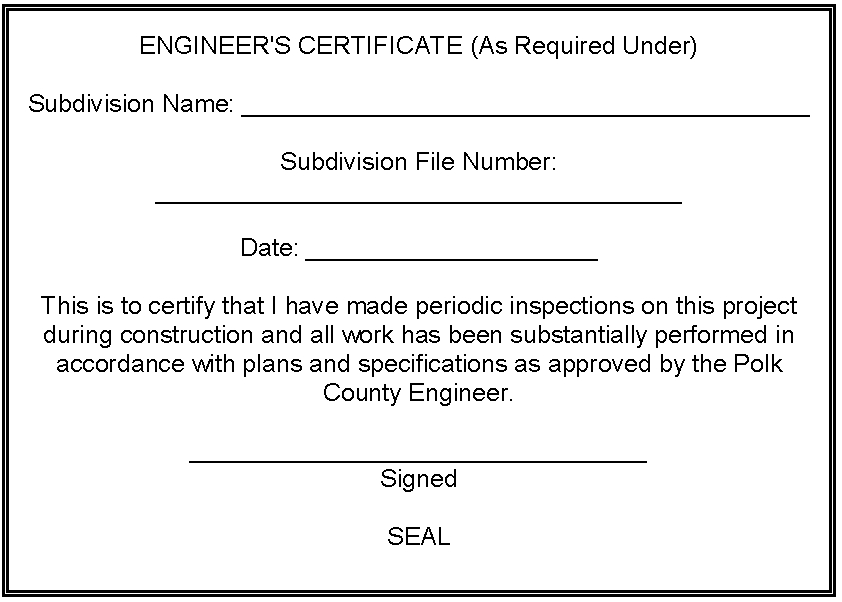
Engineer's Certificate
Prior to final plat approval and at the time of final acceptance of improvements by the County if applicable, the engineer of record shall provide the following engineer's certificate for all completed improvements.
C.
Subdivider's Guarantee
Prior to plat approval and at the time of final acceptance of improvements by the County, the subdivider shall provide the following subdivider's guarantee:

D.
Special Conditions
If the County Engineer determines that special conditions encountered during design or construction make normal inspection and testing insufficient to assure structural integrity, the time period for which a guarantee security must remain in force may be extended to a maximum of five years from date of acceptance of plat improvements if:
1.
Marginal soils are used in construction.
2.
Application of geotextile material precludes the removal of unsuitable material.
3.
Construction practices result from experimental design concepts.
Section 809 - Final Plat Approval and Recording
A.
Approval
Upon recommendation of the final plat by County staff, the BoCC may approve or disapprove the final plat and any legal instruments.
B.
Cost
The actual cost of recording and preparing all required prints and reproductions shall be paid by the applicant.
Section 810 - Re-plats and Modifications
A.
Vacating and Re-platting
Whenever land comprising all or part of an existing plat of record is proposed as all or part of a new plat, it shall be in accordance with the procedures as set forth in F.S. ch. 177.
B.
Revision of Final Plat After Board Approval
No changes, erasures, modifications or revisions shall be made on any final plat after approval has been given, unless the plat is resubmitted to the BoCC for its approval. This shall not affect the right to file an affidavit confirming an error on a recorded plat as provided by law. Any change, other than those listed in Section C, shall be considered a major modification or re-plat and shall be processed as a major subdivision pursuant to Section 803 C.
C.
Minor Modifications
When it is necessary to change a plat which has been duly recorded, the applicant may proceed with submission of the final plat to the County. The minor subdivision process in Section 803 B. shall apply if one or more of the following modifications are proposed:
1.
Lot lines are adjusted, provided that the number of lots does not increase and the individual lot sizes still meet the minimum lot size prescribed in this Code.
2.
Minor adjustments in street alignments.
3.
Release or dedication of easements.
4.
Street name changes.
Section 811 - Streets
Any development which includes or is required to construct, widen or improve a public or private street shall adhere to the design and construction requirements in this Section and Sections 821 through 824.
A.
Clear Visibility Triangle
In order to provide a clear view of intersecting roads to the motorist, there shall be a triangular area of clear visibility formed by two intersecting roads or the intersection of a driveway and a road pursuant to Section 711.
B.
Traffic Signs and Signalization
All required traffic signs and signalization shall be installed by the applicant prior to acceptance by the County. The County may, prior to acceptance of roads, accept from the applicant a deposit of sufficient funds to provide all required traffic signs and signalization.
Speed limit signs shall be shown on Level 2 plans prior to approval. The initial posted speed limit shall be 20 MPH. Signs shall be posted close to the beginning of each road, without conflicting with other assets (i.e., driveways, drainage structures, other signs, etc.).
C.
Right-of-Way Requirement
All residential and non-residential development shall provide additional road right-of-way on all public roads adjacent to the development, if required. The roads rights-of-way requirements shall be in accordance with Table 8.2 and Table 8.3 in Chapter 8 of this Code.
(Ord. No. 2024-033, § 3, 5-21-2024)
Section 820 - Subdivision Design Standards
A.
Approval
No subdivision plat shall be approved under the provision of this Code unless the subdivision satisfies the standards and requirements set forth herein.
B.
Lot Depth
In the TSDA, UGA, and SDA a lot platted for residential purposes shall not exceed 500 feet in depth.
(Ord. No. 2020-042, § 8, 11-3-2020)
Section 821 - Access (Rev. 06/08/04 Ord. 03-94; 4/4/02 - Ord. 02-18; 2/11/02 - Ord. 02-07;)
A.
Access Through Platted Residential Lots
1.
Access through a platted subdivision to adjoining property shall not be permitted through existing lots which have been platted for residential purposes.
2.
Access may be allowed through tracts which have been recorded as part of a plat for the expressed purpose of future road access.
3.
All roads and road rights-of-way recorded as of 1992 for future road access shall be the minimum required for a road based on the potential functional classification of the road and the master development plan for the area.
4.
Any deviance from Section 821 A. shall require a Level 4 Review.
Table 8.1 Minimum Clear Recovery Zone
(1) Use Rural for Urban Facilities when no curb and gutter or a depressed (Miami) curb is used.
(2) From face of curb.
(3) Curb and gutter not to be used on Facilities with Design Speed >45mph.
Table 8.2 Minimum Roads and Right-of-Way (R-O-W) Widths
(Rev. 9/13/06 - Ord. 06- 047; Rev. 06/08/04 Ord. 03-96)
(1) Utility easements must be provided outside of the right-of-way.
B.
Access to the County Transportation System (Rev. 7/10/18 - Ord. 18-047; 4/4/02 - Ord. 02-18; Rev. 7/25/01 - Ord. 01-57)
1.
When a tract of land to be sub-divided accesses a County road, such road shall be a paved County maintained road.
a.
Where a proposed development entrance has no frontage on an existing paved public road, a paved road meeting the requirements of this Code shall be constructed connecting the proposed development to an existing paved public road meeting County standards, except as provided for in Section 705 B. of this code.
b.
A proposed development consisting of more than 2000 AADT shall provide either a minimum of two points of access to public roads meeting County standards or a boulevard type entrance.
C.
Residential Access on Arterial and Collector Roads (Rev. 7/10/18 - Ord. 18-047; 06/08/04 Ord. 03- 94; Rev. 2/11/02 - Ord. 02-07)
No new development shall create any parcels for single-family or duplex residential uses accessing on an arterial, urban collector, or rural major collector roadway, unless the parcels conform to the requirements specified in Table 8.3.
D.
Lot Access
Primary lot access shall be from the side where the frontage width is measured.
Section 822 - Road Frontage (Rev. 07/10/18 - Ord. 18-047; 06/08/04 Ord. 03-94)
A.
Minimum Road Frontage
All new lots, except as provided for in Section 705 B., shall have a minimum road frontage based upon the classification of the road as follows:
Table 8.3 Minimum Road Frontage Requirements
(1) All driveways shall meet the driveway separation criteria as outlined in Section 705.
(2) The required lot frontage may be reduced by 50 percent if access to the lot is shared through a recorded easement with other lots created as part of the same development.
(3) Shall also comply with the Local Road minimum standards as outlined in this section.
B.
Local Road Minimum Standards (Rev. 7/10/18 - 18-047; 3/25/03 - Ord. 03-26; 4/4/02 - Ord. 02-18; 9/26/01 - Ord. 01-70; Rev. 06/08/04 Ord. 03-94)
Unless different standards are established by a Planned Development (PD), all new lots fronting on a local road shall have a minimum frontage of 50 feet. A lot with less than 50 feet but more than 25 feet of road frontage will be allowed provided the following conditions are met:
1.
No more than two contiguous lots with less than 50 feet but more than 25 feet of road frontage may be located less than 300 feet from another lot with less than 50 feet of road frontage as measured along the road right-of-way.
2.
The portion of any lot which is less than 50 feet in width abutting a street or road which is publicly maintained and which provides the actual access to the lot may not extend to a depth of more than 435 feet from the street.
3.
Lots located on a cul-de-sac or on a roadway with a curve of at least 90-degree may measure the minimum frontage width at the building setback line.
4.
In no circumstance shall any lot be less than 25 feet wide.
5.
Except as otherwise authorized by this Code, all side lot lines shall be straight and unbroken to the greatest extent practical.
C.
Multi-Family/Townhome Lot Access Standards (Added 03/19/08 - Ord. 08-004)
The following standards shall apply to the subdivision of lands for multi-family structures:
1.
All newly created lots for multi-family/townhome developments shall not be required to have minimum road frontage as long as each unit has access to a paved road meeting County local road standards via a common area, open space, or common parking facility.
2.
Parking areas or driveways for multi-family/townhome units shall either have direct access to a paved road meeting County standards or indirect access to a paved road meeting County standards via common area, open space or common parking facility.
3.
Parking areas or driveways shall be designed to prevent vehicles from encroaching into, or obstructing, the public right-of-way.
4.
All paring areas shall meet the criteria contained in Chapter 7 of this Code.
5.
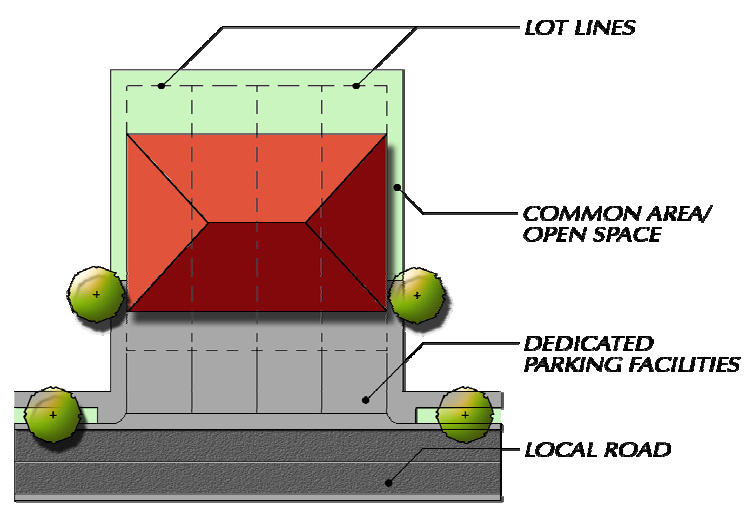
Figures 8.1 through 8.4 illustrate potential parking and access scenarios for multi- family/townhome units.
Figure 8.1 Multi-family / townhome units with lot frontage on common area/open space and parking areas having direct access from a local road only
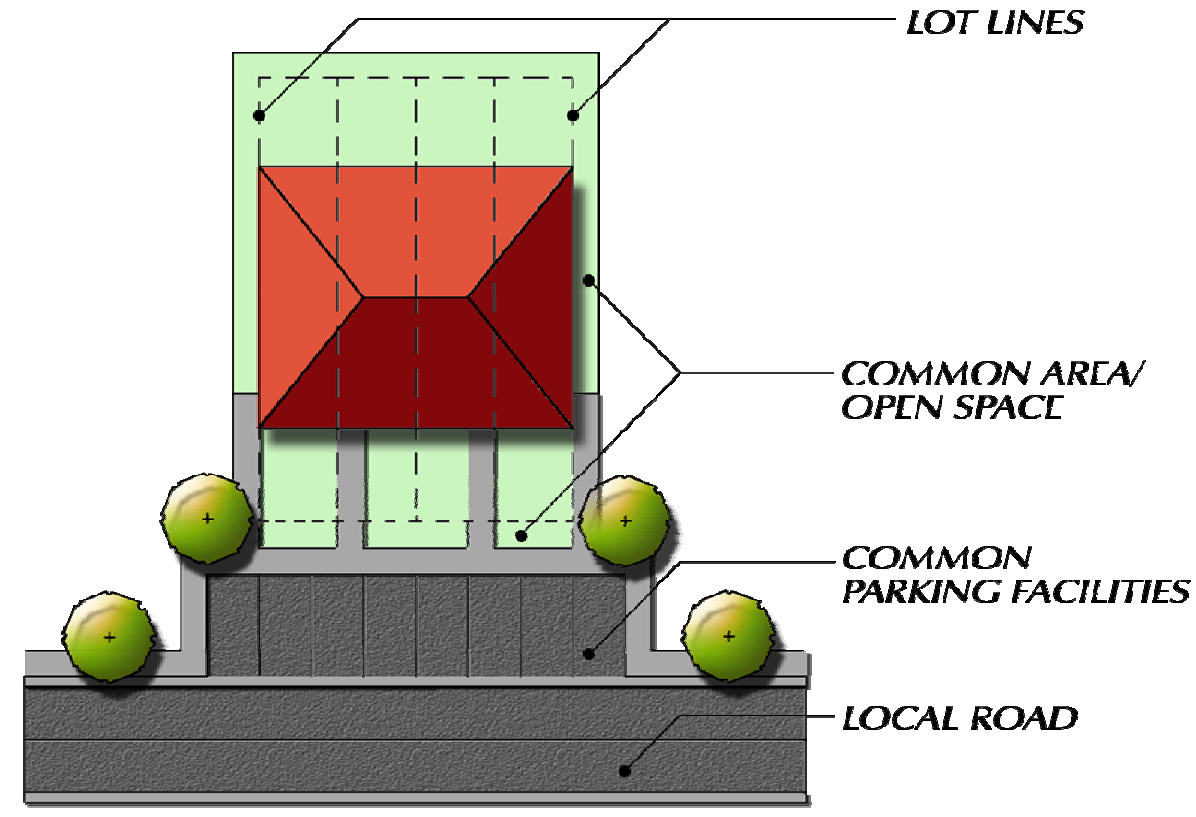
Figure 8.2 Multi-family / townhome units with lot frontage and driveways / parking areas having direct access from a local road only.
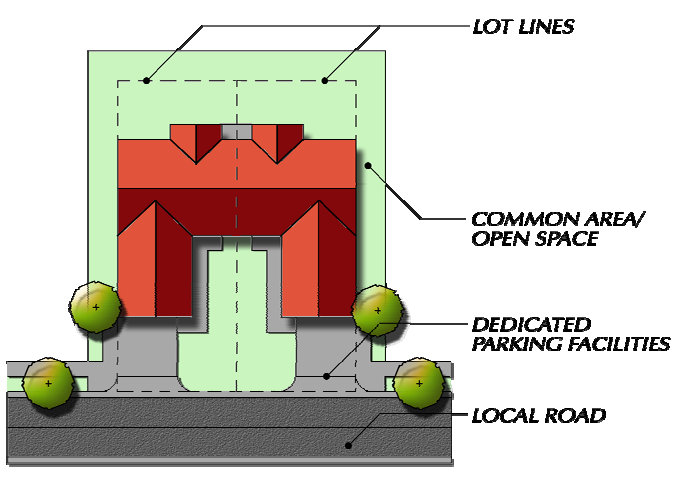
Figure 8.3 Multi-family / townhome units with lot frontage on common area /open space with parking areas having indirect access from a local or collector road.
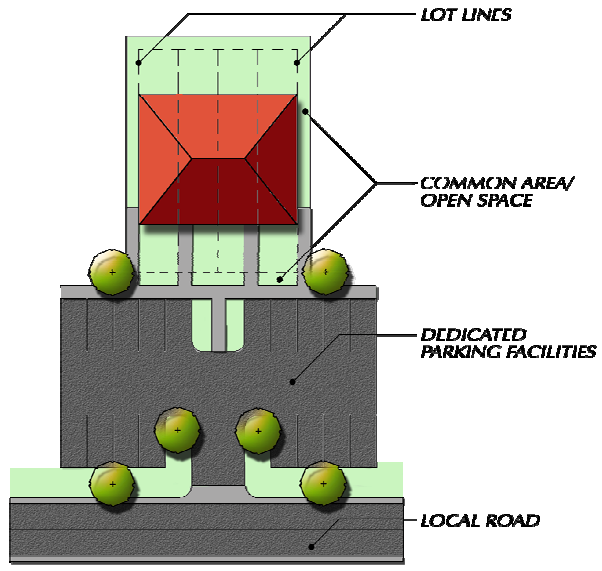
Figure 8.4 Multi-family / townhome units with lot frontage on driveways / parking areas having direct access from a local road only.
Section 823 - Right-of-Way Requirements
A.
Width
Right-of-way requirements for road construction shall be as specified in Table 8.3 of this Section.
B.
Existing
In the development of an existing unimproved platted subdivision, or a new subdivision adjacent to an existing County road where right-of-way is deficient, additional right-of-way shall be provided from the centerline of the existing County road of sufficient width to meet the requirements of this Section (one half of the entire right-of-way requirement).
C.
Boundary Roads
No half roads or road rights-of-way shall be accepted by the County along the boundary of a development unless the road or road right-of-way is required for a future road right-of-way in the Comprehensive Plan.
D.
Protection and Use
1.
No encroachment shall be permitted into existing rights-of-way.
2.
Use of the right-of-way for public or private utilities, including, but not limited to sanitary sewer, potable water, telephone wires, cable television wires, gas lines or electric power transmission (this is not an inclusive list), shall be allowed subject to the placement specifications in Appendix A, Technical Standards Manual, and other applicable County regulations.
E.
Vacating
The vacating of County maintained or platted rights-of-way and easements shall be in accordance with the following:
1.
For the vacation of easements where no land boundary changes will result from the vacation, a certified description sketch performed in accordance with Chapter 61G17-6 of the F.A.C., pursuant to F.S. ch. 472.027 shall be prepared and submitted. Where the easement is shown on a recorded plat, a certified copy of the plat shall be submitted with the easement area clearly marked.
2.
For vacation of road rights-of-way and alleys where land boundary changes will result, a certified description sketch, performed in accordance with Chapter 61G17-6 of the F.A.C., pursuant to F.S. ch. 472.027 shall be prepared and submitted.
a.
A petition requesting the vacation shall be submitted to the Transportation Department Director. In addition to the required sketch, the petition should contain:
i.
Signatures of all adjoining property owners.
ii.
Letters of consent to the vacation by all property owners gaining access by the requested vacation.
iii.
Letters of consent to the vacation from the local utility companies (electric, water, telephone, cable, and gas).
b.
Petitions to vacate rights-of-way shall be considered upon a finding that all of the following requirements are met:
i.
The requested vacation is consistent with the Traffic Circulation Element of the Comprehensive Plan.
ii.
The vacation would not jeopardize the current or future location of any utility.
iii.
Any necessary utility easements have been provided in the area to be vacated.
iv.
The proposed vacation is not detrimental to the public interest.
v.
The right-of-way does not provide the sole access to any property.
Section 824 - Roadway Design (Rev. 06/08/04 Ord. 03-96; Rev. 06/08/04 Ord. 03-94)
A.
Applicability
This Section establishes minimum requirements for transportation system components including public and private roads, and sidewalks. The standards in this Section are intended to assure that all developments adequately and safely provide for movement of vehicles consistent with sound engineering and development design practices.
B.
General Provisions (Rev. 06/08/04 Ord. 03-96)
1.
All elements of the transportation system shall be provided and designed in compliance with the engineering design and construction standards contained in Appendix A, Technical Standards Manual.
2.
All roads in the County are classified according to the function served in order to allow for regulation of access, road and right-of-way widths, circulation patterns, design speed, and construction standards.
3.
The County Road Inventory and any amendments thereto, adopted by the BoCC, is hereby made a part of this Code. The inventory shall be the basis for all decisions which are based on functional classification including, but not limited to, required road improvements, reservation or dedication of rights-of-way for required road improvements, or access of proposed uses to existing or proposed roadways.
4.
All new roads (public and private) shall be designed and constructed in accordance with this Section and Appendix A, Technical Standards Manual. Existing private roads proposed for designation as public and involving construction, reconstruction, facilities upgrade or right-of-way dedication shall meet the provisions of this chapter and Appendix A.
5.
Table 8.3 specifies the minimum pavement and right-of-way widths for local roads. All Collector roads and Arterial roads shall be designed in accordance with the FDOT Manual for Uniform Minimum Standards for Design, Construction, and Maintenance for Streets and Highways (the "Green Book").
6.
Utilities may be located in easements or right-of-way and shall be designed in accordance with Appendix A, Technical Standards Manual.
7.
The minimum distance from the edge of the pavement which shall be free of obstruction as required by Table 8.2.
8.
All sidewalks, bikeways and stormwater facilities shall be designed and constructed in accordance with the provisions of Appendix A, Technical Standards Manual.
C.
Roadway Development Standards (Rev. 12/08/03 Ord. 03-69; Rev. 06/08/04 Ord. 03-94)
1.
All new roads (public and private) shall be designed and constructed in accordance with this Chapter and Appendix A, Technical Standards Manual. For any standards not specifically addressed in Appendix A, the FDOT standards may be used as approved by the County Engineer.
2.
The road layout in all new development shall be coordinated with and interconnected to the road system of the surrounding area where specifically required in the Comprehensive Plan.
3.
Public roads and sidewalks in developments may be connected to rights-of-way in adjacent areas to allow for proper inter-neighborhood traffic flow. If adjacent lands are un-platted, interconnecting public roads in the new development may be provided for future connection to the adjacent un-platted land. These interconnecting public access points shall not be used as the primary access to adjacent un-platted properties unless the public road is constructed in accordance with Section 821.
4.
Local roads should be arranged to discourage through traffic.
5.
Roads shall intersect at right angles.
6.
New intersections along one side of an existing road shall coincide with the center lines of existing intersections. Where an offset is necessary at an intersection, the distance between center lines of the intersecting roads shall be no less than 150 feet except when divided by a raised median.
7.
No two roads may intersect with a local road on the same side at a distance of less than 150 feet measured from centerline to centerline of the intersecting road. When the intersected road is an urban collector or rural major collector, the distance between intersecting roads shall be no less than 440 feet.
8.
Access to subdivisions by fire apparatus shall not be less than 20 feet (6 meters) of unobstructed width, able to withstand live loads of fire apparatus, and shall have a minimum vertical clearance of 13 feet, six inches.
D.
Roads with No or Limited Outlet (Rev. 12-08-03 Ord. 03-69)
1.
A turnaround shall be located at the terminus of any road greater than 150 feet in length with no outlet.
2.
Cul-de-sac turnarounds shall consist of a travel lane with a minimum outside turning radius of 50 feet.
3.
Turnarounds shall be designed and constructed pursuant to Appendix A, Technical Standards Manual.
4.
Subdivision roads that cross railroad tracks or bridges shall provide a second outlet.
E.
Temporary Interconnecting Roads
1.
Temporary local interconnecting roads may be permitted only within subsections of a phased development for which the proposed road in its entirety has received Final Site Plan approval. However, interconnecting roads may be permitted or required by the County provided that the future extension of the road is deemed desirable by the County or conforms to an adopted County Transportation Plan and is included in a Master Site Plan.
2.
Temporary turnarounds shall be provided for all interconnecting roads providing access to five or more lots or housing units or more than 200 feet in length.
3.
Temporary interconnecting roads shall be designed and constructed pursuant to the standards in Appendix, Technical Standards Manual.
F.
Roadway Construction Standards
1.
The applicant or contractor retained by the applicant to construct the development shall give the County at least five days written notice before the commencement of any construction.
2.
A pre-construction meeting is required prior to the commencement of construction.
3.
Clearing and grubbing shall be accomplished on the entire width of rights-of-way dedicated by the plat as public roads. This clear area shall include all area between the edge of pavement and the edge of right-of-way. No trees shall remain within the Minimum Clear Recovery Zone.
4.
All roadway improvements resulting in a change in the travel lane on existing roads shall include an overlay of the existing pavement between the limits of the improvement.
5.
All rights-of-way other than pavement, shall be either grass sodded, or seeded and mulched on swale section roadways in accordance with FDOT Standard Specifications, except that only Bahia, Bermuda and Centipede or St. Augustine grasses will be permitted unless specifically approved by the County Engineer. All roadways shall incorporate a two foot grass sod strip behind the curb or edge of pavement.
6.
All roads associated with new development shall be paved.
7.
All roads associated with new development shall be striped in accordance with County standards.
8.
Curbing shall be required in accordance with the following standards:
a.
Curbing shall be required for the purposes of drainage, safety, and delineation and protection of pavement edge along roads in the following cases:
i.
Along designated parking lanes.
ii.
Where the surface drainage plan requires curbing to channel storm water.
9.
Curbing shall be required for all residential development with a net density of three or more units/acres located in the Transit Supportive Development Area (TSDA), the Urban Growth Area (UGA), and the Suburban Development Area (SDA).
10.
All curbing shall conform to the construction standards contained in Appendix A, Technical Standards Manual.
11.
Shoulders are required on all local roads and collector roads and shall conform with the typical section contained in Appendix A, Technical Standards Manual. Shoulders shall be provided on each side of roads and located within the right-of-way as indicated in Table 8.3.
12.
Acceleration, deceleration, and turning lanes shall be designed and constructed in accordance with Section 705 and Appendix A, Technical Standards Manual.
13.
Medians shall be constructed as follows:
a.
All roads, divided by a median, shall have a minimum pavement width on both sides of the median meeting the minimum established in Table 8.3. Multiple travel lanes shall be striped.
b.
Medians at intersections shall not extend beyond the backside of the radius return to ensure safe turning movements.
c.
Design of roadways and medians shall provide for safe movement of anticipated traffic.
d.
Where boulevard entrances are provided to residential and non-residential developments vehicle lane striping and marking shall be provided to reflect the number of lanes provided and approved turning movements from each lane.
e.
Guard houses or entrance gates may be located on private residential streets provided their location does not present a traffic hazard, obstruct the visibility triangle, impeded drainage or adversely interfere with the use of the right-of-way by approved utilities.
f.
Landscape medians may be located on private residential streets and may contain trees and other landscaping material provided their location does not present a traffic hazard, obstruct the visibility triangle, impede drainage or adversely interfere with the use of the right-of-way by approved utilities. Maintenance of landscape islands shall be the responsibility of a homeowners association.
G.
Street Lighting
1.
To enhance safety for pedestrian and vehicular traffic, all major subdivisions within the TSDA, UGA, and all Suburban Planned Developments (SPDs) shall provide street lighting along all internal roadways. All street lighting provided shall be recessed or consist of fixtures designed to minimize offsite glare and light trespass. All streetlights shall be installed at the expense of the developer.
2.
Two streetlights shall be provided at the crosswalks to all vehicular entrances, as required in Section 707 J.
3.
Compliance with this section shall be noted on Level 2 Review plans but will not require a separate lighting plan submission.
H.
Internal Sidewalks
1.
To enhance pedestrian safety and recreation opportunities, all major subdivisions shall provide sidewalks along internal roadways, as follows:
a.
Where sidewalks are present or required along County roadways abutting a major subdivision, sidewalks shall be provided on both sides of internal public or private roads. Connectivity shall be provided to sidewalks along the frontage of the development, where accessing the County roadway system.
b.
Where sidewalks are not present or required along County roadways abutting a major subdivision, a sidewalk shall be provided on at least one side of internal public or private roads.
c.
Internal sidewalks shall provide connectivity from all lots to open space, recreation, and parking facilities.
(Ord. No. 2021-015, § 5, 3-16-2021; Ord. No. 2020-042, § 9, 11-3-2020; Ord. No. 2023-028, § 3, 4-18-2023)
Section 830 - Uniform Street Address System
A.
Applicability
This Code shall apply to the unincorporated areas of Polk County unless an inter local agreement is entered into between the Board of County Commissioners and a municipality or postal service assigning addressing authority over a designated territory to the Enhanced 911 Office.
B.
Enclaves
1.
Any territorial unit within the unincorporated area of Polk County may be designated as an Enclave at the discretion of the County Manager provided the governing authority of such territorial unit has established a roadway naming and address numbering system which is consistent with the Uniform Street Address System established by Ordinance 04-089, as amended and this Code.
2.
The governing authority of an Enclave shall have and retain authority to assign roadway names, and building numbers within such Enclave, subject to the approval of the Enhanced 911 Office.
C.
Enhanced 911 Office
1.
The Enhanced 911 Office of the Polk County Department of Public Safety Emergency Management Division shall design, implement, administer, operate and maintain the Enhanced 911 Emergency Telephone System and the Uniform Street Address System, established by Ordinance 04-089, as amended.
D.
Violations and Penalties
1.
The Codes Enforcement Division shall have the authority and duty to investigate reported violations of this Code and Ordinance 04-089 as amended and to proceed against violators as specified in Polk County Ordinance 85-06, as amended.
2.
The owner and occupant of any building in the unincorporated areas of Polk County which is not in compliance with the provisions of this Code and Ordinance 04-089, as amended shall be subject to prosecution before the Polk County Code Enforcement Board and shall be subject to administrative fines and liens as set forth in Polk County Ordinance No. 85-6, as amended.
E.
Adoption of a Procedures Manual
The Enhanced 911 office shall prepare a procedures manual to be used for establishing addressing guidelines. The manual shall be detailed, explaining procedures for public notification of address changes, the procedures for County staff and County citizens to follow to petition for roadway name designations and changes, and what the criteria are for naming a roadway.
(Ord. No. 21-062, §§ 3, 4, 11-2-2021)

