
Polk County Unincorporated
City Zoning Code
City Zoning Code
CHAPTER 2
LAND USE DISTRICTS AND REGULATIONS
Section 201 - Relationship to Comprehensive Plan
The Polk County Land Development Code (LDC) regulates the development and use of land as set forth in the goals, objectives, and policies of the Polk County Comprehensive Plan. The Polk County Comprehensive Plan contains the Future Land Use Element (FLUE), including the Future Land Use Map Series (FLUMS) which establish and identify Development Areas, Special Area Plan Districts, Resource Protection Overlay Districts and Land Use Districts. Development Areas are referred to in this Code to determine density and public facilities needs in certain areas. Resource Protection Overlay Districts are outlined in Chapters 5 and 6 of this Code and further regulate use and development of land in environmentally sensitive areas. The land use categories established in the Plan regulate maximum density, intensity, and general policies for development. The names of the land use categories in the Plan and the Land Use Districts in this Code are the same.
Section 202 - Development Areas
Five Development Areas are designated and mapped on the FLUMS. Development occurring in any of the Development Areas shall conform to the criteria specified.
A.
Transit Supportive Development Area (TSDA)
The purpose of TSDA is to serve as a foundation from which a future urban pattern is established, and to provide areas for development at urban densities and intensities. TSDAs are where there exists the availability of infrastructure and other community facilities and services, including, but not limited to mass transit and other transportation alternatives, utilities, public safety, recreational and educational services. The TSDA also promotes and supports the location of higher density and intensity that requires compact and mixed use development.
B.
Urban Growth Areas (UGA)
The purpose of UGA's is to serve as a foundation from which a future urban pattern is established, and to provide future areas for development at urban densities and intensities. UGA's are areas within the County that, at a minimum, are currently served, or are programmed within the applicable Comprehensive Plan Capital Improvement Program to be served within years 10 through 20 of the Comprehensive Plan's planning period. UGA's are also supported by, or programmed to be supported by, other services typically found to accompany urban development such as public safety services, an urban road network, and developed parks.
C.
Suburban Development Areas (SDA)
The purpose of SDA's is to provide for areas of suburban-intensity growth. SDA's are those areas within the County that are not located within a TSDA or UGA and have developed predominantly in a suburban residential pattern with County-owned, municipal or County-franchised potable water systems, but generally without centralized sewer facilities.
D.
Utility Enclave Areas (UEA)
The purpose of UEA's is to recognize existing isolated areas of urban development that contain centralized water and sewer systems. UEA's are those areas within the County that are not located within a TSDA, UGA, or SDA and have developed at urban or suburban densities with County owned, municipal or County-franchised potable water systems, and small scale public or County franchised centralized sewer facilities, or private sewer systems with capacities in excess of 400,000 GPD.
E.
Rural Development Areas (RDA)
The purpose of RDA's is to provide areas for rural activities such as agricultural uses, mining activities, and rural residential development. RDA's include those areas of the County that are not located within a TSDA, UGA, SDA, or UEA.
(Ord. No. 2020-042, § 2, 11-3-2020)
Section 203 - Land Use Districts Established
The unincorporated County is divided into land use districts in order to implement the policies of the Polk County Comprehensive Plan. Polk County is hereby divided into said districts, the boundaries and designations of which are shown on a series of maps entitled "Future Land Use Map Series (FLUMS)."
The standard land use districts are established and listed in Section 204. Selected Area Plan (SAP) land use districts are established in Chapter 4 and the Green Swamp land use districts are established in Chapter 5. The use table and density/dimensional regulations for the Land Use Standard Districts are prescribed in this Chapter. The use tables and density/dimensional regulations for the SAP and Green Swamp districts are in Chapters 4 and 5, respectively. The SAP and Green Swamp land use districts are denoted on the FLUMS maps with an "X."
Section 204 - Standard Land Use Districts
A.
Agricultural/Residential Districts (Revised 5/6/09 - Ord. 09-018)
The purpose and intent of the standard land use districts are prescribed. Specific uses and dimensional/density regulations are outlined in the Tables in Sections 205 and 208.
1.
Rural (A/RR): The purpose of the A/RR district is to provide lands for the continuation of productive agricultural uses and to provide for very low density residential development within unincorporated rural areas. The A/RR district permits agricultural activities, agricultural support facilities, multi-family dwelling units, farm labor housing, group living facilities, and community facilities.
2.
Rural Cluster Center - Residential (RCC-R): The purpose of the RCC-R district is to recognize and protect residential neighborhoods within unincorporated communities designated RCC on the Future Land Use Map Series of the Comprehensive Plan. The RCC-R district permits low density residential development with minimum lot sizes of 20,000 square feet, group living facilities, and community facilities.
3.
Residential Suburban (RS): The purpose of the RS district is to provide areas for suburban-density residential development to promote the proper transition of land from rural to urban uses. The RS district permits single-family dwelling units, family care homes, agricultural support uses, and community facilities.
4.
Residential Low-1 (RL-1): The purpose of the RL-1 district is to provide areas for the low density residential needs of residents in urban areas who desire areas with larger sized lots, a minimum of 40,000 square feet.
5.
Residential Low-2 (RL-2): The purpose of the RL-2 district is to provide areas for the low density residential needs of residents in urban areas who desire areas with smaller lots than the RL-1 districts, a minimum of 15,000 square feet.
6.
Residential Low-3 (RL-3): The purpose of the RL-3 district is to provide areas for the low density residential needs of residents in urban areas who desire areas with smaller lots, a minimum of 10,000 square feet.
7.
Residential Low-4 (RL-4): The purpose of the RL-4 district is to provide areas for the low density residential needs of residents in urban areas who desire areas with smaller lots, a minimum of 6,000 square feet.
8.
Residential Medium (RM): The purpose of the RM district is to provide areas for medium density residential development within urban areas. The RM district permits single-family dwelling units, duplex units, multi-family units, group living facilities, and community facilities.
9.
Residential High (RH): The purpose of the RH district is to provide areas for high-density residential development within urban areas. The RH district permits single-family dwelling units, duplex units, multi-family units, group living facilities, and community facilities. Multi-family structures may contain non-residential uses to provide retail and personal services for residents.
B.
Non-residential Districts/Activity Centers (Revised 7/25/01 - Ord. 01-57)
1.
Rural Cluster Center (RCC): The purpose of the RCC district is to provide locations in the rural area for the placement of retail and service establishments to accommodate the daily shopping needs of rural residents. The RCC district permits commercial and office uses at an intensity and scale necessary to provide the immediate rural population with retail and personal services, agricultural support uses, and community facilities.
2.
Convenience Center (CC): The purpose of the CC district is to provide for the convenience shopping needs of residents within an immediate surrounding area. The CC district permits non-residential uses such as offices, convenience stores, gas stations, dry cleaners and community facilities.
3.
Neighborhood Activity Center (NAC): The purpose of the NAC district is to provide for the daily shopping needs of residents within neighborhoods surrounding the center. The NAC district non-residential uses such as offices, grocery stores, drug stores banks and community facilities.
4.
Community Activity Center (CAC): The purpose of the CAC district is to provide for shopping needs of residents living within a surrounding community. The CAC district permits special residential development, non-residential uses such as offices, department stores, supermarkets, restaurants and community facilities.
5.
Regional Activity Center (RAC): The purpose of the RAC district is to provide for the regional shopping needs of residents. The RAC district permits special residential development, regional shopping centers, other regional attractors and community facilities.
6.
Office Center (OC): The purpose of the OC district is to provide areas for small offices. The OC district permits professional offices and some retail uses. All development within the OC requires a Level 3 Review.
C.
Other Standard Land Use Districts (Revised: 3/18/14 - Ord. 14-015; 7/29/02 - Ord. 02-51)
1.
Linear Commercial Corridor (LCC): The purpose of the LCC district is to recognize existing linear concentrations of commercial, office, institutional, and industrial uses along roadways.
2.
Business Park Center-1 (BPC-1): The purpose of the BPC-1 district is to provide areas for office and business park development. The BPC-1 district permits office, research and development parks, distribution centers and wholesaling activities. Some retail uses are also permitted to support the businesses and activities within the Business Park Center.
3.
Business Park Center-2 (BPC-2): The purpose of the BPC-2 district is to provide areas for light-industrial activities. The BPC-2 district permits light manufacturing, fabrication, assembly, distribution and wholesaling activities, and some retail uses to support the businesses and activities within the Business Park Center.
4.
Commercial Enclave (CE): The purpose of the CE district is to recognize existing concentrations of commercial and office uses located outside of Activity Centers and Linear Commercial Corridors, whose future development or redevelopment is consistent with the Polk County Comprehensive Plan.
5.
High-Impact Commercial Center (HIC): The purpose of the HIC district is to provide areas for non-retail businesses and service establishments that may generate substantial truck traffic, noise, odor, and visual impacts to adjacent properties. The HIC district permits a range of non-residential service establishments and general retail uses to support the businesses and activities.
6.
Industrial (IND): The purpose of the IND district is to provide areas for general manufacturing, processing, and distribution of goods. General commercial uses necessary to support the industrial area are also permitted.
7.
Phosphate Mining (PM): The purpose of the PM district is to provide areas for phosphate mining operations, phosphate mining support facilities, and other uses that are compatible with and related to phosphate mining and its allied uses.
8.
Leisure/Recreation (L/R): The purpose of the L/R district is to provide for facilities and areas oriented primarily towards providing recreation-related services for residents and short-term visitors.
9.
Institutional-1 (INST-1): the purpose of the INST-1 district is to provide for the use and development of lands for private and public service structures with minimal external impacts such as elementary and middle schools, government facilities, cultural facilities, hospitals, and Class I and Class II utilities.
10.
Institutional-2 (INST-2): the purpose of the INST-2 district is to provide for the use and development of lands for private and public service structures which are characterized primarily by outdoor activities such as high schools, government vehicle maintenance facilities, Class III utilities, solid waste management facilities, and prisons.
11.
Recreation and Open Space (ROS): The purpose of the ROS district is to provide for the use and development of lands and areas which are accessible to the public, and which are oriented towards providing recreational activities and services for County residents and visitors.
12.
Preservation Areas (PRESV): The purpose of the PRESV district is to provide for the preservation of public or privately owned preservation areas, either obtained for long-term protective purposes, containing sensitive and unique vegetative or animal habitats, or publicly accessible property intended for long-term open space purposes.
13.
Tourism-Commercial Center (TCC): The purpose of the TCC district is to provide areas for tourism activities, recreation, and tourist-related commercial establishments. The TCC district permits commercial amusement activities, lodging facilities, service stations, restaurants, gift shops and ancillary non-residential uses to the tourism industry.
Section 205 - Use Tables for Standard Land Use Districts (Revised 5/1/18 - Ord. 18-025)
The permitted and conditional uses for the standard land use districts are prescribed in Table 2.1. Additional review levels may be required as specified in Section 903.
The following are the Footnotes for use with Table 2.1 Use Table for Standard Land Use Districts:
A.
Prohibited Uses
The use of land or structures not expressly listed in the Use Tables in Sections 205, Chapter 4 (SAP's) or Chapter 5 (ACSC) as permitted or conditional are prohibited.
B.
Selected Area Plans (SAP) and Neighborhood Plans (Revised 1/6/2010 - Ord. 10-002)
Uses proposed within any of the SAPs or Neighborhood Plans are identified in the respective Use Tables in Chapter 4 and shall be adhered to accordingly. Land uses not shown are prohibited
C.
Green Swamp Area of Critical State Concern (ACSC) (Revised 1/6/2010 - Ord. 10-002)
Uses proposed within any of the SAPs or Neighborhood Plans are identified in the respective Use Tables in Chapter 4 and shall be adhered to accordingly. Land uses not shown are prohibited
D.
Other Regulations
Uses listed as permitted may be established only after meeting all applicable regulations of Polk County and other governmental agencies.
E.
Conditional Uses
Uses listed as conditional may be established only after compliance with the specific conditions and procedures outlined in Chapter 3, Conditional Uses, and all applicable codes of Polk County and other governmental agencies.
C1
Conditional uses which are reviewed at the staff level through an existing permit procedure. The review process is a Level 1 Review.
C2
Conditional uses which are reviewed by the staff but involve multiple issues or departments. The review process is a Level 2 Review, and involves review of a site plan by the Development Review Committee.
C3
Conditional uses which are reviewed by the staff but involve multiple issues and potential off-site impacts. The review process is a Level 3 Review, and includes a site plan submittal for review by the Development Review Committee (DRC) and a public hearing before the Planning Commission (PC).
C4
Conditional uses which involve multiple issues and potential significant off-site impacts. These uses are reviewed by the DRC and include public hearings before the Planning Commission and BOCC. The procedure for this review is a Level 4 Review.
F.
Accessory and Temporary Uses
Accessory and Temporary Uses are defined in Chapter 10 and regulated in Sections 206 and 207 of this Chapter.
G.
Infill and Compatibility
1.
All uses are subject to Infill and Compatibility requirements outlined in Sections 220 and 221.
H.
Linear Commercial Corridor (LCC) Infill Criteria
1.
New industrial and High-Impact-Commercial-type (HIC) development uses within the Linear Commercial Corridor (LCC) land use district shall be limited to in-filling existing industrial/HIC areas, and new industrial/HIC development shall not extend or expand these industrial/high-impact areas.
2.
New development or redevelopment of non-residential uses within a Linear Commercial Corridor shall be limited to the intensities of uses at the same or less intensity as adjacent existing uses. New development or redevelopment of non-residential uses adjacent to existing uses shall be compatible with each other without allowing a higher intensity of development.
I.
Pre-Development of Regional Impact and Development of Regional Impact
Pre-Development of Regional Impact and Development of Regional Impact land use designations shall be consistent with Chapter 4 of the Land Development Regulations (Section 402).
J.
Resulting Nonconformity
Any proposed use that will render a legal use nonconforming shall require a Level 3 Review.
Footnote for Table 2.1:
1.
Propertties designated CAC or RAC prior to August 16, 2022 shall only require a C2 Conditional Use approval for Multi-Family development.
(Ord. No. 2023-048, § 4, 7-25-2023; Ord. No. 2024-007, § 2, 2-6-2024; Ord. No. 2024-022, § 2, 3-19-2024; Ord. No. 2025-024, § 2, 4-15-2025; Ord. No. 2025-074, § 2, 12-16-2025)
See footnotes following table.
Footnotes for Table 2.2 (Revised 9/18/12; Ord 12-028; 12/27/02 - Ord. 02-88; 7/29/02 - Ord. 02-52; 7/25/01 - Ord. 01-57)
1.
Residential density is the average number of dwelling units per acre of land. Gross density is calculated by dividing the total number of dwelling units on a site by the gross site area, exclusive of existing water bodies (Note: The term "water bodies" does not include man-made wet-retention/detention areas, man made lakes, or man made ponds). The area for computing gross density shall include all public and institutional land areas (e.g., internal streets, sewer plants, schools, and parks) located within a site, as well as one-half of the right-of-way area for perimeter local streets, and one-fourth of the right-of-way area for perimeter local street intersections. In the Rural Development Area (RDA) and Suburban Development Area (SDA), outside of the Green Swamp Area of Critical State of Concern, one unit per five-acre (l du/ 5ac) density may also be measured to the centerline of collector roads. Additionally, density may be adjusted based on the actual size of the section. A property may be considered five acres if it is one one-hundred and twenty-eighth (1/128) the section size for sections less than six hundred forty acres (640 acres).
2.
Higher densities may be achieved through a Planned Development. For a duplex structure on an individual lot, increases in density may be granted through a Level 3 Conditional Use approval. See Section 303.
3.
Lot areas are given on a per unit basis for single-family detached and duplex units. Smaller lot areas may be achieved through a Planned Development. For individual duplex units, see Section 303.
4.
The impervious surface ratio (ISR) is the relationship between the total amount of impervious surface which is present on a site and the total site area. Impervious surfaces are those which do not absorb water. They include buildings, parking areas, driveways, roads, sidewalks, and any areas of concrete or asphalt. The ISR is calculated by dividing the total area of all impervious surfaces on a site by the gross site area, excluding existing water bodies (Note: The term "water bodies" does not include man-made wet-retention/detention areas, man made lakes, or man made ponds).
5.
The floor area ratio (FAR) is the relationship between the total floor area on a site and the total site area. The FAR is calculated by adding together all floor areas of all floors and dividing this total by the gross site area, exclusive of existing water bodies (Note: The term "water bodies" does not include man-made wet-retention/detention areas, man made lakes, or man made ponds).
6.
Front, exterior side, and exterior rear setbacks for principal and accessory structures shall be determined by the distance from the road right-of-way (R/W) or road centerline (C/L), whichever results in the greatest distance from the property line. Setbacks from private roads shall be calculated in the same manner or from the edge of pavement, whichever is greater. All linear dimensions are given in feet.
7.
Residential structures exceeding 35 feet in height, setbacks shall be increased by one-half of one foot for each one foot of height over 35 feet.
8.
All development is subject to Section 610 - Setbacks from lakes and surface waters.
9.
All development is subject to Section 220 - Compatibility.
10.
All development is subject to Section 208.E - Residential Infill Requirements.
11.
Chimneys, smoke stacks, communication towers, and Religious Institution symbols, unless located in the Avon Park Air Force Range Military Compatibility Zone, as depicted in the Military Compatibility Zone Map, are exempt from the structure height limitations.
12.
All structures are subject to compliance with the Polk County Airport Zoning Regulations, adopted and administered by the Joint Airport Zoning Board (JAZB).
13.
There are no minimum setback requirements from railroad rights-of-way in the IND, BPC, and HIC districts. Structures in all other categories shall use the applicable setback.
14.
All structures shall comply with Section 214 - Distance Between Buildings.
15.
The side yard set back for lots of 75 feet or less in width which exist at the time of adoption of this ordinance shall be a minimum of seven feet provided that the sum of both set backs shall be a minimum of 15 feet.
16.
Minimum interior side setbacks for non-residential uses which adjoin non-residential districts may utilize a zero setback in accordance with the provisions in Section 755, provided that side adjoins a non-residential district.
17.
Non-residential farm outbuildings are excluded from height regulations.
18.
Where a structure in IND or PM abuts a residential use or district, structure height shall be limited to 50 feet at the building set back line and may be increased one foot higher for each foot a structure is placed further from the required setback.
19.
Recreational lighting, seating, press boxes, and other similar appurtenances are excluded from height restrictions when approved through a Level 3 Conditional Use process.
20.
The Building Official may approve a reduction in the required setbacks of up to ten percent (10%) of the requirement through a Level 1 Review process.
21.
Solid Waste Management Facilities within the Institutional-2 (INST-2) Future Land use, may be developed up to 380 feet above adjacent grade or as further limited by the Board of County Commissioners.
22.
Additional setback requirements can be found in Sections 206, 207, 208, 209, 213, 220, 222, and 303 for the applicable use.
23.
All single-family detached, single-family attached, duplex, townhome, and residential detached garage entrances for vehicles shall be setback a minimum of 25 feet from the property line, drive aisle, or right-of-way easement.
24.
Townhouses, duplexes, and single-family attached units intended to be subdivided and sold as individual units shall have no setback from the common wall between units.
(Ord. No. 19-066, § 1, 11-19-2019; Ord. No. 19-069, § 1, 12-3-2019; Ord. No. 19-072, § 1, 12-3-2019; Ord. No. 20-030, § 1, 6-16-2020; Ord. No. 2020-048, § 1, 12-1-2020; Ord. No. 2021-038, § 2, 7-6-2021; Ord. No. 22-017, § 1, 3-1-2022; Ord. No. 2022-023, § 1, 4-5-2022; Ord. No. 2022-061, § 1, 8-16-2022; Ord. No. 2022-079, § 2, 12-6-2022; Ord. No. 2022-083, § 2, 12-20-2022; Ord. No. 2023-002, § 2, 1-3-2023; Ord. No. 2023-039, § 2, 5-16-2023; Ord. No. 2023-063, § 2, 10-3-2023; Ord. No. 2024-022, § 3, 3-19-2024; Ord. No. 2024-025, § 2, 4-16-2024)
Section 206 - Accessory Uses
Accessory uses are permitted in conjunction with the primary use in all land use districts. Accessory uses are those land uses that are incidental and subordinate to the primary use of the property (see table 2.1 for a list of primary land uses allowed per district). Specific requirements pertaining to the determination of what is incidental and subordinate for certain types of accessory uses are listed in the section and sections to follow in this chapter. All accessory uses contained herein, and any other not included shall comply with Section 209.
A.
Accessory Dwelling Unit (ADU)
Accessory dwelling units (ADUs) may be permitted as accessory uses to single-family detached homes and mobile homes in all residential districts and lots of record for residential purposes subject to the applicable district regulations and the following requirements:
1.
No more than one detached ADU may be permitted on any single-family residential lot or parcel.
2.
Detached ADUs shall be built to the standards of the Florida Building Code and shall be subordinate in size to the principal structure located on the same site. No ADU shall exceed 1,000 sq. ft. of heated floorspace unless granted a variance as provided for below.
3.
Variances to subsections 1 and 2, above, may be approved through the LUHO process, pursuant to LDC Sections 930 and 931. In addition to the variance criteria, the following criteria shall be met. These criteria below (a.—c.) are not eligible for a variance.
a.
If more than one detached ADU is being requested on a single-family lot, then the total number of primary and ADU structures shall in no instance exceed the maximum residential density of the underlying FLU designation, as provided by the Comprehensive Plan.
b.
When exceeding the 1,000 sq. ft. cap or proposing more than one ADU, the total ISR of the existing structures and development onsite shall not exceed 0.60. The total ISR shall not exceed 0.50 in the COREX Future Land Use designation.
c.
ADUs exceeding the 1,000 sq. ft. cap shall meet principal structure setbacks.
4.
Detached ADUs shall be in the side or rear yard of the principal dwelling unit. On corner lots, no detached ADU shall be located forward of the building line of the principal dwelling unit.
5.
An ADU may utilize setbacks pertaining to accessory structures unless attached to the principal structure.
6.
Mobile homes shall not be permitted to be used as ADUs. However, where mobile homes are the primary residence, an ADU built to the standards of the Florida Building Code and this section may be permitted.
7.
ADUs shall be permitted subject to a Level 1 Review.
8.
ADUs shall not be approved for short-term rental or vacation rental.
9.
ADUs may be rented, leased, or serve as housing for living assistants, guests, or family members. ADUs may not be subdivided from the parent property or placed under separate ownership from the primary dwelling.
10.
ADUs in conformance with this section do not count as additional dwelling units in the calculation of density.
11.
When an ADU is attached to the principal structure, uses the same electrical service and plumbing as the primary dwelling unit, access is through a subordinate entrance on the rear or side of the principal structure, and the primary dwelling unit and ADU combined do not exceed five bedrooms, it is considered one single-family home, and the parcel is eligible for an additional detached ADU.
B.
Secondary Residential Structures for Non-residential Uses
Secondary Residential Structures may be permitted as an attached or detached accessory use in all non-residential districts for purposes of security, maintenance, monitoring, and protection of the principal non-residential use, subject to the applicable district regulations and the following requirements:
1.
Not more than one single-family dwelling unit or mobile home may be permitted on the same lot or parcel as a non-residential use.
2.
A Secondary Residential Structures may be permitted as an accessory use pursuant to a Level 1 Review.
3.
A dwelling unit intended for the onsite habitation of clergy may be approved pursuant to the previous two conditions.
C.
Dining Facilities, Employee Fitness Centers, and Childcare Centers in Non-Residential Developments (Revised 7/25/01 - Ord. 01-57)
Non-residential development projects may provide amenities for the exclusive use of the employees of the project. Such amenities shall only be permitted as accessory uses in accordance with the following:
1.
Dining rooms/cafeterias/snack shops shall not be open to the general public. There shall be no identification signs other than directional signs, identifying the facility.
2.
Employee fitness and childcare centers shall not be open to the general public.
a.
There shall be no signs, other than directional signs, identifying the facility.
b.
A childcare center shall meet all of the requirements of Section 303.
3.
Alcohol beverage sales for consumption on site shall be permitted as an accessory use in dining facilities. Alcohol sales shall be less than 50% of total food sales based on gross revenue.
4.
Such facilities shall be permitted subject to a Level 1 Review.
D.
Dining Facilities, Clubhouses, and Recreation Facilities in Residential Developments (Revised 7/25/01 Ord. 01-57; 01/03/05 - Ord. 04-80)
Residential development projects may provide amenities for the exclusive use of the residents of the project. Such amenities shall be permitted as accessory uses only as provided:
1.
Dining rooms/cafeterias/snack shops shall not be open to the general public and there shall be no identifying signs, other than directional signs identifying the facility.
2.
Residential projects may provide a central facility for a meeting place and recreation opportunities (including golf course, swimming pool, or tennis courts) for residents, subject to the following restrictions:
a.
The facilities shall not be open to the general public.
b.
Parking to serve the facilities shall be provided as required by Chapter 7.
c.
There shall be no signs, other than directional signs identifying the facilities.
3.
Alcohol beverage sales for consumption on site shall be permitted as an accessory use in dining facilities. Alcohol sales shall be less than 50% of total food sales on gross revenue.
4.
Such uses shall be subject to the same review process as for the principal residential project. If any of these accessory facilities are proposed after a residential development is constructed and lots are sold, then such facility shall be permitted as an accessory use pursuant to a Level 3 Review.
E.
Home Occupations (Revised 01/03/05 - Ord. 04-80)
Home occupations may be permitted as an accessory use to an existing dwelling unit in all residential districts subject to Section 559.995, Florida Statutes, as may be amended, the applicable district regulations, and the requirements listed to follow.
1.
A maximum of two employees or independent contractors who do not permanently reside on the premises may work onsite in the operation of a home occupation.
2.
The principal dwelling unit on the property shall be the bona fide residence of the home occupation practitioner. The home occupation shall be clearly incidental and secondary to the property's use for residential purposes.
3.
Reserved.
4.
Traffic generated by the proposed use must not negatively impact the safety, ambiance, and characteristics of the residential neighborhood. There shall be a minimum of two improved (concrete or pavement) off-street parking spaces available for residents of the dwelling exclusive of an attached or detached garage (as required in Section 709). Additional parking for employees, patrons, or vehicles associated with the Home Occupation shall be located on the property, improved (concrete or pavement), and a minimum of five feet from rights-of-way or neighboring property lines.
5.
No display of merchandise or outside storage of equipment or materials shall be permitted.
6.
No alterations shall be made to the external appearance of any principal or accessory structures or of the property which changes the character of the site from residential to non-residential.
7.
No equipment or process used in the home occupation shall create noise, vibration, glare, fumes, electromagnetic interference, odors, or air pollution outside the building other than the type and quantity customarily associated with a home or hobby.
8.
Signage shall be in accordance with Section 760.G.
9.
No storage of hazardous materials, other than substances of a type and quantity customarily associated with a home or hobby, shall be permitted.
10.
All home occupation practitioners shall obtain an occupational license.
F.
Outdoor Display of Merchandise
Outdoor display of merchandise, as an accessory use in non-residential districts where outdoor retail sales are not otherwise allowed, is permitted on a limited basis in accordance with the following requirements:
1.
The merchandise being displayed must be an item otherwise permitted to be sold in the district where the property is located. Such merchandise to be displayed outdoors shall comprise no more than 25 percent of the total merchandise sold on site.
2.
Only merchandise ordinarily used outdoors after purchase (such as outdoor play equipment or landscaping materials) may be displayed outdoors. Merchandise not ordinarily used outside (such as appliances or furniture other than patio furniture) may not be displayed outdoors except during occasional "sidewalk sales" in accordance with the requirements of Section 207, temporary uses.
3.
Merchandise displayed outdoors shall not encroach into any required parking area, vehicular use area, landscaped area, buffer yard, or public right-of-way.
4.
Outside display areas must be shown on the approved site plan for the project. Areas used for the outside display of merchandise under this Section shall be included in the Floor Area Ratio (FAR) calculation for the site.
G.
Religious Institution Schools (Revised 01/03/05 - Ord. 04-80; 12/28/01 - Ord. 01-92)
Schools locating within existing or proposed religious institutions shall be permitted as an accessory use in accordance with the following requirements:
1.
The maximum allowable students shall be no more than 100;
2.
All parking used for the school shall meet the parking space requirements as outlined in Section 708. Spaces designated for the religious institution may be used to calculate the required spaces for the school;
3.
All parking used for the school shall be paved and in addition comply with Section 709;
4.
The curriculum shall be no higher than an eighth grade level;
5.
All landscaping and buffering shall be in accordance Section 720;
6.
All parking designated for the school shall be oriented in such a manner so as not be located adjacent to residential property. If this cannot be met, then those areas shall be buffered with either a solid fence or Type C buffer (see Section 720) that has 80 percent opacity within two years; and
7.
All signage shall comply with Section 760.
8.
All access points shall be on a collector road or better if any of the following conditions exist;
a.
The uses (Religious Institution and School combined) generate 50 or more Average Annual Daily Trips (AADT).
b.
The overall Gross Floor Area (GFA) of all proposed uses combined exceeds 5,400 square feet.
If the Religious Institution and accessory uses generate more than 50 AADT based on the Institute of Traffic Engineers (ITE) Rate-Land Use Code 560 (9.11 trips per 1,000 square feet) or exceeds 5,400 square feet, the applicant has the option to provide a detailed study demonstrating that a lower trip generation rate can be achieved. The methodology shall be subject to approval by the Polk Transportation Planning Organization (TPO) and follow the guidelines as set forth in Appendix "C" of this Code.
H.
Religious Institution Childcare Center (Revised 01/03/05 - Ord. 04-80; 12/28/01 - Ord. 01-92)
Childcare centers locating within existing or proposed religious institutions shall be permitted as an accessory use in accordance with all conditions as outlined in Section 303 for childcare centers. In addition, the following standards shall also apply:
1.
The maximum allowable children shall be no more than 100;
2.
All parking used for the school shall meet the parking space requirements as outlined in Section 708. Spaces designated for the religious institution may be used to calculate the required spaces for the school;
3.
All parking used for the school shall be paved and in addition comply with Section 709;
4.
All landscaping and buffering shall be in accordance with Section 720; and
5.
All signage shall comply with Section 760.
6.
All access points shall be on a collector road or better if any of the following conditions exist:
a.
The uses (Religious Institution and Childcare Center combined) generate 50 or more Average Annual Daily Trips (AADT).
b.
The overall Gross Floor Area (GFA) of all proposed uses combined exceeds 5,400 square feet.
If the Religious Institution and accessory uses generate more than 50 AADT based on the Institute of Traffic Engineers (ITE) Rate-Land Use Code 560 (9.11 trips per 1,000 square feet) or exceeds 5,400 square feet, the applicant has the option to provide a detailed study demonstrating that a lower trip generation rate can be achieved. The methodology shall be subject to approval by the Polk Transportation Planning Organization (TPO) and follow the guidelines as set forth in Appendix "C" of this Code.
I.
Alcoholic Sales (Consumption on site) (Revised 01/03/05 - Ord. 04-80; 7/25/01 - Ord. 01-57)
Other than those establishments provided in this section, Section 224, and Table 2.1 the on- site consumption of alcoholic beverages shall be permitted as an accessory use according to the following requirements:
1.
Alcoholic beverage sales for consumption on-site for Community Centers, Cultural Facilities, Religious Institutions, private Lodges, Intensive and General Recreation and Amusement, and High Intensity Recreation shall be permitted as an accessory use only in conjunction with a special event at the facility. The consumption, sales, or service of alcoholic beverages shall meet those requirements in Section 224 for Alcohol Sales.
2.
Alcoholic Beverage sales for consumption on-site shall be permitted as an accessory use associated with a hotel and motel. Alcohol sales shall be less than 50% of gross revenue.
3.
Alcohol sales, meeting those conditions in Section 224, shall be considered accessory.
4.
Such Sale uses shall be permitted subject to Level 1 Review.
J.
Family Day Care Home (Added 7/22/09 - Ord. 09-047)
Home may be permitted as an accessory use to a single-family detached dwelling unit in A/RR, RCC-R and all Residential districts subject to the applicable district regulations and a Level 1 Review. The Family Day Care Home activities must be clearly incidental to the residential use of the property. The following shall apply to Family Day Care Homes:
1.
The Family Day Care Home shall comply with all applicable Florida Statues. In addition, it shall also comply with all applicable provisions and requirements imposed by the Florida Department of Children and Family Services, or its successor agency.
2.
There shall be no exterior alterations which change the residential character of the dwelling unit.
3.
One non-illuminated sign mounted flush to the dwelling unit and not more than two square feet in area shall be allowed.
4.
The Family Day Care Home use is not transferable to other locations or other providers.
5.
The Family Day Care Home shall be confined to the interior of the dwelling unit with exception to the outdoor play area which shall be confined to the rear and side yards. The outdoor play area and structures shall be located to minimize any noise and adverse impact on adjacent properties.
6.
The garage or any other vehicle storage areas shall not be utilized for child care activities, including use as a play area.
7.
Family Day Care Home shall be allowed to provide care for a maximum of twelve (12) children, which includes those children under thirteen (13) years of age that are related to the caregiver(s).
8.
Excluding the homeowner/operator and other adult family members residing on the premises, there shall only be one (1) person assisting in the Family Day Care Home at any one time.
9.
There shall be sufficient off-street parking to accommodate the vehicle of the non-resident employee.
K.
Cargo Containers (Rev. 09/02/09; Ord. 09-058)
This section does not apply to the construction of residential dwellings if cargo containers are modified or retrofitted for residential habitation in accordance with the Florida Building Code.
1.
All cargo containers shall comply with the Florida Building Code, Florida Fire Prevention code, and shall require a building permit.
2.
Cargo containers shall be permitted in accordance with the following:
a.
As a temporary use in any land use district in conjunction with an authorized construction project and shall be removed upon completion of the project unless properly permitted to remain as permanent storage in accordance with section.
b.
Bona fide agricultural properties are permitted to have one cargo container per five acres of agricultural tax-exempt acres of land, with no minimum acreage being required.
c.
Residentially developed properties are permitted one cargo container per acre, with a minimum property size of one acre.
d.
Non-residentially developed properties are permitted one cargo container per acre, with no minimum acreage being required.
e.
Cargo containers on residentially developed properties that do not meet the minimum acreage requirement above (2.c) but were permitted through the building department prior to December 2, 2025, shall be considered legally non-conforming.
3.
Where more than one cargo container is allowed, as outlined in this section, they shall not be stacked. However, within the IND and BPC-2 land use district they shall be permitted to be stacked two-high.
4.
Cargo containers located on a residentially developed lot, or within the CE, LCC, RCC, CC, NAC, CAC land use districts, that is adjacent to residentially developed lots or structures shall be buffered and/or screened from the adjacent off-site residential lot or structure. Additionally, they shall maintain a minimum setback of 15 feet.
5.
All cargo containers shall be placed in either the side or rear yard and meet accessory structure setbacks for the applicable land use district or the setback as outlined in condition #4 above, whichever is more restrictive.
6.
Cargo containers shall not be located within any drainage easements.
7.
Cargo containers shall not occupy any required off-street parking spaces, vehicular accesses or drive aisles, pedestrian facilities, or landscape areas for the site.
8.
Cargo containers shall not be permitted to have signage of any type.
L.
Adult Day Care Home (6 Clients or less) (Rev. 12/01/09; Ord. 09-073)
The following shall apply to Adult Day Care Homes containing six (6) clients or less:
1.
Any request for an Adult Day Care Home shall comply with F.S. ch. 429.
2.
A maximum of one person who is not a member of the immediate family residing on the premises may be employed in the operation of an Adult Day Care Home.
3.
There shall be no exterior alterations which change the residential character of the structure.
4.
Adult Day Care Homes shall be permitted one non illuminated sign mounted flush to the dwelling unit and not more than two square feet in area shall be allowed.
M.
Non Residential Mixed and Accessory Uses (Revised 2/3/10; Ord. 10-007)
1.
Non-residential properties can accommodate more than one primary use.
2.
All accessory uses and structures in a non-residential district shall be clearly incidental and subordinate to their primary host or they will be evaluated as an additional primary use.
3.
Accessory uses to retail and service establishments such as storage, offices, or light assembly may be conducted in a detached structure so long as it is incidental and subordinate to the primary retail or service establishment.
4.
Non-residential uses, whether accessory or primary, which require the use of loud equipment or machinery (e.g., saws, mixers, conveyors, hoppers, compactors, etc.) may only be allowed in Industrial (IND), High Impact Commercial (HIC), or within an enclosed facility in a Business Park Center-2 (BPC-2) district.
5.
Commercial uses that support activity within the BPC may occur before primary BPC uses if located at signalized intersections.
N.
Solar Panels and Solar Energy Systems (Revised 12/6/11; Ord. 11-033)
1.
Solar panels and solar energy systems shall be allowed on all types of structures, lots, or parcels and in all land use designations as an accessory use. The installation of such devices shall comply with the following:
a.
All devices shall comply with the Florida Building Code and be required to obtain a building permit.
b.
All ground-mounted solar panels and solar energy systems shall comply with the following:
i.
Shall be located on lots or parcels a minimum of 15,000 square feet in size;
ii.
All setback requirements for accessory structures shall be met;
iii.
Shall be located in the side or rear yard (may be allowed in the front yard with a 100 foot setback from all rights-of-way);
iv.
For lots less than one acre in size, all ground-mounted solar panels and solar energy systems shall not exceed 10 feet in height when utilized in conjunction with residential properties or structures; all other uses and properties shall comply with the structure height requirements for the applicable land use district; and,
v.
For lots less than one acre in size, the total surface area of all ground- mounted solar panels and solar energy systems shall not exceed 800 square feet when in a residential land use district or lot containing a residential structure.
c.
The installation of solar panels or solar energy systems on rooftops or structures shall comply with the following:
i.
All structure height requirements for the applicable land use district shall be complied with, inclusive of the solar panel or solar energy system;
ii.
No part of the solar panel or solar energy system and equipment shall extend beyond the edge of the roof; and
iii.
Required accessory equipment may be permitted on the roof or ground. Accessory equipment located on the ground shall meet all accessory structure setbacks.
d.
Any solar panel or solar energy system that has generated no electricity for a period of 12 months shall be deemed to be abandoned and shall be removed within 180 days of such abandonment. This shall include the removal of the entire solar panel or solar energy system and any associated facilities and equipment connected thereto from the premises and the restoration of the area to a compliant pre-installation condition.
e.
A variance may be requested for lot size, setbacks, height, or solar panel or equipment location requirements in accordance with Section 930 of this Code.
2.
These provisions contained herein this subsection only apply when the solar panel or solar energy system are considered to be accessory. These provisions do not apply to Solar Electric-Power Generation Facilities as defined in this Code (see Chapter 10, Definitions, and Section 303).
O.
Outdoor Storage
Outdoor storage shall be allowed as an accessory use in accordance with the following:
1.
Bona fide agricultural uses are permitted outdoor storage of equipment, supplies and other items customary to an agricultural operation;
2.
Outdoor storage shall be allowed in the following land use districts as an accessory use: LCC, CE, HIC, BPC-2, IND, INST-2 and PM (non-residential use only). Outdoor storage shall be screened from off-site view in LCC, CE, INST-2, and BPC-2.
3.
All outdoor storage shall be a minimum of 50 feet from any residential use or residential land use district;
4.
Additional restrictions regarding outdoor storage are found within this Code. The more restrictive provisions shall apply.
P.
Wind Energy Conversion System (WECS) (Added 03/06/18; Ord. 18-014, LDC 18T-01)
A Wind Energy Conversion System (WECS) is allowed on all types of structures, lots, or parcels as an accessory use to a home, business or farm located on the lot or parcel provided the following requirements are met:
1.
All ground-mounted WECS shall comply with the following:
a.
Shall be setback from all property lines, public road rights-of-way, overhead utility lines, and occupied structures (not including garages or storage buildings or pump houses) a distance greater than one and one quarter times (1.25x) the height of the entire structure as measured from the average adjacent grade to the end of the rotor blade at its highest reach.
b.
Shall be located in the side or rear yard.
c.
The standard height limits of the land use districts shall apply, unless variance is granted in accordance with Section 930, and as limited by Federal Aviation Administration (FAA) regulations. Height shall be as measured from the average adjacent grade to the end of the rotor blade at its highest reach. In districts without height limits, WECS shall not exceed 120 feet as measured from the average adjacent grade to the end of the rotor blade at its highest reach.
d.
Shall be designed to utilize tubular supports with pointed tops rather than lattice supports to minimize bird perching and nesting opportunities. The placement of external ladders and platforms on tubular towers should be avoided in an effort to minimize perching and nesting by birds.
e.
Shall either be supported by a tower that lacks useable hand or foot holds below sixteen feet in height, or if supported by a tower that could be climbed, shall be fenced with six-foot security fence around the base.
f.
Shall not emit noise exceeding 50dBA as measured at the property line. The described level may be exceeded during short-term events such as utility outages and/or severe wind storms.
g.
Shall not produce vibrations which are humanly perceptible at or beyond the property lines. The described level may be exceeded during short-term events such as utility outages and/or severe wind storms.
h.
Shall not be artificially lighted unless such lighting is required by the Federal Aviation Administration.
i.
Shall remain painted or finished the color or finish that was originally applied by the manufacturer, unless approved in the building permit. Paint or finishes shall be non-reflective and shall be maintained free of rust and corrosion by the operator throughout the life of the equipment.
j.
Shall have no signage visible from any public right-of-way, except for appropriate warning signs and to identify the manufacturer, installer, and/or owner.
2.
The installation of WECS on rooftops or structures shall comply with the following:
a.
The standard height limits of the land use districts shall apply, unless variance is granted in accordance with Section 930, and as limited by Federal Aviation Administration (FAA) regulations. Height shall be as measured from the average adjacent grade to the end of the rotor blade at its highest reach. In districts without height limits, WECS shall not exceed 120 feet as measured from the average adjacent grade to the end of the rotor blade at its highest reach.
b.
No part of the WECS shall extend beyond the edge of the roof.
c.
Required accessory equipment may be permitted on the roof or ground provided accessory equipment located on the ground shall meet all accessory structure setbacks.
d.
Shall not emit noise exceeding 50dBA as measured at the property line. The described level may be exceeded during short-term events such as utility outages and/or severe wind storms.
e.
Shall not produce vibrations which are humanly perceptible at or beyond the property lines. The described level may be exceeded during short-term events such as utility outages and/or severe wind storms. When placing WECS on a building, vibration pads or other engineering shall be considered.
f.
Shall not be artificially lighted unless such lighting is required by the Federal Aviation Administration.
g.
Shall remain painted or finished the color or finish that was originally applied by the manufacturer, unless approved in the building permit. Paint or finishes shall be non-reflective and shall be maintained free of rust and corrosion by the operator throughout the life of the equipment.
h.
Shall have no signage visible from any public right-of-way, except for appropriate warning signs and to identify the manufacturer, installer, and/or owner.
3.
Building permit applications for WECS shall be accompanied by standard drawings of the WECS, including the tower, base, and footings. An engineering analysis of the tower showing compliance with the currently adopted edition of the Florida Building Code and certified by a licensed professional engineer shall also be submitted. A site plan shall be submitted clearly denoting the proposed WECS location on the property including the distances to property boundaries, existing structures on the property.
4.
The WECS shall be equipped with a manual braking system for use in the event of an emergency.
5.
Any WECS that has generated no electricity for a period of one year shall be deemed to be abandoned and shall be removed within 180 days of such abandonment. This shall include the removal of the entire WECS and any associated facilities and equipment connected thereto from the premises and the restoration of the area to a compliant pre-installation condition.
6.
An applicant may seek relief pursuant to Section 930 for any requirement that has the effect of prohibiting the installation of WECS under F.S. § 163.04.
Q.
Cardboard and Shredded Paper Collection
Non-residential development projects may include collection, compaction, bailing, and transfer of discarded cardboard and shredded paper materials such as boxes, containers, office paper, card stock, cotton bond paper, and parcel packing materials in accordance with the following:
1.
All cardboard shall be stored within enclosed structures except for within BPC-2 and IND districts.
2.
Outdoor storage of cardboard in BPC-2 districts shall be screened from offsite view.
3.
Shredded paper shall not be stored outdoors.
4.
Bailers and compactors shall be located a minimum of 50 feet from any residential district or offsite residential structure.
R.
Electric Vehicle (EV) Charging Stations & Parking
All EV charging equipment installed and maintained in a surface parking area by the property owner or lessee shall be permitted as an accessory use in all districts where vehicle parking is required or allowed as follows:
1.
Electric vehicle parking spaces shall meet all performance standards of LDC Sections 708 and 709.
2.
EVSE Installed spaces shall be reserved for EVs and provide drivers the opportunity to charge their electric vehicle using EV charging stations. These spaces should be installed per the requirements of the National Electrical Code (NFPA 70) as adopted and amended by the State of Florida.
3.
No charging devices may be placed within the dimensions of a parking space.
4.
When cords and connectors are not in use, retraction devices or locations for storage shall be located sufficiently above the pedestrian surface and the parking space to reduce conflicts with pedestrians and vehicle maneuvering.
5.
Equipment mounted on structures such as pedestals, lighting posts, bollards, or other devices shall be located in a manner that does not impede pedestrian, bicycle, or transit travel.
(Ord. No. 21-037, § 2, 7-6-2021; Ord. No. 2022-002, § 2, 1-4-2022; Ord. No. 2022-079, § 3, 12-6-2022; Ord. No. 2023-064, §§ 2, 3, 10-3-2023; Ord. No. 2024-022, § 4, 3-19-2024; Ord. No. 2024-033, § 2, 5-21-2024; Ord. No. 25-018, § 2, 3-18-2025; Ord. No. 2025-024, § 3, 4-15-2025; Ord. No. 2025-067, § 2, 12-2-2025)
Section 207 - Temporary Uses
Temporary uses are defined as those types of activities that are not regularly conducted from a permanent structure or location, and are conducted for only a short period of time. Uses that meet the definition of an Outdoor Concert Venue are only permitted as conditional uses in select land use districts subject to applicable development criteria in Section 303. (Revised 11/21/17; Ord. 17-066)
A.
Categories of Temporary Uses (Revised 11/21/17; Ord. 17-066; 12/17/13; Ord. 13-68; 12/18/12; Ord. 12-040)
2.
Booths, platforms, and food stands used for the production or sale of prepared or processed food products, such as hot dog and portable barbecue stands, also known as "Food Stands;"
3.
Mobile Food Dispensing Vehicles, also known as. "Food Trucks:"
4.
Booths, platforms, and stands used for the selling flowers, fruits, vegetables, and firewood, (Flowers, firewood, fruits, and vegetables that are grown or cultivated on-site are exempt from the requirements of this section), also known as "Produce Stands;"
5.
Sales of retail products not classified as Produce Stands, such as fireworks, crafts, and Christmas trees, also known as "Retail Sales;"
6.
Sales of vehicles to include, cars, trucks, boats, recreational vehicles, and other similar type vehicles;
7.
Tents, bleachers, and similar types of facilities intended for use by congregations of people, also known as "Meeting Places;"
8.
Circuses, fairs, carnivals, festivals, rodeos and similar types of activities that are unlike the usual activities associated with the properties where the events are to be located, and which are intended or likely to attract substantial crowds, also known as "Special Events;" and
9.
Other similar uses or activities as determined by the Land Development Director.
B.
Review Criteria (Revised 11/21/17; Ord. 17-066; 12/18/12; Ord. 12-040)
Temporary Use applications shall be submitted in accordance with Section 207 C, through the Office of Planning and Development and evaluated for;
1.
Whether there is a legally established non-residential land use on the property;
2.
Whether the proposed temporary use is incidental and subordinate to the legally established non-residential land use;
3.
Whether the property is appropriately sized to accommodate all activities without infringement into public rights-of-way;
4.
Whether all setback requirements and off-street parking and loading are consistent with the applicable district requirements;
5.
Whether the proposed temporary use is compatible with surrounding properties;
6.
If the proposed temporary use will attract 250 people or more at any given time during the event or will involve amplified music, whether it is appropriately sized to ensure that noise, odor, lighting, and traffic impacts to surrounding properties will be minimized and is compatible with surrounding properties;
7.
Whether the proposed temporary use constitutes an Outdoor Concert Venue as defined in Chapter 10.
8.
Whether proposed strategies for mitigating noise, odor, lighting, and traffic impacts adequately protect the surrounding property owners;
9.
Whether the hours of operation of the proposed temporary use are compatible with surrounding properties;
10.
Whether adequate measures have been taken to ensure the safety of participants and customers, including, but not limited to, crowd control, fire safety, and emergency access;
11.
Whether adequate plans exist to ensure that trash and debris are removed from the site within 24 hours of the conclusion of the proposed temporary use;
12.
Whether consumption, distribution, or sale of alcoholic beverages comply with Section 224 of this Code and all other Federal, state and local regulations;
13.
Whether proposed temporary signage is compatible with surrounding areas, not intruding into the public right-of-way, or otherwise posing a safety hazard;
14.
Whether appropriate measures have been made to avoid the repeat of any previous violations or infractions of prior temporary uses.
C.
Application Requirements (Revised 11/21/17; Ord. 17-066; 12/18/12; Ord. 12-040)
Except as provided herein, no person or entity shall stage, conduct, manage or authorize a Temporary Use without first obtaining a Temporary Use Permit from the County.
1.
Garage or yard sales require no permit from the County and shall be permitted in any district, notwithstanding the following:
a.
The property where the sale is to be held must also contain a principal structure and,
b.
Frequency of sales is limited, as noted in Section 207 E.
2.
Mobile food dispensing vehicles require no permit from the County. A mobile food dispensing vehicle shall meet the following:
a.
Only operate in those districts specified in Table 2.3.
b.
Be located a minimum distance of five (5) feet from the right-of-way.
c.
Any overnight accessory structures or furniture including, without limitation, tables, canopies, trash receptacles, shall be considered a food stand and require a permit pursuant to this Section.
3.
All other temporary use types may be permitted as specified in Table 2.3 and where there is a legally established non-residential land use and the temporary use is incidental and subordinate to the primary non-residential use.
4.
All temporary use requests, with the exception of garage or yard sales, shall be required to apply for a Temporary Use permit, which is a Level 1 administrative review. Application requirements include, at a minimum:
a.
Identification of legally established non-residential principal land use on the property to be used for the temporary use.
b.
Description of the temporary use proposed;
c.
The hours of operation and anticipated duration of the temporary use;
d.
The number of persons expected to attend the temporary use on a daily basis and over the duration of the temporary use together with the highest anticipated attendance at any time. The maximum attendance expected for any event with amplified sound or music.
e.
A site layout plan that addresses location of temporary uses, access, parking area, pedestrian and vehicular travel patterns and distance from surrounding properties;
f.
Description of any amplified sound or music to be provided including the location of speakers and measures to be implemented to minimize noise impacts on surrounding properties.
g.
Description of potential impacts (e.g., noise, odor, traffic, lights) to surrounding properties and mitigation efforts to minimize such impacts.
h.
Description of safety and security measures to be followed, as well as a waste management plan;
i.
Description of temporary uses on the properties within the current calendar year;
j.
Description of any planned advertisement and marketing strategies;
k.
Description of any activities that require permitting from other agencies, such as the Florida Department of Health and the status of such permitting.
l.
Provision of necessary permitting from the Polk County Transportation Division or applicable agency if utilization of or closure of any public rights- of-way are being proposed, and
m.
Provision of any other additional information as requested by the County or reviewing agencies which is deemed necessary to evaluate the application.
D.
Review Procedures (Revised 12/18/12; Ord. 12-040)
Upon receipt of completed application packet and appropriate fees, (to be received no later than 15 business days prior to Meeting Place and Special Event type temporary uses), the Office of Planning and Development will administer the review in accordance with the following:
1.
For Special Events and Meeting Place temporary uses, the application packet will be distributed for review to affected divisions or agencies, including, but not limited to, Transportation Division, Waste Resource Management, Building and Codes Division, Land Development Division, Polk County Health Department; Polk County Sheriff's Office; and the Polk County Fire Marshal.
2.
Each reviewing agency or division shall review the application to determine if it is in compliance with applicable laws, rules, and regulations within each reviewing agency's purview and if the health, safety, and welfare of the participants, as well as that of the surrounding community are reasonably protected.
3.
In the event that an agency or division determines that it cannot support the proposed temporary use or can only do so with conditions, the agency or division shall notify the Office of Planning and Development of such objections or conditions.
4.
Upon receipt of responses from each agency the Director of the Office of Planning and Development or his or her assign shall approve the application, approve the application with conditions, or deny the application for failure to meet the standards of approval provided in Section 207B. No permit shall be issued until applicant complies with Section 207 C., as applicable.
E.
Frequency Limitations (Revised 12/17/13; Ord. 13-068; 12/18/12; Ord. 12-040)
An applicant may apply for a new temporary use permit or apply for renewal of an existing temporary use permit on the same lot(s) or parcel(s), in accordance with the following limitations:
1.
Food stands: maximum of six months at a time per parcel 1 , but renewable with a new application and review.
2.
Retail stands: maximum of 60 days per calendar year per parcel 2 .
3.
Produce stands: maximum of six months at a time per parcel 2 , but renewable with a new application and review.
4.
Meeting places: maximum of 30 days 1 , renewable with application after use has ceased for 60 days.
5.
Special events: maximum of 14 days per calendar year per parcel 2 .
6.
Garage or yard sales: Although permits are not required, limited to four times a calendar year with a limit of three days per sale per parcel 2 .
7.
Vehicle sales: a maximum of four (4) four-day permits per calendar year per parcel 2 .
8.
All other uses not specifically addressed: maximum of 30 days per calendar year per parcel 2 . [1]
9.
Applicants may not obtain a permit for a temporary use for the same parcel if that site has exceeded the time limitation for that calendar year. In the event that an applicant requests a temporary use permit for a parcel that has previously received a permit for an activity that is different from the current permit request, the most restrictive time limitation for the applicable temporary use shall apply.
F.
Signage for Temporary Uses (Revised 09/01/15; Ord. 15-056; 12/18/12; Ord. 12-040)
Signs for Temporary Uses shall be in accordance with Section 760 F., Temporary Signs.
G.
Performance Bond Requirements (Revised 12/18/12; Ord. 12-040)
1.
For Special Events or Meeting Places types of temporary uses with expected attendance greater than 250 people, the applicant shall obtain a performance bond on behalf of Polk County in the sum of $10,000, conditioned that the applicant shall conduct the approved temporary use in accordance with the approval and any imposed conditions and that any damages to public infrastructure, demands for removal, or other failure on the part of the applicant, the amount thereof shall be recoverable by the County for any damages resulting from the failure.
2.
The performance bond provisions may be waived or modified by the Director of the Office of Planning and Development upon written request accompanied by evidence of financial responsibility, an estimate demonstrating coverage less than $10,000 is sufficient to cover any damages or failure to comply with approval, or demonstration of the successful execution of prior temporary uses.
H.
Model Homes and Temporary Sales Offices (Revised 8/28/02 - Ord. 02-56)
Model homes and temporary sales offices may be permitted within residential subdivisions, for the sale of lots/homes. The following standards apply:
1.
One or more of the model homes, or a separate modular unit, may also be permitted as a temporary sales office for the project developer, builders, or their agents.
2.
Model home units shall meet all lot area, setbacks, parking, and unit separation requirements of the district in which they are located.
3.
A stabilized road base and fire protection facilities must be in place to the model home lots prior to lintel inspection for a model home unit or temporary sales office, as certified in writing by the engineer of record for the subdivision.
4.
Model homes and temporary sales offices may continue operation until all lots or houses within that subdivision are sold. Final Certificates of Occupancy may not be issued for model homes until the subdivision plat has been recorded and all construction has been completed. No model homes may be conveyed by deed until the plat has been recorded.
5.
Signs used for model home and temporary sales offices shall conform to the requirements of Chapter 7.
6.
Temporary parking facilities for model homes or temporary sales office may be allowed on the adjoining lot or lots within the development. However, the parking lot must be removed before the last new home or lot is sold within the development.
I.
Construction Trailers/Offices
Construction trailers/offices may be permitted on a temporary basis in all districts subject to a Level 1 Review and the following requirements:
1.
Construction trailers/offices may only be approved for licensed contractors working on construction projects for which permits have been issued. They shall be located on the same property and within the same project area where the work is being done and shall not encroach into any public right-of-way. Construction trailers/offices shall be required to meet all applicable state and local building and set-up codes.
2.
Construction trailers/offices may be approved no sooner than 30 days prior to the start of construction and shall be removed within 30 days after completion of the work for which the construction permit has been issued.
3.
Temporary construction trailers/offices may not be used as residences.
J.
Temporary Mobile Homes for Medical Hardships
Mobile homes may be permitted as a temporary special exception in all residential districts, on the same lot or parcel as an existing principal residence, in cases of medical hardship in which the infirm resident requires continuous supervision. The mobile home may be the residence of the infirm person, or the residence of the person providing the supervision. Temporary mobile homes for medical hardships are subject to the following requirements:
1.
For lots or parcels meeting or exceeding one acre, a mobile home for this purpose may be approved through a Level 1 Review, pursuant to the standards below. For lots or parcels below one acre, an application for a temporary mobile home for a medical hardship may only be approved by the Land Use Hearing Officer pursuant to procedures in Chapter 9.
2.
The mobile home shall not be located in the front yard of the existing principal residence.
3.
The mobile home shall meet all setbacks and building separation requirements pertaining to the principal residence.
4.
The mobile home may be approved only in cases of medical hardship where a resident requires continuous care and supervision as substantiated by a letter submitted by an attending physician.
5.
Approvals shall be valid for one year, or for a shorter period as specified by the Land Use Hearing Officer. Approvals may be renewed by the Land Development Director, following notice provided by the Land Development Director within 30 days before expiration, when the medical hardship warranting the original approval remains and is verified. If for any reason the resident requiring medical supervision ceases to reside on the property, the mobile home must be removed from the property within 60 days.
6.
Approval is not transferable to another person, and it shall not remain in effect in the event of a change of ownership of any land, structure, use, or other item covered by the approval.
K.
Temporary Emergency Shelters (Revised 5/20/09; Ord. 09-023)
When a permanent residential dwelling unit has been rendered uninhabitable by a calamity, an emergency shelter (mobile home or recreational vehicle) may be temporarily occupied on the same property during the reconstruction, repair, or renovation of the permanent dwelling, subject to a Level 1 Review. Initial occupancy of the temporary shelter shall not exceed 90 consecutive days. Extensions may be approved by the Building and Codes Division Director when determined to be necessary to complete the work to make the permanent residence habitable; however, in no instance shall the period of temporary occupancy of the shelter exceed nine consecutive months. Connection to potable water and wastewater shall be demonstrated during the Level 1 Review process.
In the event where new construction or replacement of a primary residence on a vacant lot is proposed and when not located in a platted subdivision, a Temporary Emergency Shelter may be occupied on the same lot, subject to a Level 1 Review, until construction or placement of the primary residence is complete and a Certificate of Occupancy (CO) has been issued. Construction of the primary residence shall be completed and occupied within one year of the Temporary Emergency Shelter approval. An extension may be requested from the Building Division Director or designee due to unforeseen circumstances. Once the primary residence has been issued a CO, the Temporary Emergency Shelter shall be removed within 60 days or the property owner must comply with all relevant policies of the Polk County Land Development Code.
L.
Road Construction and Utilities Materials/Equipment (Added 12/17/13; Ord. 13-068)
Road construction and utility installation infrastructure projects that require materials/equipment storage and assembly may be permitted on a temporary basis in all land use districts subject to a Level 1 Review and meeting the following requirements:
1.
The sites may only be approved for licensed contractors working on infrastructure projects for which permits have been issued.
2.
The sites shall be located within close proximity to the infrastructure project.
3.
The sites may be allowed within the right-of-way as long as their placement and location does not impede the traffic flow or obstruct the view of motorists.
4.
The sites may be occupied no sooner than 30 days prior to the start of construction and shall be removed within 30 days after completion of the work for which the construction permits have been issued.
5.
Construction trailers/offices shall comply with subsection I of this section.
M.
Temporary Storage of Vegetative Debris Collected from Major Storms
After a storm event federal, state, and local governments set up temporary Disposal Management Sites (DMS) on government lands to collect and process storm debris. Independent disposal contractors are hired to remove the processed debris and dispose or repurpose the debris in accordance with state and local laws of the jurisdiction where they transport the debris. This section provides temporary storage sites that these contractors can use for a limited period to assimilate all the debris in a legal manner.
Temporary storage sites for trees, shrubs, leaf, and grass debris gathered from a storm or calamity which is permitted under the supervision of, or at the direction of a local, state, or federal agency, may be permitted in non-residential land use districts subject to a Level 1 Review and meeting the following requirements and standards:
1.
All vegetative debris storage must be conducted under an active debris disposal contract with a local, state, or federal government agency.
2.
The site must have legal access to a County maintained road or permitted access to a city or state roadway facility.
3.
The site is not located in the Green Swamp Area of Critical State Concern.
4.
Application must be submitted by either the contractor or the local, state, or federal agency contracting for debris removal through a Development Review Committee (DRC) Level 1 Review.
5.
The applicant shall clearly identify all properties involved in the storage of materials and describe all storage methods. Application for DRC approval shall include:
a.
Property Owner, lead operator, and a list of all contractors and sub- contractors utilizing the site and their contact information including phone numbers, email, and place of business.
b.
Site Plan showing all properties and location of access, intake, location of storage, extent of material drop-off and separation, and provisions for ample internal stacking of intake vehicles.
c.
Days and hours of operation.
d.
Closure and post-closure plan.
6.
DRC shall review for potential conflicts with infrastructure, drainage paths, floodplain impact, and neighboring properties.
7.
Prior to commencement, authorization must be granted by the Florida Department of Environmental Protection (FDEP) through permit issuance or FDEP's written acknowledgement of permit exemption.
8.
All storage of vegetative debris shall be setback a minimum of 35 feet from all rights-of-way, 15 feet from non-residential property lines, and 200 feet from any offsite residence.
9.
Storage site property owners and operators shall provide Code Enforcement Division staff access to the site during normal business hours for periodic inspection.
10.
Prior to closing out of the debris disposal contract, the contractor shall formally contact the Code Enforcement Division for final inspection.
11.
The maximum period of operation shall be no longer than six (6) months from the date of the government contract commencement.
12.
In the event of extenuating circumstances, the DRC may grant additional time for debris removal from a temporary storage site provided no new debris is being delivered to the site and such extension does not exceed six (6) months.
(Ord. No. 20-038, § 1, 9-1-2020; Ord. No. 2021-011, § 2, 2-2-2021; Ord. No. 2022-067, § 2, 9-6-2022; Ord. No. 2024-022, § 5, 3-19-2024; Ord. No. 2025-035, §§ 2, 3, 7-1-2025)
A five day extension may be authorized by the Director of the Office of Planning and Development or his/her designee. 2 Contiguous parcels under the same ownership comprising a single principal use, including accessory uses, shall be considered as one parcel.
Section 208 - Density and Dimensional Regulations for Standard Districts (Rev. 05/06/09 - Ord. 09- 020)
A.
Density and Dimensional Regulations for Standard Districts (Rev. 05/06/09 - Ord. 09- 020)
Density and dimensional regulations for the standard land use districts are prescribed in Table 2.2. In the Rural Development Area (RDA) and Suburban Development Area (SDA), outside of the Green Swamp Area of Critical State of Concern, one unit per five-acre (1du/ 5ac) density may also be measured to the centerline of collector roads. Additionally, density may be adjusted based on the actual size of the section. A property may be considered five acres if it is one one-hundred and twenty-eighth (1/128) the section size for sections less than six hundred forty acres (640 acres).
B.
Measurement of Setbacks (Revised 12/1/10 - Ord. 10-082)
Setback shall be measured in accordance with the following:
1.
Setbacks shall be measured by the shortest dimension, running from the property line to the base of the structure or vertical wall/support structure.
2.
No portion of an alley shall be considered as part of a required setback.
3.
For determinations of setbacks, corner lots and multiple-frontage lots shall be considered to have fronts on all street frontages unless otherwise specified in this chapter. Side setbacks shall apply to all other sides of such a lot or parcel.
4.
Sills, eaves, cornices, chimneys, flues, mechanical equipment and similar projections may project into a setback area not more than three feet and shall not extend over adjacent properties except in accordance with Section 755 (zero-lot-line design). Eave(s) of a building, residence, or other structure may project into a drainage easement with the same restrictions.
5.
For through lots, the orientation of the front of the home shall meet the right-of-way setbacks while the opposite road frontage (the rear of the home) shall be permitted to meet the rear yard setbacks.
6.
Structures attached to a primary structure with a solid roof shall follow subsection 209.F of this code. Structures attached to the primary structure with a screen roof may utilize accessory structure setbacks.
C.
Setbacks from Private Roads and Private Access Easements
All principal structures shall be set back from private roads and private access easements in accordance with the following standards:
1.
Minimum Setbacks
The minimum setback distance from front, exterior side, and exterior rear lot lines shall be the same distance as the minimum setback from the right-of-way line of a public local road or private access easement in the district where the principal structure is located (refer to Table 2.2).
2.
Location of Measurements
Measurements of the minimum setback distance shall be made from the property line, the edge of road pavement, or the edge of private access easement using the measurement which provides for the greatest setback distance from the private road or the edge of the private access easement.
D.
Distance Between Buildings (Revised 12/15/15 - Ord. 15-080)
Building Height Adjustment
When a building exceeds 35 feet in height, the minimum distance from an adjacent detached building shall be increased by one-half foot for each one foot of building height or fraction thereof over 25 feet.
E.
Setbacks for Residential Infill & Legal Non-Conforming Lots of Record
This Section shall be applied where the setback requirements of this Code create a burden on properties whose lot sizes are legally non-conforming to the future land use map. In cases where vacant lots exist in established residential neighborhoods or subdivisions, a proposed infill dwelling unit shall conform to any standards required by valid recorded plats or approved, valid site plans, to the extent provided by law.
Unless provided for otherwise through a planned development approval or recorded plat, principal and accessory structure setbacks for infill development and non-conforming lots shall conform with the setbacks of the land use district where the equivalent minimum lot size is met as determined by Table 2.2 or the selected area plans or Green Swamp Area of Critical State Concern requirements in Chapters 4 and 5. Garage setbacks shall be a minimum of 25 feet from the right-of-way. Any Level 2 or Level 3 projects applied for prior to February 6, 2023 may continue to apply the garage setback development standard which would have applied to the project before February 6, 2023.
F.
Accessory Structure Setbacks
Accessory structure setbacks shall be in accordance with the district dimensional standards in Table 2.2. The following accessory structure setbacks shall be applied through a Level 1 Review and shall supersede any setback requirements found within Table 2.2, Section 303, and Chapters 4 and 5.
1.
No part of any pool, spa or hot tub or its enclosure shall be closer than five feet to any seawall or property line. A variance to this setback requirement may be granted by the Land Use Hearing Officer in accordance with Section 930 and 931.
2.
The required front setback for open carports may be reduced to six (6) feet from rights-of-way or drive aisle, provided the following requirements are met:
a.
The structure remains open from grade up to the eave, except the portion of the carport attached to the primary habitable structure;
b.
The carport is not converted to habitable living space (based upon Florida Building Code standards) at any time;
c.
The property is on a local road, private road meeting local road standards, or private drive aisle;
d.
Setback measurement shall be from the carport post to the right-of-way (public or private) or the edge of pavement of a drive aisle; and
e.
Eaves may extend into the front setback no more than three feet. However, there shall be no encroachment into the right-of-way.
(Ord. No. 22-017, § 1, 3-1-2022; Ord. No. 2022-083, § 3, 12-20-2022; Ord. No. 2023-039, § 2, 5-16-2023; Ord. No. 2023-063, § 3, 10-3-2023; Ord. No. 25-018, § 3, 3-18-2025)
Section 209 - Accessory Structures (Rev. 2/5/19 Ord. 19-008; 12/1/10; Ord. 10-083: 12/17/0 3 - Ord. 03-96)
This Section applies to accessory structures in all districts. Accessory structures may be located on a parcel provided that the following requirements are met:
A.
Building Permit (Rev. 12/17/0 3 - Ord. 03-96)
A building permit shall be obtained prior to the construction of an accessory structure.
B.
Permitted Principle Use (Rev. 12/1/10; Ord. 10-083)
Prior to locating an accessory structure on a parcel, there shall be a permitted principal use as listed on Table 2.1 located on the parcel, in full compliance with all applicable standards and requirements. This shall not apply to structures utilized in conjunction with bonafide agricultural uses.
C.
Compliance with Standards
All accessory buildings shall comply with standards pertaining to the principal use, for height restrictions and building separations.
D.
Location (Rev. 12/17/13; Ord. 13-065; 12/1/10; Ord. 10-083)
1.
Accessory structures shall be located in the side or rear yard meeting the required setbacks. Only those accessory structures located within the Agriculture/Residential Rural land use district that are part of a bona fide agricultural use shall be permitted within any yard (front, side, or rear) and shall adhere to applicable setback requirements for the district.
2.
They shall not be located in a required buffer, minimum accessory structure setback area, public rights-of-way, or easement (unless authorized by the easement or approval is obtained from the easement holder).
3.
Carports, garages and any other structures intended for the storage of vehicles which have both a rigid roof and a permanent foundation may be permitted in the front yard, provided the front yard setbacks are met.
4.
When a lot is determined to be a reverse frontage lot, the front, side and rear lot lines, the orientation of the primary structure (with regards to primary front access), along with the applicable setback requirements for the land use district, shall be used to determine the allowable placement location of an accessory structure(s).
5.
When a residentially developed waterfront parcel or property is separated by a public right-of-way, docks, boat houses and covers, gazebos, pergolas, and related accessory structures not intended for storage or habitation may be located on that portion of the parcel or property under common ownership nearest the waterfront and without the primary structure, provided all setbacks are met.
E.
Prohibited Accessory Structures (Rev. 09/02/09; Ord. 09-058)
Vehicles, vehicle parts, boilers, walk-in freezers, and mobile homes shall not be used as accessory structures in any district.
F.
Attached/Connected Accessory Structures
Roofed accessory structures physically attached or connected to the principal structure shall be considered a part of the principal structure and shall be subject to the same standards as the principal structure unless exempted or superseded elsewhere in this Code.
G.
Size
Accessory structures are customarily associated with, subordinate in size, and incidental in use to the principal structure located on the same site. However, an accessory structure may be permitted to be larger in square footage or in height than the principal structure on-site pursuant to one of the following:
1.
Accessory structures may be permitted up to 150% of the height of the principal structure and up to 2,000 sq. ft. or 150% of the principal structure square footage, whichever is greater, with a minimum lot size of two acres (no variance required):
2.
With approval of a variance from the Land Use Hearing Officer pursuant to Sections 930 and 931; or,
3.
Accessory structures utilized in conjunction with bona fide agricultural uses.
H.
Variance (Rev. 2/5/19 Ord. 19-008; 12/1/10; Ord. 10-083)
The Land Use Hearing Officer shall have the authority to grant variances from subsection G of this Section.
(Ord. No. 2024-022, § 6, 3-19-2024; Ord. No. 25-018, § 4, 3-18-2025)
Section 210 - Fences and Walls Permitted and Regulated (Revised 03/25/03 - Ord. 03-22)
A.
General Regulations for Fences (Revised 03/25/03 - Ord. 03-22)
1.
In areas where property faces two roadways, or is located in any other area construed to be a corner lot, no fence or wall shall be located within the clear visibility triangle per Section 711.
2.
No fence or wall shall be constructed or installed in such manner as to impede drainage on or adjacent to the site.
3.
No fence or wall shall be constructed or installed in such a manner as to obstruct public safety apparatus and personnel from accessing any property.
4.
No fence or wall shall be constructed in the right-of-way.
5.
In general, the design of fences shall be in keeping with neighborhood appearance. Such materials as corrugated or sheet metal or any scrap or offensive material shall not be permitted. In addition, fences in any residential district shall not contain any substance such as broken glass, spikes, nails, high voltage electronically charged wiring or similar materials designed to inflict pain or injury to any person.
6.
Barbed wire or razor wire shall be permitted in all non-residential districts.
7.
Barbed wire fences may be permitted in conjunction with agricultural activities.
8.
All opaque fences shall be limited to a height of eight feet, measured from the ground, unless a building permit is acquired pursuant to a Level 1 Review.
9.
All fencing erected prior to March 25, 2003, shall be granted non-conforming status.
B.
Permitted Fence Materials (Revised 03/25/03 - Ord. 03-22)
The following types of fences shall be allowed:
1.
Chain link or ornamental wire fences with uniformly spaced metal or wood posts;
2.
Ornamental wrought iron or other ornamental metals or plastics and fiberglass manufactured for fences;
3.
Wood or prefabricated units with finished or unfinished posts that are of uniform length and size; or
4.
Precast masonry, concrete or brick units of uniform length and size with an appropriate building permit.
C.
Maintenance
Fences, walls and gates shall be privately maintained.
Section 211 - Pools and Screen Enclosures
A.
Temporary Safety Barrier (Revised 8/28/02 - Ord. 02-56)
A temporary safety barrier shall be placed around any pool under construction in such a manner as to keep children from entering the pool area. The temporary safety barrier shall be installed prior to the beginning of excavation and shall remain until replaced by the permanent barrier required by the Code and the Florida Building Code. Failure to install or maintain the temporary safety barrier shall be a violation of this ordinance which may, at the discretion of the Building Official, result in a Stop Work Order or such other enforcement as provided by this Code.
B.
Swimming Pool Enclosures (Revised 2/5/19 Ord. 19-008; 12/1/10 - Ord. 10-082)
A swimming pool, spa or hot tub and its enclosure may only be constructed or installed in the side or rear yard.
C.
Safety Barrier
Any swimming pool more than 24 inches in depth, as measured between the lowest portion of the floor of the pool and the maximum possible water level, shall be entirely enclosed by a safety barrier of not less than four feet in height. Safety barriers shall include a screened-in enclosure, fence, wall, or other equivalent barrier approved by the Building Division and erected either around the swimming pool or around the property on which the swimming pool is constructed. Exterior access to any swimming pool must be through self-closing and self-latching gates that automatically close and fasten.
D.
Compliance with the Florida Building Code (Revised 11/27/02 - Ord. 02-84; 8/28/02 - Ord. 02-56)
All new swimming pools, spas, and hot tubs shall comply with the Florida Building Code and Florida Statutes.
(Ord. No. 22-017, § 1, 3-1-2022; Ord. No. 2025-068, § 2, 12-2-2025)
Section 212 - Plumbing Fixtures and Appliances.
This Section shall apply to all construction in the unincorporated areas of the County when new plumbing fixtures and appliances are being installed under a building permit issued by the Polk County Building Division.
A.
Applicability
The following are exempted from the provisions of this article:
1.
Fixtures or appliances installed by the homeowner or business owner.
2.
Renovation of historic structures.
3.
Repair work to existing structures is less than $5,000.
B.
Standards
1.
Contractors obtaining building permits in the unincorporated areas of Polk County, for all new residential, office, commercial, institutional, and industrial construction, shall certify that Water Sense® plumbing fixtures (faucets, showerheads, and toilets) and Energy Star® appliances (clothes washer, dryer, and dishwasher) are incorporated into said construction. Certification that WaterSense® plumbing fixtures and Energy Star® appliances under contract for the construction were installed prior to the time of closing shall be provided prior to the certificate of occupancy. The contractor shall not be responsible for appliances or fixtures installed by the homeowner after closing.
2.
In appliances where WaterSense® plumbing fixtures and Energy Star® appliances are not available, a written request for an exception may be submitted and approved by the Building Official. For an exception to be approved, the best alternative water or energy conservation fixture or appliance should be identified in the submittal.
(Ord. No. 2024-043, § 2, 7-2-2024)
Section 213 - Dumpsters and Donation Bins (Revised 12/17/13; Ord. 13-65)
A.
Accessory Use Requirements
1.
Dumpsters and donation bins shall meet all of the applicable requirements in Section 209 B. in addition to the requirements of this Section.
2.
Donation bins shall comply with the following criteria:
a.
Donation bins shall only be allowed within non-residential land use districts (or in conjunction with approved non-residential uses) and may be allowed within any yard (front, side, or rear).
b.
Donation bins shall not be located within the right-of-way.
c.
Donation bins are required to be at least 10 feet from all lot lines;
d.
When located within a parking lot, donation bins shall not impede traffic circulation or create any potential traffic hazard;
e.
It shall be the responsibility of the owner or agent whose property the bin is placed to ensure that all items are deposited within the donation bin. Donation items shall not be permitted to be deposited or stored outside of the donation bin.
f.
Donation bins shall comply with the applicable requirements in Section 220, Compatibility Standards, of the Code.
3.
Dumpsters shall comply with the following criteria:
a.
Dumpsters shall be prohibited within residential land use districts unless they are part of an approved non-residential use, a mobile home park, a recreational vehicle park, or multifamily development project.
b.
Within non-residential land use districts, dumpsters shall be located to the side or rear of a principal building. When two or more roadway frontages exist (as with reverse frontage lots), the orientation of the principal building (with regards to its primary front access) shall be used to guide the placement of the dumpster to a side or rear yard location based upon the identified side and rear lot lines.
c.
Dumpsters shall adhere to the setback requirements of the applicable land use district to which it is being placed.
d.
It shall be the responsibility of the owner or agent whose property is being serviced by the dumpster(s) to maintain the lid(s) in a closed condition at all times except when actually in the process of placing in or removing refuse from the dumpster(s).
e.
It shall be the responsibility of the property owner to maintain the dumpster area free of odors, scattered debris, overflow, and all other nuisances.
f.
No dumpster shall be used to dispose of hazardous or bio-hazardous materials.
g.
Dumpsters shall be situated so as not to obstruct the view of flowing traffic.
B.
Screening (Revised 12/17/13; Ord. 13-065)
All dumpsters shall be completely screened from view of all public roads and residential dwelling units. Screening shall include a minimum six (6) foot high opaque fence or wall. Screening requirements do not apply to donation bins or areas where dumpsters are temporarily set out for the collection of refuse.
Section 214 - Reserved
(Relocated to Section 208.D)
Section 215 - Reserved
(Relocated to Section 208.C)
Section 216 - Commercial Vehicle Parking and Storage
A.
Residential Parking
Parking, storing, or keeping a commercial vehicle regulated by this Section on any lot or parcel within a residential district is prohibited, except in accordance with the requirements of this Section.
B.
Commercial Vehicles Defined
For purposes of this Section, commercial vehicles shall include the following:
1.
Heavy Machinery Equipment;
2.
Dump Trucks;
3.
Tractors and trailer rigs, either as one unit, or separately;
4.
Vehicles having more than two axles on the road; and
5.
Similar vehicles not ordinarily used for personal transportation when the parking is not accessory to a permitted use.
C.
Exemptions (Revised 4/4/02 - Ord. 02-18)
The following shall be exempted from the requirements of this Section:
1.
Commercial vehicles that meet all of the following:
a.
Less than two tons load capacity;
b.
Less than nine feet in height, including the load, bed, or box; and
c.
Less than 26 feet in length.
2.
The parking of one commercial vehicle on a five-acre or larger parcel in the A/RR district, provided that the vehicle is parked a minimum of 20 feet from all property boundaries.
3.
The temporary parking of construction equipment and vehicles on private land in residential districts where construction is underway, and for which a current and valid building permit has been issued by the County and is displayed on the premises.
4.
Any vehicle owned by a public or private utility provider when used in the event of emergencies requiring immediate attention.
5.
The parking of agricultural equipment and vehicles on private land used for bona fide agricultural purposes.
6.
The storage of lawn maintenance equipment within an enclosed structure.
7.
Any vehicle or heavy equipment parked or stored within an enclosed structure such that it is not visible from rights-of-way or neighboring property.
D.
Special Exceptions (Revised 2/5/19 Ord. 19-008; 5/20/09; Ord. 09-023; 9/25/02 - Ord. 02-59; 04/04/02 - Ord. 02-17)
The parking of commercial vehicles in residential districts may be approved as a special exception by the Land Use Hearing Officer provided they conform to the following standards:
1.
Only one commercial vehicle, as regulated by this Section, shall be permitted on any residential lot or parcel.
2.
Commercial vehicles shall be currently registered or licensed.
3.
The parking of said vehicle does not have a negative impact to the health, safety of welfare of adjacent properties.
4.
The applicant can demonstrate that denial of said request would place an unnecessary hardship on the property prohibiting the use of land in a manner otherwise allowed under this Code.
5.
Commercial vehicles must be parked on the same lot occupied by the owner or operator of the vehicle.
6.
The vehicle shall not be parked in the front yard of the principal residence.
7.
The parking area shall be at least 20 feet from all property boundaries.
8.
The vehicle shall park in a manner so that the minimum amount of vehicle surface is facing the road adjacent to the property, unless the vehicle is screened or buffered as provided.
9.
When the vehicle parking area will be less than 200 feet from a residentially designated or used property, it shall be buffered from the adjacent residential property with a Type B Bufferyard as outlined in Section 720. A fence with a minimum height of six feet may be used in lieu of, or in conjunction with, a vegetative bufferyard.
10.
Refrigerator units on vehicles shall not be operated on the site.
11.
Approvals shall be valid for one year, or for a shorter period as specified by the Land Use Hearing Officer. Approvals may be renewed, with proper application following notice provided by the Land Development Director 30 days prior to the expiration date, if the commercial vehicle location is consistent with the Land Development Code. The applicant shall bear the burden in demonstrating that the vehicle parking still meets the criteria of the approved Special Exception and this Section.
Section 217 - Distressed or Abandoned Vehicles
A.
Vehicle Storage
Except as provided in Section 217 B., no distressed or abandoned vehicle shall be parked, and no motor vehicle frame, vehicle body, or vehicle body part shall be stored, on residentially designated or used property except when in a completely enclosed garage or building.
B.
Screening (Revised 4/4/02 - Ord. 02-18)
One distressed or abandoned vehicle or vehicle component is permitted in the rear yard of a residential dwelling unit provided such vehicle or vehicle component is stored no closer than five feet from any side or rear property line and is completely screened from view of neighboring homes and properties. Sheet metal or tarpaulin shall not be used to satisfy these screening requirements and those outlined in Chapter 10, Screening.
Section 218 - Boats, Utility Trailers, Sports Vehicles and Recreational Vehicles
Vehicles such as unoccupied boats, air boats, or personal water crafts with or without trailers; sports vehicles such as dune buggies, racing vehicles, off-road vehicles, hunting vehicles; or unoccupied recreational vehicles; or utility trailers may be parked on residential lots or parcels provided the following criteria are met:
A.
Front Yard
Only one such vehicle may be parked or stored in the front yard. More than one vehicle may be parked or stored in the side and rear yard of a dwelling unit provided that they are no closer than five feet from any side or rear property line.
B.
Vehicle Registration
The vehicle is operative and is currently registered or licensed where required by state law.
C.
Driveway Function
The driveway to the residence remains functional, and the parking of such vehicle is exclusive of the required two parking spaces on the lot.
D.
Public Rights-of-Way
No such vehicle shall be parked or stored in such a manner as to encroach into a public right-of-way. All such vehicles shall be completely parked or stored on the residential lot except for the purpose of loading or unloading, not to exceed one hour in any 24 hour period.
E.
Connection to Utilities
Recreational vehicles and watercraft may be connected to a permitted electrical source for maintenance purposes. However, no water or wastewater connections are permitted unless in accordance with Section 207.K Temporary Emergency Shelters.
F.
Residential Use
It is strictly prohibited to reside in a vehicle parked in a residential district or residential development other than for use as a Temporary Emergency Shelter as permitted under Section 207 E. of this Code.
(Ord. No. 2023-049, § 2, 7-25-2023)
Section 219 - Reserved
(Relocated to Section 208.E)
Section 220 - Compatibility Standards (Revised 05/15/18; Ord. 18-031; 5/15/02 - Ord. 02-22; 2/11/02 - Ord. 02-04)
The provisions of this Section shall apply to all non-residential development within 50 feet of an existing residence or property designated as Agricultural/Residential Rural (A/RR), Residential Suburban (RS), Residential-Low (RL-1, RL-2, RL-3, RL-4), Residential-Medium (RM), Residential High (RH) or Rural Cluster Center-Residential (RCC-R) by the Future Land Use Map Series. Only the portion of the development within the 50-foot compatibility area shall be subject to the requirements of this Section.
A.
Signage
Signage shall be attached to the building or shall be limited to signs of 24 square feet in area and ten feet in height. Internal illuminated signs shall be prohibited.
B.
Lighting
Exterior lighting shall be designed to minimize light trespass from non-residential structures and parking facilities onto adjacent residential properties and into rights-of-way except at the vehicular entrances into developments. Electrical reflectors, spotlights, floodlights, and other sources of illumination may be used to illuminate buildings, landscaping, signs, parking and loading areas, on any property provided they are equipped with proper lenses or other devices concentrating the illumination upon the building, landscaping, signs, parking and loading areas, on any property, and preventing any bright, direct illumination upon adjacent property or any public right-of-way. Lighting fixtures shall be recessed or designed with shields which prevent direct view of the light sources from adjacent property boundaries.
A lighting plan shall be required for all non-residential development proposing light fixtures within 50 feet of existing residential properties or residential districts. The plan shall clearly demonstrate that there will be no increase in ambient lighting into existing residential properties and residential districts.
The lighting plan shall include the following elements:
1.
No light source shall be located closer than 15 feet from any property line, excluding public rights-of-way.
2.
Mounting heights for exterior lights shall not exceed 30 feet in height within a parking lot and 15 feet within adjacent non-vehicular pedestrian areas.
3.
Maximum maintained illumination levels measured at finished grade on an adjoining residential property of the project in question shall average no more than 0.5 foot-candles (fc) at the property line and shall not exceed 0.1 fc at 10 feet beyond the property line.
4.
Potentially adverse effects of parking area lighting or of other light sources from the property on which the non-residential use is to be located shall be eliminated or prevented so that lights do not illuminate adjacent residential property or shine into any residential window per the standards of Section 220.E.
C.
Buildings
Non-residential buildings shall not be located within the 50-foot compatibility area.
D.
Prohibited Uses/Activities
The following are prohibited within the 50-foot compatibility area:
1.
Dumpsters, except temporary construction dumpsters.
2.
Outdoor sales, storage, or display.
3.
Air conditioning units greater than five tons. If said unit has a capacity of less than five tons, the unit shall be located to reduce off-site impacts.
4.
Loading facilities/structures.
5.
Drive-thru facilities.
6.
Grease Traps
7.
Wastewater lift stations.
8.
Gasoline pump islands
E.
Additional Screening and Buffering for Parking Areas
When vehicle parking is located within 50 feet of a residential structure or platted residential lots with a lot depth of less than 200 feet, the parking area shall require a minimum setback of 15 feet and additional landscaping with specific types of plantings required to minimize noise, light and visual effects upon neighboring residential properties. The following shall be applied in addition to the standard buffer required:
1.
For noise reduction: evergreen plantings shall be required with thick foliage covering from ground level to a minimum of 12 feet in height at maturity and spaced to provide overlapping branches within two years after planting.
2.
For minimizing ambient light: well foliated, non-deciduous canopy trees spaced to provide overlapping branches within five (5) years after planting and a hedge row to reach 100% opacity above 4 feet within three (3) years to block vehicle lights.
3.
For visual effects: decorative plantings, that seasonally flower, staggered between buildings and property line(s) at eight trees per 100 linear feet.
F.
Commercial Vehicles
Along drive aisles and where commercial vehicles may park or travel within 50 feet of a residential property line there shall be a wall or sound reducing opaque fence of at least eight (8) feet in height or greater. Where there are grade separations in which the drive aisles, parking, loading occur that are lower than the residential properties, wall height may be adjusted.
G.
Linear Commercial Corridor and Commercial Enclave
In addition to the other requirements of this section, these requirements shall apply to all new development and redevelopment of LCC and CE properties:
1.
New development or redevelopment of non-residential uses within a Linear Commercial Corridor and Commercial Enclave shall be limited to the intensities of uses at the same or less intensity as adjacent existing uses.
H.
Large Loading/Unloading Areas and Accessory Truck Parking Areas
For docking facilities and areas where loading and unloading of goods and materials is conducted that have four (4) or more bay door openings and any associated truck or trailer parking areas abutting residential 1 property, the following shall be required for minimizing vehicular lights and noise reduction:
1.
Fencing - An 8-foot opaque fence, limited to solid PVC fences, solid wooden fences, or solid masonry walls shall be required setback 30 feet from any residential 1 property line.
2.
Additional Buffering - The required buffer plantings in Section 720 of this code shall be required on the outside side of the fence (as required in section H.1 above) between the fence and the property line. The plantings shall include evergreen plantings with thick foliage covering from ground level to a minimum of 12 feet in height at maturity and spaced to provide overlapping branches within two years after planting. Existing native mature vegetation shall be incorporated into the landscape Buffer where possible.
3.
Building setback - The setback shall be a minimum of 100 feet from residential 1 property lines for the buildings with loading and unloading bays.
4.
Truck Parking - No commercial vehicle or trailer shall be parked within the 50 feet of the residential 1 property lines.
1 Residential Property is property designated as Agricultural/Residential Rural (A/RR), Residential Suburban (RS), Residential-Low (RL-1, RL-2, RL-3, RL-4), Residential-Medium (RM), Residential High (RH), or Rural Cluster Center- Residential (RCC-R) Future Land Use districts and non-residential districts with an existing residence within 200 feet of the abutting property line.
(Ord. No. 2021-015, § 2, 3-16-2021; Ord. No. 2025-008, § 2, 2-4-2025)
Section 221 - Principal Uses and Buildings
Use districts represent principal uses which conform to the intent of this Code.
A.
Residential Districts/Uses
In a residential land use district one single-family dwelling unit and accessory structures shall be permitted on a single lot meeting the minimum requirements of this Code.
B.
Non-residential Districts/Uses
In any Multi-family, Office, Commercial, or Industrial district, a single use, detached building, or a group of uses shall be permitted as a matter of right or may be authorized by a Conditional Use Permit on a single lot meeting the minimum requirements of this Code. A multiple building complex shall be considered as a single principal use.
Section 222 - Agricultural
A.
Livestock and Fowl on Residential Property (Revised 1/10/12; Ord. 12-001)
This section is intended to address the balance between quality of life for residents and responsible animal husbandry in residential areas. These provisions do not apply to the good faith commercial agricultural use of land (bona fide agricultural purposes), as defined in F.S. § 193.461, or any property within the A/RR, A/RRX, PM, and CORE Future Land Use Map districts.
1.
Livestock and fowl shall be permitted on residential properties less than ½ acre (21,780 square feet) in size as follows:
a.
Livestock and fowl shall be contained within fenced areas.
b.
Swine shall be kept in pens or fenced areas at least 50 feet from neighboring residential property lines.
c.
The collection and storage of animal waste shall be located at least 50 feet from neighboring residential property lines.
2.
No structures intended for the sheltering or feeding of animals (such as barns, stables, coops, aviaries, troughs, or feeders) shall be permitted to be built within 10 feet of a residential property boundary.
3.
Variances to the setbacks in subsections 1 & 2 may be approved by the Land Use Hearing Officer (LUHO) through the process provided in Section 930 of this Code.
4.
Show animals and educational projects intended to be kept onsite on a temporary basis shall be exempted from setbacks, provided the manure setback requirement in Section 222.A.l.c. is met.
5.
Code enforcement action of this subsection may be initiated only by complaint from an owner of residential property within 250 feet of the property on which fowl are contained.
B.
Non-residential Farm Buildings (Revised 1/6/2010; Ord. 10-002; 09/02/09; Ord. 09-054):
Non-residential farming related buildings are not required to meet the standards of the Florida Building Code except as required by F.S. ch. 553.73.
C.
Farm Worker Housing (Revised 09/02/09; Ord. 09-054):
Nothing in this Code shall prohibit the use of a single-family, duplex, or multifamily unit from housing farm workers in the same manner as a family defined within Chapter 10 of this Code.
D.
Farming, General and Animal Grazing (Revised 1/10/12; Ord. 12-001; 6/28/11; Ord. 11-008)
Nothing herein shall prevent the use of any land for farming, general and animal grazing for bona fide agricultural purposes, or the good faith commercial agricultural use of land, as defined in F.S. § 193.461. This shall be allowed in all land use classifications.
E.
Agritourism
Recreational camping, as defined by this Code, may be located on land classified as agricultural land under F.S. § 193.461, and is use for an agritourism activity as defined by F.S. § 570.86. Recreational camping on such land shall not exceed five recreational vehicles or tents. Parking areas for recreational vehicles may contain RV connections for visiting patrons or participants of the agritourism activity. Stays by visiting patrons or participants shall not exceed 3 days and the cumulative stays by visiting patrons and participants shall not exceed 180 days in a one year time period. Recreational vehicles shall only be used by visiting patrons or participants of the agritourism activity. Simple buildings or other structures shall not be used for stays by visiting patrons or participants of the agritourism activity.
F.
Cottage Industries (Added 05/19/2015; Ord. 15-29)
Cottage industries in accordance with the definition in Chapter 10 are permitted as accessory uses to a bona fide agricultural property in the A/RR, RS, and RL-1 districts, outside of the Green Swamp Area of Critical State Concern, and under the following conditions:
1.
Structures used for light manufacturing, agricultural processing and storage of the goods produced are:
a.
No greater than an FAR of 0.025 cumulatively of the contiguous agricultural property or properties;
b.
No single structure is greater than 15,000 square feet under roof; and,
c.
The total square footage all structures used in production is less than 40,000 square feet cumulatively;
2.
All production is conducted within enclosed structures;
3.
Structures used for manufacturing, processing and storage of the goods produced are at least 200 feet from offsite residential structures;
4.
All storage of finished goods is kept within enclosed structures or containers;
5.
There is no slaughtering of animals permitted onsite;
6.
Onsite retail sales may be approved by the Planning Commission through a Level 3 Review with consideration given to the extent of the retail activity, infrastructure available to support it, and compatibility with surrounding uses;
7.
Events and activities to promote the products produced onsite may be approved in accordance with Section 229, Agritourism; and,
8.
Production and sale of alcohol beverages shall be in accordance with the provisions in F.S. ch. 224 in addition to the Florida Statutes and Florida Administrative Code.
9.
Mail order sales and wholesale distribution of products produced onsite is permitted.
Cottage Industries allows for greater production than the Cottage Food Operations pursuant to the Florida Statutes (Section 500.80 at the time this amendment was adopted). Therefore, state, and local food and beverage laws will apply. Cottage Food Operations as defined in section 500.03, Florida Statutes, as may be amended, are permitted in all districts as an accessory use to an existing dwelling unit regardless of district regulations.
(Ord. No. 19-069, § 2, 12-3-2019; Ord. No. 22-002, § 4, 1-4-2022; Ord. No. 2024-005, § 2, 1-23-2024; Ord. No. 2025-038, § 2, 7-15-2025)
Section 223 - Property Maintenance (Revised 06/08/04 Ord. 04-09)
A.
In addition to Ordinance 08-047 (Property Maintenance) as amended, the following shall apply.
B.
Adequate Drainage Paths (Revised 12/08/03 Ord. 03-69)
Adequate drainage paths shall be provided around residential and non-residential structures, to guide stormwater runoff away from them, as well as adjacent structures and property.
C.
Storm Water System Maintenance (Revised 06/08/04 - Ord. 04-09)
Unless identified in the approved development permit and/or recorded subdivision plat, property owners or occupants shall not construct or maintain any building, residence, structure, or undertake or perform any development activity in wetlands, wetland mitigation areas, buffer areas, upland conservation areas, and drainage easements unless prior approval is received from appropriate agencies.
D.
Stagnant Water Within a Swimming Pool, Hot Tub or Wading Pool Creating a Nuisance (Revised 07/22/09 Ord. 04-049)
1.
Swimming pools, hot tubs or wading pools containing stagnant water shall be prohibited on all lots or parcels of land, as defined in this Code. For purposes of this section, stagnant water shall include without limitations water that is not properly aerated and/or chlorinated that may serve as a breeding area or habitat or otherwise attract mosquitoes or other insects including larvae that is considered a threat to human or animal health and safety.
2.
Additionally, the Code Enforcement Unit is authorized to declare that a nuisance or threat to the public health, safety, and welfare exists for all lots or parcels of land, as defined in this Code, where stagnant water exists within swimming pools, hot tubs or wading pools and is determined to be in a condition that is susceptible to producing disease, mosquito breeding or otherwise creating a hazard.
(Ord. No. 21-062, § 2, 11-2-2021)
Section 224 - Alcohol Sales (Revised 08/13/18; Ord. 18:49; 04/17/18; Ord. 18-023; 12/20/11; Ord. 11-042; 3/25/03 - Ord. 3-26; 7/25/01 - Ord. 01-57)
All alcohol sales shall conform to the following:
1.
No Certificate of Approval shall be issued, and no place of business shall be established, in the territory lying without the limits of incorporated municipalities in Polk County, Florida, for the sale of malt beverages having an alcoholic content of more than 1 percent by weight, or wine regardless of alcoholic content, for consumption on the premises, which place of business within 1,000 feet of any established religious institution or public and private kindergarten thru 12th grade school located outside of a Commercial Future Land Use Map District.
2.
No Certificate of Approval shall be issued, and no place of business shall be established, in the territory lying without the limits of incorporated municipalities in Polk County, Florida for the sale of alcoholic beverages having an alcoholic content of greater than 1 percent by weight (except malt beverages and wine) which place of business is within 2,500 feet of an established religious institution or public and private kindergarten thru 12th grade school located outside of a Commercial Future Land Use Map District.
3.
[No longer needed with revised Table 2.4]
4.
[No longer needed with revised Table 2.4]
5.
The table to follow illustrates the required distance between the business property for which the type of license is applied and religious institutions or kindergarten thru 12th grade schools (public or private) located outside of a Commercial Future Land Use Map District. The distance separation shall be measured so that no point on the property/lease line of the business applying for the Certificate of Approval shall be located closer than the applicable minimum distance from any point on the property/lease line of the church or school located outside of a Commercial Future Land Use Map District.
6.
Whenever a vendor of alcoholic beverages has procured a license permitting the sale of alcoholic beverages in a Commercial Future Land Use Map District and, thereafter, a religious institutions or public and private kindergarten thru 12th grade schools is established within a separation distance required herein, the establishment of such religious institutions or kindergarten thru 12th grade schools (public and private) shall not be a cause for the discontinuance or classification as a nonconforming use of the business as a vendor of alcoholic beverages. In the event a vendor ceases to operate at such a location, a new vendor with an equal or lesser series license for the sale of alcoholic beverages may be established within five years of the date when the previous vendor ceased to operate at that location.
NOTE: Commercial Future Land Use Map Districts include the following: CC, NAC, CAC, RAC, HIC, LCC, CE, TCX and TCC.
7.
Alcoholic beverages may be sold, consumed at any place holding a license under the Florida Department of Business Regulation, Division or Beverage within the territory of Polk County not included within any municipality in accordance with Table 2.4.
8.
Variances from the distance provisions of this ordinance may be granted by Land Use Hearing Officer as described in Section 930 of this Code.
9.
Violation of this ordinance shall be punishable by a fine of not more than $500.00 or imprisonment for not more than 60 days, or both.
Section 225 - Maintenance of Commercial, Office, and Industrial Structures and Premises (Revised 03/25/03 Ord. 03-24)
A.
Exterior Maintenance (Revised 03/25/03 - Ord. 03-24)
The exterior of every structure or accessory structure (including, but not limited to, storefronts, walls, fences, and signs) shall be substantially weather tight, watertight, and impervious to the adverse effects of weather, shall be maintained in sound condition and good repair, and shall not constitute a safety hazard or nuisance.
1.
All surfaces shall be maintained free of broken glass, loose siding or shingles, crumbling stone or brick, excessive peeling paint, graffiti, mildew, mold, dirt, or other condition reflective of deterioration or inadequate maintenance to the end that the basic integrity of the structure may be preserved, safety and fire hazards may be eliminated, and adjoining properties and the neighborhood may be protected from blighting influence.
2.
Exterior porches, landings, balconies, stairs, and fire escapes shall be kept structurally sound, in good repair and free from defects.
3.
Any exterior signs which have excessively weathered or faded or those upon which the paint has excessively peeled or cracked shall, with their supporting members, be removed forthwith or put into a good state of repair.
B.
Exterior Repairs (Revised 03/25/03 - Ord. 03-24)
In the event exterior repairs become necessary, such repairs shall be made with the same or similar materials used in the construction of the existing structure and in such a manner as to permanently repair the damaged area or areas.
C.
Reconstruction of Exterior Walls and Sidings (Revised 03/25/03 - Ord. 03-24)
All reconstruction of exterior walls and sidings shall conform to the requirements of the Polk County Building Code and shall be finished in a manner such that the materials used will not be of a kind that by their appearance, under prevailing appraisal practices and standards, will depreciate the values of neighboring and adjoining properties.
D.
Roof Covering (Revised 03/25/03 - Ord. 03-24)
All roofs shall have a suitable covering, free of holes, cracks, or excessively worn surfaces, which will prevent the entrance of moisture into the structure and provide reasonable durability. Roofs shall be maintained in a safe manner and have no defects which might admit rain or cause dampness in the walls or interior portion of the building.
E.
Supporting Structures and Foundation Walls (Revised 03/25/03 - Ord. 03-24)
Supporting structural members and foundation walls are to be kept structurally sound, free of deterioration and capable of bearing imposed loads safely.
F.
Exterior Electrical Wiring and Equipment (Revised 03/25/03 - Ord. 03-24)
All exterior electrical wiring and equipment shall be installed and maintained in accordance with the requirements of the authority having jurisdiction.
G.
Garbage Storage (Revised 03/25/03 - Ord. 03-24)
The owner and operator shall each have the duty and full responsibility of providing garbage storage containers for occupied structures.
H.
Non-functional Building Elements (Revised 03/25/03 - Ord. 03-24)
Existing miscellaneous non-functional elements on the building exterior, such as empty electrical conduit, unused awning brackets, pipes, duct-work, mechanical equipment, sign brackets, etc., shall be removed and the building surface repaired or rebuilt as required.
I.
Drainage (Revised 03/25/03 - Ord. 03-24)
Adequate run-off drains shall be provided and maintained in accordance with the appropriate provisions of this ordinance to eliminate any such return or excessive accumulation of storm water.
J.
Infestation and Nuisance Conditions (Revised 03/25/03 - Ord. 03-24)
Sources of infestation and all nuisance conditions shall be abated, or they shall be subject to enforcement actions.
K.
Windows (Revised 03/25/03 - Ord. 03-24)
Window panes or an approved substitute shall be maintained without cracks or holes. Window openings in occupied buildings or structures shall not be boarded or filled except as a temporary measure during replacement or construction. Such temporary measure shall not exceed 120 days in duration. All windows exposed to public view shall be kept clean and free of marks or foreign substances except when necessary in the course of changing displays. No storage of materials, stock or inventory shall be permitted in window display areas or other areas ordinarily exposed to public view unless said areas are first screened from the public view by drapes, Venetian blinds or other permanent screening which renders the windows opaque to the public view. All such screening shall be maintained in a clean and attractive manner and in a good state of repair.
L.
Awnings and Marquees (Revised 03/25/03 - Ord. 03-24)
Any awning or marquee and its accompanying structural members which extend over any street, sidewalk, or any portion of the premises shall be maintained in good repair and shall not constitute a nuisance or a safety hazard. In the event such awnings or marquees are not properly maintained in accordance with the foregoing, they shall, together with their supporting members, be removed forthwith. In the event said awnings or marquees are made of cloth, plastic, or of a similar material, said cloth or plastic, where exposed to public view, shall be maintained in good condition and shall not show evidence of excessive weathering, discoloration, ripping, tearing, or other holes. Nothing herein shall be construed to authorize any encroachment on streets, sidewalks, or other parts of the public domain.
M.
Egress (Revised 03/25/03 - Ord. 03-24)
Every structure shall have such unobstructed means of egress leading to open space outside of any building or structure or part thereof, which shall be of a number, size, design, and location meeting local and state building codes, housing standards, fire code, and other applicable requirements.
N.
Commercial, Office, Multi- Family and Industrial Premises (Revised 03/25/03 - Ord. 03-24; 12- 04-03 Ord. 03-82)
1.
All parts of the premises under the control of any owner or operator shall be kept in a clean and satisfactory condition and the occupant shall refrain from performing any acts which would render other parts of the premises unclean or unsanitary or which would obstruct the owner or occupant from performing any duty required hereunder or maintaining the premises in a clean and sanitary condition.
2.
Every owner and operator shall be responsible for the elimination of infestation in and on the premises subject to his control.
3.
Every owner and operator shall be responsible for willfully or maliciously causing damage to any part of the premises.
4.
Nothing herein shall be construed to provide a defense to any owner violating this ordinance. Owners are presumed responsible for the properties. However, in the above defined circumstances, operators may be held jointly and severely liable, as well as the owners.
5.
Every owner shall be responsible for the perpetual care and maintenance of all landscaped areas. Replacement vegetation may be substituted as long as it is appropriate for the water use zone within which it is proposed to be planted.
Section 226 - Irrigation Systems: (Revised 3-18-09; Ord. 09- 006; 12-04-03 Ord. 03-82)
It is the intent and purpose of this Section to implement uniform procedures that promote water conservation through more efficient landscapes and irrigation systems and methods. The following shall be required of all subsurface and automatic irrigation systems installed within unincorporated Polk County.
A.
Permit Requirements
1.
Irrigation systems shall require a permit, issued by the Building Division.
2.
Prior to issuance of an irrigation permit, permit including irrigation, and/or home permit, the County will require the submission of Self-Certification from either the contractor, builder, licensed professional irrigation installer and/or homeowner identifying compliance with the specific elements of the Water Star Program as required herein.
B.
Irrigation System Design and Installation Standards
1.
Applicability. Irrigation system design and installation standards shall apply to the following:
a.
All new residential and non-residential construction where a new landscape irrigation system is proposed.
b.
Where substantial modification (as defined) of an existing landscape irrigation system will be conducted.
2.
General.
a.
Nothing within this Section shall require the installation of an irrigation system.
b.
All new or substantially modified irrigation systems must be properly installed and maintained and must operate technology such as rain and/or soil moisture sensors that inhibit or interrupt operation of the irrigation systems during periods of sufficient moisture.
c.
Compliance with this Section shall not exempt an individual from any other local, state or federal requirements.
3.
System Design and Installation Standards. Irrigation system design and installation shall be consistent with the irrigation system standards and the following requirements:
a.
The maximum total irrigated area on residential lots, regardless of lot size, shall not exceed 0.5 acres (21,780 square feet). This provision does not apply to temporary irrigation such as portable hoses and sprinklers.
b.
High-volume irrigation area shall not exceed 60 percent of the landscaped area for single-family residential lots and 50 percent for non-residential development. This standard is applicable on residential and nonresidential lots over 1/8 acre (5,445 square feet) and excludes vegetable gardens and fruit or nut trees on individual lots or community gardens.
c.
Narrow areas, four feet wide or less, shall not be irrigated unless correctly installed low-volume irrigation or correctly installed side-strip irrigation is used.
d.
High-volume irrigation shall not be used for trees, shrubs, or groundcover beds. Permanent micro-irrigation may be used in these areas. The County encourages the use of temporary establishment irrigation.
e.
Sprinkler head types, such as spray heads and rotors, shall not be mixed in the same zone.
f.
Distribution equipment in each zone shall have matched precipitation rates.
g.
Rotors and spray sprinkler heads in turfgrass areas shall be spaced to provide head-to-head coverage.
h.
A minimum separation of four (4) inches shall be required between distribution equipment and pavement.
i.
A minimum separation of 24 inches shall be required between distribution equipment and buildings and other vertical structures, except fences.
j.
Permanent irrigation systems shall be equipped with an automatic control system to provide the following minimum capabilities:
1.
Ability to be programmed in minutes, by day of week, season, and time of day;
2.
Ability to accommodate multiple start times and programs;
3.
Automatic shut off after adequate rainfall;
4.
Ability to maintain time during power outages; and
5.
Operational flexibility to meet applicable year-round water conservation requirements.
k.
Sprinklers in low-lying areas have check valves to prevent head drainage.
l.
Irrigation system equipment shall be installed in accordance with manufacturer's specifications.
m.
No direct spray shall be allowed onto walkways, buildings, roadways, drives and impervious surfaces.
n.
Pipelines shall be designed to provide the system with the appropriate pressure required for maximum irrigation uniformity.
o.
All sprinkler heads with spray nozzles (non-rotary) shall be pressure-regulated at the head or zone valve.
p.
All irrigation system underground piping shall have minimum soil cover of six (6) inches.
q.
Sprinklers shall rise above turfgrass height: a minimum of 6-inch pop-up for sprays and 4-inch pop-up for rotors for St. Augustine, Zoysia and Bahia grasses; a minimum of a 4-inch pop-up for sprays and rotors for Centipede, Bermuda and Seashore Paspalum grasses.
C.
Maintenance of Irrigation Systems
1.
A licensed irrigation professional responsible for installing or substantially modifying an irrigation system shall provide the property owner with a maintenance checklist affixed to or near the controller and accompanied by a recommended maintenance schedule, proper irrigation system settings according to season, recommendations for checking technology that inhibits or interrupts operation of the system during periods of sufficient moisture, filter cleaning recommendations, if applicable, and information on the current water restrictions.
2.
A property owner is encouraged to ensure that irrigation systems on their property are inspected at least annually for leaks, overspray, maladjusted heads, and heads that may be capped due to changes in the landscape, such as maturity or changes in plants. Technology that inhibits or interrupts operation of the system during periods of sufficient moisture may need to be replaced every few years to be in compliance with this section. Irrigation systems with known leaks shall not be operated until the leaks are repaired, except for testing purposes.
3.
Within 60 calendar days after landscape installation, the property owner is encouraged to ensure that the irrigation controller is adjusted to operate according to normal, established landscape conditions or irrigation restrictions, if the irrigation system is installed as part of newly established landscaping.
D.
Exemptions
The following are exempted from the provisions of this section, but should follow the Florida Department of Environmental Protection's applicable "Florida-Friendly Best Management Practices for the Protection of Water Resources by the Green Industries":
1.
Bona fide agricultural activities;
2.
Vegetable gardens and fruit and nut trees;
3.
Athletic fields;
4.
Neighborhood recreation areas/parks;
5.
Golf courses;
6.
Cemeteries;
7.
Nurseries; and
8.
Temporary establishment irrigation.
E.
Alternative Compliance
1.
An applicant may submit a proposal that varies from the strict application of the requirements of this Section (also known as "alternative compliance") in order to accommodate unique site features or characteristics, utilize innovative design, prevent extraordinary hardship, or promote the overriding public interest or general public welfare. Diminished value of property or inconvenience is not an extraordinary hardship.
2.
An applicant seeking authorization for alternative compliance shall have the burden of demonstrating to the County the reasons why the strict application of the requirements of this Section should not apply.
3.
Requests for alternative compliance shall be submitted as part of the irrigation system permitting approval process.
4.
The County may approve an alternative compliance plan upon finding that the alternative compliance plan fulfills the purpose and intent of this Section.
F.
County Watering Restrictions
Irrigation shall be conducted in accordance with County or Water Management District water restrictions, whichever is more restrictive.
(Ord. No. 2024-043, § 3, 7-2-2024)
Section 227 - Filling and Excavating Land (Added 09-12-07 Ord. 07-55)
Clearing and grubbing of upland property is permitted in the unincorporated areas of Polk County except where prohibited by habitat or tree preservation requirements within this Code, the laws of Florida or by Federal rules and regulations. However, the addition or removal of soils from a property is required to undergo review. The filling and excavating requirements are established in this section.
All property owners and building permit applicants are required to control erosion and retain all sediments on their building site. Erosion and sediment control "Best Management Practices" shall be implemented as necessary to prevent off-site sediment discharges. Best Management Practices (BMPs) include, but are not limited to, silt fencing, entrance/exit controls, stabilization, temporary sediment basins, berms, etc.
A.
Exemptions (Revised 417/10; Ord. 10-013)
The following land use activities are exempted from review under this section:
1.
Residential dwellings on lots with a minimum width that is equal to or greater than 80 linear feet;
2.
Residential development where the areas in which fill material will be placed no closer than 10 feet from the nearest property line;
3.
Residential dwellings that are built on a stem wall foundation;
4.
On-site sewage disposal systems installed as permitted by the Florida Department of Health;
5.
Mining operations or soil excavation that will extract less than five acre/feet or 8,000 cubic yards of soil from the property when conducted in conjunction with an authorized development order or building permit. This exemption shall not apply to any site within 1,000 feet of another site under the same ownership that has been granted an exemption under this provision;
6.
Soil excavation approved as part of site grading operations for development sites (not solely mining operations) with approved Level 2 Review plans, so long as the duration of the soil removal does not exceed six consecutive months. The Land Development Director may extend the duration up to an additional 90 consecutive days. This shall supersede the exemption provided for in subsection 5, above; and
7.
Agricultural water management systems regulated by the water management district.
8.
Fill material excavation on approved phosphate mining sites, as described in Subsection 227.F.
B.
Lot Grading
Within developments that have an approved lot grading plan, all filling or excavating of lots shall be consistent with such plan. When no such plan exists the following requirements shall apply:
1.
Single-family dwellings, duplexes, and mobile homes shall have the lowest floor, including the floor of an attached garage, elevated at least 18 inches above the crown of the road at the high side of the property or 12 inches above the base flood elevation, whichever is higher. In areas of substantial relief where the lot grade may be below the crown of the road, the finished floor elevation shall be a minimum of 18 inches above the highest existing grade at the proposed building corner, unless shown otherwise in an approved engineering plan.
2.
The finished floor of the proposed dwelling shall be consistent with Section 1803.3 of the 2004 Florida Building Code.
3.
The permit applicant shall provide an adequate drainage system whereby either surface water runoff from normal rainfall events is retained on-site and does not drain onto adjacent properties, or is directed into a legal, positive outfall following BMP implementation. Choosing from the four lot grading plans provided, Types A, B, C, or D (figures 2.1 through 2.4), will expedite the review and inspection.
C.
Alternative Lot Grading
Where the above requirements can not be met, alternate measures other than fill material shall be utilized, including, but not limited to, crawl space, stem walls, pilings, pumped on- site sewage systems with elevated drain fields, yard piping and inlets, or other approved methods. In cases where other regulatory requirements demand that fill material in excess of the parameters above be added to construct the dwelling or its appurtenant structures, the following shall be required:
1.
A boundary and topographic survey with sufficient vertical elevations to establish lot height and drainage pattern shall be submitted with the building permit application.
2.
Where a proposed habitable one- or two-family dwelling is to be constructed on a lot adjacent to an existing one- or two-family dwelling, the survey shall show the finished floor elevation of the existing adjacent dwelling in relation to a fixed point of reference. The finished floor elevation of the proposed habitable one- or two- family dwelling shall be denoted on the survey or site drainage plan in relation to the fixed point of reference. A form board survey by a Florida state-registered surveyor showing the form boards and the relations to property lines shall accompany the form board inspection request.
3.
The permit applicant shall provide an adequate drainage system whereby either surface water runoff from normal rainfall events is retained on-site and does not drain onto adjacent properties, or is directed into a legal, positive outfall following BMP implementation.
D.
Lot Grading Types Figure 2.1
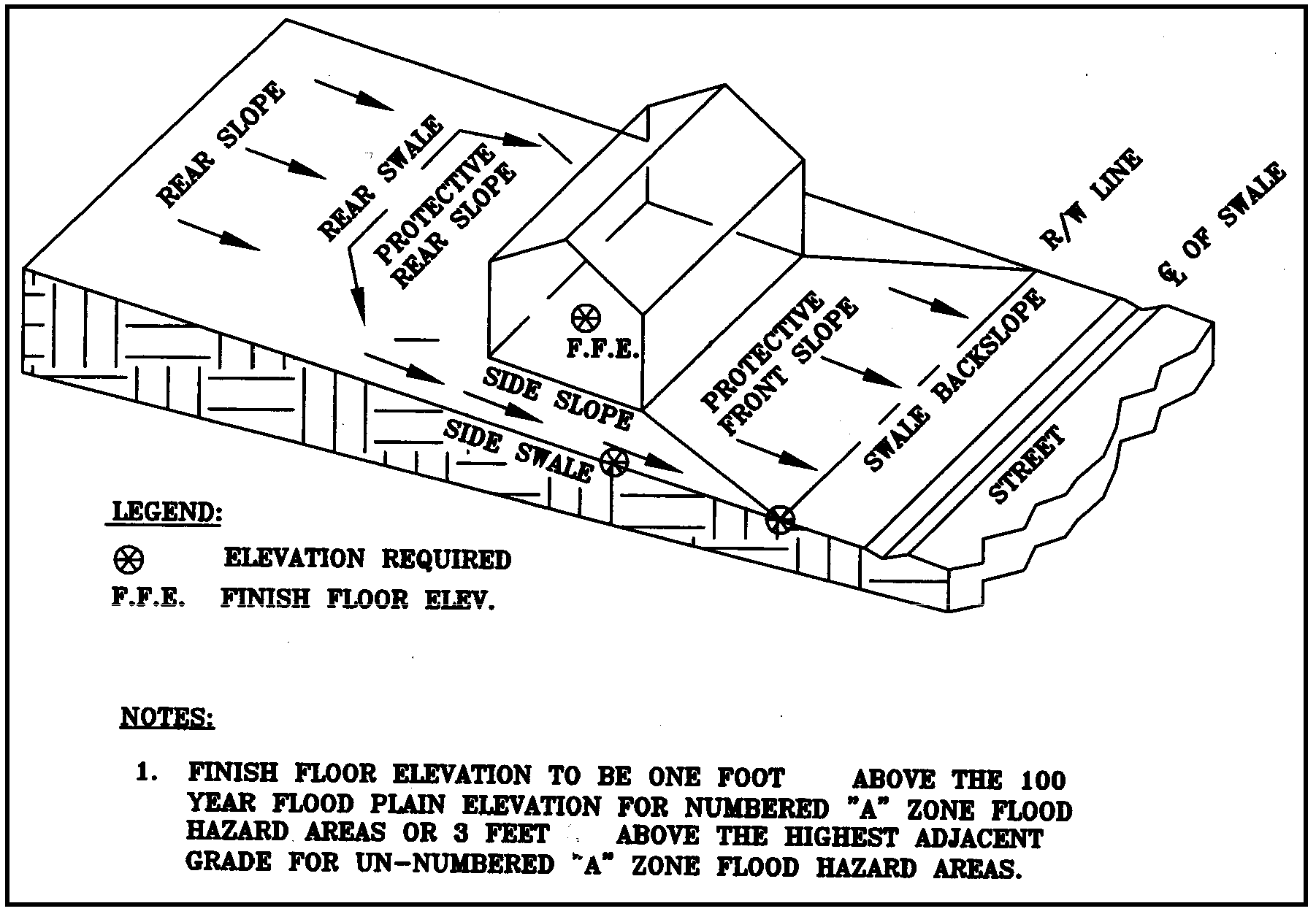
Typical Lot Grading Type "A"
Figure 2.2
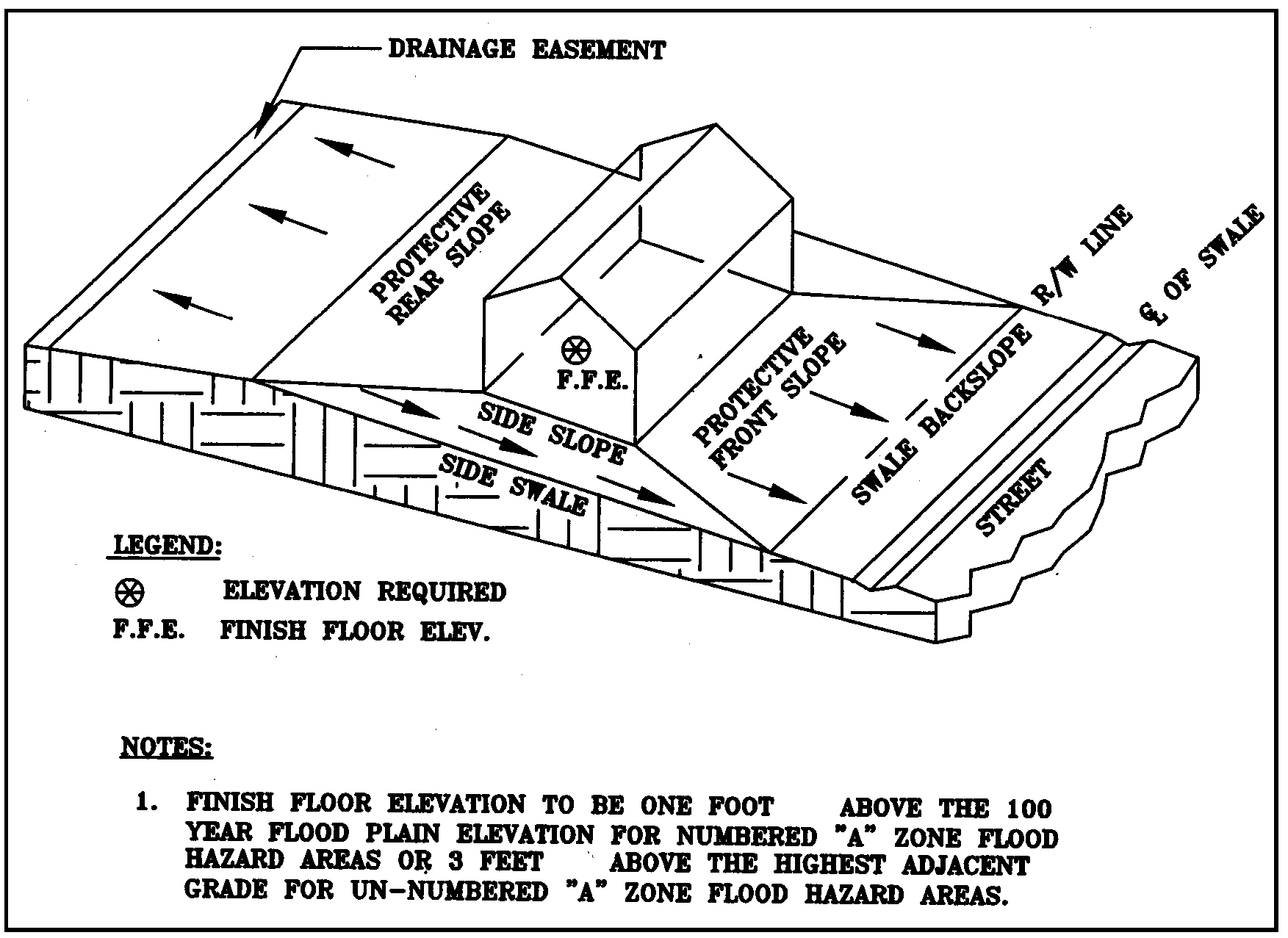
Typical Lot Grading Type "B"
Figure 2.3
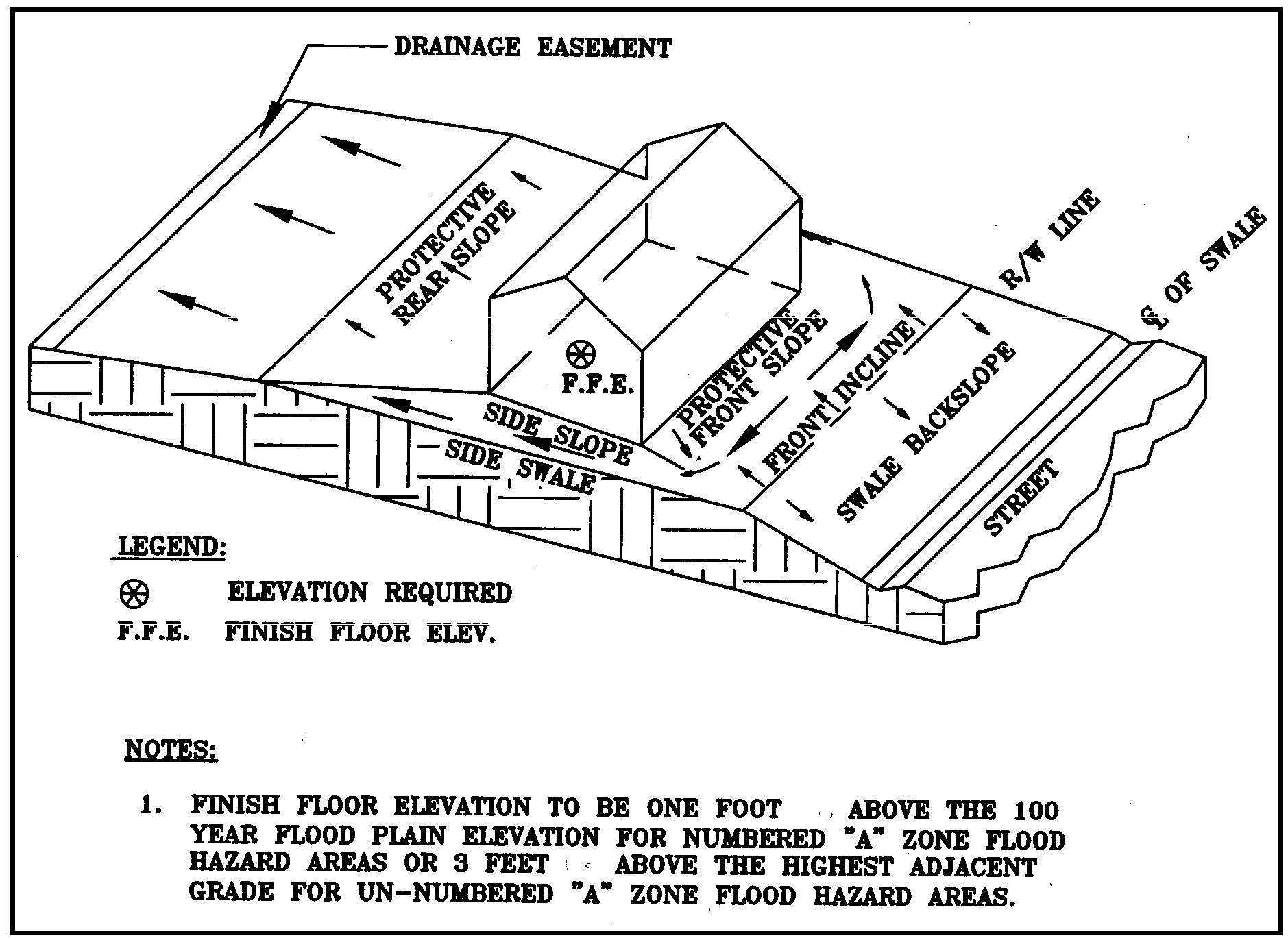
Typical Lot Grading Type "C"
Figure 2.4
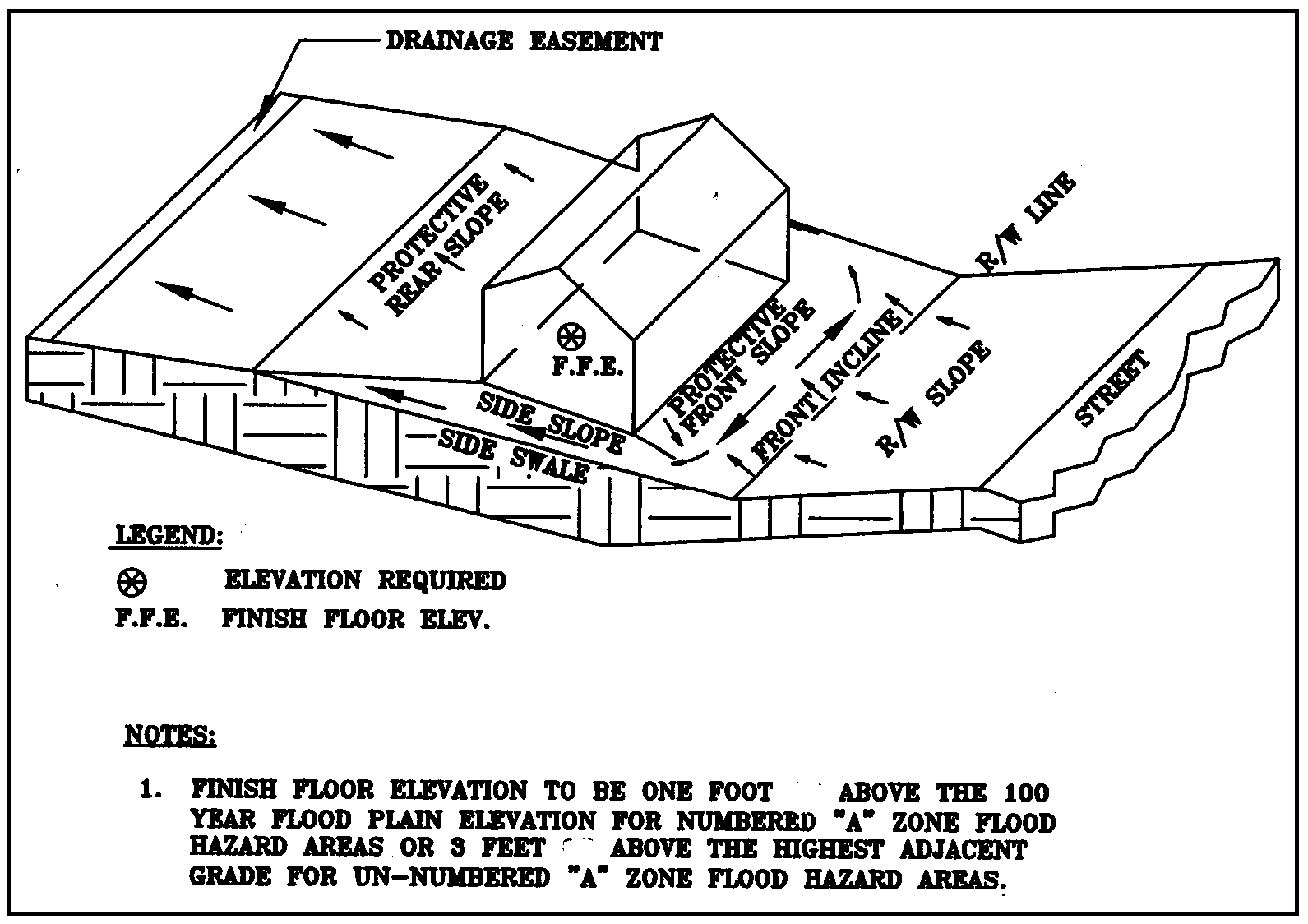
Typical Lot Grading Type "D"
E.
Soil Removal
Removal of soils from any one property or location in excess of 8,000 cubic yards are considered a non-phosphate mine and shall follow the requirements and procedures of Section 303 of this Code for Mining, Non-phosphate.
F.
Borrow Pits - Phosphate Industry
Fill material excavation ("borrow pit") associated with site management for an approved phosphate mine or gypsum stack permitted per the Land Development Code or Ordinance 88-19, is exempt from non-phosphate mining requirements provided the site has approvals from the Florida Department of Environmental Protection, is located greater than 1,000 feet from property developed with residential uses, and all excavated material remains on-site.
(Ord. No. 2025-058, § 2, 10-21-2025)
Section 228 - Reserved
(Relocated to Section 208.D)
Section 230 - Specific Provisions Applicable to Non-Residential Districts and Uses
Development within non-residential districts shall have impacts that are consistent with this Section and shall not create public nuisances that affect the public health, safety, or welfare or interfere with the safe operation of equipment on site or on adjacent property.
A.
Ambient Air Quality
Uses emitting air pollutants affecting ambient air quality shall conform to all Federal Department of Environmental Protection (FDEP) regulations.
B.
Emissions Into or Onto Water Bodies
Uses emitting solids, liquids, or other matter into or onto bodies of water or the ground shall comply with all FDEP, Southwest Florida Water Management District (SWFWMD), St. John's River Water Management District (SJRWMD), South Florida Water Management District (SFWMD), and local regulations.
C.
Vibration
No vibration shall be permitted which is discernible without instruments beyond any boundary of the district permitting the use.
D.
Air Quality
Establishments shall not exhaust or discharge into the air quantity of fly ash, smoke, dust, dirt, or similar form of particulate matter except as permitted by the appropriate agency having authority.
E.
Noxious and Odorous Quantities
No emission of noxious and odorous gases, fumes, or other odorous or toxic matter shall be permitted in such quantities as to be readily detectable by appropriate instruments beyond the property line of any establishment creating such odorous emission thereby creating a public nuisance or hazard.
F.
Glare
No direct glare from floodlights, high temperature processes such as combustion or welding, or from any other source shall be visible at the property line of any establishment.
G.
Discharge of Waste
No discharge of liquid or solid wastes into any public or private sewage system; lake, stream, ditch, or other body of water; flood way, swale, dry retention pond, or other intermittent facility for water storage or management; or onto or into the ground shall be permitted except as approved the appropriate agency having authority.
H.
Heated/Cooled Matter
No establishment shall produce heated or cooled air, water or other matter in such quantity or in such manner as to adversely alter the natural temperature of the air, water, or other matter beyond the property line of the establishment except as may be approved by the appropriate agency having authority.
I.
Radioactive Materials
No establishment shall produce, store, transfer, or use radioactive materials in any manner hazardous to human health except as may be approved by the appropriate agency having authority.
J.
Electrical/Electronic Disturbances
No establishment shall produce electrical or electronic disturbances perceptible beyond the property line of the establishment which adversely affects the public health, safety, welfare, or creates a public nuisance or hazard including, but not limited to, interference with normal radio, telephone, or television reception from off the premises where the activity is conducted.
K.
Fire Explosion Hazards
Materials and processes having potential for fire explosion hazards shall not be permitted where they constitute undue hazards.
L.
Noise
Noise which is determined to be objectionable to a reasonable person of normal sensitivities at the property line of the establishment creating such noise due to volume, frequency, or beat shall be prohibited. All uses shall comply with Section 761.
M.
Miscellaneous Hazards (Revised 5/20/09; Ord. 09-023)
Miscellaneous hazards not specifically addressed by the performance standards established by this Code shall be made known to the Growth Management Director or his designee by any establishment proposing to locate in an industrial district. Regulations of such hazards shall be processed as a Level 4 Review.
N.
Open Testing
Open testing procedures of materials and processes shall be permitted only in conformance with this Code.
Section 231 - Storage of Liquid Propane Tanks
The storage of any liquid propane gas tanks for retail sale shall be protected with bollards. Bollards shall be placed between the tank storage unit and vehicle parking. All bollards shall be no more than three feet on center and each bollard shall be at a minimum four inches in diameter steel pipe, concrete filled, six feet in length, with three feet anchored in 12 inches of concrete. All bollards shall extend the full length of the cabinet storing the liquid propane gas or tanks.

