
Polk County Unincorporated
City Zoning Code
City Zoning Code
CHAPTER 10
DEFINITIONS
Chapter 10 - Definitions
AASHTO: Abbreviation for the American Association of State Highway and Transportation Officials.
ABANDONED VEHICLE: Any vehicle without a valid registration.
ABANDONMENT: To relinquish, or give up authority with the intent of never again claiming a right or interest in.
ACCESSORY BUILDING: A building which is clearly incidental or subordinate to, and customarily used in connection with, a principal building located on the same lot.
ACCESSORY DWELLING UNIT (ADU): A residential living unit on the same parcel as a single-family dwelling or a parcel on which a single-family dwelling is present or may be constructed. The ADU provides complete independent living facilities for one or more persons. It may take various forms: a detached unit, a unit that is part of an accessory structure, such as a detached garage; or a unit that is part of an expanded or remodeled dwelling. Mobile homes, recreational vehicles, or structures built in conformance with Florida Statutes, Section 320.823, as amended, shall not be deemed an accessory dwelling unit.
ACCESSORY PARKING: Parking spaces set aside for the storage of recreational vehicles, boats, and campers.
ACCESSORY STRUCTURE: (See: STRUCTURE, ACCESSORY)
ACCESSORY USE: (See: USE, ACCESSORY)
ACTIVE AIRSTRIP: (See AIRSTRIP, ACTIVE)
ACTIVITY CENTER: An area containing a planned or existing cluster of related land use activities, including, but not limited to, commercial, industrial, and tourist/recreational activities.
ADDITION (to an existing building): Any walled and roofed expansion to the perimeter of a building in which the addition is connected by a common load bearing wall other than a fire wall. Any walled and roofed addition which is connected by a fire wall or is separated by independent perimeter load bearing wall is new construction.
ADDRESS NUMBERING MAPS: A master set of maps which, in conjunction with approved plats, depicts the existing street naming and building numbering schemes, street naming system and building numbering plan, any proposed street naming and building numbering schemes within the unincorporated area of Polk County, and the layout of internal access roads and lots or units in mobile home parks and apartment complexes. Said maps shall be delineated on a scale of one inch representing 200 feet, or some other workable scale deemed suitable by the Enhanced 9-1-1 Office.
ADMINISTRATIVE APPEAL: A request for review of any administrative decision or interpretation made under this Code.
ADMINISTRATIVE DECISIONS (Revised 2/5/19 - Ord. 19-008): A written final decision made by the appropriate Division Director in connection with a Level 1, Level 2 and/or Level 5 development review procedure as identified in Section 903.
ADMINISTRATIVE DETERMINATION (Revised 02/05/2019 - Ord. No. 19-008): A written determination made by a Division Director, upon written request and payment of a fee, which serves to: determine the permitted or conditional use of a property within the unincorporated area of Polk County; obtain information on the proper application of the guidelines, standards, or rules established by the Land Development Code; or resolve conflicting objectives, policies, maps and disputes regarding the administration of the Polk County Comprehensive Plan or Land Development Code. Administrative determinations may include decisions regarding matters which are not specifically addressed in the Comprehensive Plan or Land Development Code such as land uses not identified or listed in this Code.
ADULT DAY CARE HOME (Rev. 12/01/09 - Ord. 09-073): A residential home, whether operated for profit or not, in which is provided through its ownership or management, for a part of a day, basic services for no more than six (6) persons who are 18 years of age or older, who are not related to the owner operator by blood or marriage, and who require such services.
ADULT DAY CARE CENTER (Rev. 12/01/09 - Ord. 09-073): Any building, buildings, or part of a building, whether operated for profit or not, in which is provided through its ownership or management, for a part of a day, basic services for seven (7) or more persons who are 18 years of age or older, who are not related to the owner or operator by blood or marriage, and who require such services.
ADULT FAMILY-CARE HOME (Rev. 12/01/09 - Ord. 09-073): A full-time, family-type living arrangement, in a private home, under which a person who owns or rents the home provides room, board, and personal care, on a 24-hour basis, for no more than five disabled adults or frail elders who are not relatives, per F.S. ch. 429. The following family-type living arrangements are not required to be licensed as an Adult Family Care Home:
1.
An arrangement whereby the person who owns or rents the home provides room, board, and personal services for not more than two adults who do not receive optional state supplementation under F.S. § 409.212. The person who provides the housing, meals, and personal services/care must own or rent the home and reside therein.
2.
An arrangement whereby the person who owns or rents the home provides room, board, and personal services only to his or her relatives.
3.
An establishment that is licensed as a Congregate/Assisted Living Facility pursuant to Chapter 429, F.S and this Code. (See: GROUP HOME, SMALL)
ADULT USE: Any commercial establishment located within the unincorporated area of Polk County, Florida which permits live performances by entertainers where such performances are characterized by the exposure for the view of the patrons thereof any specific sexual activities or specific anatomical area.
ADVERSE EFFECTS: Any modifications, alterations, or effects on waters, associated wetlands, or shore lands, including their quality, quantity, hydrology, surface area, species composition, or usefulness for human or natural uses which are or may potentially be harmful or injurious to human health, welfare, safety or property, to biological productivity, diversity, or stability or which unreasonably interfere with the reasonable use of property, including outdoor recreation. The term includes secondary and cumulative as well as direct impacts.
ADVERSE IMPACT: Any direct or indirect effect likely to cause, or actually causing, a decline in the stability, natural function, or natural diversity of any environmental resource or system, or in the quiet, peaceful, safe, or healthful use or occupancy of any off-site property. This term includes secondary and cumulative as well as direct impacts.
ADVERTISING: Sign copy intended to directly or indirectly promote the sale or use of a product, service, commodity, entertainment, or real or personal property.
AFFORDABLE HOUSING: Pursuant to the Polk County State Housing Initiatives Partnership (SHIP) program guidelines and F.S. ch. 420, housing developed for owner-occupants having a sales price not to exceed 90% of the median area purchase price, as established by the U.S. Department of Treasury. Affordable rental housing shall have monthly rents not to exceed 30% of the median gross income for low, very low, and moderate income households as specified by current Polk County SHIP guidelines.
AFFORDABLE HOUSING DEVELOPMENTS: A single-family residential development in which at least 25% of the units meet the definition of affordable housing; or a multi-family residential development in which at least 25% of the units meet the definition of affordable housing.
AGRICULTURAL ACTIVITY: The use of land for the purpose of growing crops, plants, trees, or other agricultural or forestry products; aquaculture and raising livestock, as defined in F.S. § 193.461.
AGRICULTURAL PROCESSING (Added 05/19/15- Ord. 15-029): The production, fabrication, or processing, of raw or live agricultural products into goods, merchandise, or substances.
AGRICULTURAL PURPOSES: Included, but are not limited to horticulture, floriculture, viticulture, forestry, dairy, livestock poultry, bee, pisciculture, production of tropical fish, aquiculture, sod farming and all forms of farm products and farm production, F.S. § 193.416.
AGRICULTURAL STRUCTURE (FOR FLOODPLAIN MANAGEMENT PURPOSES). For floodplain management purposes, a walled and roofed structure used exclusively for agricultural purposes or uses in connection with the production, harvesting, storage, raising, or drying of agricultural commodities and livestock, including aquatic organisms. Structures that house tools or equipment used in connection with these purposes or uses are also considered to have agricultural purposes or uses.
AGRICULTURAL SUPPORT, OFF-SITE (Rev. 01/30/03 - Ord. 03-14): Activities and uses related to the production of agricultural-related products, including, but not limited to, storage and maintenance of grove equipment and farm machinery, fertilizer application, grove installation and service, and farm-management services where such activities are off-site but accessory to a nearby general farming operation. Typical off-site Agricultural Support facilities may include, but are not limited to specialized agricultural service establishments performing storage and maintenance of grove equipment and farm machinery (not to include sales), fertilizer application, grove installation and service, and farm management services. Also included are agricultural bulk products collection, weighing, storage, or transfer facilities, such as citrus scale houses (This does not include manufacturing, processing, canning facilities, or semi-truck parking). Mulching and other forestry specialized activities are considered agricultural support as well. Note: on site agricultural support uses are considered accessory to the primary agricultural uses that they are intended to serve.
AGRICULTURE TRANSFER/PACKING (Rev. 01/30/03 - Ord. 03-14): Land and structures used for the collection, exchange, loading/unloading, weighing, storage, washing, packing, and transfer of agricultural products. This term does not include manufacturing, processing, or canning facilities.
AIRPARK OR AIRPORT SUBDIVISION: A residential subdivision designed so that the airfield facilities are accessible to the residential lots.
AIRPORT: A facility licensed, designed, and used for the taking-off and landing of aircraft.
AIRPORT, ACTIVE: A public use or private use airport that has an active and valid airport license from the State of Florida.
AIRPORT OBSTRUCTION: Any structure, object of natural growth, or use of land that would exceed the federal obstruction standards contained in 14 Code of Federal Regulations (CFR) Part 77, ss. 77.21, 77.23, 77.25, 77.28, and 77.29.
AIRPORT, PRIVATE USE: Any airport licensed by the State of Florida as a private airport, used primarily by the airport licensee, but available for use by others upon specific invitation of the licensee.
AIRPORT, PUBLIC USE: Any publicly or privately owned airport licensed by the State of Florida as a public airport, which meets minimum safety and service standards and is open for use to the general flying public.
AIRSTRIP, PRIVATE: A private use airport where an unpaved strip of ground meeting minimum physical standards for use by small aircraft serves as an accessory use to a single-family residential property or bona fide agricultural operation. Private airstrips are used primarily by the owner or licensee and are not open to the public. Fly-in communities, heliports, and helistops are excluded from this definition.
ALCOHOLIC BEVERAGE SALES: Defined and regulated in Polk County Ordinance 75-04, as amended.
ALCOHOL PACKAGE SALES (Rev. 7/25/01 - Ord. 01-57): The retail sale of alcohol beverages not consumed on-site.
ALLEY: A roadway which provides a secondary or service access to the rear of lots. It is considered a local road, although different design standards apply.
ALTERNATIVE SUPPORT STRUCTURE: Any structure other than a communication tower including, but not limited to, buildings, elevated water storage tanks, light poles, power poles, telephone poles and other structures capable of supporting antennas.
ANCILLARY USE: (See: USE, ACCESSORY/ANCILLARY)
ANIMAL FARMS, INTENSIVE (Rev. 01/30/03 - Ord. 03-14): Establishments engaged in the fattening, raising, or breeding of animals typically for the commercial production of food, where the animals are fed primarily in pens, lots, or buildings (partially or wholly enclosed). Uses include, but are not limited to, hog farms, poultry/egg farms, and cattle feed lots. This term does not include slaughterhouses.
ANIMAL FARMS, SMALL, SPECIALTY (Rev. 01/30/03 - Ord. 03-14): Wholesale farms for raising small animals such as rabbits, birds, bees (honey), worms, or minks.
ANIMAL GRAZING: The foraging or feeding of animals on pastureland. This term includes the boarding and pasturing of horses.
ANNUAL AVERAGE DAILY TRAFFIC VOLUME: Seasonally adjusted (using the Florida Department of Transportation's seasonal adjustment factors) average number of vehicles that pass a point on a roadway segment on a daily basis.
ANNUAL MINE REPORT: Refers to a report submitted annually by an operator of a mine. The report is reviewed by Polk County to determine whether the operator has followed the BoCC-approved Mining Site Plan and is therefore in compliance with the conditions of the Operating Permit for the preceding year and whether the operator's plans for the coming year vary from those approved in the BoCC-approved Mining Site Plan.
ANTENNA: Any device designed for sending or receiving electromagnetic waves. The term includes radio, television and telecommunication antennas.
APPLICANT: Any person who submits an application and complete appropriate supporting documentation for the purpose of obtaining a review for compliance of applicable regulations.
APPURTENANT STRUCTURE: A structure which is on the same parcel of property as the principal structure and the use of which is incidental to the use of the principal structure.
APS: Alcohol package sales.
AQUACULTURE: The cultivation of products associated with, or grown in, water, such as fish farms and fish hatcheries.
AQUIFER: An underground formation, or group of formations, or part of a formation, that is permeable enough to transmit and store usable quantities of water.
AREA OF CONCERN (for counties): All municipalities within the county, adjacent counties, and adjacent municipalities. (Section 9J-5.015, F.A.C.)
AREA OF CONCERN (for municipalities): Adjacent municipalities, the county and counties adjacent to the municipality. (Section 9J-5.015, F.A.C.)
AREA OF SHALLOW FLOODING: (Rev. 06/04/13 - Ord. 13-020) A designated AO or AH, Zone on a community's Flood Insurance Rate Map (FIRM) with base flood depths of one to three feet where a clearly defined channel does not exist, where the path of flooding is unpredictable and where velocity flow may be evident. Such flooding is characterized by ponding or sheet flow.
ASCE 24 (Added 11/01/16 - Ord. 16-068): A standard developed by the American Society of Civil Engineers titled Flood Resistant Design and Construction that is referenced by the Florida Building Code.
AUTOMATIC IRRIGATION SYSTEM: An irrigation system designed to operate following a preset program entered into an automatic controller.
AUTOMATIC CONTROLLER: A mechanical or electrical device capable of automated operation of valve stations to set the time, duration and frequency of a water application.
AVAILABLE, RECLAIMED WATER (Revised 07/22/09 - Ord. 09-048): A municipal, County- franchised, or County-owned reclaimed water system is considered available:
1.
For any residential subdivision, and all non-residential uses that have an estimated wastewater flow of 1,000 gallons per day or more, a reclaimed water main shall be considered available and connection shall be required if a reclaimed water main is in an easement or right-of-way existing under one of the following conditions:
a.
Is within 1/2 mile (2,640 feet) of the property;
b.
Will serve 10 or more Equivalent Residential Connections (ERCs) of wastewater flow and is within 3/4 mile (3,960 feet) of the property;
c.
Will serve 20 or more Equivalent Residential Connections (ERCs) of wastewater flow and is within one (1) mile (5,280 feet) of the property; and
2.
The wastewater treatment facility generating the reclaimed water shall have adequate capacity to serve the proposed development with reclaimed water as determined by the utility purveyor.
AVAILABLE, SANITARY SEWER: A municipal, County-franchised, or County-owned sanitary sewer system is considered available when [Revised by CPA-95A-05 (Ord 95-34); Adopted by BoCC 17 OCT 95]:
1.
The system is not under Florida Department of Environmental Protection (DEP) moratorium;
2.
For all single-family residences, and for any establishment that has an estimated sewage flow of 1,000 gallons per day or less, a sanitary sewer shall be considered available if the line abuts the property and gravity flow can be maintained from the building to the sewer line;
3.
For any residential subdivision, and all non-residential uses that have an estimated sewage flow of 1,000 gallons per day or more, a sanitary sewer shall be considered available if a gravity line, force main, manhole, or lift station in an easement or right-of-way is existing under one of the following conditions:
a.
Is within one half of one mile (2,640 feet) of the property;
b.
Will serve ten or more Equivalent Residential Units (ECCS) or more and is within 3/4 mile (3,960 feet) of the property;
c.
Will serve 20 Equivalent Residential Units (ECCS) or more and is within one mile (5,280 feet) of the property; and
4.
A sewer system has adequate hydraulic capacity to accept quantity of sewage to be generated by the proposed establishment.
AVAILABILITY, PUBLIC WATER: An approved public water supply with:
1.
Sufficient capacity to serve the subject property, and
2.
Has an adequately sized distribution system within one mile of the property. (DOH)
AVERAGE ADJACENT GRADE (Rev. 12/27/02 - Ord. 02-88): The mean natural elevation of the ground surface, prior to construction, next to the proposed foundation of the structure.
BACKGROUND TRAFFIC: Existing traffic plus traffic from vested and reserved development that is estimated to travel on segments of the Concurrence Determination Network. This term is for use with Appendix C of this Code.
BACKLOGGED FACILITY: A segment on the Concurrence Determination Network operating below the Adopted Level-of-Service which does not have prohibitive physical, environmental or policy constraints, but which is not scheduled for a major capacity improvement within the first three years of the Florida Department of Transportation's Five-Year Work Program or the County's Five-Year Schedule of Capital Improvements. Backlogged facilities are recognized as such through their adoption as part of the Traffic Circulation Element of the Polk County Comprehensive Plan.
BARS, LOUNGES, AND TAVERNS (Rev. 7/25/01 - Ord. 01-57): An establishment used primarily for the serving of alcoholic beverages to the general public and where food or package alcoholic beverages may be served or sold only as accessory to the primary use.
BASE FLOOD: (Added 06/04/13 - Ord. 13-020) A flood having a 1-percent chance of being equaled or exceeded in any given year. The base flood is commonly referred to as the "100 year flood" or the "1-percent-annual chance flood" or the "regulatory flood"
BASE FLOOD ELEVATION (BFE): (Rev. 11/1/16 - Ord. 16-068; 06/04/13 - Ord. 13-020) The highest elevation of the base flood relative to the datum specified on the Flood Insurance Rate Map.
BASEMENT:(Rev. 06/04/13 - Ord. 13-020) Any portion of a building having its floor subgrade (below ground level) on all sides.
BED & BREAKFAST: A dwelling unit, often of historical significance, operated by its owner or the owner's agent which is made available for lodging of the public and which customarily offers lodging and breakfast for one price. A dwelling unit shall not be considered a bed and breakfast if its owner or the owner's agent is not present on the premises during a majority of the time guests are occupying the unit.
BENEFICIAL FUNCTIONS OF A WETLAND: Those functions, described in the Polk County Comprehensive Plan that justify protection of wetlands.
BEST MANAGEMENT PRACTICE (BMP): Conservation practices or systems of practices and management measures that:
1.
Control soil loss and reduce water-quality degradation caused by nutrients, animal waste, toxins, and sediment;
2.
Minimize adverse impacts to surface water and groundwater flow, circulation patterns, and to the chemical, physical, and biological characteristics of wetlands; and
3.
Includes allowing proper use and storage of fertilizers.
BoCC: Referencing the Board of County Commissioners of Polk County, Florida. The Board of County Commissioners is the elected body that represents the chief governing authority over unincorporated Polk County, regarding local matters.
BOARD OF COUNTY COMMISSIONERS or BoCC: The Board of County Commissioners of Polk County, Florida. (See: BoCC)
BOAT DOCK OR DOCKING FACILITY: A fixed or floating structure, including mooring pilings, tie poles, dolphins, boat lift, and other accessory structures, which has as its purpose the berthing of buoyant vessels.
BONA FIDE AGRICULTURAL PURPOSE: Per F.S. § 193.46, good faith commercial agricultural use of the land.
BORROW PIT:See FILL MATERIAL EXCAVATION
BREEDING, BOARDING, AND REHABILITATION FACILITY, WILD OR EXOTIC: (Rev. 01/30/03 - Ord. 03-14) Non-farm and non-preservation facilities and land used primarily for the breeding, raising and rehabilitation of Exotic or Wild Animals, defined as all wild or non-domestic birds, mammals, reptiles, fish or amphibians which are identified as Class I or Class II Wildlife or poisonous or venomous by the Florida Fish and Wildlife Conservation Commission (FFWCC), and which require permits for their possession or exhibition as specified in F.S. ch. 372. This term also includes alligator farms, but does not include the following:
1.
Animals used for food and associated agricultural uses, e.g., ostriches (ostrich farms are considered intensive animal farms).
2.
Animals which can be determined to have been domesticated, e.g., Asian elephants (breeding facilities for Asian elephants are considered intensive animal farms).
3.
Wild or exotic animals which are personal pets, provided that the owner possesses a valid permit by the FFWCC.
4.
However, excludes Class III species as permitted by FFW CC, such are included in General Farming.
BRIDGE: Per F.S. ch. 334, a structure, including supports, erected over a depression or an obstruction, such as water or a highway or railway, and having a track or passageway for carrying traffic as defined in F.S. ch. 316, or other moving loads.
BUFFER: Any structure, earthen berm, or vegetated open space used to minimize the adverse impact of on-site activities and uses to surrounding less intense land uses.
BUILD TO LINE (Rev. 5/18/05 - Ord. 05-18): - A line parallel to the property line along which a building shall be built.
BUILDING: Any structure that encloses a space used for sheltering any occupancy; including a gas or liquid storage tank; and shall include manufactured homes. The term building shall not be deemed to include any "restricted vehicles."
BUILDING DIVISION: The Building Division of the Polk County, Department of Community Services.
BUILDING OFFICIAL: The Director in charge of the Polk County Building Department, or his designee, and responsible for the administration of the Polk County Building Code.
BUILDING, FRONT: That area or portion of a building or its facade which faces the street and which determines which street would be named in the building's street address. With regard to a building located on a corner lot or lot which abuts two or more street, that area or portion of the building or its facade which faces the street for which a street address was or is assigned shall be deemed the building front.
BUILDING MATERIAL SALES, RETAIL: Establishments that sell primarily lumber, electrical supplies, heating and plumbing equipment, or a general line of building materials, to the general public.
BUILDING NUMBERING PLAN: A system by which existing buildings and projected lots and other sites for future buildings are assigned a building number to be combined with the street name for a street address in a uniform and coordinated manner as developed by the Enhanced 911 Addressing Office (E-911) in cooperation with designated enclaves and depicted on the Address Numbering Maps.
BUILDING PERMIT: Any permit, or combination of permits, issued by the Polk County Building Division which allows the construction of vertical construction.
BULK FUEL: Storage of fuel in quantities greater than can generally be consumed by the primary use within a 30 day period.
BUS STOP OR SCHOOL BUS STOP: A designated area, typically covered, used by school children to await pickup by a Polk County School Board operated school bus. This facility or structure must be placed in accordance with School Board standards on a specified route, and accepted by the School Board for such use.
BUSINESS INCUBATOR: An area designated for the cultivation and enhancement of future businesses or business-oriented developments.
CAMOUFLAGED TOWER: A communication tower designed to unobtrusively blend into its existing surroundings so as not to have the appearance of a communication tower.
CANOPY: A cover attached to the principal structure and supported by posts or a free standing cover supported solely by posts or an overhanging cover, or shelter to give limited protection from the elements.
CANOPY TREE: (Added 03/18/09 - Ord. 09-006) Any self supporting woody plant of a species that normally achieves an overall height at maturity of 30 feet or more.
CAPITAL IMPROVEMENT: Physical assets constructed or purchased to provide, improve or replace a public facility and which are large scale and high in cost. The cost of a capital improvement is generally nonrecurring and may require multi-year financing. For the purposes of this rule, physical assets which have been identified as existing or projected needs in the individual comprehensive plan elements shall be considered capital improvements. Capital improvements have a life expectancy of at least five years and costs more than $25,000.
CAPITAL IMPROVEMENT PROGRAM (C.I.P.): A five-year listing of capital improvement projects (including the Capital Improvements Budget), by fiscal year, of capital projects the County intends to provide. The C.I.P. includes project name, location, year of construction, cost, and source of funds.
CAR WASH, FULL SERVICE: Any facility providing complete car washing and cleaning services. Car washing is generally automatic, with the driver leaving the car during the washing procedure. Waxing and detailing may also be provided.
CAR WASH, INCIDENTAL: Any automated car wash which is incidental to the sale of fuel, and characterized by an automatic wash which requires the driver to remain in the vehicle during operation. The facility may be an attached or a free standing structure.
CAR WASH RECYCLE SYSTEM (Added: 5/21/19 - Ord. 19-032): A method, as approved by the Florida Department of Environmental Protection or other applicable regulatory authority, of recycling wash water this is captured, treated, and redirected back into the same car wash facility.
CAR WASH, SELF SERVICE: Any facility providing stalls with water, soap, wax, or other materials for cleaning vehicles by individuals.
CARDBOARD: Clean corrugated material made from cellulose fiber (such as wood pulp) like paper but usually thicker.
CARDBOARD & SHREDDED PAPER COLLECTION: Collection, compaction, bailing, and transfer of discarded cardboard and shredded paper materials such as boxes, containers, office paper, card stock, cotton bond paper, and parcel packing materials.
CARGO CONTAINERS (ALSO CALLED SHIPPING CONTAINERS): (Rev. 09/02/09 - Ord. 09-058: A reusable vessel that is originally, specifically or formerly designed for or used in the packing, shipping, movement, or transportation of freight, articles, goods or commodities and is also designed for or capable of being mounted or moved on a rail car, truck or trailer or loaded on a ship.
CARL: Conservation and Recreation Lands.
CEMETERIES: Land used or intended to be used for the burial or interment of the dead (humans or pets) and dedicated for cemetery uses, including crematories, mausoleums, and mortuaries, if operated in connection with and within the boundaries of such cemetery.
CERTIFICATE OF SCHOOL CONCURRENCY (Added 01/09/08, Ord. 08-001): A confirmation of adequate school capacity to be issued by the County or non-exempt cities based on the School Board's school capacity
CHANGE OF OCCUPANCY: An action taken for which a building or part thereof, changes the use or intended use or occupancy determined by the major occupancy group designations established by this Code or the locally adopted building codes.
CHANGE OF USE: Any change, modification or alteration of the use of any structure, lot, or building from one defined use to another. In instances where the specific use is not defined, the defined use closest to that specific use shall be used.
CHILDCARE CENTER (Revised 07/22/09 - Ord. 09-047): A structure used to provide child care for any part of a day which receives a payment, fee, or grant for any of the children receiving care wherever operated whether or not operated for profit. The following are NOT included: public schools and nonprofit schools and their integral programs; summer camps having children in full-time residence; summer day camps, and Bible schools normally conducted during vacation periods.
CITY-STYLE ADDRESSING: Assignment of house numbers in sequential order using the grid of existing community and the street name by which the structure is accessed.
CLEARING: The removal of trees, brush or any other vegetation from the land, not including the ordinary mowing of grass.
CLERK ("the Clerk"): The Clerk of the Circuit Court for the Polk County Board of County Commissioners. The Clerk of the Circuit Court for Polk County represents the clerk and accountant for the Board of County Commissioners. The responsibilities of the Clerk include keeping the official minutes and accounts of BoCC meetings, and performing such duties as the Board of County Commissioners may direct. The Clerk has custody of the official County Seal, and may affix the official seal to any document or instrument where it is necessary. (F.S. ch. 125)
CLINICS & MEDICAL OFFICES: A facility wherein professional services concerning the personal health of humans are administered by medical doctors, chiropractors, osteopaths, optometrists, dentists or any other such profession which may lawfully be practiced in the State of Florida. Persons treated shall not be lodged overnight.
CODE ENFORCEMENT BOARD: The Polk County Code Enforcement Board, as created by Polk County Ordinance 85-06, as amended.
CODE ENFORCEMENT OFFICER: Any designated employee or agent of Polk County whose duty it is to enforce those Polk County ordinances set forth in this Code.
CO-LOCATION: The placement of more than one antenna on a communication tower or alternative support structure.
"COLLOCATE" OR "COLLOCATION" (Added 4/17/18 - Ord. No. 18-022): Pursuant to F.S. § 337.401 means to install, mount, maintain, modify, operate, or replace one or more wireless facilities on, under, within, or adjacent to a wireless support structure or utility pole. The term does not include the installation of a new utility pole or wireless support structure in the public rights-of-way.
COMBINATION PARK: A development (park) consisting of a combination of mobile homes and recreational vehicles (R.S.) where no specific percentages are identified or required.
COMMERCIAL: Operated for pecuniary gain, or any establishment which has received an occupational license. For purposes of this ordinance, operation for pecuniary gain shall not depend on actual profit or loss.
COMMERCIAL AMUSEMENTS: A premises, or portion of a premises, occupied by an establishment whose primary function is to provide profit oriented amusements and is engaged in the commercial operation of sports and recreational services normally on payment of a fee or admission charge.
COMMERCIAL ESTABLISHMENT: Any business location, place or business conducting or allowing to be conducted on its premises any commercial activity.
COMMERCIAL MINERAL DEPOSIT: A deposit, naturally occurring in the earth, mineral or otherwise, which has commercial value, including, but not limited to, limestone, sand, clay, peat, and fill material.
COMMERCIAL SERVICE AIRPORT: An airport which provides scheduled passenger services by an air carrier certified by the Federal Aviation Administration.
COMMERCIAL SITE: Property intended to be developed for commercial purposes, such as apartment complexes with more than four residential units, office facilities, retail and wholesale businesses, mobile home parks, recreational vehicle parks, and camp grounds.
COMMERCIAL VEHICLE: A motor vehicle generally displaying writing, images, lettering, logos, or other advertising, that serves to encourage trade with, or make known the services provided by a vehicle's owner or company. Commercial vehicles include dump trucks; tractor/trailer rigs, or their components; vehicles having more than two axles on the road; or any other similar vehicle not ordinarily used for personal transportation.
COMMERCIAL VEHICLE PARKING: A building or area used for the parking, storing or keeping of commercial vehicles where no loading or unloading of the commercial vehicles takes place. This does not apply to the commercial vehicles parked and utilized in conjunction with a principal use on the same site where the storage or use of commercial vehicles is incidental and subordinate to the principal use of the property. Additionally, this does not include motor freight terminals or commercial vehicle parking in residential districts. Recreational Vehicles and Boats may also be parked in approved Commercial Vehicle Parking facilities provided required screening is in place.
COMMERCIAL WASTE (Added 03/18/14 - Ord. 14-015): All types of solid waste generated by commercial enterprises, including stores, offices, restaurants, warehouses, and other nonmanufacturing activities.
COMMON FACILITIES (Added 03/19/08 - Ord. 08-004): Land, facilities, or improvements such as parking areas, sidewalks, clubhouses, tennis courts or swimming pools, which are located within a development and in which the owners of the development have an undivided interest and a common responsibility for maintenance and repair.
COMMON OPEN SPACE (Added 03/19/08 - Ord. 08-004): Land, including facilities or improvements meeting the definition of open space, recreation open space and/or public commons open space, which are located within a development and in which the owners of the development have an undivided interest and a common responsibility for maintenance and repair.
COMMONLY OWNED LAND (Added 03/19/08 - Ord. 08-004): Land, or land and improvements held in common ownership by a group of people who individually own dwellings or businesses within the same development, and are responsible for the upkeep and maintenance of the commonly owned land and improvements. See also Common Facilities and Common Open Space.
COMMUNICATION FACILITY: The use of land, buildings or structures for the above ground transmission and reception of television, radio, or wireless telephone communications including all transmitting and receiving towers, dishes and antennae.
COMMUNICATION TOWER: Any structure that is designed and constructed primarily for the purpose of supporting one or more antennas, including lattice towers, guyed towers and monopole towers. The term includes, without exclusion, radio and television transmission towers, microwave towers, common-carrier towers, cellular telephone towers and camouflaged towers. The term does not include structures which are utilized solely by amateur radio operators licensed by the FCC. For the purposes of applying the height thresholds and setback requirements of this Section, antennas which add to the height of a communication tower shall be considered a part of the communication tower. Communication towers are further classified as Monopole, Lattice, and Guyed Towers. (See: MONOPOLE TOWER, LATTICE TOWER, GUYED TOWER)
COMMUNITY CENTERS (Rev. 01/03/05 - Ord. 04-80): Structures or buildings used by residents of a community for social, cultural or recreational purposes (the term also includes senior centers). Community centers are typically utilized by civic groups, clubs, home owners associations or other such community group. This provision excludes dining facilities, clubhouses and recreation facilities in residential developments pursuant to Section 206 D.
COMMUNITY RESIDENTIAL HOME (Rev. 12/01/09 - Ord. 09-073): A dwelling unit licensed to serve residents as defined in F.S. § 419.001(1)(d) who are clients of the Department of Children and Family Services, Department of Elderly Affairs, Department of Juvenile Justice, the Agency for Persons with Disabilities or the Agency for Health Care Administration which provides a living environment for 7 to 14 unrelated residents who operate as the functional equivalent of a family, including such supervision and care by supportive staff as may be necessary to meet the physical, emotional, and social needs of the residents per Section 419.001, F.S. (See: GROUP HOME, SMALL & GROUP HOME, LARGE)
COMMUNITY WATER SYSTEM: A public water system which serves at least 15 service connections used by year round residents or regularly serves at least 25 year round residents.
COMPATIBILITY (Added 03/18/14 - Ord. 14-015): A condition in which land uses or conditions can coexist in relative proximity to each other in a stable fashion over time such that no use or condition is unduly negatively impacted directly or indirectly by another use or condition.
COMPLETION GUARANTEE: Sufficient full performance security guaranteeing the completion and approval of all private and public on-site or off-site improvements.
COMPREHENSIVE PLAN: The Polk County Comprehensive Plan, as amended, adopted by the Board of County Commissioners pursuant to the requirements of F.S. ch. 163, pt. II.
CONCURRENCE: The requirement that new development can only occur where public facilities are available in the necessary quantity, capacity, and quality to maintain the adopted level-of-service standards for public facilities. (Polk County Comprehensive Plan, Capital Improvements Element)
CONCURRENCE DETERMINATION NETWORK: A listing of all existing and planned roadway segments within Polk County that comprise the roadway network to be used when evaluating the traffic impacts of proposed development.
CONCURRENCY SERVICE AREA (Added 01/09/08 by Ord. 01-008): The designation of an area within the level of service will be measured when an application for a residential subdivision or site plan is reviewed.
CONDITIONAL USE (Added 5/6/09 - Ord. 09-019): A use that, because of its characteristics and potential impact upon surrounding properties, may only be allowed in a particular land use district after demonstrating all of the following:
1.
The use complies with all the limitations and standards for the location and operation of their use;
2.
The use protects the health, safety, and welfare of adjacent properties; and,
3.
The use is compatible with other uses permitted in the same area. Compatibility standards are prescribed in either the Land Development Code and/or the Comprehensive Plan. Additional conditions may be prescribed at a public hearing by the Planning Commission, Board of Adjustment, or Board or County Commissioners.
CONFINED AQUIFER (Added 5/21/13 - Ord. 13-018): A geologic unit that can store and transmit water which is overlain by a confining layer (a geologic unit comprised of reduced permeability strata compared to the aquifer strata) and by nature is more protected from direct recharge than unconfined or water-table aquifers.
CONGREGATE ASSISTED LIVING FACILITY (Rev. 12/01/09 - Ord. 09-073): Any building or buildings, section or distinct part of a building, private home, boarding home, home for the aged, or other residential facility, whether operated for profit or not, which undertakes through its ownership or management to provide housing, meals, and one or more personal services exceeding 24 hours to one or more adults who are not relatives to the owner or administrator, per F.S. ch. 429. (See: GROUP HOME, LARGE & GROUP LIVING FACILITY)
CONGREGATE CARE FACILITY:(See: GROUP-LIVING FACILITIES CONGREGATE LIVING)
CONSERVATION EASEMENT: A right or interest in real property which is appropriate to retaining land or water areas predominately in their natural, scenic, open, or wooded condition; retaining such areas as suitable habitat for fish, plants, or wildlife; or maintaining existing land uses; and which prohibits or limits the activities described as in F.S. § 704.06.
CONSISTENCY, CONSISTENT: The requirement that a development order be compatible with and further the goals, objectives, policies, land uses, and densities or intensities in the Comprehensive Plan.
CONTIGUOUS SCHOOL SERVICE AREAS (Added 01/09/08 by Ord. 01-008): School Service Areas which have an adjacent (conterminous) boundary.
CONSTRAINED FACILITY: A roadway segment on the Concurrence Determination Network that is currently backlogged or projected to be backlogged because expansion of the facility would cause undue environmental concerns, be prohibitively expensive or would unduly disrupt neighborhood character. Constrained facilities are recognized as such through their adoption as part of the Traffic Circulation Element of the Polk County Comprehensive Plan. This definition is for use with Appendix C of this Code.
CONSTRUCTION: Any on-site activity that will result in the building, assembling, expansion, modification, or alteration of the existing contours of the property; the erection of buildings or other structures, or any part thereof.
CONSTRUCTION AGGREGATE (Added 11/4/14 - Ord. 14-066): Materials consisting of crushed stone, gravel, crushed gravel, pebbles, limestone, dolomite, limerock, shell rock, cemented coquina, sand for use as a component of mortars, concrete, bituminous mixtures, or underdrain filters, recycled or inorganic mineral material previously used in construction, and other resources providing the basic material for concrete, asphalt, road base.
CONSTRUCTION AGGREGATE PROCESSING(Added 11/4/14 - Ord. 14-066): Any parcel of land and structures thereon, that are used or devoted to processing construction aggregate (see Construction Aggregate definition) through crushing, screening, rolling, vibrating, or other similar process, and includes the transportation of construction aggregate to and from the site.
CONSTRUCTION AGGREGATE STORAGE(Added 11/4/14 - Ord. 14-066): Any parcel of land and structures thereon, that are used or devoted to storing or stockpiling construction aggregate (see Construction Aggregate definition), and includes the transportation of construction aggregate to and from the site.
CONSTRUCTION AND DEMOLITION DEBRIS (Added 03/18/14 - Ord. 14-015): Materials generally considered to be not water soluble and nonhazardous in nature, including, but not limited to, steel, glass, brick, concrete, asphalt roofing material, pipe, gypsum wallboard, and lumber, from the construction or destruction of a structure as part of a construction or demolition project, and including rock, soils, tree remains, trees, and other vegetative matter which normally results from land clearing or land development operations for a construction project, including such debris from construction of structures at a site remote from the construction or demolition project site.
CONTROL ELEVATION: The lowest point at which water can be released through the control device.
CONVENIENCE STORE: A small retail store which sells convenience goods as its primary sales. A convenience store may include the sale of gasoline and diesel fuel, but such sales shall be accessory to the primary sale of convenience goods. A proposed convenience store must meet commercial site plan requirements.
CONVENIENCE STORE, ISOLATED (IS): A commercial establishment (4,000 square feet or less that support at least 1,500 people within a one mile radius) serving the convenience shopping needs of residents largely outside urban service areas. By definition, these Isolated Convenience Stares are located outside of the normal commercial areas associated with similar retail establishments, and are generally associated with residential land use categories, though commercial zoning is required.
CONVENIENCE STORE, VILLAGE (VCS): A commercial establishment (3,000 square feet or less that support at least 500 people within a one mile radius) serving the convenience shopping needs of residents largely outside urban service areas. By definition, these Village Convenience Stores are located outside of the normal commercial areas associated with similar retail establishments, and are generally associated with the A/RR and RS land use categories, though commercial zoning is required.
COP: Consumption on premises.
COPY (SIGN): The linguistic or graphic content of a sign.
CORNER CLEARANCE: The distance from an intersection of a public or private road to the nearest access connection, measured from the closest edge of the pavement of the connection along the traveled way.
CORRECTIONAL FACILITIES: A facility for the housing of persons convicted of, or being held for, a crime. Typical uses include prisons (a facility regulated by the State of Florida Department of Corrections which is designed for maximum security to house persons convicted of a crime), community correctional centers, probation and restitution centers, vocational training centers, and forestry camps (all as defined by the State of Florida Department of Corrections), or local government jails or detention centers.
COTTAGE INDUSTRY. (Added 5/19/15 - Ord. 15-29): A small agricultural processing component accessory to a bona-fide agricultural use that produces products primarily composed of materials grown onsite.
COUNTY: The geographical region known as Polk County, Florida. Generally, used to reference the unincorporated area under the jurisdiction of the Polk County Board of County Commissioners.
COUNTY MANAGER: The chief County administrative official of Polk County, bearing the title of "County Manager"; as provided for in the Polk County Charter and appointed by the Polk County Board of County Commissioners.
COUNTY ROAD: Those roads contained in the County Road Inventory listing, as officially adopted by the BoCC.
COUNTY ROAD INVENTORY LISTING: An official record maintained by the Polk County Engineering Department containing the description of all publicly held and maintained roads within the jurisdiction of Polk County.
CREMATORIUM (Added 4/17/18 - Ord. 18-021): A location containing properly installed, certified apparatus intended for use in the act of cremation.
CRITICAL FACILITIES (Rev. 06/04/13 - Ord. 13-020): Facilities which provide or are used to provide basic necessary services and benefits to the community as a whole. Such facilities include, but not limited to:
1.
Structures or facilities that produce, use, or store highly volatile, flammable, explosive, toxic, and reactive materials;
2.
Hospitals, nursing homes, and housing likely to contain occupants who may not be sufficiently mobile to avoid death or injury during a flood;
3.
Police stations, fire stations, vehicle and equipment storage facilities, and emergency operations centers that are needed for flood response activities before during and after a flood; and
4.
Public and private utility facilities that are vital to maintaining or restoring normal services to flooded areas before, during, and after a flood, including hurricane shelters.
CRITICAL TRANSPORTATION LOCATION: Any location where the sum of existing plus vested traffic is at or above 90 percent of the generalized planning capacity or other calculated segment capacity as approved by the Transportation Planning Organization (TO).
CROSS ACCESS EASEMENT: A platted internal roadway that crosses an adjacent parcel or parcels which do not meet the commercial road frontage requirements stipulated in the Polk County Comprehensive Plan. The joint use of the private internal roadway shall be limited to small and medium commercial subdivisions or individual commercial or industrial lots of record that can utilize the private internal roadway provision.
CULTURAL FACILITIES: A building or complex of buildings that provide educational and informational services to the general public including, but not limited to, civic centers or theaters predominantly used for live performances, libraries, historical landmarks, museums, art galleries and studios, planetariums, and similar facilities. These facilities may provide ancillary educational programs associated with the facility and its resources.
CURB: A stone, concrete, or other improved boundary usually marking the edge of the roadway or paved area.
CURB RADIUS: The curved edge of the street at an intersection measured at the inner edge of the parking lane.
dB: (See: DECIBEL)
dB(A): The standard abbreviation for A-weighted sound levels in decibels. A-weighted sound levels are a measurement of sound approximating the sensitivity of the human ear, used to note the intensity or annoyance of sounds.
D.B.H. (DIAMETER AT BREAST HEIGHT): Average diameter of a tree measured four and one-half feet above ground level.
DAIRIES (Rev. 01/30/03 - Ord. 03-14): Land and structures used for the commercial production of milk or other dairy products.
DATUM (Added 06/04/13 - Ord. 13-020): A reference surface used to ensure that all elevation records are properly related. The current national datum is the National Geodetic Vertical Datum (NGVD) of 1929, which is expressed in relation to mean sea level, or the North American Vertical Datum (NAVD) of 1988.
DCA: Abbreviation for the Florida Department of Community Affairs.
DEBRIS, ORGANIC (Rev. 4/4/02 - Ord. 02-18): Any plant or animal waste. Organic debris includes, but is not limited to fallen trees and limbs, leaves, plant trimming and other similar organic debris.
DECIBEL (dB): A unit of sound measurement as measured on a sound level meter or a measure of loudness equal to twenty times the logarithm (to the base of 10) of the ratio of the sound pressure (in excess of the ambient pressure) to a standard pressure of .0002 unbars, (or .002 newton per square meter.)
DECK: Any platform, floor, shelf, suggestive of a ship's deck.
DEDICATIONS: A donation of real property, generally land, from private to public ownership.
DEFICIENT FACILITY: A segment on the Concurrence Determination Network operating below the Adopted Level-of-Service but not yet adopted as a backlogged or constrained facility as part of the Traffic Circulation Element of the Polk County Comprehensive Plan. This definition is for use with Appendix C of this Code.
DEGRADATION: Any adverse or negative modification (from the perspective of the subject species) of the hydrological, biological or climatic characteristics supporting the species, or of plants and animals co-occurring with and significantly affecting the ecology of the species.
DENSITY CREDITS: A value equal to the maximum number or residential dwelling (family) units which may be constructed on a given amount of land under the existing land use classification of that land, usually expressed in dwelling units per acre.
DENSITY, GROSS: Gross density is determined by dividing the total number of dwelling units on the site by the total area of the residential site, exclusive of natural waterbodies and limited transfer of density out of wetlands.
DEP: Abbreviation for the Florida Department of Environmental Protection.
DEPARTMENT (Revised 5/20/09 - Ord. 09-023): The Department of Growth Management is a department of Polk County government. Divisions under the Department of Growth Management include Long Range Planning, Building and Codes, and Land Development.
DETENTION (or TO DETAIN): The collection and temporary storage of storm water in such a manner as to provide for treatment through physical, chemical, or biological processes with subsequent gradual release of the storm water.
DETENTION STORAGE: The physical location where storm runoff is collected, treated, and held for a period of time, and released. (See: DETENTION)
DEVELOPABLE AREA: For purposes of density, that portion of a parcel exclusive of water bodies and wetlands.
DEVELOPER: Any person who acts in his own behalf or as the agent of the owner of a specific property or properties, and engages in the process of development of said property (either proposed or actual).
DEVELOPMENT: Any man-made change to improved or unimproved real estate, including, but not limited to, buildings or other structures, mining, dredging, filling, grading, paving, excavating, drilling operations, or permanent storage of materials or equipment and other activities as defined by the term Development in F.S. § 380.04.
1.
The term "development" means the carrying out of any building activity or mining operation, the making of any material change in the use or appearance of any structure or land, or the dividing of land into three or more parcels.
2.
The following activities or uses shall be taken for the purposes of this Chapter to involve "development" as defined in this Section.
a.
A reconstruction, alteration of the size, or material change in the external appearance of a structure on land.
b.
A change in the intensity of use of land, such as an increase in the number of dwelling units in a structure or on land or a material increase in the number of businesses, manufacturing establishments, offices, or dwelling units in a structure or on land.
c.
Alteration of a shore or bank of a seacoast, river, stream, lake, pond, or canal, including any "coastal construction" as defined in F.S. § 161.021.
d.
Commencement of drilling, except to obtain soil samples, mining, or excavation on a parcel of land.
e.
Demolition of a structure.
f.
Clearing of land as an adjunct of construction.
g.
Deposit of refuse, solid or liquid waste, or fill on a parcel of land.
3.
The following operations or uses shall not be taken for the purpose of this Chapter to involve "development" as defined in this Section:
a.
Work by a highway or road agency or railroad company for the maintenance or improvement of a road or railroad track, if the work is carried out on land within the boundaries of the right-of-way.
b.
Work by any utility and other persons engaged in the distribution or transmission of gas or water, for the purpose of inspecting, repairing, renewing, or constructing on established rights-of-way any sewers, mains, pipes, cables, utility tunnels, power lines, towers, poles, tracks, or the like.
c.
Work for the maintenance, renewal, improvement, or alteration of any structure, if the work affects only the interior or the color of the structure or the decoration of the exterior of the structure.
d.
The use of any structure or land devoted dwelling uses for any purpose customarily incidental enjoyment of the dwelling.
e.
The use of any land for the purpose of growing plants, crops, trees, and other agricultural or forest products; raising livestock; or for other agricultural purposes.
f.
A change in use of land or structure from a use within a class specified in an ordinance or rule to another use in the same class.
g.
A change in the ownership or form of ownership of any parcel or structure.
h.
The creation or termination of rights of access, riparian rights, easements, covenants concerning development of land, or other rights in land.
4.
"Development," as designated in an ordinance, rule, or development permit includes all other development customarily associated with it unless otherwise specified. When appropriate to the context, "development" refers to the act of developing or to the resulting development. Reference to any specific operation is not intended to mean that the operation or activity, part of other operations or activities, is not development. Reference to particular operations is not intended to limit the generality of subsection (1), as defined by F.S. ch. 380.04.
DEVELOPMENT AGREEMENT (Rev. 07/14/08 - Ord 08-037): a contract between the County and a developer or land owner which includes the responsibilities of each party, and is prepared and approved in accordance with F.S. ch. 163.
DEVELOPMENT (FOR FLOODPLAIN MANAGEMENT PURPOSES) (Added 11/1/16 - Ord. 16-68): Any man made change to improved or unimproved real estate, including, but not limited to, buildings or other structures, tanks, temporary structures, temporary or permanent storage of equipment or materials, mining, dredging, filling, grading, paving, excavating, drilling operations, or any other land disturbing activities. The term does not include phosphate mining activities unless the activities are within a Special Flood Hazard Area shown on the FIRM.
DEVELOPMENT OF REGIONAL IMPACT (DRI): Any development which, because of its character, magnitude, or location, would have a substantial effect upon the health, safety, or welfare of citizens of more than one county or municipality.
DEVELOPMENT ORDER: Any approval by the Board of County Commissioners or County Staff of proposed development, which includes a development plan that establishes density and intensity of development or development approvals issued pursuant to F.S. ch. 380.
DEVELOPMENT PERMIT: Any building permit, phosphate mining operations permit, plat approval or subdivision plan approval, utility permit, variance or other action having the effect of permitting or authorizing development.
DEVELOPMENT REGULATION: Any comprehensive plan, zoning, subdivision, site plan, official map, flood plain regulation, or other governmental regulation that affects the use and intensity of land development.
DEVELOPMENT REVIEW COMMITTEE (DRC): A committee of Polk County staff persons with the authority to review and coordinate plans for development.
DEVELOPMENT SERVICES DIVISION: (Definition Removed by 5/20/09 - Ord. 09-023)
DEVELOPMENT STANDARDS: An indicator of the extent or degree in which a structure or development is to be built or developed.
DEVIATION, MAJOR: Any deviation from Final Development Plans that is more extensive than what is considered a minor deviation.
DEVIATION, MINOR: A minor deviation shall be defined as one of the following:
1.
Any minor adjustment in engineering or construction details which does not affects the approved use or function of the development, or its surrounding uses, owners or properties;
2.
A reduction in the number of lots; or
3.
Any minor adjustment in road alignment, either horizontal or vertical, which does not affect the function of the development and does not violate any other agency regulations.
DIRECTLY ACCESSED SEGMENT: The first road segment on the Concurrency Determination Network on which traffic from the project's site is expected to travel. If a development has more than one access point, it may be possible for two or more Directly Accessed Segments to exist.
DISCHARGE (DISCHARGE POINT): The outflow of water from a project, site aquifer, drainage basin or facility.
DISCHARGE CONTROL DEVICE: The element of a discharge structure that allows the gradual release of water under controlled conditions.
DISCHARGE STRUCTURE: A structural device through which water is discharged from a project to the receiving system.
DISTRESSED OR ABANDONED VEHICLE: A distressed motor vehicle is one in a state of disrepair that is incapable of being moved under its own power. An abandoned motor vehicle is one which does not have a current license plate or registration and has been parked in an unused state for a period of at least 30 days.
DISTRESSED OR ABANDONED BOAT/TRAILER: A distressed boat or trailer is one in a state of disrepair and incapable of being used. An abandoned boat or trailer is one which does not have a current license plate or registration and has been parked in an unused state for a period of at least 30 days.
DISTRIBUTED WASTEWATER TREATMENT SYSTEM: Facilities that treat domestic waste to secondary treatment standards using a Sequencing Batch Reactor (SBR) process, and all of which are (1) commonly owned, (2) individually (remotely) controllable (e.g. through a SCADA system), (3) operated and maintained by licensed wastewater operators, and (4) subject to the standard inspection, monitoring and reporting requirements in Chapter 62-600, F.A.C.
DISTRIBUTION EQUIPMENT: The water emitters on irrigation systems, including but not limited to sprinklers, rotors, spray heads and micro-irrigation devices.
DISTRIBUTION LINE: That which delivers a service or flow to a specific customer or point of reception, locally located (i.e., within the jurisdiction of Polk County)
DOH: Abbreviation for the Florida Department of Health.
DONATION BIN (Added 12/17/13 - Ord. 13-65): A receptacle, typically mobile, designed with a door, slot, or other opening that is intended to accept materials such as clothing and other household or office goods donated by the public.
DORMITORY: A residence hall providing rooms for individuals or for groups with or without private baths.
DRC: Abbreviation of the Polk County Development Review Committee.
DRAINAGE BASIN: Geographical area defined by topographic ridges, from which storm water runoff flows down gradient to a receiving water body, including all man-made features added to the basin.
DRAINAGE BASIN, CLOSED: A depressed portion of the earth's surface for which there is no outlet for runoff other than percolation, evaporation, or transpiration, up to and including the 100-year flood level, or any watershed in which the runoff does not have a surface outfall up to and including the 100-year flood level.
DRAINAGE FACILITIES: A system of man-made structures designed to collect, convey, hold, divert, or discharge storm water. It may include, but not be limited to, storm water sewers, canals, detention/retention structures.
DRAINAGE FEATURES: Features of an area which accommodate the flow of storm water, such as streams, rivers, canals, and wetlands.
DRAINAGE PATTERN: The configuration of a drainage system including manmade and natural features within a drainage basin.
DREDGING: Excavation by any means in any water body or wetland. Excavation or creation of a water body which is, or is to be connected to waters, directly or via excavated water bodies or a series of excavated water bodies.
DRAINAGE STRUCTURES: Structure constructed with the purpose of diverting, passing, conveying, storing, or carrying storm water (i.e., culverts and bridges).
DRIP IRRIGATION: (Added 03/18/09 - ord. 09-006) A method of micro-irrigation wherein water is applied to the soil surface as drops or small streams through emitters.
DROUGHT-TOLERANT: (Added 03/18/09 - ord. 09-006) Describes plants that require less water because they are adapted to regions with frequent drought or to soils with low water-holding capacity.
DU: Abbreviation for dwelling unit.
DU/AC: Abbreviation for dwelling unit per acre.
DUPLEX/SINGLE FAMILY ATTACHED (Rev. 05/18/05 - Ord 05-18): A single structure containing two dwelling units connected by a common wall or other integral part of the principal building, such as a breeze way or carport, and situated either on a single lot or parcel (duplex) or two adjacent lots (single-family attached).
DUPLEX/TWO-FAMILY ATTACHED: A detached building containing two dwelling units connected by a common wall or other integral part of the principal building, such as a breeze way or carport, and situated on a single lot or parcel.
DWELLING UNIT: A unit in which the occupant or occupants live and eat separately from anyone else, and have direct access to the outside (e.g., to a hallway or street) of the unit.
EARTHMOVING: The removal, extraction, excavation, fill or grading for any purpose of soil, sand, shell, limestone, dolomite, gravel, ore, rock, clay, peat or any material by whatever process.
EASEMENTS: Interest in land owned by another that entitles its holder to a specific limited use or enjoyment of said land.
ECONOMIC DEVELOPMENT ACTION PLAN (Rev. 7/14/08 - Ord. 08-037): the Northridge Community Re-development Area Action Plan that identifies the target industries (examples of industries include office, business park, light industrial, and industrial uses), strategies and mechanisms to improve the economic opportunities in the re-development area. The projects associated with these targeted industries are eligible to use the potable water in the Economic Development water allocation category or other non-residential categories.
ELECTRIC-POWER GENERATING FACILITY: Any electrical generating facility using any process or fuel (except nuclear) and includes associated facilities which directly support the construction and operation of the electrical power plant.
ELECTRIC VEHICLE (EV) CHARGING STATION: A location that provides for replenishing the energy in the battery of an electric vehicle. These stations can be defined by their EV readiness as categorized in three levels as follows:
a.
EV Capable means the installation of electrical panel capacity with a dedicated branch circuit and a continuous raceway from the panel to the future EV parking spot.
b.
EV Ready means the installation of electrical panel capacity and raceway with conduit to terminate in a junction box or charging outlet.
c.
EVSE Installed means the complete installation of a charging station. These spaces should be installed per the requirements of the National Electrical Code (NFPA 70) as adopted and amended by the State of Florida.
ELECTRICAL POWER PLANT SITING ACT: Regulates the review and establishment of new and expanded electrical power plant facilities; as specified in F.S. ch. 403.
ELECTRICAL TRANSMISSION LINE SITING ACT: Regulates the review and establishment of electrical transmission lines for which the capacity is at least 230 kilovolts (kV) and which are greater than 15 miles in length and which cross a county jurisdictional line; as specified in F.S. ch. 403.
ELEVATED BUILDING: A non-basement building built to have the lowest floor elevated above the ground level by means of fill, solid foundation perimeter walls, pilings, columns (posts and piers), shear walls, or breakaway walls.
EMERGENCY MEDICAL CARE: An establishment providing emergency medical service which is any health care service provided to evaluate and/or treat any medical condition serving a need such that a prudent layperson possessing an average knowledge of medicine and health, believes that immediate unscheduled medical care is required. In addition to hospitals, examples include medical service facilities that do not require appointments in advance of treatment such as walk-in clinics, express care clinics, and free-standing emergency rooms.
EMERGENCY SHELTER SMALL (Rev. 12/01/09 - Ord. 09-073): Facilities operated by a public or private nonprofit, charitable, or religious organization containing six (6) residents or less and providing boarding and lodging on a day to day basis, and ancillary services on its premises for indigent, needy, runaway, homeless, or transient persons.
EMERGENCY SHELTER, MEDIUM (Rev. 12/01/09 - Ord. 09-073): Facilities operated by a public or private nonprofit, charitable, or religious organization containing 7 to 14 residents and providing boarding and lodging on a day to day basis, and ancillary services on its premises for indigent, needy, runaway, homeless, or transient persons.
EMERGENCY SHELTER, LARGE (Rev. 12/01/09 - Ord. 09-073): Facilities operated by a public or private nonprofit, charitable, or religious organization containing 15 or more residents and providing boarding and lodging on a day to day basis, and ancillary services on its premises for indigent, needy, runaway, homeless, or transient persons.
ENCLAVE: Designated territorial units within Polk County which, subject to the approval of the Enhanced 911 Office, have the authority and responsibility of assigning street addresses within a defined territory or jurisdiction.
ENCROACHMENT: The advance or infringement for use, plant growth, fill, excavation, buildings, permanent structures or development into a floodplain, which may impede or alter the flow capacity, velocity, or cross-section area of a floodplain.
ENDANGERED AND THREATENED SPECIES: These are plants and animals to be protected per local, state and federal laws. Polk County is to maintain an inventory or areas supporting endangered or threatened plants or wildlife species. This inventory includes data from State and Federal agencies.
ENDANGERED SPECIES: Any plant or wildlife animal naturally occurring in Florida, whose prospects of survival are in jeopardy due to modification or loss of habitat; over-utilization for commercial, sporting, scientific or educational purposes; disease; predation; inadequacy of regulatory mechanisms; or other natural or manmade factors affecting its continued existence.
THREATENED SPECIES: Any plant or wildlife naturally occurring in Florida which may not be in immediate danger of extinction, but which exists in such small populations as to become endangered if it is subjected to increased stress as a result of further modification of its environment.
ENERGY STAR®: A joint program of the U.S. Environmental Protection Agency and the U.S. Department of Energy, with the purpose of reducing energy costs and protecting the environment, through energy- and water-efficient products and services.
ENGINEER: A professional engineer registered and currently licensed to practice in the State of Florida.
ENGINEER'S CERTIFICATE: A signed and sealed statement placed on a subdivision plat for recording where the engineer of record on a development project attests to having made periodic inspections on the project during construction and that all work has been substantially performed in accordance with plans and specifications as approved by the Polk County Engineer.
ENHANCED 911 EMERGENCY TELEPHONE SYSTEM: The system maintained and operated by the Enhanced 911 (E-911) Office whereby the Uniform Street Address System created by this ordinance, the Address Numbering Maps, the telephone numbers associated with given street addresses, and the 911 Office's communications equipment and facilities are used in conjunction with each other to provide an efficient and reliable response to emergencies reported via 911 emergency telephone calls.
ENHANCED NITROGEN-REDUCING SEPTIC SYSTEMS: Any domestic sewage treatment and disposal facility that achieves 50% nutrient reduction compared to standard septic tanks or at least a 65% nitrogen reduction combined after leaving the drain field.
ENVIRONMENTAL CONDITIONS: The conditions, circumstances and influences surrounding and affecting the development of a parcel of land.
EPA: Abbreviation for the United States Environmental Protection Agency.
EQUIVALENT RESIDENTIAL CONNECTION (ERC): The average daily flow or consumption ratings for potable water and sanitary sewer utilized by a model single-family dwelling unit as established by the Polk County Comprehensive Plan. The Polk County Comprehensive Plan establishes an equivalent residential connection of 360 gallons per residence for potable water, and 270 gallons per residence for sanitary sewer.
EROSION: The wearing or washing away of soil by the action of wind or water.
EVENT: Any happening, occurrence, or program, scheduled for a date and time certain, including cultural, civic, ceremonial, entertainment, charitable, artistic or other matter of public interest, taking place at a venue that is open for use and/or attendance by the general public.
EVENT FACILITY: An enclosed place of assembly offered to the general public for accommodating events, which may include amplified voice, music, or live entertainment, but without permanent alcohol service.
EXACTIONS: "Exactions" is the term applied to various dedications, conditions, fees, and charges for off-site improvements to public services and facilities. Typical exactions include the provision of services and supporting-facilities like: water and sewer, recreation and open space, public-resource access, road improvements, and flood control.
EXISTING STRUCTURE (FOR FLOODPLAIN MANAGEMENT PURPOSES): (Revised 11/1/16 - Ord. 16-068; Added 06/14/13 - Ord. 13-020) Structures for which "the start of construction" commenced before January 19, 1983. This term may also be referred to as "existing structures".
FAA: Abbreviation for the Federal Aviation Administration.
F.A.C.: Abbreviation for the Florida Administrative Code
FAMILY (Revised 09/02/09 - Ord. 09-054): Any of the following groups living together sharing common living, sleeping, cooking, and eating facilities and with at least one person who has attained the legal age of 18:
a)
Any number of people related by birth, marriage, civil union, adoption, guardianship, or duly-authorized custodial relationship; or
b)
No more than six (6) unrelated people.
FAMILY DAY CARE HOME (Revised 07/22/09 - Ord. 09-047): An occupied single-family detached residence in which child care is regularly provided for children under thirteen (13) years of age for a period of less than twenty-four (24) hours per day and which receives payment, fee, or grant for any of the children receiving care, whether or not operated for profit.
FAMILY FARM: Land within areas designated as Agricultural/Residential Rural (A/RR) or Residential-Suburban (RS) which may be used by family members of the property owner for use as a permanent residence at densities higher than that permitted by the A/RR or RS land use classification, upon approval by the Board of County Commissioners. However, densities may not exceed one dwelling unit per acre (1 DU/AC) and the minimum lot size shall be one acre. This provision is intended to promote the perpetuation of the family farm by making it possible for family members to both work and reside on the property devoted to agricultural uses.
FAMILY HOMESTEAD: Land subdivided consistent with F.S. § 163.3179 for the purpose of allowing a parcel of property to be subdivided and used solely as a homestead for a relative (defined as a grandparent, parent, stepparent, adopted parent, sibling, child, stepchild, adopted child, or grandchild) of the person who conveyed the parcel to said individual, regardless of the density assigned to the property by the Comprehensive Plan, providing the parcel was in existence prior to May 1, 1992. Subject to minimum lot sizes, as provided for by this Code.
FARM BUILDINGS, NONRESIDENTIAL (Rev. 01/30/03 - Ord. 03-14): Any building or support structure designed and constructed to house farm implements, hay, grain, poultry, livestock, or other horticultural products used by a farm operation as defined in F.S. § 823.14 or is on land classified as agricultural land under F.S. § 193.461.
FARM WORKER DORMITORY, APARTMENT STYLE (Revised 09/02/09 - Ord. 09-054): Residential living quarters for unaccompanied adult farm employees housing no greater than eight (8) workers within a walled enclosure accessed through a lockable doorway that contains the following:
a)
At least one kitchen facility;
b)
At least one toilet and sink for every four (4) or less workers;
c)
At least one bathing facility for every four (4) or less workers;
d)
At least one closet and one bed for every worker; and
e)
Bedrooms shall be separated by either a wall or permanent partition with no more than four occupants per bedroom.
FARM WORKER DORMITORY, BARRACK STYLE (Revised 09/02/09 - Ord. 09-054): Any dormitory structure for unaccompanied adult farm employees that cannot meet the standards of an Apartment Style Farm Worker Dormitory.
FARMING, GENERAL (Rev. 04/19/16 - Ord. 16-022; 01/30/03 - Ord. 03-14): The growing of crops, plants, and trees. The term also includes aquaculture, dairy and the maintaining or breeding of horses, livestock, small specialty animals, fowl or poultry. The sale of agricultural products grown or raised on the premises is permitted, as well as farm buildings and accessory utility structures such as stables (public or private), barns, silos, sheds, etc., necessary to conduct normal farm operations.
FCC: Abbreviation for the Federal Communications Commission.
FDEP: Abbreviation for the Florida Department of Environmental Protection.
FDOT: Abbreviation for the Florida Department of Transportation.
FDOT DESIGN STANDARDS: The "Roadway and Traffic Design standards for Design, Construction, Maintenance, and Utility Operations for Streets and Highways on State Maintained Systems", latest edition.
FDOT GREEN BOOK: The Florida Department of Transportation Manual of "Uniform Standards for Design, Construction and Maintenance for Streets and Highways". Florida Department of Transportation, Office of Design, Tallahassee, Florida - latest edition.
FDOT STANDARD SPECIFICATIONS: The "Florida Department of Transportation Standard Specifications for Road and Bridge Construction", latest edition as amended.
FEMA: Abbreviation for the Federal Emergency Management Agency.
FFWCC: An abbreviation for Florida Fish and Wildlife Conservation Commission.
FGS: Abbreviation for the Florida Geological Survey.
FILL: Sand, gravel, earth, or other materials of any composition whatsoever placed or deposited location other than where it was excavated.
FILLING: Raising the elevation of land by depositing clean fill over the existing land surface, except that the upper two feet of the clean fill shall consist of soil.
FILL MATERIAL EXCAVATION: The removal of earthen material from one location to be used or sold for fill in another location, resulting in an excavation pit colloquially referred to as a "borrow pit."
FINAL DEVELOPMENT APPROVAL: County action granting or granting with conditions, approval of: a subdivision construction plan, a rental mobile home park or RV park construction plan, and a commercial/industrial drainage site plan (with building permit application).
FINAL DEVELOPMENT ORDER: Written authorization by the Polk County Development Services Division for the commencement of horizontal construction. The following permits, if required by the development, must be attached to the Final Development Order:
1.
Florida Department of Environmental Protection
2.
U.S. Army Corps of Engineers
3.
Water Management District
4.
Florida Department of Transportation
5.
Polk County Engineering Services and Utilities Division
6.
Polk County Health Unit
FINANCIAL INSTITUTION: Institutions engaged in deposit banking and closely related functions such as the extension of credit by means of loans and underwriting, purchase, sale or brokerage of securities and other financial investments. Typically, the hours of a financial institution are between 8:00 AM and 5:00 PM Monday through Friday.
FINANCIAL INSTITUTION, DRIVE-THRU: Institutions engaged in banking operations as defined in FINANCIAL INSTITUTION, but with the additional incorporation of an automobile drive up (or through) banking window (or windows), drive through teller or lanes, or a drive up automobile accessible Automatic Teller Machine (ATM), or any combination thereof. A Financial Institution drive through may or may not incorporate extended or weekend hours, but typically generates considerable additional impacts on surrounding land uses due to the increased amount of automotive traffic using the facility.
FISH CAMP: The area adjacent to a water body used for sport fishing and other recreational purposes and opened to the general public on a commercial basis, not including hatchery facilities or operations.
FLEA MARKET/ENCLOSED (Revised 8/20/13 - Ord 13-039): The use of one or more completely enclosed building(s) in which stalls or sales areas are rented or otherwise provided, and which are intended for use by various individuals to sell articles that are homemade, homegrown, handcrafted, or old or antique. This may also include the selling of new or used goods by businesses or individuals who are generally engaged in retail trade. Garage sales in a residence are not considered to be enclosed flea markets.
FLEA MARKET/OPEN (Revised 8/20/13 - Ord 13-039): An open, covered or uncovered outdoor area in which stalls or sales areas are rented or otherwise provided, and which are intended for use by various individuals to sell articles that are homemade, homegrown, handcrafted, or old or antique. This may also include the selling of new or used goods by businesses or individuals who are generally engaged in retail trade. Yard sales at a residence are not considered to be open flea markets.
FLOOD (or FLOODING) (Rev. 11/1/16 - Ord. 16-068; 06/04/13 - Ord. 13-020
(a)
A general and temporary condition of partial or complete inundation of normally dry land areas from:
(1)
The overflow of inland or tidal waters.
(2)
The unusual and rapid accumulation or runoff of surface waters from any source.
(3)
Mudslides (i.e., mudflows) which are proximately caused by flooding as defined in paragraph (a) (2) of this definition and are akin to a river of liquid and flowing mud on the surface of normally dry land areas, as when earth is carried by a current of water and deposited along the path of the current.
FLOOD DAMAGE-RESISTANT MATERIALS (Added 11/1/16 - Ord. 16-068): Any construction material capable of withstanding direct and prolonged contact with floodwaters without sustaining any damage that requires more than cosmetic repair.
FLOOD INSURANCE RATE MAP (FIRM): The official map issued by the Federal Emergency Management Agency showing both the Area of Special Flood Hazard and the risk premium zones within the County.
FLOOD INSURANCE STUDY: The official hydrology and hydraulics report provided by FEMA. The study contains an examination, evaluation and determination of flood hazards, and, the water surface elevations of the base flood, and supporting technical data. The report contains flood profiles, as well as the Flood Insurance Rate Map and other related data and information.
FLOOD-PLAIN (Rev. 11/01/16 - Ord. 16-068; 06/04/13 - Ord. 13-020): Any land area susceptible to being inundated by water from any source (see definition of "flooding").
FLOODPLAIN ADMINISTRATOR (Revised 11/01/16 - Ord. 16-068; Added 06/04/13 - Ord. 13-020): the position responsible for the operation of an overall program of corrective and preventive measures for reducing flood damage, including, but not limited to, emergency preparedness plans, flood control works, and floodplain management regulations.
FLOOD PRONE AREA: Any land area susceptible to being inundated by water from any source (see FLOOD).
FLOOD PROOFING: Any combination of structural and nonstructural additions, changes or adjustments to structures which reduce or eliminate flood damage to real estate or improved real property, water and sanitary facilities, structures and their contents.
FLOODWAY (Rev. 11/1/16 - Ord. 11-068; 06/04/13 - Ord. 13-020): The channel of a river or other watercourse and the adjacent land areas that must be reserved in order to discharge the base flood without cumulatively increasing the water surface elevation.
FLOOR: The top surface of an enclosed area in a building (including basement), i.e., top of slab in concrete slab construction or top of wood flooring in wood frame construction. The term does not include the floor of a garage used solely for parking vehicles.
FLOOR AREA RATIO (FAR): A non-residential land-use intensity measure analogous to density. It compares the floor area of a building with the total area of the site. Floor area is the sum of all floor areas of a building or structure, not just the ground floor area.
FLORIDA-FRIENDLY LANDSCAPE: (Added 03/18/09 - Ord 09-006) A landscape where the right plants are located in the right place, based on soil conditions and corresponding water needs. The Florida-friendly principles include appropriate choice of plants, soil analysis, efficient irrigation, appropriate use of mulches, and proper maintenance.
FLORIDA WATER STARSM: A certification program for new residential and commercial construction that is intended to include indoor and outdoor water-efficient options and prevent leaks.
FLORIDA INVENTORY OF SCHOOL HOUSES (FISH) CAPACITY (Added 01/09/08 by Ord. 01-008): The report of the permanent capacity of existing public school facilities. The FISH capacity is the number of students that may be housed in a facility (school) at any given time as determined by the Florida Department of Education's Office of Educational Facilities. In Polk County, permanent capacity does not include temporary classrooms unless they meet the standards for long- term use pursuant to F.S. § 1013.20.
FLORIDA SAFE DRINKING WATER ACT: Part VI of F.S. ch. 403.
FLORIDA WATER STAR IRRIGATION AND LANDSCAPE ACCREDITED PROFESSIONAL (AP): A landscape or irrigation professional who has successfully passed the Florida Water Star AP exam and is in good standing with the program.
FLUCFCS: The document: Florida Land Use, Cover, and Forms Classification System, published by the Florida Department of Transportation.
FLY-IN COMMUNITIES: A residential subdivision designed around one or more runways in such a manner so that airfield facilities are accessible to some or all of its component residential lots.
FOOD STAND: temporary food establishment equipped to serve food to the public. A food stand, shall include, if any, stationary or movable items including, without limitation, picnic tables, canopies, landscaping, trash receptacles, or other accessories that remains overnight at a location associated with a food stand or a mobile food dispensing vehicle.
FORESTRY OPERATIONS, SPECIALIZED: Specialized forestry-related facilities such as sawmills and mulching operations.
FOWL (Revised 1110/12 - Ord. 12-001): a primarily ground-feeding bird kept, raised, or bred for hobby or for its eggs or flesh. This definition shall include, but is not limited to, chickens, turkeys, ducks, geese, guinea fowl, pheasants, partridges, and quail.
FREEBOARD (Added 06/04/13 - Ord. 13-0200): The additional height, usually expressed as a factor of safety in feet, above a flood level for purposes of floodplain management. Freeboard tends to compensate for many unknown factors, such as wave action, blockage of bridge or culvert openings, and hydrological effect of urbanization of the watershed, which could contribute to flood heights greater than the heights calculated for a selected frequency flood and floodway conditions.
FREIGHT (Added 11/12/08 - Ord. 08-056): Goods merchandise, substances, materials, and/or commodities of any kind that may be transported or transferred from one place to another by air, rail, motor vehicle or commercial vehicle.
FRONTAGE: The length along the right-of-way line of a single property tract or roadside development area between the edges of the property. Corner property at a highway intersection has a separate frontage along each highway.
FRONTAGE BOUNDARY: The area between lines perpendicular to the highway centerline, at each end of the frontage extending from the right-of-way line to the edge of the through traffic lane.
FRONTAGE ROAD: A road which parallels an arterial or collector road which provides access to abutting properties and separation from through traffic, thereby allowing the major roadway to function as a limited-access facility while providing access to lands adjacent to the roadway. It may be designed as a local road or a collector road as dictated by anticipated traffic volumes.
F.S.: The Florida Statutes, which are the State laws governing the State of Florida.
FUNCTIONALLY DEPENDENT USE (Added 06/4/13 - Ord. 13/020): A use which cannot perform its intended purpose unless it is located or carried out in close proximity to water. The term includes only docking facilities, port facilities that are necessary for the loading and unloading of cargo or passengers, and ship building and ship repair facilities, but does not include long-term storage or related manufacturing facilities.
FUNERAL HOME AND RELATED FACILITIES: An establishment engaged in the preparation of human remains for burial or cremation, and ceremonies conducted both on and off site, for the dignified interment of deceased humans.
GASOLINE STATIONS: An establishment where gasoline and diesel fuel is supplied and dispensed at retail and where no servicing or repair of vehicles is permitted. Convenience goods may be sold at such facilities, but the sales shall be accessory to the sale of gasoline or diesel fuel.
GAS PUMPS: Any mechanism used for the dispensing of fuel for motor vehicles. For the purposes of this Code, a gas pump may have up to six dispenser nozzles.
GC: Greenway Corridor as stated in the US 27 Selected Area Plan (SAP).
GENERAL AVIATION AIRPORT: An airport with a service level other than Commercial Service or Reliever.
GENERAL FARMING: (See: FARMING, GENERAL)
GENERAL MERCANTILE: A retail establishment greater than 5,000 square feet that sells a variety of products for the general public use in addition to other retail such as grocery and prepared food products.
GENERALIZED PLANNING CAPACITY: The generalized daily, peak hour or peak hour/peak directional service volumes as identified in the Polk County Concurrency Management System. This term is for use with Appendix C of this Code.
GIS: Geographic Information System.
GLOBAL POSITIONING SYSTEM (GPS): The satellite based geographic locating system operated by the United States Department of Defense.
GOLF COURSE (Revised 10/02/12 - Ord. 12-030; 12/20/11 - Ord. 11-042): A private or public recreation facility of at least nine separate holes of golf consisting of a separate fee, fairway, and green for each of the nine holes, and requiring the use of standard golf clubs in addition to a putter. The minimum length of a golf course shall be 2,000 yards total, measuring from the front of each tee to the middle of each green. Golf Courses may also provide golf instruction, driving ranges and practice facilities, retail sales of equipment and apparel, as well as food and beverage service.
GOVERNMENTAL FACILITIES: A building or complex of buildings that houses public facilities, offices, or services. Typical uses include government-administration buildings, police, fire and emergency medical facilities.
GRADE: The inclination, to the horizontal, of any line which is generally expressed by stating the vertical rise or fall as a percentage of the horizontal distance.
GROSS FLOOR AREA (GFA): The sum of the gross horizontal area of all floors of a building measured from the exterior faces of the exterior walls.
GROSS LEASABLE AREA (GLA): The total floor area designed for the tenant's occupancy and exclusive use including basements, mezzanines, or upper floors expressed in square feet and measured from the centerline of joint partitions and from outside wall faces. It is the space for which tenants pay rent, including sales areas and integral stock areas. GLA does not include gas pump islands or areas.
GROUND COVER (Rev. 12-04-03 Ord. 03-82): Plants, other than turf grass, normally reaching an average maximum height of not more than twenty-four (24) inches at maturity.
GROUND WATER: Water beneath the surface of the ground, whether or not flowing through known and definite channels.
GROUP HOME, SMALL (Rev. 12/01/09 - Ord. 09-073): A full time, family type living arrangement, in a private residential home where room, board, and personal care is provided on a 24 hour basis for no more than six (6) unrelated persons along with a maximum of two full-time supervisors or house parents. This category includes, but is not limited to, community residential homes, adult family care homes, foster homes, certified recovery residences, and other similar group living homes. Such homes, when required, shall be licensed by either the Department of Children and Families, Department of Elderly Affairs, Department of Juvenile Justice, Agency for Health Care Administration, Agency for Persons with Disabilities or other applicable state agency, department or division
GROUP HOME, LARGE (Rev. 12/01/09 - Ord. 09-073): A full time living arrangement, in a private residential home, where room, board, and personal care is provided on a 24 hour basis for 7 to 14 unrelated persons along with a maximum of two full-time supervisors or house parents. This category includes, but is not limited to, congregate/assisted living, community residential homes, foster homes, certified recovery residences, and other similar group living homes. Such homes, when required, shall be licensed by either the Department of Children and Families, Department of Elderly Affairs, Department of Juvenile Justice, Agency for Health Care Administration, Agency for Persons with Disabilities or other applicable state agency, department or division.
GROUP LIVING FACILITY (Rev. 12/01/09 - Ord. 09-073): Any building or buildings, section or distinct part of a building, private home, boarding home, home for the aged, recovery residences, or other residential facility, which undertakes through its ownership or management to provide housing, meals, and one or more personal services on a 24 hour basis for 15 or more unrelated persons. This category includes, but is not limited to, congregate/assisted living facilities, and other similar group living facilities. Such facilities, when required, shall be licensed by either the Department of Children and Families, Department of Elderly Affairs, Department of Juvenile Justice, Agency for Health Care Administration, Agency for Persons with Disabilities or other applicable state agency, department or division.
GROWTH MANAGEMENT DEPARTMENT: (Revised 5/20/09 - Ord. 09-023) The Polk County Growth Management Department
GRUBBING: The removal or destruction of any living rooted shrubbery; the denuding of a parcel by digging, raking, or dragging; activities which disturb the roots of such vegetation or the soil in which such roots are located in a manner which is calculated to result, or likely to result, in the death, destruction or removal of such vegetation.
GSPA: Green Swamp Protection Area as stated in the US 27 Selected Area Plan (SAP).
GUYED TOWER: Any Guyed Tower structure that is designed and constructed primarily for the purpose of supporting one or more antennas. Specifically, a Guyed Tower is a Communication tower which is anchored with guy wires. (See: COMMUNICATION TOWER)
HABITAT: The place or type of site where a species naturally or normally nests, feeds, resides, or migrates, including for example, characteristic topography, soils, and vegetative cover.
HAZARDOUS SUBSTANCES: Hazardous substances listed in Chapter 38F-41 of the Florida Administrative Code, Sections 261 and 302.4 of Title 40 of the Code of Federal Regulations, and Part 355 Appendix A & B of Title 50 of the Code of Federal Regulations. A hazardous substance, as defined herein, includes any solution, mixture, or formulation containing such materials, and also includes any material which, due to its chemical or physical characteristics, as determined by the Director upon the advice of the Polk County Environmental Services Director, which poses a substantial threat to the life, health, or safety of persons or property or to the environment.
HAZARDOUS WASTE: Any hazardous substance which is a by-product of chemical or industrial processes; which is no longer usable for the purpose originally intended; and which may pose a potential hazard to human health or the environment when improperly transported, disposed of, stored, treated, or otherwise managed. These waste materials include, but shall not be limited to, volatile, chemical, biological, explosive, flammable, radioactive, and toxic waste materials.
HAZARDOUS WASTE TRANSFER AND STORAGE FACILITIES: A building, site, or structure whose principal use is to contain or hold hazardous waste, but not including the disposal of such waste. The term also includes facilities that principally store hazardous waste on a temporary basis for the purpose of transport to an offsite storage, treatment, or disposal facility.
HAZARDOUS WASTE TREATMENT FACILITIES: Any building, site, structure, or equipment used in an activity or process designed to change the physical form or chemical composition of hazardous waste, as regulated by the Resource Conservation and Recovery Act (RCRA), so as to render it nonhazardous.
HEAD-TO-HEAD SPACING: Spacing of sprinkler heads so that each sprinkler throws water to the adjacent sprinkler.
HEAVY MACHINERY EQUIPMENT SALES AND SERVICES (Revised 09/02/09 - Ord. 09-055): Establishments primarily engaged in the retail sale, leasing and service of new or used trucks (greater than 2 ton load capacity) and heavy machinery and equipment. This includes any warranty repair work and other repair service conducted as an accessory use that may require outdoor storage, or have the potential for greater nuisance to adjacent properties due to noise, light, glare, or odor than light repair uses. Heavy machinery equipment includes, but is not limited to earth movers, cranes and similar size vehicles, machinery and equipment.
HEIGHT, STRUCTURE (Rev. 12/27/02 - Ord. 02-88): The vertical distance measured from the average adjacent grade of the building or structure to the extreme high point of the building, exclusive of chimneys, heating units, ventilation ducts, air conditioning units, elevators and similar appurtenances.
HEIGHT, TOWER (Rev. 12/27/02 - Ord. 02-88): The distance measured from the base of a communication tower or structure to the highest point on such tower, including any antenna on the tower.
HELIPORTS: A facility licensed by the State of Florida for the landing and take-off of helicopters including one or more auxiliary facilities such as parking, waiting room, fueling and maintenance buildings or equipment.
HELISTOPS: A heliport, but without auxiliary facilities such as parking, waiting room, fueling and maintenance equipment.
HIGH-VOLUME IRRIGATION: An irrigation system with a minimum flow rate per emitter of more than 30 gallons per hour (gph) or higher than 0.5 gallons per minute (gpm). High-volume is usually measured as gpm.
HIGHEST ADJACENT GRADE: The highest natural elevation of the ground surface, prior to construction, next to the proposed walls of a structure.
HIGHWATER USE ZONE (Rev. 12-04-03 Ord. 03-82): Plants and turf types within this area, are associated with moist soils and require supplemental water in addition to natural rainfall to survive. This zone includes shallow rooted turf grass varieties.
HIGHWAY, STREET, ROAD: A general term denoting a public way for purposes of traffic, including the entire area within a right-of-way. The term street is typically used for urban or suburban areas.
HISTORIC BASIN STORAGE: The depression storage available on the site in the pre-development condition. The volume of storage is that which exists up to the required design storm.
HISTORIC STRUCTURE (FOR FLOODPLAIN MANAGEMENT PURPOSES (Rev. 06/04/13 - Ord. 13-020): Any structure that is:
1.
Listed individually in the National Register of Historic Places (a listing maintained by the Department of Interior) or preliminarily determined by the Secretary of the Interior as meeting the requirements for individual listing on the National Register;
2.
Certified or preliminarily determined by the Secretary of the Interior as contributing to the historical significance of a registered historic district or a district preliminarily determined by the Secretary to qualify as a registered historic district;
3.
Individually listed on a state inventory of historic places in states with historic preservation programs which have been approved by the Secretary of the Interior; or
4.
Individually listed on a local inventory of historic places in communities with historic preservation programs that have been certified either:
a.
By an approved state program as determined by the Secretary of the Interior; or
b.
Directly by the Secretary of the Interior in states without approved programs.
HORIZONTAL CONSTRUCTION: Roads, storm water management systems, utilities (water, sewer, electric, gas, cable TV, & phone), clearing and grubbing of the property.
HORSEBACK RIDING STABLES/ACADEMIES: (See: STABLES/RIDING ACADEMIES)
HOSPITALS: An institution providing physical and mental health services; primarily human in-patient medical or surgical care for the sick or injured. Hospitals may also include related facilities such as laboratories, out-patient services, training facilities, central service facilities, emergency services and staff offices.
HOTELS AND MOTELS: A building or group of buildings containing lodging units intended primarily for rental or lease to short-term visitors by the day or week, and which may provide additional services such as restaurants, meeting rooms and recreation facilities.
HYDRIC (Rev. 12-04-03 Ord. 03-82): An environment characterized by an abundance of moisture, including plant types requiring considerable moisture (e.g.-areas within wetlands).
HYDRO GRAPH: A graph or table indicating the level of water in watercourses or aquifer or the rate of flow of water during a period of time.
HYDROLOGY: The science of water distribution.
IMPACT FEE: Fees imposed pursuant to the Comprehensive Impact Fee Ordinance which are intended to support public utilities or services, through fees charged to new users, generally speaking, by assessing new customers on a specific "system" (i.e., water, sewer, roads) with a monetary share of the impact they have on the capacity of the current system.
IMPACTED SEGMENT: Any segment on the Concurrency Determination Network on which the project traffic consumes five percent or more of the generalized planning capacity for the minimum acceptable level of service standard.
IMPERVIOUS SURFACE: Those surfaces which have been compacted or covered with a layer of material so that they are highly resistant to infiltration by water and include all structures, parking areas, driveways, streets, sidewalks, and other areas of concrete, asphalt, compacted clay or other similar surfaces. In the case of storage yards, areas of stored materials constitute impervious surfaces.
IMPERVIOUS SURFACE RATIO (ISR): Percentage of impervious surface of a subject site in relation to the total area of the site.
INCIDENTAL BENEFITS: Parenthetical benefits in meeting the requirements imposed by an exaction.
INCINERATORS (Added 03/18/14 - Ord. 14-015): A facility, or any part thereof, designed or intended solely for the volume reduction of solid waste, hazardous waste, biohazardous waste, or biological waste by incineration.
INDUSTRIAL WASTE (Added 03/18/14 - Ord. 14-015): Solid waste generated by manufacturing or industrial processes that is not a hazardous waste. Such waste may include, but is not limited to, waste resulting from the following manufacturing processes: electric power generation; fertilizer/agricultural chemicals; food and related products or byproducts; inorganic chemicals; iron and steel manufacturing; leather and leather products; nonferrous metals manufacturing or foundries; organic chemicals; plastics and resins manufacturing; pulp and paper industry; rubber and miscellaneous plastic products; stone, glass, clay, and concrete products; textile manufacturing; transportation equipment; and water treatment.
INFILL DEVELOPMENT: Development of vacant, "skipped-over" parcels of land in otherwise built areas. The reuse or change of use of a previously developed parcel or the intensification of use or change of use by remodeling or renovation of a structure.
IN-LIEU-OF FEE: A fee imposed pursuant to this Code, and that is used in place of a donation of land.
INSTITUTIONAL: Public, quasi-public, or private facilities providing services essential to the function of a community and facilities providing for social wellbeing such as religious and fraternal organizations.
INTERLOCAL AGREEMENT (E-911): Agreement between the Board of County Commissioners and municipalities, or postal services, assigning addressing authority over a designated territory to the Enhanced 911 Office.
INTERNAL CAPTURE: Trips generated by a mixed use project which travel to another on-site land use without using the external road network. This term is for use with Appendix C of this Code.
INTERNAL CAPTURE FACTOR: The percentage of the total trips generated by a mixed use project that travel from one on-site land use to another on-site land use without using the external road system. This term is for use with Appendix C of this Code.
INTERSECTION: An at grade connection or crossing of a state, municipal or County road.
INTERSECTION, MAJOR: The location at which two roadway segments located on the Concurrency Determination Network cross or intersect each other.
INTERSECTION ANALYSIS: A mathematical analysis of two intersecting roadways to determine its vehicular capacity and Level-of-Service.
IRRIGATION DESIGN PROFESSIONAL: An irrigation design professional shall include state-licensed plumbers operating within the limits of the Florida Building Code, professional engineers or landscape architects licensed by the State of Florida, Florida Water Star Irrigation and Landscape Accredited Professionals and irrigation designers certified by the Irrigation Association or the Florida Irrigation Society.
IRRIGATION PROFESSIONAL: Any person installing or maintaining an irrigation system in the unincorporated areas of the County for payment.
IRRIGATION SYSTEM: A set of components that may include the water source, water distribution network, control components, and other general irrigation equipment which has been installed to provide irrigation.
IRRIGATION ZONE: (Rev. 12-04-03 Ord. 03-82) A series of irrigation emitters connected to one valve designed to address the specific watering needs of that portion of the site according to the soil characteristics, amount of sunlight, and plant needs.
ISOLATED CONVENIENCE STORE (ICS): (See: CONVENIENCE STORE, ISOLATED)
ISOLATED WETLAND: Any wetland that has no hydrological or vegetative connections with any water of the state as defined in F.S. § 327.02 (28).
JOINT AIRPORT ZONING BOARD (JAZB): An inter-governmental legislative body created in 1978 pursuant to Chapter 333, F.S., by resolutions of the following governments: the cities of Auburndale, Bartow, Lake Alfred, Lakeland, Lake Wales, Winter Haven and the Hillsborough and Polk County Board of County Commissioners. The JAZB adopts and administers airport zoning regulations relative to the height of structures and objects of natural growth, the uses of land in areas subject to airport noise, the uses of land in areas subject to aircraft overflight potential, the establishment of educational facilities of public and private schools, the uses of land which result in the generation of in-flight visual or electronic interference, and the uses of land which result in aircraft bird strike hazard.
JUNK: Discarded or abandoned material or manufactured objects including wrecked or derelict property which has no value other than nominal salvage value, if any. This may include inoperative or partially dismantled trailers, boats, machinery, appliances, or other similar articles.
KENNEL, BREEDING: Land or structures where any number of animals that are not personal pets of the property owner are kept for the purpose of sale, rental, breeding, hire as guard animals on other property, or other commercial purposes. A breeding kennel shall not include pet stores or commercial kennels used for boarding purposes only.
KENNEL, BOARDING: A commercial establishment where any number of personal pets (typically dogs and cats) are kept for boarding or lodging purposes for a fee. Pet grooming may be provided as an accessory use.
LAKE: Any permanent body of water in excess of ten acres and not wholly under one ownership, with the exception of ownership by the State of Florida.
LAND: The earth, water, air above, below, or on the surface, and includes any vegetation, improvements or structures customarily regarded as land.
LAND DEVELOPMENT DIVISION (Revised 5/20/09 - Ord. 09-023): That division under the Board of County Commissioners responsible for the administration of the Land Development Code and all succeeding documents which serve to regulate land development within Polk County. The term shall include any division or agency which succeeds the Land Development Division in the performance of this function.
LAND DEVELOPMENT REGULATIONS, POLK COUNTY: Regulations adopted pursuant to F.S. § 163.3202. And referred to as the POLK COUNTY LAND DEVELOPMENT CODE; adopted March 1, 2000, as amended. The definition shall apply to this Code, generally referred to as the (Polk County) LDCs.
LAND SURVEYING MONUMENTS: Monuments provided by a survey performed under the direction of a registered land surveyor in accordance with F.S. ch. 472 and Section 61G17-6, Florida Administrative Code, for the purpose of locating the permanent improvements constructed in conjunction with the development of a plat.
LAND USE: A designation as described in the Comprehensive Plan or this Code and displayed on the Future Land Use Map Series.
LAND USE DISTRICT MODIFICATION: Changes from one land use district to another on the Future Land Use Map Series. The process is more specifically described in Section 912 of this Code, Land Use District Modifications.
LANDFILLS (Revised 03/18/14 - Ord. 14-015): Any solid waste land disposal area for which a permit, other than a general permit, is required by F.S. ch. 403 or Chapter 62, Florida Administrative Code, and which receives solid waste for disposal in or upon land. The term does not include a land-spreading site, an injection well, or a surface impoundment.
LANDING: A platform at the end of a flight of stairs.
LANDSCAPED AREA: The entire parcel less the building footprint, driveways, hardscapes, decks and patios, and nonporous areas.
LATTICE TOWER: Any lattice tower structure that is designed and constructed primarily for the purpose of supporting one or more antennas. Specifically, a lattice tower is a communication tower which is self-supporting and which has three or more sides of open-framed supports. (See: COMMUNICATION TOWER)
LDC: The Polk County Land Development Code (See: POLK COUNTY LAND DEVELOPMENT REGULATIONS)
LEVEL-OF-SERVICE (LOS): An indicator of the extent or degree of service provided by, or proposed to be provided by, a facility based on, and related to, the operational characteristics of a facility. When interpreting Appendix C of this Code, use the following definition for interpretation: A qualitative measure describing the operational conditions within a traffic stream, and their perception by motorists and or passengers. This qualitative description describes the roadway operating conditions in terms of such factors as speed, travel time, freedom to maneuver, traffic interruptions, delay, comfort, convenience, and safety. The six levels of service are defined for each type of facility with letter designations A through F. Level-of-Service A represents the best operating conditions and Level-of-Service F the worst operating conditions. These Level-of-Services may be further defined by a specific volume to capacity ratio.
LICENSED IRRIGATION PROFESSIONAL: An irrigation specialty contractor who obtains the irrigation specialty license from The Florida Construction Industry Licensing Board and maintains continuing education requirements.
LIFE OF THE MINE: Total length of time from the beginning of mining operations up through DRC approval of the completed reclamation on a site; this includes any temporary halt in mining activity.
LIGHT ASSEMBLY (Rev. 3/6/02 - Ord. 02-13): The combining of parts into items such as but not limited to computers, computer chips, office products and other items that are free of hazardous or objectionable elements, such as noise, odor, dust, smoke or glare. Such uses shall operate entirely within enclosed structures and the premises shall not contain any outdoor or open storage or above ground tank storage of merchandise, products or materials or any outdoor or open storage of equipment, materials or other items utilized by such establishments except for automobile and delivery or service trucks.
LIME STABILIZATION FACILITY: (Revised 12/06/11 - Ord. 11-032) A facility engaged in the treatment method that decreases odors, the levels of disease-causing organisms, and the potential for putrefaction of septage by lime or other alkaline material added to raise the pH to a standard specified by the Florida Administrative Code for land application of domestic septage and sludges.
LINK: A portion of a roadway segment located on the Concurrency Determination Network defined by two intersecting roadways.
LINK IMPROVEMENT: A change in the physical or operating characteristics of a portion of a roadway segment that results in increased capacity and improvements to the general quality, Level-of-Service and safety characteristics of the link.
LIQUIFIED FUEL LINE: A pipeline which carries fuel that was formerly in a gaseous state, and is liquefied for transport under very high pressure conditions.
LIQUIFIED PETROLEUM GAS: Gases at normal room temperature and atmospheric pressure which liquefy under moderate pressure, readily vaporizing upon release of the pressure.
LISTED SPECIES: Any species of animals, flora and fauna listed by a state or federal governmental agency as: endangered, threatened, or species of special concern.
LITTORAL ZONE: The shallow-water region of a water body, natural or man made, where sunlight penetrates to the bottom and which is intended for and capable of supporting aquatic vegetation.
LIVESTOCK (Revised 1/10/12 - Ord. 12-001): any domestic species of cattle, sheep, swine, goats, llamas, or horses, which are normally and have historically, been kept and raised on farms in the United States, and used or intended for use as recreation, food or fiber, or for improving animal nutrition, breeding, management, or production efficiency, or for improving the quality of food or fiber.
LIVESTOCK SALE/AUCTION: Facilities engaged in the selling or marketing of cattle or other livestock for food or ranching purposes. Typically these facilities operate most intensively on weekend or evening hours, though due to the nature of transporting, feeding, and presenting large live animals for sale, impacts are spread over a longer period.
LOADING DOCK OR DOCKING FACILITY: A facility typically associated with commercial trucking or the movement of goods, where goods and materials are loaded and unloaded for subsequent distribution.
LODGES AND RETREATS: Gathering places, such as a company retreat or a fraternal lodge, which are not open to the general public and whose use is limited to the membership, and their guests, of the owning organization. These sites are intended to provide a meeting place and resource-based recreational site for the organization, and typically provide lodging and kitchen facilities, as well as meeting rooms. These facilities may be rented to other similar private organizations.
LOT: A single or continuous plot, parcel, or tract of land, all of which is to be used, developed or built upon as a unit under single ownership throughout and defined by boundaries or lot lines ascertainable by recorded deed or plat; and which shall be deemed to be a lot in accordance with this definition, regardless of whether or not the boundaries thereof coincide with the boundaries of lots or parcels as shown on any map of record. This definition shall not include individual units of condominium ownership. "Lot" shall mean a designated tract or area of land established by plat, subdivision, or as otherwise permitted by law to be used, developed, or built upon as a unit; or used for the purpose of property division.
LOT, CORNER: A lot at the point of intersection of and abutting on two or more intersecting street lines, or in the case of a curved street, extended street lines, being not more than one hundred thirty-five degrees.
LOT COVERAGE: The number determined by dividing that area of a lot, which is occupied or covered by the total horizontal projected surface of all buildings, including covered porches and accessory buildings, by the lot area.
LOT DEPTH: Horizontal distance between the front and rear lot lines.
LOT, FLAG: A lot accessing road frontage through a narrow section of land serving the larger rectangular main body of the parcel to the rear.
LOT, INTENDED FOR RESIDENTIAL PURPOSES: A lot, parcel, or tract is considered intended for residential purposes if it met the residential standards at the time it was created, including, but not limited to, paved access, public road frontage, residential zoning, setbacks, lot width, and lot size. Parcels created with access only via easement or with widths less than 50 feet are not considered intended for residential purposes unless further development approval was conveyed.
LOT, INTERIOR: Any lot, including a through lot, other than a corner lot.
LOT LINE: Any legal boundary line of a lot.
LOT LINE, FRONT: The street line of a lot, except:
1.
On a through lot, the front lot line shall be deemed the street line which faces the principal entrance of the principal building; or
2.
On lots in common or dedicated open space, the front lot line shall be deemed to be the closest lot line which faces the principal entrance to the principal building or structure.
LOT LINE, REAR: The lot line that is most distant from, and is most nearly parallel with, the front lot line. A corner lot shall not have a rear lot line. If a rear lot line is less than ten feet in length, or if the lot comes to a point at the rear, the rear lot line shall be deemed to be a ten foot line parallel to the front lot line, lying wholly within the lot.
LOT LINE, SIDE: A lot line which is neither a front lot line, nor a rear lot line.
LOT, NONCONFORMING: Any lot of record lawfully existing on the effective date of this Code, which is not in accordance with all provisions of this Code or any amendment hereto for the zoning district in which it is located.
LOT OF RECORD: A parcel of land, or platted lot zoned for residential purposes, the boundaries of which have been established and which have been assigned a parcel number by the Polk County Property Appraiser or by deed filed with the Clerk of the Circuit Court prior to March 21, 1991, and which as of that date otherwise met the requirements necessary to obtain a residential building permit of mobile home setup permit, including, but not limited to the requirement of frontage on a publicly maintained road.
LOT, REVERSE FRONTAGE: Any through or corner lot, intentionally designed so that the front lot line faces a local street rather than facing a thoroughfare.
LOT, THROUGH: Any lot, other than a corner lot, abutting two or more public streets, but not abutting an alley.
LOT WIDTH: The horizontal distance between the side lot lines of a lot measured at right angles to its depth along a straight line, parallel to the front lot line at the minimum required building setback line.
LOW-THC CANNABIS (Added 7/11/17 - Ord. 17-036): A plant of the genus Cannabis, the dried flowers of which contain 0.8 percent or less of tetrahydrocannabinol and more than 10 percent of cannabidiol weight for weight; the seeds thereof; the resin extracted from any part of such plant; or any compound, manufacture, salt, derivative, mixture, or preparation of such plant or its seeds or resin that is dispensed only by a Medical Marijuana Treatment Center.
LOW-VOLUME IRRIGATION: Any emitter or sprinkler that applies less than 30 gallons per hour (gph) or 0.5 gallons per minute (gpm).
LOW WATER USE ZONE (Rev. 12-04-03 Ord. 03-82): A Zone containing plants which survive on natural rainfall without supplemental water.
LOWEST ADJACENT GRADE (Added 06/04/13 - Ord. 13-020): The lowest elevation, after the completion of construction, of the ground, sidewalk, patio, deck support, or basement entryway immediately next to the structure.
LOWEST FLOOR (FOR FLOODPLAIN MANAGEMENT PURPOSES) (Rev. 11/1/16 - 11/1/16; 06/04/13 - Ord. 13-020): The Lowest floor of the lowest enclosed area of a building or structure, including basement. Any unfinished or flood-resistant enclosure, usable solely for vehicle parking, building access or limited storage, in an area other than a basement, is not considered a building or structure's lowest floor, provided that such enclosure is not built so as to render the structure in violation of the applicable non-elevation design requirements of Section 630 and the Florida Building Code.
MAINTENANCE: That action taken to restore or preserve the functional intent of any facility or system.
MANAGEMENT: A series of techniques applied to maintain the viability of species in a location. These techniques include, but are not limited to controlled burning, planting or removal of vegetation, exotic species control, maintaining hydrologic regimes, and monitoring.
MANAGEMENT COMPANY: Any person, firm, partnership, corporation or other entity which manages or is otherwise responsible for the operation and maintenance of a short-term rental. This definition includes the owner of a short-term rental if the owner does not contract with another for the operation and maintenance of his or her rental.
MANAGEMENT PLAN: A plan prepared to address conservation and management of listed species and their habitat, following recommendations from the Florida Fish and Wildlife Conservation Commission.
MANUFACTURED BUILDING: A closed structure, building assembly, or system of subassemblies, which may include structural, electrical, plumbing, heating, ventilating, or other service systems manufactured in manufacturing facilities for installation or erection, with or without other specified components, as a finished building.
MANUFACTURED HOME (FOR FLOODPLAIN MANAGEMENT PURPOSES)(Revised 11/1/16 - Ord. 16-068; Added 06/04/13 - Ord. 13-020): A structure, transportable in one or more sections, which is eight (8) feet or more in width and greater than four hundred (400) square feet, and which is built on a permanent, integral chassis and is designed for use with or without a permanent foundation when attached to the required utilities. The term "manufactured home" does not include a "recreational vehicle" or "park trailer."
MANUFACTURED HOME PARK OR SUBDIVISION (FOR FLOODPLAIN MANAGEMENT PURPOSES) (Added 06/04/13 - Ord. 13-020): A parcel (or contiguous parcels) of land divided into two or more manufactured home lots for rent or sale.
MANUFACTURED HOME/MOBILE (HUD HOME): A dwelling unit constructed on or after June 15, 1976, in an off-site manufacturing facility for installation or assembly at the building site, with each section bearing a seal certifying that it is built in compliance with the Federal Manufactured Housing Construction and Safety Standard Act.
MANUFACTURED OR MODULAR HOME (DCA HOME): A dwelling unit fabricated in an off-site manufacturing facility for installation or assembly at the building site bearing a seal certifying that it is built in compliance with the Florida Manufactured Building Act of 1979 (F.S. § 553.35-553.42). The Department of Community Affairs (DCA) oversees the administration and enforcement of the Florida Manufactured Building Act.
MANUFACTURING, LIGHT (Revised 5/19/15 - Ord. 15-029): The production, fabrication, processing, or assembling of materials or substances into goods, merchandise and equipment that is conducted within enclosed structures, where the operational characteristics of the manufacturing process limit the extent of the external impacts to the immediate vicinity. Such manufacturing operations shall not produce noise, odor, smoke, dust, glare or vibration detectable beyond the property line. The term also includes accessory storage and wholesaling activities.
MANUFACTURING, GENERAL (Revised 5/19/15 - Ord. 15-029): Manufacturing facilities that have the potential for greater nuisance to adjacent properties than light manufacturing uses due to operational characteristics such as noise, odor, or visual impact. Such manufacturing processes may be conducted outside of enclosed structures or within partially enclosed structures.
MANUFACTURING OF EXPLOSIVES/VOLATILE MATERIALS: The manufacturing and storage of explosive or volatile chemicals or materials, including, but not limited to, the following:
1.
The production and assembling of ordnance or military explosives,
2.
The production of solvents or industrial chemicals with a highly volatile or reactive nature,
3.
The production of basic industrial chemicals, including, but not limited to: acids, alkalis, chlorine, and industrial gases (compressed, liquid, and solid forms), and
4.
The production of any types of explosives, including fireworks.
MANUFACTURING, SOIL (Added 8/16/16 - Ord. 16-040): A facility that makes soil and soil related products using natural products as the primary ingredients. The manufacturing process utilizes various waste product streams including, but not limited to: yard waste, tree trimmings, other plant materials, pre-consumer food waste, post-consumer food waste, septage, bio-solids, and sludge. These materials are then treated and processed using the natural aerobic and anaerobic decomposition process to create a soil product that is sold and removed from the facility.
MARIJUANA (Added 7/11/17 - Ord. 17-036) As defined by Section 29, Article X of the State Constitution.
MARIJUANA DELIVERY DEVICE (Added 7-11-17 - Ord. 17-036): An object used, intended for use, or designed for use in preparing, storing, ingesting, inhaling, or otherwise introducing marijuana into the human body, and which is dispensed from a Medical Marijuana Treatment Center for medical use by a qualified patient.
MARINAS AND RELATED FACILITIES (Added 10/2/12 - Ord. 12-030): Waterfront establishments whose business is offering the sale or rental of boats and marine sporting equipment and the servicing, repair, or storage of same. Such establishments may also provide travelift services, slip rental, gasoline, sanitary pumpout service, boat tours and food, drink and transient lodging accommodations.
MARKET VALUE (FOR FLOODPLAIN MANAGEMENT PURPOSES)(Added 11/1/16 - Ord. 16-68): The price at which a property will change hands between a willing buyer and a willing seller, neither party being under compulsion to buy or sell and both having reasonable knowledge of relevant facts. As used in this Code, the term refers to the market value of buildings and structures, excluding the land and other improvements on the parcel. Market value may be established by a qualified independent appraiser, Actual Cash Value (replacement cost depreciated for age and quality of construction), or tax assessment value adjusted to approximate market value by a factor provided by the Property Appraiser.
MARQUEE: A structure projecting from and supported by a building which extends beyond the building line or property line and fully or partially covers a sidewalk, public entrance or other pedestrian way.
MATCHED PRECIPITATION: Expressed in inches per hour, precipitation rate is the rate at which sprinklers apply water. Matched precipitation usually implies that all the sprinklers in a particular zone apply similar amounts of water to a given area.
MATERIALS RECOVERY FACILITY (Revised 10/03/17 - Ord. 17-050; 08/16/16 - Ord. 16-040; Added 03/18/14 - Ord. 14-015): A solid waste management facility that provides for the extraction from solid waste of recyclable materials, materials suitable for re-use, repurposing, use as a fuel or soil amendment, or any combination of such materials, including without limitation a Soil Manufacturing facility. Excluded from this definition are Salvage Yard, Construction Aggregate Processing, and Construction Aggregate Storage as defined in this Code.
MAY: A permissive condition. Where the word "may" is used, it is considered to denote permissive usage. (See: SHALL and SHOULD)
MEDICAL MARIJUANA DISPENSARY (Added 7/11/17 - Ord. 17-036): Any property where Marijuana, Low-THC Cannabis, products containing Marijuana or Low-THC Cannabis, or Marijuana Delivery Devices are sold, purchased, delivered or dispensed by a Medical Marijuana Treatment Center for Medical Use.
MEDICAL MARIJUANA TREATMENT CENTER (Added 7/11/17 - Ord. 17-036): As defined by Section 29, Article X of the State Constitution.
MEDICAL USE (Added 7/11/17 - Ord. 17-036): As defined by Section 29, Article X of the State Constitution and authorized by State Law.
MEETING PLACES: Tents, temporary arenas, bleachers, and similar types of facilities designed or intended for use by congregations of people.
MESIC (Rev. 12-04-03 Ord. 03-82): An environment characterized by intermittent flooding tolerant of short drought periods; often containing moderately moist soils (e.g.-prairies, flatwood, drier areas within flood plains).
MICRO-IRRIGATION: The application of small quantities of water directly on or below the soil surface or plant root zone, usually as discrete drops, tiny streams, or miniature sprays through emitters placed along the water delivery pipes (laterals). Micro-irrigation encompasses a number of methods or concepts, including drip, subsurface, micro-bubbler, and micro-spray irrigation, previously known as trickle irrigation, low volume or low-flow irrigation.
MINE: An area of land upon which operations to extract valuable mineral deposits or other materials; typically, but not limited to phosphate or sand, have been conducted, are being conducted, or are planned to be conducted.
MINI-WAREHOUSE: (See SELF STORAGE)
MINING: The removal of overburden where necessary and the breaking up and excavation of a commercial deposit, including fill material excavation where no approved development plan exists.
MINING, NON-PHOSPHATE: Extraction of limerock, sand, peat, clay, and soil from the earth for commercial purposes. The term also includes the reclamation of previously mined land; accessory transporting, washing, storage, drying, grinding, and shipping of mined materials; and all other accessory activities reasonably related to the mining process, but not chemical processing.
MINING, PHOSPHATE: Extraction of phosphate ore from the earth, including the removal of overburden for the purpose of reaching underlying ore. The term also includes the reclamation of previously mined land; accessory transporting, washing, storage, drying, grinding, and shipping of mined materials; and all other accessory activities reasonably related to the mining process, but not chemical processing.
MINING HAUL ROUTE: The roads upon which vehicles transporting materials related to the mining operation shall travel.
MINING OPERATIONS: Any activity, other than prospecting, necessary for the extraction and sale of a deposit of natural resources, including site preparation, removal and storage of overburden, extraction, waste disposal, and storage of any deposit material.
MINING OPERATOR: An entity or person engaged in mining and responsible for reclamation of the mined lands.
MINING SITE: The entire area, including land and water, encompassed in the mining site plan.
MINING SITE PLAN: A plan which delineates the mining site by showing the location of all mining operations and related activities and facilities.
MINING WASTE: Any byproduct of mining operations which consists of some leachate zone or other soil/rock material encountered during mining which has no practical use or which may be hazardous, and which is to be discarded or left on site.
MINOR COMMERCIAL SITE: Any land development project, which has received either:
1.
An exemption or letter from the appropriate Water Management District indicating a permit will not be required; or
2.
A Notice General Permit for Minor Activity from the appropriate Water Management District, may be considered for an exemption from the Stormwater Run-off Policies of the Polk County Comprehensive Plan provided all the following criteria are met:
a.
The parcel or parcels of land within the development do not contain flood hazard areas;
b.
The proposed activity will not intrude or otherwise impact wetlands by rim ditching, dredging, draining, filling, or excavating;
c.
The total impervious surface area of the site does not exceed 25 percent of the parcel or parcels;
d.
The increase in run-off rate does not exceed 0.25 cubic feet per second (cfs); and,
e.
The applicant provides sufficient detail to demonstrate the improvement will not cause an adverse impact to the adjacent property owner.
Minor commercial sites are not exempt from meeting Level-of-Service Standards for stormwater management.
MINOR LEVEL 2 REVIEW (Revised 08/21/18 - Ord 18-058; 3-17-10 - Ord. 10-010): Non-residential development approved through a shortened review process.
MINOR RE-PLAT: (Revised 3-17-10 - Ord. 10-010)
MINOR REVISION (Revised 3-17-10 - Ord. 10-010): An adjustment in engineering or construction details on approved Level 2 Review Plans that is approved through a shortened review process than other revisions.
MIXED-USE DEVELOPMENT (Rev. 07/14/08 - Ord 08-037; Added 5/21/08 - Ord 08-016): Three or more revenue-producing uses (such as retail/entertainment, office, residential, hotel, and/or civic/cultural/recreation) that in planned projects are mutually supporting; significant physical and functional integration of project components (and thus a relatively close-knit and intensive use of land), including uninterrupted pedestrian connections; and development in conformance with a coordinated plan (that frequently stipulates the type and scale of uses, permitted densities, and related items). Source: Urban Land Institute, Mixed-Use Development Handbook, 2003.
MOBILE FOOD DISPENSING VEHICLES: Shall have the same meaning as described in F.S. § 509.102(1), as may be amended.
MOBILE HOME: Per F.S. § 320.01, a structure, transportable in one or more sections, which is eight body feet or more in width, and which is built on an integral chassis and designed to be used as a dwelling when connected to the required utilities and includes the plumbing, heating, air conditioning, and electrical systems contained therein.
MOBILE HOME (FOR FLOODPLAIN MANAGEMENT PURPOSES)(Added 06/04/2013 - Ord. 13-020): See Manufactured Home.
MOBILE HOME PARK: A single tract of land under a single ownership where lots are offered for lease or rent for placement of three or more mobile homes or where mobile homes are offered for lease or rent, and which is developed with all necessary facilities and services for park residents in accordance with an approved site development plan.
MOBILE HOME SUBDIVISIONS: A platted residential subdivision in which the dwelling units consist of mobile homes.
MOBILE HOME PARK OR SUBDIVISION (FOR FLOODPLAIN MANAGEMENT
PURPOSES)(Added 06/04/2013, Ord. 13-020): See Manufactured Home Park or Subdivision
MODERATE WATER USE ZONE: (Rev. 12-04-03 Ord. 03-82) A zone containing plants which survive on natural rainfall with supplemental water applied during seasonal dry periods.
MODIFICATION, MAJOR: A major deviation is a deviation other than a Minor Deviation, from a Final Development Plan. A major modification includes a change in the approved land use or imposed conditions.
MODIFICATION, MINOR: A minor deviation is a deviation from a Final Development Plan that falls within the following limits and that is necessary in light of technical or engineering considerations first discovered during actual development and not reasonably anticipated during the initial approval process:
1.
Alteration of the location of any road, walkway, landscaping or structure by generally not more than ten feet.
2.
Reduction of the total amount of open space by not generally more than ten percent, or reduction of the yard area or open space associated with any single structure by not more than five percent; provided that such reduction does not permit the required yard area or open space to be less than that required by this Code.
3.
Not determined to be a substantial deviation from the approved plan.
MODIFIED LAND-USE CATEGORIES: Due to the specific characteristics of Selected Area Plans or the Green Swamp Area of Critical State Concern (ACSC), development limitations are more specifically defined, and generally vary from those allowed under the general provisions (or "Standard Land Use Categories") of that specific land-use category within the Comprehensive Plan. Typically, these categories are indicated by the addition of an "X" suffix to the Land Use Category, which is specific to each individual Land Use Category within each specific SAP or the Green Swamp.
MONOPOLE TOWER: Any monopole structure that is designed and constructed primarily for the purpose of supporting one or more antennas. Specifically, a monopole tower is a single, self-supporting Communication tower of spin-cast concrete, concrete, steel or similar materials having a solid appearance and containing no guy wires. (See: COMMUNICATION TOWER)
MOTOR FREIGHT TERMINAL (Revised 11/12/08 - Ord. 08-056): A building or area where freight brought by truck is loaded, unloaded, assembled and/or stored for routing and reshipment.
MULCH: (Rev. 12-04-03 Ord. 03-82) Non-living, organic or synthetic materials customarily used in landscape design to retard erosion and retain moisture.
MULTI-FAMILY (Rev. 03/19/08 - Ord. 08-004): A building or portion thereof designed for occupancy by three or more families living independently in which they may or may not share common entrances and other spaces. Each unit is an independent housekeeping unit (room or suite of rooms used exclusively for permanent or seasonal residential occupancy as a home or residence of one (1) individual, family or household, and not including hotel rooms. Individual units may be owned as single-family attached dwellings (duplex), townhouses, condominiums, or offered for rent (apartment).
MULTIPLE BUILDING COMPLEX: Two or more detached principal buildings situated on a single lot to which access is gained by a common driveway or internal access road.
MULTIPLE OCCUPANCY COMPLEX: A commercial use, i.e., any use other than residential or agricultural, consisting of a parcel of property, or parcel of contiguous properties, existing as a unified or coordinated project, with a building or buildings housing more than one occupant.
NATIONAL FLOOD INSURANCE PROGRAM (NFIP)(Rev. 06/04/2013, Ord. 13-020): The program of flood insurance coverage and floodplain management administered under the National Flood Insurance Act of 1968, as amended, and applicable Federal regulations promulgated in Title 44 of the Code of Federal Regulations, Subchapter B.
NATIVE VEGETATION: (Rev. 12-04-03 Ord. 03-82) See Vegetation, Native.
NATURAL GAS LINE: A transmission line which carries natural gas under pressure.
NATURAL GAS LINE SITING ACT: Regulates the review and establishment of natural gas lines 15 or more miles in length and which cross a county line. (See: F.S. §§ 403.9401—403.9425).
NATURAL WATERCOURSE: (See: WATERCOURSE, NATURAL)
NEIGHBORHOOD (Rev. 04/01/03 - Ord. 03-25): A geographically defined, contiguous, self-selected community where residents generally understand the extent of the neighborhood. A neighborhood has interconnection local streets which link property within the area and may be bound by major barriers or edges, such as railroad tracks, highways, parks, lakes, or similar physical features.
NEIGHBORHOOD SIGN (Rev. 04/01/03 - Ord. 03-25): Sign designed and located to identify the location and entrance or access point(s) into a defined neighborhood.
NEO-TRADITIONAL DESIGN (Rev. 3/6/02 - Ord. 02-13): See Village
NEW CONSTRUCTION (FOR FLOODPLAIN MANAGEMENT PURPOSES)(Rev. 11/1/16 - Ord. 11-068; 06/04/2013, Ord. 13-020): Any structure for which the "start of construction" commenced on or after January 19, 1983. The term also includes any subsequent improvements to such structure.
NEW SURFACE WATER MANAGEMENT SYSTEM: Any surface water management system which is not in existence or authorized to be constructed on the effective date of this Code.
NEW TRIPS: Net external vehicle trips to be generated by a proposed development or project. The total trip generation minus the passerby capture of adjacent street traffic and minus the internal capture of project trips.
NIGHTCLUBS AND DANCE HALLS (Rev. 7/25/01 - Ord. 01-57): Any establishment dispensing alcoholic beverages for on-site consumption and where a room, place, or space is designated for music, dancing, or live entertainment. Alcohol consumption and entertainment are the primary use.
NOISE: Any sound which annoys or disturbs humans or which causes or tends to cause an adverse psychological or physiological effect on humans.
NOISE DISTURBANCE: Any sound which (a) endangers or injures the safety or health of humans or animals; (b) annoys or disturbs a reasonable person of normal sensitivities; or (c) endangers or injures personal or real property.
NON-AGRICULTURAL BUILDING/STRUCTURE (Revised 6/28/11 - Ord. 11-008): Any non-residential building or structure that does not meet the definition of a non-residential farm building as defined in this Code and per F.S. § 604.50, although the building or structure may be part of or located on agricultural classified land pursuant to F.S. § 193.46. This primarily applies to buildings utilized as part of an Agritourism use.
NON-CONFORMING DEVELOPMENT: Development that does not conform to the Polk County Comprehensive Plan (Article I) and the development design and improvement standards in this Code (Article III).
NONE-RESIDENTIAL (FOR FLOODPLAIN MANAGEMENT PURPOSES): See ASCE 24
NPDES: An abbreviation for National Pollutant Discharge Elimination System.
NURSERIES, RETAIL: Land or structures used to display flowers, shrubs, trees, plants, and garden accessories, such as tools, pots, garden ornaments, fertilizers, mulch, and similar accessories, primarily for retail sale to the public.
NURSERIES AND GREENHOUSES (Rev. 01/30/03 - Ord. 03-14): Land or greenhouse engaged in the production and non-retail sale/lease of ornamental plants and nursery products, such as bulbs, flowers, shrubbery, and trees, which are grown on the premises.
NURSING HOMES: Including extended or intermediate care facilities licensed or approved to provide full time convalescent or chronic care to individuals who, by reason of advanced age, chronic illness or infirmity, are unable to care for themselves.
OCCUPANT: Any person, firm, partnership, corporation, trust, association, or other entity or organization which is occupying or leasing a building or other real property for a period exceeding 30 days.
OFFICE: A place in which business, professional, or clerical business is conducted. This term shall not include a financial institution.
OFFICE, INDIVIDUAL: Any room, studio, suite, or building with only one room, studio, or suite in which business, professional, or clerical business is conducted.
OFFICE & PROFESSIONAL SERVICES: A building or portion of a building in which the principal use is the conduct of a business where services involving administrative, clerical, or professional duties are performed.
OFFICE PARK: A large tract of land that has been planned, developed, and operated as an integrated facility for a number of separate office buildings and supporting ancillary uses with special attention given to circulation, parking, utility needs, aesthetics, and compatibility.
ON-CENTER (LANDSCAPING): The measure from the center of the base of one plant to the center of the base of the next plant to be placed in a row (abbreviation: O.C.).
ON SITE SEWAGE DISPOSAL SYSTEM: Any domestic sewage treatment, and disposal facility, including standard subsurface systems, gray water systems, laundry wastewater systems, alternative systems or experimental systems, installed or proposed to be installed on land of the owner or on other land to which the owner has the legal right to install a system (I.E. septic tanks. enhanced nitrogen-reducing septic systems).
OPACITY: Imperviousness to light.
OPEN GRADE MIX (OGM): A large stone asphalt bound surface used to stabilize unpaved roads to improve the riding surface leaving the run-off characteristics of the road unchanged. A road stabilized with open grade mix does not satisfy the criteria of a paved road but is considered a stabilized, unpaved road.
OPEN SPACE: Lands that are intended for outdoor recreation: that provide for outdoor gathering places which incorporate landscaped areas, hardscape, and pedestrian amenities; uplands that remain in their natural state; and/or used for transitioning between differing intensities of adjacent uses. These areas may be described as tracts or portions of a development.
ORDINARY HIGH WATER LINE (OHWL): A line determined by examining the bed and banks, and ascertaining where the presence and action of the water are so common and usual, and so long continued in all ordinary years, as to mark upon the soil of the bed a character distinct from that of the banks, in respect to vegetation, as well as respects the nature of the soil itself.
ORIGIN/DESTINATION SURVEY: The collection of data at a land use resulting from an on-site interview to determine characteristics about travel to and from the land use.
OUTBUILDING (Revised 2/3/10 - Ord. 10-007): A separate accessory building or structure not physically connected to the principal building.
OUTDOOR CONCERT: A public or private performance of amplified sound consisting of speakers, singers, instrumentalists, recorded music, political speech, advertising or other content on a temporary or permanent stage in the open air, or in a partially enclosed building, stage, tent, or other temporary or permanent structure. Partially enclosed here shall mean less than four sides of a quadrangle or 270 degrees of a circular or polygon enclosure.
OUTDOOR CONCERT VENUE: Location where outdoor concerts, consisting of a single or series of performances more than 45 minutes in duration, are held. A location is defined to be an Outdoor Concert Venue if these events are held on a recurring basis or any single event has an attendance in excess of 500 persons. This defined use does not include organized sporting events that use public address systems.
OUTDOOR LOADING(Added 6/21/2016): An activity typically associated with commercial trucking or the movement of goods, where goods and materials are loaded and unloaded in an open yard rather than from truck to warehouse entry.
OUTDOOR STORAGE (Revised 11/4/14 - Ord. 14-066; 2/3/10 - Ord. 10-007): The keeping of personal or business property or motor vehicles in any area outside of a building as an accessory or subordinate use to a principal or primary use of property.
OVERBURDEN: The natural covering of earth or soil which must be removed to gain access to a commercial deposit during the process of mining, including, but not limited to, soil, rock, shell, gravel, clay, or sand.
OVERFLOW ELEVATION: The design elevation of a discharge structure at or below which water is contained behind the structure, except for that which leaks or bleeds out, through a control device down to the control elevation.
OWNER: Any person, firm, partnership, corporation, trust, association, or other entity or organization which owns the fee title to, or has an interest in a building or other real property.
PARCEL: An area with fixed boundaries (property lines) which has been legally established, but which is not divided by any public road or alley. (See: LOT)
PARK TRAILER (Updated 11/1/16 - Ord. 16-068): A type of Recreational Vehicle (RV) that is a transportable unit which has a body width not exceeding fourteen (14) feet and which is built on a single chassis and is designed to provide seasonal or temporary living quarters when connected to utilities necessary for operation of installed fixtures and appliances. Park Trailer shall mean units designated as such by the State of Florida which include the following:
Type I: Units under four hundred (400) square feet, constructed to the standards set by ANSI A 119.5.
Type II: Units under five hundred (500) square feet, constructed to the United States Department of Housing and Urban Development Standards.
PASSERBY TRIPS: Trips that enter and exit a site that would have been traveling on the street adjacent to the site regardless of whether they enter or exit the site.
PEAK HOUR/PEAK DIRECTION VOLUME: The number of vehicles that pass a point on a roadway segment during the estimated design hour in the direction of travel with the highest traffic volume.
PEAK SEASON/PEAK HOUR: The 100th highest design hour for a given roadway.
PERCENT NEW TRIPS FACTOR: A factor by which the trip rate is multiplied in order to calculate only those new trips that are added to the roadway by new development. This factor is calculated by the formula [1 - (passerby trips/total trips generated by the land use)]. Factors for each land use are contained in the Polk County Trip Rate and Percent New Trips Data Table, available from Transportation Planning Organization (TPO) staff.
PERMANENT CONTROL POINT (PCP): A secondary horizontal control monument consisting of a metal marker of a four by four inch concrete monument and a minimum of 24 inches long, marked with the point of reference and bearing the registration number of the surveyor filing the plat of record.
PERMANENT: Designed, constructed and intended for more than short term use.
PERSON(S): Individuals, firms, associations, joint ventures, partnerships, estates, trusts, business trusts, syndicates, fiduciaries, corporations, governments, their agencies and subdivisions and all other groups or combinations.
PERSONAL SERVICE: Any establishment that primarily provides services generally involving the care of a person or a person's apparel which shall include but shall not be limited to barber shops, beauty salons, seamstress shops, shoe repair and shining shops, coin operated laundry, optician shops, tanning salons, health clubs, diet centers, nail salons and pet grooming shops.
PETROLEUM PRODUCT PIPELINE: A (generally) underground conduit which carries liquid petroleum products, under pressure.
PD: A Planned Development which has been established subsequent to the adoption of this Code. (See: PLANNED DEVELOPMENT)
PILING: Vertical poles, concrete bars or other materials forming the structural support of a water access structure or other structures.
PLANNED DEVELOPMENT: A land use or uses prepared, constructed, and maintained according to a binding plan as a single entity containing one or more structures and accessory uses. Strict adherence to land use district standards may be relaxed for the purpose of accomplishing a greater objective such as increased internal vehicle trip capture, resource protection, further compatibility with adjacent uses, and more efficient use of public infrastructure. Multiple land uses contained within Planned Development shall have a functional relationship with each other as well as consistency with the land use district.
PLANNING DIVISION: The Polk County Planning Division
PLANTINGS (Rev. 12-04-03 Ord. 03-82): Organisms of the kingdom Plantae; trees, shrubs, and turf used as ground cover, decoration, buffering or shade.
PLAT: A map or drawing depicting the division of land into lots, blocks, parcels, tracts, sites or other divisions, as specified in F.S. ch. 177.
PLATTED LOTS OR TRACTS DEVELOPMENT (Rev. 07/14/08 - Ord 08-037): Residential, commercial or industrial development that have been approved by the County, with a plat that depicts the division of land into lots or tracts. These lots or tracts are situated within a County- approved plat that has been recorded. For the purposes of this ordinance, a Lot of Record is also included in this definition as it pertains to water allocation.
POLLUTANT: Any substance, contaminant, noise, or manmade or man induced alteration of the chemical, physical, biological, or radiological integrity of air or water in quantities or at levels which are or may be potentially harmful or injurious to human health or welfare, animal or plant life, or property, or which unreasonably interfere with the enjoyment of life or property, including outdoor recreation.
PORCH: A covered entrance to a building, usually projecting from the wall and having a separate roof; an open or enclosed gallery or room on the outside of a building, as a veranda for sun porch.
POTABLE WATER: Water that is satisfactory for human consumption, dermal contact, culinary purposes, or dishwashing, pursuant to F.S. § 381.0062(i).
POWER GENERATION FACILITIES, ELECTRIC (POWER PLANTS): (Revised 3/6/18 - Ord. 18-014)
1.
CERTIFIED: Electric power generating facilities that are required to be certified pursuant to F.S. §§ 403.501 thru 403.518.
2.
NON-CERTIFIED: Non-certified Electric Power Generating Facilities consist of two types:
a.
LOW IMPACT NON-CERTIFIED ELECTRIC POWER GENERATING FACILITY meet the definition of a co-generation facility pursuant to Section 210 of the Public Utility Regulation Policy Act of 1978 (PURPA) and are certified as "Qualifying Facilities" from the Federal Energy Regulatory Commission;
b.
HIGH IMPACT NON-CERTIFIED ELECTRIC POWER GENERATING FACILITY include both small power producers defined pursuant to Section 210 of PURPA and independent power producers which do not meet the "qualifying facility" standards of PURPA. This does not include Solar Electric-Power Generation Facilities, Solar Energy Systems or Wind Energy Conversion Systems (WECS) as defined in this Code.
PREMISES: The lot or lots, plots, portions or parcels of land considered as a single development or activity.
PRESERVATION AREA: Areas designated on Future Land Use Map Series of the Polk County Comprehensive Plan as "Preservation (PRESV or PRESVX)"; defined by the County Plan as lands designated by the owner for the protection of environmentally sensitive land, including lands owned by federal, state, regional, local or private agencies or organizations.
PRIMITIVE CAMPING: Primitive camping is a form of camping that generally has no facilities, no electric power, and is typically accessible only by foot or by off-road vehicle. Limited improvements include fire rings and cleared or partially-cleared sites for tent camping.
PRINCIPAL BUILDING: Any building which is not an accessory building as defined herein. Agricultural buildings such as barns and sheds shall be considered principal buildings on working farms.
PRINCIPALLY ABOVE GROUND (Added 06/04/2013, Ord. 13-020): at least 51 percent of the actual cash value of the structure is above ground.
PRINTING & PUBLISHING: Establishments primarily engaged in preparing, publishing, printing, and distributing newspapers, periodicals, books and pamphlets.
PRIVATE LODGES AND RETREATS: (See: LODGES AND RETREATS, PRIVATE)
PRIVATE ON-SITE DISPOSAL SYSTEM: See On-Site Disposal System.
PRIVATE ROAD: Those roads which are not maintained by any public entity; but rather are maintained by those property owners who own the property underlying or abutting the road. Those roads, excluding a parking lot, providing access to two or more principal buildings and subject to the street naming requirements of this Code.
PRIVATE WATER SYSTEM: A water system that provides piped potable water for no more than four non-residential uses pursuant to F.S. § 381.0062(j).
PRODUCE STANDS: Temporary facilities retailing flowers, firewood, fruits, and vegetables, boiled peanuts, and other perishable goods. This does not include food stands where food is cooked or prepared.
PROFESSIONAL LEVEL SUBORDINATE: Any employee determined by the Department Director to be a professional member of his or her staff.
PROJECT AREA: The area within the total land area, as defined, which is or will be served by a surface water management system to be permitted.
PUBLIC FACILITIES (Rev. 07/14/08 - Ord. 08-037): improvements which include, but are not limited to, facilities for transportation, wastewater, solid waste, drainage, potable water, education (including elementary, middle and high schools, vocational/technical schools, colleges and universities), parks and recreational, and public health facilities and services, and police, fire and emergency service.
RAILROAD YARDS: Areas that contain multiple railroad tracks used for rail car switching, assembling of trains, and the transfer of goods from other transportation modes to or from trains.
RAIN SENSOR: (Rev. 12-04-03 Ord. 03-82) A low voltage electrical or mechanical component placed in the circuitry of an irrigation system which is designed to turn off a sprinkler controller when precipitation has reached a pre-set quantity.
RECEIVING BODIES OF WATER: Any water bodies, watercourses, or wetlands into which surface waters flow.
RECHARGE: The inflow of water into an aquifer.
RECLAMATION: The reshaping of mined lands and lands disturbed by mining operations in a manner which meets all applicable reclamation standards, including re-vegetation, and which leaves the land in a condition suitable for a viable use allowed in the Future Land Use Element of the Comprehensive Plan.
RECORD DRAWINGS: drawings bearing the seal and signature of a professional engineer that reflect the modifications made to construction documents, documenting actual constructed conditions of the engineered plans (Level 2 Review), based on an as-built survey.
RECOVERY RESIDENCES: A residential dwelling unit, the community housing component of a licensed day or night treatment facility with community housing, or other form of group housing, which is offered or advertised through any means, including oral, written, electronic, or printed means, by any person or entity as a residence that provides a peer-supported, alcohol-free, and drug-free living environment, or as may otherwise be defined by Section 397.311(39), Florida Statutes, or any replacement statute.
RECOVERY RESIDENCE, CERTIFIED: A recovery residence that holds a valid certificate of compliance and is actively managed by a certified recovery residence administrator, or as may otherwise be defined by Section 397.311(5), Florida Statutes, or any replacement statute.
RECREATION, ACTIVE: A general term used to imply recreation activities beyond merely passive recreation, but not intended to include all forms of recreation. Such recreational activities are further defined within this Code.
RECREATION, PASSIVE (Revised 10/2/12 - Ord. 12-030): Non-competitive recreation facilities such as picnic pavilions, tot-lots, public beaches, hiking/jogging trails, walking tracks, dog parks, and public gardens. At these facilities there are no bleachers, theaters, or grand stands or any other structures intended to accommodate large crowds or sports competitions.
RECREATION, VEHICLE ORIENTED (Added 10/02/12 - Ord. 12-030): Any type of recreation, competition, or facility designed to accommodate motorized vehicle use as part of the activity including, but not limited to, off-road vehicles, watercraft, and remote control vehicles.
RECREATION & AMUSEMENT - GENERAL (Revised 11/21/17 - Ord. 17-067; 10/02/12 - Ord. 12-030): A commercial facility providing recreational activities and events that include retail sales and service components as accessory or additional primary uses. Also, general recreation facilities may be approved for food service and alcohol sales upon meeting state and local standards and requirements for those uses. In addition to sporting facilities and game rooms, general recreation facilities include movie theaters, fitness centers and health clubs, as well as small theme attractions. Thresholds distinguishing intensive from general recreational and amusement are addressed in Section 303 of this Code.
RECREATION & AMUSEMENT - INTENSIVE (Revised 11/21/17 - Ord. 17-067; 10/02/12 - Ord. 12-030): A commercial facility providing recreational activities, events, and uses included in general recreational amusement that may have higher trip generations than general recreation and amusement uses, or have the potential for greater nuisance to adjacent properties due to noise, light, glare, or odor. Thresholds distinguishing intensive from general recreational and amusement are addressed in Section 303 of this Code. This does not include an Event Facility use.
RECREATION, RESOURCE-BASED: (Revised 8/23/11 - Ord. 11-018) Outdoor recreation activities that are directly associated with environmental or natural resources and can include both active and passive recreation activities.
RECREATIONAL CAMPING: Land under unified ownership and management which has been planned, designed, and constructed for the placement of Recreational Vehicles, cabins, and/or tents for short-term occupancy of spaces rented from the owner for recreational purposes, and typically located away from urban areas. For purposes of this definition, unless otherwise limited in sections of this Code, short-term occupancy shall mean stays not exceeding 30 days. Such uses may be standalone or part of a larger park or resort facility.
RECREATIONAL FACILITIES, HIGH INTENSITY: (Rev. 11/21/17 - Ord. 17-067; 10/2/12 - Ord. 12-30; 11/27/02 - Ord. 02-83; Rev. 06/08/04 Ord. 03-95) All types of sports venues such as ball fields, courts, and tournament grounds with attendance that may exceed 250 for any event, allow for the discharge of firearms, or with lighting for night-time use by the public. Limited concessions may be permitted, but no permanent alcohol sales. This does not include an Event Facility or Outdoor Concert Venue use.
RECREATIONAL FACILITIES, LOW INTENSITY (Rev. 11/21/17 - Ord. 17-067; 10/2/12 - Ord. 12-030): All types of sports venues such as ball fields, courts, and tournament grounds with attendance below 250 persons at any event and without lighting for night-time use by the public. Limited concessions may be permitted, but no alcohol sales. This does not include an Event Facility or Outdoor Concert Venue use.
RECREATIONAL VEHICLE: Per F.S. § 320.01, a type of unit primarily designed as temporary living quarters for recreational, camping, or travel use, which either has its own motive power or is mounted on or drawn by another vehicle. Recreational vehicle type units, when traveling on the public roadways of this state, must comply with the length and width provisions of F.S. § 316.515, as that Section may hereafter be amended. For the purpose of this Code, this definition includes non-habitable vehicles typically used for recreation including watercraft and other off-road vehicles.
RECREATIONAL VEHICLE (FOR FLOODPLAIN MANAGEMENT PURPOSES)(Added 06/04/2013, Ord. 13-020): A vehicle that is
a)
Built on a single chassis;
b)
400 square feet or less when measured at the largest horizontal projection;
c)
Designed to be self-propelled or permanently towable by a light duty truck; and
d)
Designed primarily not for use as a permanent dwelling but as temporary living quarters for recreational, camping, travel or seasonal use.
RECREATIONAL VEHICLE (RV) PARK: Land for sale, lease, or rent for the placement of recreational vehicles and Park Trailers for stays up to and exceeding 30 days. RV parks are not intended to accommodate year-round residential use.
REFUNDS: Payment, or reimbursement, of an amount proven to exceed the value of the "fairly" apportioned benefit.
REGULATORY FLOOD WAY (Rev. 06/04/2013, Ord. 13-020): The channel of a river or other watercourse and the adjacent land areas that must be reserved in order to discharge the base flood without cumulatively increasing the water surface elevation more than a designated height.
RELIGIOUS INSTITUTIONS: Tax exempt buildings used for non-profit purposes by a recognized and legally established group for purpose of religious worship, including educational (but not including schools), social, and recreational buildings. Examples of religious institutions include churches, temples, synagogues, and mosques.
REPAIR, LIGHT: Activities conducted within enclosed structures that involve the repair typically small or medium sized items, which have little or no discernable impacts on the adjacent properties.
REPEAT VIOLATION: A violation of a Polk County ordinance set forth in this Code by a person whom the Code Enforcement Board has previously found to have violated the same provision within five years prior to the violation.
RESEARCH & DEVELOPMENT CENTERS: Activities typically involving processes or operations of an industrial nature, including establishments performing research and development on a contract basis as well as facilities performing proprietary research and development. Also permitted are testing centers, laboratories (including medical, dental, and other health service laboratories not accessory to a clinic or medical office), and business/industry training schools.
RESERVED DEVELOPMENT: All development projects approved after the effective date of the Polk County Concurrency Management Ordinance for which a Certificate of Concurrency has been issued.
RESIDENTIAL (FOR FLOODPLAIN MANAGEMENT PURPOSES) (Added 11/1/16 - Ord. 16-068): See ASCE 24
RESIDENTIAL SUPPORT USES: The use of land, buildings or structures for uses which include but are not limited to child care centers, schools, and religious institutions.
RESIDENTIAL TREATMENT FACILITY (Rev. 12/01/09 - Ord. 09-073): A facility providing residential care and treatment to individuals exhibiting symptoms of mental illness, as defined by Florida Statutes, who are in need of a 24-hour-per-day, 7-day-a-week structured living environment, respite care, or long-term community placement.
RESIDENTIAL WASTE (Added 03/18/14 - Ord. 14-015): Any solid waste, including garbage, and trash, derived from households, including single and multiple residences, hotels and motels, bunkhouses, ranger stations, crew quarters, campgrounds, picnic grounds, and day-use recreation areas.
RESIDENTIALLY BASED MIXED-USE DEVELOPMENT: The placement of mixed-use development in all residential land use categories (except A/RR), subject to County approval. The use of mixed-use development land use districts, typically implemented through the use of Planned Developments (PD), can result in more desirable development patterns by providing a functional mix of commercial, office, retail, recreation, and housing uses.
RESIDENTIALLY BASED MIXED-USE STRUCTURE (Added 5/21/08 - Ord 08-016): A structure or building consisting of a minimum of two floors containing both non-residential and residential dwelling units and functionally integrated to the use of shared vehicular and pedestrian access and parking areas. The non-residential uses are intended to provide complementary or supportive services and activities for the residential component of the building. Space for non-residential use is designed as an integral component of the building and provides a distinct separation of the non-residential entrances from the residential access and a clear identity for each use.
RESTAURANT, DRIVE-THRU/DRIVE-IN: An establishment whose principal business is the sale of food and beverages in a ready to consume state for consumption either on or off-site, and which includes a drive-through or drive up window, where the patron does not have to leave their automobile to purchase said food items.
RESTAURANT, SIT-DOWN/TAKE-OUT: An establishment whose principal business is the sale of food and beverages and where foods are: 1) served to customers at individual booths or tables, or 2) received by customers at a counter or bar. The customer may or may not consume the food on-site.
RETAIL, CONVENIENCE GOODS: Commercial establishments that generally serve day to day commercial needs of a residential neighborhood. All sales are conducted from within enclosed structures, except for occasional "sidewalk sales", the sale of fruits and vegetables from produce stands, or other limited outside sales.
RETAIL, HOME SALES OFFSITE (Revised 2/3/10 - Ord. 10-007): A facility where site built, mobile, manufactured, or modular homes are displayed and sold. The occupancy of homes for permanent or transient residential purposes is prohibited in these facilities.
RETAIL, LESS THAN < 5000 SQUARE FEET: Retail establishments having a total sales or gross leasable area of less than 5,000 square feet.
RETAIL, MORE THAN > 5000 SQUARE FEET (Revised 2/3/10 - Ord. 10-007): Individual retail or service establishments having a total sales or gross leasable area of more than 5,000 square feet.
RETAIL, OUTDOOR SALES/DISPLAY (Revised 2/3/10 - Ord. 10-007): Commercial establishments in which the sales and display of merchandise is conducted outside of enclosed structures. These establishments may include monument sales, outdoor farmers markets, and any use where outside sales or display is the principal use.
RETENTION: The prevention of, or to prevent the discharge of, a given volume of storm water runoff into surface waters by complete on-site storage where the capacity to store the given volume must be provided by a decrease of stored water caused only by percolation through soil, evaporation, or evapotranspiration.
RETROFITTED IRRIGATION SYSTEM (added 03/18/09 - Ord. 09-006): An irrigation system that has been modified or upgraded by installing or reconstructing irrigation lines. The replacement of heads or emitters and the minor mending of irrigation lines are not considered a retrofitted irrigation system.
REVOCATION: Rescind, or cancel, an accepted or approved exaction.
RIDING ACADEMIES (Rev. 01/30/03 - Ord. 03-14): Commercial businesses engaged in the instruction of horsemanship or horseback riding, horse racing, jumping, or other equestrian competition, or engaged in the boarding of horses.
RIGHT-OF-WAY: A general term denoting land, property, or interest therein, consisting of a strip of publicly or privately owned land occupied or intended to be occupied by a public or private road with space typically reserved for drainage and utilities.
RIVERINE: On or near the banks of a river; of, like or produced by a river or rivers.
ROAD: A general term used to describe a facility which provides for vehicular movement. Polk County roads are classified by function as follows:
ARTERIAL ROAD: This category primarily serves through traffic and provides access to abutting properties as a secondary function. Arterial roads provide the highest degree of mobility and serve the largest proportion of total travel. This system is composed of interstate highways, other principal arterials, and minor arterials. Arterials have two categories: Principal Arterials and Minor Arterials.
PRINCIPAL ARTERIAL: An arterial road interconnecting the large activity centers within an urban area as well as important rural routes. Principal arterial roads generally have greater than 25,000 average daily trips.
MINOR ARTERIAL: An arterial road which interconnects with and augments the principal arterial system, distributes travel to smaller activity centers and geographic areas with the urban area, and connects to major collector roads. Minor arterial roads generally have between 10,000 and 25,000 average daily trips.
COLLECTOR ROAD: This category provides land access and traffic circulation within residential neighborhoods, commercial, and industrial areas. These roads provide a mix of mobility and land access functions; however, the main function of collectors is to conduct traffic from residential streets to arterials. Collectors do not serve long through trips, and are not continuous for any great length. Collectors have three categories: Urban Collectors, Rural Major Collectors, and Rural Minor Collectors.
URBAN COLLECTOR: A collector road serving internal traffic movements within an area of the city, such as a subdivision, and connect this area with the arterial system. Urban collector roads generally have between 1,500 and 10,000 average daily trips.
RURAL MAJOR COLLECTOR: A collector road serving as a generator of intracounty importance, e.g., important to mining and agricultural areas, and link these places with nearby larger towns and cities. Rural major collector roads generally have between 1,500 and 10,000 average daily trips.
RURAL MINOR COLLECTOR: A collector road which provides service to the remaining small communities and links locally important generators with remote rural areas. Rural minor collector roads generally have less 1,500 average daily trips.
LOCAL ROAD: This category contains all roadways not on the arterial or collector system. Local streets primarily provide direct access to abutting land uses, such as homes, and through traffic movement is generally discouraged. These streets make up a large percentage of the total street mileage but carry a small proportion of vehicle miles in travel. Local roads have two sub-categories: Local Residential and Local Commercial.
LOCAL RESIDENTIAL: A local road that connects residences to roads serving longer trips, e.g., roads within a residential subdivision. Local residential roads generally have less than 1,500 average daily trips.
LOCAL COMMERCIAL: A local road that connects clusters of commercial, industrial, agricultural or mixed residential land uses to the roads serving longer trips, e.g., roads within an industrial park. Local commercial roads generally have less than 1,500 average daily trips.
ROAD, PAVED (Rev. 4/4/02 - Ord. 02-18): The portion of any dedicated width of access or right-of-way, either public or private, with an improved surface built to pavement standards either in Appendix A of this Code or meeting County standards at the time of construction if built before September 1, 2000. Open grade mix (OGM) surfacing does not constitute a paved surface.
ROADWAY: The portion of the right-of-way which contains the road pavement, curb and gutter and shoulders.
ROTOR: Sprinkler that rotates and specifically, a gear-driven sprinkler. Often delivers a thin stream of water in a circular pattern over a longer distance with a precipitation rate from 0.1 inches per hour to 1.5 inches per hour.
RURAL MIXED-USE DEVELOPMENT (RMD): A higher intensity "permitted use" within the A/RR land use category. RMDs contain at least 160 acres, must be served by public sewer and water, have access to a paved collector or arterial road, submit a binding site plan, reserve no less than 50 percent of the development site, provide for increased transportation internal capture, restrict vehicular access, and meet the conditions of a "Residentially Based, Mixed-Use Development" as specified in the Polk County Comprehensive Plan.
RURAL RESIDENTIAL USE: The land use category which is typically associated with the more rural areas of Polk County, which recognizes the importance of agriculture and provides for its protection and future continuance through the establishment of a base residential density of one dwelling unit per five acres (1 DU/5 AC).
SALVAGE YARDS (Revised 11/4/14 - Ord. 14-066): Any parcel of land and structures thereon, that are used or devoted to storing, dismantling, reconditioning, collecting, purchasing, or processing of wastepaper, rags, scrap metal, other scrap or discarded goods, materials, machinery, operable and inoperable vehicles, or other types of goods, for sale or storage where such activities are conducted outside the confines of a fully enclosed building. This term shall specifically include the customary terms "Disposal Yard," "Junk Yard," "Scrap Yard," "Auto Salvage", and "Auto Grave Yards." This term shall specifically exclude Construction Aggregate Processing and Construction Aggregate Storage as defined by this Code.
SCADA SYSTEM: Supervisory Control and Data Acquisition (SCADA) is a category of software applications for controlling industrial processes, which is the gathering of data in real time from remote locations in order to control equipment and conditions.
SCHOOL BUS: A vehicle used for transporting children to or from school or on activities connected with a private, public or charter school for grades pre K through 12.
SCHOOL BUS STOP: (See: BUS STOP)
SCHOOL, CHARTER (Rev. 12/28/01 - Ord. 01-92): Those schools organized as a nonprofit organization that have applied for and received authorization from the Polk County School District to operate as a charter school for kindergarten, elementary and/or secondary school grades in accordance with F.S. ch. 228.
SCHOOL, COLLEGE/UNIVERSITY (Rev. 12/28/01 - Ord. 01-92): A degree-granting establishment, accredited or qualified for accreditation by the Southern Association of Colleges and Schools, providing formal academic education and generally requiring for admission at least a high school diploma or equivalent academic training, including colleges, community colleges, universities, technical institutes, seminaries and professional schools (architectural, dental, engineering, law, medical, etc.) Accessory uses under this definition include but are not limited to dormitories, cafeterias, bookstores, libraries, classrooms, administrative offices, research facilities, sports arenas and auditoriums.
SCHOOL, ELEMENTARY (Rev. 12/28/01 - Ord. 01-92): A facility which is in compliance with all the applicable Chapters of Title XVI, F.S., and provides a curriculum, including, but not limited to grades kindergarten through fifth.
SCHOOL, MIDDLE (Rev. 12/28/01 - Ord. 01-92): A facility which is in compliance with all the applicable Chapters of Title XVI, F.S., and provides a curriculum, including, but not limited to grades sixth through eighth.
SCHOOL, HIGH (Rev. 12/28/01 - Ord. 01-92): A facility which is in compliance with all the applicable Chapters of Title XVI, F.S., and provides a curriculum, including, but not limited to grades ninth through twelfth.
SCHOOL, LEISURE/SPECIAL INTEREST (Rev. 12/28/01 - Ord. 01-92): A facility engaged in the instruction of a particular leisure or special interest activity including, but not limited to, dance, karate, and crafts and arts schools. This provision excludes water ski schools.
SCHOOL, MONTESSORI (Rev. 12/28/01 - Ord. 01-92): An establishment engaged in a method of teaching children, 3-6 years old, based upon individual activity, free expression, individual attention, and an early introduction to writing and drawing.
SCHOOL, PRIVATE (Rev. 12/28/01 - Ord. 01-92): A facility which is in compliance with F.S. ch. 553 and owned, run, and funded by private individuals, not by the local School Board District, and usually charging a fee for tuition.
SCHOOL, RELIGIOUS INSTITUTION (Rev. 12/28/01 - Ord. 01-92): Tax exempt buildings used for non-profit purposes by a recognized group for purposes of religious worship which includes an additional primary use with associated facilities that provides a curriculum of pre-school, kindergarten or elementary.
SCHOOL, TECHNICAL (Rev. 12/28/01 - Ord. 01-92): The use of land, structures or buildings for the provision of training in various skills and may include but not be limited to business schools, trade schools and vocational schools.
SCHOOL, TRADE (Rev. 12/28/01 - Ord. 01-92): An establishment which is offered, for compensation, instruction in a trade or craft, including, but not limited to, carpentry, masonry, metal working, machinery repair and operation, welding, fabrication and the like.
SCHOOL, TRAINING (Rev. 12/28/01 - Ord. 01-92): A facility engaged in the instruction of a particular discipline or skill including, but not limited to, auto driving instruction, aviation instruction, policeman instruction and firefighter instruction. This provision excludes water ski schools.
SCHOOL, VOCATIONAL (Rev. 12/28/01 - Ord. 01-92): An establishment which is offered, for compensation, instruction in a vocation such as but not limited to barbering, cosmetology, hair styling, bartending and interior decorating.
SCREENING: Visually shielding or obscuring one abutting or nearby structure or use from another by fencing, walls, berms, or densely planted vegetation.
SEAPLANE BASE: A designated area on a water surface where docking or ramping facilities are available for use by seaplanes or amphibious aircraft.
SEARCH RING: The geographic area defined by a Telecommunication Service Provider as the area in which the applicant's antenna must be located to reasonably serve the applicant's coverage area. (See: TELECOMMUNICATION SERVICE PROVIDER)
SEASONAL AGRITOURISM USES (Revised 6/28/11 - Ord. 11-008): The limited sales or offering to the general public of a crop, such as vegetables, fresh produce, seasonal fruits, and fresh flowers that are corresponding with the season for the farm product being sold. Related activities, such as the sale of food and beverages, festivals or harvest festivals, are permitted.
SECURITY, MAINTENANCE: A financial instrument that guarantees the work conducted on county rights-of-way, easements, or facilities accepted for county ownership after completion of a construction project. These sureties are in place for a specified time period to guarantee repair of defects and faults in materials, workmanship, and design that could arise during a "warranty" period. Such security is required to protect the public and affected property owners from harm or undue financial hardship that may result from improper or inferior construction of the infrastructure improvement(s) and is not an exaction, fee or tax.
SECURITY, PERFORMANCE: A financial instrument used by an applicant to guarantee that infrastructure improvements proposed within approved Level 2 Review Plans are completed as required by this Code in the event that the applicant is not able to complete them. It protects the public and affected property owners from harm or undue financial hardship that may result from an unfinished development plan and is not an exaction, fee, or tax.
SEDIMENT: Solid material, whether mineral or organic, that is in suspension, is being transported, or has moved from its site of origin by air, water or gravity.
SEGMENT: A series of sequential links identified on the Concurrency Determination Network in which the beginning and ending points are defined by the Transportation Planning Organization (TPO) using criteria that includes changes in roadway operating characteristics, locations of signalized intersections and municipal boundaries.
SELECTED AREA PLAN (SAP): A detailed, integrated land use plan for an area of the County that includes a future land use map overlay with objectives and policies establishing a mix of land uses, the densities and intensities of the land uses, a capital improvements plan for roads, potable water, sanitary sewer and parks and recreation facilities. The purposes of the SAP are to incorporate features that discourage the proliferation of urban sprawl, promote urban design criteria, establish landscaping requirements, identify the hierarchy of road networks, protect natural, historical and archaeological resources, and preserve useable open space.
SELF STORAGE FACILITIES: A building or group of buildings that contain individual, compartmentalized and controlled separate storage spaces leased or rented on an individual basis and accessible to the lessees through individual doors (also known as mini warehouses).
SEPTAGE: (Revised 12/06/11 - Ord. 11-032) The liquid and solid material pumped from a septic tank, cesspool, or any other primary wastewater treatment source.
SEPTIC TANK: See On-Site Disposal System.
SEQUENCING BATCH REACTORS (SBR) (or sequential batch reactors): A type of activated sludge process for the treatment of wastewater. SBR reactors treat wastewater such as sewage or output from anaerobic digesters or mechanical biological treatment facilities in batches. Oxygen is bubbled through the mixture of wastewater and activate sludge to reduce the organic matter (measured as biochemical oxygen demand (BOD) and chemical oxygen demand (COD)). The treated effluent may be suitable for discharge to surface waters or possibly for use on land.
SHALL: A mandatory condition. Where certain requirements are described with the "shall" stipulation, it is mandatory that these requirements be met. (See: SHOULD and MAY)
SHORELINE VEGETATION: Vegetation which grows within the shoreline area; included are terrestrial and aquatic plants associated with wetlands and both emergent (plants growing above the water surface) and non-emergent (vegetation below the water surface).
SHORT-TERM RENTAL UNITS: A dwelling unit which is made available more than three times a year for periods of fewer than 30 days or one calendar month at a time, whichever is less, for use, occupancy or possession by the public, regardless of the form of ownership of the unit. Dwelling units commonly referred to as "timeshares," "vacation rentals," and "holiday rentals" which possess the above characteristics are included within this definition. Bed and breakfast establishments are excluded from the definition. Also excluded from the definition are multiple family dwellings, the individual units of which are offered exclusively for rent. The exemption of multiple family dwellings from the definition of "short-term rental" shall not be construed as authorizing multiple family dwellings to be operated as hotels, motels or other transient lodging establishments.
SHOULD: An advisory condition. Where the term should is used, it is considered to be advisable usage, recommended but not mandatory. (See: SHALL and MAY)
SHREDDED PAPER: Clean high-grade printing and writing papers from offices that have been cut into small strips and bundled or bagged. High-grade printing and writing papers includes printed white ledger and computer printout paper. Shredded paper does not include wet or processed paper pulp.
SIDE-STRIP SPRINKLER: Sprinkler nozzle that sprays a long, but narrow pattern.
SIGN: Any writing, pictorial presentation, number, illustration, or decoration, flag, banner or pennant, or other device including the sign's area, face and structure, which is used to announce, direct attention to, identify, advertise or otherwise make anything known. The term sign shall not be deemed to include the terms "building" or "landscaping," or any architectural embellishment of a building not intended to communicate information. Types of signs are identified as:
ABANDONED SIGN: A sign shall be considered abandoned when the business activity or firm, which such sign advertises, is no longer in operation for a period of at least 60 days or does not have a current occupation tax certificate in effect. In the alternative, a sign which is non-commercial in nature and the content of the sign pertains to a time, event or purpose which has elapsed or expired in the preceding 60 days.
AGGREGATE SIGN AREA: The total available sign area of all sides or portions of a sign.
ANIMATED SIGN: Any sign using actual motion or the illusion of motion.
BILLBOARD: A permanently constructed sign structure composed of one or more large surfaces for permanent or changeable messages, supported by vertical post and generally used off-premises.
BUILDING SIGN: Sign displayed upon or attached to any part of the exterior of a building, and including wall signs, projected signs, and roof signs.
CANOPY SIGN: A building sign upon, attached to, or hanging from a marquee; said marquee to mean a canopy or covered structure projecting from and supported by a building when such canopy or covered structure extends beyond the building line or property line.
CHANGEABLE COPY SIGN: A sign with a fixed or changing display/copy composed of:
1)
Manual placement of letters or symbols on a panel mounted in or on a track system, or
2)
A series of lights that may be changed through electronic means.
CONSTRUCTION SIGN: A sign located on the premises of a construction site.
DIRECTIONAL SIGN: Sign whose sole purpose is to provide direction to pedestrian and vehicular traffic.
DOUBLE-FACE SIGN: A sign with back-to-back parallel-faces provided that the faces are joined on the same support or separated by not more than three feet. (See: "V"-TYPE SIGN)
EMBELLISHMENT: Letters, figures, characters or representations in cut-out or irregular forms or similar ornaments attached to or superimposed upon a wall or sign.
FLAG: A sign, usually square- or rectangular-shaped, made of paper, plastic or fabric of any kind and intended to be hung from a flagpole by being tethered along one side.
FLAGPOLE: A freestanding ground mounted structure, or a structure mounted to a building, wall, or roof and used for the sole purpose of displaying a flag.
FREE-STANDING SIGN: A ground sign mounted on poles or other supports such that the bottom edge of the sign face is eight feet or more above grade or a uniform width from the ground up. Pole sign is no longer referenced in the code.
GROUND SIGN: A sign that is supported by structures or supports in or upon the ground and independent of support from any building.
MONUMENT SIGN: Any sign, other than a free-standing sign, which is placed upon or supported by structures or supports in or upon the ground and independent of support from any building.
NEIGHBORHOOD IDENTIFICATION SIGN: A sign displayed at the entrance to a neighborhood or subdivision identifying the neighborhood and is visible from road rights-of- way. This definition includes SUBDIVISION SIGN.
NON-CONFORMING SIGN: A sign legally existing within Polk County on September 1, 2000, or any date thereafter, which does not conform to the requirements of this Code.
OFF-PREMISES SIGN: Any sign relating to an activity or place not on the premises on which the sign is located. A sign bearing a non-commercial message is deemed to be on- premises.
ON-PREMISES SIGN: Any sign relating to an activity or place on the same premises on which the sign is located.
PARASITE SIGN: Any sign attached to another sign, for which no permit has been issued.
PLAZA SIGN: (Rev. 9/1/15 - Ord. 15-056; 09/02/09 - Ord. 09-057) A freestanding sign used to advertise businesses that occupy a shopping center or complex with multiple tenants.
POLE SIGN: A ground sign mounted on free standing poles or other supports such that the bottom edge of the sign face is eight feet or more above grade.
PORTABLE SIGN: Any sign other than a sandwich sign that is not permanently erected upon the ground, or on the roof of any building or affixed to the wall of any building and which may be readily moved from place to place. This definition does not apply to signs painted directly on vehicles or signs displayed through, but not on, windows.
PROJECTED SIGN: A sign attached to a building or other structure and extending beyond the surface of the building or structure to which it is attached.
REAL ESTATE SIGN: A temporary sign generally erected on-premises pertaining to the sale, lease or rental of land, structure or building and identifying the owner or selling agent.
ROOF SIGN: Any sign created, constructed, and maintained wholly upon or over the roof of any building.
SNIPE SIGN: Any sign which is attached in any way to a utility pole, tree, fence post, or any other object located on public or private property. Any sign designed to provide warning to the public shall not be construed to be a snipe sign.
SUBDIVISION SIGN: See NEIGHBORHOOD IDENTIFICATION SIGN.
TABLET SIGN: Any sign located on the permanent part of a building which denotes nameplates, the name of the building, date of erection, historical significance, dedication, or other similar information.
TEMPORARY SIGN: A sign designed, constructed, and intended to be used on a limited basis.
V-TYPE SIGN: A double-faced sign with two sign faces not more than 8 feet apart when measured at the widest point and erected back-to-back at a 45 degree angle to form a "V". (See: DOUBLE-FACE SIGN).
VEHICLE SIGN: Any sign displayed upon a vehicle where the principal purpose of the vehicle is not general transportation, but the display of the sign itself.
WALL SIGN: A sign applied or attached directly to the face of a building and becoming or appearing to become, a part of the building.
WINDOW SIGN: A sign which is painted on, attached to, or suspended directly behind or in front of a window or the glass portion of a door. The display of merchandise is not a window sign.
SIGN AREA: The aggregate area of a sign within the periphery of a regular geometric form such as a square, rectangle, triangle, or circle, or combinations of regular geometric forms including the sign face.
SIGN FACE: The entire area of the sign on which copy could be placed, including any border or frame which forms an integral part of the display, but excluding the necessary supports or uprights on which the sign may be placed.
SIGN HEIGHT: The vertical distance from the top of the sign to crown of the adjacent road right-of-way to which the sign is oriented.
SIGN PERMIT: The document required in order to alter, expand, install or replace a sign not otherwise exempted from these Sign Regulations.
SIGN SETBACK: The shortest horizontal distance from the property line to the nearest point (leading edge) of the sign or its supporting member whichever is nearest to the property line.
SIGN SITE: The space of ground occupied by the sign structure.
SIGN SITE SPACING: The shortest distance between signs or a line projected from the sign, perpendicular to the right-of-way on the same side of the road, facing the same direction.
SIGN STRUCTURE: Any construction used or designed to support a sign, including all supports, braces, guys and anchors, electrical parts, wires and lighting fixtures, and all painted and display areas attached to or placed around the sign structure.
SIGNIFICANT ADVERSE EFFECT: Any modification, alteration, or effect upon a Primary Protection or Secondary Protection Zone which measurably reduces the Area's beneficial functions as delineated in the Conservation Element of the Polk Comprehensive Plan.
SILVICULTURE: The branch of forestry dealing with the development and care of forests and forest products.
SINGLE-FAMILY ATTACHED/DUPLEX (Rev. 5/18/05 - Ord. 05-18): A single structure containing two dwelling units connected by a common wall or other integral part of the principal building, such as a breeze way or carport, and situated either on a single lot or parcel (duplex) or two adjacent lots (single-family attached).
SINGLE-FAMILY DETACHED HOME: A structure containing one dwelling unit, and not attached to any other dwelling unit by any means.
SITE: Any tract, lot, or parcel of land or combination of tracts, lots, or parcels of land which are in one ownership, or are contiguous and in diverse ownership where development is to be performed as a part of a unit, subdivision, or project.
SITE ALTERATION: Any activity resulting in substantial expansion or change of a surface water management system that will increase or decrease the design discharge of the system, increase pollutant loading, change the point of discharge, or intrude into or otherwise adversely impact wetlands by rim ditching, dredging, draining, filling or excavation. Routine custodial maintenance and repairs shall not constitute alterations.
SITE PLAN: The plan required to acquire a development, construction, building, or storm water permit which shows the means by which the applicant will conform with applicable ordinances.
SJRWMD: An abbreviation for the St. Johns River Water Management District.
SMALL WIRELESS FACILITY (Added 4/17/18 - Ord. No. 18-022): Pursuant to F.S. ch. 337.401 means a wireless facility that meets the following qualifications:
a.
Each antenna associated with the facility is located inside an enclosure of no more than 6 cubic feet in volume or, in the case of antennas that have exposed elements, each antenna and all of its exposed elements could fit within an enclosure of no more than 6 cubic feet in volume; and
b.
All other wireless equipment associated with the facility is cumulatively no more than 28 cubic feet in volume. The following types of associated ancillary equipment are not included in the calculation of equipment volume: electric meters, concealment elements, telecommunications demarcation boxes, ground-based enclosures, grounding equipment, power transfer switches, cutoff switches, vertical cable runs for the connection of power and other services, and utility poles or other support structures.
SOIL MOISTURE SENSOR (Added 03/18/09 - Ord. 09-006): A device to indicate soil moisture in the root zone for the purpose of controlling an irrigation system based on the actual needs of the plant.
SOIL SURVEY, POLK COUNTY: The soil surveys and interpretations provided in the "Soil Survey of Polk County, Florida", prepared by the United States Department of Agriculture, Natural Resources Conservation Service, Issued October 1990, and subsequent revisions thereto.
SOLAR ARRAY: (Rev 12/6/11 - Ord. 11-033) A packaged interconnected assembly of solar panels.
SOLAR ELECTRIC-POWER GENERATION FACILITY: A type of electric power generation facility that includes a collection of solar arrays mounted on the ground that are utilized in the production of solar electric power as the primary or principal use of the property and whereby the power being produced is being sold to an electric utility provider or being produced directly by an electric utility provider. Such facilities may contain a battery storage system and structures for storage of solar-related materials, including, without limitation, solar panels and inverters, and battery storage systems, and equipment used for maintaining the facility and other solar power generation facilities located in the area.
SOLAR ENERGY SYSTEM: (Rev 12/6/11 - Ord. 11-033) Equipment whose primary purpose is to collect, store, and distribute solar or radiant energy received from the sun to be used for the generation of electricity. Devices could include solar collector panels, films, shingles, or other solar components. The equipment could be used for water heating, space heating or cooling, or other applications which normally require or would require a conventional source of energy such as petroleum products, natural gas, or electricity.
SOLAR PANEL: (Rev 12/6/11 - Ord. 11-033) A device comprised of solar cells, also known as photovoltaic cells, whereby the device converts sunlight into electricity.
SOLID WASTE (Added 03/18/14 - Ord. 14-015): Commercial waste, industrial waste, residential waste, construction and demolition debris, Class III waste as defined by the Florida Administrative Code, or sludge that is not regulated under the federal Clean Water Act or Clean Air Act, as well as sludge from a waste treatment works, water supply treatment plant, or air pollution control facility; or garbage, rubbish, refuse, special waste, or other discarded material, including solid, liquid, semi- solid, or contained gaseous material resulting from domestic, industrial, commercial, or governmental operations. This term does not include phosphogypsum.
SOLID WASTE DISPOSAL FACILITY (Added 03/18/14 - Ord. 14-015): Any solid waste management facility which is the final resting place for solid waste, including landfills and incinerators that produce ash from the process of incinerating solid waste.
SOLID WASTE MANAGEMENT FACILITY (Revised 10/03/17 - Ord. 17-050; 8/16/16 - Ord. 16-40; 11/4/14 - Ord. 14-066; Added 03/18/14 - Ord. 14-015): Any solid waste disposal facility, solid waste transfer station, materials recovery facility, volume reduction facility, other facility, or combination thereof, the purpose of which is resource recovery or the disposal, recycling, processing or storage of solid waste. Salvage Yards, Cardboard and Shredded Paper Collection, Construction Aggregate Processing, and Construction Aggregate Storage are excluded from this definition but may be accessory uses to a Solid waste management facility.
SOLID WASTE TRANSFER STATION: (Added 03/18/14 - Ord. 14-015 Facilities where solid waste is unloaded from collection vehicles and is reloaded onto larger transport vehicles for shipment to other solid waste management facilities.
SOUND: An oscillation in pressure, particle displacement, particle velocity, or other physical parameter, in a medium with internal or interval forces that cause compression and rarefaction of that medium, and which propagates at finite speed to distant points. The description of sound may include any characteristic of sound, including duration, intensity, and frequency.
SOUND LEVEL METER: A device for measuring sound levels in decibels for specific frequencies or for the "A" scale, providing the meter meets the requirements of the American National Standards Institute Incorporated (ANSI), or its successor bodies. The "A" scale sound pressure level shall be designated as decibel (A) or dB(A).
SPECIAL FLOOD HAZARD AREA (SFHA)(Revised 11/1/16 - Ord. 16-068; Added 06/04/2013 - Ord. 13-020): The land in the flood plain subject to a one percent or greater chance of flooding in any given year and shown as Zones A, AE, AH, AO and A99 on the Flood Insurance Rate Map. This term is synonymous with the phrase "Special Flood Hazard Area."
SPECIAL RESIDENTIAL: A residential category which allows residential development from a minimum of 15 dwelling units per acre (DU/AC) up to 25 DU/AC within Regional Activity Centers and Community Activity Centers.
SPECIALIZED FORESTRY OPERATIONS: (See: FORESTRY OPERATIONS, SPECIALIZED)
SPECIFIED ANATOMICAL AREAS:(Rev. 09/02/09 - Ord. 09-057) The less than completely and opaquely covered:
1.
Human genitals or pubic region;
2.
Human buttocks or the cleavage of human buttocks; or
3.
That portion of the human female breast below a point immediately above the top of the areola; this definition shall include the entire lower portion of the human female breast, but shall not include any portion of the cleavage of the human female breast exhibited by a dress, blouse, shirt, leotard, bathing suit, or other wearing apparel, providing the areola is not so exposed; or
4.
Human male genitals in a discernible turgid state, even if completely and opaquely covered.
SPECIFIED SEXUAL ACTIVITIES (Rev. 09/02/09 - Ord. 09-057):
1.
Human genitals in a state of sexual stimulation or arousal;
2.
Acts of human masturbation, sexual intercourse, or sodomy, whether actual or simulated;
3.
Fondling or other erotic touching of human genitals, pubic region, buttock, anus, or female breast;
4.
Excretory functions as part of or in connection with any of the activities set forth in subsections 1 through 3 of this definition.
SPOT ZONE (Added 01/09/08 by Ord. 01-008): An area zoned to a particular school that is not in the immediate neighborhood of that school facility in order to facilitate desegregation and balance socio- economic diversity.
SPRAY HEAD: Sprinkler head with a fixed orifice that does not rotate.
SPRAY IRRIGATION (OVERHEAD IRRIGATION): (Rev. 12-04-03 Ord. 03-82) An irrigation method that delivers water to the landscape in a spray or stream-like manner from above-ground irrigation nozzles or pop-up spray heads with output expressed in gallons per minute (includes micro-misters).
STABLE, PRIVATE (Rev. 01/30/03 - Ord. 03-14): Any boarding facility for horses or livestock in which use is limited to the property owner, occupants, or guests.
STABLE, PUBLIC (Rev. 01/30/03 - Ord. 03-14): Any boarding facility for horses or other livestock with space available for rental to the public.
STABLES, RECREATION (Rev. 01/30/03 - Ord. 03-14): Horse stables provided only for the residents of a residential community. Recreation stables may be an accessory use with rental if located in an approved Planned Development (PD).
STANDARD LAND USE DISTRICTS: Land use categories allowed under the general provisions of the Comprehensive Plan which are less definitive (or less strict) than those within Special Area Plans, or the Green Swamp.
START OF CONSTRUCTION (STRUCTURE OR BUILDING): The first placement of permanent construction of a structure (other than a manufactured home) on a site, such as the pouring of slabs or footings or any work beyond the stage of excavation. Permanent construction does not include land preparation, such as clearing, grading and filling; nor does it include the installation of streets and walkways; nor does it include excavation for a basement, footings, piers or foundations or the erection of temporary forms; nor does it include the installation on the property of accessory buildings, such as garages or sheds not occupied as dwelling units or not as part of the main structure. For a structure (other than a manufactured home) without a basement or poured footings, the "start of construction" includes the first permanent framing or assembly of the structure or any part thereof on its piling or foundation. For manufactured homes not within a manufactured home park or manufactured home subdivision, "start of construction" means the affixing of the manufactured home to its permanent site. For manufactured homes within manufactured home parks or manufactured home subdivisions, "start of construction" is the date on which the construction of facilities for servicing the site on which the mobile home is to be affixed (including, at a minimum, the construction of streets, either final site grading or the pouring of concrete pads, and installation of utilities) is completed.
START OF CONSTRUCTION (FOR FLOODPLAIN MANAGEMENT PURPOSES)(Added 06/04/2013, Ord. 13-020): Includes substantial improvement, and means the date the building permit was issued, provided the actual start of construction, repair, reconstruction, or improvement was within 180 days of the permit date.
1)
The actual start means the first placement of permanent construction of a building (including a manufactured home) on a site, such as the pouring of slabs or footings, installation of piles, construction of columns, or any work beyond the stage of excavation or placement of a manufactured home on a foundation.
2)
Permanent construction does not include
a.
Land preparation, such as clearing, grading and filling
b.
The installation of streets and/or walkways
c.
Excavation for a basement, footings, piers or foundations or the erection of temporary forms
d.
The installation on the property of accessory buildings, such as garages or sheds not occupied as dwelling units or not part of the main building.
3)
For substantial improvement, the actual start of construction means the first alteration of any wall, ceiling, floor, or other structural part of a building, whether or not that alteration affects the external dimensions of the building.
STATE PLANE COORDINATE SYSTEM: The system of plane coordinates which has been established by the National Ocean Survey for the purpose of defining and stating the positions of locations or points within the State of Florida.
STORM WATER: Any water on the surface of the earth, whether contained in bounds created naturally or artificially or diffused.
STORM WATER MANAGEMENT PERMIT: A Surface Water Management (SWM) Construction Permit or SWM Operation Permit.
STORM WATER MANAGEMENT SYSTEM: The collection of facilities, improvements, or natural systems whereby surface waters are collected, controlled, conveyed, impounded, or obstructed. The term includes dams, impoundments, reservoirs, appurtenant works and works as defined in F.S. §§ 373.403(1) thru (5).
STORM WATER MANAGEMENT SYSTEM: The designed features of the property which collect, convey, channel, hold, inhibit, or divert the movement of storm water.
STORM WATER MANAGEMENT SYSTEM ALTERATION: Any activity that will increase the design discharge or the pollutant loading of the storm water management system. Routine custodial maintenance and repairs of the storm water management system to the original design specifications shall not constitute alterations.
STORM WATER RUNOFF: The flow of water which results from, and which occurs immediately following, a rainfall event.
STREET: (See: ROAD)
STREET (E 911): All thoroughfares, ways, or places of whatever nature located in the unincorporated areas of Polk County, both paved and unpaved, including, but not limited to, roads, highways, and all open rights-of-way, when any part thereof is designed for or open to the use of the public for purposes of vehicular transportation or traffic, excluding parking lots, bicycle paths, alleys, sidewalks, service entrances, driveways, and privately owned roads which do not meet the definition of a private road or private street as set forth in this Code.
STREET LINE: The dividing line between a street and a lot. For public streets, the street line shall be the existing right-of-way line. For private streets, the street line shall be the street parcel boundary or the easement boundary that legally describes the street.
STREET NAMING SYSTEM: A system by which the names of all streets assigned before the effective date of this ordinance are retained and included on the Address Numbering Maps and by which the names of all other existing and projected streets shall be reviewed for compliance with the Polk County Subdivision Regulations and this ordinance before being assigned to those streets and shown on any plats or other public records and, if in compliance, shall be included on the Address Numbering Maps.
STRUCTURE: Any building, sign, wall, fence, or similar physical obstruction placed or erected with or without footers or foundation including all other man-made facilities or infrastructures placed upon a piece of property for any purpose.
STRUCTURE (FOR FLOODPLAIN MANAGEMENT PURPOSES)(Rev. 11/1/16 - Ord. 16-068; 06/04/2013, Ord. 13-020): See the Florida Building Code.
STRUCTURE (for surface water protection purposes): A walled and roofed building that is principally above ground, as well as a mobile home, or similar physical obstruction placed or erected with or without footers or foundation including all other man-made facilities or infrastructures placed upon a piece of property for any purpose.; but not including gazebos, boat houses and docks and stormwater systems.
STRUCTURE, ACCESSORY A structure, which is customarily associated with, subordinate in size and incidental in use to the principal structure and located on the same site. For floodplain management purposes, the term includes only accessory structures used for parking and storage.
STUDENT CAPACITY (Added 01/09/08 by Ord. 01-008): The estimated number of students (in full- time equivalency) that can be satisfactorily housed in a facility at any given time based upon a percentage of the total number of satisfactory student stations.
STUDIOS, PRODUCTION: Land, buildings, or structures used as a media production facility. Typically, structures involved in or with the production of (but not limited to): motion pictures; radio and television shows or movies; recording or broadcasting facilities; and other motion picture production and distribution service offices.
SUBDIVIDER'S GUARANTEE: A signed and sealed statement placed on a subdivision plat for recording where the applicant for a development project that he or she will guarantee all work referred to in the Engineer's Certificate and he or she will be responsible for correcting any construction, design, or material defects or failures for a period of one year from the date of final acceptance of the road and drainage improvements by the Polk County Board of Commissioners.
SUBDIVISION (Rev. 9-26-01 - Ord. 01-71): Any division of a lot, parcel, or tract of land.
SUBDIVISION, MAJOR (Revised 3-17-10 - Ord. 10-01): Any division of a lot, parcel, or tract of land or re-platting of land that does involve the construction of new roadway, drainage facilities or wetland or Flood plain impact or mitigation, or reconstruction of these facilities. The major subdivision process shall consist of construction plan and plat approvals.
SUBDIVISION, MINOR (Revised 3-17-10 - Ord. 10-01): Any division of a lot, parcel, or tract of land not involving the construction of new roadway or drainage facilities, wetland or flood plain impact or mitigation, or reconstruction of these facilities.
SUBDIVISION PLAT RECORDED (Rev. 12-03-03 - Ord. 03-38): Subdivision plats that were recorded with plat book and page number by the County Clerk of Courts.
SUBDIVISION WALL (Rev. 9/26/01 - Ord. 01-71): Any contiguous structure (ex., brick, block, chain link, wood, etc.) that encompasses the entire subdivision frontage along one or more public rights- of-way.
SUBSTANTIAL DAMAGE (FOR FLOODPLAIN MANAGEMENT PURPOSES)(Rev. 06/04/2013, Ord. 13-020): Damage of any origin sustained by a structure whereby the cost of restoring the structure to its before damaged condition would equal or exceed 50 percent of the market value of the structure before the damage occurred.
SUBSTANTIAL IMPROVEMENT (FOR FLOODPLAIN MANAGEMENT PURPOSES)(Rev. 11/1/16 - Ord. 16-068; 06/04/2013, Ord. 13-020): Any combination of repair, reconstruction, rehabilitation, addition, or other improvement of a building or structure taking place during ten-year period, the cumulative cost of which equals or exceeds 50 percent of the market value of the building or structure before the improvement or repair is started. If the structure has incurred "substantial damage," any repairs are considered substantial improvement regardless of the actual repair work performed. The term does not, however, include either:
1.
Any project for improvement of a building required to correct existing health, sanitary, or safety code violations identified by the building official and that are the minimum necessary to assure safe living conditions.
2.
Any alteration of a historic structure provided the alteration will not preclude the structure's continued designation as a historic structure.
SUBSTANTIAL MODIFICATION OF IRRIGATION SYSTEM: Any modification to an existing irrigation system such that 50 percent or more of the irrigation system (by yard or zone) is replaced or altered.
SUBSTANTIALLY IMPROVED MANUFACTURED HOME PARKS OR SUBDIVISIONS (FOR FLOODPLAIN MANAGEMENT PURPOSES)(Rev. 06/04/2013, Ord. 13-020): Where the repair, reconstruction, rehabilitation or improvement of the streets, utilities and pads equals or exceeds 50 percent of the value of the streets, utilities and pads before the repair, reconstruction or improvement commenced.
SURFACE MINING (Added 5/21/13 - Ord. 13-018): The removal of surface soil deposits which does not compromise the confining nature of the strata separating and protecting the confined potable aquifer from the surface deposits.
SURFACE WATER: Includes, but not limited to, rivers, lakes, streams, springs, impoundments and all other waters upon the surface of the earth, whether contained in bounds created naturally or artificially or diffused. On site stormwater, wastewater, or process water retention or treatment facilities which are not connected to other surface waters shall not be included in the definition of surface waters. Also, refer to F.S. § 363.0065(2)(m).
SURFACE WATER MANAGEMENT (SWM) CONSTRUCTION PERMIT: A surface water management permit issued by Polk County authorizing construction, alteration or abandonment of a surface water management system in accordance with the terms and conditions of this Code and of the permit.
SURFACE WATER MANAGEMENT (SWM) OPERATION PERMIT: A surface water management permit issued by the County authorizing the operation and maintenance of a surface water management system in accordance with the terms and conditions of the permit.
SURVEYOR: A professional land surveyor duly registered and licensed by the State of Florida.
SWALE: Man-made trench which exhibits the following characteristics:
1.
Has a top width to depth ratio the cross section of which is equal to or greater than 6:1, or side slopes equal to or greater than three feet horizontal to one foot vertical; and
2.
Contains contiguous areas of standing or flowing water only during or following a rainfall event; and
3.
Is planted with or has stabilized vegetation suitable for soil stabilization, storm water treatment, and nutrient uptake; and
4.
Is designed to take into account the soil erodibility, soil percolation, slope length, and drainage area so as to prevent erosion and reduce pollutant concentration of any discharge.
SWAMP: A piece of wet, spongy land that is permanently or periodically covered with water, characterized by growths of shrubs and trees indigenous to hydric soil conditions.
SWFWMD: An abbreviation for the Southwest Florida Water Management District.
TAVERNS & LOUNGES: A facility where a major activity or purpose is the sale of alcoholic beverages for on-premises consumption. If a facility also sells food, and the sale of food products represent more than fifty percent of the facility's total sales, the facility shall be considered a restaurant.
TELECOMMUNICATION SERVICE PROVIDER: Any provider of personal wireless services, commercial mobile radio services, unlicensed wireless services, common carrier wireless exchange services or radio and television broadcasting services. The term does not include amateur radio operators licensed by the Federal Communications Commission (FCC).
TEMPORARY: Designed, constructed, and intended to be used less than one year.
TEMPORARY CLASSROOM (Added 01/09/08 by Ord. 01-008): A movable or portable classroom facility
TEMPORARY ESTABLISHMENT IRRIGATION: The temporary use of irrigation for the establishment of new vegetation that shall be removed once the plants are established or within two years, which occurs first.
TIME SHARE (Rev. 3/6/02 - Ord. 02-13): A dwelling unit with multiple owners with each owner having a proprietary interest in the dwelling unit for a distinct, separate, and limited time period during each calendar year. Each separate owner is entitled to the use, possession, and occupancy of the dwelling unit during their respective time period. The characteristic of time share units are more non-residential and similar to the operation of a hotel or motel, except the occupant has ownership of the property for the limited period.
TOPOGRAPHY: Maps depicting the surface features of a region, including hills, valleys, rivers, lakes, canals, bridges, roads and similar geographic and physical features.
TOTAL LAND AREA: Land holdings under common ownership or control which are contiguous, or land holdings which are served by a common surface water management system.
TOWER: An engineered structure designed to be placed on foundations or on another structure, constructed to a given height, fabricated to withstand the minimum wind loads and for the purpose of communication, TV transmission, micro wave, radar or any other useful purpose.
TOWNHOUSE (ADDED 03/19/08 - ORD 08-004): A single-family dwelling unit not exceeding three stories in height which is constructed in a series or group of attached units with property lines separating such units. Each townhouse shall be considered a separate building and shall be separated from adjoining townhouses by the use of separate exterior walls meeting the requirements for zero clearance from property lines as required by the type of construction and fire protection requirements; or shall be separated by a party wall; or may be separated by a single wall meeting the following requirements:
1.
Such wall shall provide not less than 2 hours of fire resistance. Plumbing, piping, ducts, or electrical or other building services shall not be installed within or through the 2-hour wall unless such material and methods of penetration have been tested in accordance with the Standard Building Code.
2.
Such wall shall extended from the foundation to the underside of the roof sheathing, and the underside of the roof shall have at least 1 hour of fire resistance for a width not less than 4 feet on each side of the wall.
3.
Each dwelling unit sharing such wall shall be designed and constructed to maintain its structural integrity independent of the unit on the opposite side of the wall.
4.
Platted lots for townhouses shall extend a minimum of 2 feet beyond all exterior walls of the unit.
TPO: An abbreviation for the Polk Transportation Planning Organization.
TPO PRE-APPLICATION CONFERENCE: A meeting between the applicant and his engineer and the TPO that occurs prior to conducting a traffic impact study for the purposes of identifying key issues, unique considerations, review of assumptions and procedures to be used in a traffic impact study. This definition is to be used with Appendix C of this Code.
TRAFFIC ANALYSIS ZONE: A geographic sub-area of the County used to tabulate socio-economic and trip characteristic information used in transportation modeling and traffic impact studies.
TRAFFIC ASSIGNMENT: The procedure of estimating the extent to which vehicle trips will use a specific segment on the Concurrency Determination Network as travel occurs to/from a proposed development to other locations.
TRAFFIC COUNT STATION: A location established by the TPO where periodic traffic counts are recorded by the Florida Department of Transportation, Polk County, or local jurisdiction; and where additional traffic counts may be required as part of the submission requirements of a traffic impact study.
TRANSIT, COMMERCIAL: A business engaged in the provision of servicing, maintenance, and secure storage of busses and other high occupancy vehicles for commercial purposes. Said vehicles are not necessarily owned by the operator of the facility, as services may be provided to other commercial operations which do not have adequate means or facilities to service, maintain, or store their rolling stock.
TRANSIT FACILITIES: Transportation uses by a government or a governmental entity or franchise, which provides facilities such as bus terminals or other related facilities, that primarily involve collective or mass transportation of people. Typically, this transportation of persons involves routes from higher density residential areas to the higher density employment or business centers.
TRANSITIONAL AREAS DEVELOPMENT (TAD): Non-mapped areas which provide for the lessening of impacts between dissimilar uses by proving for transitional or "step-down" uses between intensive use activities and lower density residential uses.
TRANSMISSION LINE: That which delivers a service or flow from or to a non-locally located customer or point of reception, usually a line of large or significant magnitude, at minimum connecting two or more counties
TREE: Any deciduous or evergreen perennial plant (excluding citrus) having at least one well defined stem. Such plant will normally grow to a minimum overall height of 25 feet and develop a mature crown of at least 15 feet. At planting a tree must be at least eight feet in height and have a diameter breast height (DBH) of one and one half inches.
TREE CANOPY: Tree canopy refers to the area shaded by the crown of a mature tree., Appendix B of this Code lists tree species and canopy coverage.
TRIP GENERATION RATE: The number of vehicular trips generated by a unit of land use as defined in the Polk County Trip Rate and Percent New Trips Data Table, available from TPO staff.
TRUCK STOP: A commercial facility used for fueling, parking, and basic maintenance of truck tractors & trailers, but not including motor freight companies. Accessory uses may also include restaurants, maintenance, and lodging facilities.
TURF/TURFGRASS: (Rev. 12-04-03 Ord. 03-82) A mat layer of monocotyledonous plants such as Bahia, Bermuda, Centipede Pasapalum, St. Augustine and Zoysia mowed to maintain an established height.
TURNING MOVEMENT COUNT: The collection of data at an intersection which depicts the volumes of traffic that turn or go straight through the intersection during specified hourly periods.
UNDERSTORY TREE (Added 03/18/09 - Ord. 09-006): Any self supporting woody plant of a species that does not typically achieve an overall height at maturity of more than 30 feet.
UNIFORM STREET ADDRESS SYSTEM: The system created by Polk County Ordinance 90-38, which incorporated the Street Naming System, the Building Numbering Plan, and the Address Numbering Maps.
UNIT: That part of a building housing one or more occupant.
USE, ACCESSORY/ANCILLARY: A use which:
1.
Is clearly incidental to, customarily found in association with, and serves a principal use;
2.
Is subordinate in purpose, area, and extent to the principal use served;
3.
Is located on the same lot as the principal use, or on an adjoining lot in the same ownership as that of the principal use; and
4.
Is not the principal use.
UTILITIES, CLASS I: Transmission lines, whether subterranean or overhead; including electrical, natural gas, and water distribution lines; sewer gravity lines and pressure mains; underground septic tanks and drain fields; effluent disposal systems; cable television and telephone transmission lines; or similar utility lines.
UTILITIES, CLASS II: Booster stations, pumping stations, switching facilities, substations, lift stations, or other similarly required facilities in connection with telephone, electric, steam, water, sewer, and other similar utilities.
UTILITIES, CLASS III: (Revised 9/27/11 - Ord. 11-020) Production or treatment facilities such as sewage treatment plants, elevated water storage towers, non accessory ground storage tanks, or similar facilities. This definition does not include electric power plants and lime stabilization facilities.
UTILITY POLE (Added 4/17/18 - Ord. No. 18-022): Pursuant to F.S. § 337.401 means a pole or similar structure that is used in whole or in part to provide communications services or for electric distribution, lighting, traffic control, signage, or a similar function. The term includes the vertical support structure for traffic lights but does not include a horizontal structure to which signal lights or other traffic control devices are attached and does not include a pole or similar structure 15 feet in height or less unless an authority grants a waiver for such pole.
UTILITY TRAILER: A transport vehicle designed to be hauled by a motorized vehicle for one or more purposes.
VACATION: To release, or give up authority over an imposed dedication imposed by an exaction.
VARIANCE: Is a grant of relief from the requirements of this ordinance where specific enforcement would result in unnecessary hardship to the property.
VEGETATION NATIVE:(Rev. 12-04-03 Ord. 03-82) Any plant species with a geographic distribution indigenous to all, or part, of the State of Florida.
VEHICLE: Every device, in, upon, or by which any person or property is or may be transported or drawn upon a travel way, excepting devices used exclusively upon stationary rails or tracks.
VEHICLE RECOVERY SERVICE/AGENCY (Revised 09/16/09 - Ord. 09-060): A licensed establishment with licensed vehicle recovery agents pursuant to F.S. ch. 493 engaged in the business of performing vehicle repossessions and temporary storage of vehicles for banks and/or other financial institutions and other lending businesses.
VEHICLE REPAIR, AUTO BODY: Repairs to vehicles where physical damage has taken place to the structure or appearance of said vehicle, whether through traffic accident or other circumstances, also including the customizing or painting of vehicles. Generally, a substantial effort is involved in auto body repairs, typically, but are not limited to, repairs which may take more than a working day to complete.
VEHICLE SALES/LEASING: Establishments primarily engaged in the retail sale, leasing, and service of new or used automobiles, vans, boats, motorcycles, recreational vehicles, and light trucks (less than 2 ton capacity), including any warranty repair work and other repair service conducted as an accessory use.
VEHICLE SERVICE, MECHANICAL: Vehicle repair and servicing activities which are typically conducted within enclosed, or partially enclosed, structures. Automotive services provided by this type of facility are generally characterized as routine maintenance, though more substantial mechanical work may be offered by these businesses.
VERTICAL CONSTRUCTION: Construction of residential and non-residential buildings, including, but not limited to, conventional housing, mobile homes, awnings, outbuildings, and all non-residential buildings.
VEST, VESTING, VESTED: An immediate fixed right of development not subject to concurrency or consistency or land development regulations as further provided herein.
VETERINARY SERVICES (Rev. 01/30/03 - Ord. 03-14): Medical services, associated with a Doctor of Veterinary Medicine (D.V.M.), for animals kept as pets, or livestock.
VILLAGE CONVENIENCE STORE (VCS): (See: CONVENIENCE STORE, VILLAGE)
VILLAGE OR NEO-TRADITIONAL DESIGN: (Rev. 3/6/02 - Ord. 02-13; Rev. 01/03/05 - Ord. 04-80) A predominantly residential area with supporting commercial and public activities lying near its center. A village typically includes a post office, Religious Institution, meeting places, public open space, central commercial area that is convenient to all residents, and cultural uses. It is compact relative to traditional suburban tract development, and is easily distinguishable from the surrounding undeveloped land. The density mix and arrangement of land uses encourages pedestrian movement among local origins and destinations, and between residential and non-residential development. Village or Neo-Traditional designs include ranges of housing types and lot sizes, emphasis on aesthetics and creating a sense of place.
VIOLATION (FOR FLOODPLAIN MANAGEMENT PURPOSES)(Added 06/04/2013, Ord. 13-20): The failure of a structure or other development to be fully compliant with the community's flood plain management regulations. A structure or other development without the elevation certificate, other certifications, or other evidence of compliance required in this ordinance is presumed to be in violation until such time as that documentation is provided.
VOLUME: Occupied three dimensional space, measured in cubic units.
VOLUME REDUCTION FACILITY (Added 03/18/14 - Ord. 14-015): A facility using incinerators, pulverizers, compactors, shredding, demanufacturing, and baling plants, and other plants that accept and process solid waste for recycling and disposal.
WAREHOUSING/DISTRIBUTION (Revised 04/19/16 - Ord. 16-022): A building or group of buildings used for the storage and distribution of goods belonging either to the owner of the facility or to one or more lessees of space in the facility or both including are enclosed wholesale, but not including self-storage facilities. Outdoor storage or distribution of goods is only permitted in districts that allow for outdoor storage or outdoor activity.
WATER OR WATERS: Includes, but is not limited to, water on or beneath the surface of the ground or in the atmosphere, including natural or artificial watercourses, streams, rivers, lakes, ponds, or diffused surface water and water percolating, standing, or flowing beneath the surface of the ground.
WATER BODY: Any natural or artificial pond, lake, reservoir, or other area which ordinarily or intermittently contains water and which has a discernable shoreline.
WATER DEPENDENT STRUCTURE OR USE: Any facility which cannot be used for its intended purposes unless it is located or carried out in close proximity to water. The term shall include only docking facilities and port facilities that are necessary for the loading and unloading of cargo or passengers, or ship building, repair facilities or seafood processing facilities, but shall not include long term storage or related manufacturing facilities.
WATER SKI SCHOOLS: A commercial enterprise, whether the principal or accessory use, where water skiing instruction is provided. This may or may not include actual activity on a body of water. This includes instruction for water skis, wake boards, knee boards, and any other water sports device towed by a boat.
WATERCOURSE (added 06/04/2013, Ord. 13-020): A lake, river, creek, stream, wash, channel or other topographic feature on or over which waters flow at least periodically. Watercourse includes specifically designated areas in which substantial flood damage may occur.
WATERCOURSE, NATURAL: A natural channel, having defined banks, which is formed by the erosion from running water through turf, soil, rock, or other material and over the bottom of which water flows for substantial periods of the year. The term "watercourse" shall include both the upstream and downstream portions of a watercourse which is lost in a swamp (excluding the swamp) or a lake, if it emerges from such swamp or lake in a well defined channel.
WATERSENSE®: A program sponsored by the U.S. Environmental Protection Agency to promote the use of water-efficient products and services.
WATER SURFACE ELEVATION (Revised 11/1/16 - 16-068; added 06/04/2013, Ord. 13-020): The height, in relation to the datum on the FIRM, of floods of various magnitudes and frequencies in the floodplains of coastal or riverine areas.
WATER USE ZONE: (Rev. 12-04-03 Ord. 03-82) A grouping of sprays, sprinklers, or microirrigation emitters so that they can be operated simultaneously by the control of one valve according to the water requirements of the plants used.
WATER-WISE LANDSCAPING: (Rev. 12-04-03 Ord. 03-82) See Xeriscaping.
WELL: Any excavation that is drilled, cored, bored, washed, driven, dug, jetted, or otherwise constructed when the intended use of such excavation is to conduct ground water from a source bed to the surface, by pumping or natural flow, when ground water from such excavation is used or is to be used for a public water supply system.
WELLFIELD: Land area containing two or more interconnected potable water wells of an aggregate capacity of 100,000 G.P.D. or greater, under the ownership or control of a public or private utility whose principle purpose is to provide potable water for domestic use as defined in Rule 17-550.200, F.A.C.
WELLHEAD RESOURCE PROTECTION AREAS: The areas around public potable water supply wells which were established to give some degree of protection from identified sources of potential ground water contamination.
WELLHEAD RESOURCE PROTECTION AREA MAP: Official Map of Wellhead Resource Protection Areas which is adopted by the Board of County Commissioners, showing boundaries of Wellhead Resource Protection Areas based on time of travel or drawdown methodologies and other available technical information for public potable water supply wells in conformance with Comprehensive Plan Act requirements.
WET DETENTION: A water quality treatment system that utilizes water tolerant vegetation and which removes pollutants through settling, absorption by soils, and nutrient uptake by vegetation, and in which a permanent water pool is maintained which has a capacity to provide extended detention for the required storm water treatment volume.
WETLANDS (Rev. 06/04/2013, Ord. 13-020): Lands which are identified by being inundated or saturated by surface water or groundwater at a frequency and duration sufficient to support, and that under normal circumstances do or would support, a prevalence of vegetation typically adapted for life in saturated soil conditions. The definition includes all contiguous and noncontiguous or isolated wetlands to waters, water bodies, and watercourses. Wetlands include, but are not limited to swamp hammocks, hardwood hybrid hammocks, riverine cypress, cypress ponds, bayheads, bogs, wet prairies and freshwater marshes. Dominant wetland vegetation shall be determined as provided in Rule 17-301.400, Florida Administrative Code.
Further, wetlands shall include such areas identified under the jurisdiction of:
1.
The U.S. Army Corps of Engineers,
2.
The Florida Department of Environmental Protection,
3.
The Southwest Florida Water Management District,
4.
The South Florida Water Management District, and
WHOLESALE, ENCLOSED: An enclosed building or structure used primarily for selling merchandise in bulk quantities to retailers, wholesalers, or commercial, industrial, institutional, or professional business users. Wholesale establishments may also perform related accessory functions such as maintaining inventories, however, this category does not include retail sales (except as an accessory use), manufacturing, or any commercial use.
WIND ENERGY CONVERSION SYSTEM (WECS): (Added 3/6/18 - Ord. 18-014) An aggregation of parts including base, tower, generator, nacelle, rotor, blades, vane, guy wires, transformer, inverters and accessory equipment such as controllers, disconnects, utilities interconnect and battery banks in such configuration as necessary to convert the power of wind into mechanical or electrical energy such as a wind charger, windmill, or wind turbine.
WIRELESS FACILITY (Added 4/17/18 - Ord. No. 18-022): Pursuant to F.S. § 337.401, means equipment at a fixed location which enables wireless communications between user equipment and a communications network, including radio transceivers, antennas, wires, coaxial or fiber-optic cable or other cables, regular and backup power supplies, and comparable equipment, regardless of technological configuration, and equipment associated with wireless communications. The term includes small wireless facilities. The term does not include:
a.
The structure or improvements on, under, within, or adjacent to the structure on which the equipment is collocated;
b.
Wireline backhaul facilities; or
c.
Coaxial or fiber-optic cable that is between wireless structures or utility poles or that is otherwise not immediately adjacent to or directly associated with a particular antenna.
WIRELESS SUPPORT STRUCTURE(Added 4/17/18 - Ord. No. 18-022): Pursuant to F.S. § 337.401 means a freestanding structure, such as a monopole, a guyed or self- supporting tower, or another existing or proposed structure designed to support or capable of supporting wireless facilities. This term does not include a utility pole.
XERIC: (Rev. 12-04-03 Ord. 03-82) An environment having a low supply of moisture for plant life; plants tolerating or adapted to arid conditions; often containing well drained, droughty soils.
XERISCAPE/XERISCAPING (Rev. 12-04-03 Ord. 03-82): Originally coined in Denver, Colorado, this is a type of landscaping that conserves water and protects the environment by using site appropriate plants, an efficient watering system, proper planning and design, soil analysis, practical use of turf, the use of mulches, and proper maintenance.
XERISCAPE (Rev. 3/6/02 - Ord. 02-13): Set of landscape design and maintenance principles which promote good horticultural practice and the economic and efficient use of water. The term Xeriscape is the registered trademark of the National Xeriscape Council and means water- conserving, drought-tolerant landscaping, or simply the use of appropriate plant materials that do not required special attention and which require little supplemental water to grow properly. Xeriscape design does not resemble desert landscape, but reflects the lush appearance of Florida gardens.
XERISCAPING: A method of landscaping that groups plants according to their water and sunlight requirements. The three main plant groups associated with xeriscaping are: oasis, drought tolerant, and natural (native).
YARD: An open space between a building and adjoining lot lines or road rights-of-way, unoccupied and unobstructed by any portion of a structure from the ground upward.
YARD, FRONT: A space extending the full length or width of a lot between any building and rights-of-way and measured perpendicular to the building at its closest point to the rights-of-way. (Rev. 12/1/10 - Ord. 10-082)
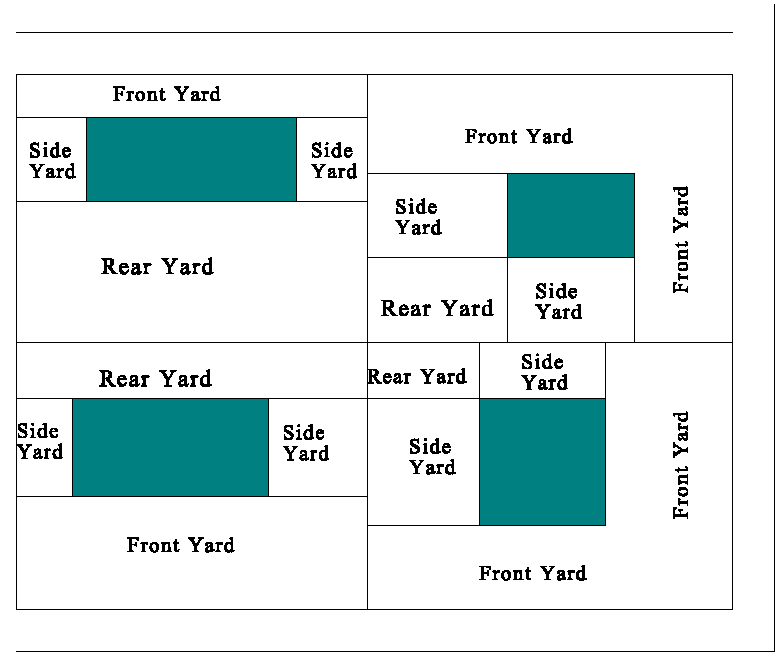
YARD, REAR: A space extending the full length of width of a lot between the principal structure and an interior lot line and measured perpendicular to the principle structure at its closest point to an interior lot line excluding the space defined as the side yard. (Rev. 12/1/10 - Ord. 10-082)
YARD, SIDE: A space extending from the front yard to the terminus of the principle structure and an interior side lot line and measured perpendicular from the interior side lot line to the closest point of the principle structure. (Rev. 12/1/10 - Ord. 10-082)
ZONING ORDINANCE, POLK COUNTY: Polk County Ordinance 83-02, as amended. The term shall also be referred to as the Zoning Ordinance.
(Ord. 08-056, 11-12-2008; Ord. No. 19-069, § 1, 12-3-2019; Ord. No. 2021-011, § 2, 2-2-2021; Ord. No. 21-047, § 4, 8-17-2021; Ord. No. 22-004, § 3, 1-18-2022; Ord. No. 22-017, § 1, 3-1-2022; Ord. No. 2022-079, § 5, 12-6-2022; Ord. No. 2022-080, § 6, 12-6-2022; Ord. No. 23-017, § 3, 3-21-2023; Ord. No. 2023-026, § 8, 4-18-2023; Ord. No. 23-032, § 3, 5-2-2023; Ord. No. 2023-048, § 2, 7-25-2023; Ord. No. 2023-064, § 4, 10-3-2023; Ord. No. 2024-007, § 5, 2-6-2024; Ord. No. 2024-022, § 9, 3-19-2024; Ord. No. 2024-032, § 3, 5-21-2024; Ord. No. 2024-033, § 4, 5-21-2024; Ord. No. 2024-043, § 4, 7-2-2024; Ord. No. 2024-087, § 6, 12-17-2024; Ord. No. 2025-007, § 5, 1-21-2025; Ord. No. 2025-038, § 4, 7-15-2025; Ord. No. 2025-074, § 12, 12-16-2025)

