
Port Royal City Zoning Code
ARTICLE 10
- DEFINITIONS
10.1.10 - Specialized Terms and Phrases
A.
Accessory Dwelling Unit: A auxiliary dwelling unit located on the same lot as the principal building that may be attached by a backbuilding or contained within a stand-alone outbuilding. Examples include, but are not limited to: a dwelling unit in a guest house, carriage house, pool house, and above or beside a garage.
Accessory Structure: A structure physically detached from, secondary and incidental to, and commonly associated with a primary structure and/or use on the same site. The use of the accessory structure must not change the character of the use for the site.
ACI (Aggregate Caliper Inch): A measure of the total combined number of inches of existing and proposed trees used to meet landscaping requirements. Caliper inch sizes for individual proposed trees are measured as indicated in the American Standard for Nursery Stock (ANSI 260.1-2004). Caliper inch sizes for existing trees are measured in diameter at breast height (DBH).
Adaptive Re-Use: Rehabilitation or renovation of existing Building(s) for any Use(s) other than the present Use.
Adjacent: Sharing a common lot line, or having lot lines separated only by an alley.
Administrative Adjustment: For all numerical standards set forth in Articles Two through Five of this Development
Code, the Administrator shall have the authority to authorize specified minor deviations
from the provisions of this Appendix in compliance with the procedures of Section
8.6.10
(Administrative Adjustment).
AICUZ (Air Installations Compatible Use Zone): The area surrounding MCAS—Beaufort as identified on the Zoning Map (Airport Overlay District/MCAS—Beaufort).
AICUZ Buffer: The quarter-mile area surrounding the AICUZ for MCAS—Beaufort.
Allee: A regularly spaced and aligned row of trees usually planted along a Street or Path.
Alley: A Thoroughfare Type (see Division 2.3 Thoroughfare Standards) that provides vehicular access to the rear or side of a property, including driveways, outbuildings, service areas, and parking. Alleys typically contain utility Easements. (also: Rear Lane)
Allowed Use: Uses that are allowed by right and are not subject to the conditions of approval, mandatory review periods, or expiration periods as required for Conditional Uses and Special Exception Permits.
Ancillary Structure / Ancillary Building: See "Accessory Structure."
Apartment House: The Apartment House is a medium-to-large-sized building type that consists of seven to 12 side-by-side and/or stacked dwelling units, typically with one shared entry. The apartment house is appropriately-scaled to fit in within medium-density neighborhoods or sparingly within large lot predominantly singly-family neighborhoods. This structure allows for higher densities and is important for providing a broad choice of housing types and promoting walkability. While residential in form, this building type may be appropriate for office, medical, lodging, and similar uses. See Section 5.1.120 (Traditional Building Types).
Appurtenances (Architectural): Cupolas, clock towers, towers, steeples, widows walk, etc. that extend above the primary roof, as well as the permitted number of stories.
Appurtenances (Mechanical or Structural): Elevator and stairwell enclosures, air-conditioning equipment, water tanks, and solar energy collectors that extend above the primary roof, as well as the permitted number of stories.
Arcade: A private frontage type designed as a covered walkway with habitable space above, often encroaching into the ROW. The arcade should extend far enough from the building to provide adequate protection and circulation for pedestrians. This type is intended for buildings with ground floor commercial uses and is common along public courtyards. See Section 5.3.130 (Arcade).
Architectural Features: Exterior building elements intended to provide ornamentation to the building massing, including, but not limited to: eaves, cornices, bay windows, window and door surrounds, light fixtures, canopies, and balconies.
Avenue (AV): A thoroughfare of high vehicular capacity and low to moderate speed designed with a landscaped median that functions as a short distance connector between urban centers.
Awning Sign: A traditional storefront fitting, often of metal or canvas, that serves to keep storefront interiors shaded and cool in hot weather and protect merchants' wares. See Section 5.9.60 (Signs).
B.
Backbuilding: A structure connecting a principal building to an outbuilding (e.g., Accessory Dwelling Unit - ADU).
Basement: A portion of a building located partially underground, having less than 50 percent of its clear floor-to-ceiling height above grade.
Base Flood Elevation: The height at or above which the lowest structural member of a building must be raised, according to an adopted FEMA Flood Insurance Rate Map.
Berm: An elongated earthen mound typically designed or constructed on a site to separate, screen, or buffer adjacent uses. To the maximum extent practicable, the use of Berms shall be discouraged.
Bicycle Boulevard: A street that is shared with motor vehicles, but prioritizes bicycle traffic through various treatments, including traffic diverters to reduce vehicle traffic and traffic calming to slow remaining traffic.
Bicycle Lane (BL): A dedicated lane for bicycle use demarcated by striping.
Bicycle Route (BR): A thoroughfare designated for the shared use of bicycles and automobiles.
Bicycle Trail (BT): A bicycle way located separately and independent from a vehicular thoroughfare for the shared use of bicycles and pedestrians.
Billboard: A sign that often contains changing copy and frequently advertises goods or services rendered or sold at locations other than the premises on which the sign is located.
Bioswale: A sunken garden comprised of native vegetation that is designed to remove silt and pollution from surface runoff water (also: Rain Garden).
Block: The aggregate of private lots, passages, rear alleys and rear lanes, circumscribed by thoroughfares.
Block Face: The aggregate of all the building facades on one side of a block. The block face is typically bounded on both sides by a cross street and provides the context for establishing architectural harmony.
Block Perimeter: The aggregate of all block side lengths.
Boulevard (BV): A thoroughfare designed for high vehicular capacity and moderate speed traversing an urbanized area.
Buffer: A vegetated area which is located between uses of differing character and is intended to mitigate the potentially negative impacts of one use upon the other.
Building: A structure consisting of one or more foundations, floors, walls and roofs that surround an interior space, and may include exterior appurtenant structures such as porches and decks.
Building Entrance: A point of pedestrian ingress and egress to a building.
Building Form: The overall character, dimensions, and intensity of a building.
Building Height: See Section 3.1.50 (How Building Height is Measured).
Building Type: A structure defined by its combination of configuration, disposition and function. See Division 5.1 (Traditional Building Types) and Division 5.2 (Exceptional Building Types).
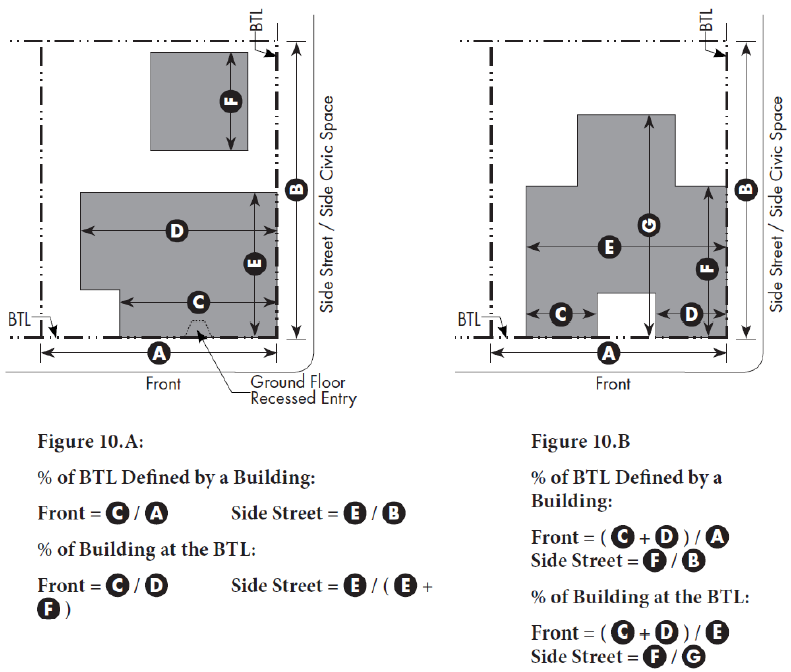
Build-to Line (BTL): A line parallel to a property line or right-of-way where a building facade must be placed. The BTL may appear graphically on the regulating plan or be stated as a dimension from the property line or right-of-way. Figures 10.A and 10.B depict how to calculate the percent of BTL Defined by a Building and percent of Building at the BTL as may be required in the Building Form Standards. Minor deviations from the BTL are allowed for architectural features, recessed entries, and recessed balconies and do not count against the calculations of percent of BTL Defined by a building or Building at the BTL.
By Right: Characterizing a proposal or component of a proposal for a community, structure, building, or use that complies with the Code and is permitted and processed administratively.
C.
Caliper: Diameter of the trunk measured six inches above the ground for trees up to and including four-inch diameter, and measured 12 inches above the ground for larger trees. This measurement is used for proposed or nursery-grown trees. Diameter of the trunk measured six inches above the ground for trees up to and including four-inch diameter, and measured 12 inches above the ground for larger trees. This measurement is used for proposed or nursery-grown trees.
Canopy Tree: A tree that has an expected height at maturity greater than 30 feet and produces significant shade because it has a crown that is oval, round, vase-shaped, or umbrella-shaped.
Carriage House: The Carriage House building type is a secondary structure typically located at the rear of the lot for the purpose of providing a small residential unit, home office space, or other small commercial or service use that may be above a garage or at ground level. The building type is important for providing affordable housing opportunities and incubating small businesses within walkable neighborhoods. See Section 5.1.40 (Carriage House).
Ceiling Height, Ground Floor: Height from finished floor to finished ceiling of primary rooms on the ground floor, not including secondary rooms such as bathrooms, closets, utility rooms and storage spaces. See Section 3.1.50 (How Building Height is Measured).
Ceiling Height, Upper Floor(s): Height from finished floor to finished ceiling of primary rooms on the floor(s) above the ground floor, not including secondary rooms such as bathrooms, closets, utility rooms and storage spaces. See Section 3.1.50 (How Building Height is Measured).
Chamfered Corner: An external wall of a building joining two perpendicular exterior walls, typically at a symmetrical, 45 degree angle creating a beveled edge to the building rather than a 90 degree corner.
Charrette: A multiple-day collaborative design and planning workshop held on-site and inclusive of all affected stakeholders.
Civic: A term defining not-for-profit organizations that are dedicated to arts, culture, education, religious activities, recreation, government, transit, and public parking facilities.
Civic Building: A building generally operated by not-for-profit organizations dedicated to arts, culture, education, religious activities, recreation, or government. Civic buildings are sited at prominent locations, adjacent to or within a civic space, or at a significant point of termination.
Civic Space: An outdoor area dedicated for civic activities.
Close: A small green area surrounded by a driveway that provides vehicular access to several buildings and performs the same function as a cul-de-sac.
Commercial: A term defining workplace, office, retail, and service functions collectively.
Common Destination: An area of focused community activity acting as the social center of a neighborhood usually defining the approximate center of a pedestrian shed that includes one or more of the following: a civic space, a civic building, a retail trade center, or a transit station.
Common Yard: A private frontage type where the main facade of the building has a large planted setback from the frontage line, establishing a front yard, and providing relief from the intensity of a thoroughfare. The front yard created remains unfenced and is visually continuous with adjacent yards, supporting a common landscape and working in conjunction with other private frontages. See Section 5.3.40 (Common Yard).
Common Courtyard: An entry court, forecourt or courtyard shared by multiple residential units or commercial spaces.
Community: A group of people who interact with each other and are of similar character, agreement, and/or identity. The nature of the interaction is informal and spontaneous rather than formalized.
Community Garden: A neighborhood civic space designed and maintained as a place to grow useful plants for small scale cultivation by nearby residents. Community gardens typically contain groupings of garden plots, both formally and naturalistically disposed, and may be spatially defined by buildings or landscaping. Community gardens do not have a minimum or maximum size, and may be included within other civic spaces. See Division 2.4 (Civic Space Types).
Community Park: A moderate sized civic space of at least 12 acres in size that serves multiple neighborhoods and consists of both structured and unstructured recreation. A Community Park typically contains paths and trails, meadows, waterbodies, woodlands, and shelters, both formally and naturalistically disposed. Community parks may be spatially defined by buildings or landscaping. See Division 2.4 (Civic Space Types).
Concertina Wire: Coiled barbed wire used as an obstacle.
Conditional Use: These uses are permitted by right, provided that the additional use regulations set forth in Division 4.2 (Conditional Use Regulations) are met, as well as all other applicable regulations of this ordinance. The additional regulations associated with a "conditional use" are intended to ensure that "permitted uses" are compatible with neighboring activities and the surrounding community.
Cottage Court: This building type consists of a series of small, detached structures sited upon a single lot in which multiple units are arranged to define a shared court that is typically perpendicular to the street. The shared court takes the place of a private rear yard and becomes an important community-enhancing element. This type is appropriately-scaled to fit within primarily single-family or medium-density walkable neighborhoods, and is important for providing a broad choice of housing types. While residential in form, this type allows for the establishment of a single-lot cluster of buildings dedicated to retail, the arts, education, etc. See Section 5.1.80 (Cottage Court).
Compact House: This building type is a small detached structure on a small lot that incorporates one unit. It is typically located within a primarily single-family neighborhood in a walkable urban setting, potentially near a neighborhood main street. This type enables appropriately-scaled, well-designed higher densities and is important for providing a broad choice of housing types that promote walkability. While residential in form, this building type is ideal for low intensity retail, service, and office uses. See Section 5.1.70 (Compact House).
Curb: The edge of the vehicular pavement that may be raised curb, ribbon, or flush to a swale. The curb usually incorporates the drainage system.
Curb Radius: The curved edge of street paving at an intersection, measured at the inside travel edge of the travel lane.
D.
DBH (Diameter at Breast Height): The diameter (in inches) of the trunk of a tree (or, for multiple trunk trees, the aggregate diameters of the multiple trunks) measured 4 ½ feet from the existing grade at the base of the tree. This measurement is used for existing trees.
Depth, Ground-Floor Commercial Space: The distance from the street-facing facade to the rear interior wall of the ground-floor space available to a commercial tenant.
Design Speed: is the velocity at which a street tends to be driven without the constraints of signage or enforcement. There are four ranges of speed: Yield: (below 20 MPH); Slow: (20—25 MPH); Low: (25—35 MPH); and Suburban: (above 35 MPH, ideally in T1 only). Lane width is determined by the desired design speed.
Detention Basins: Areas for the temporary storage of storm runoff, used primarily for flood control and to control discharge rates sufficiently to provide gravity settling of pollutants.
Directory Sign: Secondary signage that provides guidance to entrances for businesses. For specific criteria regarding directory signs, see Sub-section 5.9.50.B.5 (Upper Story Business).
Diseased Trees: Those trees that may constitute a hazard to life and property or harbor insects or disease which represent a potential threat to other trees within the Town.
Dooryard: A private frontage type where the frontage line is defined by a low wall or hedge and the main facade of the building is set back a small distance creating a small private space. The space may be raised, sunken, or at grade and is associated with ground floor residential, live / work, and small commercial uses. See Section 5.3.90 (Dooryard).
Drive: A thoroughfare along the boundary between an urbanized and a natural condition, usually along a park or promontory. One side has the character of a thoroughfare with sidewalk and building, while the other has the qualities of a road or parkway with naturalistic planting and rural details.
Driveway: A vehicular lane within a lot, or shared between two lots, usually leading to a parking or loading area.
Duplex: This building type is a small to medium-sized structure that consists of two side-by-side, front-to-back, or stacked dwelling units, both facing the street, and sharing one common party wall. This type has the appearance of a medium to large single-family home and is appropriately scaled to fit within primarily single-family or medium-density neighborhoods. It enables well-designed higher densities and is important for providing a broad choice of housing types that promote walkability. While residential in form, this building type is appropriate for low intensity retail, service, and office uses. See Section 5.1.90 (Duplex).
Dwelling Unit: An enclosed space used or intended to be used for living, sleeping, cooking, and eating.
E.
Easement: A legal instrument, recorded in the county records, that allows access through real property of the conveyor.
Elevation: An exterior wall of a building.
Encroachment: Any architectural feature, structure or structural element, such as a gallery, fence, garden wall, porch, stoop, balcony, bay window, terrace or deck, that breaks the plane of a horizontal regulatory limit extending into a setback, beyond the build-to-line, or into the public frontage.
Entrance, Principal: The main point of access of pedestrians into a building, most often from the primary street.
Entrance, Secondary: The secondary point of access of pedestrians into a building, most often from a secondary street or parking area (rear or side).
Expression Line: A line prescribed at a certain level of a building for the major part of the width of a facade, expressed by a variation in material or by a limited projection such as a molding or balcony.
F.
Facade: The exterior wall of a building that is set along a frontage line.
Facade Zone: The area between the minimum and maximum setback lines.
Fascia: A wide band of material covering the ends of roof rafters, sometimes supporting a gutter in steep-slope roofing, but typically it is a border or trim in low-slope roofing.
Fence: A structure made of wood, metal, masonry, or other material, typically used as a screen or enclosure for a yard or open space, or as a divider along a lot line.
Finished Grade: Existing topography of a site at the completion of construction.
Finish Level, Ground Floor: Height difference between the ground floor finished floor of residential or commercial space, excluding lobbies and common-use areas, and the adjacent public walk. In the case of a loading dock frontage that serves as the public right-of-way, the floor finish level is the height of the walk above the adjacent street.
Flex Building: This Building Type is a medium to large-sized detached structure of one to two and a half stories with a storefront treatment that most often accommodates commercial or other uses that are too large or intense to be appropriately housed in a residential building type. The front facade is typically flat, often with a shopfront or gallery frontage. These buildings remain true to their function and take inspiration from the large vernacular structures of the lowcountry, including: packing sheds, barns, warehouses, and waterborne industries. They are often located at prominent intersections or activity areas outside the traditional Town core. See Section 5.1.130 (Flex Building).
Flex Space: A room or group of internally connected rooms designed to accommodate an evolution of use over time in response to an evolving market demand. Typically designed to accommodate future commercial uses, while accommodating less intense short-term uses, such as residential or live / work, until the full commercial demand has been established.
Forecourt: A private frontage type where the main facade of the building is at or near the frontage line and a percentage is set back, creating a small courtyard space. The space can be used as an entry court or shared garden area for apartment buildings, or as an additional shopping or restaurant seating area for commercial uses. See Section 5.3.80 (Forecourt).
Formally Disposed: Composed in a formal arrangement, in a regular, classical, and typically symmetrical manner.
Free Standing Signs: Free standing signs encompass a variety of signs that are not attached to a building and have an integral support structure. Three varieties include: Monument, Pole, and detached Yard Signs. See Division 5.9 (Signs).
Front: The primary frontage(s) of a lot, determined as follows:
• For lots with frontages along multiple thoroughfares, the frontage along the thoroughfare with the most pedestrian activity, as determined by the Administrator, will always be the Front. All other frontages may be considered to be side street frontages.
• For lots with frontages along a thoroughfare and a civic space, the Front may be the frontage along either the thoroughfare or the civic space, or both frontages may be treated as Fronts.
• For lots with a single frontage along a thoroughfare or a civic space, but not both, that frontage is the front.
• Frontages along alleys and pedestrian passages are not common, but are permitted (see Section 2.2.80 Lots). Frontages along service drives and parking drives may never be a front.
Frontage: A strip or extent of land abutting a thoroughfare, civic space or other public right-of-way.
• Private Frontage. The area between the curb of the public right-of-way and the front or side facade. See Division 5.3 (Private Frontages).
• Public Frontage. The area between the curb of the vehicular lanes and the frontage line.
See Section 2.3.70 (Public Frontages).
Frontage Line: The property line(s) of a lot fronting a thoroughfare or other public way, or a civic space.
Frontage Type: The way in which a building engages the public realm. See Division 5.3 (Private Frontages).
G.
Gallery: A private frontage type where the main facade of the building is at the frontage line and the gallery element overlaps the sidewalk. This Type is intended for buildings with ground-floor commercial uses and may be one or two stories. The gallery should extend far enough from the building to provide adequate protection and circulation for pedestrians and extend close enough to the curb so that a pedestrian cannot bypass it. See Section 5.3.120 (Gallery).
Gable: A vertical wall in the shape of a triangle formed between the cornice or eave and the ridge of the roof.
Garage: A structure, or part thereof, used or intended to be used for the parking and storage of motor vehicles. For public or commercial garages see Subsection 4.2.50.B.2 (Specific to Parking Decks / Garages). For private garages see Subsection 4.3.40.A.3 (Private Garage).
Garden Wall: A freestanding wall made of masonry, typically used as a screen or enclosure for a yard or open space, or as a divider along a street, alley, or lot line.
Gas Station: A corner-lot or mid-block building type which provides for necessary services without sacrificing the walkability of the surrounding street frontage. Gas pumps are located behind a shopfront "convenience store" that addresses the street and is designed to the dimensional and development standards of this code. See Section 5.2.40 (Gas Station).
Glazing: Openings in a building in which glass is installed.
Green: A neighborhood civic space often located in a residential area that is available for unstructured and limited amounts of structured recreation. A green typically consists of lawn and trees, both formally and naturalistically disposed, and may be spatially defined by buildings or landscaping. The minimum size shall be one acre and the maximum size shall be 15 acres. See Division 2.4 (Civic Space Types).
Greenway: A linear civic space of at least eight acres in size that follows a natural corridor, providing both structured and unstructured recreation for multiple neighborhoods. A Greenway contains paths and trails, meadows, creeks, woodlands, and shelters, both formally and naturalistically disposed. Greenways may be spatially defined by buildings or landscaping. See Division 2.4 (Civic Space Types).
Green Roof: A roof of a building that is partially or completely covered with soils, drought tolerant vegetation, and a growing medium, planted over a waterproofing membrane. The roof may also include additional layers such as a root barrier and drainage and irrigation systems.
Ground Cover: Low-growing plants that spread to form a more or less solid mat of vegetation, generally planted to provide decorative landscaping or permeable cover for bare earth that prevents soil erosion.
Gross Floor Area: The total floor area inside the building envelope, including the external walls, but not including the roof.
H.
Hardscaping: The part of a building's grounds consisting of hard materials including brick, concrete, wood, tile paver, or other decorative hard surfaces used in lieu of or in conjunction with landscape materials such as trees, shrubs, turf, ground cover, wood chips, or gravel.
Hedge: A group of shrubs planted in line or in groups that form a compact, dense, living barrier. A Hedge is used both formally and informally to provide landscaping and screening, or as a means of enclosing an open space or demarcating a lot line. A Hedge may be used in combination with a garden wall or fence.
Height:
1.
Buildings. Building height shall be measured in number of Stories from the natural grade or finished grade adjacent to the building exterior to the highest point of coping of a flat roof, the top of a mansard roof, or the highest point of the highest pitched roof. See Section 3.1.50 (How Building Height is Measured).
2.
Fences and Walls.. Height is measured from the finished grade along the exterior side of the fence to the top of the fence. If a fence is built on top of a wall, the combined height of the fence and wall must not exceed the allowable fence height. See Division 5.5 (Fences and Walls).
Historic Resources: See Division 3.3.50 (Historic Preservation Overlay (HPO) Zone Standards).
Home Occupation: Any occupation, profession, activity, or use which is customarily, in whole or in part, conducted in a residence, which does not change the exterior of the property or affect the character of the residential use.
I.
Infill: The development of vacant land that was bypassed by earlier waves of development and is now largely surrounded by developed land.
Impermeable: Not able to be infiltrated by water.
Improvement: The product of any modification to a lot, structure or building.
L.
Landmark Buildings: Landmark Buildings are designed for occupancy by public or commercial uses that provide important services to the community, including recreation, education, safety, assembly, and related functions. They contribute significantly to the quality of the community and often serve as the focal point of a public open space, terminate a vista, or are placed at a prominent location. The architectural quality and construction of a Landmark Building shall be of the highest quality and exceed that of nearby buildings. See Section 5.2.30 (Landmark Buildings).
Landscape Wall Sign: Landscape wall signs are attached to freestanding walls and are often used to mark a place of significance or the entrance to a location. See Section 5.9.70 (Landscape Wall Sign).
Large Footprint Building: A building type that appropriately accommodates a large building envelope devoted to a single use in excess of 35,000 sf. Large Footprint Buildings are required to provide commercial, office, or residential liner space along facades that face streets or public spaces. Those functions deemed applicable for a Large Footprint Building are conducive to a walkable environment, and:
• The use is inherently associated with long blank exterior walls, requiring special treatment (i.e., parking garage, movie theater, etc.); and / or
• The function is associated with a single story structure whose mass (20 to 30 ft tall) often equals that of a standard two- to three- story building (e.g., building supply, grocery store, etc.).
See Section 5.2.50 (Large Footprint Building).
Large House: This Building Type is a large detached structure on a large lot that typically incorporates one unit and is located within a primarily single-family residential neighborhood in a rural or sub-urban setting. If located within a walkable neighborhood, this building type is typically located at the edge of the neighborhood, often along the water, providing a transition to more rural areas. While primarily used for single family housing, this Building Type is appropriate for low intensity group living. See Section 5.1.50 (Large House).
Liner Building: A fully functional commercial space built in front of a larger scaled building, structure, or "anchor" such as a grocery store, cinema, boat storage facility, or parking garage. Liner Buildings are used to conceal and activate large expanses of blank wall area by providing smaller shopfronts along the sidewalk.
Live / Work Unit: An integrated housing unit and working space in a structure that has been designed or structurally modified to accommodate joint residential occupancy and work activity with a substantial commercial component that may accommodate employees and walk-in trade. The residential component may be located above or behind the commercial space.
Lot: A unit of real property having boundaries established by the official county tax map.
• Lot, Corner: A lot with two or more frontage lines that intersect.
• Lot, Flag: A lot not meeting minimum lot frontage requirements and where access to a public or private street is provided by means of a long, narrow driveway between abutting lots.
• Lot, Reverse Frontage: "Reverse-frontage lot" means a double-frontage lot for which the boundary along one of the streets is established as the front lot line and the boundary along the other street is established as the rear lot line, and over the rear of which an easement is provided. The rear lot line of the lot shall be that boundary abutting a major thoroughfare or other disadvantageous use.
• Lot, Through: A lot with two or more frontage lines that do not intersect.
Lot Area: The total square footage or acreage of horizontal area included within the lot lines.
Lot Depth: The horizontal distance between the front lot line and rear lot line of a lot measured perpendicular to the front lot line.
Lot Width: The horizontal distance between the lot lines measured parallel to the front lot line.
M.
Main Street Mixed-Use Building: A Building Type which consists of a small- to medium-sized structure, typically attached, intended to provide a vertical mix of uses with ground-floor commercial, service, or retail uses and upper-floor commercial, service, or residential uses. Smaller versions of this Type include live/work units. This Type makes up the primary component of a neighborhood main street and portions of a downtown main street, and is critical to providing a walkable environment. See Section 5.1.140 (Main Street Mixed-use).
Mansion Apartment: This Building Type is a medium structure that consists of three to six side-by-side and/or stacked dwelling units, typically with one shared entry or individual entries along the front. This Type has the appearance of a medium-sized family home and is appropriately scaled to fit in sparingly within primarily single-family neighborhoods or into medium-density neighborhoods. This Type enables well-designed higher densities and is important for providing a broad choice of housing types that promote walkability. While residential in form, this Building Type may be appropriate for office, medical, lodging, and similar uses. See Section 5.1.110 (Mansion Apartment).
Manufactured Home: A structure built and constructed in a factory or manufacturing plant. It has a chassis, a manufacturer's certificate, axles, and trailer tongue, but is primarily designed to be installed once. A manufactured home can be retro-fitted easily with running gear and moved with a temporary license plate. These units are built to the Housing and Urban Development standards.
Marquee Sign: A sign mounted to or hung from a marquee that projects horizontally or vertically from the facade to express a figural design and message to motorists and pedestrians. Marquee signs often have patterned or neon lighting and changeable or painted lettering. See Section 5.9.80 (Marquee Sign Type).
Medium House: This Building Type is a medium-sized detached structure on a medium-sized lot that incorporates one unit. It is typically located within a primarily single-family residential neighborhood in a walkable urban setting potentially near a neighborhood main street. While primarily used for single family housing, this Building Type is appropriate for low intensity group living and non-residential uses. See Section 5.1.60 (Medium House).
Mixed Use: The development of a single building containing more than one type of land use or a single development of more than one building and use including, but not limited to, residential, office, retail, recreation, public, or entertainment, where the different land use types are in close proximity, and shared pedestrian and vehicular access and parking areas are functionally integrated.
Mixed-Use Project: A development that combines both commercial and residential uses on the same site, typically with the commercial uses occupying the ground floor street frontage and the residential uses above.
N.
Naturally Disposed: The preservation of existing natural conditions, or the composition of elements arranged as they appear in nature, with irregular shapes and asymmetry.
Neighborhood: An area of a community with characteristics that distinguish it from other community areas and which may include distinct ethnic or economic characteristics, schools, social clubs, or boundaries defined by physical barriers such as thoroughfares or natural features.
New Urbanism: A design-focused alternative to automobile-oriented planning and development that promotes walkable, town-centered, environmentally sensitive and sustainable communities by emphasizing transit, human scale, and a mix of housing, civic, commercial, and retail uses in close proximity, while preserving open lands and achieving other environmental goals.
O.
Outbuilding: Is a Building located toward the rear of the same Lot as a Principal Building and sometimes connected to the Principal Building by a Backbuilding. An Outbuilding contains non-habitable/non-heated space and Uses such as a garage, port-cochere, parking area, storage space, and garden shed, etc. An Outbuilding functions as an Accessory Dwelling Unit (ADU) if a portion or all of the building contains a Use requiring habitable, heated, or overnight space (e.g., residential dwelling, lodging, office, or other indoor function).
P.
Parallel Access Road: A subsidiary road running parallel to a main road or highway and giving access to houses and businesses. Syn. Frontage Road.
Parapet: A low wall along the edge of a roof or the portion of a wall that extends above the roof line.
Parcel: See "Lot".
Passive Recreation: Recreation requiring little or no physical exertion focusing on the enjoyment of one's natural surroundings.
Path (PT): A pedestrian way traversing a park or rural area, with landscape matching the contiguous open space, ideally connecting directly with the urban sidewalk network.
Pedestrian Passage: An open or roofed access passing between buildings. These passageways frequently connect rear parking areas and alleys to frontages, streets, plazas, and other public use spaces. A pedestrian passage provides a shortcut through long blocks and is often restricted to pedestrian use and limited vehicular access.
Pedestrian Shed: An area that is centered on a common destination. There are three types of pedestrian sheds: standard; linear; and long, whose size is defined by an average walking distance that may be traversed at an easy walking pace from its edge to its center.
Pedestrian Shed, Standard: A pedestrian shed that is an average one-quarter mile radius or 1,320 feet, that is centered on a common destination. A standard pedestrian shed represents approximately a five-minute walk at a leisurely pace.
Pedestrian Shed, Linear: A pedestrian shed that is elongated along an important mixed-use corridor, such as a main street. A linear pedestrian shed extends approximately one-quarter mile (1,320 feet) from each side of the corridor for the length of its mixed-use portion.
Pedestrian Shed, Long: A pedestrian shed that is an average one-half mile radius or 2,640 feet that is centered on a larger common destination, such as a downtown or transit station. A long pedestrian shed represents approximately a ten-minute walk at a leisurely pace.
Perforated Vinyl: A vinyl graphic film that is perforated to allow a full graphic image to be seen on the outside of a window, such that it is not possible to see into a building interior, yet it is possible to see through the image from the interior to the exterior of the building.
Performance Guarantee: A financial guarantee to ensure that all improvements, facilities, or work required by this Ordinance will be completed in compliance with the Ordinance, regulations, and the approved plans and specifications of a development.
Permeable: A type of soil or other material that allows passage of water or other liquid.
Planting Strip: Areas intended for the placement of vegetation within the interior of parking lot areas or along street right-of-way edges, typically between the back of the curb and the inside edge of the sidewalk.
Plaza: A neighborhood civic space located in the more urban transect zones that promotes civic and commercial activities. Plazas primarily consist of pavement and hardscapes, formally disposed and spatially defined with building frontages. Trees are optional. Plazas are often located at significant intersections, with a minimum acreage of ½ acre and a maximum acreage of 2 ½ acres. See Division 2.4 (Civic Space Types).
Playground: A neighborhood civic space designed and equipped for the recreation of children. Playgrounds should be fenced and may include an open shelter or other features. They may be cited at prominent locations, within the block, or even within another civic space; and are spatially defined by buildings or landscaping. See Division 2.4 (Civic Space Types).
Pocket Park: A small-sized civic space of less than one acre in size that is fronted by buildings and primarily serves nearby residents. Pocket parks are used for both informal and formal activities. See Division 2.4 (Civic Space Types).
Pocket Plaza: A small civic space located in the more urban transect zones that promotes civic and commercial activities. Pocket plazas primarily consist of pavement and hardscapes, formally disposed and spatially defined with building frontages. Trees are optional. Pocket plazas are often located at significant intersections, with a minimum size of 4,000 sf. and a maximum size of a ½ acre. See Division 2.4 (Civic Space Types).
Porch: See Division 5.3 (Private Frontages).
• Projecting Porch: A porch which is open on three sides and all habitable space is located behind the setback line. See Section 5.3.50 (Porch: Projecting).
• Engaged Porch: A porch which has two adjacent sides of the porch that are engaged to the building while the other two sides are open. See Section 5.3.60 (Porch: Engaged).
Private Frontage: The privately held space between the front plane or primary mass of the principal building and the front parcel line / ROW. See Division 5.3 (Private Frontages).
Projecting Sign: Projecting signs mount perpendicular to a building's facade. They are typically hung from decorative cast or wrought iron brackets, allowing them to swing slightly. These signs are small, pedestrian scaled, and easily read from both sides. See Section 5.9.100 (Projecting Sign Type).
Public Frontage: The area between the vehicular lanes and the front parcel line that contains the curb assembly, walkway type, planter type, landscaping, lighting, signage, and civic elements (benches, bus stops, etc.).
Public Realm: The physical and social domain of the public that is held in common either by their physical presence or by visual association. This includes, but is not limited to plazas, squares, parks, thoroughfares, public frontages, private frontages, civic buildings and civic spaces.
R.
Rain Garden: See Bioswale.
Rear Alley (RA): A vehicular way located to the rear of lots providing a location for utility easements and access to service areas, parking, and outbuildings paved with a ribbon curb at the outer edge.
Rear Lane (RL): A vehicular way located to the rear of lots providing a location for utility easements and access to service areas, parking, and outbuildings paved with a ribbon curb at the edge of the pavement, and compacted gravel or similar suitable material placed on the outer edges.
Regional Park: A large sized civic space of at least 200 acres in size that serves the region and consists of both structured and unstructured recreation. A regional park typically contains paths and trails, meadows, waterbodies, woodlands, and shelters, both formally and naturalistically disposed. Regional parks may be spatially defined by buildings or landscaping. See Division 2.4 (Civic Space Types).
Residential: Premises used primarily for human habitation.
Right-of-Way (ROW): A right-of-way is the actual land area acquired for a specific purpose such as a utility line or roadway.
Road: A local, rural, or suburban thoroughfare for low vehicular speed and capacity. This thoroughfare type is allocated to the more rural transect zones.
S.
Setback: The mandatory clear distance between a property line and a structure.
Secondary Wing: A smaller building mass attached to the main body of a building.
Shared Lane Markings: Pavement marking that shows bicyclists where to position themselves to "take the lane" on streets where traffic lanes are too narrow for motor vehicles to safely share the lane side-by-side with bicycles.
Shared Parking: Any parking spaces assigned to more than one user, where different persons utilizing the spaces are unlikely to need the spaces at the same time of day.
Sharrow: A road shared by bicycles and vehicles.
Shed Roof: A roof shape having only one sloping plane.
Shopfront: A private frontage type where the main facade of the building is at or near the frontage line with an at-grade entrance along the public way. This Type is intended for retail use. It has substantial glazing at the sidewalk level and may include an awning that may overlap the sidewalk. It may be used in conjunction with other frontage types. See Section 5.3.100 (Shopfront).
Shrub: A woody plant, smaller than a tree, consisting of several small stems emerging from the ground, or small branches near the ground. Shrubs may be deciduous or evergreen.
Sidewalk Sign: A temporary, moveable sign type that may be used to announce daily specials, sales, or point to shops off the sidewalk. See Section 5.9.110 (Sidewalk Sign Type).
Special Exception Permit: See Section 8.2.50 (Special Exception Permit). These permits are issued by the Design Review Board (DRB) for special uses allowed within a zone.
Sports Complex: A large sized civic space of at least 25 acres in size that serves the region and consists of structured recreation. A sports complex consolidates heavily programmed athletic fields and associated facilities into one, formally disposed complex. See Division 2.4 (Civic Space Types).
Square: A civic space that promotes unstructured recreation and civic activities. Squares consist of paths, lawns, and trees, formally disposed and spatially defined by building frontages. Squares are often located at significant intersections, with a minimum size of ½ acre and a maximum size of five acres. See Division 2.4 (Civic Space Types).
Storefront: The portion of a frontage composed of the display window and / or entrance and its components, including windows, doors, transoms and sill pane, that is inserted into various frontage types, such as a shopfront or gallery, to accommodate retail uses.
Stoop: A private frontage type where the main facade of the building is near the frontage line and the elevated stoop engages the sidewalk. The stoop shall be elevated above the sidewalk to ensure privacy within the building. Stairs may lead directly to the sidewalk or be side-loaded. See Section 5.3.70 (Stoop).
Story: An above-grade habitable floor level within a building. See Section 3.1.50 (How Building Height is Measured).
• Half Story. A 1/2 story is the top floor of a building that has a maximum exterior wall height not to exceed six feet zero inches, creating a sloped ceiling on the top level of the structure. Dormers may be used to provide egress windows as required by the adopted building code.
Street (ST): A local urban thoroughfare for low vehicular speed and capacity.
Structure: Anything constructed or erected, the use of which requires attachment to the ground, attachment to something located on the ground, or placement on the ground.
Suspended Signs: Suspended signs mount to the underside of beams or ceilings of a porch, gallery, arcade, breezeway or similar covered area. They are typically hung in a manner that allows them to swing slightly. These signs are small, pedestrian scaled, and easily read from both sides. See Section 5.9.120 (Suspended Sign Type).
T.
Tandem Parking: A parking space deep enough to allow two cars to park, one behind the other.
Temporary Parking Lots: Parking lots that are not permanent, are only intended to fulfill a short-term need, and ultimately will be replaced by a permanent building or structure. Temporary Parking lots are not subject to the parking location regulations and liner requirements for above grade parking in the building form standards, but must comply with all landscaping standards.
Terrace: A private frontage type where the main facade is at or near the frontage line with an elevated terrace providing public circulation along the facade. The terrace can be used to provide at-grade access while accommodating a grade change. Frequent steps up to the terrace are necessary to avoid dead walls and maximize access. This type may also be used in historic industrial areas to mimic historic loading docks. See Section 5.3.110 (Terrace).
Thoroughfare: A street. This ordinance mandates that all vehicular rights-of-way, easements, and parking access-ways be designed as thoroughfares that both resemble and function as a traditional street would.
Thoroughfare, Primary: For corner lots with buildings, the thoroughfare with the most pedestrian activity (as determined by the Administrator) that also provides the main point of access for pedestrians into the building.
Thoroughfare, Secondary: For corner lots with a buildings, the thoroughfare with less pedestrian activity (as determined by the Administrator). The building should address the secondary thoroughfare, but may or may not contain a secondary entrance, allowing pedestrian access directly from the secondary thoroughfare.
Townhouse: This building type is a small to medium-sized attached structure that consists of three or more dwelling units placed side-by-side. This type is typically located within medium-density neighborhoods or in a location that transitions from a primarily single-family neighborhood into a neighborhood main street. This type enables well-designed higher densities and is important for providing a broad choice of housing types that promote walkability. While primarily residential in form, this type may be used for live-work and similar low intensity retail, service, and office uses. See Section 5.1.100 (Townhouse).
Transect: A cross-section of the environment showing a range of different habitats. The rural-to-urban transect of the human environment is divided into multiple transect zones that describe the physical form and character of a place according to the intensity of its land use and urbanism.
Transect (T) Zone: A zoning district. The five transect zones in this ordinance (T1—T5) are mixed-use and walkable. They use the rural to urban transect as their primary organizing principle, and thus vary by the ratio and level of intensity of their natural, built, and social components. The higher the corresponding number (e.g., T1, T3, T5), the more intense and urban the zoning district, or transect zone.
Transit Stop: A location where buses stop to load and unload passengers. A transit stop may or may not include a shelter or a pullout.
Tree, Shade: See "Canopy Tree."
Tree, Street: A tree planted that is an element of a thoroughfare assembly. See Division 2.3 (Thoroughfare Standards).
U.
Understory Tree: A tree that has an expected height at maturity of no greater than 30 feet.
Utilities: Installations or facilities or means for furnishing to the public, electricity, gas, steam, communications, water, drainage, sewage disposal, or flood control, irrespective of whether such facilities or means are underground or above ground; utilities may be owned and operated by any person, firm, corporation, municipal department or board, duly appointed by state or municipal regulations. Utility or utilities as used herein may also refer to such persons, firms, corporations, departments, or boards.
V.
Vegetation, Native: Any indigenous tree, shrub, ground cover or other plant adapted to the soil, climatic, and hydrographic conditions occurring on the site.
W.
Wall Sign: A sign that is flat against the facade of a building consisting of individual cut letters applied directly to the building or painted directly on the surface of the building. Wall Signs are placed directly above the main entrance and often run horizontally along the "expression line" or entablature of traditional buildings. They are typically intended to be seen from a distance and are often accompanied by additional pedestrian-scaled signage. See Section 5.9.130 (Wall Signs).
Wall Mural Sign: A sign that is flat against the building facade and is located on a secondary facade, typically along a side street, alley, or pedestrian passageway. These signs are often painted directly on the building and contain a combination of text and graphic elements. They are intended to be visible from a greater distance and must be accompanied by additional signage on the primary facade. See Section 5.9.140 (Wall Mural Signs).
Window Sign: Window signs are professionally painted consisting of individual letters and designs, gold leaf individual letters and designs, applied directly on the inside of a window. Window signs offer a high level of craftsmanship and visibility, and are often used for small professional offices. See Section 5.9.150 (Window Sign).

