
Port Royal City Zoning Code
ARTICLE 8
- PROCEDURES
8.1.10 - Conformity with Development Code
Every official and employee of the Town of Port Royal, South Carolina vested with the duty or authority to issue a building permit, grading permit, or business license shall not issue a permit or license for any use, building, or purpose that conflicts with any provision of this Development Code. Any permit or license or certificate issued in conflict with the provisions of this Development Code, whether intentionally or unintentionally, shall be null and void.
8.1.20 - Pre-application Conference
A.
Mandatory Pre-application Conference.
A pre-application conference with the Administrator shall be required prior to filing an application for the following approvals:
1.
Subdivision Review involving the creation of new streets (Preliminary and / or Final Review);
2.
Map Amendment (Rezoning); or
3.
Text Amendment to the Development Code.
The Administrator shall have the authority to waive any mandatory pre-application conference where such conference is deemed unnecessary.
B.
Optional Pre-application Conference.
Prior to the submission of any application required by this Development Code, a potential applicant may request an optional pre-application conference to discuss procedures, standards or regulations required by this Development Code. Upon receipt of such request, the Administrator shall afford the potential applicant an opportunity for such a pre-application conference at the earliest reasonable time.
8.1.30 - Application Forms and Fees
The following regulations shall apply to all applications.
A.
Forms.
Applications required under this Development Code shall be submitted on forms and in such numbers as required by the Town.
B.
Fees.
1.
Filing fees shall be established from time to time by ordinance of the Town Council to defray the actual cost of processing the application;
2.
All required fees shall be made payable to "The Town of Port Royal"; and
3.
An applicant who has paid an appropriate fee pursuant to the submission of an application, but who chooses to withdraw such application prior to any review or action taken, shall be entitled to a refund of 75 percent of the total amount paid upon written request to the Town.
8.1.40 - Application Deadline
All applications shall be completed and submitted to the Administrator according to schedules as determined by the Town.
8.1.50 - Complete Application Required
A.
The Administrator shall have five working days to review the application and confirm that all required items have been submitted and the application is complete.
B.
If the application is not complete, the Administrator shall inform the applicant in writing within the five-day period, specifying the ways in which the application is incomplete.
C.
Following notification in writing that an application is incomplete, the applicant shall have 60 days during which to provide the requested materials and complete the application. Any application for which additional materials have not been forthcoming during this 60-day period shall be considered null and void. This application period may be extended by the Administrator upon mutual agreement to provide the required materials at some date certain in the future.
8.1.60 - Concurrent Processing
Any applicant may submit an application for any sequential approvals (such as a Zoning Map Amendment and Preliminary Plat) required under this Development Code and request that such sequential approvals be processed concurrently; however, such concurrent processing shall proceed at the applicant's own risk, and shall have no implication in regard to the approval of any of the various approvals requested.
8.1.70 - Summary of Notice Required
Notice shall be required for development review as shown in the Table 8.1.70.A below.
8.1.80 - Public Notice Requirements
A.
Published Notice. A distinctive advertisement (Public Hearing Notice) shall be placed by the Administrator in a local newspaper of general circulation within the Town not less than 15 calendar days prior to the meeting for the purpose of notifying the public of all Public Hearing agenda items which may be considered or reviewed.
B.
Posted Notice. When required, a notice of application sign shall be posted by the Administrator not less than 15 calendar days prior to the meeting at which the application will be reviewed. The sign shall be posted on the subject property in a location clearly visible from each street adjacent to the property.
C.
Mailed Notice. As a courtesy, the Town may to provide mailed notice from time to time.
D.
Content of Notice. The Notices listed above schoose hall contain the following specific information.
1.
Content in a Published Notice. A published notice shall provide at least the following information:
a.
The general location of land that is the subject of the application;
b.
The legal description, tax map and parcel number, or street address;
c.
The substance of the application, including the magnitude of proposed development and the current zone;
d.
The time, date and location of the public hearing;
e.
A phone number to contact the Town; and
f.
A statement that interested parties may appear at the public hearing.
2.
Content in a Posted Notice. Required posted notices shall indicate the following:
a.
Type of application;
b.
The date of the public hearing; and
c.
A phone number to contact the Town.
8.1.90 - Public Hearing Procedures
If the development application is subject to a public hearing by an advisory or decision-making body (e.g. Town Council, Planning Commission, Zoning Board of Appeals, HPC, etc), the advisory or decision-making body shall hold the public hearing in accordance with the following procedures.
A.
Conduct of Public Hearing.
1.
Burden of Proof or Persuasion. The burden of demonstrating that an application complies with applicable review and approval standards of this Development Code is on the applicant.
2.
Rights of All Persons. Any person may appear at a public hearing and submit testimony, either individually or as a representative of a person or an organization.
3.
Continuance of Public Hearing. The body conducting the public hearing may, on its own motion or at the request of any person, continue the public hearing to a fixed date, time, and place. An applicant shall have the right to request and be granted a continuance upon a showing of good cause.
4.
Recording. The body conducting the public hearing shall record the public hearing. The written or taped record of oral proceedings (including testimony and statements of personal opinions), the hearing minutes, all applications, exhibits and papers submitted in any proceeding before the review board, the staff report, and the recommendation or decision shall constitute the record.
5.
Public Record. All records of public hearings conducted by an advisory or decision-making body shall be a public record, and a copy of the public hearing record may be obtained by any person upon request to the Administrator.
8.1.100 - Procedures and Findings Following a Public Hearing.
The review body conducting the public hearing shall convey their decision in accordance with the time limits established in this Development Code for the type of application; or 30 calendar days from close of hearing, whichever is less.
8.1.110 - Written Notice of Final Decision
Within ten calendar days after a final decision is made by the Planning Commission, Zoning Board of Appeals or other Board under the requirements of this Development Code, a copy of the written decision shall be sent to the applicant or appellant. A copy of the decision shall be filed in the Office of the Administrator, where it shall be available as part of the public record.
8.1.120 - Time Limits for Re-submission of Application
In the event that any application required under this Development Code is denied or disapproved, an application for the same request shall not be re-filed for one year from the advertised public hearing date. Where no public hearing is required, time shall run from the date of mailing of the notice of denial. The Administrator, upon petition by the applicant, may permit a re-filing of said application after six months from the original public hearing date upon a determination that:
A.
Significant physical, economic or land use changes have taken place on the subject tract or within the immediate vicinity; or
B.
A text amendment has been adopted that would allow for favorable review of a resubmitted application for the subject property.
8.1.130 - Expiration of Permits and Approvals
A.
Generally.
1.
Approval of any application pursuant to this Development Code shall authorize only the particular use, plan, or other specific activity for which the application was issued, and not any other approval requiring separate application.
2.
Vested Rights for Final Development Plans/Plats. A vested right is established for two years upon the final approval of a development plan, plat, or phased development plan. An applicant shall have two years from final approval to receive a building permit, or, if no building permit is required, to obtain a certificate of compliance. Such vested right shall receive five one-year extensions for good cause upon written request by the landowner to the Administrator no later than one month prior to expiration unless an amendment to this Development Code has been adopted that prohibits approval.
a.
A vested right in a development plan, plat, or phased development plan shall not attach to the property until all plans have been received, approved and all fees paid in accordance with this Division.
b.
A vested right is subject to revocation by the Town council upon its determination, after notice and public hearing, that there was a material misrepresentation by the landowner or substantial noncompliance with the terms and conditions of the original or amended approval.
c.
A vested plan is subject to later local governmental overlay zoning that imposes site plan-related requirements, but does not affect allowable types, height as it affects density or intensity of uses, or density or intensity of uses.
d.
Phased development plans remain subject to review and approval of all phases prior to any portion of the project being vested.
e.
In case of projects where more than one building is to be built, the applicant may submit a series of building permit applications. The first application must be submitted within two years from the date the development plan approval is granted. Each subsequent application must be submitted within 180 days from the date of issuance of a Certificate of Compliance or Certificate of Occupancy for the previous building, whichever shall occur first. The lapse of more than 180 days shall cause the expiration of the development plan approval.
f.
The Zoning Board of Appeals does not have the authority to grant a vested right and no such right shall accrue as a result of their decision.
g.
Variances or Special Exception uses do not create a vested right.
h.
All projects must comply with the latest adopted version of the Building Code.
3.
Time Limitations for Other Types of Approval.
a.
All permits and approvals not referenced in Subsection 2 above, shall expire as shown in the Table below without further action of the Administrator, Building Official, Zoning Board of Appeals, Historic Preservation Commission, Design Review Board, Planning Commission or Town Council, unless the holder of the permit or approval either submits a complete application for the appropriate subsequent permit or approval; or, if no subsequent permit or approval is required, completes the work described in the permit or approval, within the time frames established.
b.
An applicant who submits an appropriate subsequent application for a permit or approval must diligently pursue approval of such application, which means, at a minimum, the applicant must submit any required additional materials or revisions within the time frame specified by the Administrator or if no time frame is specified, within six months. Failure to submit the required information or revision within the specified time frame shall result in the application's expiration.
c.
Upon written request, a one-time extension of an approval may be granted by the decision-making body for good cause for a period not to exceed that shown in the Table. No written request for an extension shall be considered unless submitted to the administrator no later than one month prior to expiration. Failure to submit an application for an extension within the time limits established by this Section shall result in the approval's expiration.
8.1.140 - Written Interpretation
A.
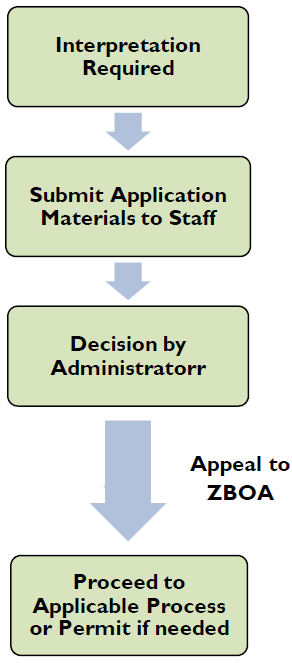
Applicability. The Administrator shall have authority to make all written interpretations concerning the provisions of this Development Code.
B.
Request for Interpretation. A request for interpretation shall be submitted to the Administrator in writing.
C.
Interpretation by Administrator.
1.
The Administrator shall:
a.
Review and evaluate the request in light of the text of this Development Code, the Official Zoning Map, the Comprehensive Plan and any other relevant information;
b.
Consult with other staff, as necessary; and
c.
Render an opinion.
2.
The interpretation shall be provided to the applicant in writing by mail.
D.
Official Record. The Administrator shall maintain an official record of interpretations. The record of interpretations shall be available for public inspection during normal business hours.
E.
Appeal. Appeals of written interpretations made by the Administrator shall be made to the Zoning Board of Appeals within 30 days of the decision, in accordance with the procedures found in Division 8.5 (Administrative Appeals).
F.
Fee. The Town may charge a fee in order to defray costs associated a written interpretation.
8.2.10 - Building Permit
A.
No building or other structure shall hereafter be erected, moved, added to, or structurally altered without a permit issued by the Building Official except in conformity with the provisions of this Development Code.
B.
No Building Permit issued under the provisions of this Development Code shall be considered valid unless signed by the Building Official.
C.
Unless exempted in accordance with Section 8.2.60 (Development Design Review), all new development and exterior improvements or changes to existing development in the Town of Port Royal shall receive Development Design Review approval prior to the Building Official granting a Building Permit.
8.2.20 - Certificate of Occupancy
A.
Certificate of Occupancy Required. No building or other structure shall hereafter be occupied without a permit issued by the Building Official. No Certificate of Occupancy issued under the provisions of this Development Code shall be considered valid unless signed by the Building Official.
B.
Applicability. A Certificate of Occupancy shall be required for any of the following:
1.
Occupancy and use of a building hereafter erected or enlarged;
2.
Change in occupancy or use of an existing building; or
3.
Any change in a nonconforming use or structure.
C.
Unlawful to Occupy Without Valid Certificate of Occupancy. It shall be unlawful to use or occupy or permit the use or occupancy of any building or premises, or both, or parts thereof hereafter created, erected, changed, converted, or wholly or partly altered or enlarged in its use or structure until a Certificate of Occupancy shall have been issued therefore by the Building Official stating that the proposed use of the building or land conforms to the requirements of this Code. Failure to obtain a Certificate of Occupancy shall be a violation of this Code, and punishable subject to Article 9 (Enforcement).
D.
Temporary Certificate of Occupancy. Pending the issuance of a permanent Certificate of Occupancy, a temporary certificate may be issued. The certificate shall be issued in conformity with the provisions of this Development Code and the building code by the Building Official. The temporary certificate may include such safeguards and conditions as will protect the safety of the occupants and the public. Where improvements required by this Development Code or the specific approval of the development are incomplete, a guarantee acceptable to the Town equal to 125 percent of the costs of such improvements may be required to ensure the installation of the improvements.
8.2.30 - Certificate of Compliance
A.
Applicability. The regulations set forth in this Section shall apply to any development which has previously obtained a Subdivision or Site Development Plan approval pursuant to the provisions of this Article.
B.
Certificate of Compliance Required. The development, or approved phase thereof, may not be occupied or used until a Certificate of Compliance has been obtained from the Administrator. Approved phase for purposes of this Section shall be an approved phase through the Subdivision or Site Development Plan approval process, or a phase thereof approved by the Administrator prior to a request for an inspection for a Certificate of Compliance. In order for a phase to receive a certificate of compliance, that approved phase must be able to function alone with all required infrastructure including, but not limited to, access drives, parking, drainage facilities, utilities, and required landscaping/tree planting.
C.
Determination of Compliance by Administrator. Upon completion of all development work and simultaneous with the applicant's request to the Administrator for a final site inspection, the applicant shall submit the applicable documents to the Administrator for review and approval. Following the review of the materials submitted above, the Administrator shall schedule and conduct a final inspection for the purpose of verifying compliance with all applicable provisions of this Section, requirements of Subdivision approval, Site Development Plan approval or permit and any other applicable approval. Upon determination of compliance, the Administrator shall complete a Certificate of Compliance and forward it to the applicant.
D.
Issuance of Certificate of Occupancy. A final Certificate of Occupancy shall not be issued by the Building Official until a Certificate of Compliance has been issued for the site or phase thereof in which the building is located.
E.
Appeals. Appeals of Certificate of Compliance applications denied by the Administrator shall be taken to the Zoning Board of Appeals within 30 days of the decision, in accordance with the procedures found in Division 8.5 (Administrative Appeals).
8.2.40 - Sign Permit
A.
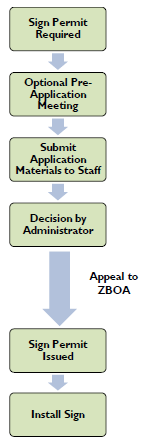
Sign Permits Required. No sign shall hereafter be erected, moved, added to, or structurally altered without a permit therefore, issued by the Administrator in conformity with the provisions of this Development Code. No Sign Permit issued under the provisions of this Development Code shall be considered valid unless signed by the Administrator.
B.
Review and Action by Administrator.
1.
Sign Permit Review may run concurrently with Development Design Review. The Administrator shall require Development Design Review approval prior to granting a Sign Permit.
2.
The Administrator shall review each Sign Permit application in light of this Development Code and any adopted master sign plan (approved prior to the date of adoption of this Development Code), and shall act to approve, approve with conditions or deny the permit. The Administrator may grant approval with conditions only to the extent that such conditions specify the actions necessary to bring the application into complete compliance with this Development Code or the previously approved master sign plan. The Administrator shall be responsible for issuing all Sign Permits.
C.
Maintenance and Repair. Cleaning, painting, repainting and other routine maintenance and repair of a sign shall not require a Sign Permit unless a structural or size change is made.
D.
Expiration of Approval. Any Sign Permit issued for the erection of a sign shall become invalid unless the work authorized by it shall have been commenced within six months after its issuance.
E.
Appeals. Appeals of Sign Permit applications denied by the Administrator shall be taken to the Zoning Board of Appeals within 30 days of the decision, in accordance with the procedures found in Division 8.5 (Administrative Appeals).
8.2.50 - Special Exception Permit
A.
Purpose. A use designated as requiring a Special Exception (SE) Permit in the Principal Use Table (see Section 4.1.30) may be appropriate for the zone, but because of its character and intensity requires special consideration of its location, design, and methods of operation before it can be approved for the proposed site and surroundings. The purpose of this Division is to establish a mechanism to review Special Exceptions to ensure that these uses are appropriately developed in the zone.
B.
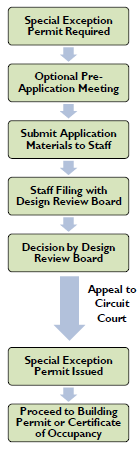
Application. A Special Exception application form as published by the Administrator and appropriate fee as required by Section 8.1.30 (Application Forms and Fees) shall be required, along with such accompanying material as is required to ensure compliance with the criteria listed below.
C.
Approval Process.
1.
Staff Review and Report. The Administrator shall prepare a staff report that reviews the proposed development in light of the Comprehensive Plan, the review criteria listed below, and the requirements of Section 4.1.20.A.3 (Special Exception) and this Development Code. A copy of the report shall be provided to the Design Review Board and the applicant before the scheduled hearing.
2.
Mailed Notice. A courtesy notice of any Special Exception application shall be provided by US Mail to all property owners within 200 feet of the subject property. Failure to provide such notice shall not be considered a jurisdictional defect, provided that published notice in accordance with Section 8.1.80 (Public Notice Requirements) has been provided.
3.
Action by Design Review Board.
a.
Following posted and mailed notice in accordance with Division 8.1 (Approval Procedures), the Design Review Board shall hold a public hearing on the Special Exception application.
b.
After review of the application and the public hearing, the Design Review Board shall make a written finding and approve, approve with modifications or conditions, or disapprove the request.
c.
If approval, or approval with modifications or conditions is granted, the decision shall be communicated in writing within 15 working days to the applicant, and the applicant shall then be authorized to submit a development permit application consistent with this Development Code.
D.
Special Exception Review Criteria. The Design Review Board may approve an application for a Special Exception where it reasonably determines that there will be no significant negative impact upon residents of surrounding property or upon the general public. The Board shall consider the following criteria in its review:
1.
Whether the proposed use is compatible with existing land uses in the surrounding area;
2.
Whether the proposed site plan, circulation plan, and schematic architectural designs are harmonious with the character of the surrounding area;
3.
The likely impact on public infrastructure such as roads, parking facilities, and water and sewer systems, and on public services such as police and fire protection and solid waste collection, and the ability of existing infrastructure and services to adequately service the proposed use without negatively impacting existing uses in the area and in the Town (A traffic impact analysis (TIA) may be required as determined by the Administrator);
4.
Whether the proposed use and designs are in general conformity with the Town's Comprehensive Plan and any other plans officially adopted by the Town;
5.
Likely impact on public health and safety; and
6.
Potential creation of noise, lights, fumes, dust, smoke, vibration, fire hazard, or other injurious or obnoxious impacts.
E.
Conditions. The Design Review Board may impose such conditions and restrictions upon the application as may be necessary to minimize or mitigate any potential adverse impacts of the proposed use.
F.
Appeal. Any party aggrieved by the Design Review Boards' decision may appeal such determination to the Circuit Court of Beaufort County by filing with the Clerk of the Court a written petition within 30 days of the decision, in accordance with the procedures found in Division 8.5 (Administrative Appeals) of this Development Code.
8.2.60 - Development Design Review
A.
Purpose. Development Design Review is intended to promote a thriving, mixed use, pedestrian friendly Town comprised of unique communities that:
1.
Preserve and enhance the visual character and aesthetic qualities of Port Royal for its citizens' and visitors' enjoyment; and
2.
Preserve and enhance the unique character and value of all properties.
B.
Applicability.
1.
New Development, Additions and Major Alterations. All private and public development located within the Town shall be subject to the provisions of this Section.
2.
Exemptions. Where specific uses or types of development are exempt from the provisions of this Development Code, those same uses and types of development shall be exempt from the requirements of this Section (e.g. In T1, T2, and T3 Single-Family Detached Residential is exempt from the Architectural Standards of Division 5.4. Therefore, new development, additions, and major alterations involving this specific use, in these specific zones, shall not be reviewed against the provisions of this Section).
3.
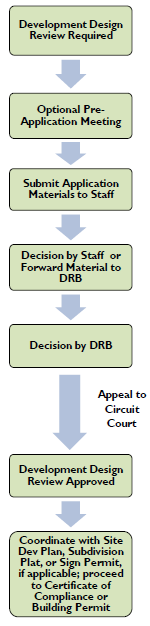
Design Review Required. No permit shall be issued for new development nor for any exterior improvements or changes to existing development subject to the requirements of this Article without receiving Development Design Review approval.
a.
Development Subject to Staff Approval.
(1)
All Development shall meet the requirements of this Development Code.
(2)
The Administrator, in consultation with the Town Architect, shall approve all aspects of site planning and exterior architecture, including aesthetic appropriateness, fit with historic context, environmental implications, traffic impacts, and any other site-specific matters as they relate to the design of the following types of development:
(a)
Individual parcels in single-family residential use, or in a single family or mixed-use residential subdivision;
(b)
New nonresidential development on undeveloped sites;
(c)
New nonresidential development on redevelopment sites;
(d)
Demolition of structures of any size where no new building is proposed;
(e)
New duplex, townhouse, multifamily, or mixed-use development;
(f)
Exterior alterations and/or additions to structures and sites in existing nonresidential development; and
(g)
Exterior alterations and/or additions to structures and sites in existing single-family, duplex, townhouse or multifamily development.
(3)
The Administrator, in consultation with the Town Architect, shall have the authority to grant or require alterations to proposed development:
(a)
Where compliance would create undue hardship (e.g. an addition in which the new portion of the structure would be incompatible with the existing structure, or the application of roofing materials that are consistent with the goals of preservation, but are not expressly permitted); or
(b)
On the basis of architectural merit, in which the proposed alteration meets or exceeds the level of architectural quality, construction, and urban design presently required; and remains consistent with the Purpose and Intent conveyed in each Division.
Such alterations are part of the Development Design Review process and are not considered to be an Administrative Adjustment or Variance. They shall not establish precedence for future projects.
b.
Development Subject to Design Review Board (DRB) Approval. At the request of the Administrator or Applicant, the Administrator shall submit any application subject to Staff approval to the DRB for approval.
(1)
DRB Review Standards. The DRB shall review forwarded applications using the same standards conveyed in [subsection] B.3 (Design Review Required) above.
(2)
DRB Review Procedures. The DRB shall review forwarded applications in accordance with the following procedures:
(a)
Applications shall be submitted to the Design Review Board according to a schedule prepared by the Administrator and approved by the Design Review Board.
(b)
Applicants are encouraged but not required to begin the process with a conceptual presentation of the project to the Board.
(c)
Projects involving new development, major additions, or major alterations will typically undergo a preliminary and a final review.
(d)
The Design Review Board may continue the initial public hearing only once to provide guidance to the applicant regarding revisions to the proposed project.
(e)
Applicants shall be informed in writing of the outcome of their review.
C.
Approvals. Approved documents, written recommendations, and findings received during the Development Design Review process shall become a part of any future permitting submissions.
D.
Appeal. A person having substantial interest may appeal a decision of the Design Review Board to the Circuit Court of Beaufort County within 30 days of the decision.
8.2.70 - Certificate of Appropriateness
See Section 3.3.50 (Historic Preservation Overlay (HPO) Zone Standards).
8.3.10 - Applicability
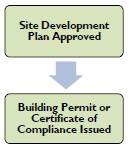
The purpose of this Division is to ensure that the layout and general site design of proposed development in which the landowner intends to commence public facility, infrastructure, or support facility improvements is compatible with its surroundings and complies with all applicable standards in this Development Code. No Building Permit shall be issued by the Building Official until a Site Development Plan approval has been granted.
8.3.20 - Exempt from Site Development Plan Review
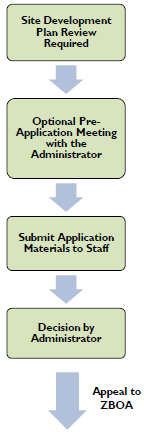
The following activities or uses shall be exempt from a Site Development Plan review, although they may be reviewed under a separate administrative procedure where noted in this Division or other Divisions of this Article:
A.
Routine maintenance of any structure, not including any change in color or materials.
B.
The use or intended use of land, with or without accessory structures, for the purposes of agriculture, raising of crops, and forestry.
C.
Any single-family residence, including manufactured homes, on an individual parcel, tract, or lot of record, or on a lot within a platted subdivision existing prior to the adoption of this Development Code or approved under this Development Code.
D.
Cleaning, painting and other routine maintenance and repair.
E.
Home Occupations as defined in this Division and as regulated by Section 4.2.10.B. (Home Occupation).
F.
Uses Customarily Accessory to Residential Structures (e.g., Private Garage, Private Swimming Pool and Pool House, Garden Shed), as conveyed in Section 4.3.40.
G.
Temporary uses that do not materially affect the area's natural environment, parking requirements, transportation patterns, public health, or economic values.
8.3.30 - Review and Action by the Administrator
A.
Site Development Plan Review may run concurrently with Development Design Review. The Administrator shall require Development Design Review approval prior to granting Site Development Plan Review approval.
B.
Plans submitted for review under this Division shall be processed and the applicant notified in writing of such approval or disapproval within 30 days from the date of submittal to the Administrator. If the proposed Site Development Plan is determined by the Administrator to be consistent with all applicable provisions of this Division, the Administrator shall approve the Site Development Plan and so advise the applicant in writing. A determination by the Administrator that all such requirements and provisions have not been satisfied shall result in disapproval of the Site Development Plan and notice of such disapproval shall be provided to the applicant in writing.
8.3.40 - Site Development Plan Review Standards
A.
An application for a Site Development Plan Review shall be approved on a finding the applicant has demonstrated the proposed development:
1.
Is consistent with the Comprehensive Plan;
2.
Complies with the applicable standards of this Development Code;
3.
Complies with all other applicable standards of the Town's Code of Ordinances and State and Federal law; and
4.
Complies with all standards or conditions of any prior applicable development permits and approvals.
B.
Reserved.
8.3.50 - Expiration of Site Development Plan Approval
An approved Site Development Plan shall expire 12 months from the date of approval unless the proposed development is pursued as set forth below:
A.
A complete Building Permit application has been submitted or, if no Building Permit is required, a Certificate of Compliance has been issued.
B.
In case of projects where more than one building is to be built, the applicant may submit a series of Building Permit applications. The first application must be submitted within one year from the date Site Development Plan approval is granted. Each subsequent application must be submitted within 180 days from the date of issuance of a Certificate of Compliance or Certificate of Occupancy for the previous building, whichever shall occur first. The lapse of more than 180 days shall cause the expiration of the Site Development Plan approval.
8.3.60 - Appeals
Appeals of Site Plan applications denied by the Administrator shall be taken to the Zoning Board of Appeals within 30 days of the decision, in accordance with the procedures found in Division 8.5 (Administrative Appeals).
8.4.10 - Purpose
The purpose of this Division is to provide a uniform means for the review and approval of division of land and to ensure, in conjunction with the development and design standards of Division 2.5 (Specific to Subdivision) that new subdivisions are consistent with the Town's community-oriented character by ensuring the adequate and timely provision of required blocks, lots, open space set-asides, thoroughfares, infrastructure, and other facilities and services.
8.4.20 - Applicability
A.
Subdivision approval shall be required before any of the following activities occur:
1.
The division of land (for any purpose) into two or more parcels;
2.
Development on a parcel not previously subdivided; or
3.
Development that involves the construction of any public improvements that are to be dedicated to the Town.
B.
Exemptions. See Section 2.5.20 (Applicability) for a list of activities that are exempt from the subdivision approval requirements of this Development Code.
8.4.30 - Unlawful to Record Plat without Town Approval
It shall be unlawful to offer and cause to be recorded any plan, plat or re-plat of land within the Town limits of Port Royal with the Beaufort County Register of Mesne Conveyances unless the same bears the endorsement and approval of the Town.
8.4.40 - Authority to Approve a Subdivision
The Administrator shall review and approve all Minor and Major Subdivision Plats.
8.4.50 - Definition of Major and Minor Subdivision
A Minor Subdivision is a division of land into five or fewer lots where no new streets are created. All other divisions shall be considered Major Subdivisions.
8.4.60 - Subdivision Review Standards
A.
An application for a Subdivision (major or minor) shall be approved on a finding the applicant has demonstrated the proposed subdivision:
1.
Is consistent with the Comprehensive Plan;
2.
Complies with the applicable standards of this Development Code;
3.
Complies with all other applicable standards of the Town's Code of Ordinances and State and Federal law; and
4.
Complies with all standards or conditions of any prior applicable development permits and approvals.
B.
Subdivision Review may run concurrently with Development Design Review. The Administrator shall require Development Design Review approval prior to granting preliminary approval of a Major Subdivision Plat.
8.4.70 - Minor Subdivision Plat Submission Requirements
A.
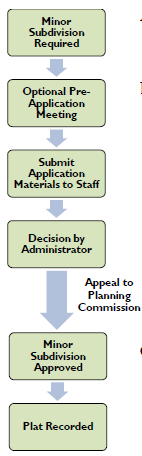
Procedure. A Minor Subdivision Plat shall be submitted to the Administrator.
B.
Review by Technical Review Committee (TRC). Plat shall then be submitted to and checked by the TRC for conformance with the requirements of Section 8.4.60 (Subdivision Review Standards). The TRC shall review the plat and within 30 days of submission the Administrator shall:
1.
Approve and certify the plat;
2.
Approve and certify the plat with conditions; or
3.
Determine that all applicable provisions have not been satisfied, resulting in disapproval of the Preliminary Plat, and written notice of such disapproval to the applicant.
8.4.80 - Major Subdivision Plat Submission Requirements
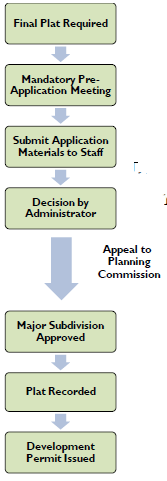
A.
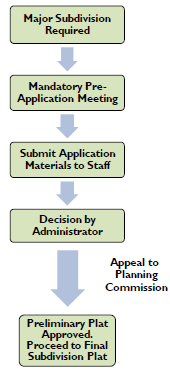
Mandatory Pre-Application Meeting. The applicant and Administrator shall schedule a pre-application meeting to discuss the proposal prior to any submittal for Preliminary and/or Final Plat Review.
B.
Sketch Plan Review.
1.
Purpose and Procedure. The purpose of Sketch Plan review is to afford the subdivider an opportunity to avail himself/herself of the advice and assistance of the Town staff by first submitting a simple Sketch Plan of the proposed plat for review. Although not mandatory, the purpose of the Sketch Plan is to assist the subdivider prior to extensive site planning and to facilitate the subsequent preparation and approval of subdivision plats in compliance with the requirements of Section 8.4.60 (Subdivision Review Standards).
2.
Requirements. This procedure does not require a formal application or fee.
C.
Preliminary Plat Review.
1.
Procedure. The subdivider shall submit to the Administrator the required number of copies of the Preliminary Plat. Additional copies of the plat or any supplemental information may be requested.
2.
Review by Technical Review Committee (TRC).
a.
The Preliminary Plat shall then be submitted to and checked by the TRC for conformance with the requirements of Section 8.4.60 (Subdivision Review Standards). The TRC shall review the plat and within 30 days of submission the Administrator shall:
(1)
Approve and certify the plat;
(2)
Approve and certify the plat with conditions; or
(3)
Determine that all applicable provisions have not been satisfied, resulting in disapproval of the Preliminary Plat, and written notice of such disapproval to the applicant.
Unless this time limit is extended by mutual agreement, failing to act within the above time limit constitutes approval of the Preliminary Plat.
b.
Approval of a Preliminary Plat shall not constitute approval of the Final Subdivision Plat. Application for approval of the Final (Record) Plat will be considered only after the requirements for Final Plat approval as specified herein have been fulfilled and after all other specified conditions have been met.
c.
Upon approval of the Preliminary Plat by the Administrator, the subdivider may proceed to comply with the other requirements of these regulations and the preparation of the Final Subdivision Plat.
3.
Approved Plans Containing School Sites. Where a tract of land that has been approved by the County Board of Education as a proposed school site lies wholly or partially within an area proposed to be subdivided, and provided the Board of Education has notified the Town and the property owner of its approval of the proposed school site prior to or within ten days after the presentation of a Preliminary Plat to the TRC for approval, the subdivider shall reserve the proposed school site for a period of not more than 60 days from the date of approval of the Preliminary Plat. Such reservation would be stated as a condition of preliminary approval by the Administrator.
D.
Final Review.
1.
The final plat shall constitute only that portion of the approved preliminary plat which the subdivider proposes to record and develop at the time of submission. Approval of the final plat shall be subject to the installation of the improvements designated in Division 2.5 (Specific to Subdivision) and Article 2; or certified evidence from the Town that said improvements shall be installed in accordance with these regulations.
a.
Procedure.
(1)
The subdivider shall submit to the Administrator the required number of copies of the final plat.
(2)
The plat shall then be submitted to and checked by the Technical Review Committee for conformance with the approved preliminary plat and the requirements of Section 8.4.60 (Subdivision Review Standards). The TRC shall review the plat and within 30 days of submission the Administrator shall:
(a)
Approve and certify the plat; or
(b)
Determine that all applicable provisions have not been satisfied, including deviations from the approved preliminary plat; resulting in disapproval of the Preliminary Plat, and written notice of such disapproval to the applicant.
(3)
Approval and certification by the Technical Review Committee shall not be deemed to constitute or affect an acceptance by the Town or the County or the public of the dedication of any street or other ground shown upon the plat. Upon receipt of the plat, the Town Council shall determine the acceptance or non-acceptance of all dedicated streets, easements right-of-way, public parks, and other public lands as shown on the plat. If accepted by the Town, action to that effect shall be noted on the final plat; if not accepted, the reason's for non-acceptance shall be so stated.
(4)
It shall be unlawful to sell or transfer property (lots) within the approved subdivision until after the plat has been recorded with the Beaufort County Register of Mesne Conveyances.
b.
Reserved.
2.
Reserved.
E.
Subdivision in Phases. Whenever part of a tract is proposed for platting and it is intended to subdivide additional parts in the future or abutting land is in the same ownership, a sketch plan for the entire tract shall be submitted with the plat.
8.4.90 - Appeal
A.
Appeals of Subdivision Plat decisions made by the Administrator may be appealed to the Planning Commission within 30 days of the decision. The Planning Commission shall review the Subdivision Plat within 60 days and shall have all of the same authority as the TRC / Administrator in such review. The decision of the Planning Commission shall be final.
B.
Appeals of Subdivision Plat decisions made by the Planning Commission may be appealed to the Circuit Court of Beaufort County within 30 days of the decision.
8.4.100 - Expiration of Approval
A Subdivision approval shall expire as set forth in Section 8.1.130 (Expiration of Permits and Approvals) of this Development Code unless a Certificate of Compliance is obtained, or unless recorded at the Beaufort County Register of Mesne Conveyances.
8.5.10 - Applicability
Appeals to the Zoning Board of Appeals may be taken by any person aggrieved by a decision, interpretation or determination of the Building Official or Administrator of the Town. The officer from whom the appeal is taken shall immediately transmit to the Board all papers constituting the record upon which the action appealed from was taken.
8.5.20 - Effect of Appeal
An appeal stays all legal proceedings in furtherance of the action appealed from (except enforcement proceedings), unless the officer from whom the appeal is taken certifies to the Zoning Board of Appeals, after the notice of appeal shall have been filed with him, that by reason of facts stated in the certificate a stay would, in his opinion, cause imminent peril to life and property. In such case, proceedings shall not be stayed otherwise than by a restraining order which may be granted by the Board or by a Court of record on application, on notices to the officer from whom the appeal is taken, and on due cause shown.
8.5.30 - Application
An application for appeal shall be filed within 30 days of receipt of the decision or order of the Building Official or Administrator by filing with the officer from whom the appeal is taken and with the Zoning Board of Appeals, notice of the appeal specifying the grounds thereof. All applications are subject to the requirements of Division 8.1 (Approval Procedures).
8.5.40 - Hearing
The Zoning Board of Appeals shall fix a reasonable time for the hearing of an appeal or other matter referred to it, and give at least 15 working days' public notice of it in a newspaper of general circulation in the Town, as well as due notice to the parties of interest, and decide the same within a reasonable time. At the hearing any party may appear in person or by agent or by attorney.
8.5.50 - Action by Zoning Board of Appeals
At the conclusion of the proceeding on the appeal, the Zoning Board of Appeals shall take one of the following actions, consistent with the provisions of this article:
A.
Affirm the action of the Building Official or Administrator;
B.
Modify the action of the Building Official or Administrator, and to that end, the Zoning Board of Appeals shall have all the powers of the officer, board or commission from which the appeal is taken, and may issue a permit or direct that a permit be issued; or,
C.
Reverse the action of the Building Official or Administrator, and to that end, the Board of Zoning Appeals shall have all the powers of the officer, board or commission from which the appeal is taken, and may issue a permit or direct that a permit be issued.
8.5.60 - Findings of Fact
A.
The Zoning Board of Appeals in the execution of the duties specified in this Division may subpoena witnesses and in case of contempt may certify such fact to the Circuit Court having jurisdiction.
B.
All final decisions and orders of the Board must be in writing and be permanently filed in the office of the board as a public record. All findings of fact and conclusions of law must be separately stated in final decisions or orders of the Board which must be delivered to parties of interest, within 15 working days, by certified mail.
8.5.70 - Contempt: Penalty
In case of contempt by a party, witness, [or] other person before the Zoning Board of Appeals, the Board may certify this fact to the Circuit Court of the county in which the contempt occurs and the judge of the court, in open court or in chambers, after hearing, may impose a penalty as authorized by law.
8.5.80 - Appeal to Circuit Court
A.
Any applicant aggrieved by the Zoning Board of Appeal's determination may appeal such determination to the Circuit Court of Beaufort County.
B.
Upon the filing of the appeal, the Clerk of the Circuit Court shall give immediate notice of it to the secretary of the Board and within 30 days from the time of the notice the Board shall file with the Clerk a certified copy of the proceedings held before the Zoning Board of Appeals, including a transcript of the evidence heard before it, if any, and the decision of the Board including its findings of fact and conclusions.
C.
The filing of an appeal in the Circuit Court from a decision of the Board shall not ipso facto act as a supersedeas.
D.
At the next term of the Circuit Court or in chambers, upon ten days notice to the parties, the presiding judge of the Circuit Court of Beaufort County shall proceed to hear and pass upon the appeal on the certified record of the Zoning Board of Appeals proceedings. The findings of fact by the Board shall be treated in the same manner as a finding of fact by a jury, and the Court may not take additional evidence. In the event the judge determines that the certified record is insufficient for review, the matter may be remanded to the Zoning Board of Appeals for rehearing. In determining the questions presented by the appeal, the Court shall determine only whether the decision of the Board is correct as a matter of law.
8.5.90 - Appeal to Supreme Court
A party in interest who is aggrieved by a judgment rendered by the Circuit Court upon the appeal may appeal in the same manner as provided by law for appeals from other judgments of the Circuit Court in law cases.
8.6.10 - Administrative Adjustments

A.
Purpose. Administrative Adjustments are specified deviations from otherwise applicable development standards where development is proposed that would be:
1.
Compatible with surrounding land uses;
2.
Harmonious with the public interest; and
3.
Consistent with the Purpose and Intent of each Division of this Development Code.
B.
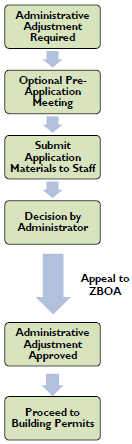
Applicability. For all numerical standards set forth in Articles Two through Five of this Development Code, the Administrator shall have the authority to authorize an Administrative Adjustment of up to ten percent, or as provided in Table 8.6.10.A (Administrative Adjustments) below.
Except where provided in Table 8.6.10.A (Administrative Adjustments), any request greater than ten percent shall be treated as a variance handled by the Zoning Board of Appeals, and subject to the requirements of Section 8.6.20 (Variance Permit).
C.
Application. An application for an Administrative Adjustment shall include a brief description of the requirement to be varied and any other material necessary to ensure the criteria in Subsection E (Administrative Adjustment Criteria) below are met.
D.
Review and Action by Administrator. The Administrator shall review the application and approve, approve with conditions or deny the application based upon the criteria below. A written decision including affirmative findings on the criteria set forth below shall be mailed to the applicant.
E.
Administrative Adjustment Criteria. To approve an application for an Administrative Adjustment, the Administrator shall make an affirmative finding that the following criteria are met:
1.
That granting the Administrative Adjustment will ensure the same general level of land use compatibility as the otherwise applicable standards;
2.
That granting the Administrative Adjustment will not materially and adversely affect adjacent land uses and the physical character of uses in the immediate vicinity of the proposed development because of inadequate screening, setbacks, and other land use considerations;
3.
That granting the Administrative Adjustment will not adversely affect property values in any material way; and
4.
That granting the Administrative Adjustment will be generally consistent with the purposes and intent of this Development Code.
F.
Appeals. A decision on an Administrative Adjustment denied by the Administrator may be appealed to the Zoning Board of Appeals within 30 days of the mailing of the Administrator's decision in accordance with Division 8.5 (Administrative Appeals).
G.
Expiration and Lapse of Approval. Property owners shall have six months from the date of approval of an Administrative Adjustment to secure a Building Permit to carry out the proposed improvements. If a complete Building Permit application has not been filed within six months of the date of approval, the approval shall lapse and be of no further effect.
8.6.20 - Variance Permit
A.
Purpose. A Variance Permit may be approved by the Zoning Board of Appeals if the Board concludes that the strict enforcement of the development standards set forth in this Development Code would result in an unnecessary hardship to the applicant and that by granting the variance, the spirit of this Development Code will be observed, public welfare and safety will not be diminished, and substantial justice will be done.
B.
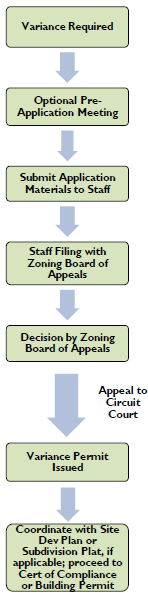
Application. A variance application form as published by the Administrator and appropriate fee as required by Section 8.1.30 (Application Forms and Fees) shall be required, along with such accompanying material as is required to ensure compliance with the criteria listed below. No variances to the sign regulations of this Development Code shall be permitted.
C.
Approval Process. Staff Review and Report.
1.
The Administrator shall prepare a staff report which shall be provided to the applicant or appellant and the Zoning Board of Appeals before the scheduled hearing.
2.
Action by the Zoning Board of Appeals.
a.
Following published and posted notice in accordance with Division 8.1 (Approval Procedures), the Zoning Board of Appeals shall hold a public hearing.
b.
After review of the Variance Permit application and the public hearing, the Zoning Board of Appeals shall make a written finding and give its approval; approval with modifications or conditions; or disapproval.
c.
If approval or approval with modifications or conditions is granted, the decision shall be communicated in writing to the applicant within 15 working days and the applicant shall be authorized to submit a development permit application.
3.
Mailed Notice. A courtesy notice of any Variance Permit application shall be provided by US Mail to all property owners within 200 feet of the subject property. Failure to provide such notice shall not be considered a jurisdictional defect, provided that published notice in accordance with Section 8.1.80 (Public Notice Requirements), has been provided.
D.
Criteria for Approval of Variance Permits.
1.
Required Findings. A Variance Permit may be granted by the Zoning Board of Appeals if the Board concludes that the strict enforcement of any design and performance standard set forth in this Development Code would result in unnecessary hardship to the applicant and that by granting the Variance Permit, the spirit of this Development Code will be observed, public welfare and safety will not be diminished and substantial justice done. A Variance Permit may be granted in an individual case of unnecessary hardship only when the Board makes and explains in writing all of the following findings:
a.
Extraordinary Conditions. There are extraordinary and exceptional conditions pertaining to the particular piece of property. For example, the variance is justified because of topographic or other special conditions unique to the property and development involved, in contradistinction to the mere inconvenience or financial disadvantage;
b.
Other Property. These conditions do not generally apply to other property in the vicinity;
c.
Conditions. The conditions are not the result of the applicant's own actions;
d.
Comprehensive Plan. Granting of the variance would not substantially conflict with the Comprehensive Plan and the purposes of this Development Code;
e.
Utilization. Because of these conditions, the application of the Development Code to the particular piece of property would effectively prohibit or unreasonably restrict the utilization of the property; and
f.
Substantial Detriment. The authorization of a variance will not be of substantial detriment to adjacent property or the public good, and the character of the zone will not be harmed by the granting of the Variance Permit.
2.
Limitations. The Board may not grant a Variance Permit the effect of which would be any of the following:
a.
The Board may not grant a variance the effect of which would be to allow the establishment of a use not otherwise permitted in the applicable zone;
b.
To increase the density of a use above that permitted by the applicable zone;
c.
To extend physically a nonconforming use of land; or
d.
To change the zone boundaries shown on the Official Zoning Map.
3.
Profitability Not to Be Considered. The fact that property may be utilized more profitably should a Variance Permit be granted may not be considered grounds for a variance.
4.
Hardship Due to Eminent Domain. Where the alleged hardship results from the taking of part of the property by eminent domain, thus reducing the land area available for parking, buffers, and other purposes, the applicant shall have the burden of proving that, after good-faith efforts by the applicant or previous owner, the condemning authority failed or refused to provide the applicant compensation adequate to cover the value of both the land actually taken and the economic impacts of the reduction in the size of the remaining property. Only if the applicant meets this burden of proof will a hardship under these conditions be considered adequate to justify the granting of a Variance Permit.
5.
Conditions. In granting a Variance Permit, the Board may attach to it conditions regarding the location, character, or other features of the proposed building, structure, or use as the Board may consider advisable to protect established property values in the surrounding area, or to promote the public health, safety, or general welfare.
E.
Appeal. Any party aggrieved by the Zoning Board of Appeals' decision may appeal such determination to the Circuit Court of Beaufort County within 30 days of the decision.
8.7.10 - Text Amendments

A.
Applicability. When the public necessity, convenience, general welfare, or good zoning practice justify such action, and after the required review and report by the Planning Commission, the Town Council may undertake the necessary steps to amend the text of this Development Code.
B.
Initiation of Amendments.
1.
A proposed amendment to this Development Code may be initiated by any member of the Town Council, the Planning Commission, the Administrator, or by application filed with the Administrator by any Town resident or business owner.
2.
Any proposed text amendment to this Development Code initiated by a member of Town Council may be given first reading prior to being referred to the Planning Commission for its review and recommendation.
C.
Approval Process. Requests to amend this Development Code shall be processed in accordance with the following requirements:
1.
Mandatory Pre-application Meeting. The applicant and Administrator shall schedule a pre-application meeting prior to any submittal in order to discuss the proposal.
2.
Application Procedure. Application forms for text amendment requests shall be obtained from the Administrator. Completed forms, together with an application fee as required by Section 8.1.30 (Application Forms and Fees), to cover administrative costs, plus any additional information the applicant feels to be pertinent, shall be filed with the Administrator. Any communication purporting to be an application for an amendment shall be regarded as a mere notice to seek relief until it is made in the form required.
3.
Staff Review and Report. The Administrator shall prepare a staff report that reviews the proposed text amendment in light of the Comprehensive Plan and the general requirements of this Development Code. A copy shall be provided to the Planning Commission and the applicant before the scheduled public meeting.
4.
Planning Commission Recommendation.
a.
Notice. Following published notice in accordance with Section 8.1.80 (Public Notice Requirements), of this Development Code, the Planning Commission shall hold a public meeting.
b.
Hearing by Planning Commission. All papers and other data submitted by the applicant on behalf of the text amendment request shall be transmitted to the Planning Commission. The Planning Commission, at regular meetings, shall review and prepare a recommendation, including its recommendation, for transmittal to the Town Council. All meetings of the Planning Commission shall be open to the public. At a meeting, any party may appear in person, or by agent, or by attorney. No member of the Planning Commission shall participate in a matter in which he has any pecuniary or special interest. Following action by the Planning Commission, all papers and data pertinent to the application shall be transmitted to the Town Council for final action.
(1)
The Planning Commission shall study the proposed text amendment taking into account all factors which it may deem relevant including, but not limited to, the consistency of the proposed amendment with the Comprehensive Plan and whether the proposed amendment serves to carry out the purposes of this Development Code.
(2)
At the close of the public meeting, the Planning Commission shall recommend approval, modified approval, or denial of the text amendment.
(3)
The staff shall prepare a report of the Planning Commission deliberations and recommendation which shall be forwarded to Town Council. The Planning Commission shall have 30 days within which to submit its report. If the Planning Commission fails to submit a report within the 30-day period, it shall be deemed to have recommended approval of the proposed amendment.
5.
Town Council Action.
a.
Before enacting a text amendment to this Development Code, the Town Council shall hold a public hearing thereon; notice of the time and place, in accordance with Division 8.1 (Approval Procedures).
b.
Town Council shall consider the proposed text amendment at the earliest reasonable date and shall consider the report of the Planning Commission in making a decision.
c.
Town Council shall act to approve, approve with modifications, or deny the proposed text amendment.
d.
Following Town Council action, the applicant shall be notified within 15 working days of the decision in writing.
8.7.20 - Zoning Map Amendments (Rezoning)
A.
Applicability. When the public necessity, convenience, general welfare, or good zoning practice justify such action, and after the required review and report by the Planning Commission, the Town Council may undertake the necessary steps to amend the Official Zoning Map.
B.
Initiation of Amendments. Any proposed amendment to the Official Zoning Map may be initiated by the Town Council, the Planning Commission, the Town Manager, the Administrator, or by the owner of such property for which the amendment is sought.
C.
Application.
1.
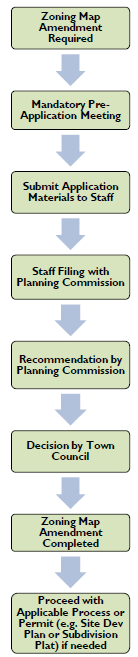
Mandatory Pre-application Meeting. The applicant and Administrator shall schedule a pre-application meeting prior to any submittal in order to discuss the proposal.
2.
A rezoning application form as published by the Administrator shall be required and appropriate fee as required by Section 8.1.30 (Application Forms and Fees) and shall include the following:
a.
A narrative addressing the reasons for the requested zoning map amendment and addressing the applicable review criteria set forth in Subsection D.3.b (Review Criteria) below.
b.
A boundary map of the subject property prepared and sealed by a registered land surveyor.
c.
Where applicable, a copy of correspondence illustrating that the applicant has solicited written comments from the appropriate property owners' association regarding the requested amendment. Such correspondence shall encourage the association to direct any comments in writing to the Administrator and the applicant within 15 calendar days of receipt of the notification.
3.
If the applicant is not the Town, the applicant shall submit written consent from the owner of the property that is being considered for a zoning map amendment.
D.
Approval Process. Requests to amend the Official Zoning Map shall be processed in accordance with the following requirements:
1.
Application Procedure. Application forms for amendment requests shall be obtained from the Administrator. Completed forms, plus any additional information the applicant feels to be pertinent, shall be filed with the Administrator. Any communication purporting to be an application for an amendment shall be regarded as a mere notice to seek relief until it is made in the form required.
2.
Staff Review and Report. The Administrator shall prepare a staff report that reviews the proposed zoning map amendment in light of the Comprehensive Plan and the general requirements of this Development Code. For map amendments that would generate more than 50 external trips during the peak hour, a traffic impact analysis (TIA) shall be conducted, all road improvements needed to maintain the current level of service identified (based on that analysis), and assurances provided that all road improvements will be in place so the impacts of the development are accommodated and the current level of service is maintained. A copy shall be provided to the Planning Commission and the applicant before the scheduled public meeting.
3.
Planning Commission Recommendation.
a.
Hearing by Planning Commission. All papers and other data submitted by the applicant on behalf of the request shall be transmitted to the Planning Commission. The Planning Commission, at regular meetings, shall review and prepare a recommendation for transmittal to the Town Council. All meetings of the Planning Commission shall be open to the public. At a meeting, any party may appear in person, or by agent, or by attorney. Following action by the Planning Commission, all papers and data pertinent to the zoning map amendment application shall be transmitted to the Town Council for final action.
(1)
The Planning Commission shall study the proposed zoning map amendment, taking into account all factors which it may deem relevant, including, but not limited to, the consistency of the proposed amendment with the Comprehensive Plan and whether the proposed rezoning serves to carry out the purposes of this Development Code.
(2)
At the close of the public meeting, the Planning Commission shall recommend approval, modified approval, or denial of the request.
(3)
The staff shall prepare a report of the Planning Commission deliberations and recommendation, which shall be forwarded to Town Council. The Planning Commission shall have 30 days within which to submit its report. If the Planning Commission fails to submit a report within the 30-day period, it shall be deemed to have approved the proposed zoning map amendment request.
b.
Review Criteria. In making recommendations regarding amendments to the Official Zoning Map, the Planning Commission shall consider and make findings on the following matters regarding the proposed amendment:
(1)
Consistency (or lack thereof) with the Comprehensive Plan;
(2)
Compatibility with the present zoning and conforming uses of nearby property and with the character of the neighborhood;
(3)
Suitability of the property affected by the amendment for uses permitted by the proposed zone;
(4)
Suitability of the property affected by the amendment for uses permitted by the zone applicable to the property at the time of the proposed amendment;
(5)
Compatibility of the uses permitted in the proposed district with the natural features of and any archaeological or cultural resources on the property;
(6)
Marketability of the property affected by the amendment for uses permitted by the zone applicable to the property at the time of the proposed amendment; and
(7)
Availability of roads, sewer, water and stormwater facilities generally suitable and adequate for the proposed use.
4.
Town Council Action.
a.
Before enacting an amendment to the Official Zoning Map, the Town Council shall hold a public hearing in accordance with Division 8.1 (Approval Procedures).
b.
Town Council shall consider the proposed rezoning at the earliest reasonable date and shall consider the report of the Planning Commission in making a decision.
c.
Town Council shall act to approve, approve with modifications, or deny the rezoning request.
d.
Following Town Council action, the applicant shall be notified within 15 working days of the decision in writing.
D.
Changes in Zoning Map. Following final action by the Town Council, any necessary changes shall be made in the Official Zoning Map. A written record of the type and date of such change shall be maintained by the Administrator. Until such change is made, no action by the Town Council on amendments to this Development Code shall be considered official, unless the Administrator fails to make the change with seven days after formal action by the Town Council. In the latter event, action by the Town Council shall be considered official seven days after the date of the action even if the Administrator has failed to make the appropriate changes.
8.8.10 - Summary Table of Development Review Procedures

