
Port Royal City Zoning Code
ARTICLE 4
- SPECIFIC TO USE
4.1.10 - Purpose
A.
This Division establishes the:
1.
Principal Uses permitted in each zoning district;
2.
Corresponding Definitions with Examples, Accessory Uses, and Uses Not Included.
3.
Additional regulations regarding site planning, development, and operating standards intended to ensure compatibility with neighboring uses and the surrounding community.
B.
This Division continues, and expands upon the Town's commitment to establishing mixed-use neighborhoods comprised of multi-use buildings.
4.1.20 - Applicability
A.
Use Permission Defined. The Use Table in Section 4.1.30 affords one of four types of permission to each use in each zoning district as follows:
1.
Permitted Use (P): The use is permitted by right without any additional requirements in this Article. Such uses are subject to all other applicable regulations of this Ordinance.
2.
Conditional Use (C): The use is permitted by right, provided that the additional use regulations set forth in Division 4.2 (Conditional Use Regulations) are met, as well as all other applicable regulations of this Ordinance.
Conditional Use Regulations are intended to ensure that permitted uses are compatible with neighboring uses and the surrounding community.
3.
Special Exception (SE): The use is permitted only when a Special Exception Permit has been approved. Special Exception Permits are required for uses which comply with the Purpose established for the zoning district but which, because of their unique characteristics or potential impacts on neighboring uses and/or the surrounding community, require individual consideration in their location, design, configuration, and/or operation. All applications for Special Exception Permits shall, at a minimum, meet the standards for the district in which they are located, the additional standards set forth in this Article for that use, and all other applicable regulations of this Ordinance.
Approval procedures for Special Exception Permits are found in Division 8.2.50 (Special Exception Permit).
4.
Prohibited Uses (—): The use is prohibited in the specified District.
B.
Mixed-use development and multi-use buildings are permitted and encouraged using the individual standards for each function.
C.
Section for Additional Conditions. The second from last column of the Use Table (Section for Additional Conditions) identifies the specific location of the additional regulations that apply to a Conditional Use.
D.
By Right Design Criteria. The last column of the Use Table (Additional Design Criteria) identifies the location of additional design standards that frequently apply to a given use.
E.
Accessory Uses. Accessory Uses that are regulated by zoning district are listed in the Principal Use Table, including Accessory Dwelling Units and Home Occupations. Other typical accessory uses are established and defined in Division 4.3 Accessory Uses and structures.
F.
Interpreting and Assigning the Appropriate Use.
1.
Developments with Multiple Principal Uses: When all principal uses of a development fall within one use category, the entire development is assigned to that use category. When the principal uses of a development fall within different use categories, each principal use is classified in the applicable category and each use is subject to all applicable regulations for that category.
2.
Similar Use Interpretation Criteria: The following considerations shall be used when making similar use interpretations, including the appropriate category for a use not specifically listed in the Principal Use Table or the Examples provided with the Principal Use Definitions:
a.
The actual or projected characteristics of the activity in relationship to the stated definition for the use;
b.
The relative amount of site area or floor space and equipment devoted to the activity;
c.
Relative amounts of sales from each activity;
d.
The customer type for each activity;
e.
The relative number of employees in each activity;
f.
Hours of operation;
g.
Building and site arrangement;
h.
Vehicles used with the activity;
i.
The relative number of vehicle trips generated by the use; and
j.
How the use advertises itself.
4.1.30 - Principal Use Table
Table 4.1.30. Principal Use Table
4.1.40 - Principal Use Definitions
Table 4.1.40 Principle Use Definitions
(Ord. No. 2015-4, § 1, 3-11-15; Ord. No. 2020-10, 7-8-20)
4.2.10 - Residential Uses
A.
Accessory Dwelling Unit.
1.
An accessory dwelling unit shall comply with the following standards:
a.
Zones Allowed. Accessory dwelling units shall be permitted as accessory uses to single-family and two-family residential dwellings in accordance with Table 4.1.30 (Principal Use Table) provided:
(1)
The area of the lot meets or exceeds the minimum lot size requirement for the district;
(2)
The lot is currently served with public water and sewer;
(3)
Both the principal dwelling and the accessory dwelling will be in the same ownership; and
(4)
The unit will be a minimum of 240 square feet in total area.
b.
Number of Units. One accessory dwelling unit shall be permitted per lot and shall not count toward any applicable maximum residential density requirements.
c.
Dimensional and Development Standards. Accessory dwelling units shall comply with all dimensional and development standards in Article 3 (Specific to Zones).
(1)
ADU in an Existing Structure. If the accessory dwelling unit is to be located in an existing accessory structure, the accessory structure shall meet all setback requirements for the district in which the lot is located.
(2)
ADU in a New Structure. Accessory dwelling units shall use the Carriage House building type in Section 5.1.40 (Carriage House).
d.
Design.
(1)
Architecture. Accessory dwelling units shall comply with the architectural standards and guidelines in Division 5.4 (Architectural Standards and Guidelines).
(2)
Residential Form and Character. The unit shall appear to be a single family residential dwelling.
(3)
Compatible with Principal Building. To the maximum extent practicable the exterior color, siding, roof pitch, window detailing, roofing materials, and foundation of the accessory dwelling unit shall be compatible to that which is found on the principal building.
(4)
Outside Entrance: For an attached accessory dwelling unit, any additional entrances will be located in the side or the rear of the accessory dwelling unit.
e.
Parking. There will be one on-site, off-street parking space for each accessory dwelling unit in addition to the spaces required for the primary dwelling.
f.
Resale. Accessory dwelling units shall not be sold apart from the principal dwelling upon the same lot where they are located.
g.
Rental. An accessory dwelling unit may be used as a Short Term Rental or guest room for a Bed and Breakfast.
B.
Home Occupation.
1.
A home occupation occurring as an accessory use to any principal dwelling unit shall comply with the following standards:
a.
Exclusions to Home Occupations. No home occupation shall be permitted that does any of the following:
(1)
Internal or external alterations inconsistent with the residential use of the building;
(2)
Is visible from the street;
(3)
Generates traffic, parking, sewerage, or water use in excess of what is normal in the neighborhood;
(4)
Creates a hazard to persons or property;
(5)
Results in electrical interference;
(6)
Is a nuisance; or
(7)
Results in the outside storage or display of anything.
b.
Employees. A maximum of two employees who are not residents of the household may work on-site.
c.
ADUs. Such use shall not operate from an accessory dwelling unit if it involves visitation by customers or salespeople.
d.
Building Codes. Building must meet all applicable codes for electrical wiring, plumbing, etc., before such use begins.
e.
Outside Storage. Outside storage related to such use is prohibited.
f.
Signs: Signage shall comply with the standards of Sub-section 5.9.50.B.1 (Home Occupation).
g.
Display and Sales. The sale of products grown, made or repaired on site is permitted. In addition, incidental retail sales are allowed in connection with a permitted home occupation (for example, a hair stylist may sell hair products to customers). No outdoor display of products for sale is permitted.
h.
Maximum Size. Such use shall occupy a maximum of 25 percent of the floor area of the principal dwelling.
i.
Vehicles. Only passenger vehicles shall be permitted in connection with the conduct of such use.
j.
Hours. Deliveries and activities involving visitors/clients shall occur only between 8:00 a.m. and 8:00 p.m.
k.
Parking. Such use shall not result in off-street parking of more than three vehicles at any one time not owned by members of the occupant household.
(1)
One off-street parking space shall be provided per outside employee.
(2)
The off-street parking spaces required for the home business shall be maintained in addition to the space or spaces required for the residence itself.
(3)
No parking spaces, other than driveways, may be located in the required front yard setback.
l.
Trailers. One vehicle trailer no more than 12 feet in length may be permitted as part of such use. Such trailer shall not be parked in the street right-of-way or in the front yard unless it is parked in a driveway.
m.
Barber Shop/Beauty Parlor. Such use shall be licensed and operated according to the standards set by the South Carolina Department of Labor, Licensing, and Regulation and shall be limited to two chairs. The applicant shall certify that the proposed use is not prohibited by any covenant or deed restriction on the property.
n.
Prohibited Home Occupations. The following are prohibited as home occupations:
(1)
Adult entertainment;
(2)
Animal boarding facilities (such as kennels, animal hospitals, etc.);
(3)
Body piercing facilities and tattoo facilities;
(4)
The repair, rental, sales or assembly of vehicles or equipment with internal combustion engines (such as outboard marine engines, lawnmowers, etc.) or any other work related to automobiles and their parts;
(5)
Commercial lodging;
(6)
Food handling, processing or packing, other than catering services that utilize standard home kitchen equipment;
(7)
Medical offices and clinics; and
(8)
Repair, rental or sales of large appliances (such as washing machines, dryers and refrigerators, etc.);
(9)
Restaurants and bars.
2.
Reserved.
4.2.20 - Offices and Services
A.
General Offices and Services.
1.
Specific to the T3SN and T3N Districts.
a.
Permitted Location: The lot or new development shall front an arterial, collector, or one of the following thoroughfares: Midtown Drive, Edinburgh Avenue, Columbia Avenue, Madrid Avenue, Old Shell Road, Waddell Road, or Southside Boulevard. Businesses wishing to locate on lots that do not comply with this standard may apply for and receive approval of a Special Exception Permit, see Section 8.2.50 (Special Exception Permit).
b.
Hours of Operation. Hours of operation shall be limited to between 7:00 a.m. and 7:00 p.m., Monday through Saturday. Businesses seeking to remain open after this time must apply for and receive approval of a Special Exception Permit, see Section 8.2.50 (Special Exception Permit).
2.
Reserved.
B.
General Offices and Services with a Drive Through Facility.
1.
Service uses with a drive through facility shall comply with the following standards:
a.
General to All Zones.
(1)
Building Location and Circulation. To the maximum extent practicable, all dimensional and design standards of this code shall apply. In no case shall a vehicular accessway/driveway or off-street parking area be permitted between the principal facade of the building and the primary street.
(2)
Drive-through Configuration. Drive-throughs shall be located to the side or at the rear of the building and shall be designed so that pedestrian safety is ensured.
(3)
Location on Corner Lot. Drive-throughs serving a building located on a corner lot shall be located to the rear or interior side. In no instance shall the drive-through be located on the side of a building facing a street.
(4)
Roof. If covered, the roof over the drive-through shall be of a complementary architectural design as the design covering the primary portion of the structure.
(5)
Talk Boxes. Talk boxes at drive-through facilities shall be screened by a sound barrier such as landscaping, a fence or a masonry wall.
b.
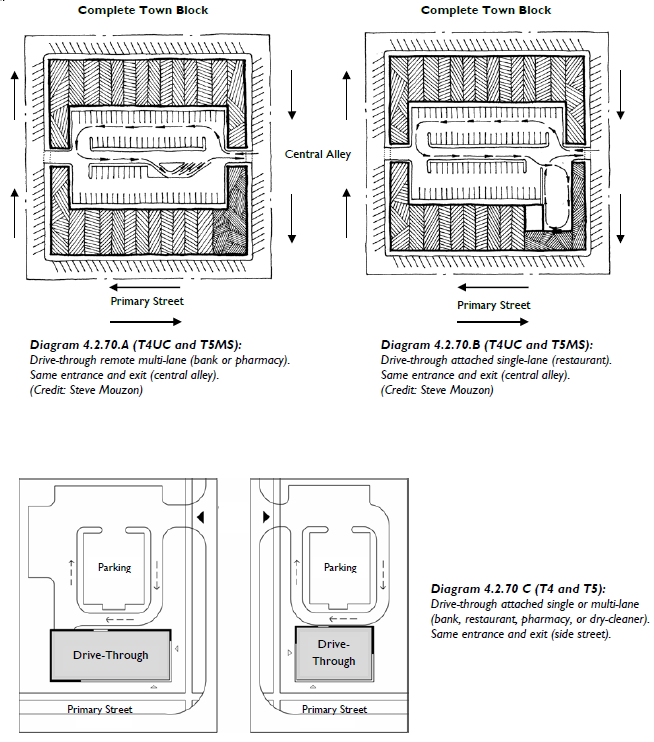
Specific to T4UC and T5MS. Per the Vehicle Access and Parking Standards for building types permitted in T4UC and T5MS (Division 5.1. Traditional Building Types), drive-through access in these districts shall occur from an adjacent side street or central alley. See Section 4.2.70 (Diagrams Specific to Use).
(1)
Drive-through establishments are allowed only on the corners of the block in order to be visually tied to the entries that serve them.
(2)
The shop fronts of the Main Street shall not be punctured by a drive-through exit.
(3)
Drive-through traffic should exit the site where it enters the site, rather than being routed to another side of the block, so customers are not disoriented.
(4)
Remote drive-through technology (in which objects are placed in a capsule and delivered to the drive-through via a tube) shall be encouraged.
c.
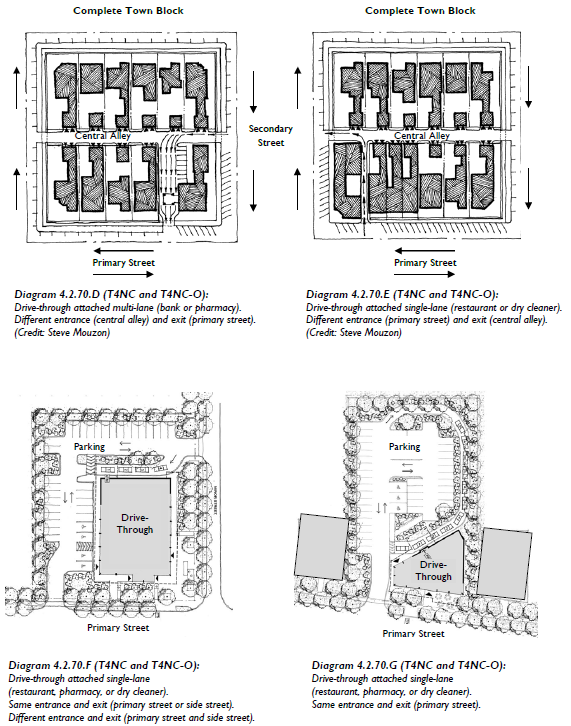
Specific to T4NC and T4NC-O. Per the Vehicle Access and Parking Standards for building types permitted in T4NC and T4NC-O (Division 5.1. Traditional Building Types), drive-through access in these districts may occur from the front if there is no adjacent side street or alley, as depicted in the diagrams in Section 4.2.70 (Diagrams Specific to Use).
(1)
Drive-through establishments are allowed on corners and mid-block.
(2)
Drive-through traffic should enter and exit the site at different locations.
(3)
Both remote drive-through technology and attached drive-throughs are permitted. The roof on a multi-lane attached drive-through that is visible from the street may be designed as a porte corchere.
2.
Reserved.
C.
Body Branding, Piercing, and Tattoo Facilities.
1.
Tattoo or body piercing facilities shall comply with the following standards:
a.
Separation. A tattoo or body piercing facility shall be a minimum of 300 feet from property line to property line of any place of worship, school, public park or recreation area, youth activity center, child day care, or lot devoted to a residential use.
b.
Spacing. The minimum spacing between another tattoo or body piercing facility shall be 500 feet from property line to property line.
c.
Parking. Provide the required minimum of 2.5 off-street parking spaces per 1,000 sf.
d.
Signage. No neon signage will be allowed at a tattoo facility.
e.
Screening. When providing branding, piercing, or tattooing services that involve a state of semi-nudity, such services shall be screened and shall not be visible through any external window, door, or other aperture of the building.
f.
Hours. The facility is limited to business hours of 8:00 a.m. to 10:00 p.m.
g.
State Permits Required. All tattoo facilities must be licensed by the State Department of Health and Environmental Control (SC-DHEC).
2.
Reserved.
D.
Day Care.
1.
General to All Day Care.
a.
State Requirements. Facilities shall comply with all relevant state requirements.
b.
Parking. Provide the required minimum of 2.5 off-street parking spaces per 1,000 sf, as well as one off-street passenger drop off/pick-up space per ten clients/students.
2.
Specific to Child Day Care.
Child day care facilities shall also comply with the following:
a.
Outdoor Play Areas. Outdoor play areas shall be provided, and shall be safely segregated from parking, loading, or service areas.
b.
Screening. A landscaped hedge or solid fence shall be provided along any rear or side property line adjoining a residential lot. The hedge or fence shall be designed and/or planted to be at least four feet in height at maturity.
c.
Parking Area, Vehicular Circulation, and Drop-Off and Pick-Up. The parking areas and vehicular circulation for the child day care shall be designed to:
(1)
Ensure the safety of children as they arrive at and leave the facility; and
(2)
Provide a designated pickup and delivery area that is located in such a way that children do not have to cross vehicular travel ways to enter or exit the center and traffic congestion is minimized.
E.
Personal Storage Facilities.
1.
Personal storage facilities shall comply with the following:
a.
Blocks and Streets. Larger facilities shall integrate blocks and streets into the site, allowing for future mixed-use infill and the eventual transformation of the site. See Division 2.2 (General to All Development).
b.
Wrap or Line the Facility. Whenever possible, storage areas should be:
(1)
Sited internal to the lot/block, and "wrapped" by detached perimeter buildings. Perimeter buildings may be constructed separately and at a later date.
i.
Perimeter and outparcel buildings shall be oriented so that the principal facade faces a public street or public space; and
ii.
Perimeter or outparcel buildings shall "wrap" the overall site such that their principal and /or secondary facade occupies a minimum of 70 percent of the perimeter street frontage (primary and secondary).
iii.
The principal facade of the main building (leasing office, security or caretakers quarters, etc.) shall occupy and address the perimeter street frontage, or the primary "internal" street.
(2)
Sited internal to the lot/block and designed to include additional commercial, office, or residential "liner" space along every facade that fronts a public street or public space. Liner space, of a minimum 15 feet in depth, may be attached or detached, and constructed separately or at a later date.
c.
Building Standards.
(1)
The leasing office, or security/caretakers quarters shall conform to the building type standards of Division 5.1 (Traditional Building Types), and contain an associated private frontage as conveyed in Division 5.3 (Private Frontage Standards). The building shall be sited per the dimensional and development standards of Article 3 (Specific to Zones) and conform to the architectural provisions of Division 5.4 (Architectural Standards and Guidelines).
(2)
To the maximum extent practicable, structures used for storage shall be designed to the architectural provisions of Division 5.4 (Architectural Standards and Guidelines). See Photographic Examples on the following page. Perimeter or exterior walls visible from a public street should not include metal as a primary material.
(3)
Garage doors serving individual storage units shall be perpendicular to a public or private street so as to not be visible from adjacent streets.
(4)
With the exception of a structure used as a leasing office or caretaker quarters, the maximum height of a personal storage facility shall be 20 feet and the maximum height of a dry stack boat storage facility shall be 35 feet (measured to the eave).
d.
Operation.
(1)
The only uses allowed on-site shall be the rental of storage bays and the pickup and deposit of goods or property in dead storage, and limited incidental sales of storage materials (e.g., boxes, tape). Storage bays shall not be used to manufacture, fabricate, or process goods, to service or repair vehicles, small engines or electrical equipment, or conduct similar repair activities, to conduct garage sales or retail sales of any kind, or to conduct any other commercial or industrial activity on the site.
(2)
Individual storage bays or private postal boxes within a personal storage facility shall not be considered premises for the purpose of assigning a legal address.
(3)
No more than one security or caretaker quarters may be developed on the site.
(4)
All property stored on the site shall be located entirely within an enclosed building, except in the case of dry stack storage structures that demonstrate significant architectural merit. Such facilities may be partially enclosed, as depicted below. Energy efficient features such as solar panels and green roofs shall be encouraged, especially on facilities not visible from the street.
(5)
There shall be no storage of toxic, hazardous, flammable, explosive or noxious materials.
e.
Parking and Circulation.
(1)
Parking. The minimum of 2.5 off-street parking spaces per 1,000 sf. shall apply to the Main Building only.
(2)
Interior circulation shall be provided in the form of aisleways adjacent to the storage bays. These aisleways shall be used both for circulation and temporary customer parking while using storage bays. The one- or two-way traffic flow patterns in aisleways shall be clearly marked with, at a minimum, directional signage or painted lane markings with arrows.
(3)
All aisleways shall be paved with asphalt, concrete, or comparable materials.
f.
Fences and Walls.
(1)
Fences and Walls shall be no shorter than six feet or taller than eight feet and meet the standards of Division 5.5 (Fences and Walls).
(2)
Fences and Walls shall tie into, and complement all buildings.
(4)
Wooden or chain link entry gates into the use are prohibited.

All buildings designed to the Architectural Standards and Guidelines of this code.
F.
Vehicle Services: Maintenance and Repair: Major.
1.
Applicable to All Major Vehicle Maintenance and Repair Facilities.
a.
Site Planning, Building Type, and Architecture. To the maximum extent practicable:
(1)
The site plan shall maintain the street edge so as not to create a void in the built environment. Vehicular accessways/driveways and off-street parking areas shall not be permitted between the principal facade of the building and the primary street.
(2)
The site shall comply with all dimensional and development standards in Article 3 (Specific to Zones).
(3)
Repair of all vehicles shall occur within an enclosed building that conforms to the building type standards of Division 5.1 (Traditional Building Types), contain an associated private frontage as conveyed in Division 5.3 (Private Frontage Standards), and comply with the architectural provisions of Division 5.4 (Architectural Standards and Guidelines).
(4)
Openings to repair bays and wash bays shall not face a primary or secondary street ROW. They shall be designed to minimize visual intrusion onto adjoining properties.
b.
Operations.
(1)
Temporary outdoor vehicle storage shall be allowed on-site in the designated parking area (see Article 3 Specific to Zones) provided the area is completely screened 100 percent opacity to a minimum six feet in height) from adjoining properties and ROWs using vegetative plantings, fences and walls, buildings, or a combination thereof.
(2)
All automobile parts and similar materials shall be stored within an enclosed building or an outside storage area that is completely screened 100 percent opacity to a minimum six feet in height) from adjacent properties and ROW's using vegetative plantings, fences or walls, buildings, or a combination thereof.
(3)
Except where permitted below, these uses shall not include outdoor storage lots or impound yards for towed vehicles.
2.
Auto Painting and Body Shops. In addition to the standards listed above in subsection F.1 (Applicable to All Major Vehicle Maintenance and Repair Facilities), the following standards shall apply to these facilities:
a.
The use shall be located at least 250 feet from any existing residential development.
b.
Vehicles shall not be parked or stored as a source of parts or for the purpose of sale or lease/rent.
c.
Vehicles that are repaired and are awaiting removal shall not be stored or parked for more than 30 consecutive days unless the owner or operator of the establishment demonstrates steps have been taken to remove the vehicle from the premises using the appropriate legal means.
3.
Auto Wrecker Service. In addition to the standards listed above in subsection F.1 (Applicable to All Major Vehicle Maintenance and Repair Facilities), the following standards shall apply to these facilities:
a.
Outdoor storage lots or impound yards for towed vehicles are permitted, provided:
(1)
The number of vehicles stored on-site shall be limited to 15 vehicles.
(2)
Vehicles shall not be stored for more than 90 days.
b.
Reserved.
4.
Car Wash and Auto Detailing. In addition to the standards listed above in subsection F.1 (Applicable to All Major Vehicle Maintenance and Repair Facilities), the following standards shall apply to these facilities:
a.
Large clear windows on car wash facades can animate the public street, provide interest for pedestrians, and inadvertently advertise the facility. They shall be permitted.
b.
Vacuuming equipment shall be set back at least 50 feet from any adjacent residential development.
c.
Car wash and auto detailing uses shall provide adequate, enclosed trash storage facilities on the site.
4.2.30 - Retail and Restaurants
A.
General Retail or Restaurant with a Drive Through Facility.
1.
Retail and Restaurant establishments with a drive through facility shall comply with the following standards:
a.
General to All.
(1)
Building Location and Circulation. To the maximum extent practicable, all dimensional and design standards of this code shall apply. In no case shall a vehicular accessway/driveway or off-street parking area be permitted between the principal facade of the building and the primary street.
(2)
Drive-through Configuration. Drive-throughs shall be located to the side or at the rear of the building and shall be designed so that pedestrian safety is ensured.
(3)
Location on Corner Lot. Drive-throughs serving a building located on a corner lot shall be located to the rear or interior side. In no instance shall the drive-through be located on the side of a building facing a street.
(4)
Roof. If covered, the roof over the drive-through shall be of a complementary architectural design as the design covering the primary portion of the structure.
(5)
Talk Boxes. Talk boxes at drive-through facilities shall be screened by a sound barrier such as landscaping, a fence or a masonry wall.
b.
Specific to T4UC and T5MS. Per the Vehicle Access and Parking Standards for building types permitted in T4UC and T5MS (Division 5.1. Building Types), drive-through access in these districts shall occur from an adjacent side street or central alley, as depicted in the diagrams in Section 4.2.70 (Diagrams Specific to Use).
(1)
Drive-through establishments are allowed only on the corners of the block in order to be visually tied to the entries that serve them.
(2)
The shop fronts of the Main Street shall not be punctured by a drive-through entryway or exit way.
(3)
Drive-through traffic should exit the site where it enters the site, rather than being routed to another side of the block, so customers are not disoriented.
(4)
Remote drive-through technology (in which objects are placed in a capsule and delivered to the drive-through via a tube) shall be encouraged.
c.
Specific to T4NC and T4NC-O. Per the Vehicle Access and Parking Standards for building types permitted in T4NC and T4NC-O (Division 5.1. Building Types), drive-through access in these districts may occur from the front if there is no adjacent side street or alley, as depicted in the diagrams in Section 4.2.70 (Diagrams Specific to Use).
(1)
Drive-through establishments are allowed on corners and mid-block.
(2)
Drive-through traffic should enter and exit the site at different locations.
(3)
Both remote drive-through technology and attached drive-throughs are permitted.
(4)
The roof on a multi-lane attached drive-through that is visible from the street may be designed as a porte corchere.
2.
Reserved.
B.
Open Air Retail.
1.
Open Air Retail facilities shall comply with the following standards:
a.
To the maximum extent practicable, the primary structure contributing to this use shall conform to the dimensional and development standards of Article 3 (Specific to Zones); and if applicable, the building type standards of Division 5.1 (Traditional Building Types), private frontage standards of Division 5.3 (Private Frontage Standards), and architectural provisions of Division 5.4 (Architectural Standards and Guidelines).
b.
Items Permitted for Sale. The following merchandise can be sold:
(1)
Agricultural goods; and
(2)
Artisan and craft goods; and
(3)
Cultural items; and
(4)
Seafood; or
(5)
Seasonal sales, such as Christmas trees or pumpkins.
c.
Operation.
(1)
Sales displays shall be arranged to leave at least five feet of clear walkway for pedestrian circulation and shall not adversely impact vehicular access or circulation or unreasonably reduce parking.
(2)
Displays shall only be permitted during daylight hours.
(3)
Lighting of merchandise, signage, or any other element of the outdoor sales area shall not be permitted.
(4)
No permanent improvements shall be made for the sole purpose of outdoor sales.
(5)
Tents shall not be used on Paris Avenue.
(6)
All merchandise and sales displays shall be located on private property.
2.
Reserved.
C.
Vehicle Sales and Rental: Alternative and Low Impact.
1.
Facilities engaged in the sale or rental of alternative and low impact vehicles shall function like a general retail store and comply with the following standards:
a.
Site Design. To the maximum extent practicable, all dimensional and design standards of this code shall apply. In no case shall a vehicular accessway/driveway or off-street parking area be permitted between the principal facade of the building and the primary street.
b.
Outdoor Display.
(1)
Up to five vehicles (not more than one row deep) may be displayed directly in front of, or along the side of the building for every 50 feet of building frontage that faces a primary or secondary street. The display area is limited to private property and may include the private frontage (porch, gallery, arcade, etc.)
(2)
Display items shall not impede pedestrian circulation in any way.
(3)
Outdoor display may occur from dawn to dusk only. At all other times display items shall be stored within a fully enclosed building.
c.
Merchandise. Aside from those items on outdoor display, all other items (including all merchandise) shall be stored, maintained, and sold from inside the building.
2.
Reserved.
D.
Vehicle Sales and Rental: Automobiles, Light Trucks, Boats.
1.
Facilities engaged in the sale or rental of automobiles, light trucks, or boats shall comply with the following standards:
a.
Site Design.
(1)
To the maximum extent practicable, all dimensional and design standards of this code shall apply. In no case shall a vehicular accessway/driveway or off-street parking area be permitted between the principal facade of the building and the primary street.
(2)
Large Facilities.
i.
Larger facilities shall integrate blocks and streets into the site, allowing for future infill and transformation.
ii.
Buildings in excess of 35,000 sf. shall comply with the standards of Section 5.2.50 (Large Footprint Building).
iii.
Vehicle sales and rental facilities with front-loaded parking or display lots shall be prohibited except in the case of facilities with a Main Building that meets or exceeds 35,000 SF. Such facilities shall comply with the standards of Section 5.2.50. (Large Footprint Building).
b.
Outdoor Display. Vehicle and boat display shall only be permitted as follows:
(1)
Display is permitted in the designated parking area (see Article 3 Specific to Zones). Large Footprint Buildings with "front loaded parking" may display in this area.
(2)
Up to three vehicles or boats (not more than one row deep) may be displayed along one side of the building for every 50 feet of side building frontage. The display area shall be located behind the front plane of the principal facade of the building, and shall not impede upon are the private frontage/encroachment area.
(3)
On corner lots outdoor display shall not be permitted along the side of the building that abuts the corner.
(4)
Display items shall not impede pedestrian or vehicular circulation in any way.
(5)
No vehicles shall be displayed with their hoods open, except in a display building, which shall be an enclosed structure.
c.
Vehicles and Boats for Sale and Rent. Aside from those vehicles and boats on outdoor display, all other items shall be stored, maintained, and sold from inside the building, or within the designated parking area (see Article 3 Specific to Zones). These provisions apply to a Large Footprint Buildings with "front loaded parking."
d.
Location of Service Bay Doors. Repair of all vehicles and boats shall occur within an enclosed building. Service bay doors shall be located perpendicular to the road fronting the site and shall be screened from all other streets and adjacent residential property.
e.
Outdoor Intercoms. Outdoor intercoms located on vehicular sales and rental sites shall comply with the following:
(1)
Be located a minimum of 150 feet from the property line of any existing residential use; and
(2)
If the facility is located adjacent to an existing residential use, be located on a side of the building that does not front the residential use.
2.
Reserved.
4.2.40 - Recreation, Education, Safety, Public Assembly
A.
Recreation and Entertainment Facility: Outdoor.
1.
Outdoor amusement and entertainment facilities shall comply with the following standards:
a.
Site Design. To the maximum extent practicable, all buildings on the site shall conform to the building type standards of Division 5.1 (Traditional Building Types), and contain an associated private frontage as conveyed in Division 5.3 (Private Frontage Standards). The building shall be sited per the dimensional and development standards of Article 3 (Specific to Zones) and conform to the architectural provisions of Division 5.4 (Architectural Standards and Guidelines).
b.
Screening. Any portion of the site or function requiring (or resulting in) additional external lighting, noise, or odors shall be located 50 feet from the lot line and shall be completely screened using vegetative plantings, fencing, buildings, or a combination thereof.
c.
Hours of Operation. Outdoor operations shall be closed and exterior lighting turned off by 11:00 p.m. Facilities seeking to remain open after this time must apply for and receive approval of a Special Exception Permit, see Section 8.2.50 (Special Exception Permit).
2.
Reserved.
B.
Recreation Facility - RV Park/Campground.
1.
All recreational vehicle (RV) parks within the Town of Port Royal shall be governed by the following regulations:
a.
Site Design. Campgrounds can be located with conditions only in the T4-NC zones. Campground is required to be located with direct access from a major arterial road. Minimal size of property to be 3.0 acres. Setback requirements shall meet the following requirements: Fifty feet when abutting a State or Federal Highway or designated major arterial road; Twenty-five feet when abutting a public right-of-way; Fifteen feet when abutting any property line other than a or b. There shall be a minimum distance of ten feet provided between RV units parked side by side. There shall be a minimal distance of Ten feet between RV units parked end to end. There shall be a minimum distance of 20 feet between an RV space and any building. RV pads provided shall be a minimum of 15 feet wide.
b.
Screening. This use shall be screened with a 15 wide, opaque, visual buffer next to all property lines. A fence can be installed in addition to a planted buffer. An eight-foot height fence may be installed along adjacent property lines.
c.
Hours of Operation/Length of Stay. Outdoor operations shall be closed by 11:00 p.m. Facilities seeking to remain open after this time must apply for and receive approval of a Special Exception Permit, see Section 8.2.50 (Special Exception Permit). Security measures must be installed for users arriving later.
d.
Facility Amenities. This use shall be provided one or more service buildings equipped with flush toilets, lavatories, showers and laundry facilities meeting minimum state Health Department standards. Such facilities shall be conveniently located at a distance of not more than 300 feet from any RV served. Such facilities shall be kept in a clean and sanitary condition, and plumbing fixtures shall be maintained in good working order. All such facilities shall be adequately lighted at all times of the day and night and shall be well ventilated. Portable fire extinguishers of a type approved by the Town of Port Royal Fire Protection District shall be kept in the service buildings and at all locations designed by the fire district and shall be maintained in operating condition.
e.
Accessory Uses. Recreational facilities and amenities shall be for the purpose of the camper enjoyment including sports facilities, equipment for amusement, playground facilities, swimming pools and a camp store/office. These amenities shall not be for general public use and shall not exceed 3,000 square feet.
f.
Sanitary Disposal Stations. This use shall contain at least one sanitary disposal station for the sole purpose of removing and disposing of wastes from holding tanks in a clean, efficient and convenient manner.
g.
Utilities. All utilities shall be placed underground.
h.
Water Supply. An accessible, adequate, safe and potable supply of water under pressure shall be provided in every RV park. The water supply system shall be designed, constructed and maintained in compliance with the state Health Department standards and applicable city, standards. All plans and specifications shall be submitted with the zoning or rezoning request. Each rental space equipped with sewer and electrical hookups shall also be equipped with two water outlets, to provide connection for the RV and a garden hose. All other rental spaces shall be equipped with one water outlet.
i.
Sanitary Sewer. A minimum of 80 percent of all rental spaces shall be equipped with a hookup to a public sewage system by way of a branch line and riser pipe at least four inches inside diameter. The riser pipe shall be capped with a watertight cap or plug when not in use. Sanitary sewage systems shall be installed in compliance with the state Health Department standards and the rules and regulations of the BJWSA or other such governing authority. All plumbing in the RV park shall comply with state and local plumbing laws and regulations.
j.
Electricity. A minimum of 80 percent of all rental spaces shall be equipped with an electrical outlet supplying at least 110 volts, or 110/220 volts, installed in accordance with applicable state electrical codes.
k.
Refuse Disposal. The storage, collection and disposal of refuse shall be performed so as to minimize accidents, fire hazards, air pollution, odors, insects, rodents or other nuisance conditions. All refuse shall be stored in durable, washable and nonabsorbent metal or plastic containers with tight-fitting lids. Such containers shall be provided at the rate of at least one 30 gallon container, secured in a rack or holder, for each rental space, or an equivalent storage capacity in centralized storage facilities. Adequate refuse collection and removal shall be the responsibility of the park owner.
1.
Landscaping. A landscape plan, to be approved by the Planning Director of the Town of Port Royal, shall be required for all RV parks. Landscaping shall be designed to perform the following functions:
a.
Screen the RV park visually and audibly from adjacent properties as completely as possible;
b.
Provide an attractive entrance and street frontage;
c.
Provide dust and erosion control;
d.
Provide a neat, attractive and aesthetically pleasing appearance.
Existing trees shall remain between all campsites and/or RV pads, to the maximum extent practicable. If there are no trees between campsites, tent sites, or RV pads, at least one tree shall be planted per two sites.
Grass and ornamental landscaping shall be required in all RV parks, together with adequate water outlets to maintain all landscaping. The RV park shall be screened from adjacent properties by means of fences or walls, eight feet in height, or by means of hedges or other landscaping. This use shall be screened with a 15-foot wide, opaque, visual buffer next to all property lines.
m.
Open Space. Open space for common areas, playgrounds and other recreational uses shall be provided at the rate of at least ten percent of the gross area of the RV park, and shall be of sufficient size and distribution as to be a functional part of the entire development plan.
n.
Length of Stay. All RV and Camper units are limited to a 28-day length of stay. All campers are limited to a 14-day length of stay. All parks shall require a minimum of a five day span between visits.
o.
Safety. There shall be low-intensity night lighting throughout the recreational vehicle park. Each RV parking pad shall have a light in front of the unit, next to the driveway at the roadway. Designated walkways and all other park facilities will also have night lighting as approved by the Town of Port Royal and applicable permitting agencies. There shall be fire hydrants installed within the park or within close proximity to the park, as per the Town Fire Department's recommendations or requirements. Animals shall be kept inside the RV or on a leash while inside of the recreational vehicle park apart from a dog park. Only one recreational vehicle is permitted at any time per RV parking pad. The park manager may opt to rent a maximum of two contiguous pads to one oversized recreational vehicle. Detached accessory structures are not permitted on RV parking pads or in their accompanying side yards. Parking of any motorized vehicle is prohibited in RV parking pad side yards. All accessory structures installed in a recreational vehicle park shall meet or exceed the requirements of the International Building Code and other applicable laws.
(Ord. No. 2020-10, 7-8-20)
4.2.50 - Transportation, Communications, Infrastructure
A.
Infrastructure and Utility: Minor and Major
1.
Specific to Infrastructure and Utility: Minor.
a.
Site and Building. To the maximum extent practicable:
(1)
The site shall conform to the standards of this Code.
(2)
Facilities shall be fully enclosed within a building that conforms to the building type standards of Division 5.1 (Building Types). This includes the Carriage House Building Type (see Section 5.1.40 Carriage House) which may be sited as a Main Building per the dimensional and development standards of Article 3 (Specific to Zones).
(3)
Buildings shall contain an associated private frontage as conveyed in Division 5.3 (Private Frontage Standards).
(4)
Landscaping shall conform to the standards of Division 5.7 (Landscaping).
b.
Architecture. The Administrator shall have discretion regarding the level of architectural detail required. See Division 5.4 (Architectural Standards and Guidelines).
c.
Screening. Minor Utilities not encased in a building shall be completely screened (100 percent opacity to a minimum of six feet in height) from adjoining properties and ROWs using vegetative plantings, fences and walls, buildings, or a combination thereof.
2.
Specific to Infrastructure and Utility: Major.
a.
Environmental Impact. The use shall not cause an adverse impact on the state's waters.
b.
Additional Setback. The site shall be located 100 feet from all lot lines.
c.
Structure Over 150 feet in Height.
(1)
Within a regional utility corridor, all structures 150 feet or taller located in a regional utility corridor shall be fitted with orange aviation marker balls installed along the static wire located between the structures, in accordance with applicable industry standards.
(2)
Outside a regional utility corridor, all structures 150 feet or taller shall have lighting in accordance with Federal Aviation Administration (FAA) Advisory Circular AC 70/7460-1K, as amended, and FAA Advisory Circular AC 150/5345-43E, as amended, and shall be red flashing strobe lights (L-864) at night and medium intensity flashing white lights (L-865) during daylight and twilight use unless otherwise required by the FAA.
B.
Parking Facility: Public or Commercial.
1.
Specific to Surface Parking.
a.
Site and Building. To the maximum extent practicable:
(1)
The site shall conform to the standards of this Code, including Article 5.5 (Fences and Walls), Article 5.6 (Off-Street Parking), and Article 5.7 (Landscaping and Screening).
(2)
Where surface parking lots are located adjacent to a:
i.
Street - A "picket" or "dog ear" fence with corner posts, garden wall, or garden wall with wrought iron fence shall be provided along the length of the property line. The structure shall be a minimum of four feet in height and a maximum of six feet in height.
ii.
Alley - A hedge wall, "picket" or "dog ear" fence with corner posts, garden wall, or garden wall with wrought iron fence shall be provided along the length of the property line. The structure shall be a minimum of four feet in height and a maximum of six feet in height.
iii.
Residential Property - A hedge wall, garden wall, or garden wall with wrought iron fence shall be provided along the length of the property line. The structure shall be six feet in height.
Fences and Walls are described in detail in Division 5.5 (Fences and Walls).
2.
Specific to Parking Decks/Garages.
a.
Location and Frontage. Parking garages should be located on the interior of a block, with little or no street exposure. If the parking garage cannot be sited on the interior of a block, the garage should be placed mid-block (with limited street exposure) as opposed to a corner (with significant street exposure). All parking garages, regardless of size, that are not located in the interior of the block shall:
(1)
Comply with the standards of Section 5.2.50 (Large Footprint Building).
(2)
Reserved.
b.
Garage Height. The height of the garage should be equal to or lower than surrounding buildings.
c.
Materials. Building materials should be similar in color and texture to those of nearby structures.
d.
Wall Enclosures. Wall enclosures on street elevations should be designed to be compatible with other buildings in the area and reflect similar proportions of solid to void.
e.
Level Floor Plates. Garages should have Level floor plates on all facades.
f.
Stairs and Elevators. Stairs and elevators shall be designed to fit within the boundaries of the garage, rather than on the exterior as an attached stair and/or elevator tower.
g.
First Floor Commercial. First floor commercial storefronts should be heavily glazed, allowing for visual interaction with pedestrians and vehicular traffic.
C.
Radio and Television Transmission Towers and Tower Farms
1.
Specific to Radio and Television Transmission Towers.
a.
Radio and Television Transmission Towers shall have all required federal permits and licenses, including the Federal Aviation Administration (FAA) and the Federal Communication Commission (FCC).
b.
All new proposed sites must be at least six acres in size, and the tower must be located at least 200 feet from any existing public road or residence, unless the residence is part of the parcel upon which the tower is to be located, and the landowner specifically consents to the location of the tower.
c.
All structures 150 feet or taller shall have lighting in accordance with FAA Advisory Circular AC 70/7460-1K, as amended, and FAA Advisory Circular AC 150/5435-43E, as amended, and shall be red flashing strobe lights (L-864) at night and medium intensity flashing white lights (L-865) during daylight and twilight use unless otherwise required by the FAA.
d.
All existing towers must be maintained in accordance with FCC requirements, and provide commercially reasonable opportunities for location or collocation of commercial wireless (cellular) equipment on the tower. "Commercially reasonable" shall mean at prevailing market rates, without interference with the primary function of the tower as a radio or television transmission facility, or previously located wireless communication equipment on the tower or tower site.
2.
Specific to Radio and Transmission Tower Farms.
a.
On sites containing existing radio and television transmission towers as of January 1, 2015, additional towers may be constructed on the site, so as to create a "tower farm," on the following conditions.
i.
The parcel containing the tower must be at least six acres in size.
ii.
The new tower must be located such that adequate setbacks are provided on all sides to prevent the tower's fall zone from encroaching onto adjoining properties and residential structures; the "fall zone" shall be determined and certified by a South Carolina licensed engineer in a letter which includes the engineer's signature and seal, and shall be depicted on the plats and drawings submitted to the Town for approval.
iii.
All applications for Tower Farms shall complete the Site Plan Review process as provided in Chapter 8 of the Port Royal Code. In addition to any Site Plan Review requirements, the application must contain the following items:
1.
A site plan, drawn to engineer's scale, showing the location of the tower, guy anchors (if any), existing or proposed buildings and structures or improvements, including existing towers, guy wires and anchors, parking, driveways or access roads, fences, and protected trees affected by the proposed construction. If there are no protected trees affected, a surveyor's statement on the Site Plan must be shown. Adjacent land uses shall also be noted on the site plan, with precise measurements noted between the proposed tower and any residential structures on surrounding properties.
2.
The height and typical design of the tower, typical materials to be used, color, and lighting shall be shown on elevation drawings.
3.
Towers shall contain a sign no larger than four square feet to provide adequate notification to persons in the immediate area of the presence of an antenna that has transmission capabilities. The sign shall contain the name(s) and operator(s) of the antenna(s) as well as emergency phone number(s). The sign shall be located so as to be visible from the access point of the site. No other signage, including advertising, shall be permitted on the antenna or antenna supporting structure unless required by law.
b.
The provisions of Subsection C.1 above shall apply to the tower design and requirements.
(Ord. No. 2015-4, § 1, 3-11-15)
4.2.60 - Industrial
A.
Manufacturing, Processing, and Packaging - Light: 15,000 SF or Less.
1.
Facilities engaged in low intensity manufacturing, processing, assembly, and packaging shall comply with the following:
a.
Site and Building. To the maximum extent practicable:
(1)
The site shall conform to the dimensional and development standards of Article 3 (Specific to Zones); and
(2)
Buildings on the site shall comply with the building type standards of Division 5.1 (Traditional Building Types), utilize an associated private frontage, as conveyed in Division 5.3 (Private Frontage Standards), and abide by the architectural provisions of Division 5.4 (Architectural Standards and Guidelines).
a.
Operations.
(1)
All operations related to this use shall be conducted completely within a building, except for limited daily outdoor operations and storage which may occur behind the building and at least 50 feet from any property line.
(2)
No impacts or byproducts of the use, including noise, dust, or odor shall be discernible from the property line.
2.
Reserved.
B.
Warehousing and Distribution.
1.
Facilities engaged in the receipt, short term storage, and re-distribution of goods shall comply with the following:
a.
Site and Building. To the maximum extent practicable:
(1)
The site shall conform to the dimensional and development standards of Article 3 (Specific to Zones); and
(2)
Buildings on the site shall comply with the building type standards of Division 5.1 (Traditional Building Types), utilize an associated private frontage, as conveyed in Division 5.3 (Private Frontage Standards), and abide by the architectural provisions of Division 5.4 (Architectural Standards and Guidelines).
(3)
The site shall be designed to prevent vehicle stacking.
b.
Outdoor Storage.
(1)
No open storage of junk or salvage materials of any type shall occur in conjunction with the operation.
(2)
The use shall locate outdoor storage areas to the rear of the principal structure, to the maximum extent practicable, and screen them with an opaque fence or wall of no less than eight feet in height in accordance with Division 5.5 (Fences and Walls).
c.
Yard Requirements. Open yard use for the sale, rental and/or storage of materials or equipment, excluding junk or other salvage shall be located to the rear of the principal structure, and completely screened (100 percent opacity) from adjacent properties and ROW's using vegetative plantings, fences or walls, buildings, or a combination thereof. Materials may not exceed the height of the screening.
2.
Reserved.
4.2.70 - Diagrams Specific to Use
A.
Drive-Through Facilities. The following Diagrams depict potential and desired configurations for drive-through facilities.
4.3.10 - Purpose
This Division authorizes the establishment of accessory uses and structures that are incidental and customarily subordinate to principal uses. The Town's intent in adopting this Division is to allow a broad range of accessory uses and structures, so long as they are located on the same lot as the principal use, and so long as they comply with the standards set forth in this Division in order to reduce potentially adverse impacts on surrounding lands.
4.3.20 - General Standards and Limitations
A.
Compliance with Development Code Requirements. All accessory uses and accessory structures shall comply with the standards and requirements of this Division, as well as all applicable provisions in this Development Code.
B.
General Standards. All accessory uses and accessory structures shall meet the following standards:
1.
Be customarily accessory and clearly incidental and subordinate to the principal use or structure;
2.
Be subordinate in area, extent, and purpose to the principal use or structure;
3.
Be owned or operated by the same person as the principal use or structure;
4.
Be located on the same lot as the principal use or structure unless otherwise specified in this section;
5.
Together with the principal use or structure, not violate the standards of this Ordinance; and
6.
Not constitute a combination use, which is the combination of two principal uses (combination uses will not meet the above standards in terms of being subordinate or providing service to the principal use).
C.
Listed Accessory Uses and Structures. Activities and structures accessory to the principal uses identified in Table 4.1.30 (Principal Use Table) are addressed in:
1.
Table 4.1.40 (Principal Use Definitions). A limited number of examples are provided with each principal use.
2.
Division 4.2 (Conditional Use Regulations). On occasion a specific condition associated with a principal use applies to an accessory activity or structure.
3.
This Division (Division 4.3 Accessory Uses and Structures). All other Activities and structures associated with a principal use or structure are identified in this Division, as are their associated provisions.
D.
Approval. All "Listed Accessory Uses and Structures" (see subsection C. above) shall be treated as permitted uses, provided the provisions of this Division are met. Any person desiring to participate in a "listed" accessory activity, or site a "listed" accessory use should confer with the Administrator prior to do so.
E.
Interpretation of Unidentified Accessory Uses. The Administrator shall evaluate potential accessory uses that are not identified in this Section on a case-by-case basis, as an interpretation, see Section 8.1.140 (Interpretations). In making the interpretation, the Administrator shall apply the following standards.
1.
Purpose and Intent of Zones. The purpose and intent of the zone in which the accessory use is located, see Article 3 (Specific to Zones).
2.
Potential Adverse Impacts. Any potential adverse impacts the accessory use may have on other lands in the area, compared with other accessory uses permitted in the zone.
3.
Compatibility. The compatibility of the accessory use, including the structure in which it is housed, with other principal and accessory uses permitted in the zone.
4.3.30 - Conditions Applicable to All Accessory Uses and Structures
A.
Setbacks, Yards, and Height. All accessory uses and structures, including in-ground or above-ground pools, shall comply with all setbacks, yard, and building height requirements for the applicable zoning district (Article 3 Specific to Zones), and shall be located behind the front plane of the principal facade of the main building such that they do not impede upon the private frontage/encroachment area, except:
1.
Water-Oriented Facilities. Accessory water-oriented facilities such as docks, landings, boat houses, etc., shall be allowed to infringe into required setback areas along shorelines and into rivers, lakes, streams and other waterways.
2.
Fences and Walls. Fences and walls shall meet the standards in Division 5.5 (Fences and Walls).
B.
Location. Accessory structures shall not be located within any platted or recorded easement or over any known utility.
C.
Accessory Storage Buildings. Except where addressed in this ordinance, accessory buildings used for storage shall be completely enclosed structures.
D.
Air Conditioning Compressor Units. Air conditioning compressor units shall be located within five feet of a principal structure or any other accessory structure.
4.3.40 - Uses Customarily Accessory to Residential Dwellings
A.
Uses customarily accessory to residential dwellings shall comply with Section 4.3.30 (General to All Accessory Uses and Structures), as well as the following conditions:
1.
Accessory Dwelling Units (ADUs). Conditions specific to this use are located in Section 4.2.10.A (Accessory Dwelling Units).
2.
Home Occupation. Conditions specific to this use are located in Section 4.2.10.B (Home Occupation).
3.
Private Garage. A private garage shall comply with the following standards:
a.
Attached. Attached garages shall conform to the dimensional and development standards of the building type for which they are associated (Division 5.1 Building Types), as well as the zone in which the building is located (Article 3 Specific to Zones).
b.
Detached.
(1)
Detached garages shall comply with the dimensional and development standards for the Carriage House building type (see Section 5.1.40 Carriage House) and the underlying zoning district (see Article 3 Specific to Zones).
(2)
Aggregate footprint shall not exceed 50 percent of the footprint of the Main Building.
c.
Services. A private garage may be provided with electricity, a sink, and a commode.
4.
Garden Shed or Storage Building. Multiple garden sheds and/or one storage building shall be permitted per lot provided:
a.
Scale.
(1)
Garden sheds. Garden sheds shall be limited to 120 square feet each.
(2)
Storage Buildings. Storage Buildings shall be limited to 320 square feet and one story (12 feet measured to the eave).
b.
Water and Electricity. Garden sheds and storage buildings may be provided with electricity and a sink.
c.
Steel Cargo Containers. Steel cargo storage containers or modified versions thereof are not permitted.
5.
Children's Playhouse. One Children's playhouse up to 150 square feet in size and related play equipment may occupy the side or rear yard of the lot.
6.
Private Swimming Pool and Pool House. One private swimming pool is permitted as per the adopted Building Code; and one pool house or pool cabana may occupy the lot.
a.
The pool house/cabana shall comply with the dimensional and design standards for the Carriage House building type (see Section 5.1.40 Carriage House); and
b.
Shall not exceed 200 square feet in size and one story (max. 12 ft. measured to the eave).
7.
Private Dock. One private dock and associated boat house may occupy the lot. The boat house shall comply with the dimensional and design standards for:
a.
The boat house shall comply with the dimensional and design standards for the Carriage House building type (see Section 5.1.40 Carriage House); and
b.
Shall not exceed 200 square feet in size and one story (max. 12 feet measured to the eave).
8.
Ornamental Structures. Gazebos, trellises, picnic tables, and furniture designed specifically for outdoor use.
B.
Reserved.
4.3.50 - Uses Customarily Accessory to Retail and Service Functions, Offices, Recreational Entertainment Facilities, and Industry
A.
Uses customarily accessory to retail and service functions, offices, recreational entertainment facilities, and industry shall comply with Section 4.3.30 (Conditions Applicable to All Accessory Uses and Structures), as well as the following conditions:
1.
Accessory Structures.
a.
Garden or Tool Shed. One garden or tool shed - for the storage of equipment used in operations and/or maintenance - is permitted per lot, provided the shed does not exceed 120 square feet in size.
b.
Storage Building. One building - for the storage of supplies, stock or merchandise - is permitted per lot, provided the building:
(1)
Exceeds 120 square feet, and
(2)
Complies with the dimensional and development standards for the Carriage House building type (see Section 5.1.40 Carriage House), and
(3)
Complies with the dimensional and development standards of Article 3 (Specific to Zones), and
(4)
Does not exceed 50 percent of the floor area of the principal structure.
c.
Not Permitted. Steel cargo storage containers or modified versions thereof are not permitted.
2.
Light Manufacturing and/or Repair Facility.
a.
An accessory light manufacturing and/or repair facility in which dust, odor, smoke, noise, vibration, heat or glare is not perceptible from any boundary line of the lot shall be permitted.
b.
Reserved.
3.
Outdoor Display.
a.
Except where specifically addressed elsewhere in this Code, outdoor display of merchandise may be allowed as an accessory use provided the activity complies with the following standards:
(1)
Merchandise for Display. For the purposes of this section, merchandise is defined as any item that is for sale on the premises or is representative of an item that is for sale on the premises, regardless of whether or not that particular item is available for purchase. The following types of merchandise shall be permitted for display outside as an accessory use:
i.
Outdoor Merchandise. Merchandise typically used outdoors, including but not limited to: Landscape structures (garden sheds, arbors, gazebos, etc.), play sets (swings, slides, forts, etc.), plants and related materials (garden pots, plant holders, etc.), agricultural products, lawn maintenance equipment (lawn mowers, spreaders, wheelbarrows, etc.), outdoor furniture.
ii.
Indoor Merchandise. Merchandise typically used or displayed indoors, including but not limited to: clothing, furniture, household goods, recreation items.
(2)
General Display Area. Except where noted in this Sub-section, the outdoor display area may occupy the private frontage (porch, gallery, arcade, etc.) along the primary and/or secondary street (if applicable).
The display area may abut, and slightly infringe upon the public sidewalk, so long as the activity does not disrupt or impede the normal flow of pedestrian traffic (minimum 42 inch clear area measured from the curb).
Outdoor display of goods shall not occur anywhere else on the property, including the interior or rear side of the building, drive aisles and accessways, loading zones, fire lanes, or parking lots.
Exception. Landscape structures and play sets may only be displayed in the designated rear or side parking area. Items shall be displayed in a row, located as close to the building as is practicable. The display area shall be no more than one row in depth, and shall comply with the standards in subsection (3) below.
(3)
Display Area Parameters.
i.
The outdoor display area may occupy no more than one-half of the length of the principal building's facade.
ii.
Multi-Tenant Building. In the case of a multi-tenant building, the outdoor display area shall include the entire private frontage along the primary and/ or secondary street (if applicable). The total amount of display area for all in-line tenants combined shall not exceed 50 percent of the aggregate private frontage for the building.
iii.
Pedestrian Entrance. The area of outdoor display shall not occupy the space directly in front of the primary and/or secondary entrance to the building.
iv.
No Goods Attached to Wall Surface. No goods shall be attached to a building's wall surface.
v.
Height. The height of the outdoor display shall not exceed ten feet. If a single item on display exceeds ten feet, that item may encroach upon this limit.
vi.
Hours. Merchandise typically used indoors (as defined above) may only be displayed outdoors during business hours.
b.
Reserved.
4.
Outdoor Storage as an Accessory Use.
a.
Except where specifically addressed elsewhere in this Code, outdoor storage may be allowed as an accessory use provided the activity complies with the following standards:
(1)
Location and Design. Each outdoor storage area shall be:
i.
Incorporated into the overall design of the principal structure on the site; and
ii.
Located such that the storage area complies with the required parking setbacks for the site; and
iii.
Located to the rear of the principal structure.
(2)
Goods Stored Must be Sold on Premises. Goods stored in an outdoor storage area that are intended for re-sale shall be limited to those sold on the premises as part of an associated, principal use.
(3)
Screening.
i.
Each outdoor storage area shall be completely screened (100 percent opacity) from adjacent properties and ROW's using vegetative plantings, fences or walls, buildings, or a combination thereof. Materials may not exceed the height of the screening.
ii.
When fences and walls are used to screen the storage area, they shall incorporate at least one of the predominant materials and one of the predominant colors used in the primary structure.
(4)
Storage Area Covering. If the outdoor storage area is covered, then the covering shall include at least one of the predominant exposed roofing colors on the primary structure.
(5)
Flammable Liquid or Gas. Flammable liquids or gases in excess of 1,000 gallons shall be stored underground.
(6)
Storage. No materials may be stored in areas intended for vehicular or pedestrian circulation.
b.
Reserved.
B.
Reserved.
4.3.60 - Uses Customarily Accessory to Both Residential and Non-Residential Facilities
A.
Uses customarily accessory to both residential and non-residential facilities shall comply with Section 4.3.30 (Conditions Applicable to All Accessory Uses and Structures), as well as the following conditions:
1.
Satellite Dish Antenna.
a.
All satellite dishes, regardless of size shall comply with the following standards:
(1)
General Requirements. No form of advertising shall be allowed on the dish or framework other than the manufacturer's small identification plate.
(2)
Satellite dishes should be placed in the side or rear yard or on the roof. Dishes shall not be allowed in any front yard unless a company licensed to install satellite dishes in the Town certifies that the front yard is the only place where the dish will be operational. Satellite dishes should be screened from the street and to the degree feasible, from adjoining properties. Such screening can be accomplished through fencing, landscaping, or placement of the dish between/behind architectural features of the building.
b.
Reserved.
2.
Security or Caretaker Quarters.
a.
A dwelling unit for security or caretaker quarters shall comply with the following standards:
(1)
One Unit per Principal Use. Only one such dwelling unit per principal use shall be allowed.
(2)
Location. The dwelling unit for security or caretaker quarters shall be located within a principal building or accessory dwelling unit. Such quarters are not permitted in a mobile home.
(3)
Design. Security or caretakers quarters in a freestanding accessory structure shall:
i.
Comply with the dimensional and development standards for the Carriage House building type (see Section 5.1.40 Carriage House), and
ii.
Comply with the building height standards for ancillary buildings in Article 3 (Specific to Zones), and
iii.
Not exceed 30 percent of the floor area of the principal structure.
(4)
Off-street Parking. A minimum of two off-street parking spaces shall be provided, in addition to the required parking for the principal use or business.
(5)
Occupant. Only the owner, operator, caretaker, or an employee of the principal building, plus that person's immediate family, may occupy the dwelling unit.
b.
Reserved.
3.
Small Wind Energy System.
a.
A small wind energy facility shall comply with the following standards:
(1)
Amount. Towers and turbines associated with a small wind energy facility shall be limited to a maximum of one per principal use.
(2)
Capacity. Small wind energy facilities shall be:
i.
Limited to 10kw of wind power generation or less on blocks that are primarily residential in nature.
ii.
Limited to less than 100kw of wind power generation on blocks that are primarily mixed-use or commercial in nature.
(3)
Location and Setback.
i.
Small wind energy facilities shall not be located between a principal building and any streets fronting the lot.
ii.
A small wind energy facility shall be set back a distance equal to its total extended height (e.g., if on a roof, roof height plus the height of any tower extending from the roof) plus ten feet from all lot lines and overhead utilities. Guy wires and other support devices shall be set back at least ten feet from all lot lines.
(4)
Height. The maximum height of a small wind energy system (including the tower and extended blades) shall be 90 feet.
(5)
Sound. Sound produced by the wind turbine under normal operating conditions, as measured at a lot line, shall not exceed 55 dBA. The 55 dBA sound level, however, may be exceeded during short-term events that occur beyond the property owner's control, such as utility outages and/or severe wind storms.
(6)
Appearance. The wind turbine and tower shall be painted or finished in the color originally applied by the manufacturer, or a matte neutral color (e.g., gray, white, or galvanized steel).
(7)
Blade Clearance. The blade tip or vane of any small wind energy facility shall have a minimum ground clearance of 15 feet above grade, as measured at the lowest point of the arc of the blades. No blades shall extend over public rights-of-way, parking, or driveway areas.
(8)
Lighting. No illumination of the turbine or tower shall be allowed, unless required by the FAA.
(9)
Access to Tower. Any climbing rungs shall be removed to a height of 12 feet above grade.
(10)
Signage Prohibited. Signage visible from any public street shall be limited to the manufacturer's or installer's identification, appropriate warning signs, or owner identification.
(11)
Abandonment. On determining that a small wind energy facility has been inoperable for 180 days or more, the Director shall send the property owner notice requiring restoration of the system to operating order within 180 days after receiving the notice. If the owner fails to restore the system to operating condition within the authorized time frame, the owner shall be required, at the owner's expense, to remove the wind turbine from the tower for safety reasons. If the owner fails to remove the wind turbine from the tower, the County may pursue legal action to have the wind turbine removed at the owner's expense.
b.
Reserved.
4.
Solar Energy Equipment.
a.
Solar energy equipment shall comply with the following standards:
(1)
Location. The system may be located on the roof of a principal or accessory structure, on the side of such structures, on a pole, or on the ground.
(2)
Height. The system shall comply with the maximum height standards for the zone in which it is located, provided that a roof-mounted system shall not extend more than 15 feet above the roofline of the structure on which it is mounted.
(3)
Nonconforming Structure-Height. Where an existing structure exceeds the applicable height limit, a solar energy collection system may be located on its roof irrespective of applicable height standards, provided the system extends no more than five feet above the roof surface.
(4)
Area. The area of the system shall not exceed one-half the footprint of the principal structure or 600 square feet, whichever is greater.
(5)
The property owner shall be responsible for negotiating with other landowners in the vicinity to establish any solar easement designed to protect solar access for the solar energy collection system.
b.
Reserved.
5.
Swimming Pools, Hot Tubs, and Ornamental Ponds.
a.
Swimming pools, hot tubs, and ornamental ponds are permitted as per the adopted building code.
b.
Reserved.
6.
Waste receptacles and refuse collection areas.
a.
Waste receptacles and refuse collection areas except for facilities serving individual single-family detached dwellings, two-family dwellings, and temporary waste receptacles on construction sites, all waste receptacles and refuse collection areas shall comply with the following standards:
(1)
Setbacks. Waste receptacles and refuse collection areas shall be set back at least five feet from a side or rear lot line, and shall not be located within the front or street side setback area.
(2)
Surfacing Requirements. Areas intended for large waste receptacles and refuse collection shall be surfaced with concrete or other material approved by the Town Engineer.
(3)
Drainage. Eating establishments and other uses that produce significant amounts of liquid waste shall configure areas intended for large waste receptacles and refuse collection to drain to an approved stormwater management system through grease traps or similar devices.
(4)
In a Parking Area. Waste receptacles and refuse collection areas shall meet the requirements in Section 5.6.60 (Loading and Service Areas).
(5)
Screening. Waste receptacles and refuse collection areas shall meet the screening requirements in Section 5.7.60 (Screening).
b.
Reserved.
7.
Domestic Fowl.
a.
A total of not more than six chicken hens may be kept and maintained in a clean and sanitary pen or structure:
(1)
No part of said structure shall be located less than 40 feet from any residence, other than a residence owned and occupied by the person owning or in possession of such animals
(2)
Further, that the keeping of such animals shall not create a health or nuisance problem.
(3)
Such fenced area shall be wholly located within the rear yard of the site where the animals are kept.
(4)
No part of the fenced area shall be within a required side yard or front yard setback.
(5)
The keeping of roosters is expressly prohibited.
(6)
Feed must be stored in rodent proof container.
B.
Reserved.
(Ord. No. 2016-2, 3-9-16)
4.3.70 - Uses Customarily Accessory to Public Buildings and Public Functions
A.
Uses customarily accessory to public functions and public buildings shall comply with Section 4.3.30 (Conditions Applicable to All Accessory Uses and Structures), as well as the following conditions:
1.
Public Buildings and Public Functions. There shall be no limitations regarding accessory uses to any function or building operated within the public domain except that such functions and buildings must be directly related and subordinate to the principal Public Use.
2.
Reserved.
B.
Reserved.
4.4.10 - Purpose
This Division allows for the establishment of certain temporary uses of limited duration and special events provided that such uses do not negatively affect adjacent properties, and provided that such uses are discontinued upon the expiration of a set time period. Temporary uses and special events do not involve the construction or alteration of any permanent building or structure.
4.4.20 - Table of Allowed Temporary Uses and Structures
Table 4.4.20.A summarizes the temporary uses and structures that are allowed within the Town and any general or specific standards that apply. Temporary uses or structures not listed in Table 4.4.20.A, are not allowed by this Development Code.
Table 4.4.20.A: Temporary Uses and Structures
4.4.30 - Prohibited Temporary Uses
Without limiting the standards of this Development Code, the following activities are prohibited in all zones:
A.
Retail or Display of Goods, Products, or Services in Public Rights-of-Way. Retail sales or display of goods, products, or services within the public right-of-way except as part of an authorized not-for-profit, Town-recognized event.
B.
Retail Sales or Display of Goods from Vehicles. Except as part of a permitted seasonal sale or a roadside stand, retail sales or display of goods, products, or services from a motor vehicle, trailer, or shipping container.
4.4.40 - Temporary Use Permit
All temporary uses and structures required to obtain a temporary use permit in accordance with Table 4.4.20.A (Temporary Uses and Structures), shall be reviewed, approved, or revoked only in accordance with the standards of this Division.
4.4.50 - General Standards for all Temporary Uses, Structures, or Special Events
All temporary uses, structures, or special events shall meet the following general standards, unless otherwise specified in this Development Code:
A.
General. The temporary use, structure, or special event shall not be detrimental to property or improvements in the surrounding area or to the public health, safety, or general welfare.
B.
Compliance with Town Code of Ordinances. All temporary uses, even those requiring no temporary use permit shall be subject to the requirements in the Town's Code of Ordinances or other provisions related to business licenses, vendor permits, or other Town requirements.
C.
No Adverse Effects. The temporary use, structure, or special event shall not have substantial adverse effects or noise impacts on nearby residential neighborhoods.
D.
Permanent Alterations Prohibited. Permanent alterations to the site to accommodate a temporary use, structure, or special event are prohibited.
E.
Temporary Signs. Temporary signs associated with the temporary use or structure shall meet the standards of Section 5.9.170 (Temporary Signs) and shall be removed when the activity ends.
F.
Conditions of Approval. The temporary use or structure shall not violate any applicable conditions of approval that applies to a principal use on the site.
G.
Location. Tents and other temporary structures will be located so as to not interfere with the normal operations of any permanent use located on the property.
H.
Off-Street Parking. Adequate off-street parking shall be provided to accommodate the proposed temporary use.
I.
Inspections. All inspections and permits required by applicable Town, County, and State departments shall be approved by the appropriate person and/or agencies.
4.4.60 - Temporary Offices and Classrooms
A.
Purpose and Scope. Factory-fabricated, transportable buildings that are designed to arrive at the site ready for occupancy (except for minor unpacking and connection to utilities), and designed for relocation to other sites, may be placed on land to serve as the following:
1.
Temporary Expansion Space for Places of Worship, Heath Care Facilities, and Government Offices. Expansion space for existing places of worship, health care facilities, and government offices, provided plans for the permanent expansion of the existing facilities have been approved by the Town.
2.
Temporary Classroom Space. Temporary classroom space to augment existing schools, colleges, and universities.
3.
Temporary Office. One temporary office per site to include but not be limited to, the following uses:
a.
Quarters for recreational facilities that are being provided in conjunction with a new residential development.
b.
Quarters for construction and security personnel during construction of a development.
c.
Hiring.
d.
Membership solicitation.
e.
Multiple family development office/leasing.
f.
Other general office uses.
The number of modular buildings housing such uses shall be limited to one, in addition to those already allowed by this Section. Such modular buildings shall not be placed on the property prior to the issuance of a Building Permit.
B.
Standards. In addition to meeting the general standards of Section 4.4.50 (General Standards for All Temporary Uses and Structures), all temporary structures approved in accordance with this Section shall meet the following standards:
1.
Location. Temporary structures allowed under this Section may be located anywhere on site, except within the following areas:
a.
Building setbacks; and
b.
Existing required landscaping or an area designated as a future required landscaping area (whether or not vegetation currently exists); and
c.
Other areas designated on the site for open space, natural resource protection, and vehicular use, or ingress/egress.
2.
Other Standards.
a.
The temporary structure shall be factory-fabricated and transportable;
b.
In addition to any other off-street parking required on the site in accordance with Division 5.6 (Off-Street Parking), adequate off-street parking shall be provided for the temporary use;
c.
All permits required by applicable building, electrical, plumbing, and mechanical codes shall be obtained prior to installation of the temporary structure;
d.
The temporary structure shall be compatible with the existing buildings on the site in terms of exterior color; and
e.
A sketch plan containing sufficient information to show compliance with the above standards shall be approved as part of the Temporary Use Permit by the Administrator in accordance with Section 4.4.40 (Temporary Use Permit).
C.
Duration.
1.
General. Except for temporary classrooms, temporary structures under this Subsection may remain on the site for no more than 12 months. This period may be renewed for two additional 12 month periods, for good cause shown, upon approval of a written request for such extension, submitted to the Administrator 30 days prior to the expiration of the Temporary Use Permit. Except for temporary classrooms, in no event shall the extension allow the temporary structure to remain on the site for more than three years.
2.
Temporary Classrooms. Temporary classrooms for use as part of an existing school, college, or university may be allowed to remain on the site for longer than three years.
4.4.70 - Real Estate Sales Office
A.
General Standards. One temporary real estate sales office may be allowed as incidental to a new residential, non-residential, or mixed use development, provided that:
1.
Yard and Setbacks. The temporary use complies with the development standards of the zone in which it is located.
2.
Off-street Parking. Off-street parking provided for the temporary use complies with the standards of Division 5.6 (Off-Street Parking).
3.
Sketch Plan. A sketch plan, containing sufficient information to show compliance with the above standards is approved by the Administrator in accordance with Section 4.4.40 (Temporary Use Permit).
4.
Termination. Upon termination of use as a temporary real estate sales office the structure shall be removed from the site.
5.
Temporary Trailers. All temporary trailers shall be removed from the site prior to the issuance of the last certificate of occupancy for the site.
B.
Duration.
1.
Temporary Real Estate Sales Office. Temporary real estate sales offices may be approved for a period of up to one year. This period may be renewed for two additional 12 month periods, for good cause shown, upon approval of a written request for such an extension, submitted to the Administrator, 30 days prior to the expiration of the permit. In no event shall the extension allow the temporary structure to remain on the site for more than three years.
2.
Reserved.
4.4.80 - Temporary Storage in a Portable Shipping Container
A.
One or more portable shipping containers may be sited on a lot provided:
1.
Location. The unit(s) are sited in a designated parking area for the lot (see Article 3 Specific to Zone).
2.
Height. No unit(s) shall exceed 8.5 feet in height.
3.
Footprint. The aggregate footprint of the storage unit(s) shall not exceed 130 square feet.
4.
Duration. The unit(s) may occupy the lot for a period not to exceed 45 consecutive days per calendar year, after which they shall be removed. Such units shall not occupy the same lot more than three times in one calendar year.
B.
Reserved.
4.4.90 - Seasonal Sales
A.
General. Seasonal sales, including the sale of such items as Christmas trees and pumpkins, seasonal produce, and other similar agricultural products, may take place on a vacant or developed lot, and may be permitted for a maximum of 120 total days per calendar year, or no more than three such sales per site, per calendar year.
B.
Standards. Seasonal sales shall comply with the standards in Section 4.4.50 (General Standards for All Temporary Uses and Structures).
4.4.100 - Sidewalk and Parking Lot Sales
A.
General. Sidewalk and parking lot sales, located on the same site as the merchant's permanent place of business, may be permitted in accordance with the standards in Section 4.4.50 (General Standards for All Temporary Uses and Structures), for a period not to exceed 60 days per calendar year. There shall be no more than three temporary sidewalk or parking lot sales of goods per site, per calendar year.
B.
Display Areas. Sales displays shall not interfere with pedestrian circulation or traffic safety.
4.4.110 - Roadside Stands and Farmers' Markets
A.
Standards for Roadside Stands and Farmers' Markets. In addition to the standards in Section 4.4.50 (General Standards for All Temporary Uses and Structures), roadside stands and farmers' markets located on private property shall comply with the following:
1.
Roadside stands shall be located on private property. The written permission of the property owner shall be required prior to issuance of a permit for a roadside stand.
2.
Minimum setbacks shall be 15 feet from any property line.
3.
Signage shall comply with the standards of Section 5.9.170 (Temporary Signs). No off-premise signs shall be permitted. Signs shall be removed when the stand/market is removed.
4.
A driveway encroachment permit shall be required from the appropriate agency/government. Vehicle parking shall be accommodated without interfering with the safe flow of traffic on adjacent roads.
5.
All display stands, shelters, etc. associated with a roadside stand shall be temporary and moveable. No permanent structures shall be permitted.
6.
Roadside stands and farmers' markets typically sell items such as produce, seafood, crafts, artwork, flowers, firewood and other goods.
B.
Duration. Permits for roadside stands and farmers' markets shall be valid for one year. Permits may be re-issued for the same location on an annual basis.

