
Rancho Santa Margarita
City Zoning Code
City Zoning Code
CHAPTER 9
01 - General Provisions
Sec. 9.01.010.- Purpose.
This Title has been adopted in accordance with Government Code §§ 65800 et seq. and is established to:
(1)
Serve the public health, safety, and general welfare;
(2)
Implement the General Plan; and
(3)
Provide the economic and social advantages resulting from an orderly planned use of land and resources.
(Ord. No. 07-03, § 4(Exh. A), 4-11-2007)
Sec. 9.01.020. - Title.
This Ordinance shall be known as the Planning and Zoning Title of the City of Rancho Santa Margarita Municipal Code or the "Rancho Santa Margarita Zoning Code."
(Ord. No. 07-03, § 4(Exh. A), 4-11-2007; Ord. No. 07-07, § 4, 11-14-2007)
Sec. 9.01.030. - Authority.
This Zoning Code is adopted pursuant to Article XI Section 7, of the Constitution of the State and in compliance with the requirements of Government Code Title 7, Planning and Zoning Law, for the purpose of promoting the public health, safety, and general welfare.
(1)
Development Services Director authority. Subject to the general control and supervision of the City Manager, the Development Services Director shall have the following duties, responsibilities, and authority for this Title, as well as other duties, responsibilities, and authority prescribed for the Development Services Director under other laws and ordinances, City regulations, and administrative provisions:
a.
The Development Services Director shall be responsible for the processing of all development applications in this Title, in accordance with the applicable provisions contained in that Section. Table 9.08.1 of Chapter 9.08 identifies which applications the Development Services Director has authority to approve or deny.
b.
The Development Services Director shall have authority or responsibilities assigned by the provisions of this Title. Said authority and responsibility may be delegated through deputies or assistants appointed by the Director for such purpose. Therefore, any time the term "Development Services Director" is used in this Title, it shall mean "Development Services Director or his/her designee."
c.
The Development Services Director shall be responsible for determining the applicable Section of this Title that applies when separate provisions of this Title appear to be in conflict.
d.
The Development Services Director shall review the plans and process building permit applications for subdivisions and create and assign official street addresses.
e.
The Development Services Director shall investigate and submit to the Planning Commission or City Council, his/her findings on appeals where it is alleged there is an error or abuse of discretion in any order, requirement, decision, or determination made during the administration of this Title.
(2)
Building Official authority. Subject to the general control and supervision of the City Manager or his/her designee, the Building Official shall have the following duties, responsibilities and authority for this Title, as well as other duties, responsibilities and authority prescribed for the Building Official under other laws and ordinances, City regulations, and administrative provisions:
a.
The Building Official shall be responsible for the following inspection and plan checking duties:
1.
To check plans and make structural inspections of residential and non-residential construction to ensure compliance with the latest adopted Uniform Building Code and other related codes and laws; and
2.
To check plans and make inspections of construction work for conformity with the latest adopted Mechanical Code, National Electrical Code, Uniform Plumbing Code and any other related Codes and laws.
b.
The Building Official shall have authority or responsibilities assigned by the provisions of this Title. Said authority and responsibility may be delegated through deputies or assistants appointed by the Building Official for such purpose. Therefore, any time the term "Building Official" is used in this Title, it shall mean "Building Official or his/her designee."
c.
The Building Official in cooperation with the Development Services Director shall issue certificates of use and occupancy for all building construction and modifications that may change the occupancy or building classification of existing buildings.
d.
Where any use of land, building, erection, construction, reconstruction, alteration or addition to any building or structure is being done contrary to the provisions of this Title, the Building Official may order the work stopped by notice in writing served to any person engaged in doing or causing such work to be done, and any such person shall forthwith stop such work until authorized to recommence by the Building Official.
(3)
Code Enforcement authority. Subject to the general control and supervision of the City Manager or his/her designee, the Code Enforcement Officer shall investigate all purported violations of any of the provisions of this Title, investigate complaints and conduct the follow up of violations to this Title, including serving as a courtroom witness.
(4)
City Engineer authority. Subject to the general control and supervision of the City Manager, the City Engineer shall have the following duties, responsibilities and authority for this Title, as well as other duties, responsibilities and authority prescribed for the City Engineer under other laws and ordinances, City regulations and administrative provisions:
a.
The City Engineer shall provide the engineering and technical review of plans, and field inspections of drainage, soil, and geological conditions relating to building, infrastructure, and earthwork construction as set forth in this Title.
b.
The City Engineer shall issue all transportation, grading, landscaping, and encroachment permits.
c.
The City Engineer shall have authority or responsibilities assigned by the provisions of this Title. Said authority and responsibility may be delegated through deputies or assistants appointed by the City Engineer for such purpose. Therefore, any time the term "City Engineer" is used in this Title, it shall mean "City Engineer or his/her designee."
(5)
Planning Commission authority.
a.
The Planning Commission authority is per Chapter 2.20. With respect to this Title, the Planning Commission shall have the authority and responsibilities described and illustrated in Chapter 9.08 and anywhere else the Planning Commission is identified within this Title.
b.
The Planning Commission's functions are identified in Table 9.08.1 in Chapter 9.08 and include:
1.
Reviewing certain applications and forwarding recommendations to the City Council; and
2.
Hearing and deciding appeals to Development Services Director decisions. In certain instances (see Chapter 9.08), the Planning Commission has the authority to approve, conditionally approve or deny an application, and their decision is final unless appealed to the City Council.
(6)
City Council authority. The City Council authority is per Chapter 2.10. With respect to this Title, the City Council shall have the direct authority and responsibilities described and illustrated in Chapter 9.08 Administration, and anywhere else the City Council is identified within this Title. The City Council's primary function is to consider various project applications and Planning Commission recommendations. The City Council has the authority to approve, conditionally approve or deny certain applications as identified in Table 9.08.1 of Chapter 9.08.
The City Council shall constitute the Board of Appeals for decisions by the Planning Commission. Only matters originally heard by the Planning Commission shall be appealable to the City Council and their decision is final (see Chapter 9.08). Appeals heard and decided by the Planning Commission are not appealable to the City Council.
(Ord. No. 07-03, § 4(Exh. A), 4-11-2007; Ord. No. 07-07, §§ 2, 4, 11-14-2007)
Sec. 9.01.040. - Effect of provisions.
(a)
Effective date.Chapters 9.01 through 9.11 shall take effect and be in force on and after 30 days following the date of adoption.
(b)
Effectuation. The provisions of this Title governing the use of land, buildings and structures, the size of yards, abutting buildings and structures, height and bulk of buildings, standards of performance, and other provisions are in effect upon all lands within the City's jurisdiction.
(c)
Effect on existing laws and ordinances. The provisions of this Title shall not be interpreted to repeal, abrogate, annul, or in any way affect any existing provision of any statute, permit, deed restriction, or covenant adopted or issued relating to the use of land or buildings, or the erection, construction, moving, alteration or enlargement of any structure or improvement.
(d)
Effect on private agreements/development agreements. The provisions of this Title shall not interfere with, abrogate, or annul any easements, covenants, or other existing agreements between parties.
(e)
Effect on planned community texts and feature plans. The zoning map, standards, and regulations codified in this Title wholly replace the regulations of any previously approved planned community and feature plan documents. Improvements and development existing on or before (30 days following the date of adoption) and that do not conform to the property development and performance standards in this Title shall continue to exist as provided in Section 9.04.080, unless otherwise stated in this Title.
(f)
Effect on developed land. The provisions of this Title apply to new development, as well as to the modification and redevelopment of previously developed property, unless otherwise noted in Section 9.04.080. Improvements and development existing on or before (30 days following the date of adoption) and that do not conform to the property development and performance standards in this Title shall continue to exist as provided in Section 9.04.080 unless otherwise stated in this Title.
(g)
Effect on County Code. The provisions of this Title shall supersede and take precedence over any conflicting provision of the Codified Ordinances of the County of Orange that may have been incorporated into this Code by reference or that may have been saved from repeal therefrom.
(Ord. No. 07-03, § 4(Exh. A), 4-11-2007; Ord. No. 07-07, § 5, 11-14-2007; Ord. No. 13-01, § 11, 8-14-2013)
Sec. 9.01.050. - Interpretation.
(a)
Interpretation as minimum requirements. The provisions of this Title are held to be the minimum requirements for the promotion of the public health, safety, comfort, convenience, and general welfare.
(b)
Interpretation duties. If ambiguity arises concerning the content or intent of this Title with respect to appropriate classifications, allowable uses, definitions, zone boundaries, height, yard, and setback requirements, or other standards or requirements, the Development Services Director shall ascertain all pertinent facts, and set forth the findings and interpretation(s). Unless such finding and interpretation is appealed to the Planning Commission, the Development Services Director's interpretation shall thereafter govern.
(Ord. No. 07-03, § 4(Exh. A), 4-11-2007; Ord. No. 07-07, § 2, 11-14-2007)
Sec. 9.01.055. - Consistency with all laws.
Notwithstanding any provision of this Code to the contrary, any use, entitlement, authorization, license, or permit allowed or issued under this Title, including without limitation any accessory or ancillary use, shall be consistent with applicable State and Federal law. Any permit, license, entitlement, or authorization issued in conflict with the provisions of controlling State or Federal law, or the provisions of this Title, shall be null and void.
(Ord. No. 09-05, § 1, 12-9-2009)
Sec. 9.01.060. - Definitions—General.
For the purposes of this Title, certain terms are hereby defined. Words used in the present tense shall include the past and future tense, and vice versa; words in the singular form shall include the plural form and vice versa; any gender includes the other gender. The words "shall" and "will" are mandatory and the word "may" is permissive.
Words and phrases used in the Zoning Code and not specifically defined shall be construed according to the context and approved usage of the language, and as ultimately determined by the Development Services Director.
(Ord. No. 07-03, § 4(Exh. A), 4-11-2007; Ord. No. 07-07, §§ 2, 4, 11-14-2007)
Sec. 9.01.070. - "A" definitions.
Abandonment means the cessation of use and maintenance of a property by the owner for a specified period of time.
Abate means to end a nuisance, emergency, or nonconformance.
Abut or abutting means a parcel of land having a common boundary with another parcel of land, including parcels which have no common boundary other than a common corner.
Access means the place or way by which pedestrians and/or vehicles shall have safe, adequate and suitable ingress and egress to a property or use as required by this Title.
Accessory dwelling unit shall mean an attached or detached residential dwelling unit which provides complete independent living facilities for one or more persons. It shall include permanent provisions for living, sleeping, eating, cooking, and sanitation on the same parcel as the single-family dwelling is situated. An accessory dwelling unit also includes an efficiency unit, as defined in California Health and Safety Code § 17958.1, and a manufactured home, as defined in California Health and Safety Code § 18007.
Accessory structure or accessory building means a structure or building that is incidental to the principal structure. Such structures may be attached to or detached from the principal structure. Typical accessory structures would include, but are not limited to, garages, gazebos, workshops, sheds, decks, and patios. Except for accessory dwelling units and caretaker's residences as defined in this Title, accessory structures and buildings are not designed for human habitation.
Accessory use means a use of a portion of land or building that is customarily and clearly incidental and subordinate to the principal use of the land or building that is located on the same lot as such principal use. Accessory uses typically are very small in proportion to the principal use
Acreage, gross means the total land area within a defined lot or parcel of land before the exclusion of public streets and rights-of-way, public parks, public school sites and other public facilities.
Acreage, net means the total area of a site or lot minus any and all required dedications for public streets and rights-of-way, public parks, public school sites and other public facilities.
Adjacent means lying near or close to each other. Separated only by an alley, street, highway or recorded easement.
Adjoining means joined contiguous to, in contact with each other so that no third object intervenes.
Adult business. See Section 9.04.030 and Chapter 6.10.
Adult day care facility means any family home, group care facility, or similar facility (as determined by the State) licensed by the State to provide less than 24-hour non-medical care of persons in need of personal services, supervision, or assistance essential for sustaining the activities of daily living or for the protection of the individual.
Adult living facility. See "Rest home."
Affordable housing means housing which is rented or sold for an amount that is limited by a set percentage of the County median income, adjusted for family size, as reported and updated annually by the Department of Housing and Community Development (HCD) as defined in Government Code § 65589.5(h)(3).
Agent means any person authorized to act for the owner of a property by virtue of a notarized statement of authorization, a proof of contract to purchase, or a lease to the property.
Allowed means permitted pursuant to the regulation in this Title.
Alley means a narrow service way, either public or private, which provides a permanently reserved but secondary means of public access. Alleys are not intended for general traffic circulation, but for services and delivery access. Alleys are typically located along rear property lines.
Alteration means any interior or exterior change to a structure.
Amateur radio antenna means any antenna used for the purpose of transmitting and receiving radio signals in conjunction with an amateur radio station licensed by the Federal Communications Commission (FCC) e.g., for a "ham" radio.
Animal, domestic means any tame and domesticated animal or household pet commonly maintained in a household.
Animal day care means a commercial recreation facility that provides nonmedical care to domestic animals, typically dogs, in need of supervision on less than a 24-hour basis. This classification includes activities such as feeding, exercising, grooming and incidental activities.
Animal hospital means a facility where animals are given medical or surgical treatment and are cared for during the time of such treatment. Same as "veterinary clinic."
Animal shelter means a facility providing short-term and long-term boarding for stray animals which may include services such as pet adoption, spay/neuter clinics and the reunion of pets and their owners.
Annexation means the incorporation of land area into the jurisdiction of the City with a resulting change in the boundaries of the City.
Antenna means any system of wires, poles, rods, reflecting disks or similar devices used for the transmission and/or reception of electromagnetic radiation waves, including devices having active elements extending in any direction and directional parasitic arrays having elements attached to a generally horizontal boom which may be mounted upon a vertical support structure.
Antenna, dish means an antenna distinguished from a "conventional" antenna by the use of a parabolic or spherical disk.
Antenna, ground-mounted means an antenna, the entire weight of which is supported by a platform, framework, or other structural system, which system is affixed directly on or in the ground by a foundation and which system is freestanding, excluding lateral bracing to a building.
Antenna height means the overall vertical length of the antenna and grade, including any building on which the antenna is mounted.
Antenna, roof-mounted means an antenna, the entire weight of which is supported by the roof of a building through the use of a framework or other structural system.
Apartment means one or more rooms with private bath and kitchen facilities comprising an independent self-contained dwelling unit in a building containing two or more dwelling units for rent only.
Apartment building means a structure containing two or more apartment units.
Appeal means a request by a project applicant or other qualified individual or agency for a City body to modify, reconsider, or reverse a decision rendered by a subordinate City body or City staff.
Applicant means the owner(s) or lessee(s) of property, or their authorized agents, or person(s) seeking discretionary or nondiscretionary approval from the City.
Arcade means a series of arches, typically covered, supported by columns, pilasters, or piers.
Arcade, video means a business establishment containing four or more video, pinball, or similar player-operated amusement devices for commercial use.
Architectural projection means anything attached to and extended outside the outer face of the exterior wall of a structure and not intended for shelter or occupancy, including, but not limited to, stairs, balconies, fireplaces, etc.
Area median income (AMI) means the median family income (MFI) of a geographic area, estimated by the U.S. Department of Housing and Urban Development.
Assisted living facility means an establishment that provides services to assist with daily activities, including, but not limited to, dressing, grooming, bathing, etc.
Attached means connected, or in a reference to dwelling units, sharing at least one common wall.
Attic means the uninhabitable space between the upper surface of the top floor and the roof above. An attic is not considered a story.
Auto repair, major means general repair, rebuilding, or reconditioning of engines, motor vehicles or trailers, including, but not limited to, body work, framework, welding, and major painting service.
Auto repair, minor means the replacement of any part of repair or any part that does not require removal of the engine head or pan, engine transmission or differential; incidental body and fender work, minor painting, and upholstering service.
Average daily traffic (ADT) means the average number of vehicles using a traveled way for a 24-hour period determined by dividing the total number of vehicles for a stated period by the number of days in that time period. In calculating vehicle trips, trucks with trailers shall be adjusted to a passenger car equivalent.
Awning means a nonstructural roof-like cover that is attached to and projects from the wall of a structure.
(Ord. No. 07-03, § 4(Exh. A), 4-11-2007; Ord. No. 11-02, § 1, 4-27-2011; Ord. No. 18-01, §§ 4, 5, 2-14-2018; Ord. No. 24-07, § 3, 9-11-2024)
Sec. 9.01.080. - "B" definitions.
Balcony means a platform construction that projects from the wall of a building and is surrounded by railing.
Bar means any commercial establishment licensed by the State Department of Alcoholic Beverage Control to serve any alcoholic beverages on the premises for which the license has been issued.
Base district or base zoning district means a portion of the city within which only certain land uses and structures are permitted and certain standards are established for development of land.
Basement means an area of a structure partially or completely underground. A basement is not considered a story unless over 50 percent of its height is above finished grade.
Bed and breakfast means a private, owner-occupied establishment, that provides overnight lodging and breakfast for compensation.
Boarding or rooming house means a residential building, other than a rest home, containing a single dwelling unit and not more than five guest rooms or suites of rooms where lodging is provided with or without meals, for compensation.
Brewery pub means a commercial business that conducts the retail sale of beer which is brewed on the premises.
Building means any structure having a roof supported by columns or walls, not including vehicles.
Building, accessory. See "Accessory structure."
Building coverage means a percentage referring to that portion of a lot covered only with principal and accessory buildings. See also "Floor area ratio (FAR)."
Building exposure means a building wall which is parallel to or visible from a public or private street, highway, or designated parking area.
Building frontage means the length of the longest building elevation facing a street.
Building line means the exterior wall surface of a building, exclusive of architectural projections or eaves.
Building, main means the primary or principal structure on a property in which the principal use is located.
Building, main residential a residential building that is the main building on a residential lot.
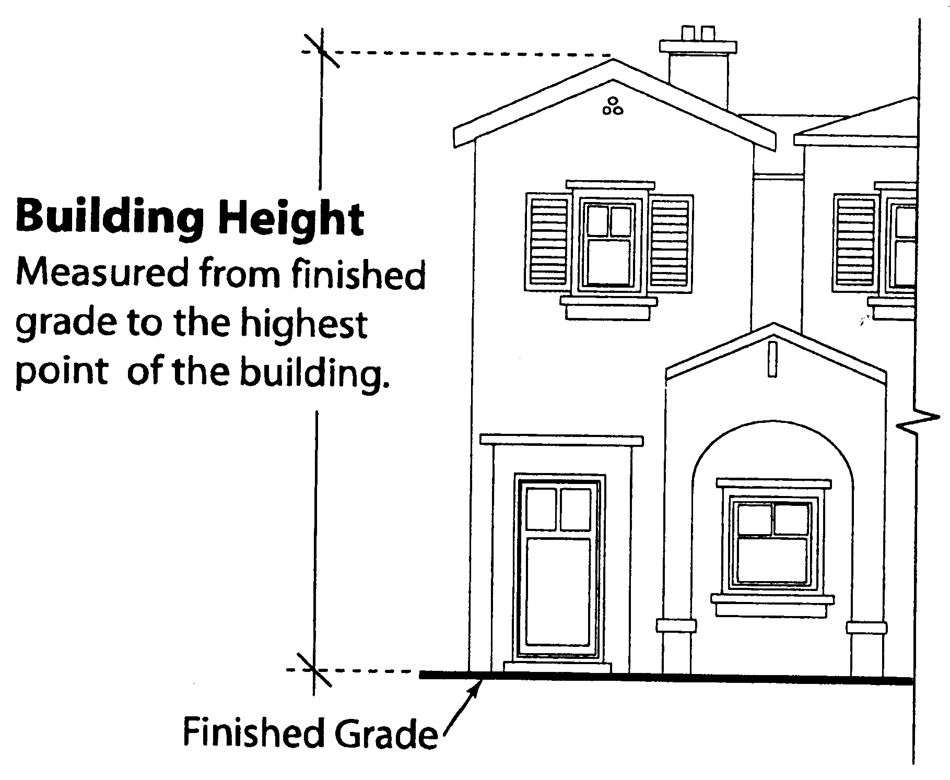
Building height means the vertical distance from finished grade or flood protection elevation to the highest point of the roof of a building or to the highest point of a structure other than a building. Chimneys and finials are not included in determining building height.
Building site means the ground area of a lot; or the ground area of two or more lots when used in combination for a building or permitted group of buildings, together with all open spaces as required by this Title.
(Ord. No. 07-03, § 4(Exh. A), 4-11-2007)
Sec. 9.01.090. - "C" definitions.
Car wash, automated means an enclosed building/facility designed for self-service wash and/or wash of motor vehicles by mechanical means only.
Caretaker means a person residing in a home on a property, whose duties include, but are not limited to, direct care, supervision, or maintenance of the property or uses on the property.
Caretaker's residence (permanent) means a residence located on a premises with a main non-residential use and occupied only by a caretaker or guard employed on the premises, and his/her family.
Caretaker's residence (temporary) means a temporary accessory structure containing living quarters and kitchen facilities for housing persons responsible for administering, overseeing, or maintaining security for the main use on the site during the construction period.
Carport means a permanent roofed structure not completely enclosed, and designed for vehicle shelter or storage.
Catering means a business, which prepares its food on-site to be served and consumed off-site. Catering does not include drive-through restaurants.
CC&R. See "Conditions, covenants and restrictions."
Cellular means an analog or digital wireless communication technology.
Cemetery means land used or intended to be used for the burial of the dead and dedicated for cemetery purposes, including crematories, mausoleums, and mortuaries when operated in conjunction with and within the boundary of such cemetery.
Center means a commercial or professional use, consisting of one or more buildings sharing common facilities such as off-street parking, access, or landscaping.
Certificate of use and occupancy means a required document issued by the Department of Building and Safety prior to occupation or use of buildings erected or structurally altered that acknowledges that such use, structure, or building complies with the provisions of this Code.
Changed plan means a modification to a site development permit.
Channel letters means individual letters or figures, illuminated or non-illuminated, affixed to a building or freestanding sign structure.
Check cashing facility means a non-bank business that for compensation engages in whole or in part, in the business of cashing checks, warrants, drafts, money orders, or other commercial paper serving the same purpose. Check cashing facility does not include a retail seller engaged primarily in the business of selling consumer goods that cashes checks or issues money orders as a service that is incidental to its main purpose or business.
Child day care center or child care nursery means a facility that provides nonmedical care to children under 18 years of age in need of personal services, supervision, or assistance essential for sustaining the activities of daily living or for the protection of the individual on less than a 24-hour basis. Child day care facility includes day care centers, employer-sponsored child care centers, and family child day care homes.
Children's home means one or more buildings used for the semi-permanent, 24-hour care of orphans or other children deprived of parental care, operated by a public agency or a philanthropic or charitable organization, but shall not include commercial enterprises operated by such organizations.
Church means a structure or portion of a structure that is used primarily for religious worship and related religious activities.
Clinic means any facility used for outpatient medical services.
Clubs and lodges (private) means buildings and facilities, owned or operated by a for-profit or non-profit corporation, association, person or persons, for a social, educational, or recreational purpose, to which membership is required for participation.
Co-located means the usage of a single support structure and/or site by more than one wireless communications provider.
Collection facility means a center for the acceptance by donation, redemption, or purchase of recyclable materials from the public.
Commercial means a land use or other activity involving the sale of goods or services for financial gain.
Commercial recreation means a land use or other activity that provides recreational opportunities for financial gain, including, but not limited to "animal day care," "dance studios" and "fitness classes."
Commercial district means a zoning district allowing specified commercial activities including General Commercial (C), Neighborhood Commercial (NC), and Business Park (BP).
Common open space means a type of open space area that is readily accessible for use by the residents and visitors of a multi-family residential or mixed-use development. Common open spaces are designed and reserved for outdoor living and social gathering, active and passive recreation, and pedestrian access and amenities. See Section 9.01.210 for "open space area" definition.
Community care facility means any facility that provides residential care, day treatment or adult day care for children, adults, or both. See also "Residential care facility."
Community facility means a noncommercial use established primarily for the benefit and service of the population of the community in which it is located.
Conditional use means a use that, because of special requirements or characteristics, may be allowed in a particular zoning district only after review by the planning commission and granting of a conditional use permit imposing such conditions as necessary to make the use compatible with other uses permitted in the same zone or vicinity.
Conditional use permit (CUP) means a permit issued by the City authorizing establishment and operation of a conditional use.
Conditions, covenants and restrictions (CC&Rs) means a set of private agreements recorded against property deeds, which set down certain rules and regulations governing the development and use of said properties.
Condominium means an estate in real property consisting of an undivided interest, in common, in a portion of a parcel of real property together with a separate interest in a building on such property.
Congregate care facility means a facility for long-term residence, which shall include common dining and social and recreational features, special safety and convenience features designed for the needs of the elderly and/or disabled, and provision of social services for residents, which must include at least two of the following: meal services, transportation, housekeeping, linen, and organized social activities.
Contiguous. See "Adjoining."
Convalescent facility means a building, wherein for compensation, nursing care is provided for persons suffering from illnesses, other than mental or contagious, which are not of sufficient severity to require hospitalization.
Cornice means a projecting shelf along the top of a wall supported by a series of brackets; the exterior trim where a roof and wall meet, consisting of soffit, fascia, and molding.
CUP. See "Conditional use permit."
Custom house means a house designed especially for construction on a particular residential lot.
Cybercafe. See Chapter 6.09.
(Ord. No. 07-03, § 4(Exh. A), 4-11-2007; Ord. No. 24-07, § 4, 9-11-2024)
Sec. 9.01.100. - "D" definitions.
Dance studio means any premises on which there is conducted all of the following:
(1)
A program of instruction involving live dance;
(2)
Instruction is offered indoors; and
(3)
An instructor is present in the classroom while any participants are present.
Day care/day nursery. See "Child day care center."
Deck means a structure without a roof, directly adjacent to a principal building, which has an average elevation of 30 inches or greater from finished grade. May include porches and balconies.
Density means the number of dwelling units per acre of land.
Density bonus means a minimum density increase of at least 25 percent over the maximum residential density.
Density bonus housing agreement means a legally binding agreement between a developer and the City to ensure that the requirements of Government Code § 65915 are satisfied.
Design means the physical aspects of a development, road improvement, or other construction project. Design includes, but is not limited to, street alignment, grading, landscaping, site layout, building elevations, and signage.
Detached housing. See "Dwelling, single-family detached."
Development project means a public or private-sector venture involving the development, construction, structural or site modification, or redevelopment of commercial, industrial, residential, or other properties.
Development plan means a plan created to describe a proposed development on a specific building site.
Development standard means a numerical maximum or minimum requirement set for each zoning district and regulating the development of building sites. Such standards include, but are not limited to, building setbacks, street frontage, and lot sizes.
Dish antenna. See "Antenna, dish."
District or zoning district means a "base district" or "overlay district."
District, base. See "Base district."
District, overlay. See "Overlay district."
Drive-through means any use or structure, such as a bank, restaurant, or automatic teller machine (ATM) that is designed and intended to be used to provide for sales and/or services to patrons who remain in their vehicles.
Driveway means a traveled way providing vehicular access to a property in single ownership or a nonresidential joint land use of more than one property from an alley or a street.
Duplex means a building designed or used exclusively for occupancy by two households and containing two attached dwelling units.
Dwelling means a building or portion thereof used exclusively for residential purposes.
Dwelling, multiple family means a dwelling within a building on one lot, containing separate living units for three or more rental or homeownership households, having separate or joint entrances, and including apartments, condominiums, and townhomes.
Dwelling, single-family attached means a structure or structures designed to contain two or more dwelling units under separate ownership on one lot that is under common ownership.
Dwelling, single-family detached means a detached building designed or used exclusively for occupancy by one household and containing one dwelling unit.
(Ord. No. 07-03, § 4(Exh. A), 4-11-2007; Ord. No. 11-02, § 2, 4-27-2011; Ord. No. 18-01, § 6, 2-14-2018)
Sec. 9.01.110. - "E" definitions.
Easement means a recorded right or interest in the land of another, which entitles the holder thereof to some use, privilege, or benefit out of or over said land.
Eave line means the bottom of the roof eave or parapet.
Electric vehicle (EV) ready space means a parking space served by a complete electric circuit with proper capacity to accommodate an EV charger in accordance with the requirements of the electrical code in Title 10 of the Rancho Santa Margarita Municipal Code in effect at the time of building permit issuance. The service panel or sub panel and the termination location shall be labeled "EV Ready." The termination point shall accommodate a receptacle within ten feet of the designated EV ready space.
Emergency shelter means a facility that provides shelter and services to homeless families and/or homeless individuals on a limited short-term basis.
Employee means any person employed by a firm, business, educational institution, nonprofit agency, corporation, government agency, or other entity.
Employee housing means residential accommodations provided or designated by an employer for the use of their employees in accordance with the Employee Housing Act, Health and Safety Code Sections 17000 et seq.
Environmental impact report (EIR) means a detailed statement setting forth the environmental effects, considerations, and mitigation measures pertaining to a project pursuant to Section 21100 of the California Environmental Quality Act (CEQA) and the State CEQA Guidelines.
Environmental review means the process of determining the impact of proposed projects on the environment. The review process shall be carried out in accordance with the California Environmental Quality Act and the guidelines of the City.
Equestrian trail means a right-of-way or easement, public or private, designated for the riding of horses. Such trails may also include pedestrian use (hiking trails) and off-road non-motorized bicycle use.
Exception means a minor modification(s) to restrictions or requirements set forth in this Title, and which has no potential for adversely impacting adjacent property.
Extraction operation, commercial the removal or displacement of sand, gravel, rock, aggregate, clay, or similar materials conducted for financial gain.
(Ord. No. 07-03, § 4(Exh. A), 4-11-2007; Ord. No. 11-02, § 3, 4-27-2011; Ord. No. 24-07, § 5, 9-11-2024)
Sec. 9.01.120. - "F" definitions.
Façade means the exterior "face" or elevation of the building, extending from grade to the eaves or the top of the parapet wall and the entire width of the building elevation.
Family care home means a small or large family care home licensed by the State providing 24-hour, non-medical care for persons, including mentally or physically handicapped persons.
(1)
Large family care home means a home that provides care for seven to 14 persons, including children under the age of 18 years who reside at the home.
(2)
Small family care home means a home that provides family care for six or fewer persons including children under the age of 18 years who reside at the home.
Family child day care home means a licensed home that regularly provides care, protection, and supervision for 14 or fewer children, in the provider's own home, for periods of less than 24 hours per day, while the parents or guardians are away, and is either a large family day care home or a small family day care home.
(1)
Large family day care home means a home that provides family day care for seven to 14 children, inclusive, including children under the age of ten years who reside at the home.
(2)
Small family day care home means a home that provides family day care for six or fewer children, including children under the age of ten years who reside at the home.
Fence means an artificially constructed barrier, such as wooden posts, wire, iron, etc., used as a boundary, means of protection, privacy screening or confinement. Does not include natural barriers such as hedges, shrubs, trees, or other natural growth.
Fenestration means the arrangement, proportioning, and design of windows, doors, and other exterior openings in a building.
Final map means a subdivision map prepared by or under the direction of a licensed land surveyor or registered civil engineer in accordance with the California Subdivision Map Act, and which is intended to be placed on record in the office of the County Recorder.
Fitness class means an instructional use including all of the following:
(1)
Fitness activities, including but not limited to aerobics, boxing, cheerleading, gymnastics, kickboxing, weight training, martial arts, yoga, or Pilates;
(2)
Instruction is offered indoors; and
(3)
An instructor is present in the classroom while any participants are present.
Fitness facility means any premises in which a range of indoor and/or outdoor fitness activities and classes are offered.
Flag means any fabric, banner or bunting containing distinctive colors, patterns or symbols, used as a symbol of a government, political subdivision, or other entity.
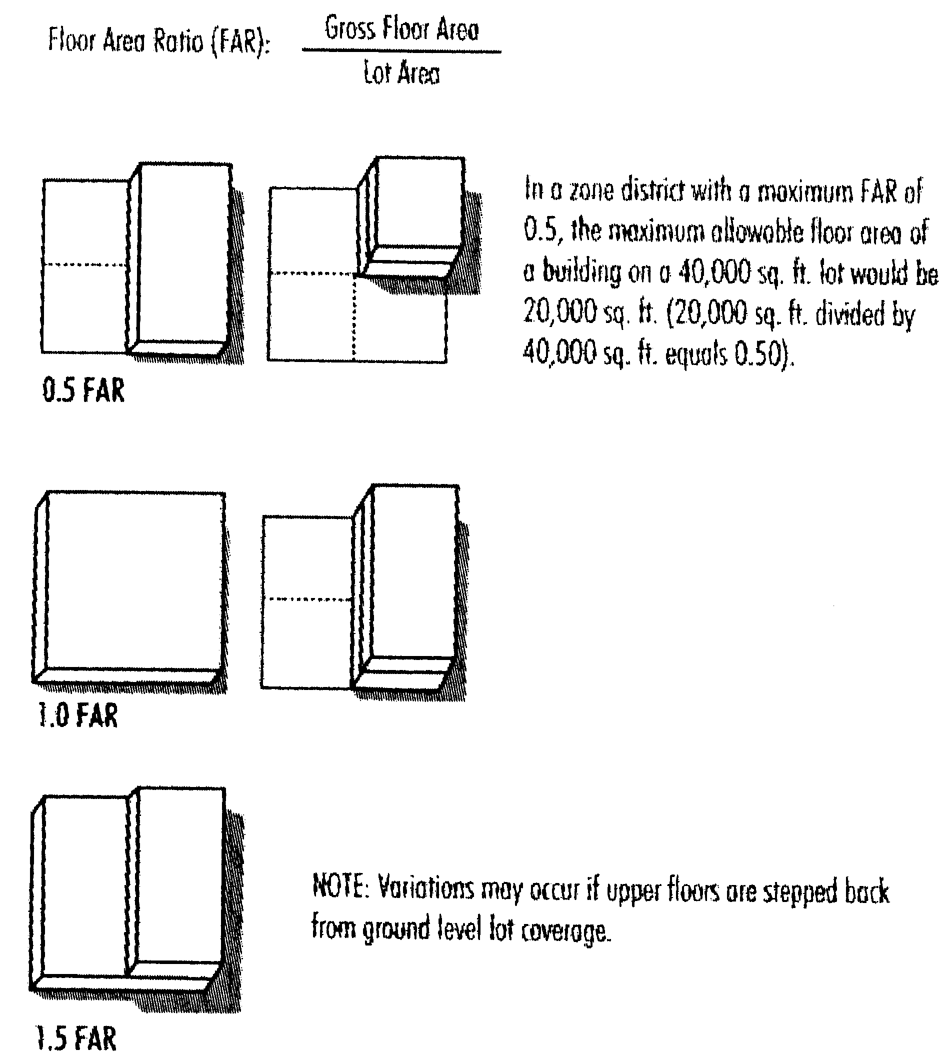
Floor area, gross means the sum of the horizontal areas of the several stories of a building, measured from the exterior faces of exterior walls, or in the case of a common wall separating two buildings, from the centerline of such common wall. Gross floor area excludes basements and attics, the surface area of tennis courts, swimming pools, driveways, parking spaces, decks, and porches.
Floor area ratio (FAR) means the ratio between the total gross floor area of all buildings on a lot and the total area of that lot (figure 9.01.2).
Footcandle means a unit of illumination on a surface that is everywhere one foot from a uniform point source of light of one candle and equal to one lumen per square foot.
Fortune telling means an activity or establishment involving the foretelling of the future or predicting and providing advice on or about future events for financial or other valuable consideration. Fortune telling includes uses where the fortune is told through astrology, palm reading, psychometry, card or tea reading, clairvoyance, crystal gazing, divination, magic mediumship, phrenology, prophecy, spiritual reading, or similar means. Fortune telling does not include advice or forecasting based on historical trends or given during licensed medical care.
Frontage, street means the length of a property line abutting a street.
Fuel dispensing station. See "Gas station."
(Ord. No. 07-03, § 4(Exh. A), 4-11-2007; Ord. No. 24-07, § 6, 9-11-2024)
Sec. 9.01.130. - "G" definitions.
Game machine means any electric or electronic machine (e.g., pinball, video games) that provides amusement, enjoyment or entertainment and that may be operated upon the insertion of a coin or token. This term shall not include juke boxes, children's mechanical rides (e.g., horses, rocket ships), or machines that sell merchandise.
Garage means a building or a portion of a building used primarily for the parking of vehicles belonging to the occupants of the property.
Gas station means a commercial business which conducts the retail sale of motor vehicle and related petroleum-based fuels including but not limited to gasoline, diesel, ethanol, and propane fuels. Automobile service and repair is not included.
General plan means the General Plan of the City adopted by the City Council.
Grade means the lowest horizontal elevation of the finished surface of the ground, paving or sidewalk at a point where the height is to be measured; the degree of rise or descent of a sloping surface.
Grading means an excavation, filling in, spreading, or moving of earth, sand, gravel, rock, or other material on a lot, building site, street right-of-way or other land area.
Gross floor area means the area included within the surrounding exterior finish wall surface of a structure or portion thereof, excluding the courtyards.
(Ord. No. 07-03, § 4(Exh. A), 4-11-2007; Ord. No. 18-01, § 7, 2-14-2018)
Sec. 9.01.140. - "H" definitions.
Hazardous waste means a waste, or combination of wastes, which because of its quality, concentration, toxicity, corrosiveness, flammability, or physical, chemical, or infectious characteristics may:
(1)
Cause or significantly contribute to an increase in mortality or an increase in serious irreversible, or incapacitating reversible illness; or
(2)
Pose a substantial present or potential hazard to human health or the environment when improperly treated, stored, transported, or disposed of, or otherwise managed.
HCD means the State Department of Housing and Community Development.
Home occupation means a business activity conducted in compliance with Section 9.05.060.
Homeless shelter. See "Emergency shelter."
Hookah bar means a primary or incidental use which offers the use of hookahs or other similar smoking devices.
Hospital means an establishment, licensed by the State Department of Health Services, which provides accommodations, facilities and services over a continuous period of 24 hours or more, for observation, diagnosis, treatment or care of human patients who are suffering from mental or physical illness.
Hotel means a structure or group of structures containing six or more guest rooms or suites offering temporary lodging accommodations to the general public.
Housing development project has the same meaning as defined in subdivision (h) of Section 65589.5 of the Government Code.
(Ord. No. 07-03, § 4(Exh. A), 4-11-2007; Ord. No. 11-02, § 4, 4-27-2011; Ord. No. 24-07, § 7, 9-11-2024)
Sec. 9.01.150. - "I" definitions.
Improvement means the construction of infrastructure and all related appurtenances, bridges, utilities, pedestrian-ways, bikeways, equestrian trails, or landscaping and irrigation in connection with an approved development or public works project, whether involving the subdivision of land or not.
Interested person means a person who either:
(1)
Participates in one or more public meetings or hearings held to consider an application for a land use decision;
(2)
Is a recipient of legally-required notice of a proposed land use decision; or
(3)
Is the owner of property that is the subject of a proposed land use decision.
Internet cafe. See "Cybercafe."
Irrevocable offer of dedication (IOD) means an offer made to the City for the dedication of land or facilities which, at any time, may be accepted by Resolution of the City Council.
(Ord. No. 07-03, § 4(Exh. A), 4-11-2007)
Sec. 9.01.160. - "J" definitions.
Junk means cast off, used or scrap material of any sort.
(Ord. No. 07-03, § 4(Exh. A), 4-11-2007)
Sec. 9.01.170. - "K" definitions.
Kennel means any place where four or more domestic animals, four months of age or older, are kept or maintained for the purpose of boarding, breeding, raising, or training for a fee or for sale.
(Ord. No. 07-03, § 4(Exh. A), 4-11-2007)
Sec. 9.01.180. - "L" definitions.
Landscape boundary area means the planted area consisting of trees, shrubs, groundcover, or turf that borders a project site.
Landscaping means the planting and maintenance of some combination of trees, groundcover, shrubs, vines, flowers or lawn. In addition, the combination or design may include natural features such as rock and stone, and structural features including but not limited to fountains, reflecting pools, art work, screens, walls, fences, and benches.
Laundromat means a facility where patrons wash, dry, or dry clean clothing or other fabrics in machines operated by the patron.
Logo means a trademark, copyright, or symbol of an organization which is consistently used within the conducting of the business activity.
Lot means any numbered, lettered, or otherwise designated parcel of land shown on:
(1)
A recorded tract map;
(2)
A record of survey map recorded pursuant to an approved division of land; or
(3)
A parcel map.
Lot area, gross. See "Acreage, gross."
Lot area, net. See "Acreage, net."
Lot cluster means any single lot, or a group of adjacent lots having a single uninterrupted perimeter boundary enclosing all of the lots.
Lot, corner means a lot situated at the intersection of two or more streets as shown in Figure 9.01.3.
Lot coverage means that percentage of a lot which, when viewed directly from above, would be covered by a structure or structures, or any part thereof, excluding projecting roof eaves, as shown in Figure 9.01.5.
Lot depth means the distance between the midpoint of the front lot line and the midpoint of the rear lot line.
Lot, flag means a parcel of land shaped like a flag; the staff is a narrow strip of land providing vehicular and pedestrian access to a street, with the bulk of the property lying to the rear of other lots, as shown in Figure 9.01.3.
Lot, interior means a lot other than a corner lot, as shown in Figure 9.01.3.
Lot line means a line separating one lot from another or from a public right-of-way.
Lot line adjustment means the reconfiguration of lot lines where an equal or lesser number of lots are created.
Lot line, front means:
(1)
A line separating an interior lot from a street or highway;
(2)
A line separating the narrower street frontage of a corner lot from a street or highway, unless otherwise specified by deed restriction;
(3)
In the case of lots set back from the street, with long narrow portions for access, the line, or series of lines, delimiting the front of the buildable portion of the lot shall be established as the front lot line, as shown in Figure 9.01.4.
Lot line, rear means a lot line which is opposite and most distant from the front lot line; and, in the case of an irregular, triangular, or other non-rectangular lot, a line a minimum of ten feet in length within the lot, approximately parallel to and at the maximum distance, within the lot, from the front lot line, as shown in Figure 9.01.4.
Lot line, side means any lot boundary line, not a front lot line or a rear lot line. On a corner lot, the street right-of-way line with the greatest amount of street frontage shall be the side lot line, unless otherwise specified by deed restriction, as shown in Figure 9.01.4.
Lot, through means a lot that extends between two parallel or approximately parallel streets, with frontage and access points on both streets, as shown on Figure 9.01.3.
Lot width means the minimum horizontal distance between the side lot lines measured at a point midway between the front and rear lot line.
Low barrier navigation center means a housing-first, low-barrier, service-enriched shelter focused on moving people into permanent housing that provides temporary living facilities while case managers connect individuals experiencing homelessness to income, public benefits, health services, shelter, and housing. A low-barrier navigation center includes any facility that meets the definition and requirements set forth in Sections 65660 and 65662 of the Government Code.
Lower slope means in relation to terraces on manufactured slopes, the lower slope shall be that portion of the slope below the terrace.
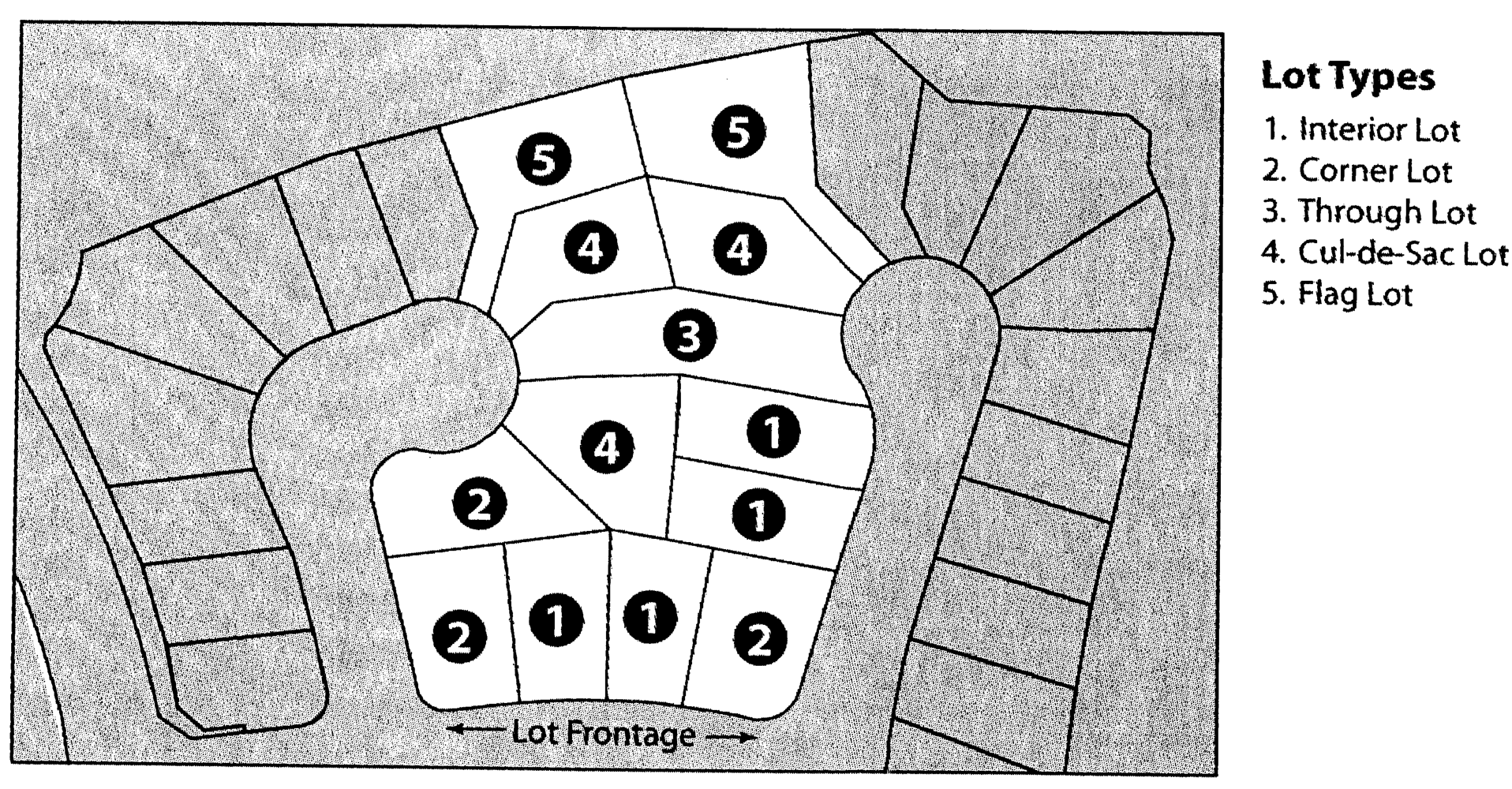
Figure 9.01.3: Lot Types
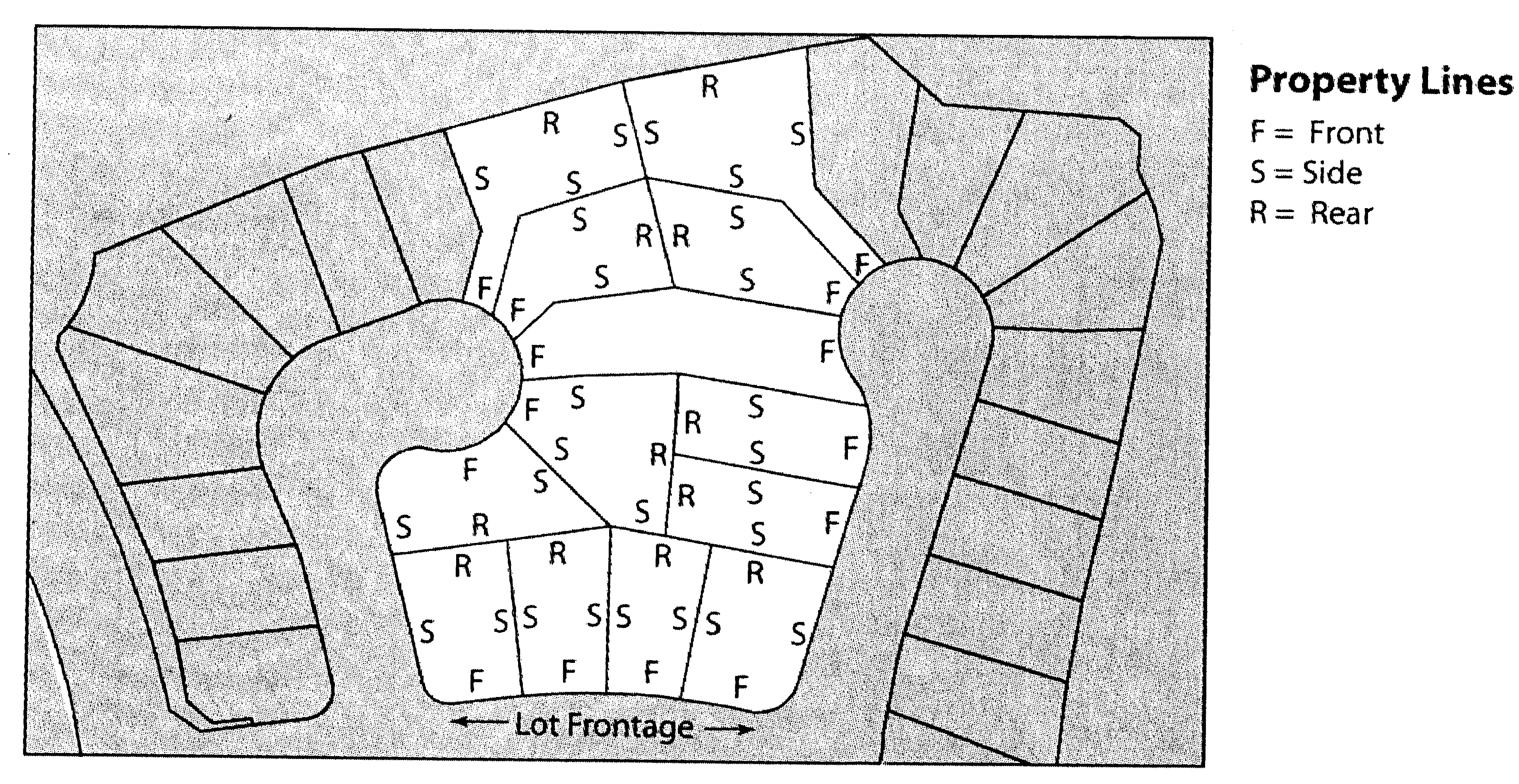
Figure 9.01.4: Lot Lines
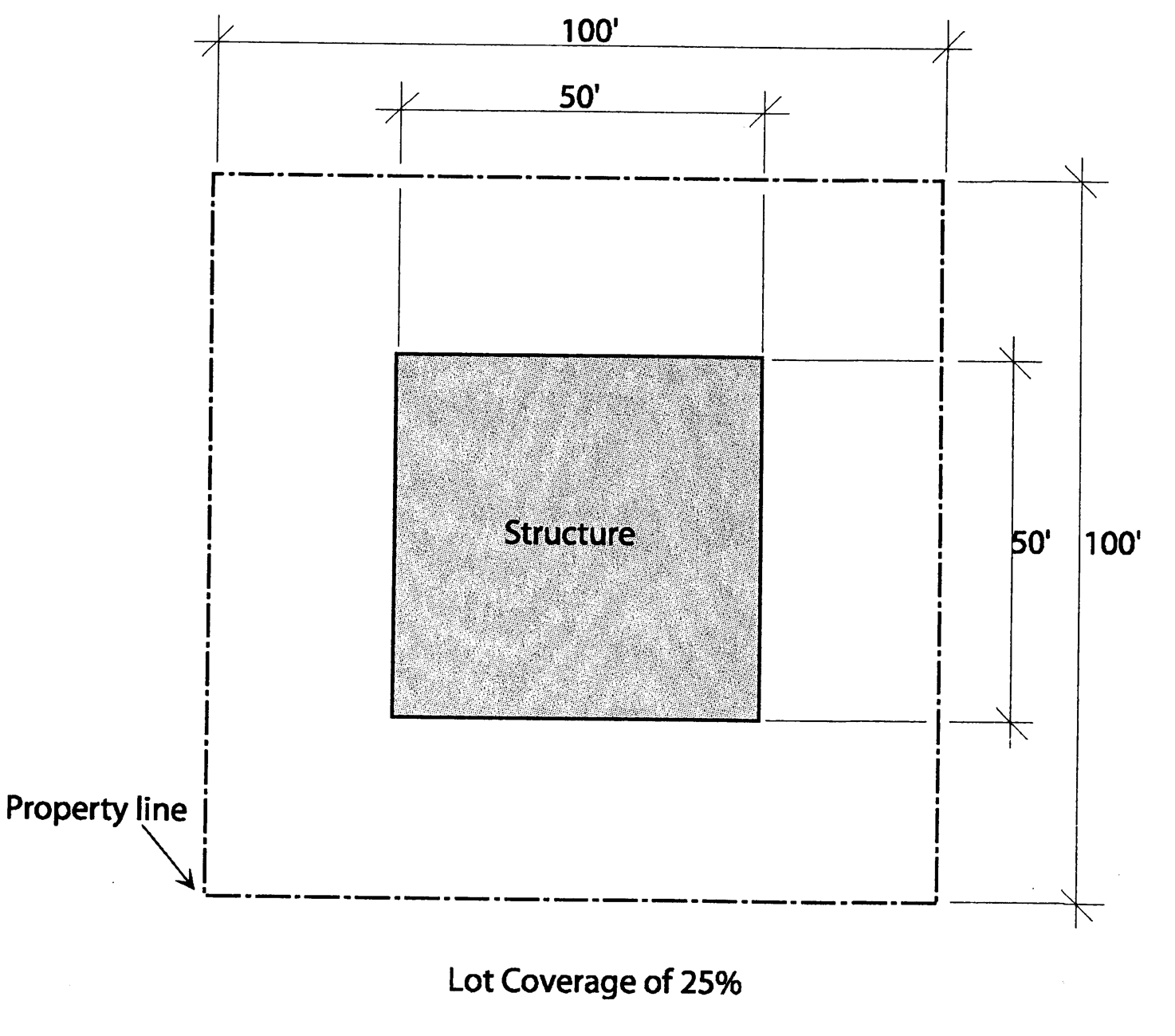
Figure 9.01.5: Lot Coverage
(Ord. No. 07-03, § 4(Exh. A), 4-11-2007; Ord. No. 24-07, § 8, 9-11-2024)
Sec. 9.01.190. - "M" definitions.
Main residential building. See "Building, main residential."
Manufactured housing means housing that is constructed of manufactured components, assembled partly at the site rather than totally at the site, and as defined in the California Health and Safety Code § 18007. Also referred to as "modular housing" or "factory-built housing."
Marijuana business means any activity, whether or not carried out for commercial gain, which involves cultivation, possession, manufacture, processing, storage, laboratory testing, labeling, transportation, distribution, or sale of marijuana or any marijuana-infused products. This definition shall include any of the foregoing activities conducted by or on behalf of a qualified patient or the primary caregiver of a qualified patient. All references in this Section to "marijuana business," shall be synonymous with "marijuana dispensary," "mobile marijuana dispensary," and "marijuana cultivation site," which are defined in Section 9.05.140. The term "marijuana business" shall not include "personal cultivation of marijuana," as defined in Section 9.05.140.
Massage establishment means any business or establishment with a fixed location within the City of Rancho Santa Margarita where any individual, firm, association, partnership, limited liability company, corporation, or combination of individuals, offers, engages in, conducts, carries on or permits to be engaged in, conducted or carried on, massage services, as defined in Chapter 4.02, within the City, including the business office of a sole provider who provides massage services at such business office. Any type of business or establishment at which massage services are provided shall be considered a massage establishment for purposes of this Title, regardless if the business holds itself out as something other than a massage establishment and/or also offers or provides other types of products or services. Any business or establishment that offers any combination of massage services and sauna facilities, including, but not limited to, showers, baths, wet and dry heat rooms, pools and hot tubs, shall be deemed a massage establishment under this Title.
Mini-mart or food convenience store means a business offering for sale food products both fresh and refined, including but not limited to fresh fruits and vegetables, prepackaged and processed food products, dairy products, baked goods, and beverages within a building less than 5,000 square feet.
Mini-storage. See "Self-storage facility."
Mixed-use development means a development that includes non-residential and residential uses on the same development site, developed as a cohesive project and designed with a blend of various compatible uses such as commercial, office, and residential.
Mobile home or manufactured home means a home built on a permanent steel chassis in a factory to the specifications of the National Manufactured Housing Construction and Safety Standards Act of 1974 and installed either with or without a permanent foundation.
Model home means a dwelling unit temporarily used for display purposes as an example of dwelling units available or to be available for sale or rent in a particular subdivision or other residential development approved by the City. Model homes may also incorporate sales or rental offices for dwellings within the development.
Modular or factory built home. See "Manufactured housing."
Monopole means a structure composed of a single spire used to support antennas or related equipment.
Motel means an establishment otherwise defined as "hotel" with at least 25 percent of all rooms having direct access to parking areas without the necessity of passing through the main lobby of the building.
Multi-tenant means a building occupied by more than one business or organization.
(Ord. No. 07-03, § 4(Exh. A), 4-11-2007; Ord. No. 13-01, § 3, 8-14-2013; Ord. No. 16-05, § 4, 10-12-2016; Ord. No. 17-02, § 5, 5-24-2017; Ord. No. 17-03, § 3, 9-13-2017; Ord. No. 18-01, § 8, 2-14-2018; Ord. No. 24-07, § 9, 9-11-2024)
Sec. 9.01.200. - "N" definitions.
Noncommercial means a land use or other activity that does not involve the sale of goods or services for financial gain.
Nonconforming activity means an activity that, under the zoning regulations, is not itself a permitted activity where it is located or does not conform to the development standards, performance standards, or other requirements of the zoning district in which it is located.
Nonconforming structure means any structure upon land, including any sign, that was lawfully established and in compliance with all applicable ordinances and laws at the time the structure was built or the improvement made, but which, as a result of a subsequently enacted ordinance or law, no longer complies with all of the applicable regulations and standards of the zoning district in which the structure is located.
Nonconforming use means any use of land or property that was lawfully established and in compliance with all applicable ordinances and laws at the time the use was established, but which, because of a subsequently enacted ordinance or law, no longer complies with all of the applicable regulations and standards of the zoning district in which the use is located.
Non-restricted units means all units within a housing development excluding units restricted for affordable housing.
NPDES means National Pollution Discharge Elimination Systems of the Clean Water Act.
Nursing home. See "Rest home."
(Ord. No. 07-03, § 4(Exh. A), 4-11-2007)
Sec. 9.01.210. - "O" definitions.
Objective development standard means a standard that involves no personal or subjective judgment by a public official and is uniformly verifiable by reference to an external and uniform benchmark or criterion available and knowable by both the development applicant and the public official prior to submittal.
Open space areas means:
(1)
Land area not devoted to or covered by structures or any area serving motor vehicles (such as parking areas, loading areas, driveways, streets, or alleys), and not part of any required yard;
(2)
Areas not a part of a manufactured or altered slope having a ratio of steeper than three to one (3:1); or
(3)
Areas with a minimum width of ten feet and a minimum contiguous area of 300 square feet.
Outdoor storage, permanent means the use of a premises or part of a premises not enclosed by a building, for the storage of materials or equipment, not otherwise classified as temporary storage.
Outdoor storage, temporary means the use of a premises or part of a premises not enclosed by a building, for the storage of materials or equipment for a period not greater than 30 days in a 60-day period.
Overlay district means a certain portion of the City wherein regulations relating to specific environmental and/or physical characteristics are imposed in addition to those of the zoning district covering the land in question.
(Ord. No. 07-03, § 4(Exh. A), 4-11-2007; Ord. No. 24-07, § 10, 9-11-2024)
Sec. 9.01.220. - "P" definitions.
Parapet means an architecturally integrated low wall, railing, or screen to protect the edge of a building's platform or roof.
Parcel means a contiguous quantity of land in the possession of, owned by, or recorded as the property of the same person.
Parcel map means a map, prepared by a registered civil engineer or licensed land surveyor, showing the subdivision of land into four or less lots in accordance with the provisions of the California Subdivision Map Act and this Title, and which shows detailed information sufficient for recordation by the County Recorder.
Parking facilities, off-site shall include any parking lot or structure for the parking of motor vehicles which serve a use or uses which are located on a different legal lot of record from that of the parking facility and do not directly adjoin the lot served. Off-site parking facilities do not include parking lots or structures which are classified as "joint use/shared parking" as provided by Section 9.06.090.
Parking facility means an area, either open or enclosed, within a structure or portion thereof, designed or used for the parking of motor vehicles.
Parking lot, public means an open parking facility which is not accessory to a structure or use on the same or another lot.
Parking management plan means a plan, the principal aim of which is to obtain maximum use from a limited number of parking spaces.
Parking, shared or joint use means a public or private parking area used jointly by two or more uses.
Parking space or stall means a designated area within a parking facility designed and used for the temporary parking of one motor vehicle.
Parking structure means a structure of two or more stories, whether privately or publicly owned, used for parking more than four automobiles.
Parkway means a piece of land located between the rear of a curb and the front of a sidewalk or between the sidewalk and property line, usually used for planting low ground cover and/or street trees and separating pedestrians from vehicles within the right-of-way.
Patio means a level, surfaced area directly adjacent to a principal building open on one or more sides whose principal use shall be for outdoor entertaining and recreation.
Patio cover means a solid or open roof structure not exceeding 12 feet in height and covering a patio or deck. Patio covers may be detached or attached to another structure.
PC cafe. See "Cybercafe."
Pedestrian-oriented means a streetscape, building, or environment that is designed to accommodate, and is comfortable for the pedestrian. Building and street elements will relate and be scaled to a typical human body, including height and eye level (sightlines), walking stride and speed, perception of information, and the need for shelter from the elements. Used in contrast to car- or vehicle-oriented.
Pedestrian ways means a paved right-of-way for pedestrians that is separate and protected from the traveled portion of the roadway, and free from vehicular traffic.
Pennant means any lightweight plastic, fabric, or other material, whether or not containing a message of any kind, suspended from a rope, wire or string, usually in series, designed to move in the wind.
Pergola means an outdoor structure providing partial or complete shade, with vertical posts and a slatted or minimalist roof, which may be a freestanding structure or attached to the outer wall of a building.
Permit means any permit issued pursuant to the provisions of this Code, together with the application required for such permit, the conditions upon which such permit is issued, and the plans, specifications, reports, and approved modifications pertaining thereto.
Permitted use means a use permitted in a zone district which requires only ministerial approval.
Photovoltaic zone (PV zone) means the section of a roof designated and reserved for the future installation of a photovoltaic system.
Pilaster means a partial pier or column, often with a base, shaft, and capital that is embedded in a wall and projects slightly.
Planning commission means the Planning Commission of the City, unless some other commission, board or committee is indicated.
Planned community means communities developed per land use plans and development agreements that identify specific land uses, levels of development allowed, and important public facilities.
Porch means a covered deck, usually having a separate roof, at an entrance to a dwelling, which may or may not use columns or other ground supports for structural purposes.
Portico means a type of building entrance with a roof structure overhead and supported by columns or enclosed by walls.
Primary/principal use means the main purpose for which a structure or lot is designed, arranged, or intended, or for which either may be used, occupied, or maintained under this Title.
Primary street means a street in relation to a site that is the right-of-way with the higher street classification according to the City's circulation element, and which generally carries the greater volume of vehicular traffic.
Private outdoor space means an exterior area such as a balcony, deck, patio, or fenced yard located immediately adjacent to an individual dwelling unit, and only available for use by the residents of that dwelling unit.
Project means any proposal for new or changed use, or for new construction, alteration or enlargement of any structure, that is subject to the provisions of this Title.
Property line means a line separating parcels of real property having separate legal descriptions, or which separates a parcel from a public right-of-way.
Public facilities means uses principally of an institutional nature and serving a public need, such as hospitals, public schools, libraries, museums, post offices, police and fire stations, public utilities, and other public services.
(Ord. No. 07-03, § 4(Exh. A), 4-11-2007; Ord. No. 24-07, § 11, 9-11-2024)
Sec. 9.01.230. - "Q" definitions.
Quasi-public means a use owned or operated by a non-profit institution providing educational, cultural, recreational, religious, or similar types of public programs.
(Ord. No. 07-03, § 4(Exh. A), 4-11-2007)
Sec. 9.01.240. - "R" definitions.
Recreational area means areas of active play or recreation such as sports fields, schoolyards, picnic grounds, or other areas with intense foot traffic.
Recreational vehicles means recreational vehicles include the following:
(1)
Travel trailer means a vehicular portable structure built on a chassis designed to be used as a temporary dwelling for travel, recreational and vacation uses permanently identified as a travel trailer by the manufacturer;
(2)
Camper means a structure designed primarily to be mounted upon a motor vehicle and with sufficient facilities to render as suitable for use as a temporary dwelling for camping travel, recreational and vacation purposes;
(3)
Motor home means a portable dwelling designed and constructed as an integral part of a self-propelled vehicle for camping, travel, recreation, and vacation purposes; and
(4)
Full tent trailer means including boats, floats, and rafts plus the normal equipment to transport the same on a street or highway.
Recycling area means space allocated for the accessory use of collecting and loading of recyclable materials.
Recycling facility means a center for the collection of recyclable materials. A recycling facility does not include storage containers or processing activity located on the premises of a residential, commercial, or industrial use and used solely for the recycling of material generated by that tenant or owner.
Reimbursement agreement means a legal agreement between a person and a government agency whereby the person will be repaid a certain portion of the fees paid in connection with a development or subdivision when further development occurs in the area or other specified events take place.
Religious, fraternal or service organizations means churches and/or nonprofit organizations engaged primarily in performing charitable, benevolent, patriotic, employment-related or educational functions.
Residential care facility means any family home, group care facility, or similar facility (as determined by the State) licensed by the State to provide 24-hour non-medical care of persons in need of personal services, supervision, or assistance essential for sustaining the activities of daily living or for the protection of the individual, provided by the California Community Care Facilities Act.
Residential density, maximum means the maximum number of residential units permitted by the City's General Plan Land Use Element and Zoning Code at the time of application, excluding the provisions of Section 9.05.040.
Residential district means generally, zoning districts for residential uses, including RL, RLM, RM and RH.
Residential project means a development project which will result in the construction of new dwelling units in the City. Such projects may or may not involve the subdivision of land.
Restaurant means a commercial establishment where food and beverages are prepared, served, and consumed.
Rest home means an institution or premises licensed by the State and used for the housing and care of the ambulatory, aged, or infirm and offering or providing lodging, meals, nursing, dietary or other personal services, but not including the care and treatment of persons with contagious or communicable disease, mental illness, or persons addicted to narcotics or alcohol. The term does not include places where there is surgery, physical therapy, or other similar activities, such as are customarily provided in hospitals. Rest homes also include residential care facilities for the elderly, nursing homes, assisted care facilities, convalescent homes, homes for the aged, veterans' homes and the like, plus other similar names signifying long-term care, which is personal and at most nursing help, rather than medical or surgical care.
Retail or retail sales means the sale of goods, merchandise, or commodities for consumption or use by the purchaser.
Reveal means an inner surface of an opening or recess in a wall, typically in relation to a window or door.
Reverse vending machine means an automated mechanical device that accepts at least one type of empty beverage containers including but not limited to, aluminum cans, glass and plastic bottles, and issues a cash refund or a redeemable credit slip with a value not less than the container's redemption value as determined by the State.
Right-of-way means an area or strip of land, either public or private on which a right of passage has been recorded. Thus, "right-of-way" shall include a public right-of-way, an easement, a common lot containing a private street, or other public or private right of passage consistent with this definition.
Roadway means that portion of a street, highway, or alley right-of-way designed or used for accommodating the movement of vehicles. The roadway may or may not accommodate vehicle parking.
Roof, gable means a roof having a triangular portion of wall at one or both ends; or a roof sloping downward in two opposite directions from a central ridge, so as to form a triangular portion of wall at each end.
Roof, hip means a roof which slopes upward from all four sides of a building, requiring a rafter at each corner. A hip roof has no gables or other vertical sides.
Roof, mansard means a roof with a steep lower slope and a flatter upper slope on all sides, and having either a convex or concave shape.
Roof, shed means a roof having a single sloping plane, and no hips, ridges, or valleys.
Runoff means water that flows at a rate above the infiltration rate of soil which causes water to drain away on the surface from the landscape area it is intended to service.
(Ord. No. 07-03, § 4(Exh. A), 4-11-2007; Ord. No. 07-07, § 4, 11-14-2007; Ord. No. 24-07, § 12, 9-11-2024)
Sec. 9.01.250. - "S" definitions.
Sanitary sewer means a conduit designed to carry sewage.
School means any institution of learning for minors, whether public or private, offering instruction in those courses of study required by the California Education Code and maintained pursuant to standards set by the State Board of Education. This definition includes a nursery school, kindergarten, elementary school, middle or junior high school, senior high school, or any special institution of education, but it does not include a vocational or professional institution of higher education, including a community or junior college, college, or university.
Screening means solid walls, solid fences or dense hedges, trees or other similar landscaped installed for the purpose of concealing from view the area behind such structure or hedges.
Secondhand store. See "thrift store."
Second dwelling unit. See "Accessory dwelling unit."
Senior citizen housing development means a housing development that has been designed to meet the physical and social needs of senior citizens as that phrase is used in California Civil Code § 51.3(b)(1) and which qualifies as housing for older persons as that phrase is used in the Federal Fair Housing Amendments Act of 1988 and implementing regulations.
Service commercial means retail establishments that primarily render services rather than goods. Such services may include, but not be limited to, copy shops, printing services, appliance repair, salons, photo processing, and postal and packaging services.
Setback means a minimum horizontal distance between the building line and the lot line; or when abutting a street, the minimum horizontal distance between the building line and the ultimate right-of-way line, as shown in Figure 9.01.6.
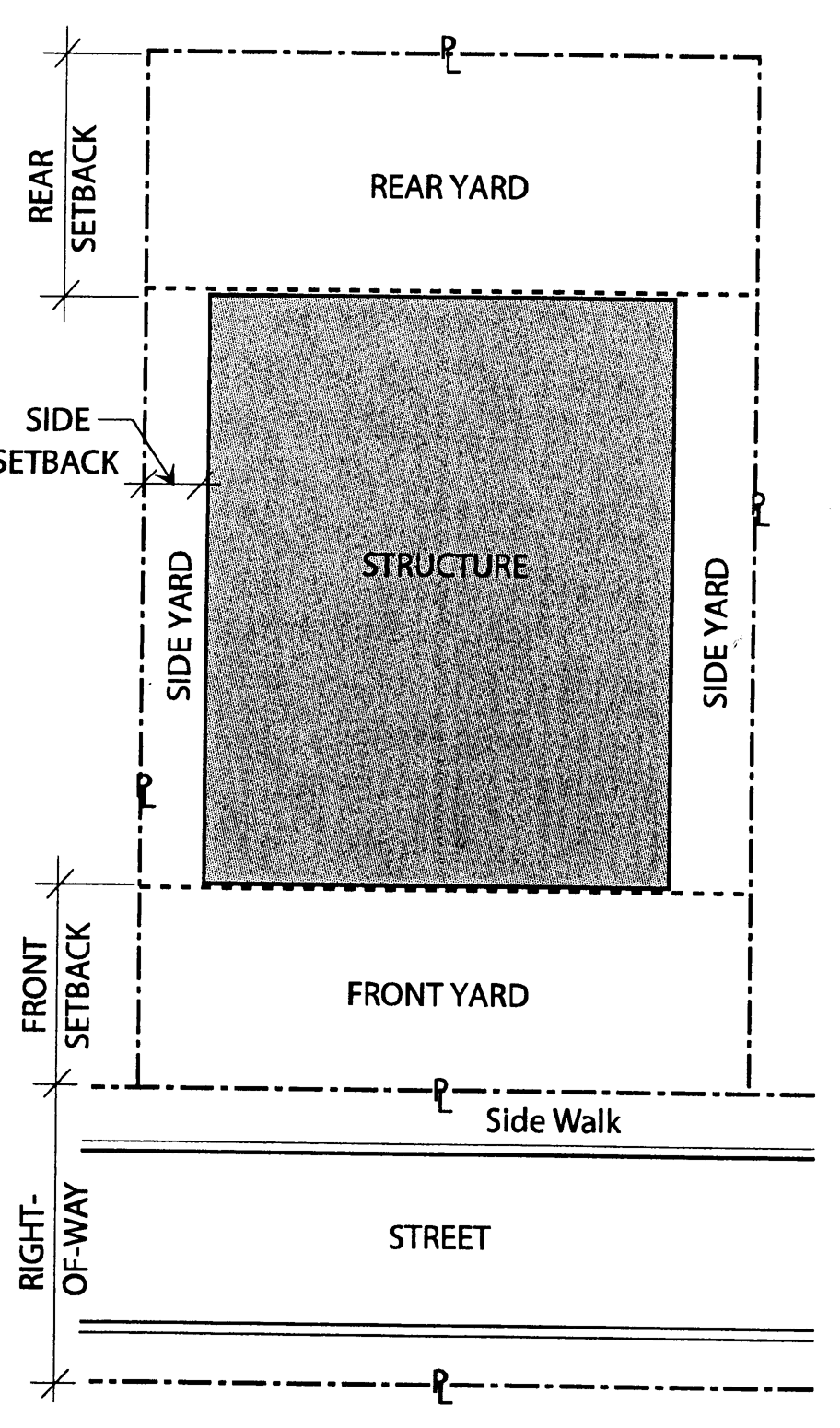
Figure 9.01.6: Setbacks
Shopping center means a group of more than two retail stores and service establishments designed to serve as a unit with shared access and common parking.
Side street means a street joining and often terminated by a collector or arterial roadway as defined in the General Plan circulation element.
Sidewalk means that portion of a vehicular thoroughfare not within the roadway and set apart by curbs, barriers, markings or other delineations for pedestrian travel.
Sign means any medium of visual communication, including copy, artwork, structure, component parts, and humans which is used or intended to be used to attract attention to and identify an establishment, product, service, activity, location, or to provide information.
Sign, A-frame means a freestanding sign usually hinged at the top, or attached in a similar manner, and widening at the bottom to form a shape similar to the letter A. Such signs are usually designed to be portable, hence they are not considered permanent signs.
Sign, abandoned means any display remaining in place or not maintained for a period of 90 days or more in a one-year period, which no longer advertises or identifies an ongoing business, product, or service available on the business premises where the display is located.
Sign alteration means any change of copy, sign face, color, size, shape, illumination, position, location, construction, or support of any sign or advertising device.
Sign, ancillary means a secondary or subordinate sign.
Sign, animated means any sign that uses movement or change of lighting to depict action or create a special effect or scene.
Sign area means the entire surface area of a sign including non-structural trim, but excluding the supports, uprights, or structures upon which the sign is supported. Sign area of cutout letters or displays include the total area within the periphery of the cutout letters or display. The sign area of advertising statuary is the entire surface area of the statuary.
Sign, banner means a temporary visual display device, with or without copy, usually rectangular in shape made of flexible material, usually cloth, paper, or plastic
Sign, bench means a sign located on any part of the surface of a bench or seat placed on or adjacent to a public right-of-way or that is visible from a public right-of-way.
Sign, billboard means an off-site sign used for advertising purposes and whose copy or message is changed from time to time.
Sign, blade. See "Sign, hanging."
Sign, building-mounted means a sign affixed to or painted on a building, including awning, window, or canopy.
Sign, cabinet means a sign that contains all the text and/or symbols within a single enclosed cabinet and may or may not be illuminated.
Sign, campaign or political means a temporary political sign, which may include any advertising device or sign, not otherwise prohibited by this Title, which is designed to influence the passage or defeat of any measure on the ballot or designed to influence the voters with respect to the nomination, election, defeat or removal of a candidate from public office at any National, State or local election.
Sign, can. See "Sign, cabinet."
Sign, canopy means any sign that is a part of or attached to an awning, canopy, or other fabric, plastic, or structural protective cover over a door, entrance, window, or outdoor service area. A marquee is not a canopy.
Sign, City means a sign erected and maintained by the City for public informational, directional or safety purposes.
Sign, commercial center means a freestanding sign which identifies the name and/or address of a commercial center and which may also identify the principal tenants of the center.
Sign, community neighborhood identification means a monument or wall sign within the boundaries of a residential development or subdivision containing only the name and/or identifying symbol of the community, residential development, or subdivision.
Sign, construction means a sign containing information pertaining to a future development or on-going construction on the site where the sign is located, including the name of the project, developer, contractor, architect, financing source, future occupant(s), and other information directly related to the development.
Sign copy means any words, letters, numbers, designs, logos, or other symbolic representations incorporated into the face of a sign.
Sign, directional means a sign directing motorists or pedestrians to parking or building entrances or providing similar directional information.
Sign, directory means a sign or group of signs attached to a building or freestanding that identifies the business, owner, address, or occupation of a group of businesses, but contains no advertising.
Sign, double-sided means a single structure designed with the intent of providing copy on both sides.
Sign, electronic message board means a directly illuminated sign which presents variable advertising messages displayed by electronically controlled lighting pattern against a contrasting background, and which may be programmed to change the message display periodically.
Sign, externally illuminated means a sign made readable by projecting light onto or around the message or copy of the sign.
Sign face means the exterior surface of sign, exclusive of structural supports, on which is placed the sign copy.
Sign feature means a unique, artistic, two- or three-dimensional image reflective of a company's use, product or service.
Sign, flashing means a sign that contains an intermittent or sequential flashing light source.
Sign, freestanding means a sign supported by a base, uprights, or braces placed upon or into the ground and detached from any building.
Sign, freestanding pole means a sign supported upon the ground and mounted on poles and not attached to any building.
Sign, freestanding monument means a sign which is supported by a solid base of masonry, brick, block, or wood.
Sign, garage sale means a temporary sign announcing the limited sale, from a private resident, of goods, furniture, clothing, or similar articles.
Sign, gas or service station price means a permanent sign subject to State regulation, usually of a monument type, containing the prices and grades of fuel for sale at an automobile service station.
Sign, hanging means a sign hanging from a building canopy, arcade, or other structural member.
Sign height means the measurement from the top of the sign face to the average finished grade at the base of the sign.
Sign, identification means a sign whose commercial copy is limited to the name, type of business, and address of the building, business, office, establishment, person, or activity.
Sign, interior means a sign inside of any business that is located more than three feet from any window and cannot be seen from outside the building in which the business is located. An interior sign is not a window sign.
Sign, internally illuminated means a sign which a source of light is projected through a transparent material that consists of the letters of the message or sign copy.
Sign, major tenant means a business in a multi-tenant center which occupies more than 15 percent of the net building square footage of a building or whose building area is designated as a major tenant suite by the Planning Commission as part of an approved sign program.
Sign, marquee means a building-mounted sign which is attached flush to or painted on the front of a marquee or similar architectural projection.
Sign, mobile means a sign attached to or painted on a vehicle used for the purpose of transporting personnel or goods as part of the day-to-day operations of a business. A vehicle sign is not a mobile sign. A portable sign is not a mobile sign.
Sign, monument means an independent structure supported from grade to the bottom of the sign with the appearance of having a solid base.
Sign, multi-faced means a single sign having two or more faces.
Sign, multiple means a sign structure to which are attached two or more separate signs.
Sign, neon means any glass tube lighting in which a gas and phosphors are used in combination to create a colored sign.
Sign, nonconforming means any temporary or permanent sign legally erected, established and maintained in conformance with the provisions of all applicable laws in effect at the time of original installation, but which does not conform to the number, size, placement, or other requirements of this Title.
Sign, off-site means a sign referring to a person, establishment, merchandise, service, event, or entertainment which is not located, sold, produced, manufactured, provided, or furnished on the premises where the sign is located.
Sign, on-site means a sign referring to a person, establishment, merchandise, service, event, or entertainment which is located, sold, produced, manufactured, provided, or furnished on the premises where the sign is located.
Sign, painted means any sign which consists of paint or a similar substance applied directly to a building surface, such as a wall, window, rafter, canopy support, or applied directly to the surface of a sign face or structure.
Sign, pedestrian means a small sign readable primarily from the abutting sidewalk or other walkway, but generally not from the street.
Sign, portable means any sign designed to be moved easily and which is not permanently affixed to either the ground, a structure, or building, or vehicle.
Sign program means a plan created and submitted by a project applicant that lays out the number, location, types, heights, style, illumination, etc. of the signs on a property.
Sign, projecting means a building-mounted sign where the face is not parallel to the building, but which projects out at an angle.
Sign, real estate means a sign indicating that the premises on which the sign is located are for sale, lease, or rent.
Sign, revolving means a sign, which all or a portion of, may rotate either on an intermittent or constant basis.
Sign, roof means a sign erected upon or above the roof eave of a building or other structure.
Sign, separated panel means a single sign composed of individual panels separated by air space between the panels.
Sign, special event means a temporary sign which advertises special events and activities, such as charitable events.
Sign structure means the structural supports, uprights, and bracing for a sign.
Sign, suspended means a sign oriented toward pedestrians that is suspended from the underside of a horizontal plane surface and is supported by such surface.
Sign, temporary means any sign that is used only temporarily and is not permanently mounted, such as signs to promote the sale of new products, new management, new hours of operation, a new service, or a special sale.
Sign, under canopy means a sign suspended beneath a projecting canopy, walkway cover, awning ceiling, said signs are considered building-mounted.
Sign, vehicle means a sign affixed to the vehicle indicating the name of the business which is using the vehicle. The sign copy is limited to the logo, name of business, address of business, and/or telephone number only.
Sign, wall means a sign attached to, erected against, or painted onto a wall of a building or other structure with the exposed face of the sign in a plane parallel to the wall.
Sign, window means any written representation, artwork, emblem, or other figure or similar character painted on or otherwise affixed to a window, excepting that portion of sign copy that identifies days and hours a business is open; any interior sign within three feet of any window and visible from off the subject building site shall be considered a window sign.
Single room occupancy means a building with a common entrance containing a cluster of rental units which provide sleeping and living facilities persons where kitchen and/or bathroom facilities may be shared.
Single tenant means a building occupied by a single business or organization.
Site means one or more parcels of land identified by the assessor's records where an integrated building development has been proposed or approved. The site shall include all parcels of land contained within or identified as a part of the development application. An integrated building development shall include all parcels served by common access ways, driveways, parking and landscaping.
Site development permit means a permit issued by the City, or permits issued by the County of Orange prior to incorporation of the City, for all new residential development projects, and non-residential development projects involving new construction, reconstruction, building additions (see Section 9.08.040(a)(2)), or structural or site modifications as defined herein.
Site plan means a plan indicating all of the improvements existing and proposed on and off the property (including grading, streets, buildings, utilities, and landscaping).
Slope means the degree of deviation of a surface from the horizontal, usually expressed in percent or degrees.
Spa. See "Swimming pool."
Special event means a temporary outdoor use that extends beyond the normal uses and standards allowed by this Title. Special events include, but are not limited to art shows, sidewalk sales, pumpkin and Christmas tree sales, haunted houses, carnivals, special auto sales, grand openings, festivals, home exhibitions, and church bazaars.
Specific plan means a plan, adopted by City ordinance, which shows the future physical development to be implemented within a specifically defined and circumscribed area of the City. The specific plan describes the types of land uses to be developed on each parcel; a plan for infrastructure in and adjacent to the specific plan area; and written standards, regulations and policies for such items as architectural design, open spaces, preservation of existing structures, and other relevant factors.
Stable, commercial means any place where horses or other equine are kept, housed, boarded, lodged, fed, hired, trained, sold, rented, or bred for monetary compensation.
Stable, noncommercial means any place where horses or other equine are kept for the use and enjoyment of the occupants of the premises, or a noncommercial facility for the use of a private homeowner association.
Storm drain means a conduit designed to carry storm-water runoff.
Story means that portion of a building included between the upper surface of any floor and the upper surface of the floor above, except that the topmost story shall be that portion of a building included between the upper surface of the top floor and the ceiling or roof above. If the space between the upper surface of the top floor and the roof above is designed for habitation, then it is considered a story. In addition, if the bottom level, including basement, of a structure has more than 50 percent of its height above finish grade on any side, then it is considered a story.
Street means a right-of-way which provides a primary means of access for vehicular and pedestrian traffic to abutting properties.
Street frontage. "See Frontage, street."
Street, public means a street:
(1)
The right-of-way for which has been dedicated to and accepted by the City for public use; or
(2)
An easement for which has been granted to the City for public use.
Structure means anything constructed or erected requiring a fixed location on the ground or attached to something having a fixed location on the ground.
Supportive housing means a housing development, as defined in either Section 65582 or 65650 of the California Government Code, with no limit on length of stay, that is occupied by the applicable target population, and that is linked to on-site or off-site services that assist the supportive housing resident in retaining the housing, improving his or her health status, and maximizing his or her ability to live, and when possible, work in the community.
Swimming pool means a man-made body of water having a depth in excess of 18 inches, designed, constructed and used for swimming, dipping or immersion purposes by humans.
(Ord. No. 07-03, § 4(Exh. A), 4-11-2007; Ord. No. 11-02, § 5, 4-27-2011; Ord. No. 16-03, § 6, 4-13-2016; Ord. No. 18-01, § 9, 2-14-2018; Ord. No. 24-07, § 13, 9-11-2024; Ord. No. 25-04, § 2, 10-8-2025)
Sec. 9.01.260. - "T" definitions.
Telecommunications facility. See "Wireless communication facility."
Temporary use means a use which is associated with a holiday or special event, or which is accessory to a permitted use and transitory in nature.
Terrace, slope means that level portion of a manufactured slope.
Theater means a premises used for giving dramatic performances or for showing motion pictures, with all functions and facilities contained within a building unless a drive-in theater is specified.
Thrift store means a retail store and related donation facilities engaged primarily in the sale of secondhand clothing, shoes, apparel, toys, and standard household goods, including furniture, fixtures, and small household appliances, and the collection of those goods for resale. "Thrift store" does not include the sale of large household appliances such as refrigerators or stoves and does not include the sale of cars or anything automotive-related.
Tot lot means a small area developed especially for preschool or elementary school aged children. It may contain such facilities as sand boxes, slides, teeter-totters, swings, climbing apparatus, etc.
Townhouse means A dwelling unit occupying its own lot but which is physically attached to at least one other dwelling unit.
Tract map means a map, prepared by a registered civil engineer or licensed land surveyor, showing the subdivision of land into five or more lots in accordance with the provisions of the California Subdivision Map Act and this Title, and which shows detailed information sufficient for recordation by the County Recorder.
Transitional housing means a form of supportive housing consisting of buildings configured as rental housing developments, but operated under program requirements that require the termination of assistance and recirculating of the assisted unit to another eligible program recipient at some predetermined future point in time that shall be no less than six months from the beginning of the assistance.
(Ord. No. 07-03, § 4(Exh. A), 4-11-2007; Ord. No. 11-02, § 6, 4-27-2011; Ord. No. 24-07, § 14, 9-11-2024; Ord. No. 25-04, § 3, 10-8-2025)
Sec. 9.01.270. - "U" definitions.
Use means the purpose for which land or structures are arranged, designed or intended, or for which either land or structures are, or may be, occupied or maintained. "Use" includes construction, establishment, maintenance, alteration, moving onto, enlargement, operation, or occupancy.
Use, accessory. See "Accessory use."
Use, conditional. See "Conditional use."
Use, non-conforming. See "Nonconforming use."
Use permit, conditional. See "Conditional use permit."
Use, primary. See "Primary use."
Use, temporary. See "Temporary use."
(Ord. No. 07-03, § 4(Exh. A), 4-11-2007)
Sec. 9.01.280. - "V" definitions.
Value, building or improvement means the cash value of a building or improvement as determined by the Building Official or City Engineer in accordance with the building regulations adopted by the City.
Variance means a modification of any specific provision of this Title, granted by the City, after a public hearing, in accordance with applicable Sections of this Title.
Vehicle means a device with wheels capable of moving or being moved along the ground, on pavement, or on rails.
Veterinary clinic. See "Animal hospital."
(Ord. No. 07-03, § 4(Exh. A), 4-11-2007)
Sec. 9.01.290. - "W" definitions.
Wall means a constructed solid barrier of concrete, stone, brick, tile, wood, or similar type of material that closes, marks, or borders a field, yard, or lot, and that limits visibility and restricts the flow of air, light, and noise.
Wall height means the vertical distance to the highest point of a wall as measured from ground.
Warehouse means a use engaged in storage, wholesale, and distribution of manufactured products, supplies, and equipment, excluding bulk storage of materials that are inflammable or explosives or that present hazards or conditions commonly recognized as offensive.
Water feature means man-made feature, such as a pond, fountain, stream, or waterfall installed for landscaping or passive enjoyment purposes, not including pools or spas.
Wholesale or wholesale business means the sale of goods, merchandise, or commodities to a retailer or resaler rather than to the consumer.
Wireless communication facility means any facility, other than an amateur "ham" radio or satellite television dish antennas, that contains one or more antennas that are components of a communications network.
Worksite means a building, grouping of buildings, or property which are in actual physical contact or separated solely by a private or public roadway/right-of-way, and which are owned or operated by the same employer or by employers under common control.
(Ord. No. 07-03, § 4(Exh. A), 4-11-2007)
Sec. 9.01.300. - "Y" definitions.
Yard means an open space on a lot or parcel of land which is unoccupied and unobstructed from the ground upward except as otherwise provided in this Code.
Yard, front means a yard extending across the full width of any building site between the side lot lines, and measured between the front lot line and the nearest line of any building. However, if any road easement or official ultimate right-of-way line has been established for the street upon which the site fronts, the front yard shall be measured instead from such easement or ultimate right-of-way line to the nearest line of any building.
Yard, rear means a yard extending across the full width of any building site between the side lot lines, and measured between the rear lot line and the nearest line of any building.
Yard, side means a yard extending between the front yard and the rear yard of any lot and measured between the side lot line and the nearest line of any building opposite said lot line.
(Ord. No. 07-03, § 4(Exh. A), 4-11-2007)
Sec. 9.01.310. - "Z" definitions.
Zoning district. See "District."
Zoning map, official means designated official map or maps which show the location and boundaries of the districts established by this Code and are referred to as the "Official Zoning Map" and incorporated as a part of this Code.
(Ord. No. 07-03, § 4(Exh. A), 4-11-2007)

