
Rancho Santa Margarita
City Zoning Code
City Zoning Code
CHAPTER 9
13 - Objective Development Standards for Multi-Family and Mixed-Use Development
Sec. 9.13.010.- Introduction.
(a)
Purpose. The purpose of this Chapter is to provide the public, building and design professionals, and City authorities with objective development criteria for multi-family residential and mixed-use development. The intent is to provide clear design direction that ensures a high-quality environment and enhances the development's architectural character and sense of place.
(b)
Applicability. The provisions of this Chapter apply to any multi-family residential or mixed-use development in all districts.
(c)
Consistency with objective standards. Projects shall comply with all objective City policies and objective development standards as established in this Chapter and/or elsewhere in Title 9.
(1)
Conflicting standards. If there are conflicting standards, the following applies:
a.
Conflicts with other city requirements. If there is any conflict between an objective development standard set forth in this Chapter and an objective standard set forth in another provision of this Title, the more restrictive objective standard shall apply.
b.
Conflicts with State/federal requirements. If there is any conflict between this Chapter and State and/or federal requirements, the State and/or federal requirement shall apply.
(Ord. No. 24-05, § 3, 9-11-2024)
Sec. 9.13.020. - Site design.
(a)
Pedestrian circulation and access.
(1)
General. On-site pedestrian walkways within a development shall connect all areas throughout the site, including residential dwelling units, common open space, vehicle parking areas, bicycle parking areas, waste and recycling enclosures, and other amenities. Pedestrian walkways shall also connect building entrances through the site interior to all transit stops directly adjacent to the site. In addition to these requirements, pedestrian walkways shall comply with all other applicable requirements of Subsection 9.10.060(l) (Standards of design — Sidewalks and pedestrian ways).
(2)
Walkway design. Pedestrian walkways shall provide a minimum width of four feet along their entire length, unless otherwise specified in Subsection 9.10.060.l.2, and shall comply with the Americans with Disabilities Act (ADA) and the requirements below.
a.
Through lot connection. Through lots located more than 300 feet from a public street intersection, measured from the closest point of the lot, shall provide a publicly accessible sidewalk or walkway connecting the two streets.
b.
Materials. Walkways shall be constructed of firm, durable, stable and slip-resistant materials such as poured-in-place concrete (including stamped concrete), permeable paving, compacted decomposed granite, or concrete pavers.
c.
Paving for pedestrian crossings. Where a pedestrian walkway intersects a vehicle drive aisle or parking area, enhanced paving treatment using patterned and/or colored pavers, painted or colored asphalt, brick, or decorative colored and scored concrete shall be used. Enhanced pedestrian crossings shall have a minimum width of five feet, and span the length of the intersecting drive area. Enhanced paving treatment shall not include logos or symbols.
d.
Landscaping adjacent to pedestrian walkways. Pedestrian walkways shall be flanked on both sides with landscaping at a minimum width of 18 inches on each side, and may include a mix of turf, groundcover, and shrubs. Landscaping shall comply with the provisions of Section 9.05.070 (Landscape and screening).
(b)
Vehicular parking and access. Vehicular parking and access shall comply with the provisions of Chapter 9.06 (Parking). For parking structure design, see Subsection 9.13.040(e) (Parking structures). In addition, projects shall provide the following:
(1)
Primary access. Side street or alley shall serve as the primary vehicular access to parking areas, if available. If not available, the primary street shall serve as vehicular access.
(2)
Parking separation from residential units. Vehicle parking areas shall be located, oriented, and/or screened to prevent visual intrusion of vehicle lights into interior ground-floor residential spaces from the parking area. Where parking areas are located within ten feet of a residential unit, they shall be located within a garage or parking structure, or screened by a solid wall, fence, or landscaping a minimum of six feet in height and meeting the requirements of Section 9.06.100, Visibility at intersections/driveways.
(3)
Electric vehicle (EV) charging. EV ready and EV capable facilities shall be provided in compliance with the California Green Building Standards Code.
(4)
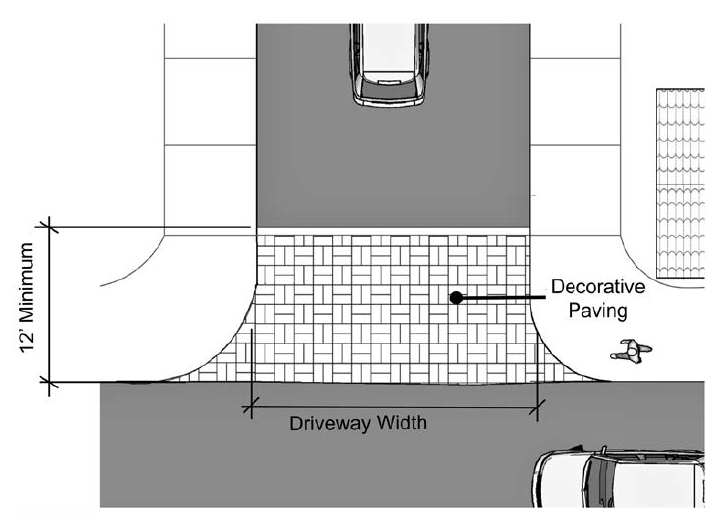
Enhanced driveway paving. Paving treatment using patterned and/or colored pavers, brick, or decorative colored and/or scored concrete shall be used for driveways. The enhanced paving treatment shall be a minimum of 12 feet deep, measured from the back of curb, and span the width of the entrance driveway where vehicular ingress and egress is provided to the nearest public street as depicted in Figure 9.13.1. Enhanced paving treatment shall not include logos or symbols.
Figure 9.13.1—Enhanced Paving for Driveways
(5)
Loading and service areas. Loading and service areas shall be located a minimum of 100 feet from any dwelling unit entrance. Required loading and service areas shall comply with the requirements of Subsection 9.06.080(h) (Off-street loading).
(c)
Common open space. Multi-family and mixed-use developments shall provide a minimum of 150 square feet of common, on-site, functional open space per residential dwelling unit.
(1)
Size. Common open space shall have a minimum dimension of ten feet in every direction and a minimum contiguous area of 300 square feet. Landscaping adjacent to pedestrian walkways, as required pursuant to Subsection 9.13.020(a)(2)(d), shall not count towards the common open space requirement.
(2)
Visibility. Unless located on a rooftop, common open space shall be located and arranged to allow visibility into the space from pedestrian walkways into the common open space amenity. Fencing or barriers enclosing the common open space shall be designed to have a minimum 80 percent of the surface area to be transparent.
(3)
Number of common open spaces. Projects shall provide separate common open space proportionate to the number of dwelling units as set forth below and in Subsection 9.13.020(c)(4).
a.
Three to 25 dwelling units. A minimum of one common open space.
b.
Twenty-six to 50 dwelling units. A minimum of two common open spaces.
c.
Fifty-one to 75 dwelling units. A minimum of three common open spaces.
d.
Seventy-six or more dwelling units. A minimum of four common open spaces.
(4)
Types of common open space. The following are types of common open space that may be provided to fulfill the requirement of this Section.
a.
Children's play area. Children's play area, with a minimum of four pieces of play equipment, designed for children of all abilities and ages five years and younger. The space shall provide a minimum of: three benches or lounging furniture (at least one covered by an overhead shade canopy or evergreen tree), two secured-in-place waste and recycling receptacles, and three shade trees anticipated to provide shade for a minimum of 25 percent of the area at maturity. Trees shall meet the minimum size requirements at installation as stated in Section 9.05.070.
b.
Gathering or picnic area. Gathering or picnic area located either at ground level, or on rooftops. The gathering or picnic area shall provide a minimum of four picnic tables or pieces of lounge furniture, and two barbecue grills/fire pits all located a minimum of 20 feet away from any openable window or door on any dwelling units. The area shall also provide shade structures, or trees anticipated to provide shade for a minimum of 25 percent of the area at maturity. Trees shall meet the minimum size requirements at installation as stated in Section 9.05.070. Gathering areas shall not be located on roofs directly adjacent to single-family zoning districts.
c.
Plaza or courtyard. Open or semi-enclosed area providing a transitional space between the interior and exterior of a building, or a transitional space between private and public areas. The plaza or courtyard shall provide a minimum of: four benches, two tables with seating, and two drinking fountains. At least one water feature, sculptural artwork, or bulletin board/information kiosk shall be provided. The area shall also provide trees or shade structures anticipated to provide shade for a minimum of 25 percent of the area at maturity.
d.
Tennis/basketball/multi-use recreational area. A tennis, basketball, or multi-use recreational area or sports court and, if lighted, incorporating shielded light fixtures to avoid spillover into residential units, and consistent with the requirements of Section 9.05.080, Lighting. The space shall provide a minimum of three benches or lounging furniture.
e.
Bocce/pétanque court. A bocce or pétanque court. The space shall provide a minimum of: three benches or lounging furniture (at least one covered by an overhead shade canopy or evergreen tree), two secured-in-place waste and recycling receptacles, and three shade trees anticipated to provide shade for a minimum of 25 percent of the area at maturity. Trees shall meet the minimum size requirements at installation as stated in Section 9.05.070.
f.
Dog park. An enclosed, off-leash dog park comprised of at least two of the following: a dog run, relief area, and/or wash area, with a minimum size of 500 square feet. The dog run shall include a combination of signage, shade trees, and pet waste bag and disposal stations adjacent to all entrances and exits. The area shall be designed to prevent the illegal discharge of pollutants to the storm drain system and to comply with all applicable water quality control regulations, including but not limited to the provisions set forth in Chapter 5.10, Water Quality Control.
g.
Community swimming pool. Enclosed swimming pool with a minimum size of 800 square feet that includes a minimum of one changing area and restroom. The pool area shall include a minimum of four lounge chairs and two large umbrellas or shade structure(s). The pool area shall include perimeter landscaping of evergreen trees and no fewer than four non-fruiting shade trees.
h.
Walking path or trail. A paved and accessible walking path/trail that is a minimum of five feet wide, one-quarter mile long, and is provided with one lighting fixture and a minimum of one bench or two chairs per every 250 linear feet of path or trail. Lighting shall comply with the requirements of Section 9.05.080, Lighting.
i.
Community garden. Community garden provided with a compost bin and a storage shed to accommodate gardening tools. The community garden shall have at least one potable water connection and have irrigation provided to all garden beds. The space shall provide a minimum of: three benches (at least one covered by an overhead shade canopy or evergreen tree), and two secured-in-place waste and recycling receptacles.
(5)
Local park code provisions. Common open space may be used to satisfy the requirements of Chapter 9.11 (Local Park Code).
(d)
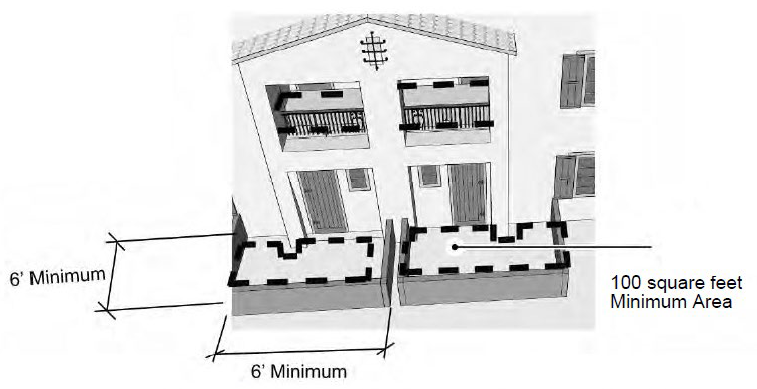
Private outdoor space. Multi-family and mixed-use developments shall provide a minimum of 100 square feet of private outdoor space per residential dwelling unit with a minimum dimension of six feet in every direction as shown in Figure 9.13.2. Private outdoor spaces include balconies, patios, decks, terraces, gardens, and yards for the personal use of residents.
Figure 9.13.2—Minimum Dimensions for Private Outdoor Space
(1)
Where private outdoor space for a dwelling unit is located adjacent to and within ten feet of a window of a neighboring dwelling unit, patio walls or fencing shall be constructed with an opaque material to ensure privacy.
(2)
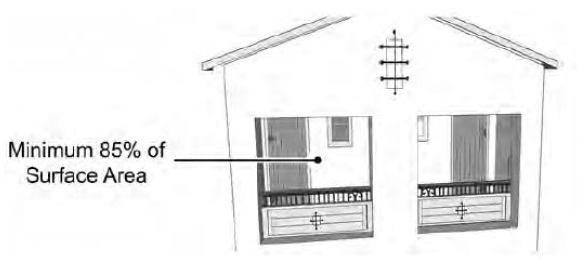
Screening shall be constructed with openings to provide a minimum surface area of 85 percent as shown in Figure 9.13.3.
Figure 9.13.3-Screening for Private Outdoor Space
(3)
Local park code provisions. Private outdoor space may not be used to meet the requirements of Chapter 9.11 (Local Park Code).
(e)
Landscaping. Landscaping and screening shall comply with all applicable provisions of Section 9.05.070 (Landscape and screening).
(Ord. No. 24-05, § 3, 9-11-2024)
Sec. 9.13.030. - Architectural style.
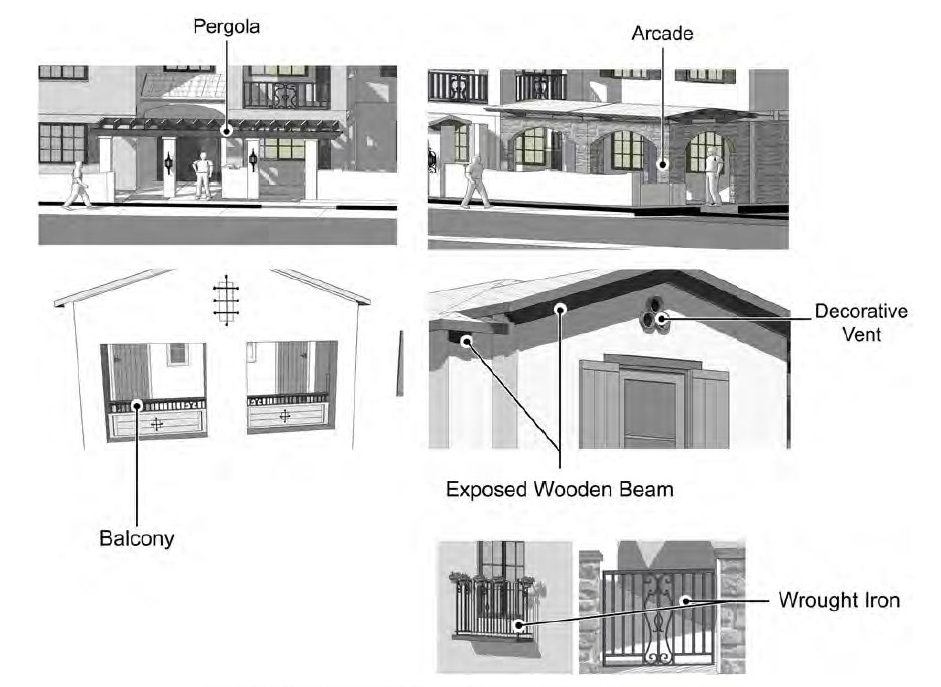
Applicants shall incorporate a minimum of three of the architectural style elements listed below into the overall project design. Architectural style elements shall be chosen to reflect Spanish, Mission, and Mediterranean architectural heritages, and shall be incorporated into all multi-family and mixed-use buildings utilizing the specific features listed herein.
(1)
Rounded arches for primary building and unit entries.
(2)
Arcades along ground-floor facades, upper-floor facades, interior courtyards, or in exterior walkways.
(3)
Pergolas located in exterior walkways between buildings, in outdoor common open spaces, or private outdoor spaces.
(4)
Exposed wooden beams in a dark color.
(5)
Accents, balconies, and deck railings in iron or wrought iron materials.
(6)
Decorative vents, canopies, or shutters.
(7)
Recessed windows and precast window trim.
Figure 9.13.4—Examples of Architectural Style Elements
(Ord. No. 24-05, § 3, 9-11-2024)
Sec. 9.13.040. - Building design.
(a)
Building form, massing, and articulation.
(1)
Articulation and hierarchy. Buildings shall be designed to differentiate between a defined base; a middle or body; and a top, cornice, or parapet cap. All buildings shall achieve this effect through at least two of the following, and in accordance with the standards stated herein:
a.
Color, texture, or material changes.
b.
Variations, projections, or reveals in the wall plane.
c.
Variations in fenestration size or pattern.
d.
One or more of the following decorative architectural details: arches, balconies, cornices, columns.
(2)
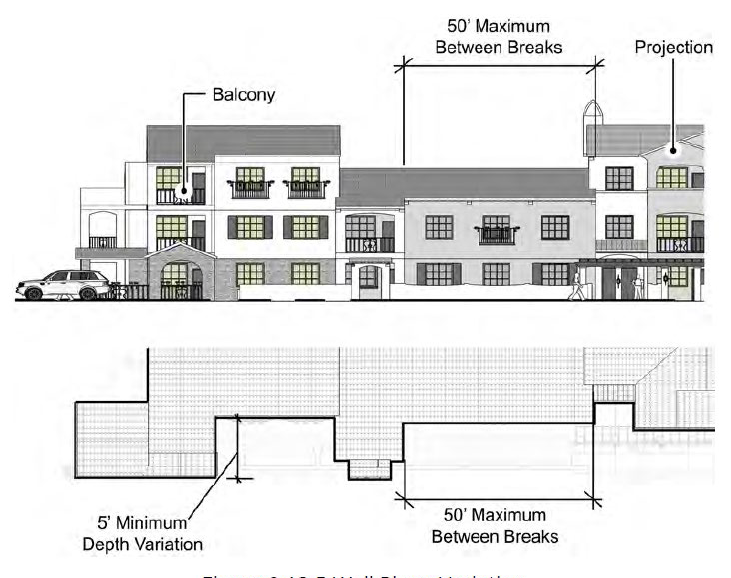
Wall plane variation. Buildings shall not extend more than 50 feet in length without a massing break that is at least a five-foot variation in depth, or an architectural element that provides a massing break. The architectural element may be a building entrance, courtyard, front porch, upper-story setback, or projections such as stoops, bays, overhangs, and trellises as shown in Figure 9.13.5.
Figure 9.13.5—Wall Plane Variation
(3)
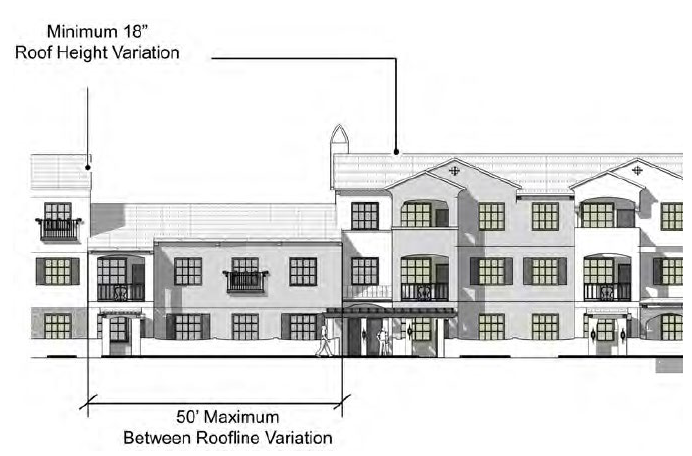
Roof line variation. Roof lines shall not extend more than a length of 50 feet without at least one change as described below and shown in Figure 9.13.6:
a.
Variation in roof form, such as hip, mansard, gable, shed, and flat with parapet.
b.
Variation in architectural elements, such as parapets or varying cornices.
c.
Variation of roof height of at least 18 inches (as measured from the highest point of each roof line.
Figure 9.13.6—Roof Line Variation
(4)
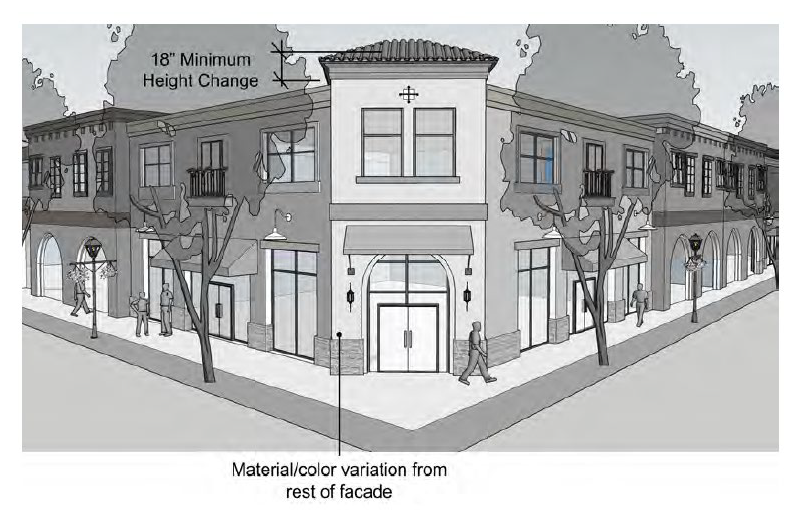
Corner buildings. Buildings located on a corner lot shall include one or more of the following features on both street-facing facades, located within 25 feet of the corner of the building closest to the intersection:
a.
An entrance to a ground-floor use or a primary building entrance.
b.
A different material application, color, or fenestration pattern of windows and doors from the rest of the façade.
c.
A change in height of at least 18 inches from the height of the abutting façade as shown in Figure 9.13.7.
Figure 9.13.7—Features for Corner Buildings
(b)
Building and individual dwelling unit entrances.
(1)
Building entrance.
a.
Building entrance adjacent to parking area. Multi-family residential buildings with 16 or more residential units in a single building shall provide a common building entrance within 50 feet of the primary parking area. Where multiple buildings exist, each building shall include a common entrance within 50 feet of the nearest parking area. For standards related to parking, see Subsection 9.13.020(b) (Vehicular parking and access).
b.
Street-facing building entrance.
1.
Multi-family buildings. Multi-family buildings located within 20 feet of the primary street right-of-way shall have a ground-level building entrance facing that street.
2.
Mixed-use buildings. Mixed-use buildings shall provide a ground-level primary building entrance directly from the public sidewalk. At least one building entrance shall be available for every 100 linear feet of sidewalk.
c.
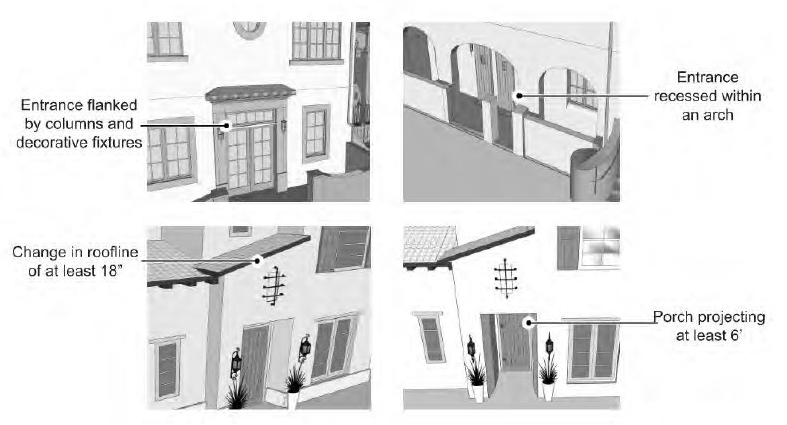
Articulation of building entrance. Primary building entrances shall provide two or more of the following and as shown in Figure 9.13.8:
1.
Entrance flanked by columns, decorative fixtures, or other similar elements.
2.
Entrance recessed within a large arch or cased decorative opening.
3.
Entrance emphasized by a change in roofline of at least 18 inches, or a tower, to provide a break in the wall façade.
4.
Entrance covered by a large arcade, portico, or formal porch projecting a minimum six feet from the wall façade.
Figure 9.13.8—Building Entrance Articulation
(2)
Individual dwelling unit entrance.
a.
Exterior unit entrance. All individual exterior unit entrances shall have either a projected sheltering element or be recessed from the main façade; the projection or recess shall have a minimum depth of 24 inches.
b.
Street-facing unit entrance. Each dwelling unit located within 20 feet of a primary street right-of-way shall include at least one street-facing porch, balcony, or patio.
c.
Upper-floor unit entrance. Exterior entrances to individual dwelling units on upper floors are permitted. Exterior corridors on upper floors shall be limited to a maximum horizontal length of 50 linear feet in any direction.
(c)
Windows and openings.
(1)
Spacing. Exterior facing walls shall have a minimum of one window or door every 30 linear feet of horizontal wall length.
(2)
Privacy. Where windows are proposed within ten feet of another building's window, window design shall incorporate one or more of the following:
a.
Window offset of at least 12 inches horizontally from any adjacent building window (edge to edge) so as not to have a direct line-of-sight into adjacent units.
b.
Utilize non-transparent or obscured glazing, such as frosted/patterned glass. Reflective glazing is not permitted.
(3)
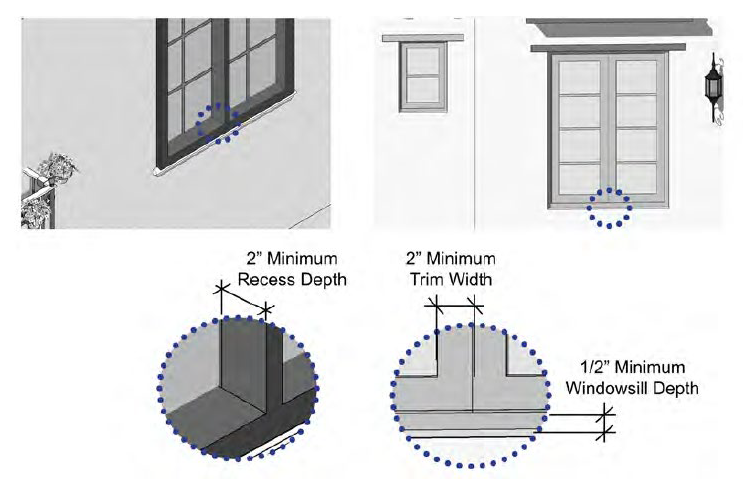
Window treatment. Window treatments shall utilize one of the following: a minimum two-inch window recess from the plane of the surrounding exterior wall; a trim a minimum of two inches wide; or a windowsill a minimum of one-half inch depth as shown in Figure 9.13.9.
Figure 9.13.9—Window Treatment
(d)
Materials and colors.
(1)
Consistency across units. Affordable and market-rate units within the same development shall be constructed of the same materials, colors, and architectural elements as to not be distinguishable from one another in architectural quality and detail.
(2)
Wall material and color. The primary exterior wall material for buildings shall be stucco, stone, sandstone, or limestone. Exterior walls shall be white, cream, beige, or another pale, earth tone color. Exposed plywood and metal panels are prohibited for exterior walls.
(3)
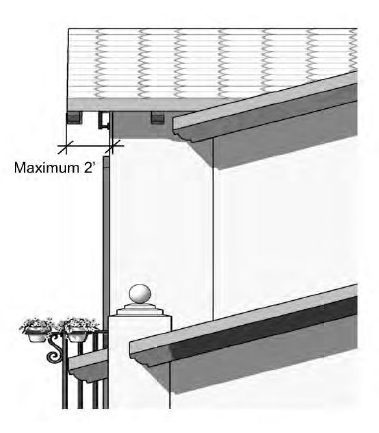
Roof form and material. Roofs shall consist of barrel tiles or flat shingles in ceramic, terracotta, concrete, or composite material, with an eave overhang not to exceed a maximum horizontal length of two feet as shown in Figure 9.13.10.
Figure 9.13.10—Dimension for Roof Eaves
(4)
Window consistency. Window materials, color, and style shall be the same on all elevations.
(5)
Accent material. Use of two or more accent materials such as glass, tile, brick, stone, concrete, or plaster shall be incorporated to highlight building features.
(6)
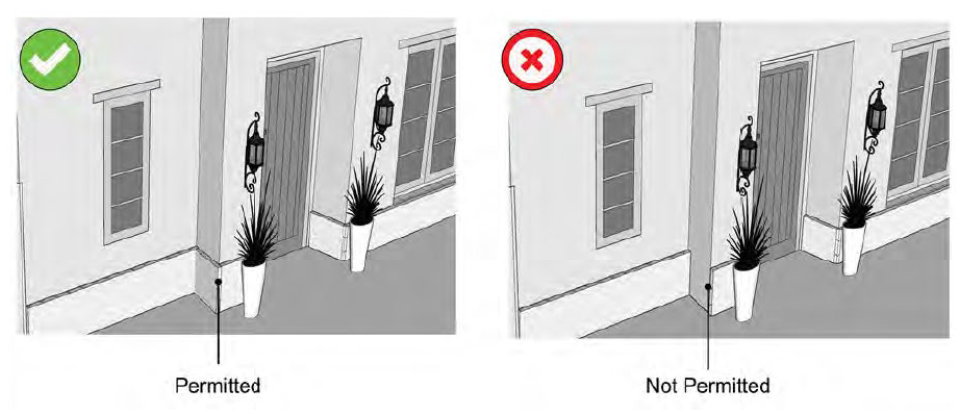
Material transition. Changes in material shall occur at inside corners of intersecting walls or at architectural features that break up the wall plane, such as columns as demonstrated in Figure 9.13.11.
Figure 9.13.11—Material Transition
(e)
Parking structures. For additional standards related to parking, see Subsection 9.13.020(b) (Vehicular parking and access)
(1)
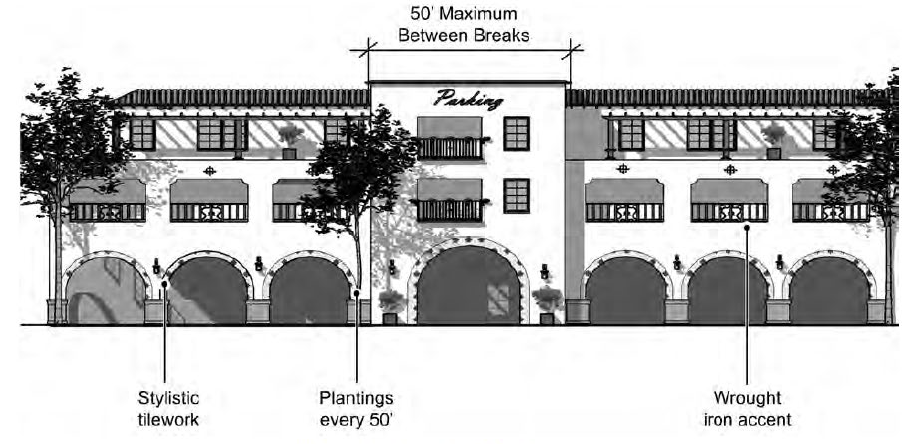
Wall plane variation for parking structures. Parking structures visible from the primary street shall not extend more than 50 feet in length without a two-foot variation in depth in the wall plane.
(2)
Articulation. The exterior of the parking structure shall include one of the following articulation methods as shown in Figure 9.13.12:
a.
Applied materials (tile, brick, decorative block, or stone) extending a minimum two inches from the face of the structure to the facade. Painted concrete, smooth concrete, or stucco walls shall not be considered sufficient articulation.
b.
A combination of two or more of the following decorative architectural features: cut-metal screens, awnings, wrought iron accents, trellises, louvers, decorative grills, and stylistic tilework.
(3)
Vertical plantings. Vertical plantings shall be located between pedestrian and vehicular entrances, windows, and other openings on street facing facades and/or adjacent to residential units. A minimum of one tree shall screen the building façade every 50 linear feet. The tree shall be selected to grow to a minimum of 15 feet tall within two years from time of installation and 40 feet in height at maturity.
Figure 9.13.12—Parking Structures
(f)
Garages.
(1)
Recessed door. Garage doors shall be recessed a minimum of six inches from the plane of the surrounding exterior wall.
(2)
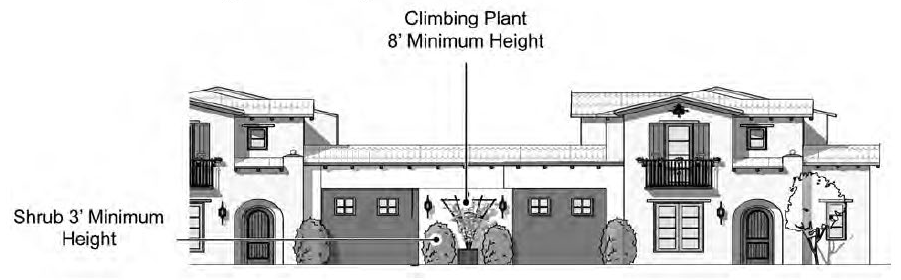
Landscape element. Where two or more garage doors face the same street within 50 feet of each other, a landscape element, such as landscape planters or climbing/wall plants, shall be provided on the façade between doors as depicted in Figure 9.13.13. Landscaping shall be maintained as to not interfere with the mechanical movement of the garage door and to comply with the visibility at driveway requirements of Section 9.06.100 of Title 9.
a.
Landscape planters shall provide shrubs and plants that are selected to grow to a minimum of three feet in height at maturity.
b.
Climbing/wall plants shall be selected to grow to a minimum height of eight feet in height at maturity.
Figure 9.13.13—Garage Landscape Element
(g)
Utilitarian elements.
(1)
Residential private storage. Each residential dwelling unit in a multi-family or mixed-use development that does not have a garage shall be provided with an on-site private storage area to be a minimum size of 200 cubic feet. Closet and cupboard spaces interior or exterior to the residential dwelling unit that are smaller than 200 cubic feet in size do not count cumulatively towards meeting this requirement.
(2)
Bicycle parking. Long-term bicycle parking shall be provided in order to serve residents of multi-family and mixed-use developments.
a.
Number of spaces required. A minimum of one long-term bicycle parking space per dwelling unit shall be provided. Bicycle parking for the non-residential portion of a mixed-use project shall be provided in accordance with the standards of the California Green Building Standards Code
b.
Location. Bicycle parking shall be located on the ground floor on the same site as the multi-family or mixed-use development. At least 50 percent of the required bicycle parking shall be provided in:
1.
An enclosed bicycle locker;
2.
A fenced, covered, locked, or guarded bicycle storage area; or
3.
A secure area within a building or structure.
c.
Accessibility. Each bicycle parking space shall be accessible without moving another bicycle.
1.
Minimum dimensions. Bicycle parking facilities shall provide a minimum area of two feet wide, six feet long, and a minimum of five feet vertical and horizontal clearance per bicycle shall be provided for maneuvering space, and shall be placed to maintain a clear path of travel for pedestrians.
2.
A minimum of two feet of vertical and horizontal clearance shall be provided between a bicycle parking space and adjacent walls, poles, landscaping, street furniture, drive aisles, and/or pedestrian ways.
3.
A minimum of five feet of horizontal clearance shall be provided between bicycle parking and vehicle parking spaces.
4.
Bicycle lockers shall be situated to allow a minimum of five feet clear space at the door for access.
(3)
Trash, recycling, and green waste container enclosures. Trash, recycling, and green waste container enclosures are required for multi-family and mixed-use developments and shall be provided in accordance with the regulations of Section 9.04.090 (Solid waste and recycling facilities). All waste container enclosures shall be located within the building, and/or located within a detached enclosure incorporated into the exterior building design with a solid roof and floor drain, and shall be subject to the following regulations:
a.
Location. Each dwelling unit shall have a trash, recycling, and green waste disposal enclosure located within 250 linear feet, measured from the dwelling unit's primary entrance to the waste container enclosure. All trash, recycling, and green waste enclosures shall be located outside of view from a public right-of-way.
b.
Screening of outdoor enclosures. Outdoor enclosures shall include a solid wall a minimum of six feet in height, and a roof or trellis structure that shields the top of the enclosure from views above.
(4)
Fences and walls.
a.
Fences and walls shall comply with the provisions of Section 9.04.070, (Fences, walls, hedges, and landscape screening).
b.
Where fences and walls of different materials or finishes intersect, a natural transition or break, such as a column or pilaster, shall be provided.
(5)
Digital infrastructure. All residential and mixed-use projects with five or more dwelling units must provide internet access to occupants and users of the development as follows:
a.
Project-wide fiber network infrastructure shall be installed to provide high-speed internet access to all residential units, businesses, and common spaces on-site.
b.
Public access. An indoor common space shall be provided for residents of the development to facilitate free internet access. The space shall include:
1.
Free wi-fi for residents. The manager of the property must provide and maintain the proper hardware and software, including a wi-fi router and internet subscription, to allow residents to access the internet for free while within the indoor common space.
2.
Computer station(s) for resident use (shall include laptop or desktop computer, or tablet, with all necessary hardware and software) with internet access. The number of required computer stations per project is as follows: one computer station for projects with five—20 dwelling units; two computer stations for projects with 21—39 dwelling units; three computer stations for projects with 40 or more dwelling units.
(6)
Solar ready infrastructure. All residential and mixed-use projects with five or more dwelling units must include a residential photovoltaic system, or demonstrate preparation for later installation (i.e., solar ready or "PV ready"). Solar ready facilities shall include the following:
a.
A reserved "PV zone" on the residential roof or site available to accommodate PV panels.
b.
A dedicated area for accommodating PV equipment including meter, disconnect, and inverter, with a minimum area of four square feet, adjacent to the electrical service panel.
c.
Roof structure dead loading and electrical load calculations will be determined during the building permit stage in accordance with the building and electrical codes in effect at the time of issuance.
(7)
Vents and exhaust. All wall-mounted vent and exhaust elements shall be located at interior corners of building walls or behind building elements that conceal them from public view. All flashing, sheet metal vents, exhaust fans/ventilators, and pipe stacks shall be painted to match the adjacent roof or wall material and color.
(8)
Lighting. Lighting shall comply with the provisions of Section 9.05.080, Lighting.
(9)
Screening of mechanical equipment. Equipment and utilities shall comply with the provisions of Subsection 9.04.020(g) (Mechanical equipment) and be screened in accordance with the regulations of Section 9.05.070 (Landscape and screening).
(Ord. No. 24-05, § 3, 9-11-2024)
Sec. 9.13.050. - El Paseo Corridor standards.
(a)
Applicability. This Section applies to any residential and/or mixed-use development along El Paseo between Richard Reese Way and Alma Aldea.
(1)
The intent of these standards is to create an inviting, engaging, pedestrian-oriented "Main Street" environment.
(2)
The standards of this Section apply in addition to other standards of this Chapter. Where there are conflicts between this Section and other objective development standards, the more specific or restrictive development standard shall prevail.
(b)
Pedestrian-oriented public realm. El Paseo shall be maintained as the primary street that connects pedestrians and vehicles between Richard Reese Way and Alma Aldea.
(1)
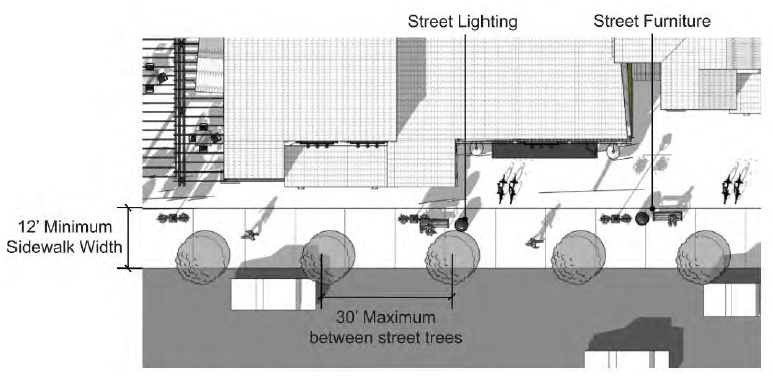
Sidewalk Along El Paseo. Multi-family and mixed-use development shall provide for sidewalks a minimum of 12 feet in width, measured from back of curb as depicted in Figure 9.13.14.
a.
Pedestrian-oriented street lighting. Pedestrian-oriented street lighting shall be provided in the sidewalk along El Paseo, as established in Subsection 9.13.050(e) (Lighting).
b.
Street trees. Development shall provide for at least one street tree placed within a wrought-iron tree grate every 30 linear feet of sidewalk. The tree shall have a minimum box size of 15 gallons at the time of planting. The tree species shall be selected to grow to a minimum of 15 feet tall within two years from time of installation, with a minimum height of 40 feet at maturity.
c.
Street furniture. Street furniture shall be provided in the sidewalk, with an average of one bench or seating element and one trash receptacle provided, per every 50 linear feet.
Figure 9.13.14—Sidewalk Along El Paseo
(2)
El Paseo crosswalks. Crosswalks providing pedestrian access across El Paseo or Richard Reese Way shall use an enhanced paving treatment as established in Subsection 9.13.020(a)(2)(c) (Paving for pedestrian crossings). The crosswalk shall have a minimum width of eight feet and shall be raised to the grade of the sidewalk.
(c)
Public gathering spaces. Mixed-use development shall provide a public gathering space along El Paseo between Richard Reese Way and Alma Aldea. Public gathering spaces shall be a minimum of 450 square feet, with a minimum dimension of 15 feet in every direction. At least one public gathering space shall be provided at the intersection of El Paseo and El Corazon. The gathering space shall contain a minimum one pedestrian-oriented, publicly accessible amenity per every 50 square feet that includes a combination of benches, café-style seating, fountains, shade structures, children play structures, public art, planters, and kiosks. Public gathering spaces may be used to fulfill the requirements of Subsection 9.13.020(c) (Common open space).
(d)
Ground floor character.
(1)
Build-to line. All buildings along El Paseo shall have a wall façade located within five feet of the sidewalk required in Subsection 9.13.050(a)(1), for at least 80 percent of the linear building frontage. The linear dimension of any public gathering space required by Subsection 9.13.050(c) that is within five feet of the sidewalk along El Paseo is counted towards this requirement.
(2)
Ground floor use and activity. Residential dwelling units shall not be located within the ground floor space facing El Paseo and within 20 feet of the building frontage. Residential common areas, amenities, and leasing offices are allowed in ground floor spaces facing El Paseo.
(3)
Ground floor height. The ground floor shall have a minimum floor-to-floor height of 15 feet.
(4)
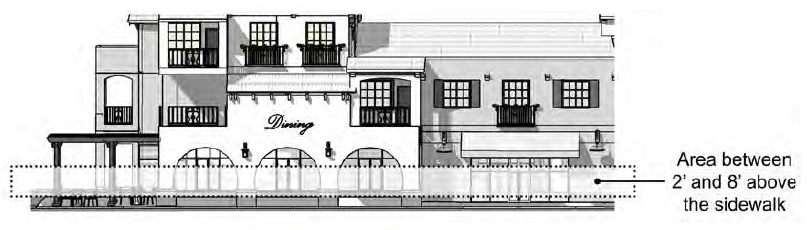
Transparency. Building walls facing El Paseo or any street-facing lot line shall include transparent windows or doors for at least 50 percent of the building wall area located between two and eight feet above the elevation of the sidewalk. No wall may extend in a continuous plane for more than 20 feet without such an opening as demonstrated in Figure 9.13.15. Garages and parking structures are not required to meet the ground floor transparency requirement.
a.
The bottom of any product display window shall not be more than three and a half feet from the elevation of the sidewalk.
b.
Product display windows shall have a minimum height of four feet and be internally lit. Lighting shall comply with the requirements of Section 9.05.080, Lighting.
c.
Transparent or translucent glazing is required on the ground floor façade. Opaque, reflective, dark tinted glass, exterior window stickers, and treatments that obstruct interior views at the street level are not permitted.
Figure 9.13.15—Ground Floor Transparency
(5)
Landscape planters. Window box planters and planter pots below display windows shall be provided for at least 25 percent of the length of all retail window displays along El Paseo and shall utilize drip irrigation.
(6)
Awnings. Separate awnings shall be provided over individual windows or storefronts. Awnings shall not exceed 20 feet in length.
(e)
Lighting.
(1)
Pedestrian-oriented street lighting. Pedestrian-oriented street lighting shall be provided on the sidewalk along El Paseo and Richard Reese Way. Street lighting style, including luminaires, arms, color, height, and finish shall be consistent with existing City approved lighting for the length of El Paseo between Santa Margarita Parkway and Richard Reese Way. A minimum of one street light shall be provided for every 50 linear feet of sidewalk.
(2)
Wall-mounted lighting. Spotlighting or glare from wall-mounted lighting shall be shielded from residential units. Up to 50 percent of a bulb may be exposed when viewed from the sidewalk on El Paseo or other pedestrian pathways.
(3)
Up-lighting on El Paseo. Up-lighting shall be limited to use for building entrances and the landscape buffer along El Paseo.
(4)
Signage. Signage shall comply with the provisions of Chapter 9.07 (Signs).
(f)
Vehicular parking. The provisions of this Subsection shall replace that of Subsection 9.13.020(b) (Vehicular parking and access).
(1)
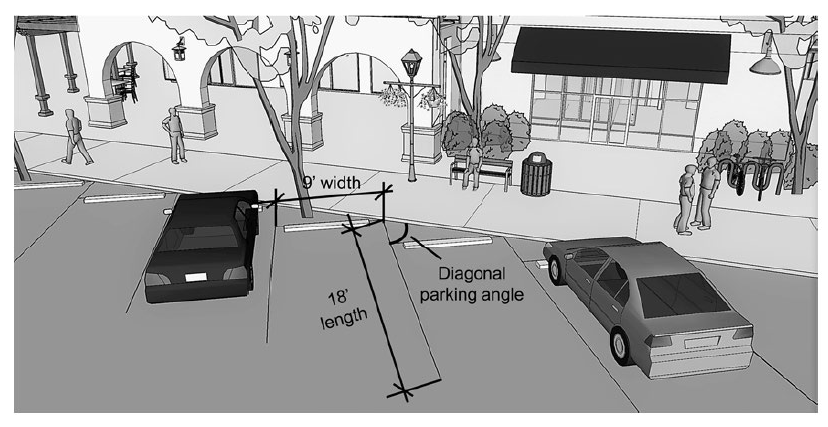
Diagonal parking on El Paseo. Parking along El Paseo shall be permitted as one row of diagonal parking spaces on either side of the street.
a.
Space dimensions. Diagonal parking shall be nine feet in width and 18 feet in length.
b.
Space angle. Diagonal parking shall be provided at a 30, 45, or 60-degree angle. The angle of parking is measured linearly along the entire length of the parking space striping to the curb as shown in Figure 9.13.16. Wheel stops shall be provided in accordance with Figure 9.06.2 of Chapter 9.06 (Parking).
Figure 9.13.16—Diagonal Parking on El Paseo
(2)
Loading prohibited on El Paseo. Loading and service areas are prohibited on El Paseo. They shall be located a minimum of 100 feet from any property line along El Paseo, and shall not be visible to a pedestrian on El Paseo at any point.
(3)
Electric vehicle (EV) charging. EV ready and EV capable facilities shall be provided in compliance with the California Green Building Standards Code.
(Ord. No. 24-05, § 3, 9-11-2024)

