
Rancho Santa Margarita
City Zoning Code
City Zoning Code
CHAPTER 9
03 - Zoning Districts and Standards
APPENDIX A. - ZONING MAP
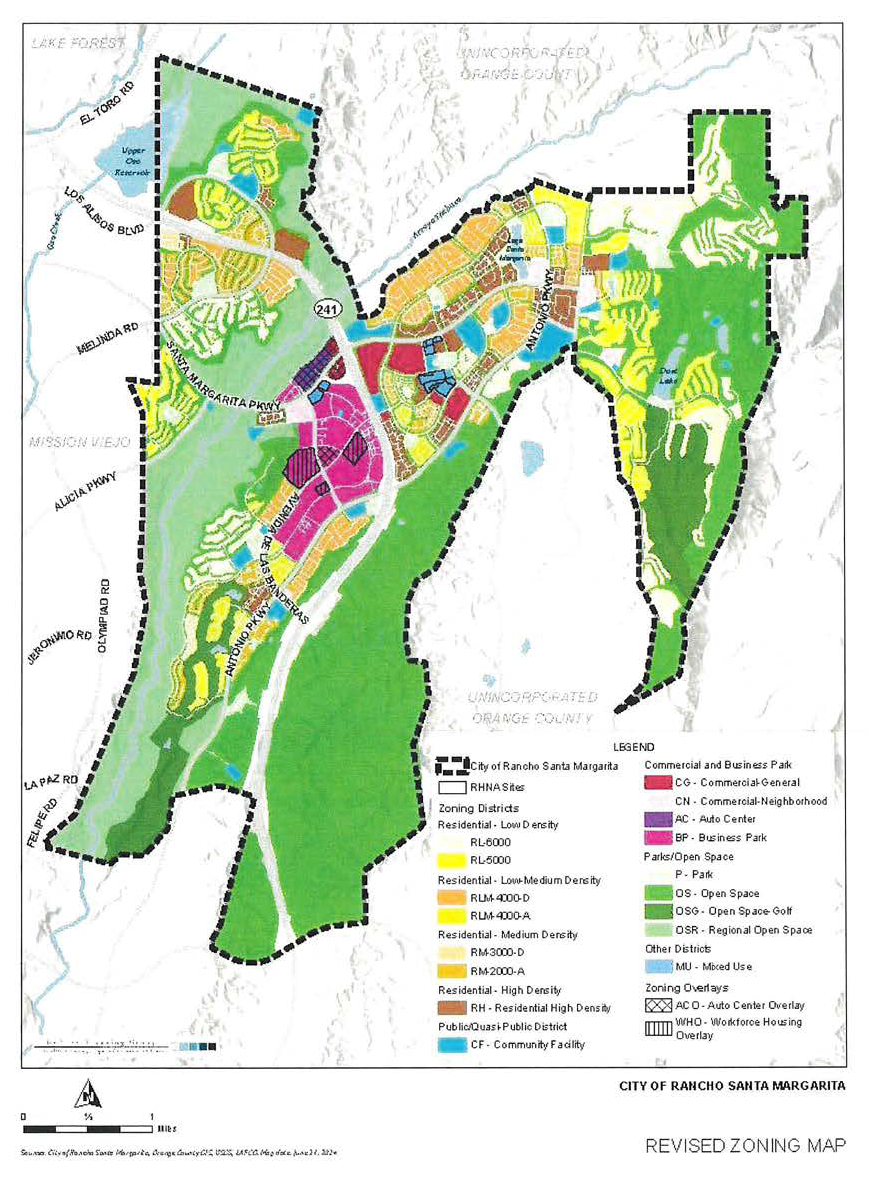
(Ord. No. 11-05, §§ 3, 4, 6-22-2011; Ord. No. 12-04, § 6(Exh. 1), 6-27-2012; Ord. No. 14-03, § 6(Exh. 1), 9-24-2014; Ord. No. 15-02, § 4(Exh. 1), 8-12-2015; Ord. No. 24-04, § 8(Exh. 1), 9-11-2024)
Sec. 9.03.010. - Districts established.
To carry out the purposes of this Title, the City is divided into the zoning districts identified in Table 9.03.1. These districts are consistent with and necessary to implement the City's general plan.
(Ord. No. 07-03, § 4(Exh. A), 4-11-2007)
Sec. 9.03.020. - Official zoning map.[2]
(a)
Adoption. The boundaries of the districts designated and established by Section 9.03.010 shall be shown on a map entitled "Official Zoning Map, City of Rancho Santa Margarita" or as subsequently amended, and on file in the office of the City Clerk. The zoning map is adopted herein by reference and shall hereafter exist pursuant to and as an integral part of this Title.
(b)
Amendments—Notations. If changes are made in the district boundaries or other matters portrayed on the official zoning map, provided in Section 9.08.070 of the official zoning map/change of zoning district, such changes shall be entered on the official zoning map promptly after the amendment has been approved by the City Council. An entry listing the change shall be made on the official zoning map.
(c)
Replacement. In the event the official zoning map becomes damaged, destroyed, lost, or difficult to interpret because of the nature or number of changes and additions, the City Council, by resolution, may adopt a new official zoning map which shall supersede the prior official zoning map. The new official zoning map may correct drafting or other errors or omissions in the prior official zoning map, but no such correction shall have the effect of amending the original official zoning map or any subsequent amendment thereto.
Table 9.03.1
Zoning District/General Plan Designation
Consistency Matrix
Unless the prior official zoning map has been lost or has been totally destroyed, the prior map or any significant part thereof remaining shall be preserved, together with all available records pertaining to its adoption or amendments thereto.
(Ord. No. 07-03, § 4(Exh. A), 4-11-2007; Ord. No. 10-06, § 4, 10-13-2010; Ord. No. 11-05, § 1, 6-22-2011; Ord. No. 24-07, § 15, 9-11-2024)
Editor's note— See Appendix A to this chapter (ch. 9.03) for the current Official Zoning Map for the City of Rancho Santa Margarita.
Sec. 9.03.030. - Interpretation of district boundaries.
Where uncertainty exists as to the boundaries of the zoning districts shown on the Official Zoning Map, the following rules shall apply:
(1)
Boundaries indicated as approximately following the center lines of streets, highways, or alleys shall be construed to follow such center lines.
(2)
Boundaries indicated as approximately following plotted lot lines shall be construed as following such lot lines.
(3)
Boundaries indicated as approximately following the City limits shall be construed as following such City limits.
(4)
Where physical features existing on the ground are at variance with those shown on the Official Zoning Map, or in other circumstances not referred to in this Section, the Development Services Director shall interpret the zoning district boundaries. The Development Services Director may refer the interpretation to the Planning Commission for a decision.
(5)
In the event any other uncertainty regarding zoning district boundaries exists, the Development Services Director shall interpret the district boundaries. The Development Services Director may refer the interpretation to the Planning Commission for a decision.
(6)
Interpretations made by the Development Services Director and/or the Planning Commission may be appealed as provided in Section 9.08.100.
(Ord. No. 07-03, § 4(Exh. A), 4-11-2007; Ord. No. 07-07, § 2, 11-14-2007)
Sec. 9.03.040. - Application of provisions.
The provisions set forth in this Chapter for each zoning district shall be the minimum regulations and shall apply uniformly to each class or kind of structure or land, except as follows:
(1)
No building, structure, or land shall be used or occupied, and no building or sign shall be erected, constructed, reconstructed, moved, or structurally altered, except in conformity with all of the provisions set forth for the zoning district in which such building, structure, or land is located.
(2)
No building or other structure shall be erected or altered:
a.
To exceed the maximum permitted height or bulk;
b.
To accommodate or house a greater number of units;
c.
To occupy a greater percentage of lot area;
d.
To have narrower or smaller rear yards, front yards, side yards, or other open spaces than required; or
e.
In any other manner contrary to the provisions of this Title.
(3)
No part of a yard or other open space or off-street parking or loading space required for or in connection with any building for the purpose of complying with this Title shall be included as part of a yard, open space, or off-street parking or loading space similarly required for any other building, except as specifically provided in this Title.
(4)
No yard or lot existing on or after the effective date of this Title, shall be reduced in dimensions or area below the minimum requirements set forth in this Title unless expressly permitted by this Title. Yards or lots created on or after the effective date of this Title, shall meet at least the minimum requirements established by this Title. (See Section 9.04.080 for provisions relating to nonconforming lots.)
(Ord. No. 07-03, § 4(Exh. A), 4-11-2007)
Sec. 9.03.050. - Prohibited uses.
(a)
Prohibited uses. All land uses and provisions of this Title shall be consistent with controlling Federal, State, and local law. Any use or activity that is illegal under Federal, State, or local law shall be deemed a prohibited use in all zoning districts within the City. Any use that is not consistent with Federal, State or local law and is not expressly permitted in a zoning district as a permitted uses or as a conditionally permitted use, including a use in a district determined to be similar in character to a particular use allowed in such district as provided by this Title, shall be deemed a prohibited use and such use shall not be allowed in such district.
(b)
Use determination. Unless a use is specifically identified in the table of uses for each applicable zoning district, it is not permitted in that district. However, the Planning Commission shall have the authority to review proposed uses not listed in this Chapter. A proposed unlisted use may be permitted as a principal or accessory use within a Zoning District if the Planning Commission makes written findings that such use:
(1)
Falls within the purpose and intent of that Zoning District;
(2)
Is of a comparable nature to the principal, accessory or conditional uses set forth as permitted in the Zoning District;
(3)
Is not listed in another Zoning District;
(4)
Will not be inconsistent with any allowable uses in the vicinity of such use; and
(5)
Is not prohibited under Federal, State or local law.
(c)
Appeal of decision. The Planning Commission's decision may be appealed as provided in Section 9.8.100.
(Ord. No. 07-03, § 4(Exh. A), 4-11-2007; Ord. No. 09-05, § 2, 12-9-2009)
Editor's note— Ord. No. 09-05, § 2, adopted December 9, 2009, changed the title of Section 9.03.050 from "Unlisted uses" to "Prohibited uses." The historical notation has been preserved for reference purposes.
Sec. 9.03.060. - Prezoning prior to annexation.
The City may, by Ordinance, prezone certain contiguous areas outside the City which, in the opinion of the City Council, are in accordance with the general plan and sphere of influence. For this purpose, prezoning maps shall be developed, adopted, and amended in accordance with the provisions of Section 9.08.090.
(Ord. No. 07-03, § 4(Exh. A), 4-11-2007)
Sec. 9.03.070. - Residential districts.
(a)
Purpose of residential districts. The purpose of these residential district regulations is to:
(1)
Provide for a variety of well-designed and well-maintained housing types and neighborhoods in the community;
(2)
Reserve planned neighborhood areas for residential living with a broad range of dwelling unit densities consistent with the General Plan and appropriate standards of public health, safety, welfare, and aesthetics;
(3)
Designate lands to accommodate housing units that meet the diverse economic needs of the residents;
(4)
Encourage residential development that retains the scale and character of existing residential neighborhoods;
(5)
Facilitate the provision of adequate light, air, privacy, and open space for each dwelling unit;
(6)
Protect residential neighborhoods from incompatible uses.
The specific uses allowed and development standards that apply to these districts are identified in Subsections 9.03.070(b) and (c).
Residential - Low Density (RL) Districts—RL-6,000 and RL-5,000. The purpose of the RL districts is to provide for the development of single-family detached homes on moderate to large lots consistent with the General Plan low density residential (LDR) designation.
Residential - Low-Medium Density (RLM) Districts—RLM- 4,000-D and RLM-4,000-A. The purpose of the RLM districts is to provide for single-family detached (RLM-4,000-D) homes on smaller lots, as well as attached (RLM-4,000-A) townhomes and duplexes consistent with the General Plan low-medium density residential (LMDR) designation.
Residential - Medium Density (RM) Districts—RM-3,000-D and RM-2,000-A. The purpose of the RM districts is to provide for detached (RM-3,000-D) single-family homes on smaller lots, as well as attached (RM-2,000-A) townhomes, condominiums, duplexes, and apartments consistent with the General Plan medium density residential (MDR) designation.
Residential - High Density (RH) District. The purpose of the RH district is to provide for high density attached homes, as well as apartments, and senior housing consistent with the General Plan high density (HDR) designation.
(b)
Residential districts use regulations.
(1)
Table 9.03.2 identifies the uses permitted in each residential district.
(2)
Uses listed as conditionally permitted uses are subject to the review requirements and conditions contained in Section 9.08.110. Accessory uses are subject to the review requirements and conditions contained in Section 9.04.020.
(3)
The "notes and exceptions" column of Table 9.03.2 indicates more precisely the use regulations for specific uses or operating characteristics. The notes and exceptions must be reviewed in conjunction with the other information for the class of use.
(4)
Certain permitted uses and conditionally permitted uses may be subject to special conditions regarding location, operation, or the design of the use. The Sections of this Title governing these uses are identified in the "notes and exceptions" column of Table 9.03.2.
(c)
Residential districts development standards. Tables 9.03.3a through 9.03.3d identify the development standards for all of the residential districts.
All residential additions, alterations and modifications shall to the greatest extent possible, avoid excessive massing of the primary structure, through means of varying rooflines, elevations and other architectural elements.
(d)
Landscaping in residential districts. Landscaping is required in the front yard for all areas not covered by a driveway or pedestrian walkway pursuant to Sections 9.05.070 and 9.08.140.
(e)
Site development permit for residential development. Projects shall require site plan review per the site development permit process and standards described in Section 9.08.170.
(f)
Other applicable regulations for residential districts. Other applicable regulations in the Residential Districts include, but are not limited to, the supplemental district regulations identified in Chapters 9.04 and 9.05 and the administrative processes identified in Chapter 9.08.
Table 9.03.2
Uses in Residential Districts
a Only permitted in the RLM-4,000-D zoning district.
b Only permitted in the RM-3,000-D zoning district.
c Only permitted in the RLM-3,000-A zoning district.
d Only permitted in the RM-2,000-A zoning district.
P = Principal use permitted
— = Not permitted
A = Accessory use permitted (subject to Section 9.04.020 Accessory Uses and Structures)
C = Conditional use permit required (subject to Section 9.8.110 Conditional Use Permit)
Unless a use is specifically identified, it is not permitted in the district (see Section 9.3.050 Prohibited Uses).
Table 9.03.3a
Low Density Residential (RL) Development Standards
Table 9.03.3b
Low-Medium Density Residential (RLM) Development Standards
Table 9.03.3c
Medium Density Residential (RM) Development Standards
Table 9.03.3d
High Density Residential (RH) Development Standards
(Ord. No. 07-03, § 4(Exh. A), 4-11-2007; Ord. No. 08-03, §§ 2—5, 8-27-2008; Ord. No. 09-03, § 5, 3-25-2009; Ord. No. 09-05, § 3, 12-9-2009; Ord. No. 11-02, § 7, 4-27-2011; Ord. No. 13-01, § 4, 8-14-2013; Ord. No. 16-05, § 5, 10-12-2016; Ord. No. 18-01, § 10, 2-14-2018; Ord. No. 21-02, § 4, 5-26-2021; Ord. No. 24-07, § 16, 9-11-2024; Ord. No. 25-03, § 3, 10-8-2025)
Sec. 9.03.080. - Commercial districts.
(a)
Purpose of commercial districts. The purpose of these commercial districts regulations is to:
(1)
Provide for a variety of local and regional shopping, dining, commercial recreation, and entertainment opportunities in the community consistent with the General Plan.
(2)
Provide for employment opportunities for existing and future residents.
(3)
Provide adequate space to meet the needs of commercial development, including off-street parking and loading.
(4)
Protect commercial areas and surrounding uses from excessive noise, illumination, odor, smoke, traffic, surface water runoff and other objectionable effects.
Commercial—General (CG) District. The purpose of the CG district is to provide for retail uses that rely primarily on automobile traffic and attract customers Citywide and/or in the regional trade area consistent with the General Plan general commercial (C) designation.
Commercial—Neighborhood (CN) District. The CN district provides for a variety of retail uses that serve the needs of nearby neighborhoods and have limited potential to negatively impact nearby residents. This district is consistent with the General Plan neighborhood commercial (NC) designation.
(b)
Commercial districts use regulations.
(1)
Table 9.03.4 identifies the uses permitted in each commercial district.
(2)
Uses listed as conditionally permitted uses are subject to the review requirements and conditions contained in Section 9.08.110. Accessory uses are subject to the review requirements and conditions contained in Section 9.04.020.
(3)
The "notes and exceptions" column of Table 9.03.4 indicates more precisely the use regulations for specific uses or operating characteristics. The notes and exceptions must be reviewed in conjunction with the other information for the class of use.
(4)
Certain permitted uses and conditionally permitted uses may be subject to special conditions regarding location, operation, or the design of the use. The Sections of this Title governing these uses are identified in the "notes and exceptions" column of Table 9.03.4.
(c)
Commercial districts development standards. Table 9.03.5 indicates the development standards for the commercial districts.
(d)
Landscaping for commercial districts. Landscaping is required pursuant to Sections 9.05.070 and 9.08.140.
(e)
Site development permit for commercial developments. Projects shall require site plan review per the site development permit process and standards described in Section 9.08.170.
(f)
Other applicable regulations in commercial districts. Other applicable regulations in the commercial districts include, but are not limited to, the supplemental district regulations identified in Chapters 9.04 and 9.05 and the administrative processes identified in Chapter 9.08.
Table 9.03.4
Uses in Commercial Districts
P = Principal use permitted
— = Not permitted
A = Accessory use permitted (subject to Section 9.04.020)
C = Conditional use permit required (subject to Section 9.08.110)
N/A = Not applicable
Unless a use is specifically identified, it is not permitted in the District. Uses prohibited by Federal, State or local law are not permitted (see Section 9.03.050).
Table 9.03.5
Commercial Development Standards
(Ord. No. 07-03, § 4(Exh. A), 4-11-2007; Ord. No. 09-03, §§ 4, 6, 3-25-2009; Ord. No. 09-05, § 4, 12-9-2009; Ord. No. 11-05, § 2, 6-22-2011; Ord. No. 13-01, § 5, 8-14-2013; Ord. No. 13-02, § 6, 8-14-2013; Ord. No. 16-05, § 6, 10-12-2016; Ord. No. 17-03, § 4, 9-13-2017; Ord. No. 25-04, § 4, 10-8-2025)
Sec. 9.03.090. - Business park district.
(a)
Purpose of business park district. The purpose of these business park district regulations is to:
(1)
Provide for and maintain an employment center in the Rancho Santa Margarita Business Park that includes employment generating uses such as general office, light industrial, light manufacturing, warehousing, and research and development. Service and retail commercial uses that primarily support the businesses in the business park may also be appropriate.
(2)
Provide adequate space to meet the needs of business park uses including off-street parking and loading.
(3)
Protect adjacent uses from excessive noise, illumination, odor, smoke, traffic, surface water runoff and other objectionable effects.
(b)
Business park district use regulations.
(1)
Table 9.03.6 identifies the uses permitted in the business park (BP) district.
(2)
Uses listed as conditionally permitted uses are subject to the review requirements and conditions contained in Section 9.08.110. Accessory uses are subject to the review requirements and conditions contained in Section 9.04.020.
(3)
The "notes and exceptions" column of Table 9.03.6 indicates more precisely the use regulations for specific uses or operating characteristics. The notes and exceptions must be reviewed in conjunction with the other information for the class of use.
(4)
Certain permitted uses and conditionally permitted uses may be subject to special conditions regarding location, operation, or the design of the use. The Sections of this Title governing these uses are identified in the "notes and exceptions" column of Table 9.03.6.
(5)
In addition to the use regulations listed in Table 9.03.6, the combined total of the gross square footage for commercial recreation uses within the business park district shall be limited to five percent or 175,000 square feet of the overall usable building square footage in the business park district, whichever is less.
(c)
Business park district development standards. Table 9.03.7 indicates the development standards for the business park district.
(d)
Landscaping for business park district. Landscaping is required pursuant to Sections 9.05.070 and 9.08.140.
(e)
Site development permit for business park developments. Projects shall require site plan review per the site development permit process and standards described in Section 9.08.170.
(f)
Other applicable regulations in business park district. Other applicable regulations in the business park district include, but are not limited to, the supplemental district regulations identified in Chapters 9.04 and 9.05 and the administrative processes identified in Chapter 9.08.
Table 9.03.6
Uses in Business Park District
P = Principal use permitted
— = Not permitted
A = Accessory use permitted (subject to Section 9.04.020).
C = Conditional use permit required (subject to Section 9.08.110).
Unless a use is specifically identified, it is not permitted in the District. Uses prohibited by Federal, State or local law are not permitted (see Section 9.03.050).
Table 9.03.7
Business Park Development Standards
(Ord. No. 07-03, § 4(Exh. A), 4-11-2007; Ord. No. 09-03, §§ 4, 7, 3-25-2009; Ord. No. 09-05, § 5, 12-9-2009; Ord. No. 13-01, § 6, 8-14-2013; Ord. No. 13-02, § 7, 8-14-2013; Ord. No. 16-05, § 7, 10-12-2016; Ord. No. 20-03, § 2, 6-10-2020)
Sec. 9.03.100. - Public/quasi-public district.
(a)
Purpose of public/quasi-public district. The purpose of these public/quasi-public district regulations is to:
(1)
Provide adequate space to meet the needs of public and quasi-public facilities including off-street parking and loading.
(2)
Protect adjacent areas from excessive noise, illumination, odor, smoke, traffic, surface water runoff and other objectionable effects.
(b)
Public/quasi-public district use regulations.
(1)
Table 9.03.8 identifies the uses permitted in the public/quasi-public (PQ) district.
(2)
Uses listed as conditionally permitted uses are subject to the review requirements and conditions contained in Section 9.08.110. Accessory uses are subject to the review requirements and conditions contained in Sections 9.04.020 and 9.04.120.
(3)
The "notes and exceptions" column of Table 9.03.8 indicates more precisely the use regulations for specific uses or operating characteristics. The notes and exceptions must be reviewed in conjunction with the other information for the class of use.
(4)
Certain permitted uses and conditionally permitted uses may be subject to special conditions regarding location, operation, or the design of the use. The Sections of this Title governing these uses are identified in the "notes and exceptions" column of Table 9.03.8.
(c)
Public/quasi-public district development standards. Table 9.03.9 indicates the development standards for the public/quasi-public district.
(d)
Landscaping for public/quasi-public district. Landscaping is required pursuant to Sections 9.05.070 and 9.08.140.
(e)
Site development permit for public/quasi-public developments. Projects shall require site plan review per the site development permit process and standards described in Section 9.08.170.
(f)
Other applicable regulations in public/quasi-public district. Other applicable regulations in the community facility district, include, but are not limited to, the supplemental district regulations identified in Chapters 9.04 and 9.05 and the administrative processes identified in Chapter 9.08.
Table 9.03.8
Uses in Public/Quasi-Public (PQ) District
P = Principal use permitted
— = Not permitted
A = Accessory use permitted (subject to Section 9.04.020 Accessory Uses and Structures)
C = Conditional use permit required (subject to Section 9.08.110 Conditional Use Permit)
Unless a use is specifically identified, it is not permitted in the district (see Section 9.03.050 Prohibited Uses). If a use is prohibited by any State or Federal law, it is not permitted in the district.
Table 9.03.9
Public/Quasi-public Development Standards
Notes:
N/A = not applicable
(Ord. No. 07-03, § 4(Exh. A), 4-11-2007; Ord. No. 07-07, § 6, 11-14-2007; Ord. No. 09-03, § 4, 3-25-2009; Ord. No. 09-05, § 6, 12-9-2009; Ord. No. 11-02, § 8, 4-27-2011; Ord. No. 13-01, § 7, 8-14-2013; Ord. No. 16-05, § 8, 10-12-2016; Ord. No. 25-04, § 5, 10-8-2025)
Sec. 9.03.110. - Parks/open space districts.
(a)
Purpose. The purpose of these parks/open space district regulations is to provide a variety of passive and active recreational opportunities in the community, as well as to maintain important natural resources.
Parks (P) district. The purpose of the parks district is to provide for and maintain active and passive parks, whether privately or publicly owned.
Open space (OS) district. The purpose of the open space district is to provide open space for outdoor recreation, buffering of incompatible uses, preservation of natural resources, and protection of public health and safety.
Open Space—Golf (OSG) district. The purpose of the open space golf district is to provide for the development of golf courses.
O'Neill Regional Park (ONP) district. The sole purpose of the O'Neill Regional Park District is to identify areas of O'Neill Regional Park that are located in the City and designated on the City's official zoning map. Because the County of Orange is the jurisdiction responsible for development and maintenance of O'Neill Regional Park, this Title does not identify specific uses or standards for the ONP district.
(b)
Parks/open space districts use regulations.
(1)
Table 9.03.10 identifies the uses permitted in the parks/open space districts.
(2)
Uses listed as conditionally permitted uses are subject to the review requirements and conditions contained in Section 9.08.110. Accessory uses are subject to the review requirements and conditions contained in Section 9.04.020.
(3)
The "notes and exceptions" column of Table 9.03.10 indicates more precisely the use regulations for specific uses or operating characteristics. The notes and exceptions must be reviewed in conjunction with the other information for the class of use.
(4)
Certain permitted uses and conditionally permitted uses may be subject to special conditions regarding location, operation, or the design of the use. The Sections of this Title governing these uses are identified in the "notes and exceptions" column of Table 9.03.10.
(c)
Parks/open space districts development standards. Table 9.03.11 indicates the development standards for the parks/open space districts.
(d)
Landscaping for parks/open space districts. Landscaping is required pursuant to Sections 9.05.070 and 9.08.140.
(e)
Site development permit for parks and open space areas. Projects shall require site plan review per the site development permit process and standards described in Section 9.08.170. Routine maintenance, including, but not limited to, repair, modification or replacement of site furnishings, equipment, irrigation, landscaping and other similar projects, shall not be considered a modification or enhancement.
The Development Services Director shall have the authority to approve minor modifications or minor enhancements.
(f)
Other applicable regulations in parks/open space districts. Other applicable regulations in the parks/open space district, include, but are not limited to, the supplemental district regulations identified in Chapters 9.04 and 9.05 and the administrative processes identified in Chapter 9.08.
Table 9.03.10
Uses in Parks/Open Space Districtsa
Notes:
a - Because the County of Orange is the jurisdiction responsible for development and maintenance of O'Neill Regional Park, this Title does not identify specific uses or standards for the ONP District.
P = Principal use permitted
— = Not permitted
A = Accessory use permitted (subject to Section 9.04.020).
C = Conditional use permit required (subject to Section 9.08.110)
S = Special Event Permit as a temporary use only (subject to Sections 9.05.110 and 9.08.180)
Unless a use is specifically identified, it is not permitted in the District. Uses prohibited by Federal, State or local law are not permitted (see Section 9.03.050).
Table 9.03.11
Parks/Open Space Development Standards
Notes:
a. Or height of nearest building/structure on-site, whichever is greater.
N/A - not applicable
(Ord. No. 07-03, § 4(Exh. A), 4-11-2007; Ord. No. 07-07, § 2, 11-14-2007; Ord. No. 09-03, § 4, 3-25-2009; Ord. No. 09-05, § 7, 12-9-2009; Ord. No. 13-01, § 8, 8-14-2013; Ord. No. 16-05, § 9, 10-12-2016)
Sec. 9.03.120. - Future planned community district.
(a)
Purpose. The purpose of the future planned community (FPC) district is to encourage innovative design and development that is consistent with the General Plan future planned community designation and land use assumptions.
(b)
Future planned community use regulations. Permitted uses and structures in the FPC district shall be designated in a specific plan. The specific plan shall include all parcels within the district and shall identify the existing and proposed uses on all parcels.
(c)
Future planned community district development standards.
(1)
The development standards for the FPC district shall be designated in a specific plan. The development standards may be applied uniformly throughout a district or may be applied to individual parcels in accordance with the provisions of the specific plan.
(2)
The development standards and any supplementary regulations adopted as part of the specific plan shall supersede other conflicting requirements of this Title. In cases where an item is not addressed in the specific plan, the appropriate provision of this Title shall regulate.
(d)
Specific plan process. Specific plans for the FPC district shall be prepared and processed pursuant to Section 9.08.190, and must be prepared prior to annexation as described in Section 9.08.090.
(Ord. No. 07-03, § 4(Exh. A), 4-11-2007)
Sec. 9.03.130. - Auto center district.
(a)
Purpose of auto center district. The purpose of the auto center district regulations is to:
(1)
Provide for the retail sale of automobiles in the community consistent with the General Plan.
(2)
Provide an attractive and architecturally compatible environment along Santa Margarita Parkway in an effort to maximize the retail sale of automobiles in the City.
(3)
Provide for employment opportunities for existing and future residents.
(4)
Provide adequate space to meet the needs of auto dealerships, including off-street parking, display and loading.
(5)
Protect adjacent uses from excessive noise, illumination, odor, smoke, traffic, surface water runoff and other objectionable effects.
(b)
Auto center use regulations.
(1)
Table 9.03.12 Uses in Auto Center District identifies the uses permitted in the auto center district.
(2)
Uses listed as conditionally permitted uses are subject to the review requirements and conditions contained in Section 9.08.110 Conditional Use Permit. Accessory uses are subject to the review requirements and conditions contained in Section 9.04.020 Accessory Uses and Structures.
(3)
The "notes and exceptions" column of Table 9.03.12 indicates more precisely the use regulations for specific uses or operating characteristics. The notes and exceptions must be reviewed in conjunction with the other information for the class of use.
(4)
Certain permitted uses and conditionally permitted uses may be subject to special conditions regarding location, operation, or the design of the use. The Sections of this Title governing these uses are identified in the "notes and exceptions" column of Table 9.03.12.
(c)
Auto center development standards. Table 9.03.13 indicates the development standards for the auto center district.
(d)
Landscaping for auto center district. Landscaping is required pursuant to Sections 9.5.070 Landscape and Screening and 9.8.140 Landscape Plan Review of this Title.
(e)
Site development permit for commercial developments. Projects shall require site plan review per the Site Development Permit process and standards described in Section 9.8.170 Site Development Permit.
(f)
Other applicable regulations in auto center district. Other applicable regulations in the auto center district include, but are not limited to, the supplemental district regulations identified in Chapters 9.4 Regulations for Special Uses and Structures and 9.5 Special Regulations and the administrative processes identified in Chapter 9.8 Administration.
Table 9.03.12
Uses in Auto Center District
P = Principal use permitted
— = Not permitted
A = Accessory use permitted (subject to Section 9.04.020 Accessory Uses and Structures)
C = Conditional use permit required (subject to Section 9.08.110 Conditional Use Permit)
Unless a use is specifically identified, it is not permitted in the District. Uses prohibited by Federal, State or local law are not permitted (see Section 9.03.050 Prohibited Uses).
Table 9.03.13
Auto Center Development Standards
Notes:
a Or height of nearest building/structure on site, whichever is greater.
b Setback measured from back of curb when adjacent land use is a parkway. Otherwise, setback is measured from the property line.
c Setback measured from back of curb.
A - Architectural features exceeding the maximum height may be permitted subject to an Alternative Development Standard pursuant to Section 9.08.050.
(Ord. No. 10-06, § 5, 10-13-2010; Ord. No. 13-01, § 9, 8-14-2013; Ord. No. 16-05, § 10, 10-12-2016)
Sec. 9.03.140. - Auto center overlay district.
A.
[Purpose of auto center overlay district.] The purpose of the auto center overlay district regulations is to:
(1)
Expand the opportunity to provide for the retail sale of automobiles in the community consistent with the General Plan.
(2)
Provide an attractive and architecturally compatible environment along Santa Margarita Parkway in an effort to maximize the retail sale of automobiles in the City.
(3)
Provide for employment opportunities for existing and future residents.
(4)
Provide adequate space to meet the needs of auto dealerships, including off-street parking, display and loading.
(5)
Provide additional opportunities to expand the auto center district in appropriate areas without creating additional nonconforming lots, uses or structures.
(6)
Protect adjacent uses from excessive noise, illumination, odor, smoke, traffic, surface water runoff and other objectionable effects.
B.
Auto center overlay use regulations.
(1)
In addition to the uses permitted within the underlying base Zoning Districts, Table 9.03.14 Uses in Auto Center Overlay District identifies the uses permitted in the auto center overlay district.
(2)
Uses listed as conditionally permitted uses are subject to the review requirements and conditions contained in Section 9.08.110. Accessory uses are subject to the review requirements and conditions contained in Section 9.04.020.
(3)
The "notes and exceptions" column of Table 9.03.14 indicates more precisely the use regulations for specific uses or operating characteristics. The notes and exceptions must be reviewed in conjunction with the other information for the class of use.
(4)
Certain permitted uses and conditionally permitted uses may be subject to special conditions regarding location, operation, or the design of the use. The Sections of this Title governing these uses are identified in the "notes and exceptions" column of Table 9.03.14.
C.
Auto center overlay development standards. Notwithstanding the development standards permitted for the underlying base zoning districts, Table 9.03.15 Auto Center Overlay Development Standards indicates development standards for uses within the auto center overlay district. The development standards in Table 9.03.15 are only applicable to uses identified within Table 9.03.14 Uses in Auto Center Overlay District. With regard to uses identified in Table 9.03.14 Uses in Auto Center Overlay District, in the event of a conflict between the development standards set forth in Table 9.03.15 Auto Center Overlay Development Standards and another development standard, the development standards in Table 9.03.15 shall prevail.
D.
Landscaping for auto center overlay district. Landscaping is required pursuant to Sections 9.05.070 Landscape and Screening and 9.08.140 Landscape Plan Review of this Title.
E.
Site development permit for commercial developments. Projects shall require site plan review per the Site Development Permit process and standards described in Section 9.08.170 Site Development Permit.
F.
Other applicable regulations in auto center district. Other applicable regulations in the auto center overlay district include, but are not limited to, the supplemental district regulations identified in Chapters 9.04 Regulations for Special Uses and Structures and 9.05 Special Regulations and the administrative processes identified in Chapter 9.08 Administration.
Table 9.03.14
Uses in Auto Center Overlay District
P = Principal use permitted
— = Not permitted
A = Accessory use permitted (subject to Section 9.04.020)
C = Conditional use permit required (subject to Section 9.08.110)
Unless a use is specifically identified, it is not permitted in the District. Uses prohibited by Federal, State or local law are not permitted (see Section 9.03.050).
Table 9.03.15
Auto Center Overlay Development Standards
Notes:
a Acreage may consist of the sum of acreage from multiple adjacent parcels. This minimum lot size only applies to the establishment of uses listed in Table 9.03.14 Uses in Auto Center Overlay Zoning District. Additionally, wireless communication facilities are exempt from maintaining a minimum lot size.
b Or height of nearest building/structure on site, whichever is greater.
c Setback measured from back of curb when adjacent land use is a parkway. Otherwise, setback is measured from the property line.
d Setback measured from back of curb.
A - Architectural features exceeding the maximum height may be permitted subject to an Alternative Development Standard pursuant to Section 9.08.050.
(Ord. No. 11-05, §§ 3, 4, 6-22-2011; Ord. No. 12-04, § 6(Exh. 1), 6-27-2012; Ord. No. 13-01, § 10, 8-14-2013; Ord. No. 16-05, § 11, 10-12-2016)
Sec. 9.03.150. - Workforce housing overlay district.
(a)
Purpose of workforce housing overlay district. The purpose of the workforce housing overlay (WHO) district regulations is to:
(1)
Allow for the development of attainable housing options within employment centers, thereby attracting and retaining employees and supporting the business community.
(2)
Protect the character and composition of the business park to continue to provide for and maintain an employment center.
(3)
Plan for a range of housing opportunities to adequately meet the existing and projected needs of the entire community. (Housing Element Goal 1)
(4)
Allow for a variety of housing types and prices throughout the City to increase housing choice and ensure that households of all types and income levels have the opportunity to find suitable housing. (Housing Element Policy 1.1)
(5)
Ensure that new residential development and modifications to existing development continue to honor the master plan's vision of the community in an objective manner. (Housing Element Policy 1.4)
(6)
Establish appropriate density and development standards on adequate sites to accommodate the City's regional housing needs allocation. (Housing Element Program 1)
(b)
Applicability.
(1)
This section applies to properties in the workforce housing overlay (WHO) identified on the zoning map by a "WHO" label after the base zone. For example, BP-WHO.
(c)
Workforce housing overlay district use regulations.
(1)
In addition to the uses permitted within the underlying base zoning district, Table 9.03.16 (Uses in Workforce Housing Overlay District) identifies the uses permitted in the WHO. Notwithstanding any other provisions set forth in this Chapter, and except otherwise provided by State law, the combined total number of residential dwelling units permitted to be developed within the workforce housing overlay shall not exceed the estimated dwelling units for the business park land use designation set forth in Table LU-3 of the General Plan Land Use Element.
(2)
Uses listed as conditionally permitted are subject to the review requirements and conditions contained in Section 9.08.110 (Conditional Use Permit). Accessory uses are subject to the review requirements and conditions contained in Section 9.04.020 (Accessory Structures). The review provisions and regulations contained in Chapter 9.14 (Housing Development Project Special Regulations) apply to certain housing development projects.
(3)
The "notes and exceptions" column of Table 9.03.16 indicates more precisely the use regulations for specific uses or operating characteristics. The notes and exceptions must be reviewed in conjunction with the other information for the class of use.
(4)
Certain permitted uses and conditionally permitted uses may be subject to special conditions regarding location, operation, or the design of the use. The Sections of this Title governing these uses are identified in the "notes and exceptions" column of Table 9.03.16.
(d)
Workforce housing overlay district development standards. Notwithstanding the development standards permitted for the underlying base zoning districts, Table 9.03.17 (Workforce Housing Overlay Development Standards) indicates development standards for uses within the workforce housing overlay district. The development standards in Table 9.03.17 are only applicable to uses identified within Table 9.03.16, Uses in Workforce Housing Overlay District. With regard to uses identified in Table 9.03.16, Uses in Workforce Housing Overlay District, in the event of a conflict between the development standards set forth in Table 9.03.17, Workforce Housing Overlay District Development Standards, and another development standard, the development standards in Table 9.03.17 shall prevail.
(e)
Parking requirements. The number of and design of required off-street parking spaces shall be as set forth in Chapter 9.06, Parking. The calculation of required parking spaces shall be based upon the parking required for each individual use within the development. Alternative regulations may be approved pursuant to Section 9.06.040 and joint use/shared parking may be approved by the Planning Commission pursuant to Section 9.06.090.
(f)
Other applicable regulations in the workforce housing overlay district.
(1)
If a conflict arises between regulations of this section and those within the underlying business park zoning district related to development of workforce housing, the specific provisions of this section shall govern.
(2)
Other applicable regulations in the workforce housing overlay district include, but are not limited to, the supplemental district regulations identified in Chapters 9.04, Regulations for Special Uses and Structures, 9.05, Special Regulations, and 9.14, Housing Development Project Special Regulations, and the administrative processes identified in Chapter 9.08, Administration.
Table 9.03.16
Residential Uses1in Workforce Housing Overlay District
1. Pursuant to Government Code Section 65583.2(h): (a) 100 percent residential use projects are permitted; and (b) residential uses must occupy a minimum of 50 percent of the total floor area of any mixed-use project.
P = Principal use permitted
— = Not permitted
A = Accessory use permitted (subject to Section 9.04.020 Accessory Uses and Structures)
C = Conditional use permit required subject to Section 9.08.110 (Conditional Use Permits)
Unless a use is specifically identified, it is not permitted in the workforce housing overlay district. Uses prohibited by federal, State or local law are not permitted (see Section 9.03.050, Prohibited Uses).
Table 9.03.17
Workforce Housing Overlay Development Standards
1. Flexibility in design and development may be requested through (i) waivers or reductions of development standards for qualifying housing developments pursuant to Section 9.14.040, Residential Density Bonus, and Government Code Section 65915 or (ii) through modifications of development standards approved pursuant to Section 9.08.050, Alternative Development Standards.
2. Pursuant to Government Code Section 65583.2(h), at least 16 units per site shall be permitted.
(Ord. No. 24-04, § 3, 9-11-2024)
Sec. 9.03.160. - Mixed-use district.
(a)
Purpose of mixed-use district. The purpose of the mixed-use (MU) district is to:
(1)
Provide the ability for development projects to combine compatible uses in ways which offer a balance of land uses where people can live, work, shop and dine on a neighborhood scale.
(2)
Encourage property owners to make efficient use of their land and propose unique mixes of development designed to meet the demands of the surrounding community.
(3)
Plan for a range of housing opportunities to adequately meet the existing and projected needs of the entire community. (Housing Element Goal 1)
(4)
Allow for a variety of housing types and prices throughout the City to increase housing choice and ensure that households of all types and income levels have the opportunity to find suitable housing. (Housing Element Policy 1.1)
(5)
Ensure that new residential development and modifications to existing development continue to honor the master plan's vision of the community in an objective manner. (Housing Element Policy 1.4)
(6)
Establish appropriate density and development standards on adequate sites to accommodate the City's regional housing needs allocation. (Housing Element Program 1)
(b)
Mixed-use district use regulations.
(1)
Table 9.03.18 and Table 9.03.19 identify the uses permitted in the mixed-use district. Notwithstanding any other provisions set forth in this Chapter, and except as otherwise provided by State law, the combined total number of residential dwelling units permitted to be developed within the mixed-use zone shall not exceed the estimated dwelling units for the mixed-use land use designation set forth in Table LU-3 of the General Plan land use element.
(2)
Uses listed as conditionally permitted are subject to the review requirements and conditions contained in Section 9.08.110 (Conditional Use Permits). Accessory uses are subject to the review requirements and conditions contained in Section 9.04.020 (Accessory Structures). The review provisions and regulations contained in Chapter 9.14 (Housing Development Project Special Regulations) apply to certain housing development projects.
(3)
The "notes and exceptions" column of Table 9.03.18 and Table 9.03.19 indicate more precisely the regulations for specific uses or operating characteristics. The notes and exceptions must be reviewed in conjunction with the other information for the class of use.
(4)
Certain permitted and conditionally permitted uses may be subject to additional conditions regarding location, operation, or the design of the use. The Sections of this Title governing these uses are identified in the "notes and exceptions" column of Table 9.03.19.
(c)
Mixed-use district development standards. Table 9.03.20 indicates the development standards for the mixed-use district.
(d)
Parking and loading requirements.
(1)
The amount and design of off-street parking spaces required shall be as set forth in Chapter 9.06. For residential/commercial mixed-use developments, the calculation of required parking spaces shall be based upon the parking required for each individual use within the development. Alternative regulations may be approved pursuant to Section 9.06.040 and joint/shared parking may be approved by the Planning Commission pursuant to Section 9.06.090.
(2)
Off-street loading areas/spaces shall follow requirements in Section 9.06.080 of this Title.
(e)
Other applicable regulations in the mixed-use district. Other applicable regulations in the mixed-use district include, but are not limited to, the supplemental district regulations identified in Chapters 9.04, Regulations for Special Uses and Structures, 9.05 Special Regulations, and Chapter 9.14, Housing Development Project Special Regulations, and the administrative processes identified in Chapter 9.08, Administration.
Table 9.03.18
Residential Uses1in Mixed-Use District
1. Pursuant to Government Code Section 65583.2(h): (a) 100 percent residential use projects are permitted; and (b) residential uses must occupy a minimum of 50 percent of the total floor area of any mixed-use project.
P = Principal use permitted
— = Not permitted
A = Accessory use permitted (subject to Section 9.04.020, Accessory Uses and Structures)
C = Conditional use permit required (subject to Section 9.08.110).
Unless a use is specifically identified, it is not permitted in the workforce housing overlay district. Uses prohibited by Federal, State or local law are not permitted (see Section 9.03.050).
Table 9.03.19
Non-Residential Uses in Mixed-Use District
P = Principal use permitted
— = Not permitted
A = Accessory use permitted (subject to Section 9.04.020 Accessory Uses and Structures)
C = Conditional use permit required (subject to Section 9.08.110).
Unless a use is specifically identified, it is not permitted in the workforce housing overlay district. Uses prohibited by Federal, State or local law are not permitted (see Section 9.03.050).
Table 9.03.20
Mixed-Use Development Standards
1. Flexibility in design and development may be requested through (i) waivers or reductions of development standards for qualifying housing developments pursuant to Section 9.14.040, Residential Density Bonus, and Government Code Section 65915 or (ii) through modifications of development standards approved pursuant to Section 9.08.050, Alternative Development Standards.
2. Pursuant to Government Code Section 65583.2(h), at least 16 units per site shall be permitted.
(Ord. No. 24-04, § 4, 9-11-2024; Ord. No. 25-04, § 6, 10-8-2025)

