
Rancho Santa Margarita
City Zoning Code
City Zoning Code
CHAPTER 9
06 - Parking
Sec. 9.06.010.- Purpose.
These regulations are established to provide for off-street parking of motor vehicles related to the various land uses in the City. The purpose of these regulations is to ensure properly designed parking areas with adequate numbers of parking spaces in order to reduce traffic congestion, promote business and enhance public safety.
(Ord. No. 07-03, § 4(Exh. A), 4-11-2007)
Sec. 9.06.020. - General standards applying to all uses and zoning districts.
(a)
Modifications to parking facilities. No existing parking facility shall be restriped or modified with respect to layout, aisle width, numbers or sizes of spaces, street access, or any other physical characteristic without prior review and approval by the Development Services Director and the City Engineer.
(b)
Location of off-street parking.
(1)
Required parking facilities shall be located on the same building site and conveniently proximate to the uses they serve except as otherwise provided in Sections 9.06.040 and 9.06.090.
(2)
Property within the ultimate right-of-way of a street, either public or private, shall not be included in provision of the minimum parking requirements.
(c)
Accessibility. All required off-street parking spaces shall be designed, located, constructed and maintained so as to be fully and independently usable and accessible at all times.
(d)
Usability.
(1)
The required off-street parking facilities shall not be used for any purpose which would at any time preclude the use of the area for the parking of motor vehicles unless allowed by a special event permit or temporary use permit.
(2)
Unless otherwise provided by an approved discretionary permit, no owner or tenant shall lease, rent or otherwise make unavailable to intended users any off-street parking spaces required by this Section.
(e)
Access to arterial highways.
(1)
Wherever access from a parking area is to an arterial highway as designated in the General Plan circulation element, parking spaces, driveways and maneuvering areas shall be designed so that motor vehicles must enter the arterial highway while traveling in a forward direction.
(2)
Vehicular access location, design of the parking lot interface and sight distance parameters at any access to an arterial highway shall require the approval of the City Engineer.
(f)
Maximum grade.
(1)
Whenever access is taken from a street, alley or driveway to an off-street parking area serving industrial, commercial or professional uses, public or community facilities, or dwelling units, the driveway or other vehicular accessway shall have a maximum grade of plus six percent (+6%) or minus two percent (-2%), measured from the street, alley or driveway grade along the driveway centerline.
(2)
The maximum grade in Subsection (f)(1) will generally provide adequate sight distance at street level and prevent vehicles from dragging on extreme grade breaks. Exceptions may be approved by the City Engineer, where physical design prevents such extreme grade breaks and provides safe distance.
(3)
Off-street parking spaces and all abutting parking aisles shall have a maximum grade of plus or minus two percent ( 2%). Said grade shall be measured across the parking space and the abutting parking aisle in any direction.
(4)
Exceptions to maximum grades established in this Section may be permitted, on a case-by-case basis, subject to the review and approval of the City Engineer.
(g)
Parking area notices and directional instructions.
(1)
Parking area notices and directional instructions lettered on the paved surface of driveways and parking areas are permitted for parking facilities serving business park, commercial and professional uses, community facilities, and multiple family dwelling units.
(2)
Each parking notice shall not exceed four square feet in area.
(3)
Such parking notices may contain the name of the owner or occupant of the property and only such words and symbols that are directly related or essential to parking, enforcement or the direction of vehicular traffic within the parking area.
(h)
Markings.
(1)
In all parking facilities, individual stalls shall be marked with hairpin lines four inches to six inches wide forming an elongated "U" between 12 inches and 24 inches wide around the centerline of each stall, except that parking facilities serving not more than two dwelling units on a single lot need not be marked. The space widths set forth in this Subsection shall be the overall width of the stall, including the areas required for marking.
(2)
In all parking facilities the aisles, approach lanes, and maneuvering areas shall be clearly marked to expedite traffic movement. Once a parking facility has been marked in accordance with the approved site plan, the markings shall be permanently maintained.
(3)
Changes. If any changes to existing markings are approved by the City Engineer through any discretionary process, existing markings shall first be ground out or sand blasted prior to re-marking the parking area. Painting over existing markings without first grinding out or sand blasting such that the previous markings are not visible is not permitted. Re-marking of the parking area according to the approved, revised site plan shall be done in accordance with this Section.
(4)
Paving. All permanent parking spaces, driveways and maneuvering areas shall be paved and permanently maintained with asphalt concrete, cement concrete or other all-weather, non-erodible hard surfacing. Temporary parking spaces, driveways and maneuvering areas may use decomposed granite or other stable, all-weather surfacing, with prior City approval.
(i)
Lighting. All parking area lighting shall be designed to minimize lighting spillover onto adjacent properties. A lighting plan denoting foot candle distribution may be required for any development proposal.
(j)
Change or increase in use of property. Whenever the occupancy or use of any property is changed to a different use, or the existing use is altered, enlarged, expanded or intensified, parking to meet the requirements of this Section shall be provided for the new use or occupancy.
(k)
Fractional parking spaces. Whenever the computation of the number of off-street parking spaces required by this Section results in a fractional parking space, the parking computation shall be rounded up to the nearest whole number.
(l)
Reciprocal access. When required by the City Engineer, a parking area shall be designed to allow reciprocal access with an adjoining property.
(Ord. No. 07-03, § 4(Exh. A), 4-11-2007; Ord. No. 07-07, § 2, 11-14-2007)
Sec. 9.06.030. - Accessible parking facilities.
Public accommodations or facilities, including commercial, professional, business park, public/quasi-public facilities and multifamily dwellings of five or more units, shall provide parking spaces for the physically handicapped in compliance with the Americans with Disabilities Act (ADA) Design Guidelines outlined in the following provisions:
(1)
Handicap spaces required. Table 9.06.1 establishes the number of handicap parking spaces required:
Table 9.06.1
Accessible Parking Space Requirements
(2)
Accessible parking space size and location.
a.
Parking spaces for the physically handicapped shall be located as near as practical to a primary entrance.
b.
The minimum length of each parking space shall be 18 feet.
c.
If only one space is provided, it shall be 17 feet wide and marked to provide a nine-foot parking area and an eight-foot loading and unloading area.
d.
When more than one space is provided, in lieu of providing a 17-foot wide space for each parking space, two spaces may be provided within a 26-foot wide area marked to provide a nine-foot parking area on each side of an eight-foot loading/unloading area in the center.
e.
One handicap van parking space shall be provided for every eight regular handicap spaces. Such van spaces shall be 26 feet in width.
f.
Arrangement of parking area. In each parking area, a bumper or curb shall be provided and located to prevent encroachment of cars over the required width of walkways. Also, the space shall be so located that a handicapped person is not compelled to wheel or walk behind parked cars other than his/her own. Pedestrian ways which are accessible to the physically handicapped shall be provided from each such parking space to related facilities, including curb cuts or ramps as needed. Ramps shall not encroach into any parking space except where such encroachment into the length of any handicap space does not limit the handicapped person's capability to leave or enter the vehicle.
g.
Slope of parking space. Surface slopes of parking spaces for the physically handicapped shall be the minimum possible, and shall not exceed plus or minus two percent in any direction.
h.
Identification. Each parking space reserved for the handicapped shall be identified by a permanently affixed reflectorized sign constructed of porcelain on steel, beaded text, or equal, displaying the international symbol of accessibility. The sign shall not be smaller than 70 square inches in area and shall be centered at the interior end of the parking space at a minimum height of 80 inches from the bottom of the sign to the parking space finished grade, or centered on the wall at the interior end of the parking space at a minimum height of 36 inches from the parking space finished grade, ground or sidewalk.
i.
Pursuant to Vehicle Code § 22511.8(d), a sign shall also be posted, in a conspicuous place, at each entrance to the off-street parking facility. Said sign shall be not less than 17 inches by 22 inches in size, with lettering not less than one inch in height, which clearly and conspicuously states the following:
"Unauthorized vehicles not displaying the distinguishing placards or license plates issued for physically handicapped persons may be towed away at the owner's expense. Towed vehicles may be reclaimed at ________ or by telephoning ________."
The sign shall also reference Vehicle Code § 22511.8(d).
j.
The surface of each parking space shall have a surface identification duplicating the symbol of accessibility in blue paint, at least three square feet in area.
k.
Vertical clearance. Entrances to and vertical clearances within parking structures shall have a minimum vertical clearance of eight feet two inches where required for accessibility to handicap parking spaces.
l.
Additional requirements. For additional handicap site development requirements, including curbs, ramps and landing requirements, refer to the State regulations for the accommodation of the disabled.
(Ord. No. 07-03, § 4(Exh. A), 4-11-2007)
Editor's note— Ord. No. 07-03, § 4(Exh. A), adopted April 11, 2007, enacted provisions intended for use as Subsections A. and B. To preserve the style of this Code, and at the discretion of the editor, said provisions have been redesignated as Subsections (1) and (2).
Sec. 9.06.040. - Alternative parking regulations.
(a)
Deviations in requirements set forth in this Chapter may be permitted subject to the alternative development standards process described in Section 9.08.050. No such application shall be approved unless the Planning Commission makes the following findings in addition to the standard findings for approval of a site development permit:
(1)
Applicable off-street parking requirements are excessive or inappropriate due to the nature of the specific land use involved or because of special circumstances applicable to the property; and
(2)
The proposed off-street parking facilities substantially comply with the intent of these regulations.
(b)
All applications for an alternative development standard shall apply to the total site requirement and not a specific building within the site regardless of ownership.
(c)
Deviations shall be for specific land uses. Termination of use may result in revocation of an alternative parking requirement.
(Ord. No. 07-03, § 4(Exh. A), 4-11-2007)
Editor's note— Ord. No. 07-03, § 4(Exh. A), adopted April 11, 2007, enacted provisions intended for use as Subsections (1)—(3). To preserve the style of this Code, and at the discretion of the editor, said provisions have been redesignated as Subsections (a)—(c).
Sec. 9.06.050. - Residential parking requirements.
(a)
Off-street parking facilities shall be provided for all residential uses in compliance with this Subsection, as well as Subsection 9.06.020 General Standards Applying to All Uses and Zoning Districts.
(b)
The minimum number of off-street parking spaces required for each category of residential use shall be as identified in Table 9.06.2.
(c)
The parking requirements for residential uses shall be in addition to the spaces required for any recreation or community center provided within a residential development. The space requirements for recreation and community centers shall be determined pursuant to [Table] 9.06.3. Through the Alternative Development Standard process described in Section 9.8.050 Alternative Development Standards, the Planning Commission may credit some of the recreation or community center spaces provided toward the satisfaction of the visitor parking requirements for the development if such spaces are in close proximity (i.e., 200 feet) to residences within the development.
(d)
Residential projects that qualify as affordable housing development projects shall be required to adhere to the following parking requirement:
Table 9.06.2
Residential Parking Requirements
(Ord. No. 07-03, § 4(Exh. A), 4-11-2007; Ord. No. 11-02, § 12, 4-27-2011; Ord. No. 24-07, § 22, 9-11-2024)
Editor's note— Ord. No. 07-03, § 4(Exh. A), adopted April 11, 2007, enacted provisions intended for use as Subsections (1)—(3). To preserve the style of this Code, and at the discretion of the editor, said provisions have been redesignated as Subsections (a)—(c).
Sec. 9.06.060. - Residential parking standards.
(a)
Size of parking spaces.
(1)
Each required covered off-street parking space for single-family dwellings shall be in a garage or carport a minimum of ten feet in width and 20 feet in length of unobstructed area. In garages or carports containing two or more side-by-side parking spaces, the required minimum width may include the exterior walls or supports of the structure, provided minimum unobstructed dimensions of nine feet in width and 18 feet in length are met.
(2)
Uncovered off-street parking spaces, including driveways to private garages, shall be a minimum of ten feet in width and 20 feet in length. In measuring the length of paving required for uncovered parking spaces, allowance, not to exceed two feet, may be made for vehicular overhang beyond the bumper or tire stop if such overhang does not interfere with screening or pedestrian use.
(3)
When a side of any space abuts a building, fence, support column or other obstruction which interferes in any way with access to a motor vehicle, the space shall be a minimum of two feet wider than otherwise required by this Section.
(4)
Uncovered parallel parking spaces adjoining private accessways shall be not less than eight feet in width and 18 feet in length, with a minimum of eight feet separating each pair of such parking spaces.
(b)
Driveway dimensions.
(1)
Single-family residence driveways shall be paved to a minimum of 16 feet in width from the access street or alley to the garage.
(2)
Driveways providing access to garages, carports and uncovered parking areas serving two or more dwelling units shall be paved to a minimum of 20 feet wide, except when a wider width is required for maneuvering area in front of the garages, carports or uncovered parking spaces as illustrated is Figure 9.06.1.
(3)
All driveways providing access to a garage shall be paved to a minimum of 20 feet in length, unless an automatic roll-up door is provided, in which case the driveway length may be paved to a minimum of 18 feet in length.
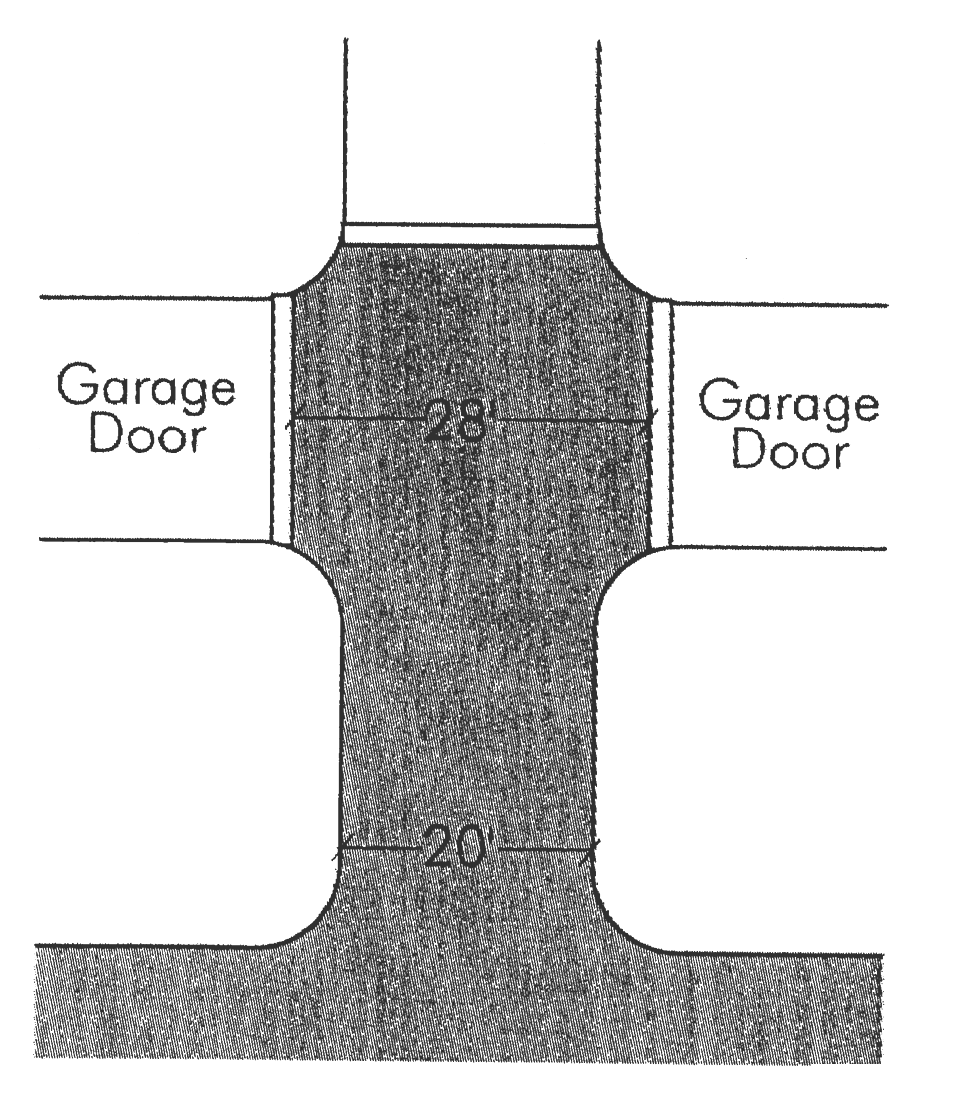
Figure 9.06.1: Garage Access
(c)
Maneuvering areas. Maneuvering areas for access into and out of garages, carports and uncovered parking spaces shall have minimum widths as follows:
(1)
Garages and carports shall have 28 feet of unobstructed area, measured from the garage or carport entry as illustrated in Figure 9.06.1.
(2)
Uncovered parking shall have 24 feet of unobstructed area, measured from the outward end of the parking stall.
(d)
Location of residential parking spaces.
(1)
Assigned spaces shall be conveniently and safely located on the same site within 200 feet of the dwelling unit they serve.
(2)
Assigned spaces shall be designated as to the dwelling unit to which they are assigned on all plot plans or site plans submitted for the proposed project.
(e)
Design of common parking areas. Common off-street parking areas, including multiple garages and carports serving multi-family dwelling units, shall comply with the following:
(1)
The off-street parking area shall be designed so that a vehicle within the parking area will not have to enter a public street to move from one location to any other location within that parking area.
(2)
Parking and maneuvering areas, including garages and carports, shall be designed so that any vehicle can leave the parking area and enter onto the nearest street traveling in a forward direction.
(3)
Curbs or tire stops shall be provided at the end of each uncovered parking space along any property line abutting a public walkway, street or alley, except where screening is positioned, to ensure that the motor vehicle will not encroach into the public right-of-way as illustrated in Figure 9.06.2.
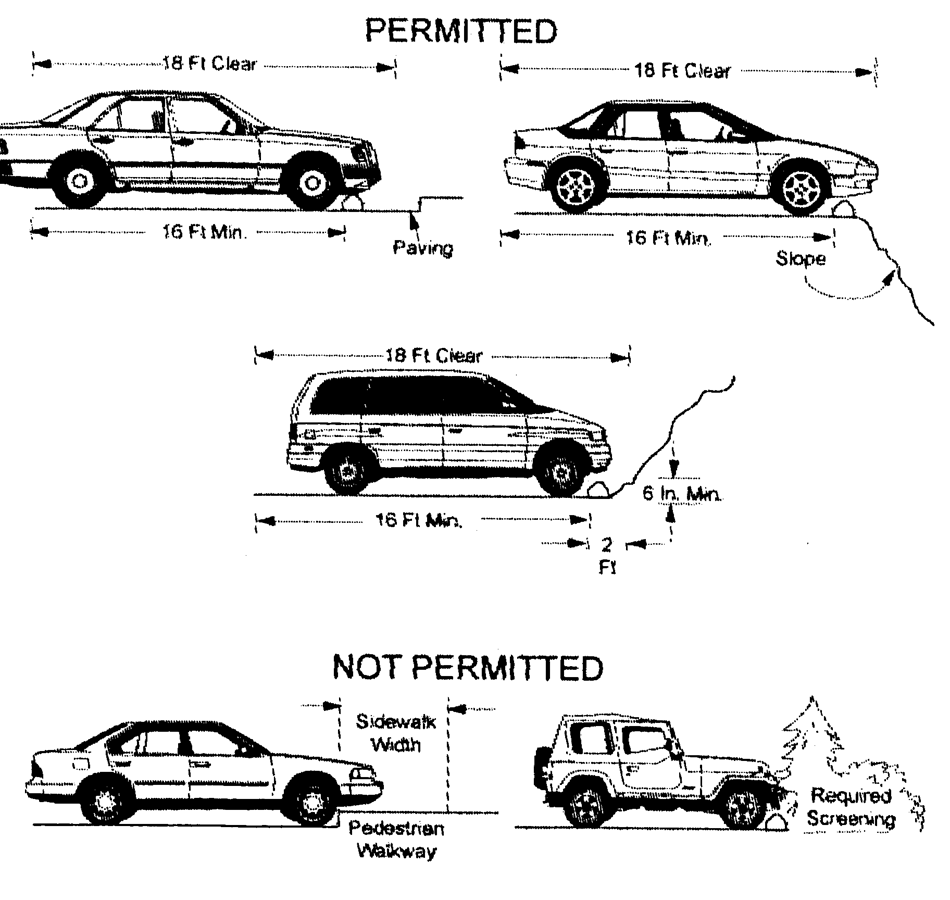
Figure 9.06.2: Curbs/Tire Stops
(f)
Location of driveway on corner lot. When a building site abuts two intersecting streets, the driveway approach shall be located within the half of either street frontage that is farthest from the intersection of the two streets. If one of the intersecting streets is an arterial highway, the driveway approach shall be located on the other street. (Figure 9.06.3)
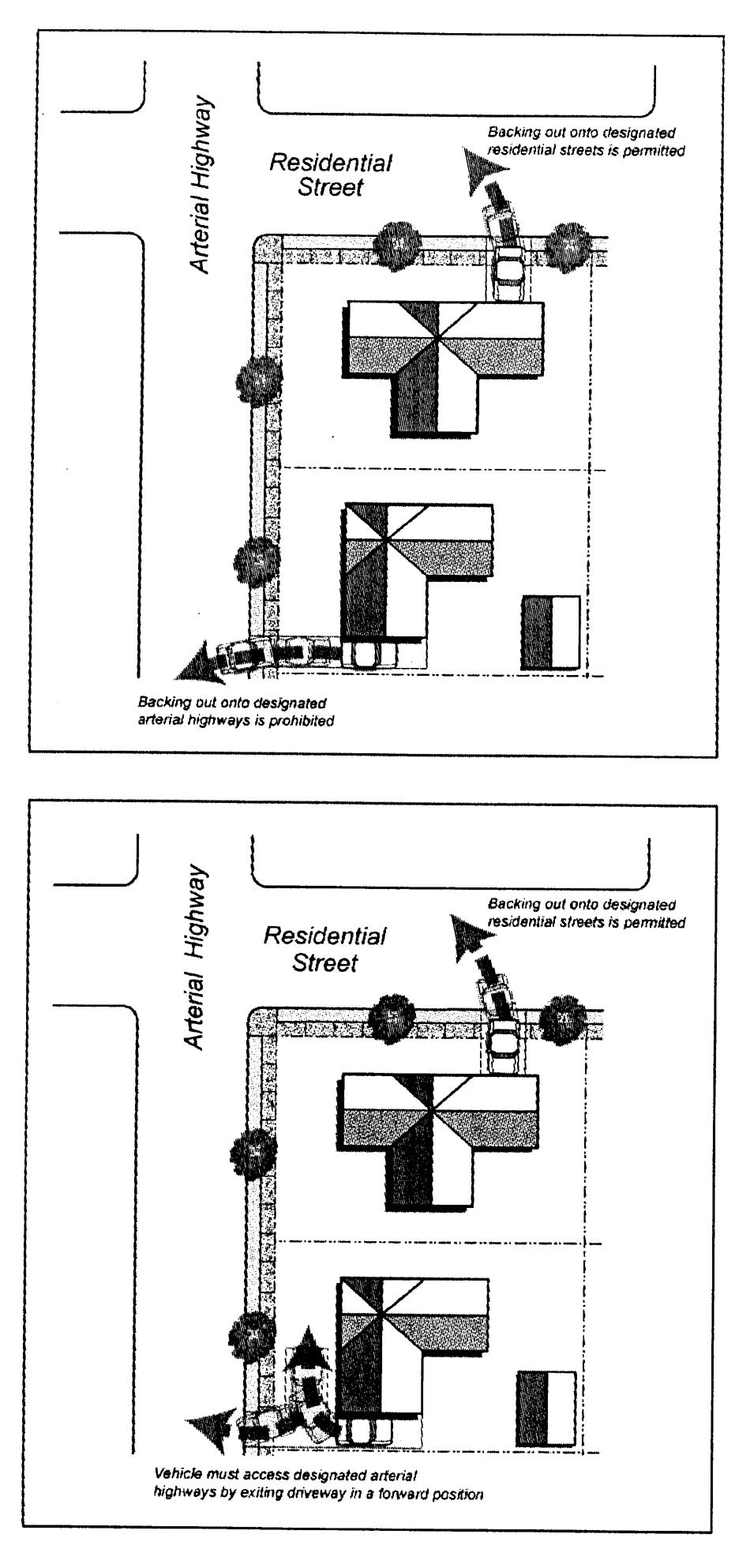
Figure 9.06.3: Location of Driveway on Corner Lot
(g)
Screening. Uncovered residential parking facilities containing five or more spaces shall be screened in accordance with the screening requirements of Section 9.05.070.
(Ord. No. 07-03, § 4(Exh. A), 4-11-2007)
Sec. 9.06.070. - Non-residential parking requirements.
The numerical parking requirements for all non-residential uses are identified in Table 9.06.3.
(Ord. No. 07-03, § 4(Exh. A), 4-11-2007)
Sec. 9.06.080. - Non-residential parking standards.
(a)
Location of non-residential parking. Required parking for non-residential uses shall be located:
(1)
On the same site as the use which the facilities serve; or
(2)
On an adjoining lot or parcel of land under the same ownership as the site necessitating the parking, provided that the shared parking does not conflict with and are in addition to any preestablished parking requirement on that site and that the owner of the site will grand and record a parking easement or other recorded document satisfactory to the City; or
(3)
On an adjacent lot or parcel of land not under the same ownership as the site necessitating the parking, provided that the shared parking does not conflict with, is in addition to any preestablished parking requirements on that site and that the owner of the site will grant and record a parking easement or other recorded document satisfactory to the City, provided:
a.
Said lots or parcels would be contiguous, if not separated by an alley;
b.
Direct vehicular and pedestrian passage between said lots or parcels would be possible if the public right-of-way were vacated; and
c.
The parking and vehicular access on said lots or parcels can be designed to ensure safe pedestrian movement between the parking and site which the parking facilities serve as determined by the City Engineer.
(4)
On a remote site, with Planning Commission approval of a parking management plan through an alternative development standard pursuant to Section 9.08.050 to include security measures, pedestrian access between the parking and parent site, means and methods of transportation between the sites, schedule of usage, parking assurances and other issues or concerns deemed necessary by the City Engineer, the Development Services Director and the Planning Commission.
(5)
Remote or shared employee parking meeting the same requirements of Subsection (4) may be substituted for existing on-site parking if the existing on-site area is converted to another land use approved by the Planning Commission through an alternative development standard pursuant to Section 9.08.050. An analysis approved by the Development Services Director verifying the number of employees to be relocated and that remaining parking supports the proposed new land use and other issues or concerns deemed necessary by the Development Services Director.
Table 9.06.3
Non-Residential Parking Requirements
(b)
Size of parking spaces.
(1)
All covered or uncovered off-street parking spaces, except as otherwise noted in this Section, shall be a minimum clear unobstructed nine feet in width and 18 feet in length.
(2)
Parking spaces parallel to a curb may be eight feet in width and 18 feet in length, with a minimum of four feet separating each pair of such parking spaces.
(3)
When a side of any space abuts a building, fence, support column or other obstruction which interferes in any way with access to a motor vehicle, the space shall be a minimum of two feet wider than the standard required width.
(4)
In measuring the length of paving required for uncovered parking spaces, allowance may be made to accommodate vehicular overhang beyond a continuous, unbroken concrete curb, if such overhang does not interfere with screening or pedestrian use.
(5)
No compact spaces are permitted.
(c)
Non-residential parking facility design.
(1)
Off-street parking facilities shall be designed so that a car within a facility will not have to enter a street to move from one location to any other location within that parking facility. On industrial or office sites, separate noncontiguous parking facilities may be provided with independent entrances for employee and visitor parking, provided the designated use is clearly identified on all plot plans or site plans submitted for the proposed project.
(2)
Parking and maneuvering areas shall be arranged so that any vehicle can leave the parking area and enter into an adjoining vehicular right-of-way traveling in a forward direction.
(3)
Dead ends shall include adequate maneuvering areas as illustrated in Figure 9.06.4.
(4)
No dead-end parking aisles shall serve more than five consecutive stalls for single-loaded aisles and ten, on each side, for double-loaded aisles.
(5)
Continuous, unbroken concrete curbs shall be provided along any abutment to a pedestrian walkway, access or driveway, street or alley, except where screening is positioned, to ensure that the motor vehicle will not extend into these areas.
(6)
All paved parking stalls, except parallel spaces, which may use a single line, shall be clearly outlined with double or hairpin lines or special paving techniques on the surface of the parking facility.
(7)
All parking spaces shall be located so as to be within proximity to the use they are intended to serve. Distribution of parking in multi-tenant centers should be in reasonable proximity to the uses they are intended to serve.
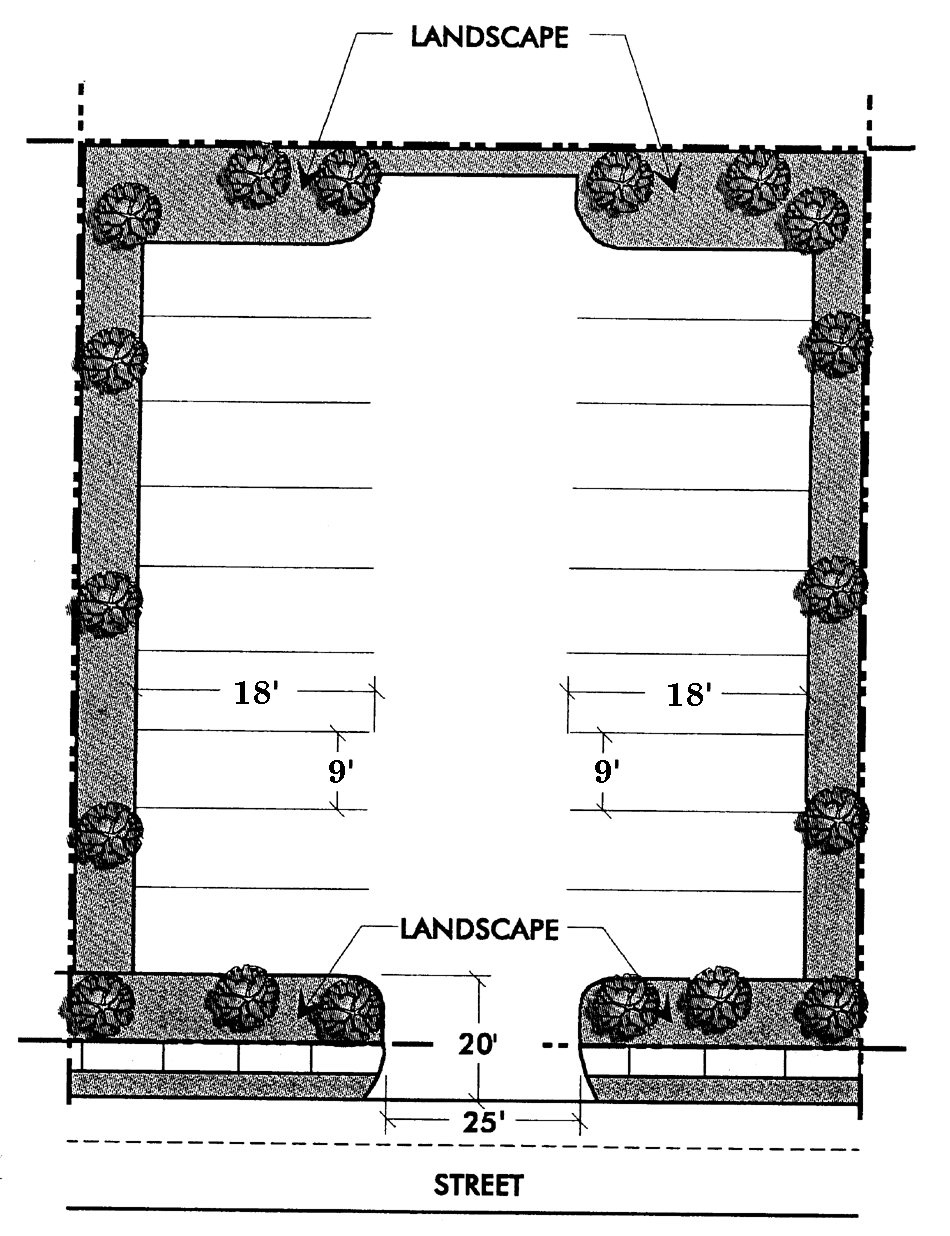
Figure 9.06.4: Dead End Maneuvering Areas
(d)
Non-residential parking accessways. Parking accessways are those driveways that provide ingress or egress from a street to the parking aisles, and those driveways providing interior circulation between parking aisles. No parking is permitted on an accessway. Accessways shall conform to the following standards:
(1)
All parking facilities taking access from a major, primary or secondary arterial shall have a parking accessway between the arterial and the parking aisles.
(2)
Parking accessways from arterial highways shall not have parking spaces taking direct access therefrom and shall not be intersected by a parking aisle or another parking accessway for a minimum distance of the following:
a.
Thirty feet for projects with zero to 200 parking spaces;
b.
Fifty feet for projects with 201 to 350 spaces;
c.
Seventy feet for projects with 351 to 450 spaces; and
d.
Ninety feet for projects with 451 spaces or more.
All distances shall be measured from the curb face of the ultimate curbline of the adjacent street.
(3)
Parking accessways from nonarterial highways shall be not less than 20 feet in length from the ultimate curbline of the adjacent street.
(4)
One-way accessways shall have a minimum width of 15 feet, unless the accessway is a fire lane, which requires a minimum of 20 feet.
(5)
Two-way accessways shall have a minimum width of 28 feet.
(e)
Parking aisles. Parking aisles shall have a minimum width of 14 feet. In no case shall the parking aisles for two-way traffic be less than 25 feet in width.
(f)
Landscaping. Landscaping of parking areas shall be provided in accordance with Subsection 9.05.070(d).
(g)
Screening. Open parking spaces and parking structures shall be screened in accordance with Section 9.05.070. Screening shall be located adjacent to the inside edge of any required boundary landscaping and the outside edge of the paved parking area when there is no landscaping.
(h)
Off-street loading.
(1)
Off-street loading spaces shall be required on the same building site with every building, storage warehouse, auto dealership, wholesale distributor, department store, market, hotel, laundry, dry cleaning, and other similar uses involving the receipt or distribution by vehicle of materials or merchandise incidental to carrying on such activity.
(2)
Each off-street loading space shall be sufficient to permit the standing, loading, and unloading of vehicles to avoid undue interference with the public use of streets and alleys and shall not be a part of the off-street parking area required for each particular use.
(3)
The loading area shall be screened from public view.
(Ord. No. 07-03, § 4(Exh. A), 4-11-2007; Ord. No. 07-07, §§ 2, 7—9, 11-14-2007; Ord. No. 09-03, § 8, 3-25-2009; Ord. No. 11-02, § 13, 4-27-2011; Ord. No. 24-07, § 23, 9-11-2024)
Sec. 9.06.090. - Joint use/shared parking.
(a)
General. Parking facilities may be provided jointly subject to the satisfaction of the requirements of this Section and approval of a site development permit pursuant to Section 9.08.170, and, when an inadequate supply of required parking is provided on site, an alternative development standard pursuant to Section 9.08.050. The joint use/shared parking plan shall include:
(1)
Written verification from the involved property owners and tenants acknowledging acceptance of and compliance with the requirements of the joint use/shared parking plan;
(2)
A proposed means of providing notice of the joint use/shared parking plan to all future property owners, tenants and other users;
(3)
A proposed means to amend the agreement to include future users/tenants or changes based upon participant modifications to uses;
(4)
A site plan showing all parking spaces, building square footage and tenant spaces within the complex or area participating;
(5)
A joint use/shared parking matrix with the following information:
a.
The number of parking stalls available on-site (parking supply);
b.
Project building and tenant addresses;
c.
Gross square footage of all buildings and tenant spaces;
d.
The name, type of use and the days and hours of operation for each tenant;
e.
The number of parking stalls required for each tenant based on each tenant's gross square footage and type of use;
f.
The hourly parking demand for all tenants on:
1.
Weekdays (Monday through Friday);
2.
Saturdays; and
3.
Sundays.
g.
A comparison between hourly parking demand and the parking supply to show that demand will not exceed parking supply.
(b)
Joint usage where there is an overall deficiency in the number of spaces provided. Parking facilities for adjoining uses within shopping centers for which the hours of parking demand are substantially different from each other may be provided jointly. Such joint usage shall be subject to:
(1)
The granting of an alternative development standard by the City; and
(2)
The satisfaction of the following conditions:
a.
Absence of conflicts. Sufficient evidence as identified and documented in a parking study shall be submitted demonstrating that no substantial conflict in the principal hours or periods of peak demands of the structures or uses for which the joint use is proposed will exist.
b.
Allocation of spaces. The number of parking spaces which may be allocated to the requirements for each structure or use involved shall not exceed the number of spaces reasonably anticipated to be available during the differing hours of operation.
c.
Location. The parking facilities designated for joint use shall be contiguous to all the structures and uses served and not more than 200 feet from each shared use. A pedestrian pathway is required to provide a means for pedestrian linkage between immediately adjacent land uses and uses within the parking facility.
d.
Deed recorded agreements. The city may require a written agreement, approved by the City Attorney as to form and content, to be executed by all parties concerned and filed in the office of the County Recorder. Such agreement shall be a covenant running with the land or other enforceable restriction and shall assure the continued availability of the number of spaces designated for joint use at the periods of time indicated.
(c)
Joint usage where there is no overall deficiency in the number of spaces provided. If two or more adjoining uses are under common ownership, or if the ownership is not common and the respective owners thereof have acquired recordable easements appurtenant for off-street parking approved by the City Attorney as to form and content, such buildings or uses collectively may provide the required off-street parking, in which case the required number of parking spaces shall not be less than the sum of the requirements for the several individual uses computed separately.
(d)
Mixed land use developments (shared parking). Shared parking may be considered in determining the specific number of parking spaces that can be used to serve two or more individual land uses without conflict or encroachment. Any program that would use a shared parking concept may be granted by the Planning Commission through the alternative development standards process if it determines in any individual use that the following findings can be satisfied:
(1)
Variations in the peak accumulations of parking vehicles as the result of different activity patterns of mixed land use will not result in a deficiency of parking spaces (by hour, by day, by season).
(2)
There is a relationship among the land uses that result in two or more land use activities with a single vehicle trip to the development.
In preparing a traffic/parking study for consideration by the Planning Commission, a methodology acceptable to the Development Services Director and City Engineer is to be used.
(Ord. No. 07-03, § 4(Exh. A), 4-11-2007; Ord. No. 07-07, § 2, 11-14-2007)
Sec. 9.06.100. - Visibility at intersections/driveways.
(a)
Intersection visibility. On a corner lot of any intersection in any zoning district, no fence, wall, hedge, or other barrier shall be erected, placed, planted, or allowed to grow above a height of 36 inches so as to:
(1)
Materially impede vision in the triangular area on the parkway side of the curb, at the intersection of streets as illustrated in Figure 9.06.5; or
(2)
Be in conflict with the vehicular sight distance requirements of the current edition of the California Department of Transportation Highway Design Manual.
(b)
Driveway visibility. In any zoning district, no fence, wall, hedge, or other barrier shall be erected, placed, planted, or allowed to grow above a height of 36 inches so as to materially impede vision in the triangular area on the parkway side of the curb, located on both sides of a driveway entrances as shown in Figure 9.06.5.
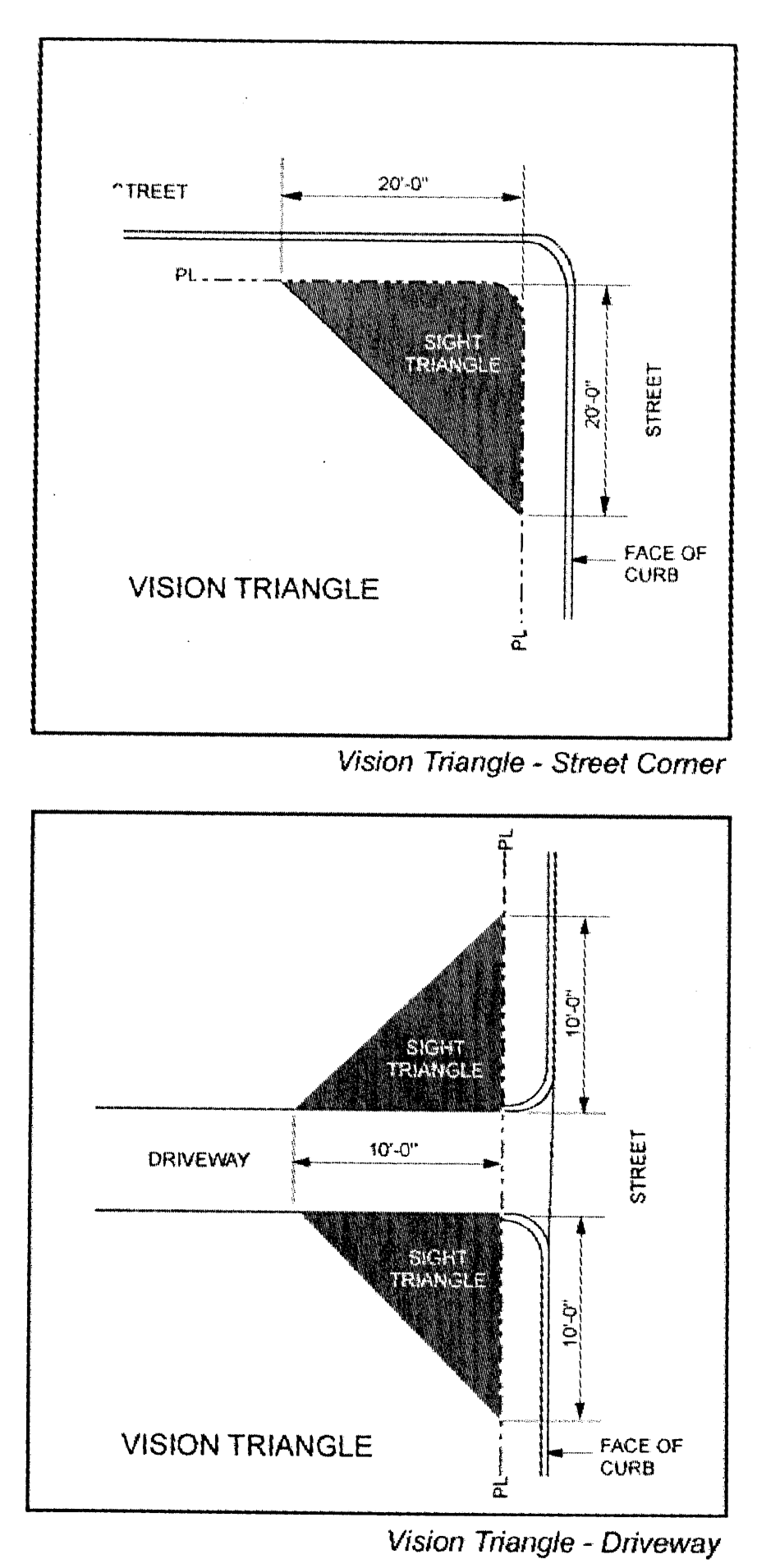
Figure 9.06.5 Intersection/Driveway Visibility
(Ord. No. 07-03, § 4(Exh. A), 4-11-2007)

