
Rancho Santa Margarita
City Zoning Code
City Zoning Code
CHAPTER 9
04 - Regulations for Special Uses and Structures
Sec. 9.04.010.- General requirements.
Accessory uses and structures may be developed as permitted in this Chapter provided such uses are located on the same lot or parcel of land as the principal use, and such uses are incidental to, and do not alter, the use of land as permitted within the specific zoning district in which they are located.
(Ord. No. 07-03, § 4(Exh. A), 4-11-2007)
Sec. 9.04.020. - Accessory structures.
(a)
Development standards for attached accessory structure. A fully-enclosed, attached accessory structure shall be made structurally a part of the main building and shall comply in all respects with the requirements applicable to the principal structure. Decks, porches and balconies shall be regulated by Subsection 9.04.020(d). Open patio covers shall be regulated by Subsection 9.04.020(e). Accessory dwelling units shall be regulated by Section 9.04.190.
(b)
Development standards for detached accessory structure. Detached accessory structures shall satisfy all of the following requirements:
(1)
The structure shall not exceed the height of the principal structure on the building site, except as may otherwise be permitted under Section 9.04.190 (accessory dwelling units).
(2)
The structure shall conform to the front and side yard requirements of the applicable zoning district unless otherwise noted in this Section or Section 9.04.190 (accessory dwelling units).
(3)
The structure shall maintain a minimum separation of five feet between the detached accessory structure and the main building.
(4)
If less than 450 square feet in gross floor area, the structure shall be located a minimum distance from the parcel's rear and side property line equal to the height of the structure. However, if the structure is 450 square feet or more in gross floor area, the structure shall conform to the same rear yard setback requirement as required for main buildings in the applicable zoning district.
(5)
Detached fireplaces, barbecues, fire pits, landscape structures and other similar structures, with a height less than five feet, shall be permitted to encroach into the rear and side setback areas unless the adopted Uniform Building Code regulations require a more restrictive setback. If such structures are five feet or greater in height or if the structure is 450 square feet or more in gross floor area, they shall maintain the minimum side and rear yard setback for the zoning district. No detached fireplace, barbecue, fire pit, landscape structure or other similar structures shall exceed eight feet in height unless approved through the alternative development standard process described in Section 9.08.050.
(6)
Recreational play structures including swings and playgrounds, which are not permanently affixed to the ground, shall be permitted to encroach into the rear and side setback areas. Any recreational play structure which requires a building permit shall maintain the requirements described in Subsections (1), (2), (3), and (4) above.
(c)
Additional development standards for attached and detached accessory structures in residential districts.
(1)
Accessory structures located in residential and future planned community (FPC) districts shall be subject to the development standards for that district, as well as the following requirements:
a.
Exterior sides used to enclose the structure shall be finished with wood, stucco, masonry, or other material of similar texture and durability as the principal structure, and which is compatible with the existing structure.
b.
The roof material shall be concrete, slate, tile, asphalt shingle, or other material of similar appearance, texture, substance, and durability as the principal structure, and which is compatible with the existing structure.
c.
Roof eaves and gables shall be no less than 12 inches, measured from the vertical side of the unit, unless otherwise approved by the Development Services Director or, upon referral, the Planning Commission.
d.
Exterior finish colors for accessory structures shall be the same as the principal structure.
e.
Accessory dwelling units shall comply with the requirements of Section 9.04.190.
(2)
The following building materials shall not be used in the construction and finish of an accessory structure that requires a building permit:
a.
Exterior sides of accessory structures shall not use metal siding and/or exposed metal supports, cloth, canvas, plastic sheeting, corrugated fiberglass, or corrugated metal.
b.
Roofs of accessory structures shall not use cloth, canvas, plastic sheeting, corrugated fiberglass, or corrugated metal.
c.
Temporary shade structures may utilize canvas or other similar material, provided the shade structure is not permanently affixed to the ground.
(d)
Decks, porches, and balconies. Decks, porches, and balconies more than 30 inches above finished grade may be erected as accessory structures in conjunction with the principal use on the building site subject to the following requirements:
(1)
Setbacks.
a.
Front yard setback. Attached decks, porches and balconies shall conform to the front yard requirements of the applicable district.
b.
Side yard setback. If an attached deck, porch or balcony is 450 square feet or more in area, the deck, porch or balcony shall conform with the side yard requirement of the applicable district. If the attached deck, porch or balcony is less than 450 square feet in area, the deck may extend into a side yard not more than three feet, but shall in no case be closer than three feet from the side property line.
c.
Rear yard setback. If an attached deck, porch or balcony is less than 450 square feet in area, the deck, porch or balcony may be located a minimum distance from the rear property line equal to three feet, whichever is greater. However, if the deck is 450 square feet or more in area, the deck shall conform to the same rear yard setback requirement as required for the principal structure in the applicable district.
(2)
Decks, porches and balconies over six feet in height measured from finished grade shall not exceed 60 percent of the total length of the principal building elevation to which it is attached and shall maintain all building setbacks of the principal structure.
(3)
Detached decks. Detached decks shall comply with the requirements for detached accessory structures in Subsections 9.04.020(b) and (c).
(e)
Patios and patio covers. Patios and patio covers may be erected as accessory structures in conjunction with the principal use on the building site subject to the following requirements:
(1)
A wholly enclosed covered patio shall maintain the same yard requirements as set forth for the main structure.
(2)
An open patio cover may be erected within the required rear yard to a minimum of three feet from the rear property line. Such structure shall maintain the same front and side yards as required for the principal structure on the building site.
(3)
Patio covers located on properties where individual lots for each residential unit do not exist shall be permitted only upon the approval of a site plan and building designs by the Development Services Director. Issuance of building permits shall be approved upon a finding of consistency with the Development Services Director approved plans.
(4)
Patio cover setbacks shall be measured from the edge of the cover and not the footing.
(f)
Antennas. An antenna may be installed on a lot in any zoning district if it complies with the criteria identified in this Section. Satellite television antennae less than 30 inches in diameter are permitted in any zone and are not subject to the requirements of this Section, provided that such antennae are attached to a permitted main or accessory structure on the lot.
(1)
RL, RLM, RM, RH and FPC zoning districts or residential land uses.
a.
Locations prohibited. No satellite dish antenna shall be located in a front or corner-side yard.
b.
Setbacks. Front and street-side property lines, 20 feet; interior side and rear property lines, ten feet, except that no setback shall be required in interior side and rear setback areas if the antenna does not exceed six feet in height.
c.
Maximum height. Fifteen feet, measured from ground level immediately under the antenna to the highest point of the antenna or any appurtenance attached to it, provided that the Development Services Director may approve mounting an antenna on the rear half of a roof if no other feasible location exists.
(2)
CG, CN, BP, CF, P, and OS zoning districts or non-residential land uses.
a.
Roof-mounted antennas. Satellite dish antennas shall be located on the roof of a structure whenever possible, providing the dish is not visible from public roadways or can be adequately screened from view of public roadways.
b.
Ground-mounted antennas. All satellite dish antennas that cannot be installed on the roof in a manner that is not visible from a public roadway shall be located directly adjacent to a building, whenever possible. Ground-mounted dishes shall be located to the rear or interior side of the building, whenever possible, in order to be screened from view from the front of the building and public roadways. Ground-mounted antennas shall be adequately screened from view from public roadways, unless required for antenna focusing purposes. Ground-mounted antennas located on properties adjacent to residential land uses shall be completely screened from view.
c.
Location prohibited. No satellite dish antenna shall occupy a required parking space or adversely impact any vehicle circulation.
d.
Maximum height. Twenty feet measured from ground or ten feet measured from roof level immediately under the antenna to the highest point of the antenna or any appurtenance attached thereto.
e.
Permit required. A site plan review shall be required for all satellite dish antennas in any C, BP, CF, P, or OS district.
(g)
Mechanical equipment. Mechanical equipment such as air conditioning units and heating and ventilation units shall maintain the same setback requirements as described in the Uniform Building Code. Mechanical equipment located within a front yard or that is otherwise visible from the public right-of-way shall be screened per Section 9.05.070. See Section 9.04.120 regarding swimming pool and spa equipment.
(Ord. No. 07-03, § 4(Exh. A), 4-11-2007; Ord. No. 07-07, § 2, 11-14-2007; Ord. No. 18-01, § 11, 2-14-2018)
Sec. 9.04.030. - Adult businesses.
(a)
Statement of purpose. It is the intent of this Section to prevent community-wide adverse economic impacts, increased crime, decreased property values, and the deterioration of neighborhoods which can be brought about by the concentration of adult businesses in close proximity to each other or proximity to other incompatible uses such as schools, churches, parks, public facilities and residentially zoned districts or uses. The City Council finds that it has been demonstrated in various communities that the concentration of adult businesses causes an increase in the number of transients in the area and an increase in crime, and in addition to the effects described above can cause other businesses and residents to move elsewhere. It is, therefore, the purpose of this Section to:
(1)
Establish reasonable and uniform regulations to prevent the concentration of adult businesses or their close proximity to incompatible uses; and
(2)
To mitigate the negative secondary effects of adult businesses, while permitting the location of adult businesses in certain areas to comply with existing legal standards.
(b)
Definitions.
(1)
Except as otherwise specified, as used herein, the terms and phrases shall have the same meaning as defined in Chapter 6.10.
(2)
Establishment of an adult business. To "establish" an adult business shall be defined to include any of the following:
a.
The opening or commencement of any adult business as a new business;
b.
The conversion of an existing business, whether or not an adult business, to any adult business defined herein;
c.
The addition of any of the adult businesses defined herein to any other existing adult business; or
d.
The relocation of any such adult business.
(c)
Minimum proximity requirements. No adult business shall be established or located in any zoning district in the City other than the business park zoning district, and subject to the distance requirements of certain specified land uses or zones as set forth below:
(1)
No such business shall be established or located within 1,000 feet of any other adult business.
(2)
No such business shall be established or located within 1,000 feet from any existing residential zoning district or use, park, church or school.
(3)
The distances set forth above shall be measured as a radius from the primary entrance of the adult business to the property lines of the property so zoned without regard to intervening structures.
(Ord. No. 07-03, § 4(Exh. A), 4-11-2007)
Sec. 9.04.040. - Animal care facilities.
In addition to the requirements of the zoning district in which an animal hospital/clinic, kennel, or animal day care facility is located, the following conditions shall apply to the establishment, maintenance, and operation of the facility:
(1)
All animal service and confinement areas and all animal runs shall be located within an air conditioned and sound attenuated building;
(2)
All facilities for the treatment and confinement of animals shall be designed, installed, constructed, and maintained to meet applicable standards established by relevant County and State public health agencies;
(3)
All animal waste shall be double bagged and disposed of in a timely manner. The cleaning product, Chlorhexiderm, or other similar cleaning products, shall be used when mopping the interior of the building. No animal waste or animal crates shall be washed down into the storm drains; and
(4)
All uses on the site shall comply with existing National Pollutant Discharge Elimination System (NPDES) requirements, including, but not limited to, Chapter 5.10, the Rancho Santa Margarita Local Implementation Plan and the best management practices developed by the County of Orange.
Additional conditions may be placed upon the animal care facility through the conditional use permit process.
(Ord. No. 07-03, § 4(Exh. A), 4-11-2007)
Sec. 9.04.050. - Wireless communication facilities.
The purpose of this Section is to provide placement, design and screening criteria for wireless communication facilities in order to protect the public health, safety, general welfare, and quality of life while preserving the rights of wireless communication providers. These regulations are intended to establish flexible guidelines for the governance of wireless communications facilities that recognize the unique land use distribution and topography in the City.
(1)
Exemptions.
a.
Emergencies. In the event an emergency or disaster is declared for the area, the Development Services Director may exempt wireless communication facilities from the requirements of this Section during the duration of such emergency or disaster.
b.
Small wireless facilities. Small wireless facilities covered by and/or subject to the provisions of Section 9.04.055 are exempt from and shall not be governed by this Section 9.04.050.
(2)
Definitions.
a.
Minor wireless communication facility means a wireless communication facility that is building-, facade-, or wall-mounted, and does not exceed the height of the parapet wall or roof line of the building. A roof-mounted facility that is concealed or is of a small diameter and does not exceed the maximum height of the district, is considered a minor wireless communication facility.
b.
Major wireless communication facility means a wireless communication facility that is ground-mounted, and/or is mounted in any manner on property or buildings owned by the City or in rights-of-way over which the City has regulatory authority.
c.
Co-location facility means a wireless communication facility that meets the requirements of Government Code § 65850.6(a).
(3)
Prohibited uses. Wireless communication facilities that incommode the public use of the road or highway are prohibited.
(4)
Development criteria. The following regulations shall apply to the placement of wireless communication facilities:
a.
All wireless communication facilities may be mounted subject to the preferred order of placement and general provisions of this Section:
1.
Co-located with other wireless communication facilities.
2.
On existing structures such as buildings, communication towers, and utility facilities.
b.
Wireless communications facilities shall be located where the existing topography, vegetation, buildings or other structures provide the greatest amount of screening.
c.
Ground-mounted wireless communication facilities shall be located in close proximity to existing above ground utilities, such as electrical towers, water tanks or utility poles (which are not scheduled for removal or undergrounding in the next 18 months), light poles, trees of comparable heights, and in areas where they are otherwise visually compatible and will not detract from the appearance of the city.
d.
For all ground-mounted communication facilities, the support structures shall be set back from all residential property lines a distance equal to and no less than, the height of the highest point of the wireless communication facility.
e.
Wireless communication facilities shall not be located within 1,000 feet of any other communication facility except when located on an existing building, structure or wireless facility. For the purpose of this Section, all distances shall be measured in a straight line without regard to intervening structures, from the nearest point of the proposed major wireless communication facility to the nearest property line of any residential land use, or to the nearest point of another major wireless communication facility.
Design standards.
(1)
Wireless communication facilities shall not bear any signs or advertising devices other than certification, warning, or other legally required seals or signage.
(2)
Accessory equipment shall meet the following standards:
a.
All accessory equipment associated with the operation of the wireless communication facility shall be located within a building, enclosure, or underground vault that complies with the development standards of the zoning district in which the accessory equipment is located, subject to City approval.
b.
Accessory equipment permitted to be located above ground shall be visually compatible with the surrounding buildings and include sufficient landscaping to screen the structure from view.
c.
Accessory equipment enclosures shall be limited to the housing of radio, electronic and related power equipment, and shall not be used for any other purpose, including storage.
(3)
Wireless communication facilities shall have subdued colors and non-reflective materials that blend with surrounding materials and colors.
(4)
All screening for building-mounted facilities shall be compatible with the existing architecture, color, texture and or materials of the building.
(5)
The monopole foundation and structures upon which antenna are to be mounted, shall be no greater in diameter or cross Sectional dimension than is necessary for the proper functioning of the wireless communication facility. However, such facility shall be designed to accommodate at least two antennas.
(6)
In considering an application for any major or minor wireless communication facility, the Planning Commission shall consider the cumulative visual effects of existing wireless communication facilities in determining the location of an additional facility and in imposing conditions on the facility, all as necessary to minimize negative visual impacts of the applied for facility.
(7)
Security fencing, if permitted or required, shall conform to the following:
a.
No fence shall exceed six feet in height.
b.
The fence material shall be compatible with the underlying zoning requirements.
c.
Security fencing shall be screened from view through the use of appropriate landscaping material.
Height standards. Wireless communication facilities utilizing a free-standing support structure shall be limited to the maximum building height for the applicable zoning district.
Noise. Any noise generating equipment shall meet the requirements of Chapter 5.04 of the Municipal Code.
Co-location.
(1)
All applicants shall cooperate in good faith with existing wireless communication facilities operators in co-locating additional antennas on support structures and/or on existing buildings provided the existing operator has received a discretionary permit for such use at said site from the City.
(2)
All applicants shall exercise good faith in cooperating in co-locating with other providers and sharing the permitted site, provided such proposed shared use does not prevent or unreasonably interfere with the existing use (e.g., significant interference in broadcast or reception capabilities as opposed to competitive conflict or financial burden). Such good faith cooperation shall include sharing technical information necessary to evaluate the feasibility of co-location. In the event a dispute arises as to whether a provider has exercised good faith in accommodating other users, the City may require a third party technical study at the expense of either or both the applicant and the existing operator as to the feasibility of co-locating.
(3)
Failure to comply with the co-location requirements of this Section may result in the denial of a permit request or revocation of an existing permit.
(4)
A co-location facility shall be a permitted use.
(5)
Performance standards.
a.
The site in which the wireless facility is located must be maintained in a condition free of trash, debris, and refuse in accordance with Section 9.05.100.
b.
Lawfully-erected wireless communication facilities that have not provided wireless communication services for a cumulative period of 90 days in a one-year period shall be considered abandoned and be removed promptly from the premises no later than three months after the discontinuation of use, except as otherwise provided by law. Such removal shall be in accordance with proper health and safety requirements and all ordinances, rules and regulations of the City. The wireless communication provider shall send to the City a copy of the discontinuation notice required by the California Public Utilities Commission (CPUC) or Federal Communications Commission (FCC) at the time the notice is sent to the regulatory agencies.
c.
All facilities determined to be abandoned and not removed within the required three-month period from the date of notice shall be in violation of this Chapter, and operators of the facility and the owners of the property shall be subject to penalties for violations under the enforcement and penalties provisions of this Section. The City may remove all abandoned facilities following the three-month removal period at the operators' expense. Facilities removed by the City shall be stored for no less than 15 days and thereafter be disposed of by public auction, if deemed to be of value by the City, or otherwise as permitted by law.
(6)
Permit application and other submittal requirements.
a.
For minor and co-location wireless communication facilities, the applicant shall submit a completed "site development permit application" to the Development Services Director.
b.
For major wireless telecommunication facilities, the applicant shall submit a completed "conditional use permit application" to the Development Services Director.
(7)
Approval of wireless communication facilities.
a.
Major and minor wireless communications facilities shall be subject to approval by the Planning Commission. The decision of the Planning Commission shall be final unless appealed in writing within ten business days pursuant to Section 9.08.100.
b.
Co-location facilities are subject to administrative approval.
(8)
Nonconforming wireless communication facilities. Any wireless communication facility constructed in violation of this Section, or in violation of any prior ordinance or regulation, is subject to immediate abatement or revocation of permit.
(9)
Enforcement.
a.
All wireless communication facilities are subject to periodic inspection by the City to determine whether they are in compliance with all applicable provisions of this Section.
b.
If any conditions are discovered that may result in a danger to life or property, the City will give written notice to the permittee and/or the property owner at their last known address, describing the dangerous condition and demanding that the condition be corrected within the period of time specified in that notice.
c.
Failure to comply with any applicable provision of this Section, or with conditions that may be imposed in connection with a variance, approved permit, or conditional use permit, will constitute a public nuisance as well as grounds for immediate revocation of the permit or other entitlement.
(Ord. No. 07-03, § 4(Exh. A), 4-11-2007; Ord. No. 07-07, § 2, 11-14-2007; Ord. No. 09-03, § 4, 3-25-2009; Ord. No. 20-04, § 3, 6-10-2020)
Editor's note— Ord. No. 07-03, § 4(Exh. A), adopted April 11, 2007, enacted provisions intended for use as Subsections A.—I. To preserve the style of this Code, and at the discretion of the editor, said provisions have been redesignated as Subsections (1)—(9).
Sec. 9.04.055. - Small wireless facilities.
(a)
Statement of purpose. The purpose and intent of this Section is to:
(1)
Provide a uniform and comprehensive set of regulations and standards for the permitting, development, siting, installation, design, operation, and maintenance of small wireless facilities in the City.
(2)
Establish clear local guidelines, standards, and time frames for the exercise of local authority with respect to the regulation of small wireless facilities in the City.
(3)
Impose clear and reasonable requirements so that applications for small wireless facilities will be processed in a consistent and timely manner. This Section imposes requirements that are necessary to protect public health, safety, welfare, aesthetics, and provide for the orderly, managed, and efficient deployment of small wireless facilities in accordance with State and Federal laws, rules, and regulations.
(4)
Provide for the orderly, managed, and efficient development of small wireless facilities in accordance with State and Federal laws, rules, and regulations and permit and manage reasonable access to public rights-of-way of the City for telecommunications purposes on a competitively neutral basis.
(5)
Enable the City to discharge its public trust responsibilities consistent with rapidly evolving Federal and State regulatory policies, industry competition, and technological development through the encouragement of advanced and competitive telecommunications services on the widest possible equivalent basis to the businesses, institutions, and residents of the City while continuing to fairly and responsibly protect the public health, safety, and welfare.
(6)
Promote and protect public health, safety, welfare, and the aesthetic quality of the City consistent with the goals, objectives, and policies of the General Plan.
(7)
Conserve the limited physical capacity of public rights-of-way held in public trust by the City.
(8)
Assure that the City's current and ongoing costs of granting and regulating private access to and use of public rights-of-way are fully paid by the persons seeking such access and causing such costs while securing fair and reasonable compensation for the City and the residents of the City for permitting private use of public rights-of-way, within the limits established by the FCC.
(9)
This Section is not intended nor shall it be interpreted or applied to: (1) prohibit or effectively prohibit any small wireless service provider's ability to provide small wireless facilities; (2) prohibit or effectively prohibit any entity's ability to provide any interstate or intrastate telecommunications service, subject to any competitively neutral and nondiscriminatory rules or regulations for rights-of-way management; (3) unreasonably discriminate among providers of functionally equivalent services; (4) deny any request for authorization to place, construct, or modify small wireless facilities on the basis of environmental effects of radio-frequency emissions to the extent that such wireless facilities comply with the FCC's regulations concerning such emissions; (5) prohibit any collocation or modification that the City may not deny under Federal or State law; or (6) otherwise authorize the City to preempt any applicable Federal or State law.
(b)
Definitions. For the purpose of this Section, the words and terms defined in this subsection (b) shall have the meaning set forth herein unless the context clearly indicates or requires a different meaning.
Accessory equipment means any equipment, other than antenna equipment, associated with the installation of a small wireless facility.
Antenna means the same as defined by the FCC in 47 C.F.R. § 1.6002(b), as may be amended or superseded, which defines that term as an apparatus designed for the purpose of emitting radiofrequency radiation, to be operated or operating from a fixed location, for the provision of personal wireless service and any commingled information services.
Antenna equipment means the same as defined by the FCC in 47 C.F.R. § 1.6002(c), as may be amended or superseded, which defines the term as equipment, switches, wiring, cabling, power sources, shelters or cabinets associated with an antenna, located at the same fixed location as the antenna, and, when collocated on a structure, is mounted or installed at the same time as such antenna.
Antenna facility means the same as defined by the FCC in 47 C.F.R. § 1.6002(d), as may be amended or superseded, which defines the term as an antenna and associated antenna equipment.
Applicant means a person or entity that submits an application for a small wireless facility permit under the provisions of this Section and the agents, employees, and contractors of such person or entity.
Collocation means the same as defined by the FCC in 47 C.F.R. § 1.6002(g), as may be amended or superseded, which defines that term as mounting or installing an antenna facility on a pre-existing structure, and/or modifying a structure for the purpose of mounting or installing an antenna facility on that structure.
Decorative pole means any pole that includes decorative or ornamental features, design elements and/or finials intended to enhance the appearance of the pole or the public rights-of-way in which the pole is located.
Deployment means the same as defined by the FCC in 47 C.F.R. § 1.6002(h), as may be amended or superseded, which defines the term as placement, construction, or modification of a personal wireless service facility.
Development Services Director means the Development Services Director for the City or a designee of the City Manager.
FCC means the Federal Communications Commission or its duly appointed successor agency.
Modification means any change to a small wireless facility that involves any of the following: collocation, expansion, alteration, enlargement, intensification, or augmentation, including, but not limited to, a change in size, shape, color, visual design, or exterior material. Modification does not include repair, replacement, or maintenance if those actions do not involve a change to the small wireless facility involving any of the following: collocation, expansion, enlargement, intensification, or augmentation.
New pole means any pole erected or installed after the effective date of this Section. The term "new pole" does not include a "replacement pole" as defined in this Section.
Pole means a single shaft of wood, steel, concrete, or other material capable of supporting the equipment mounted thereon in a safe and adequate manner and as required by provisions of this Code.
Public right-of-way or right-of-way means any public street, public way, public alley, or public place, laid out, reserved, or dedicated for street, sidewalk, storm drainage, bicycle path, or other public uses or purposes under the jurisdiction of the City.
Public Works Director means the Public Works Director/City Engineer of the City or the designee of the City Manager.
Replacement pole means and shall only include a pole or structure that replaces a pole in the exact same location in order to accommodate small wireless facilities at the time the replacement pole is approved.
Small wireless facility or facility means the same as defined by the FCC in 47 C.F.R. § 1.6002(l), as may be amended or superseded, which defines the term as a facility that meets each of the following conditions:
(1)
The facility is: (i) mounted on structures 50 feet or less in height including their antennas; or (ii) mounted on structures no more than ten percent taller than other adjacent structures; or (iii) does not extend existing structures on which it is located to a height of more than 50 feet or by more than ten percent, whichever is greater;
(2)
Each antenna associated with any deployment, excluding associated antenna equipment, is no more than three cubic feet in volume;
(3)
All other wireless equipment associated with the structure, including the wireless equipment associated with the antenna and any pre-existing associated equipment on the structure, is no more than 28 cubic feet in volume;
(4)
The facility does not require antenna structure registration under 47 C.F.R. Part 17;
(5)
The facility is not located on Tribal lands, as defined under 36 C.F.R. 800.16(x); and
(6)
The facility does not result in human exposure to radiofrequency radiation in excess of the applicable safety standards specified in 47 C.F.R. 1.1307(b).
Structure means the same as defined by the FCC in 47 C.F.R. § 1.6002(m), as may be amended or superseded, which defines the term as a pole, tower, base station, or other building, whether or not it has an existing antenna facility, that is used or to be used for the provision of personal wireless service (whether on its own or comingled with other types of services).
(c)
General provision. Notwithstanding any provision of the Rancho Santa Margarita Municipal Code to the contrary, this Section shall govern all applications for small wireless facility permits in the City.
(d)
Required approvals.
(1)
A small wireless facility permit shall be required to locate or modify any small wireless facility on a pole, new pole, replacement pole, or structure located within the City, including without limitation on any public rights-of-way. No small wireless facility shall be located or modified within the City on any property, including the public right-of-way, without the issuance of an administrative small wireless facility permit, as required by this Section. The Development Services Director, in consultation with the Public Works Director, shall have the authority to approve, approve with conditions, or deny any application for the deployment or modification of a small wireless facility.
(2)
Each applicant for a small wireless facility permit pursuant to this Section proposed for location in or on any public right-of-way within the City shall also submit an application for an encroachment permit pursuant to the provisions of Chapter 11.07 of this Code. The application for an encroachment permit shall be processed, reviewed, and approved concurrently with the application for a small wireless facility permit pursuant to the provisions of this Section.
(3)
An administrative approval granted under this Section shall not confer any exclusive right, privilege, license, or franchise to occupy or use the public right-of-way of the City for delivery of telecommunication services of any kind or for any other purposes.
(4)
All required approvals under this Section shall be processed in conformance with the time periods established by applicable State and Federal law, and FCC regulations and orders.
(e)
Application content. All applications for a small wireless facility permit required by this Section and all required submittals must be made in writing by the applicant on such form as the Development Services Director may prescribe, which shall include the information specified in this subsection in addition to all other information determined necessary by the Development Services Director, in consultation with the Public Works Director:
(1)
Full name and contact information of the small wireless facility owner, small wireless facility operator, agent (if any), and property owner, and related letter(s) of authorization from the small wireless facility and/or property owner.
(2)
A full written description of the proposed small wireless facility, including its purpose and specifications.
(3)
A detailed site plan or photo simulation of the small wireless facility containing the exact proposed location of the small wireless facility, and any existing wireless facilities within a 500-foot radius of the proposed location.
(4)
Photographs of all proposed small wireless facility equipment and an accurate visual impact analysis with photo simulations, including reasonable line-of-sight locations from public streets, nearby vicinity, or other adjacent viewpoints as may be required by the Development Services Director, in consultation with the Public Works Director, and a map that shows the photo location of each view angle.
(5)
Building elevations and roof plan (for building- and/or rooftop-mounted small wireless facilities) indicating exact location and dimensions of equipment proposed. For all other small wireless facilities not mounted to a building or rooftop, indicate surrounding grades, structures, and landscaping from all sides.
(6)
Proposed landscaping and/or nonvegetative screening plan for all aspects of the small wireless facility.
(7)
Written documentation demonstrating a good faith effort to locate the proposed small wireless facility in the least aesthetically intrusive location and screened to the greatest extent feasible in accordance with the design and development standards listed within this Section.
(8)
If the application is for a small wireless facility that will be located within the public right-of-way, the applicant shall state the basis for its claimed right to enter the right-of-way, and provide a copy of its certificate of public convenience and necessity (CPCN), if a CPCN has been issued by the California Public Utilities Commission.
(9)
Evidence from the equipment manufacturer that the ambient noise emitted from all proposed equipment will not, both individually and cumulatively, exceed the applicable noise limits as found in Chapter 5.04 of this Code.
(10)
Evidence that demonstrates that the small wireless facility's antenna does not exceed three cubic feet in volume, and all other equipment (antenna equipment and accessory equipment) does not exceed 28 cubic feet in volume.
(11)
An application and processing fee in an amount consistent with FCC regulations as established within a resolution by the City Council for the estimated cost of the City, including staff time, and all other costs of whatever type or variety, incurred for the processing, review, commenting upon, evaluation, and consideration of the small wireless facility application.
(12)
A siting analysis which identifies a minimum of two other least aesthetically intrusive locations within or outside the City that could serve the area intended to be served by the small wireless facility. The alternative site analysis should include at least one collocation site, if feasible.
(13)
A radio-frequency (RF) exposure compliance report prepared and certified by an RF engineer licensed by the State of California that certifies that the proposed small wireless facility, as well as any collocated facilities, will comply with applicable Federal RF exposure standards and exposure limits. The RF report must include the actual frequency and power levels (in watts effective radio power (ERP)) for all existing and proposed antennas at the site and show the location and orientation of all transmitting antennas and the boundaries of areas with RF exposures in excess of the uncontrolled/general population limit (as that term is defined by the FCC). Each such boundary shall be clearly marked and identified for every transmitting antenna at the project site.
(f)
Design and development standards for small wireless facilities.
(1)
Small wireless facilities shall be located so as not to cause any physical or visual obstruction to pedestrian or vehicular traffic, inconvenience to the public's use of the public right-of-way, or create safety hazards to pedestrians and motorists.
(2)
Small wireless facilities shall not be located within any portion of the public right-of-way interfering with access to fire hydrants, fire stations, water valves, underground vaults, valve housing structures, utility lines or facilities, or any other vital public health and safety facility.
(3)
The applicant shall use screening and camouflage design techniques in the design and placement of small wireless facilities to ensure such facilities are as visually inconspicuous as possible.
(4)
Small wireless facilities shall be sited at least 300 feet away from other small wireless facilities to avoid an over-concentration of such facilities, to preserve community aesthetics, and to avoid the creation of potential hazards or inconvenience to the travelling public. Collocated small wireless facilities on the same pole/structure are not required to meet this minimum spacing standard with respect to one another.
(5)
To preserve community aesthetics, all small wireless facilities, excluding antennas and aboveground vents, shall be pole-mounted or placed underground, flush to the finished grade, whenever there are no physical or site constraints to make undergrounding infeasible, except as may be determined by the Development Services Director, in consultation with the Public Works Director. Infeasibility shall not be demonstrated by the mere cost to place the equipment underground.
(6)
The applicant shall use the least visible antennas as possible to ensure the antenna is as visually inconspicuous as possible.
(7)
All above-ground equipment must provide adequate sight distance in accordance with Section 9.06.100 of this Code.
(8)
If an applicant proposes to replace a pole to accommodate the small wireless facility, the replacement pole shall match the appearance of the original pole to the extent feasible, unless the Development Services Director, in consultation with the Public Works Director, finds that another design accomplishes objectives of this subsection.
(9)
Small wireless facilities may incorporate reasonable and appropriate security measures, such as fences, walls, and anti-climbing devices, to prevent unauthorized access, theft, and vandalism. Security measures must be designed to enhance concealment to the maximum extent feasible. Security measures shall not include barbed wire, razor ribbon, electrified fences or any similar security measures.
(10)
Small wireless facilities shall not be installed on decorative poles, except as may be determined by the Development Services Director, in consultation with the Public Works Director.
(g)
Installation and operation requirements for small wireless facilities.
(1)
Small wireless facilities shall be operated in a manner so as to avoid any significant adverse impacts caused by noise.
a.
Backup generators shall only be operated during periods of power outages, and shall not be tested on weekends or holidays, or between the hours of 10:00 p.m. and 7:00 a.m.
b.
At no time shall equipment noise from any small wireless facility exceed the applicable noise levels as established under Chapter 5.04 of this Code.
(2)
Small wireless facilities shall not bear any signs or advertising devices other than certification, warning, or other signage required by law or permitted by the City.
(3)
Small wireless facility equipment shall not be illuminated unless specifically required by the Federal Aviation Administration, the FCC, or other governmental agency.
(4)
The City recognizes that the advances associated with telecommunication equipment is subject to rapid changes and upgrades as a result of industry competition and customer demands, and anticipates that antennas and related equipment with reduced visual impacts will be available in the future with comparable or improved coverage and capacity capabilities. The City finds that it is in the interest of the public health, safety, and welfare that small wireless facilities be required to replace older facilities with newer equipment of equal or greater capacity and reduced visual impacts as equipment improvements become available. Small wireless facilities shall be reviewed every five years from the approval date of the small wireless facility permit in order to review equipment.
(5)
Only pole-mounted small wireless facilities shall be permitted in the public right-of-way. All poles shall be designed to be the minimum functional height and width required to support the proposed small wireless facility installation and meet FCC requirements.
(6)
Pole-mounted equipment shall be designed to occupy the least amount of space in the right-of-way that is technically feasible.
(7)
All antennas shall be installed so as not to preclude possible future collocation by the same or other operators.
(8)
Each antenna associated with any deployment shall be no more than three cubic feet in volume. All other equipment associated with the small wireless facility, including associated antenna equipment and accessory equipment, shall be no more than 28 cubic feet in volume.
(9)
Small wireless facilities must be mounted on structures 50 feet or less in height including their antenna, or mounted on structures no more than ten percent taller than other adjacent structures, or do not extend existing structures on which the small wireless facility is located to a height of more than 50 feet or by more than ten percent, whichever is greater.
(10)
Small wireless facilities shall be maintained in good working order and condition and shall be fully operable at all times. Each small wireless facility shall be clean and free of general dirt and grease; chipped, faded, peeling, and cracked paint; rust and corrosion; cracks, dents, and discoloration; missing, discolored, or damaged artificial foliage or other camouflage; graffiti, bills, stickers, advertisements, litter and debris; and damaged structural parts.
(11)
Small wireless facilities shall be built in compliance with the Americans with Disabilities Act.
(h)
Conditions of approval for small wireless facilities. In addition to compliance with the requirements of this Section, approval of small wireless facilities shall be subject to each of the following conditions of approval, as well as any modification of these conditions or additional conditions of approval deemed reasonably necessary by the Development Services Director, in consultation with the Public Works Director:
(1)
In the event the construction of a small wireless facility, as approved pursuant to this Section, requires a building permit under the provisions of Title 10 of this Code, all conditions and restrictions imposed on the small wireless facility permit and encroachment permit approved pursuant to the provisions of this Section shall be incorporated in, and made a condition of such building permit. All conditions shall be binding as to the applicant and all successors in interest to permittee. The permittee must construct, install, and operate the small wireless facility in strict compliance with all approved permits.
(2)
As more concealable equipment evolves and becomes available, the permittee shall place above-ground equipment below ground, including, but not limited to:
a.
Any accessory equipment that has been mounted to a small wireless facility or pole or mounted on the ground; and
b.
Replace larger, more visually intrusive small wireless facilities with smaller, less visually intrusive facilities, after receiving all necessary permits and approvals required pursuant to this Code.
(3)
The permittee shall submit and maintain current at all times basic contact and site information on a form as may be provided by the Development Services Director, in consultation with the Public Works Director. The permittee shall notify the Development Services Director of any changes to the information submitted within seven days of any change, including change of the name or corporate legal status of the owner or operator. This information shall include, but is not limited to, the following:
a.
Identity, including the name, address and 24-hour local or toll-free contact phone number of the permittee, the owner, the operator, and the agent or person responsible for the maintenance of the small wireless facility.
b.
The corporate legal status of the owner of the small wireless facility, including official identification numbers and FCC certification.
c.
Name, address, and telephone number of the property owner if different than the permittee.
(4)
The permittee shall not place any small wireless facility that will deny access to, or otherwise interfere with, any public utility, easement, or right-of-way located on the site. The permittee shall allow the City reasonable access to, and maintenance of, all utilities and existing public improvements within or adjacent to the site, including, but not limited to, pavement, trees, public utilities, lighting, and public signage.
(5)
At all times, all required notices and signs shall be posted on the site as required by the FCC and California Public Utilities Commission, and as approved by the City. The location and dimensions of a sign bearing the emergency contact name and telephone number shall be posted pursuant to the approved plans.
(6)
At all times, the permittee shall ensure that the small wireless facility complies with the most current regulatory and operational standards including, but not limited to, radio-frequency emissions standards adopted by the FCC and antenna height standards adopted by the Federal Aviation Administration.
(7)
Every five years the permittee shall submit to the Development Services Director a written report by a qualified licensed radio-frequency emissions engineer, certifying that the facility follows the radio-frequency emissions guidelines or standards of the FCC. Additionally, if at any time while the small wireless facility permit is in effect the Development Services Director, in consultation with the Public Works Director, determines there is good cause to believe that the small wireless facility may emit radio-frequency emissions that are likely to exceed FCC standards, the Development Services Director may require the permittee to submit a report described by this Section. Failure to comply with this provision shall be grounds for revocation of the small wireless facility permit by the Development Services Director. This provision shall not apply to small wireless facilities that are categorically excluded from assessment per FCC Regulation 47 C.F.R. § 1.1307(b), as may be amended or superseded.
(8)
The permittee shall assume full liability for damage or injury caused to any property or person by the small wireless facility.
(9)
The permittee shall agree to the following indemnity provision, as approved by the City Attorney, which shall substantially read as follows: The permittee of any administrative or discretionary land use entitlement permit issued under the provisions of this Section shall indemnify, defend, and hold the City, its officers, agents, employees, and representatives ("indemnitees"), harmless from and against any and all loss, damage, liability, claim, demand, suit, cost, and expense whatsoever, including reasonable attorneys' fees, regardless of the merit or outcome of any such claim or suit arising from or in any manner connected with the issuance of any such permits or approvals and/or the installation, construction, maintenance, use, or operation of the work contemplated on private property, City property, or the public right-of-way for such permits, regardless of whether the indemnitees reviewed and approved any plans or inspected any work or improvement, including any encroachment, and regardless of whether such maintenance, repair, replacement, or condition was affected or caused by the indemnitees, except as provided by law.
(10)
All conditions of approval shall be binding as to the applicant and all successors in interest to the permittee.
(i)
Additional conditions of approval for small wireless facilities in the public right-of-way. In addition to compliance with the requirements of Section 9.04.055 and the conditions of approval stated above in subsection (h), including without limitation the terms and conditions set forth in an approved encroachment permit, approval of small wireless facilities in the public right-of-way shall be subject to the following conditions of approval and any modification of these conditions or additional conditions of approval deemed necessary by the Development Services Director, in consultation with the Public Works Director:
(1)
The small wireless facility shall be subject to such conditions, changes or limitations as are from time to time deemed necessary by the Development Services Director, in consultation with the Public Works Director, for the purpose of: (a) protecting the public health, safety, and welfare, (b) preventing interference with pedestrian and vehicular traffic, and (c) preventing damage to the public right-of-way or any property adjacent to it.
(2)
The permittee shall not move, alter, temporarily relocate, change, or interfere with any existing structure, improvement, or property without the prior written consent of the owner of that structure, improvement, or property. No structure, improvement, or property owned by the City shall be moved to accommodate a small wireless facility unless the Development Services Director, in consultation with the Public Works Director, determines that such movement will not adversely affect the City or any surrounding businesses or residents, and the permittee pays all costs and expenses related to the relocation of the City's structure, improvement, or property. Prior to commencement of any work pursuant to an encroachment permit issued for any small wireless facility within the public right-of-way, the permittee shall provide the City with documentation establishing to the City's satisfaction that the permittee has the legal right to use or interfere with any other structure, improvement, or property within the public right-of-way to be affected by applicant's small wireless facility.
(3)
The permittee shall repair, at its sole cost and expense, any damage including, but not limited to subsidence, cracking, erosion, collapse, weakening, or loss of lateral support to City streets, sidewalks, curbs, gutters, trees, parkways, slopes, street lights, traffic signals, improvements of any kind or nature, or utility lines and systems, underground utility lines and systems, or sewer systems and sewer lines that result from any activities performed in connection with the installation or maintenance of a small wireless facility in the public right-of-way. The permittee shall restore such areas, structures, and systems to the condition in which they existed prior to the installation or maintenance that necessitated the repairs. In the event the permittee fails to complete such repair within the number of days stated on a written notice by the Development Services Director, the Public Works Director shall cause such repair to be completed at permittee's sole cost and expense.
(4)
The permittee shall modify, remove, or relocate its small wireless facility, or portion thereof, without cost or expense to the City, if and when made necessary by:
a.
Any public improvement project, including, but not limited to, the construction, maintenance, or operation of any underground or aboveground public infrastructure including but not limited to sewers, storm drains, conduits, gas, water, electric or other utility systems, or pipes owned by the City or any other public agency;
b.
Any abandonment of any street, sidewalk, or other public facility;
c.
Any change of grade, alignment or width of any street, sidewalk, or other public facility; or
d.
A determination by the Development Services Director, in consultation with the Public Works Director, that the small wireless facility has become incompatible with public health, safety, or welfare or the public's use of the public right-of-way.
(5)
Any modification, removal, or relocation of the small wireless facility shall be completed within 90 days of written notification by the Development Services Director, in consultation with the Public Works Director, unless exigencies dictate a different period for removal or relocation. Modification or relocation of the small wireless facility shall require submittal, review, and approval of a permit amendment pursuant to this Code. The permittee shall be entitled, on permittee's election, to either a pro-rata refund of fees paid for the original permit or to a new permit, without additional fee, at a location as close to the original location as the standards set forth in this Code allow. In the event the small wireless facility is not modified, removed, or relocated within said period of time, the City may cause the same to be done at the sole cost and expense of permittee. In the event of exigent circumstances, as determined by the Development Services Director, in consultation with the Public Works Director, the City may modify, remove, or relocate small wireless facilities without prior notice to permittee provided permittee is notified in writing within a reasonable period thereafter.
(j)
Abandonment or discontinuation of use.
(1)
Small wireless facilities that have not provided wireless communication services for a cumulative period of 90 days in a one-year period shall be considered abandoned and shall be removed promptly from the premises no later than three months after written notification is sent by the Development Services Director, in consultation with the Public Works Director, to the operator of the small wireless facility and property owner. Such removal shall be in accordance with proper health and safety requirements and all ordinances, rules and regulations of the City. The permittee shall send to the City a copy of the discontinuation notice required by the California Public Utilities Commission or FCC at the time the notice is sent to the regulatory agencies.
(2)
Small wireless facilities that are abandoned but not removed within the required three-month period from the date of notice shall be in violation of this Section, and the operators of the small wireless facility and the owners of the property shall be subject to penalties for violations under the enforcement and penalties provisions of this Code. The City may remove all abandoned small wireless facilities following the three-month removal period at the operators' expense. Facilities removed by the City shall be stored for no less than 15 days and thereafter disposed of by public auction, if deemed to be of value by the City, or otherwise as permitted by law.
(k)
Appeals. A decision of the Development Services Director pursuant to this Section may be appealed on behalf of the applicant to the Planning Commission pursuant to Section 9.08.030 and Table 9.08.1 of this Code and such appeal shall be reviewed and decided in conformance with the time periods and procedures established by applicable State and Federal law, and FCC regulations and orders.
(Ord. No. 20-04, § 2, 6-10-2020)
Sec. 9.04.060. - Caretaker facilities.
Caretaker facilities may be developed as permitted in specific zoning districts for the exclusive use of personnel employed for the maintenance and security of the principal use, subject to the following provisions:
(1)
Permanent caretaker facilities are subject to the following requirements:
a.
Must be listed as a permitted use in the applicable zoning district.
b.
Must meet all yard setback requirements of the applicable zoning district.
(2)
Temporary caretaker facilities are subject to Section 9.04.130.
(Ord. No. 07-03, § 4(Exh. A), 4-11-2007)
Sec. 9.04.070. - Fences, walls, hedges and landscape screening.
(a)
General.
(1)
Fences, walls, hedges and landscape screening may be erected within required yard setbacks in all zoning districts subject to the requirements of this Section.
(2)
Fences are required to be located in internal side yards between residences and in any yard located between a residence and an open space or park use.
(3)
For the purposes of this Section, the words "fence" and "wall" shall have the same meaning, and any reference to fences shall include walls. In addition, all height restrictions applying to fences and walls shall apply equally to landscaping planted within required yards forming a barrier serving the same visual purpose as a fence or wall.
(b)
Measurement of height. The height of any fence, wall, hedge or landscape screening shall be measured from the finished grade upon which the fence is placed and the top of the fence as illustrated in Figure 9.04.1. For fences or walls that are located on a natural or manufactured slope in a side or rear yard, the fence may be staggered in height where the minimum height is not less than five feet. Plans for such fences and walls shall be subject to the approval of the Development Services Director.
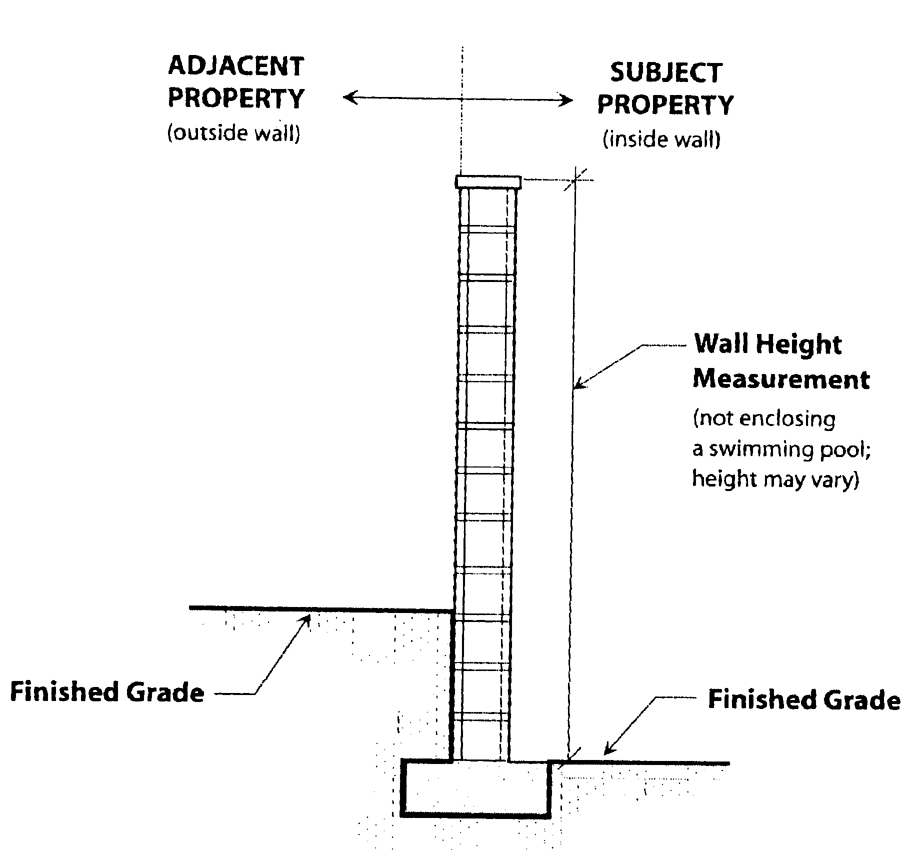
Figure 9.04.1 Fence and Wall Height
(c)
Height limits. The following height limits apply to all zoning districts, except as identified in Subsection 9.04.070(d).
All residential and future planned community (FPC) lots.
(1)
Front yard. Three and one-half feet.
(2)
Side yard. Six feet with the exception of corner lots. Corner lot side yards shall maintain a height limit of three feet within ten feet of a corner side property line. At no time shall such fence, wall, hedge or landscape screening encroach into any area of unrestricted visibility as specified in Section 9.06.100.
(3)
Rear yard. Six feet.
All commercial, mixed-use, and business park lots. As identified in Section 9.05.070.
(d)
Exceptions to height limits.
(1)
Lots adjacent to arterials and highways with a noise contour of 65 dBA or greater as shown in the General Plan noise element may, for noise attenuation purposes, install and maintain a fence or wall to a maximum of eight feet. Any such wall over six feet in height shall be subject to administrative approval (Section 9.08.040) to ensure that the fence or wall is compatible with surrounding land uses. All walls must be constructed in accordance with the requirements of Subsection 9.04.070(g).
(2)
Any wall over eight feet in height shall be subject to discretionary approval through an alternative development standard as described in Section 9.08.050. Such wall or fence visible from public rights-of-way shall have architectural treatments as described in Subsection 9.07.070(g) designed to mitigate its visual impact.
(3)
The Development Services Director may approve fences up to five feet in height in front yards if the following requirements are met:
a.
The portion of the fence above three and one-half feet in height is of open vertical bar construction with a minimum spacing of three inches between vertical elements.
b.
The City Engineer confirms the proposed fence allows adequate sight distance for vehicles using driveways and/or street intersections.
(4)
Where the elevation of an adjoining building site to the side or rear is higher than the base of the fence or wall in the side or rear setback area, the height of the fence or wall may be measured from the elevation of the adjoining building site to the top of the fence or wall as illustrated in Figure 9.04.1. However, in no case shall such a fence or wall exceed eight feet from the base of the fence or wall to the top. This exception shall not apply to situations where the subject fence or wall is located adjacent to a street or alley.
(e)
Fence/retaining wall combinations. If a fence is a vertical extension of a retaining wall, and the combined retaining wall and fence height is greater that six feet within a side or rear yard or greater than three and one-half feet within a front yard (measured from the base of the retaining wall), the base of the fence shall be stepped back from the top of the retaining wall a minimum of two feet as illustrated in Figure 9.04.2. This provision is subject to the review and approval of the Development Services Director.
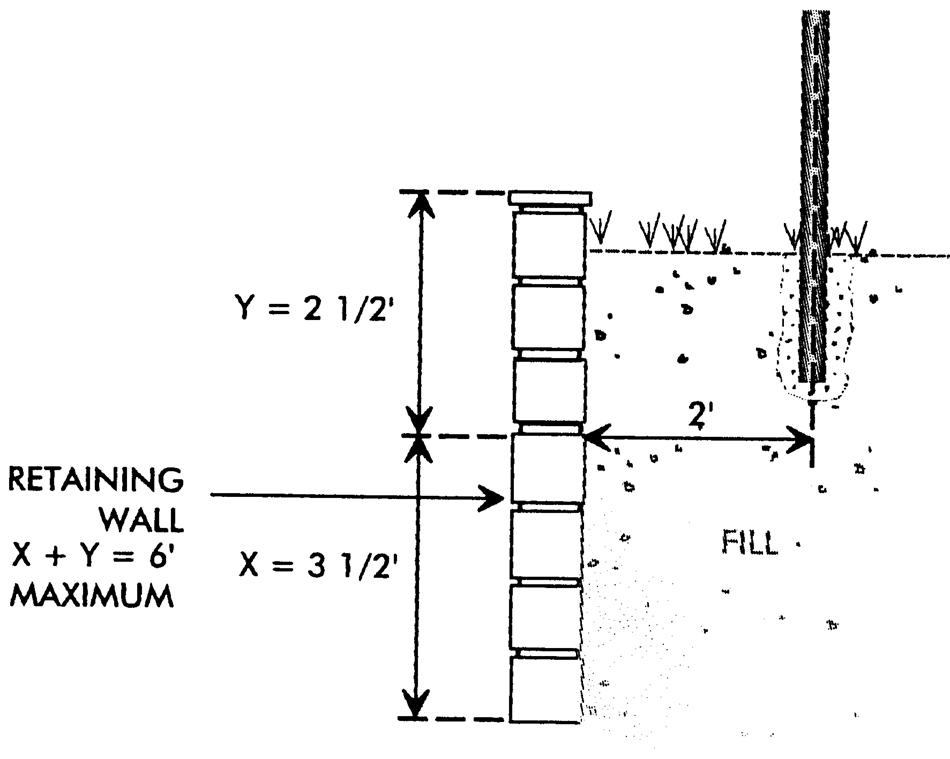
Figure 9.04.2 Fence/Retaining Wall Combinations
(f)
Prohibited materials. Barbed wire, razor wire and other similar materials are prohibited in all zoning districts. Chain link fencing is only permitted under the following circumstances:
(1)
In commercial and business park zoning districts and only when not visible from the public right-of-way;
(2)
Temporary fencing associated with a construction site, special event or other similar temporary use; and
(3)
In the park zoning district and only when associated with existing sports field fencing. New permanent chain link fencing in the park zoning district shall only be permitted as part of an approved changed plan.
(g)
Requirements for all zoning districts. All fences, walls, hedges and landscape screening are subject to the following additional height and design standards:
(1)
Fences located on corner lots and adjacent to driveways shall be in compliance with the provisions of Section 9.06.100.
(2)
All swimming pools, whirlpools, and spas shall be enclosed by a minimum five-foot high fence with a self-closing gate.
(3)
Tennis court fencing shall be in compliance with the setback and height requirements of Chapter 9.04.
(4)
Where walls are used along property frontages, or screen walls are used to conceal storage and equipment areas, they shall be constructed of concrete, stone, brick, tile or similar type of solid masonry material a minimum of six inches thick. Walls shall be painted tan, brown, or another neutral earthtone color, and architecturally treated with accent materials of stone or tile, and include pilasters or decorative cap.
Long expanses of fence or wall surfaces over 50 linear feet in length shall be vertically offset a minimum of 12 inches every 30 feet and architecturally treated with pilasters and decorative caps to prevent monotony. Landscape pockets or vines shall be provided at a minimum of 30-foot intervals for the length of the wall or fence.
(h)
Building permits required. Building permits are required prior to the erection of fences in accordance with the requirements of the most recent Uniform Building Code adopted by the City.
(Ord. No. 07-03, § 4(Exh. A), 4-11-2007; Ord. No. 07-07, § 2, 11-14-2007; Ord. No. 11-06, § 1, 9-14-2011; Ord. No. 24-07, § 17, 9-11-2024)
Sec. 9.04.080. - Nonconforming uses, lots and structures.
(a)
General provisions.
(1)
The provisions to this Section apply to all existing, legal nonconforming uses, activities and structures as defined in Section 9.01.200, and to any use, building or structure made nonconforming upon adoption of this and subsequent ordinances.
(2)
Any conforming or nonconforming use or structure established illegally under the ordinance in effect at the time of establishment is considered an illegal use or structure and shall be subject to immediate abatement or correction.
(b)
Nonconforming use—Continuation of use.
(1)
The lawful use or occupancy of a building existing at the time this Title or amendments thereto take effect may be continued provided there is no alteration or addition to any structure, nor any enlargement of area, space, or volume occupied by such nonconformity.
(2)
A legal nonconforming use shall not be changed to another use, except to a use permitted in the zoning district in which it is located.
(3)
Any legal non-conforming use that is discontinued for 90 days within a one-year period or more shall not be re-established.
(4)
A legal non-conforming use shall not increase in intensity or expand its activities.
(c)
Nonconforming buildings and structures—Continuation of use. A legal nonconforming building or structure shall be allowed to remain for the lifetime of the structure provided the structure and property on which it is located are maintained in good condition and repair.
(d)
Repairs and maintenance.
Ordinary repairs and maintenance work. Ordinary repairs and maintenance work may be made to a legal nonconformity, subject to the following provisions:
(1)
Maintenance work shall not include structural alterations, except those required by law or those required to make the structure and use conform to the standards and use regulations of the zoning district in which such structure and use are located.
(2)
Ordinary repairs and the repair or replacement of nonbearing walls, fixtures, wiring, and plumbing may be made to an extent not exceeding the latest assessed valuation of the structure. In no case, however, shall the cubic content of the structure as it existed when it became nonconforming be increased.
Repairs to damages. In the event damage or destruction to a non-residential structure exceeds one-half of the assessed valuation of such structure, that structure shall not be reconstructed except in conformity with all use and area regulations for new structures in the zoning district in which such structure is located. In the event damage or destruction to a residential structure exceeds one-half of the assessed valuation of such structure, that structure may be reconstructed on the approved building footprint as of the date of adoption of this Title, as determined by the Building Official, but shall comply with all other use and area regulations for new structures in the zoning district in which the structure is located.
Strengthening and restoring. Nothing set forth in this Section shall be deemed to prevent the strengthening or restoration to a safe condition of any structure or its support structure, or part thereof, declared to be unsafe by any officer of the City charged with protecting the public safety upon the order of such officer.
(e)
Enlargement. A legal nonconformity shall not be enlarged in volume or extended or relocated beyond the area it occupies. However, when a residential or commercial structure established legally becomes nonconforming under the provisions of this Title, specifically related to setbacks, lot size or height limit, the structure may be enlarged or extended under the following provisions:
(1)
A structure shall not extend or enlarge into any nonconforming setback area; however, the structure may extend or enlarge in any direction where the setbacks are conforming to the provisions of this Title.
(2)
The structure shall comply with all applicable lot coverage restrictions.
(f)
Removal of nonconforming uses or structures. The City may adopt abatement programs for nonconforming uses and structures. The abatement program shall identify an amortization period and process for the removal of nonconforming use or structure.
(g)
Violations. Any of the following violations shall immediately terminate the right to operate a legal nonconformity:
(1)
Changing to another use not permitted in the district;
(2)
Increasing or enlarging the area, space, or volume occupied by or devoted to such nonconforming use; or
(3)
Increasing the number of personnel employed or volume of business performed so that such increase constitutes an intensification of the nonconforming use.
(Ord. No. 07-03, § 4(Exh. A), 4-11-2007)
Sec. 9.04.090. - Solid waste and recycling facilities.
(a)
Purpose. The provisions of this Section are established to provide for the collection, storage and removal of solid waste from non-residential, mixed-use, and multi-family establishments and for the redemption and recycling of reusable materials, separation of organic and green waste, and to make such facilities convenient to the consumer in order to reduce the solid waste and organic material streams to landfills and increase the recycling of reusable materials. The recycling and organic waste facilities outlined by this Section are intended to encourage recycling and organic waste services by providing a comprehensive and easily understood program of permitting and regulating such uses. Solid waste disposal is also subject to Chapter 5.06 (Solid Waste) of this Code.
(b)
Trash recycling, and organics enclosure requirements.
(1)
All trash, recycling, and organic waste enclosures shall be designed to facilitate the collection of solid waste in accordance with Chapter 5.06 (Solid Waste) of this Code.
(2)
All trash, recycling, and organic waste bins shall be completely screened from view using an enclosure meeting the requirements of Section 5.06.460 (Solid Waste Container Storage Enclosures) of this Code and consisting of three solid walls and a gate to provide access by necessary personnel, including solid waste generators and authorized collectors.
(3)
Temporary bins and roll-off boxes used for construction and demolition projects are not required to be within an enclosure, subject to the requirements of Chapter 5.06 (Solid Waste) of this Code.
(4)
Trash, recycling, and organic waste enclosures for multi-family, mixed-use, and non-residential uses shall be constructed to accommodate the size and number of containers required for the development with minimum interior dimensions of nine feet by 13 feet. All enclosures shall include a solid roof with a minimum height of nine feet, level concrete surface, and floor drain connected to sanitary sewer. It is recommended that applicants verify the number and size of required waste containers prior to submittal of a development application. Gates shall be opaque, self-latching, and metal or metal-framed.
(5)
All trash, recycling, and organic waste bin lids shall remain closed at all times, with the exception of the temporary opening and closing of the lids for the collection and removal of solid waste.
(6)
Trash, recycling, and organic waste bin enclosures shall be used for the collection of solid waste only. Trash, recycling, and organic waste bin enclosures shall not be used for storage, stockpiling or other similar uses.
(7)
Any non-residential or multi-family establishment desiring to provide recycling and organic waste removal on-site, but having insufficient space on-site, may reduce the parking requirement by one parking space in order to allow for an expanded trash enclosure and required screening for recycling and organic waste bins, subject to Development Services Director approval and subject to Section 9.05.070 (Landscape and Screening).
(c)
Recycling facility permit requirements. No person shall permit the placement, construction, or operation of any recycling facility without first obtaining all required approvals and permits pursuant to the provisions set forth in this Section. Recycling facilities shall be permitted as set forth in Table 9.04.1.
Recycling facility operational/site standards. Permitted and conditionally permitted recycling facilities shall meet all of the applicable criteria and standards in this Section.
The criteria and standards for recycling facilities are as follows:
(1)
Reverse vending machines. Reverse vending machines do not require additional parking spaces for recycling customers and are permitted in the zoning districts identified in Table 9.04.1, provided the machines:
a.
Are established in conjunction with a commercial or business park use or community facility which is in compliance with the zoning, building and fire codes of the City;
b.
Are located near the entrance to the structure and shall not obstruct pedestrian or vehicular circulation;
c.
Do not occupy parking spaces required by the primary use;
d.
Do not occupy more than 50 square feet;
e.
Are constructed of durable rustproof and waterproof material;
f.
Have sign area of a maximum of four square feet per machine exclusive of operating instructions;
g.
Comply with illumination requirements in this Title;
h.
Are maintained in a clean, dry, and litter-free condition on a daily basis; and
i.
Are clearly marked to identify the phone number of the operator or responsible person if the machine is inoperative or in violation of this Code.
(2)
Recycling areas. Recycling areas no greater than 100 square feet in size are permitted as accessory uses in the zoning districts identified in Table 9.04.1. All recycling areas must meet the landscaping and screening and outdoor storage regulations identified in Section 9.05.070 and the parking requirements identified in Chapter 9.06.
(3)
Small collection facilities. Small collection facilities may be located in the zoning districts identified in Table 9.04.1 and do not require additional parking spaces provided that they comply with the following standards:
a.
The facility is established in conjunction with an existing commercial use or community facility which is in compliance with the zoning, building and fire codes of the City;
b.
The facility is no larger than 500 square feet and occupies no more than five parking spaces, not including space that will be needed periodically for removal of materials or exchange of containers, provided said parking spaces are not necessary to satisfy the minimum on-site parking requirements of this Title;
c.
The facility is set back ten feet from the public right-of-way and does not obstruct pedestrian or vehicular circulation;
d.
The facility and signs are in compliance with the requirements of this Title;
e.
Hours of operations are restricted to the same as the primary use;
f.
The facility is clearly marked to identify the phone number of the operator or responsible person if the machines are inoperative or in violation of this Title; and
g.
The site is maintained free of litter and any other undesirable materials, and cleaned of loose debris on a daily basis.
(4)
Large collection facilities. A large collection facility is one that is larger than 500 square feet, or is on a separate property not appurtenant to a primary use, and which may have a permanent building. Large collection facilities are permitted in the zoning districts identified in Table 9.04.1, subject to approval of a site plan review and conditional use permit, and the facility shall meet the following standards:
a.
The facility does not abut a property zoned or planned for residential use;
b.
The facility will be screened from the public right-of-way by operating in an enclosed building or;
1.
Within an area enclosed by an opaque fence or wall at least six feet in height with landscaping;
2.
At least 150 feet from property zoned or planned for residential use;
c.
The facility shall meet all development standards as required in this Title; and
d.
The site shall be maintained free of litter and any other undesirable materials, and will be cleaned of loose debris on a daily basis.
Table 9.04.1
Allowed Recycling Facilities
— = Not permitted
P = Permitted
C = Conditional Use Permit
A = Permitted as an accessory use or structure
(Ord. No. 07-03, § 4(Exh. A), 4-11-2007; Ord. No. 07-07, § 2, 11-14-2007; Ord. No. 24-07, § 18, 9-11-2024)
Sec. 9.04.100. - Gas and fuel dispensing stations.
(a)
Purpose. The provisions of this Section are established to provide for the needs of motorists with appropriately designed and located gas and fuel dispensing stations.
(b)
Discretionary permits required. All gas and fuel dispensing stations require a site development permit and conditional use permit as described in Sections 9.08.170 and 9.08.110.
(c)
Use regulations.
(1)
The following activities are permitted as primary uses in gas and fuel dispensing stations:
a.
Sale and dispensing of engine fuels and lubricants;
b.
Sale and service of tires, batteries, automotive accessories, and replacement items;
c.
Minor automotive repair, including all government mandated automobile diagnostic evaluations; and
d.
Other incidental customer services and products.
(2)
The following activities may be permitted as accessory uses subject to a site development permit and conditional use permit as described in Sections 9.08.170 and 9.08.110.
a.
Sale of groceries and sundries;
b.
Automatic or manual automobile washing, waxing, interior cleaning, and detailing services;
c.
Sale of liquefied or pressurized butane, propane, or natural gas;
d.
Fast-food restaurants with or without drive-through facilities. These uses are subject to all County, State and Federal health regulations.
(3)
The outdoor storage of motor vehicles other than the temporary parking of an automobile being serviced or for the temporary use of employees during work hours shall be prohibited.
(d)
Site development standards.
(1)
Building site area. No minimum.
(2)
Minimum street frontage. Minimum street frontage is required as follows:
a.
One hundred feet on one street for a station that engages only in the sale and dispensing of engine fuels and lubricants; and
b.
One hundred fifty feet on one street for a station that engages in any two or more activities listed in Subsections (c)(1) and (2).
(3)
Building height. Maximum of 25 feet.
(4)
Setbacks. The minimum setback requirements are as follows:
a.
For corner lots, the minimum front setback and the minimum street side setback shall be the minimum setback required by the zoning district of the abutting property.
b.
For interior lots, the minimum front setback shall be the minimum front setback required by the zoning district of the abutting properties. If the required front setbacks of the abutting properties differ, the station is required to provide the greater setback.
c.
The minimum side setback and the minimum rear setback are as required by the applicable zone, except that if the lot abuts residentially zoned property, the minimum side or rear setback along the common property line is 15 feet or as required by the zone, whichever is greater.
(5)
Vehicular access, queuing, and driveway visibility regulations. Prior to issuance of a building permit, a plan of vehicular access and queuing for the entire street frontage of the building site containing the station shall be approved by the City Engineer.
(6)
Lighting. All exterior and interior lighting shall be designed and located to confine direct rays to the building site.
(7)
Signs. All project identification signs shall conform to the design regulations as set forth in the Chapter 9.07.
(8)
Trash and storage area. All storage of cartons, containers, and trash shall be shielded from view within a building area or enclosed by a solid masonry wall not less than six feet in height. No trash or storage area shall be located within 50 feet of any adjacent residential uses.
(9)
Enclosed uses. All activities other than the sale of motor fuel shall be contained in the primary building on-site, except that motor oil, tires, batteries and other automotive supplies may be displayed at pump islands or adjacent to a building if the display or storage racks and containers are designed to appear as an integral part of the pump island or building exterior.
(10)
Landscaping and screening. The landscaping and screening requirements (Section 9.05.070) of the zoning district in which the station is located shall apply.
(e)
Abandonment or discontinuation of use. When a gas and fuel dispensing station is abandoned or the use changed, the property owner shall remove the underground storage tanks in accordance with all applicable County, State, and Federal procedures and regulations.
(Ord. No. 07-03, § 4(Exh. A), 4-11-2007; Ord. No. 24-07, § 18, 9-11-2024)
Sec. 9.04.110. - Storage and display—Outdoor.
(a)
Outside storage as accessory use. The outside storage of materials and equipment, where permitted in non-residential zoning districts as incidental to the use of an office, store, warehouse, or other commercial building located on the same building site, shall conform to the following:
(1)
Any outdoor area used for storage shall be completely enclosed by a solid masonry wall, with necessary solid appearing gates, with a minimum height of six feet and a maximum height of eight feet. The substitution of a fence, decorative wall, or dense plantings which will adequately buffer the area may be approved as a part of the development review procedures.
(2)
The storage of materials or equipment shall not be higher than the enclosure surrounding it. Exceptions may be granted by the Planning Commission in cases where the stored materials are within a container, such as bins or tanks, for finished products in transition or in other situations where the provisions of this Subsection are not appropriate.
(3)
The required off-street parking facilities and driveways shall not be used for any storage or display purpose which would at any time preclude the use of the area for the required parking for the site unless allowed by a special event permit.
(b)
Outside displays of merchandise and products. The outside displays of merchandise and products shall be prohibited in all zoning districts, except where specifically permitted by this Title, and in particular, Section 9.05.110. Permitted outside displays shall comply with the following provisions:
(1)
Every portion of a lot used for outside displays (such as garden centers and other outdoor sales displays) shall comply with all the setback requirements for the applicable zoning district, except for vehicular sales and rentals.
(2)
Every portion of a lot used for outside displays shall be considered as a part of the gross floor area in calculating the parking requirements for the subject use, except for vehicular sales and rentals.
(3)
Every portion of a lot used for the sale, rental, or lease of automobiles, trucks, trailers, and other similar vehicles shall comply with the screening, access, circulation, paving, bumper, lighting, and other applicable provisions of this Title required for parking facilities. For inventory parking of vehicles, tandem parking is permitted, subject to maintenance of a 25-foot drive aisle. In addition to the landscape requirements required by Chapter 9.06 all sites shall provide a minimum ten-foot landscaped buffer area between the street frontage and display area; and
(4)
All outside display areas shall be designated and approved by the Planning Commission through a site development permit.
(Ord. No. 07-03, § 4(Exh. A), 4-11-2007)
Sec. 9.04.120. - Swimming pools and spas.
The provisions of this Section apply to swimming pools, whirlpools and spas:
(1)
Location and setback requirements.
a.
Pools, whirlpools and spas shall be located no closer than three feet from the edge of the water to any side or rear property line.
b.
No pool, whirlpool, or spa shall be located within the front yard setback of a lot.
(2)
Fence required. Pools, whirlpools and spas must be enclosed by a fence as required by the adopted Uniform Building Code.
(3)
Filter and heating equipment. Filter, heating, and other pool support equipment shall maintain the setback requirements described within the adopted Uniform Building Code. All pool equipment shall adhere to the requirements of Chapter 5.04 of the Municipal Code. All pool equipment shall be completely screened from view from any public right-of-way and from any adjacent property.
(4)
Supplemental pool structures.
a.
Supplemental swimming pool, whirlpool and spa structures less than five feet in height shall be located no closer than three feet from the edge of the structure to any side or rear property line.
b.
Supplemental pool structures including pool slides, waterfalls, grottos, etc., which exceed five feet in height shall be set back from the rear and side property lines at a distance equal to the maximum height of the structure.
c.
In no instance shall a supplemental pool structure exceed a height of eight feet.
(Ord. No. 07-03, § 4(Exh. A), 4-11-2007; Ord. No. 09-03, § 4, 3-25-2009)
Editor's note— Ord. No. 07-03, § 4(Exh. A), adopted April 11, 2007, enacted provisions intended for use as Subsections A.—D. To preserve the style of this Code, and at the discretion of the editor, said provisions have been redesignated as Subsections (1)—(4).
Sec. 9.04.130. - Temporary uses and structures.
(a)
Purpose. This Section allows for the establishment of certain temporary uses of limited duration, provided that such uses are discontinued upon the expiration of a set time period. Temporary uses do not involve the construction or alteration of any permanent building or structure. Some temporary uses may be considered a special event and subject to Sections 9.05.110 and 9.08.180.
(b)
General standards for all temporary uses and structures. All temporary uses and structures shall meet the following general requirements, unless otherwise specified in this Title:
(1)
The temporary use shall not be detrimental to property or improvements in the surrounding area or to the public health, safety, or general welfare.
(2)
The temporary use shall not have substantial adverse noise impacts on nearby residential uses.
(3)
Permanent alterations to the site are prohibited.
(4)
If the property is developed, the site of the temporary use shall contain an area that supports the temporary use without encroaching into or creating a negative impact on existing buffers, open space, landscaping, pedestrian and vehicular traffic movements (including emergency vehicle access), and parking space availability.
(5)
If the property is undeveloped, the site of the temporary use shall contain sufficient land area to allow the temporary use to occur, as well as any parking and traffic movement that may be associated with the temporary use, without disturbing sensitive or protected resources, including required buffers.
(6)
Temporary structures shall be located so as to not interfere with the normal operations of any permanent use located on the property.
(7)
The temporary use shall not violate any applicable conditions of approval that apply to the principal use on the site.
(8)
Off-street parking shall be adequate to accommodate the proposed temporary use.
(9)
All approved temporary signs associated with the temporary use shall be removed when the activity ends.
(10)
All inspections and permits required by applicable construction codes shall be obtained.
(11)
Any temporary use or structure, which will be utilized for longer than 90 days, may be reviewed for aesthetic impacts by the Development Services Director.
(12)
All temporary structures shall be approved through a site development permit as identified in Section 9.08.170, unless otherwise approved through a special event permit identified in Sections 9.05.110 and 9.08.180.
(c)
Specific standards for certain temporary uses and structures.
Construction-related activities. Temporary construction-related activities, including construction offices and storage buildings, outdoor storage, restroom facilities, employee parking areas and any other temporary construction-related use or activity, may occur on the same site or on a site that is adjacent to or nearby the construction site. On-site and off-site uses shall be removed within 30 days after issuance of a final certificate of occupancy. If the use was off-site, the off-site property shall be restored to its previous condition.
Temporary office facilities and temporary classroom facilities. Temporary facilities used as sales/leasing offices or temporary classrooms, including those located in a model unit of a residential project, or used during construction to expand or replace a permanent building, or used as temporary classrooms for private schools, may be permitted on the same site as the permanent use. Sales offices may be established for pre-sales or leasing prior to construction of the project.
(1)
Such temporary facilities may remain on the site for up to 12 months. This period may be renewed for two six-month periods, for good cause shown, upon approval of a written request, submitted to the Development Services Director thirty days prior to the expiration of the permit. In no event, however, shall such extensions allow the temporary use to remain on the site for more than two years, unless otherwise approved by the Planning Commission through a site development permit as described in Section 9.08.170.
a.
Temporary classrooms approved by the Planning Commission through a site development permit shall apply for a renewal of the temporary facilities at least three months prior to the expiration of the temporary use established within the site development permit.
If the approval for a temporary classroom expires, a new site development permit must be approved by the Planning Commission as described in Section 9.08.170.
(2)
In addition to meeting the general standards of Subsection 9.04.130(b), all temporary structures approved pursuant to this Section shall meet the following standards and requirements:
a.
Location. Such structures may be located anywhere on site, except within the established setbacks for the zoning district, existing vegetated buffers, or other areas designated on the site plan to remain free from land disturbance.
b.
Other requirements.
1.
The temporary structure shall be factory-fabricated and transportable.
2.
Underskirting shall be installed around all temporary structures requiring site plan approval.
3.
All permits required by applicable building, electrical, plumbing, and mechanical codes shall be obtained from the Building Official prior to installation of the temporary structure.
4.
For those temporary structures requiring site plan approval by the Planning Commission, the temporary structure shall be compatible with the existing buildings on the site in terms of exterior color.
5.
A sketch plan containing sufficient information to show compliance with the above standards shall be submitted to and approved by the Development Services Department prior to installation of the temporary structure.
(Ord. No. 07-03, § 4(Exh. A), 4-11-2007; Ord. No. 07-07, §§ 2, 3, 11-14-2007)
Sec. 9.04.140. - Water features.
The following regulations apply to water features:
(1)
Location and setback requirements.
a.
Water features less than five feet in height shall be located no closer than three feet from the edge of the water feature to the property line. Structures shall maintain the setbacks required by the adopted Uniform Building Code.
b.
Water features in excess of five feet in height shall be set back from all property lines at a distance equal to the maximum height of the feature.
c.
In no instance shall a water feature exceed eight feet in height.
(2)
Filter, aeration, and heating equipment. Filter, heating, and other support equipment shall maintain the setback requirements described within the Uniform Building Code. All equipment shall adhere to the requirements of Chapter 5.04 of the Municipal Code. All equipment shall be completely screened from view from any public right-of-way and from any adjacent property.
(3)
Runoff. The water feature shall generate no detectable runoff from the property.
(Ord. No. 07-03, § 4(Exh. A), 4-11-2007; Ord. No. 09-03, § 4, 3-25-2009)
Editor's note— Ord. No. 07-03, § 4(Exh. A), adopted April 11, 2007, enacted provisions intended for use as Subsections A.—C. To preserve the style of this Code, and at the discretion of the editor, said provisions have been redesignated as Subsections (1)—(3).
Sec. 9.04.150. - Cybercafes.
All regulations for cybercafes are contained within Chapter 6.11.
(Ord. No. 07-03, § 4(Exh. A), 4-11-2007)
Sec. 9.04.160. - Massage establishments.
All regulations for massage establishments are contained within Chapter 4.02.
(Ord. No. 07-03, § 4(Exh. A), 4-11-2007)
Sec. 9.04.170. - Emergency shelters.
(a)
Development and management standards. An emergency shelter must meet the following development and management standards:
(1)
The shelter may serve no more than ten persons per night unless State law requires a different limitation greater than ten, in which case the shelter may serve no more than the number of persons required by State law.
(2)
The shelter shall provide sufficient parking as required in Table 9.06.3 Non-Residential Parking Requirements.
(3)
The waiting and client intake areas shall be at least 250 square feet in total gross floor area.
(4)
The shelter shall prepare and file a management plan with the City that includes clear operational rules and standards, including, but not limited to, standards governing expulsions and lights-out. As part of the management plan, each shelter must provide 24-hour on-site supervision when the shelter is operating. An "on-site 24-hour manager" shall mean one or more identified individuals, at least one of whom shall be present at the emergency shelter at all times, and who shall have authority to enforce the management plan and all rules set forth therein, and to ensure compliance with all development and management standards.
(5)
No person may stay at a shelter for longer than six months within a one-year period.
(6)
All lighting shall be subject to Section 9.5.080 Lighting Standards.
(7)
Security shall be provided during the hours the shelter is in operation.
(b)
Findings required for disapproval of an emergency shelter. The City may not disapprove an emergency shelter from any zoning district where it is considered a permitted use unless it makes written findings, based upon substantial evidence in the record as to one of the following:
(1)
The City has met or exceeded the need for emergency shelters as identified in the Housing Element, and that the disapproval is not based on any of the reasons prohibited by California Government Code Section 65008.
(2)
The emergency shelter would have a specific, adverse impact upon the public health or safety, and there is no feasible method to satisfactorily mitigate or avoid the specific adverse impact without rendering the development of the emergency shelter financially infeasible. As used in this paragraph, a "specific, adverse impact" means a significant, quantifiable, direct, and unavoidable impact, based on objective, identified written public health or safety standards, policies, or conditions as they existed on the date the application was deemed complete. Inconsistency with this Title or the General Plan land use designation shall not constitute a specific, adverse impact upon the public health or safety.
(3)
The denial of the project or imposition of conditions is required in order to comply with specific State or Federal law, and there is no feasible method to comply without rendering the development of the emergency shelter financially infeasible.
(4)
The emergency shelter is proposed on land zoned for agriculture or resource preservation that is surrounded on at least two sides by land being used for agricultural or resource preservation purposes, or which does not have adequate water or wastewater facilities to serve the project.
(5)
The emergency shelter is inconsistent with both this Title and the General Plan land use designation as specified in any element of the General Plan as it existed on the date the application was deemed complete, and the City has adopted a revised Housing Element that is in substantial compliance with State law.
(Ord. No. 11-02, § 9, 4-27-2011)
Sec. 9.04.175. - Transitional and supportive housing projects.
(a)
Transitional housing and supportive housing. Consistent with subdivision (c)(3) of Government Code Section 65583, transitional and supportive housing are considered residential uses of property and shall be subject only to those permit requirements, development standards, and restrictions that apply to other residential dwellings of the same type or configuration in the same zoning district, as determined by the Development Services Director based on the predominant characteristics of the proposed development. The applicant for a transitional or supportive housing development shall provide all information reasonably requested by the Development Services Director necessary to establish that the proposed use meets the definition of transitional housing or supportive housing pursuant to California Government Code Section 65582.
(b)
Permanent supportive housing for persons experiencing homelessness. Notwithstanding any other provision of this Code, in accordance with Government Code Section 65650 et seq., a supportive housing development shall be a use by right in any zoning district where multi-family and mixed-use are permitted and shall be subject to ministerial review by the Development Services Director if it conforms to each of the following requirements:
(1)
The development shall consist of 50 units or fewer.
(2)
The development shall conform to all objective development standards and policies that apply to multi-family dwellings or multi-family residential components of mixed-use projects in the zoning district in which the development is located; provided, however, that, if the proposed development is located within one-half mile of a public transit stop, no minimum parking requirements shall apply to the units occupied by supportive housing residents.
(3)
The development shall satisfy all requirements set forth in Government Code Section 65651, including, without limitation, the following:
a.
Units with the development shall be subject to a recorded affordability restriction for 55 years.
b.
One hundred percent of the units, excluding managers' units, within the development shall be restricted to lower income households and receiving public funding to ensure affordability of the housing to lower income Californians.
c.
At least 25 percent of the units in the development or 12 units, whichever is greater, shall be restricted to residents who meet criteria of the target population as defined in Health and Safety Code Section 50675.14. If the development consists of fewer than 12 units, then 100 percent of the units, excluding manager's units, in the development shall be restricted to such residents.
d.
Nonresidential floor area shall be used for on-site supportive services in the following amounts:
1.
For a development with 20 or fewer total units, at least 90 square feet shall be provided for on-site supportive services.
2.
For a development with more than 20 units, at least three percent of the total nonresidential floor area shall be provided for on-site supportive services that are limited to tenant use, including, but not limited to, community rooms, case management offices, computer rooms, and community kitchens.
e.
The project shall replace any existing or previously demolished protected units on the site in the manner provided in subdivision (c)(3) of Government Code Section 65915.
f.
Units within the development, excluding managers' units, include at least one bathroom and a kitchen or other cooking facilities, including, at a minimum, a stovetop, a sink, and a refrigerator.
(4)
The applicant shall submit for review and approval by the Development Services Director a plan for providing on-site supportive services, along with supporting documentation, in accordance with Government Code Section 65652. Such on-site supportive services may include, but are not limited to, transportation services, counseling services, individual case management, job readiness training, assistance in applying for competitive employment, housing retention assistance services, health status improvement services, mental health services, drug rehabilitation services, parenting services, and budgeting and life skill services.
(5)
The record owner(s) of the property shall enter into a regulatory agreement with City pursuant to Section 9.14.050 to ensure compliance with the provisions of Government Code Section 65651 and this Subsection 9.14.070(b).
(c)
Low barrier navigation centers. Notwithstanding any other provision of this Code, a low barrier navigation center shall be permitted as a use by right in any areas zoned for mixed-use and in nonresidential zoning districts permitting multi-family uses and shall be subject to ministerial review by the Development Services if it satisfies the requirements set forth in California Government Code Section 65662. The applicant for low barrier navigation center shall provide all information reasonably requested by the Development Services Director necessary to establish that it meets all applicable requirements.
(Ord. No. 24-06, § 3, 9-11-2024)
Sec. 9.04.180. - Single room occupancy (SRO) facilities.
SRO facilities must meet the following development and management standards:
(1)
SRO facilities shall contain a cluster of at least five rental units which each provide sleeping and living facilities for one or two persons.
(2)
SRO parking standards shall be subject to the requirements in Table 9.06.3 Non-Residential Parking Requirements.
(3)
SRO units shall have a minimum of 100 net square feet of space for a single occupancy and 120 net square feet for a two-person occupancy. The calculation for net floor space in the sleeping area includes built-in cabinets, sinks and closets, but excludes toilet compartments. A unit larger than 225 square feet shall not be considered an SRO.
(4)
A management plan shall be submitted as part of the permit application for review and approval by the City. The management plan shall contain management policies, operations, emergency procedures, security program, rental procedures, maintenance plans, and staffing needs.
(5)
An on-site, 24-hour manager is required in every SRO project. An "on-site 24-hour manager" shall mean one or more identified individuals, at least one of whom shall be present at the SRO project at all times, and who shall have authority to enforce the management plan and all rules set forth therein, and to ensure compliance with all development and management standards. In addition, a single manager's unit shall be provided which shall be designed as a complete residential unit, and be a minimum of 225 square feet in size.
(6)
SRO facilities shall be treated as non-residential uses. As such, Section 9.5.040 Density Bonus does not apply and residential dwelling unit limitations (e.g., statistical summary) are not applicable.
(Ord. No. 11-02, § 10, 4-27-2011)
Sec. 9.04.190. - Accessory dwelling units and junior accessory dwelling units.
(a)
Purpose and intent. The purpose of this Section is to provide for and regulate the development of accessory dwelling units (ADUs) and junior accessory dwelling units (JADUs) in a manner consistent with State law.
(b)
Definitions. As used in this Section, the following terms shall have the following meanings:
Accessory dwelling unit, accessory structure, efficiency unit, living area, nonconforming zoning condition, passageway, proposed dwelling, public transit, and tandem parking all have the same meaning as that stated in Government Code § 66313(a) as that section may be amended from time to time. The terms "accessory dwelling unit" and "ADU" shall have the same meaning.
Attached ADU means an ADU, other than a converted ADU, that is physically attached to a primary dwelling structure.
Converted ADU means an ADU that is constructed within all or a portion of the permitted existing interior space of an accessory structure or within a portion of the permitted existing interior space of a dwelling structure, including bedrooms, attached or detached garages, storage areas, or similar uses. A converted ADU also includes an ADU that is constructed in the same location and to the same dimensions as a permitted existing structure or portion of a permitted existing structure.
Detached ADU means an ADU, other than a converted ADU, that is physically separated from, but located on the same lot as, a primary dwelling structure.
Director means the Development Services Director, or their designee.
Junior accessory dwelling unit shall have same meaning as that stated in Government Code § 66313(d) as that section may be amended from time to time. The terms "junior accessory dwelling unit" and "JADU" shall have the same meaning.
State exempt ADUs means the four categories of ADUs or JADUs that are created pursuant to Government Code § 66323 including one converted ADU and JADU per single-family lot as described in Government Code § 66323(a)(1), (2), one detached ADU per single-family lot as described in Government Code § 66323(a)(2), (3), one or more converted ADUs on multifamily lots as described in Government Code § 66323(a)(3), and (4), one or more detached ADUs on multifamily lots as described in Government Code § 66323(a)(4). State exempt ADUs shall be approved ministerially and are not subject to certain development standards as required by State law and as specified in Subsection (h)(6) below.
(c)
Conforming ADUs. An ADU that conforms to this Section and all applicable provisions of Section 9.04.020 (accessory structures) shall:
(1)
Be deemed an accessory use or an accessory building and shall not be considered to exceed the allowable density for the lot upon which it is located;
(2)
Be deemed a residential use that is consistent with the existing General Plan and zoning designation for the lot upon which it is located; and
(3)
Not be considered in the application of any local ordinance, policy, or program to limit residential growth.
(d)
Locations permitted.
(1)
Permitted ADU locations. ADUs conforming to the provisions of this Section may be located on any lot in the City zoned to allow single-family or multifamily residential uses and that includes a proposed or existing legally developed single-family or multifamily dwelling.
(2)
Permitted JADU locations. JADUs conforming to the provisions of this Section may be located within a proposed or existing legally developed single-family dwelling on any lot in the City that is zoned to allow single-family residential uses.
(e)
ADU requirements.
(1)
Legal lot/residence. An ADU shall only be allowed on a lot that contains a proposed or legally developed existing single-family or multifamily residence.
(2)
An ADU shall either be:
a.
Attached to, or located within, the proposed or existing primary dwelling, including attached garages, storage areas or similar uses, or an accessory structure; or
b.
Detached from the proposed or existing primary dwelling and located on the same lot as the proposed or existing primary dwelling including detached garages.
(3)
Number of units per lot.
a.
For lots with a proposed or existing single-family dwelling:
i.
One attached, or converted ADU, and one JADU shall be permitted on the lot; and
ii.
One detached, new construction ADU, that does not exceed four-foot side and rear setbacks.
b.
For lots with an existing multifamily dwelling:
i.
At least one ADU, and up to 25 percent of the number of the existing units may be constructed within portions of the existing multifamily dwelling structure that are not used as livable space (e.g., storage rooms, boiler rooms, passageways, attics, basements, or garages) provided all applicable building code standards are met; and
ii.
Not more than eight detached ADUs shall be permitted on the lot provided the number of detached ADUs shall not exceed the number of existing units on the lot.
c.
For lots with a proposed multifamily dwelling:
i.
Not more than two detached ADUs shall be permitted.
(4)
Unit size, height and design.
a.
Maximum size.
i.
Attached ADUs. The total floor area of an attached ADU shall not exceed (i) 1,200 square feet, or (ii) 50 percent of the floor area of the existing primary dwelling unit, whichever is less. However, in no case shall this limitation be imposed to require an ADU with a total floor area of less than 800 square feet.
ii.
Detached ADUs. The total floor area of a detached ADU shall not exceed 1,200 square feet.
iii.
Converted ADUs. The maximum size limitations set forth in this Subsection do not apply to converted ADUs that do not increase the existing floor area of a structure. In addition, a converted ADU created within an existing accessory structure may include an expansion of not more than 150 square feet beyond the same physical dimensions as the existing accessory structure to extent necessary to accommodate ingress and egress.
b.
Minimum size. The total floor area of an attached or detached ADU shall be at least 150 square feet.
c.
Height.
i.
Except as provided below, the height of a detached ADU on a lot with an existing or proposed single-family or multifamily dwelling unit shall not exceed 16 feet.
ii.
The height of a detached ADU located on a lot with an existing or proposed single-family or multifamily dwelling unit that is within one-half of one mile walking distance of a major transit stop or a high-quality transit corridor, as those terms are defined in § 21155 of the Public Resources Code, shall not exceed 18 feet. However, an additional two feet of height, for a maximum of 20 feet, is allowed when necessary to align the roof pitch on the ADU to the roof pitch of the primary dwelling.
iii.
The height of a detached ADU on a lot with an existing or proposed multifamily, multistory dwelling shall not exceed 18 feet.
iv.
The height of an attached ADU shall not exceed the height limitation of the zoning district applicable to the primary dwelling or 25 feet, whichever is lower. In no event shall any such ADU exceed two stories.
d.
To facilitate the development of ADUs in a manner that ensures reasonable consistency and compatibility of design, the Director is authorized to develop standard design plans and criteria for ADUs. ADUs developed in conformance with such standard plans and criteria shall be deemed to comply with this Subsection.
(5)
Applicability of development standards. Except as modified by this Section or as otherwise provided by State law, an ADU must conform to the development standards applicable to the lot on which it is located as set forth in this Title 9, the development standards for accessory structures set forth in Subsection 9.04.020(c)(2), and/or in an applicable specific plan or planned unit development ordinance or resolution. Notwithstanding the foregoing, when the application of a development standard related to floor area ratio, lot coverage, open-space, front setbacks, or minimum lot size would prohibit the construction of an attached or detached ADU of at least 800 square feet, such standard shall be waived to the extent necessary to allow construction of an ADU of up to 800 square feet.
(6)
Setbacks.
a.
Front yard setbacks. New attached and detached ADUs are subject to the same minimum front yard setback requirements applicable to other structures on the lot on which the ADU is located.
b.
Side and rear yard setbacks. Minimum setbacks of no less than four feet from the side and rear lot lines are required for new attached and detached ADUs.
c.
Converted ADUs. No setbacks are required for converted ADUs, provided the side and rear yard setbacks of the existing converted structure are sufficient for fire and safety, as determined by the City's Building Official.
(7)
Off-street parking.
a.
One off-street parking space must be provided for an attached or detached ADU. The required parking space may be permitted in setback areas, or through tandem parking on a driveway, unless specific findings are made by the Director that parking in setback areas or tandem parking is not feasible based upon specific site or regional topographical or fire and life safety concerns.
b.
When a garage, carport, covered parking structure, or uncovered parking space is demolished in conjunction with the construction of an ADU, or converted to an ADU, those off-street parking spaces are not required to be replaced.
c.
Off-street parking is not required in the following instances:
i.
The ADU is located within one-half mile walking distance of public transit, including transit stations and bus stations;
ii.
The ADU is located within an architecturally and historically significant historic district;
iii.
The ADU is part of the proposed or existing primary residence or accessory structure (i.e., a converted ADU);
iv.
When on-street parking permits are required but not offered to the occupant of the ADU;
v.
When there is a car share vehicle station located within one block of the ADU; and/or
vi.
When a permit application for an ADU is submitted with a permit application to create a new single-family dwelling or a new multi-family dwelling on the same lot, provided the ADU or the parcel satisfies any other criteria listed in this Section.
(8)
Exterior access. An attached or converted ADU must have independent exterior access from the proposed or existing primary dwelling.
(9)
Passageway. No passageway shall be required in conjunction with the construction of an ADU.
(f)
JADU requirements.
(1)
Footprint. A JADU may only be constructed within the walls of a proposed or existing single-family residence, including an existing attached garage.
(2)
Size. A JADU shall not be less than 150 square feet and shall not exceed 500 square feet in size.
(3)
Separate entrance. A JADU located within a proposed or existing single-family residence must include a separate entrance from the main entrance of the residence.
(4)
Kitchen requirements. A JADU must include an efficiency kitchen, including a cooking facility with appliances, and a food preparation counter and storage cabinets that are of reasonable size in relation to the size of the JADU.
(5)
Bathroom facilities. A JADU may include separate sanitation facilities or may share sanitation facilities with the proposed or existing single-family residence in which it is located. If a JADU does not include separate sanitation facilities, the JADU must include an interior entrance to the primary dwelling's main living area.
(6)
Parking. No additional off-street parking is required for a JADU beyond that required at the time the existing primary dwelling was constructed.
(7)
Fire protection. For purposes of any fire or life protection ordinance or regulation, a JADU shall not be considered a separate new dwelling unit.
(8)
Utility service. For purposes of providing service for water, sewer, or power, including a connection fee, a JADU shall not be considered a separate or new dwelling unit.
(9)
Deed restriction. Prior to the issuance of a building permit for a JADU, the owner shall record a deed restriction against the title of the property in the County Recorder's office with a copy filed with the Director. The deed restriction shall run with the land and shall bind all future owners, heirs, successors, or assigns. The form of the deed restriction shall be provided by the City and shall provide that:
a.
The property shall include no more than one JADU.
b.
The JADU may not be sold, mortgaged, transferred separately from the primary residence; this deed restriction may be enforced against future purchasers.
c.
The owner of the property shall occupy either the primary residence or the JADU as his or her domicile. In the event owner occupancy of the property ceases, the JADU shall not be used as a separate dwelling unit, and shall not be separately rented or leased for any purpose.
d.
A restriction on the size and attributes of the junior accessory dwelling unit that conforms with this Section.
The deed restriction may not be modified or terminated without the prior written consent of the Director.
(g)
Other requirements.
(1)
No separate conveyance. Except as otherwise provided in Government Code § 66341 or by other applicable law, an ADU or JADU may be rented separate from the primary residence, but may not be sold or otherwise conveyed separate from the primary residence, and a lot shall not be subdivided in any manner which would authorize such separate sale or ownership.
(2)
No short-term rental permitted. An ADU that is rented shall be rented for a term that is longer than 30 days. Short-term rental (i.e., 30 days or less) of an ADU is prohibited.
(3)
Owner occupancy requirements.
a.
ADUs. Owner occupancy of either the primary dwelling or ADU is not required.
b.
JADUs. The property owner of the lot upon which a JADU is located must occupy either the JADU or the primary residence as his or her domicile.
(h)
Permit application and review procedures.
(1)
Building permit required. A building permit is required prior to construction of an ADU or JADU. Except as otherwise provided in this Section or by State law, all building, fire, and related code requirements applicable to habitable dwellings apply to ADUs and JADUs. However, fire sprinklers shall not be required if they are not required for the primary dwelling.
(2)
Application. Prior to the issuance of a building permit for an ADU or JADU, the applicant shall submit an application on a form prepared by the City, along with all information and materials proscribed by such form. No application shall be accepted unless it is completed as prescribed and is accompanied by payment for all applicable fees.
(3)
Review. The Director shall consider and approve or disapprove a complete application for an ADU or JADU ministerially without discretionary review or public hearing within the time prescribed by law. Review is limited to whether the proposed ADU or JADU complies with the requirements of this Section. If an applicant requests a delay, the time period for the City to review of an application shall be tolled for the period of the requested delay. If the application to create an ADU or a JADU unit is submitted with an application to create a new single-family dwelling on the lot, the Director may delay acting on the application for the ADU or the JADU until the City acts on the application to create the new single-family dwelling, but the application to create the ADU or JADU will still be considered ministerially without discretionary review or a hearing.
(4)
Zoning conformity. The City shall not require, as a condition of approval of a permit application for the creation of an ADU or JADU, the correction of nonconforming zoning conditions.
(5)
Demolition permits. A demolition permit for a detached garage that is to be replaced with an ADU shall be reviewed with the application for the ADU and issued at the same time.
(6)
State exempt ADUs and conformity with State law. The City shall not apply any requirement or development standard provided for in this Chapter to an ADU or a JADU to the extent prohibited by any provision of State law, including, but not limited to, Government Code § 66323. State exempt ADUs shall be approved ministerially and are not subject to the standards set forth in Government Code §§ 66314-66322. For example, and without limitation, state exempt ADUs do not have to comply with Subsection (e)(4)(a)(ii), size limits for new construction multifamily detached ADUs; Subsection (e)(6)(a), front setback requirements, Subsection (e)(6)(b), side and rear setback requirements for single-family converted ADUs and JADUs, or Subsection (e)(7), off-street parking requirements.
(i)
Utilities.
(1)
ADUs. Unless otherwise mandated by applicable law or the utility provider or determined by the City's Public Works Director to be necessary, an ADU may be served by the same water, sewer, and other utility connections serving the primary dwelling on the property, and the installation of a new or separate utility connection directly between an ADU and a utility is not required. However, separate utility connections and meters for ADUs may be installed at the property owner's option, when permitted by the utility provider, and subject to the payment of all applicable fees.
(2)
JADUs. A JADU shall be served by the same water, sewer, and other utility connections serving the primary single-family dwelling in which it is located, and no separate utility meters shall be permitted for a JADU.
(j)
Fees.
(1)
No impact fee is required for an ADU measuring less than 750 square feet. Any impact fees charged for an ADU of 750 square feet of more shall be charged proportionately in relation to the square footage of the primary dwelling.
(2)
Construction of an ADU is subject to any applicable fee adopted under the California Government Code, Title 7, Division 1, Chapter 5 (commencing with § 66000) and Chapter 7 (commencing with § 66012).
(3)
For purposes of this Subsection, "impact fee" does not include any planning application fee, plan check fee, or building permit fee.
(Ord. No. 18-01, § 3, 2-14-2018; Ord. No. 21-02, § 3, 5-26-2021; Ord. No. 23-01, § 3, 4-12-2023; Ord. No. 25-03, § 2, 10-8-2025)
Sec. 9.04.200. - Thrift stores.
(a)
Purpose. The purpose of this section is to comply with California Government Code § 65630 et seq. to properly regulate thrift stores to ensure compatibility with surrounding land uses.
(b)
Standards. All thrift stores shall conform to the following standards:
(1)
The delivery and storage of goods or donations must be conducted entirely indoors.
(2)
Outdoor display of merchandise is regulated by Section 9.04.110 of this Title.
(3)
Donations may only be accepted during business hours; no drop-off of donated goods may occur outside of business hours. No thrift store shall operate between 10:00 p.m. and 7:00 a.m.
(4)
The donation process must be supervised and operated by employees of the thrift store.
(5)
Any donated, discarded, or illegally dumped items left outside the building must be removed immediately.
(6)
Donation acceptance areas shall be clearly marked and must provide vehicular circulation which does not interfere with shopping center ingress, egress, or parking, and may not queue onto adjacent property or the public right-of-way.
(7)
All signage, including temporary and directional signage is regulated by Chapter 9.07 of this Title
(8)
Equipment utilized in the collection, receipt, processing or disposal of used and donated goods is subject to the restrictions of Chapter 5.04 (noise control) and shall be operated in accordance with all applicable noise standards; equipment shall not be operated between 10:00 p.m. and 7:00 a.m. or on Sundays or federal holidays.
(Ord. No. 25-04, § 7, 10-8-2025)

