
Ray Township City Zoning Code
LS LANDSCAPE
STANDARDS
SECTION 1800 - STATEMENT OF INTENT.
A.
Uphold the Township's right and duty to protect its natural resources and amenities, as established within the State Constitution and the enabling legislature.
B.
To protect the existing natural environment to the greatest extent possible. By protecting the existing natural environment, the Township is protecting the existing natural systems, which include the following:
1.
Unique wildlife habitat and habitat transition, including, without limitation, feeding, nesting, resting, and traveling areas for numerous species.
2.
Existing natural drainage ways which filter out particulates and other sediments which would otherwise pollute the State waterways and groundwater.
3.
Preserve the existing soil stability to reduce soil erosion and contamination.
4.
Preserving the existing water quality.
5.
Maintaining a reasonable micro climate.
6.
Filtering pollution from the atmosphere.
C.
To enhance the visual quality of the Township, while preserving and/or enhancing each individual property's economic value.
D.
To provide protection in a natural manner for adjacent property owners, persons passing by, and the Township as a whole, from activities and unintentional side effects of new development.
1.
Reduce or eliminate glare into and from adjacent sites and activities.
2.
Reduce dust and other pollutants from the air.
3.
Control noise and provide acoustical modification into and from adjacent sites.
4.
Control the direction and velocity of surface water runoff and minimize soil erosion.
5.
Minimize the visibility of undesirable elements contained within the site.
SECTION 1801 - MINIMUM GREENBELT REQUIREMENT.
Whenever screening of a more intense nature is not otherwise required along a side or rear property line of a multiple-family, non-residential, office, commercial or industrial development a greenbelt shall be provided.
A.
Such greenbelt shall be a minimum ten (10') foot wide greenbelt shall be established along all such property lines.
B.
Greenbelts shall be planted with a mixture of eight (8') foot high evergreens and two and one-half (2½) inch caliper deciduous trees at a ratio consistent with one (1) tree for each thirty (30') feet of side or rear property line. It is encouraged that these trees be planted in a natural manner such as tree clusters or the like.
C.
This section shall not apply to the Davis Mixed Use District.
SECTION 1802 - SCREENING OF DISSIMILAR USES
Whenever a nonresidential development abuts a residential use or district, screening shall be provided consistent with the following:
A.
Natural landscape buffer:
1.
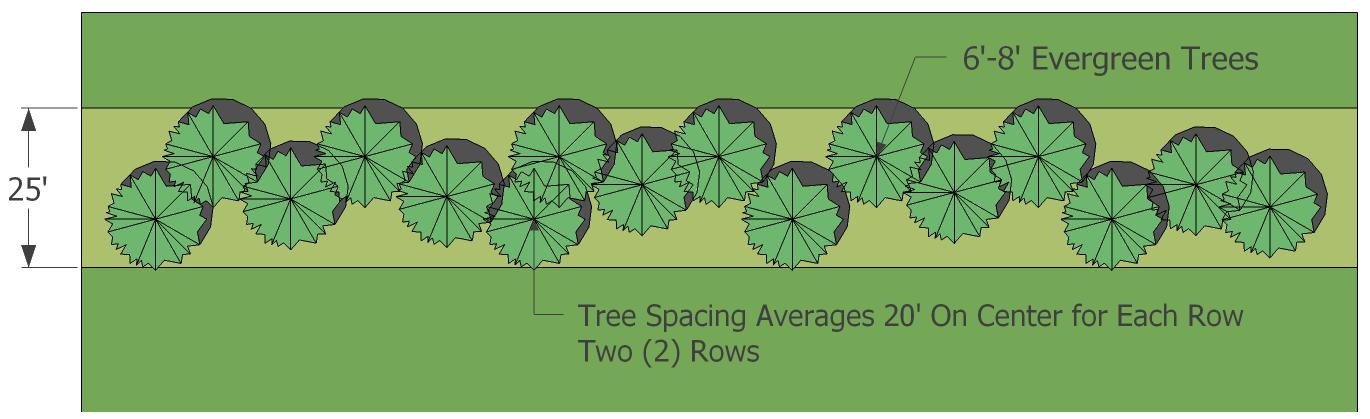
A natural rolling berm between three (3) and six (6') foot high shall be constructed along the entire property line(s) of such dissimilar uses or immediately around the area being screened if determined to be acceptable by the Planning Commission.
2.
The berm shall be planted with two (2) contiguous staggered rows of evergreen trees measuring six (6') to eight (8') feet in height. Each row shall be planted at intervals not exceeding twenty (20') feet on center. Natural groupings of the evergreens are encouraged provided the tree ratios are maintained
3.
The berm and landscaping shall be contained within a twenty five (25') foot landscaped easement.
B.
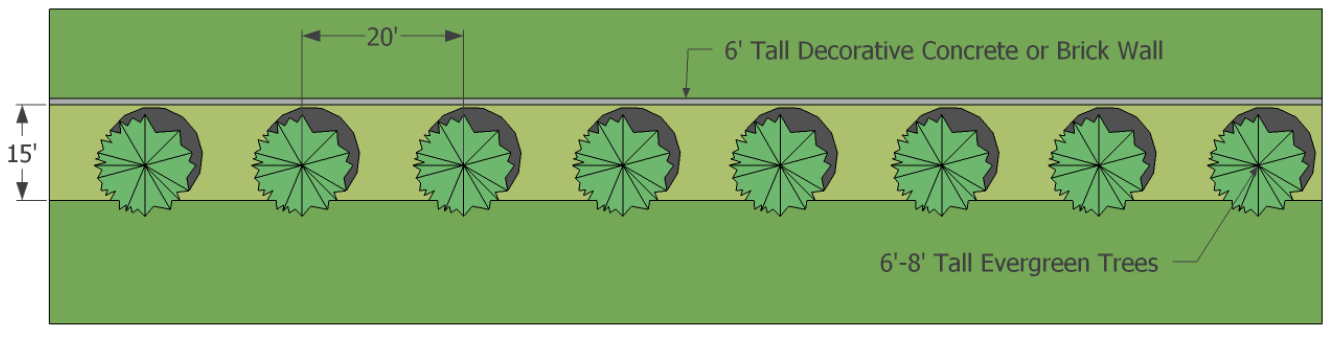
If the Planning Commission determines that a natural landscape buffer is not acceptable or that another form of screening may provide a better screening scenario, a six (6') foot tall poured decorative concrete or decorative brick wall may be approved.
1.
Such wall shall be constructed on the mutual property line and shall be contained within a fifteen foot wide landscape easement.
2.
A single row of evergreens, six to eight (6-8') feet in height shall be planted along such wall at intervals not exceeding twenty (20') feet on center.
C.
The Planning Commission upon their review may approve other unique configurations which meet the intent of this Ordinance.
D.
This section shall not apply to the Davis Mixed Use District
SECTION 1803 - STREET TREES AND FRONTAGE LANDSCAPING.
A.
Minimum Street Tree Requirement
1.
Street trees shall be provided in all zoning districts and for all uses (with the exception of single family residential dwellings and farm uses)
2.
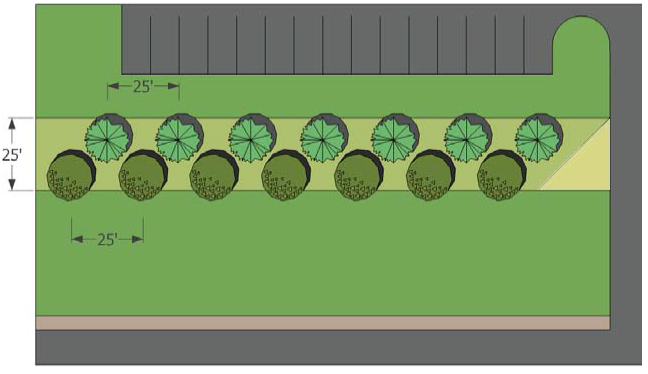
Shall be planted at a rate of one (1) tree for each twenty five (25) feet of frontage.
3.
Shall be a minimum of two and one-half inch caliper at breast height.
4.
Planted generally parallel and adjacent to (within five (5) feet unless easements are present) the right of way along the frontage(s) of the property.
B.
Supplemental Plantings for Commercial and Industrial developments which have frontage along 26, 29, and 32 Mile Roads as well as Romeo Plank and North Avenue.
1.
Additional evergreen trees shall be planted in addition to the required minimum street tree requirements at a rate of one (1) tree for each twenty five (25) feet of frontage.
FRONTAGE LANDSCAPING GRAPHIC
SECTION 1804 - SCREENING OF ROADWAYS AND ACCESS DRIVES.
A.
Whenever a roadway or other access drive within any development abuts an exterior property line or does not provide sufficient area for a buildable lot, a row of eight-foot (8') high evergreens within a twenty (20) foot landscape easement, planted at a rate of not less than one tree for each fifteen (15) feet shall be planted along such roadway for the length of such abutment. Natural groupings of such trees is encouraged as approved by the Planning Commission. The Planning Commission may waive the requirement for screening if existing landscaping is present, more creative alternatives are provided, or if no good purpose would be served by requiring such.
PERMISSIBLE TREES
SECTION 1805 - PARKING LOT SCREENING FROM A PUBLIC THOROUGHFARE.
A.
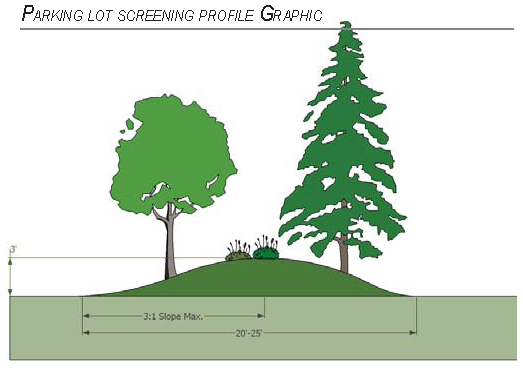
A three-foot (3') high (as measured from the parking lot curb grade) naturally rolling berm shall be provided between the outer edge of all parking lots and the adjacent road right-of-way. The slope of such berm shall be no steeper than 3:1 (a maximum slope ratio of three feet (3') horizontal to one foot (1') vertical. This provision shall not be applicable to the Davis Mixed Use District.
SECTION 1806 - PARKING LOT LANDSCAPING.
A.
All unpaved areas between a nonresidential building and a facing street shall be landscaped and maintained to include grass and/or shrubbery.
B.
Curbed landscape islands shall be placed at the ends of all parking space groupings to separate the parking spaces from maneuvering lanes and to provide for safe traffic flow. The Planning Commission may waive the requirement for parking islands in certain instances where the Fire Department provides written comment that such island will interfere with emergency service.
C.
Curbed landscaped islands shall not be less than one hundred and eighty (180') square feet of land area for each tree planting. Further, such islands shall not be less than seven (7') feet in width. The curbed landscaped islands shall be planted with sod or other acceptable plant material.
D.
Trees shall be planted throughout the parking area and within the required curbed landscape islands. Trees shall be a minimum of two and one-half (2½") inch caliper at the time of planting and shall be provided at a ratio of one (1) tree for each five (5) parking spaces or fraction thereof. These trees shall not be counted towards street frontage trees or general greenbelt planting requirements.
The following trees or similar types are suitable species for parking lots:
SECTION 1807 - TRASH RECEPTACLES, LOCATION AND SCREENING.
A.
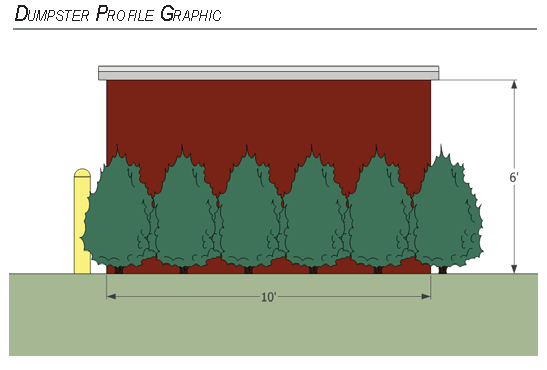
The location of trash receptacles shall be indicated on a site plan. All such trash receptacles shall be located so as to facilitate collection and minimize any negative impact on persons occupying the development site, neighboring properties, site traffic circulation patterns, or any public right-of-way. Trash receptacles shall not be located within the front or street side yard.
B.
All trash receptacles shall be screened on three (3) sides by durable masonry walls which are similar to, or compatible with, the exterior construction materials used elsewhere on site. The height of the masonry screening shall be six (6') feet. The walls shall be constructed of either color impregnated poured concrete with a simulated brick pattern or decorative clay brick, the same as that used for the principle building. The dumpster enclosure shall not be painted. Further, the trash receptacle enclosure shall be complemented with evergreen and other decorative plantings that provide a continuous screen.
C.
All trash receptacles shall be placed on a concrete pad, approved by the Township Engineer. Further, all such walls shall be constructed with suitable footings. Concrete or metal bollards shall be placed between the trash receptacle and the rear wall of the enclosure.
D.
Trash receptacles shall be so located and arranged to minimize their visibility from adjacent streets and uses. All trash receptacles shall be located on site to be as accessible as possible without interfering with vehicular circulation patterns.
SECTION 1808 - LANDSCAPING ADJACENT TO NON-RESIDENTIAL BUILDINGS.
Wherever a building is constructed which abuts parking, a drive, service aisle, road or other means of access or maneuvering, the following landscape areas shall be provided:
A.
A ten (10') foot wide greenbelt shall be provided around the equivalent of twenty five (25%) percent of the building and a four (4') foot wide greenbelt around the equivalent of fifty (50%) percent of the building. The remaining twenty five (25%) percent of the building may abut the above described paved areas.
B.
Such landscaped areas shall contain landscape materials as approved by the Township Planning Commission. Acceptable materials may include small shrubs and bushes as well as flowering plants.
C.
The Planning Commission may waive the requirement for landscaping adjacent to non-residential buildings in certain instances where the Fire Department provides written comment that such landscaping will interfere with emergency service.
SECTION 1809 - NON RESIDENTIAL FIXTURE SCREENING.
Nonresidential appliances, including, but not limited to, air conditioners, heating apparatus, dust collectors, filters, transformers, and any other such appliance or apparatus, shall be obscured from view.
A.
Such appliances, if located on the roof shall be enclosed on all sides by view-obscuring screening so as not to be visible from off the site. The design of the screening shall be approved by the Planning Commission as compatible with the architectural design of the building upon which it is located.
B.
Ground mounted appliances shall be screened using decorative landscaping, a decorative wall or wood screening fence, whichever the Planning Commission determines to be most appropriate.
SECTION 1810 - LOADING AND UNLOADING AREA SCREENING.
Areas designated for formalized loading and unloading shall be screened from view of any public or private thoroughfare or adjacent residential property.
A.
Screening shall consist of either an extension of the building architecture or with additional evergreen landscape screening for the length of such loading and unloading space.
B.
The screening mechanism shall provide a minimum screening height of eight (8) feet.
SECTION 1811 - GENERAL LANDSCAPING REQUIREMENTS.
A.
Whenever any yard (front, side or rear) is not designated for building, off-street parking, loading and unloading, storage, or other purpose within the terms and requirements of a given zoning district, it shall be landscaped with either approved natural materials or living plant materials.
B.
Existing significant trees, tree stands, natural vegetation, and wild-life habitat shall be integrated into the site landscape plan to the maximum extent possible.
C.
Undeveloped portions of the site shall remain in a natural undisturbed state or shall be seeded and maintained back to its original condition.
D.
All plant materials shall be maintained in a healthy and vigorous growing condition. All unhealthy and dead plant material shall be replaced within one year or the next appropriate planting period, whichever comes first.
E.
Plant and grass materials shall be of acceptable varieties and species, free of pests and diseases, hardy in Macomb County, and shall conform to standards of the American Association of Nurserymen and the Township.
F.
Approved ground cover used in lieu of grass, in whole or in part, shall be planted in such a manner as to present a finished appearance and reasonably complete coverage after one complete growing season.
G.
Grass areas shall be planted in species or seed mixtures normally grown as permanent lawns or other acceptable natural cover in Macomb County. Grass may be plugged, sprigged, seeded or sodded. Except that rolled sod, erosion reducing net or suitable mulch shall be used in swales or other areas subject to erosion.
H.
An ample variety and quantity of ornamental plants, trees and shrubs should be provided. Variety should be achieved with respect to seasonal changes, species selected, texture, color and size at maturity.
I.
Landscaping should be encouraged that will serve the functions of enhancing the visual environment, ensuring public safety, moderating the microclimate and minimizing nuisances.
J.
Landscaping should serve to integrate the project with the site, with a particular sensitivity to the natural topography, drainage and existing native vegetation. It should enhance the architecture of surrounding structures, when possible, by being of similar scale.
K.
Preservation of the existing landscape material and landforms is mandatory, particularly where mature trees are a part of the site.
SECTION 1812 - NATURAL RESOURCE GREENBELT.
The Township recognizes the fragility and benefits of certain natural features within the Township such as wetlands, marshes, bogs, streams, inland lakes, ponds and drains. These features help regulate storm water drainage, water quality, help control erosion and sediment disposition, as well as provide for wildlife and plant habitat. In an effort to help preserve these environmental features and the benefits in which they provide, the Township shall require natural resource buffers or greenbelts around natural features located on site. These buffers will help ensure that no damage, impairment or other intrusion occurs to the natural habitat and that contaminates or pollutants do not degrade or destroy these areas.
A.
A twenty-five foot (25') undisturbed greenbelt shall be preserved around the boundary of any State regulated wetland and all other flagged wetlands which are intended to remain onsite, as well as from the ordinary high water mark of any inland lake or pond, streams, creeks or drains (improved or unimproved). These areas shall be conspicuously noted on the site plan and before any land clearing activities are commenced, the developer shall erect and maintain a suitable barrier between such environmental feature greenbelt and lands which are intended to be cleared.
B.
There shall be no construction of any structures or the removal or deposit of any soils, including dredging, filling or land balancing within a required natural resource greenbelt.
C.
These requirements may be modified by the regulating State, County or other appropriate agency.
SECTION 1813 - STORMWATER FACILITIES.
The placement and design of storm water systems shall be coordinated with the Township Engineer and the Township's Land Development and Engineering Standards. Particular attention shall be given to the aesthetic value of the system. Wherever possible the system shall be incorporated into the overall landscape design of the site.
A.
Whenever fencing is required around a pond, detention pond, retention pond, siltation basin, lake or the like, fencing which is ornamental in nature shall be utilized.
B.
Fencing shall be either decorative wrought iron or simulated wrought iron.
C.
Fencing shall be between four (4) and six (6) feet in height as required by the Township and must meet all other applicable building codes.
D.
In those areas not visible to public view or adjacent residences, the Planning Commission may approve a substitute material if no good purpose is served by provided the decorative fencing material.
SECTION 1814 - OUTDOOR LIGHTING.
A.
Outdoor lighting in conjunction with any site plan or special land use approval in all use districts shall conform to the following requirements as to type, location and intensity.
1.
All outdoor lighting used to light a specific site shall be shielded downward or below horizontal (maximum of 85 degrees from vertical) to reduce glare and shall be so arranged and designed to reflect light away from all adjacent residential districts or existing adjacent residences and public right-of-ways. No light shall cast a glare onto adjacent roadways.
2.
Artificial light shall be stationary and constant in intensity and color at all times when in use. There shall be no flashing, oscillating, moving or intermittent type of lighting or illumination. In addition, there shall be no bare bulb illumination of any kind exposed to public view.
3.
There shall be no lights which tend to be harmful to natural forms of vegetation in any use district. Lighting shall utilize high pressure sodium or LED bulbs.
4.
The lighting sources (bulbs or lenses) for non-residential properties shall not be visible from adjoining properties or rights-of-way. In addition, the height of the non-residential lighting fixture, including the base, measured from the established grade shall not exceed twenty (20) feet; fifteen (15) feet when located within fifty (50) feet of a residential district.
5.
Carriage style lights which may have lighting sources which are not directed downward may be utilized in any district; however, such lights shall have internal shields to direct light downward and away from adjacent properties and roadways as necessary. The height of such lights shall not exceed twelve (12) feet.
6.
No light measured (at eye level) at the property line between any use and any other use shall be greater than one-tenth (0.1) foot candle at the side and rear property line. Lighting along roadways shall not have an average maintained illuminance greater than 0.5 foot candles.
7.
Lighting at any non-residential drive and street intersection may be required upon Planning Commission determination. Fixtures located at an intersection shall be full cutoff fixtures. Such lighting shall not exceed an average of one (1) foot candle. Lighting at major intersections shall not exceed an average of one and four tenths (1.4) foot candles.
8.
Ground lighting (up-lighting) used for the purpose of illuminating signs, landscaping and architectural details shall be shielded away from public view, directed solely at the object to be lit and landscaped as necessary.
9.
A ground level illumination plan (in foot candles) which demonstrates compliance with the standards of this Ordinance shall be required for each site or development.
10.
The intensity of outdoor lighting in all use districts shall be limited to the following amounts, unless otherwise noted above.
SECTION 1815 - FENCES, WALLS, AND OTHER PROTECTIVE BARRIERS.
All fences and walls of any nature, type or description located in the Township shall conform to the following regulations:
A.
The erection, construction or alteration of all fences, walls or other types of protective barriers, in other than a residential zoning district, shall be approved by the Building Inspector as to their conformance to the requirements of the zoning district wherein they are located and to the requirements of this Section.
B.
Fences in the residential zoning districts shall conform to the following requirements:
1
. No fence shall hereafter be erected along lot lines or located within any required side or rear yard in excess of six (6) feet, or less than three (3) feet in height above the grade of the surrounding land. Public recreation facilities may erect a fence greater than six (6) feet to provide protection to adjoining residential properties.
2.
Bona fide farms may use barbed wire or electric current fences to contain their animals.
3.
All other fences hereafter erected in the R-1 Residential-Agricultural zoning district shall be of an ornamental nature. Barbed wire, spikes, nails or any other sharp point or instrument of any kind on top or on the sides of any fence, or electrical current or charge in said fences, must receive the prior approval of the Board of Appeals.
4.
No fence shall hereafter be erected in the front yard of lots or parcels which have a height greater than four (4) feet.
C.
Required walls shall be located on the lot line, except where underground utilities interfere and except in instances where this Ordinance requires conformance with front yard setback lines in abutting residential zoning districts. Masonry or poured walls shall be erected on a concrete foundation, which shall have a minimum depth of forty-two (42) inches below a grade approved by the Building Inspector.
D.
No fence, wall, structure or planting shall be erected, established or maintained on any corner lot which will obstruct the view of a driver of a vehicle approaching the intersection, except that shade trees would be permitted where all branches are not less than eight (8) feet above the road level. Such unobstructed corner shall mean a triangular area formed by the street property lines and a line connecting them at points thirty (30) feet from the intersection of the street lines or, in the case of a rounded property corner, from the intersection of the street property lines extended.
E.
A wall or greenbelt and/or landscaped earthen berm shall be required for construction in any district which abuts a One-Family Residential zoning district.
F.
Walls shall be constructed of a common or face brick, decorative block, or similar material that is compatible with the principal building or adjacent residential districts.
G.
Where the Planning Commission has determined that a wall would not be desirable or that the buffering of adjacent uses could better be accomplished through the use of a chain-link fence and greenbelt or earthen berm, such fence and greenbelt or berm shall meet the following requirements of these Sections and the greenbelt provisions of this Section.
H.
The height of any wall or fence shall be measured from the existing natural ground elevation to the highest point of the wall or fence. In cases where there is a grade variation between adjoining properties, such measurement shall be made from the property having the highest ground elevation.
(Ord. of 3-15-2022)

