
Ray Township City Zoning Code
GENERAL PROVISIONS
SECTION 200 - ACCESSORY BUILDINGS IN RESIDENTIAL DISTRICTS.
Accessory buildings, except as otherwise permitted in this Ordinance, shall be subject to the following regulations.
A.
Accessory buildings or structures in all residential districts shall be customarily incidental to and subordinate in size and scope to the principal structure or use, and shall be subjected to the following regulations:
1.
Where the accessory building is structurally attached to the principal building, it shall conform to all regulations of the principal building.
2.
No accessory building shall be constructed prior to the enclosure of the principal building.
3.
An accessory building shall not be used for any business, profession, trade or occupation, unless approved as a home occupation.
4.
One storage building or shed, which does not exceed two hundred (200) square feet, shall be permitted on each residential lot. A zoning compliance permit shall be required.
5.
An affidavit of Zoning Compliance shall be filed by the owner, prior to the issuance of a building permit, for all accessory buildings or structures. This requirement shall not apply to garages of 720 square feet or less.
6.
Accessory Buildings and/or Structures:
Required Side and Rear Yard Setbacks and Maximum Heights for Accessory Structures
a.
Shall not be located closer than ten (10) feet to any other building.
b.
Building heights shall be measured from the lowest ground elevation at the base of the structure, to the ridgeline if the roof is flat, to the deck line if the roof is a mansard type, and to the average height between the eaves, and the ridge, if the roof is a gable, hip, or gambrel type. This provision does not include architectural design features such as spires, cupolas, weathervanes, and similar features that do not exceed a height of ten (10) percent of the front width of the building, or ten (10) feet, whichever is greater.
c.
Shall have the following maximum size limits (these limitations shall not include the area within garages up to 720 square feet):
d.
The area of all unenclosed awnings, lean-tos, and similar structures, which are attached or directly adjacent to the accessory structure, and are structurally attached to the ground, shall be counted as part of the maximum allowed square footage.
(Amd. of 1-16-2018; Ord. of 3-15-2022; Ord. of 4-17-2024; Ord. of 8-31-2025)
SECTION 201 - ANIMALS, KEEPING OF
The following provisions shall not apply to those properties, which meet the Township's definition of farm or farmland.
A.
In all districts, the minimum required area for the keeping of any hoofed animals shall be 90,000 square feet and shall be accessory to the primary residence.
B.
All animals shall be afforded adequate shelter.
C.
All animals shall be contained within an enclosed fenced area.
D.
The refuse and waste resulting from the maintenance of animals shall be controlled upon the premises and shall be cared for or disposed of in a manner keeping with generally accepted agricultural practices so as to minimize hazards of health and offensive effects.
E.
Each animal shall be maintained in a good healthy condition in a manner not causing injury to the health of any animal or the health and safety of any person.
F.
The maximum number of hoofed animals kept on single-family residential property (non-farm), shall be 1.3 animal units (1,300 pounds of live weight) per acre.
(Ord. of 3-15-2022)
SECTION 202 - ARCHITECTURAL PROJECTIONS INTO YARDS.
Architectural features such as chimneys, roof overhangs, bay windows, etc., may extend or project into a required side yard, not more than two (2) inches for each one (1) foot of width of such side yard and may extend or project into a required front yard or rear yard not more than three (3) feet.
SECTION 203 - BUILDING GRADES.
A.
It shall be unlawful for any person to alter the drainage pattern of any land by excavating, grading, or filling without first obtaining a permit issued by the Township.
B.
The existing grade of all properties within the Township shall not be altered without the approval of the Township Building Official and Engineer. Grade changes of less than one (1) foot are exempt if the land is being utilized solely for agricultural purposes.
C.
Any building requiring yard space shall be located at such an elevation that a sloping grade shall be maintained to cause the flow of surface water to run away from the walls of the building. There shall be a sloping grade from the finished grade line at the front of the building to the front lot line. However, this shall not prevent the maintenance of natural existing grades or the grading of a yard space to provide a sunken or terraced area, provided proper means are provided and maintained to prevent the runoff of surface water from flowing onto adjacent properties. Grade elevations shall be determined by using the elevation at the center line of the road in front of the lot as the established grade.
D.
When a new building is constructed on a vacant lot, the yard around the new building shall be graded in such a manner as to prevent the run-off of surface water onto the adjacent properties.
E.
In general, each lot shall drain from the front of the house or other principal structure to the road and from the rear of the house or other principal structure, to the rear of the lot.
F.
Whenever a lot is graded toward the sides or the rear, a drainage structure must be provided across the side and/or the rear lot line to receive surface run-off. The structure shall direct the run-off water to an appropriate natural drainageway or a County drain.
G.
Drainage for each site must be self-contained to avoid drainage across adjacent sites unless written, recorded easements are provided for that purpose.
H.
Whenever drainage is required to cross an adjacent lot, an easement for this purpose must be obtained across the adjacent lot; the easement must be in writing and recorded.
I.
All grade changes shall be approved by the Building Department, where the owner and/or the developer are required to submit a Plot, preliminary, and Final Certificate of Grade Plans (standard forms furnished by the Township) prepared and certified by a registered civil engineer or land surveyor. The Township Planner shall review plans for setback requirements, and the Township Engineer shall determine that the proposed site grading is proper, drainage from abutting properties is not obstructed, and downstream properties will not be adversely affected by runoff from the subject property. All Certificates of Grade shall be field verified by the Township Engineer, who will compare the elevations shown on the Certificates to those shown on the approved Plot Plan.
J.
Health Department requirements for "elevated" or "engineered" septic system tile fields shall not constitute a valid reason for directing stormwater onto adjacent properties. In no instance shall the finished grade of the lot be more than six (6) inches above the approved finished grade of the septic system.
K.
Fees required by this Section shall be established by Resolution of the Ray Township Board of Trustees.
(Ord. of 8-31-2025)
SECTION 204 - BUILDINGS TO BE MOVED.
The moving of buildings, includes any buildings or structures being relocated within the Township, being moved out of Township or being moved into the Township. Board approval is not needed when the building is being moved within the property lines of a lot or when such move does not necessitate movement along a County, State or Township Road.
Moving of buildings into, within and/or out of the Township shall be approved by the Township Board prior to such moving. Approval shall be contingent upon the Board determining that the following conditions have been met:
A.
Any person desiring to move a building in Ray Township shall file an application for a building permit and a moving of building application with the Building Inspector.
B.
Record of adequate insurance is provided assuring any improvements in the public right-of-way are adequately insured.
C.
Adequate police protection has been arranged for with the appropriate agency(s).
D.
Record of all proper permits and approvals having been obtained.
E.
Where a structure is moved into the Township, the structure must comply with all codes and ordinances, as determined by the Township Building Official prior to obtaining a certificate of occupancy.
F.
That the necessary fees, licenses and financial surety have been received by the Township.
G.
A financial surety shall be required by the Township to insure that the ultimate moving, erection or construction of the building and the development of the site shall be in accordance with the approved plans and proposals. Such financial surety shall be in an amount equal to the estimated cost of the construction and the site improvements as determined by the Township Building Official. The financial surety will not be returned until a final occupancy permit has been granted.
SECTION 205 - BUILDING UNDER CONSTRUCTION.
A.
Any building or structure for which a building permit has been issued and the construction of which has been started, prior to the effective date of this Ordinance, may be completed and used in accordance with the plans and application on which said building permit was granted.
SECTION 206 - DECKS, PORCHES, PATIOS AND TERRACES.
A deck, unenclosed porch, paved patio or terrace shall have a minimum setback of fifteen (15) feet from any property line.
SECTION 207 - DWELLINGS IN OTHER THAN MAIN STRUCTURE.
A.
No accessory building or structure shall be converted to living quarters on a lot where a residential dwelling exists. On a lot where no residential dwelling exists, an accessory building or structure may be converted to a residential dwelling provided all residential codes are met.
SECTION 208 - FARM, FISH AND RECREATION PONDS OR AESTHETIC LANDSCAPING PONDS.
A.
A plot plan shall be submitted to and approved by the Building Inspector.
B.
Ponds shall only be of an excavation type.
C.
No commercial activities, including public fishing, shall be allowed.
D.
The pond shall be a minimum distance of fifty (50) feet from the property line of abutting lands.
E.
In the event the owner wishes to sell or otherwise remove the excavated materials from the site, he shall conform to the requirements of the mining and extraction ordinances of the Township.
F.
Any artisan well or other water overflow from a pond that could affect adjacent property shall be provided with adequate drainage.
G.
Ponds shall be a minimum of ten (10) feet deep over twenty-five (25%) percent of the pond's surface area.
H.
Ponds shall be located a minimum of one hundred (100) feet from the septic tank or field.
I.
Contaminated surface water shall be diverted around all ponds.
J.
Ponds shall be constructed in such a manner that runoff, overflow, spillage or seepage shall not encroach upon adjacent properties owned by another person.
K.
Ponds shall have warning signs and lifesaving equipment, as required by the State of Michigan.
SECTION 209 - GARAGE AND BASEMENT DWELLINGS.
A.
Basement or garage dwellings which constitute a second separate dwelling are prohibited.
SECTION 210 - LOT LIMITATIONS.
A.
Within the Township's single family residential districts one (1) dwelling unit shall be permitted per lot, parcel or unit.
SECTION 211 - MEDICAL MARIJUANA USES.
A.
Intent
1.
Voters in the State of Michigan approved a referendum authorizing the use of marijuana for certain medical conditions, being the Michigan Medical Marihuana Act, MCL 333.26421, et seq. ("The Act").
2.
The specified intent of The Act is to enable certain specified persons who comply with the registration provisions of the law to acquire, possess, cultivate, grow and use marijuana as well as to assist specifically registered individuals identified in the statute without being subject to criminal prosecution under state law in limited, specific circumstances.
3.
Despite the specific provisions of The Act and the activities identified in The Act, marihuana remains a controlled substance (Schedule 1 drug) under Michigan law. The activities set forth in the Act have a potential for abuse. Such activities should be closely monitored and, to the extent permissible, regulated by local authorities.
4.
If not closely monitored or regulated, the presence of marihuana even for the purposes specified by The Act may present an increase for illegal conduct and/or activity which adversely affects the health, safety and welfare of the residents of Ray Township.
5.
Nothing in this Ordinance shall be construed to allow persons to engage in conduct that endangers others or causes a public nuisance, or to allow use, possession or control of marijuana for non-medical purposes or allow any other activity relating to cultivation/growing, distribution or consumption of marijuana that is otherwise illegal.
6.
This section is intended to protect and preserve the public health, safety and welfare of the community, the quality of life and the stability of property values including but not limited to the value of residential, commercial, and industrial districts.
7.
This section is intended to prohibit a caregiver's cultivation of marijuana in residential and commercial districts in order to protect and preserve peace, order, property and safety of persons as a result of issues associated with the growth of marijuana in residential and commercial districts including problems with insufficient or improper electrical supply, problems with ventilation leading to mold, offensive odors, or other health hazards and other hazards which are associated with the cultivation of marijuana in residential and commercial settings and which is otherwise often difficult to detect and regulate.
B.
Medical Marijuana Dispensary, Compassion Centers or other similar operation for the consumption or distribution of medicinal marijuana. It shall be unlawful for any person or entity to own, manage, conduct, or operate a medical marijuana dispensary, compassion center or other similar operation, or to participate as an employee, contractor, agent or volunteer, or in any other manner or capacity, in any medical marijuana dispensary, compassion center, growth facility, growth cooperative or other similar operation in Ray Township.
C.
Registered Primary Caregiver Operations. Any registered primary caregiver may acquire, possess, cultivate, manufacture, transfer, or transport medical marijuana compliant with the MMMA. Cultivation of medical marijuana by a registered primary care giver as defined under the MMMA, is prohibited in any zoning district, except the I-1 Industrial district; and further subject to the following:
1.
A registered primary caregiver may only grow, cultivate, manufacture, process, and store marijuana on a parcel in the I-1 Industrial district and in an enclosed locked facility.
2.
The registered primary caregiver is responsible for utilizing an enclosed locked facility upon the industrial zoned parcel, compliant with the MMMA for cultivating, growing, manufacturing, processing, and storing marijuana for medical use only. The enclosed locked facility utilized by the primary registered caregiver, shall provide separation by fully enclosed walls or fences, for plants that are grown on behalf of each registered qualifying patient, on whose behalf the registered primary caregiver is furnishing marijuana for medical use, so it is accessible only to the primary caregiver and registered patient. The processing and storing of medical marijuana is permitted only by registered primary caregivers and their registered qualifying patients. The registered primary caregiver may grow up to a maximum of seventy-two (72) plants, but no more than twelve (12) plants for each individual registered qualifying patient as set forth in the MMMA.
3.
The registered primary caregiver is responsible for providing the security necessary to assure that the growing marijuana and usable product are accessible only by the primary registered caregiver and/or registered qualifying patients who are registered to the registered primary caregiver through the state registration system. The security must fully comply with the provisions of the MMMA, and Administrative Rules promulgated by the State of Michigan.
4.
Each parcel upon which enclosed locked facilities with marijuana for medical use are present, must be a minimum of five hundred (500) feet from any parcel upon which any school, school facility, child care facility, place of worship, or public park is situated. Measurement of the buffer shall be from property line to property line.
5.
A certificate of occupancy is required and must be obtained from the Township before the presence of marijuana is allowed on the parcel.
6.
The consumption, transfer, or use of marijuana, in public, or a place opened to the public is prohibited.
7.
No person other than the primary caregiver shall be engaged or involved in the growing, processing, dispensing, delivering or handling of medical marijuana except to the extent that the primary caregiver lawfully transfers medical marijuana to a qualifying patient to whom the primary caregiver is linked through the state registration system.
D.
Certificate Required. The operations of a registered primary caregiver within the I-1 Industrial district shall only be permitted upon the issuance of a Zoning Certificate to Cultivate Medical Marijuana. Such certificate is required to be renewed annually and is subject to inspections by the building and fire department as well as the Macomb County Sheriff's Department for compliance with the provisions of this Ordinance and for the issuance of the certificate and its renewals.
1.
A complete and accurate application shall be submitted on a form provided by the Township along with submission of the application fee. The application fee and renewal fee shall be in an amount determined by resolution of the Township Board.
2.
The certificate application shall include the name and address of the applicant; the address of the property; a copy of the current state registration card issued to the primary caregiver; a full description of the nature and types of equipment which will be used in marijuana cultivation and processing; and a description of the location at which the use will take place. The Township Supervisor, Building Official and Planning Consultant shall review the application to determine compliance with this Ordinance, the MMMA and any applicable Michigan Regulatory Agency General Rules. A certificate shall be granted if the application demonstrates compliance with the Zoning Ordinance, the MMMA and Administrative Rules.
3.
The use shall be maintained in compliance with the requirements of this Ordinance, the MMMA and Administrative Rules promulgated by the State of Michigan. Any departure shall be grounds to revoke the certificate and take other lawful action. If a certificate is revoked, the applicant shall not engage in the activity unless and until a new zoning authorization to cultivate medical marijuana certificate is granted.
4.
Information treated as confidential under the MMMA, including the primary caregiver registry identification card and any information about qualifying patients associated with the primary caregiver, which is received by the Township, shall be maintained separately from public information submitted in support of the application. It shall not be distributed or otherwise made available to the public and shall not be subject to disclosure under the Freedom of Information Act.
(Ord. No. 36, §§ 1.2, 1.3, 8-25-2021)
SECTION 212 - NON COMMERCIAL RADIO TOWERS.
Ham radio or CB towers for non-commercial uses shall be considered as uses permitted after special approval. The setbacks for such towers shall be such that the tower or smokestack cannot fall onto abutting streets or adjacent property.
SECTION 213 - NONRESIDENTIAL BUILDING STANDARDS
A.
The facades of all non single family residential buildings shall be constructed of face brick or other decorative materials with similar durability, as approved by the Planning Commission.
B.
The approved exterior treatment shall be uniform on all sides of the building that are visible from a public right-of-way or abut a residential district.
C.
Some form of covered pedestrian entrance ways and/or walkways should be provided which is compatible with the overall architecture of the building.
D.
Any ancillary buildings or outlots shall be architecturally compatible with the principle building.
E.
All buildings that front on a public street shall be orientated in such a manner that the main facade and architectural features are parallel to the street. The actual building entrance is not required to front the street.
F.
Roof-mounted equipment, including, but not limited to, air conditioners, heating apparatus, dust collectors, filters, transformers, noise control devices and any other such appliance or apparatus, shall be concealed from view by obscuring screening so as not to be visible from the ground. The design of the screening shall be compatible with the architectural design of the building upon which it is located, and shall be designed to mitigate noise generated by any roof mounted appliances.
G.
These materials and design guidelines are established to maintain, enhance and be compatible with the general character and architectural style that is desired within the community. No buildings shall be reconstructed, remodeled or altered as to conflict with the original intent of the Planning Commission. All architectural designs shall also be reviewed for safety and code compliance by the Fire Department and the Building Department.
SECTION 214 - SINGLE DWELLING STANDARDS.
A.
A building permit shall be required before any dwelling unit is constructed, relocated, or moved into the Township. All new dwelling units and additions shall meet or exceed all applicable construction standards of the State of Michigan as well as Ray Township.
B.
All new dwelling units and additions shall meet the minimum setbacks, coverage requirements, parking, and all other minimum site requirements applicable to residential dwellings within the zoning district in which the dwelling will be located.
C.
All dwelling units shall meet the minimum living area standards for single-family residential dwellings of the zoning district in which the dwelling will be located.
D.
All dwelling units shall have a minimum width across any front, side, or rear elevation of twenty-two (22) feet and shall have a minimum roof pitch of 4:12.
E.
All dwelling units shall be firmly attached to a permanent foundation constructed on the site in accordance with all applicable codes.
F.
Each dwelling unit shall be connected to a public sewer and water supply or to private facilities approved by the Macomb County Health Department or other applicable agency.
G.
For all driveways, road culvert permits shall be obtained from the Macomb County Department of Roads (as applicable).
SECTION 215 - SOLAR PANELS AND SHINGLES (OR THE LIKE).
A.
The use of solar panels and shingles (or the like) for private use shall meet the following requirements:
1.
Freestanding
(a)
Freestanding solar panels shall not be located in the front or side yard;
(b)
All freestanding solar panels shall be regulated as an accessory structure and shall meet all applicable accessory building requirements of the ordinance;
(c)
Solar panels shall be counted as part of the maximum permitted impervious surface/lot cover- age ratio requirements of the zoning district in which it is located;
(d)
No freestanding solar panel shall be permitted to exceed a height of fifteen (15) feet at any point;
2.
Roof or Structural Mounted
(a)
Shall not project more than one (1) foot feet above the roof line, flat mount panels or solar shingles are preferred;
(b)
May be constructed on any façade or roof surface of an existing structure.
(c)
Shall not be located within three (3) feet of any peek, eave or valley to maintain adequate accessibility.
3.
Requirements for All Panels (Freestanding or Roof Mounted/Integrated)
(a)
In addition to building and electrical reviews, the solar panels, solar shingles and arrays of panels shall also be reviewed by the Fire Department.
(b)
The panel array shall be fitted with an automatic shut off or breaker switch as approved by the Fire Department to isolate the panels in case of fire.
(c)
The Fire Department shall keep on file the type of system that the solar panel array is a part of, either photovoltaic, thermal or other.
(d)
All panels shall have tempered, non-reflective surfaces.
(e)
It shall be shown that all panels are adequately secured to the surface upon which they are mounted and that the mounting structure has the capability of supporting the panels.
(f)
The installation of the panels shall not require or be reliant on the clear cutting of trees or other vegetation.
(Amd. of 1-16-2018)
SECTION 216 - STORAGE IN ANY RESIDENTIAL DISTRICT.
A.
All Storage
1.
Storage in a residential district shall be permitted only when it is accessory to the principle use of the parcel, or the adjacent parcel when owned by the same person.
2.
Commercial highway trailers and commercial vehicles in excess of 24,000 pounds Gross Vehicle Weight (GVW) shall not be parked or stored on any residential zoned property unless approved as a special land use described below.
B.
Open or Outside Storage
1.
No open or outside storage of vehicles is permitted in any zoning district within the minimum front yard setbacks, in the required side yards, nor closer than ten (10) feet to any dwelling unit except as part of an approved driveway serving a residence, or as part of an approved site plan in a commercial or industrial zoning district.
2.
No junk or waste material, building materials, parts of motor vehicles, or parts of machines not generally suited for use on the premises shall be kept or stored outside a building or structure, except as specifically permitted in the subject zoning district and properly screened.
3.
Open storage of recreation vehicles which are currently licensed, such as motor homes, travel trailers, boats and similar vehicles, and utility trailers, shall be permitted as an accessory use only in the rear or side yard of a lot in any residential district. Such vehicles shall be owned and registered to the owner of said lot. Recreational vehicles which are parked or stored shall not be used for living purposes, nor used for storage of materials or equipment other than those items considered to be a part of the vehicle.
4.
The above regulations shall not apply to farm machinery or farm vehicles with farm license plates which are used for farm operations, provided that such storage takes place on a bona fide farm and that no such storage takes place within the minimum front yard setback..
C.
Storage of Commercial Vehicles in Selected Residential Districts.
Storage of Commercial vehicles in excess of 24,000 pounds Gross Vehicle Weight (GVW) may be permitted by the Planning Commission subject to Special Approval Land Use and the following requirements:
1.
Lot size: Minimum of five (5) acres, and having a sufficient minimum "design" width to complete an uninterrupted turn of said commercial vehicle.
2.
The property shall be located within Section 35 or 36 of the Township and shall have direct access to a Class A road as designated by the Township and the Macomb County Department of Roads.
3.
The vehicle must be solely owned and operated by the occupant of the property.
4.
The minimum front yard setback for commercial vehicle storage shall be the established building setback line of the principle building, but in no case less than the minimum required front yard. The minimum side and rear yard setbacks shall be thirty (30) feet.
5.
All vehicles and/or equipment must be stored completely within an approved enclosed structure
6.
An approved method of screening shall be provided between the enclosed structure and adjacent residential uses or districts for the length of the storage structure and driveway servicing the structure.
7.
The site plan shall indicate that fuel, fuel pumps and waste oil be contained within secondary containers.
SECTION 217 - SWIMMING POOLS.
All swimming pools erected in the Township greater than twenty-four (24) inches in depth shall comply with all applicable Building Codes as well as the following requirements:
A.
Pool Location. The pool or its fence must not be built within (as measured from the wall/edge of the pool):
1.
The required front yard or required corner lot side yard.
2.
Ten (10) feet of the side property line,
3.
Ten (10) feet of the rear property line,
4.
Ten (10) feet of any building on the lot.
B.
For the protection of the general public, all swimming pools shall be completely enclosed by a fence or other means of access control as required in the Building Code.
SECTION 218 - TEMPORARY STRUCTURE PERMIT.
A.
Temporary structures - With the exception of recreational vehicles, motorhomes, campers, tents, and similar, any structure which meets any of the following criteria:
1.
Is originally designed to be moved from place to place by any means whatsoever, whether on wheels, skids, or otherwise.
2.
Is not originally designed to be permanently attached to the real property on which it sits.
3.
Any structure not having a permanent foundation.
4.
Temporary carports, and accessory/storage buildings.
5.
Shipping containers, Conex boxes, and similar, when used primarily for storage.
B.
No temporary structure shall be placed, located, or assembled on any property within the Township, with the exception of the following:
1.
Tents and canopies used for special events (graduation parties, weddings, reunions, etc.).
2.
A building or structure may be approved for temporary residential use only while damage to the principal dwelling due to fire, flood, ice, wind, or other natural disaster is being repaired.
3.
A building or structure may be approved for temporary residential use when a building permit has been issued for construction, major repair, or remodeling of a dwelling unit.
4.
Recreational vehicles, for personal use, are exempt from these provisions.
C.
Temporary structures shall not be used as a residence without prior review and recommendation by the Township Building Inspector, approval of the Township Board, and compliance with the following:
1.
Temporary structures shall comply with the setback standards of the zoning district in which they are located.
2.
No temporary structure shall be allowed to remain longer than six (6) months, unless the Township Board determines that special circumstances exist that warrant an extension.
3.
The building inspector and/or electrical inspector shall review and approve all electrical and utility connections to the temporary structure.
4.
Compliance with all Macomb County Health Department requirements regarding water and on-site sewage disposal.
5.
The temporary structure shall require a financial surety in the manner prescribed in this Ordinance.
6.
Upon issuance of a certificate of occupancy for the principal dwelling, the temporary structure must be removed with fourteen (14) days.
(Ord. of 3-15-2022)
SECTION 219 - WIND ENERGY CONVERSION SYSTEMS (WINDMILLS):
A.
Applicable Zones. WECS may be permitted in any zoning district subject to the following Special Land Use Approval Requirements (Subsections C, D, and E). However, the erection of one (1) WECS structure on a single parcel of land at a height equal to or less than eighty (80) feet shall be considered a permitted use in the R-1 Agricultural Residential Zoning District and shall not require special land use or Planning Commission approval. This shall also apply to WECS units constructed on farm properties regardless of zoning classification. The approval of a WECS under this requirement shall be subject to administrative approval through the Building Department, as well as all other applicable provisions (Subsections D and E) of this Section of the Zoning Ordinance.
B.
Applicability of Ordinance. The standards that follow shall apply to systems intended for the provision of the electrical or mechanical power needs of the owner/operator of the system. For systems intended for uses other than the above, including multiple residents connecting to the same system, Planning Commission and special land use approval (Section 1201 of the Township Zoning Ordinance) shall be required. Said approval shall cover the location of the system (shown on a site plan for the property) on the site, the noise generated by the system, assurances as to the safety features of the system, and compliance with all applicable state and federal statutes and regulations. Planning Commission and special land use approval shall specifically be required for arrays of more that one wind energy conversion system and for systems wherein one wind energy conversion system is intended to provide the electric power for more than one main building.
C.
Standards for and Regulation of WECS.
1.
Construction: Tower construction shall be in accordance with the latest edition of the Michigan Building Code, and any future amendments and/or revisions to it.
2.
Electric-Magnetic Interference (EMI): Wind energy conversion system generators and alternators shall be filtered and/or shielded so as to prevent the emission of radio frequency energy which would cause harmful interference with radio and/or television broadcasting or reception, and shall comply with the provisions of Title 47, Chapter 1, Part 15 of the Federal Code of Regulations and subsequent revisions governing said emissions. Proof (from the manufacturer) of the WECS meeting this standard shall be supplied to the Township.
3.
Setbacks: The structural design shall be signed and sealed by a professional engineer, registered in the State of Michigan, certifying that the structural design complies with all of the standards set forth for safety and stability in all applicable codes then in effect in the State of Michigan and all sections referred to herein above. The minimum setbacks for such towers from all abutting streets or adjacent property shall be a distance equal to one and one-half (1½) times the height of the tower. Setbacks shall be measured from the property line to the center of the windmill tower structure.
The WECS shall be located a sufficient distance from any overhead utility lines, excluding service drops, such that a structural failure of any portion of the WECS or its supporting structure will not cause any portion of it to fall within five (5') feet of utility lines.
4.
Location: WECS shall be located within the side or rear yards. Any WECS located within the front yard shall require special land use approval. Such WECS may have an accessory building to house (only the necessary equipment associated with such WECS) within the front yard.
5.
Maximum Height: The maximum height permitted as a special land use shall be one hundred and fifty (150') feet, unless otherwise prohibited by any state or federal statutes or regulations.
6.
Minimum Blade Height: The minimum distance between the ground and any protruding blades utilized on a WECS shall be twenty (20') feet, as measured at the lowest point of the arc of the blades. Special exceptions may be allowed for vertical axis turbines.
7.
Labeling Requirements: A minimum of one sign shall be clearly posted near ground level on the tower structure warning of high voltage. In addition, the following information shall be posted on a label or labels on the generator or alternator of the WECS.
(a)
The maximum power output of the system and the wind speed at which it is achieved.
(b)
Nominal voltage and maximum current.
(c)
Manufacturer's name and address, serial number and model number.
(d)
Maximum survival wind speed and the emergency and normal shut down procedures.
8.
Utility Company Notification: The appropriate utility company shall be notified in writing of any proposed interface with that company's grid prior to installing such interface and shall conform with any legislated requirements governing installations of WECS so as to comply with the Utility Tariff specifications. Verification of this shall also be supplied and filed with the Township.
9.
Safety: The WECS' manufacturers shall document that the WECS model has been tested and certified by Underwriter's Laboratory, or other such applicable independent accrediting agency, and that when installed in accordance with recommended specifications shall have a maximum survival wind speed of not less than eighty (80) miles per hour.
10.
Noise: The maximum level of noise to be generated by a WECS shall be fifty (50) decibels, as measured on the dBA scale, measured at each property line at any time. Proof (from the manufacturer) of the WECS meeting this standard shall be supplied to the Township.
E.
Miscellaneous.
1.
All electric line/utility wires shall be buried under ground unless otherwise approved by the Township.
2.
Any mechanical equipment associated with and necessary for operation, including a building for batteries and storage cells shall be enclosed with a six (6') foot view obscuring fence. The supporting tower shall also be enclosed with a six (6') foot view obscuring fence unless the base of the tower is not climbable for a distance of twelve (12') feet. All areas which are secured with a fence shall provide emergency access as required by the Township. If the equipment is located within a lockable building, the view obscuring fence shall not be required.
3.
When a building is necessary for storage of cells or related mechanical equipment, the building may not exceed one hundred forty (140) square feet in area nor eight (8') feet in height, and must be located at least the number of feet equal to the height of the tower from any property line. Such building shall not be considered an accessory building in terms of the total number or total size of accessory buildings permitted onsite.
4.
The tower and generating unit shall be kept in good repair and sound condition. Upon abandonment of use, the tower and related structure shall be dismantled and removed from the property within sixty (60) days. Appropriate legal documentation, in the form of a deed restriction, shall be filed with the County and the Township guaranteeing such removal prior to any permits being granted for construction.
5.
Every WECS shall be insured with minimum liability insurance of five hundred thousand dollars ($500,000) for each occurrence. Proof of insurance shall be furnished to the township.
SECTION 220 - AMPLIFIED EXTERIOR SOUND DEVICES.
A.
The use of outdoor amplified music, sound systems and public address systems (this provision shall not apply to those uses of a temporary nature or a special event as authorized by the Township or Township Board) shall be reviewed by the Planning Commission as a special land use.
SECTION 221 - CLEAR VISION.
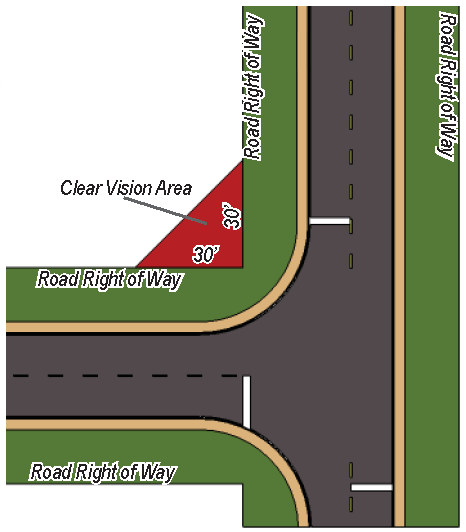
To ensure that natural landscape materials or built structures do not constitute a driving hazard, clear vision site triangles shall be established at all road intersections and at the intersection of site driveways and adjoining roads.
A.
No fence, wall, shrubbery, sign, berm or other obstruction to vision above a height of thirty (30) inches from the established grades shall be permitted within the triangular area formed at the intersection of any road right-of-way lines by a straight line drawn between said right-of-way lines at a distance of thirty (30) feet from their point of intersection.
B.
Internal parking lot landscaping and other improvements should be located to avoid blocking the vision of drivers within the parking lot.
SECTION 222 - HEIGHT EXCEPTIONS.
Non-inhabitable decorative architectural features such as cupolas, weathervanes, spires, etc., are allowed to exceed the maximum height in the zoning district, by ten (10) percent of the linear frontage of the building of ten (10) feet, whichever is less.
(Ord. of 3-15-2022)
SECTION 223 - TEMPORARY DUMPSTERS REQUIRED AT CONSTRUCTION AND DEMOLITION SITES.
A.
There shall be provided at all residential, commercial, and industrial construction and demolition sites, a trash dumpster of adequate size to contain the construction waste materials anticipated in connection with the construction/demolition activity.
B.
The location of such trash dumpster shall be indicated on the construction/demolition plans.
C.
Trash dumpsters shall not be located within any right-of-way or within ten (10) feet of any side or rear property line.
D.
Trash dumpsters shall be maintained in an odor-free condition and in such a manner as to prevent waste materials from being blown out of them.
E.
Trash dumpsters shall be emptied on a regular basis so as to comply with the requirements of this subsection.
F.
All trash dumpsters must be removed from the property prior to the issuance of a temporary of final certificate of occupancy for the principal dwelling.
G.
Upon issuance of a certificate of occupancy for the principal dwelling, the temporary dumpster must be removed within fourteen (14) days.
(Ord. of 3-15-2022)

