
Ray Township City Zoning Code
PK OFF
STREET PARKING AND LOADING
SECTION 1900 - STATEMENT OF INTENT.
The off-street parking and loading requirements of this Ordinance are established to prevent congestion on public streets by providing clearly defined parking areas that are separated from roadways; to remove the hazard to pedestrians emerging between parked vehicles onto a public street; to facilitate proper stormwater runoff; to prevent the generation of dust; and to ensure safe, on-site circulation for pedestrians and automobiles.
SECTION 1901 - GENERAL PARKING REQUIREMENTS.
A.
Whenever a use or an activity requiring off-street parking is created, enlarged or increased in activity or intensity, off-street parking spaces shall be provided on site and maintained as required by this Ordinance.
B.
The amount of required off-street parking for new uses of buildings, additions to existing buildings, new uses of land and accessory buildings shall be determined in accordance with the regulations in effect at the time the new use or addition is proposed, and the space so required shall be shown on the site plan and shall be irrevocably reserved for such use.
C.
Off-street parking existing at the effective date of this Ordinance in conjunction with the operation of an existing building or use shall not be reduced to an amount less than hereinafter required for a similar new building or new use.
D.
Required off-street parking areas may not be enclosed with a gate or fence that would permit it to be closed.
E.
Unless otherwise stated, for the purpose of determining off-street parking requirements for a use, floor area shall mean one hundred (100) percent of the gross floor area. The Planning Commission may allow a variation to the this requirement based on unique floor plans.
F.
All parking area stalls (for other than single family residential) shall be striped and surfaced with either bituminous asphalt or concrete.
G.
The storage of merchandise, motor vehicles for sale, trucks, or the repair of vehicles is prohibited within the required off-street parking.
SECTION 1902 - PARKING LAYOUT AND DESIGN.
A.
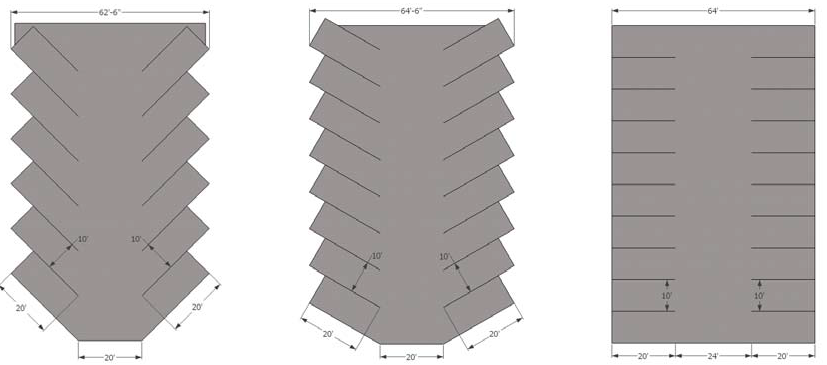
Plans for the layout of an off-street parking area shall have dimensions consistent with the following standards:
PARKING PATTERN LAYOUT
1.
All other two-way drives or maneuvering lanes not indicated above shall have a minimum width of twenty- four (24) feet. One-way drives may have a minimum width of twelve (12) feet. All proposed maneuvering lanes less than twenty (20) feet in width are subject to approval by the Ray Township Fire Department.
2.
In any area where front-end parking abuts an unobstructed curbed area or a raised sidewalk, up to a two- foot vehicle overhang credit may be applied to the required parking space depth, equal to the depth of the overhang. In no case shall the parking stall depth be decreased to allow a vehicle to overhang a required parking setback or property line.
3.
In any area where a row of front-end parking abuts a raised sidewalk, such sidewalk shall have a minimum width of at least seven (7) feet.
SECTION 1903 - RESIDENTIAL PARKING STANDARDS.
A.
Residential off-street parking spaces shall consist of a parking strip, parking bay, driveway, garage, or combination thereof and shall be located on the premises they are intended to serve, and subject to the provisions of this Ordinance.
SECTION 1904 - NONRESIDENTIAL PARKING STANDARDS.
A.
No parking lot shall be constructed unless a permit therefore is issued by the Building Department after the requirements of Site Plan Review have been met.
B.
Off-street parking shall be either on the same lot or within three hundred (300) feet of the building it is intended to serve, measured from the nearest point of the building to the nearest point of the off-street parking lot. Ownership shall be shown of all lots or parcels intended for use as parking by the applicant as well as all necessary easements to secure the use of such parking. Such parking area shall not be separated from the use it is intended to serve by a road.
C.
Off-street parking may be located within any non-required yard.
SECTION 1905 - CALCULATING PARKING REQUIREMENTS.
A.
For those uses not specifically mentioned, the requirements for off-street parking facilities shall be in accordance with a use which the Planning Commission considers similar in nature.
B.
When units or measurements determining the number of required parking spaces result in the requirement of a fractional space, any fraction up to and including one-half shall be disregarded and fractions over one-half shall require one parking space.
C.
For sites which have multiple uses, parking shall be provided for all such uses. The Planning Commission may allow for a reduction based on overlap between such uses.
D.
Reserved parking may be requested by the applicant. Reserved parking spaces must be shown and labeled on the site plan. If an applicant demonstrates that its proposed specific use presents a fewer required number of parking spaces based on total usable floor area; the total number of employees / workers is substantially less than that anticipated by the previous sections of this Ordinance; there exists a combination of uses which share parking facilities; peak hours or operation vary from normal business hours and that the reserve parking for the development will be serviced safely, undue stacking of vehicles will not occur, and traffic flow throughout the parking lot will be maintained in a safe manner, the Planning Commission may reduce the total number of parking spaces required to be built. If the Planning Commission determines that the development cannot be serviced safely, that undue stacking, is likely to occur, or that traffic flow will likely not be maintained in a safe manner if the total number of parking spaces is not built prior to the issuance of a certificate of occupancy, the Planning Commission shall deny the applicant's request for reserve parking. If the Planning Commission grants the applicant's request for reserved parking, the total number of parking spaces required to be built must be shown on the site plan and the number of spaces which the total is reduced by must be shown on the site plan as reserved parking. If the Township determines that traffic patterns, a change in use or an increase in the use, either in number of employees, hours of operation, decreased amount of storage, etc. constitutes a need, in the Township's sole discretion, for the reserved parking spaces to be constructed, such spaces shall be constructed as shown on the site plan within six (6) months of being so notified by the Township.
SECTION 1906 - COLLECTIVE PARKING
A.
Nothing in this section shall be construed to prevent the collective provisions of off-street parking areas for two (2) or more buildings or uses. Such collective parking may be reduced by up to fifteen (15) percent of the required minimum number of spaces for the various uses computed separately, provided that parking calculations are presented to the Planning Commission which substantiate the requested reduction.
SECTION 1907 - DRIVE THRU OR STACKING LANES
A.
Whenever drive-thru or vehicle stacking lanes are provided, such lanes shall be located so as not to impede pedestrian or vehicular circulation.
B.
A drive-through or stacking lane shall not cross a vehicle maneuvering lane or aisle or block any space used for parking.
C.
Uses which require drive thru or stacking lanes shall provide at a minimum six (6) off-street waiting spaces for each service window or service bay.
D.
The lane arrangement and number of drive thru or stacking lanes shall be subject to Planning Commission approval based on the layout of the parking lot/maneuvering lanes, the proposed use of the service window/bays and any concerns set forth by the Fire Department.
E.
Waiting space requirements for eating establishments shall be counted beginning at the menu board. All spaces between the menu board and the service window shall not count towards the waiting space requirement.
F.
A waiting space shall be twenty-three (23) feet long by ten (10) feet wide.
SECTION 1908 - CROSS ACCESS.
A.
If the Planning Commission finds that in order to decrease hazards to vehicular traffic by minimizing the need for driveways to each facility, it shall require a cross access easement and shared driveway easement to provide for vehicular access to existing and/or contemplated adjacent parking lots. All such easements shall be reviewed by the Township and recorded with the Macomb County Register of Deeds.
SECTION 1909 - OFF-STREET LOADING AND UNLOADING.
A.
On the same premises with every building, structure, or part thereof, involving the receipt or distribution of vehicles or materials or merchandise, there shall be provided and maintained on the lot, adequate space for standing, loading and unloading in order to avoid undue interference with public use of dedicated rights-of-way. Such space shall be provided as follows:
1.
All spaces shall be laid out in the dimension of at least ten by fifty (10 × 50) feet, or five hundred (500) square feet in area, with a clearance of at least fourteen (14) feet in height.
2.
There shall be provided:
3.
The Planning Commission may waive the loading and unloading space requirement for uses which do not customarily require large amounts of shipping.
4.
All unloading and unloading areas shall be located in the rear yard. Loading and unloading may be permitted in the front or side yard by the Planning Commission if they determine that the activity will be screened from the road and will not cause conflicts with internal or external traffic circulation.
5.
Loading and unloading areas shall be so located and designed that the vehicles intended to use them can maneuver safely and conveniently to and from a public right-of-way and complete loading and unloading operations without obstructing or interfering with any public right-of-way or any parking space or parking lot maneuvering lane or aisle. When required, loading and unloading areas shall be designated and defined. Overhead doors shall be considered as loading/unloading areas and shall not be placed on the front of the building.
6.
Areas designated for loading and unloading shall be screened from view of any public or private thoroughfare or adjacent residential property with either an extension of the building architecture or with additional landscape screening for the length of such loading and unloading space. The screening mechanism shall provide a minimum screening height of eight (8) feet.

