
Reno City Zoning Code
CHAPTER 18
08 - Administration and Procedures
Article 1 - Purpose and Organization
(a)
The purpose of this chapter is to provide consistent, equitable procedures for the review of development proposals and to ensure that proposed development will be in accordance with the purposes and standards of this Title.
(b)
This chapter describes the review and approval procedures for applications for land use and development in the city and is divided into the following sections:
(1)
Article 3, Common Review Procedures, describes the standard procedures that apply to most development application types.
(2)
Articles 4 through 8 contain specific information on each application type within five categories (development permits, subdivision procedures, ordinance amendments, abandonment, and flexibility and relief procedures), including approval criteria and any additions or modifications to the common review procedures.
(3)
Article 9, Review and Decision-Making Bodies, describes the powers and duties of the bodies that have specific roles in the administration of this Title.
Article 2 - Summary Table of Review Procedures
Table 8-1, below, lists the development applications authorized by this Title. For each application type, the table indicates whether public noticing is required (and if so, what type) and the review and decision-making responsibilities of the bodies that have specific roles in the administration of the procedures set forth in this chapter.
(Ord. No. 6692, § 1(Exh. A), 1-8-25)
18.08.301 - General
This article describes the standard procedures and rules applicable to all development applications unless otherwise stated in this chapter. Not all procedures are applicable to every development application. Application-specific procedures in Articles 4 through 8 identify additional procedures and rules beyond those in this article.
18.08.302 - Pre-Application Meeting
(a)
Purpose The pre-application meeting is intended to provide an opportunity for the applicant to meet with City staff to review applicable submittal requirements and review procedures associated with the proposed development concept.
(b)
Applicability A pre-application meeting is optional for all application types and may be requested by the applicant for any of the procedures listed in Table 8-1, Summary Table of Review Procedures.
(c)
Procedure
(1)
Request The applicant shall submit a request for a pre-application meeting to the Administrator.
(2)
Scheduling The Administrator shall schedule pre-application meetings and notify appropriate staff and the applicant of the time and location of the meeting.
(3)
Required Information At least seven days prior to the scheduled pre-application conference, the applicant shall submit preliminary project materials, which may include:
a.
A draft of a complete application;
b.
A written description of the proposed project;
c.
Conceptual drawings showing the location, layout, and primary elements of the proposal;
d.
Proposed uses, location of uses, and densities proposed; and
e.
Any questions for staff related to the project or process.
(4)
Conference Determinations City staff attending the pre-application conference shall identify preliminary concerns or factors the applicant should consider related to the scope, features, and potential impacts of the project. City staff shall also indicate to the extent possible whether additional approval procedures may be required for the proposed project.
(d)
Effect Any information or discussions held at the pre-application meeting shall be considered preliminary in nature and shall not be binding on the City or the applicant. Discussions of potential staff recommendation or conditions to mitigate impacts do not reflect actions by the decision-making body until and unless a decision-making body takes formal action on a complete application.
18.08.303 - Application Submittal and Handling
(a)
Authority to Submit Application
(1)
Unless expressly stated otherwise in this Title, a development application shall be submitted by:
a.
The owner, contract purchaser, or any other entity or person having a recognized property interest in the land on which development is proposed; or
b.
A person authorized to submit the application on behalf of the owner, contract purchaser, or other entity or person having a recognized property interest in the land, as evidenced by a letter or document signed by the owner, contract purchaser, or another person.
(2)
If there are multiple owners listed on a deed, multiple buyers listed on a purchase agreement, or multiple entities or persons authorized to submit the application, all such persons shall sign the application or a letter or document consenting to the application.
(3)
Applications shall be signed by the owner(s) of the property in question or their authorized representatives. If the property has multiple owners, a list shall be provided of all persons and entities with a property interest in the property.
(4)
These application filing requirements shall not require that all members or shareholders of an entity sign an application if company authorization of signing authority is provided for the person signing the application consent form.
(b)
Application Content The application shall be submitted to the Administrator on a form established by the Administrator. The applicant bears the burden of demonstrating compliance with application requirements.
(c)
Application Fees
(1)
The Administrator is authorized to charge fees related to the processing of applications in accordance with the City Council's approved schedule of fees.
(2)
Fees are due at the time the application is filed.
(d)
Concurrent Review
(1)
Except as provided in subsection 2, below, with approval of the Administrator, an applicant may elect to submit applications for different permits and approvals that may be required for a single development project for concurrent processing as part of the same application.
(2)
Applications for Master Plan Amendment, Rezoning, or Rezoning to PUD may not be combined with applications for Development Permits, Subdivision Permits, or Flexibility and Relief. However, with approval of the Administrator, separate applications may be scheduled for review at the same Planning Commission or City Council meeting.
(3)
The review schedule, notification, and processing requirements for a consolidated application shall follow the longest and most intensive review standards of the submitted requests.
(4)
Approval standards for consolidated applications shall include all approval requirements for the submitted requests. The decision-making body may make the same decision or different decisions on the submitted requests based on the specific standards applicable to each approval.
(5)
Review and decision-making bodies considering separate applications being processed concurrently shall render separate recommendations and decisions on each application based on the specific standards applicable to each approval.
(e)
Alternative Process
(1)
At the discretion of the applicant, any project subject to a minor site plan review may instead by processed in accordance with a major site plan review.
(2)
At the discretion of the applicant, any project subject to a minor conditional use permit may instead by processed in accordance with a conditional use permit.
(3)
At the discretion of the applicant, any development subject to a minor site plan review and a minor conditional use permit may be combined into a single application for minor conditional use permit.
(4)
At the discretion of the applicant, any development subject to a major site plan review and a conditional use permit may be combined into a single application for a conditional use permit.
(f)
Application Intake Schedule Unless a different review process is outlined in other sections of this Title, applications shall be accepted for review as follows:
(1)
Master Plan amendment applications shall be accepted for review on the first regular business day in January, April, July, and October, and in accordance with an established schedule.
(2)
Applications requiring an initial decision at a City Council or Planning Commission public hearing and applications for minor deviations, minor conditional use permits, and site plan review shall be accepted for review in accordance with an established schedule, with no fewer than two acceptance dates per month.
(3)
Applications for other administrative approvals shall be accepted on all working days.
(g)
Determination of Application Completeness The Administrator shall determine whether the application is complete or incomplete no more than three working days following submittal and shall provide written notification of such determination to the applicant. A complete application shall be processed according to the procedures in this article. An incomplete application shall not be processed or reviewed. Any deficiencies noted by the Administrator shall be addressed by the applicant prior to resubmitting the application.
(h)
Application Withdrawal
(1)
After an application has been accepted for review, the applicant may withdraw the application at any time by submitting a letter of withdrawal to the Administrator.
(2)
An applicant is not entitled to a refund of application fees for withdrawn applications. However, the Administrator may refund fees not expended during the staff review based on an established pro rata basis.
(Ord. No. 6692, § 1(Exh. A), 1-8-25)
18.08.304 - Review and Action
(a)
Referral to Staff and Review Agencies The Administrator shall distribute the complete application to appropriate staff and appropriate review agencies.
(b)
Staff Review and Application Revisions
(1)
Staff shall review the application and shall solicit comments from applicable City departments and participating reviewing agencies with jurisdiction over public health and safety. Staff shall submit recommendations and comments to the applicant in a form established by the Administrator. The applicant may attend a meeting with the appropriate staff as determined by the Administrator to discuss staff recommendations and comments. The applicant may modify the application in response to the City's recommendations and comments, may request additional time to respond to the City's recommendations and comments, or the applicant may request that the application move forward for a decision without responding to the City's recommendations and comments.
(2)
Staff shall answer questions from the public and shall consider issues raised through the public input process when making recommendations and decisions. Staff recommendations and decisions shall be based on applicable requirements and shall not be based solely on the preferences of participating members of the public.
(c)
Applications Subject to Staff Recommendation
(1)
Staff Report If an application is subject to staff review and recommendation to the Planning Commission and/or City Council per Table 8-1, Summary Table of Review Procedures, staff shall prepare a written staff report, which includes:
a.
The location and nature of the proposed development;
b.
How the application does or does not comply with applicable requirements of this Title or any other City requirements, including addressing any required findings; and
c.
Recommendations on the approval, conditional approval, or denial of the request based on the applicable review criteria in this Title.
(2)
Distribution and Availability of Application and Staff Report The Administrator shall provide the staff report online and to the advisory and/or decision-making body at least five days prior to the public hearing.
(d)
Applications Subject to Staff Decision
(1)
If an application is subject to staff review and a final decision by the Administrator, the Administrator shall make a decision based on the review standards applicable to the application type. The decision shall be in writing and shall clearly state reasons for a denial or conditions of approval.
(2)
Appeals of administrative decisions may be made pursuant to Subsection 18.08.307(j), Appeal.
(e)
Approval Criteria Applicable to all Applications Unless otherwise specified in this Title, City review and decision-making bodies shall review all development applications and staff reports submitted pursuant to this article for compliance with the applicable general review criteria stated below.
(1)
Consistency with the Reno Master Plan The proposed development shall be consistent with the Reno Master Plan. The decision-making authority:
a.
Shall weigh competing plan goals, policies, and strategies; and
b.
May approve an application that provides a public benefit even if the development is contrary to some of the goals, policies, or strategies in the Reno Master Plan.
(2)
Compliance with This Title The proposed development shall comply with all applicable standards in this Title, unless the standard is lawfully modified or varied. Compliance with these standards is applied at the level of detail required for the subject submittal.
(3)
Mitigates Traffic Impacts The project mitigates traffic impacts based on applicable standards of the City of Reno and the Regional Transportation Commission.
(4)
Provides Safe Environment The project provides a safe environment for pedestrians and people on bicycles.
(5)
Rational Phasing Plan If the application involves phases, each phase of the proposed development contains all of the required streets, utilities, landscaping, open space, and other improvements that are required to serve or otherwise accompany the completed phases of the project, and shall not depend upon subsequent phases for those improvements.
(f)
Conditions of Approval
(1)
Where this Title authorizes the Administrator or review body to approve or deny an application subject to applicable criteria or findings, the Administrator or review body may approve the application with conditions necessary to bring the proposed development into compliance with this Title or other regulations, or to mitigate the impacts of that development on the surrounding properties and streets.
(2)
All conditions of approval shall be reasonably related to the anticipated impacts of the proposed use or development or shall be based upon standards duly adopted by the City. Such conditions may include those necessary to carry out the purpose and intent of the Reno Master Plan, other adopted City plans, and this Title.
(3)
No conditions of approval shall be less restrictive than the requirements of this Title, except where the Title expressly allows deviations.
(4)
Any condition of approval that requires an applicant to dedicate land or pay money to a public entity in an amount that is not calculated according to a formula applicable to a broad class of applicants shall be roughly proportional both in nature and extent to the anticipated impacts of the proposed development, as shown through an individualized determination of impacts.
(5)
During its consideration, the Administrator or decision-making body may consider alternative potential conditions, and no discussion of potential conditions shall be deemed an attempt or intent to impose any condition that would violate federal or state constitutions, statutes, or regulations. Discussions of potential conditions to mitigate impacts do not reflect actions by the Administrator or decision-making body unless and until the Administrator or decision-making body takes formal action to attach that condition to a development approval.
18.08.305 - Scheduling and Notice of Public Hearings
(a)
Scheduling If an application is subject to a public hearing per Table 8-1, Summary Table of Review Procedures, the Administrator shall schedule the public hearing for either a regularly scheduled meeting or special meeting of the appropriate decision-making body.
(b)
Public Hearing Notice
(1)
General Notice Requirements All public hearings required by this Title shall be preceded by the notices identified in Table 8-1, Summary Table of Review Procedures, and detailed in this section. Persons with specific issues or concerns regarding a proposed application are encouraged to contact the City of Reno Development Services Department in writing, by phone, or in person prior to the hearing.
(2)
Responsibility for Notice The City shall be responsible for the preparation of and proper publication and mailing of notice of the public hearing. The applicant shall be responsible for verifying the notification language, posting notice, and maintaining the posted notice on the site.
(c)
Notice Format and Content
(1)
Published and Mailed Notice
a.
Required published and mailed notices shall be published in a newspaper of general circulation or mailed as set forth in Table 8-1, Summary Table of Review Procedures, at least ten calendar days before the public hearing. Published and mailed notices shall:
1.
Identify the application type;
2.
Describe the nature and scope of the proposed project;
3.
Identify the location subject to the application;
4.
Identify the date, time, and location of the hearing being noticed;
5.
Provide a telephone number that may be used by interested persons to obtain additional information;
6.
Provide existing and proposed designations for Master Plan land use amendments, zoning map amendments, and zoning upon annexation shall also be specified.
b.
Mailed notices shall be sent via first-class mail to all mobile home park tenants within the area set and to all property owners as listed in the records of the County tax assessor's office - to the last known address of the owner - within a distance established in Table 8-1, Summary Table of Review Procedures, as measured from property boundaries.
c.
If a military installation is located within 3,000 feet of the area to which the proposal pertains, notice is also given to the commander of the military installation.
d.
If the minimum number of property owners is not reached within the distance required by Table 8-1, Summary Table of Review Procedures, the minimum distance shall be expanded in concentric circles of 100 feet until the required number of property owners has been reached.
e.
Service of a notice shall be effective on the date of mailing. The failure of the property owner(s) to receive any notice served in accordance with this section shall not affect the validity of any proceeding taken under this Title except where otherwise required.
(2)
Posted Notice
a.
Required on-site posted notice shall be provided by the City and posted by the applicant on the property which is subject of the procedure as set forth in Table 8-1, Summary Table of Review Procedures, at least 10 calendar days before the public hearing.
b.
Posted notices shall:
1.
Be placed adjacent to and visible from each street abutting the property at least 10 calendar days before the public hearing.
2.
Identify the application type;
3.
Describe the nature and scope of the proposed project;
4.
Include the date, time, and location of the hearing being noticed; and
5.
Provide a telephone number that may be used by interested persons to obtain additional information.
6.
Describe the existing and proposed designations for Master Plan land use amendments, zoning map amendments, and zoning upon annexation, if applicable.
c.
On sites less than one-half acre, the City shall provide the notice sign(s) to be posted by the applicant with lamination or other protection from normal weather conditions for 40 days. Signs shall meet the following specifications:
1.
Public notice sign shall be a minimum of 11 inches wide by 17 inches tall.
d.
On sites of one-half acre or more, the City shall provide the applicant an electronic project notification document to be printed, laminated, or protected from normal weather conditions, and posted by the applicant. Signs shall meet the following specifications:
1.
Shall be a minimum of three feet wide by four feet tall and shall be placed on one-half inch plywood or similar hard, durable, material with a smooth surface. The applicant shall laminate or otherwise protect the sign so that it will withstand normal weather conditions for 40 days.
e.
Public notice signs shall be exempt from requirements of this Title regarding the size, placement, and composition of signs.
f.
The applicant shall remove or cause to be removed any sign required by this subsection within five days after the appeal period for the public hearing has ended.
(3)
Advisory Board Notice
a.
Notice for procedures requiring advisory board notice in Table 8-1, Summary Table of Review Procedures, shall be provided to the chair of the neighborhood advisory board for the project area at least ten calendar days before the public hearing.
b.
Advisory board notice shall include the date, time, location, and purpose of public hearings being noticed, and a telephone number that may be used by interested persons to obtain additional information. Existing and proposed designations for Master Plan land use amendments, zoning map amendments, and zoning upon annexation shall also be specified.
c.
Service of a notice shall be effective on the date of mailing. The failure of an advisory board member to receive any notice served in accordance with this section shall not affect the validity of any proceeding taken under this Title.
(d)
Notice of Continued Hearings A hearing properly noticed under this section may be continued to a later date without again complying with this section's notice requirements, provided the continued hearing is set for a date certain and the date and time of the continued hearing are announced at the time of continuance.
(e)
Hearing Examiner Agenda Notices of hearings before the Hearing Examiner shall be posted on the City's website.
(f)
Constructive Notice
(1)
Minor Defects in Notice Shall Not Invalidate Proceedings Minor defects in any notice shall not impair the notice or invalidate proceedings pursuant to the notice if a bona fide attempt has been made to comply with applicable notice requirements. Minor defects in notice shall be limited to errors in a legal description or typographical or grammatical errors that do not impede communication of the notice to affected parties. In all cases, however, the requirements for the timing of the notice and for specifying the time, date, and location of a hearing shall be strictly construed.
(2)
Failure to Receive Notice Shall Not Invalidate City Action Failure of a party to receive written notice shall not invalidate subsequent action. If questions arise at the public hearing regarding the adequacy of notice, the decision-making body shall make a formal finding as to whether there was substantial compliance with the notice requirements of this Title.
(g)
Additional Public Notice In addition to the minimum noticing set forth in Table 8-1, Summary Table of Review Procedures, above, the Administrator may require additional public notice.
(Ord. No. 6692, § 1(Exh. A), 1-8-25)
18.08.306 - Review and Decision
(a)
Hearing, Review, and Decision
(1)
The application shall be subject to review, hearings, recommendations, and decisions as indicated in Table 8-1, Summary Table of Review Procedures
(2)
If the application is subject to a public hearing, the applicable review body shall hold a public hearing on the application in accordance with the rules and procedures established by the respective bodies, and in compliance with the Reno Municipal Code and state law.
(3)
The applicable review body shall consider the application, relevant support materials, staff report, and any evidence and public comments from the public hearing (if required).
(4)
The applicable review body shall approve, approve with conditions, or deny the application based on the applicable approval criteria listed in the application-specific procedures. The body may also continue the hearing.
(5)
All decisions shall be provided to the applicant and all appellants in writing.
(b)
Time Limits for Action, Postponements, and Invalid Applications
(1)
Prior to publishing and mailed notice for an application, the applicant and the Administrator may extend the time limit for action by mutual agreement, and such action shall not be considered a postponement. The applicant has the right to postpone a public hearing or administrative decision if the request is provided to the Administrator in writing no later than 5:00 p.m. the day prior to the scheduled public hearing or decision. In all other cases, the public hearing shall be opened and affirmative action by the body is required to postpone a decision. Public re-noticing is not required if the continuance is specified with a time and date certain.
(2)
Approval of the applicant and all appellants is required in order to postpone a public hearing for applications that have received an initial decision and are under appeal. In all other cases, the public hearing shall be opened and affirmative action by the body is required to postpone a decision.
(3)
The applicant shall pay for notification and advertising costs caused by requested postponement when filing the request for postponement.
(4)
Any application that is postponed by the applicant and is not reactivated by the applicant within 90 days shall become invalid ten days after the Administrator provides a notice of invalidation to the applicant.
(5)
Regardless of the stage in the review process, any application which is postponed more than twice by the applicant will become invalid.
(Ord. No. 6692, § 1(Exh. A), 1-8-25)
18.08.307 - Post-Decision Actions and Limitations
(a)
Effective Date of Approval Unless otherwise provided in this Title, a decision made under this Chapter shall be final on the date of the decision unless, the decision is appealable and an appeal has been filed pursuant to Subsection 18.08.307(j), Appeal.
(b)
Notice of Decision
(1)
The Administrator shall provide written notification of the decision to the applicant via personal delivery, electronic mail, or first-class mail to the applicant and shall make a copy of the decision available to the public in a conspicuous location such as the official meeting notice board in City Hall.
(2)
If the review involves a quasi-judicial hearing, the Administrator shall provide a written notification of the decision via personal delivery, electronic mail, or first-class mail to the owner(s) of the subject site, and any other person that submitted a written request for a copy of the decision.
(c)
Expiration of Approval
(1)
Some applications may be subject to a schedule of development, a set time period for development of specific improvements, establishment of a specific use or uses for which the approval is requested, and/or the expiration time periods.
(2)
A change in ownership of the land shall not affect an established expiration time period of an approval.
(3)
A new application is required to be submitted after an application has expired or become invalid.
(4)
The applicant shall pay all applicable fees and charges for the new application as if no application had been previously submitted.
(5)
The new application shall be regularly scheduled with no priority given because a previous application had been submitted on the matter.
(6)
The new application shall be considered as a new project with no priority given because of previous decisions or conditions of approval.
(d)
Revocation of Approval
(1)
Failure to comply with any conditions of approval or any expiration of approval of any permit granted through a discretionary action shall result in the initiation of revocation procedures and any other enforcement procedures provided for by the Reno Municipal Code.
(2)
The Planning Commission shall notice and hold a public hearing upon the revocation of any permit granted through a discretionary action.
(3)
The Planning Commission shall submit recommendations to City Council and notify the applicant and property owner no later than seven days after the submission of the report to the Clerk of the City Council.
(4)
The City Council may, upon receipt of recommendations for revocation of a permit, provide notice of a public hearing to revoke the permit for failure to comply with any conditions or timelines for action associated with the permit. The City Council may also impose additional conditions, or it may reinstate the permit.
(5)
A decision to revoke an approval shall be supported by a finding that the owner or responsible party is in substantial nonconformance with the conditions of approval or City ordinances.
(e)
Extension of Approval
(1)
Allowances and restrictions for extensions of approval, if any, are identified by application type in this Chapter.
(2)
All decisions regarding time extensions are subject to Subsection 18.08.307(j), Appeal.
(3)
If, in order to construct an approved project or operate an approved business, an applicant must first obtain a permit or approval from another governmental agency before applying for a building permit or business license, then, upon submission of appropriate documentation showing reasonable diligence in attempting to secure that permit or approval, the Administrator shall automatically extend the time limit for the amount of time between the date the applicant submitted an application for the permit for approval and the date the permit was issued or the approval granted.
(4)
If the applicant participates as a defendant or respondent in any legal challenge related to a project approval, then, upon submission of appropriate documentation showing reasonable diligence in resolving the legal challenge, the Administrator shall automatically extend the time limit for the amount of time between the date the legal challenge was filed and the date the challenge was resolved or decided.
(f)
Minor Modification or Amendment of Approval
(1)
The Administrator may approve minor facade alterations, minor changes in the site plan and minor changes in the conditions of approval at the request of the applicant and/or owner as long as the Administrator first determines that:
a.
The proposed changes are consistent with applicable provisions of this Title;
b.
The proposed changes are within the scope of the original approval;
c.
The proposed changes will not adversely impact neighboring properties or the public in general; and
d.
The proposed changes respond to comments made or during the public hearing or involve issues that were not contested at the public hearing.
(2)
The Administrator may require public notice prior to approving changes on contested projects. No other changes may be made without an amendment to the application, utilizing the process outlined above, unless such changes are required as a condition of approval of the original application.
(g)
Compliance with Plans All work involved in constructing and operating a project approved pursuant to this Title shall comply with all plans, reports, renderings, and materials that were submitted or presented as a part of the application. City Codes shall prevail in the event of a conflict between the approved plans and the City Codes in effect when the building permit is reviewed.
(h)
Limitation on Subsequent Similar Applications An applicant whose application is finally denied may not institute a new application on substantially the same project within 12 months from the date of final action on the original application, unless the City Council has first determined that the original decision was based on an error, lack of information, or a misrepresentation of the facts, or the Administrator has determined that there has been a substantial change in the subject project or an amendment to applicable provisions of this Title.
(i)
Temporary Certificates of Occupancy
(1)
During the non-growing season (November 1 through April 30), grading completed to rough grade for a construction phase will be acceptable for issuance of temporary certificates of occupancy for individual dwellings or commercial units provided that security is made payable to the City, to cover the final grading and landscaping in the estimated amount of the contracted price plus 20 percent, as determined by and posted with the Development Services Department.
(2)
Construction phases in which units have been issued a temporary certificate of occupancy must be brought to finish grade and landscaped before July 1 or no further certificates of occupancy will be issued within the subdivision phase until all final grading and landscaping within that phase have been completed.
(3)
If the landscaping is not installed to the satisfaction of the City, the City may call the security to complete the final grading and landscaping and seek any other remedies available under the law.
(4)
During the growing season (May 1 through October 31), the Administrator may authorize the issuance of a temporary certificate of occupancy for good cause subject to applicable requirements of this subsection and any other requirements that may be necessary to minimize impacts and ensure the timely completion of all required work.
(j)
Appeal
(1)
Appeal of Administrative Decisions to City Council
a.
Applicability The following permit applications subject to an administrative decision may be appealed to the City Council:
1.
Minor Deviation,
2.
Minor Conditional Use Permit,
3.
Minor Site Plan Review, and
4.
Administrative Interpretation.
b.
Appeal Submittal
1.
The Mayor, any member of the City Council, or any person or entity aggrieved by an administrative decision may appeal such decision to the City Council by filing a written appeal with City Clerk within ten working days after the filing of notice of the final action, decision, or order.
2.
The written notice of appeal must briefly specify the grounds of the appeal on the appropriate form accompanied by the required fees.
3.
Any other aggrieved person may file a subsequent appeal within the time allotted for appeal with payment of fees. Any subsequent appeal will not affect the date on which the City Council hears the appeal.
4.
Any appellant may withdraw their appeal.
5.
If any appeal is withdrawn, the City Council shall hear all remaining appeals.
c.
Appeal Scheduling The City Clerk shall schedule an appeal before the City Council no less than 14 days or more than 45 days following the last day of the appeal period following the administrative decision.
d.
Review and Decision
1.
The City Council shall be guided by the statement of purpose underlying the regulation of the improvement of land expressed in NRS Section 278.310 to determine whether the Administrator committed an abuse of discretion.
2.
The City Council, after a public hearing, shall have the power to affirm, reverse, or modify the administrative decision.
3.
The City Council must render a decision within 30 days of the public hearing.
(2)
Appeal of Administrative Decisions to Hearing Examiner
a.
Applicability All other administrative decisions made pursuant to this Title may be appealed to the Hearing Examiner.
b.
Appeal Submittal
1.
The Mayor, any member of the City Council, or any person or entity aggrieved by their inability to obtain a building permit or by any decision made by an administrative officer or agency based upon or made in the course of the administration or enforcement of the provisions of any zoning regulation or any regulation relating to the location or soundness of structures in the administration and enforcement of this Title may appeal such decision to the Hearing Examiner by filing a written appeal with the Development Services Department within ten working days after the filing of notice of the final action, decision, or order with the Clerk or Secretary of the Planning Commission.
2.
The written notice of appeal must briefly specify the grounds of the appeal on the appropriate form accompanied by the required fees.
3.
Any other aggrieved person may file a subsequent appeal within the time allotted for appeal with payment of fees. Any subsequent appeal will not affect the date on which the Hearing Examiner hears the appeal.
4.
Any appellant may withdraw their appeal.
5.
If any appeal is withdrawn, the Hearing Examiner shall hear all remaining appeals.
c.
Staff Action The Administrator will place the appeal on the Hearing Examiner's calendar at its next regularly scheduled meeting, commencing at least 14 days after the last day of the appeal period.
d.
Review and Decision
1.
The Hearing Examiner shall be guided by the statement of purpose underlying the regulation of the improvement of land expressed in NRS Section 278.310 to determine whether the Administrator committed an abuse of discretion.
2.
The Hearing Examiner, after a public hearing, shall have the power to affirm, reverse, or modify the administrative decision.
3.
The Hearing Examiner must render a decision within 30 days of the public hearing.
4.
If the administrative decision is predicated upon a notice of violation written pursuant to Chapter 1.05, Code Enforcement, and the Hearing Examiner finds that a violation has occurred, the Hearing Examiner shall forward the case to the City Clerk for further action under Chapter 1.05, Code Enforcement.
e.
Appeal The decision of the Hearing Examiner regarding administrative appeals may be appealed to the City Council in accordance with subsection (3), below.
(3)
Appeal of Planning Commission and Hearing Examiner Decisions
a.
General
1.
The Mayor, any member of the City Council, or any person or entity aggrieved by the decision of the Planning Commission or Hearing Examiner, may appeal such decision by completing an appeal form briefly setting forth the grounds of the appeal available in the City Clerk's office and filing it with the City Clerk within ten working days after the date of filing of notice of the final action, decision, or order with the Clerk or Secretary of the Planning Commission accompanied by the required fees.
2.
Any other person or entity aggrieved by a decision of the Planning Commission or Hearing Examiner may file a subsequent appeal within the time allotted for appeal with payment of fees. Any subsequent appeal will not affect the date on which the City Council will hear the appeal.
3.
Any appellant may withdraw their appeal.
4.
If any appeal is withdrawn, the City Council shall hear all remaining appeals.
b.
Review Process
1.
Scheduling and Notice of Public Hearing
[a]
The City Clerk shall schedule an appeal from the Planning Commission or Hearing Examiner for public hearing before the City Council no less than 14 days or more than 45 days following the last day of the appeal period following the Planning Commission or Hearing Examiner decision.
[b]
The City Clerk shall mail notice of the public hearing to the appellant and all others who were mailed a notice of the public hearing before the Planning Commission or Hearing Examiner.
2.
City Council Action
[a]
After the public hearing, the City Council shall review the decision of the Planning Commission or Hearing Examiner and shall be guided by the statement of the purpose underlying the regulation of the improvement of land expressed in NRS Section 278.020.
[b]
The City Council shall consider the decision of the Planning Commission or Hearing Examiner and the reasons for the decision.
[c]
The City Council shall affirm, modify, or reverse the appealed decision.
[d]
The City Council shall render a decision within 30 days of the public hearing.
[e]
If the decision is predicated upon a notice of violation written pursuant to Chapter 1.05, Code Enforcement, and the City Council finds that the violation has occurred, the City Council shall forward the case to the City Clerk for further action under Chapter 1.05, Code Enforcement.
3.
City Council Decision
[a]
A decision of the City Council is a final decision for the purpose of judicial review.
[b]
With respect to a violation pursuant to Chapter 1.05, Code Enforcement, the decision of the City Council is a final decision regarding the existence of a violation for the purpose of judicial review.
c.
City Clerk Duties If a case has been forwarded to the City Clerk pursuant to subsection (3)(e), above, the City Clerk shall set a case on the calendar of the Hearing Examiner.
(4)
Appeal of the City Council's Decision to District Court Any aggrieved person who has appealed the decision of the Planning Commission, Board of Appeal, or Hearing Examiner to the City Council, and who is aggrieved by the decision of the City Council, may appeal the City Council's decision by filing a petition for judicial review with the District Court within 25 days after the date of filing of City Council's decision with the City Clerk's office, as set forth in NRS Section 278.3195(4).
(5)
Judicial Review of First Amendment Applications
a.
Judicial review may be sought in accordance with NRS Chapter 34.
b.
Notwithstanding any right to initiate proceedings for judicial review under NRS Chapter 34, the City shall, upon written request for the City to initiate judicial proceedings made by an aggrieved applicant and filed with the City Clerk, within five working days of filing of the request, file an action with a court of competent jurisdiction seeking declaratory and/or injunctive relief, including temporary and/or preliminary relief, as to the propriety of the denial to determine the constitutionality of the denial on prior restraint grounds.
c.
The aggrieved applicant shall make their request within 25 days after the date of filing of the final action, order, or decision with the Clerk of the governing body.
d.
For the purposes of subsections b. and c., above, an aggrieved applicant is a person who asserts in their written request for the City to initiate judicial proceedings that the constitutionality of the denial of the application is being challenged on prior restraint grounds under the First Amendment of the United States Constitution or Section 9 of Article 1 of the constitution of the State of Nevada.
e.
For purposes of subsection b., above, working days do not include Saturday, Sunday, or those days declared legal holidays pursuant to NRS Section 236.015.
(Ord. No. 6692, § 1(Exh. A), 1-8-25)
18.08.401 - Annexation
(a)
General Provisions
(1)
Purpose The City Council finds that orderly and uniform procedures are necessary for the general welfare of the people. It is the purpose and intent of the City Council to establish this chapter to govern annexation or detachment of land from the city consistent with NRS Chapters 268 and 278.
(2)
Detachment For purposes of this chapter and Title, the term "annexation" shall include the detachment of land from the city.
(3)
Concurrent Applications Applications for annexation shall be reviewed by the City Council concurrently with an application for a zoning map amendment or Master Plan amendment. The Administrator may waive this requirement if the applicant confirms that no change to the current land use or zoning is proposed, or provides other justification to support processing an annexation application separately from Master Plan amendment or zoning map amendment applications.
(b)
Annexation Pursuant to NRS Sections 268.610 to 268.668, Inclusive
(1)
Purpose This subsection describes the process by which areas within the City's sphere of influence are considered for annexation.
(2)
Applicability All areas within the City's sphere of influence which are to be considered for annexation during the next seven years are identified within the program of annexation.
(3)
Annexation Program The annexation program shall be established pursuant to NRS Sections 268.610 to 268.668, inclusive.
a.
The City's program of annexation is incorporated by reference;
b.
The City's program of annexation shall be updated no more frequently than annually;
c.
The City's program of annexation shall be amended by resolution subject to certification as provided by NRS Section 268.625; and
d.
After certification provided by NRS Section 268.625, each amendment to the City's program of annexation shall be filed with the City Clerk and upon filing shall be incorporated herein and the latest amendment shall be the controlling document.
(4)
Annexation Initiation and Review Procedures Annexations pursuant to the City's program of annexation shall be in accordance with NRS Section 268.610 to 268.668, inclusive, and Article 3, Common Review Procedures.
(5)
Zoning Classification of Newly Annexed Lands Territory that is annexed will be zoned, by action of law, in accordance with Section 18.02.105, Classification of Annexed Land, and 18.02.107, Sphere of Influence.
(6)
Update of Annexation Program Maps Within 30 days of the effective date of an annexation pursuant to NRS Sections 268.610 to 268.668, inclusive, the City shall update its annexation program maps and notify the Regional Planning Commission, Washoe County Commission, and NV Energy.
(c)
Annexation Pursuant to NRS Section 268.670
(1)
Purpose This subsection describes the process by which contiguous areas owned by the City are annexed or contiguous areas where 100 percent of the record owners of real property within the subject area petition the City for annexation in accordance with NRS Section 268.670 and the procedures to adopt ordinances under the Reno City Charter.
(2)
Applicability This subsection shall apply to annexation of contiguous areas in the following circumstances:
a.
Owned by the City, or
b.
Petitioned by 100 percent of the record owners of real property within the subject area.
(3)
Application Submittal and Review Procedures Figure 8-1, below, identifies the applicable steps from Article 3, Common Review Procedures, that apply to the review of alternative annexation applications. Additions or modifications to the common review procedures are noted below.
Figure 8-1: Summary of Alternative Annexation Procedures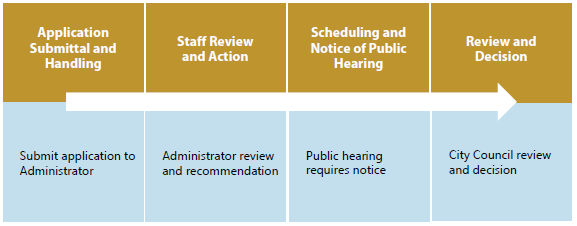
a.
Application Submittal and Handling Applications shall be submitted, accepted, and revised, and may be withdrawn, in accordance with Section 18.08.303, Application Submittal and Handling. However, applications for annexation pursuant to NRS Section 268.670 shall be initiated by the City Council or upon petition signed by 100 percent of the record owners of real property within the subject area.
b.
Staff Review and Action The Administrator shall review annexation applications and prepare a staff report and recommendation in accordance with Section 18.08.304, Review and Action.
c.
Scheduling and Notice of Public Hearings The annexation application shall be scheduled for a public hearing before the City Council and noticed in accordance with Section 18.08.305, Scheduling and Notice of Public Hearings and the following procedures:
1.
The City Clerk shall provide mailed notice at least 10 days prior to the City Council hearing to:
[a]
Each owner, as listed on the County Assessor's records, of real property located within 750 feet of the property in question;
[b]
The owner, as listed on the County Assessor's records, of each of the 30 separately owned parcels nearest the property in question, to the extent this notice does not duplicate the notice given pursuant to Subsection [a]., above;
[c]
Each tenant of a mobile home park located within 750 feet of the property in question;
[d]
Any advisory board which has been established for the affected area by the governing body;
[e]
To the commander of a military installation located within 3,000 feet of the property in question; and
[f]
To the Washoe County Clerk.
d.
Review and Decision
1.
The City Council shall hold a public hearing within 90 days of the date that the application was submitted to the City.
2.
Within 30 days from the date the public hearing is concluded the City Council, by affirmative vote of a majority of the Council, shall approve, disapprove, or approve a proposed annexation with modifications in accordance with Section 18.08.306, Review and Decision.
(4)
Review Considerations When considering an application for annexation submitted under NRS Section 268.670, the City Council shall consider the following factors in deciding on the application:
a.
Location of the property to be considered for annexation;
b.
The logical extension or boundaries of city limits;
c.
The need for the expansion to accommodate planned regional growth;
d.
The location of existing and planned water and sewer service;
e.
Community goals that would be met by the proposed annexation;
f.
The efficient and cost-effective provision of service areas and capital facilities;
g.
Fiscal analysis regarding the proposed annexation;
h.
Whether Washoe County has adopted a community management plan for the proposed annexation area;
i.
Whether the annexation creates any islands; and
j.
Any other factors concerning the proposed annexation deemed appropriate for consideration by the City Council.
(5)
Notice of Annexation to Public Utilities and Rural Electric Cooperatives
a.
Whenever an incorporated city annexes territory in accordance with the provisions of this section and NRS 268.570 to 268.608, inclusive, the city clerk of the annexing city shall, not less than 10 working days after the adoption of the ordinance approving the annexation, send by certified mail to each public utility and rural electric cooperative operating within the jurisdiction of the incorporated city:
(1)
A notice containing the address and legal description of all property in the territory to be annexed;
(2)
An accurate map or plat of the territory to be annexed; and
(3)
A copy of the ordinance approving the annexation.
b.
As used in this section, "public utility" has the meaning ascribed to it in NRS 704.020.
(Ord. No. 6692, § 1(Exh. A), 1-8-25)
18.08.402 - Master Plan Amendments
(a)
Purpose This section describes the process by which requests to amend the City of Reno Master Plan (Master Plan) are reviewed. Procedures to review Master Plan amendments shall also be consistent with NRS Sections 278.150 to 278.250, inclusive.
(b)
Applicability This section shall be applicable to all requests to amend the Master Plan, except those amendments that are applicable to Section 18.08.403, Minor Master Plan Amendment. The Master Plan is a legislative planning document with respect to the City's vision, goals, and policies relative to such matters as population, housing, streets, and resource use, which is governed by NRS Sections 278.150 to 278.250, inclusive.
(c)
Application Submittal and Review Procedures Figure 8-2, below, identifies the applicable steps from Article 3, Common Review Procedures, that apply to the review of Master Plan amendment applications. Additions or modifications to the common review procedures are noted below.
Figure 8-2: Summary of Master Plan Amendment Procedures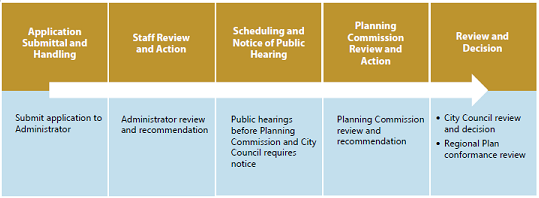
(1)
Application Submittal and Handling Master Plan amendment applications shall be initiated by the Administrator, Planning Commission, or City Council, except that Master Plan Land Use Map amendments may be initiated by application. A Master Plan Land Use Map amendment application shall be submitted, accepted, and revised, and may be withdrawn, in accordance with Section 18.08.303, Application Submittal and Handling.
(2)
Staff Review and Action The Administrator shall review the Master Plan amendment and prepare a staff report and recommendation in accordance with Section 18.08.304, Review and Action.
(3)
Scheduling and Notice of Public Hearings The Master Plan amendment application shall be scheduled for a public hearing before the Planning Commission and noticed in accordance with Section 18.08.305, Scheduling and Notice of Public Hearings.
(4)
Planning Commission Review and Action The Planning Commission shall hold a public hearing and thereafter, address the requirements of NRS Section 278.210, as applicable, and recommend to the City Council approval, approval with modifications, or disapproval of the proposed amendment with modifications in accordance with Section 18.08.306, Review and Decision.
(5)
Review and Decision
a.
By affirmative vote of a majority of the City Council, the Council shall approve, disapprove, or approve a proposed Master Plan amendment with modifications in accordance with Section 18.08.306, Review and Decision.
b.
The decision shall not take effect until the Master Plan amendment has been found in conformance with the Truckee Meadows Regional Plan.
(6)
Regional Plan Conformance Review The Truckee Meadows Regional Planning Commission shall review the Master Plan amendment to determine if it is in conformance with the Truckee Meadows Regional Plan.
(7)
Post-Decision Actions and Limitations
a.
The Truckee Meadows Regional Planning Commission shall be notified by City staff of any City Council decision to approve a proposed Master Plan amendment.
b.
All common procedures in Section 18.08.307, Post-Decision Actions and Limitations, shall apply.
(d)
Findings for Amendments to Master Plan Land Use Map
(1)
To adopt an amendment to the Master Plan Land Use Map, the City Council shall find that:
a.
The amendment is in substantial conformance with Master Plan priorities and policies.
b.
Activities and development allowed by the proposed land use will be reasonably compatible with nearby land uses.
c.
Plans are in place to provide public services and facilities in accordance with the Master Plan Concurrency Management System.
(2)
All other proposed amendments to the Master Plan, beyond those affecting the Land Use Map, shall be decided by the City Council in its discretion.
18.08.403 - Minor Master Plan Amendment
(a)
Purpose This section describes the process by which minor amendments to the City of Reno Master Plan (Master Plan) are processed.
(b)
Applicability This section shall be applicable to the following requests to amend the Master Plan as authorized by NRS Section 278.225:
(1)
A change in a boundary that is based on a geographical feature, including, without limitation, topography, slopes, hydrographic features, wetland delineation and floodplains, when evidence is produced that the mapped location of the geographical feature is in error;
(2)
A change made to reflect the alteration of the name of a jurisdiction, agency, department or district by the governing body, governing board or other governing authority of the jurisdiction, agency, department or district, as applicable, or by another entity authorized by law to make such an alteration; and
(3)
An update of statistical information that is based on a new or revised study.
(c)
Application Submittal and Review Procedures Figure 8-3, below, identifies the applicable steps from Article 3, Common Review Procedures, that apply to the review of minor Master Plan amendment applications. Additions or modifications to the common review procedures are noted below.
Figure 8-3: Summary of Minor Master Plan Amendment Procedures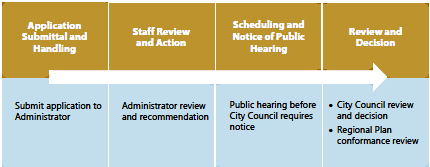
(1)
Application Submittal and Handling Minor Master Plan amendment applications shall be initiated by the Administrator or City Council.
(2)
Staff Review and Action The Administrator shall prepare the minor Master Plan amendments and provide a recommendation to the City Council in accordance with Section 18.08.304, Review and Action.
(3)
Scheduling and Notice of Public Hearings The Master Plan amendment application shall be scheduled for a public hearing before the City Council and noticed in accordance with Section 18.08.305, Scheduling and Notice of Public Hearings.
(4)
Review and Decision
a.
There are no time limits for public hearings or City Council decisions regarding minor Master Plan amendments.
b.
By affirmative vote of a majority of the City Council, the Council shall approve, disapprove, or approve a proposed Master Plan amendment with modifications in accordance with Section 18.08.306, Review and Decision.
c.
The decision shall not take effect until the Minor Master Plan amendment has been found in conformance with the Truckee Meadows Regional Plan.
(5)
Regional Plan Conformance Review The Truckee Meadows Regional Planning Commission shall review the Master Plan Land Use Map amendment to determine if it is in conformance with the Truckee Meadows Regional Plan.
(6)
Post-Decision Actions and Limitations
a.
The Truckee Meadows Regional Planning Commission shall be notified by City staff of any City Council decision to approve a proposed Master Plan amendment.
b.
All common procedures in Section 18.08.307, Post-Decision Actions and Limitations, shall apply.
(d)
Findings To adopt a minor amendment to the Master Plan, the City Council shall find that a change is justified because of one of the following:
(1)
Evidence is produced that an error exists in the mapped location of a geographical feature, including without limitation, topography, slopes, hydrographic features wetland delineation and floodplains;
(2)
The name of a jurisdiction, agency, department, or district is altered by the City, governing board, or other governing authority of the jurisdiction, agency, department, or district, as applicable, or another entity authorized by law to make such an alteration; or
(3)
Statistical information that results from a new or revised study and alters existing information.
18.08.501 - Code Text Amendment
(a)
Purpose This section describes the process by which changes to the text of this Title are reviewed. The code text amendment review procedure ensures conformance with the Master Plan and that potential impacts are considered.
(b)
Applicability This section's procedures apply to all legislative amendments to the text of this Title.
(c)
Amendment Initiation and Review Procedures Figure 8-4, below, identifies the applicable steps from Article 3, Common Review Procedures, that apply to the review of amendments to the text of this Title. Additions or modifications to the common review procedures are noted below.
Figure 8-4: Summary of Code Text Amendment Procedures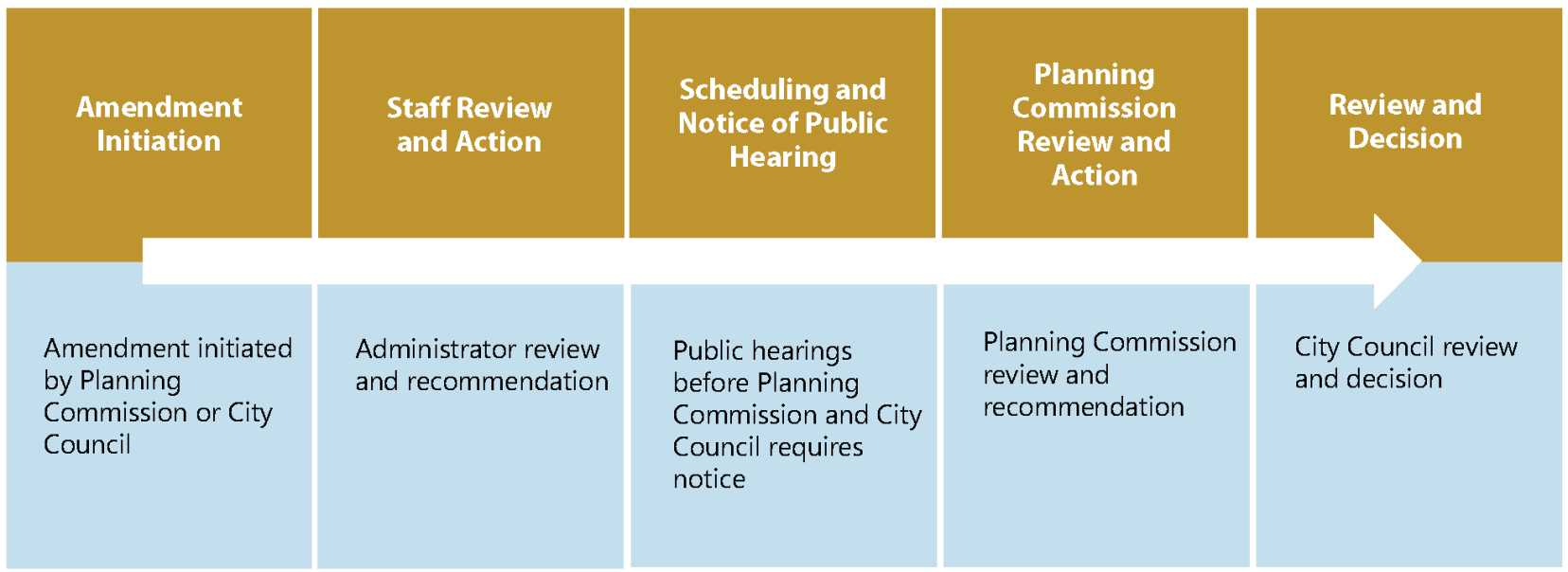
(1)
Application Submittal and Handling Amendments to this Title may only be initiated by the Planning Commission or the City Council.
(2)
Staff Review and Action The Administrator shall review the text amendment and provide a recommendation to the Planning Commission.
(3)
Scheduling and Notice of Public Hearing The code text amendment application shall be scheduled for a public hearing before the Planning Commission and noticed in accordance with Section 18.08.305, Scheduling and Notice of Public Hearings.
(4)
Planning Commission Review and Action The Planning Commission shall hold a public hearing on a proposed code text amendment and shall forward a recommendation of approval, approval with modifications, or disapproval of the proposed code text amendment to the City Council in accordance with Section 18.08.306, Review and Decision.
(5)
Review and Decision At a public hearing, by affirmative vote of a majority of the City Council, the City Council shall approve, disapprove, or approve with modifications in accordance with Section 18.07.306, Review and Decision.
(6)
Post-Decision Actions and Limitations All common procedures in Section 18.08.307, Post-Decision Actions and Limitations, shall apply.
(d)
Findings Text amendments shall be in substantial conformance with the statement of purpose and intent for this Title, as set forth in Chapter 18.01 Article 2, Purpose, and the Master Plan.
18.08.502 - Administrative Interpretations of Title 18
(a)
General
(1)
Administrative interpretations of this Title shall be issued only if related to a matter for which an application is pending pursuant to this Chapter or when the Administrator deems such interpretation is appropriate.
(2)
The form of the administrative interpretation shall be in writing and shall be on file with the City Clerk's office.
(b)
Appeal The interpretation of the Administrator may be appealed to the City Council in accordance with Subsection 18.08.307(j), Appeal.
18.08.503 - Rezoning (Zoning Map Amendment)
(a)
Purpose This section describes the process by which requests to change the zoning district of a property or properties are reviewed for compliance with this Title. The zoning map amendment (rezoning) review procedure ensures conformance with the Master Plan and that potential impacts are considered.
(b)
Applicability This section shall be applicable to all requests to change the zoning district of a property or properties as shown on the official zoning map of the city. Zoning map amendments to apply the Planned Unit Development (PUD) or Specific Plan District Zoning District designation to a property or properties shall also be subject to the procedures and criteria in sections 18.08.505, Rezoning to Planned Unit Development, and 18.08.504, Rezoning to Specific Plan District. Requests to add the Historic Landmark (HL) overlay designation shall be subject to the process in Section 18.07.202, Procedures for Nomination and Designation.
(c)
Application Submittal and Review Procedures Figure 8-5, below, identifies the applicable steps from Article 3, Common Review Procedures, that apply to the review of zoning map amendment applications. Additions or modifications to the common review procedures are noted below.
Figure 8-5: Summary of Rezoning Procedures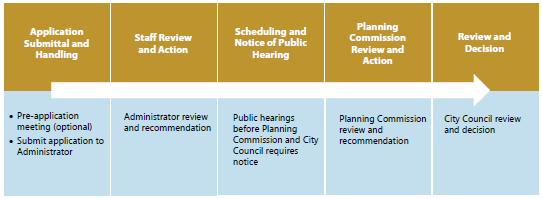
(1)
Application Submittal and Handling Amendments to the zoning map may only be initiated by City Council or by application in accordance with Section 18.08.303, Application Submittal and Handling.
(2)
Staff Review and Action The Administrator shall review the zoning map amendment and prepare a staff report and recommendation in accordance with Section 18.08.304, Review and Action.
(3)
Scheduling and Notice of Public Hearings The zoning map amendment application shall be scheduled for a public hearing before the Planning Commission and noticed in accordance with Section 18.08.305, Scheduling and Notice of Public Hearings.
(4)
Planning Commission Review and Action
a.
The Planning Commission shall hold a public hearing within 65 days of application.
b.
The Planning Commission shall recommend approval or denial within 30 days from the date of the hearing in accordance with Section 18.08.306, Review and Decision, based on the general approval criteria in subsection 18.08.304(e), Approval Criteria Applicable to all Applications, and the specific findings for zoning map amendments in subsection 18.08.605(e), Findings, below.
(5)
Review and Decision
a.
A public hearing shall be scheduled before the City Council no more than 45 days following the Planning Commission recommendation.
b.
The City Council shall render a decision within 30 days of the public hearing in accordance with Section 18.08.306, Review and Decision, based on the general approval criteria in subsection 18.08.304(e), Approval Criteria Applicable to all Applications, to all Applications and the specific findings for zoning map amendments in subsection 18.08.605(e), Findings, below.
(6)
Post-Decision Actions and Limitations All common procedures in Section 18.08.307, Post-Decision Actions and Limitations, shall apply.
(d)
Findings All applications for zoning map amendments shall meet the approval criteria in Section 18.08.304(e), Approval Criteria Applicable to all Applications, and the following findings:
(1)
The amendment, together with changed components of the Title, promotes, or does not conflict with, the provisions of NRS Section 278.250(2); and
(2)
The amendment is in substantial conformance with the Master Plan.
(Ord. No. 6692, § 1(Exh. A), 1-8-25)
18.08.504 - Rezoning to Specific Plan District
(a)
Purpose This section describes the process by which requests to change the zoning district of a property or properties to a Specific Plan District (SPD) special purpose zoning districts are reviewed for compliance with this Title.
(b)
Applicability
(1)
This section applies to all requests to amend the zoning designation of a property to an SPD district.
(2)
SPD applications shall be based on the existing zoning designation but may include proposals to apply modified lot and building standards, land use permissions, and design, compatibility, and buffering provisions that provide benefits over what would otherwise be achieved with a base zone district.
(3)
SPD review is a special type of zoning map amendment and the standards and procedures of Section 18.08.503, Rezoning (Zoning Map Amendment), shall apply except when preempted by a SPD-specific review provision in this section.
(c)
Application Submittal and Review Procedures Figure 8-6, below, identifies the applicable steps from Article 3, Common Review Procedures, that apply to the review of SPD applications. Additions or modifications to the common review procedures are noted below.
(1)
Application Submittal and Handling Supplemental application and plan requirements of this subsection shall apply.
Figure 8-6: Summary of Tentative SPD Procedures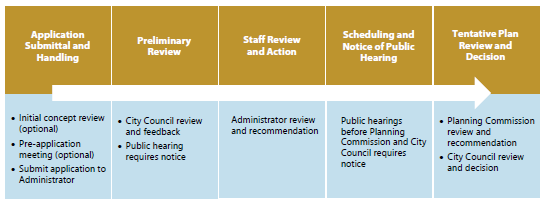
a.
Supplemental Application and Plan Requirements
1.
Specific Plan District Handbook
[a]
The applicant shall submit a Specific Plan District Handbook that includes a statement of purpose explaining rationale for SPD zoning, the base zoning district upon which the proposed SPD is based, and each proposed modification from standard zoning district provisions. All district standards not specifically modified in the SPD handbook shall remain in effect.
[b]
The applicant shall submit a plan that delineates the location of the proposed land uses, as well as the location of structures, improvements, and open space.
2.
Demonstration of Benefit Documentation shall be provided with any application for an SPD that demonstrates the benefit to the City of the proposed SPD plan over what would otherwise be achieved with an existing base zone district.
3.
Certification and Recordation of Plan A Plan which has been given final approval by the city must be certified without delay by the city and filed of record in the office of the appropriate county recorder before any development occurs in accordance with that plan.
(d)
Findings All applications for zoning map amendments to SPD shall meet the approval criteria in Section 18.08.304(e), Approval Criteria Applicable to all Applications, and the following findings:
(1)
The amendment, together with changed components of the Title, promotes, or does not conflict with, the provisions of NRS Section 278.250(2);
(2)
The amendment is in substantial conformance with the Master Plan;
(3)
The SPD Handbook is consistent with the purpose of the SPD District (Section 18.02.506); and
(4)
The SPD Handbook addresses a unique situation, provides substantial benefit to the City, or incorporates innovative design, layout, or configuration resulting in quality over what could have been accomplished through strict application of a base zoning district.
(e)
Post-Decision Actions and Limitations
(1)
Minor Amendments to SPD Plans
a.
The Administrator may approve minor amendments to an approved SPD if the proposed amendment complies with the following criteria and the Administrator determines that the amended SPD is consistent with all SPD approval findings:
1.
The number of residential units shall not be increased by more than 10 percent.
2.
The gross square footage of nonresidential building area shall not be increased by more than 10 percent.
3.
The amendment shall not change the allowed uses listed in the approved SPD.
4.
The number or location of vehicular access points shall not be changed in a way that negatively impacts public safety or the flow of traffic onto public streets.
5.
The numeric standards in the SPD shall not be revised by more than would be allowed through Section 18.08.804, Minor Deviation.
b.
The Administrator may modify any architectural design standards.
c.
The Administrator may require public notice prior to approving changes on contested projects. No other changes may be made without an amendment to the SPD, utilizing the process outlined above.
(Ord. No. 6692, § 1(Exh. A), 1-8-25)
18.08.505 - Rezoning to Planned Unit Development
(a)
Purpose This section describes the process by which requests to change the zoning district of a property or properties to a Planned Unit Development (PUD) are reviewed for compliance with this Title. The rezoning to PUD review procedure ensures conformance with the Master Plan, demonstration of benefit, and that potential impacts are considered.
(b)
Applicability This section applies to all requests to amend the zoning designation of a property to the PUD special purpose zoning district. PUD review is a special type of zoning map amendment and the standards and procedures of Section 18.08.503, Rezoning (Zoning Map Amendment), shall apply except when preempted by a PUD-specific review provision in this section.
(c)
Overview of PUD Process Evaluation and approval of an application for rezoning to PUD shall occur in three phases, each of which is further detailed in the following sections.
(1)
Initial Concept Review The applicant may, at its option, request a review and discussion of high-level aspects of the proposed PUD with the City Council prior to submitting an application for a Tentative PUD plan. The purpose of such a review would be to obtain preliminary feedback on the feasibility of fundamental aspects of the proposed PUD, such as the mix of land uses, the general site layout, and the site circulation system. Any discussion and feedback received at this optional meeting is intended to help inform the development of the Tentative PUD Plan application, but shall not be binding on the City or the applicant.
(2)
Tentative PUD Plan
a.
The tentative PUD plan is for the applicant, the City, and the public to evaluate and determine the basic development plan for the proposed PUD, and to consider whether the development of the property as a PUD will result in a significant improvement over its development within a base zoning district.
b.
The review and consideration of the tentative PUD plan is the opportunity to discuss and evaluate issues such as the location and scale of development, open spaces and recreation areas, the land use mix and distribution of land uses within the PUD, dimensional standards, the development standards applicable to the site, and plans for utilities and infrastructure to serve the project.
c.
The tentative PUD plan requires a public hearing and review and recommendation by the Planning Commission, and a public hearing and review and decision by the City Council.
(3)
Final PUD Plan
a.
The purpose of the final PUD plan is for the applicant to respond to the issues raised during the review of the tentative PUD plan and to prepare a final PUD plan.
b.
The final PUD plan requires review and recommendation by the Administrator, and approval by the City Council.
(d)
Procedure for Initial Concept Review
(1)
The applicant may, at their option, request a review and discussion of high-level aspects of the proposed PUD with the City Council prior to submitting an application for a Tentative PUD plan.
(2)
To initiate a concept review, an applicant shall submit a request to the Administrator with conceptual plan documents sufficient to understand the basic plan for development, services, and amenities; and shall submit fees for such review in accordance with an approved fee schedule.
(3)
The Administrator may prepare a staff report addressing considerations for the City Council.
(4)
The Administrator shall schedule the initial concept plan for review by the City Council within 45 days of receiving a request.
(5)
The initial concept plan review may occur prior to submittal of an application for a Tentative PUD; or concurrent with the review process for a Tentative PUD.
(6)
The City Council shall review the initial concept plan and may provide feedback to the applicant on the feasibility of fundamental aspects of the proposed PUD, such as the intensity and mix of land uses, the general site layout, the site circulation system, public infrastructure and project amenities.
(7)
Any discussion and feedback received at this optional meeting is intended to help inform the development of the Tentative PUD Plan application, but shall not be binding on the City or the applicant.
(e)
Procedure for Tentative PUD Plan
(1)
Application Submittal and Review Procedures Figure 8-6, below, identifies the applicable steps from Article 3, Common Review Procedures, that apply to the review of tentative PUD applications. Additions or modifications to the common review procedures are noted below.
Figure 8-7: Summary of Tentative PUD Procedures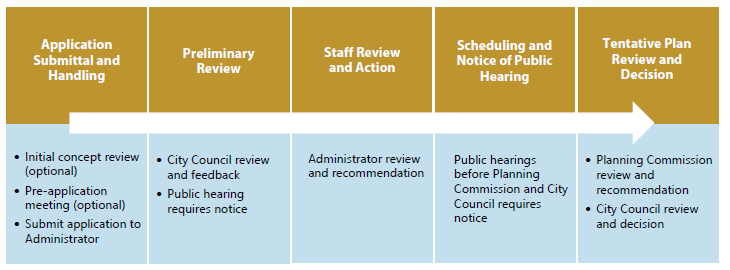
a.
Application Submittal and Handling PUD applications shall be submitted, accepted, and revised, and may be withdrawn, in accordance with Section 18.08.303, Application Submittal and Handling. However, amendments to the official zoning map to create a PUD may only be initiated by the City Council or by application. The application shall include the following information:
1.
A statement of the present ownership and a legal description of all the land included in the proposed PUD;
2.
An explanation of the objectives to be achieved by the planned unit development and why those objectives cannot be achieved with standard zoning designations;
3.
Description of the existing conditions of the site;
4.
Statement of consistency with the Master Plan;
5.
General site characteristics such as environmentally sensitive lands, wildlife habitat, areas of visual impact, and waterways;
6.
The location and intensity of proposed land uses and development;
7.
General site planning layout, including vehicular, bicycle, and pedestrian circulation;
8.
Proposed public infrastructure and facilities;
9.
Proposed amenities, including availability for public use and maintenance responsibilities;
10.
A development schedule indicating the approximate date when construction of the planned unit development or stages of the planned unit development can be expected to begin and be completed; A Fiscal Impact Analysis (FIA) that details the infrastructure and services needed to support the proposed PUD and the estimated net fiscal impact to the City resulting from project approval;
11.
Copies of any special agreements, conveyances, restrictions, or covenants, which will govern the use, maintenance, and continued protection of the planned unit development and any of its common open space areas; and
12.
The applicant may submit any other information or exhibits deemed pertinent in evaluating the proposed planned unit development.
b.
Staff Review and Action The Administrator shall review the tentative applications for a PUD, prepare a staff report and recommendation in accordance with Section 18.08.304, Review and Action, and the procedures below:
1.
Except as outlined in this section, tentative approval of a PUD shall be processed as a zoning map amendment in accordance with Section 18.08.503, Rezoning (Zoning Map Amendment).
2.
All requirements and regulations pertaining to the approval, denial, conditioning of tentative approval by minute order, findings of fact, specification of time for filing application for final approval, and status of plan after tentative approval shall be as provided in NRS Sections 278A.490 to 278A.520, inclusive.
3.
In approving a PUD, the Planning Commission and City Council shall make findings regarding the requirements of this section and NRS Section 278.250(2), as applicable.
c.
Scheduling and Notice of Public Hearings The tentative PUD application shall be scheduled for a public hearing before the Planning Commission and noticed in accordance with Section 18.08.305, Scheduling and Notice of Public Hearings.
d.
Planning Commission Review and Action The Planning Commission shall hold a public hearing and recommend to the City Council approval, approval with modifications, or disapproval of the proposed tentative PUD in accordance with Section 18.08.306, Review and Decision.
e.
Review and Decision By affirmative vote of a majority of the City Council, the Council shall approve, disapprove, or approve a proposed tentative PUD with modifications in accordance with Section 18.08.306, Review and Decision.
f.
Minute Order Within 30 days following approval or denial of a Tentative PUD Plan, the City shall distribute a Minute Order in accordance with NRS 278A.500 through 278A.520, inclusive.
g.
Post-Decision Actions and Limitations Following approval of a tentative PUD plan, the applicant may submit an application for a final PUD plan in accordance with the procedure below.
(f)
Procedure for Final PUD Plan All requirements and regulations pertaining to the application for a Final PUD Plan, substantial compliance with the Tentative PUD Plan, alternative proceedings for final action on plans not in substantial compliance, recourse to courts on failure of city to grant or deny final approval, certification and filing of approved plan, and zoning map amendment and re-subdivision upon abandonment or failure to carry out approved plan shall be as provided in NRS 278A.530 to 278A.580, inclusive.
(g)
Findings In addition to meeting the approval criteria in Section 18.08.304(e), Approval Criteria Applicable to all Applications and the findings for approval of zoning map amendments in Section 18.08.503(d), Findings, the Planning Commission and City Council shall find that the Tentative PUD Plan:
(1)
Is consistent with the statement of objectives of a PUD.
(2)
Ensures that any departures from standard zoning and subdivision regulations otherwise applicable to the property, including but not limited to density, bulk and use, are in the public interest.
(3)
Has a ratio of residential to nonresidential use that is appropriate for the area and compatible with nearby land uses.
(4)
Provides an appropriate location and amount of the common open space and provides for the maintenance and conservation of the common open space in relation to the proposed density and type of residential development.
(5)
Includes an adequate provision for public services, adequate control over vehicular traffic, and furthers the amenities of light and air, recreation, and visual enjoyment
(6)
Is compatible with the neighborhood in which it is proposed to be established.
(7)
For PUD Plans that propose phased development over a period of years, sufficient terms and conditions are included to protect the interests of the public, residents, and owners of the PUD in the integrity of the plan. Addresses a unique situation, provides substantial benefit to the City, or incorporates innovative design, layout, or configuration resulting in quality over what would typically be accomplished through strict application of a base zoning district or other standards of this Title;
(8)
Is compatible with a Master Plan land use category or categories, including Master Plan guidance on the desired density, use, and characteristics of the land use category; and
(9)
Demonstrates that there is a public benefit gained from approval of the PUD, such as but not limited to the following:
a.
Additional or better open spaces, or a design or development of open spaces that creates a desirable and useful environment;
b.
Additional public use facilities, such as but not limited to pedestrian and bicycle trails, parks, open spaces, streets improving local circulation, or public access to a lake or stream;
c.
Preservation or enhancement of natural and cultural assets, such as historic landmarks, migration routes, wetlands, fish or animal habitats, geographical features, specimen trees, or views;
d.
Other general public benefit features that contribute to improving the environment and ecology of the vicinity, such as incorporating green infrastructure improvements to enhance stormwater infiltration and/or provision of additional flood protection facilities; and/or
e.
A significantly higher quality development than following traditional development practices would allow, including more efficient use of land, energy, and resources, a more unified design concept, and a more carefully planned, considered, and livable community.
(h)
Post-Decision Actions and Limitations
(1)
General
a.
All common procedures in Section 18.08.307, Post-Decision Actions and Limitations, shall apply.
b.
All requirements and regulations pertaining to the enforcement and modification of the provisions of the PUD plan as finally approved, whether or not these are recorded by plat, covenant, easement or otherwise, shall be as provided in NRS Sections 278A.380 to 278A.420, inclusive.
c.
Amendments to the official zoning map and minor amendments to PUD plans shall be initiated by a person that submits an affidavit executed by each of the property owners giving permission for the zoning map amendment or minor amendment to PUD plans.
(2)
Minor Amendments to PUD Plans
a.
The Administrator may approve minor amendments to an approved PUD if the proposed amendment complies with the following criteria and the Administrator determines that the amended PUD is consistent with all PUD approval findings:
1.
The number of residential units shall not be increased by more than 10 percent.
2.
The gross square footage of nonresidential building area shall not be increased by more than 10 percent.
3.
The amendment shall not change the allowed uses listed in the approved PUD.
4.
The number or location of vehicular access points shall not be changed in a way that negatively impacts public safety or the flow of traffic onto public streets.
5.
The numeric standards in the PUD shall not be revised by more than would be allowed through Section 18.08.804, Minor Deviation.
b.
The Administrator may modify any architectural design standards.
c.
The Administrator may require public notice prior to approving changes on contested projects. No other changes may be made without an amendment to the PUD, utilizing the process outlined above.
(3)
Reconsideration and Expiration
a.
For PUD Plans approved or amended after the effective date or this Title, the Administrator shall schedule public hearings with the Planning Commission and City Council to monitor construction within the PUD every five years following adoption of each PUD or PUD amendment that is approved under this Title. The City Council, during any of the monitoring public hearings, may modify the monitoring schedule to be more frequent, less frequent, or to not occur at all.
1.
If no development has occurred on the site five years following the approval date of the PUD or PUD amendment, the applicant shall either provide a construction phasing plan that provides for the commencement of work within two years following the five-year review or shall provide an explanation to the City about why commencement of development has not occurred and why the approval should remain in place. If development has not commenced within two years following the five-year review, the City Council may initiate a rezoning to another district if it determines that the PUD approval findings can no longer be made and PUD zoning is no longer appropriate on the site.
2.
If less than 20 percent of the PUD has been developed within ten years following the approval date of the PUD, the City Council may initiate a rezoning of undeveloped areas to another district if it determines that the PUD approval findings can no longer be made and PUD zoning is no longer appropriate on the site.
3.
If less than 40 percent of the PUD has been developed within 15 years following the approval date of the PUD, the City Council may initiate a rezoning of undeveloped areas to another district if it determines that the PUD approval findings can no longer be made and PUD zoning is no longer appropriate on the site.
4.
If less than 60 percent of the PUD has been developed within 20 years following the approval date of the PUD, the City Council may initiate a rezoning of undeveloped areas to another district if it determines that the PUD approval findings can no longer be made and PUD zoning is no longer appropriate on the site.
5.
If less than 80 percent of the PUD has been developed within 25 years following the approval date of the PUD, the City Council may initiate a rezoning of undeveloped areas to another district if it determines that the PUD approval findings can no longer be made and PUD zoning is no longer appropriate on the site.
6.
The five-year reviews shall terminate when 90 percent of the PUD is developed.
b.
During a monitoring hearing, the City Council and applicant or responsible party may, by mutual agreement, add conditions or modify the PUD.
(Ord. No. 6692, § 1(Exh. A), 1-8-25)
18.08.601 - Projects of Regional Significance
(a)
Purpose This section describes the process by which a project of regional significance is reviewed for conformance with the Regional Plan, per NRS Section 278.026.
(b)
Applicability All applications submitted pursuant to this Title are subject to the procedures of this section to determine whether the proposed activity is a "project of regional significance" pursuant to NRS Section 278.026. On any application determined to be a "project of regional significance," the City's final approval shall be contingent upon a subsequent review by the Regional Planning Commission, according to NRS Section 278.0278, to determine whether the project is in conformance with the adopted regional plan.
(c)
Application Submittal and Review Procedure Figure 8-8, below, identifies the applicable steps from Article 3, Common Review Procedures, that apply to the review of projects to determine regional significance. Additions or modifications to the common review procedures are noted below.
Figure 8-8: Summary of Regional Plan Conformance Review Procedures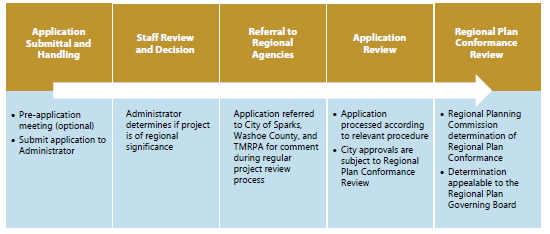
(1)
Application Submittal and Handling This process shall be initiated following submittal of any development application unless otherwise stated in this chapter. This section shall supersede other relevant sections of this chapter to the extent that the procedural aspects of those sections conflict with this section.
(2)
Staff Review and Decision The Administrator shall make a determination as to whether a proposed project meets the guidelines for a "project of regional significance" based on NRS Section 278.0277 and Regional Planning Commission guidelines and procedures.
(3)
Referral to Regional Agencies If the Administrator determines an application for the use of land is a project of regional significance, copies of such application shall be provided to the planning staffs of the City of Sparks, Washoe County, the Truckee Meadows Regional Planning Agency (TMRPA), and those agencies which generally provide comments on development applications.
(4)
Application Review Concurrent with the referral to regional agencies, the application shall be reviewed in accordance with the City procedures outlined in other sections of this chapter for the application involved.
(5)
Regional Plan Conformance Review
a.
City approval of projects of regional significance shall not be final until the Regional Planning Commission finds the project to be in conformance with the Regional Plan.
b.
Applications requiring a public hearing shall be submitted to the Regional Planning Commission following final City approval.
c.
Applications not otherwise requiring a public hearing shall be submitted directly to the Regional Planning Commission by the Administrator.
d.
If the Regional Planning Commission determines that the project is not in conformance with the regional plan, the determination may be appealed to the Regional Planning Governing Board in accordance with NRS Section 278.0278.
(Ord. No. 6692, § 1(Exh. A), 1-8-25)
18.08.602 - Minor Site Plan Review
(a)
Purpose This section describes the process by which proposed development is reviewed for compliance with the development and design standards of this Title. The minor site plan review procedure ensures that potential impacts of development are considered before submittal of an application for construction plan approval or issuance of a building permit.
(b)
Applicability Approval of a minor site plan review according to the procedures and criteria in this section is required for the following development applications and activities, unless exempted under Subsection (c), below:
(1)
Specified Development Applications All development activities expressly made subject to a minor site plan review in this Title.
(2)
Additional Activities Subject to Minor Site Plan Review Except where modified by other provisions of this Title, a minor site plan review application is required for the following development applications:
a.
Nonresidential developments adjacent to or within 300 feet of residentially zoned property. This does not include subdivision of land through a parcel map.
1.
Nonresidential facilities are exempt if less than 35 feet in height and are separated from residentially zoned property by a freeway.
b.
Primary or secondary schools adjacent to residentially zoned properties;
c.
Commercial or industrial developments within 300 feet of a primary or secondary school;
d.
Communication facilities in an Urban Zoning District or Employment Zoning District that do not meet the use standards set forth in Section 18.03.305(a)(1), Communication Facility, Equipment Only; and
e.
Development proposals that qualify as a "cluster" development per Subsection 18.04.903(a)(6), Cluster Development.
(c)
Exemptions The following are exempt from the minor site plan review procedure, but are subject to the standards of this Title:
(1)
Accessory Structures Accessory structures with combined gross floor areas no larger than 1,000 square feet on each parcel.
(2)
Additions to Nonresidential Facilities A structural addition to nonresidential facilities that would require a minor site plan review are exempt if the following conditions are met:
a.
The addition does not exceed 20 percent of the size of the original development or 20,000 square feet in size, whichever is smaller.
b.
The construction of the proposed addition will not materially alter the original site plan application in that no new use is involved in the addition that would itself require discretionary review, no potentially deleterious aspect of the development will be increased, the proposed addition will not have significant impacts on neighboring properties, the size of the property has not been increased, and the proposed addition will continue to comply with other conditions of the approval.
c.
The exemption provided in this subsection may be used only once per property.
(3)
Certain Urban Districts Projects that meet the standards of Subsection 18.04.1002(c)(1), Certain Development Exempt from Discretionary Review, with Exceptions.
(4)
Solar Structures Solar structures, classified as accessory alternative utility systems.
(d)
Application Submittal and Review Procedure Figure 8-9, below, identifies the applicable steps from Article 3, Common Review Procedures, that apply to the review of site plans. Additions or modifications to the common review procedures are noted below.
Figure 8-9: Summary of Minor Site Plan Review Procedures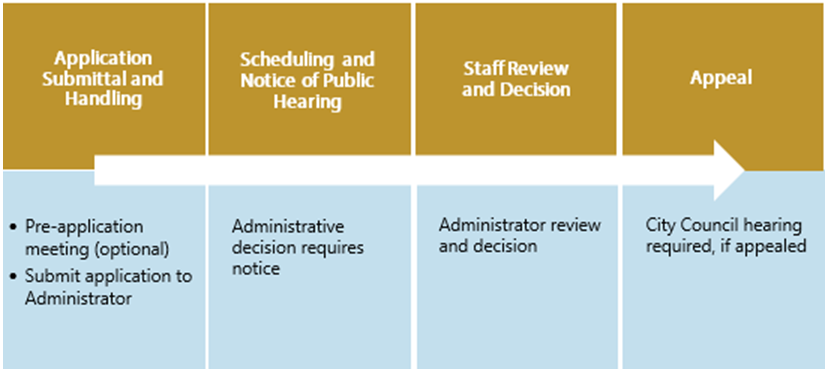
(1)
Application Submittal and Handling Minor site plan review applications shall be submitted, accepted, and revised, and may be withdrawn, in accordance with Section 18.08.303, Application Submittal and Handling.
(2)
Applications Subject to Minor Site Plan Review and Minor Conditional Use Permit The processing of any development subject to a minor site plan review and a minor conditional use permit may be combined into a single application for a minor conditional use permit and processed in accordance with Section 18.08.604, Minor Conditional Use Permit at the applicant's discretion. Both the findings for a minor site plan review and a minor conditional use permit shall be made and listed in the decision letter.
(3)
Alternative Process At the discretion of the applicant, any project subject to a minor site plan review may instead be processed in accordance with Section 18.08.603, Major Site Plan Review.
(4)
Public Notice Public notice shall be provided in accordance with Section 18.08.305, Scheduling and Notice of Public Hearings.
(5)
Staff Review and Decision The Administrator shall review the application and shall approve, approve with conditions, or deny the application for minor site plan review within 30 days of receiving the completed application in accordance with Section 18.08.303(f), Determination of Application Completeness. The decision shall be based on the general criteria in 18.08.304(e), Approval Criteria Applicable to all Applications.
(6)
Appeal The decision of the Administrator may be appealed to the City Council in accordance with Subsection 18.08.307(j), Appeal.
(7)
Post-Decision Actions and Limitations All common procedures in Section 18.08.307, Post-Decision Actions and Limitations, shall apply, with the following modifications:
a.
No Building Permit without Approval
1.
The minor site plan review, as approved by the Administrator, shall accompany the plans submitted for building permit approval, and all development of the property shall be in accordance with the approved plan.
2.
No building permit shall be issued until the minor site plan review application and all other associated applications have been approved and any applicable appeal period is exhausted. Any building permitted when an application has been appealed or prior to the end of the appeal period shall be submitted "at risk," with no refunds due if the minor site plan review is not finally approved.
b.
Time Limitations and Extensions
1.
Time Limitations
[a]
Minor site plan reviews that accompany tentative maps shall be valid as long as the tentative map is valid.
[b]
The owner or developer shall apply for a building permit for the entire project within 18 months of the date of approval of the minor site plan review application and maintain the validity of that permit, or the minor site plan review approval shall be null and void unless a different time limitation was established at the time of final approval based on the characteristics and complexity of the project.
2.
Extension by the Administrator
[a]
The Administrator may extend the time limit by up to 12 months if a request is received prior to the expiration of the time limit to apply for a building permit under a minor site plan review, provided that:
i.
The applicant agrees to comply with all requirements of this Title and all conditions of approval; and
ii.
The applicant agrees to pay all applicable fees.
iii.
No more than one administrative time extension shall be approved for any project or project phase.
3.
Extension by the Planning Commission
[a]
The Planning Commission may extend the time limit by six additional months if an application is received by the Administrator 45 days prior to the expiration of the extension granted by the Administrator, and the Planning Commission approves a schedule indicating that the applicant will apply for a building permit for the entire project or the relevant phase within the six month extension.
[b]
In reviewing any such extension request, the Planning Commission shall consider the continued appropriateness of the project in the approved location and may add conditions to ensure that the project does not adversely impact other properties and to protect the public interest.
[c]
No more than one six-month time extension shall be approved for any project or project phase.
(e)
Findings In addition to meeting the criteria in Section 18.08.304(e), Approval Criteria Applicable to all Applications, the following findings shall be made prior to granting a minor site plan review permit:
(1)
General
a.
The proposed design is compatible with surrounding development;
b.
The proposed design is consistent with applicable development standards;
c.
Public services and facilities are available to serve the project, or will be provided with development;
d.
The characteristics of the project as proposed and as may be conditioned are reasonably compatible with the types of development permitted in the surrounding area; and
e.
The approval will not be materially detrimental to the public health, safety, or welfare. The factors to be considered in evaluating this application shall include:
1.
Property damage or nuisance resulting from noise, smoke, odor, dust, vibration, or illumination; and
2.
Any hazard to persons and property.
(2)
Mixed-Use Downtown (MD-) Districts In addition to the general minor site plan review findings, the following findings shall be made prior to approving a minor site plan review to modify supplemental standards for the Mixed-Use Downtown Riverwalk (MD-RD) District:
a.
Strict application of the building envelope, height restrictions, Riverfront Esplanade setbacks, or provision of the design guidelines would constrain the design of the project;
b.
The proposed project will not negatively impact the visual integrity of the river or result in a visual barrier to the river corridor;
c.
The project provides adequate separation from the river course to allow for public circulation along the river corridor and creates pedestrian oriented public spaces adjacent to the river;
d.
The project does not unduly shade the North Esplanade, or increased shading has been mitigated by providing additional or enhanced pedestrian amenities;
e.
The project will enhance or preserve environmental resources;
f.
The project does not impede flood flows; and
g.
The project will be used by and benefits local residents.
(Ord. No. 6692, § 1(Exh. A), 1-8-25; Ord. No. 6710, § 13, 6-4-25)
18.08.603 - Major Site Plan Review
(a)
Purpose This section describes the process by which proposed development is reviewed for compliance with the development and design standards of this Title. The major site plan review procedure ensures that potential impacts of development are considered before submittal of an application for construction plan approval or issuance of a building permit.
(b)
Applicability Approval of a major site plan review according to the procedures and criteria in this section is required for the following uses, development, and activities, unless exempted under Subsection (c), below:
(1)
Specified Development Applications All development activities expressly made subject to a major site plan review in this Title.
(c)
Exemptions The following are exempt from the major site plan review procedure, but are subject to the standards of this Title:
(1)
Accessory Structures Accessory structures with combined gross floor areas no larger than 1,000 square feet on each parcel.
(2)
Additions to Nonresidential Facilities A structural addition to nonresidential facilities that would require a major site plan review are exempt if the following conditions are met:
a.
The addition does not exceed 20 percent of the size of the original development or 20,000 square feet in size, whichever is smaller.
b.
The construction of the proposed addition will not materially alter the original major site plan application in that no new use is involved in the addition that would itself require discretionary review, no potentially deleterious aspect of the development will be increased, the proposed addition will not have significant impacts on neighboring properties, the size of the property has not been increased, and the proposed addition will continue to comply with other conditions of the approval.
c.
The exemption provided in this Paragraph may be used only once per property.
(3)
Certain Urban Districts Projects that meet the standards of Subsection 18.04.1002(c)(1), Certain Development Exempt from Discretionary Review, with Exceptions.
(4)
Solar Structures Solar structures, classified as accessory alternative utility systems.
(d)
Application Submittal and Review Procedures Figure 8-10, below, identifies the applicable steps from Article 3, Common Review Procedures, that apply to the review of major site plan review applications. Additions or modifications to the common review procedures are noted below.
Figure 8-10: Summary of Major Site Plan Review Procedures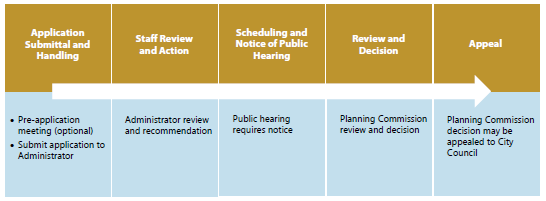
(1)
Application Submittal and Handling Major site plan review applications shall be submitted, accepted, and revised, and may be withdrawn, in accordance with Section 18.08.303, Application Submittal and Handling.
(2)
Applications Subject to Major Site Plan Review and Conditional Use Permit The processing of any development subject to a major site plan review and a conditional use permit shall be combined into a single application for a conditional use permit and processed in accordance with Section 18.08.605, Conditional Use Permit. Both the findings for a major site plan review and conditional use permit shall be made and listed in the staff report.
(3)
Staff Review and Action The Administrator shall review the application and prepare a staff report and recommendation in accordance with Section 18.08.304, Review and Action.
(4)
Scheduling and Notice of Public Hearing The major site plan review application shall be scheduled for a public hearing before the Planning Commission and noticed in accordance with Section 18.08.305, Scheduling and Notice of Public Hearings.
(5)
Review and Decision
a.
The Planning Commission shall hold a public hearing within 65 days of application.
b.
The Planning Commission shall approve, approve with conditions, or deny the application within 30 days from the date of the hearing in accordance with Section 18.08.306, Review and Decision, based on the general approval criteria in subsection 18.08.304(e), Approval Criteria Applicable to all Applications and the specific findings for major site plan review applications in subsection 18.08.605(e), Findings, below.
(6)
Appeal The decision of the Planning Commission may be appealed to the City Council in accordance with Subsection 18.08.307(j), Appeal.
(7)
Post-Decision Actions and Limitations All common procedures in Section 18.08.307, Post-Decision Actions and Limitations, shall apply, with the following modifications:
a.
Time Limitations and Extensions
1.
Time Limitations
[a]
Major site plan reviews that accompany tentative maps shall be valid as long as the tentative map is valid.
[b]
The owner or developer shall apply for a building permit for the entire project within 18 months of the date of approval of the major site plan review application and maintain the validity of that permit, or the major site plan review approval shall be null and void unless a different time limitation was established at the time of final approval based on the characteristics and complexity of the project.
2.
Extension by the Administrator
[a]
The Administrator may extend the time limit by up to 12 months if a request is received prior to the expiration of the time limit to apply for a building permit under a major site plan review, provided that:
i.
The applicant agrees to comply with all requirements of this Title and all conditions of approval; and
ii.
The applicant agrees to pay all applicable fees.
[b]
No more than one administrative time extension shall be approved for any project or project phase.
3.
Extension by the Planning Commission
[a]
The Planning Commission may extend the time limit by six additional months if an application is received by the Administrator 45 days prior to the expiration of the extension granted by the Administrator, and the Planning Commission approves a schedule indicating that the applicant will apply for a building permit for the entire project or the relevant phase within the six-month extension.
[b]
In reviewing any such extension request, the Planning Commission shall consider the continued appropriateness of the project in the approved location and may add conditions to ensure that the project does not adversely impact other properties and to protect the public interest.
[c]
No more than one six-month time extension shall be approved for any project or project phase.
(e)
Findings In addition to meeting the criteria in Section 18.08.304(e), Approval Criteria Applicable to all Applications, the following findings shall be made prior to granting a major site plan review permit:
(1)
General
a.
The proposed design is compatible with surrounding development;
b.
The proposed design is consistent with applicable development standards;
c.
Public services and facilities are available to serve the project, or will be provided with development;
d.
The characteristics of the project as proposed and as may be conditioned are reasonably compatible with the types of development permitted in the surrounding area; and
e.
The approval will not be materially detrimental to the public health, safety, or welfare. The factors to be considered in evaluating this application shall include:
1.
Property damage or nuisance resulting from noise, smoke, odor, dust, vibration, or illumination; and
2.
Any hazard to persons and property.
(2)
Mixed-Use Downtown (MD-) Districts In addition to the general major site plan review findings, the following findings shall be made prior to approving a major site plan review to modify the supplemental standards for the Mixed-Use Downtown Riverwalk (MD-RD) District:
a.
Strict application of the building envelope, height restrictions, Riverfront Esplanade setbacks, or provision of the design guidelines would constrain the design of the project;
b.
The proposed project will not negatively impact the visual integrity of the river or result in a visual barrier to the river corridor;
c.
The project provides adequate separation from the river course to allow for public circulation along the river corridor and creates pedestrian oriented public spaces adjacent to the river;
d.
The project does not unduly shade the North Esplanade, or increased shading has been mitigated by providing additional or enhanced pedestrian amenities;
e.
The project will enhance or preserve environmental resources;
f.
The project does not impede flood flows; and
g.
The project will be used by and benefits local residents.
(3)
Cluster Development In addition to the general major site plan review findings, the following findings shall be made prior to approving a major site plan review in cluster developments:
a.
The clustering proposal, compared with a more traditional site development plan, better attains the policies and objectives of this article, such as providing more open space, preserving existing trees and vegetation coverage, preserving view corridors, and preserving sensitive environmental areas such as stream corridors, slide areas, wetlands, and steep slopes;
b.
The clustering proposal will have no significant adverse impact on adjacent properties or development, or the applicant has agreed to adopt appropriate mitigation measures such as edge matching, landscaping, screening, illumination standards, and other design features to buffer and protect adjacent properties from the proposed clustered development; and
c.
The clustering proposal meets all other applicable requirements set forth in this article or in other applicable ordinances or regulations.
(4)
Grading Activity In addition to the general major site plan review findings, the following findings shall be made prior to approving a major site plan review for the following: (1) Grading resulting in cuts deeper than 20 feet and/or fills greater than 10 feet in height; (2) Hillside development meeting the criteria in Section 18.04.402, Applicability; (3) Grading within a major drainageway meeting the criteria in section 18.04.104(c) Applicability; or (4) Grading within the Parks, Greenways, and Open Space (PGOS) District, except for paths, public recreational amenities, or environmental restoration.
a.
Findings The following findings shall be made prior to granting a major site plan review (or conditional use permit, if elevated), in addition to the general major site plan review findings:
1.
The proposed project mitigates environmental degradation, including slope failure, erosion, sedimentation, and stormwater run-off;
2.
The proposed project utilizes grading practices that are appropriate for hillsides and designed to minimize the visibility of unsightly scarring;
3.
The proposed project provides open space based on hillside constraints;
4.
The proposed project adheres to applicable hillside development design standards and to Master Plan provisions related to development in sloped areas; and
5.
The proposed project's site layout and design features adequately mitigate potential visual impacts of development near prominent ridgelines and within other visually prominent areas.
(Ord. No. 6692, § 1(Exh. A), 1-8-25)
18.08.604 - Minor Conditional Use Permit
(a)
Purpose The minor conditional use permit procedure provides a mechanism for the City to evaluate proposed land uses that have unique or widely varying operating characteristics or unusual features. This procedure is intended to ensure compatibility with surrounding areas and that adequate mitigation is provided for anticipated impacts.
(b)
Applicability Approval of a minor conditional use permit according to the procedures and criteria in this section is required for the following uses and activities, unless exempted under subsection (c), below:
(1)
Use Table and Use Regulations All principal, accessory, and temporary uses listed or referenced in Section 18.03.206, Table of Allowed Uses, as requiring a minor conditional use permit or additional standards that require a minor conditional use permit in Articles 3-5 of Chapter 18.03 Use Regulations.
(2)
Specified Development Applications All land uses and development activities expressly made subject to a minor conditional use permit under this Title.
(c)
Exemptions No minor conditional use permit shall be required for:
(1)
Accessory Structures Accessory structures with combined gross floor areas no larger than 1,000 square feet on each parcel.
(2)
Additions to Nonresidential Facilities A structural addition to nonresidential facilities that would require a minor conditional use permit are exempt if the following conditions are met:
a.
The addition does not exceed 20 percent of the size of the original development or 20,000 square feet in size, whichever is smaller.
b.
The construction of the proposed addition will not materially alter the original minor conditional use permit in that no new use is involved in the addition that would itself require a minor conditional use permit, no potentially deleterious aspect of the development will be increased, the proposed addition will not have significant impacts on neighboring properties, the size of the property has not been increased, and the proposed addition will continue to comply with all conditions of the minor conditional use permit.
c.
The exemption provided in this Paragraph may be used only once per property.
(3)
Certain Urban Districts Projects that meet the standards of Subsection 18.04.1002(c)(1), Certain Development Exempt from Discretionary Review, with Exceptions.
(d)
Application Submittal and Review Procedure Figure 8-11, below, identifies the applicable steps from Article 3, Common Review Procedures, that apply to the review of minor conditional use permits. Additions or modifications to the common review procedures are noted below.
Figure 8-11: Summary of Minor Conditional Use Permit Review Procedures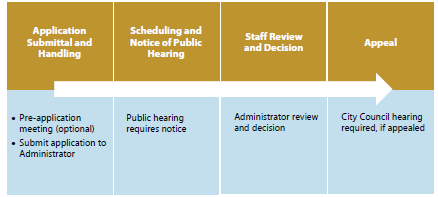
(1)
Application Submittal and Handling Minor conditional use permit applications shall be submitted, accepted, and revised, and may be withdrawn, in accordance with Section 18.08.303, Application Submittal and Handling.
(2)
Applications Subject to Minor Site Plan Review and Minor Conditional Use Permit The processing of any development subject to a minor site plan review and a minor conditional use permit may be combined into a single application for a minor conditional use permit and processed in accordance with Section 18.08.604, Minor Conditional Use Permit at the discretion of the applicant. Both the findings for a minor site plan review and a minor conditional use permit shall be made and listed in the decision letter.
(3)
Public Notice
a.
Noticing Thresholds Public notice shall be provided in accordance with Section 18.08.305, Scheduling and Notice of Public Hearings.
b.
Alternative Process At the discretion of the applicant, any project subject to a minor conditional use permit may instead be processed in accordance with Section 18.08.605, Conditional Use Permit.
(4)
Staff Review and Decision The Administrator shall review the application and shall approve, approve with conditions, or deny the application for minor conditional use permit within 30 days of receiving the completed application in accordance with Section 18.08.303(f), Determination of Application Completeness. The decision shall be based on the general criteria in 18.08.304(e), Approval Criteria Applicable to all Applications.
(5)
Appeal The decision of the Administrator may be appealed to the City Council in accordance with Subsection 18.08.307(j), Appeal.
(6)
Post-Decision Actions and Limitations All common procedures in Section 18.08.307, Post-Decision Actions and Limitations, shall apply, with the following modifications:
a.
No Building Permit without Approval
1.
The minor conditional use permit, as approved by the Administrator, shall accompany the plans submitted for building permit approval, and all development of the property shall be in accordance with the approved plan.
2.
No building permit shall be issued until the minor conditional use permit application and all other associated applications have been approved and any applicable appeal period is exhausted. Any building permitted when an application has been appealed or prior to the end of the appeal period shall be submitted "at risk," with no refunds due if the minor conditional use permit is not finally approved.
(7)
Time Limitations and Extensions
a.
Time Limitations
1.
Minor conditional use permits that accompany tentative maps shall be valid as long as the tentative map is valid.
2.
The owner or developer shall apply for a building permit for the entire project within 18 months of the date of approval of the minor conditional use permit application and maintain the validity of that permit, or the minor conditional use permit approval shall be null and void unless a different time limitation was established at the time of final approval based on the characteristics and complexity of the project.
b.
Extension by the Administrator
1.
The Administrator may extend the time limit by up to 12 months if a request is received prior to the expiration of the time limit to apply for a building permit under a minor conditional use permit, provided that:
[a]
The applicant agrees to comply with all requirements of this Title and all conditions of approval; and
[b]
The applicant agrees to pay all applicable fees.
2.
No more than one administrative time extension shall be approved for any project or project phase.
c.
Extension by the Planning Commission
1.
The Planning Commission may extend the time limit by six additional months if an application is received by the Administrator 45 days prior to the expiration of the extension granted by the Administrator, and the Planning Commission approves a schedule indicating that the applicant will apply for a building permit for the entire project or the relevant phase within the six month extension.
2.
In reviewing any such extension request, the Planning Commission shall consider the continued appropriateness of the project in the approved location and may add conditions to ensure that the project does not adversely impact other properties and to protect the public interest.
3.
No more than one six-month time extension shall be approved for any project or project phase.
(e)
Findings In addition to meeting the criteria in Section 18.08.304(e), Approval Criteria Applicable to all Applications, the following findings shall be made prior to granting a minor conditional use permit:
(1)
The proposed location of the use is in accordance with the objectives of this Title and the purpose of the zoning district in which the site is located;
(2)
The proposed land use and project design is compatible with surrounding development;
(3)
The proposed land use and project design is consistent with applicable development standards;
(4)
Public services and facilities are available to serve the project, or will be provided with development;
(5)
The characteristics of the use as proposed and as may be conditioned are reasonably compatible with the types of use permitted in the surrounding area; and
(6)
The granting of the minor conditional use permit will not be materially detrimental to the public health, safety, or welfare. The factors to be considered in evaluating this application shall include:
a.
Property damage or nuisance resulting from noise, smoke, odor, dust, vibration, or illumination; and
b.
Any hazard to persons and property.
(Ord. No. 6692, § 1(Exh. A), 1-8-25)
18.08.605 - Conditional Use Permit
(a)
Purpose The conditional use permit procedure provides a mechanism for the City to evaluate proposed land uses that have unique or widely varying operating characteristics or unusual features. This procedure is intended to ensure compatibility with surrounding areas and that adequate mitigation is provided for anticipated impacts.
(b)
Applicability Approval of a conditional use permit according to the procedures and criteria in this section is required for the following uses and activities, unless exempted under subsection (c), below:
(1)
Use Table and Use Regulations All principal, accessory, and temporary uses listed or referenced in Section 18.03.206, Table of Allowed Uses, as requiring a conditional use permit or additional standards that require a conditional use permit in Articles 3-5 of Chapter 18.03 Use Regulations.
(2)
Specified Development Applications All land uses and development activities expressly made subject to a conditional use permit under this Title.
(3)
Operation Hours All uses operating between the hours of 11:00 p.m. and 6:00 a.m. shall require a conditional use permit unless they meet one of the following exemptions:
a.
All uses located in the Industrial (I), Industrial Commercial (IC), Mixed Employment (ME), and Mixed Airport (MA) districts and are a Manufacturing and Processing use or a Storage, Distribution, and Warehousing use, located greater than 300 feet from residentially zoned property;
b.
Uses located in the Mixed-Use Downtown (MD-) districts, Mixed-Use Midtown (MU-MC) District, or Mixed-Use Urban (MU) District and greater than 300 feet from residentially zoned property. The Mixed Use - Midtown Commercial (MU-MC) and Mixed Use-Residential (MU-RES) zoning districts have more specific operating hours, as noted in section 18.04.1005.
c.
Stocking and inventory activities that occur inside Retail uses;
d.
All uses in the Public Facility (PF) District;
e.
Hotels or Motels with or without Nonrestricted Gaming; or
f.
Adult Businesses.
g.
Certain development exempt from discretionary review as outlined in 18.04.1002(c) and 18.04.1104(a)(2);
h.
Freestanding Birthing Centers as defined in NRS 449.0065;
i.
Data Centers.
(4)
Gaming New gaming operations, or structural additions to existing gaming operations, located within 500 feet of a Large Lot Residential (LLR-) or Single-Family Residential (SF-) zoned property or exceeding 80,000 square feet. Conversion of existing buildings to gaming operations within the Mixed-Use Downtown (MD-) districts is exempt from this conditional use permit requirement.
(5)
Hazardous and Explosive Substances Any facility that includes the production, use, or storage of hazardous substances and hazardous waste as defined in NRS Section 459.429 or the production, use, storage, or handling of explosives as defined by NRS Section 278.147 or a highly hazardous substance as defined by NRS Section 459.3816 and Chapter 18.09 Rules of Construction and Definitions.
(c)
Exemptions No conditional use permit shall be required for:
(1)
Accessory Structures Accessory structures with combined gross floor areas no larger than 1,000 square feet on each parcel.
(2)
Additions A structural addition to a development that would require a conditional use permit are exempt if the following conditions are met:
a.
The addition does not exceed 20 percent of the size of the original development or 20,000 square feet in size, whichever is smaller.
b.
The construction of the proposed addition will not materially alter the original conditional use permit in that no new use is involved in the addition that would itself require a conditional use permit, no potentially deleterious aspect of the development will be increased, the proposed addition will not have significant impacts on neighboring properties, the size of the property has not been increased, and the proposed addition will continue to comply with all conditions of the conditional use permit.
c.
The exemption provided in this Paragraph may be used only once per property.
(3)
Certain Urban Districts Projects that meet the standards of Subsection 18.04.1002(c)(1), Certain Development Exempt from Discretionary Review, with Exceptions.
(d)
Application Submittal and Review Procedure Figure 8-12, below, identifies the applicable steps from Article 3, Common Review Procedures, that apply to the review of conditional use permits. Additions or modifications to the common review procedures are noted below. Facilities that manufacture, process, transfer, or store explosives or hazardous substances shall meet the application submittal and review procedures of Subsection 18.03.306(a)(9)a.
Figure 8-12: Summary of Conditional Use Permit Procedures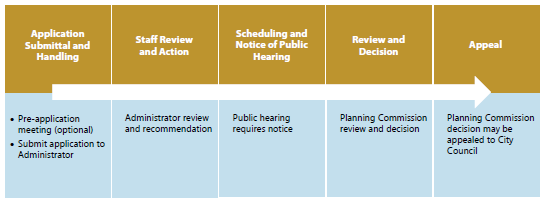
(1)
Application Submittal and Handling Conditional use permit applications shall be submitted, accepted, and revised, and may be withdrawn, in accordance with Section 18.08.303, Application Submittal and Handling.
(2)
Applications Subject to Major Site Plan Review and Conditional Use Permit The processing of any development subject to a major site plan review and a conditional use permit may be combined into a single application for a conditional use permit and processed in accordance with Section 18.08.605, Conditional Use Permit at the discretion of the applicant. Both the findings for a major site plan review and conditional use permit shall be made and listed in the staff report.
(3)
Staff Review and Action The Administrator shall review the application and prepare a staff report and recommendation in accordance with Section 18.08.304, Review and Action.
(4)
Scheduling and Notice of Public Hearing The conditional use permit application shall be scheduled for a public hearing before the Planning Commission and noticed in accordance with Section 18.08.305, Scheduling and Notice of Public Hearings.
(5)
Review and Decision
a.
The Planning Commission shall hold a public hearing within 65 days of application.
b.
The Planning Commission shall approve, approve with conditions, or deny the application within 30 days from the date of the hearing in accordance with Section 18.08.306, Review and Decision, based on the general approval criteria in subsection 18.08.304(e), Approval Criteria Applicable to all Applications and the specific findings for conditional use permits in subsection 18.08.605(e), Findings, below.
(6)
Appeal The decision of the Planning Commission may be appealed to the City Council in accordance with Subsection 18.08.307(j), Appeal.
(7)
Post-Decision Actions and Limitations All common procedures in Section 18.08.307, Post-Decision Actions and Limitations, shall apply, with the following modifications:
a.
Time Limitations and Extensions
1.
Time Limitations
[a]
Conditional use permits that accompany tentative maps shall be valid as long as the tentative map is valid.
[b]
The owner or developer shall apply for a building permit for the entire project within 18 months of the date of approval of the conditional use permit review application and maintain the validity of that permit, or the conditional use permit approval shall be null and void unless a different time limitation was established at the time of final approval based on the characteristics and complexity of the project.
2.
Extension by the Administrator
[a]
The Administrator may extend the time limit by up to 12 months if a request is received prior to the expiration of the time limit to apply for a building permit under a conditional use permit, provided that:
i.
The applicant agrees to comply with all requirements of this Title and all conditions of approval; and
ii.
The applicant agrees to pay all applicable fees.
[b]
No more than one administrative time extension shall be approved for any project or project phase.
3.
Extension by the Planning Commission
[a]
The Planning Commission may extend the time limit by six additional months if an application is received by the Administrator 45 days prior to the expiration of the extension granted by the Administrator, and the Planning Commission approves a schedule indicating that the applicant will apply for a building permit for the entire project or the relevant phase within the six-month extension.
[b]
In reviewing any such extension request, the Planning Commission shall consider the continued appropriateness of the project in the approved location and may add conditions to ensure that the project does not adversely impact other properties and to protect the public interest.
[c]
No more than one six-month time extension shall be approved for any project or project phase.
(e)
Findings In addition to meeting the criteria in Section 18.08.304(e), Approval Criteria Applicable to all Applications, the following findings shall be made prior to granting a conditional use permit:
(1)
The proposed location of the use is in accordance with the objectives of this Title and the purpose of the zoning district in which the site is located;
(2)
The proposed land use and project design is compatible with surrounding development;
(3)
The proposed land use and project design is consistent with applicable development standards;
(4)
Public services and facilities are available to serve the project, or will be provided with development;
(5)
The characteristics of the use as proposed and as may be conditioned are reasonably compatible with the types of use permitted in the surrounding area; and
(6)
The granting of the conditional use permit will not be materially detrimental to the public health, safety, or welfare. The factors to be considered in evaluating this application shall include:
a.
Property damage or nuisance resulting from noise, smoke, odor, dust, vibration, or illumination; and
b.
Any hazard to persons and property.
(Ord. No. 6692, § 1(Exh. A), 1-8-25)
18.08.606 - Other Development Permits and Approvals
(a)
Outdoor Dining Permit
(1)
Purpose This section describes the process by which proposals for outdoor dining are reviewed for compliance with the development and design standards of this Title. The permit review procedure ensures that potential impacts of outdoor dining are considered before approval or issuance of a building permit.
(2)
Applicability Outdoor dining, including sidewalk cafes, is not allowed without authorization of an outdoor dining permit as set forth in this section. This section shall not apply to outdoor dining authorized by a special event permit issued pursuant to Chapter 4.48.
(3)
Application Submittal and Review Procedure Figure 8-13, below, identifies the applicable steps from Article 3, Common Review Procedures, that apply to the review of outdoor dining permits. Additions or modifications to the common review procedures are noted below.
Figure 8-13: Summary of Outdoor Dining Permit Procedures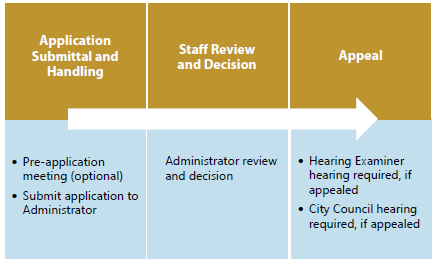
a.
Application Submittal and Handling Outdoor dining permit applications shall be submitted, accepted, and revised, and may be withdrawn, in accordance with Section 18.08.303, Application Submittal and Handling.
b.
Staff Review and Decision The Administrator shall review the application and shall approve, approve with conditions, or deny the application for outdoor dining permit within 30 days of receiving the completed application in accordance with Section 18.08.304, Review and Action, and shall make the findings set forth in this section.
c.
Appeal The decision of the Administrator may be appealed to the Hearing Examiner and subsequently the City Council in accordance with Subsection 18.08.307(j), Appeal.
d.
Post-Decision Actions and Limitations
1.
Suspension or Revocation An outdoor dining permit may be suspended or revoked for any of the following reasons:
[a]
Conducting the business of outdoor dining contrary to the conditions of the permit or in violation of any law or ordinance; or
[b]
Conducting the business of outdoor dining in such a manner as to create a public nuisance or constitute a danger to the public health, safety, or welfare.
2.
Duties of the Permittee Every permittee authorized to conduct business under this section shall:
[a]
Ascertain and comply with all laws and provisions of this Title applicable to the operation of an outdoor dining cafe;
[b]
Terminate the business after the expiration of the permit and during any period when such permit has been suspended or revoked; and
[c]
Surrender the permit promptly upon its revocation or suspension.
(4)
Conditions of Approval Approval of an outdoor dining permit shall be subject to the following conditions under which outdoor dining may occur:
a.
Compliance with the Sidewalk Cafe use regulations in Subsection 18.03.405(o);
b.
Execution of a hold harmless agreement in a form acceptable to the City Attorney;
c.
Certificate of insurance carrying comprehensive general liability issued by an authorized representative of the insurance carrier. Each certificate will bear a 30-day written notice of cancellation to the certificate holder and shall name the City as an additional insured.
d.
Such other conditions as are necessary for public safety or to protect public improvements.
e.
Conditions necessary to restore the appearance of the sidewalk on termination of use.
(5)
Findings To approve an outdoor dining permit, the recommending or deciding body shall make the following findings:
a.
The proposed design and signage complies with the requirements of this Title; and
b.
Granting of the outdoor dining permit will not be materially detrimental to the public health, safety, or welfare, or injurious to property or improvements in the vicinity.
(b)
Grading Permit
(1)
Purpose This section describes the process by which proposals for grading are reviewed for compliance with the development and design standards of this Title. The permit review procedure ensures that potential impacts of grading are considered before approval or issuance of a permit.
(2)
Applicability No person shall excavate, fill, or otherwise alter the existing grade of any property without first obtaining a grading permit, except in the following instances:
a.
An excavation below finished grade for landscaping or for basements and footings of a building, retaining wall or other structure authorized by a valid building permit. This subsection shall not exempt any fill made with the material from such excavation nor exempt any excavation having an unsupported height greater than five feet after the completion of such structure.
b.
Cemetery graves.
c.
Excavations for wells or utilities.
d.
Exploratory excavations under the direction of soil engineers or engineering geologists in the preparation of a geotechnical report for a subdivision or development.
e.
A grading permit is still required following the approval of any applicable discretionary review procedure.
(3)
Application Submittal and Review Procedure Figure 8-14, below, identifies the applicable steps that apply to the review of grading permits.
Figure 8-14: Summary of Grading Permit Procedures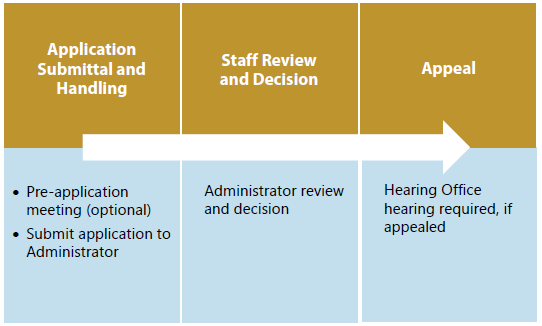
(4)
Security Required
a.
Before issuance of a grading permit on slopes exceeding 3:1 or as required by the City to protect areas disturbed by project grading and/or other associated construction activity, the applicant shall deposit with the Development Services Department a bond or letter of credit in the amount determined by the applicant and approved by the City to assure that the plantings on cut and fill slopes will be established.
b.
In the event the City determines that plantings have not been established within a four-year period following completion of development, the City will determine the cost to replace and established such plantings. Such costs shall be deducted from the security and retained by the City for re-establishing such plantings. Any unencumbered security will be returned to the applicant at the end of the 48-month period.
(c)
Demolition Permit
(1)
See Title 14, Buildings and Construction.
(2)
In addition to other applicable requirements, applications to fully or partly demolish any structure over 50 years in age shall require documentation of the structure design and any historically significant features. At a minimum, documentation shall include:
a.
Digital photographs with a 5 mb minimum file size of each exterior building facade
b.
Close-up photographs or any unique interior or exterior design elements, including as materials, trim, eaves, vertical elements, crown molding, and similar elements;
c.
Approximate floor plans for each floor of the building with ceiling heights noted.
(d)
Building Permit See Title 14, Buildings and Construction, and Sections 14.03.040—14.03.080, for applicable procedures.
(e)
Fence or Wall Permit See Chapter 14.18, Fences, for applicable fence or wall permit procedures.
(f)
Sign Permit See Chapter 14.16, Signs, and Chapter 18.05 for applicable sign permit procedures.
(g)
Mobile Home Park/RV Park Permit See Title 14, Buildings and Construction, for applicable Mobile Home Park/RV permit procedures.
(h)
Demolition Certificate and Certificate of Appropriateness in Historic Districts or for Designated Landmarks
(1)
See Chapter 18.07 Historic Preservation, for applicable procedures.
(2)
In addition to other applicable requirements, applications to fully or partly demolish any structure over 50 years in age shall require documentation of the structure design and any historically significant features. At a minimum, documentation shall include:
a.
Digital photographs with a 5 mb minimum file size of each exterior building facade
b.
Close-up photographs or any unique interior or exterior design elements, including as materials, trim, eaves, vertical elements, crown molding, and similar elements;
c.
Approximate floor plans for each floor of the building with ceiling heights noted.
(Ord. No. 6692, § 1(Exh. A), 1-8-25)
18.08.701 - Purpose
(a)
This Article sets forth the procedures for review and approval of all applications related to the division of land.
(b)
The purpose of this article is to promote the public interest in careful land use planning before a land division is approved or boundary line adjusted.
(c)
No individual, firm, association, corporation, or partnership, as principal or agent, may sell, or cause or permit to be sold, any portion of any parcel of land subject to the requirements of this section prior to the recording of the division of land map in the Office of the County Recorder.
18.08.702 - Tentative Subdivision Map
(a)
Purpose This section describes the process by which proposals for division of land are reviewed for compliance with the Master Plan and the development and design standards of this Title. The tentative subdivision map procedure provides a mechanism for the City to review an overall plan for a proposed subdivision and ensure the provision of adequate facilities and services before approval of a final subdivision map or issuance of a permit.
(b)
Authority The authority for this section is NRS Sections 278.320 to 278.353, inclusive, and contains additional requirements.
(c)
Applicability This section shall apply to all tentative maps, as defined in NRS Sections 278.320 to NRS 278.353, inclusive.
(d)
Application Submittal and Review Processes Figure 8-15, below, identifies the applicable steps from Article 3, Common Review Procedures, that apply to the review of tentative subdivision maps. Additions or modifications to the common review procedures are noted below.
Figure 8-15: Summary of Tentative Subdivision Map Procedures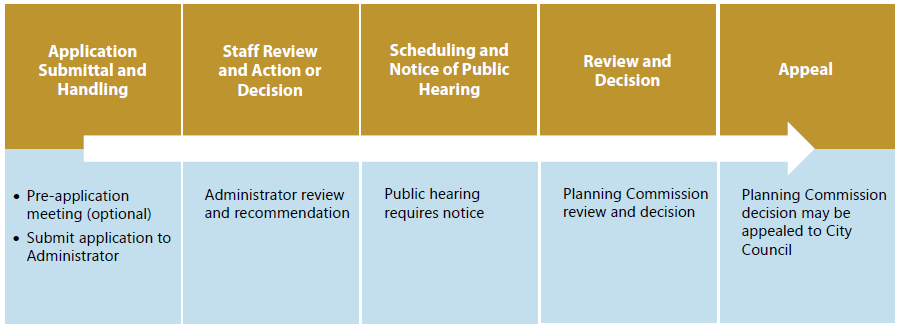
(1)
Application Submittal and Handling Tentative subdivision map applications shall be submitted, accepted, and revised, and may be withdrawn, in accordance with Section 18.08.303, Application Submittal and Handling.
(2)
Staff Review and Action The Administrator shall review each tentative map application and provide a recommendation to the Planning Commission of approval, approval with conditions, or disapproval in accordance with Section 18.08.304, Review and Action.
(3)
Scheduling and Notice of Public Hearing The tentative map application shall be scheduled for a public hearing before the Planning Commission and noticed in accordance with Section 18.08.305, Scheduling and Notice of Public Hearings.
(4)
Review and Decision
a.
The Planning Commission shall hold a public hearing and shall, by affirmative vote of a majority of all the members, approve, conditionally approve, or disapprove a tentative map within 60 days of the date the Planning Commission or its representative accepts the application as complete. This timeline may be extended by mutual agreement of the subdivider and Planning Commission or representative.
b.
In approving a tentative map, the Planning Commission may impose conditions on the tentative map which safeguard the public health, safety, and welfare.
(5)
Appeal The decision of the Planning Commission may be appealed in accordance with Subsection 18.08.307(j), Appeal.
(6)
Post-Decision Actions and Limitations
a.
Compliance with Plans Following approval of a tentative map, the subdivider and/or owner shall comply with all relevant plans, reports, renderings, and materials which were submitted or presented as a part of the application and approved by the City. In the event of a conflict between the plans and City codes, City codes shall prevail.
b.
Extension Consistent with NRS Section 278.360, the Planning Commission may extend the time limit for presentation of the final subdivision map by up to 24 months if an application is received 30 days prior to the expiration of the time limit, provided that:
1.
The applicant agrees to comply with all requirements of this Title and all conditions of approval; and
2.
The applicant agrees to pay all applicable fees.
(e)
Review Considerations Approval of tentative maps shall be subject to the approval criteria in Section 18.08.304(e), Approval Criteria Applicable to all Applications, and criteria set forth in NRS Section 278.349(3).
(Ord. No. 6692, § 1(Exh. A), 1-8-25)
18.08.703 - Final Subdivision Map
(a)
Purpose This section describes the process by which proposals for division of land are reviewed for compliance with the Master Plan and the development and design standards of this Title. The final subdivision map procedure provides a mechanism for the City to review a proposed subdivision with the approved features of the tentative subdivision map along with property lines and parcels of land, before approval and issuance of a permit.
(b)
Authority The authority for this section is NRS Sections 278.350 to 278.460, inclusive.
(c)
Applicability The procedure in this section shall apply to all applications for final subdivision maps.
(d)
Application Submittal and Review Processes Figure 8-16, below, identifies the applicable steps from Article 3, Common Review Procedures, that apply to the review of final subdivision maps. Additions or modifications to the common review procedures are noted below.
Figure 8-16: Summary of Final Subdivision Map Procedures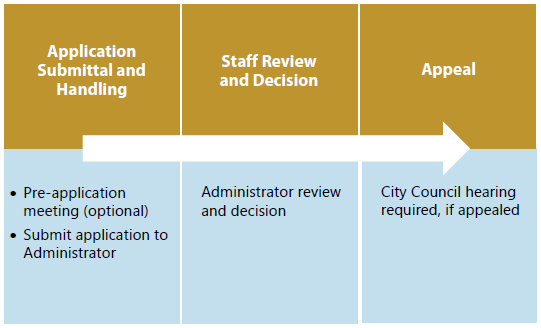
(1)
Application Submittal and Handling Final subdivision map applications shall be submitted, accepted, and revised, and may be withdrawn, in accordance with Section 18.08.303, Application Submittal and Handling.
(2)
Review and Decision
a.
The Administrator or designee shall review the final subdivision map for conformance to all the requirements of NRS Sections 278.010 to 278.630, inclusive, and any ordinances applicable at the time of approval of the final map, or any ruling made thereunder. If the final subdivision map fails to conform to all the above requirements, the final subdivision map application shall be denied.
b.
If the Administrator approves the final subdivision map, the Administrator shall also accept or reject all offers of dedication and may, as a condition of acceptance of streets or easement, require the subdivider to improve or agree to improve the streets or easement.
(3)
Appeal The decision of the Administrator may be appealed to the Planning Commission and subsequently the City Council in accordance with Subsection 18.08.307(j), Appeal.
(Ord. No. 6692, § 1(Exh. A), 1-8-25)
18.08.704 - Parcel Map
(a)
Purpose This section describes the process by which minor proposals for division of land are reviewed for compliance with the Master Plan and the development and design standards of this Title.
(b)
Authority This authority for this section is NRS Sections 278.461 to 278.4725, inclusive.
(c)
Applicability
(1)
General The procedures of this section shall apply to all applications to subdivide four lots or less for transfer or development per NRS Section 278.461.
(2)
Waiver of Parcel Map
a.
The Planning Commission may waive the requirement of a parcel map.
b.
The Planning Commission shall act upon a request for a waiver within 60 days after the date of the request for the waiver.
c.
By mutual agreement, the time for the Planning Commission to act on a request for a waiver may be extended.
d.
If the Planning Commission waives the requirement of a parcel map, the Planning Commission may impose the requirements set forth in NRS Section 278.467.
(d)
Application Submittal and Review Processes Figure 8-17, below, identifies the applicable steps from Article 3, Common Review Procedures, that apply to the review of applications for parcel maps. Additions or modifications to the common review procedures are noted below.
Figure 8-17: Summary of Parcel Map Procedures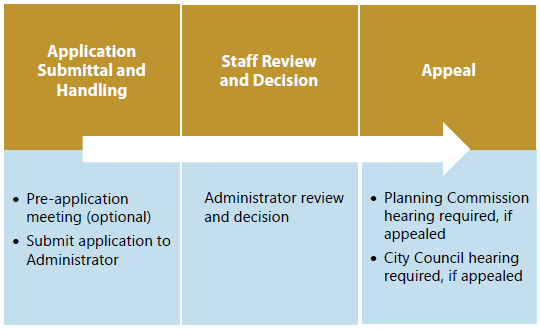
(1)
Application Submittal and Handling Parcel map applications shall be submitted, accepted, and revised, and may be withdrawn, in accordance with Section 18.08.303, Application Submittal and Handling.
(2)
Review and Decision
a.
The Administrator shall approve, conditionally approve, or deny a parcel map within 60 days after the Administrator or designee accepts the application as complete.
b.
The Administrator and the applicant may mutually agree to extend the 60-day period.
c.
In reviewing applications for parcel maps, the Administrator shall consider the criteria set forth in NRS Section 278.349(3) and the effect of the proposed parcel map on existing drainage patterns and the need for new drainage facilities to serve the parcel map.
d.
The Administrator may impose conditions to protect the safety, health, and welfare of the public.
(3)
Appeal The decision of the Administrator may be appealed to the Planning Commission and subsequently to the City Council in accordance with Subsection 18.08.307(j), Appeal.
(e)
Post-Decision Actions and Limitations
(1)
Second or Subsequent Parcel Map within Five Years
a.
In accordance with NRS Section 278.464, the Planning Commission is authorized to act upon a second parcel map for land divided by a parcel map that was recorded within five years of accepting the latest complete application.
b.
The Planning Commission decision may be appealed in accordance with Subsection 18.08.307(j), Appeal.
(f)
Conditions of Approval
(1)
The Administrator is authorized to determine if all conditions imposed on a parcel are satisfactorily met.
(2)
As an alternative to actual completion of public improvements, the Administrator may accept an improvement agreement and security in the form as provided in Section 18.04.1203, Improvement Agreements and Security.
(Ord. No. 6692, § 1(Exh. A), 1-8-25)
18.08.705 - Reversion to Acreage
(a)
Purpose This section describes the process by which applications to revert to acreage any recorded subdivision map, parcel map, or map of division into large parcels are reviewed for compliance with the Master Plan and the development and design standards of this Title.
(b)
Authority The authority for this section is from NRS Section 278.490 to 278.496, inclusive.
(c)
Applicability The procedures of this section apply to all applications to revert to acreage any recorded subdivision map, parcel map, or map of division into large parcels, or any part thereof.
(d)
Application Submittal and Review Processes Figure 8-18, below, identifies the applicable steps from Article 3, Common Review Procedures, that apply to the review of applications for reversion to acreage. Additions or modifications to the common review procedures are noted below.
Figure 8-18: Summary of Reversion to Acreage Procedures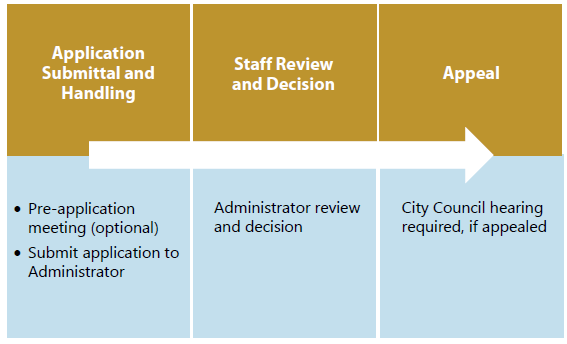
(1)
Application Submittal and Handling
a.
Reversion to acreage applications shall be submitted, accepted, and revised, and may be withdrawn, in accordance with Section 18.08.303, Application Submittal and Handling.
b.
In the case of condominiums, the applicant shall provide all certificates as required, including the appropriate fees in accordance with NRS Section 247.305.
(2)
Review and Decision The Administrator shall approve or disapprove a reversion to acreage within 30 days of the date the Administrator accepts the application as complete.
(3)
Appeal The decision of the Administrator may be appealed to City Council in accordance with Subsection 18.08.307(j), Appeal.
(Ord. No. 6692, § 1(Exh. A), 1-8-25)
18.08.706 - Boundary Line Adjustment
(a)
Purpose This section describes the process by which applications to correct or amend a recorded subdivision map, parcel map, map into division into large parcels, or reversionary map are reviewed for compliance with the Master Plan and the development and design standards of this Title.
(b)
Applicability The procedures of this section apply to all applications to correct or amend a recorded subdivision map, parcel map, map into division into large parcels, or reversionary map, where the correction or amendment changes, or purports to change, the physical location of any survey monument, property line, or boundary line.
(c)
Application Submittal and Review Processes Figure 8-19, below, identifies the applicable steps from Article 3, Common Review Procedures, that apply to the review of applications for boundary line adjustment. Additions or modifications to the common review procedures are noted below.
Figure 8-19: Summary of Boundary Line Adjustment Procedures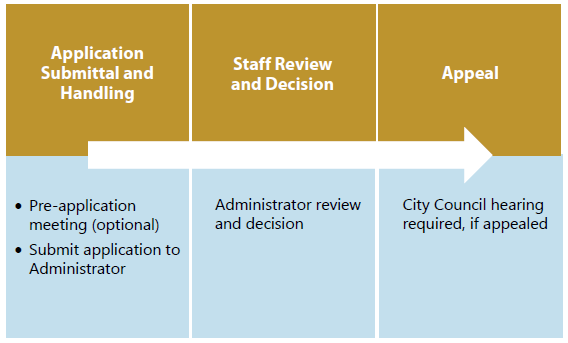
(1)
Application Submittal and Handling
a.
Boundary line adjustment applications shall be submitted, accepted, and revised, and may be withdrawn, in accordance with Section 18.08.303, Application Submittal and Handling.
b.
In the case of condominiums, the applicant shall provide all certificates as required, including the appropriate fees, in accordance with NRS Section 247.305.
(2)
Review and Decision The Administrator shall approve or disapprove a boundary line adjustment application within 30 days of the date the Administrator accepts the application as complete.
(3)
Appeal The decision of the Administrator may be appealed in accordance with Subsection 18.08.307(j), Appeal.
(4)
Limitations and Modifications If the applicant fails to cause recordation of the boundary line adjustment within one year from the date of approval, the application shall be deemed expired.
(Ord. No. 6692, § 1(Exh. A), 1-8-25)
18.08.707 - Abandonment
(a)
Purpose This section describes the process by which proposals for abandonment or vacation of public rights-of-way or easements are reviewed in the interest of the City.
(b)
Applicability An application to abandon or vacate a public street, right-of-way, or easement, or any portion thereof, shall be reviewed according to the procedures in this section.
(c)
Application Submittal and Review Processes Figure 8-20, below, identifies the applicable steps from Article 3, Common Review Procedures, that apply to the review of applications for abandonment or vacation. Additions or modifications to the common review procedures are noted below.
Figure 8-20: Summary of Abandonment Procedures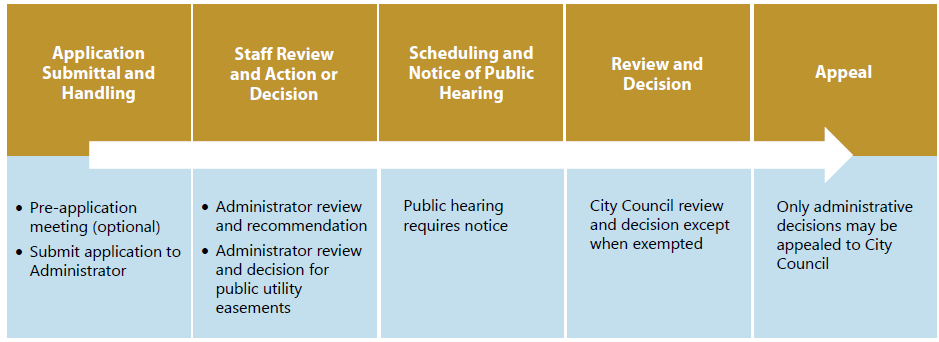
(1)
Application Submittal and Handling Abandonment applications shall be submitted, accepted, and revised, and may be withdrawn, in accordance with Section 18.08.303, Application Submittal and Handling.
(2)
Staff Review and Action or Decision
a.
General The Administrator shall review abandonments and provide a recommendation to the City Council, except those detailed in Subsection b., below, where the Administrator may approve or deny abandonments.
b.
Public Utility Easements
1.
For applications for abandonment of sewer, storm drain, or other public utility easements, the Administrator shall review and provide a decision within 65 days of acceptance of an application for abandonment of storm drain or sewer easements not presently utilized, or storm drain or sewer easements to be relocated as a result of a development project if it is determined that the public will not be materially injured by the proposed abandonment.
2.
Abandonments denied by the Administrator may utilize the review process described in this section for other applications for abandonment.
3.
Easements approved for abandonment by the Administrator shall be extinguished by recording a quitclaim deed.
(3)
Scheduling and Notice of Public Hearing
a.
The application for abandonment shall be scheduled for a public hearing before the City Council and noticed in accordance with this subsection and Section 18.08.305, Scheduling and Notice of Public Hearings.
b.
All abutting property owners and mobile home park tenants within the specified distance (in feet) from the outer boundary of the project site or 30 property owners, whichever is greater, shall be noticed mail not less than 10 days before the date of the public hearing. The method of notice must provide confirmation of delivery but does not require the signature of the recipient.
c.
Publication must be made at least 10 working days before the date of the public hearing.
(4)
Review and Decision
a.
The City Council shall hold a public hearing within 65 days of acceptance of the application for abandonment.
b.
Within 60 days of the public hearing, the City Council shall consider all evidence relative to the proposed abandonment and approve, approve with conditions, or deny the abandonment by a majority vote of a quorum of the City Council.
(5)
Appeal
a.
The decision of the Administrator for abandonment of a public utility easement may be appealed to the City Council in accordance with Subsection 18.08.307(j), Appeal.
b.
The decision of the City Council may be appealed in accordance with Subsection 18.08.307(j), Appeal.
(d)
Findings In approving any abandonment, the City Council shall find that the public will not be materially injured by the proposed abandonment.
(Ord. No. 6692, § 1(Exh. A), 1-8-25)
18.08.801 - Variance
(a)
Purpose This section describes the process by which requests for exception to compliance with the land development standards are reviewed for compliance with this Title and that potential impacts are considered.
(b)
Applicability Variances are exceptions to compliance with the land development standards found in this Title. Variances are intended to alleviate exceptional practical difficulties or undue hardship arising from the strict application of the provisions of this Title to a specific property. Variances address extraordinary, exceptional, or unique situations that were not caused by the applicant's act or omission.
(c)
Application Submittal and Review Procedures Figure 8-21, below, identifies the applicable steps from Article 3, Common Review Procedures that apply to the review of requests for variance from the land development standards of this Title. Additions or modifications to the common review procedures are noted below.
Figure 8-21: Summary of Variance Procedures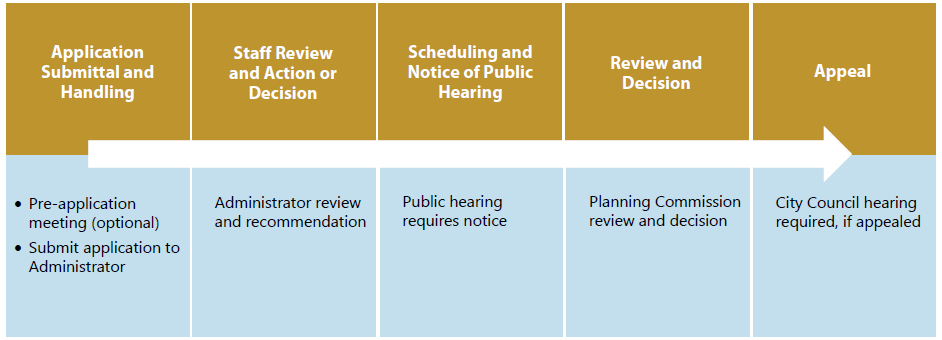
(1)
Application Submittal and Handling Variance applications shall be initiated by the property owner and be submitted, accepted, and revised, and may be withdrawn, in accordance with Section 18.08.303, Application Submittal and Handling.
(2)
Staff Review and Action The Administrator shall review variances and provide a recommendation to the Planning Commission.
(3)
Scheduling and Notice of Public Hearing The application for variance shall be scheduled for a public hearing before the Planning Commission and noticed in accordance with Section 18.08.305, Scheduling and Notice of Public Hearings.
(4)
Review and Decision The Planning Commission shall hold a public hearing within 65 days of the date of application and shall either approve or deny the application for variance within 30 days from the date of the hearing in accordance with Section 18.08.306, Review and Decision.
(5)
Appeal The decision of the Planning Commission may be appealed in accordance with Subsection 18.08.307(j), Appeal.
(6)
Modifications and Limitations All common procedures in Section 18.08.307, Post-Decision Actions and Limitations, shall apply.
a.
Time Limitations and Extensions
1.
Time Limitations
[a]
Variances that accompany tentative maps shall be valid as long as the tentative map is valid.
[b]
The owner or developer shall apply for a building permit for the entire project within 18 months of the date of approval of the variance application and maintain the validity of that permit, or the variance approval shall be null and void unless a different time limitation was established at the time of final approval based on the characteristics and complexity of the project.
2.
Extension by the Administrator
[a]
The Administrator may extend the time limit by up to 12 months if a request is received prior to the expiration of the time limit to apply for a building permit under a variance, provided that:
i.
The applicant agrees to comply with all requirements of this Title and all conditions of approval; and
ii.
The applicant agrees to pay all applicable fees.
[b]
No more than one administrative time extension shall be approved for any project or project phase.
3.
Extension by the Planning Commission
[a]
The Planning Commission may extend the time limit by six additional months if an application is received by the Administrator 45 days prior to the expiration of the extension granted by the Administrator, and the Planning Commission approves a schedule indicating that the applicant will apply for a building permit for the entire project or the relevant phase within the six-month extension.
[b]
In reviewing any such extension request, the Planning Commission shall consider the continued appropriateness of the project in the approved location and may add conditions to ensure that the project does not adversely impact other properties and to protect the public interest.
[c]
No more than one six-month time extension shall be approved for any project or project phase.
(d)
Findings
(1)
In addition to meeting the approval criteria in Section 18.08.304(e), Approval Criteria Applicable to all Applications, the following findings shall be made prior to granting a variance:
a.
The property is characterized by an extraordinary or exceptional situation or condition, such as exceptional narrowness, shallowness, or shape, or it has exceptional topographic conditions at the time of enactment of the regulations;
b.
The strict application of the regulation would result in peculiar and exceptional practical difficulties to, or exceptional and undue hardships upon, the owner of the property;
c.
Granting of the variance will not be materially detrimental to the public health, safety, or welfare, or injurious to property or improvements in the vicinity; and
d.
The proposed variance is consistent with the intent and purpose of this Title per Chapter 18.01 Article 2, Purpose.
(2)
In granting variances, the decision-making body shall have no power to take action which has the effect of allowing a use of land in contravention of the applicable zoning district or which in any other way changes the applicable zoning district. Any action that has in effect changed the zoning district shall be deemed a violation of powers of this section and be of no force and effect.
(3)
The fact that a building exists or was constructed or expanded in a manner which does not conform with this Title prior to the consideration of a variance application may not be used as a basis for the granting of a variance.
(4)
Where the variance pertains to an application marked as a First Amendment application by the applicant, the Planning Commission shall consider the following in lieu of Subsection (1)(c), above:
a.
Granting the variance will not be materially detrimental to property or improvements in the vicinity.
(e)
Conditions
(1)
In approving a variance the decision-making body may require conditions under which the lot or parcel may be used, or the building constructed, which, in the decision-making body's opinion, will prevent material damage or prejudice to adjacent properties, and provide suitable safeguards to the public health, safety and general welfare. These conditions may include:
a.
Architectural considerations;
b.
Access provisions;
c.
Off-street parking;
d.
Landscaping requirements; or
e.
Other controls.
(2)
All conditions must be satisfied and violation of the conditions shall result in revocation of the permission granted by the variance. Further use shall constitute a violation of this Chapter and shall be enforceable under Chapter 1.05, Code Enforcement.
(f)
Construction Prior to Approval If a structure exists or is under construction in violation of the provisions of this Title, the decision-making body, in granting a variance for the property, may condition such approval upon the payment of a fine of ten percent of the value of such structure, as determined by the Administrator in accordance with current practices for assessing building permit fees.
(Ord. No. 6692, § 1(Exh. A), 1-8-25)
18.08.802 - Major Deviation
(a)
Purpose Major deviations provide an opportunity for adjustments to quantifiable development standards when modifications enabled by the approval are not impactful to nearby properties or the general public. This is not a general waiver of regulations. Rather, this authorizes targeted deviations from standards when the changes benefit the overall project design.
(b)
Applicability
(1)
The Planning Commission may approve or deny major deviations of no more than 50 percent from quantifiable development standards in this Title.
(2)
The Planning Commission shall not allow major deviations from density standards, lot size standards, building height limitations, sign regulations, or the minimum number of required trees.
(c)
Application Submittal and Review Procedures Figure 8-22, below, identifies the applicable steps from Article 3, Common Review Procedures, that apply to the review of major deviation applications. Additions or modifications to the common review procedures are noted below.
Figure 8-22: Summary of Major Deviation Procedures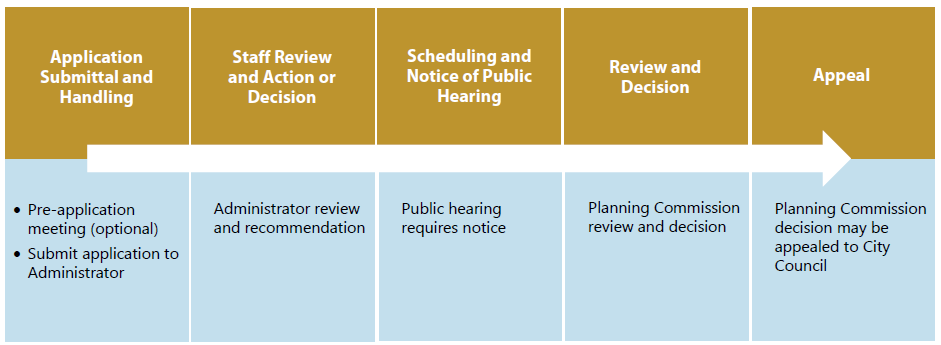
(1)
Application Submittal and Handling Major deviation applications shall be submitted, accepted, and revised, and may be withdrawn, in accordance with Section 18.08.303, Application Submittal and Handling.
(2)
Staff Review and Action The Administrator shall review the application and prepare a staff report and recommendation in accordance with Section 18.08.304, Review and Action.
(3)
Scheduling and Notice of Public Hearing The major deviation application shall be scheduled for a public hearing before the Planning Commission and noticed in accordance with Section 18.08.305, Scheduling and Notice of Public Hearings.
(4)
Review and Decision
a.
The Planning Commission shall hold a public hearing within 65 days of application.
b.
The Planning Commission shall approve, approve with conditions, or deny the application within 30 days from the date of the hearing in accordance with Section 18.08.306, Review and Decision, based on the general approval criteria in subsection 18.08.304(e), Approval Criteria Applicable to all Applications and the specific findings for major deviation in subsection 18.08.605(e), Findings, below.
(5)
Appeal The decision of the Planning Commission may be appealed to the City Council in accordance with Subsection 18.08.307(j), Appeal.
(6)
Post-Decision Actions and Limitations All common procedures in Section 18.08.307, Post-Decision Actions and Limitations, shall apply, with the following modifications:
a.
Time Limitations and Extensions
1.
Time Limitations
[a]
Major deviation applications that accompany tentative maps shall be valid as long as the tentative map is valid.
[b]
The owner or developer shall apply for a building permit for the entire project within 18 months of the date of approval of the major deviation review application and maintain the validity of that permit, or the major deviation approval shall be null and void unless a different time limitation was established at the time of final approval based on the characteristics and complexity of the project.
2.
Extension by the Administrator
[a]
The Administrator may extend the time limit by up to 12 months if a request is received prior to the expiration of the time limit to apply for a building permit under a major deviation, provided that:
i.
The applicant agrees to comply with all requirements of this Title and all conditions of approval; and
ii.
The applicant agrees to pay all applicable fees.
[b]
No more than one administrative time extension shall be approved for any project or project phase.
3.
Extension by the Planning Commission
[a]
The Planning Commission may extend the time limit by six additional months if an application is received by the Administrator 45 days prior to the expiration of the extension granted by the Administrator, and the Planning Commission approves a schedule indicating that the applicant will apply for a building permit for the entire project or the relevant phase within the six-month extension.
[b]
In reviewing any such extension request, the Planning Commission shall consider the continued appropriateness of the project in the approved location and may add conditions to ensure that the project does not adversely impact other properties and to protect the public interest.
[c]
No more than one six-month time extension shall be approved for any project or project phase.
(d)
Findings In addition to meeting the approval criteria in Section 18.08.304(e), Approval Criteria Applicable to all Applications, the following findings shall be made prior to approving a major deviation:
(1)
Granting the major deviation will not significantly impact nearby property;
(2)
Project changes enabled by the major deviation enhance the overall design of the project, operations of the project or the public benefits resulting from the project;
(3)
Granting of the major deviation does not constitute a special privilege inconsistent with the limitations upon other properties in the vicinity and land use district in which the property is located; and
(4)
Granting the major deviation will not be materially detrimental to the public health, safety, or welfare.
(Ord. No. 6692, § 1(Exh. A), 1-8-25)
18.08.803 - Alternative Equivalent Compliance
(a)
Purpose To encourage creative and unique design, "alternative equivalent compliance" allows development to occur in a manner that meets the intent of this Title, yet through an alternative design that does not strictly adhere to the specific design standards. This is not a general waiver of regulations. Rather, this authorizes a site-specific plan that is equal to or better than the strict application of the standard.
(b)
Applicability The alternative equivalent compliance procedure is available only for the standards in Articles 8-11 of Chapter 18.04 Development Standards.
(c)
Application Submittal and Review Procedures Figure 8-23, below, identifies the applicable steps from Article 3, Common Review Procedures, that apply to the review of alternative equivalent compliance applications. Additions or modifications to the common review procedures are noted below.
Figure 8-23: Summary of Alternative Equivalent Compliance Procedures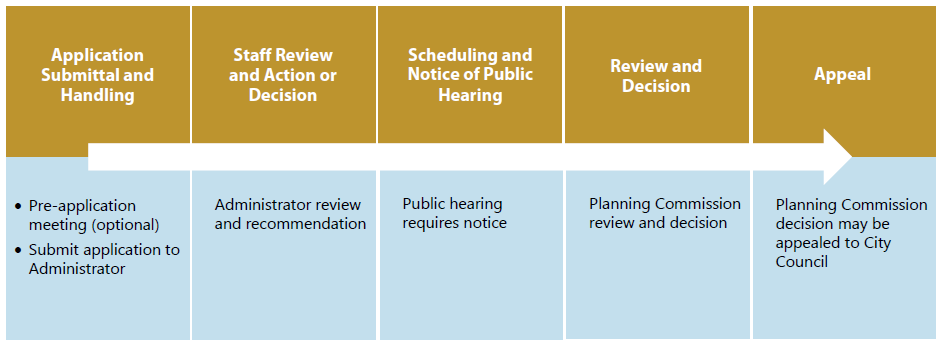
(1)
Application Submittal and Handling Alternative equivalent compliance applications shall be submitted, accepted, and revised, and may be withdrawn, in accordance with Section 18.08.303, Application Submittal and Handling.
(2)
Staff Review and Action The Administrator shall review the application and prepare a staff report and recommendation in accordance with Section 18.08.304, Review and Action.
(3)
Scheduling and Notice of Public Hearing The alternative equivalent compliance application shall be scheduled for a public hearing before the Planning Commission and noticed in accordance with Section 18.08.305, Scheduling and Notice of Public Hearings.
(4)
Review and Decision
a.
The Planning Commission shall hold a public hearing within 65 days of application.
b.
The Planning Commission shall approve, approve with conditions, or deny the application within 30 days from the date of the hearing in accordance with Section 18.08.306, Review and Decision, based on the general approval criteria in subsection 18.08.304(e), Approval Criteria Applicable to all Applications and the specific findings for alternative equivalent compliance in subsection 18.08.605(e), Findings, below.
(5)
Appeal The decision of the Planning Commission may be appealed to the City Council in accordance with Subsection 18.08.307(j), Appeal.
(6)
Post-Decision Actions and Limitations All common procedures in Section 18.08.307, Post-Decision Actions and Limitations, shall apply, with the following modifications:
a.
Time Limitations and Extensions
1.
Time Limitations
[a]
Alternative equivalent compliance applications that accompany tentative maps shall be valid as long as the tentative map is valid.
[b]
The owner or developer shall apply for a building permit for the entire project within 18 months of the date of approval of the alternative equivalent compliance application and maintain the validity of that permit, or the application approval shall be null and void unless a different time limitation was established at the time of final approval based on the characteristics and complexity of the project.
2.
Extension by the Administrator
[a]
The Administrator may extend the time limit by up to 12 months if a request is received prior to the expiration of the time limit to apply for a building permit under alternative equivalent compliance, provided that:
i.
The applicant agrees to comply with all requirements of this Title and all conditions of approval; and
ii.
The applicant agrees to pay all applicable fees.
[b]
No more than one administrative time extension shall be approved for any project or project phase.
3.
Extension by the Planning Commission
[a]
The Planning Commission may extend the time limit by six additional months if an application is received by the Administrator 45 days prior to the expiration of the extension granted by the Administrator, and the Planning Commission approves a schedule indicating that the applicant will apply for a building permit for the entire project or the relevant phase within the six-month extension.
[b]
In reviewing any such extension request, the Planning Commission shall consider the continued appropriateness of the project in the approved location and may add conditions to ensure that the project does not adversely impact other properties and to protect the public interest.
[c]
No more than one six-month time extension shall be approved for any project or project phase.
(d)
Findings Alternative equivalent compliance may be approved if the applicant demonstrates that following criteria have been met by the proposed alternative:
(1)
Achieves the intent of the subject standard to the same or better degree than the subject standard;
(2)
Advances the goals and policies of this Title to the same or better degree than the subject standard;
(3)
Results in benefits to the community that are equivalent to or exceed benefits associated with the subject standard;
(4)
Imposes no greater impacts on adjacent properties than would occur through compliance with the specific requirements of this Title; and
(5)
Is not materially detrimental to the public health, safety, or welfare.
(e)
Effect of Approval
(1)
Alternative equivalent compliance shall apply only to the specific site for which it is requested and shall not establish a precedent for approval of other requests.
(2)
Granting of the alternative equivalent compliance approval does not constitute a special privilege inconsistent with the limitations upon other properties in the vicinity and land use district in which the property is located.
(Ord. No. 6692, § 1(Exh. A), 1-8-25)
18.08.804 - Minor Deviation
(a)
Purpose This section describes the process by which requests for minor deviations from strict compliance with the land development standards are reviewed for compliance with this Title and that potential impacts are considered.
(b)
Applicability
(1)
Minor Deviations from Code Requirements The Administrator may approve or deny minor deviations of less than ten percent from quantifiable development standards in this Title and in accordance with NRS Section 278.319.
(2)
Minor Deviations in PUD or Specific Plan Districts The Administrator shall not grant minor deviations related to properties and land uses in Planned Unit Development (PUD) or Specific Plan (SPD) zoning districts unless the Administrator finds that there will be no significant effect on adjacent land uses located outside of the districts.
(c)
Application Submittal and Review Procedures Figure 8-24, below, identifies the applicable steps from Article 3, Common Review Procedures, that apply to the review of requests for minor deviation from the land development standards of this Title. Additions or modifications to the common review procedures are noted below.
Figure 8-24: Summary of Minor Deviation Procedures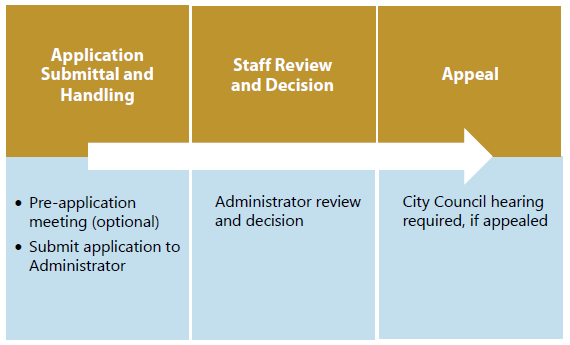
(1)
Application Submittal and Handling Minor deviation applications shall be initiated by application of the property owner with the written consent of the owner of any real property that would be affected by the deviation and be submitted, accepted, and revised, and may be withdrawn, in accordance with Section 18.08.303, Application Submittal and Handling.
(2)
Staff Review and Decision
a.
The Administrator shall review applications for minor deviations and approve or deny the minor deviation within 30 days of application submittal. In approving the minor deviation, the Administrator may require conditions as outlined in Subsection 18.08.804(e), below.
b.
No hearing is required for a minor deviation of less than ten percent per NRS Section 278.319.
(3)
Appeal
a.
The decision of the Administrator may be appealed in accordance with Subsection 18.08.307(j), Appeal.
b.
In addition to the right to appeal, an applicant may apply contemporaneously for a variance as provided in Section 18.08.801, Variance.
(d)
Findings In addition to meeting the approval criteria in Section 18.08.304(e), Approval Criteria Applicable to all Applications, the following findings shall be made prior to approving a minor deviation:
a.
Granting the minor deviation will not be materially detrimental to the public health, safety, or welfare, or injurious to property or improvements in the vicinity; and
b.
The proposed minor deviation is consistent with the intent and purpose of this Title.
(e)
Conditions
(1)
In approving a minor deviation, the Administrator may require conditions under which the lot or parcel may be used, or the building constructed, which, in the Administrator's opinion, will prevent material damage or prejudice to adjacent properties, and provide suitable safeguards to the public health, safety, and general welfare. These conditions may include:
a.
Architectural considerations;
b.
Access provisions;
c.
Off-street parking;
d.
Landscaping requirements; or
e.
Other controls.
(2)
All conditions must be satisfied, and violation of the conditions shall result in revocation of the permission granted by the minor deviation. Further use shall constitute a violation of this Chapter and shall be punishable as provided in Chapter 1.05, Code Enforcement.
(Ord. No. 6692, § 1(Exh. A), 1-8-25)
18.08.805 - Development Agreement
(a)
Purpose and Intent The purpose of this chapter is to provide an alternative mechanism, when deemed appropriate by the city council, to give assurance to a property owner who has obtained the necessary approvals for a project that he may proceed with and complete development, as specified in and in accordance with the development agreement, under the specified laws, ordinances, codes, resolutions, rules, regulations, plans, and conditions of approval adopted by the city council and in effect at the time the project was originally approved in return for specified benefits pursuant to the terms of a development agreement.
(b)
Applicability Pursuant to the provisions of NRS 278.0201 through 278.0207, the City Council may enter into development agreements to regulate the development of land within the City. The agreements and the procedures applicable thereto shall be governed by and must conform to NRS 278.0201 through NRS 278.0207 and the provisions of this Chapter. The administrator, subject to review and input from other City departments, has authority to apply, administer and enforce this section, including the negotiation and enforcement of development agreements.
(c)
Development Agreements in Existence at Time of Annexation Upon annexation, the city may adopt with or without modifications, a development agreement in existence between a property owner and another jurisdiction. The development agreement shall be administered consistent with provisions of RMC Title 18 to the extent that Title 18 is not in conflict with provisions of the development agreement.
(d)
Initiation An applicant shall file an application for a development agreement, along with the proposed development agreement and filing fee, as established by City Council resolution. Applications shall include an agreement to sponsor the application by the City Council member for that Ward, the Mayor, or the At-Large Council member. Sponsorship of an application does not bind a council member to support the application during review proceedings.
(e)
Application Submittal and Review Procedure Figure 8-25, below, identifies the applicable steps from Article 3, Common Review Procedures, that apply to the review of development agreements. Additions or modifications to the common review procedures are noted below.
Figure 8-25: Summary of Development Agreement Procedures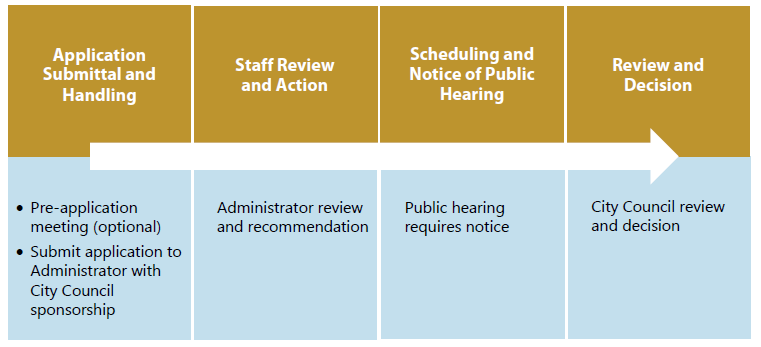
(1)
Filing Requirements
a.
An application for a development agreement shall be filed on forms prescribed by the administrator and shall include the following:
1.
The legal description of the property involved;
2.
The most recent assessor's maps with the subject property highlighted along with a list of the assessor's parcel number of all of the parcels involved;
3.
A written description of the proposed development and statement of objectives and reasons for the request;
4.
If the property has already received the associated approvals named above, copies of letters from the city clerk confirming the approvals and any related terms and conditions of approval;
5.
A copy of the map, site plans and materials submitted for the proposed development project;
6.
A statement of the proposed duration of the agreement;
7.
The proposed development agreement;
8.
Any other information required to provide a complete understanding of the proposed development agreement;
9.
A filing fee as established by the city council by resolution.
b.
The administrator shall review the application, and may reject it is inaccurate or incomplete for processing. Such rejection shall be in writing and shall be accompanied by the reasons for rejection. The applicant may modify or amend the application in accordance with the administrator's rejection without paying an additional filing fee or may appeal the administrator's rejection for inaccuracy or incompleteness in accordance with Section 18.08.307(j)(2), Appeal of Administrative Decisions to Hearing Examiner.
(2)
Contents and Approval Procedure
a.
A development agreement shall:
1.
Describe the land subject to the development agreement;
2.
Specify the permitted uses of the property, the density, or intensity of the uses, and the maximum height and size of proposed buildings;
3.
Provide, where appropriate, for reservation or dedication of land for public purposes, including, but not limited to rights-of-way, easements or public facilities, as may be required or permitted pursuant to laws, ordinances, resolutions, rules, or plans adopted by the city and in effect at the time of entering into the agreement;
4.
Specify the duration of the agreement and, if desired, terms for modification and extension of the agreement; provided, that the parties shall not be precluded from extending the termination date by mutual agreement or from entering into subsequent development agreements or supplements thereto;
5.
Specify the laws, ordinances, codes, resolutions, regulations, design and improvement standards by name and date of adoption applicable to the development of the land for which the applicant intends to establish a vested private development right;
6.
Specify other conditions, terms, restrictions, and requirements for other discretionary actions;
7.
Commit no vested rights other than those allowed in the agreement and otherwise provided under the laws of the City of Reno, the State of Nevada, or other state or local governmental or quasi-governmental bodies; and
8.
Not be used to circumvent the entitlement and/or discretionary review process.
b.
A development agreement may:
1.
Specify progress thresholds based upon the construction of specific public or private improvements or the submission of specific plans or data prior to the exercise of certain vested rights;
2.
Provide for commencement and completion of various portions of the proposed development. Each portion or phase of development or improvement contemplated should be able to stand alone, independent of proposed further phases or improvements. Subsequent phases of development may be added to completed phases to achieve independent status;
3.
Include conditions imposed by other land use and permit approvals allowed by law as of the effective date of the development agreement;
4.
If required by the city, be accompanied by a form of security as defined in Chapter 18.09 of this title as subsequently amended, or require submittal of a security with project phases. The security shall be posted by the property owner, to insure provision of some or all of the public facilities;
5.
Contain an indemnity or insurance clause requiring the developer, applicant and/or property owner to indemnify the city against certain claims arising out of the development process;
6.
Contain a clause regarding remedies to each party in the event of a default;
7.
Include provision or provisions which inure(s) to the benefit of the city or community which might not otherwise be provided by the developer to the city or community in the absence of the agreement.
c.
The development agreement also may cover any other matter not inconsistent with this chapter.
(3)
Review Process
a.
General The procedure for review of development agreements shall be in accordance with Chapter 18.08 of this title.
b.
Administrator The Administrator shall review the application and prepare a staff report and recommendation in accordance with Section 18.08.304, Review and Action.
c.
City Council
1.
The City Council shall hold a public hearing on all proposed development agreements. The development agreement application shall be scheduled for a public hearing before the City Council and noticed in accordance with Section 18.08.305, Scheduling and Notice of Public Hearings.
2.
There are no time limits for public hearings or decisions on development agreements.
(4)
Findings The City Council may enter into a development agreement when it can make the following findings:
a.
A development agreement is an appropriate mechanism to implement the project's development due to the project's complexity such as:
1.
Public and/or private infrastructure requirements;
2.
Proposed phasing and/or build-out schedules;
3.
Conditions of approval;
4.
Some other way which would be of benefit and in the best interest of the city;
b.
The development agreement is not in conflict with and supports the objectives, policies, general land uses, and programs specified in the master and regional plans;
c.
The development agreement is compatible with the uses authorized in, and the regulations prescribed for, the zoning district(s) in which the property is proposed to be located and is consistent with the associated approvals;
d.
The development agreement is in conformity with the public convenience and good land use practices;
e.
The development agreement will not be detrimental to the public health, safety, and general welfare;
f.
The development agreement will not adversely affect the orderly development of property and adequate consideration has been given to projected infrastructure capacity demands in the immediate area; and
g.
The development agreement is consistent with the provisions of NRS Chapter 278.
h.
The City Council shall approve an agreement by adoption of an ordinance. The agreement shall take effect upon the effective date of the ordinance.
(5)
Applicable Laws and Ordinances
a.
Where specified in the development agreement, the laws, ordinances, codes, resolutions, regulations, design, and improvement standards listed by name and date of adoption apply to the development of the land. Unless specified in the agreement or unless directly in conflict with what is specified in the agreement, the laws, ordinances, codes, resolutions, rules, regulations, and design and improvement standards adopted by the city council and in effect at the time of issuance of any required construction or building permit shall apply.
b.
A development agreement shall not prevent the city from adopting new laws, ordinances, codes, resolutions, design, and improvement standards or regulations that alter or amend those laws, ordinances, codes, resolutions, design and improvement standards and regulations in effect at the time the development agreement is made. A development agreement does not prevent the city, in subsequent actions applicable to the property from applying new laws, ordinances, codes, regulations, resolutions, design, or improvement standards which do not conflict with those laws, ordinances, codes, regulations, resolutions, design, or improvement standards applicable to the property under the development agreement, nor does a development agreement prevent the city from denying or conditionally approving any subsequent development project application on the basis of such existing or new rules, regulations and policies.
c.
The city may suspend the issuance of building permits for the development project after a noticed public hearing if it finds in good faith that it is necessary to protect the residents of the project or of the immediate community, or both, from a condition hazardous or perilous to the residents' health and/or safety.
d.
In the event that state or federal laws or regulations enacted after a development agreement has been entered into prevent or preclude compliance with one or more of the provisions of the development agreement, such provisions may be modified or suspended as may be necessary to comply with the new state or federal laws or regulations after the city and the property owner have attempted to mutually agree upon the modification or suspension. Any such action may only be taken by the city council after a public hearing.
(6)
Mutual Amendment or Cancellation
a.
The development agreement may be amended or canceled, in whole or in part, by mutual consent of the parties or their successor in interest in accordance with NRS 278.0205.
b.
Notice of the intention to amend or cancel any portion or all of a development agreement must be given in accordance with Section 18.08.805(e)(3), above. The city council may, after conducting a public hearing, approve any amendment or cancel any portion or all of an agreement by ordinance if the amendment or cancellation is consistent with the findings set forth in Section 18.08.805(e)(4), above.
(7)
Cancellation by City
a.
If at any time during the term of a development agreement, the city council finds by substantial evidence that the property owner has not complied with the terms and conditions of the development agreement, and such noncompliance has not been cured after notice and an opportunity to cure as specified in the development agreement, then the city may amend or cancel the agreement without the consent of the property owner.
b.
Prior to amending or canceling a development agreement due to noncompliance, notice of intention to amend or cancel shall be provided as follows:
1.
In writing to the property owner at least 30 days prior to the hearing; and
2.
The city council shall conduct a public hearing at which the property owner and any other interested person shall be entitled to submit such evidence and testimony as may be germane to the issue of the property owner's compliance with the terms of the development agreement.
c.
After conducting a hearing, the city council may amend or cancel the agreement, in whole or in part, or take other action considered necessary to protect the interests of the city.
(8)
Rights of the Parties After Cancellation or Termination In the event that a development agreement should be canceled, or otherwise terminated, unless otherwise agreed, all rights, except those already vested, of the property owner under the development agreement shall terminate. The property owner can proceed with the development pursuant to permits issued prior to the date of termination and under the existing rules, regulations, and ordinances of the city absent the development agreement.
(Ord. No. 6692, § 1(Exh. A), 1-8-25)
18.08.901 - Purpose
This article establishes and describes the organization, authority, duties, and operating procedures of the offices and decision-making bodies responsible for administering and enforcing this Title.
18.08.902 - City Council
(a)
Roles and Duties In addition to the roles and duties shown in Table 8-1, Summary Table of Review Procedures, the City Council shall have the following responsibilities in administering this Title:
(1)
Land Use Plans Review and approve, or deny new Master Plan elements, including citywide plans, neighborhood plans, center and corridor plans, and similar plans, and any updates or amendments to such plans.
(2)
Appointment As authorized by Nevada law and this Title, and subject to the provisions of this article appoint:
a.
Members and alternates to boards and commissions intended to administer and enforce this Title, including without limitation the Planning Commission and Historical Resources Commission.
b.
Hearing Examiner(s) intended to administer and enforce this Title.
(3)
Public Improvements Accept public improvements following their satisfactory completion.
(4)
Schedule of Fees Approve a schedule of fees necessary to effectively administer and enforce the provisions of this Title.
18.08.903 - Planning Commission
(a)
Authority The provisions of this section are adopted pursuant to NRS Sections 278.030 to 278.080, inclusive.
(b)
Purpose The purpose of the Planning Commission is to carry out the duties and functions outlined under NRS Chapter 278.
(c)
Roles and Duties In addition to the roles and duties shown in Table 8-1, Summary Table of Review Procedures, the Planning Commission shall have the following responsibilities in administering this Title:
(1)
To serve, advise, and make recommendations to the City Council on matters pertinent to reasonable and practical means for putting into effect the Master Plan or part thereof to serve as a pattern and guide for orderly physical growth and development of the city which will cause the least amount of natural resource impairment and will conform to the adopted population plan and ensure an adequate supply of housing and a basis for efficient expenditure of funds relating to the subject of the Master Plan.
(2)
To consider, advise, and make recommendations to the City Council on matters relating to urban planning including, but not limited to policy development, community design, natural resource conservation and enhancement, economics, housing, land use, population, streets, zoning, subdivision regulation, transportation, the Master Plan, and other matters authorized by state law.
(d)
Composition The Planning Commission shall be composed of seven Commissioners representing each of the six wards and one from the City at large. The City Manager shall appoint the members at the direction of the Mayor, or City Council member representing the ward or office experiencing a vacancy, subject to confirmation by the City Council.
(e)
Qualifications for Office
(1)
Each Planning Commissioner shall be appointed in accordance with NRS Section 278.040;
(2)
Each Planning Commissioner shall be a resident of the city at the time of their appointment and shall maintain such residency throughout their term; and
(3)
No Planning Commissioner shall hold another public office;
(4)
If there are not adequate qualified voters for a particular ward or at-large position at the time the vacancy occurs, the City Manager may recommend the appointment subject to the approval of the City Council.
(f)
Term of Office
(1)
The term of office of each Planning Commissioner shall be four years, expiring on June 30th, or until their successor takes office.
(2)
No Planning Commissioner shall be appointed for more than two full consecutive terms.
(g)
Compensation Pursuant to NRS Section 278.040, the City shall compensate each Planning Commissioner in the amount of $80.00 for each Commission meeting attended and the total compensation for each Planning Commissioner shall not exceed $300.00 per month.
(h)
Removal
(1)
Upon the third consecutive absence, the Administrator shall report the absences to the City Council, make recommendation regarding the absences of the Planning Commissioner to the City Council, and set the matter for public hearing before the City Council; and
(2)
Planning Commissioners may be removed in accordance with NRS Section 278.040(5).
(i)
Vacancies Vacancies occurring other than through the expiration of term must be filled for the unexpired term. Any vacancy must be filled within 30 days of the date the vacancy was created.
(j)
Meetings
(1)
All meetings shall be conducted in accordance with state and local open meetings laws;
(2)
The Planning Commission shall hold at least one regular meeting in each month and such other meetings as it deems necessary to transact the business of the Commission; and
(3)
Minutes shall be kept of all meetings.
(k)
Records The Planning Commission shall keep a record of its minutes, decisions, resolutions, recommendations, transactions, findings, and determinations and shall file its records in the City Clerk's office.
(Ord. No. 6692, § 1(Exh. A), 1-8-25)
18.08.904 - Historical Resources Commission
(a)
Creation of Historical Resources Commission There is hereby created a Historical Resources Commission (HRC).
(b)
Powers and Duties of the Historical Resources Commission The HRC shall have the following powers and duties:
(1)
Contribute to the development and review of plans, bylaws, rules, ordinances, regulations, and implementation programs affecting historic resources; Survey districts, areas, places, buildings, structures, sites, landscapes, objects and properties having historic, community, architectural, archaeological, or aesthetic value;
(2)
Administer on behalf of the city, a register of historic resources to include information concerning historic resources, and make nominations to the National Register of Historic Places;
(3)
Review and act upon applications for designation, demolition, alteration, and maintenance of historic resources;
(4)
Advise and assist owners or other persons, entities, or governmental, or private agencies concerned with historic resources, and confer recognition upon those involved in exceptional historic preservation efforts;
(5)
Inform and educate the community concerning historic resources through promotion, signage and wayfinding, publishing information, and by developing interpretive programs and holding events;
(6)
Administer, in accordance with a budget approved by the City Council, gifts, grants, money, and contracts as may be appropriate for the purposes of the commission and this Chapter;
(7)
Present, hear evidence, testify, or assist as appropriate before all boards, commissions, committees, councils, and related public and private entities on any matter affecting historic resources;
(8)
Work with City staff to implement adaptive reuse policy by incentivizing the use and preservation of existing building stock in new and creative ways; and
(9)
Play a significant role in the renaming of public facilities with potential historical significance, resources listed on the local register, or resources within a local register historic district.
(c)
Composition
(1)
The HRC shall consist of seven members, who are residents of the State of Nevada, each appointed by an affirmative vote of no less than four members of the City Council, which includes the mayor. At all times, five commissioners shall be residents of the City of Reno.
(2)
At a minimum, the HRC shall be composed of the following positions:
a.
One position held by a person who is a registered architect in the State of Nevada;
b.
One position held by a person who is an historian with knowledge of local history;
c.
One position held by a structural or civil engineer licensed in the State of Nevada; and,
d.
Remaining positions held by persons who have demonstrable interest, competence, or knowledge of historic preservation in the disciplines of landscape architecture, real estate, construction, community development, urban planning, archeology, law, finance, cultural geography, cultural anthropology, or related disciplines.
(d)
Terms of Office
(1)
The regular term of membership on the HRC shall be three years.
(2)
A commissioner may serve two consecutive regular terms on the HRC.
(3)
A person may serve more than two consecutive regular terms on the HRC in accordance with this subsection provided such regular terms are separated by a period of not less than three years.
(e)
Designation of Alternate Commissioner
(1)
The City Council, which includes the mayor, may designate an alternate commissioner to serve on the HRC when a commissioner is temporarily absent. The commissioner's temporary absence shall not exceed three months. The designated alternate commissioner shall meet the same requirements of the position as the commissioner who is temporarily absent.
(2)
A commissioner is temporarily absent when they will be absent at a regular meeting for a consecutive third time or longer.
(3)
Either the chair of the HRC or the temporarily absent commissioner may seek the designation of an alternate commissioner. Before any such alternate commissioner may serve on the HRC, the City Council shall have appointed the alternate commissioner for a specific period. The period of designation shall be three months.
(4)
An alternate commissioner may be designated for more than one three-month period.
(5)
Once an alternate commissioner is designated, the alternate shall sit as a commissioner on the HRC for the period of the designation.
(Ord. No. 6692, § 1(Exh. A), 1-8-25)
18.08.905 - Hearing Examiner
(a)
Authority The provisions of this section are adopted pursuant to NRS Sections 278.262 to NRS 278.265, inclusive, 278.278.300 to 278.35, inclusive, 278.310, and 278.3195.
(b)
Roles and Duties In addition to the roles and duties shown Table 8-1, Summary Table of Review Procedures, the Hearing Examiner shall hear and decide appeals where it is alleged by the appellant that there is an error in any order, requirement, decision, and refusal made by an administrative official or agency based on, or made in, the administration or enforcement of any zoning regulation or any regulation relating to the location or soundness of structure.
(c)
Qualifications A Hearing Examiner shall:
(1)
Be appointed in accordance with NRS Section 278.262, as amended.
(2)
Possess qualifications similar to those of a licensed architect, attorney, engineer, or a member of the American Institute of Certified Planners, and
(3)
Be appointed by the Mayor, subject to confirmation by the City Council.
(d)
Term of Office Hearing Examiners serve at the pleasure of the City Council in accordance with an appropriate personnel ordinance or regulation.
(e)
Compensation Hearing Examiners are entitled to receive such compensation as is considered necessary by the City Council.
(f)
Final Authority The Hearing Examiner shall have final authority unless a decision is appealed within the time allotted for appeals as set forth elsewhere in this chapter.
(g)
Records Hearing Examiners shall keep a record of its minutes, decisions, and recommendations, and shall file its records in the City Clerk's office.
18.08.906 - Administrator
The Administrator shall have those administration and review roles as shown in Table 8-1, Summary Table of Review Procedures, and as may be specified in other provisions of this Title.

