
Reno City Zoning Code
CHAPTER 18
03 - Use Regulations
Article 2 - Table of Allowed Uses
Table 3-1, Table of Allowed Uses, lists the uses allowed within each base zoning district. Each listed use is defined in Chapter 18.09 Article 3, Definitions of Use Categories and Use Types.
18.03.101 - Purpose
This chapter identifies the land uses allowed in Reno's zoning districts and establishes standards that apply to certain uses with unique characteristics or impacts.
18.03.102 - Organization
(a)
Article 2, Table of Allowed Uses, lists uses allowed by district and provides cross-references to applicable use-specific standards.
(b)
Article 3, Use-Specific Standards, establishes use-specific standards applicable to specific land uses.
(c)
Article 4, Accessory Uses and Structures, establishes standards applicable to accessory uses and structures.
(d)
Article 5, Temporary Uses and Structures, establishes standards applicable to temporary uses and structures.
18.03.201 - Explanation of Table Abbreviations
(a)
Permitted Uses A "P" designation in a cell within Table 3-1, Table of Allowed Uses, indicates that the use is allowed in the respective zoning district. Permitted uses are subject to all other applicable standards in this Title.
(b)
Permitted with Minor Conditional Use Permit An "M" designation in a cell within Table 3-1, Table of Allowed Uses, indicates that the use is allowed in the respective zoning district only with approval of a minor conditional use permit pursuant to Section 18.08.604, Minor Conditional Use Permit. The use shall comply with all applicable use-specific standards referenced in the summary use table. Uses requiring minor conditional use permits are also subject to all other applicable standards in this Title. The "M" designation does not constitute authorization or ensure that a minor conditional use permit will be approved for that use. Each minor conditional use permit application shall be evaluated on its own merit based on the findings in Section 18.08.604(e). An applicant may elect to process a minor conditional use permit application in accordance with procedures for a conditional use permit.
(c)
Conditional Use Permit Required A "C" designation in a cell within Table 3-1, Table of Allowed Uses, indicates that the use is allowed in the respective zoning district only with approval of a conditional use permit pursuant to Section 18.08.605, Conditional Use Permit. The use shall comply with all applicable use-specific standards referenced in the summary use table. Uses requiring conditional use permits are also subject to all other applicable standards in this Title. The "C" designation does not constitute authorization or ensure that a conditional use permit will be approved for that use. Each conditional use permit application shall be evaluated on its own merit based on the findings in Section 18.08.605(e).
(d)
Alternative Permission Types
(1)
An asterisk "*" in a cell within Table 3-1, Table of Allowed Uses, indicates that use specific standards may require an enhanced administrative review, public hearing, or specifically listed geographic locations where they use is allowed.
(e)
Permitted Accessory Uses An "A" designation in a cell within Table 3-1, Table of Allowed Uses indicates that the use is allowed as an accessory use in the respective zoning district. Permitted accessory uses are subject to all other applicable standards in this Title. An asterisk "*" designation in a cell follows the alternative permission types outlined for primary uses in Section 18.03.201(d), above.
(f)
Prohibited Uses A blank cell in Table 3-1, Table of Allowed Uses indicates that the use is prohibited in the respective zoning district.
(g)
Use-Specific Standards Regardless of whether a use is allowed by right or with any additional, additional standards may be applicable to that use. Such use-specific standards are identified and cross-referenced in the last column of Table 3-1, Table of Allowed Uses.
(Ord. No. 6692, § 1(Exh. A), 1-8-25)
18.03.202 - Table Organization
In Table 3-1, Table of Allowed Uses, land uses and activities are classified into general use categories and specific use types based on common functional, product, or physical characteristics such as the type and amount of activity, the type of customers or residents, how goods or services are sold or delivered, and site conditions. This classification provides a systematic basis for assigning present and future land uses into appropriate zoning districts. This classification does not list every use or activity that may appropriately exist within each category. Certain uses may be listed in one category when they may reasonably have been listed in one or more other categories. The use categories are intended as an indexing tool and are not regulatory.
18.03.203 - Multiple Uses
(a)
A lot or parcel may include one principal use, but may also include any Accessory or Temporary uses as shown in Table 1.38, provided that all use-specific standards applicable to each use are met.
(b)
A lot or parcel may include multiple principal uses, including a combination of residential and nonresidential uses, provided that each use is permitted by right, or permitted with site plan approval, major site plan approval, minor conditional use permit, or conditional use permit as shown in Table 3-1, Table of Allowed Uses, and that all use-specific standards applicable to each use are met.
18.03.204 - Use for Other Purposes Prohibited
Approval of a use listed in Table 3-1, Table of Allowed Uses, and compliance with the applicable use-specific standards for that use, authorizes that use only. Buildings and structures shall not be erected, altered, or enlarged except for the uses listed in Table 3-1, Table of Allowed Uses. All other uses not specifically listed are prohibited and shall be unlawful unless the Administrator has determined an appropriate use category and use type for the unlisted use pursuant to the procedure in Section 18.03.205, below.
18.03.205 - Classification of New and Unlisted Uses
The following procedure shall apply if an application is submitted for a use category or use type that is not specifically listed in Table 3-1, Table of Allowed Uses. Submission and approval of such an application shall be required prior to approval of any other permit or development approval associated with the use.
(a)
Administrator Determination of Appropriate Use Category and Use Type The Administrator shall determine the appropriate use category and use type for the proposed use. In making such determination, the Administrator shall consider the potential impacts of the proposed use including the nature of the use and whether it includes dwellings, sales, processing, or storage; and typical operations, employment characteristics, nuisances, requirements for public utilities, and transportation requirements.
(b)
Establish Use-Specific Standards if Necessary When establishing a use category and specific use type, the Administrator shall also determine whether additional use-specific standards are necessary to reduce potential impacts to surrounding properties or the community.
(c)
Uses Requiring a Code Text Amendment In deciding on a new or unlisted use, the Administrator may determine that such new or unlisted use requires a text amendment of this Title. A text amendment to this Title shall follow the procedures in Section 18.08.501, Code Text Amendment.
(d)
Appeal of Administrator's Determination An appeal of the Administrator's determination may be made pursuant to the procedures in Subsection 18.08.307(j), Appeal.
18.03.206 - Table of Allowed Uses
(Ord. No. 6614, § 1(Exh. B, §1.1), 12-8-21; Ord. No. 6638, § 1, 10-26-22; Ord. No. 6682, § 1, 7-24-24; Ord. No. 6692, § 1(Exh. A), 1-8-25; Ord. No. 6727, § 1, 10-8-25; Ord. No. 6732, § 1, 1-14-26)
18.03.301 - Generally
(a)
Applicability Use-specific standards shall apply to all zoning districts unless otherwise noted.
(b)
Cross-References in Table of Allowed Uses All uses with use-specific standards as indicated in the right-hand column of Table 3-1 shall comply with the applicable standards in this section, in addition to the applicable standards in Chapter 18.04 Development Standards.
(c)
Resolution of Conflicting Standards In case of a conflict between these use-specific standards and the standards in Chapter 18.04 Development Standards, these use-specific standards shall apply unless otherwise noted.
18.03.302 - Residential Uses
(a)
Household Living
(1)
Dwelling, Duplex, Triplex, and Fourplex
a.
Each individual dwelling unit shall have a separate entrance.
(2)
Dwelling, Live/Work
a.
Residential areas shall be located on upper floors, or in other areas not required for access to nonresidential areas.
(3)
Dwelling, Multi-Family
a.
All Districts
1.
A parcel/subdivision plat is required for condominium conversions.
2.
Shall provide two washers and four dryers per 20 dwelling units or hook-ups in each dwelling unit.
3.
Shall provide air conditioners when adjacent to major arterials or under the airspace of the Reno-Tahoe or Reno-Stead Airports per Subsections 18.02.602(a) and 18.02.602(b).
4.
Facilities with ten or more two-bedroom units shall provide a central playground or alternative resident amenity approved by the Administrator, equivalent to 15 square feet per two-bedroom dwelling unit.
5.
Shall provide recycling containers on-site.
6.
Facilities with 30 or more units shall provide the following:
[a]
A lighted building directory in a public area,
[b]
Lidded dumpsters,
[c]
Covered mailboxes located in a central area which is lighted and has seating available,
[d]
Laundry rooms with secured access or laundry facilities in each unit, and
[e]
Common areas visible from windows.
b.
MF-14, MF-21, MF-30, NC, and GC Districts
1.
A minor conditional use permit is required if more than 20 and less than 100 units are proposed.
2.
A conditional use permit is required if 100 or more units are proposed.
c.
ME District
1.
Multi-family residential dwellings are permitted only on properties located within the area bounded by Sutro Street on the east, Valley Road on the west, Timber Way on the south, and Paintbrush Drive and the Union Pacific Railroad right-of-way on the north.
2.
A minor conditional use permit is required if less than 100 units are proposed.
3.
A conditional use permit is required if 100 or more units are proposed.
4.
Any multi-family project in the ME zoning district shall follow all MF-30 standards including:
[a]
All lot and building standards per Chapter 18.02 Article 2;
[b]
All standards for accessory uses/structures per Chapter 18.03 Article 4;
[c]
Site and building standards for residential districts per Chapter 18.04 Article 9; and,
[d]
All applicable development standards in Chapter 18.04.
5.
A disclosure shall be provided to each resident with their lease agreement notifying them that they are located within a zoning district that allows industrial uses that may produce noise, offensive odors, truck traffic, bright lighting and/or glare. Said disclosure shall also be recorded such that it appears on the title report for the subject property.
6.
Screening shall be required between the residential use and adjacent non-residential use, regardless of the underlying zoning designation per Section 18.04.808.
(4)
Dwelling, Single-Family Attached
a.
All Districts
1.
Except where noted, a minor conditional use permit is required if the number of units proposed is more than 20 and less than the conditional use permit threshold.
2.
A tentative map is required for new construction or conversion of five or more townhouse or condominium units.
b.
PO, PF, and NC Districts A conditional use permit is required if 50 or more units are proposed.
c.
SF-5, SF-8, SF-11, MF-14, MF-21, and MF-30 Districts
1.
A minor conditional use permit is required if more than 20 and less than 100 units are proposed.
2.
A conditional use permit is required if 100 or more units are proposed.
d.
ME District
1.
Single-family attached residential dwellings are permitted only on properties located within the area bounded by Sutro Street on the east, Valley Road on the west, Timber Way on the south, and Paintbrush Drive and the Union Pacific Railroad right-of-way on the north.
2.
A minor conditional use permit is required if less than 100 units are proposed.
3.
A conditional use permit is required if 100 or more units are proposed.
4.
Any single-family attached residential project in the ME zoning district shall follow all MF-30 standards including:
[a]
All lot and building standards per Chapter 18.02 Article 2;
[b]
All standards for accessory uses/structures per Chapter 18.03 Article 4;
[c]
Site and building standards for residential districts per Chapter 18.04 Article 9; and,
[d]
All applicable development standards in Chapter 18.04.
5.
A disclosure shall be provided to each resident with their lease agreement notifying them that they are located within a zoning district that allows industrial uses that may produce noise, offensive odors, truck traffic, bright lighting and/or glare. Said disclosure shall also be recorded such that it appears on the title report for the subject property.
6.
Screening shall be required between the residential use and adjacent non-residential use, regardless of the underlying zoning designation per Section 18.04.808.
(5)
Dwelling, Single-Family Detached
a.
PGOS District The minimum lot size shall be 50 acres or the existing lot size, whichever is less.
(6)
Manufactured Home
a.
Dwellings shall be permanently affixed to a full perimeter foundation designed to meet local requirements. Anchorage of the structure to the foundation shall provide a mechanism for effectively transferring building loads to the foundation. A Nevada Registered Engineer's design of the foundation and anchorage system may be required at the discretion of the Administrator.
b.
Dwellings shall be converted to real property as defined by the Washoe County Assessor.
c.
Dwellings shall have been manufactured within six years of being affixed to the lot.
d.
Roofing materials and colors shall be different than siding materials and colors to create contrast. Acceptable roofing materials include asphalt shingle, tile, wood shake, colored metal, raw steel, or solar panels. Acceptable siding materials include wood, stucco, masonry, rock, vinyl, colored metal, or raw steel.
e.
Dwellings shall consist of one or more sections with a minimum size of 400 square feet.
f.
Siding shall extend to within 12 inches of grade.
(7)
Mobile Home Park
a.
Permits Required
1.
Mobile home parks proposed to be constructed or expanded shall require the approval of a conditional use permit.
2.
Construction or alteration of a mobile home park requires a permit from the building department.
3.
Prior to placement of an individual mobile home in a mobile home park, application for inspection shall be made to the building department.
b.
Applicability to Existing Parks The City recognizes that there are many examples of parks that do not conform with these standards but provide important affordable housing options in the community. Modifications to an existing park that does not conform with these standards shall not require that the entire park be brought into conformance, but instead shall include proportional improvements to achieve closer conformance, with a priority on public safety, planting of trees, and pedestrian improvements.
1.
New units that are too large to fit into an existing park and cannot meet setbacks or individual mobile home site standards may be approved by the Administrator.
c.
Closure or Conversion of Existing Park Closure or conversion of a mobile home park shall comply with the provisions of NRS Section 278.0232 and 118B.184.
d.
Permitted Uses
1.
One mobile home per space.
2.
One carport, garage, or carport/garage combination per mobile home and other accessory buildings in compliance with this chapter and Chapter 18.04 Development Standards, except that a prefabricated metal storage shed of 90 square feet or less may be placed in the side setback provided that drainage is not impaired
3.
Community recreational buildings and facilities, laundry, car wash, screened boat or storage facilities serving the mobile home park only.
4.
Management office or one single-family dwelling, mobile home, or manufactured home used exclusively for living quarters by the operator or manager of the park.
e.
Area, Lot, and Bulk Development Standards The following standards apply instead of the base zoning district standards:
f.
Street System
1.
All streets shall be constructed in accordance with this Title.
2.
Streets shall have a paved section not less than 24 feet in width and a right-of-way of not less than 24 feet.
3.
All streets and walkways shall be properly signed and lighted from dusk until dawn. The lights shall be designed and maintained to produce at least 0.1-foot candle of light at street level throughout the system of streets and walkways. Potentially hazardous locations, such as intersections of major streets, steps, or stepped ramps, shall be individually illuminated with at least 0.3-foot candle of light. Such lighting shall be controlled manually by the operator of the mobile home park or be under an automatic system of control.
4.
The grade of a street in a mobile home park shall not exceed eight percent, except that for a short distance a street may have a grade of up to 12 percent if traffic safety is not thereby impaired.
g.
Off-Street Automobile Parking Requirements
1.
Off-street parking for each mobile home space shall follow the parking requirements defined in Table 4-7 in Section 18.04.705.
2.
Where streets are less than 32 feet in width, provisions shall be made for guest parking at not less than one guest automobile parking space for each six mobile home spaces.
3.
Where streets are less than 32 feet in width, no on-street parking shall be allowed.
4.
All vehicle parking spaces and driveways shall be paved.
h.
Landscaping Except for driveways and parking spaces provided in accordance with this section, the front setback area of each mobile home space shall be landscaped. Except as provided elsewhere in this section, all other ground surfaces within a mobile home park shall be covered with suitable materials or protected with vegetation capable of preventing soil erosion and eliminating dust.
i.
Recreation Area Unless each space within a mobile home park is located within a walking distance of one-quarter mile or less of a public park, a mobile home park shall have at least one recreation area or open space conveniently accessible from all spaces; the cumulative size of which recreation area shall not be less than five percent of the gross mobile home park area and shall be landscaped or developed with recreational facilities. Parks catering to family use will be required to provide larger recreation areas and adequate playgrounds.
j.
Pedestrian Ways When included, pedestrian ways shall have a minimum width of three feet, be constructed of an all-weather surface, and be lighted in accordance with item f(3) of this subsection.
k.
Refuse and Garbage
1.
In every mobile home park not having individual garbage and trash collection services for each mobile home space, an adequate number of garbage and trash containers shall be provided, each on a concrete slab, enclosed in accordance with Section 18.04.808(c), Screening of Outdoor Service Areas, Utilities, and Equipment. Every mobile home space shall be within 200 feet of such garbage of trash disposal areas.
2.
Containers to be used for bulk storage of garbage and rubbish shall be placed on concrete slabs which are constructed to minimize spillage onto adjacent areas and shall be equipped with drains properly connected to the sewer system. In the immediate vicinity of any container for bulk storage there shall be a water faucet for use in cleaning the container or some other means for cleaning it which is approved by the building department. Each such container shall be equipped with a self-closing lid.
3.
Every mobile home park not served by either a municipal or private collection service shall provide for refuse to be collected twice weekly.
l.
Fuel Supply and Storage Installation of liquefied petroleum gas or fuel oil containers within a mobile home park shall be in conformance to any applicable statutes and ordinances, any regulations of the state or county district health departments, and to the satisfaction of the fire department.
m.
Fire Protection In every mobile home park, there shall be installed and maintained fire hydrants, and fire extinguishers of the number and size, and in such locations as may be required by the chief of the fire department.
n.
Screening Mobile home parks shall be fenced with a solid view-screening fence six feet in height around the entire boundary of the park. Where such a fence adjoins a public right-of-way a landscaped area no less than five feet in width shall be provided on the outside of the fence. A landscaped berm of 20 feet in width and three feet in height may be substituted for said fence.
o.
Marking Underground Utility Lines
1.
The underground location of electric cables, gas piping, water piping and sewer lines which are buried along the periphery of a space or within four feet of a mobile home stand shall be indicated by underground markers in the form of tapes, electrically connected wires or other means for locating the underground lines. Signs may be erected aboveground to assist in locating the lines, but such signs shall not be used in lieu of the required system of underground markers.
2.
The holder of the permit shall accurately plot the location of all underground utility lines when they are installed. The holder shall keep a copy of this plot for reference at the mobile home park and upon request, make it available to the city or public utilities.
p.
Management The holder of a valid City business license for the operation of a mobile home park shall be responsible for compliance with this Title and any other applicable ordinance or statute. The holder shall always maintain the mobile home park in a neat, orderly, and sanitary condition. Landscaping shall be maintained, or the business license may be revoked.
q.
Identification of Spaces
1.
Each mobile home space shall be numbered or designated by a street or space number or by another method that adequately identifies the space. The designation shall be displayed on:
[a]
A location facing the roadway, or
[b]
The front of the mobile home.
2.
Corner markers or other adequate means shall define the boundaries of each space. The inside surface of any fence or windbreak erected parallel to and delineating those boundaries or any perimeter wall or other enclosure of the park erected inside the property line shall be deemed to be the boundary of the space.
r.
Register The license holder shall be responsible for maintaining a register of the occupants of the park.
s.
Plan A copy of the final approved plan for the mobile home park shall be conspicuously posted on the site and the license holder shall be responsible for maintenance of the park as per the final approved plan. The holder of the license shall designate all mobile home spaces in accordance with the final approved plan for the mobile home park and shall maintain same to be readily ascertainable by representatives of the City.
t.
Location and Use Outside Parks
1.
Parking any mobile home or vehicle outside a mobile home park or a mobile home subdivision, when such mobile home or vehicle is used for dwelling or sleeping purposes, is unlawful.
2.
Storage of mobile homes shall be permitted only in Employment Districts.
u.
Violations Any person violating any of the provisions of this section:
1.
Upon conviction, shall be guilty of a misdemeanor and punished as provided in Section 1.04.010, General Penalty; Continuing Violations; or
2.
Shall be subject to provisions of Chapter 1.05, Code Enforcement.
(8)
Mobile Home Subdivision
a.
Applicability This Subsection shall apply to mobile home subdivisions constructed, expanded, or remodeled after the effective date of this ordinance. The Subsection does not apply to existing parks or resales of existing subdivisions, except for any portion of the subdivision being remodeled.
b.
Permitted Uses
1.
One mobile home per lot.
2.
Community recreation buildings and facilities.
3.
Accessory buildings and structures, subject to Chapter 18.03 Article 4, Accessory Uses and Structures.
c.
Development Requirements
1.
Maximum density: Same as the underlying zone.
2.
Maximum building height: Same as the underlying zone.
3.
Minimum lot area per mobile home: Same as the underlying zone.
4.
Minimum lot width: Same as underlying zone.
5.
Yards: Same as the underlying zone.
d.
Mobile Home Subdivisions Utilizing Small Lots and Homeowners' Associations
1.
Conditional Use Permit Required All mobile home subdivisions with reduced lot dimensions and homeowners' associations shall be subject to the approval of a conditional use permit.
2.
Applicability to Existing Mobile Home Subdivisions Those mobile home subdivisions using small lots with valid approvals from prior to the effective date of this subsection shall not be subject to any increased standard established by this subsection, but shall be governed by the initial approval. Any extension request shall make the project subject to all provisions of this subsection.
3.
Permitted Uses
[a]
One mobile home per lot.
[b]
Community recreation buildings and facilities.
[c]
Screened boat or RV storage facilities serving the mobile home subdivision only.
[d]
Accessory buildings and structures, subject to Chapter 18.03 Article 4, Accessory Uses and Structures.
4.
Prohibited Uses All uses prohibited in the underlying zone.
5.
Area, Lot, and Bulk Development Standards The following standards apply instead of the base zoning district standards:
6.
Street System
[a]
All streets shall be constructed in accordance with this Title.
[b]
Streets shall have a paved section not less than 24 feet in width and a right-of-way of not less than 24 feet.
[c]
All streets and walkways shall be properly signed and lighted from dusk until dawn. The lights must be designed and maintained to produce at least 0.1-foot candle of light at street level throughout the system of streets and walkways. Potentially hazardous locations, such as intersections of major streets, steps, or stepped ramps, must be individually illuminated with at least 0.3-foot candle of light. Such lighting must be under an automatic system of control.
[d]
The grade of a street must not exceed eight percent, except that for a short distance a street may have a grade of up to 12 percent if traffic safety is not thereby impaired.
7.
Off-Street Automobile Parking Requirements
[a]
Off-street parking for each mobile home space shall follow the parking requirements defined in Table 4-7 in Section 18.04.705.
[b]
Where streets are less than 32 feet in width, provisions shall be made for guest parking at not less than one guest automobile parking space for each six mobile home spaces.
[c]
Where streets are less than 32 feet in width, no on-street parking shall be allowed.
[d]
All vehicle parking spaces and driveways shall be paved.
8.
Landscaping Except for driveways and parking spaces provided in accordance with this section, the front setback area of each mobile home lot shall be landscaped. Except as provided elsewhere in this subsection, all other ground surfaces must be covered with suitable materials or protected with vegetation capable of preventing soil erosion and eliminating dust.
9.
Recreation Area Unless each lot is located within a walking distance of one-quarter mile or less of a public park, a mobile home subdivision using small lots and a homeowner's association must have at least one recreation area conveniently accessible from all lots, the cumulative size of which recreation area shall not be less than five percent of the gross mobile home subdivision area and shall be landscaped or developed with recreational facilities. Subdivisions catering to family use will be required to provide larger recreation areas and adequate playgrounds.
10.
Pedestrian Ways When included, pedestrian ways shall have a minimum width of three feet, be constructed of an all-weather surface, and be lighted in accordance with Paragraph 6., above.
11.
Fuel Supply and Storage Installation of liquefied petroleum gas or fuel oil containers shall be in conformance to any applicable statutes and ordinances, any regulations of the state or county district health departments, and to the satisfaction of the fire department.
12.
Fire Protection In every mobile home subdivision using small lots there shall be installed and maintained fire hydrants, and fire extinguishers of the number and size, and in such locations as may be required by the chief of the fire department.
13.
Screening Mobile home subdivisions using small lots shall be fenced with a solid view-screening fence six feet in height around the entire boundary. Where such a fence adjoins a public right-of-way, a landscaped area no less than five feet in width must be provided on the outside of the fence. A landscaped berm of 20 feet in width and three feet in height may be substituted for said fence.
14.
Marking Underground Utility Lines The underground location of electric cables, gas piping, water piping and sewer lines which are buried along the periphery of a space or within four feet of a mobile home stand must be indicated by underground markers in the form of tapes, electrically connected wires or other means for locating the underground lines. Signs may be erected above ground to assist in locating the lines, but such signs must not be used in lieu of the required system of underground markers.
15.
Identification of Lots
[a]
Each mobile home lot must be numbered or designated by a street or lot number or by another method that adequately identifies the lot. The designation must be displayed on:
[b]
A location facing the roadway; or
[c]
The front of the mobile home.
[d]
Corner markers or other adequate means shall define the boundaries of each lot. The inside surface of any fence or windbreak erected parallel to and delineating those boundaries or any perimeter wall or other enclosure erected inside the property line shall be deemed to be the boundary of the space.
e.
Location and Use Outside Parks
1.
Parking any mobile home or vehicle outside a mobile home park or a mobile home subdivision, when such mobile home or vehicle is used for dwelling or sleeping purposes, is unlawful.
2.
Storage of mobile homes shall be permitted only in Employment Districts.
f.
Violations Any person violating any of the provisions of this section:
1.
Upon conviction, shall be guilty of a misdemeanor and punished as provided in Section 1.04.010, General Penalty; Continuing Violations; or
2.
Shall be subject to provisions of Chapter 1.05, Code Enforcement.
(b)
Group Living
(1)
Assisted Living Facility
a.
All Districts
1.
Units serving people with disabilities shall be a minimum of 220 square feet.
2.
Facilities shall be located within 1,000 feet from a public transportation route.
3.
Facilities with 20 or more units shall have an activity room.
4.
Washers and dryers shall be provided at a rate of two washers and two dryers per 20 dwelling units or hookups shall be provided in each unit, or laundry service shall be provided.
5.
For facilities with 20 or more units dedicated to older adults or people with disabilities, on site management shall be required.
6.
Facilities with more than 20 units dedicated to older adults or people with disabilities shall provide paratransit facilities, including a sheltered waiting area with a view of the paratransit loading area.
b.
MF-14, MF-21, and MF-30 Districts A conditional use permit is required if 50 or more units or 100 or more beds in a dormitory-style project are proposed.
c.
NC and GC Districts A conditional use permit is required if 100 or more units or 200 or more beds in a dormitory-style project are proposed.
(2)
Boarding or Rooming House
a.
SF-3, SF-5, SF-8, MF-14, and MF-21 Districts
1.
Shall be located within ½ mile of the portion of North Virginia Street or Evans Avenue rights-of-way, located south of North McCarran and north of Interstate 80.
2.
No parking reductions shall be allowed.
3.
Required parking spaces shall be provided on-site. Parking spaces located on street, in front of and adjacent to the parcel which houses the boarding/rooming house may be counted toward required parking, subject to residential parking permit regulations.
4.
Tandem parking in excess of two spaces shall be allowed toward on-site required parking.
(3)
Convent or Monastery
a.
SF-3 District When more than five members reside permanently on-site, the residential adjacency standards in Article 14, Residential Adjacency shall be met.
(4)
Group Home
a.
Shall have a maximum of six clients plus two staff residing in a house.
b.
When serving persons with disabilities may have a maximum of ten clients with house parents or guardians and shall be licensed by the state.
(5)
Private Dorm See Section 18.03.302(b)(6), Single-Room-Occupancy. Except that Sections 18.03.302(b)(6)a.3, 6, and 8 may be modified with the provision of shared dining and recreation facilities.
(6)
Single-Room-Occupancy
a.
All Districts
1.
Facilities shall have a secured common entrance lobby and corridor access to all units.
2.
Facilities shall have a maximum occupancy of two people per unit or two persons plus one child.
3.
Facilities shall be located no more than one-quarter mile from a public transportation route.
4.
Facilities with 50 or more rooms shall have a common, centrally located recreation space.
5.
Units shall be a minimum of 220 square feet for two people and, 320 square feet for two people and one child, exclusive of bathroom facilities.
6.
Units shall include a sink, toilet, and shower.
7.
All the units shall include a kitchen, consisting of a refrigerator, microwave oven, two burner stove (minimum), sink, food preparation center, and food storage area.
8.
Personal storage space shall be provided within each unit.
9.
Facilities shall provide adequate storage space for bicycles and motor scooters.
10.
Facilities shall provide access to police with proper identification.
b.
MF-30, GC and PF Districts
1.
A minor conditional use permit is required if more than four and less than 50 units are proposed.
2.
A conditional use permit is required if 50 or more units are proposed.
(7)
Transitional Living Facility All transitional living facility uses shall comply with the following standards:
a.
Shall not be located within 600 feet of another transitional living facility.
b.
Shall not be located within 1,000 feet of a school.
c.
Twenty-four-hour management and supervision shall be required.
d.
A management plan that includes life-skills training shall be submitted to the Administrator with an application for certificate of occupancy and approved by the Administrator prior to issuance of the certificate of occupancy.
(Ord. No. 6682, § 2, 7-24-24; Ord. No. 6692, § 1(Exh. A), 1-8-25)
18.03.303 - Public, Institutional, and Civic Uses
(a)
Community and Cultural Facilities
(1)
Cemetery or Mausoleum Shall only be allowed on parcels abutting and having access to a collector or arterial street.
(2)
Minor Government Facility
a.
The Administrator may approve modifications to Chapter 18.04 Development Standards, including but not limited to fencing standards, landscaping, lighting, setbacks, screening, parking, parkway and sidewalk standards, based on design concerns maintaining safety and/or security.
(3)
Public Meal or Homeless Service Provider
a.
Any public meals facility shall include an internal dining room and a lobby or waiting area designed to prevent the formation of a queue outside of the building. Such lobby shall open at least 30 minutes before the dining room opens so that patrons may wait inside.
b.
In public meals facilities, interior restrooms shall be available to patrons at least 30 minutes before meals are served, while meals are being served, and at least 30 minutes after meals have been served.
c.
Homeless services may be operated without public meal facilities, as determined through an approved conditional use permit.
d.
Design and operation standards for new or expanded facilities shall be determined through an approved conditional use permit consistent with the provisions of (a) through (k) of this section. New or expanded facilities are exempt from the design standards of specific zoning districts.
e.
Queuing of patrons on private property or sidewalk in public view is prohibited.
f.
Use shall not be located closer than 600 feet from residentially zoned property or K-12 school licensed by the State of Nevada.
g.
Use shall not be located within the Redevelopment District #1 (RDA 1).
h.
Any public meal provider and all homeless service providers shall obtain a business license regardless of federal tax status.
i.
Only one public meal provider may be licensed and operate within city limits.
j.
Only one of each of the following homeless service providers may be licensed and operate within city limits: men; women and families; and the mentally ill (for a total of three).
k.
Any public meal provider must be associated with an on-site homeless shelter or transitional living facility.
l.
Within the MU (Mixed-Use Urban) district, the use is only allowed in the area bounded by Wells Avenue on the west, I-80 on the north, the Truckee River on the south, and Galetti Way on the east.
(4)
Public Park or Recreation Area In all districts except the PGOS District, ball courts, ballfields, and parking areas shall comply with the following standards:
a.
Lights shall be shielded from adjacent residences.
b.
Courts and parking areas shall be screened from adjacent residential zoned property.
c.
Lighting subject to 18.04.1306.
d.
Court and ballfield fences shall meet side and rear yard setbacks for accessory structures.
e.
Courts and ballfields shall be closed between the hours of 10 p.m. and 7 a.m.
(5)
Religious Assembly
a.
When the facility is located adjacent to a collector or arterial, primary access to the facility shall be by means of a collector or arterial street.
(b)
Educational Facilities
(1)
Adult Education
1.
MA District .....Enrollment is limited to a maximum of 400 students per school.
(2)
Childcare Center All childcare centers and facilities shall comply with the following standards, as applicable:
a.
All Districts
1.
The site shall be designed so that all discharging or loading of passengers from a vehicle is accomplished without impeding traffic flow on adjacent roadways. The Administrator shall approve layout of driveways, circulation patterns, pick-up and drop-off plans, and parking prior to the issuance of any building permit or business license, whichever comes first.
2.
Where structures or play areas are adjacent to residentially zoned property:
[a]
A six-foot high fence shall be installed along the common property line, with an additional buffer of plant materials along the play area.
[b]
The building entrance and access shall be oriented away from residential uses on local streets, if possible.
[c]
Outdoor play shall be limited to the hours of 7:00 a.m. to 7:00 p.m.
[d]
Outdoor lighting shall be designed to not shine directly onto any abutting residential uses.
[e]
These standards may be deviated from through the approval of a minor conditional use permit (MUP).
(3)
School, Public or Private
a.
Any school with a planned enrollment capacity of 400 students or more requires approval of a conditional use permit.
b.
Building heights are not restricted.
c.
In all yards located adjacent to residentially zoned property, buildings shall be setback one foot for every foot in building height. Each elevation will determine the amount of setback, for example, a 25-foot front facing elevation will require a 25-foot setback in the front, a 30-foot side elevation will require a 30-foot setback on that side, and that same building that has a rear facing elevation adjacent to a zoning other than residential will have no setback requirement.
d.
Up to 20 percent of the site shall be landscaped, as determined by the Administrator, based on community character and site specifics such as slope and soil quality.
e.
Prior to approval of a building permit for a new school or for a major redesign of an existing school, the applicant shall provide plans that demonstrate compliance with Title 18 and required professional traffic study recommendations and shall include details on driveways, circulations patterns, parking, and pedestrian improvements such as crosswalks or flashers (either on-site or off-site). In addition, a professionally prepared passenger discharge, loading, and vehicle queuing plan shall be provided demonstrating adequate improvements are provided to accomplish on-site student pick-up and drop-off at peak hours.
f.
MA District
1.
Enrollment is limited to a maximum of 400 students per school.
(4)
School, Vocational or Trade
a.
MA District Enrollment is limited to a maximum of 400 students per school.
(c)
Healthcare Facilities
(1)
Blood Plasma Donor Center An enclosed waiting room that is screened from the street shall be provided. May be indoor or obscured in an outdoor courtyard.
(Ord. No. 6692, § 1(Exh. A), 1-8-25; Ord. No. 6732, § 2, 1-14-26)
18.03.304 - Commercial Uses
(a)
Agriculture, Animals, and Farming
(1)
Animal Clinic, Shelter, Hospital, Boarding Kennel, or Training Facility
a.
LLR-2.5, LLR-1, LLR-.5, UT-5, UT-10, and UT-40 Districts
1.
Shall have a minimum lot size of two and one-half acres.
2.
Outside facilities and activities, including outdoor runs, shall require approval of a conditional use permit.
3.
A four-foot tall, 25-foot wide landscaped berm shall be provided on any property line in common with a residentially zoned property.
b.
ME and Urban Districts
1.
All animal pens and boarding shall be inside.
2.
Outdoor facilities and activities, including outdoor runs, shall require approval of a conditional use permit.
(2)
Farm
a.
All Districts
1.
Buildings for the sale and display of products grown and raised on the premises shall not be situated closer than 50 feet to any residentially zoned property with an allowed density of greater than one dwelling unit per acre, or closer than 30 feet to any public street.
2.
Buildings, corrals, coops, pens, or structures used in conjunction with commercial farming or ranching shall not be located closer than 100 feet to any public street or to any public park or school, or to any property residentially zoned with an allowed density or greater than one dwelling unit per acre.
3.
Accessory slaughtering and processing of animals raised on-site is permitted.
b.
LLR-2.5 and LLR-1 Districts Poultry or hog farms shall be permitted as a home occupation, subject to the standards in Subsection 18.03.405(k), Home Occupation.
(3)
Stable, Commercial
a.
Urban Districts Commercial stable uses shall be indoor only.
(4)
Urban Farm A minor conditional use permit shall be approved for any urban farming operation intended to be established beyond three years (otherwise temporary use standards shall apply). The application shall outline the proposed layout, site access/circulation, and any structures, and demonstrate compliance with the following standards:
a.
No vehicular access to the site may occur unless the Administrator determines that ingress and egress to the property is sufficient for automotive and pedestrian safety and convenience, traffic flow and control, emergency access; and that parking is sufficient to accommodate the use through an approved site plan.
b.
All structures allowed under this land use shall be considered accessory to the urban farm. The Administrator shall confirm that all accessory structures adhere to minimum five-foot side and rear setbacks and that the front setbacks required in the underlying zoning designation are maintained through issuance of one accessory structure permit applicable to all onsite structures. These standards shall supersede the accessory structure standards specified in Section 18.03.405 with no limit on the quantity or restrictions on aesthetic design of accessory structures.
c.
No accessory structure shall exceed 12 feet in height or 120 square feet without a building permit. No accessory structure shall be occupied by the general public unless a valid building permit is issued.
d.
Dead plant material shall be removed promptly or screened from view of adjacent property and streets by a solid permitted fence. All farm equipment shall be adequately screened or stored in an enclosed structure.
e.
On-premises signs are subject to the standards of Chapter 18.05 Signs, as amended.
f.
No more than 12 fowl and no hoofed animals or livestock shall be allowed on site.
g.
Only the sales of products grown on site shall be allowed. Operations on the site, including sales of farm products, shall be restricted to 6:00 a.m. to sunset.
(b)
Food and Beverage
(1)
Microbrewery, Distillery, or Winery
a.
ME District and Urban Districts Shall be limited to no more than 50,000 square feet in gross floor area.
(2)
Restaurant with Alcohol Service
a.
GC, I, IC, and ME Districts
1.
Lounge areas shall occupy no more than 30 percent of the total gross floor area.
2.
Shall include a full commercial kitchen.
3.
Food shall be served all hours that the business is open.
(c)
Lodging
(1)
Bed and Breakfast Inn
a.
SF-5, SF-8, MF-14, MF-21, MF-30, PO, and NC Districts
1.
The establishment shall be in an existing residential structure containing not more than six guest rooms.
2.
Cooking facilities in guest rooms are not permitted.
3.
Individual guest occupancy is limited to no more than one month in any three-month period.
4.
The required off-street parking for guests shall be screened by a six-foot fence or by dense landscaping.
5.
The operator of the establishment shall reside on-site.
6.
Twenty percent of the site shall be landscaped.
b.
SF-5, SF-8, MF-14, PO, and NC Districts Shall only be permitted in structures on the City Register of Historic Places or within a local historic district.
(2)
Hotel-Condominium
a.
All Districts Shall provide recycling containers on-site.
b.
MA District Shall be located within ½ mile of the airport terminal, except prohibited in the Airport Critical Area.
(3)
Hotel
a.
All Districts A hotel use, where permitted, may be combined with such ancillary business uses as are customarily conducted in conjunction with hotel uses; including retail, restaurants, fitness, personal services, car rental, recreation, and special events. For purposes of interpreting and administering this Chapter, such ancillary business uses may be considered principal uses to allow different ownership and operation from the principal hotel use, but in all other respects shall be treated as accessory uses according to Chapter 18.03 Article 4, Accessory Uses and Structures.
b.
MA District Shall be located within ½ mile of the airport terminal, except prohibited in the Airport Critical Area.
(4)
Hotel, with Nonrestricted Gaming
a.
All Districts Any proposed new nonrestricted gaming shall be located in a gaming overlay as described in 18.02.602(c)
b.
Urban Districts
1.
Design and Layout
[a]
Shall have a minimum lot size of one acre.
[b]
Shall maintain a minimum ratio of one square foot of public space to one square foot of gaming space.
[c]
Gaming space may not exceed public space until a maximum of 37,500 square feet of public space is reached.
[d]
Shall be a minimum of 301 rooms.
[e]
A maximum of 37,500 square feet of gaming space will be allowed without requiring an increase in the minimum number of rooms.
[f]
Expansion of the gaming area beyond the 37,500 square feet will require the construction of additional rooms over 301 by the proportionate ratio of 125 square feet of gaming space to each room up to a maximum of 500 rooms at which point no additional rooms will be required.
2.
Landscaping All interior parking lot landscaping requirements (islands) may be satisfied by relocation of the total amount required by Subsection 18.04.804(e) to the perimeter of the parking lot. This amount shall be added to whatever would have been required on the perimeter of the lot.
3.
Convention Space
[a]
If the site is located within ¼ mile (measured from property line to property line) of the Reno-Sparks Convention Center, the applicant must provide the following prior to any certificate of occupancy for any new development:
i.
A minimum of 20,000 square feet of convention space shall be provided on site.
ii.
A minimum of 35,000 square feet of gaming area consisting of both slot machines and live games.
iii.
Three restaurants shall be provided, one of which must be open for service to the public 24 hours per day, seven days a week and which has a minimum seating capacity of 60 patrons at one time.
iv.
Safe connections and amenities supporting the convention center.
c.
MA District Shall be located within ½ mile of the airport terminal, except prohibited in the Airport Critical Area.
(5)
Motel
a.
MA District Shall be located with ½ mile of the airport terminal, except prohibited in the Airport Critical Area.
(6)
Motel, with Nonrestricted Gaming Shall comply with the standards for Hotel, with Nonrestricted Gaming. See Section 18.03.304(c)(4)a, above.
(d)
Office and Professional Services
(1)
Financial Institution
a.
MF-30 District
1.
Shall only be permitted on the first floor.
2.
Access shall be from a collector or larger street.
(2)
Laboratory Testing on animals shall be clearly noted on all discretionary applications, building permits and business license, and requires approval by Washoe County District Health Department.
(3)
Office, General
a.
All Districts For conversions from existing single-family residential use, backing out into the right-of-way and tandem parking spaces are allowed for a maximum of two parking spaces on streets smaller than a collector and if a minimum of 50 feet from the driveway to the curb return of any intersection is provided.
b.
MF-30 District
1.
Shall only be permitted on the first floor.
2.
Access shall be from a collector or larger street.
c.
I District Medical offices are prohibited.
(e)
Personal Services
(1)
Personal Service, General
a.
All Districts Commercial cleaning shall be drop-off only with cleaning performed off-site.
b.
MF 30 District
1.
Shall only be permitted on the first floor.
2.
Access shall be from a collector or larger street.
c.
MF-30, ME, and NC Districts Drop-off/pickup laundry uses shall not exceed 2,000 square feet in area.
(f)
Recreation and Entertainment
(1)
Adult Business
a.
Purpose; Findings and Rationale
1.
The purpose of these adult business regulations is to prevent crime, protect the city tourist and retail trade, maintain property values, and preserve the quality of the city's neighborhoods, commercial districts, and urban life, and permit reasonable alternative avenues of communication to prevent the proliferation of illegal sex related businesses. Similarly, it is neither the intent nor effect of this Title to restrict or deny access by adults to adult businesses protected by the First Amendment; nor is it to suppress any speech activities protected by the First Amendment. Instead, the intent is to enact a content-neutral ordinance which addresses the adverse secondary effects of adult businesses.
2.
The predominant concern of these regulations is the limitation and prevention of the adverse secondary effects of the operation of adult businesses which manifest through exposure of minors to adult business activities and materials (including in the form of exterior signage), distraction to motorists, harm to neighboring properties, businesses and tourism, spread of disease, commission of crime and exacerbation of these effects by the clustering of adult businesses and allowance and use of alcohol on the premises of adult businesses.
3.
The provisions of these regulations have neither the purpose nor effect of imposing a limitation or restriction on the content of any communication, including adult business-related materials or performances. Similarly, it is neither the intent nor effect of these regulations to restrict or deny access by adults to adult business-related communication protected by the First Amendment, or to deny access by the distributors, exhibitors, and performers of adult business-related communication to their intended market. Likewise, the City seeks to assure adequate locations within the City of Reno for the conduct of adult businesses, and that regulations governing adult businesses are content neutral reasonable time, place and manner regulations furthering the purpose of these regulations.
4.
Based on evidence of the adverse secondary effects of the operation of adult businesses presented in hearings and in reports made available to the City Council, including findings and interpretations incorporated in multiple court cases, and including multiple studies and reports concerning secondary effects occurring in and around adult businesses 1 , the City Council finds:
[a]
Adult businesses, as a category of commercial uses, are associated with a wide variety of adverse secondary effects including, but not limited to, personal and property crimes, prostitution, potential spread of disease, lewdness, public indecency, obscenity, illicit drug use and drug trafficking, negative impacts on surrounding properties, urban blight, exposure of minors to adult business activities and materials (including in the form of exterior signage), exposure of minors to alcohol and adverse secondary effects associated with adult businesses, decrease in nearby property value in both commercial and residential areas, economic vitality of nearby businesses, litter, and sexual assault and exploitation. Alcohol consumption impairs judgment and lowers inhibitions, thereby increasing the risk of and exacerbating adverse secondary effects.
[b]
Adult businesses should be separated by suitable zoning location and reasonably spaced from sensitive land uses to minimize the impact of their secondary effects upon such uses.
[c]
Each of the foregoing negative secondary effects constitutes a harm which the City has a substantial government interest in preventing and/or abating. This substantial government interest in preventing secondary effects, which is the City's rationale for this section of code, exists independent of any comparative analysis between adult businesses and non-adult businesses. In addition, the City's interest in regulating adult businesses extends to preventing future secondary effects of either current or future adult businesses that may locate in the city. The City finds that the cases and documentation relied on in this section of code are reasonably believed to be relevant to said secondary effects.
5.
The City hereby adopts and incorporates herein its stated findings and legislative record related to the adverse secondary effects of adult businesses, including the judicial opinions, expert testimony, scholarly literature, and reports related to such secondary effects.
b.
Exception A business licensed under Title 4, Business License Code, which only has a segment or section devoted to the sale, lease, or display of material referred to in the definition of "adult bookstore" in 18.09 Article 3 of this Title is not subject to regulation under this subsection if all of the following criteria are met:
1.
The total square footage of the area devoted to said material does not exceed seven percent of display or retail floor space of the business or 200 square feet of display area or retail floor space in the business, whichever is less;
2.
The material is available only for sale or lease for private use by the purchaser or lessee outside and off the premises of the business;
3.
The area devoted to said material is segregated by partition, separate internal entrance, or otherwise obscured from casual observance by minors;
4.
The area devoted to said material is clearly signed to prohibit access by minors;
5.
The area devoted to said material is adequately staffed or within view of staff or otherwise controlled to assure monitoring of minors who may seek access to said area;
6.
The business in which such an area is located may not advertise itself or hold itself out to the public in any way as being an adult bookstore, whether by store window displays, signs, or other means;
7.
No product, picture, photograph, graphic, or other representation identifying products, entertainment, or entertainers depicting merchandise or pictures of the products or entertainment on the premises that falls within the materials as described under the definition of "adult bookstore" in 18.09 Article 3 shall be displayed in window areas or any area where it may be viewed from the exterior of the building;
8.
The business in which the area devoted to said material is located is not licensed pursuant to Chapter 5.11, Gaming, or any other numbered section to which these activities may be assigned; and
9.
A business wherein an exception as defined by the above criteria is established cannot be combined with any other area or business to result in an increase in the gross floor area devoted to this activity beyond the maximum specified in Subsection 18.03.304(f)(1)b.1., above.
c.
Locational Criteria Adult businesses, as defined in 18.09 Article 3 may be located in the I, IC and ME Districts provided they comply with all of the following:
1.
No adult business may be located within Redevelopment Areas 1 and/or 2 (RDA 1 and/or RDA 2) as measured from the building footprint of the adult business to the property line of the nearest parcel within the prohibited area.
2.
No adult business may be located on a parcel which abuts a freeway, expressway, or major or minor arterial roadway.
3.
No adult business may be located within 750 feet of any:
[a]
Residentially zoned district;
[b]
Public or private university, college, or school;
[c]
Preschool or childcare facility licensed by the Washoe County Social Services Department; or
[d]
Park or playground as measured from the building footprint of the adult business to the property line of the park or playground.
4.
No adult business may be located within 500 feet of any other adult business.
d.
Operational Requirements
1.
No adult business shall operate or remain open for more than 17 hours within a single 24-hour period, unless a conditional use permit for extended hours of operation is approved pursuant to Section 18.08.605.
2.
For adult motion picture arcades, individual enclosures shall comply with Figure 3-1, below. Side and rear walls may extend from floor to ceiling. The entrance to the enclosure shall maintain a minimum clearance of 18 inches from the top and bottom of the door frame. Door frames shall not exceed seven feet in height. The opening may not be blocked at any time by a door, wall, curtain, or other partition. A ventilation device or hole in a booth must be covered by a permanently affixed ventilation cover. A ventilation hole may be located only within one-foot from the top of or one-foot from the bottom of the booth walls, or both. Enclosures shall be configured in such a manner that there is an unobstructed view from a manager's station to the interior of the enclosure or a video surveillance system installed to monitor customer activity. Locks or barriers to entry shall not be installed on the doors which would restrict access by management or emergency service personnel. Enclosures shall comply with ADA requirements.
3.
The public area including video sale or rental or the viewing area of an adult bookstore must have lighting which is a minimum of 30-foot candle power when measured at a point of 60 inches from the floor.
4.
All exterior walls shall provide minimum exterior lighting of the building of no less than three-foot candles measured from the ground level immediately adjacent to the exterior wall.
5.
Electronic video shall be used to monitor all exterior portions of the business. Monitoring shall be recorded, and the video recording shall be maintained for at least five days from the date and time of recording.
Figure 3-1: Adult Motion Picture Arcade Individual Enclosure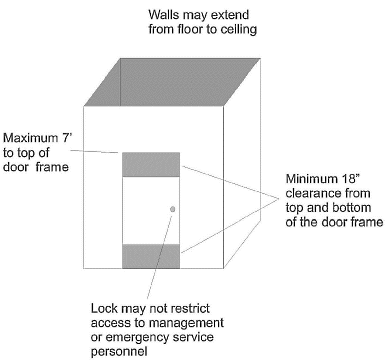
e.
Scope of Establishing a Business Establishment of an adult business, as used in this section, shall include the opening of such business as a new business, the relocation of such business, the enlargement of such business in either scope or area, or the conversion of an existing business location to any of the uses described in this section.
f.
Written Decision Required
1.
Decisions shall be in writing.
2.
Decisions shall include an explanation setting forth the reasons for the decisions.
g.
Appeal Process The written decision of the Administrator, or other designated official representative of the City may be appealed in accordance with the appeal procedures provided under Subsection 18.08.307(j), Appeal, as applicable.
h.
Judicial Review - Writ of Mandamus Judicial review may be sought in accordance with NRS Section 34.185 by the applicant if there is an allegation of an unconstitutional prior restraint of the applicant's rights under the First Amendment of the U.S. Constitution or Section 9 of Article 1 of the Nevada Constitution.
(2)
Amusement or Recreation, Inside
a.
MF-30 When located within the MF-30 zone, an Amusement or Recreation, Inside, use shall be limited to 10,000 square feet of gross floor area.
(3)
Country Club, Private Except in the Mixed-Use Districts, private country club uses shall have a minimum lot area of two acres.
(4)
Recreational Vehicle Park All recreational vehicle park uses, shall comply with the following standards:
a.
Vehicle may not stay longer than 90 days pursuant to NRS.
1.
Uses Permitted
[a]
Recreational vehicles.
[b]
Cabana, ramada, or patio, and one detached storage room per recreational vehicle space.
[c]
Community recreation buildings and facilities, laundry, car and trailer wash, battery charging station, water fill-up, boat or storage facilities serving the recreational vehicle park only.
[d]
Management offices or one single-family dwelling, or mobile home, used exclusively for living quarters by the operator or manager of the park.
2.
Area, Space, and Bulk Development Standards The following standards apply instead of the base zoning district standards:
3.
Street System
[a]
All recreational vehicle spaces shall be provided with safe and convenient vehicular access from public or private streets. Alignment and gradient of streets shall be properly adapted to topography.
[b]
All streets shall be paved and drained with a minimum two inches asphalt; four inches base.
[c]
Access to recreational vehicle parks shall be designed to minimize congestion and traffic hazards and provide for safe movement of traffic at the entrance or exits to adjoining streets.
[d]
Streets provided for two-way traffic shall have a paved section not less than 24 feet in width and a right-of-way of not less than 24 feet. Streets provided for one-way traffic shall have a paved section of not less than 12 feet in width and a right-of-way of not less than 12 feet.
[e]
All streets shall be properly signed and lighted at night with at least the equivalent of a 50-watt lamp for each 100 lineal feet of street, or guard light each 300 feet.
[f]
When appropriate, adequate provisions for snow removal and snow storage areas shall be provided.
4.
Vehicle Parking Spaces and Driveways All vehicle parking spaces and driveways shall be paved.
5.
Exposed Ground Surfaces Exposed ground surfaces in all other parts of a recreational vehicle park shall be paved or covered with stone screening or other material or protected with a vegetative growth, any of which can prevent soil erosion and eliminating objectionable dust.
6.
Recreation Area All recreational vehicle parks shall have at least one recreation area or open space accessible from all spaces; the cumulative size of which recreation area shall be not less than two and one-half percent of the gross recreational vehicle park area. It shall be landscaped as per plans approved as part of conditional use permit.
7.
Pedestrian Ways When included, pedestrian ways shall have a minimum width of three feet and shall be appropriately surfaced.
8.
Service Facilities All recreational vehicle parks shall provide restroom and bath facilities in conformance to regulations of the state and county district health departments. Additionally, all recreational vehicle parks shall provide sanitary stations for the discharge of vehicle retention tanks, such stations to be in conformance with any applicable statutes and ordinances and any regulations of the state and county district health departments.
9.
Water Supply An accessible, adequate, safe, and potable supply of water for domestic purposes shall be provided within 100 feet of each recreational vehicle space. Such supply of water shall be in conformance to any applicable statutes and ordinances and any regulations of the state and county district health departments.
10.
Sewage Facilities An adequate and safe sewer system shall be provided in each recreational vehicle park. Such sewer system shall be in conformance to any applicable statutes and ordinances and any regulations of the state and county district health departments.
11.
Refuse and Garbage Storage, collection and disposal of garbage and refuse shall be in conformance to any applicable statutes and ordinances and any regulations of the state and county district health departments.
12.
Fuel Supply and Storage Installation of liquefied petroleum gas or fuel oil containers within a recreational vehicle park shall be in conformance to any applicable statutes and ordinances, any regulations of the state or county district health departments, and to the satisfaction of the chief of fire department.
13.
Fire Protection In every recreational vehicle park, there shall be installed and maintained fire hydrants, and fire extinguishers of the number and size, and in such locations as may be required by the chief of fire department.
14.
Fences A recreational vehicle park shall be fenced with a solid view-screening fence not more than six feet nor less than four feet in height around the entire boundary of the park.
15.
Management The holder of a valid city business license for operation of a recreational park shall be responsible for compliance with this chapter and any other applicable ordinances or statutes. The holder shall always maintain the recreational vehicle park in a neat, orderly, and sanitary condition.
16.
Register The license holder shall be responsible for maintaining a register of the occupants of the park, such register to indicate the following:
[a]
The name and occupation of each occupant;
[b]
The make, model and year of all motor vehicles and trailer coaches;
[c]
The license number and year of license and owner of each trailer coach and motor vehicle parked or stored in the trailer coach park;
[d]
The dates issuing such license; and
[e]
The dates of arrival and departure of each trailer coach.
17.
Plan A copy of the final approved plan for the recreational vehicle park shall be conspicuously posted on the site and the license holder shall be responsible for maintenance of the park as per the final approved plan.
b.
Location Outside Parks
1.
Parking any recreational vehicle outside a recreational vehicle park, when such recreational vehicle is used for dwelling or sleeping purposes, is unlawful, except if such use of self-contained recreational vehicles is permitted by the Administrator on the premises of a public use event in a residential zone or on the premises of a public use event in a commercial zone. The Administrator may grant such permission only after determining that at least one of the criteria stated in Resolution No. 3831, or its successor, is met. The Administrator, in granting such permission, may impose conditions to protect the public health, safety and welfare. Upon granting such permission, the Administrator shall immediately notify the police department.
2.
Storage of a recreational vehicle is permitted on the premises of its owner when not used for dwelling or sleeping purposes if in compliance with this Title.
(g)
Retail
a.
All Districts
1.
Materials, supplies, and equipment associated with operation of the use shall be enclosed within a building or screened from view from adjacent streets and from residential uses with 10 feet of landscaping and a six foot solid fence or wall.
2.
All parking and outdoor storage areas shall be paved, or an all-weather surface shall be provided.
b.
MU District This use is only permitted in the area bounded by Wells Avenue on the west, I-80 on the north, the Truckee River on the south, and Galetti Way on the east.
(2)
Cannabis Dispensary, Medical
a.
Shall not be located on a parcel:
1.
Adjacent to residentially zoned property;
2.
Owned by the federal government; or
3.
South of Mount Rose Highway or Geiger Grade (SR341).
b.
Shall be exempt from minor site plan review requirements identified in Section 18.08.602, Minor site plan review.
c.
At the time of application for a zoning verification letter with the City, proof of compliance with all location requirements set forth in Reno Municipal Code (see subsection a, above) and distance separation requirements in NRS shall be provided by a State of Nevada licensed surveyor. NRS Section 678B.210 establishes a 1,000-foot separation from a public or private school, preschool through 12th grade, a 300-foot separation from a community facility, and 1,500 feet from a facility with a nonrestricted gaming license as described in NRS 463.0177.
d.
All required spacing criteria shall be measured in a straight line from the front door of the cannabis establishment to the closest parcel line, as shown on the Washoe County Assessor's records, of any school, community facility, or licensed gaming establishment identified in NRS Section 678B.210.
e.
Any medical cannabis dispensary shall be in a separate building from any other medical cannabis establishment. This may include two facilities separated by a fire wall with no shared facilities, other than parking.
f.
Any medical cannabis dispensary shall have a professional, orderly, dignified appearance which is consistent with the traditional style of pharmacies and medical offices.
g.
Any signage associated with a medical cannabis dispensary shall be discreet and professional which is consistent with the traditional style of signage for pharmacies and medical offices.
h.
Any medical cannabis dispensary shall obtain all required approvals from the State of Nevada and the City of Reno to operate such a facility.
i.
Hours of operation shall not exceed 8:00 a.m. to midnight seven days a week.
(3)
Cannabis Retail Store, Adult-use
a.
Shall not be located on a parcel:
1.
Adjacent to residentially zoned property;
2.
Owned by the federal government;
3.
South of Mount Rose Highway or Geiger Grade (SR341);
4.
Located closer than 2,500 feet from another adult-use cannabis retail store; or
5.
Located within 500 feet from a facility licensed by the State of Nevada for the treatment of alcohol or drug abuse as outlined by NRS 449.00455, as amended.
b.
Shall be exempt from minor site plan review requirements identified in Section 18.08.602, Minor Site Plan Review.
c.
At the time of application for a zoning verification letter with the City, proof of compliance with all location requirements set forth in Reno Municipal Code (see subsection a, above) and distance separation requirements in NRS shall be provided by a State of Nevada licensed surveyor. NRS Section 678B.250 establishes a 1,000-foot separation from a public or private school, preschool through 12th grade, a 300-foot separation from a community facility, and 1,500 feet from a facility with a nonrestricted gaming license as described in NRS 463.0177.
d.
All required spacing criteria shall be measured in a straight line from the front door of the cannabis establishment to the closest parcel line, as shown on the Washoe County Assessor's records, of any school, community facility, or licensed gaming establishment identified in NRS Section 678B.250.
e.
Any adult-use cannabis retail store shall obtain all required approvals from the State of Nevada and the City of Reno to operate such a facility.
f.
Any adult-use cannabis retail store shall have a professional, orderly, dignified appearance which is consistent with the traditional style of pharmacies and medical offices.
g.
Any signage associated with an adult-use cannabis retail store shall be discreet and professional which is consistent with the traditional style of signage for pharmacies and medical offices. Signage shall be restricted to logos approved by the State Department of Taxation. No temporary or window signs shall be allowed. With the exception of the aforementioned provisions, all signage shall be subject to the standards of Chapter 18.05 Signs.
h.
Hours of operation shall not exceed 8:00 a.m. to midnight seven days a week beginning September 1, 2018.
i.
A medical cannabis dispensary in continuous operation before April 30, 2018, shall be allowed to continue operations as an adult-use cannabis retail store within their existing location. Any new or relocated establishment shall be required to meet all applicable provisions of this Title with regards to allowable zoning districts and additional use regulations. An adult-use cannabis retail store established using this provision, but not allowed in the underlying zone, shall be considered legal nonconforming and subject to all provisions in Section 18.01.403, Nonconforming Uses.
j.
All parking, landscaping, and signs shall be brought into conformance with current code standards unless determined physically impossible by the Administrator.
(4)
General Retail, less than 10,000 Square Feet
a.
MF-30 District
1.
Access shall be from a collector or larger street.
2.
General retail uses shall only be permitted on the first floor for buildings up to three stories and shall only be permitted on the first and second floors for buildings over three stories.
(5)
General Retail, 10,000 Square Feet or More
a.
NC District General retail uses shall not exceed 80,000 square feet in any single building.
b.
Urban Districts Development of Large Retail Establishments is subject to the requirements found in Section 18.04.1006.
(6)
General Retail, Package Alcohol Sales
a.
All Districts
1.
All package alcohol sales shall comply with applicable provisions as outlined in this Section and RMC Chapter 5.07 (Alcoholic Beverages).
2.
When required, a development permit application (e.g., conditional use permit) may be processed concurrently with the associated package alcoholic beverage license or package wine and beer license. Approval of the conditional use permit is required prior to the approval and issuance of the associated privilege business license.
3.
All applications for a package alcoholic beverage license, a package wine and beer license, or a development permit (e.g., conditional use permit) shall include a map prepared by a State of Nevada licensed surveyor or professional engineer, identifying the project site and all of the following uses or geographic areas which are within 500 feet of the proposed site. All required spacing criteria shall be measured in a straight line from the front door of the retail establishment to the closest parcel line, as shown on the Washoe County Assessor's records.
[a]
The Downtown Safe Scape Buffer Area (See Figure 3-2)
[b]
East 4 th Street Corridor Buffer Area (See Figure 3-3)
[c]
Residentially zoned property
[d]
Primary or secondary schools
[e]
Public parks
[f]
A facility licensed by the State of Nevada for the treatment of alcohol or drug abuse as outlined by NRS 449.00455, as amended.
Figure 3-2 Downtown Safe Scape and Buffer Area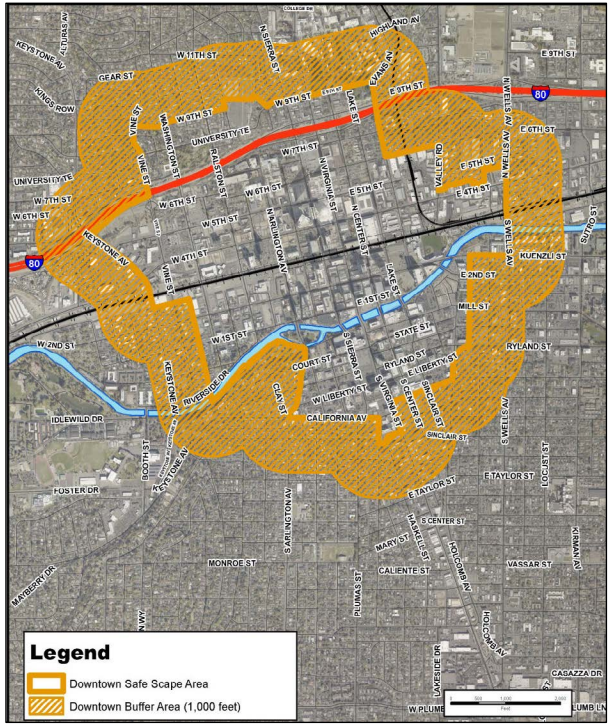
Figure 3-3 East 4th Street Corridor Safe Scape Buffer Area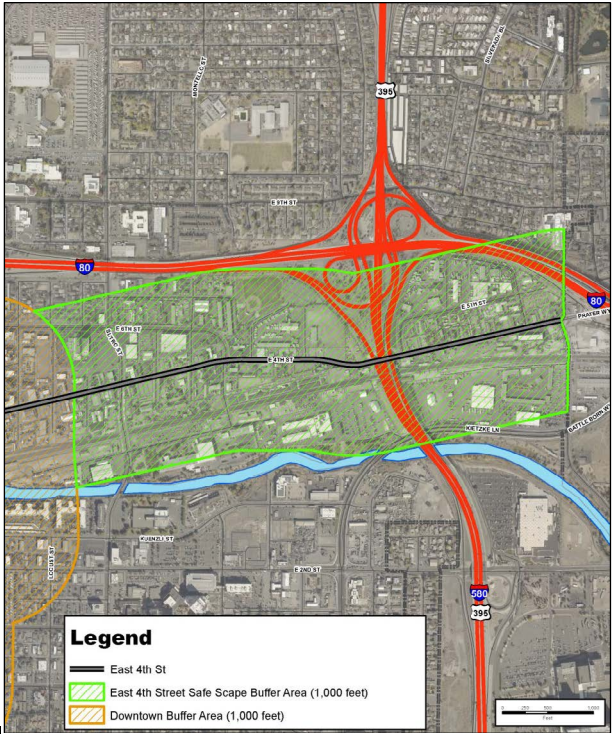
(7)
Pawn Shop In all zoning districts, all pawnshop uses shall meet the following standards:
a.
A 1,000-foot separation measured property line to property line from all primary- or secondary-schools licensed by the State of Nevada and University of Nevada - Reno (UNR).
b.
Pawnshops are specifically prohibited from parcels contiguous to the following streets:
1.
Virginia Street south of North McCarran Boulevard,
2.
Kietzke Lane from Mill Street to South Virginia Street,
3.
Plumb Lane east of South Virginia Street,
4.
Moana Lane between South Virginia Street and Kietzke Lane, and
5.
McCarran Boulevard.
(h)
Transportation, Vehicles, and Equipment
(1)
Auto Service and Repair
a.
Urban Districts
1.
All repair work shall be performed within an enclosed building. This does not include smog check services.
2.
Outdoor storage is not allowed.
(2)
Automobile, Truck, Mobile Home, RV, Boat, and Trailer Sales or Rental
a.
All Districts except I, IC, and MA
1.
A minor conditional use permit is required when more than four and less than 12 automobiles, trucks, mobile homes, RVs, boats, or trailers are stored on-site for sale or rental.
2.
A conditional use permit is required when 12 or more automobiles, trucks, mobile homes, RVs, boats, or trailers are stored on-site for sale or rental.
3.
Discretionary review is not required for internet-based sales with off-site storage or less than five automobiles, trucks, mobile homes, RVs, boats, or trailers stored on-site.
b.
MD-ID, MD-NWQ, and Urban Districts Shall only be permitted east of I-580 or within ¼ mile of the intersection of a street and a freeway on- or off-ramp.
(3)
Bus or other Transportation Terminal
a.
Urban and PF Districts
1.
All storage and repair areas shall be screened from view of the street and adjacent properties.
2.
All pre- and post-trip operations shall be performed on-site. Transient discharge, boarding, or queuing shall not be performed on the street or public sidewalk.
3.
On-site repairs shall be indoors only.
(4)
Car Wash
a.
All Districts
1.
Facilities and equipment related to the car wash facility, such as vacuums stations, shall be located out of the required setbacks.
2.
Impacts to surrounding properties, including noise from a voice box, idling vehicles, headlights, visibility of the business operation, and mechanical equipment, shall be mitigated to the approval of the Administrator.
3.
Car wash facilities shall meet minimum vehicle stacking requirements as outlined in Section 18.04.708.
4.
Stacking lanes shall be located so that they do not interfere with vehicular circulation and parking on site and on adjacent roadways.
5.
The Administrator may require a stacking and/or queuing analysis prepared by a licensed engineer.
(5)
Gas Station
a.
All Districts
1.
All activities and operations shall be conducted entirely within an enclosed structure, except as follows:
[a]
The dispensing of petroleum products, ice, water, and air from pump islands;
[b]
The provision of emergency service of a minor nature; and
[c]
The sale of items via vending machines which shall be located within the main structure.
2.
Pump islands shall be located a minimum of 20 feet from a street right-of-way line. A canopy or roof structure over a pump island may be located no closer than ten feet from the street right-of-way line if it matches the architecture and color of the building.
3.
No vehicle shall be parked on the premises for the purposes of offering the vehicle for sale.
4.
No used or discarded automotive parts or equipment or disabled, junked, or wrecked vehicles shall be in any open area outside the main structure.
5.
Noise from bells or loudspeakers shall not be audible beyond the property line at any time.
(6)
Parking Lot, Open
a.
Principal (not temporary) open parking lot uses shall comply with all site improvement requirements under this Title, including lighting, sidewalks, and landscaping.
b.
Open parking lot uses shall comply with off-street parking and loading standards listed in Section 18.04.703, General Standards.
c.
Open parking lot uses that are also intended for special events may relocate required parking lot landscaping to the perimeter of the parking lot with approval of a major site plan review and the following supplemental findings:
1.
The landscaping, as required, would interfere with planned events; and
2.
The relocated landscaping would not create significant impacts for the public or adjacent properties.
(7)
Truck Stop/Travel Plaza
a.
All Districts
1.
Design and Layout
[a]
Minimum parcel size shall be ten acres.
[b]
Maximum number of motel or hotel rooms in conjunction with a truck stop within the I and IC Districts shall be as follows:
i.
With 100 truck parking spaces or fewer no motel/hotel rooms shall be allowed;
ii.
Over 100 truck parking spaces but fewer than 200 truck parking spaces, a maximum of 100 motel/hotel rooms shall be allowed; and
iii.
With 200 or more truck parking spaces, a maximum of 200 motel/hotel rooms shall be allowed.
[c]
Other business activities which are customarily accessory and clearly incidental and subordinate to the truck stop, may include but not be limited to; scales, truck wash, tire repair and sales, barber shop, restaurant with or without alcohol service, shower facility, convenience store, truckers lounge (for services such as television/exercise/internet access, etc.), motel/hotel (see Subsection 18.03.304(h)(6)a.1.[b], above), laundry, chain rental, and gasoline and propane dispensing.
[d]
The applicant shall furnish a traffic impact study and any necessary mitigation measures prepared by a civil engineer registered in the State of Nevada.
[e]
The applicant shall furnish a noise impact study and any necessary mitigation measures prepared by qualified acoustical consultant.
[f]
All commercial vehicle truck traffic accessing the site shall access the site via an arterial roadway.
[g]
In addition to designated commercial truck parking, off-street parking shall be provided at a rate equal to that which is required for each use comprising the truck stop.
[h]
All vehicle service and/or repair activities shall be conducted within a completely enclosed building. Parts, equipment, lubricants, fuels, tires or other materials used or discarded in any service or repair operations must be screened from adjoining roads and properties.
[i]
Outdoor storage shall be prohibited.
[j]
The minimum distance from Urban Districts or any residentially zoned property shall be at least one-quarter mile (1,320 feet), measured from property line to property line.
[k]
Compliance with diesel idling regulations adopted by the Washoe County District Board of Health as amended shall be maintained. Adequate signage shall be provided to inform drivers of idling time restrictions. A minimum of 15 percent of truck parking spaces must be equipped with approved Engine Idle Reduction Technology or similar comprising of "plug-in" locations for trucks with sleepers and/or refrigeration to avoid idling engines.
[l]
The primary parcel of the truck stop shall not be located more than 1,500 feet from the right-of-way limits surrounding an interstate highway interchange, measured from property line to property line.
[m]
No more than one truck stop shall have primary access from any interstate highway interchange.
[n]
The minimum distance between truck stops shall be 7,000 feet, measured from property line to property line.
[o]
The minimum distance from Amusement or Recreation (Outside) use, Public Park or Recreation Area, or a primary or secondary school shall be 750 feet, measured from property line to property line.
2.
Landscaping
[a]
Parking lot landscaping for areas not designated for circulation or parking of commercial vehicles shall comply with this Title unless otherwise noted in this section.
[b]
Property line or boundaries adjacent to residentially zoned property must provide a six-foot tall solid wall (unless separated by an arterial roadway) and a minimum 20-foot wide landscape buffer interior to the site which includes one ten-foot tall evergreen tree every 20 feet in staggered rows. Shrubs shall be provided per code.
[c]
Property line or boundaries adjacent to public streets must provide a two-foot tall berm, wall or hedge and a minimum 20-foot wide landscape buffer which includes a mixture of evergreen and deciduous trees per code, based on one tree for every 20 lineal feet. Shrubs shall be provided per code.
[d]
Property line or boundaries adjacent to nonresidential zoned properties must provide a minimum ten-foot wide landscape buffer interior to the site, which includes one ten-foot tall evergreen tree 20 feet on center. Shrubs shall be provided per code.
[e]
All buildings shall have a minimum five-foot wide perimeter landscape area, excluding areas for pedestrian and vehicular entrances. These landscape areas shall be adjacent to building walls and landscaped with trees and shrubs per code.
3.
Lighting
[a]
All outdoor lighting shall be fully shielded. Fully shielded requires a lighting fixture to be constructed so that all the light emitted by the fixture is projected below the horizontal plan of the lowest plane of the lowest point of the fixture.
[b]
Lighting fixtures used to illuminate a sign shall be mounted on the top of the sign structure, lighting the sign downward.
[c]
Dark sky compliant lighting is required throughout the site.
[d]
Search lights, laser source lights, or any similar high-intensity light shall not be permitted.
b.
MS District Shall only be permitted within ¼ mile of I-80 Exit 2 off-ramp.
(Ord. No. 6614, § 1(Exh. B, §1.2), 12-8-21; Ord. No. 6638, § 1, 10-26-22; Ord. No. 6692, § 1(Exh. A), 1-8-25)
18.03.305 - Public and Quasi-public Utilities and Services Uses
(a)
Communications and Broadcasting
(1)
Communication Facility, Equipment Only
a.
All Districts
1.
Communication facilities that do not meet all standards below, shall obtain approval of a minor site plan review by the Administrator.
2.
A primary use on the parcel must be established.
3.
The mechanical equipment shall be buried, integrated into a building or structure by virtue of its location inside the building, or as an addition to the structure unless an alternate means such as landscaping, camouflage, or screening is proposed to the satisfaction of the Administrator. Additions shall be architecturally compatible with the building or structure utilizing the same siding (color and materials), roof covering, and roof lines.
4.
Antenna(s) shall be installed inside a radome or similar enclosure that conceals all equipment from public view, as applicable. Existing towers in which antenna(s) are not installed inside a radome or similar enclosure, shall enclose any new antenna(s) proposed for collocation using this technology, unless otherwise approved by the Administrator.
5.
Antenna(s) shall be attached to a building or located on a monopole or monotower whose support is entirely within the building footprint and installed on the highest point of the roof of the primary structure. When camouflaged, antenna(s) may be located on existing poles used for lighting or power, or on an architecturally compatible replacement pole.
6.
All poles shall be designed to be integrated into their surroundings.
7.
The pole and antenna shall be setback four feet for every one foot in overall height from residentially zoned property and parks. Alternatively, a pole and antenna may be setback two feet for every one foot of overall height from residentially zoned property and parks if concealed using design solutions complementary to the site which are compatible with their surroundings (e.g., a tree, streetlamp, flagpole, architectural tower feature), to the satisfaction of the Administrator. The setback does not apply when the antenna is installed on top of a building or on an existing pole when the proposed antenna is placed lower than the existing antenna.
8.
Overall antenna and pole height shall not exceed 55 feet, except that antennas which are attached to a building, existing pole or tower and do not increase building pole or tower height may exceed 55 feet.
9.
All antennas and towers shall meet applicable requirements of the Federal Aviation Administration, the Federal Communications Commission, and any other agency of the county, state, or federal government with the authority to regulate towers and antennas. If such requirements are changed, then the owners of the towers and antennas governed by this ordinance shall bring such towers and antennas into compliance with such revised standards and regulations with the compliance schedule mandated by the controlling agency. Failure to bring towers and antennas into compliance with such revised standards and regulations shall constitute grounds for the removal of the tower or antenna at the owner's expense. No more than 60 days after the compliance period has elapsed, the owner or operator of the tower or antenna shall send a letter to the Administrator certifying that changes have been made to bring the tower or antenna into compliance.
10.
All towers installed at grade shall be non-climbable or fenced for security.
11.
All towers constructed under these provisions shall allow collocation with other providers. If collocation at existing and applied for telecommunications facilities sites would result in less visual impact than the visual impact of the proposed facility, applicants shall justify why such collocation is not being proposed.
12.
Applicants must identify all available telecommunication facility sites within the proposed coverage area, including applications currently on file with the Development Services Department. If the proposed site is in a residential district and there are alternate sites in commercial and/or industrial districts within the proposed coverage area, applicants shall justify to the satisfaction of the Administrator why those alternate sites have not been proposed.
13.
Each commercial telecommunications facility site will be clearly marked with signs which indicate the use of the facility and an emergency contact name(s) and telephone number(s).
14.
A telecommunication tower that is not operated for a continuous 12-month period shall be considered abandoned and the owner of such facility shall remove the same, at the expense of the owner, within 60 days of receipt of notice from the City of Reno.
15.
In addition to the on-site posting required by a minor site plan review, applicants requesting location of a commercial telecommunications facility at a primary or secondary school (public or private) must verify that the Washoe County School District (or equivalent) has presented this proposal to locate the telecommunications facility on the school site at a parent teachers association meeting (or equivalent).
16.
Applications for all telecommunication facilities outside of the commercial and industrial districts shall be accompanied with sufficient information to justify the need for the facility at the proposed location and height within the next 12-month period. A map shall accompany the application depicting the zoning on parcels within 1,000 feet of the proposed site, and all acceptable nonresidential sites. Evidence shall be provided demonstrating why more acceptable nonresidential properties are not being pursued. "Acceptable sites" are those that meet the provider's technical requirements (location, elevation, clear line of sight).
17.
The applicant shall submit written documentation demonstrating that the emissions from the proposed project are within the limits set by the FCC.
18.
Telecommunication facilities shall require a minor site plan review in all residential districts, on school sites, public parks, and day care centers (12 or more children or adults). Where an existing facility received approval of a conditional use permit or minor site plan review, additional antenna may be collocated on the pole without compliance with subsection p. above or a minor site plan review, when installation will not increase pole height.
19.
See Subsection 18.03.405(n) for district specific standards governing satellite dishes.
b.
I, IC, ME, and Urban Districts Communication facilities are not required to meet paragraphs a.2., a.5., and a.8., above. Communication facilities located on top of a building that is three or more stories are not required to meet paragraphs a.2., a.5., and a.6., above.
c.
MA District Communication facilities for the purpose of air traffic control are allowed without conditions, unless in residential interface areas.
(2)
TV Broadcasting and other Communication Service
a.
ME, PF, and Urban Districts
1.
No freestanding towers shall be permitted.
2.
Any antennae or dishes shall be incorporated into the architecture of the building.
b.
LLR-2.5, LLR-1, and LLR-.5 Districts Towers shall be subject to the standards of Subsection 18.03.305(a)(1), above.
(b)
Utilities
(1)
Utilities, Major
a.
Siting
1.
General
[a]
Major utilities shall be sited in an existing utility corridor or facility site as adopted in the Truckee Meadows Regional Plan.
[b]
Major utilities shall not be in the Truckee River Corridor, public parks, or Airport Flight Path overlay zones unless it can be demonstrated that there will be no detrimental residual impact.
[c]
Installation of electric overhead utilities shall meet the minimum setbacks as outlined in the Truckee Meadows Regional Plan.
[d]
Utilities that cannot meet the requirements of subsections 18.03.305(b)(1)a.1.[b]. and 18.03.305(b)(1)a.1.[c]., above, shall be mitigated with underground construction, low EMF designs, low-visibility designs and/or off-site mitigation as described in the Truckee Meadows Regional Plan.
2.
IC and ME Districts
[a]
Minor site plan review is required when the facility is adjacent to residentially zoned property.
b.
Electric Generating Plants and Electric Utility Substations
1.
Design and Layout
[a]
Facilities require a conditional use permit and screening, fencing, landscaping, and related development standards will be reviewed with each project.
i.
At the discretion of the Administrator, installation of landscaping and irrigation may be delayed until development is constructed adjacent to the utility facility.
(2)
Utilities, Minor In all zoning districts, all utility box/well house, back-up generator, pumping or booster station, or other minor utility installation or service uses shall comply with the following standards:
a.
Facilities shall be exempt from landscape and screening requirements.
(Ord. No. 6692, § 1(Exh. A), 1-8-25)
18.03.306 - Industrial Uses
(a)
Manufacturing and Processing
(1)
Animal and Animal Byproduct Processing
a.
All activities shall occur indoors.
b.
Site must be adjacent to industrial zoned property on all sides or a major arterial.
c.
Shall not include any processing of materials collected.
(2)
Cannabis Cultivation Facility, Adult-use
a.
Shall not be located on a parcel:
1.
Adjacent to residentially zoned property;
2.
Owned by the federal government; or
3.
South of Mount Rose Highway or Geiger Grade (SR341).
b.
Shall be exempt from minor site plan review requirements identified in Section 18.08.602, Minor Site Plan Review.
c.
At the time of application for a zoning verification letter with the City, proof of compliance with all location requirements set forth in Reno Municipal Code (see subsection a, above) and distance separation requirements in NRS shall be provided by a State of Nevada licensed surveyor. NRS Section 678B.250 establishes a 1,000-foot separation from a public or private school, preschool through 12th grade, a 300-foot separation from a community facility, and 1,500 feet from a facility with a nonrestricted gaming license as described in NRS 463.0177.
d.
All required spacing criteria shall be measured in a straight line from the front door of the cannabis establishment to the closest parcel line, as shown on the Washoe County Assessor's records, of any school, community facility, or licensed gaming establishment identified in NRS Section 678B.250.
e.
Any adult-use cannabis cultivation facility shall have a professional, orderly, dignified appearance.
f.
Only one sign shall be allowed. The sign shall not exceed six square feet and shall be placed on a window or a door for the purposes of identifying the business (e.g., business name, address, hours of operation, etc.)
g.
Any adult-use cannabis cultivation facility shall obtain all required approvals from the State of Nevada and the City of Reno to operate such a facility.
h.
All cultivation shall take place within a building. No outdoor cultivation shall be allowed.
i.
All parking, landscaping, and signs shall be brought into conformance with current code standards unless determined physically impossible by the Administrator.
(3)
Cannabis Cultivation Facility, Medical
a.
Shall not be located on a parcel:
1.
Adjacent to residentially zoned property;
2.
Owned by the federal government; or
3.
South of Mount Rose Highway or Geiger Grade (SR341).
b.
Shall be exempt from minor site plan review requirements identified in Section 18.08.602, Minor Site Plan Review.
c.
At the time of application for a zoning verification letter with the City, proof of compliance with all location requirements set forth in Reno Municipal Code (see subsection a, above) and distance separation requirements in NRS shall be provided by a State of Nevada licensed surveyor. NRS Section 678B.210 establishes a 1,000-foot separation from a public or private school, preschool through 12th grade, a 300-foot separation from a community facility, and 1,500 feet from a facility with a nonrestricted gaming license as described in NRS 463.0177.
d.
All required spacing criteria shall be measured in a straight line from the front door of the cannabis establishment to the closest parcel line, as shown on the Washoe County Assessor's records, of any school, community facility, or licensed gaming establishment identified in NRS Section 678B.210.
e.
Any medical cannabis cultivation facility shall be in a separate building from any other cannabis establishment. This may include two facilities separated by a fire wall with no shared facilities, other than parking.
f.
Any medical cannabis cultivation facility shall have a professional, orderly, dignified appearance which is consistent with the traditional style of pharmacies and medical offices.
g.
Any signage associated with a medical cannabis cultivation facility shall be discreet and professional which is consistent with the traditional style of signage for pharmacies and medical offices.
h.
Any medical cannabis cultivation facility shall obtain all required approvals from the State of Nevada and the City of Reno to operate such a facility.
(4)
Cannabis Independent Testing Laboratory, Adult-use
a.
Shall not be located on a parcel:
1.
Adjacent to residentially zoned property;
2.
Owned by the federal government; or
3.
South of Mount Rose Highway or Geiger Grade (SR341).
b.
Shall be exempt from minor site plan review requirements identified in Section 18.08.602, Minor Site Plan Review.
c.
At the time of application for a zoning verification letter with the City, proof of compliance with all location requirements set forth in Reno Municipal Code (see subsection a, above) and distance separation requirements in NRS shall be provided by a State of Nevada licensed surveyor. NRS Section 678B.250 establishes a 1,000-foot separation from a public or private school, preschool through 12th grade, a 300-foot separation from a community facility, and 1,500 feet from a facility with a nonrestricted gaming license as described in NRS 463.0177.
d.
All required spacing criteria shall be measured in a straight line from the front door of the cannabis establishment to the closest parcel line, as shown on the Washoe County Assessor's records, of any school, community facility, or licensed gaming establishment identified in NRS Section 678B.250.
e.
Any adult-use cannabis independent testing laboratory shall have a professional, orderly, dignified appearance which is consistent with the traditional style of pharmacies and medical offices.
f.
Only one sign shall be allowed. The sign shall not exceed six square feet and shall be placed on a window or a door for the purposes of identifying the business (e.g., business name, address, hours of operation, etc.)
g.
Any adult-use cannabis independent testing laboratory shall obtain all required approvals from the State of Nevada and the City of Reno to operate such a facility.
h.
All parking, landscaping, and signs shall be brought into conformance with current code standards unless determined physically impossible by the Administrator.
(5)
Cannabis Independent Testing Laboratory, Medical
a.
Shall not be located on a parcel:
1.
Adjacent to residentially zoned property;
2.
Owned by the federal government; or
3.
South of Mount Rose Highway or Geiger Grade (SR341).
b.
Shall be exempt from minor site plan review requirements identified in Section 18.08.602, Minor Site Plan Review.
c.
At the time of application for a zoning verification letter with the City, proof of compliance with all location requirements set forth in Reno Municipal Code (see subsection a, above) and distance separation requirements in NRS shall be provided by a State of Nevada licensed surveyor. NRS Section 678B.210 establishes a 1,000-foot separation from a public or private school, preschool through 12th grade, a 300-foot separation from a community facility, and 1,500 feet from a facility with a nonrestricted gaming license as described in NRS 463.0177.
d.
All required spacing criteria shall be measured in a straight line from the front door of the cannabis establishment to the closest parcel line, as shown on the Washoe County Assessor's records, of any school, community facility, or licensed gaming establishment identified in NRS Section 678B.210.
e.
Any medical cannabis independent testing laboratory shall be in a separate building from any other cannabis establishment. This may include two facilities separated by a fire wall with no shared facilities, other than parking.
f.
Any medical cannabis independent testing laboratory shall have a professional, orderly, dignified appearance which is consistent with the traditional style of pharmacies and medical offices.
g.
Any signage associated with a medical cannabis independent testing laboratory shall be discreet and professional which is consistent with the traditional style of signage for pharmacies and medical offices.
h.
Any medical cannabis independent testing laboratory shall obtain all required approvals from the State of Nevada and the City of Reno to operate such a facility.
(6)
Cannabis Production Facility, Adult-use
a.
Shall not be located on a parcel:
1.
Adjacent to residentially zoned property;
2.
Owned by the federal government; or
3.
South of Mount Rose Highway or Geiger Grade (SR341).
b.
Shall be exempt from minor site plan review requirements identified in Section 18.08.602, Minor Site Plan Review.
c.
At the time of application for a zoning verification letter with the City, proof of compliance with all location requirements set forth in Reno Municipal Code (see subsection a, above) and distance separation requirements in NRS shall be provided by a State of Nevada licensed surveyor. NRS Section 678B.250 establishes a 1,000-foot separation from a public or private school, preschool through 12th grade, a 300-foot separation from a community facility, and 1,500 feet from a facility with a nonrestricted gaming license as described in NRS 463.0177.
d.
All required spacing criteria shall be measured in a straight line from the front door of the cannabis establishment to the closest parcel line, as shown on the Washoe County Assessor's records, of any school, community facility, or licensed gaming establishment identified in NRS Section 678B.250.
e.
Any adult-use cannabis production facility shall have a professional, orderly, dignified appearance.
f.
Only one sign shall be allowed. The sign shall not exceed six square feet and shall be placed on a window or a door for the purposes of identifying the business (e.g., business name, address, hours of operation, etc.)
g.
Any adult-use cannabis production facility shall obtain all required approvals from the State of Nevada and the City of Reno to operate such a facility.
h.
All parking, landscaping, and signs shall be brought into conformance with current code standards unless determined physically impossible by the Administrator.
(7)
Cannabis Production Facility, Medical
a.
Shall not be located on a parcel:
1.
Adjacent to residentially zoned property;
2.
Owned by the federal government; or
3.
South of Mount Rose Highway or Geiger Grade (SR341).
b.
Shall be exempt from minor site plan review requirements identified in Section 18.08.602, Minor Site Plan Review.
c.
At the time of application for a zoning verification letter with the City, proof of compliance with all location requirements set forth in Reno Municipal Code (see subsection a, above) and distance separation requirements in NRS shall be provided by a State of Nevada licensed surveyor. NRS Section 678B.210 establishes a 1,000-foot separation from a public or private school, preschool through 12th grade, a 300-foot separation from a community facility, and 1,500 feet from a facility with a nonrestricted gaming license as described in NRS 463.0177.
d.
All required spacing criteria shall be measured in a straight line from the front door of the cannabis establishment to the closest parcel line, as shown on the Washoe County Assessor's records, of any school, community facility, or licensed gaming establishment identified in NRS Section 678B.210.
e.
Any medical cannabis production facility shall be in a separate building from any other cannabis establishment. This may include two facilities separated by a fire wall with no shared facilities, other than parking.
f.
Any medical cannabis production facility shall have a professional, orderly, dignified appearance which is consistent with the traditional style of pharmacies and medical offices.
g.
Any signage associated with a medical cannabis production facility shall be discreet and professional which is consistent with the traditional style of signage for pharmacies and medical offices.
h.
Any medical cannabis production facility shall obtain all required approvals from the State of Nevada and the City of Reno to operate such a facility.
(8)
Crematorium
a.
All equipment shall be located within a completely enclosed building.
b.
There shall be no audible or visible indication of the use from outside of the building.
c.
Shall be at least 1,500 feet from any residential zoned property, unless per NRS 451.635, a crematorium proposes to cremate the remains only through alkaline hydrolysis or natural organic reduction in which City Council approval is needed and written notice from the City Council to the Nevada Funeral and Cemetery Services Board consenting to the proposed location of the crematorium is required.
(9)
Hazardous Waste Facility Except as required, below, the Administrator may exempt any hazardous waste use from the requirement for a conditional use permit if the impacts are determined to be so minor as to be disregarded based on the findings of this section and Section 18.08.605, Conditional Use Permit.
a.
Conditional Use Permits for Facilities that Manufacture, Process, Transfer, or Store Explosives or Hazardous Substances
1.
Applicability As required by NRS Section 278.147, a conditional use permit is required for any facility (except in the mining industry) that uses, manufactures, processes, transfers, or stores an explosive (which is subject to regulation as an explosive pursuant to NRS Section https://www.leg.state.nv.us/NRS/NRS-459.html#NRS459Sec3816) or a highly hazardous substance designated pursuant to NRS Section https://www.leg.state.nv.us/NRS/NRS-459.html#NRS459Sec3816 if present in a quantity equal to or greater than the amount designated pursuant to NRS Section 459.3816, or a hazardous substance listed in the regulations adopted pursuant to NRS Section 459.3833. Applications for such conditional use permits shall be processed in accordance with this subsection.
2.
Applications and Consideration by Planning Commission
[a]
Applications for a conditional use permit under this subsection shall be submitted on forms and with the content determined by the Administrator. When the application is deemed complete, the Administrator shall send a copy to and consult with the following agencies in addition to the normal agency review:
i.
The City of Reno Emergency Management Board;
ii.
The Administrator of the Division of Environmental Protection of the State Department of Conservation and Natural Resources;
iii.
The State Fire Marshal;
iv.
The Administrator of the Division of Industrial Relations of the Department of Business and industry;
v.
The commander of any military installation that may be affected by the operation of the facility; and
vi.
The governing body of any other city or county that may be affected by the operation of the facility
[b]
The Planning Commission shall hold a public hearing to consider the application within 90 days from the date it is deemed complete by the Administrator. Notice for the public hearing shall be provided as set forth in paragraph 3., below.
[c]
Based on consultation with the agencies listed in Subsection 2.[a], above, and information submitted with the staff report and at the hearing, the Planning Commission shall consider and make findings as set forth in Paragraph 5., below.
[d]
Within a reasonable time after the public hearing the Planning Commission shall submit its recommendation for any actions to be taken on the application by the City Council. If the Planning Commission recommends that a conditional use permit be granted to the applicant, the Planning Commission shall include in its recommendations such terms and conditions for the operation of the facility as it deems necessary for the protection of (i) the health and safety of the residents of the city, and (ii) the safety and security of any military installation in the city.
3.
Notices of Hearing Notice of the public hearings by the Planning Commission and City Council under this subsection shall be prepared, published, and mailed as required by NRS Sections 278.147(2) and (3).
4.
Action by the City Council Within 30 days after receiving the recommendations of the Planning Commission, the City Council shall provide notice as specified in paragraph 3., above, and hold a public hearing to consider the application and the findings discussed in paragraph 5., below, and within 30 days from the public hearing, shall grant or deny the conditional use permit.
5.
Findings In addition to the general conditional use permit findings in Section 18.08.605, Conditional Use Permit, the following findings shall be made prior to granting a conditional use permit:
[a]
Planning Commission shall consider and discuss as a part of the record:
i.
The health and safety of the residents of the city, and
ii.
The safety and security of any military installation in the city.
[b]
In approving the conditional use permit, the City Council shall affirm the findings and discussions of the Planning Commission.
(b)
Storage, Distribution, and Warehousing
(1)
Data Center
a.
All Districts
1.
Dock doors are limited to three per building.
2.
Loading docks and semi-truck staging areas shall be designed to minimize noise and odor impacts on residential properties and shall not be located between non-residential buildings and residential zoning districts or residential uses unless one of the following conditions exist:
i.
The loading docks are screened by another non-residential building on the site; or
ii.
The loading docks are screened by a masonry wall at least ten feet in height; or
iii.
The loading docks are screened by an enhanced 30-foot-wide landscaped area with a three-foot berm, six-foot-tall masonry wall and landscaping designed to screen the loading docks from the residential areas.
iv.
These requirements may be modified through the conditional use permit review.
(2)
Heavy Machinery and Equipment, Rental, Sales, and Service
a.
ME, MS, and GC Districts Shall only operate between the hours of 6:00 a.m. and 9:00 p.m.
b.
MU District This use is only permitted in the area bounded by Wells Avenue on the west, I-80 on the north, the Truckee River on the south, and Galetti Way on the east. Outside this area, the use is not allowed in the MU district.
(3)
Mini-warehouse
a.
All Districts
1.
No more than one manager's or security residence shall be permitted.
2.
All storage shall be within an enclosed building except for the storage of recreational vehicles, boats, and similar vehicles, which shall only be allowed if operable and completely screened from view from surrounding properties and abutting streets at the first-floor level.
3.
No business shall be conducted from or within a mini-storage facility.
4.
Retail sale of stored items on the premises is prohibited.
5.
Auction sales of stored items on the premises are prohibited.
6.
The commercial repair of motor vehicles, boats, trailers, and other like vehicles shall be prohibited.
7.
The operation of spray-painting equipment, power tools, welding equipment, or other similar equipment shall be prohibited.
8.
The production, fabrication, or assembly of products shall be prohibited.
9.
Storage units shall not be used as a musical practice or recording space.
(4)
Outdoor Storage
a.
All Districts
1.
Where permitted, storage shall conform with setback requirements for principal buildings.
2.
Where permitted, outdoor storage shall be screened from adjacent roadways and parks, and from residential zoned property within 750 feet of the use with 10 feet of landscaping and a solid fence up to 10 feet in height, and no shorter than the allowed storage height. The required 10 feet of landscaping shall be located between the required fence and property line. Notwithstanding the above, in Employment Districts only outdoor storage sites with more than one street frontage may extend storage to within 20 feet of the non-primary street frontage(s) with screening and landscaping.
3.
The maximum height for all material storage is ten feet, except the decision-making body may approve the storage of equipment taller than ten feet with additional screening as determined appropriate.
b.
MS, MU, MU-MC Districts
1.
No storage taller than 6 feet, except increased storage height may be allowed with a conditional use permit.
c.
MU District
1.
This use is only permitted in the area bounded by Wells Avenue on the west, I-80 on the north, the Truckee River on the south, and Galetti Way on the east. Outside this area, the use is not allowed in the MU district.
d.
ME District
1.
This use shall be permitted by right when located within the area bounded by Sutro Street on the east, Valley Road on the west, Timber way on the south, and Paintbrush Drive and the Union Pacific Railroad right-of-way on the north. Outside this area, the use requires a conditional use permit in the ME district.
(5)
Tow Yard
a.
All Districts Tow yards shall be subject to the outdoor storage additional use standards in 18.03.306(b)(3)a (1 through 5) related to screening.
b.
Mixed Employment When located within the area bounded by Sutro Street on the east, Valley Road on the west, Timber Way on the South, and Paintbrush Drive and the Union Pacific Railroad right-of-way on the north, this use shall be allowed with a conditional use permit.
(6)
Transfer Station Shall be inside a permanent structure.
(7)
Warehouse or Distribution Center
a.
All Districts
1.
All warehousing and/or distribution must take place within an enclosed building, except for outdoor storage if allowed in the zoning district as a primary or accessory use in the use table (Table 3-1).
2.
Loading docks and semi-truck staging areas shall be designed to minimize noise and odor impacts on residential properties and shall not be located between non-residential buildings and residential zoning districts or residential uses unless one of the following conditions exist:
i.
The loading docks are screened by another non-residential building on the site; or
ii.
The loading docks are screened by a masonry wall at least ten feet in height; or
iii.
The loading docks are screened by an enhanced 30-foot-wide landscaped area with a three-foot berm, six-foot-tall masonry wall and landscaping designed to screen the loading docks from the residential areas.
iv.
These requirements may be modified through a minor site plan review.
(8)
Wholesale
a.
All Districts
1.
Loading docks and semi-truck staging areas shall be designed to minimize noise and odor impacts on residential properties and shall not be located between non-residential buildings and residential zoning districts or residential uses unless one of the following conditions exist:
i.
The loading docks are screened by another non-residential building on the site; or
ii.
The loading docks are screened by a masonry wall at least ten feet in height; or
iii.
The loading docks are screened by an enhanced 30-foot-wide landscaped area with a three-foot berm, six-foot-tall masonry wall and landscaping designed to screen the loading docks from the residential areas.
iv.
These requirements may be modified through a minor site plan review.
b.
ME and Urban Districts
1.
The primary or predominant use shall be wholesale sales of construction related materials, with sales to the general public allowed, via a mix of internal storage, showroom, and offices. All sales and storage must occur within an enclosed structure.
2.
At least one square foot of non-storage area per each four square feet of storage, staging, and pick up areas is required. Products stored on site shall be limited to those displayed and sold on the showroom floor.
(Ord. No. 6638, § 1, 10-26-22; Ord. No. 6692, § 1(Exh. A), 1-8-25)
18.03.401 - General Provisions
(a)
Accessory Uses Permitted Table 3-1, Table of Allowed Uses, of this Chapter includes accessory uses and shows in which zoning district a specific accessory use is permitted and the applicability of any additional regulations for such accessory use. If an accessory use is not listed in the Table of Allowed Uses, the Administrator may allow the accessory use if they find that such use satisfies the definition of "accessory use" in Section 18.09.302 and that the unlisted use is customarily incidental to the principal use or structure, and is located on the same lot or tract of land as the principal use or structure. In making such determination, the Administrator shall apply the criteria for unlisted uses stated in Section 18.03.205, Classification of New and Unlisted Uses, to the extent applicable.
(b)
Accessory Structures Permitted An accessory structure that is customarily incidental to the principal use or structure and is located on the same lot or tract of land as the principal use or structure, shall be permitted, subject to the regulations of this section. The Administrator shall have the authority to determine whether a proposed accessory structure is "accessory" consistent with this section, the definition of "accessory structure" in Section 18.09.302, and the purpose and intent of the subject zoning district.
(c)
Applicable Regulations All accessory uses, structures, and activities shall be subject to the general, dimensional, operational, and use-specific regulations stated in this section in addition to the same regulations that apply to the principal use in the subject zoning district. In case of any conflict between the accessory use/structure standards in this section and any other requirement of this Title, the standards of this section shall apply.
(Ord. No. 6692, § 1(Exh. A), 1-8-25)
18.03.402 - Accessory Buildings and Structures in Residential Zoning Districts
The standards in this subsection shall apply to all accessory buildings and structures in the residential zoning districts except caretaker quarters, unless otherwise specifically stated. Caretaker quarters are regulated by the standards in Section 18.03.405.
(a)
Accessory Building Requires Principal Building No private garages or other accessory buildings or structures may be constructed or located in any residential zoning district without an approved principal building.
(b)
Accessory Buildings on Lots Larger than the Required Minimum Size Accessory building standards for lots larger than the required minimum size may be utilized if the subject lot complies with minimum lot size and dimensions for the larger lot zoning district. For example, the LLR-.5 zoning district regulations may be utilized for a SF-3 zoned half-acre size parcel.
(c)
Number of Permitted Detached Accessory Structures on a Single Residential Lot Limits on the number of detached accessory structures allowed on a single lot in a residential zoning district are shown in Table 3-5, below. These limits shall apply only to detached accessory structures with a gross floor area of 200 square feet or larger. The maximum limits shown here may not be possible to achieve in all circumstances; each case will depend on the applicability of other bulk and dimensional standards (e.g., required setbacks or maximum building coverage) or other site development standards (e.g., hillside protection).
(d)
Design of Detached Accessory Buildings A detached accessory building in a residential zoning district that contains more than 200 square feet of gross floor area shall be architecturally compatible with the existing or proposed principal residential building. Architectural compatibility must be achieved by including two of the following three elements in the accessory building design:
(1)
The exterior finish is constructed with materials compatible with the principal building materials. The new materials shall be either identical or similar to the principal building materials. For example, details of synthetic siding should match that of traditional wood siding.
(2)
Contemporary interpretations of architectural features such as trim, fenestration, window frames, dormers, columns, gables, decorative wood, or metal work found on the existing principal building are used.
(3)
The roof pitch is the same as that of the most predominant roof plane of the principal building.
(Ord. No. 6692, § 1(Exh. A), 1-8-25; Ord. No. 6710, § 2, 6-4-25; Ord. No. 6727, § 2, 10-8-25)
18.03.403 - Dimensional Standards for Residential Zoning Districts
All accessory structures and buildings in the residential zoning districts shall comply with the lot and building standards in Chapter 18.02 Zoning Districts, except when Section 18.03.405 states a more specific bulk or dimensional standard for a specific type of accessory structure. In case of conflict between a standard stated in Chapter 18.02 Zoning Districts, and a specific standard stated in Section 18.03.405, the use-specific standard in Section 18.03.405 shall apply.
(Ord. No. 6692, § 1(Exh. A), 1-8-25)
18.03.404 - Dimensional Standards: Urban and Employment Zoning Districts
(a)
Bulk and Dimensional Standards Accessory structures and buildings in the Urban and Employment Zoning Districts shall comply with the bulk and dimensional standards applicable to the principal structure or building per Chapter 18.04Article 10, Site and Building Standards for Urban Districts, and Chapter 18.04Article 11, Site and Building Standards for Employment Districts.
(Ord. No. 6692, § 1(Exh. A), 1-8-25)
Editor's note— Ord. No. 6692, § 1(Exh. A), adopted January 8, 2025, amended the title of § 18.03.404 to read as herein set out. The former § 18.03.404 title pertained to dimensional standards: mixed use and nonresidential zoning districts.
18.03.405 - Standards for Specific Accessory Uses
(a)
Ball Courts See subsection 18.03.303(a)(3).
(b)
Caretaker Quarters The following specific standards shall apply to both existing and new caretaker quarters units in the City of Reno, except as otherwise expressly stated.
(1)
Intent Accessory Dwelling Units Caretaker quarters must be accessory to a primary non-residential or multi-family use and may not be used as accessory dwelling units.
(2)
Types Allowed Caretaker quarters may be attached to and integrated with a principal structure, or may be located in a detached accessory structure.
(3)
Number Per Lot No more than one caretaker quarters unit shall be established on the same lot
(c)
Childcare, In-Home (5—12 Children)
(1)
The site shall be designed so that all discharging or loading of passengers from a vehicle is accomplished without impeding traffic flow on adjacent roadways. The Administrator shall approve layout of driveways, circulation patterns, pick-up and drop-off plans, and parking prior to the issuance of any building permits or business license, whichever comes first.
(2)
Outdoor play shall be limited to the hours of 7:00 a.m. to 7:00 p.m.
(3)
Outdoor lighting shall be designed to not shine directly onto any abutting residential uses.
(4)
The residence or dwelling unit in which the in-home childcare use is operated shall be the permanent residence of the provider of the in-home childcare service.
(5)
A six-foot high fence shall be installed along all common property lines with abutting residential uses.
(6)
These standards may be deviated from through the approval of a minor conditional use permit (MUP).
(d)
Childcare, Workplace
(1)
Childcare use must be accessory to an approved primary business and must not substantially alter the primary business function.
(2)
Where structures or play areas are adjacent to residentially zoned property:
a.
A six-foot high fence shall be installed along the common property line, with an additional buffer of plant materials along the play area.
b.
Outdoor play shall be limited to the hours of 7:00 a.m. to 7:00 p.m.
c.
Outdoor lighting shall be designed to not shine directly onto any abutting residential property.
(3)
The site shall be designed so that all discharging or loading of passengers from a vehicle is accomplished without impeding traffic flow on adjacent roadways. The Administrator shall approve layout of driveways, circulation patterns, pick-up and drop-off plans, and parking prior to the issuance of any building permit or business license, whichever comes first.
(4)
These standards may be deviated from through the approval of a minor conditional use permit (MUP).
(e)
Community Center, Private See Section 18.03.303(a)(4).
(f)
Drive-Through Facility
(1)
All Districts
a.
Drive-through facilities shall always be considered a separate accessory use.
b.
Drive-through lanes shall be designed to not block any other drive aisle or parking space and shall not be located within 100 feet of residentially zoned property unless separated by a principal building or a six-foot-tall solid screen fence, wall, or landscaped berm, in addition to at least ten feet of landscaping, or where all owners of residentially zoned property within 100 feet of the drive-through lane provide written consent.
c.
Shall not have access to local residential streets unless needed for traffic safety.
d.
Impacts to surrounding properties, including noise from a voice box, idling vehicles, headlights, and visibility of the business operation, shall be mitigated to the approval of the Administrator.
e.
The drive-through portion of the use may be subject to conditions imposed by the Administrator to ensure compatibility with surrounding uses, efficient vehicular travel, and architectural compatibility with the principal structure.
f.
Drive-through facilities shall meet minimum vehicle stacking requirements as outlined in Section 18.04.708.
g.
The Administrator may require a drive-through stacking and/or queuing analysis prepared by a licensed engineer.
(g)
Gaming Operation, Restricted
(1)
All Districts Restricted gaming operations shall be in the same building as, and operated as incidental to, one of the following principal uses:
a.
Amusement or Recreation;
b.
Bar, Lounge, or Tavern;
c.
Convenience Store;
d.
Hotel;
e.
Motel;
f.
Restaurant with Alcohol Service;
g.
Restaurant without Alcohol Service; or
h.
General retail store or commercial use not otherwise listed in this subsection and having greater than 3,000 square feet of retail gross floor area
(2)
To prohibit restricted gaming operations from creating the perception of a casino or non-restricted gaming establishment, the use shall comply with the following:
a.
Establishments shall be physically separated by solid wall;
b.
Establishments shall not share common building facilities such as bathroom, kitchens, storage areas or the like;
c.
Establishment signage shall in no way identify them as a non-restricted gaming establishment or the like; and
d.
Establishments shall maintain separate entrances and addresses.
(h)
Guest Quarters The following specific standards shall apply to both existing and new guest quarters units in the City of Reno, except as otherwise expressly stated.
(1)
Intent Accessory Dwelling Units Guest quarters must be accessory to a primary single family residential use and may not be used as accessory dwelling units.
(2)
Types Allowed Guest quarters may be attached to and integrated with the principal structure or may be in a detached accessory structure.
(3)
Number Per Lot No more than one guest quarter unit shall be established on the same lot per Table 3-5 Detached Accessory Structures Permitted.
(4)
Minimum Lot, Bulk and Dimensional Standards See Table 3-6 and Table 3-7, Detached Accessory Structure Dimensional Standards, above, for applicable lot, bulk and dimensional standards in the residential zoning districts.
(5)
Design of Guest Quarters in Detached Structures
a.
All detached guest quarters shall maintain a single-family appearance and shall be subordinate to the principal dwelling unit in size, location, and appearance. New detached guest quarters shall be architecturally compatible with the principal residential building. Architectural compatibility shall be achieved by including all of the following elements in the accessory building design:
1.
The exterior finish is constructed with materials compatible with the existing principal building materials. The new materials must be either identical or similar to the original building materials. For example, details of synthetic siding should match that of traditional wood siding.
2.
Contemporary interpretations of architectural features such as trim, fenestration, window frames, dormers, columns, gables, decorative wood, or metal work found on the existing principal building are used.
3.
The roof pitch is the same or within the range of the roof pitches on the existing principal building.
b.
The front door of the detached guest quarters shall not be visible from the same street that the front door of the principal structure faces.
(i)
Helipad
(1)
All Districts
a.
Shall be no closer than 300 feet from a single-family residential use. If on top of a building, the distance is measured from the corner of the building nearest the residential use.
b.
Flight paths shall be reviewed to eliminate flying over residential uses to the extent possible.
(2)
MU District Helipads for patient transport are allowed at permitted hospitals adjacent to single-family residential uses without any discretionary review and are not subject to spacing and flight path limitations.
(j)
Home Occupation
(1)
Appearance The appearance of the structure shall not be altered, nor shall the occupation within the dwellings be conducted in a manner, that would cause the premises to differ from its residential character either by the use of colors, materials, construction, lighting, or by signs, or the emission of sounds, noises, dust, odors, fumes, smoke, or vibrations.
(2)
Accessory to Principal Dwelling The property proposed to support the home occupation shall contain a minimum of one dwelling unit designed and actually used for residential living.
(3)
Employees Home occupations may have one employee who does not reside in the home when adequate off-street parking is provided. An exception to this provision is that for home occupations operating in accessory buildings, employees who do not reside on site are not allowed.
(4)
Sale of Merchandise There shall be no sale of merchandise which requires customers to go to the property.
(5)
Traffic Pedestrian and vehicular traffic shall be limited to that normally associated with residential districts. No more than one client's car may be on site at any one time.
(6)
Commercial Vehicle The home occupation may involve the use of one commercial vehicle, not to exceed 8,000 pounds gross unladed weight, or a single vehicle limousine service.
(7)
Size Limits Up to 25 percent of the living space or 500 square feet, whichever is less, of the dwelling may be used for the home occupation and any related storage of materials and supplies.
(8)
Storage
a.
There shall be no outdoor storage of materials or equipment.
b.
No storage of toxic or hazardous materials, including ammunition and gunpowder, shall be allowed.
c.
Merchandise shall not be visible from outside the dwelling.
(9)
Location The home occupation shall be confined within the principal residential dwelling as a clearly secondary use of the dwelling, or may be located within an existing and legally established accessory dwelling unit. When conducted in an attached garage, the home occupation shall not permanently eliminate the use of the garage if required for off-street parking space for a car.
(10)
Use of Facilities and Utilities The use of utilities and community facilities shall be limited to that normally associated with the use of the property for residential purposes.
(11)
Advertising There shall be no public advertising that includes the dwelling address or calls attention to the fact that the dwelling is being used for business purposes, except when required by Nevada Revised Statutes. The home address may appear on business cards, letterhead, and invoices only when the home address is also the business address.
(12)
Electromagnetic interference Electrical or mechanical equipment that creates audible interference in radio receivers or visual or audible interference in televisions receivers, or causes fluctuations in the line voltage outside the dwelling unit, is prohibited.
(13)
Fire safety Activities conducted and equipment or material used or stored shall not adversely change the fire safety of the premises.
(14)
Equipment There shall be no use or storage of mechanical equipment not recognized as being part of normal household or hobby use.
(15)
Clients Businesses that serve young clients (e.g., music or swimming lessons) or other clients that do not drive may have up to six clients on site at any one time. Businesses that serve clients that drive may serve up to two clients on site at any one time as limited by subsection e. above.
(16)
Prohibited Home Occupations The following types of businesses are prohibited as home occupations: auto repair, equipment painting, heavy equipment repair, heavy industrial activities, and similar uses. This provision provides an illustrative list only and shall not be interpreted to exclude other businesses or activities from prohibition as a home occupation according to this section or interpretation by the Administrator.
(17)
Modification with Minor Site Plan Review Standards in Subsections 1-16, above, may be modified with minor site plan review, subject to findings and compatibility with nearby land uses.
(k)
Live Entertainment
(1)
Any establishment offering scheduled live entertainment shall meet the following standards:
a.
Outdoor Live Entertainment activities shall be limited to the hours of 10:00 a.m. to 10:00 p.m.
b.
Indoor Live Entertainment activities shall be limited to the hours of 10:00 a.m. to 11:00 p.m.
c.
Indoor Live Entertainment activities shall require doors and windows to be kept closed after 10 p.m.
d.
Exits and entrances to the establishment shall be oriented away from residentially zoned property immediately adjoining the site, except for emergency entrances and exits.
e.
Outdoor Live Entertainment shall not be located within 150 feet of any residentially zoned property. Indoor Live Entertainment is permitted by-right.
f.
Any pedestrian queuing that overflows into the public right-of-way shall require a queuing plan, subject to the satisfaction of the Administrator.
g.
Exceeding any of the Live Entertainment use standards may be approved through a conditional use permit process to ensure compatibility with surrounding uses and zone districts.
(2)
All required spacing criteria shall be measured in a straight line from the front door of the live entertainment establishment to the closest parcel line, as shown on the Washoe County Assessor's records.
a.
In a situation where the live entertainment activities are not directly adjacent to the place of business, such as in a center with a broader outdoor community entertainment area, the measurement shall be from the outdoor activity stage to the closest parcel line.
b.
The Administrator shall make any final measurement determinations that are outside of these situations.
(3)
Live entertainment is triggered when a secondary use(s) occurs at a business. Amplified music played through an establishment's sound system, although subject to applicable noise standards, does not constitute live entertainment. However, live performances of music or dancing in conjunction with amplified music (or any type of music), is considered live entertainment. For example, having a dance floor that allows customers to dance constitutes as a secondary use to the primary commercial use (i.e., bar or restaurant) and is therefore considered live entertainment. Similarly, karaoke or DJ's that perform in addition to standard "background" amplified music would be considered live entertainment.
(l)
Outdoor Storage
(1)
All Districts
a.
Where permitted, storage shall conform with setback requirements for primary buildings.
b.
Where permitted, outdoor storage shall be located to the side or rear of the primary building if a building exists, and shall be screened from roadways, parks, and residentially zoned property within 750 feet of the use with 10 feet of landscaping and a solid fence up to 10 feet in height and no shorter than the allowed storage height. The required 10 feet of landscaping shall be located between the required fence and property line.
c.
The maximum height for all material storage is ten feet, except the decision-making body may approve the storage of equipment taller than ten feet with additional screening as determined appropriate.
d.
The outdoor storage shall be associated with the primary use of the property.
e.
No outdoor storage shall be permitted between the primary building and an abutting residentially zoned property.
f.
Materials not actively used by the principal business shall not be stored.
g.
The outdoor storage shall not exceed the lesser of 40 percent of the total gross area of the site or the square footage of the main building on the site, except principal businesses selling, renting, repairing, or storing vehicles or equipment may have accessory outdoor storage not exceeding the lesser of 60 percent of the site area or 250 percent the building square footage.
(2)
NC District
a.
The maximum height for all storage is six feet.
b.
The size of the outdoor storage area must not exceed the greater of 200 square feet or 25 percent of square footage of the main building on the site.
(3)
MU, MS, GC, MU-MC, and MD - Districts
a.
The maximum height for all storage is six feet, except storage up to ten feet in height may be allowed in side and rear yard areas if fully screened and not adjacent to a residential districts.
b.
Storage of material taller than ten feet may be allowed with a minor conditional use permit.
c.
The outdoor storage shall not exceed 20 percent of the total gross area of the site or 50 percent of the square footage of the main building on the site.
(m)
Package Alcohol Sales Accessory to a Primary Use
(1)
All Districts
a.
Accessory package alcohol sales shall only be permitted on a site where the primary use is one of the following:
1.
General Retail Store
2.
Convenience Store
3.
Bakery, Retail
4.
Bar, Lounge or Tavern
5.
Commercial Kitchen
6.
Food Processing or Wholesale Bakery
7.
Hotel
8.
Hotel with Nonrestricted Gaming
9.
Microbrewery, Distillery, or Winery
10.
Restaurant with Alcohol Service
b.
All package alcohol sales shall comply with the provisions of this title and shall comply with additional provisions outlined in RMC Chapter 5.07 (Alcoholic Beverages).
c.
When required, a development permit application (e.g., minor conditional use permit) may be processed concurrently with the associated package alcoholic beverage license or package wine and beer license. Approval of the minor conditional use permit is required prior to the approval and issuance of the associated privilege business license.
d.
Ten percent of the retail floor space, excluding gross floor area dedicated to storage, offices, restrooms, hallways, or otherwise not accessible by the public, shall be dedicated to the sale of fresh or frozen perishable foods, as defined in RMC Chapter 5.07 (Alcoholic Beverages).
1.
Except for properties located within the Downtown Safe Scape Area (See Figure 3-2), the minimum square footage dedicated to fresh or frozen food sales may be modified if it can be determined that there are fresh or frozen perishable food options within ¼ mile of the site, or otherwise approved by conditions.
2.
The following uses are exempt from the fresh or frozen perishable food requirement:
[a]
Bakery, Retail
[b]
Bar, Lounge or Tavern
[c]
Commercial Kitchen
[d]
Food Processing or Wholesale Bakery
[e]
Hotel with Nonrestricted Gaming
[f]
Microbrewery, Distillery, or Winery
[g]
Restaurant with Alcohol Service
(2)
Additional Review Based on Location
a.
A minor conditional use permit shall be required when the subject site is within 500 feet of any of the following. The application shall include a map prepared by a State of Nevada licensed surveyor or professional engineer, identifying the project site and all of the following uses or geographic areas which are within 500 feet of the proposed site. All required spacing criteria shall be measured in a straight line from the front door of the retail establishment to the closest parcel line, as shown on the Washoe County Assessor's records.
1.
Residentially zoned property
2.
Primary or secondary schools
3.
Public parks
4.
A facility licensed by the State of Nevada for the treatment of alcohol or drug abuse as outlined by NRS 449.00455, as amended.
5.
A minor conditional use permit is required when the subject site is either within the boundaries of the Downtown Safe Scape Buffer Area or within 500 feet of the Downtown Safe Scape Buffer Area boundary (See Figure 3-2)
6.
A minor conditional use permit is required when the subject site is either within the boundaries of the East 4th Street Corridor Buffer Area or within 500 feet of the East 4th Street Corridor Buffer Area boundary (See Figure 3-3)
b.
The following uses are exempt from the package alcohol additional review (e.g., minor conditional use permit) based on the locational criteria listed above:
1.
Bakery, Retail
2.
Bar, Lounge or Tavern
3.
Commercial Kitchen
4.
Food Processing or Wholesale Bakery
5.
Hotel with Nonrestricted Gaming
6.
Microbrewery, Distillery, or Winery
7.
Restaurant with Alcohol Service
(n)
Retail Sales Associated with a Primary Use
(1)
Shall be associated with an allowed primary uses.
(2)
Shall not exceed 20 percent of the gross floor area of the allowed primary use.
(3)
Parking shall be provided at the rate established for "General Retail, less than 10,000 Square Feet" in Section 18.04.705(a) and is based upon the gross allowed retail sales gross floor area.
(o)
Satellite Dish
(1)
No satellite dish shall be placed in the front of any parcel unless it can be demonstrated that reception is impossible outside the front yard.
(2)
The diameter of the satellite dish in residential districts shall not exceed 18 inches.
(3)
No satellite dish that exceeds 18 inches in diameter may be placed on a residential building.
(4)
Only one satellite dish shall be permitted per parcel in single-family residential districts.
(5)
The satellite dish shall comply with the setback requirements for accessory buildings.
(p)
Sidewalk Seating
(1)
Purpose The purpose of these standards is to allow increased business and pedestrian traffic by providing safe and visually appealing opportunities for outdoor dining.
(2)
Outdoor Dining Permit Required Outdoor dining or sidewalk seating within the public-right-of-way, is not allowed without authorization of an outdoor dining permit.
(3)
Outdoor Dining in Public Rights-of-way Permitted Outdoor dining permit within the public right-of-way may be permitted with approval of occupancy and/or encroachment permits from the City Engineer. Outdoor dining is not permitted where the speed, volume or nearness of vehicular traffic is not compatible with sidewalk dining. All outdoor dining area must be adjacent to and incidental to the operation of an indoor business or a building including an indoor use. Use of the sidewalk must be confined to the actual sidewalk and public right-of-way frontage of the indoor building. Outdoor dining shall not be allowed within ten feet of a fire hydrant, fire department standpipe connection, fire escape, bus stop, any doorway posted as an exit, loading zone, mailboxes, or traffic signal stanchions.
(4)
Required Sidewalk Width Outdoor dining is permitted only where the sidewalk is wide enough to adequately accommodate both the usual pedestrian traffic in the area and the operation of the proposed activity. The outdoor dining area shall leave not less than six consecutive feet of sidewalk width at every point which is clear and unimpeded for pedestrian traffic.
(5)
Alcoholic Beverage Restrictions The service of alcoholic beverages shall be restricted solely to on-premise consumption by customers within the outdoor dining area.
a.
The operator shall post a written notice to customers that the drinking or carrying of an open container of alcoholic beverage is prohibited and unlawful outside the outdoor dining area.
(6)
Health Standards The operator shall not permit the following outside the building: tables preset with utensils, glasses, napkins, condiments, busing service stations or trash and garbage storage. Outdoor food preparation is not allowed except in compliance with conditions of an outdoor dining permit. All exterior surfaces within the outdoor dining area shall be easily cleanable and shall be kept clean at all times by the permittee. Restrooms sufficient for indoor and outdoor dining shall be provided in the adjoining indoor business. The permittee shall be responsible for maintaining the outdoor dining area, including the sidewalk surface and furniture and adjacent areas in a clean and safe condition.
(7)
Special Closures Outdoor dining on public property is a privilege. The City shall have the right and power, acting through the City Manager, or their authorized agent, to prohibit the operation of an outdoor dining area at any time because of anticipated or actual problems and conflicts in the use of the sidewalk area. Such problems and conflicts may arise from, but are not limited to, scheduled festivals and similar events or parades or marches, or repairs to the street or sidewalk, or from demonstrations or emergencies occurring in the area. To the extent possible, the permittee shall be given prior written notice of any time period during which the operation of the outdoor dining area will be prohibited by the City.
(q)
Stable, Private ll private stables for more than four horses shall be located on one acre or larger lots.
(r)
Utilities, Alternative System In all zoning districts, all alternative utility systems, as defined in Section 18.09.302, shall comply with the following regulations:
(1)
Except for wind turbines and solar panels, alternative systems shall be screened from view or integrated into the design of the structure in compliance with Subsection 18.04.808(c).
(2)
A system shall comply with applicable fire codes and building codes.
(3)
The applicant must provide satisfactory evidence that the electrical utility provider has been informed of the applicant's intent to install a system. An off-grid system shall be exempt from this requirement if an electrical utility provider does not serve the property.
(4)
Wind turbine alternative utility systems shall adhere to the following:
a.
Building permit applications must include, at a minimum:
1.
Standard drawings of the wind turbine structure including base, tower, and footings.
2.
An engineering analysis of the tower showing compliance with the International Building Code and certified by a professional engineer licensed in the state of Nevada.
3.
A line drawing of the electrical components in sufficient detail to allow for a determination that the manner of installation conforms to the National Electric Code.
b.
Noise:
1.
Except during short-term events such as high windstorms, sound or noise produced by wind turbine systems proposed within zoning districts identified in Section 18.04.1402 shall adhere to the standards identified in Section 18.04.1408.
2.
Except during short-term events such as high windstorms, noise from proposed systems in zones other than those identified above shall not exceed 60 dBA as measured at the property line of the closest neighboring inhabited dwelling.
c.
Systems shall be painted a non-reflective, non-obtrusive color such as white or sky blue, to generally match their surroundings. The Administrator may allow alternative colors/painted designs when determined to be appropriate for the location (e.g., artist work in an arts district).
d.
A system shall not be used for displaying any advertising or signage except for the reasonable identification of the manufacturer.
e.
Combined Uses. A wind turbine may serve a combined use such as with a communication structure or flagpole, subject to the applicable requirements of both uses.
f.
The following setbacks and the respective height standards for accessory uses specified in this Section 18.03.405 shall apply, unless it can be proven to the satisfaction of the Administrator that adherence would significantly decrease the efficiency or performance of the system and that a comparable system at a comparable cost and with comparable efficiency and performance would be infeasible.
1.
All components of the system must be set back at least 30 feet from the front property line and at least ten feet from the side and rear property lines.
g.
Removal The owner shall remove any wind system and related structures that have been abandoned or discontinued for 12 months or do not meet the noise standards identified above.
(Ord. No. 6614, § 1(Exh. B, §1.3), 12-8-21; Ord. No. 6638, § 1, 10-26-22; Ord. No. 6692, § 1(Exh. A), 1-8-25; Ord. No. 6727, § 2, 10-8-25; Ord. No. 6732, § 3, 1-14-26)
18.03.501 - Permit Required/Applicable Regulations
A temporary use, activity, or structure shall obtain all required permits prior to establishment. Temporary uses and structures specified in this article shall comply with the specific standards stated therein. In case of any conflict between this section's specific standards and with this Title's general use and development regulations, this section's specific standards shall apply.
18.03.502 - Temporary Uses Permitted
The Table of Permitted Uses in Chapter 18.03 Article 2 shows in which zoning district a specific temporary use is permitted and the applicability of any additional regulations for such accessory use. If a temporary use is not listed in the Table of Permitted Uses, the Administrator may allow the temporary use if the Administrator finds that such use is similar in type, scale, duration, and impacts as other temporary uses allowed in the zoning district, taking into consideration the criteria for unlisted uses stated in Section 18.03.205.
18.03.503 - Standards for Specific Temporary Uses
(a)
Asphalt or Concrete Batch Plant
(1)
Shall be located within the boundary of a development under construction, subject to the approval of the Administrator.
(2)
Shall be removed within two years with a bond posted to cover the costs of removal.
(3)
The original authorization for the temporary plant may be extended one time for an additional two-year period upon approval of a conditional use permit.
(4)
Shall be located and designed to minimize and mitigate impacts on occupied homes.
(b)
Christmas Tree Sale Lot and Similar Uses
(1)
Urban Districts A site plan and operating plan shall be submitted with business license applications demonstrating:
a.
Ingress and egress to the property is sufficient for automotive and pedestrian safety and convenience, traffic flow and control, and emergency access;
b.
Off-street parking is sufficient to accommodate the use;
c.
The number of refuse receptacles (dumpsters) is sufficient;
d.
The proposed site of the use is adequate in terms of space and facilities, to include restrooms, for the event;
e.
The use of the property will not be a nuisance or a detriment to the surrounding area;
f.
The use shall close down no later than 11:00 p.m.;
g.
Shall last for two months or less; and
h.
Any other conditions necessary to prevent the event from being detrimental to adjacent properties and to protect the public health, safety and welfare, as determined by the Administrator.
(c)
Construction Field Office
(1)
All Districts (Except the PF District)
a.
Temporary trailers or storage containers must be directly associated with construction activity on-site, or in MD, or Urban Districts, within 1,000 feet of the construction site.
b.
A building permit must have been issued for the construction activity to which the temporary structures are associated.
c.
A building permit is required for installation or removal of temporary structures connected to utilities.
d.
Temporary construction structures must be removed prior to a certificate of occupancy being issued, or the building permit being finalized.
e.
All temporary construction structures must comply with zoning setbacks and be placed outside of any vision triangle.
f.
One temporary construction structure may be permitted per contractor working on site (e.g., general, electrical, plumbing).
g.
Up to three storage containers may be utilized to house fixtures, materials, or merchandise.
h.
On-job sites exceeding ten acres or 100,000 square feet of building area, the number of temporary construction structures may be increased at the discretion of the Administrator.
i.
Temporary trailers for office or business use are subject to connection to sewer and water and all necessary fees paid. If a sewer connection is impracticable, connection fees paid are to be credited to the final construction. In any such case, the application shall be accompanied by a hold-harmless agreement acceptable to the City Attorney.
(d)
Garage Sale
(1)
Temporary garage sales may be conducted on premises of a residential property only if a principal dwelling is located on the same premises.
(2)
No more than four garage sales shall be conducted on the same premises within one year.
(3)
Garage sales shall not exceed three days in duration per event.
(e)
Parking Lot, Open
(1)
All Districts Allowed without discretionary review for a period of up to 36 months provided all the general requirements, below, are met:
a.
Temporary open parking lot uses shall comply with off-street parking and loading standards listed in Section 18.04.703, General Standards.
b.
Improvement standards for lighting and landscaping shall not be required for temporary open lot parking. All other site improvements pertaining to water quality, air quality, accessible parking and emergency access shall be required.
c.
The Administrator may approve temporary open parking lots for a period of up to 90 days, for uses such as Christmas tree lots, short term construction, special events, etc.
d.
For temporary open parking lot uses that are between 91 days and 36 months, the following additional requirements shall apply:
1.
A plan and agreement for the construction of improvements shall be in the format provided by the City, as approved by the City Attorney, and shall include an exhibit showing an estimate of the quantities and costs of public and private improvements. An engineer's estimate of the improvement quantities and costs shall be provided. The City will determine the final estimate of quantities and costs based on the engineer's estimate and the improvement plan and will provide the developer with a copy of the final estimate.
2.
The security for improvements shall be on a format approved by the City Attorney, shall accompany the improvement plan and agreement, and shall be in such amount and for such a time period as set by the Administrator, corresponding to the improvement plan and agreement, to ensure that all improvements required will be provided and installed.
3.
Parking lots may not be installed until approval of the Administrator is obtained.
(f)
Real Estate Sales Office
(1)
May be permitted as an office within a trailer or building for sale of lots or homes within the development, provided that a general real estate business shall not be conducted in the offices.
(2)
Adequate parking shall be provided.
(g)
Stockpiling
(1)
All Districts
a.
Stockpiling shall not impair natural drainage patterns and shall be protected against erosion per stockpile management as set forth in the Truckee Meadows Construction Site Best Management Practices Handbook.
b.
All stockpiling shall meet required setbacks of the zoning district where the stockpiling is occurring.
c.
All stockpile sites shall be posted with an on-site sign identifying the approved duration of the stockpile site, hours of operation, and contact information for the company conducting the stockpiling. The on-site sign shall be placed at the entrance to the site and be easily visible from a public access easement or public right-of-way.
d.
The truck route associated with the stockpiling activity shall be submitted with the building permit and approved by the Administrator.
e.
Security to restore the site to pre-stockpiling conditions shall be covered under one of the following types of security: (1) Subdivision Bond; (2) Restoration, Landscaping, and Revegetation Bond; (3) Encroachment/Excavation Permit Bond; or (4) Labor and Material Bond.
f.
All stockpiling shall obtain a grading permit per Section 18.08.606(b).
g.
Stockpiling shall be allowed for 12 consecutive months. The Administrator may grant one extension for an additional 12 months.
h.
Material processing that includes rock crushing shall be approved by the Administrator, subject to the site location and proximity to residential uses.
i.
Specific conditions may be added to stockpile permits to address different hours of operation, material processing, screening, buffers, and other mitigation measures as determined by the Administrator, based on the site location and proximity to residential uses.
(h)
Urban Farm Urban farms shall be allowed as a temporary principal use for a period of three years in designated zoning districts subject to compliance with the following standards:
(1)
Operators of urban farms shall register as a temporary principal use and submit a site plan outlining the proposed layout, site access/circulation, and any structures.
(2)
A minor conditional use permit shall be required to continue an urban farming operation beyond three years. The duration of the temporary operation or approval of a permanent operation shall be specified in the minor conditional use permit approval letter.
(3)
No vehicular access to the site may occur unless the Administrator determines that ingress and egress to the property is sufficient for automotive and pedestrian safety and convenience, traffic flow and control, emergency access; and that parking is sufficient to accommodate the use through an approved site plan.
(4)
All structures allowed under this land use shall be considered accessory to the temporary urban farm. The Administrator shall confirm that all accessory structures adhere to minimum five-foot side and rear setbacks and that the front setbacks required in the underlying zoning designation are maintained through issuance of one accessory structure permit applicable to all onsite structures. These standards shall supersede the accessory structure standards specified in Section 18.03.405 with no limit on the quantity or restrictions on aesthetic design of accessory structures.
(5)
No accessory structure shall exceed 12 feet in height or 120 square feet without a building permit. No accessory structure shall be occupied by the general public unless a valid building permit is issued.
(6)
Dead plant material shall be removed promptly or screened from view of adjacent property and streets by a solid permitted fence. All farm equipment shall be adequately screened or stored in an enclosed structure.
(7)
Temporary on-premises signs are subject to the standards of Chapter 18.05 Signs, as amended, and may remain for the allowed duration of the temporary urban farm use.
(8)
No more than 12 fowl and no hoofed animals or livestock shall be allowed on site.
(9)
Only the sales of products grown on site shall be allowed.
(10)
Operations on the site, including sales of farm products, shall be restricted to 6:00 a.m. to sunset.
(11)
Temporary urban farms shall be exempt from residential adjacency requirements.
(i)
Vegetation Management Vegetation management shall be allowed as a temporary seasonal use in designated zoning districts subject to compliance with the following standards:
(1)
Vegetation Management activities may be conducted for infrastructure operations, ecological purposes or public safety.
(2)
Administrative approval of a plan of operations is required. Operations shall minimize impacts on residences to the extent feasible.
(3)
Temporary overnight caretaker lodging, including cowboy camps, and temporary livestock corrals, shall be located away from homes to the extent feasible to minimize impacts on residences.
(Ord. No. 6692, § 1(Exh. A), 1-8-25)

