
Reno City Zoning Code
CHAPTER 18
09 - Rules of Construction and Definitions
Article 1 - Rules of Construction and Interpretation
In addition to the rules of interpretation and definitions stated in Title 1 of the Reno Municipal Code, the following rule shall apply in this Title:
Article 4 - All Other Terms Defined
General
Certain words and phrases are defined and certain provisions shall be construed as
herein set out unless it shall be apparent from the context that they have a different
meaning. The word "used" includes the words "arranged," "designed" or "intended to
be used"; the word "construct" includes the word "erect," "reconstruct," "alter,"
"move in" and "move upon."
Abandonment
As relates to rights-of-way and easement, "abandonment' means to abandon or vacate
a public right-of-way or easement through the procedures stated in Chapter 18.08 Administration and Procedures, when a right-of-way is abandoned, the ownership of
the property reverts to the abutting properties as contemplated by NRS Section 278.479
et seq. When an easement is abandoned, the right to use the property established in
the easement is terminated. Easements or rights-of-way that have been dedicated to
the public may only be abandoned by ordinance of the City Council.
Abuse of Discretion
Abuse of discretion means the Administrator acted arbitrarily and capriciously and
without substantial evidence. Substantial evidence means that evidence which a reasonable
mind might accept as adequate to support a conclusion.
Abut or Abutting
Bordering or touching, such as sharing a common lot or property line.
Access
A way or means of approach to provide vehicular or pedestrian physical entrance to
a property.
Access, Emergency
An access way designated or intended for use by authorized emergency vehicles.
Access, Primary
The access way abutting a development that carries the most average daily traffic
volumes. If a development abuts two streets that have average daily traffic volumes
within 20 percent of each other, the applicant shall designate for purposes of development
review which street is the "primary access."
Access, Secondary
An access way abutting a development that is not a "primary access" as defined in
this chapter.
Accessible Route
A continuous, unobstructed path connecting all accessible elements and spaces of a
building or facility, as required by the federal Americans with Disabilities Act of
1990, as amended.
Accessory Building
A subordinate building on the same lot with a principal building or use, the use of
which is customarily incidental to the principal building or use.
Accessory Structure
A subordinate building on the same lot with a principal building or use, the use of
which is customarily incidental to the principal building or use.
Accessory Use
A use that is subordinate in purpose to the principal use or uses, contributes to
the operations of the principal use or uses, and is located on the same site as the
principal use or uses.
ADA
Americans with Disabilities Act of 1990, a Federal law.
Adaptive Reuse
The process of converting a building to a use other than that for which it was originally
designed.
Adjacent
Sharing a common property line or separated by a public street, private street or
access easement, railroad corridor, or other right-of way.
Adjoining
See definition of "abut or abutting" above.
Administrative Change
A change in development that is not substantial in nature for which the Administrator
or authorized designee has the authority to approve or deny.
Administrator or Administrative Officer
For purposes of administering and enforcing this Title, the City of Reno Director
of Development Services, or their authorized designee, is the designated administrative
officer and referred to in this Title as "the Administrator."
ADT
Average Daily Traffic. An estimate or statistical value of traffic volume using a
particular street or intersection that is adjusted to account for typical day of the
week and month of the year variations. This term is also sometimes used to express
the estimated daily trip generation for a particular land development.
Advertising Display
See definition of term under the general definition of "Sign."
Affordable Housing
The relationship between the price of housing in a region (either sale price or rent)
and household income. Affordable housing is that which is affordable to households
of very low, low and moderate incomes. Generally, for housing to be affordable, shelter
costs shall not exceed 30 percent of the gross annual income of the household. Specific
definitions for affordable housing specific to Reno are to be defined (and periodically
updated) as part of the City's Affordable and Workforce Housing Strategy.
Aggrieved Person
An aggrieved person is one whose personal right or right of property is adversely
and substantially affected by the action of a discretionary body.
Alarm System
A device or system that transmits an audible, visual, or electronic signal intended
to summon or alert law enforcement. The term does not include a system which does
not transmit a signal from outside of a building or residence and it's intended to
alert only occupants of a building or residence.
Alley
An access way which is used primarily for vehicular service access to the back side
of properties otherwise abutting on a street; usually provides a secondary means of
access to the abutting property.
Alluvial Fan
An area subject to flooding when the floodplain is comprised of a series of low flow
channels where sediment accompanies the shallow flooding and the unstable soils scour
and erode during a flooding event.
Ambient Noise Level
The composite of noise from all sources near and far. In this context, the ambient
noise level constitutes the normal or existing level of environmental noise at a given
location.
Amplified
Any device for the amplification of the human voice, music or any other sound.
Annexation Commission
As authorized by NRS Section 268.630, the body with the power and duty to review and
approve or disapprove, with or without amendment, wholly, partially, or conditionally,
proposals for the annexation of territory to cities within Washoe County pursuant
to NRS Sections 268.610 to 268.668, inclusive.
Apartment
A room, or suite of rooms, within an apartment house, which has facilities for the
preparation of meals and is designed for and used or intended to be used by one family.
The units are intended to be occupied on a rental basis with the duration of the rental
to be no less than weekly.
Apartment House
A structure arranged in several suites of connecting rooms, each suite designed for
independent housekeeping, but with certain typical mechanical conveniences, such as
air conditioning, heat, lights, or elevator services shared in common by all families
occupying the building. An "apartment house" is a type of multi-family dwelling.
Applicant
A person with a legal or equitable interest in land that is the subject of an application
for land development or annexation brought pursuant to this Title.
Arcade
An area contiguous to a street or plaza that is open and unobstructed, and that is
accessible to the public at all times. Arcades may include building columns, landscaping,
statuary and fountains. Arcades do not include off-street loading/unloading areas,
driveways or parking areas.
Archaeological Site
A location that has yielded or may yield information on history or prehistory, or
that contains physical remains of the past. A place containing evidence of previous
human activity that has been or can be investigated by an archaeologist.
Architect
A registered professional architect in the State of Nevada.
Architectural Element
The architectural character and general composition of the exterior of a structure,
including the kind and texture of the building material, and the type, design, and
character of all windows, doors, landscape elements, light fixtures, signs, and appurtenant
elements.
Architectural Graphic
See definition of term under the general definition of "Sign."
Architectural Significance
Importance of a property based on physical aspects of its design, materials, form,
style, or workmanship.
Area Median Income
Median income for the City of Reno or Reno Metropolitan Statistical Area adjusted
for family size in accordance with housing and urban development department standards.
Area of Shallow Flooding
Flooding with an average depth limited to 3.0 feet or less where no defined channel
exists. The flood insurance rate map (FIRM) designations that are relevant to areas
susceptible to shallow flooding are Zone A, Zone AO, Zone AH, and Zone X (shaded).
Arterial Street
See definition of the term "street, arterial" below.
Articulate
To give emphasis to or distinctly identify a particular element. An articulated facade
would be the emphasis of elements on the face of a wall including a change in setback,
materials, roof pitch, or height.
Assessment Roll
The list or record of taxable persons and property as defined in NRS Chapter 361 and
compiled by the Washoe County Assessor's Office.
Association
The organization of persons who own a unit or right to exclusive occupancy in a community
apartment project or stock cooperative.
Automobile Parking Area
A fully accessible space for the parking of an automobile.
Awning
See definition of term under the general definition of "sign" below.
Banner
See definition of term under the general definition of "sign" below.
Base Flood
The computed elevation to which flooded water is anticipated to rise during the base
flood. Base Flood Elevations (BFE's) are shown on Flood Insurance Rate Maps and on
the flood profiles.
Basement
Any floor level below the first story in a building, except that a floor level in
a building having only one floor level shall be classified as a basement unless such
floor level qualifies as a first story as defined herein. For purposes of administering
Section 18.04.102, Flood Hazard Areas, "basement" shall be defined as any area of the building having
its floor subgrade (below ground level) on all sides.
Battery-Charged Fence
A fence that interfaces with an alarm system in a manner that enables the fence to
cause the connected alarm system to transmit a signal intended to summon law enforcement
in response to an intrusion and has an energizer that is driven by a battery.
Benefit District
The geographic area established and defined in the Regional Road Impact Fee Ordinance,
within which regional road impact fees are required to be spent to ensure that fee
payers receive sufficient benefit from regional road impact fees paid.
Best Management Practices (BMP)
Urban stormwater management techniques designed to minimize the adverse impacts of
development are called best management practices (BMPs). BMPs incorporate strategies
for regulating development, managing runoff, and creating supportive policies that
minimize the impact of stormwater from both new development and already developed
areas on local waterways. This is often accomplished by grading paved areas to direct
runoff to swales lined with rocks and native vegetation that allow for on-site retention
and infiltration of stormwater.
Bicycle
A vehicle having two tandem wheels, either of which is more than 16 inches in diameter
or having three wheels in contact with the ground any of which is more than 16 inches
in diameter, propelled solely by human power, upon which any person or persons may
ride.
Bicycle Facilities
A general term denoting improvements and provisions made by public agencies to accommodate
or encourage bicycling, including parking facilities, mapping all bikeways, and shared
roadways not specifically designated for bicycle use.
Bicycle Lane (Bike Lane)
Also referred to as a Class II bikeway, a bike lane is a portion of a roadway that
has been designated by striping, signage, and pavement markings for the preferential
or exclusive use of bicyclists.
Bicycle Path (Bike Path)
A bikeway physically separated from motorized vehicular traffic by an open space or
barrier and either within the highway right-of-way or within an independent right-of-way.
Bicycle Route (Bike Route)
Also referred to as a Class III bikeway, a bicycle route is a right-of-way usually
shared with automobiles and designated with appropriate "bike route" directional and
information signs.
Bikeway
Any road, path, or way which in some manner is specifically designated as being open
to bicycle travel, regardless of whether such facilities are designated for the exclusive
use of bicycles or are to be shared with other transportation modes.
Billboard
See definition of term under the general definition of "sign" below.
Block
An area of land within a subdivision bounded on all sides by a street, highway, railroad
right-of-way, unsubdivided land or other definite boundary.
Buffer
An area of land on the boundary of a parcel that adjoins a parcel which has more restrictive
use zoning, such as where a parcel zoned for commercial uses adjoins a parcel zone
for residential uses, or a residential zoned parcel that allows a certain number of
units to the acre adjoins a parcel that allows a lesser number of units to the acre
that the adjoining parcel. A buffer may consist of more restrictive development requirements
or standards such as in height, bulk, landscaping, or setbacks. The intent of buffer
is to mitigate the negative impacts of the more intense uses on the less intense uses.
Building
A resource, such as a house, barn, store, hotel, factory, or warehouse that shelters
some form of human activity.
Building, Main or Principal or Primary
A building or group of buildings devoted to the principal use of the lot on which
it is situated.
Building Articulation
To divide a building wall into distinct and significant parts.
Building Coverage
Building coverage is measured as the amount of the total property area covered by
the floor plates of all principal and accessory structures, expressed as a percentage
of gross property area.
Building Division
The officer, department or agency of the city charged with the enforcement of the
provisions of all ordinances and regulations pertaining to the erection, construction,
reconstruction, alteration, conversion, movement, arrangement, or use of the buildings
or structures within the city.
Building Envelope
The three-dimensional space within which a building may be constructed on a lot or
parcel according to the regulations of this Title, including regulations addressing
maximum building height, building coverage, yards, and required landscaped and open
areas.
Building Facade
The exterior wall of a building facing the street or parking lot including the parapet
and wall area above canopies.
Building Form
The shape and structure of a building as distinguished from its substance or material.
Building Frontage
The length of the face or wall of a completely enclosed building which fronts directly
on a public street or other public area.
Building Height
The vertical distance of a building measured as stated in Section 18.09.207, above.
Building Mass
The three-dimensional bulk of a building height, width, and depth.
Building Permit
The development permit issued by the city before any building or construction activity
can be initiated on a parcel of land.
Building Scale
The size and proportion of a building relative to surrounding buildings and environs,
adjacent streets, and pedestrians.
Building Setback
See definition of the term "yard," below.
Business
An operation conducted by an individual, partnership or corporation which functions
as a single enterprise or activity or is owned and operated by a single individual,
partnership, or corporation.
Business Day
See definition of "Working Day," below.
Business Frontage
The length of building frontage occupied by an individual building occupant. An occupant
may have more than one business frontage if it occupies building frontage facing on
two or more streets or public areas.
Cabana
Any portable, demountable, or permanent cabin, room, enclosure, or other building
erected, constructed, or placed on any mobile home lot, mobile home space, or recreational
vehicle space within six feet of any principal building.
Caliper
The diameter of a tree measured six inches above the ground.
Camping Trailer
A folding structure usually made of canvas, mounted on wheels, and designed for travel,
recreation, and vacation use.
Canopy (Building)
A rigid multi-sided structure covered with fabric, metal or other material and supported
by a building at one or more points or extremities and may be supported by columns
or posts embedded in the ground at other points or extremities. May be illuminated
by means of internal or external sources.
Canopy (Freestanding)
A rigid multi-sided structure covered with fabric, metal or other material and supported
by columns or posts embedded in the ground. May be illuminated by means of internal
or external sources.
Capacity
The maximum number of vehicles which have a reasonable expectation of passing over
a given section of a street in one direction, or in both directions of a highway,
during a given time period, under prevailing traffic conditions, expressed in terms
of vehicles per hour or maximum critical turn volumes each of which is described under
Level of Service. Capacity is measured in the Regional Road Impact Fee Ordinance and
the Regional CIP during the PM Peak Hour.
Carport
A one-story accessory structure entirely open on one or more sides used for vehicle
parking or storage.
CCFEA Capital Contribution Front-Ending Agreement
A pre-development agreement between the RTC and the Participating Local Government
with any person who proposes to construct non-site related street project capital
improvements or right-of-way dedication identified in the Regional Road Impact Fee
CIP. The Agreement shall specifically describe: (1) the contribution, payment, construction,
or land dedication; (2) the time by which the construction of roadway improvements
or dedication of land shall be paid; (3) the amount of credit to be issued; and (4)
the schedule for when credits shall be issued during phases of construction or dedication
of land.
Certificate of Appropriateness
A document awarded by a preservation commission or architectural review board allowing
an applicant to proceed with a proposed alteration, demolition, or new construction
in a designated area, district, or site, following a determination of the proposal's
suitability to applicable criteria.
Certified Local Government
A local government that has met special requirements set by the State Historic Preservation
Office and the National Park Service, and is eligible to receive 10 percent of the
Historic Preservation Fund to finance local historic preservation activities.
Change in Use
Any principal use that differs from the previous principal use of a building or land,
as determined in Section 18.03.206, Table of Allowed Uses, or where the Administrator finds the new use differs substantially
in the amount of required parking, traffic generation, number or frequency of customers/users,
hours of operation, or other similar aspects of the use.
City
The City of Reno, Nevada.
City Attorney
That official elected to the office of City Attorney of the City of Reno, or his/her
designee.
City Clerk
That official charged with the title of City Clerk of the City of Reno, or his/her
designee.
City Engineer
The official charged with the title of City Engineer of the City of Reno, or his/her
designee.
City Register of Historic Places
Established by ordinance 4313, the city register is a listing of properties important
in the prehistory and history of the City of Reno.
City Standards
The current edition in effect at time of project approval of "Construction Standards"
and "Standard Specifications" as defined and as adopted by the City Council. Upon
construction, the most current standards shall apply.
Civic Display
See definition of term under the general definition of "sign" below.
Clean Water Act (CWA)
Federal Water Pollution Control Act enacted by Public Law 92-500 as amended by Public
Laws 95-217, 95-576, 96-483, and 97-117, enacted at 33 USC 1251 et seq. and as subsequently
amended.
Clerestory Window
A row of windows above eye level that allows light into a space. Clerestory windows
provide light without the distraction of a view and without compromising privacy.
Closed Intermittent Lake
A substantial enclosed area that contains water on an intermittent basis without a
means of outlet.
Cluster Development
Moderate density attached or detached development, that is designed to protect sensitive
areas to allow for common open space.
CNEL, Community Noise Equivalent Level
The average equivalent sound level during a 24-hour day, obtained after addition of
approximately five decibels to sound levels in the evening from 7:00 p.m. to 10:00
p.m. and ten decibels to sound levels in the night before 7:00 a.m. and after 10:00
p.m.
Commercial Center
A group of two or more commercial sales and service establishments managed as a single
entity; for example, a grocery-store anchored community shopping center. In addition
to commercial sales and service uses, a commercial center may include recreation,
entertainment, and amusement uses, or institutional, public and community service
uses.
Commercial or Commercial Use, Business, or Establishment
An activity involving the sale of goods or services carried out for profit. Includes
office, retail, services, lodging, wholesale trade, and other similar development.
Common Element or Common Area
The entire project excepting all units therein.
Common Interest Community
A residential, business, or industrial development wherein persons purchasing any
real estate identified as part of that development are required to purchase interest
in real estate other than their specific unit, as further defined and regulated in
NRS Chapter 116 including parking areas, open space, and public use areas.
Common Open Space
A parcel or parcels of land or an area of water or a combination of land and water
within the site designated for a planned unit development that is designed and intended
for the use or enjoyment of the residents or owners of the development. Common open
space may contain such complementary structures and improvements as are necessary
and appropriate for the benefit and enjoyment of the residents or owners of the development.
Community Facility
As used in relation to medical cannabis establishment regulations:
1)
A licensed facility that provides day-care to children;
2)
Public park;
3)
Playground;
4)
Public swimming pool as defined in NRS Section 444.065;
5)
Center or facility, the primary purpose of which is to provide recreational opportunities or services to children or adolescents; or
6)
Church, synagogue, or other building, structure, or place used for religious worship or other religious purpose.
Complete Menu
A selection of foods primarily prepared on site and intended to be served as meals
to restaurant patrons.
Completed Application
An application that complies with the applicable policies and procedures the city
has determined is complete.
Condominium
A building or group of buildings in which units are owned individually, but the structure,
common areas and facilities are owned by all owners on a proportional, undivided basis,
as further defined and regulated in NRS Chapter 116 and NRS Chapter 117.
Conservation District
A geographically definable area that conveys a distinct character that demonstrates
its history and development patterns. Conservation Districts are suitable for design
guidelines and/or standards adopted through zoning that preserve and enhance their
character. However, new development or exterior modifications to existing structures
do not require review or approval from the Historical Resources Commission (HRC).
Construction Standards
"The Standard Details for Public Works Construction" (Orange Book) or as amended by
the Supplemental Standard Drawing Details, and the "Public Works Design Manual" as
adopted and amended by the City Council.
Construction Standards—Downtown Redevelopment District
The most current standards, specifications and details available from the City of
Reno Downtown Redevelopment Agency, also commonly called "Redevelopment Standards",
"Downtown Standards", "Streetscape", etc.
Conversion, Condominium
A change in the ownership of a parcel or parcels of property, together with the structures
thereon, whereby the parcel or parcels and structures previously used as residential
rental housing are changed into condominium ownership.
Council of Co-owners
The co-owners acting as a group in accordance with the bylaws of the condominium association.
Critical Areas
See Flight Path Area(s).
Critical Drainage Area
The floodplain area where the existing drainage system is inadequate, or where some
other unusual drainage pattern or criteria exists.
Critical Flood Zone 1
The watershed as depicted in the latest version of the Truckee River Flood Project
Floodplain Storage Areas, a part of the Elevation Maps.
Critical Root Zone
The critical root zone is the area of undisturbed natural soil around a tree defined
by a concentric circle with a radius equal to the distance from the trunk to the outermost
portion of the drip line.
Curb Cut
The opening along the curb line at which point vehicles or pedestrians may enter or
leave the street, parking lot, or other paved area.
Cut-out
Any portion of an advertising display which portion is connected to but extends from
the main body of the display.
Decibel, Db
A unit for describing the amplitude of sound, equal to 20 times the logarithm to the
base ten of the ratio of the reference pressure, which is 20 micropascals (20 micronewtons
per square meter).
Decision-Making Bodies
Decision-making bodies are the Administrator, Planning Commission, Hearing Examiner,
Historical Resources Commission, Board of Appeals, or the City Council.
Default
Default means that the improvements listed in Exhibit A to the improvement agreement
have not been completed by the subdivider/developer within the period concurred to
by the City Council including any applicable extensions in time, and/or the security
posted by the subdivider/developer to ensure that improvements will be completed has
lapsed or been revoked by the surety.
Demolition
The complete or constructive removal of any or part or whole of a building or structure
upon any site when same will not be relocated to a new site.
Density
This refers to the number of housing units on a unit of land (e.g., ten units per
acre).
Density Bonus
An incentive granted by the City that authorizes development at a greater density
than would otherwise be allowed by the Code in return for the performance of certain,
publicly desirable functions, such as the provision of a certain proportion of affordable
housing.
Design Guidelines
Criteria developed by a preservation commission, board, or review body to identify
design concerns in a conservation or historic district, and to help property owners
ensure that rehabilitation and new construction respect the character of designated
buildings or districts.
Design Review
The process of ascertaining whether modifications to historic structures, sites, or
districts meet standards of appropriateness established by a governing or advisory
review board.
Determination of Eligibility for Historic Register
An action through which the eligibility of a property for National, State, or City
Register listing is confirmed without actual listing in a historic register.
Disability
A long-lasting physical, mental, or emotional condition. This condition can make it
difficult for a person to do activities such as walking, climbing stairs, dressing,
bathing, learning, or remembering. This condition can also impede a person from being
able to go outside the home alone or to work at a job or business.
Developer
Any landlord, person, firm, partnership, association, joint venture or corporation
or any other entity or combination of entities or successors thereto who at any time
causes property to be improved and/or developed.
Development
The division of a parcel of land into two or more parcels; the construction, reconstruction,
conversion, structural alteration, relocation, or enlargement of any structure; any
mining, dredging, grading, excavation, landfill, or other land disturbance; and any
use or extension of the use of land; any other man-made changes being made to real
property. For purposes of administering Section 18.04.102, Flood Hazard Areas, "development" also includes the storage of both equipment and
materials within a flood hazard area.
Development Agreement
An agreement entered into by the city, at its discretion, to vest private development
rights for projects of regional significance excluding those agreements entered into
with the redevelopment agency.
Development Impact Fee
A one-time fee or charge imposed on new development projects by a jurisdiction to
cover capital expenditures by the governmental unit on the infrastructure required
to serve the new development.
Development Right
The right granted to a landowner or other authorized party to improve a property.
Such right is usually expressed in terms of a use and intensity allowed under existing
zoning regulation.
Digital Flood Insurance Rate Map (DFIRM)
The official map, in digital format, on which the Federal Emergency Management Agency
or Federal Insurance Administration has delineated both the areas of flood hazards
and the risk premium zones applicable to the community. The DFIRM is the legal equivalent
of the FIRM in communities where a DFIRM is available (see flood insurance rate map).
Director of Public Works
The official charged with the title of Director of Public Works of the City of Reno,
or designee.
Discretionary Review
A procedure for review and approval of a development application brought pursuant
to this Title where the decision-making body is not the Administrator. Discretionary
review includes, but is not limited to, procedures for zoning map amendments, major
site plan review, and conditional use permits review.
Display Surface
The total of the geometric areas of the display surfaces which make up the total sign
or advertising display. Any borders, outlines, frames, embellishments, or other similar
material constituting an area in excess of ten percent of the area of the display
surfaces shall be included in the sum total. Necessary supports or uprights shall
be excluded.
District
A significant concentration, linkage, or continuity of sites, buildings, structures,
or objects united historically or aesthetically by plan or physical development.
Divide Real Property
For purposes of regulating condominiums, to divide the ownership thereof by conveying
one or more condominiums therein but less than the whole thereof.
Drainage Plan
A plan prepared and sealed by a Nevada Registered Professional Civil Engineer, for
the collection, transportation, treatment and discharge of storm water within and
from a subdivision/development.
Drainage Report
A technical engineering report prepared and sealed by a Nevada Registered Professional
Civil Engineer, whose purpose is to identify and define drainage characteristics associated
with a proposed development and to define possible problems and conceptual solutions.
In its final form, the drainage report shall transform the defined conceptual solutions
to a final drainage plan.
Drainageway, Major
Any drainageway which drains a land area of 100 acres or more. Major drainageways,
are further classified into "natural", "disturbed" or "landscaped" major drainageways.
Specifically, the three major drainageway types are defined as follows:
1)
"Disturbed" - Major drainageways which have been or will be significantly graded, filled, or otherwise altered by people.
2)
"Natural" - Major drainageways that: 1) have not been altered by people, or; 2) have significant riparian vegetation, or; 3) by their nature provide for filtration, infiltration, or impoundment of storm waters.
3)
"Landscaped" - Major drainageways that have been or will be formally improved with landscaping and irrigation.
Major drainageways generally operate in two conditions. The first condition marks the presence of storm waters. The second condition exists when waters have subsided which represents the predominant state of the natural system and its corresponding appearance. Major drainageway systems may also contain a variety of improvements, and range from a natural state, to developed on either side, to piped; however, these systems should not cease to be classified as a major drainageway because of a loss of their natural state or due to deterioration and regardless of the size. Furthermore, the process of disturbing the major drainageway, even if disturbance is later mitigated, can set up a chain of actions and reactions.
Driveway
A privately owned and maintained vehicular access not used for address assignment
and excluding alleys.
Driveway, Shared
Means a driveway serving more than one owner.
Driveway, Residential
A vehicular access from a public or private street serving only one dwelling unit
or, with the Administrator's approval, more than one dwelling unit, as approved per
the Public Works Design Manual, or if it is a part of a preferred design component
in the implementation of LID objectives. An easement that grants the right of access
to each served dwelling unit shall be recorded for each driveway serving more than
one residential unit.
Dwelling
Any building or portion thereof used exclusively as the residence of one or more families,
but shall not include hotels, motels, or other lodging accommodations, or clubs, boarding
or rooming houses, fraternity or sorority houses, or institutional living facilities
such as private dorms or nursing homes.
Dwelling Unit
One or more rooms located in a dwelling and containing one kitchen and one full bathroom
intended to be rented, owned, or used by one family, including necessary employees
of each such family.
Electronic Readerboard
See definition of the term under the general definition of "sign," Below.
Elevation:
1)
A vertical distance above or below a fixed reference level; or
2)
A fully dimensional drawing of the front, rear, and sides of a building showing features such as construction materials, height, dimensions, windows, doors, and relationship of grade to floor level.
Elevation Band
Within ten vertical feet of a project's lowest natural elevation.
Elevation Map
The latest version of that portion of the Truckee River Flood Management Project's
Ground Elevation and Flood Water Elevation Map Series within the Critical Flood Zone
1, on file with the City of Reno Development Services and Public Works Departments,
as amended, and incorporated by reference.
Employment District or Employment Zoning District
Any of the following zoning districts: I, IC, ME, MA, or and any portion of a PUD
or SPD District where the primary use is employment, and not residential or mixed-use.
Engineer
Any person who is retained as a consultant by the owner/developer and is legally authorized
to practice civil engineering in the state in accordance with NRS Chapter 625 and
includes Project Engineer and Engineer of Record as used in this Title.
Engineer of Record
Any person who is retained as a consultant by the owner/developer and is legally authorized
to practice civil engineering in the State of Nevada in accordance with NRS Chapter
625 and maintains a valid City of Reno business license.
Erect
To arrange, build, construct, attach, hang, paint, place, suspend, affix, or otherwise
establish an advertising display.
Escort
Any person who, for a salary, fee, commission, hire, or profit, makes themself available
to the public for the purpose of accompanying other persons for social engagements.
Expansion of Street Capacity
Any widening, intersection improvement, signalization, or other capital improvement
designed to increase the existing street's capacity to carry vehicles.
Exterior Alteration
Any act or process that changes one or more of the exterior architectural features
of a structure, including the erection, construction, reconstruction, or removal of
any structure.
Facility or Facilities, General
One or more buildings, structures, uses of land, landscaping, or other site improvements
that are built, installed, or established to serve a particular purpose or activity.
Facilities (For Purposes of Interpreting Residential Construction Tax Requirements
Only)
For purposes of implementing this Title's residential construction tax for parks,
playground and recreational facility improvements, "facility" means turf, trees, irrigation,
playground apparatus, playing fields, play areas, picnic areas, horseshoe pits and
other recreational equipment or appurtenances designed to serve the natural persons,
families and small groups from the neighborhood from which the tax was collected.
Facing
For purposes of sign control under this Title, "facing" means a sign that is clearly
visible and legible from the subject property (e.g., a sign that is "facing" a residential
property means a reasonable person can clearly see and read the sign from the property
line of the residential property).
Fence
An artificially constructed barrier of any material or combination of materials erected
to enclose or screen areas of land.
Fence, Open
A fence that is less than 50 percent opaque when viewed perpendicularly to its vertical
surface.
Final Action
Final action means that action which could not be subjected to any further discretionary
action by the city or the County of Washoe, as applicable.
Final Authority
The right of the board of adjustment or Planning Commission to make the final decision
on certain applications, such as variance, conditional use permit, or tentative maps
if no appeal is filed.
Final Plat
A map prepared in accordance with the provisions of NRS Chapter 278 and the provisions
of this Title.
Fire Chief
That official charged with the title of Fire Chief of the City of Reno, or designee.
Flight Path Areas
Trapezoidal areas extending generally from the ends of runways as shown on the maps
labeled Figure 2-1 and Figure 2-2 in Subsection 18.02.602(a), Airport Flight Path
(AF) Overlay District. May also be called "critical area(s)."
Flood or Flooding
A general and temporary condition of partial or complete inundation of normally dry
land areas from:
1)
The overflow of inland waters and/or
2)
The unusual and rapid accumulation of runoff of surface waters from any source.
Flood Boundary Floodway Map
See definition of "Flood Insurance Rate Map (FIRM)" below.
Flood Hazard Area
Darkly shaded area on a flood hazard boundary map (FHBM) or flood insurance rate map
(FIRM) that identifies an area that has a one-percent chance of being flooded in any
given year (100-year floodplain). The FIRM identifies these shaded areas as FIRM Zones
A, AO, AH, A1-A30, AE, A99, AR, AR/A, AR/AE, AR/A1-A30, AR/AH, and AR/AO. See flood
insurance risk zone designations.
Flood Insurance Rate Map (FIRM)
The official map on which the federal insurance administration has delineated the
flood hazard area, the limited flooding area, and the flood insurance risk zone designations
applicable to the community. This definition includes digital flood insurance rate
maps (DFIRMS).
Flood Insurance Risk Zone Designations
The zone designations indicating the magnitude of the flood hazard in specific areas
of a community (see flood hazard area). The zones are follows:
1)
Zone A: Special flood hazard areas inundated by the 100-year flood; base flood elevations are not determined.
2)
Zone A1-30 and Zone AE: Special flood hazard areas inundated by the 100-year flood; base flood elevations are determined.
3)
Zone AO: Special flood hazard areas inundated by the 100-year flood; with flood depths of one to three feet (usually sheet flow on sloping terrain); average depths are determined. For areas of alluvial fan flooding, velocities are also determined.
4)
Zone AH: Special flood hazard areas inundated by the 100-year flood; flood depths of one to three feet (usually areas of ponding); base flood elevations are determined.
5)
Zone AR: Special flood hazard areas that result from the decertification of a previously accredited flood protection system that is in the process of being restored to provide a 100-year or greater level of flood protection.
6)
Zones AR/A1-30, AR/AE, AR/AH, AR/AO, and AR/A: Special flood hazard areas that result from the decertification of a previously accredited flood protection system that is in the process of being restored to provide a 100-year or greater level of flood protection. After restoration is complete, these areas will still experience residual flooding from other flooding sources.
7)
Zone A99: Special flood hazard areas inundated by the 100-year flood to be protected from the 100-year flood by a federal flood protection system under construction; no base flood elevations determined.
8)
Zone B and Zone X (shaded): Areas of 500-year flood; areas subject to the 100-year flood with average depths of less than one foot or with contributing drainage area less than one square mile; and areas protected by levees from the base flood.
9)
Zone C and Zone X (unshaded): Areas determined to be outside the 500-year floodplain.
10)
Zone D: Areas in which flood hazards are undetermined.
Flood Insurance Study (FIS)
The official report provided by the Federal Emergency Management Agency that includes
flood profiles, the flood insurance rate map (FIRM), the flood boundary-floodway map,
and the water surface elevation of the base flood.
Flood Storage Area
Flood storage areas within Critical Flood Zone 1 are depicted on the Elevation Maps
on file with the City of Reno Development Services and Public Works Departments, as
amended, and incorporated here by reference.
Floodproofing
Any combination of structural and nonstructural additions, changes or adjustments
to nonresidential structures which reduce or eliminate flood damage to real estate
or improved property.
Floodway
The channel of a river or other watercourse and the adjacent land areas that shall
be reserved in order to discharge the base flood without cumulatively increasing the
water surface elevation more than one foot. The floodway is delineated on the flood
boundary floodway map.
Footcandle
A unit of measurement referring to illumination incident to a single point. One footcandle
is equal to one lumen uniformly distributed over an area of one square foot.
Freeway
Freeways are intended to move large volumes of traffic at high speeds through and
between urban centers. No direct access to abutting properties is permitted and all
intersections are grade-separated. Speeds are normally 50—65 mph and right-of-way
widths typically are 150—300 feet. More specifically, it is the portions of Interstate
80 and U.S. 395 within the City of Reno or its sphere of influence.
Frontage, Building
See definition of "building frontage" above.
Frontage, Business
See definition of "business frontage" above.
Gable
A triangular wall section at the end of a pitched roof, bounded by the two roof slopes.
Gaming
To deal, operate, carry on, conduct, maintain, or expose to play any game as defined
in NRS Section 463.0152, as amended, or to operate an inter-casino linked system as
defined in NRS Section 463.01643.
Garage, Private
A space intended for or used by the private automobile of those who reside upon the
lot.
Gateway
A significant threshold entrance to the city, or the city's downtown area or urban
core.
Gathering Space
A gathering space is an area set aside for the leisure and recreational use of the
residents and visitors of a multi-family development.
Glare
The effect produced by brightness sufficient to cause annoyance, discomfort, or loss
in visual performance and visibility.
Grade (Adjacent Ground Elevation)
Lowest point of elevation of the finished surface of the ground, paving or sidewalk
within the area between the building and the property line or, when the property line
is more than five feet (1,524 mm) from the building, between the building and a line
five feet (1,524 mm) from the building.
Grading
Rearrangement of the earth's surface by stripping, cutting, filling, or stockpiling
of earth or land, including the land in its cut or filled condition, to create new
contours or grades.
Greenway
Linear open spaces with an improved recreational trail or bikeway. In addition to
protecting sensitive natural features, greenways typically serve to connect parks,
major drainageways, nature preserves, cultural facilities, and historic sites with
each other, as well as with centers, corridors, and neighborhoods throughout the City
and its sphere of influence. In this way, they serve as connectors between urban areas
and open spaces at the city's periphery. Portions of some greenways feature improved
landscaping, which may include small turf areas, benches, and signage.
Gross Floor Area (GFA)
The total area of all floors of a building, as measured to the outside surfaces of
exterior walls. Gross floor area includes halls, stairways, elevator shafts, on grade,
semi-subterranean, and subterranean garages, lofts and mezzanines, finished or habitable
basements, and finished or habitable attics, except as otherwise defined or exempted
in a specific Section of this Title.
Habitable Room
A habitable room is a space in a structure for living, sleeping, eating, or cooking.
Bathrooms, toilet compartments, closets, storage or utility space, and similar areas,
are not considered habitable space.
Half-Block
One side of a block that is divided by an alley.
Hardscape
Decorative materials included within a landscape area such as large boulders, public
art, decorative walkways, turf blocks, and plazas, excluding public sidewalks.
Hazard Mitigation
Any action taken to reduce or eliminate the long-term risk to human life and property
from natural hazards.
Hazardous Substances and Hazardous Wastes
Hazardous Substances and Hazardous Wastes are defined in NRS Sections 459.428 to 458,
inclusive as follows:
1)
Hazardous substances include, without limitation, hazardous material, a regulated substance, a pollutant, and a contaminant (NRS Section 459.429).
2)
Hazardous wastes include (NRS Section 459.430):
a.
Any waste or combination of wastes, including solids, semi-solids, liquids or contained gases, that, because of its quantity or concentration or its physical, chemical, or infectious characteristics may:
1.
Cause or significantly contribute to an increase in mortality or serious irreversible or incapacitating illness; or
2.
Pose a substantial hazard or potential hazard to human health, public safety, or the environment when it is given improper treatment, storage, transportation, disposal or other management.
3)
Is identified as hazardous by the Nevada Department of Conservation and Natural Resources as a result of studies undertaken for the purpose of identifying hazardous wastes. The term includes, among other wastes, toxins, corrosives, flammable materials, irritants, strong sensitizers, and materials which generate pressure by decomposition, heat, or otherwise.
4)
Waste brought into the state which is designated as hazardous waste in the state of its origin.
Hazardous waste does not include ancillary waste produced as a by-product of a retail or commercial use such as photo finishing or biohazardous waste.
Highly Hazardous Substances and Explosives
Highly Hazardous substances and explosives as defined in NRS Section 459.3816, include,
but are not limited to:
1)
Gunpowder, powders used for blasting, all forms of high explosives, blasting materials, fuses other than electric circuit breakers, detonators and other detonating agents, smokeless powders, other explosive or incendiary devices and any chemical compound, mechanical mixture or device that contains any oxidizing or combustible units which could cause an explosion.
2)
Explosives do not include: Ammunition for small arms or their components, black powder commercially manufactured in quantities that do not exceed 50 pounds and explosives manufactured under the regulations of the U.S. Military.
Hear
To conduct a hearing.
Hearing
A range of proceedings, open to and inclusive of the public, in which issues of fact
or law are reviewed.
Highest Adjacent Grade (for Floodplain Management Purposes)
The highest natural elevation of ground surface prior to construction next to the
proposed walls of a structure.
High Water Mark
The line which delimits the riverbed from its bands; the point to which the water
rises at its average or mean highest annual stage.
Highway
A highway means a highway as defined in NRS Section 484.065.
Hillside Development
A development that has an average slope, as calculated in Article 4, Hillside Development,
equal to or greater than ten percent or slopes that exceed 15 percent on 25 percent
or more of the site.
Hip Roof
A roof without gables.
Historic
Related to the known or recorded past.
Historic District
A significant concentration or continuity of sites, buildings, structures, and or
objects united historically or aesthetically by plan or physical development. Historic
Districts may encompass a neighborhood or may be comprised of individual elements
separated geographically but linked by association or history. Historic Districts
are regulatory by nature and new development or exterior modifications to existing
structures require review or approval from the Historical Resources Commission (HRC).
Historic Function
Use of a district, site, building, structure, or object at the time it attained historical
significance.
Historical Resources Commission
The board of citizens charged with enforcing provisions of local laws governing historic
districts and buildings.
Historical Significance
The importance of an element, building, or site owing to its involvement with a significant
event, person, or time period, or as an example of a past architectural style.
Historic Resource (or property)
Any prehistoric or historic district, building, site, structure, or object; specifically,
any such resource that is listed in or eligible for listing in the National, State
or City Registers of Historic Places.
Historic Structure (for Floodplain Management Purposes)
Any structure that is:
1)
Listed individually in the National Register of Historic Places (a listing maintained by the Department of Interior) or preliminarily determined by the Secretary of the Interior as meeting the requirements for individual listing on the National Register;
2)
Certified or preliminarily determined by the Secretary of the Interior as contributing to the historical significance of a registered historic district or a district preliminarily determined by the Secretary to qualify as a registered historic district;
3)
Individually listed on a state inventory of historic places in states with historic preservation programs which have been approved by the Secretary of Interior; or
4)
Individually listed on a local inventory of historic places in communities with historic preservation programs that have been certified either by an approved state program as determined by the Secretary of the Interior or directly by the Secretary of the Interior in states without approved programs.
Historic Survey
A comprehensive survey or inventory involving the identification, research, and documentation
of buildings, sites, and structures of any historical, cultural, archaeological, or
architectural importance.
Holiday Decoration
See definition of term under the general definition of "Sign."
Homeless Person or Individual
An individual living outside or in a building not meant for human habitation, or which
they have no legal right to occupy, in an emergency shelter, or in a temporary housing
program which may include a transitional and supportive housing program if habitation
time limits exist. This definition includes substance abusers, mentally ill people,
and sex offenders who are homeless. (U.S. House Bill 2163).
Hotel, with or without Gaming
A building occupied or intended to be occupied for compensation, as the temporary
residence for transient guests, primarily persons who have residence elsewhere. Hotels
have an interior hall and lobby with access to each room from the interior hall or
lobby.
Household
A household is made up of all persons living in a dwelling unit whether or not they
are related by blood, birth or marriage.
Housing Unit
A house, an apartment, a mobile home or trailer, a group of rooms, or a single room
occupied as separate living quarters, or if vacant, intended for occupancy as separate
living quarters. Separate living quarters are those in which the occupants live separately
from any other individuals in the building and which have direct access from outside
the building or through a common hall. For vacant units, the criteria of separateness
and direct access are applied to the intended occupants whenever possible.
Housing and Urban Development (HUD)
The United States Department of Housing and Urban Development is cabinet level department
of the federal government that oversees program and funding for affordable housing
laws, development, and federally funded financial assistance.
Improvement Agreement
An agreement executed between the city and the owner/developer of land to be subdivided
or developed where improvements are to be installed, modified or removed.
Improvement Plans of Record
The plans accepted by the city as the official plans of the subdivision or development
which are placed on file with the city.
Indirect Illumination
Illumination which is cast on a sign from a source outside the sign with the source
of the light that is substantially shielded from direct view.
Infill
Development on a vacant or substantially vacant tract of land surrounded by existing
development.
Integrity
The unimpaired authenticity of a property's historic or prehistoric identity evidenced
by surviving physical characteristics.
Internal Illumination
Illumination produced by a light source contained within a sign and not directly visible
from outside.
Kiosk
A structure not exceeding six feet in any horizontal dimension or 12 feet in vertical
dimension which is used to provide surfaces for the posting of notices.
Kitchen
Any room or part of a room designed, built, or intended to be used for food preparation,
food storage, and dishwashing for the consumption by residents of a dwelling unit.
The presence of a permanently installed range or cooktop along with a sink and a means
of refrigeration shall be considered a kitchen.
Landfill
A lot or premises used for the disposal of garbage, trash, refuse or waste material,
but not including sewage, which is officially sanctioned by proper authorities of
the jurisdiction in which it is located.
Landing or Landing Place
An unenclosed and level part of an exterior staircase, outdoor deck or porch, or similar
exterior structure attached to a principal building and from which direct entry into
the building is possible.
Landmark
A designated building, site, or structure having historical, architectural, or archaeological
significance.
Landscape Area
An area comprised of any combination of living plants, inorganic material such as
rocks or stones, and architectural features including fountains, pools, art works,
screen walls, fences, street furniture and ornamental concrete or stonework.
Landscape Material
Living material including, but not limited to, grass, ground covers, shrubs, vines,
hedges or trees; and non-living materials including, but not limited to, rocks, gravel,
sand, tile, bricks, wood, textured hard surfaces and water features.
Landscaping
Preserving the existing trees, shrubs, grass, and decorative materials such as fences
or walls on a lot, tract, or parcel of land, or the rearranging or modifying thereof
by planting or installing more or different trees, shrubs, grass, or decorative materials.
Large Retail Establishment
A single-tenant building with at least 50,000 square feet of gross floor area for
the purpose of retailing.
Ldn, Day-Night Average Sound Level
The average equivalent sound level during a 24-hour day, obtained after addition of
ten decibels to sound levels in the night after 10:00 p.m. and before 7:00 a.m.
Level of Service (LOS)
A qualitative measure describing operational conditions, from "A" (best) to "F" (worst),
within a traffic stream or at intersections, which is quantified for street segments
by determination of a volume to capacity ratio (V/C), which is a measurement of the
amount of capacity of a street which is being utilized by traffic, and which is quantified
for signalized intersections in terms of either vehicle delay or total critical hourly
volumes.
The V/C for LOS "A" through "F" for street segments are:
Intersection level of service may be measured either in terms of vehicle delay or in terms of total critical turning movements, as follows:
Licensee
A person holding a license subject to Section 5.07.125.
Light or Lighting Fixture
A complete outdoor lighting unit consisting of a lamp or lamps together with the parts
designed to distribute the light, to position and protect the lamps, and to connect
the lamps to the power supply.
Limited Flooding Area
The area between the limits of the base flood (100-year flood) and the 500-year flood;
or certain areas subject to 100-year flooding with average depths less than one foot
or where the contributing drainage area is less than one square mile; or areas protected
by levees from the base flood. This area is designated as "shaded X" on the flood
insurance rate map (FIRM).
Living Area
The portion of a single-family dwelling that is habitable.
Loading Space
An off-street space or berth on the same lot with a building or contiguous to a group
of buildings for the temporary parking of vehicles while handling merchandise or materials.
Long Term Residential
A multi-dwelling unit for extended stay lodging, like a hotel or motel. This definition
shall not include other dwelling units as defined by this chapter.
Lot or Parcel
Any unit or contiguous units of land in the possession of or recorded as the property
of one person. A distinct part of land divided with the intent to transfer ownership
or for building purposes and which abuts upon a means of access.
Lot, Corner
A lot that abuts two or more streets that intersect at one or more corners of the
lot.
Lot, Front Line
The narrowest lot dimension fronting on a street.
Lot, Through
A lot abutting two non-intersecting streets, as distinguished from a corner lot. Also
referred to as a "double-frontage lot."
Lot Depth
The distance between the front and rear lot lines measured in the mean direction of
the side lines.
Lot Width
The distance between the side lot lines measured at right angles to the lot depth
at a point midway between the front and rear line.
Lowest Floor
For purposes of regulation of flood hazard areas, the lowest floor of the lowest enclosed
area (including basement). An unfinished or flood resistant enclosure, usable solely
for parking of vehicles, building access or storage, in an area other than a basement
area, is not considered a building's lowest floor, provided that such enclosure is
not built so as to render the structure in violation of the applicable nonelevation
design requirements of this chapter.
Low Impact Development (LID)
Systems and practices that use or mimic natural processes that result in the infiltration,
evapotranspiration or use of stormwater in order to protect water quality and associated
aquatic habitat. (See also Best Management Practices.)
Maintain
For purposes of this Title's sign regulations, maintain means to keep in a state of
repair provided there is no increase in the movement of any visible portion of the
off-premises advertising display nor any increase in the illumination emitted by the
off-premises advertising display or any other characteristic beyond that allowed by
the permit or law under which it exists.
Major Drainage Facility
See definition of the term "Drainageway, Major," above.
Malt Beverage
Beer, ale, porter, stout, and other similar fermented beverages of any name or description,
brewed or produced from malt, wholly or in part.
Massage Therapy
A professional occupation that, for the purposes of this chapter, when licensed and
operated in accordance with Reno Municipal Code, Chapter 4 (Massage Establishments),
shall be deemed to meet the criteria for a professional office use.
Master Plan
A comprehensive, long-term general plan for the physical development of the city in
accordance with NRS Section 278.150 et seq. The form of the Master Plan is defined
by NRS Section 278.200.
Maximum Extent Possible
No feasible and prudent alternative exists, and all possible efforts to comply with
the regulation or minimize potential harm or adverse impacts have been undertaken.
Economic factors may be considered but shall not be the overriding factor in determining
"maximum extent possible."
Mean Sea Level
For purposes of the National Flood Insurance Program, the National Geodetic Vertical
Datum (NGVD) of 1929 or other datum, to which base flood elevations shown on a community's
flood insurance rate map are referenced.
Mechanical Stabilization
The application or use of structural measures such as rock rip-rap, gabions, turfstone,
or an approved equal, to provide sufficient soil cover to prevent soil movement by
action of wind or water. Stabilization may include incorporation of vegetative measures
if approved, so that in combination the structural and vegetative measures will provide
an appropriate level of protection. The determination of whether the proposed methods
are appropriate will be made by the Administrator.
Merchandising Poster
See definition of term under the general definition of "sign" below.
Mitigation
The following actions, prioritized in order of preference:
1)
Avoiding Impacts. Avoiding an impact by not taking a certain action or parts of an action; or
2)
Minimizing Impacts. Limiting the degree or magnitude of the action or its implementation, or by changing its location; or
3)
Rectifying Impacts. Repairing, rehabilitating, or restoring the impact area, facility, or service; or
4)
Reducing or Eliminating Impacts. Reducing or eliminating the impact over time by preservation and maintenance operations; and
5)
Compensating For Impacts. Compensating for the impact by replacing or providing equivalent biological, social, environmental, and physical conditions, or a combination thereof.
Mixed-Use
This refers to different types of development (e.g., residential, retail, office,
etc.) occurring on the same lot or in close proximity to each other. Cities and Counties
sometimes allows mixed-use in commercial zones, with housing typically located above
primary commercial uses on the premises.
Mobile Home
A structure which is built on a permanent chassis, designed to be used with or without
a permanent foundation as a dwelling unit when connected to utilities, and is transportable
in one or more sections, as defined by NRS 489.120
Mobile Home Lot
A portion of land within a mobile home subdivision used or intended to be used for
parking of one mobile home, including required yards and parking area, attached or
detached accessory building, and open space.
Mobile Home Space
A portion of land within a mobile home park used or intended to be used for the parking
of one mobile home, including required yards and parking area, attached or detached
accessory buildings, and open space.
Model
See Truckee River Flood Project Mitigation Model(s).
Model Home
A single-family dwelling, which is open to the general public for viewing within specified
times on a regular basis and which was constructed for the purpose of encouraging
the sale of similar homes within the same development. A model home is a type of temporary
real estate sales office during the buildout of the community.
Motor Home
A portable, temporary dwelling used for travel, recreation and vacation, constructed
as an integral part of a self-propelled vehicle.
National Pollutant Discharge Elimination System (NPDES) Permit
A storm water discharge permit issued by NDEP in compliance with the federal Clean
Water Act and its amendments.
National Register of Historic Places
The official federal list of districts, sites, buildings, structures, and objects
significant in American history, architecture, archaeology, engineering, and culture.
Natural Watercourse
A natural creek, stream, or river, whether seasonal, intermittent, or perpetually
flowing.
NDOT
Nevada Department of Transportation.
Neighborhood Park
A site not exceeding 25 acres designed to serve the recreational and outdoor needs
of natural persons, families and small groups.
Neighborhood Plan
A neighborhood plan is a plan regarding land use designations and community development
specific to a designed location within the city and has been adopted by the city as
a part of the City of Reno Master Plan.
New Construction (for Floodplain Management Purposes)
For purposes of floodplain management, structures for which the "start of construction"
commenced on or after the effective date of Ordinance No. 3529.
No Adverse Impact
As determined by the application and output of the Truckee River Flood Project Mitigation
Model(s), Water Surface Elevation in the critical flood Zone 1 within the 1997 water
surface elevation as determined by the Elevation Maps is not to be raised.
Noise Exposure Contours
Lines drawn about a noise source indicating constant levels of noise exposure. Ldn
contours are frequently utilized to describe community exposure to noise.
Nomination
An official proposal to list a historic resource in a historic register.
Nonconforming Lot
A lot, the area, dimensions, or location of which was lawful prior to the adoption,
revision, or amendment of this Title, but which fails by reason of such adoption,
revision, or amendment to conform to the present requirements.
Nonconforming On-Premise Sign
See the specific definition of the term "sign, nonconforming" under the general definition
of "sign" below.
Nonconforming Site Improvement
Any driveway, parking or loading area, landscaping, buffer, screening, exterior lighting
or other site feature, except signs, that was legally established prior to the adoption
of the Title, but does not comply with current requirements of this Title.
Nonconforming Structure
A legally established building or structure constructed or installed prior to adoption
of this Title that does not comply with the current requirements of this Title.
Nonconforming Use
A use or activity which was lawful prior to the adoption, revision, or amendment to
this Title, but which fails, by reason of such adoption, revision, or amendment, to
conform to the present requirements of the zone district in which such use is located.
Nonconformity
Generally, a nonconforming use, sign, lot, or site improvement.
Nonresidential Development or Use
Any specific types of principal or accessory uses included within the following use
categories, as shown in Section 18.03.206, Table of Allowed Uses:
1)
Public, Institutional, and Civic Uses;
2)
Commercial Uses;
3)
Public and Quasi-Public Utilities and Services Uses; or
4)
Industrial Uses.
Non-Site Related Improvements
Capital improvements and right-of-way dedications for street improvements to the arterial
streets and collector streets identified in the Regional CIP that are not site related
improvements.
Notification
Process through which property owners, public officials, and the general public are
notified of nominations to, listings in, and determinations of eligibility for the
National Register.
Nuisance
See Title 1 of the Reno Municipal Code.
Open Fence
See definition for the term "Fence, Open."
Open Space
Areas that preserve the special natural and environmental character and health of
a particular location. Open space can involve a variety of areas including floodplains,
aquifer recharge areas, steep slopes, ridgelines, wetlands and other water bodies,
playas, and habitat areas. These are typically important habitat conservation areas,
environmentally sensitive areas, or historical areas.
Open Space, Useable
On-site land area, contained within lot lines or within common open space, which is
absent of any building or structure. Usable open space could contain but is not limited
to the following: private yards, walkways, trellises, swings, arbors, swimming pools,
tennis courts, and landscaping. Surface parking areas or driveways are not usable
open space.
Outdoor Dining
The use of public sidewalks and/or public rights-of-way for the consumption of food
and beverages. Also referred to in this Title as "sidewalk seating", when located
on a public sidewalk.
Overlay Zoning District
An overlay district, whether general or a planning area, is a zone which is superimposed
on a base zone, thus establishing additional regulations which restrict, prohibit,
or add to the base zoning regulations set forth in Chapter 18.08. If conflicts exist between base zoning districts and overlay zoning districts, provisions
of zoning overlay districts shall apply.
Owner
The person, partnership, firm, corporation, or association having sufficient proprietary
interest in the land sought to be subdivided or developed to commence and maintain
proceedings to subdivide or develop the same under this Title. The holder of an option
or contract of purchase, a lessee having a remaining term of not less than 30 years,
or another person having an enforceable proprietary interest in the land is an "owner"
for the purposes of this Title.
Ownership
Legal status in which an owner holds fee simple title to a property, or a portion
of it.
Pad Site
Typically used in the context of retail shopping center development, a building or
building site that is physically separate from the principal or primary building and
reserved for freestanding commercial uses, each such use containing no more than 25,000
square feet of gross floor area. Typical pad site uses include, but are not limited
to, freestanding restaurants, banks, and auto services.
Parapet
The portion of a wall that extends above the roofline.
Parcel Map
A map filed pursuant to NRS Sections 278.461 to 278.469, inclusive, and City Code,
which creates four or fewer lots, parcels, sites, units, plots or interest, but not
including streets offered for dedication.
Parking Lot or Area
A surface or structured facility for parking that is ancillary or accessory to a primary
use. A parking lot does not include areas used for display or storage of vehicles
that are owned by a licensed business on the site.
Parking Space
See parking diagram in Section 18.04.707, Off-Street Parking Layout and Design.
Parkway
The strip of land, regardless of whether currently paved, surfaced, or landscaped,
and situated between the back of the curb and the sidewalk. In the absence of a curb,
the curbline of a street shall be deemed to be the edge of the parkway.
Pedestrian Walkway
A surfaced walkway, separate from the traveled portion of a public or private right-of-way
or parking lot/driving aisle, intended for pedestrian or bicyclist use.
Pennant
See definition of term under the general definition of "Sign."
Permanent Supportive Housing
Long-term community-based housing and supportive services for homeless persons with
disabilities. The intent of this type of supportive housing is to enable these special
needs people to live as independently as possible in a permanent setting. The supportive
services may be provided by the organization managing the housing or provided by other
public or private service agencies. There is no definite length of stay. (U.S. House
Bill 2163)
Person
Any governmental entity, individual, firm, association, club, organization, corporation,
partnership, business trust, company or other entity which is recognized by law as
the subject of rights or duties.
Pickup Coach
A structure designed to be mounted on a truck chassis for use as a temporary dwelling
for travel, recreation, and vacation.
Plan
For purposes of development of a planned unit development ("PUD"), a "plan" is the
provisions for development, including a plat of subdivision, all covenants relating
to use, location and bulk of buildings and other structures, intensity of use or density
of development, private streets, ways and parking facilities, common open space and
public facilities. The phrase "provisions of the plan" means the written and graphic
materials referred to in this section.
Planned Unit Development (PUD)
An area of land controlled by a landowner, which is to be developed as a single entity
for one or more planned unit residential developments, one or more public, quasi-public,
commercial or industrial areas, or both. The plan for a planned unit development does
not correspond in lot size, bulk or type of dwelling, density, lot coverage and required
open space to the regulations established in any one zoning district under this Title.
Planning Act
NRS Chapter 278 as same is or may hereafter be amended.
Planning Commission
The City of Reno Planning Commission.
PM Peak Hour
The highest traffic volumes during four consecutive 15 minute periods usually between
the hours of 4:00 PM and 6:00 PM.
Pollutant
Dredged spoil, solid waste, incinerator residue, filter backwash, sewage, garbage,
sewage sludge, munitions, chemical wastes, biological materials, radioactive materials
(except those regulated under the Atomic Energy Act of 1954, as amended (42 USC 2011
et seq.), heat, wrecked or discarded equipment, rock, sand, cellar dirt, sediment
and industrial and municipal waste discharge into water.
Portico
A porch or walkway with a roof supported by columns, often leading to the entrance
to a building.
Predominant Use
The main or primary purpose for which a tract of land or structure is designed, arranged,
or intended, or for which it may be occupied or maintained, under this Title. When
more than one principal use permitted in a zoning district is established on the same
tract of land or in the same structure, the "predominant use" shall be the one use
that occupies the larger percentage of gross land or gross floor area. When a standard
in this Title requires the ground floor or pedestrian level of a building to be occupied
by a specified "predominant use," the "predominant use" shall be the use that occupies
the greater percentage of building frontage at the ground floor or pedestrian level.
Prehistoric
Related to the period before recorded history.
Premise
A parcel of real property, including improvements.
Preservation
Generally, saving from destruction or deterioration old and historic buildings, sites,
structures, and objects, and providing for their continued use by means of maintenance,
restoration, rehabilitation, or adaptive use. Specifically, the act or process of
applying measures to sustain the existing form, integrity, and material of a building
or structure, and the existing form and vegetative cover of a site.
Primary or Principal Use
The specific primary purpose for a property is used. The primary or principal use
of a property may occur in one or more buildings. All other uses, not a "primary use"
are accessory uses of the property.
Print
Print means and includes a blueprint, white print, photostat, direct process print
or other copy which reproduces the original drawing from which it is made.
Project
For purposes of regulation of condominiums, the entire parcel of real property divided
or to be divided into condominiums, including all structures thereon.
Property
Area of land containing a single historic resource or a group of resources, and constituting
a single entry in the National Register, State Register, or City Register of Historic
Places.
Prospective Purchaser
A tenant, subtenant or any person who visits the condominium project site for the
purposes of inspection for possible purchase.
Public Lands
Public lands shall mean lands owned and managed by the Bureau of Land Management (BLM),
National Forest Service, Washoe County, or other local, state, or federal agency or
non-profit organization.
Public and Semi-Public Parking
A surface or structured facility for parking, either free or for remuneration, that
is designated or otherwise identified for use by the general public, including tenants,
employees, patrons, clients, or owners of the property.
Public Space
The total qualifying area within a hotel with gaming or within a nonrestricted gaming
operation which is accessible to the public, consisting of the area devoted to lobby,
retail stores, restrooms, meeting and exhibitor rooms, restaurants, entertainment
areas, indoor sports and recreation areas, and any other square footage determined
to be qualifying public area.
Public Utility
A regulated enterprise with a franchise for providing to the public a utility service
deemed necessary for the public health, safety, and welfare.
Ramadas
Any roof, or shade structure, installed, erected or used above a mobile home, recreational
vehicle, lot, space, or portion thereto.
Reconstruction
The act or process of reproducing by new construction the exact form and detail of
a vanished building, structure, or object, or part thereof, as it appeared at a specific
period of time.
Recreational Vehicle
A vehicle towed, or self-propelled on its own chassis, or attached to the chassis
of another vehicle and designed or used for recreational or sporting purposes. The
term recreational vehicle includes, but is not limited to, travel trailers, pick-up
campers, camping trailers, motor coach homes, and converted trucks or buses. For purposes
of administering Section 18.04.102, Flood Hazard Areas, a "recreational vehicle" shall also be 400 square feet or less
when measured at the largest horizontal projection.
Recreational Vehicle Space
A portion of land within a recreational vehicle park used or intended to be used for
the transient parking of one recreational vehicle, including permitted accessory uses
and structures.
Redevelopment
Development on a tract of land with existing buildings where all or most of the existing
buildings would be razed and a new building or buildings built.
Refuse Container
A container designed and used for the collection of on-site trash until it can be
picked up by a refuse service or taken directly to a solid waste disposal or recycling
facility. The term includes such containers of all sizes but does not include boxes
or other containers originally designed for another purpose.
Regional Centers
Locales in the city where higher intensity land uses are concentrated as determined
in the Master Plan.
Regional Road Impact Fee
A fee collected at the time of building permit issuance from traffic generating land
developments. Fees are subsequently utilized to fund road capital improvements identified
in the Regional Road Impact Fee CIP.
Regional Road Impact Fee CIP
The Regional CIP is the listing of road capital improvements necessary to maintain
regional level of service standards relative to traffic volume increases associated
with land development activity.
Regional Road Impact Fee Network
All major arterial streets and minor arterial streets, and collector streets that
are within the Service Area, including proposed arterial streets and collector streets
necessitated by projected future traffic generating land development activity as identified
in the Regional Road Impact Fee CIP.
Rehabilitation
The act or process of returning a property to a state of utility through repair or
alteration that makes possible an efficient contemporary use while preserving those
features of the property significant to its historical, architectural, and cultural
values.
Remedy a Violation (for Floodplain Management Purposes)
For purposes of floodplain management, to bring the structure or other development
into compliance with state or local floodplain management regulations, or, if this
is not possible, to reduce the impacts of its noncompliance. Ways that impacts may
be reduced include protecting the structure or other affected development from flood
damages, implementing the enforcement provisions of the ordinance or otherwise deterring
future similar violations, or reducing federal financial exposure with regard to the
structure or other development.
Removal
Any relocation of a structure on its site or to another site.
Renovation
Modernization of an old or historic building that may produce inappropriate alterations
or eliminate important features and details.
Renovation, Major
An addition or renovation project to an existing structure that will contain a nonresidential
use where the total gross floor area of the proposed addition is more than 50 percent
of the total gross floor area of the existing structure before addition or renovation.
Renovation, Minor
An addition or renovation project to an existing structure that will contain a nonresidential
use where the total gross floor area of the proposed addition is less than 50 percent
of the total gross floor area of the existing structure before addition or renovation.
Required Area
Required area refers to the minimum size of lot or parcel of land as defined and required
by city code.
Residential Interface Area
An area depicted on the development concept map within the Reno-Tahoe International
Airport Regional Center Plan, a part of the Master Plan.
Residential Unit or Residential Dwelling Unit
See definition of the term "dwelling unit" above.
Residentially Zoned District or Residential Zoning District
Any area zoned LLR-2.5, LLR-1, LLR-.5, SF-3, SF-5, SF-8, SF-11, MF-14, MF-21, MF-30,
or that portion of a PUD or SPD if residential is the primary use.
Residentially Zoned Parcel or Property
A lot or parcel contained in a residentially zoned district, as the term "residentially
zoned district" is defined above.
Resource
Any building, structure, site, or object that is part of or constitutes a historic
property.
Responsible Person
Any owner, foreman, superintendent, project manager, or other person with operational
control over site activities and day-to-day operational control over plan requirements
and permit conditions at the site of any construction activity.
Restoration
The act or process of accurately recovering the form and details of a property and
its setting as it appeared at a particular period of time by means of removal of later
work or by the replacement of missing earlier work.
Retaining Wall
A wall where the grade on one side of the wall is greater than the grade on the opposite
side. This term shall not include paving or a similar treatment of a slope to prevent
erosion.
Riverbank
The elevated margin of land that confines the water when it rises out of the bed.
Riverbed
The depression between the banks worn by the regular and usual flow of the river.
Riverfront Development
Any manmade structure abutting the river.
Riverside
That side of a riverfront development which is clearly visible from and parallel to
the river.
Road Capital Improvement
Includes the transportation planning of, preliminary engineering, engineering design
studies, land surveys, alignment studies, right-of-way acquisition, engineering, permitting,
and construction of all necessary features for any street construction project on
any arterial or collector street on the Regional CIP, undertaken to accommodate additional
traffic resulting from new traffic generating land development, including: (a) construction
of new through lanes, (b) construction of new bridges, (c) construction of new drainage
facilities in conjunction with new street construction, (d) purchase and installation
of traffic signals, including new and upgraded signalization, (e) construction of
curbs, gutters, sidewalks, medians and shoulders, (f) relocating utilities to accommodate
new street construction, (g) the construction and reconstruction of intersections,
(h) the widening of existing streets, (i) bus turnouts, (j) acceleration and deceleration
lanes, (k) interchanges, and (l) traffic control devices. Road Capital Improvement
does not include sound walls or landscaping.
Road Grade
The surface of the pavement of the road.
Roof Line
The top edge of the roof, or top of the parapet, or the top of a mechanical penthouse,
or any structure which is an integral part of the building, forming the top line of
the building silhouette.
Room
An un-subdivided portion of the interior of a dwelling, excluding bathrooms, kitchens,
closets, hallways and porches.
Rounding
As defined and described in Section 18.09.209, above.
Salesclerk
Any principal, employee, or other agent of the business who participates in taking
sales, operates the cash register, or is otherwise behind the counter of the business
at any time during which the business is open to the public.
Security
A notarized letter of credit furnished by a bank or financial institution authorized
to do business in the state, in the form approved by the City Attorney; or in lieu
thereof, a bond from an agent authorized to do business in the state, in the form
approved by the City Attorney; a cashier's check or a certified check of the subdivider/developer
made payable to the City of Reno; or a cash deposit with the city in lawful money
of the government of the United States, provided further that under no circumstances
shall the words be construed to authorize or permit a personal bond or other security
other than that described herein.
Senior Housing
Specific units in a development are restricted to residents over a certain age (as
young as 55 years and over). Persons with disabilities may share certain developments
with the elderly.
Service Area
For purposes of administering Chapter 18.04, Article 12, Improvement Standards for New Development, the area encompassed within the boundaries
of the Region is hereby designated as the Service Area for the imposition of regional
road impact fees and the collection and expenditure of funds under the provisions
of the Regional Road Impact Fee Ordinance. The Service Area specifically excludes
the Washoe County High Desert Planning area, the Washoe County Truckee Canyon Planning
Area, and the Washoe County Tahoe Planning Area. With regard to Citifare transit service,
service area is defined as the area with ¼ mile of a bus route.
Setback
See definition of the term "yard."
Sidewalk
A public pedestrian walkway located adjacent to or immediately near a street.
Sign
A design or device displayed to the public for the purpose of identifying, advertising
or promoting the interests of any person, persons, firm, corporation or other entity
by conveying an advertising message, a non-commercial message or attracting the attention
of the public. This definition shall include all parts of such a device, including
its structure and supports and shall also include balloons, flags, banners, building
wrap, pennants, streamers, canopies, or other devices which are used to attract the
attention of the public, whether or not they convey a specific advertising message.
The definition of "sign" above includes the following specific sign types, which are further defined below:
Abandoned Sign
A sign that has not been maintained in accordance with the provisions of this ordinance
for a period in excess of 90 days following legal notice from the Administrator to
the owner of property and the owner of the advertising display that said sign does
not meet minimum maintenance standards or the cessation of the right to continue the
use of an off-premises advertising display.
Advertising Display
Any arrangement of material or symbols erected, constructed, carved, painted, shaped
or otherwise created for the purpose of advertising or promoting the commercial interests
of any person, persons, firm, corporation, or other entity, located in view of the
general public. This definition shall include signs, billboards, posters, graphic
advertising messages, flags, banners, balloons, building wrap, canopies, pennants,
streamers, or other devices which used to attract attention, advertising copy, accessory
signs and similar displays, but shall not include courtesy bus benches bearing advertising
placed in public rights-of-way and covered by the City of Reno/Regional Transportation
Commission Franchise Agreement. Advertising structure means any structure or device
erected for the purpose of supporting any sign or other advertising display, and the
framework of the sign. For the purposes of sign or advertising display removal, the
removal shall include advertising structures.
Animated Sign
A sign which meets the definition of changeable sign as contained in this chapter
or a tri-vision display.
Architectural graphic
A painted design, mural, relief, mosaic or similar feature of an artistic nature which
is incorporated into the architectural design of a building and conveys no advertising
message.
Area Identification Sign
A permanent, decorative sign used to identify a neighborhood, subdivision, commercial
or office complex, industrial district or similar distinct area of the community.
Awning
See, Canopy Sign.
Back-to-back sign
A structure with two parallel and directly opposite signs with their faces oriented
in opposite directions. A back-to-back sign shall constitute one off-premises sign
or billboard.
Banner
A temporary sign made of any on-rigid fabric-like material that is mounted to a pole
at one or more edges. National flags, state or municipal flags shall not be considered
banners.
Billboard
See, Off-Premises Advertising Display.
Building Wrap
A sign applied to or painted on, all or a portion of a building exterior wall(s).
Building wraps include the application of a flexible material to a building containing
an off-premises advertising display.
Canopy Sign
A sign affixed or applied to the exterior facing surface or surfaces of a building
or freestanding canopy. Canopy signs may not project above the roof line. Signs attached
to a canopy will be considered a wall sign when flashed back to the canopy.
Changeable Sign
A sign whose informational content can be changed or altered by manual or electric,
electro-mechanical, or electronic means. Changeable signs include the following types:
a.
Manually activated. Signs whose alphabetic, pictographic, or symbolic informational content can be changed or altered by manual means.
b.
Electrically activated. Signs whose alphabetic, pictographic, or symbolic informational content can be changed or altered on a fixed display surface composed of electrically illuminated or mechanically driven changeable segments. Includes the following two types:
i.
Fixed message electronic signs. Signs whose basic informational content has been preprogrammed to include only certain types of information projection, such as time, temperature, predictable traffic conditions, or other events subject to prior programming.
ii.
Computer controlled variable message electronic signs. These are signs whose informational content can be changed or altered by means of computer-driven electronic impulses. A common example of this type of sign would be a digital advertising display.
c.
Mechanically changeable signs. These are signs that contain mechanically driven changeable segments. A common example of this type of manually changeable sign would be a Tri-Vision type display.
Community Directory Sign
A sign, or a group of signs designed as a single display, which gives information.
Directional Sign
A permanent sign which directs the flow of traffic or pedestrians on private or public
property.
Directory Sign
A sign, or a group of signs designed as a single display, which gives information
about the location of businesses, buildings or addresses within a residential, office,
commercial or industrial complex.
Drive-Through Sign
Any permanent sign accessory to allowed drive-through facilities.
Electronic Readerboard
See, Changeable Signs, Electrically Activated.
Facing or Surface
The surface of a sign upon, against, or through which the message is displaced or
illustrated.
Flashing Sign
A sign which uses blinking, flashing or intermittent illumination, either direct,
or indirect or internal.
Freestanding Sign
A sign that is supported by its own structure apart from a building including, but
not limited to, monument signs and pole signs, as further defined in this section.
Inflatable Sign
Any device that is supported by air pressure or inflated with air or gas which is
used to attract the attention of the public, whether or not it displays any specific
advertising message.
Mobile Sign
A sign attached to or suspended from any type of vehicle, other than normal identification
of the business owned and served by the vehicle. Mobile signs shall not include those
normally painted on or attached permanently to a franchised mass-transit vehicle or
taxicab, nor shall mobile signs include special events signs.
Monument Sign
A permanent on-premise freestanding sign with a low profile and having a base and
support structure with a solid appearance that is at least as wide as the width of
the widest part of the sign's face.
Official Sign
Any sign erected by or at the direction of a governmental agency.
Off-Premises Advertising Display
Any arrangement of material, words, symbols or any other display erected, constructed,
carved, painted, shaped or otherwise created for the purpose of advertising or promoting
the commercial interests of any person, persons, firm, corporation or other entity,
located in view of the general public, which is not principally sold, available or
otherwise provided on the premises on which the display is located. An off-premises
advertising display includes its structure. Off-premises advertising displays are
commonly called billboards.
Off-Premises Advertising Display, Permanent
A permanent off-premises advertising display is a sign displayed for more than 12
hours in a day and for longer than 30 consecutive days, except signs for special events.
Off-Premises Advertising Display, Conforming Permanent
An off-premises advertising device that is constructed or erected in conformance with
all applicable local ordinances and codes in effect on the date a building permit
is issued for the off-premises advertising display.
Off-Premises Advertising Display, Temporary
A temporary off-premises advertising display is a sign displayed only temporarily
and is not permanently mounted.
Off-Premises Digital (also known as Digital Off-Premises) Advertising Display
A type of computer controlled variable electronic message for off-premises signs whose
informational content can be changed or altered by means of computer-driven electronic
impulses.
On-Premises Sign
Any arrangement of material, words, symbols or any other display erected, constructed,
carved, painted, shaped or otherwise created for the purpose of advertising or promoting
the commercial interests of any person, persons, firm, corporation or other entity,
located in view of the general public, which is principally sold, available or otherwise
provided on the premises on which the display is located.
Pennant
A temporary sign made of any lightweight plastic, fabric, or other material, whether
or not containing a message of any kind, suspended from a rope, wire, string, or other
similar device usually in series, designed to move in the wind.
Permanent Sign
Any sign that is designed, constructed and affixed at the site in such a manner that
it cannot be conveniently moved from place to place.
Pole Sign
Any freestanding sign that is supported by a pole (sometimes more than one) and otherwise
separated from other structures, buildings, and the ground by air.
Portable Sign
Any sign that is designed and constructed in such a manner that it can conveniently
be moved from place to place. This definition shall include cardboard, paper, fabric,
canvas and plastic banners and signs.
Projecting Sign
Any sign, other than a wall sign, that projects from and is supported by a wall of
a building or structure.
Roof Sign
Any sign located on the roof, of a building and either supported by the roof or by
an independent structural frame. A sign which is attached flat against the wall of
a penthouse or other similar roof structure or architectural blade shall not be considered
a roof sign that does not extend above the roof line.
Stacked Sign
Two or more off-premises signs affixed to the same standards which are not back-to-back
signs and which vary in height from the ground.
Temporary Sign
A sign which is which is not permanently mounted and is designed and constructed in
such a manner that it can be conveniently moved from place to place and is allowed
by Chapter 18.05 to remain in use for a limited time only.
Wall Sign
A sign attached to or erected against the wall of a building or structure with the
exposed face of the sign in a parallel plane to the plane of the wall.
Wind Sign
Any display or series of displays, banners, flags, balloons or other objects designed
and fashioned in such a manner as to move when subjected to wind pressure.
Sign Structure
Those parts of a sign designed to support it in place.
Single-Family Development, Use, or Residence
Development or use of land where the primary land use is single-family attached dwellings
or single-family detached dwellings, as defined in this Chapter.
Single-Family Zoned District or Single-Family Zoning District
Any area zoned LLR-2.5, LLR-1, LLR-.5, SF-3, SF-5, SF-8, or SF-11, or that portion
of a PUD or SPD District if single-family residential is the primary use.
Single-Family Zoned Parcel or Property
A lot or parcel contained in a single-family zoned district, as the term "single-family
zoned district" is defined above.
Site
All of the lots, parcels, and land area proposed for annexation or development according
to the provisions of this Title, and which is in a single ownership or has multiple
owners, all of whom join in an application for annexation or development. The term
"site" does not include portions of a parcel not included in an annexation or development
request.
Site Plan
The development plan for one or more lots on which is shown the existing and proposed
conditions of the lot, typically including topography, vegetation, drainage, floodplains,
landscaping and open spaces, walkways, access, circulation, utility services, buildings
and structures, signs, lighting, buffers and screening devices, surrounding development,
and any other information that the Administrator may reasonably require in order for
an informed decision to be made by the deciding body.
Site-Related Improvements
Those capital improvements and right-of-way dedications and/or site-related improvements
not included in the Regional Road Impact Fee CIP that provide direct access to the
development. Direct access improvements include but are not limited to the following:
(a) site driveways and streets; (b) right and left turn lanes leading to those driveways
and streets; (c) traffic control measures for those driveways; (d) frontage street;
and (e) local and/or private streets.
Skybuilding
An elevated, occupiable structure, located over a right-of-way, used for occupancies
that are not considered hazardous, as defined by the building code in effect in the
city and Fire Code.
Skytram
An automated conveyance associated with an elevated structure, located over a right-of-way,
used for the movement of people, and material that is not hazardous, as defined by
the building code in effect in the city and Fire Code.
Skyway
A walkway, in an elevated structure, used exclusively for pedestrian traffic that
passes over a right-of-way. This skywalk shall not be used for any occupancy.
Slope
The deviation of a surface from the horizontal, usually expressed in percent, degree,
or as a ratio of horizontal distance (run) to vertical distance (rise or drop) of
a slope.
1)
Slope percent is computed by dividing the vertical distance (V) by the horizontal distance (H), times 100 (= V/H x 100). For example, a parcel of land that is 40 feet in length (H) that rises 10 feet in height (V) has a slope of 25 percent: 10 / 40 x 100 = 25. See Figure 9-3.
2)
Degree of slope is the tangent of the vertical distance divided by the horizontal distance ( = tangent of V/H). See Figure 9-3.
3)
The ratio horizontal distance (run) to vertical distance (rise) can be expressed, for example, as a 4:1 slope where the land has one foot of rise for every four horizontal feet. See Figure 9-3.
Figure 9-3: Slope Calculation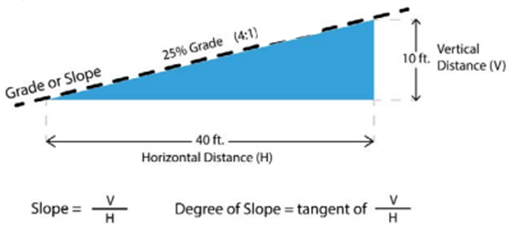
Special Event
Any show, exhibition, fair, carnival, theatre, or similar activity of a temporary
nature as more particularly described in Section 5.13.010, Definitions.
Special Purpose District
A special purpose district is a base zoning district which has unique characteristics
because of a specialized use which require special zoning regulations to provide for
the use.
Stable Rock
A rock slope as certified by a Nevada registered engineer that will stand near vertical
and provide perpetuity and stability against weathering.
Standard Specifications
The "Standard Specifications for Public Works Construction" hereinafter referred to
as S.S.P.W.C. (a.k.a., the orange book), as adopted by the City Council.
Start of Construction (for Floodplain Management Purposes)
For purposes of floodplain management, "start of construction" includes substantial
improvement, and means the date the building permit was issued, provided the actual
start of construction, repair, reconstruction, placement, or other improvement was
within 180 days of the permit date. The actual start means either the first placement
of permanent construction of a structure on a site, such as the pouring of slab or
footings, the installation of piles, the construction of columns, or any work beyond
the stage of excavation; or the placement of a manufactured home on a foundation.
Permanent construction does not include land preparation, such as clearing, grading
and filling; nor does it include the installation of streets and/or walkways; nor
does it include excavation for a basement, footings, piers, or foundations or the
erection of temporary forms; nor does it include the installation on the property
of accessory buildings, such as garages or sheds not occupied as dwelling units or
not part of the main structure.
State's General Permit
The State of Nevada Division of Environmental Protection General Permit for Storm
Water Associated with Construction Activity set forth in NRS Chapter 445A and Section
18.04.303, Control of Construction Site Discharge, as amended.
State Coordinating Agency (for Floodplain Management Purposes)
The agency of the state government (or other office designated by the Governor of
the state or by state statute) that, at the request of the Federal Insurance Administrator,
assists in the implementation of the National Flood Insurance Program in that state.
State Register of Historic Places
Created by NRS Chapter 383.085, the State Register is a listing of properties important
in the prehistory and history of Nevada.
Story
That portion of a building included between the upper surface of any floor and the
upper surface of the floor next above, except that the topmost story shall be that
portion of a building included between the upper surface of the topmost floor and
the ceiling or roof above. If the finished floor level directly above a usable or
unused under-floor space is more than six feet (1,829 mm) above grade, as defined
herein, for more than 50 percent of the total perimeter or is more than 12 feet (3,658
mm) above grade, as defined herein, at any point, such usable or unused under-floor
space shall be considered as a story.
Story, First
Lowest story in a building that qualifies as a story, as defined herein, except that
a floor level in a building having only one floor level shall be classified as a first
story, provided such floor level is not more than four feet (1,219 mm) below grade,
as defined herein, for more than 50 percent of the total perimeter, or not more than
eight feet (2,438 mm) below grade, as defined herein, at any point.
Story, Half
An additional and partial upper story that is limited to a story with a 12-foot maximum
height between the floor and ceiling, a 6-foot maximum height between the floor and
ceiling for no more than 50 percent of the building footprint, and used only on buildings
with the first story floor elevation not exceeding the average ground level of the
building perimeter by more than four feet.
Street
A way for vehicular access and address assignment whether designated as a street,
freeway, highway, parkway, throughway, road, avenue, drive, lane, boulevard, place,
or however otherwise designated, but not including alleys or driveways.
Street, Collector
A street functional classification which relates to Master Plan documents and design
standards. Collectors link local streets in neighborhood areas to arterial streets
and provide access to abutting properties. STOP signs are often found at intersections
with local streets, and intersections with arterial streets may have traffic signals.
Typical width (curb to curb) is 40 feet in residential areas and 50 feet in commercial
areas, with speed limits of 25 or 30 miles per hour.
Street Furniture
Municipal equipment placed along streets, including light fixtures, fire hydrants,
police and fire call boxes, signs, benches, and kiosks.
Street, Local
A low speed, low-traffic-volume street that provides access to abutting properties
in neighborhoods.
Street, Major Arterial
A functional classification for a street that accommodates large volumes of through
traffic between city districts. Direct access is discouraged to individual properties,
although limited access to major projects (i.e., business park, shopping mall, etc.)
is allowable, provided such access does not compromise the roadway's ability to handle
large volumes of through traffic. Access, parking and loading may be restricted or
prohibited to improve capacity. Traffic signals are located at intersections with
other arterials and some collector streets. The typical width provides for six travel
lanes; speed limits on major arterials are usually 40—50 miles per hour.
Street, Minor Arterial
A minor arterial provides traffic access between neighborhoods and city centers. The
minor arterial street is subject to some access control, channelized intersections,
and parking restrictions, and is signalized at intersections with major arterial streets,
other minor arterial streets and some collector streets. The city standard width of
68 feet allows for left turn lane and four travel lanes. Speed limits on minor arterials
are typically 30—45 miles per hour.
Street, Private
A street which is to be owned and maintained by parties other than the city or other
government agency.
Street, Public
A street owned by the city or other government agency.
Structure
Any construction principally above-ground, except a tent, trailer (mobile home), vehicle,
or other portable object that is not left in place for greater than 14 consecutive
days. An object constructed or installed including, but not limited to, a building,
tower, crane, prefabricated storage container, smokestack, sign, overhead transmission
line, and an edifice or building of any kind, or any piece of work artificially built
up or composed of parts joined together in some definite manner. For the purposes
of administering Section 18.04.102, Flood Hazard Areas, this definition shall include gas and liquid storage tanks.
Subdivider
A person who owns and causes land to be divided by means of a subdivision, parcel
map or record of survey.
Subdivision
Pursuant to NRS Section 278.320, any land, vacant or improved, which is divided or
proposed to be divided into five or more lots, parcels, sites, units or plots for
the purpose of any transfer, development, or any proposed transfer or development.
Substantial Damage (for Floodplain Management Purposes)
Damage of any origin sustained by a structure whereby the cost of restoring the structure
to its before damaged condition would equal or exceed 50 percent of the market value
of the structure before the damage occurred.
Substantial Improvement (for Floodplain Management Purposes)
For purposes of floodplain management, any repair, reconstruction, or improvement
to a structure, the cost of which equals or exceeds 50 percent of the market value
of the structure either:
1)
Before the improvement or repair is started, or
2)
If the structure has been damaged and is being restored, before the damage occurred. For the purposes of this definition, "substantial improvement" is considered to occur when the first alteration of any wall, ceiling, floor, or other structural part of the building commences, whether or not that alteration affects the external dimensions of the structure.
This term does not, however, include either: any project for improvement of a structure to comply with existing state or local health, sanitary or safety code specifications which are solely necessary to assure safe living conditions; or any alteration of a structure listed on the National Register of Historic Places or a state inventory of historic places.
Surveyor
A person who is retained by the owner/developer and is currently licensed in the state
as a land surveyor in accordance with NRS Chapter 625.
SWPPP
Stormwater Pollution Prevention Plan.
Tandem Parking
Up to three vehicles placed end-to-end.
Tenant
A person entitled under a lease or rental agreement to occupy a dwelling unit to the
exclusion of others.
Tentative Map
A map made for the purpose of submittal to the city for application of a subdivision
showing the conceptual design of the proposed subdivision and the existing and proposed
physical conditions in and around it.
Traffic Calming
The combination of mainly physical measures that reduce the negative effects of motor
vehicle use, alter driver behavior and improve conditions for non-motorized street
users.
Traffic Control Device
A device as defined in NRS Chapter 484 and Chapter 6.06, Rules of the Road.
Transient Lodging
Transient lodging is the rental of a room for a period of less than 28 consecutive
days. Transient lodging is subject to the applicable provisions of Chapter 2.10, Article
III: Room Taxes.
Transient Parking
Parking intended to serve a transient use (e.g., parking for a temporary special event)
or to serve transient persons or patrons (e.g., parking intended for the short-duration
guests of a permitted hotel).
Transparency, Minimum
Minimum transparency shall be measured using elevation views of the building facade.
Ground level wall area shall mean the area up to the finished ceiling height of the
fronting space or fifteen feet above finished grade, whichever is less.
Travel Trailer
A vehicular, portable structure built on a chassis, designed to be used as a temporary
dwelling for travel, recreation and vacation use; having a body width not exceeding
eight feet, body length not exceeding 32 feet.
Trip
A one-way movement of vehicular travel from an origin (one trip end) to a destination
(the other trip end).
Trip Generation
The attraction or production of trips caused by a certain type of land development.
Truckee Meadows Region or "the Region"
The entirety of the City of Reno, the entirety of the City of Sparks, and that area
of unincorporated Washoe County that has been subject to transportation modeling in
the development of the Regional CIP.
Truckee River Flood Project Mitigation Model(s)
Hydraulic model or models, as amended, and incorporated here by reference, used to
measure the effects of proposed mitigation outside the same storage area on the displacement
of flood volume storage. Models are on file with the City of Reno's Development Service
and Public Works Departments.
Undisturbed
The ground surface in its original, natural state before any grading, excavation,
or filling.
Uniform Fire Code
The edition of the fire code as adopted by the City Council and in effect at the time
of project approval.
Unit
For purposes of describing a condominium project, the elements of a condominium which
are not owned in common with the owners of other condominiums in the project and which
are designed and intended for individual ownership and use.
Urban Districts or Urban Zoning Districts
Any of the following base zoning districts: MD-ED, MD-UD, MD-ID, MD-RD, MD-NWQ, MD-PD,
MU, MS, GC, NC, PO, MU-MC, MU-RES, and any portion of a PUD or SPD District where
the primary use is mixed-use development.
Urban/Rural Interface
Areas where urban and rural development and uses meet, and in some instances intermix.
U.S. EPA
United States Environmental Protection Agency.
Utility/Transmission Lines, Overhead (over 60 kv)
Utility infrastructure primarily located above ground providing electrical power which
is installed, operated and maintained by a municipality or a franchised utility company.
Utility/Transmission Lines, Underground (60 kv and under)
Utility infrastructure primarily located underground providing electrical power which
is installed, operated and maintained by a municipality or a franchised utility company.
Variance
A grant of relief from the zoning, development, or design standards of this Title
which permits construction in a manner that would otherwise be prohibited by this
Title.
Vegetation Area, Established or Re-established; or Re-vegetation Area
A vegetation or re-vegetation area which has a visual vegetative coverage of 70 percent.
Vegetative Coverage
Coverage with perennial plant and second-year annual grass species. Invasive weeds
do not contribute to coverage. Excessive rilling (ruts) and large areas of re-vegetated
areas which have been impacted by trespass are not acceptable as established.
Vicinity
Vicinity means the area within 1,500 feet of a property line.
Vested Private Development Right
Right to undertake and complete the development and use of property under terms and
conditions of a development agreement, which precludes any zoning or land use action
concerning the subject land by the City of Reno which would alter, impair, prevent,
diminish or otherwise delay the development or use of the property in the future.
Violation
The failure of a land use, building, structure, facility, or other development to
be fully compliant with the regulations of this Title. For purposes of floodplain
management, a structure or other development without the elevation certificate, other
certifications, or other evidence of compliance required by this Title's floodplain
management regulations is presumed to be in violation until such time as that documentation
is provided.
VMT
Vehicle Miles Traveled; refers to the number of miles traveled by all vehicles within
a specified area over a specified time.
Water Supply Ditch
A ditch conveying water for domestic or agricultural purposes that is owned and/or
controlled by a ditch or utility company.
Water Surface Elevation
The height, in relation to the National Geodetic Vertical Datum (NGVD) of 1929 (or
other datum, where specified), of floods of various magnitudes and frequencies in
the floodplains of coastal or riverine areas.
Wildland-Urban Interface (WUI)
The wildland-urban interface, or WUI, is any area where man-made improvements are
built close to, or within, natural terrain and flammable vegetation, and where high
potential for wildland fire exists.
Working Day
A calendar day, exclusive of Saturdays, Sundays, or city recognized holidays. Any
other reference to days means calendar days.
Yard
A required open space on the same lot or parcel with a building or structure, extending
between each property line and the projection of a building or structure that is closest
to each property line, measured along a line at right angles to the property line.
Yards are to be unoccupied and unobstructed, except as provided in Subsection 18.09.205(e), Intrusions into Yards. Figure 9-1 illustrates a variety of lot types and indicates
which are the front, rear and side yards.
Yard, Front
A yard that extends the full width of a lot or site, the depth of which is the distance
between the front property line that abuts a street or an access easement, and the
projection of a building or structure that is closest to the front property line along
a line at right angles to the front property line, excluding allowable projections
set forth in Subsection 18.09.205(e), Intrusions into Yards. Access easements for purposes of this definition do not
include access easements limited to emergency or secondary use or which are designed
to facilitate proper circulation in parking lots, and do not provide primary access
to any parcel. Freeways are exempt from being considered a front yard unless direct
access to the lot is taken off the freeway.
Yard, Rear
A yard that extends the full width of a lot or site, the depth of which is the distance
between the rear property line, which may or may not abut an alley, and the projection
of a building or structure that is closest to the rear property line along a line
at right angles to the rear property line, excluding allowable projections set forth
in Subsection 18.09.205(e), Intrusions into Yards. A rear yard is typically parallel or nearly parallel to
the front yard. On corner lots that do not abut an alley, there will be no rear yard.
Yard, Side
A yard other than a front or rear yard the depth of which is the distance between
each side property line and the projection of a building or structure that is closest
to each side property line along a line at right angles to the side property line,
excluding allowable projections set forth in Chapter 18.12 of this Title.
Zone 1
See definition for Critical Flood Zone 1.
Zoning
Regulatory tool adopted by the City to direct and shape land development activities
and implement the Master Plan.
Zoning Map Amendment
An amendment to the official zoning map typically intended to change the zoning district
designation of a particular parcel or lot.
(Ord. No. 6692, § 1(Exh. A), 1-8-25; Ord. No. 6710, § 14, 6-4-25)
18.09.101 - Meanings and Intent
All provisions, terms, phrases, and expressions contained in this Title shall be construed according to the general purpose set forth in Chapter 18.01 Article 2, Purpose, and the specific purpose statements set forth throughout this Title. When, in a specific section of this Title, a different meaning is given for a term defined for general purposes in this Title, the specific section's meaning and application of the term shall control.
18.09.102 - Text Controls
In case of any difference of meaning or implication between the text of this Title and any heading, caption, figure, illustration, table, or map, the text shall control.
18.09.103 - Lists and Examples
Unless otherwise specifically indicated, lists of items or examples that use terms such as "for example," "including," and "such as," or similar language are intended to provide examples and are not exhaustive lists of all possibilities.
18.09.104 - Computation of Time
The time within which an act is to be performed shall be computed by excluding the first day and including the last day. If the last day is a Saturday, Sunday, or legal holiday, that day shall be excluded. The following time-related words shall have the meanings ascribed below:
(a)
"Day" means a calendar day unless otherwise stated.
(b)
"Week" means seven calendar days.
(c)
"Month" means one calendar month.
(d)
"Year" means one calendar year, unless a fiscal year is indicated.
18.09.105 - Mandatory and Discretionary Terms
The words "shall" and "will" are always mandatory. The term "may" is discretionary.
18.09.106 - Conjunctions
Unless the context clearly indicates the contrary, conjunctions shall be interpreted as follows:
(a)
"And" indicates that all connected items or provisions apply; and
(b)
"Or" indicates that one or more of the connected items or provisions may apply singularly.
18.09.107 - Technical and Non-Technical Terms
Words and phrases shall be construed according to the common and approved usage of the language, but technical words and phrases that may have acquired a peculiar and appropriate meaning in law, city planning, or land development shall be construed and understood according to such meaning.
18.09.108 - Tenses, Plurals, and Gender
Whenever appropriate with the context, words used in the present tense include the future tense. Words used in the singular number include the plural. Words used in the plural number include the singular, unless the context of the particular usage clearly indicates otherwise. Words used in the masculine gender include the feminine gender, and vice versa.
18.09.109 - Titles and Headings
All titles and headings of chapters, sections, or subsections of this Title are to be used for convenience in arrangement only and shall not be construed to alter the intended meaning.
18.09.201 - Purpose
The purpose of this section is to provide uniform requirements for measuring dimensional standards and to list any exceptions to the dimensional standards in this Title.
18.09.202 - Related Zoning District or Use-Specific Regulations
Applicants for development should refer to Chapter 18.02 Zoning Districts, and Chapter 18.03 Use Regulations, for any applicable bulk/dimensional, density or intensity regulations specific to a particular zoning district or use. In case of conflict with the general measurement/exception standards in this article, the more specific zoning district or use standard in Chapter 18.02 and Chapter 18.03 shall apply unless otherwise expressly stated.
18.09.203 - Density
(a)
Calculation
(1)
Generally Except for mixed-use projects, residential density is calculated by dividing the gross area designated as residential by the number of dwelling units proposed to be built. Density shall be calculated based on the entire development site, which shall include all of the lots, parcels, and land area proposed for annexation or development according to the provisions of this Title, and which is in a single ownership or has multiple owners, all of whom join in an application for annexation or development. The term "site" does not include portions of a parcel not included in an annexation or development request.
(2)
Calculation for Mixed-Use Projects and Non-Residential Projects For mixed-use projects, density shall be calculated based on the floor area ratio of proposed buildings, and shall be calculated based on the entire development, as described in subsection (1), above.
(Ord. No. 6692, § 1(Exh. A), 1-8-25)
18.09.204 - Lots and Site Area Requirements
(a)
Measurement
(1)
Lot Area Lot area is measured as the amount of gross land area contained within the property lines of a lot or parcel, but not including streets, primary public access easements, or other rights-of-way.
(2)
Lot Width Lot width is measured as the distance between the side lot lines measured at right angles to the lot depth at a point midway between the front and rear line. For corner lots, minimum lot widths shall apply to all sides.
(3)
Lot Depth Lot depth is measured as the distance between the front and rear lot lines measured in the mean direction of the side lines. For corner lots, lot depth is measured as the depth perpendicular to the street frontage which provides primary access.
(4)
Net Land Area When used in this Title, "net land area" shall be measured as the total gross area of a parcel or lot less area devoted to public rights-of-way including public access easements.
(5)
Floor Area Ratio (FAR) Floor area ratio (FAR) is measured as the gross floor area of all buildings on a lot or parcel, divided by the lot area. For residential developments density shall be used to calculate the floor area ratio.
(6)
Site All of the lots, parcels, and land area proposed for annexation or development according to the provisions of this Title, and which is in a single ownership or has multiple owners, all of whom join in an application for annexation or development. The term "site" does not include portions of a parcel not included in an annexation or development request.
(b)
Minimum Lot Standards
(1)
No lot or parcel shall be so reduced in area as to be less in any dimension than is required by the zoning district in which the lot is located, unless one of the specified exceptions to minimum lot sizes in Subsection (c), below, applies.
(2)
Calculation of minimum area requirements shall not include area devoted to public access or roadway easements.
(c)
Exceptions to Minimum Lot Standards
(1)
Parcels Created for Public Agencies and Utilities Parcels created for TMWA, public agencies and for utilities regulated by the Public Utilities Commission are exempt from the minimum lot size requirements. Upon cessation of the use, the parcel created for the public agency or utility shall be reverted to acreage or abandoned in accordance with Nevada law. Parcels previously created for this purpose shall be recognized under and subject to the provisions of this subsection.
(2)
Cluster Development Cluster development may modify lot standards and density as specified in Subsection 18.04.903(a)(6), Cluster Development.
(3)
Neotraditional Development To promote neotraditional development and compensate for the otherwise developable land that is used for alleys, minimum lot sizes and dimensions may be reduced by 20 percent and maximum lot coverage may be increased to 50 percent for parcels that abut a primary street but restrict vehicular access to be provided exclusively from alleys.
(4)
Dimensional Standards for Attached Single-Family, Condominiums, and Townhouse Units Reduced lot sizes, reduced lot widths, and zero-foot setbacks may be provided for single-family, attached; townhouse; and condominium units, including commercial, industrial, and multi-family condominium projects, if:
a.
Common areas are maintained in a consistent manner by an association, master developer, or similar mechanism;
b.
Reciprocal parking and access agreements are recorded for use of the common areas; and
c.
All other development standards are addressed and met by the larger project. This subsection may be utilized for residential and non-residential developments.
(d)
Split Parcels No portion of any parcel of land that is a part of the required area for an existing building shall be used as a part of the required area of any other parcel or proposed building. When a portion of any parcel is sold or transferred and the area of that portion or the portion remaining no longer conforms to the required area as defined in the zoning district in which the parcel is located, the portion sold or transferred and the portion remaining shall be considered as one parcel only in determining the permissible number and location of buildings allowed to be placed on both parcels.
(e)
Number of Principal Buildings or Uses per Lot
(1)
In single-family zoning districts, only one principal building is permitted except for approved multi-family projects. Every dwelling shall have legal means of access to a right-of-way.
(2)
Where a lot or tract of land is used for multi-family, mixed-use, commercial, or industrial purposes, more than one principal building may be located upon the lot but only when such buildings conform to all requirements of this Title applicable to the uses and district.
(3)
No lot shall be divided to contain more dwelling units than are permitted by the regulations of the zoning district in which they are located.
(Ord. No. 6692, § 1(Exh. A), 1-8-25)
18.09.205 - Property Line Setback/Yard
(a)
Measurement
(1)
Generally
a.
Required yards and property line setbacks for buildings shall be measured as the horizontal distance between the property line and the nearest portion of a building or structure on the property.
b.
Where the parcel or lot includes a private roadway or access easement serving any nonresidential development other than minor utilities, or more than four residential parcels or units, yards or setbacks shall be measured from the edge of that roadway.
c.
Except for front setbacks in certain Urban Districts specified below, all required yard setbacks shall be measured from parcel boundaries. Where the parcel includes a private roadway or access easement serving any nonresidential development other than minor utilities, or more than four residential parcels or units, setbacks shall be measured from the edge of that roadway.
(2)
Measurement of Front Setbacks in Certain Urban Districts In the MD-, MU, MU-MC, and MU-RES districts, front setbacks shall be measured from the back of the curb. See Subsection 18.04.1003(a)(2)a, Measurement of Front Setbacks in Downtown, Mixed-Use Urban, and Mixed-Use Midtown Districts.
(3)
Exception for Transit System and School Bus Shelters The setback requirements of each zoning district shall not apply to public transit system, post office, or school bus shelters provided these shelters have first been approved by the Administrator. Public transit system or school bus shelters may be placed within the public right-of-way if approved by the City Engineer.
(b)
Irregularly Shaped Lots
(1)
Generally Structures on irregularly shaped lots shall comply with the following:
a.
Lots with multiple street frontages, except for corner lots, shall be required to comply with front setbacks along each lot line abutting a street.
b.
Lots with multiple side and/or rear lot lines not abutting a street shall comply with side setback requirements for all lot lines except that any lot line abutting a street shall comply with the front setback and the lot line farthest from the front lot line shall comply with the rear setback. See Figure 9-1.
(2)
Alternatives Approved by Administrator The Administrator may establish alternative setbacks for properties with irregularly shaped lots based on unique site and/or lot conditions.
Figure 9-1: Irregular Yard Determination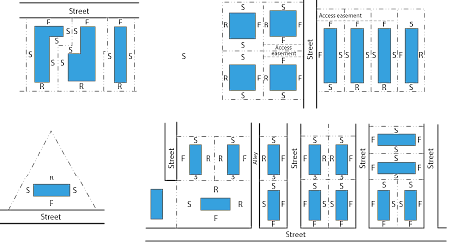
(c)
Self-Contained Yards No required yard or open space around an existing building or any building hereafter erected shall be considered a yard or open space for any other building on an adjoining lot or parcel.
(d)
Development Restrictions Where yards are required by this chapter, all structures shall be prohibited, except as specified by this Title.
(e)
Intrusions into Yards The following intrusions are permitted into a required yard setback:
(1)
Cornices, canopies, chimneys, eaves, or other similar architectural features may extend into a required yard not to exceed two feet.
(2)
Outside stairs, landing places, or patio areas may extend into the setback for a distance not to exceed three feet, provided the improvements do not extend above the elevation of the ground floor level plus a railing with a maximum height of three feet.
(3)
Mobility improvement for existing buildings shall allow covered or uncovered mobility and access ramp/lift retrofits to extend into the required yards, with any roof structure maintaining a two-foot minimum setback.
(4)
Mechanical equipment, including screening, not exceeding 4 feet in height may extend into the required side or rear yard, with all equipment maintaining a 2-foot minimum setback.
(5)
Solar panel assemblies no taller than six feet above ground level may extend into the required side or rear yards with a solid screen fence that is at least as tall as the solar panels provided along the property line.
(f)
Patio Covers/Decks Covered, unenclosed structures such as patio covers which are attached to a residential dwelling may extend into any required rear setback, provided:
(1)
The floor level of the covered, unenclosed structure does not exceed the ground floor level of the principal building.
(2)
The improvements do not exceed a height of twelve feet above the elevation of the ground floor level of the principal building.
(3)
The improvements do not extend to within ten feet of any rear property line.
(4)
The improvements do not encroach into any required front or side setback.
(g)
Ground Floor Level Decks Uncovered structures, such as decks which are attached to a residential dwelling, may extend into any required side or rear setback, provided:
(1)
The improvements do not extend above the elevation of the ground floor level plus a railing with a maximum height of three feet.
(2)
The improvements do not extend to within five feet of any property line.
(3)
The improvements do not extend into any required front setback.
(h)
Decks Above Ground Floor Level Uncovered structures, such as decks which are attached to a residential dwelling and have a floor level that exceeds the ground floor level of the principal building, shall meet the minimum setback requirements for principal buildings in the zoning district in which they are located
(1)
For a proposed use that will be located in an individual structure or building, the required minimum distance shall be measured from the closest point of the structure or building housing the proposed use to the closest edge of the principal structure housing the existing use or to the closest lot line.
(i)
Distance or Spacing Requirements Whenever a regulation requires a proposed use or activity to be located a specified distance from an existing use, zoning district boundary, or activity, such distance or spacing requirement shall be measured as follows:
(1)
For a proposed use that will be located in an individual structure or building, the required minimum distance shall be measured from the closest point of the structure or building housing the proposed use to the closest edge of the principal structure housing the existing use or to the closest lot line.
(2)
For a proposed use that will be located within a building also occupied by other uses, such as within a shopping center, the required minimum distance shall be measured from the closest point of that portion of the building housing the proposed use to the closest edge of the principal structure housing the existing use or to the closest lot line.
(3)
Drive-through lanes, drives for gas stations, and other similar areas accessory to a principal use subject to a distance or spacing requirement shall also be located outside the minimum distance required.
(4)
For a use that triggers residential adjacency the distance shall be measured from parcel line to parcel line.
(Ord. No. 6692, § 1(Exh. A), 1-8-25)
18.09.206 - Building Coverage
(a)
Measurement Building coverage is measured as the amount of the total property area covered by the floor plates of all principal and accessory structures, expressed as a percentage of gross property area.
18.09.207 - Height
(a)
Measurement, Building Height Building height is measured from the finished floor to the highest point of the coping of a flat roof or to the deck line of a mansard roof or to the midpoint between the peak of the roof and the eave line. In areas where a daylight basement or building on sloping terrain exist, building height shall be calculated from the average finished grade (average distance between the high point and low point of the grade) to the midpoint of the roof. Underground crawl spaces and basements (only if they are located completely under the ground level) are not included in determining the building height. See Figure 9-2.
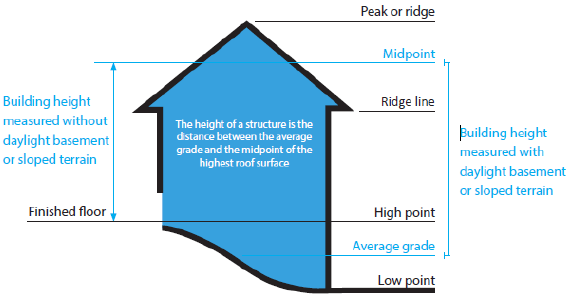
Figure 9-2: Building Height Determination
(b)
Exclusions from Building Height Limits
(1)
Church spires, belfries, cupolas, domes, chimneys, flues or flagpoles, or to water towers, radio towers, and the like, except where such may be deemed a hazard.
(2)
Parapet walls extending four feet or less above the limiting height of the building on which they rest.
(3)
Bulkheads, elevator towers, one-story penthouses, water tanks, or similar structures, provided that the features are not used for living space and aggregate gross floor area of such structures is not greater than 25 percent of the total roof area.
(c)
Plant Material Height Material height is measured from the top of the root ball or, if the plant is in a container, from the soil level in the container.
(d)
Sign Height The vertical distance from the topmost part of a sign face, cabinet, or copy (whichever is higher) to the grade of the sign foundation or the nearest point on a street or road other than an elevated roadway.
(Ord. No. 6692, § 1(Exh. A), 1-8-25)
18.09.208 - Open Space
Each owner of a project that includes a requirement to maintain land as open space shall deed restrict the use of the property to preclude its future use for anything other than open space, recreational purposes, vegetation management, utilities, and roadway infrastructure. The deed restriction shall not be amended or the open space reduced or withdrawn from use as open space without the consent of the City Council.
18.09.209 - Rounding
Unless specifically stated otherwise, and only where the Administrator finds the result is not contrary to the intent of the subject standard, any requirement of this Title that results in a fraction of .50 or greater are rounded up to the nearest whole number, while fractions of 0.49 or less are rounded down to the nearest whole number.
This standard shall not apply to the following measurements:
(a)
Minimum lot size (e.g., if the minimum lot size is 10,000 square feet, the lot cannot be anything less than 10,000.00 square feet).
(b)
Density or intensity, maximum or minimum (e.g., if the maximum density is 21 units per acre, the density cannot be greater than 21.00 units per acre).
(c)
Building or structure height, maximum or minimum (e.g., if the maximum building height is 30 feet, the building cannot be taller than 30.00 feet).
(d)
Setbacks, maximum or minimum (e.g., if the minimum setback is 10 feet, the building must be setback at least 10.00 feet).
(Ord. No. 6692, § 1(Exh. A), 1-8-25)
18.09.301 - Uses
Adult Business
Terms related to adult businesses are defined as follows:
1)
"Adult bookstore," "Adult novelty store," or "Adult video store" means an establishment which has as its stock in trade, or derives a portion of its revenues from, or devotes a portion of its interior business or advertising to, or maintains a sales or display space for the distribution, display, or presentation of any one or more of the following:
a.
Books, magazines, periodicals, or other printed matter, pictures, drawings, photographs, sound recordings, films, negatives, slides, motion pictures or other video recordings or visual representations that are distinguished or characterized by their emphasis on matter depicting, describing or relating to "specified sexual activities" or "specified anatomical areas"; and
b.
Instruments, objects, devices, or paraphernalia, that are designed for use or marketed primarily for stimulation of human genital organs or for sadomasochistic use or abuse of the user or others.
2)
"Adult characterized business" means any business wherein it is intended, for any form of consideration or gratuity, alone or in combination with an otherwise established fee, to employ persons, whether as an employee or independent contractor, to perform business activities or be present in conjunction with the performance of a business activity not requiring a special license under Title 4, Business License Code, and Chapter 5.11, Gaming, where such performance or presence involves the display of "specified anatomical areas" or "specified sexual activities".
3)
"Adult drive-in theater" means a drive-in theater used for presenting materials distinguished or characterized by an emphasis on matter depicting, describing, or relating to "specified sexual activities" or "specified anatomical areas" for observation by patrons therein.
4)
"Adult hotel or motel" means a hotel or motel which holds itself out to the public through advertising as an establishment wherein material is presented which is distinguished or characterized by an emphasis on matter depicting, describing or relating to "specified sexual "activities" or "specified anatomical areas" and rents or allows subrentals of rooms for periods of ten hours or less.
5)
"Adult interactive cabaret" means any fixed place of business which offers to patrons on a regular basis or as a substantial part of the premises activity, the opportunity to view adult interactive cabaret performers whose attire, costume, clothing or lack thereof exposes "specified anatomical areas," whose performance emphasizes exposure of and focus on "specified anatomical areas" and whose performance or exposure of "specified anatomical areas" while providing services is designed specifically to arouse sexual passions, all of which is typically associated with allowing the performer to solicit from patrons present anything of value such as drinks, tips, gratuities, or other compensation whether monetary or otherwise.
6)
"Adult motion picture arcade" means any portion of an adult business to which the public is permitted or invited wherein coin or slug-operated or electronically, electrically or mechanically controlled still or motion picture machines, projectors, video cassettes, computer displays, slides, photographic reproductions, or other image-producing devices are maintained to show images to ten or fewer persons per machine at any one time whether or not for remuneration, and where the images so displayed are distinguished or characterized by an emphasis on depicting or describing "specified sexual activities" or "specified anatomical areas".
7)
"Adult motion picture theater" means an enclosed building with a capacity of greater than ten persons used for presenting material distinguished or characterized by their emphasis on matter depicting, describing or relating to "specified sexual activities" or "specified anatomical areas" for observation by patrons therein.
Adult Education
Adult literacy, language, and education for adult students who have not graduated
from high school and are working towards adult diplomas after earning credits and
passing proficiency exams.
Agriculture, Animals, and Farming
This category includes agricultural and farming activities, including nurseries and
facilities for processing and selling agricultural products. Agricultural uses involve
urban farming, beekeeping, horticulture, floriculture, viticulture, and animal husbandry.
Animal-related uses include the boarding and care of animals on a commercial basis.
Accessory uses may include confinement facilities for animals, parking, and storage
areas.
Airport Operations and Facilities
Any structure or facility built in conjunction with the daily operation of an airport
on RTAA-owned property.
Amusement or Recreation, Inside
An enclosed facility or area for sport, entertainment, games of skill, or recreations
to the general public for a fee. Examples include, but are not limited to, theaters
(without drive-through), bowling alleys, video arcades, indoor miniature golf, roller
and ice-skating rinks, game courts, swimming pools, or physical fitness centers and
gyms. Shall include instruction such as gymnastics, karate and like activities/uses.
Amusement or Recreation, Outside
An outdoor facility or area for sport, entertainment, games of skill, or recreations
to the general public for a fee. Examples include but are not limited to game courts,
water slides, miniature golf courses, drive-in theaters, batting cages, practice/instructional
fields, and driving ranges.
Animal and Animal By-Product Processing
A facility that processes animals or animal by-products.
Animal Clinic, Shelter, Hospital, Boarding Kennel, or Training Facility
A place where animals or pets are given medical or surgical treatment, are cared for
during the time of the treatment, or are boarded, trained, bred, kept, or fed, including
animal daycare.
Asphalt or Concrete Batch Plant
A facility or area, which is not temporary in nature, for mixing concrete, or asphalt.
Assisted Living Facility
A residential facility providing food and shelter, personal guidance, care, rehabilitation
services, or supervision of over six clients. Shall be licensed by the city, county,
or state or operated by a non-profit organization.
Auto Service and Repair
A facility for the service or repair of any type of motorized vehicle. This use can
include mechanical repair, service facilities, collision services, painting of vehicles,
emissions testing, tire sales and installation, window tinting, stereo installation,
and repairing and installing elements of an automobile such as engines, transmissions,
wheels, brakes, and differential.
Automobile, Truck, Mobile Home, RV, Boat, and Trailer Sales or Rental
The sale or rental of automobiles, trucks, RVs, boats, and other similar equipment.
Automobiles kept on the lot for sales or rental purposes are not considered to be
outside storage.
Bakery, Retail
A facility which sells bakery and related items. Items sold on site may be made at
the facility. Catering is permitted.
Bar, Lounge, or Tavern
An eating and drinking establishment which sells alcoholic beverages for consumption
on the premises in which the sale of food products is secondary. The establishment
may also authorize the sale, to consumers only and not for resale, of alcoholic beverages,
in original sealed or corked containers, for consumption off the premises where the
same are sold. A bar, lounge, or tavern may be operated in conjunction with a live
entertainment use. The use does not include any use defined under Adult Business.
Bed and Breakfast Inn
Overnight accommodations and a morning meal in a dwelling unit provided to tourists
for compensation.
Blood Plasma Donor Center
A building used for the collection of human blood plasma from plasma donors. The term
does not include a facility for the provision of medical care or treatment.
Boarding or Rooming House
A building or portion thereof (not a hotel or motel) where, for reasonable compensation,
lodging is provided for more than five guests. Cooking facilities may or may not be
available.
Building, Lumber, and Landscape Material Sales
A facility for the sale of home, lawn and garden supplies, and construction materials
such as brick, lumber, and other similar materials.
Bus or Other Transportation Terminal
Any premises for the transient housing and/or parking and maintenance of buses or
other vehicles used for the movement of people (not freight) and where passengers
are picked up or discharged and tickets sold.
Call Center
A primary point of contact with customers via phone or Internet for purposes of selling
merchandise characterized by most employees processing orders via phone or Internet.
Cannabis Cultivation Facility, Adult-use
A business that is licensed by the Cannabis Compliance Board pursuant to NRS 678B.250 and acquires, possesses, cultivates, delivers, transfers, supplies or sells cannabis
and related supplies to: a) adult-use cannabis retail stores, adult-use cannabis production
facilities, or other adult-use cannabis cultivation facilities.
Cannabis Cultivation Facility, Medical
A business that is licensed by the Cannabis Compliance board pursuant to NRS 678B.210 and acquires, possesses, cultivates, delivers, transfers, supplies or sells cannabis
and related supplies to: a) medical cannabis dispensaries, medical cannabis production
facilities, or other medical cannabis cultivation facilities.
Cannabis Dispensary, Medical
A business that is licensed by the Cannabis Compliance board pursuant to NRS 678B.210 and acquires, possesses, cultivates, delivers, transfers, supplies or sells cannabis
and related supplies to: a) medical cannabis dispensaries, medical cannabis production
facilities, or other medical cannabis cultivation facilities.
Cannabis Independent Testing Laboratory, Adult-use
A business that is licensed by the Cannabis Compliance board pursuant to NRS 678B.250 and tests: a) cannabis intended for the medical use of cannabis; and b) medical cannabis
products.
Cannabis Independent Testing Laboratory, Medical
A business that is licensed by the Cannabis Compliance board pursuant to NRS 678B.210 and tests: a) cannabis intended for the adult use of cannabis; and b) adult-use cannabis
products.
Cannabis Production Facility, Adult-use
A business that is licensed by the Cannabis Compliance board pursuant to NRS 678B.250 and acquires, possesses, manufactures, delivers, transfers, supplies or sells adult-use
cannabis products to adult-use cannabis retail stores.
Cannabis Production Facility, Medical
A business that is licensed by the Cannabis Compliance board pursuant to NRS 678B.210 and acquires, possesses, manufactures, delivers, transfers, supplies or sells medical
cannabis products to medical cannabis dispensaries.
Cannabis Retail Store, Adult-use
A business that is licensed by the Cannabis Compliance board pursuant to NRS 678B.250 and acquires, possesses, delivers, transfers, supplies, sells or dispenses cannabis
or related supplies to a consumer or to another adult-use cannabis retail store.
Car Wash
The use of a site for washing, cleaning, and detailing of passenger vehicles, recreational
vehicles, or other light-duty equipment.
Casino (See Hotel with Nonrestricted Gaming)
A nonrestricted gaming operation where gaming is made available for play by the public
and which shall be associated with a hotel. Restricted gaming operations are not included
in the definition of "casino."
Cemetery or Mausoleum
Land used for burial of the dead, whether human or animal, including a mausoleum or
columbarium.
Chemical Processing and/or Manufacture
A facility in which chemical processing is used or where chemicals are manufactured.
Childcare Center
Any place, home, institution, business, or establishment in which children are received,
cared for, or maintained for any period of time with or without compensation. A Childcare
Center does not include accessory, in-home childcare uses as defined in this Chapter.
Cleaners, Commercial
A facility or area for cleaning items in bulk quantities such as clothes and linens.
This definition includes cleaning for hospitals, restaurants, hotels, diaper cleaning
services, and other similar accounts, as well as rug and dry-cleaning plants where
on-premise retail services to individual households are incidental to the operation
of the plant.
Collection Station
A facility used for the collection and temporary storage of empty beverage containers,
aluminum, glass, paper or clothing for recycling purposes conducted totally within
an enclosed structure or container. This definition does not include processing except
for "can banks" that crush cans as they are deposited. Excludes recycle containers
for the convenience of patrons.
College, University, or Seminary
A college or university is an academic institution of higher learning beyond the level
of secondary school. A seminary is an institution for the training of candidates for
the priesthood, ministry, rabbinate, or other religious order.
Commercial Kitchen
An establishment whose principal business is to prepare food on-site, then to transport
and serve the food off-site. No business consumption of food or beverages is permitted
on the premises.
Communication Facility, Equipment Only
Satellite, microwave, cellular telephone, or other radio transmission devices and
equipment, excluding satellite dishes for individual use.
Communications and Broadcasting
Uses including all towers, transmission devices, buildings, easements, or structures
used or intended to be used by any public or private communications and broadcasting
operation.
Community and Cultural Facilities
Uses including buildings, structures, or facilities to provide a service to the public.
Accessory uses may include limited retail, concessions, parking, and maintenance facilities.
Convenience Store
A retail store containing less than 5,000 square feet of gross floor area that is
designed and stocked to sell a limited amount of primarily food, beverages, and other
household supplies to customers who purchase only a relatively few items (in contrast
to a "supermarket"). It is designed to attract and depends upon a large volume of
stop-and-go traffic. Illustrative examples of convenience stores are those operated
by the "7-11" and "AM-PM" chains. A store of less than 5,000 square feet, which deals
primarily with the retail sale of alcohol would also be categorized as a convenience
store.
Convent or Monastery
A building housing a community of persons living under religious vows, such as nuns
or monks.
Convention Center
A facility dedicated to the hosting of conventions including service areas, such as
common areas, kitchens, and coat check rooms.
Country Club, Private
A facility used for recreational or athletic purposes with limited membership and
the use of which is primarily restricted to members and their guests. Accessory uses
include retail facilities that do not have separate signage or advertising, and a
club house.
Crematorium
A facility where human and/or animal corpses are cremated.
Custom and Craft Manufacturing
The on-site production of goods by hand manufacturing or artistic endeavor which involves
only the use of hand tools or domestic mechanical equipment and the incidental sale
of these goods directly to consumers. Examples include, but are not limited to, ceramic
studios, custom cabinet making, candle making shops, custom jewelry manufacturing,
textiles, pottery, furniture repair or refinishing, woodworking, sculpting and other
work or wood products on an individualized single item basis.
Data Center
A facility used primarily for the storage, management, processing, and transmission
of digital data, and which houses computer and/or network equipment, systems, servers,
appliances, and other associated components related to digital data operations. Such
facilities may also include air handlers, power generators, water cooling and storage
facilities, utility substations, and other associated utility infrastructure to support
sustained operations of a data center.
Dwelling, Duplex
A building with two dwelling units located on a single lot designed or arranged to
be occupied by two families living independently.
Dwelling, Fourplex
A building with four dwelling units located on a single lot designed or arranged to
be occupied by four families living independently.
Dwelling, Live/Work
A dwelling unit combining both a residential living space and an integrated workspace
principally used by one or more of the residents. The unit typically has a storefront,
workspace or studio, and public display area on the ground floor, with residential
located either on the upper floor or in the back of the workspace.
Dwelling, Multi-Family
A building used or designed as five or more dwelling units, or at least two detached
single-family structures on one lot, regardless of whether the dwelling units are
owned or rented or condominium units. Does not include cluster development, or lots
with one primary unit and one accessory dwelling.
Dwelling, Single-Family Attached
A dwelling unit attached to one or more other dwelling units located on a separate
lot. Each dwelling has its own front and rear access, no unit is located over another
unit, each unit is separated from other units by one or more vertical common walls
(not to include a common fence), and each dwelling is located on a separately owned
lot. A single family attached complex may include common areas and facilities owned
by all owners on a proportional, undivided basis.
Dwelling, Single-Family Detached
A dwelling, located on a separate and individually owned lot, for the exclusive use
of a single family maintaining a household. No single-family dwelling may have more
than one kitchen and all rooms used for human habitation must have interior access
to one another, except for the provision of an attached accessory dwelling as permitted
in this Title. The term "single-family detached dwelling" includes the definitions
set forth in NRS Sections 278.0209, 278.02095, and 278.021.
Dwelling, Triplex
A building with three dwelling units located on a single lot designed or arranged
to be occupied by three families living independently.
Educational Facilities
Uses in this category include public, private, and parochial institutions at the primary,
elementary, middle, high school, or post-secondary level, or vocational or trade schools.
Accessory uses commonly include cafeterias, indoor and outdoor recreational and sport
facilities, auditoriums, and day care facilities.
Escort Service/Outcall
Any business, agency, or person who, for a fee, commission, hire, or profit furnishes
or arranges for escorts or entertainers.
Event Center/Banquet Hall
An establishment rented by individuals or groups to accommodate private functions
(such as banquets, weddings, graduation parties, anniversaries, business or retirement
luncheons, trade shows, and similar events). They may include: 1) kitchen facilities
for the preparation or catering of food; 2) the sale of alcoholic beverages for on-premises
consumption, only during scheduled events and not open to the general public; and
3) outdoor gardens or reception facilities.
Farm
Land area devoted to raising, breeding, or producing an animal or plant, including
accessory processing, preparation, and sale of animal products, feed, grain, timber,
fruit, and vegetables.
Financial Institution
An establishment authorized to receive and safeguard money or other valuables, lend
money at interest, execute bills of exchange, and provide other similar services.
Food and Beverage
Establishments involved in serving prepared food or beverages for consumption on or
off the premises. Accessory uses may include food preparation areas, offices, and
parking.
Food Processing or Wholesale Bakery
A facility in which food for human consumption is provided in its final form, such
as candy, baked goods, tortillas, and ice cream, and the food is distributed to customers
on-site or to retailers or wholesalers for resale on or off the premises. Food or
beverage processing using mechanized assembly line production of canned or bottled
goods, which occupies more than ten percent of the facility's floor area, is excluded
from this definition.
Fraternity or Sorority House
Any building occupied and maintained by a social association of college students,
or where organization-sponsored functions are regularly held.
Funeral Parlor
An establishment engaged in the preparation of the deceased for burial or cremation,
for the display of the deceased, and/or for related ceremonies or services.
General Retail, 10,000 Square Feet or More
A retail sales facility of 10,000 square feet or more. Typical general merchandise
sold to the general public for direct consumption and not for wholesale may include
those listed under General Retail, less than 10,000 square feet. This use does not
include retail or commercial uses specifically listed or defined elsewhere in this
chapter or Title.
General Retail, Less than 10,000 Square Feet
A facility, of less than 10,000 square feet, for the retail sale of general merchandise
to the general public for direct consumption and not for wholesale. Typical general
merchandise includes clothing and other apparel, equipment for hobbies or sports,
gifts, antiques and collectables, flowers and household plants, dry goods, groceries,
convenience and specialty foods, toys, furniture, books and stationery, hardware,
pets and pet supplies, used goods, and other similar uses as determined by the Administrator.
This use does not include retail or commercial uses specifically listed or defined
elsewhere in this chapter or Title.
General Retail, Package Alcohol Sales
A facility that is dedicated to the retail sale or distribution of any alcoholic beverage
that is packaged for consumption outside of the establishment where the product is
sold or distributed and does not meet the use standards for the Package Alcohol Sales
Accessory to a Primary Use definition. Refer to RMC Title 5 "Privileged Licenses,
Permits, and Franchises", Chapter 5.07.011 (Definitions), 5.07.110 (Package wine and
beer license), and 5.07.120 (Package alcoholic beverage license) for definitions of
alcohol and alcoholic beverages.
Group Home
A community-based dwelling use providing food and shelter, personal guidance, care,
rehabilitation services, or supervision. Group homes shall have a maximum of six clients
plus two staff residing in a house, except where federal and/or state law requires
otherwise. Group homes serving persons with disabilities may have a maximum of ten
clients with house parents or guardians and shall be licensed by the city, county,
or state.
Group Living
Uses characterized by residential occupancy of a structure by a group of people who
do not meet the definition of "household living." Tenancy is arranged on a monthly
or longer basis and the size of the group may be larger than a "family." Generally,
group living structures have a common eating area for residents. Residents may receive
care, training, or treatment, and caregivers may or may not also reside at the site.
Accessory uses commonly include recreational facilities and vehicle parking for occupants
and staff. The group living category is not to be construed as a "group home."
Gun Range, Indoor
A facility for the sport of shooting at targets to test accuracy in rifle, pistol
or other firing device, or for the practice of archery, owned or operated by a corporation,
association, or individuals.
Hazardous Waste Facility
A facility or a part of a facility that is used for the manufacture, processing, transfer,
treatment, storage, or disposal of explosives or hazardous substances.
Healthcare Facilities
Uses characterized by activities focusing on medical services, particularly licensed
public or private institutions that provide primary health services and medical or
surgical care to persons suffering from illness, disease, injury, or other physical
or mental conditions. Accessory uses may include laboratories, outpatient, or training
facilities, or other amenities primarily for the use of employees in the firm or building.
Heavy Machinery and Equipment Rental, Sales, and Service
A facility for the display, sale, and rental of tools, heavy machinery, dump trucks,
or commercial and heavy equipment such as those used in building construction, farming,
restaurants, or manufacturing.
Hospital, Acute and Overnight Care
A building used for accommodation of sick, injured, or infirm persons, including,
sanitaria, convalescent, and rest homes. An institution, designed within an integrated
campus setting for the diagnosis, care, and treatment of human illness, including
surgery and primary treatment.
Hotel-Condominium
A hotel-condominium is an establishment meeting the criteria for a "Hotel" as set
forth in this Title but subdivided into individual rooms or suites for separate ownership.
Hotel-condominiums are a commercial condominium development for which the units are
primarily used to derive commercial income from, or provide service to the public,
and may not be used as a dwelling by an Owner for 28 days or more within any 12-month
period. Hotel-condominiums are subject to transient lodging standards and requirements.
When hotel-condominiums are not occupied by the owner, owners shall make them available
for transient rental lodging use through a hotel rental management program or otherwise.
Household Living
Uses characterized by residential occupancy of a dwelling unit by a "family." Tenancy
is arranged on a month-to-month or longer basis. Common accessory uses include recreational
activities, raising of household pets, personal gardens, personal storage buildings,
hobbies, and resident parking.
Indoor Manufacturing, Processing, Assembly, or Fabrication
A manufacturing processing or assembly facility in which all activities and storage
of materials occurs indoors. This use may include accessory retail sales as defined
in this section.
Laboratory
A facility for conducting medical or scientific research, investigation, testing,
or experimentation, but not facilities for the manufacture or sale of products, except
as incidental to the main purpose of the laboratory. This definition also includes
labs for the manufacture of dentures and prosthesis.
Library, Art Gallery, or Museum
A facility or area that is open to the public and is intended for collections of books,
manuscripts, and similar materials for study and reading, or for the acquisition,
preservation, study, and exhibition of works of artistic, historic, literary, or scientific
value.
Lodging
Uses in this category provide lodging services for a defined period of time with incidental
food, drink, and other sales and services intended for the convenience of guests.
Maintenance, Repair, or Renovation Business
A facility for contracting services such as building repair, renovation and maintenance,
the installation of plumbing, electrical, air conditioning and heating equipment,
and janitorial services.
Major Government Facility
Public facilities provide a significant service and have a substantial impact on the
community. Typical uses are sanitary landfills, airports, and detention and correction
facilities.
Manufactured Home
A dwelling unit fabricated in an off-site manufacturing facility for installation
or assembly at the building site, bearing the label certifying that it is built in
compliance with the Federal Manufactured Housing and Construction and Safety Standards
in effect on the date of manufacture. A manufactured home is further defined by NRS
Section 489.113. Whenever this Title refers to mobile homes, manufactured homes that are not single-family
dwellings, as defined in this chapter, shall be considered as having the same restrictions
and privileges.
Manufactured or Mobile Home Park
A parcel or tract of land having as its principal use the rental, leasing, or occupancy
of space by two or more manufactured or mobile homes on a permanent or semi-permanent
basis, including customary accessory buildings and uses.
Manufacturing and Processing
Uses in this category includes the excavation, transporting, manufacture, fabrication,
processing, reduction, destruction or any other treatment of any article, substance,
or commodity, to change its form, character or appearance. Accessory uses may include
retail sales, offices, storage, cafeterias, employee amenities, parking, warehousing,
and repair facilities.
Medical Facility, Day Use
An outpatient medical facility which is used only during the day, and which does not
provide overnight care. This includes surgery centers, outpatient care facilities,
urgent care, etc. that are typically standalone medical facilities that include medical
care beyond routine consultation and may be in connection with surgery. This use may
also include freestanding birthing centers as defined by NRS 449.0065 with the potential
for overnight care.
Microbrewery, Distillery, or Winery
A small brewery, winery, or distillery operated separately or in conjunction with
a drinking establishment or restaurant.
Mini-warehouse
A facility for the storage of personal effects and household goods within an enclosed
storage area having individual access, but excludes workshops, hobby shops, manufacturing,
or commercial activity. This use may also include the outdoor storage of operable
vehicles such as recreational vehicles, boats, and similar vehicles, but not including
heavy-duty trucks or semi-trailers.
Mining Operations
The activity of surface, underwater, or underground extraction and treatment of deposits
of minerals, ores, and other solid matter using techniques including, but not limited
to, excavating, dredging, drilling, crunching, grinding, sorting, sifting, sizing,
washing, drying, blasting, trimming, punching, splitting, gauging, and sawing and
cutting of stone. The term also includes the construction and use of buildings, facilities
and equipment to carry out similar activities, exclusive of manufacturing processes,
and includes the removal of overburden to provide access to minerals. The term also
includes processes related to the preparation or processing of mineral aggregates
obtained from the site, including, but not limited to, stockpiling of materials, dewatering,
and grading of land. The term does not include the excavation, removal, and disposition
of minerals from construction projects or excavations in aid of agricultural activities.
Minor Government Facility
An office or facility for storage of materials and equipment that is operated by the
federal, state, county or city, or other public entity.
Mobile Home Subdivision
A subdivision of land platted in conformance to NRS Chapter 278 and applicable City ordinances for the purpose of providing mobile home lots.
Motel, with or without Gaming
A building or group of buildings occupied or intended to be occupied, for compensation,
as the temporary residence for transient guests, primarily persons who have residence
elsewhere, with access to each room or unit from an outside porch or landing (whether
or not the outside porch or landing is enclosed with screen, glass, plastic or similar
material) and with accessible parking spaces on the premises, or adjacent premises
under the same ownership, for each unit, as provided for in this chapter.
Night Club
An establishment operated as a place of entertainment, characterized by any of the
following as a principal use:
1)
Live, recorded, or televised entertainment, including performance by magicians, musicians or comedians.
2)
Dancing.
Office and Professional Services
Uses in this category provide executive, management, administrative, governmental,
or professional services, but do not sell merchandise except as incidental to a permitted
use. Typical uses include real estate, insurance, property management, investment,
employment, travel, advertising, law, architecture, design, engineering, accounting,
call centers, and similar offices. Accessory uses may include cafeterias, health facilities,
parking, or other amenities primarily for the use of employees in the firm or building.
Office, General
An office facility other than specifically listed or defined elsewhere in this Chapter
or Title. This includes medical offices that are typical of routine office visits
including physicians, dentist, chiropractors, psychiatrists, and related medical disciplines,
as distinguished from medical facilities and outpatient surgery centers.
Outdoor Storage
Property used for the long term (more than 72 hours) retention of materials, machinery,
large vehicles, including boats and recreational vehicles, and/or equipment; regardless
of whether materials, machinery, large vehicles, or equipment are to be bought, sold,
repaired, stored, incinerated, or discarded. New or used motor vehicle sales and rental
display and parking shall not be defined as outside storage if the vehicles are operable.
Parking Lot, Open
A facility for parking that is not associated with a building on the same lot, or
is operated as a business enterprise by charging the public a fee and is not reserved
or required to accommodate occupants, clients, customers, or employees of a particular
establishment or premises.
Pawn Shop
A facility (other than a bank, saving and loan or mortgage banking company) used for
the business of lending money on the security of pledged goods or for the business
of the purchase of tangible personal property on condition that it may be redeemed
or repurchased by the seller for a fixed price within a fixed period of time.
Personal Service, General
A facility for the sale or provision of personal services, but not including personal
service uses otherwise listed or specifically defined in this Chapter. Typical personal
services include, but are not limited to, barber or beauty salon, massage parlor,
shoe repair, tailor, instructional arts studio, photography studio, custom and craft
work studio, safe deposit boxes, copy center, travel bureau, house cleaning services,
self-service laundry or laundry drop-off/pick-up, weight reduction centers, florists
(excluding greenhouses), astrologer, hypnotist, psychic, tattoo shop, body paint,
and other similar uses as determined by the Administrator.
Personal Services
Uses in this category provide individual services related to personal needs directly
to customers at the site of the business, or that receive goods from or return goods
to the customer, which have been treated or processed at that location or another
location.
Plant Nursery/Garden Supply
A facility for the growing, display, or sale of plant stock, seeds, or other horticulture
items. This use may include raising plants outdoors or in greenhouses for sale either
as food or for use in landscaping.
Printing and Publishing
A commercial facility which reproduces a large quantity of copies of books and other
printed material. Does not include a facility which provides custom copy and printing
services.
Prison or Custodial Institution
A place where persons convicted or accused of crimes are confined.
Private Club, Lodge, or Fraternal Organization
An organization and its premises operating on a membership basis for the promotion
of interests of the members including facilities for business organizations; facilities
or spaces for physical exercise and recreational activities; civic, social, and fraternal
organizations, and other similar organizations.
Private Dorm
A residential facility used for training purposes.
Public Meal or Homeless Services Provider
Any use of land whether in a structure, tent or any enclosed or unenclosed private
or public area, where for no charge or for only a token charge (provision of meals
where the charge for the meal is less than the actual cost to provide the meal) meals
are provided to the public for a period exceeding more than 24 days in any year. A
building that is used or intended to be used to provide to homeless individuals temporary
accommodations, shelter, meals or any combination thereof. For purposes of this chapter,
a "homeless individual" includes an individual who lacks a fixed, regular residence.
Public Park or Recreation Area
Land designated and used by the public for active and/or passive recreation.
Public Transit or School Bus Shelter
A shelter to provide cover for persons waiting to use public transit services, including
school buses.
Railroad Yard or Shop
A facility or area for the maintenance, repair, or storage of rail vehicles, and associated
with a working railroad.
Recording Studio
A building or portion of a building used as a place to record music and videos. This
definition does not include broadcasting facilities.
Recreation and Entertainment
This category includes indoor and outdoor recreation and entertainment activities.
Accessory uses may include limited retail, concessions, parking, and maintenance facilities.
Recreational Vehicle Park
A parcel or tract of land, having as its principal use the transient rental or occupancy
of space for no more than 90 days by two or more recreational vehicles, including
accessory buildings, structures, or uses customarily incidental thereto.
Religious Assembly
Any building used for religious worship services, religious education, fellowship
activities, and programs of a religious organization. The term does not include any
class of childcare center, general education classrooms and facilities, or commercial
activities.
Resource and Extraction
Uses relating to the removal or materials from the natural environment often including
logging and mining rocks, soils, minerals, and other similar materials.
Restaurant
A retail business licensed to serve food and beverages for consumption and which uses
a kitchen on the premises for food preparation with a minimum floor area of 200 square
feet. Includes cafes, coffee shops, sandwich shops, ice cream parlors, fast food take-out
(i.e., pizza), and similar uses.
Restaurant with Alcohol Service
A restaurant where alcoholic beverage drinks are prepared for service at tables for
consumption only in connection with a meal served on the premises. May include a lounge
area where customers wait to be seated for a meal. Alcoholic beverages are not purchased
directly from the bar or for off-premise consumption.
Retail
Uses involving the sale, lease, or rent of new or used products directly to the final
consumer for whatever purpose but not specifically or exclusively for the purpose
of resale. Accessory uses may include offices, parking, storage of goods, assembly,
repackaging, or repair of goods for on-site sale.
Salvage or Reclamation of Products, Indoors
Reclamation of products means a facility or area for storing, keeping, selling, dismantling,
or salvaging scrap or discarded material or equipment not listed elsewhere in this
chapter. Scrap or discarded materials includes, but is not limited to, metal, paper,
rags, tires, bottles, or inoperable or wrecked motor vehicles, motor vehicle parts,
machinery, structural steel, equipment, and appliances. This definition includes facilities
for recycling recoverable resources, such as newspapers, magazines, books, and other
paper products; glass, metal cans, and other products, to return the products to a
condition in which they may again be used for production.
School, Public or Private
An educational institution at which attendance satisfies the compulsory education
laws of the State of Nevada. Public schools are further defined by NRS 385.007 and
private schools are further defined by NRS 394.103.
School, Vocational or Trade
A business operating for profit and offering instruction and training in a service
or art, such as a secretarial school, barber college, commercial art school; or offering
instruction and training in a trade such as welding, brick laying, machinery operation,
and other similar manual trades.. For purposes of this Title, this use differs from
business schools in that large equipment and outdoor activities are associated with
vocational/trade schools.
Septic Tank Services
A facility which provides installation, maintenance, and cleaning services for septic
tanks.
Single-Room-Occupancy
A commercial residential hotel providing sleeping and living facilities that may rent
on a weekly or monthly basis as a primary residence. Cooking and sanitary facilities
shall be provided within the unit. Does not include any building, structure, or property
in which persons are housed or detained under legal restraint or hospitalized or otherwise
under medical, nursing, or psychiatric care.
Sports Arena, Stadium, or Track
A facility where sports such as football, baseball, soccer, or track are played.
Stable, Commercial
Barns and equestrian facilities to house horses and provide riding classes or equestrian
activities to the public.
Stable, Private
A stable to house horses for the private use of the owner.
Storage, Distribution, and Warehousing
Uses in this category are engaged in the storage or movement of goods for themselves
or other businesses. Goods are generally delivered to other businesses or the final
consumer, except for some will-call pickups. There are typically few customers present.
Accessory uses may include offices, truck fleet parking, and maintenance areas.
Towing and Impound Yard
A facility where towing trucks are stored and where towed vehicles are stored on a
temporary basis.
Transfer Station
A facility for the collection and transfer of solid waste.
Transitional Living Facility
A residence that provides housing and a living environment for persons who have been
released from prison and who require assistance with reintegration into the community.
The term does not include a halfway house for recovering alcohol and drug abusers
or a facility for the treatment of abuse of alcohol or drugs.
Transportation, Vehicles, and Equipment
This category includes uses primarily associated with train, bus, and aircraft facilities.
Examples include airports, depots, terminals, or other facilities which serve as a
hub.
Truck Stop or Travel Plaza
A development oriented to the service of trucks, including the sale of fuel to truck
drivers, and provision for support facilities for truck drivers as set forth in Section
18.03.304(h)(6). Truck stops are designed to accommodate trucks and truck drivers, and may
also be utilized by non-truck traffic and the interstate traveler. This facility allows
for the temporary, daily, or overnight parking (excluding for the loading and unloading
of cargo) of commercial motor vehicles which are en-route to or from a destination
along an interstate freeway system, for free or for a fee that may be independent
of any other use on the premises. The term "truck" shall mean a commercial vehicle
driven by a 'truck driver' who is required to have a Class "A" CDL (Commercial Drivers
License) license or equivalent.
Truck Terminal
A business, service, or industry involving the use of commercial vehicles in the loading,
unloading, and transportation of cargo. May also include the fueling, maintenance,
servicing, storage, or repair of commercial vehicles or the storage of cargo. This
use does not include truck stops as defined elsewhere in this chapter or Title.
TV Broadcasting and Other Communication Service
A building or portion of a building used as a place for television broadcasting and
similar activities.
Urban Farm
The growing, raising, keeping, producing, and selling of agricultural, horticultural,
viticultural, fruit and vegetable products, including bees and up to 12 fowl.
Utilities
Uses including all lines, buildings, easements, passageways, or structures used or
intended to be used by any public or private utility related to the provision, distribution,
collection, transmission, or disposal of power, oil, gas, water, sanitary sewage,
communication signals, or other similar public services at a local level.
Utility, Major
A facility that generates, as a principal use, electricity from mechanical power produced
by solar, wind, gas, coal, hydraulic, nuclear fission franchised by the city, or other
fossil or non-fossil fuel power sources. Also, electric utility substations, electric
lines 60 kv or greater, natural gas lines greater than 100 psi, water lines greater
than 30 inches in diameter and greater than five miles in length, and geothermal lines
and facilities.
Utility, Minor
A facility, structure, or utility service that is not listed as a Major Utility in
this chapter, including, but not limited to, utility boxes, well houses, transmission
lines, pipelines, and irrigation water ditches.
Warehouse or Distribution Center
An enclosed structure for the loading, unloading, and storage of goods for distribution
or transfer to another location. This use may include accessory retail sales as defined
in this section.
Wedding Chapel
A facility which is principally rented to perform wedding ceremonies. Facilities may
include a chapel, dressing rooms, offices, and/or gardens.
Wholesale
The sale of goods in large quantities for resale by a retailer or the sale of construction
materials to general or subcontractors for use in the construction industry. Goods
are sold in bulk quantities usually at a lower cost. This use may include accessory
retail sales as defined in this section. This use does not include retail sales by
membership clubs, which are classified as a retail use. Lumber, plywood and millwork
yards such as building material establishments whose primary operations are directed
to the general public as opposed to builders are also classified as a retail use.
Wrecking Yard, Salvage Yard, or Junk Yard
A yard or building where automobiles, machinery, appliances, or other used commodities
and equipment are stored, dismantled, and/or offered for sale as whole units or as
salvaged parts.
(Ord. No. 6614, § 1(Exh. B, §1.6), 12-8-21; Ord. No. 6638, § 2, 10-26-22; Ord. No. 6692, § 1(Exh. A), 1-8-25)
Editor's note— Ord. No. 6692, § 1(Exh. A), adopted January 8, 2025, amended the title of § 18.09.301 to read as herein set out. The former § 18.09.301 title pertained to residential uses and derived from original source Code. Additionally, said ordinance amended and merged, in alphabetical order, the following former sections: § 18.09.302, pertaining to public, institutional, and civic uses, derived from original source Code; § 18.09.303, pertaining to commercial uses, derived from Ord. No. 6614, § 1(Exh. B, §1.5), adopted December 8, 2021; and Ord. No. 6638, § 2, adopted October 26, 2022; § 18.09.304, pertaining to public and quasi-public utilities and services; and § 18.09.305, pertaining to industrial uses, derived from original source Code.
18.09.302 - Accessory Uses
Accessory Dwelling Unit (ADU)
An Accessory Dwelling Unit is a dwelling unit that contains a kitchen, a full bathroom,
and living and sleeping areas, that is incidental and subordinate to the principal
use of the premises, that is located on the same lot or parcel as a principal dwelling
unit, and that does not alter the essential characteristic of the principal use of
the property.
Automated Teller Machine, Freestanding
A freestanding machine where financial transactions may be performed; not necessarily
located within a financial institution.
Ball Court
A facility to play court games such as tennis and basketball.
Caretakers Quarters
An independent, self-contained dwelling unit located on the same lot as a principal
multi-family dwelling or nonresidential use or structure and which provides residential
accommodations for property manager or security personnel.
Child Care, In-Home (5-12 Children)
Any facility in an occupied private residence where the licensee resides and care
is provided to at least five but not more than 12 children.
Childcare, Workplace
A childcare center accessory to a principle business for the purpose of providing
employees with onsite day care and training for their child or children.
Community Center, Private
A facility associated with a planned development, subdivision, or multi-family development
that provides for community activities for residents of the development.
Drive-Through Facility (Food Service)
An accessory feature of an establishment that permits customers to obtain food or
beverage services or goods while remaining in or on a motor vehicle. Includes stacking
spaces and queuing lanes.
Drive-Through Facility (Non-Food Service)
An accessory feature of an establishment that permits customers to obtain services
or goods, except food or beverage but including groceries, while remaining in or on
a motor vehicle. Includes stacking spaces and queuing lanes.
Gaming Operation, Nonrestricted
A gaming operation authorized to operate by the Nevada Gaming Commission under the
terms of a nonrestricted license, as defined in NRS Section 463.0177. A nonrestricted
gaming operation shall be combined with and operated in conjunction with a principal
hotel use. Also referred to as a "casino."
Gaming Operation, Restricted
A gaming operation consisting of the operation of 15 or fewer slot machines, and no
other gaming devices, when the machines are operated as incidental to the business
of the primary or principal commercial or lodging use. A restricted gaming operation
is authorized to operate by the Nevada Gaming Commission under the terms of a restricted
license, as defined by NRS Section 463.0189.
Guest Quarters
An accessory use consisting of one or more rooms contained within the primary building
or a detached accessory building located on the same parcel as a single-family detached
dwelling (e.g., a casita), intended for guest occupancies only and not leased or rented
for commercial gain. Guest quarters are not "accessory dwelling units" because guest
quarters do not contain separate and independent cooking (kitchen) facilities and
may not be rented, and therefore, are not "dwelling units" as defined in this Chapter.
Helipad
A facility for helicopter landing, taking off, fueling, maintenance, or other accessory
services for helicopters.
Home Occupation
An accessory to a primary residential use; a business establishment conducted within
a home by the home's occupants.
Live Entertainment
A facility that provides live performances and entertainment, including but not limited
to singing, dancing, floor show and musical entertainment, subordinate to the primary
commercial use of the establishment. This use may be operated independently or in
conjunction with another principal use such as a restaurant or an amusement or recreation
facility. Live entertainment does not include any use defined under Adult Business.
Live entertainment does not include background music not intended to draw spectators
or amplified music played through an establishment's sound system, however, live performances
of music or dancing in conjunction with amplified music is considered live entertainment.
Similarly, karaoke or DJs that perform in addition to background music would be considered
live entertainment.
Outdoor Storage
Property used for the long term (more than 72 hours) retention of materials, machinery,
and/or equipment; regardless of whether materials, machinery, or equipment are to
be bought, sold, repaired, stored, incinerated, or discarded. New or used motor vehicle
sales and rental display and parking shall not be defined as outside storage as long
as the vehicles are operable.
Package Alcohol Sales Accessory to a Primary Use
The retail sale or distribution of any alcoholic beverage that is packaged for consumption
outside of the establishment where the product is sold or distributed and where the
use is accessory to a primary use. The total gross floor area for the display and
sale of package alcoholic beverages, including package wine and beer, shall not exceed
49 percent of the total gross floor area of the commercial/retail portion of the use,
excluding gross floor area dedicated to storage, offices, restrooms, hallways, or
otherwise not accessible by the public. Refer to RMC Title 5 "Privileged Licenses,
Permits, and Franchises", Chapter 5.07.011 (Definitions), 5.07.110 (Package wine and
beer license), and 5.07.120 (Package alcoholic beverage license) for definitions of
alcohol and alcoholic beverages.
Retail Sales Associated with a Primary Useqa>Sale of products manufactured, produced, wholesaled, distributed, or warehoused in conjunction with an allowed principal manufacturing, wholesaling, distribution, or warehousing use. The accessory retail use shall not exceed 20 percent of the gross floor area of the principal use, with a maximum gross floor area not to exceed 5,000 square feet.
Satellite Dish
A signal-sending or receiving device for communicating with orbiting satellites.
Sidewalk Cafe
The use of public sidewalks and public rights-of-way for the consumption of food and
beverages.
Stable, Private
A stable to house horses for the private use of the owner.
Utility, Alternative Systems
A common or individual solar, wind, or other non-fossil fuel utility system that requires
a building permit for installation, is intended to reduce the costs of energy for
a principal structure as an accessory use, and is not otherwise defined in this section
as Electric Generating Plant, Electric Utility Substation, Utility Box/Well House,
or Major Utilities.
(Ord. No. 6614, § 1(Exh. B, §1.6), 12-8-21; Ord. No. 6638, § 2, 10-26-22; Ord. No. 6692, § 1(Exh. A), 1-8-25; Ord. No. 6727, § 3, 10-8-25)
Editor's note— Ord. No. 6692, § 1(Exh. A), adopted January 8, 2025, renumbered the former § 18.09.306 as § 18.09.302 as set out herein. The former § 18.09.302 pertained to public, institutional, and civic uses, and has been amended, and herein set out in § 18.09.301. The historical notation has been retained with the amended provisions for reference purposes.
18.09.303 - Temporary Uses
Asphalt or Concrete Batch Plant
A facility or area for mixing concrete or asphalt.
Christmas Tree Sales Lot and Similar Uses
A lot used to temporarily sell Christmas trees and other similar items.
Construction Field Office
A temporary building used as an on-site construction office.
Garage Sale
A sale of personal property from a residence or residential property which has been
owned or used previously by an individual or resident residing on the premises where
the sale is conducted. A yard, patio, or tag sale shall be included within the definition
of "garage sale."
Parking Lot, Open
An area, other than a street, alley, or parking structure designed or used primarily
for the temporary parking of vehicles.
Real Estate Sales Office
An office or a model home used to sell homes or buildings while the property is under
development.
Stockpiling
The temporary outdoor storage of soil, paving materials, wood, or other similar displaced
materials generated during a construction project which is located in the public right-of-way
or on a separate parcel. This includes the temporary storage of vehicles and supplies
related to the associated construction project; and may include material processing
as regulated in Section 18.03.503.
Urban Farm
The growing, raising, and selling of agricultural, horticultural, viticultural, and
vegetable products of the soil and up to 12 fowl in an urban setting as a temporary
principal land use.
Vegetation Management
The practice of thinning, clearing, or treating vegetation, debris, and combustible
fuels, including defensible space activities like mowing, seeding, targeted herbicide
treatments, and the temporary use of cattle, sheep, goats, or other similar animals
on fields for the purpose of vegetation management. This term may include temporary
overnight caretaker lodging, including cowboy camps, but shall not include feed lot,
animal husbandry, forestry, or silviculture activities.
(Ord. No. 6614, § 1(Exh. B, §1.6), 12-8-21; Ord. No. 6638, § 2, 10-26-22; Ord. No. 6692, § 1(Exh. A), 1-8-25)
Editor's note— Ord. No. 6692, § 1(Exh. A), adopted January 8, 2025, renumbered the former § 18.09.307 as § 18.09.303 as set out herein. The former § 18.09.303 pertained to commercial uses, and has been amended, and herein set out in § 18.09.301. The historical notation has been retained with the amended provisions for reference purposes.

