
Rifle City Zoning Code
ARTICLE I
General Provisions
Sec. 16-1-10. - Short title.
The ordinance codified in this Chapter shall be known and may be cited and referred to as the Rifle Land Use Regulations and herein may be referred to as these regulations or this Chapter. (Prior code 17.01.110; Ord. 4 §1, 2005)
Sec. 16-1-20. - Purpose.
This Chapter is drawn in accordance with the general plan (Comprehensive Plan) of the City, and is designed to lessen congestion in the streets; to secure safety from fire, panic, flood waters and other dangers; to promote health and general welfare; to provide adequate light and air; to prevent the overcrowding of land; to avoid undue concentration of population; and to facilitate the adequate provision of transportation, water, sewer, schools, parks and other requirements. This Chapter is drawn with reasonable consideration, among other things, as to the character of the City and neighborhoods and other areas of the City regarding the suitability for particular uses, and with a view to conserving the value of buildings and encouraging the most appropriate uses of land throughout the City. (Prior code 17.01.115)
Sec. 16-1-30. - Authority and jurisdiction.
This Chapter is authorized by Article 23, Title 31, C.R.S. These regulations shall apply to all land and all land uses within the municipal boundaries of the City. (Prior code 17.01.120)
Sec. 16-1-40. - Organization.
This Chapter is divided into separate Articles to address different aspects of these regulations. The headings and section titles in these regulations are for convenience only and are not intended to be used to interpret or give effect to any of the provisions of these regulations. (Prior code 17.01.125)
Sec. 16-1-50. - Public notice requirements.
For all actions of the City requiring public hearings, the applicant shall provide public notice and shall demonstrate that such public notice conforms to the following requirements.
(1)
Notice shall be sent by certified mail, return receipt requested, or first-class mail, to all property owners within two hundred (200) feet of the property in question at least ten (10) days in advance of the hearing. This Paragraph shall not apply to text amendments, a rezoning or other land use action initiated by the City Council or Planning Commission; provided, however, that the City shall provide notice pursuant to this Paragraph for a rezoning of property owned by the City.
(2)
Notice of the hearing shall be published in a newspaper of general circulation within the City at least ten (10) days in advance of the hearing.
(3)
Notice shall be posted on the subject property or at other locations specified by the City staff if the intent of this Paragraph is not satisfied by posting the subject property. Such posting shall take place at least ten (10) days in advance of the hearing.
(4)
Written notice shall be sent, via first-class mail, to any mineral estate owners of the property in question, and to the City, in accordance with Sections 24-65.5-101, et seq., C.R.S. An applicant seeking subdivision plat or plan approval listed in Paragraphs 16-5-210(a)(1) through (a)(6) of this Chapter shall send written notice, via certified mail, to all surface owners, mineral owners and lessees of mineral owners, in accordance with Section 31-23-215(1), C.R.S. Applicants shall send the notices required under this Paragraph at least thirty (30) days in advance of the hearing. In addition to the information required in Paragraph (5) below, all notices required by this Paragraph also shall contain the name of the applicant seeking the approval. Applicants shall certify to the City that such notice has been provided prior to approval of the application.
(5)
All notices shall include:
a.
A legal description of the subject property;
b.
A statement of the nature of the matter being considered;
c.
The time, date and place of the public hearing; and
d.
The agency or office and phone number where further information may be obtained. (Prior code 17.01.130; Ord. 4 §1, 2005)
Sec. 16-1-60. - Fees.
(a)
Each application shall be submitted with the appropriate fees as established by resolution of the City Council and as may be amended from time to time by resolution. Such fees shall be posted as the City of Rifle Land Use Application Fee Schedule at City Hall in the Planning Department and on the City's website. All fees and charges imposed by the authority within this Section shall be paid to the City Treasurer, in such manner as he or she shall prescribe. In addition to the minimum application fees, the applicant will also be charged the actual review costs for outside professional services for review of the application. Further, all applicants for subdivision (including parcels identified as "future phases"), plat amendment, annexation and right-of-way vacation will be assessed a fee for electronic GIS coordinate integration. The minimum application fees shall be due and payable upon submission of the application. In addition, at the time of submittal of the application, the applicant shall deposit funds as set forth on the City's Land Use Application Fee Schedule to be used as the initial payment to offset the costs of outside professional services for review of the application. The deposit amount may be increased as determined by the Planning Director, based upon the complexity of the project, and must be replenished at the request of the Planning Director if the deposit is exhausted prior to the completion of the application. After exhaustion of the initial deposit, statements for professional review services will be mailed to the applicant, and payment of such amounts is due within thirty (30) days of receipt of the statement. Interest shall be imposed at a rate of one and one-half percent (1.5%) per month on all balances not paid within thirty (30) days of the date of the statement. In the event the City is forced to pursue collection of any amounts due and unpaid under this provision, the City shall be entitled to collect attorneys' fees and costs incurred in said collection efforts in addition to the amount due and unpaid. The City reserves the right to suspend review of an application, withhold approval or postpone public hearings if an applicant fails to pay outstanding review fees as required hereunder.
(b)
As provided elsewhere in this Code, all costs of providing notice, including publication, mailing and posting, shall be borne by the applicant.
(c)
Recording and filing fees imposed by the County Clerk and Recorder, and others, as a result of the application, shall be advanced by the applicant prior to the documents being tendered for recording.
(d)
The City may suspend taking any further action if the applicant fails to pay any fees when due.
(e)
Until paid, all land use application fees, including fees for professional review services, shall become and remain a first and perpetual lien on or against the subject premises. This lien on the premises may be foreclosed by an action at law or in equity in the name of the City in any court having jurisdiction thereof. The City shall have the right to collect from any owner delinquent in the payment of such land use application fees all legal, court and other costs necessary or incidental to collection of any delinquent amount, including reasonable attorneys' fees, filing fees and recording costs. In addition to the remedies described above, in the event any rates, charges, tolls, fees and assessments are not paid when due, the City Treasurer may certify the amount to the County Treasurer to be placed on the tax list for the current year, and to be collected in the same manner as other taxes are collected, with ten percent (10%) added to defray the costs of collection. All laws of the State for the assessment and collection of general taxes, including the laws for the sale of property for taxes and redemption of the same, shall apply. (Prior code 17.01.140; Ord. 4 §1, 2005; Ord. 6 §2, 2010)
Sec. 16-1-70. - Severability.
If any section, subsection, paragraph, clause, phrase or provision of these regulations shall be adjudged invalid or held to be unconstitutional by a court of competent jurisdiction, the validity of these regulations shall not be affected in whole or in part, other than the provision adjudged to be invalid or unconstitutional. (Prior code 17.01.145)
Sec. 16-1-80. - Amendment.
(a)
Amendment procedure. Amendments to these regulations may be proposed by any person who is an owner of real property in the City, by the Planning Commission or by the City Council. Amendments to these regulations shall be known as text amendments and will be reviewed by the Planning Commission and City Council as prescribed in Article V of these regulations.
(b)
Zone district amendments and planned unit developments. The City may, from time to time, amend the number, shape or boundaries of any zone district or any regulation of or within such district, or any other provisions of this Chapter. Planned unit developments as described under Article III, Division 6 of this Chapter shall be processed as an amendment to the zone district map and to the applicable zone district regulations within the area proposed for development. The subdivision plat of the planned unit development shall, upon favorable vote of the City Council, be incorporated into the zone district map.
(c)
Procedure. Amendments to this Chapter shall be considered by the Planning Commission and the City Council pursuant to the requirements and procedures of Article V of this Chapter.
(d)
Protest; Council decision. In case of protest against an amendment signed by the owners of twenty percent (20%) or more, either of the area of lots included in such proposed amendment or of those immediately adjacent in the area thereof extending one hundred (100) feet therefrom, or from those directly opposite thereto, extending one hundred (100) feet therefrom, or from those opposite thereto, extending one hundred (100) feet from the street frontage of such opposite lots, such amendment shall not become effective except by a favorable vote of two-thirds (?) of the members of the City Council voting on the issue. (Prior code 17.01.150)
Sec. 16-1-90. - Land dedication requirements.
(a)
General requirements. For every annexation, subdivision or residential development, the City Council shall require the dedication of certain sites for parks and recreational use, and may require the reservation of sites for school and other public purposes. Land dedicated may include the one-hundred-year floodplain, national and state historical or natural features, and proposed public areas set aside in state, regional, county or city comprehensive plans. Land dedicated shall not include sites for private schools, sites for service organizations which are not open to the general public and sites unsuitable for public use due to steep slopes, rock formations, adverse topography, utility easements or other features which may be harmful to the health and safety of the citizens. These requirements shall not apply in cases where satisfactory dedication arrangements were made and approved by the City Council at the time of annexation or previous subdivision of the same property.
(b)
Method and amount of land dedicated.
(1)
The subdivider shall convey to the City by means of a final plat dedication, or shall deed land to be used for public recreation at locations designated by the City, in the following manner:
a.
The subdivider shall dedicate to the City land in the ratio of eight and ninety-sixth hundredths (8.96) acres for every one thousand (1,000) residents of the proposed subdivision or development;
b.
For the purpose of the foregoing requirement, the number of residents attributable to each subdivision shall be:
1.
Single-family dwellings, three and one-half (3.5) residents per unit.
2.
Two-family dwellings, three (3.0) residents per unit.
3.
Multi-family dwellings, two and one-half (2.5) residents per unit.
4.
For planned unit developments or where the number of units is known because of a proposed master plan, the number of units proposed shall govern.
(2)
Commercial and industrial developments within the City are exempt from the requirements of this Section, and there shall be no parkland dedication requirement imposed on such development.
(3)
A minimum of eighty percent (80%) of the land dedicated shall lend itself to utilization for public recreation purposes which includes, but is not limited to, the following: trails, play fields, tennis courts, picnic sites and boating areas.
(c)
Reservation of land for schools and other public agencies.
(1)
If requested by a public agency, the City Council may require a subdivider or developer to reserve land areas sufficient for development of school or other public agency facilities. A public agency includes the State or any political subdivision thereof.
(2)
Land reserved shall, by the nature of its natural topography, soil condition and connecting utilities, lend itself to development of the desired facility.
(3)
Land reserved shall be purchased by the public agency at its fair market value as determined below, according to the following schedule:
a.
Within ninety (90) days following approval of the final plat, the requesting agency and the subdivider or developer shall enter into an option agreement for a period of no greater than one (1) year, with a renewal provision for one (1) additional year.
b.
When the option is signed, the public agency shall deposit with an escrow agent an amount which shall be determined by the public agency and the developer to equal the actual costs and expenses, plus ten percent (10%), of the costs of replatting the subdivision if the option is not exercised. In the event the public agency and developer cannot agree upon the estimated expenses, the City Manager shall make the determination. In the event the option is extended for an additional year, the public agency shall deposit an additional ten percent (10%) of the estimated costs and expenses with the escrow agent.
c.
For the purpose of this Section, the fair market value of the land reserved shall be the value of the raw, undeveloped land, plus a proportionate share, as they benefit the reserved land, of the actual cost of the improvements required by the subdivider or developer.
d.
In the event the public agency and the subdivider or developer cannot agree as to the fair market value, the parties shall submit the matter to binding arbitration under such rules and regulations as the City Council may, by resolution, prescribe.
(d)
Cash payment in lieu of dedication.
(1)
At the option of the City Council, the subdivider or developer may be required, on or before final passage of the ordinance approving the subdivision, to pay to the City in cash or to transfer other property in lieu of land dedication. The amount of cash payment shall be as determined by this Section for the fee. If the City Council determines to accept other property instead of, or as a partial payment toward, the cash payment required hereunder, the City Council shall determine the value of the other property.
(2)
Payment in lieu of land dedication shall be made prior to final approval of the ordinance approving the subdivision, and such payment shall be placed in a recreation fund to be established and maintained by the City for the acquisition of land and for the improvement of parks, playgrounds, trails and recreation areas in the City, and may benefit the residents of the City in general, as well as those of the proposed subdivision.
(3)
The fee which may be accepted in lieu of land dedication shall be established each year as of January 1 by the City Council upon a recommendation from the Planning Commission. However, said fee shall increase by five percent (5%) from the preceding year unless the City Council finds that the fee structure requires further amendment due to land value increases or decreases. Fees shall be based on the average cost of vacant undeveloped residential land within the corporate limits of the City.
(4)
In extraordinary circumstances, the City Council may authorize the deferral of the payment of cash in lieu of dedication as required by this Section. In such event, the owner of the property shall agree with the City, in such form as shall be acceptable to the City Council, to pay such sums at the time of the issuance of any building permit upon the property. Notice shall be given of such deferred payment by the recording of a first mortgage or other security instrument with the County Clerk and Recorder. In no event, however, shall the deferral of any dedication fee required by this Section extend for a period of greater than five (5) years from the date it would otherwise be payable. The developer shall agree to pay the higher of the dedication fee calculated in accordance with this Section at the time originally owed or at the time actually paid. (Prior code 17.01.155; Ord. 16 §§2, 3, 2004)
Sec. 16-1-100. - Off-site street impact fee.
(a)
General requirements. For every residential, commercial or industrial subdivision, every commercial or industrial land use that involves heavy truck traffic (exceeding ten thousand [10,000] Gross Vehicle Weight) making an average of three (3) or more weekly trips, and every residential, commercial or industrial building in the City, there is hereby established an off-site street impact fee which shall be imposed pursuant to the provisions of this Article for the purpose of funding street improvements related to the provision of transportation services; provided, however, that this provision shall not apply to any property that is obligated to pay an off-site street impact fee pursuant to an annexation agreement or other development agreement with the City. The amounts of applicable off-site street impact fees shall be as set forth in Appendix A to this Code. Such fees shall automatically escalate at a rate of three percent (3%) per annum commencing January 1, 2022, unless increased or decreased by resolution adopted by the City Council.
(b)
Payment of fees. For every residential, commercial or industrial subdivision, the off-site street impact fees shall be paid to the City one-third (⅓) at the time of final plat and two-thirds (&frax23;) at the time of the issuance of each building permit for all lots and/or units within a proposed subdivision. The fees due on a one-third basis at the time of final plat and a two-thirds basis prior to the issuance of each building permit shall be calculated based upon the amount of the off-site street impact fee then in effect in any given year which includes the annual five-percent escalator, and fees shall not be "locked in" in any given year. For every commercial or industrial land use in the City not otherwise reviewed as a subdivision or for a building permit, one hundred percent (100%) of the off-site impact fee shall be paid to the City in full at the time of City approval of a development application filed pursuant to Section 16-5-40 of this Code. For every residential, commercial or industrial building in the City on property that has not paid any portion of an off-site street impact fee as part of a subdivision, one hundred percent (100%) of the off-site impact fee shall be paid to the City in full at the time of the issuance of each building permit.
(c)
Traffic and road impact study. To determine the amount of off-site street impact fees to be assessed for all nonresidential units and uses, a traffic and road impact study shall be prepared at the applicant's expense by a registered professional engineer. The impact study shall address traffic counts, weight loads, size of vehicles and timing of the impact, among other items which may be required by the City Manager. The City Manager shall review the results of each traffic and road impact study in a timely manner and make a determination as to the amount of off-site traffic impact fees necessary to offset the proposed development impacts. The applicant will be required to pay such fees according to the terms established in subsections (a) and (b), above. Any person aggrieved by the decision of the City Manager may appeal the same in writing to the City Council, by filing a written demand therefor, within fifteen (15) days after the City Manager provides notice of the amount of off-site street impact fees to be assessed. (Ord. 11 §3, 2006; Ord. 5 §2, 2007; Ord. 7, §2, 2021)
Sec. 16-1-105. - Reduced impact fees for infill development.
The water system improvement fee set forth in Section 13-4-70, the wastewater system improvement fee set forth in Section 13-4-90 and the offsite street improvement fee set forth in Section 16-1-100 shall all be reduced by twenty percent (20%) for building permits issued in the infill development area shown on the following Figure 16-1-105-1:
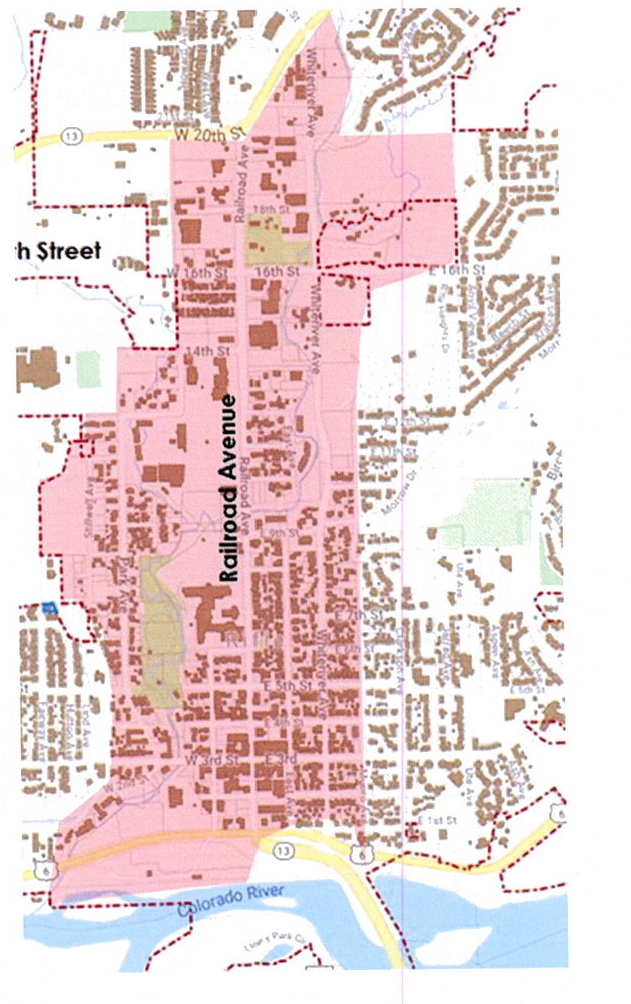
(Ord. 7 §4, 2021)
Sec. 16-1-110. - Interpretation.
In their application and interpretation, the provisions of this Chapter shall be held to be minimum requirements. This Chapter is not intended to repeal, abrogate, annul or in any way impair or interfere with existing provisions of private agreements. Where this Chapter imposes a greater restriction than that imposed by such existing provisions of law, contract or deed, the provisions of this Chapter shall control. (Prior code 17.01.160; Ord. 11 §2, 2006)
Sec. 16-1-120. - Certificate of occupancy.
(a)
Required. No vacant land shall be occupied and used, and no building hereafter erected shall be occupied or used, until a certificate of occupancy has been issued by the Building Inspector.
(b)
Issuance for building use. A certificate of occupancy for a new building or the alteration of an existing building shall be applied for coincident with the application for a building permit, and shall be issued within ten (10) days after the erection or alteration of such building has been completed in conformity with the provisions of these regulations.
(c)
Issuance for land use. A certificate of occupancy for the use of vacant land or the change in the use of land as herein provided shall be applied for before such land is occupied or used, and a certificate of occupancy shall be issued within ten (10) days after the application has been made, provided that such use is in conformity with these requirements.
(d)
Record; filing; fee. The certificate of occupancy shall state that the building or land complies with all the building and health laws and ordinances and with the provisions of this Chapter. A record of all certificates shall be kept on file in the office of the Building Inspector and copies shall be furnished upon request to any person having proprietary or tenancy interest in the building affected. No fee shall be charged for an original certificate applied for coincident with the application of the building permit. For all certificates or copies of the original certificate, there shall be a fee as set by City Council. (Prior code 17.01.165; Ord. 4 §1, 2005; Ord. 11 §2, 2006)
Sec. 16-1-130. - Building permits.
(a)
Required. No site preparation or building construction for any building shall be commenced without first obtaining a building permit.
(b)
Site/plot plan required. All applications for a building permit for a structure or a fence shall be accompanied by two (2) copies of a plot plan drawn to scale showing the actual dimensions of the lot to be built upon, the location of the existing structures and fences, the size of the building to be erected, the location of the building on the lot with reference to the legally established property lines, and such information as may be necessary to provide for the enforcement of these regulations. For all buildings, with the exception of single-family dwellings, within the MDR districts and all the commercial and industrial districts, a site plan must be prepared in accordance with the provisions of Section 16-6-40 of this Chapter and approved by the Planning Director before building permits shall be issued; provided, however, that any site plan for a multiple-dwelling unit project must be reviewed and approved by the Planning Commission pursuant to Article V, Division 3 of this Chapter, before the issuance of a building permit. A record of such applications shall be kept in the office of the Building Inspector. Notice of approval of a building permit shall be posted on the subject property within twenty-four (24) hours of such approval.
(c)
Review; public improvements.
(1)
All applications for building permits shall be reviewed by the Public Works Director to determine whether or not the proposed construction will require the installation or construction of public improvements such as street paving, curbs, gutters, sidewalks, drainage facilities or other public improvements.
(2)
If the Public Works Director determines that the proposed construction makes necessary any such public improvements, the Public Works Director shall so inform the Building Inspector. In such event, a condition shall be inserted in the building permit which shall require the construction of such public improvements by the permittee and the dedication thereof to the City. The cost of such improvements shall be borne by the permittee and the construction thereof shall be at the sole cost, risk and expense of the permittee, subject to the provisions of any applicable City ordinance, regulation or policy. All such improvements are to be constructed in full compliance with the City engineering regulations, design standards and construction specifications as may be adopted by resolution from time to time. In no event shall street drains or meter pits be placed in driveways. All meter pits shall be located in the street right-of-way or in a provided utility easement with a minimum width of five (5) feet located in the front or side yard setback of any proposed structure. (Prior code 17.01.170; Ord. 4 §1, 2005; Ord. 11 §2, 2006)
Sec. 16-1-140. - Public works manual.
(a)
All construction of public improvements shall conform to the requirements of the Rifle Public Works Manual, as adopted and amended from time to time, unless the City Manager, in consultation with the Public Works Director, expressly modifies or exempts the construction of specific public improvements from such requirements. In the event an applicant requests a modification or exemption from the Public Works Manual and the City Manager denies such request, an applicant may appeal the City Manager's decision to the City Council for final resolution.
(b)
Policy revisions to the Public Works Manual shall be considered major amendments requiring approval by resolution of the City Council. The following amendments shall be considered policy revisions:
(1)
Changes in law, major procedures or construction philosophies which may cause significant increased costs, controversy or methods inconsistent with current accepted practices in the industry; and
(2)
Changes related to public use, convenience and safety, including but not limited to standard street widths, fire flow requirements and bonding requirements.
(c)
Technical revisions to the Public Works Manual are minor amendments necessary to conform to current engineering and/or construction standards that do not create a policy revision. The Public Works Director or Utility Director, as applicable, have the authority to approve in writing proposed technical revisions that are consistent with all existing policies relevant to the revision, do not result in significant additional costs to persons affected by the revision and are consistent with existing law. The Public Works Director shall undertake planned periodic revisions of the Public Works Manual every six (6) months or on such other schedule as deemed appropriate by the Public Works Director; provided, however, that an accelerated technical review process may also occur outside of the periodic revisions. If an immediate technical revision is deemed necessary, the proposed amendments shall be provided to the City Manager for concurrence that they are technical revisions and not policy revisions. If deemed technical and approved, notification of the amendments shall be provided to the City Council at its next regularly scheduled meeting, prior to taking effect. Notice of approved amendments shall be posted on the City's website and shall be included in the copy of the Public Works Manual available for inspection by the public. (Ord. 38 §2, 2009)
Sec. 16-1-145. - Traffic impact study.
(a)
Any new development, rezone, change of use, or plat, forecasted to generate at least twenty (20) vehicle trips during the peak hour, or require new/revised access from a state highway, shall comply with the traffic impact study criteria as defined in Appendix B of the Public Works Manual, for review and approval by the Public Works Director and/or City Engineer prior to approval of the proposed development.
(Ord. 12 §2, 2026)
Sec. 16-1-150. - Violations.
(a)
Designated. It is unlawful to erect, construct, reconstruct, alter, maintain or use any building or structure or to use any land in violation of any provision of this Chapter or any amendment thereof. Any person, either as owner, lessee, occupant or otherwise, who violates any of the provisions of this Chapter or any amendment thereof or who interferes in any manner with any person in the performance of a right or duty granted or imposed upon him or her by the provisions of this Chapter shall be guilty of a violation of this Chapter.
(b)
Penalty. Any person convicted of a violation of this Chapter shall be punished by a fine not to exceed two thousand dollars ($2,000.00) or imprisonment for a period not to exceed one (1) year. Each day during which the violation occurs shall constitute a separate offense. As a separate remedy, administrative penalties as described in Section 16-1-170 below may also be imposed for violation of the sections of this Chapter.
(c)
Remedies. In case any building or structure is erected, constructed, reconstructed, altered, repaired, converted or maintained or any building, structure or land is used in violation of this Charter or other regulation made under authority conferred hereby, the City, in addition to other remedies, may institute any appropriate action or proceedings to prevent such unlawful erection, construction, reconstruction, alteration, repair, conversion, maintenance or use, to restrain, correct or abate such violation, or to prevent any illegal act, conduct, business or use in or about such premises.
(d)
Rules and regulations. The City Manager shall promulgate such rules and regulations as are necessary to implement the provisions of Section 16-1-170 below. A certified copy of the Administrative Citations Rules and Regulations shall be kept in the office of the City Clerk and made available for viewing during regular business hours.
(Prior code 17.01.175; Ord. 11 §2, 2006; Ord. 5 §2, 2009; Ord. 18 §9, 2016)
Sec. 16-1-160. - Alternate procedure for violations.
The procedure in this Section shall be available in addition to all other remedies available at law to the City to assure compliance with this Code:
(1)
The City Manager shall designate one (1) or more Zoning Enforcement Officials, whose duties shall include the investigation of apparent offenses under this Chapter.
(2)
In the event that the Zoning Enforcement Official learns of a violation of this Chapter, the Zoning Enforcement Official may issue a Notice of Apparent Violation and Order to Comply to the violator. This Notice shall inform the violator of the section of this Code which the Zoning Enforcement Official believes has been violated, and shall contain an order outlining the steps necessary to bring the property or use into compliance with this Chapter and the time by which these steps must be taken. It shall also advise the recipient of the appeals procedure set forth in this Section. The Notice shall be served upon the owner or user personally or by certified mail, return receipt requested.
(3)
Any person who receives such a Notice may appeal the Zoning Enforcement Official's decision to the Board of Adjustment within seven (7) days, as provided by and subject to the limitations contained in Section 16-5-530 of this Code. The failure to file or prosecute an appeal from a Notice of Apparent Violation shall create the conclusive presumption that the uses constitute a violation of the Code as provided in the Notice.
(4)
The failure to comply with a Notice of Apparent Violation and Order to Comply shall constitute a violation of this Chapter, and the offender may be punished as provided in Section 16-1-150 and the City may proceed to abate the violation as a public nuisance, as elsewhere provided by law. (Prior code 17.01.180; Ord. 4 §1, 2005; Ord. 11 §2, 2006)
Sec. 16-1-170. - Administrative citations.
(a)
Designated.
(1)
Any responsible party violating provisions of this Code may be issued an administrative citation by a Zoning Enforcement Official as provided in this Section.
(2)
Each day a violation exists or continues shall constitute a separate and distinct violation for which a separate citation may be issued. However, once a citation has been issued for a violation of this Code, no additional citation shall be issued for the same violation during the period of time stated in the citation to remedy the violation or, if the responsible party appeals, until after the appeal has been heard and the responsible party has not complied with an order of the Administrative Hearing Officer ("AHO") within the time period specified by the AHO.
(3)
Enforcement actions are intended to be cumulative in nature. The City may pursue one (1) or more civil, criminal and administrative actions, fees, fines, sentences, penalties, judgments and remedies and may do so simultaneously or in succession.
(b)
Procedures.
(1)
Upon discovering a violation of this Code, a Zoning Enforcement Official may issue an administrative citation to a responsible party on a form as specified by the Administrative Citations Rules and Regulations.
(2)
The Zoning Enforcement Official shall attempt to issue the administrative citation to the responsible party at the site of any violation.
a.
If the responsible party is not located, a copy of the administrative citation shall be left with any adult person at the site. If no adult person is found at the site and the violation occurred on private property or on property for which the responsible party has responsibility, then a copy of the administrative citation shall be posted in a conspicuous place on the property.
b.
The Zoning Enforcement Official shall attempt to obtain the signature of the person receiving the citation, but failure or refusal to sign the administrative citation shall not affect the validity of the citation and subsequent proceedings.
(3)
If the Zoning Enforcement Official is unable to issue the administrative citation to an adult person, then the administrative citation shall also be sent via first-class mail to the most recent mailing address contained in the County Assessor's records for the property in violation or the property of the responsible party.
(4)
Notice shall be deemed served on the date of receipt by the responsible party, if personally served, or upon the fifth day after mailing of the administrative citation.
(c)
Contents of notice. The administrative citation shall contain the following information:
(1)
The time and date the violations were observed and the location of the violations (address, parcel number or legal description of the property).
(2)
The Code sections violated and a description of the violations.
(3)
The action required to correct the violations.
(4)
A requirement to immediately correct the violations and an explanation of the consequences of failure to correct said violations.
(5)
The amount of penalty imposed for the violations.
(6)
An explanation of how the penalty shall be paid, the deadline to pay the penalty and the consequences of failure to pay the penalty.
(7)
A brief statement of the process for appeal.
(8)
The signature of the Zoning Enforcement Official and the signature of the responsible party, if it can be obtained.
(d)
Appeal of administrative citation.
(1)
Notice of appeal.
a.
A person served with an administrative citation may file a written notice of appeal with the City Manager within ten (10) calendar days from the service of the notice. Failure to comply with this time limit shall bar any appeal brought under this Section.
b.
As soon as practicable after receiving the written notice of appeal, an AHO appointed by the City Council shall schedule a date, time and location for the hearing.
c.
Written notice of the date, time and location of the hearing shall be personally served upon or sent by first-class mail to the responsible party at least ten (10) calendar days prior to the date of the hearing.
(2)
Administrative hearing officers. The qualifications, appointment and duties of AHOs shall be as provided in the Administrative Citations Rules and Regulations. Any person designated to serve as an AHO is subject to disqualification for bias, prejudice, interest or for any other reason for which a judge may be disqualified in a court of law.
(3)
Procedure at administrative appeals.
a.
Administrative appeals are intended to be informal in nature. Formal rules of evidence and discovery do not apply. The procedure and format of the administrative hearing shall follow the procedures as provided in the Administrative Citations Rules and Regulations.
b.
The parties to an administrative appeal shall be the responsible party and the Building and Planning Director or a designated representative. Parties may be represented by legal counsel. Parties may call and question witnesses.
c.
The AHO, at the request of any party to the hearing, may subpoena witnesses, documents and other evidence where the attendance of the witness or the admission of evidence is deemed necessary to decide the issues at the hearing. All costs related to the subpoena, including witness and mileage fees, shall be borne by the party requesting the subpoena. It is unlawful for any person to refuse to obey a subpoena issued by an AHO. Failure to obey a subpoena constitutes contempt and may be criminally prosecuted and have penalties imposed under Section 1-4-20 of this Code.
d.
The AHO shall have the power to call and question witnesses, to review and consider the relevancy of documentary or other tangible evidence, to rule on evidentiary questions and witness qualifications and to generally conduct the hearing in conformance with the procedures and requirements set forth herein and as provided by Chapter 1, Article VII of this Code.
e.
The City bears the burden of proof at an administrative appeal to establish the existence of a violation of the Code.
f.
The standard of proof to be used by the AHO in deciding the issues at an administrative appeal is by a preponderance of the evidence.
g.
Each party shall have the opportunity to cross-examine witnesses and present evidence in support of its case.
h.
It is unlawful to commit perjury at an administrative hearing. Any person who shall violate this provision shall be subject to the provisions of Section 1-4-20 of this Code.
(4)
Failure to attend administrative appeal. Any responsible party who fails to appear at the hearing is deemed to waive the right to a hearing and the adjudication of the issues related to the hearing, provided that proper notice of the hearing has been provided, and administrative costs shall be assessed in addition to any penalties.
(e)
Administrative enforcement order.
(1)
The decision of the AHO shall be entitled "administrative enforcement order" and shall be issued in accordance with the Administrative Citations Rules and Regulations.
(2)
As part of the administrative enforcement order, the AHO: may uphold the administrative citation and all penalties; may dismiss the administrative citation and its penalties; or may reduce, waive or conditionally reduce the penalties assessed by the administrative citation. The AHO may also impose conditions and deadlines to correct the violations or require payment of any outstanding penalties.
(3)
In the event the AHO does not dismiss the administrative citation, the AHO shall assess administrative costs as prescribed in the Administrative Citations Rules and Regulations.
(4)
The administrative enforcement order shall become final on the date of mailing of the order to the responsible party. A copy of the order shall be provided to the City.
(5)
It is unlawful for a responsible party to an administrative enforcement hearing who has been served with a copy of the final administrative enforcement order to fail to comply with the order. Failure to comply with a final administrative enforcement order may be criminally prosecuted and have penalties imposed under Section 1-4-20 of this Code.
(f)
Penalties assessed.
(1)
If the responsible party fails to correct the violation, subsequent administrative citations may be issued for continuing violations of the same Code section. The penalties assessed for each administrative citation issued for continuing violations of the same Code section shall not exceed the following amounts:
a.
First administrative citation: One hundred fifty dollars ($150.00).
b.
Second administrative citation: Five hundred dollars ($500.00).
c.
Third or subsequent administrative citation: Nine hundred ninety-nine dollars ($999.00).
(2)
Payment of the penalty is in addition to correcting the violations and shall not excuse the failure to correct the violations, nor shall it bar further enforcement action by the City.
(3)
Any other expenses incurred by the City related to the issuance and enforcement of the administrative citation may be recovered from the responsible party, including attorney fees and costs.
(4)
All penalties assessed shall be payable to the City.
(g)
Failure to pay penalties.
(1)
The failure of any responsible party to pay the civil penalties assessed by an administrative citation within the time specified on the citation or administrative enforcement order may result in the imposition of a late fee of twenty-five dollars ($25.00) and interest at a rate of eighteen percent (18%) per annum on the penalty amount.
(2)
In the event of failure to pay all penalties assessed, the City may refer the matter for collection by whatever means are available to the City.
(3)
In the case of violations related to real property, the City Manager shall record a notice of lien with the County Clerk and Recorder as a lien against the property in violation for the amounts due. The assessment shall be a lien against the property until it is paid and shall have priority over all other liens except general taxes and prior special assessments.
a.
The City shall have all remedies for collection thereof provided by state statutes, for the purpose of having the assessment placed upon the tax list and collected in the same manner as taxes are now collected.
b.
The amount of such assessment may be paid to the City Clerk at any time before the tax list is placed in the hands of the County Treasurer, but thereafter only to the County Treasurer.
c.
In case the responsible party shall fail to pay such assessment within the required time as provided above, then it shall be the duty of the City Clerk to certify the amount of the assessment as provided for by state law for the collection of delinquent general taxes.
(4)
An action or other process provided by law may be maintained by the City to recover or collect any amounts, including late fees, interest and administrative costs, owing under this Article. (Ord. 5 §3, 2009)
Sec. 16-1-210. - Rules of construction.
Whenever appropriate with the context, words used in the present tense include the future tense; words used in the singular number include the plural; and words used in the plural number include the singular. The word shall is mandatory; and the word may is permissive. (Prior code 17.01.210)
Sec. 16-1-220. - Definitions.
For purposes of this Chapter, certain terms are defined as follows:
Accessory commercial outdoor storage means items that are used in conjunction with an indoor commercial use and kept outside in a small storage area not visible from a street. See Section 16-3-430(f)(2) for regulations on this use.
Accessory dwelling unit (attached or detached) means a separate and complete single-family dwelling unit that is built on the same lot with another single-family dwelling unit or commercial unit, either substantially contained within or attached to the unit or detached from it for use as a complete, independent living facility with provision within the unit for cooking, eating, sanitation and sleeping. An accessory dwelling unit is an accessory use to the principal dwelling unit or use of the lot.
a.
Attached accessory dwelling unit contains common exterior structural properties of the existing principal dwelling, such as roof and load-bearing walls, and is integrated into the design and/or extended, without separation, as an addition to the existing primary dwelling.
b.
Detached accessory dwelling unit is structurally independent and separated from the principal dwelling and shall be located in the rear or side yard of the primary dwelling unit.
Accessory storage structure for commercial use means a prefabricated structure not on a permanent foundation used for commercial storage. See Section 16-3-430(f)(3) for regulations on this use.
Accessory structure, major means an accessory structure typically associated with a principal structure that may include sheds, storage buildings, gazebos, shelters, greenhouses, arbors, trellises and other similar structures as determined by the Planning Director; and are larger than three hundred fifty (350) square feet in area and less than sixteen (16) feet in height.
Accessory structure, minor means an accessory structure typically associated with a principal structure that may include sheds, storage buildings, gazebos, shelters, greenhouses, arbors, trellises and other similar structures as determined by the Planning Director; and are not larger than three hundred fifty (350) square feet in area and sixteen (16) feet in height.
Accessory use means a use that is subordinate to and serving the principal use on the same lot and customarily incidental thereto.
Active outdoor recreation means a principal land use category that includes all publicly-owned recreational land uses that involve active recreational activities such as playcourts (e.g., tennis courts and basketball courts), playfield (e.g., ball diamonds, football fields and soccer fields), tot lots, fitness courses and similar land uses. See Section 16-18-1020 for Central Business District regulations associated with this land use category. This land use category includes, but may not be limited to, the following land uses listed in Sections 16-3-320 and 16-3-420 of this Chapter: "Parks and playgrounds." Privately owned outdoor recreational facilities, such as miniature golf facilities, are considered "Outdoor commercial entertainment" land uses.
Addition means any walled and roofed expansion to the perimeter and/or height of a building in which the addition is connected by a common load-bearing wall. Any walled and roofed addition that is connected by a fire wall or is separated by any independent perimeter load-bearing wall is considered new construction.
Administrative Citations Rules and Regulations means such procedures and requirements as are promulgated by the City Manager to implement the provisions of Section 16-1-170 above pursuant to the authority granted in Subsection 16-1-150(d) above.
AdministrativeHearingOfficer means a person appointed by the City Council to preside over an appeal of an administrative citation.
Adult entertainment establishment or sexually oriented business, as more fully described in Chapter 6, Article III of this Code, means an adult arcade, adult bookstore, adult video store, adult novelty store, adult cabaret, adult motel, adult motion picture theater, adult theater, massage parlor, sexual encounter establishment or other similar business and includes any of the following:
a.
The opening or commencement of any sexually oriented business as a new business;
b.
The conversion of an existing business, whether or not a sexually oriented business, to any sexually oriented business;
c.
The addition of any sexually oriented business to any other existing sexually oriented business; or
d.
The relocation of any sexually oriented business.
The definition of sexually oriented businesses shall not include an establishment where a medical practitioner, psychologist, psychiatrist or other similar professional person licensed by the State engages in medically approved and recognized sexual therapy.
Alfalfa or hemp drying facility means any building or portion thereof or other premises or portion thereof whose primary function is the processing of alfalfa, hemp, or similar agricultural products after harvest, to prepare it for on-site marketing or processing and packaging elsewhere.
Alley means a public right-of-way providing secondary access to the rear of a property and not intended for general travel.
AMI, Area Median Income (AMI), means the midpoint of a region's income distribution, as determined annually by HUD, and used to determine eligibility for affordable housing programs. AMI is also used to categorize income levels, such as low, very low, extremely low, and moderate income.
Artisan galleries and studios means a principal land use category that includes a building or portion thereof used for the production, display and sale of individually crafted artwork, jewelry, furniture, sculpture, pottery, leather craft, hand-woven articles and related items. This category may also include uses within which small-scale fine art lessons or classes are offered, including but not limited to drawing or painting classes, sculpture classes, dance classes or vocal or instrumental music classes. See Section 16-18-1020 of this Chapter for Central Business District regulations associated with this land use category. Artisan studios combined with residential dwelling units shall be considered Live-work units and shall be regulated by the provisions of that land use category (see Section 16-18-1020).
Asphalt or concrete batch plant means an industrial facility used for the manufacture or mixing of asphalt or concrete, or asphalt or concrete products, and includes:
a.
Facilities for the administration or management of the business;
b.
The stockpiling of bulk materials that are:
1.
Used in the production process; or
2.
Finished products manufactured on the premises; and
3.
The storage and maintenance of any equipment, apparatus and uses incidental to such manufacturing and mixing.
Assembly (as in manufacturing) meansthe creation of a distinct product from the physical, as opposed to chemical, mating or joining of individual standard component parts.
Attached dwelling means a dwelling that is attached to another dwelling, excluding accessory dwellings, and is separated from those other dwellings by a common wall.
Auditorium means an open, partially enclosed, or fully enclosed facility used or intended to be used primarily for spectator sports, entertainment events, expositions and other public gatherings. Typical uses include convention and exhibition halls, sports arenas and amphitheaters.
Auto body shop/painting booth means a facility designated for activities including collision repair services, body frame straightening, replacement of damaged parts, painting or undercoating of the body or frame.
Automobile salvage yard means any lot, parcel or portion thereof, including automobile graveyards, where salvage vehicles, or parts thereof, are located for the purposes of resale as parts.
Automobile washing facility means a facility for washing and cleansing of passenger vehicles, recreational vehicles or other light-duty equipment.
Automotive repair shop is a commercial facility where technicians diagnose, repair, and maintain the mechanical, electrical, and moving parts of vehicles, such as engines, brakes, and transmissions, as well as, functional repairs, routine maintenance (e.g., oil changes, tire rotations), and performance issues.
Automotive sales and service means the use of any building or portion thereof, or other premises or portion thereof, for the display, sale, rental or lease of new or used motor vehicles and any warranty repair work and other repair service conducted as an accessory use.
Average ground elevation means the average level of the finished surface of the ground adjacent to the exterior walls of a building or structure.
Balcony means a horizontal flat surface that projects from the wall of a building, is enclosed by a railing and is entirely supported by the building.
Barber and beauty shop means a fixed place of business wherein barbering is practiced or where cosmetology services are provided, including hair care, nail care and skin care on a regular basis for compensation.
Bed and breakfast lodging means a principal land use category that includes exclusively indoor lodging facilities, generally located in a single-family dwelling or detached guesthouse, that provides at least one (1) meal per day to paid lodgers at no additional charge other than what is charged for overnight lodging. See Section 16-18-1020 of this Chapter for Central Business District regulations associated with this land use category.
Boarding house means a land use category that includes a building or portion thereof, other than a hotel, motel or multiple-family dwelling, wherein lodging and/or meals are provided for compensation. Such compensation may include money, services or other things of value.
Bottling facility means a facility in which nonalcoholic beverages are bottled and distributed to retailers or wholesalers for resale on or off the premises, including the mechanized assembly line production of such goods.
Breezeway means a covered walkway connecting the principal use on a lot to an accessory use or accessory dwelling unit.
Brewery means an establishment that brews and/or bottles alcoholic beverages on site.
Building means any permanent structure built for the shelter or enclosure of persons, animals, chattels or property of any kind. Buildings do not include industrial equipment or structures such as cooling towers or refinery equipment.
Building, accessory means a detached subordinate building located on the same lot as the principal building, and the use of which is incidental to the principal building or use of the lot; such building shall not be used for living or sleeping quarters.
Building height. Refer to Section 16-3-250 of this Chapter. For buildings within the Central Business District, also see Section 16-18-830 of this Chapter.
Building-mounted small wind system means an accessory land use category that includes a wind-powered electricity system that is specifically designed for attachment to the roof or wall of a building or structure other than a tower specifically designed to support a wind system. This may include an array of two (2) or more interconnected turbines whose combined output is one hundred (100) kW or less. See Section 16-18-1020 of this Chapter for Central Business District regulations associated with this land use category.
Building, principal means a building in which is conducted the principal use of the lot on which the building is located.
Building separation means the narrowest distance between two (2) buildings.
Building size means the total gross floor area of a building.
Bulk (of a building) means the combination of building height, size and location on a lot.
Bulk petroleum storage means the storage of petroleum products and other materials in aboveground containers for subsequent resale to distributors or retail dealers or outlets.
Camper park means any area that is occupied or intended, designed or improved for occupancy by a transient population using camp trailers, tent trailers, recreational vehicles, travel trailers or similar movable sleeping quarters.
Camper sales lot means a plot of land that is used primarily for the sale of campers, camp trailers, tent trailers, travel trailers or similar movable sleeping quarters. Such uses are not permitted as part of a camper park.
Campgrounds means a lot in single ownership that has been developed or is intended to be developed for the use of the public or members of any organization for the establishment of temporary outdoor living sites or camping units.
Caretaker means any person who resides on a property and who performs maintenance or repair services on or for that property on a regular basis.
Caretaker/sleeping quarters unit means a dwelling unit of no more than six hundred (600) square feet occupied by no more than two (2) persons employed by an on-site business in security or other shift work incidental to on-site operations. A caretaker/sleeping quarters unit may not house off-site employees of the on-site business or any other occupants and must meet the requirements of Subsection 16-3-450(g) of this Chapter.
Church means a building wherein persons regularly assemble for religious worship and which is maintained and controlled by a religious body organized to sustain public worship, together with all accessory buildings and uses customarily associated with such primary purpose.
Clinic means a facility, other than a hospital as herein defined, providing medical, psychiatric or surgical service for sick or injured persons exclusively on an outpatient basis, including emergency treatment, diagnostic services, training, administration and services to outpatients, employees or visitors. The term clinic includes immediate care facilities, where emergency treatment is the dominant form of care provided at the facility.
Co-generation facility means an installation that produces useful energy, often by creating or converting waste disposal material to useable energy, which is intended for sale to the public by use of a distribution system or connection to an existing system, such as a utility that provides the public with electricity, gas, heat, steam, communication, water, sewerage collection or other similar services.
Cold storage means a facility primarily engaged in either renting refrigerated locker space to individuals for storage purposes or in warehousing and storing goods under refrigeration on a larger scale.
Commercial automobile parking lot or garage means a parcel of land or portion thereof or a structure or portion thereof used for the parking or storage of motor vehicles as a commercial enterprise for which any fee is charged independently of any other use of the premises.
Commercial communications tower; radio, television means any pole, spire, structure or combination thereof intended primarily for the purpose of mounting an antenna or similar apparatus. This definition includes supporting lines, cables, wires, braces, masts, etc., required for the support of such antenna or similar apparatus.
Commercial laundry means a building or part of a building used for the cleaning of clothing, fabrics or other household goods for profit.
Common interest community means real estate described in a declaration with respect to which a person, by virtue of such person's ownership of a unit, is obligated to pay for real estate taxes, insurance premiums, maintenance, or improvement of other real estate described in a declaration. Ownership of a unit does not include holding a leasehold interest in a unit of less than forty (40) years, including renewal options. The period of the leasehold interest, including renewal options, is measured from the date the initial term commences.
Company provided on-site recreation means an accessory land use category that includes any active or passive recreational facility located on the same site as a principal land use and which is reserved solely for the use of company employees and their guests. See Section 16-18-1020 of this Chapter for Central Business District regulations associated with this land use category.
Comprehensive plan provides the policy framework for regulatory tools such as zoning, subdivision regulations, annexations, and other policies. A comprehensive plan promotes the community's vision, goals, objectives, and policies, establishes a process for orderly growth and development, addresses both current and long-term needs, and provides for a balance between the natural and built environment. Elements addressed in a comprehensive plan must include: a narrative description of the procedure used for the development and adoption of the comprehensive plan, housing action plan, recreation and tourism, strategic growth, tiered growth and water supply. Other elements may include: transportation, land use, economic development, affordable housing, environment, parks and open space, natural and cultural resources, hazards, capital improvements, water supply and conservation, sustainability, energy, and urban design. Comprehensive plans should be updated approximately every five (5) years.
Comprehensive plan amendment is a request from a property owner to amend or change the text or maps of any required element(s) of the adopted comprehensive plan. Comprehensive plan amendments shall follow the process as required in Article V, Review Procedures.
Condominium means a single-family dwelling unit in a common-interest community designated for separate ownership, in fee simple, of the cubic air space including only interior surfaces where the remainder common and limited common elements are designated for common ownership by all unit owners.
Contractor yard means any land use that involves outdoor storage of equipment, five (5) or more fleet vehicles, machinery (new or used), building materials, paints, pipe, electrical components or other material.
Convenience store means a small-scale food store generally located in a neighborhood convenience center. Such stores often have on-site service of food or drink for immediate consumption, for-sale general prepackaged food items, as well as medicines, cosmetics, limited beer and wine items, and may also sell gasoline. Such stores may have hours of operation that extend longer than other types of food stores and are designed to attract a large volume of stop-and-go traffic.
Crop production, orchards, flower production means commercial agricultural field and orchard uses including production of: field crops, flowers and seeds, fruits, grains, melons, ornamental crops, tree nuts, trees, sod and vegetables. The term also includes associated crop preparation services and harvesting activities, such as mechanical soil preparation, irrigation system construction, spraying, crop processing and sales in the field not involving a permanent structure.
Cultivation means the act of growing or raising of plants.
Density means the number of dwelling units per acre.
Development application means the process through which all land use reviews are conducted by the City, beginning with a development application form listing the name of the property owner, the name of the applicant if different, the legal description of the real property, the various land use review steps proposed by an applicant and approval actions by the City, and including all phases of the project and every subsequent stage of review required by this Code, including any land use review application currently pending before the City as of August 23, 2000.
Discouraged design element: see Subsection 16-18-40(c) of this Chapter.
Discouraged land use: see Subsection 16-18-40(c) of this Chapter.
DOE means the United States Department of Energy.
Drainage structure means an accessory land use category that includes all improvements intended to affect the direction, rate and/or volume of stormwater runoff, snow melt and/or channelized flows across, within and/or away from a site, including but not limited to swales, ditches, culverts, drains, tiles, gutters, levees, basins, detention or retention facilities, impoundments and dams. See Section 16-18-1020 of this Chapter for Central Business District regulations associated with this land use category.
Drive-in restaurant means a food service establishment that includes facilities designed for serving food and nonalcoholic beverages directly to the occupants of motor vehicles.
Drive-in sales and service means a principal land use category that includes all land uses that perform sales and/or services to persons in vehicles, or to vehicles that may or may not be occupied at the time of such activity (except vehicle repair and maintenance services) or other commercial land uses that have more than two (2) drive-through lanes, (e.g., restaurants or banks with more than two (2) drive-through lanes). Examples of such land uses include drive-in, drive-up and drive-through facilities, vehicular fuel stations and all forms of car washes. See Section 16-18-1020 of this Chapter for Central Business District regulations associated with this land use category. This category includes, but may not be limited to, the following specific land uses listed in Sections 16-3-320 and 16-3-420 of this Chapter. Filling (gas) station/convenience store. If performed in conjunction with a principal land use (for example, a convenience store, restaurant or bank), such uses shall be considered a "Drive-in sales and service incidental to on-site principal land use." See Section 16-18-1020 of this Chapter.
Drive-in sales and service incidental to on-site principal land use means an accessory land use category that includes all drive-in, drive-up and drive-through facilities that are established in conjunction with another principal land use, such as a drive-thru pharmacy, bank or drive-thru window at a restaurant. See Section 16-18-1020 of this Chapter for Central Business District regulations associated with this land use category. This category includes, but may not be limited to, the following specific land uses listed in Sections 16-3-320 and 16-3-420 of this Chapter: "Drive-up banks/savings and loans/drive-in restaurants." Land uses that perform sales and/or services to persons in vehicles, or to vehicles that may or may not be occupied at the time of such activity (e.g., vehicular fuel stations, all forms of car washes), or those principal land uses that have more than two (2) drive-through lanes are considered "Drive-in sales and service" land uses and shall be regulated under the provisions of that land use category.
Drive-up bank/savings and loan means a facility including provisions for the conduct of banking services directly to the occupants of motor vehicles.
Dry-cleaning establishment means a business operation that engages in the cleaning of clothing, fabrics or other such material, which may use chemical solvents having little or no water for cleaning purposes.
Duplex means a principal land use category that includes a single-family dwelling attached on one (1) side to another single-family residence. Both residences are located on the same lot under common ownership. The land use category Attached dwellings, listed in Sections 16-3-320 and 16-3-420 of this Chapter, includes, but is not limited to duplex uses.
Dwelling means a building or portion thereof used for residential occupancy.
Dwelling, multiple-family means a building containing three (3) or more dwelling units.
Dwelling, single-family means a building containing only one (1) dwelling unit.
Dwelling, two-family means a building containing two (2) dwelling units.
Dwelling unit means a building or portion of a building that is designed, occupied or intended to be occupied as living quarters for a single family and includes facilities for cooking, sleeping and sanitation.
Dwellings in the same building as a business means separate and complete dwelling units constructed in the same building as a commercial business. Dwelling units will be complete, independent living facilities with provision for cooking, eating, sanitation and sleeping and will typically be constructed above the business.
Electric power generation means a facility that converts one (1) or more energy sources, including but not limited to waterpower, fossil fuels, nuclear power or solar power, into electrical energy.
Equipment-leasing establishment means an establishment primarily engaged in the sale or rental of tools, trucks, tractors, construction equipment, agricultural implements and similar industrial equipment. Included in this use type is the incidental storage, maintenance and servicing of such equipment.
Exterior communication devices means an accessory land use category that includes any antennas used for communication reception (e.g., satellite dishes, ham radio towers, T.V. antennas). See Section 16-18-1020 of this Chapter for Central Business District regulations associated with this land use category. This category does not include Commercial communications towers, which are otherwise regulated by this Chapter as communication tower; radio, television.
Extraction and refining of hydrocarbon, mineral and gaseous materials means the extraction and refining of minerals, including solids, such as coal and ores; liquids, such as crude petroleum; and gases, such as natural gases. The term also includes quarrying; well operation; milling, such as crushing, screening, washing and flotation; and other preparation and refinement customarily done at the extraction site or as a part of the extractive activity.
Fabrication means the creation of a product from a change in the physical shape of matter; OR the final step in utilization of a natural resource, such as wood and metal working operations.
Family child care home (up to twelve (12) children) means an occupied residence in which a qualified person or persons who live in the home provide child care for twelve (12) or less children who are not related to the person or persons providing the care, as defined and regulated by the Colorado Department of Human Services Child Care Facility Licensing regulations for child care facility licensing.
Feedmill means a facility where grain and other foodstuffs for animals and livestock are processed and/or stored.
Filling means an accessory land use category that includes any activity in an area over four thousand (4,000) square feet, or greater than five hundred (500) cubic yards of fill, involving the modification of the earth's surface above that in its undisturbed state. See Section 16-18-1020 of this Chapter for Central Business District regulations associated with this land use category.
Filling (gas) station means that portion of property where flammable or combustible liquids or gases used as fuel are stored and dispersed from fixed equipment into the fuel tanks of motor vehicles. Such an establishment may offer for sale at retail other convenience items as a clearly secondary activity and may include a freestanding automatic carwash.
Fleet vehicle storage means an accessory land use category that includes the overnight parking of more than four (4) delivery or service vehicles owned by a commercial establishment and not issued license plates based on gross vehicle weight (GVW). See Section 16-18-1020 of this Chapter for Central Business District regulations associated with this land use category.
Floor area means the total inhabitable horizontal floor area of all floors in a building, exclusive of garage, storage and utility areas.
Floor area ratio means the relationship of floor area to total lot area expressed as an arithmetic ratio.
Food processing establishment means a manufacturing establishment producing or processing foods for human consumption and certain related products. The term includes: (a) bakery products, sugar and confectionary products (except facilities that produce goods only for on-site sales with no wider distribution); (b) dairy products processing; (c) fats and oil products (not including rendering plants); (d) fruits and vegetable canning, preserving and related processing; (e) grain mill products and by-products; (f) meat, poultry and seafood canning, curing and byproduct processing (not including facilities that also slaughter animals); and (g) miscellaneous food preparation from raw products, including catering services that are independent from food stores or restaurants.
General temporary outdoor sales means a temporary land use category that includes the display of any items outside the confines of a building that is not otherwise allowed. This may be as part of a special event otherwise regulated by this Code. Examples of this land use include, but are not limited to, seasonal garden shops, tent sales and sidewalk sales. See Section 16-18-1020 of this Chapter for Central Business District regulations associated with this land use category.
Golf course (with or without clubhouse) means a facility, other than a miniature golf course, for the playing of golf and at which there may be a clubhouse, including restrooms and locker rooms, as an accessory use.
Green roofs means an accessory land use category that includes extensions of an existing building roof designed to accommodate the growing of plants. A green roof typically requires and involves the installation of multiple components, including a water-proofing and root-repellant material, a drainage component, a plant-growing medium and plants. Types of plants grown on green roofs can vary from lawn grass and small herb gardens to larger trees and shrubs. Green roofs may or may not be accessible by people. Roofs upon which planters or garden boxes have been placed shall not be considered green roofs. See Section 16-18-1020 of this Chapter for Central Business District regulations associated with this land use category.
Gross density means the result of dividing the number of dwelling units located on a site by the gross site area. See Minimum gross density.
Gross floor area means the total floor area on all levels of a building.
Gross site area means the total area of a site available for inclusion in calculations of the minimum permitted density or intensity of development.
Group care facilities (one (1) to eight (8) residents) means a principal land use category that includes all facilities provided for in state statutes, including residential care facilities, group homes for children, rehabilitative centers, group foster care and senior citizens' group homes. Group care facilities do not include day care centers, nursing homes, halfway houses, general hospitals, special hospitals, prisons or jails. Group care facilities are regulated depending upon their capacity as provided for in state statutes, provided that any such regulations do not violate federal or state housing or anti-discrimination laws. See Section 16-18-1020 of this Chapter for Central Business District regulations associated with this land use category.
Group child care center (up to twelve (12) children) means a principal land use category that includes facilities in which qualified persons provide child care services for up to twelve (12) children. Examples of such land uses include day care centers and nursery schools. Child care facilities located within an occupied residence shall be considered a family child care home twelve (12) children or less land use. Such land uses may be operated on a for-profit or a not-for-profit basis and may be operated in conjunction with another principal land use on the same environs, such as a church, school, business or civic organization. In such instances, group child care centers shall be considered principal uses (not accessory uses), and, as such, shall require separate review. See Section 16-18-1020 of this Chapter for Central Business District regulations associated with this land use category.
Group child care center (thirteen (13) or more children) means a principal land use category that includes facilities in which qualified persons provide child care services for more than thirteen (13) children. Examples of such land uses include day care centers and nursery schools. Such land uses may be operated on a for-profit or a not-for-profit basis and may be operated in conjunction with another principal land use on the same environs, such as a church, school, business or civic organization. In such instances, group child care centers shall be considered principal uses (not accessory uses) and, as such, shall require separate review. See Section 16-18-1020 of this Chapter for Central Business District regulations associated with this land use category.
Group foster home means a dwelling used in whole or in part as living quarters for a household, including minor children placed by a licensed child care agency, who are not members of the family occupying said dwelling but are under their supervision.
Halfway house means a licensed facility in which persons are aided in readjusting to society following a period of imprisonment, hospitalization or institutionalized treatment.
Heavy equipment storage yard means a facility that requires outdoor storage, repair and/or maintenance of tractor trucks or similar heavy commercial vehicles, buses, tractors, dozers, cranes, construction equipment, farm equipment or any other vehicle that has a Gross Vehicle Weight (GVW) of six thousand (6,000) pounds or greater.
Home occupation means an accessory land use category that includes economic activities performed within any residential unit or within a structure that is accessory to the residential unit (e.g., garage or shed). See Section 16-3-280 of this Chapter for regulations associated with this land use category. Home occupations in which the workspace comprises more than twenty-five percent (25%) of the residential unit's total floor area shall be considered live-work units and shall be regulated under the provisions of that land use category. A workspace is defined as an area designed or equipped exclusively or principally for the conduct of work activities and is to be regularly used for such work activities by one (1) or more occupants of the unit. Cultivation of medically regulated or plant-based psychedelic substances is not permitted as a home occupation.
Hospital means a building designed and used for the medical and surgical diagnosis, treatment and housing of persons under the care of doctors and nurses. Rest homes, nursing homes, convalescent homes and clinics are not included.
Hotel means any building containing six (6) or more guest rooms which are used, rented or hired for sleeping purposes by transient guests and with access to units primarily from interior lobbies, courts or halls.
Housing, affordable housing means deed restricted rental housing affordable to a household with an annual income of at or below sixty percent (60%) of the area median income and where the cost of occupancy, including rent or mortgage payments and basic utilities, does not exceed thirty percent (30%) of a household's gross income. "Affordable housing" also means deed restricted for-sale housing that could be purchased by a household with an annual income of at or below one hundred percent (100%) of the area median income, for which the mortgage payment costs the household thirty percent (30%) or less of its monthly income.
Housing, Capital "A" Affordable Housing means housing that is made affordable through the use of public or private subsidies, including, but not limited to government programs, grants, tax credits, or other financial assistance.
Housing, workforce housing means residential properties that are intended to be attainable to members of the local workforce. Workforce housing shall be deemed affordable when the total monthly housing costs, including rent or mortgage payments and basic utilities, does not exceed thirty percent (30%) of a household's gross income.
Indoor commercial entertainment means a principal land use category that includes all land uses less than three thousand (3,000) square feet that provide entertainment services entirely within an enclosed building. Such activities often have operating hours that extend significantly later than most other commercial land uses. Examples include restaurants, taverns, theaters, health or fitness centers, all forms of training studios (dance, art, martial arts, etc.), bowling alleys, arcades, roller rinks and pool halls. See Section 16-18-1020 of this Chapter for Central Business District regulations associated with this land use category. This category includes, but may not be limited to, the following specific land uses listed in Sections 16-3-320 and 16-3-420 of this Chapter: Indoor commercial recreation facilities; Private membership clubs; Restaurants, taverns, micro-breweries; and Theaters, auditoriums and places of assembly.
Indoor commercial entertainment, major means a principal land use category that includes all land uses greater than three thousand (3,000) square feet that provide entertainment services entirely within an enclosed building. Such activities often have operating hours that extend significantly later than most other commercial land uses. Examples include restaurants, taverns, theaters, health or fitness centers, all forms of training studios (dance, art, martial arts, etc.), bowling alleys, arcades, roller rinks and pool halls. See Section 16-18-1020 of this Chapter for Central Business District regulations associated with this land use category. This category includes, but may not be limited to, the following specific land uses listed in Sections 16-3-320 and 16-3-420 of this Chapter: Indoor commercial recreation facilities; Private membership clubs; Restaurants, taverns, micro-breweries; and Theaters, auditoriums and places of assembly.
Indoor commercial lodging means a principal land use category that includes all land uses that provide overnight housing in individual rooms or suites of rooms, each room or suite having a private bathroom. Such land uses may provide in-room or in-suite kitchens and may also provide indoor recreational facilities for the exclusive use of their customers. Restaurants, arcades, fitness centers and other on-site facilities available to non-lodgers shall be considered principal uses (not accessory uses) and, as such, shall require separate review. See Section 16-18-1020 of this Chapter for Central Business District regulations associated with this land use category. This category includes, but may not be limited to, the following specific land uses listed in Sections 16-3-320 and 16-3-420 of this Chapter: Hotel, motel.
Indoor commercial recreation facility means an indoor facility, with or without seating for spectators, and providing accommodations for a variety of individual, organized or franchised sports, including but not limited to basketball, ice hockey, wrestling, soccer, tennis, volleyball, racquetball or handball. Such facility may also provide other regular organized or franchised events, health and fitness club facilities, swimming pool, snack bar, restaurant, retail sales of related sports, health or fitness items and other support facilities.
Indoor institutional - general means a principal land use category that includes all indoor public and not-for-profit community facilities that are twenty thousand (20,000) gross square feet or less, including gyms, swimming pools, libraries, museums, community centers, schools, nonprofit clubs, nonprofit fraternal organizations and similar land uses. See Section 16-18-1020 of this Chapter for Central Business District regulations associated with this land use category. This category includes, but may not be limited to, the following specific land uses listed in Sections 16-3-320 and 16-3-420 of this Chapter: Library;Museum;Public and private schools;Vocational schools; and Mortuary (with or without crematory).
Indoor institutional - intensive means a principal land use category that includes all public and not-for-profit community facilities that are over twenty thousand (20,000) gross square feet, including gyms, swimming pools, libraries, museums, community centers, schools, nonprofit clubs, nonprofit fraternal organizations and all arenas, convention centers, hospitals, jails, prisons and similar uses of a size and character that typically serve the needs of the whole community and region. It does not include churches. See Section 16-18-1020 of this Chapter for Central Business District regulations associated with this land use category. This category includes, but may not be limited to, the following specific land uses listed in Sections 16-3-320 and 16-3-420 of this Chapter: Hospitals; Library; Museum; Public and private schools; Vocational schools; Mortuary (with or without crematory); and Indoor commercial recreation facility.
Indoor maintenance service means a principal land use category that includes all land uses that perform maintenance services, such as oil changes, tire service and brake service, and contain all operations (except loading) entirely within an enclosed building. Uses that shall not be considered indoor maintenance service include outdoor storage of vehicles, fabrication, body work, paint shops or overnight storage and repair of vehicles, including automobiles, snowmobiles, ATVs, riding lawnmowers and like items. This category includes, but may not be limited to, the following specific land uses listed in Sections 16-3-320 and 16-3-420 of this Chapter: Assembly; Service and repair as an accessory use to a retail or wholesale business; and Furniture repair/refinishing and upholstery.
Indoor sales, service and minor repair means a principal land use category that includes all land uses that conduct sales, display merchandise or rent consumer-oriented equipment entirely within an enclosed building. This includes the repair and service of consumer goods, such as bicycles, vacuum cleaners, office equipment, jewelry, appliances, leather goods and like items. See Section 16-18-1020 of this Chapter for Central Business District regulations associated with this land use category. This category includes, but may not be limited to, the following specific land uses listed in Sections 16-3-320 and 16-3-420 of this Chapter: Equipment leasing; Printing and publishing (copyshops only, not including industrial printing and publishing operations); and Retail establishments, including but not limited to the sale of food, beverages, dry goods, drugs, furniture, appliances, hardware and clothing.
Infiltration means the downward movement or seepage of water from the surface to the subsoil and/or groundwater.
Intensity means the amount of gross floor area or landscaped area on a lot or site, compared to the gross area of the lot or site.
Internet sweepstakes café includes any use of an enclosed building or portions of an enclosed building that provide one (1) or more "electronic gaming machine" or "simulated gambling device," as defined in Section 18-10.5-102, C.R.S. or Article 6, Chapter 10 of this Code. As defined, these terms do not include "bona fide amusement devices", as authorized in Section 44-3-103(47), C.R.S., that pay nothing of value, cannot be adjusted to pay anything of value, and are not used for gambling.
Kennel means any premises, except where accessory to an agricultural use, where domestic animals, such as dogs and cats, are boarded, trained or bred.
Land use means the type of development and/or activity occurring on a piece of property.
Landscaping means the finishing and adornment of unpaved yard areas. Materials and treatment generally include naturally growing elements such as grass, trees, shrubs and flowers. This treatment may also include the use of logs, rocks, fountains, water features and contouring of the earth.
Library means a public, nonprofit facility in which literary, musical, artistic or reference materials such as, but not limited to, books, manuscripts, computers, recordings or films are kept for use by or loaning to patrons of the facility, but are not normally offered for sale.
Live-work unit means a principal land use category that includes a room or rooms used by a single household both as a dwelling unit and as a work space, where such work space occupies more than twenty-five percent (25%) of the unit's total floor area. A work space is defined as an area designed or equipped exclusively or principally for the conduct of work activities and is to be regularly used for such work activities by one (1) or more occupants of the unit. The living space of the live-work unit shall contain a kitchen area and sanitary facilities. See Section 16-18-1020 of this Chapter for Central Business District regulations associated with this land use category.
Lot means a place, plot or parcel of land or assemblage of contiguous parcels of land as established by survey, plat or deed, having frontage on a dedicated public street or a shared, privately owned and privately maintained driveway approved pursuant to this Chapter.
Lot area means the total horizontal area within the boundaries of a lot.
Lot, corner means a lot situated at the junction of and abutting on two (2) or more intersecting streets, or a lot at the point of deflection in alignment of a continuous street, the interior angle of which does not exceed one hundred thirty-five (135) degrees.
Lot coverage means that portion of a building lot which is occupied by a principal or accessory building, including any portion of the lot that is not open to the sky, but not including areas occupied by uncovered porches, slabs, patios, walks and steps. Cornices, sills and architectural features may project twelve (12) inches beyond the maximum lot coverage. Roof eaves, fire escapes and balconies not used as passageways may project eighteen (18) inches beyond the maximum lot coverage.
Lot line, front means the property line of a lot dividing the lots from the adjoining street. On a corner lot or double frontage lot, the property owner may elect which street frontage shall be the front lot line for the purpose of determining the rear yard only. Any yard adjacent to a street shall be considered a front yard.
Lot line, rear means the property line of a lot opposite or most parallel to the front lot line.
Lot line, side means any property line other than a front or rear lot line.
Lot line, street side means any lot line that abuts a public or private street right-of-way and that is not the front lot line.
Lumber sales includes the storage, distribution and sale of finished or rough-cut lumber and lumber products, but does not include the manufacture or fabrication of lumber, lumber products or firewood.
Manufactured home means a HUD-standard (Federal Manufactured Housing Construction and Safety Standards Act of 1974 [42 U.S.C. § 5401 et seq.] which became effective June 15, 1976) approved structure or a IRC-standard approved structure with a permanent foundation, which:
a.
Is designed to be transported in whole or in part after fabrication;
b.
Is not less than twenty-four (24) feet in width and thirty-six (36) feet in length; and
c.
Has brick, wood or cosmetically equivalent exterior siding and a pitched roof.
Manufactured home sales means the use of any building or plot of land or portion thereof, or other premises or portion thereof, for the display and sale of new or used manufactured homes. Such uses are not permitted as part of a manufactured home subdivision. This definition does not apply to any manufactured home that is being sold by the person actually residing in the unit. Storage of uninhabitable units, or units that fail to meet the requirements as outlined in the definition of manufactured homes above, is prohibited.
Manufacturing and processing, assembly, fabrication, service, repair, packaging or preparation of articles or merchandise means the mechanical or chemical transformation or blending of goods, raw materials or substances into a new state or a finished or semi-finished product; the making of goods, articles or parts from raw materials by hand or machinery. The term includes the assembling of component parts, the creation of products, incidental service and repair of those products and the packaging and preparation of those products for sale.
Meat packing/processing associated with retail sales means a retail store supplying meat and poultry products where meat processing is limited to making cuts of meat from preprocessed carcasses.
Medical or dental office means a facility operated by a physician, dentist, chiropractor or other licensed practitioner of the healing arts for the examination and treatment of persons solely on an outpatient basis.
Microbrewery means an establishment where beer, ale, etc., are brewed typically in conjunction with a bar, tavern or restaurant use and where the maximum brewing capacity shall not exceed two hundred (200) gallons per day.
Minimum gross density means the minimum number of dwelling units permitted per acre of gross site area. See also Gross density.
Mini-storage unit means a building or group of buildings consisting of individual, self-contained units leased to individuals, organizations or businesses for self-service storage of personal property. Inflammable, toxic and hazardous liquids and chemicals are not allowed. Units are not intended to be used as a place of business.
Minor subdivision means a division of four (4) or fewer lots, or a realignment or condominiumization of a property.
Mixed-use development means a principal land use category that includes a single building containing more than one (1) type of land use (e.g., retail and residential in the same building), or a single site with more than one (1) building and use and where the different types of land uses are in close proximity; planned as a unified, complementary whole; and functionally integrated with a shared vehicular and pedestrian access and parking area.
Mobile home means a HUD-standard (Federal Manufactured Housing Construction and Safety Standards Act of 1974 [42 U.S.C. § 5401 et seq.] which became effective June 15, 1976] approved structure without a permanent foundation, designed to be transported after fabrication and equal to or exceeding fourteen (14) feet in width and seven hundred (700) square feet in area, excluding towing gear and bumpers. Such a structure is suitable for human habitation on a year-round basis when equipped with required plumbing, heating and electrical facilities. Mobile homes have integral chassis or permanent hitches to allow future movement. The term mobile home shall not include travel trailers, campers, camper buses, buses or motor homes.
Mobile home community means a plot of land under single ownership or control that is designed for or being used to accommodate two (2) or more mobile homes for rental.
Mobile home development means a general category of development that includes mobile home subdivisions and mobile home communities.
Mobile home park means a plot of land of at least ten (10) acres in area where two (2) or more mobile homes are located for permanent dwelling purposes.
Mobile home sales lot means a plot of land that is used primarily for the sale of mobile homes. Such uses are not permitted as part of a mobile home park or subdivision. This definition does not apply to any mobile home that is being sold by the person actually residing in the unit.
Mobile home subdivision means a plot of land that is designed and/or intended for the sale of individual lots for the siting of mobile homes.
Mortuary (with or without crematory) means an establishment in which the deceased are prepared for burial or cremation. The facility may include a chapel for the conduct of funeral services and spaces for funeral services and informal gatherings or display of funeral equipment.
Motel means a building or group of buildings in which lodging is provided to transient guests, offered to the public for compensation, and in which access to and from each room or unit is through an exterior door.
Motor freight service center (truck stop) means an establishment engaged primarily in the fueling, servicing, repair or parking of tractor trucks or similar heavy commercial vehicles, including the sale of accessories and equipment for such vehicles. Motor freight service centers may also include overnight accommodations, showers or restaurant facilities primarily for the use of truck crews.
Motor freight shipping center means a facility for the receipt, transfer, short-term storage and dispatching of goods or trailers transported by truck.
Multi-unit dwelling means a building containing three (3) or more individual dwellings with separate cooking and toilet facilities for each dwelling.
Museum means a room or building for exhibiting, or an institution in charge of, a collection of books or artistic, historical or scientific objects of lasting interest or value.
Neighborhood retail business means establishments primarily engaged in the provision of frequently or recurrently needed goods for household consumption, such as prepackaged food and beverages and limited household supplies and hardware. Typical uses include neighborhood markets and country stores.
Nuisance means any public nuisance defined by ordinance or statute.
Office means a room or group of rooms used for conducting the affairs of a business, profession, service industry or government.
Office and personal services means a principal land use category that includes all exclusively indoor land uses whose primary functions are the handling of information or administrative services or the provision of services directly to an individual on a walk-in or appointment basis. See Section 16-18-1020 of this Chapter for Central Business District regulations associated with this land use category. This category includes, but may not be limited to, the following specific land uses listed in Sections 16-3-320 and 16-3-420 of this Chapter: Offices for the conduct of a business or profession; professional or business offices; medical and dental clinics; healing arts clinics for medically regulated or plant-based psychedelic substances; personal service establishments, including but not limited to barber and beauty shops, shoe repair shops, tailors, self-service laundries, dry cleaning outlets, travel agencies and photography shops; and small animal hospital or clinic.
Open space means land areas that are not occupied by buildings, structures, parking areas, streets, alleys or required yards. Open space may be devoted to landscaping, preservation of natural features, patios and recreational areas and facilities; however, land areas with slopes greater than forty percent (40%) shall not be counted in any open space calculations required by this Code.
Outdoor commercial entertainment means a principal land use category that includes all land uses that provided entertainment services partially or wholly outside of an enclosed building. Such activities often have the potential to be associated with nuisances such as noise, light, dust, trash and/or late operating hours. Examples include outdoor commercial swimming pools, driving ranges, miniature golf facilities, amusement parks, go-cart tracks and racetracks.
Outdoor dining area means an accessory land use category that includes patios, decks, lawns, sidewalks and similar outdoor areas used for dining that are accessory to a principal restaurant, coffee shop or other food service establishment. See Section 16-18-1020 of this Chapter for Central Business District regulations associated with this land use category.
Outdoor display, removable means an accessory land use category that includes portable or semi-portable racks, displays or merchandise that is to be set out each morning and taken inside a building each night. See Section 16-18-1020 of this Chapter for Central Business District regulations associated with this land use category.
Outdoor entertainment incidental to on-site commercial means an accessory land use category that includes a variety of entertainment uses, such as volleyball courts, horseshoe pits and music stages that are accessory to a principal use. See Section 16-18-1020 of this Chapter for Central Business District regulations associated with this land use category.
Outdoor storage or display, permanent means an accessory land use category that includes all uses that conduct sales; display merchandise or equipment; or store goods, materials or by-products outside of an enclosed building on a permanent or seasonal basis; and where such merchandise, equipment, materials or by-products are not stored overnight in a fully enclosed building. See Section 16-18-1020 of this Chapter for Central Business District regulations associated with this land use category.
Outdoor vending machines means an accessory land use category that includes any unattended, self-service devices located outside of a building that, upon insertion of cash, tokens or other form of payment, dispense products, including food, beverages, goods, wares or merchandise. See Section 16-18-1020 of this Chapter for Central Business District regulations associated with this land use category.
Outside storage means keeping of any goods, material, merchandise or equipment not within an enclosed building, including incidental maintenance and repair of the material that is being stored.
Park means an area reserved for recreational, educational or scenic purposes.
Parking lot means an off-street, ground-level area improved for the temporary storage of motor vehicles.
Passive outdoor recreation means a principal land use category that includes all recreational land uses located on either public property or property owned and managed by a nonprofit organization that involves passive recreational activities. Such uses include arboretums and botanical gardens, natural areas, wildlife areas, hiking trails, bike trails, cross country ski trails, horse trails, open grassed areas not associated with any particular active recreational land use, picnic areas, community gardens, fishing areas and similar land uses. See Section 16-18-1020 of this Chapter for Central Business District regulations associated with this land use category. This category includes, but may not be limited to, the following specific land uses listed in Sections 16-3-320 and 16-3-420 of this Chapter: Parks and playgrounds.
Perjury means perjury in the first degree and/or perjury in the second degree as defined in the Colorado Revised Statutes: "A person commits perjury in the first degree if in any official proceeding he knowingly makes a materially false statement, which he does not believe to be true, under an oath required or authorized by law." Section 18-8-502(1), C.R.S. "A person commits perjury in the second degree if, other than in an official proceeding, with an intent to mislead a public servant in the performance of his duty, he makes a materially false statement, which he does not believe to be true, under an oath required or authorized by law." Section 18-8-503(1), C.R.S.
Personal service establishment means an establishment primarily engaged in providing individual services generally related to personal needs. Typical uses include, but are not limited to, beauty and barber shops, shoe repair shops, tailor shops, coin-operated laundromats, photographic studios and travel agencies.
Personal storage units means multiple storage areas under a single ownership that are leased or rented to the public and which are completely enclosed within a building, or series of buildings. Inflammable, toxic and hazardous liquids and chemicals are not allowed. Units are not intended to be used as a place of business.
Place of assembly means a room or space in which provision is made for the congregation or assembly of persons for religious, recreational, educational, political, social or amusement purposes or for the consumption of food or drink. For the purpose of this definition, such room or space shall include any occupied connecting rooms, space or area on the same level or in the same story, or in a story or stories above or below, where entrance is common to the rooms, space or areas.
Playground means a publicly or privately owned area for recreational use primarily by children.
Porch means a covered deck or platform, usually having a separate roof, that is located at an entrance to a dwelling.
Preferred design element: see Subsection 16-18-40(b) of this Chapter.
Primary facade applies only within the Central Business District. An exterior building wall facing a primary street. (See definition of Primary street.)
Primary street applies only within the Central Business District. Primary streets include Highways 6 and 24, Railroad Avenue, Second Street, Third Street, Fourth Street, Fifth Street and Park Avenue.
Printing and publishing means an establishment in which the principal business consists of duplicating and printing services, including printing, imprinting, reproducing, duplicating images, publishing, binding and engraving.
Private membership club means permanent, headquarters-type and meeting facilities for organizations operating on a membership basis for the promotion of the interests of the members, including facilities for: business associations; civic, social and fraternal organizations; country clubs (golf courses separately defined); labor unions and similar organizations; political organizations; professional membership organizations; and other membership organizations.
Private school means any building or group of buildings, the use of which meets state requirements for primary, secondary or higher education and which does not secure the major part of its funding from any governmental agency.
Processing of natural resources means the refinement of minerals to specifications for sale, including but not limited to the crushing, screening, washing or grading of minerals; and the use of minerals in any manufacturing process such as, but not limited to, concrete or cement batching plants, asphalt plants and manufacture of concrete and clay products.
Prohibited design element: See Subsection 16-18-40(d) of this Chapter.
Public services and utilities means a principal land use category that includes all City, county, state and federal facilities (except those otherwise defined in this Chapter), emergency service facilities such as fire departments and rescue operations, wastewater treatment plants, public and/or private utility substations, water towers, utility and public service-related distribution facilities and similar land uses. See Section 16-18-1020 of this Chapter for Central Business District regulations associated with this land use category.
Public school means any building or group of buildings, the use of which meets state requirements for primary, secondary or higher education and which receives the majority of its funding from a governmental agency.
Public transit stops means a principal land use category that includes facilities located at key points along transit routes designed for passenger pick-up, drop-off and waiting. Improvements associated with public transit stops are limited to shelters, benches and signs. See Section 16-18-1020 of this Chapter for Central Business District regulations associated with this land use category.
Public Works Manual means the Public Works Manual which contains the Technical Specifications and Design and Improvement Standards for the construction of public improvements and subdivision infrastructure development in the City. The Public Works Manual is incorporated into this Land Use Code by reference and may be revised periodically by the City to reflect changes in technical requirements.
Railroad transfer yards means an area of land, a portion of which is covered by a system of tracks that provides for the making up of trains by one (1) or more railroads or private industry concerns. Necessary functions of a railroad transfer yard include but are not limited to the classifying, switching, storing, assembling, distributing, consolidating, moving, repairing, weighing or transferring of cars, trains, engines, locomotives and rolling stock.
Rehabilitative center means a facility for the purposes of temporary or long-term inpatient treatment of victims of alcohol or drug use or addiction.
Required design element: See Subsection 16-18-40(a) of this Chapter.
Research facility, testing laboratory means a structure or group of structures used primarily for applied and developmental research, where product testing is an integral part of the operation and goods or products may be manufactured as necessary for testing, evaluation and test marketing.
Residential care facility means a facility providing social services in a protective living environment for adults or children, including, without limitation, group foster care homes; shelters for abused children or adults; and nursing homes, intermediate care facilities or residential care facilities licensed by the Colorado Department of Health and Public Environment.
Responsibleparty means the property owner or an individual or entity who, acting as an agent for or in any other legal capacity on behalf of the owner, has authority over property that is subject to an administrative citation under this Article.
Restaurant means a structure in which the principal use is the preparation and sale of food and beverages.
Retail establishments (including but not limited to the sale of food, beverages, dry goods, drugs, furniture, appliances, hardware and clothing) means a commercial enterprise that provides goods and/or services directly to the consumer, where such goods are available for immediate purchase and removal from the premises by the purchaser.
Rifle Institutional Control Boundary means the boundary of a geographic area in and adjacent to the City that has been identified and mapped by the United States Department of Energy within which lands are subject to nonpotable polluted groundwater.
Rifle Institutional Control Boundary Map means a map recorded with the Garfield County Clerk and Recorder as Reception No. 600936 that depicts the Rifle Institutional Control Boundary and subject lands.
Rowhouse means a series of dwelling units, attached in a row, separated from each other by an unpierced wall extending from basement to roof.
Salvage yard means a parcel of land on which wastes or used secondhand materials are bought, sold, exchanged, stored, processed or handled. Materials include but are not limited to: scrap iron and other ferrous materials, paper, rags, rubber tires, bottles, discarded goods, machinery or two (2) or more inoperable motor vehicles.
Sawmill means a facility where logs or trees are sawn, split, shaved, stripped, chipped or otherwise processed to produce wood products, not including the processing of timber for use on the same lot by the owner or resident of that lot.
Scale (of development) means the gross floor area, height or volume of a single structure or group of structures.
Scrap metal processing/recycling means an outdoor establishment primarily engaged in the assembling, breaking up, sorting, temporary storage and distribution of recyclable or reusable scrap and waste materials, including auto wreckers engaged in dismantling automobiles for scrap, and the incidental wholesale or retail sales of parts from those vehicles. The term includes light and heavy processing facilities for recycling.
Secondary street applies only within the Central Business District; includes East Avenue and West Avenue.
Self-service laundry means a facility where patrons wash, dry or dry-clean clothing or other fabrics in machines operated by the patron.
Senior citizens group home means a facility for long-term residence exclusively by persons sixty (60) years of age or older, and which shall include common dining, social and recreational services, special safety and convenience features designed for the needs of the elderly, such as emergency call systems, grab bars and handrails, special door hardware, cabinets, appliances, passageways and doorways designed to accommodate wheelchairs, and the provision of social services for residents.
Single-unit dwelling means a detached building designed for or used exclusively for residence purposes by one (1) family.
Slaughterhouse and rendering plant means a facility for the slaughtering and processing of animals and the refining of their byproducts.
Small animal hospital or clinic means any facility maintained by or for the use of a licensed veterinarian in the diagnosis, treatment or prevention of animal diseases wherein the animals are limited to dogs, cats or other comparable household pets and wherein the overnight care of said animals is prohibited except when necessary in the medical treatment of the animal.
Solar energy device means an accessory land use category that includes a solar collector or other device, or a structural design feature that provides for the collection of sunlight and that comprises part of a system for the conversion of the sun's radiant energy into thermal, chemical, mechanical or electrical energy. See Section 16-18-1020 of this Chapter for Central Business District regulations associated with this land use category.
Solid, opaque fence means a fence, including any gates in said fence, constructed of solid material, wood or masonry through which no visual images may be seen.
Stand-alone ATMs(Automated Teller Machines) means an accessory land use category that includes an unattended computerized telecommunications device located outside of a building that provides people with access to their bank accounts from a location remote from their financial institution. This does not include drive-through ATMs associated with banks, which are separately regulated as Drive-in sales and services incidental to on-site principal land use. See Section 16-18-1020 of this Chapter for Central Business District regulations associated with this land use category.
Stoop means an exterior floor typically, but not necessarily, constructed of concrete and/or masonry and usually less than twelve (12) square feet in area, with a finished elevation at least six (6) inches higher than the adjacent ground level and utilized primarily as an access platform to a building.
Storage yard means a facility for enclosed storage, repair and maintenance of vehicles, equipment or related materials.
Street means a public right-of-way, either dedicated or established by usage, other than an alley, which provides primary access to adjacent property.
Street, arterial means a street that serves to move medium to high traffic volume through and between major residential, commercial or industrial areas within the City.
Street, collector means a street with low to medium traffic volume, whose purpose is to provide access to residential areas and to channel traffic from residential or commercial areas to arterial streets.
Street facade means an exterior building wall facing any street.
Street, local means a street with low volume, low speed traffic, that is intended to provide access to adjacent residential or commercial lots.
Subdivision means any division of land into two (2) or more separate parcels, lots, sites, tracts or separate interests, or interests in common, including any parcel of land which is to be used for condominiums or any other multiple-dwelling units with separately conveyed interests, but excepting any division of land which results from a conveyance or other transfer of land to the City, which conveyance is accepted by the City. All subdivisions of land located within the City are regulated by the provisions of this Chapter.
Tavern means any place in which fermented malt beverages or intoxicating liquors are sold for consumption upon said premises.
Temporary construction office or storage area means a temporary land use category that includes any structure or outdoor storage area designed for the on-site storage of construction equipment and/or materials for an active construction project; or any structure containing an on-site construction management office for an active construction project. See Section 16-18-1020 of this Chapter for Central Business District regulations associated with this land use category.
Tents and soft canopies means a temporary land use category that includes any temporary structure or enclosure constructed of silk, cotton, canvas, fabric or a similar pliable material. Such structures are designed to be assembled and disassembled for temporary events or uses. See Section 16-18-1020 of this Chapter for Central Business District regulations associated with this land use category.
Theater means a building or part of a building devoted to showing motion pictures, or for dramatic, dance, musical or other live performances.
Tow yard means a lot used for the temporary storage of vehicles which have been towed by a towing company or for impounded vehicles, but which does not include permanent vehicle storage or dismantling of vehicles.
Townhouse means a principal land use category that includes two (2) or more attached single-family residences, each located on its own lot; and having separate ownership; and a private, individual access. Townhouses are typically, but not always, two (2) or more stories. See Section 16-18-1020 of this Chapter for Central Business District regulations associated with this land use category.
Transit terminal means a principal land use category that includes a facility located along a transit route designed for passenger pick-up, drop-off and waiting. Facilities and improvements may include buildings for ticket sales, offices and/or restrooms; shelters; benches; signs; passenger loading platforms; and other improvements to provide security, protection from the weather and access to nearby services. Such facilities do not provide for the long-term storage of transit equipment or vehicles. Ancillary commercial uses (e.g., coffee shop, convenience store) will be reviewed as separate principal land uses. Transit terminals are regulated separately from transit stops. See Section 16-18-1020 of this Chapter for Central Business District regulations associated with this land use category. This category includes, but may not be limited to, the following specific land uses listed in Sections 16-3-320 and 16-3-420 of this Chapter: Transportation centers: bus, taxi, train.
Transportation center for bus, taxi, train means a facility for the transfer, pickup or discharge of people or goods without the long-term storage of such items.
Twin-house means a principal land use category that includes a single-family dwelling attached on one (1) side to another single-family dwelling. The two (2) residences are located on separate lots but under common ownership. The twin-house is distinguished from the duplex solely by having each unit located on an individual lot. See Section 16-18-1020 of this Chapter for Central Business District regulations associated with this land use category. The land use category Attached dwellings, listed in Sections 16-3-320 and 16-3-420 of this Chapter includes, but is not limited to, twin-house uses.
Use, accessory means a use incidental and subordinate to the principal use of the lot, structure or building and on the same lot.
Use by right means a use allowed in a particular zone district when listed thereunder with no further conditions or approval required other than the general terms and stipulations of this Chapter.
Use, conditional means a use allowed only by permit of the City, which permit may be granted or denied. If granted, certain conditions and performance standards may be imposed and must be complied with by the permittee.
Use, principal means the purpose or function for which a lot or structure is intended, designed or constructed, or the activities occurring on/within said lot or structure.
Visible from street means any facade, building feature or site feature that can be seen from any public right-of-way adjoining the property, not including alleys.
Vocational school means a specialized instructional establishment that provides on-site training of business, commercial and/or trade skills such as accounting, data processing, computer repair, dancing, barbering or hairdressing.
Warehouse means a use engaged in storage, wholesale and distribution of manufactured products, supplies and equipment, excluding bulk storage of materials that are inflammable or explosive or that present hazards or conditions commonly recognized as offensive.
Wholesale establishment means an establishment or place of business primarily engaged in selling and/or distributing merchandise to retailers; to industrial, commercial or professional business users or other wholesalers; or acting as agent or broker and buying merchandise for, or selling merchandise to, such individuals or companies.
Yard means an open space other than a court, not in any alley or street, unoccupied and unobstructed from the ground upward, except as otherwise provided in this Chapter.
Yard, front means a yard extending the full width of the lot or parcel, the depth of which is measured in the least horizontal distance between the front lot line and the nearest wall of the principal building; such distance being referred to as the front yard setback.
Yard, rear means a yard extending the full width of the lot or parcel, the depth of which is measured in the least horizontal distance between the rear lot line and the nearest wall of the principal building; such depth being referred to as the rear yard setback.
Yard, side means a yard extending from the front yard to the rear yard, the width of which is measured in the least horizontal distance between the side lot and the nearest wall of the principal building.
Yard, street means a yard extending along the full width of the street side lot line between front and rear yards and extending from the abutting street right-of-way line to a depth required in the yard regulations for the district in which such lot is located.
ZoningEnforcementOfficial means a person charged with enforcing the ordinances of the City.
(Prior code 17.01.220; Ord. 13 §2, 2003; Ord. 28 §2, 2004; Ord. 4 §1, 2005; Ord. 5 §4, 2009; Ord. 9 §2, 2009; Ord. 11 §2, 2011; Ord. 23 §2, 2016; Ord. 4 §2, 2017; Ord. 1 §5, 2020; Ord. 10 § 3, 2020; Ord. 12 § 2, 2021; Ord. 22 §6, 2022; Ord. 19 §2, 2024; Ord. 3 §2, 2025; Ord. 8 §2, 2025; Ord. 11 §2, 2025; Ord. 5 §2, 2026; Ord. 14 §2, 2026)
Sec. 16-1-230. - Additional definitions.
Other definitions are found in various sections of this Chapter, such as the floodplain standards and mobile home sections. Such other definition sections further define relevant terms necessary for the enforcement of this Chapter. The rules of construction prescribed in Section 16-1-210 above apply to all definitions in these regulations. (Prior code 17.01.230)
Sec. 16-1-240. - Title commitments.
For all land use applications in the City, the applicant shall submit to the City for City staff review and approval a title commitment or title policy for the subject property issued no more than ninety (90) days prior to the land use application. This requirement may be waived at the sole discretion of City staff. (Prior code 17.01.235)

