
Rifle City Zoning Code
ARTICLE XIII
Landscape Guidelines2
Editor's note—Ord. 20 §2, adopted Jan. 7, 2015, repealed the former Art. XIII, §§ 16-13-10—16-13-170, and enacted a new Art. XIII as set out herein. The former article pertained to similar subject matter and derived from Ord. 27 §1, 2004; Ord. 4 §1, 2005; Ord. 10 §§2, 3, 2011.
Sec. 16-13-10.- General provisions.
Landscaping shall refer to any combination of living plants such as trees, shrubs, plants, vegetative ground cover, functional turf, native and climate adapted grasses, and may include natural nonliving elements such as rock, stone and bark, as well as structural features, including but not limited to walks, fences, benches, and works of art.
(Ord. 20 §2, 2014; Ord. 5 §3, 2026)
Sec. 16-13-20. - Purpose and intent.
The purpose and intent of this Article is to protect the health and welfare of the citizens of Rifle through the regulation of landscaping of new multi-family (greater than twelve (12) units), common interest community property, commercial, public/civic, institutional, light industrial and industrial developments, as well as street rights-of-way, parking lots, medians, and transportation corridors. Installed landscapes should enhance property values, promote quality development, contribute to the visual character of new developments, and promote water conservation through water-wise landscaping. Water-wise landscaping principles are as follows:
(1)
Design. Identify zones of different water requirements and group plants together that have similar water needs;
(2)
Appropriate use of functional turf. Limit high-irrigation turf and plantings to recreational use areas or other space that is regularly used for civic, community, or recreational purposes;
(3)
Low-water-using plants. For areas that are not regularly used for civic, community or recreational purposes, choose low-water-demanding trees, shrubs and plants from Appendix C, as well as native and climate adapted grasses;
(4)
Irrigation. Design, operate and maintain an efficient irrigation system;
(5)
Soil preparation. Incorporate soil amendments before planting;
(6)
Mulch. Add mulch to planting beds to a minimum depth of three (3) inches;
(7)
Maintenance. Provide regular and attentive maintenance to landscaping and irrigation system.
(Ord. 20 §2, 2014; Ord. 5 §4, 2026)
Sec. 16-13-30. - Scope and applicability.
(a)
The provisions of this Article shall apply to all new construction of multi-family housing with more than twelve (12) units, common interest community property, commercial development, public/civic, institutional, light industrial and industrial development, as well as street rights-of-way, parking lots, medians, and transportation corridors.
(b)
Existing or nonconforming landscapes. Landscapes installed prior to the effective date of the ordinance codified in this Article, and not in compliance herewith, shall be regarded as nonconforming landscapes that may continue as long as the landscapes are properly maintained in conformance with the other ordinances of the City. If uses or buildings regulated by this Article are reconstructed, remodeled or added to where the alteration will affect more than fifty percent (50%) of the aggregate landscape area will be impacted, the impacted landscaping shall be updated to meet all applicable code requirements in effect at that time.
(Ord. 20 §2, 2014; Ord. 5 §5, 2026)
Sec. 16-13-40. - Definitions.
Whenever the following words or phrases are used in this Article, they shall have the following meanings:
Annual means a plant that lives only one (1) year or growing season.
Bunch grass means those types of grasses that grow in clumps and do not spread to form a continuous sod mat and do not require regular mowing, as do turf grasses. Included are most of the native or prairie grasses such as bluestems, fescues, grammas, wheat grasses, etc.
Climate adapted grass means a grass that may not be native to the state of Colorado but that has water use requirements similar to native grasses.
Climate adapted plant means a plant that may not be native to the state of Colorado but that has water use requirements similar to native plants.
Common interest community property means property within a common interest community that is owned and maintained by a unit owners association, such as entry ways, parks and other common elements.
Coniferous means those evergreen plants whose foliage is needle-like, scale-like or awl-like and are cone-bearing.
Deciduous means a plant with foliage that is shed annually.
Drip irrigation means a system that delivers water directly to a plant's root zone, minimizing the amount of water applied and maximizing the effectiveness of the water used.
Evergreen means a plant with foliage that persists and is green year-round and may or may not be coniferous.
Functional artificial turf means artificial turf that is 1) located in a recreational use area or other space that is regularly used for civic, community, or recreational purposes, which may include a playground, a sports field, a picnic ground, an amphitheater, a portion of a park, and the playing area of a golf course, such as a driving range, chipping and putting green, tee box, green, fairway, and rough; or 2) a component of a product designed and approved by a professional engineer for civil infrastructure projects, including but not limited to covers for solid waste facilities and brownfield sites; and revetments for slopes, channels, levees, and dams.
Functional turf means turf that is located in a recreational use area or other space that is regularly used for civic, community, or recreational purposes which may include: a playground, a sports field, a picnic ground, an amphitheater, a portion of a park, and the playing area of a golf course, such as a driving range, chipping and putting green, tee box, fairway and rough.
Groundcover means low-growing perennial and/or evergreen plants, other than turf grass, which grow and spread in such a manner as to provide continuous plant coverage. Such plants are typically shorter than eighteen (18) inches and may include herbs, ivies, ornamental grasses, perennials, spreading evergreens, succulents, vines and wildflowers. Annuals, mulches and stone are not considered groundcovers.
Hedge means a continuous, living, landscape barrier consisting of closely planted shrubs maintained at a height of greater than two (2) feet. Trees of any kind, other than upright junipers, shall not be pruned, sheared, trimmed or otherwise treated as hedges, but may be planted, as approved, to form wind-rows, visual screens or sound barriers.
Invasive plant species means weeds which are plants that are not native to the state and that:
a.
Are introduced into the state accidentally or intentionally;
b.
Have no natural competitors or predators in the state because the state is outside their competitors' range or predators' range; and
c.
Have harmful effects on the state's environment or economy or both.
Landscaping means aesthetic improvements using natural and manmade materials as defined below (landscaping materials). Landscaping areas may include, by way of example but not by way of limitation, parts of the following: playgrounds, sports fields, picnic grounds, amphitheaters, portions of park, and playing areas of golf courses, courtyards, entranceways, basketball courts, pools, tennis courts, playgrounds or similar areas or uses.
Landscaping materials means, but is not limited to, trees, shrubs, vines, and plants of all descriptions (excluding weeds, noxious plants and other invasive vegetation) and other materials and treatments such as stone, mulches and other nonliving landscape materials.
Living plant material coverage means the covering of raw ground or bare soil with living landscape materials at a growth size of two-thirds (2/3) maturity, such as shrubs, groundcovers, perennials, vines and all plants of all descriptions (excluding weeds or other unkempt vegetation). Living plant material shall be distributed throughout the entire landscape treatment area so as to avoid over-massing of plant materials or creating disproportionately large areas containing no living plant material.
Mulch means nonliving matter, such as bark chips, chipped wood products, pole shavings, stone and any approved like materials customarily used in landscapes for the purpose of retaining soil moisture, retarding weed growth and stabilizing soils.
Native grass means a grass species that is indigenous to the state of Colorado.
Native plant means a plant species that is indigenous to the state of Colorado.
Nonfunctional artificial turf means artificial turf that is not functional artificial turf.
Nonfunctional turf means turf that is not functional turf. Nonfunctional turf includes turf located in a street right-of-way, parking lot, median, or transportation corridor. Nonfunctional turf does not include turf that is designated to be part of a water quality treatment solution required for compliance with federal, state, or local agency water quality permitting requirements that is not irrigated and does not have herbicides applied.
Nonliving landscaping materials means, but shall not be specifically limited to, manmade or artificial materials used for decorative or ornamental purposes such as fountains, monuments, statues, planting containers and trestles and frames; but excluding artificial plants, shrubs, bushes, trees and flowers.
Ornamental grass means native and climate adapted grasses, those types of grasses that grow in clumps and do not spread to form a continuous mat, as do turf grasses. Bunch grasses and other taller, more decorative types of grasses may be considered ornamental when grown as accents in conjunction with other plants in larger bed-plantings.
Ornamental tree means a tree, typically fifteen (15) to twenty (20) feet tall at maturity, that is planted for its decorative value, perhaps in screening applications rather than for shading purposes. They are usually deciduous but may include short growing conifers such as upright junipers, pinion pine and bristlecone pine.
Perennial means those types of herbaceous flowering plants which live for several years and "die back" annually to grow again the next season without having to be replaced or replanted.
Planting bed means any landscape area covered with a non-turf surface such as rocks, gravel, mulch, or like material, into which trees, shrubs, and ornamental grasses are planted.
Shade tree means a tree, over fifteen (15) to twenty (20) feet tall at maturity, that is deciduous and planted for its wider canopy, higher bottom branch scaffold and shading value and does not include conifers or evergreens of any kind.
Shrub means a long-lived deciduous, evergreen or coniferous woody plant, typically multi-stemmed and having a mature height of between three (3) and fifteen (15) feet, and does not include perennials.
Stone means any rock material that may fall under further sub-classification, such as river rock, cobble, flagstone, boulders and others. Any stone material used in landscape applications must be at least three-fourths (¾) inch in diameter or cross-section. Squeegee and road-base are not acceptable materials within the definition of "stone."
Street tree means trees strategically planted, usually in parkway strips, medians or along streets, to enhance the visual quality of a street.
Tree means a long-lived deciduous, evergreen or coniferous woody plant, typically single-stemmed and having a mature height of fifteen (15) feet or more.
Turf grass means those types of non-native grasses that have not been hybridized for arid conditions that do not grow in clumps but, rather, spread naturally to form a continuous sod mat. Such are the grasses customarily used in lawn applications, typically available in sod form, being tolerant of foot traffic, and presenting a finished, maintained appearance with proper care.
Water-wise landscaping xeriscape means the combined application of the seven (7) principals of planning and design including hydrozoning of plants, use of functional turf areas, appropriate plant selection, irrigation efficiency, soil analysis and improvement, uses of mulches, and appropriate maintenance.
Water-wise plant means a plant that is a native plant or a climate adapted plant that uses less water.
Weeds means plants included in the Garfield County Vegetation Management Program Noxious Weed List.
(Ord. 20 §2, 2014; Ord. 5 §6, 2026)
Sec. 16-13-50. - Submittal requirements.
Landscape plans developed by a commercial nursery, licensed landscape contractor or landscape architect shall be submitted with the application for a building permit for any project subject to the provisions of this Article. The following information shall be included on required plans:
(1)
Calculation of net site area showing all existing and proposed structures, parking and access areas, and any other paved areas.
(2)
Calculation of required landscape treatment area.
(3)
Location and dimensions of areas to be landscaped and areas of existing landscaping (landscape treatment area).
(4)
Location, general type and quality of existing vegetation.
(5)
Existing vegetation to be saved.
(6)
Locations and labels for all proposed plants.
(7)
Plant lists or schedules with the botanical and common names, quantity, spacing and size of all proposed landscape materials at the time of planting.
(8)
Location and description of other landscape improvements such as earth berms, walls, fences, screens, sculptures, fountains, street furniture, lights and courts or paved areas.
(9)
Location and coverage of required irrigation systems.
(10)
Planting and installation details as necessary to ensure conformance with all required standards.
(11)
Confirmation that all turf and artificial turf areas are functional and that no nonfunctional turf or nonfunctional artificial turf is used in the design.
(12)
Confirmation that no invasive plant species (per the county's noxious weed list) are used in the design.
(13)
Confirmation that plants used include a mix of native plants and/or climate adapted plants suited to the region.
(14)
Guarantee from the developer that all plant materials will be warranted for a period of twenty-four (24) months from the time of installation. If any of the material should fail to survive during that period, it will be replaced during the next appropriate planting season with materials similar in type and size to those outlined on the approved landscape plans. If a material fails because it is an inappropriate selection for the site where installed, such material shall be replaced with a more appropriate plant for that site and shall be of approximately the same size as the material specified on landscape plans for that location.
(Ord. 20 §2, 2014; Ord. 5 §7, 2026)
Sec. 16-13-60. - Certificate of occupancy.
(a)
No final inspection shall be completed or certificate of occupancy (C.O.) issued, except as stated in subsection (b) below, for any multi-family (greater than twelve (12) units), commercial, public/civic, light industrial or industrial property that is required to provide landscaping in conformance with these regulations unless all landscaping on the property has been installed and has been accepted in writing as correct by the commercial nursery, licensed landscape contractor or landscape architect that developed the approved landscape plans for such property.
(b)
Final inspections may be completed and C.O.s issued by the Director of Planning and Development prior to the installation or completion of the landscaping when weather conditions or other circumstances, such as the winter season, place an unreasonable burden or hardship on the developer or builder. Such burden or hardship must be documented in writing by a commercial nursery or licensed landscape contractor stating that it would be impractical or unwise to install landscape materials due to conditions such as those outlined above. All landscape improvements allowed under a delayed installment must be completed within one (1) year of the date of issuance of the C.O. Additional time may granted by the Director of Planning and Development when conditions or circumstances such as those previously described herein prevent completion.
(c)
In those instances where a C.O. is granted prior to the installation of landscaping, the developer or builder shall be required to provide a surety, such as a cash escrow or letter of credit, for one hundred twenty percent (120%) of the estimated cost of materials and labor for the installation of the landscaping. The surety shall be in a form and amount approved by the Director of Planning and Development to guarantee that, by an agreed-upon date, the required landscaping is installed according to the approved landscape plan, or the surety will be subject to forfeiture to the City. The City then may apply the surety funds towards installation of landscaping on the subject property, or seek other enforcement remedies.
(d)
In those instances where a C.O. is granted prior to the installation of landscaping, the developer or builder must meet all of the City's sediment and erosion control requirements by an agreed-upon date as established by the Department of Public Works.
(e)
All landscaping material and labor estimates presented by developers in connection with the issuance of a C.O. prior to landscape installation shall be prepared by a commercial nursery, licensed landscape contractor or landscape architect, and such estimate shall be signed and dated by the person who prepared it. The Director of Planning and Development must approve the estimate before submittal of any surety.
(Ord. 20 §2, 2014; Ord. 5 §8, 2026)
Sec. 16-13-70. - Plant sizes.
The caliper of deciduous and ornamental trees shall be measured six (6) inches above the base. Plant materials shall meet the requirements outlined in Table 16-13-1.
Table 16-13-1
(Ord. 20 §2, 2014)
Sec. 16-13-80. - General landscape requirements.
(a)
Landscape treatment area. Commercial, industrial, civic, and multi-family uses (greater than twelve (12) units) shall have landscape treatment areas that include all areas of the site not covered by structures, bodies of water, driveways, sidewalks, plazas, hardscape recreation areas, parking lots, or ditches.
(b)
Specific landscape treatment areas are further addressed in:
(1)
Right-of-way landscaping (Sec. 16-13-90);
(2)
Parking lot landscaping (Sec. 16-13-100).
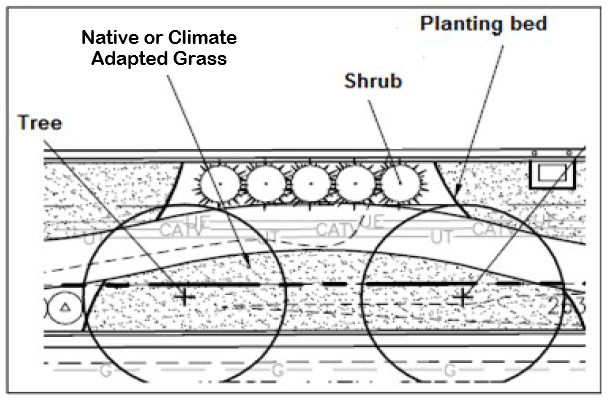
Typical components of a landscape treatment area.
(c)
All landscape treatment areas shall meet the following standards:
(1)
Turf. The use of nonfunctional turf is prohibited. Native and climate adapted grasses may be used in traditional turf areas as a non-turf alternative. If kept in a healthy and weed-free state native grasses may grow to a mature height of above eight (8) inches without being considered a weed. Functional turf is allowed only in a recreational use area or other space that is regularly used for civic, community, or recreational purposes which may include: a playground, a sports field, a picnic ground, an amphitheater, a portion of a park, and the playing area of a golf course, such as a driving range, chipping and putting green, tee box, fairway and rough.
(2)
Planting beds. Any area of the site covered by rock, gravel, or mulch is defined as a planting bed. The following standards are intended to provide a diversity of landscape materials within planting beds.
a.
Planting beds shall have a minimum of one (1) planting (tree, shrub, or ornamental grass) per twenty-five (25) square feet of planting bed area.
b.
The maximum usage of any one (1) plant species is fifty percent (50%) of total plantings.
c.
Ornamental grasses shall be no more than forty percent (40%) of the total number of plantings.
d.
At least fifty percent (50%) of plantings shall meet water-wise plant low water use (xeric) criteria. See Appendix C Recommended Plant Materials List.
e.
River cobble as a planting bed ground cover shall not cover more than fifty percent (50%) of the total landscape treatment area, and is not permitted in street buffers for commercial zones, to preserve public safety. Pea gravel, organic mulch, or other similar materials are preferred alternatives.
f.
At least ten percent (10%) of plants shall be of a flowering variety. Flowering plants should be used along rights-of-way or in foundation landscaping areas. See Appendix C Recommended Plant Materials List.
(3)
Trees, See tree requirements for rights-of-way (Sec. 16-13-90) and parking lots (Sec. 16-13-100).
a.
Trees in unspecified landscape areas. Landscape treatment areas not within defined right-of-way, parking lot, or foundation areas shall provide trees at a ratio of a minimum of one (1) tree per four hundred (400) square feet. Exception: In areas away from public use and view, and where it is appropriate for the site to retain a natural character, the Planning Director may approve use of unirrigated native grasses in place of tree requirements.
b.
Quaking aspen trees shall be permitted but shall not count towards required trees.
(4)
Airport Road landscape buffer. The minimum landscape buffer along Airport Road shall be fifteen (15) feet in Commercial zones and twenty (20) feet in Light Industrial zones. The intent of this requirement is to provide a continual landscape buffer regardless of the location of parking lots within developments on Airport Road. The buffer shall meet general landscape requirements and right-of-way landscaping requirements. Additionally, evergreen trees shall not be permitted in Light Industrial zones on Airport Road due to elk and deer feeding habits.
(5)
Artificial turf. The use of nonfunctional artificial turf is prohibited. Functional artificial turf may be used in a recreational use area or other space that is regularly used for civic, community, or recreational purposes, which may include a playground, a sports field, a picnic ground, an amphitheater, a portion of a park, and the playing area of a golf course, such as a driving range, chipping and putting green, tee box, green, fairway, and rough. Functional artificial turf may also be used when it is a component of a product designed and approved by a professional engineer for civil infrastructure projects, including but not limited to covers for solid waste facilities and brownfield sites; and revetments for slopes, channels, levees, and dams.
(Ord. 20 §2, 2014; Ord. 5 §9, 2026)
Sec. 16-13-90. - Right-of-way landscape standards.
Each development shall provide trees and landscaping within public rights-of-way and transportation easements as described in Table 16-13-2.
Table 16-13-2
(Ord. 20 §2, 2014; Ord. 5 §10, 2026)
Sec. 16-13-100. - Parking lot landscaping.
The definition of parking lots shall include storage areas, gas station fueling areas, parking lot access drives, or other paved or graveled areas.
(1)
Parking Lot Perimeter Landscaping. The entire perimeter of a parking lot shall be landscaped according to Table 16-13-3.
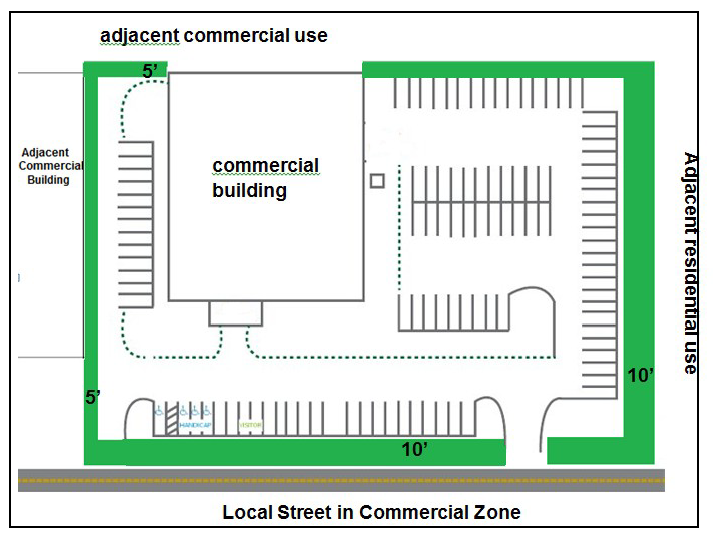
The depth of the parking lot landscaping buffer is determined by the adjacent right-of-way
or land use.
Table 16-13-3
Parking Lot Perimeter Standards
(2)
Parking Lot Interior Landscaping. There shall be one (1) landscaped island for every fifteen (15) parking spaces. Parking lots with less than fifteen (15) spaces are exempt from this requirement.
a.
Landscape islands. Landscape islands shall be evenly distributed to the maximum extent possible. Landscape islands shall be a minimum of eighteen (18) feet by six (6) feet for single rows and thirty-six (36) feet by six (6) feet for double rows of parking spaces. Islands shall have raised concrete curbing and shall contain a minimum of one (1) deciduous shade tree and six (6) shrubs and/or plants for single rows and two (2) deciduous shade trees and twelve (12) shrubs and/or plants in each landscape island for double rows. The remaining landscaping shall consist of a mulched planting bed. Turf is prohibited in parking lot islands.
b.
All required landscape areas adjacent to vehicle use areas shall be protected by wheel stops, curbs or other physical barriers. When a parking space abuts a landscape island or planter, the front two (2) feet of the required parking space may overhang the planter, provided that wheel stops or curbing are present.
(Ord. 20 §2, 2014; Ord. 5 §11, 2026)
Sec. 16-13-110. - Planting for safety at intersections and near driveways.
(a)
Sight Distance Triangle. On corner lots, in order to preserve sight distances, an unobstructed view shall be maintained within the triangular area at the intersection of two (2) streets, which is formed by three (3) points as established by:
(1)
The intersection of the flowline at the corner;
(2)
By measuring thirty (30) feet back from this intersection on each flowline; and
(3)
Connecting the two (2) ends of the legs to form a triangle.
(b)
No landscaping within a required front yard setback, or within the side yard setback on corner lots, shall exceed a height of forty-eight (48) inches, with the exception of trees. Such trees, at sufficient maturity, shall be trimmed to a height of at least eight (8) feet above the gutter flow line.
(c)
Street trees shall be placed a minimum of eight (8) feet from the corners of alleys and driveways, ten (10) feet from intersections, and fifteen (15) feet from overhead utility and light poles.
(Ord. 20 §2, 2014)
Sec. 16-13-120. - Screening elements of low visual interest.
Landscape or other materials shall be used to screen areas of low visual interest from the public right-of-way. These elements include, but are not limited to, trash receptacles, service areas, loading docks, and utility boxes and pedestals. Screening shall be provided on all sides, except where an opening is required for access. The access side shall permit access, yet the areas should be screened when access is not required. Screening shall be in the form of landscaping, walls, fences, berms, buildings or a combination of these techniques. The screening around trash receptacles shall be a minimum of six (6) feet in height.
(Ord. 20 §2, 2014)
Sec. 16-13-130. - Irrigation.
(a)
A permanently installed, automatic underground irrigation system shall be established to provide total water coverage to all plant materials installed pursuant to this Article. An exception is made for drip irrigation systems, which may be aboveground.
(b)
If native dryland grass species are planted, irrigation shall occur for at least the first six (6) weeks after installation, although no permanently installed irrigation system is required.
(c)
Once functional turf has been established, supplemental irrigation shall be implemented as required to maintain turf areas.
(d)
A reduced pressure backflow preventer shall be used on all systems. Where the irrigation point of connection is from the domestic water service, the irrigation tap and backflow preventer shall be installed after the water meter but before any backflow or pressure-reducing valve for the building.
(Ord. 20 §2, 2014; Ord. 5 §12, 2026)
Sec. 16-13-140. - Replacement and maintenance.
(a)
After the initial twenty-four-month guarantee period when failing landscape materials will be replaced by the developer/contractor in conformance with this Article, the property owner shall be responsible for the replacement of any landscape materials that die. All replacement plant material shall be of the same type and size as the original material installed according to the approved landscape plan, or an equivalent replacement to be approved by the Director of Planning and Development Director.
(b)
All materials included in the landscape treatment area shall be maintained in a manner resulting in a landscape consistent with the original intent and vision of accepted landscape plans. As an example, typical maintenance activities should include mowing, pruning, weeding, replacing mulch and any other practices required to maintain the aesthetic integrity of landscape areas.
(Ord. 20 §2, 2014)
Sec. 16-13-150. - Plant materials lists.
(a)
All installed trees and shrubs must be selected from the Recommended Plant Materials List contained in Appendix C to this Code. Any annual or perennial flower or grass available through local nurseries may be incorporated into landscapes required by this Article.
(b)
Trees and shrubs not included in these lists may also be installed at the discretion and approval of the Director of Planning and Development.
(c)
Replacement plant material shall be of the same type and size as the original material installed according to the approved landscape plan, or an equivalent replacement to be approved by the Director of Planning and Development Director.
(Ord. 20 §2, 2014; Ord. 5 §13, 2026)

