
Rifle City Zoning Code
ARTICLE VII
General Design Standards
Sec. 16-7-10. - Applicability.
(a)
New development. The off-street parking and loading standards of this Article shall apply to any new building constructed and to any new land use established.
(b)
Central Business District. See Article XVIII, Division 9 for standards applicable to all Central Business sub-districts.
(c)
Expansions and alterations. The off-street parking and loading standards of this Article shall apply when an existing structure or use is expanded or enlarged. Additional off-street parking and loading spaces shall be required to serve only the enlarged or expanded area, provided that in all cases the number of off-street parking and loading spaces provided for the entire use (preexisting and expansion) must equal at least seventy-five percent (75%) of the minimum ratio established in the Off-Street Parking Schedule "A" of this Article.
(d)
Change of use. Off-street parking and loading must be provided for any change of use or manner of operation that would, based on the Off-Street Parking Schedule "A" or the Off-Street Loading Schedule of this Article, result in a requirement for more parking or loading spaces than the existing use. (Ord. 11 §2, 2004; Ord. 11 §12, 2011)
Sec. 16-7-20. - Off-Street Parking Schedule "A".
Unless otherwise expressly stated in this Chapter, off-street parking spaces shall be provided in accordance with the following off-street parking schedule.
(Ord. 11 §2, 2004; Ord. 15 §2, 2026)
Sec. 16-7-30. - Off-Street Parking Schedule "B".
Uses subject to off-street parking schedule "B" shall provide the following minimum number of off-street parking spaces:
(Ord. 11 §2, 2004)
Sec. 16-7-40. - Off-Street Parking Schedule "C".
Schedule "C" uses have widely varying parking and loading demand characteristics, making it difficult to specify a single parking or loading standard. Upon receiving a development application for a use subject to "Schedule C" standards, the Planning and Development Director shall apply the off-street parking and loading standard specified for the listed use that is deemed most similar to the proposed use or establish a minimum off-street parking requirement on the basis of a parking and loading study prepared by the applicant. The study must include estimates of parking demand based on recommendations of the Institute of Traffic Engineers (ITE) or other acceptable estimates as approved by the Planning Director, and should include other reliable data collected from uses or combinations of uses that are the same as or comparable with the proposed use. Comparability will be determined by density, scale, bulk, area, type of activity and location. The study must document the source of data used to develop the recommendations. (Ord. 11 §2, 2004)
Sec. 16-7-50. - Off-street loading schedule.
Off-street loading spaces shall be provided in accordance with Schedule A and the following schedule:
Note:
Type A: Ten-foot minimum width, twenty-foot minimum length and ten-foot minimum vertical clearance.
Type B: Twelve-foot minimum width, thirty-five-foot minimum length and fourteen-foot minimum vertical clearance.
(Ord. 11 §2, 2004)
Sec. 16-7-60. - Rules for computing requirements.
The following rules apply when computing off-street parking requirements.
(1)
Combination of uses. Unless otherwise approved, lots containing more than one (1) use must provide parking and loading in an amount equal to the total of the requirements for all uses.
(2)
Fractions. When measurements of the number of required spaces result in a fractional number, any fraction of one-half (.5) or less shall be rounded down to the next lower whole number and any fraction greater than one-half (.5) shall be rounded to the next highest whole number.
(3)
Area measurements. Unless otherwise specified, all square-footage-based parking and loading standards must be computed on the basis of gross floor area.
(4)
Occupancy- or capacity-based standards. For the purpose of computing parking requirements based on employees, students, residents or occupants, calculations shall be based on the largest number of persons working on any single shift, the maximum enrollment or the maximum fire-rated capacity, whichever is applicable and whichever results in the greater number of spaces.
(5)
Unlisted uses. Upon receiving a development application for a use not specifically listed in an off-street parking schedule, the Planning and Development Director shall apply the off-street parking standard specified for the listed use that is deemed most similar to the proposed use or establish a minimum off-street parking requirement based on the requirements that apply to Schedule "C" uses. (Ord. 11 §2, 2004)
Sec. 16-7-70. - Location.
Except as otherwise expressly provided in this Article, required off-street parking spaces shall be located on the same lot as the principal use (See Off-Street Parking Alternatives, Section 16-7-90 below). (Ord. 11 §2, 2004)
Sec. 16-7-80. - Setbacks.
(a)
In a commercial or industrial zone district, required off-street parking spaces may occupy any part of the property, except within required landscape areas or site distance triangles.
(b)
Off-street parking or storage of vehicles, travel trailers or motor homes shall not be permitted within any front or street side setback area, provided that off-street parking may be permitted within that portion of any setback used for driveway access to required off-street parking areas for single-family residences and duplex units. Storage of mobile homes is not permitted unless related to an approved mobile home sale facility. (Ord. 11 §2, 2004)
Sec. 16-7-90. - Off-street parking alternatives.
The Planning Director shall be authorized to approve alternatives to providing the number of off-street parking spaces required by Schedule "A" in accordance with this Section.
(1)
Off-site parking. The Planning Director may approve the location of required off-street parking spaces on a separate lot from which the principal use is located if the off-street parking complies with all of the following:
a.
Ineligible activities. Off-site parking may not be used to satisfy the off-street parking standards for residential uses (except guest parking), restaurants, convenience stores or other convenience-oriented uses. Required parking spaces reserved for persons with disabilities may not be located off-site.
b.
Location. No off-street parking space may be located more than six hundred (600) feet from the primary entrance of the use served (measured along the shortest legal pedestrian route) unless remote parking shuttle bus service is provided. Off-site parking spaces may not be separated from the use served by a street right-of-way with a width of more than one hundred (100) feet. Off-site parking spaces may not be separated from the use served unless there is an improved pedestrian path offering access or a shuttle bus serves the parking area.
c.
Zoning classification. Off-site parking areas require the same or a more intensive zoning classification than required for the use served.
d.
Off-site parking agreement. In the event that an off-site parking area is not under the same ownership as the principal use served, a written agreement between the record owners will be required. The agreement must guarantee the use of the off-site parking area for at least ten (10) years. An attested copy of the agreement between the owners of record must be submitted to the Planning Director for recordation in the form established by the City Attorney. Recordation of the agreement must take place before issuance of a building permit or certificate of occupancy for any use to be served by the off-site parking area. An off-site parking agreement may be revoked only if all required off-street parking spaces will be provided, in accordance with Schedule "A" (Section 16-7-20 above). No use shall be continued if the parking is removed unless substitute parking facilities are provided, and the Planning Director shall be notified at least sixty (60) days prior to the termination of a lease for off-site parking.
(2)
Shared parking. The Planning Director may approve shared parking facilities for developments or uses with different operating hours or different peak business periods if the shared parking complies with the following:
a.
Location. Shared parking spaces must be located within six hundred (600) feet of the primary entrance of all uses served, unless remote parking shuttle bus service is provided.
b.
Zoning classification. Shared parking areas require the same or a more intensive zoning classification than required for the use served.
c.
Shared parking study. Those wishing to use shared parking as a means of satisfying off-street parking requirements must submit to the Planning Director a shared parking analysis that clearly demonstrates the feasibility of shared parking. It must address, at a minimum, the size and type of the proposed development, the composition of tenants, the anticipated rate of parking turnover and the anticipated peak parking and traffic loads for all uses that will share off-street parking spaces.
d.
Shared parking agreement. A shared parking plan will be enforced through written agreement among all owners of record. An attested copy of the agreement between the owners of record must be submitted to the Planning Director for recordation in a form approved by the City Attorney. Recordation of the agreement must take place before issuance of a building permit for any use to be served by the off-site parking area. A shared parking agreement may be revoked only if all required off-street parking spaces would be provided, in accordance with Schedule A.
(3)
Other eligible alternatives. The Planning Director may approve any other alternative to providing off-street parking spaces on the site of the subject development if the applicant demonstrates to the satisfaction of the Planning Director that the proposed plan will do at least as good of a job protecting surrounding neighborhoods and properties, maintaining traffic circulation patterns and promoting quality urban design than would strict compliance with otherwise applicable off-street parking standards.
(4)
Violations. Violations of an approved alternative parking plan constitute a violation of this Chapter and will be subject to the enforcement and penalty provisions of this Chapter. (Ord. 11 §2, 2004; Ord. 4 §1, 2005)
Sec. 16-7-100. - Fees in lieu of parking.
Reserved.
Sec. 16-7-110. - Use of off-street parking areas.
Required off-street parking areas are to be used solely for the parking of licensed, motor vehicles in operating condition. Required spaces may not be used for the display of goods for sale or lease or for long-term storage of vehicles, boats, motor homes, campers, mobile homes or building materials. (Ord. 11 §2, 2004)
Sec. 16-7-120. - Vehicle stacking areas.
The vehicle stacking standards of this Section shall apply unless otherwise expressly approved by the Planning Director.
(1)
Minimum number of spaces. Off-street stacking spaces shall be provided as follows:
(2)
Design and layout. Required stacking spaces are subject to the following design and layout standards.
a.
Size. Stacking spaces must be a minimum of eight (8) feet by twenty (20) feet in size.
b.
Location. Stacking spaces may not impede on- or off-site traffic movements or movements into or out of off-street parking spaces.
c.
Design. Stacking spaces must be separated from other internal driveways by raised medians if deemed necessary by the Planning Director for traffic movement and safety. (Ord. 11 §2, 2004; Ord. 4 §1, 2005)
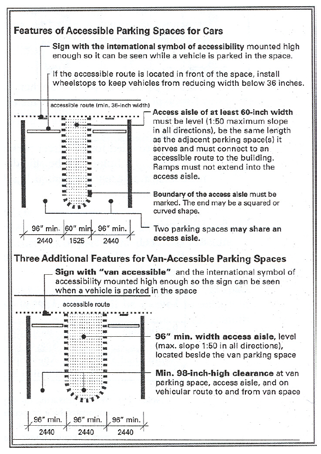
Sec. 16-7-130. - Accessible parking for physically handicapped persons.
A portion of the total number of required off-street parking spaces in each off-street parking area shall be specifically designated, located and reserved for use by persons with physical disabilities.
(1)
Number of spaces. The minimum number of accessible spaces to be provided shall be a portion of the total number of off-street parking spaces required, as determined from the following schedule. Parking spaces reserved for persons with disabilities shall be counted toward fulfilling off-street parking standards.
(2)
Minimum dimensions. All parking spaces reserved for persons with disabilities shall comply with the parking space dimension standards of this Article, provided that access aisles shall be provided immediately abutting such spaces, as follows:
a.
Car-accessible spaces. Car-accessible spaces shall have at least a five-foot-wide access aisle located abutting the designated parking space.
b.
Van-accessible spaces. Van-accessible spaces shall have at least an eight-foot-wide access aisle located abutting the designated parking space.
(3)
Location of spaces. Required spaces for persons with disabilities shall be located in close proximity to building entrances and shall be designed to permit occupants of vehicles to reach the building entrance on an unobstructed path.
(4)
Signs and marking. Required spaces for persons with disabilities shall be identified with signs and pavement markings identifying them as reserved for persons with disabilities. Signs shall be posted directly in front of the parking space at a height of no less than forty-two (42) inches and no more than seventy-two (72) inches above the pavement level.
(Ord. 11 §2, 2004; Ord. 4 §1, 2005)
Sec. 16-7-140. - Parking design standards.
(a)
Markings.
(1)
Each required off-street parking space and off-street parking facility shall be identified by surface markings and shall be maintained in a manner so as to be readily visible and accessible at all times. Such markings shall be arranged to provide for orderly and safe loading, unloading, parking and storage of vehicles. Marking shall be maintained in a highly visible condition, include striping, directional arrows, lettering on signs and in handicapped-designated areas, and field color.
(2)
Directional arrows shall identify one-way and two-way accesses into required parking facilities. Any two-way access located at any angle other than ninety (90) degrees to a street shall be marked with a traffic separation stripe the length of the access. This requirement does not apply to internal drive aisles.
(b)
Surfacing and maintenance. All off-street parking, loading and maneuvering areas shall be paved with asphalt, concrete or an equivalent surface material and kept in a dust-free condition. Storage areas and heavy equipment yards may be surfaced with gravel or rock of sufficient thickness to insure a dust-free surface, or paved with asphalt, concrete or similar permanent surfacing.
(c)
Curb stops. Curb stops shall be provided when there is potential for vehicles to overhang into right-of-way, pedestrian walks, drive aisles and/or landscaped areas.
(d)
Lighting. Lighting provided for off-street parking lots shall be sufficient to provide safe pedestrian circulation. Lighting shall be shielded and downward directed so that it does not: disturb residents of adjacent residential buildings; interfere with driver vision; or directly shine onto adjacent properties.
(e)
Dimensions.
(1)
General. Required off-street parking spaces shall comply with the following dimensional standards:
Note: When measuring the depth of an angled parking stall, the two sides of the stall shall be connected by a perpendicular line drawn from the most interior point of each leg. Each leg of the stall shall be not less than 18 feet long when measuring from the perpendicular line to the outermost point of the leg.
(2)
Compact spaces. The Planning Director shall be authorized to approve the use of compact parking spaces for up to thirty percent (30%) of employee parking, if the need for compact parking spaces is supported by a parking study that has been prepared by the applicant. Compact parking spaces shall have minimum dimensions of eight and one-half (8½) feet by eighteen (18) feet. Compact parking spaces shall be designated by signs or other approved markings.
(3)
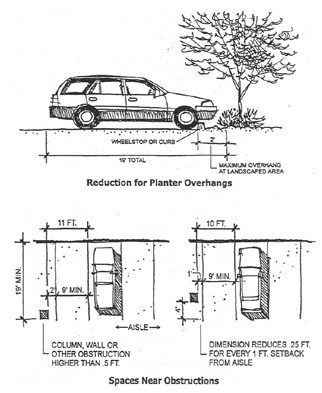
Reduction for planter overhangs. When a parking space abuts a landscape island or planter, the front two (2) feet of the required parking space length may overhang the planter, provided that wheel stops or curbing is provided.
(4)
Spaces near obstructions. When the side of a parking space adjoins a wall, column or other obstruction that is taller than one-half (0.5) foot, the width of the parking stall shall be increased two (2) feet on the obstructed side.
(f)
Drainage. Off-street parking areas shall be constructed in a manner to ensure the drainage of storm water therefrom, without flooding or doing damage to surrounding properties or public roads. Temporary water ponding is allowable if part of a drainage detention system approved by the City Engineer or part of a subdivision's approved drainage plan.
(g)
Garages and carports in residential districts. The following standards shall apply to driveways, garages and carports in residential zoning districts, whether they are accessory structures or part of the principal structure.
(1)
Driveways. Driveways shall be paved and, if functioning as an off-street parking space, the space provided shall be nine and one-half (9.5) feet wide and twenty (20) feet long and shall be located to ensure that no overhang into public right-of-way or a pedestrian easement occurs. Multi-family units (three [3] units and greater) are not permitted to use driveways for off-street parking unless drives are internal to the development and access a private drive.
(2)
Carport dimensions. Carports shall measure at least nine (9) feet wide by nineteen (19) feet deep, measured from the inside face of support to inside face of opposite support. The carport roof shall cover the entire nineteen-foot length of the space.
(h)
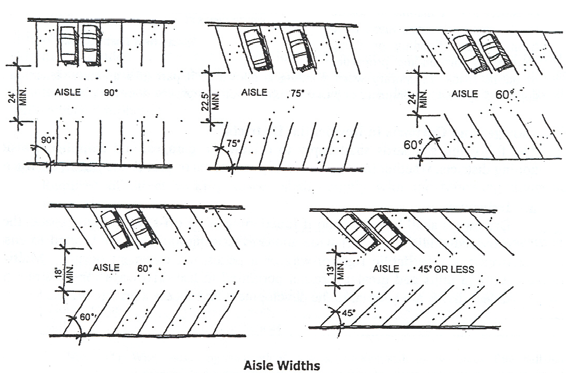
Aisle widths. Aisle widths adjoining off-street parking stalls shall comply with the following dimensional standards:
Note: Required fire lanes shall have a minimum width of 24 feet with a vertical clearance of 13.5 feet.
_____
(i)
Driveways. The following standards shall apply to driveways, which for purposes of this subsection shall mean a drive that provides access to one (1) residential or nonresidential unit or to one (1) parking lot shared by several residential or nonresidential units.
(1)
Widths. Driveways shall have the following minimum widths at the gutterline, plus a minimum one-foot additional clearance on each side of a vertical obstruction exceeding one-half (0.5) foot in height.
(2)
Spacing. Driveways serving the same parking facility shall comply with the Rifle Public Works Manual.
(3)
Grade/slope. Driveways shall not exceed a maximum grade of twelve percent (12%) unless approved by the Public Works Director.
(4)
Passenger drop-off areas.
a.
All schools, public or private institutional and recreational uses shall provide an on-site area for drop-offs and pick-ups.
b.
A traffic circulation plan shall be submitted to the Planning and Development Director for review and approval prior to issuance of any permits for the use. The traffic circulation plan shall describe proposed measures for ensuring safe and efficient traffic circulation on-site and in the area surrounding the subject site. The plan shall also include information about the number of enrollees or users; the hours of operation and peak loading and unloading times; the projected number of vehicles that will use the loading/unloading area; plans for directing traffic within the area; and other information deemed necessary by the Planning and Development Director.
c.
Minimum widths for drop-off areas combined with access drives shall be twelve (12) feet for one-way traffic and twenty-four (24) feet for two-way traffic.
d.
Required drop-off/pick-up areas for schools (public and private) shall include at least: 1) five (5) auto and five (5) school bus spaces; or 2) one (1) auto and one-half (0.5) school bus spaces for every fifty (50) students, whichever results in the greater number of spaces. No more than twelve (12) auto or bus spaces shall be required. Drop-off/pick-up areas may be adjacent to a primary driveway access or aisle, but they shall be located far enough off the roadway so that they do not cause traffic to stop.
(5)
Visibility. Visibility of a driveway crossing a street property line shall not be blocked between a height of two (2) feet and nine (9) feet for a depth of sixteen (16) feet from the back of the curb. The driveway visibility zone shall extend along the edge of the right-of-way on either side of the driveway for a distance of thirty (30) feet or to the nearest property line intersecting the street property line, whichever is less. Corner lots shall also provide the described visibility zone for a distance of thirty (30) feet along both rights-of-way beginning at the common intersecting curb line.
(j)
Access to parking areas.
(1)
All off-street parking spaces shall be accessible without backing into or otherwise reentering a public right-of-way, unless it is physically impossible to provide for such access. An alley may be used as maneuvering space for access to off-street parking, and a twenty-foot credit may be granted for required back-up space.
(2)
When an off-street parking area does not abut a public street, there shall be provided an access drive not less than twenty-four (24) feet in width for two-way traffic, connecting the off-street parking area with a public street. For purposes of this Section, access drive is defined as a drive that gives access to multiple driveways or parking lots from a public street and has no on-street parking. The access drive shall be paved in the manner required for off-street parking lots and may not traverse property in a residential district unless the drive provides access to a parking area serving a use allowed in a residential district. Where an access or service drive is such that satisfactory turn-around is not possible, a turn-around shall be provide as required by the Fire Chief.
(3)
Entrances and exits are subject to approval of the Public Works Director. All driveways shall be at least (30) feet from the point of curvature at intersections unless the Public Works Director waives this requirement.
(k)
Off-street parking area screening. Off-street parking areas shall be screened in accordance with the standards of Section 16-7-150. (Ord. 11 §2, 2004; Ord. 39 §§2—4)
Sec. 16-7-150. - Loading area design.
Required off-street loading spaces shall not be located within a building, but shall be on the site of the use served or on an adjoining site. On a site adjoining an alley, a required loading space shall be accessible from the alley unless the Public Works Director approves alternative access. A required loading space shall be accessible without backing a truck across a street property line unless the Public Works Director determines that the provision of turn-around space is infeasible and approves alternative access. An occupied loading space shall not prevent access to a required off-street parking space. A loading area shall not be located in a required setback. In addition, street side loading docks shall be setback at least seventy (70) feet from the public right-of-way line. No loading bay may intrude into any portion of a required aisle or access dimension. Loading areas visible from a street shall be screened on three (3) sides by a solid, decorative fence, wall or hedge at least six (6) feet in height. (Ord. 11 §2, 2004; Ord. 4 §1, 2005)
Sec. 16-7-210. - Purpose.
The purpose of these standards is to promote the design of an urban environment that is built to human scale; to encourage creativity in new development; to foster attractive street fronts and pedestrian environments; and to protect the visual integrity of central transportation corridors. (Ord. 11 §2, 2004)
Sec. 16-7-220. - Applicability.
(a)
New development. All new structures built within the specified zone districts stated herein shall be subject to this Division.
(b)
Expansions and alterations. Any alteration, improvement or addition affecting the external appearance, function or external circulation of any existing use in the following zone districts is subject to the standards set forth in this Division; this shall include additions to original structure. (Ord. 11 §2, 2004)
Sec. 16-7-230. - General review standards.
(a)
Central Business Zone District. The Planning Director shall approve or approve with conditions a site plan application for an infill use or building within the Central Business Zone District only upon finding that all applicable infill use standards of this Section have been met.
(1)
Architectural character. New buildings and additions/modifications shall be compatible with the established architectural character by using a design that is complimentary in terms of:
a.
Consistency of rooflines, roof materials and roof colors;
b.
Use of similar proportions in building mass and outdoor spaces;
c.
Similar relationship to the street;
d.
Similar window and door patterns;
e.
Similar streetscapes, including landscaping, light fixtures and other site amenities;
f.
Similar decorative elements such as ornamental grillwork and accent tiles; and
g.
The use of building materials that have colors, shades or texture similar to those found in projects in the immediate area that have been approved pursuant to these procedures or that are found in the natural terrestrial environment.
(2)
Building size, height, bulk, mass and scale. Buildings shall either be similar in size and height or, if larger, be articulated and subdivided into massing that is proportional to the mass and scale of other structures on the same block or, if no buildings exist thereon, then on adjoining blocks.
(3)
Building orientation. To the maximum extent feasible, primary facades and entries shall face the adjacent street.
(4)
Building materials. Building materials shall be similar to the materials already being used in the neighborhood or, if dissimilar materials are proposed, other characteristics such as scale and proportions, form architectural detailing, and color and texture shall be utilized to ensure that enough similarity exists for the building to be compatible despite the difference in materials.
(5)
Building color. Color shades shall be used to facilitate blending into the neighborhood and unifying the development. The color shades of building materials shall draw from the range of color shades found in projects in the immediate area that have been approved pursuant to these standards or that are found in the natural terrestrial environment.
(6)
Exterior physical security devices. The use of burglar bars, security gates, security shutters and the like are permitted in alleys NOT immediately abutting a public plaza or park. All other use of these devices in the Central Business District is prohibited.
(b)
Commercial, Industrial, and Public Districts (CS, TC, LI, I, PD). The Planning Director shall approve or approve with conditions a site plan application for any nonresidential or multi-family developments within CS, TC, LI, I and PD Zone Districts upon a finding that the following standards have been met:
(1)
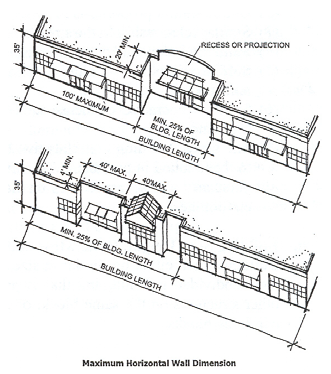
Maximum horizontal wall dimension. A wall surface shall be no longer than one hundred (100) feet without a break, a recess or offset measuring at least twenty (20) feet in depth and one-quarter (¼) of the building in length or a series of recesses or offsets, at intervals not more than forty (40) feet, that vary the depth of the building wall by a minimum of four (4) feet. Not less than twenty-five percent (25%) of the building wall shall be varied this way. The objective of this standard is to avoid large, undifferentiated wall surfaces. Smaller offsets at forty-foot intervals are an acceptable substitute.
(2)
Exterior building/facade materials.
a.
Commercial (TC, CS) and Public (PD) Zone Districts.
1.
One hundred percent (100%) of the front elevation shall be comprised of brick, stone, split-face block, horizontal siding, stucco or a combination of sidings with brick or stone accents. The architectural treatment of the front elevation shall be continued, in its major features, around all sides of a building that are visible from a public right-of-way. Blank walls or service area treatment of side and/or rear elevations visible from the public viewshed is discouraged.
2.
Metal roofs shall be nonreflective, and roof color shall compliment the building facade as viewed from the public right-of-way.
b.
Industrial (LI and I) Zone Districts.
1.
The lower twenty-five percent (25%) of all building elevations visible from a public right-of-way shall have a facade comprised of brick, stone, split-face block, horizontal siding, stucco or a combination of sidings with brick or stone accents. Blank walls or service area treatment of side and/or rear elevations visible from the public viewshed is discouraged.
2.
All metal walls must be nonreflective.
3.
Buildings constructed adjacent to Railroad Ave., Whiteriver Ave., Highways 6 and 24, including the access road, Highway 13 including the bypass, and Airport Road that are zoned LI or I shall comply with Subsection a. above.
(3)
Fenestration. Twenty percent (20%) of facades fronting public right-of-way shall be comprised of windows, doors, curtain walls, etc.
(4)
Building colors. Color shades shall be used to facilitate blending into the neighborhood and unifying the development. The color shades of building materials shall draw from the range of color shades found in projects in the immediate area that have been approved pursuant to these standards or that are found in the natural terrestrial environment.
(5)
Premanufactured buildings. Manufactured homes or other premanufactured structures for nonresidential uses shall not be permitted as permanent structures in the CBD, CS, TC, CS, LI or I Zone Districts. Temporary use for development construction offices is permissible. (Ord. 11 §2, 2004; Ord. 4 §1, 2005; Ord. 3 §2, 2010)

