
Rifle City Zoning Code
ARTICLE XVIII
CB Central Business District
Sec. 16-18-10. - Applicability.
This Article functions as a separate component of Chapter 16 of this Code. All text, figures and tables in this Article are regulatory unless otherwise noted. Lands regulated by the provisions of this Article also are subject to all provisions of this Code. The provisions in this Article are intended to be consistent with the provisions of Articles I through XVII of Chapter 16. However, in cases where the provisions of this Article conflict with the provisions of other Articles, the provisions of this Article shall prevail. (Ord. 11 §15, 2011)
Sec. 16-18-20. - Purpose and intent; Central Business District as a vibrant regional center.
(a)
The primary goal of the Central Business District is to be a vibrant, pedestrian-oriented, commercial, residential, entertainment and cultural center. The standards set forth in this Article are designed to implement this goal as described in the City's 2008 Downtown Master Plan. This Article encourages development that enhances the City's economy, energy efficiency, appearance and quality of life through high-quality design. The intent is to create a nest of amenities to attract both City residents and residents of the wider region to the downtown.
(b)
The intent of this Article is to encourage the following characteristics:
(1)
A mix of land uses throughout the Central Business District with housing, shopping, services, entertainment and jobs located within walking distance of one another;
(2)
Private and public community amenities that contribute to economic development;
(3)
A range of housing options at different types and densities;
(4)
Development densities and intensities that substantially exceed those of other areas of the City;
(5)
A pedestrian-friendly atmosphere as it relates to infrastructure, development form and development character;
(6)
Inclusion of public gathering places: indoor and outdoor, public and private;
(7)
Incorporation of energy-efficient and sustainable building and site design features that make the downtown a model of sustainable urban design;
(8)
Development patterns that accommodate a range of transportation choices; and
(9)
Parking solutions that are complementary to and do not detract from a dense, pedestrian-oriented environment. (Ord. 11 §15, 2011)
Sec. 16-18-30. - Central Business District Glossary of Design Concepts and Terms.
(a)
The Central Business District Glossary of Design Concepts and Terms (hereafter the "CBD Glossary") is intended to ensure that the standards of this Article are applied consistently over time and to assist private land owners and developers in understanding and executing these standards. The CBD Glossary is a non-codified accompaniment to this Article; however, it is to be used as an official reference when evaluating a project's consistency with this Article. The CBD Glossary has been officially adopted by the City in association with this Article and is thus considered a regulatory document enforceable by law.
(b)
Land use descriptions and other customary zoning ordinance terms not included in the CBD Glossary are defined in Section 16-1-220 of this Code. (Ord. 11 §15, 2011)
Sec. 16-18-40. - Use of terms "required," "preferred," "discouraged" and "prohibited."
In order to achieve the goals of the 2008 Downtown Master Plan, this Article seeks to strike a balance between high standards and flexibility for development. Accordingly, throughout this Article many standards are expressed as one of the following terms. Where these terms are not included, the listed standards shall be deemed to be "required" and compliance with them is mandatory.
(1)
Required design elements are those that must be included in a project to achieve consistency with the desired character of the Central Business District. Compliance with required design elements is mandatory, and failure to include them in a project will result in project denial.
(2)
Preferred design elements are those that are consistent with and contributing to the desired character of the Central Business District. Although these design elements are not mandatory for a project, their inclusion in a project increases the likelihood of (although does not guarantee) project approval and an expedited review. Applicants are encouraged to incorporate as many preferred elements as possible.
(3)
Discouraged design elementsand land uses are those that are potentially inconsistent with and detracting from the desired character of the Central Business District. Although not prohibited, their inclusion in a project will decrease the likelihood of project approval and lengthen the review period. Projects that incorporate any discouraged design element will require a Tier 2 level of review as defined in Section 16-18-1240 of this Article. For each discouraged design element that is proposed, the applicant shall demonstrate why the element is appropriate and how its inclusion will not detract from the quality of the project or the stated goals and character of the applicable sub-district.
(4)
Prohibited design elements are those that are highly inconsistent with the desired character of the Central Business District and may not be used under any circumstances. Inclusion of a prohibited design element in a project will result in project denial. (Ord. 11 §15, 2011)
Sec. 16-18-50. - Variances and Planned Unit Developments prohibited.
Allowances for "preferred" and "discouraged" elements have been included throughout this Article and provide for the level of flexibility and creativity necessary to ensure exceptional development projects. As described in Section 16-18-40, above, regulations falling under the heading of "required" or "prohibited" are mandatory. Variances to any "required" or "prohibited" use or design element are not permitted. Planned Unit Developments of any type (as described in Article III, Division 6 of this Chapter) are prohibited throughout the entire Central Business District. (Ord. 11 §15, 2011)
Sec. 16-18-60. - Overview of Central Business District.
Following the City's 2008 Downtown Master Plan, the Central Business District is divided into six (6) sub-districts. The following six (6) sub-districts are described in the divisions that follow and are identified on the City's Official Zoning Map.
Historic Core (CBD-HC)
Second Street Mixed-Use (CBD-MU)
River Gateway (CBD-RG)
Creekside Neighborhood (CBD-CS)
Centennial Neighborhood (CBD-CN)
North Gateway (CBD-NG)
(Ord. 11 §15, 2011)
Sec. 16-18-210. - Purpose.
The Historic Core sub-district represents the historic and cultural center of the community. The purpose of the sub-district is to preserve and restore the character and scale of most historic buildings and to promote complementary infill development and a high quality, pedestrian-oriented environment. (Ord. 11 §15, 2011)
Sec. 16-18-220. - Overview of sub-district character.
The intent of this Section is to describe the desired character of the sub-district and serve as a guide to developers and the City throughout the development process. See Sections 16-18-230 and 16-18-240 below for more specificity on which items are required, preferred, discouraged and prohibited.
(1)
Building scale and intensity. The scale of new buildings in the Historic Core should match existing historic development, which generally consists of two- to three-story buildings with a high percentage of lot coverage. The density and intensity of individual uses should be consistent with the lower scale of the buildings and be oriented to passing pedestrians more so than cars (although some civic uses may have larger draws).
Figure 16-18-220-1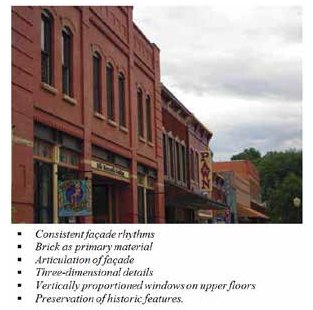
(2)
Redevelopment and preservation opportunities. As indicated in the 2008 Downtown Master Plan, the Historic Core sub-district is characterized by several high priority preservation sites that help set the tone for the character of new development projects. These include the entire southern block faces on Third Street from East Avenue to West Avenue, the northern block face of Third Street from East Avenue to Railroad Avenue and additional properties on Third Street and Fourth Street. Several opportunities also exist for infill and redevelopment, particularly at the edges of the sub-district on Third and Fourth Streets where the block faces should be continued all the way to East Avenue and West Avenue.
(3)
Primary land uses. Land uses in the Historic Core should promote pedestrian activity. These include retail, restaurants and complementary service uses on the ground floor with upper-story residential or office uses and civic and public uses.
(4)
General design characteristics. To maintain the City's historic and cultural integrity, the design of new development and modifications to existing development should be thoughtfully designed to complement the key historic design elements of this sub-district. This includes brick as the primary building material and large, ground floor storefront windows that contribute to the pedestrian-oriented character. Although the design of buildings should reflect the traditional characteristics of the sub-district, opportunities should be sought to incorporate energy efficient elements as well.
(5)
Relationship of development to street. New buildings in the Historic Core should fill in the existing block faces along Third Street and Fourth Street, extending them all the way to East Avenue and West Avenue. Accordingly, buildings should be pulled up to the sidewalk and include large display windows to increase pedestrian interest and activity. The limited breaks in the block faces, such as those needed for small parking lots, should incorporate walls and landscaping and/or decorative structures that visually continue the block face across the opening. Building sides along Railroad Avenue should be similar to those on Third and Fourth Streets. Building and property sides along East Avenue and West Avenue also should be of high quality but are expected to have a lesser importance and are likely to provide secondary and service accesses.
Figure 16-18-220-2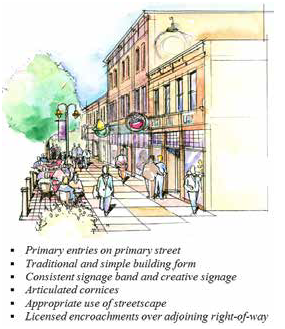
(6)
Parking. Parking requirements in the Historic Core should be met through a combination of diagonal on-street parking stalls and small surface parking lots situated to the side or rear of buildings, but preferably not at street corners. Structured parking is discouraged and should include a face of ground floor retail/commercial uses along Third Street and Fourth Street and Railroad Avenue if it is used. Likewise, large surface lots also are discouraged and all surface parking should be screened with walls and/or landscaping.
(7)
Project review criteria. The City will evaluate proposed projects in the Historic Core based on the following considerations in addition to all of the other standards contained in Section 16-18-1260 of this Article:
a.
Does the project enhance the Historic Core as the cultural center of the community and/or complement existing cultural amenities (e.g., historic theater, the museum and the historic post office)?
b.
Does the project contribute to and enhance the western small-town charm of the Historic Core?
c.
Does the project help preserve and sensitively restore historic buildings?
d.
Does the project help preserve and restore the City's historic building pattern with complementary infill development?
e.
Do the intensity, scale and overall design of the project enhance the pedestrian friendliness of this area?
f.
Does the project preserve and complement historically representative structures? (Ord. 11 §15, 2011)
Sec. 16-18-230. - Site design standards.
The site design standards listed in Table 16-18-230 shall apply to all projects located within the Historic Core sub-district. See Division 5 of the CBD Glossary for illustrations and definitions of the concepts and terms used in the Table.
Table 16-18-230
1 Except where no other options exist, in which case it shall be discouraged.
2 Except where the safety of the public is an issue (such as protection from high voltage equipment), in which case it shall be discouraged.
3 Accessory structures for single-family homes and homes that have been converted into commercial uses shall be governed by the standards in Sections 16-3-230, 16-3-240 and 16-3-340 of this Code.
(Ord. 11 §15, 2011)
Sec. 16-18-240. - Building design standards.
The building design standards listed in Table 16-18-240 shall apply to all projects located within the Historic Core sub-district. See Division 6 of the CBD Glossary for illustrations and definitions of the concepts and terms used in the Table.
Table 16-18-240
1 Uses that are permitted in the downtown whose function requires reduced or no fenestration, such as a movie theater, may have fenestration requirements waived through a Tier 2 review.
(Ord. 11 §15, 2011)
Sec. 16-18-310. - Purpose.
The North Gateway sub-district is the northern entryway into the City's downtown. The purpose of the sub-district is to provide an attractive gateway into the downtown and create a transition between the auto-oriented commercial uses to the north and the pedestrian character of the Central Business District. (Ord. 11 §15, 2011)
Sec. 16-18-320. - Overview of sub-district character.
The intent of this Section is to describe the desired character of the sub-district and serve as a guide to developers and the City throughout the development process. See Sections 16-18-330 and 16-18-340 below for more specificity on which items are required, preferred, discouraged and prohibited.
(1)
Building scale and intensity. Buildings in the North Gateway should be consistent with the scale of the buildings in the Historic Core. However, the intensity of development may be somewhat greater than that in the Historic Core given that more auto-oriented uses are permitted in this sub-district.
Figure 16-18-320-1
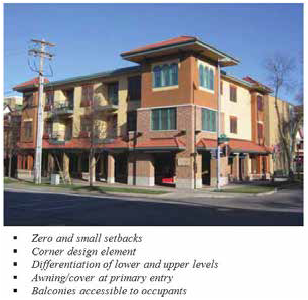
(2)
Redevelopment and preservation opportunities. The existing buildings and properties within this sub-district all present opportunities for redevelopment. None were identified in the 2008 Downtown Master Plan as high-priority preservation sites.
(3)
Primary land uses. This sub-district is intended to accommodate primarily commercial uses. Ground floor uses should consist of retail, personal services and restaurants with upper floor residential or offices. Auto-oriented uses also are permitted, such as service stations, provided that various standards are met. Land uses on Sixth Street should be compatible with the school located to the north, and those on the east and west ends of the sub-district should be compatible with the adjoining residential neighborhoods.
(4)
General design characteristics. The intersection of Fifth Street and Railroad Avenue is the visual gateway into the downtown. Development on these corners should provide an attractive gateway through high-quality design and architectural elements oriented towards the intersection. Preferred exterior building materials are primarily brick with large ground floor windows to maintain a pedestrian-friendly character and vibrancy. Although simple, rectangular building forms consistent with those in the Historic Core are preferred, the lack of any historically significant buildings in this sub-district creates opportunities for somewhat more contemporary development.
(5)
Relationship of development to street. Development on the corners of the Fifth Street/Railroad Avenue intersection should incorporate strong corner elements to create a strong sense of entry to the downtown. Throughout the North Gateway, buildings should include small setbacks and designs with high levels of transparency to encourage pedestrian activity.
Figure 16-18-320-2
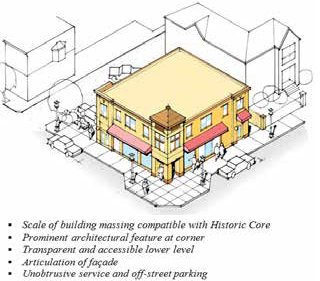
(6)
Parking. Parking in the North Gateway should be located at the sides and rear of buildings and preferably not along Railroad Avenue. A mix of on-street spaces (both within this sub-district and within adjoining sub-districts) and smaller, well-screened on-site parking areas should be sufficient to address most of the anticipated parking needs of the district.
(7)
Project review criteria. The City will evaluate proposed projects in the North Gateway based on the following considerations in addition to all of the other standards contained in Section 16-18-1260 of this Article:
a.
Does the project contribute to a positive gateway experience to the Historic Core and Central Business District?
b.
Does the project complement the character, scale and function of the Historic Core?
c.
Does the project improve the appearance of properties in this sub-district?
d.
Are the uses, scale and intensity of development along Sixth Street compatible with the school to the north?
e.
Are the uses, scale and intensity of development at the east and west ends of the sub-district compatible with the adjoining residential neighborhoods? (Ord. 11 §15, 2011)
Sec. 16-18-330. - Site design standards.
The site design standards listed in Table 16-18-330 shall apply to all projects located within the North Gateway sub-district. See Division 5 of the CBD Glossary for illustrations and definitions of the concepts and terms used in the Table. Table 16-18-330
1 Except where no other options exist, in which case it shall be discouraged.
2 Except where the safety of the public is an issue (such as protection from high voltage equipment), in which case it shall be discouraged.
3 Accessory structures for single-family homes and homes that have been converted into commercial uses shall be governed by the standards in Sections 16-3-230, 16-3-240 and 16-3-340 of this Code.
(Ord. 11 §15, 2011)
Sec. 16-18-340. - Building design standards.
The building design standards listed in Table 16-18-340 shall apply to all projects located within the North Gateway sub-district. See Division 6 of the CBD Glossary for illustrations and definitions of the concepts and terms used in the Table.
Table 16-18-340
1 Uses that are permitted in the downtown whose function requires reduced or no fenestration, such as a movie theater, may have fenestration requirements waived through a Tier 2 review.
(Ord. 11 §15, 2011)
Sec. 16-18-410. - Purpose.
With only a few exceptions, the Second Street Mixed Use sub-district presents an opportunity for redevelopment of the entire sub-district. The purpose of the sub-district is to create high-quality, higher density, mixed use development and civic uses that bring vitality to the downtown. (Ord. 11 §15, 2011)
Sec. 16-18-420. - Overview of sub-district character.
The intent of this Section is to describe the desired character of the sub-district and serve as a guide to developers and the City throughout the development process. See Sections 16-18-430 and 16-18-440 below for more specificity on which items are required, preferred, discouraged and prohibited.
(1)
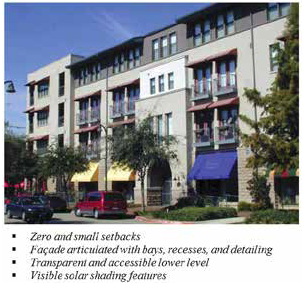
Building scale and intensity. The potential for redevelopment of most properties in the Second Street area permits a high level of density throughout the sub-district. Between East Avenue and West Avenue, the potential to assemble sites creates opportunities for large building footprints, but heights should be limited so as not to overshadow the neighboring Historic Core sub-district. West of West Avenue, building heights can increase to achieve a scale more consistent with that permitted in the high-density Creekside Neighborhood sub-district. While development within the Second Street area should respect the development scale and pattern in the Historic Core, the Second Street sub-district also should have a sufficiently high level of intensity to generate a concentration of activity and residents to increase the vibrancy of the downtown.
Figure 16-18-420-1
(2)
Redevelopment and preservation opportunities. The Second Street sub-district contains some of the City's most significant opportunities for larger-scale redevelopment projects. However, consistent with the 2008 Downtown Master Plan, the Rifle House should be preserved and adjoining development should be respectful of this historic structure.
(3)
Primary land uses. Second Street should serve as a high-activity commercial and entertainment spine that attracts a regional market. A high level of focus should be placed on ground floor retail, restaurant and entertainment uses that literally spill out onto the sidewalk. Upper floors should contain a mix of commercial, office and residential uses.
(4)
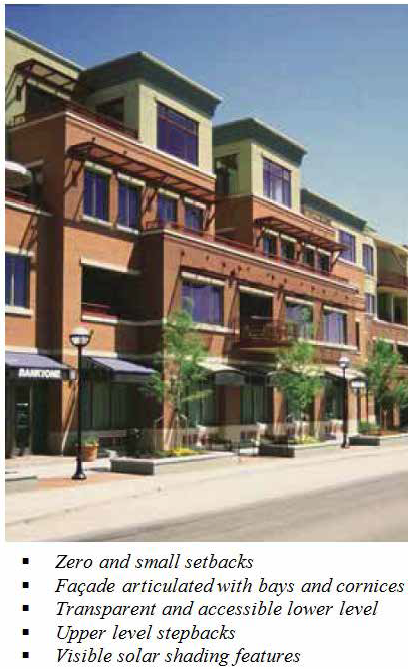
General design characteristics. Within the Second Street sub-district, attractive modern architectural and site design should be incorporated. This should include extensive use of ground floor windows, the integration of horizontal building elements on taller buildings and the use of high-quality building materials and architectural details. Wherever possible, buildings should incorporate exposed sustainability components such as sky lights, integrated solar panels, wind turbines, natural and local materials and similar features. Buildings located along Rifle Creek should relate to the creek by incorporating terraces and balconies oriented to the creek and footprints and stepbacks that maintain a comfortable pedestrian environment along the Rifle Creek trail.
Figure 16-18-420-2
(5)
Relationship of development to street. Buildings within the Second Street area should be pulled up to and oriented toward Second Street, Park Avenue and Highway 6/24 to encourage pedestrian activity. However, buildings can be set back as necessary to accommodate outdoor activity areas such as dining, artistic displays and public gathering areas. For taller buildings located west of West Avenue, upper stories should be stepped back to maintain a pedestrian-friendly experience along the street. Upper stories also should have a strong orientation to the street through the use of large windows, balconies and terraces. Second Street and Park Avenue should be extended consistent with the 2008 Downtown Master Plan to improve circulation within the downtown and the community.
(6)
Parking. Given the desired intensity of development within the Second Street sub-district, parking will be a challenge that will have to be met using a number of tools. Second Street itself should accommodate significant on-street, angled parking. In addition, new development should look to incorporate parking structures either under and/or within the buildings. Parking structures on Second Street should be faced with commercial units to avoid large expanses of dead walls. Parking also may be phased as development occurs. Surface parking lots may be provided initially that are later converted to structures. Large expanses of surface parking should not be considered a long-term solution if the sub-district is to achieve the desired level of intensity and activity. Accordingly, flexibility, public-private partnerships and shared arrangements between various property owners all will be necessary to meet this challenge.
(7)
Project review criteria. The City will evaluate proposed projects in the Second Street Mixed-Use sub-district based on the following considerations, in addition to all of the other standards contained in Section 16-18-1260 of this Article:
a.
Do the proposed land uses contribute to the desired dynamic, mixed-use character of the sub-district?
b.
Does the project take advantage of the potential to assemble lots to develop larger-scale uses?
c.
Does the project have an appropriate level of density/intensity to foster a high level of activity along Second Street and throughout the downtown?
d.
Does the project encourage people to gather in this area of the City and create a pedestrian-oriented atmosphere?
e.
Where applicable, does the project extend Second Street and Park Avenue consistent with the circulation plan contained in the 2008 Downtown Master Plan?
f.
Does development along Rifle Creek relate to the creek by creating strong visual connections and providing a comfortable pedestrian environment along the creekfront trail?
g.
Does development adjoining priority preservation sites complement those sites and set them apart in a visually attractive and respectful manner? (Ord. 11 §15, 2011)
Sec. 16-18-430. - Site design standards.
The site design standards listed in Table 16-18-430 shall apply to all projects located within the Second Street Mixed Use sub-district. See Division 5 of the CBD Glossary for illustrations and definitions of the concepts and terms used in the Table.
Table 16-18-430
1 Except where no other options exist, in which case it shall be discouraged.
2 Except where the safety of the public is an issue (such as protection from high voltage equipment), in which case it shall be discouraged.
3 Accessory structures for single-family homes and homes that have been converted into commercial uses shall be governed by the standards in Sections 16-3-230, 16-3-240 and 16-3-340 of this Code.
(Ord. 11 §15, 2011)
Sec. 16-18-440. - Building design standards.
The building design standards listed in Table 16-18-440 shall apply to all projects located within the Second Street Mixed Use sub-district. See Division 6 of the CBD Glossary for illustrations and definitions of the concepts and terms used in the Table.
Table 16-18-440
1 Uses that are permitted in the downtown whose function requires reduced or no fenestration, such as a movie theater, may have fenestration requirements waived through a Tier 2 review.
(Ord. 11 §15, 2011)
Sec. 16-18-510. - Purpose.
The River Gateway sub-district encompasses lands along Highway 6/24 and Highway 13 and is the most important gateway into the downtown. The sub-district's location also offers attractive views of the Colorado River, valley floor and surrounding bluffs. The purpose of the sub-district is to ensure that new development shapes favorable first impressions of the Central Business District through the presence of high-quality, large-scale regional destinations. (Ord. 11 §15, 2011)
Sec. 16-18-520. - Overview of sub-district character.
The intent of this Section is to describe the desired character of the sub-district and serve as a guide to developers and the City throughout the development process. See Sections 16-18-530 and 16-18-540 below for more specificity on which items are required, preferred, discouraged and prohibited.
(1)
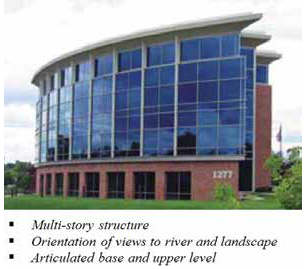
Building scale and intensity. The intensive nature of the potential uses should result in buildings with large footprints and multiple stories that draw attention to the River Gateway area from outside of the downtown, including I-70. Accordingly, "signature" and iconic building designs should be considered to serve as guideposts for drawing visitors and those just passing through to the downtown.
Figure 16-18-520-1
(2)
Redevelopment and preservation opportunities. No sites or buildings in this sub-district were identified in the 2008 Downtown Master Plan as high-priority preservation sites. This sub-district offers significant and large-scale redevelopment and infill opportunities. The entire sub-district should be developed under a single master plan.
(3)
Primary land uses. The River Gateway is intended to accommodate high-quality, higher-intensity commercial, hospitality, entertainment and civic uses, as well as higher density, multi-family residential development. The sub-district also is a potential location for a major transit center that could transform the downtown into a transit-oriented development.
(4)
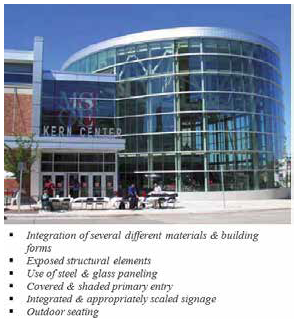
General design characteristics. Development within the River Gateway should be characterized by high-quality urban architecture and "one-of-a-kind" structures. Building elements should include those that expose their sustainable components such as skylights, integrated solar panels, natural and local materials and similar features. In addition, street frontage improvements, landscaping and attractive signage should enhance this area as the primary "gateway" to the downtown and the entire community. The larger parcels and lack of alleys in this sub-district coupled with uses of a regional nature will likely result in an urban campus-type of development pattern.
(5)
Relationship of development to street. Consistent with the 2009 Rifle Gateway Alternatives Report, Highway 6/24 is expected to flank the north and south sides of the district as a one-way couplet with Railroad Avenue, West Avenue and Park Avenue extended south to the new eastbound leg of Highway 6/24. Buildings should have a strong visual orientation to Highways 6/24 and 13 even if their main entries face an internal street. Buildings may be pulled up to the sidewalks or sites may have highly landscaped setbacks that provide sufficient buffering from the high traffic levels on the adjoining highways. Upper floors should be oriented toward views of the river and the ranges to the south and north.
Figure 16-18-520-2
(6)
Parking. Parking needs in the River Gateway are likely to be substantial and will likely eventually require one (1) or more parking structures. These structures should be fully integrated into the overall development by reflecting the high quality materials used on the principal buildings. Parking may be phased over time, starting with screened surface lots that are eventually converted to structures. However, surface parking between buildings and the adjoining thoroughfares should be minimized, with the majority of parking placed toward the center of the district, between buildings.
(7)
Project review criteria. The City will evaluate proposed projects in the River Gateway sub-district based on the following considerations in addition to all of the other standards contained in Section 16-18-1260 of this Article:
a.
Does the project contribute to a positive City gateway experience, putting forth a high-quality image for the Central Business District and the entire City?
b.
Does the project have an appropriate level of density/intensity to foster a dynamic, mixed-use environment with regional scale uses and/or transit-oriented development?
c.
Do the buildings and uses provide a recognizable destination that will draw visitors into the downtown and to the riverfront?
d.
Does the building incorporate a "one-of-a-kind," high-quality design?
e.
Does the development accommodate the proposed one-way couplet for Highway 6/24 and extensions of the north-south avenues?
f.
Does the development provide strong visual connections to the Colorado River?
g.
Is adequate parking integrated into the development? (Ord. 11 §15, 2011)
Sec. 16-18-530. - Site design standards.
The site design standards listed in Table 16-18-530 shall apply to all projects located within the River Gateway sub-district. See Division 5 of the CBD Glossary for illustrations and definitions of the concepts and terms used in the Table.
Table 16-18-530
1 Except where no other options exist, in which case it shall be discouraged.
2 Except where the safety of the public is an issue (such as protection from high voltage equipment), in which case it shall be discouraged.
3 Accessory structures for single-family homes and homes that have been converted into commercial uses shall be governed by the standards in Sections 16-3-230, 16-3-240 and 16-3-340 of this Code.
(Ord. 11 §15, 2011)
Sec. 16-18-540. - Building design standards.
The building design standards listed in Table 16-18-540 shall apply to all projects located within the River Gateway sub-district. See Division 6 of the CBD Glossary for illustrations and definitions of the concepts and terms used in the Table.
Table 16-18-540
1 Uses that are permitted in the downtown whose function requires reduced or no fenestration, such as a movie theater, may have fenestration requirements waived through a Tier 2 review.
(Ord. 11 §15, 2011)
Sec. 16-18-610. - Purpose.
The Creekside Neighborhood sub-district represents the best location for high quality, higher-density residential development in all of the City. The purposes of the sub-district are to promote high-density development so that residents can walk to a wide variety of commercial, entertainment and civic uses in the downtown and provide support for downtown businesses. Development should also create an attractive visual gateway when entering downtown from the west. (Ord. 11 §15, 2011)
Sec. 16-18-620. - Overview of sub-district character.
The intent of this Section is to describe the desired character of the sub-district and serve as a guide to developers and the City throughout the development process. See Sections 16-18-630 and 16-18-640 below for more specificity on which items are required, preferred, discouraged and prohibited.
(1)
Building scale and intensity. Residential development in Creekside Neighborhood is intended to be more intensive than anywhere else in the City. Located at the foot of a tall bluff to the north, this sub-district can accommodate very tall buildings without blocking views of the river valley from existing neighborhoods. High-density residential on this site will support street level activity and pedestrian-oriented uses and ensure the long-term vibrancy of the entire downtown.
Figure 16-18-620-1
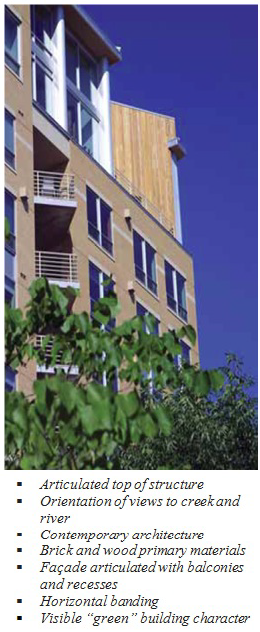
(2)
Redevelopment and preservation opportunities. The entire Creekside Neighborhood is currently vacant and under single ownership. As a result, Rifle Creek and Highway 6/24 are the only constraints to development. The entire district should be developed under a single master plan.
(3)
Primary land uses. The Creekside Neighborhood should be comprised primarily of high-density, high-quality residential development with some potential for commercial uses on the ground floor. High-quality lodging may be acceptable, but all other freestanding commercial uses are prohibited given the importance of having increased residential densities in the downtown and this sub-district's unique ability to accommodate such densities.
(4)
General design characteristics. Development within the Creekside Neighborhood should maximize the use of high-quality building materials and should be oriented to take advantage of views of Rifle Creek and the Colorado River. Horizontal building and other elements should be integrated into taller buildings to blend with background bluffs. Where possible, buildings also should expose their sustainable components, such as skylights, integrated solar panels, natural and local materials and similar features.
(5)
Relationship of development to street. Buildings in the Creekside Neighborhood should have a strong visual orientation to Highway 6/24 even if their main entries are located toward the interior of the sub-district. Buildings may be pulled up to the sidewalk or sites may have highly landscaped setbacks that provide sufficient buffering from the high traffic levels on Highway 6/24. Rifle Creek should be embraced as a key site amenity with building elevations that relate to the creek by incorporating terraces and balconies oriented to the creek and footprints and stepbacks that maintain a comfortable pedestrian environment along the creekfront trail. Likewise, upper floors should be oriented toward views of the creek and the Colorado River. Services and "back-of-house" activities should be located between buildings and not between the buildings and the highway or Rifle Creek.
Figure 16-18-620-2
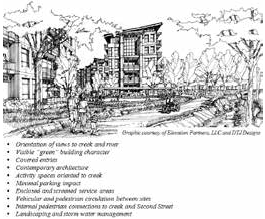
(6)
Parking. Parking needs in the Creekside Neighborhood will be significant and will likely require the development of several parking structures. These structures should be fully integrated into the overall development by reflecting the high-quality materials used on the principal buildings. Parking may be phased over time, starting with well-designed and screened surface lots that are eventually converted to structures. However, surface parking lots located between buildings and the highway should be minimized with the majority of parking placed toward the center of the sub-district. The proximity of transit stops should be closely evaluated, as well as the inclusion of "carshares," shuttles or other methods that reduce the potential parking demands of residents.
(7)
Project review criteria. The City will evaluate proposed projects in the Creekside Neighborhood sub-district based on the following considerations, in addition to all of the other standards contained in Section 16-18-1260 of this Article:
a.
Does the project contribute to a positive City gateway experience, putting forth a high-quality image for the Central Business District?
b.
Is the proposed level of density consistent with the opportunities presented by the site and the need to increase residential development in the downtown?
c.
Does development provide strong visual connections to Rifle Creek and the Colorado River? (Ord. 11 §15, 2011)
Sec. 16-18-630. - Site design standards.
The site design standards listed in Table 16-18-630 shall apply to all projects located within the Creekside Neighborhood sub-district. See Division 5 of the CBD Glossary for illustrations and definitions of the concepts and terms used in the Table.
Table 16-18-630
1 Except where no other options exist, in which case it shall be discouraged.
2 Except where the safety of the public is an issue (such as protection from high voltage equipment), in which case it shall be discouraged.
3 Accessory structures for single-family homes and homes that have been converted into commercial uses shall be governed by the standards in Sections 16-3-230, 16-3-240 and 16-3-340 of this Code.
(Ord. 11 §15, 2011)
Sec. 16-18-640. - Building design standards.
The building design standards listed in Table 16-18-640 shall apply to all projects located within the Creekside Neighborhood sub-district. See Division 6 of the CBD Glossary for illustrations and definitions of the concepts and terms used in the Table.
Table 16-18-640
1 Uses that are permitted in the downtown whose function requires reduced or no fenestration, such as a movie theater, may have fenestration requirements waived through a Tier 2 review.
(Ord. 11 §15, 2011)
Sec. 16-18-710. - Purpose.
The Centennial Neighborhood sub-district represents an opportunity to increase residential density adjacent to the Historic Core, Centennial Park and the Rifle Creek Trail. The purpose of this sub-district is to promote the revitalization of this area and to encourage the development of a high-quality, medium- to high-density, pedestrian-oriented, downtown neighborhood. (Ord. 11 §15, 2011)
Sec. 16-18-720. - Overview of sub-district character.
The intent of this Section is to describe the desired character of the sub-district and serve as a guide to developers and the City throughout the development process. See Sections 16-18-730 and 16-18-740 below for more specificity on which items are required, preferred, discouraged and prohibited.
(1)
Building scale and intensity. The Centennial Neighborhood is intended to consist of medium- to high-density, high quality residential development in the form of townhomes, apartments and condominiums with some opportunities for compatible commercial uses in mixed-use buildings or small-scale, freestanding structures. All buildings should have a pedestrian/residential scale and a strong relationship to the adjoining street grid to encourage residents to walk into the more commercial-oriented districts of the downtown.
(2)
Redevelopment and preservation opportunities. The Centennial Neighborhood offers many opportunities for redevelopment projects by assembling marginal single-family home sites and the redevelopment or outright replacement of existing, marginal multi-family buildings and commercial properties. Although the 2008 Downtown Master Plan did not identify any high-priority preservation sites in this sub-district, there are some single-family homes with historic characteristics that are in good shape that should be preserved on-site or relocated to other residential neighborhoods in the community. These homes also may be candidates for appropriate conversion to commercial uses or live/work units.
Figure 16-18-720-1
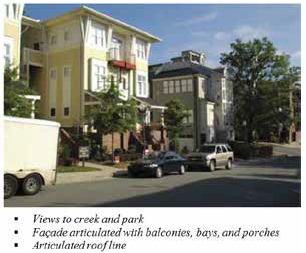
(3)
Primary land uses. The Centennial Neighborhood should consist primarily of moderate- to higher-density residential uses, complemented by some small-scale commercial development. Although the scale and density of buildings should be scaled to pedestrians and reflective of a residential neighborhood, it is equally important that the residential density in this sub-district is not so low that opportunities are missed to add needed residents to the downtown that support downtown businesses.
(4)
General design characteristics. New development within the Centennial Neighborhood should be characterized by traditional brick and wood frame building materials with articulated facades that maintain the residential character of the neighborhood. Larger assembled parcels should be designed to preserve the historic street grid pattern, including the alleys where appropriate, with primary building entries placed along the east-west streets within the district. However, site plans also should orient and draw residents to Rifle Creek and Centennial Park where they adjoin the development.
(5)
Relationship of development to street. In keeping with the residential character of the district, modest front yards should be provided where possible. Porches and balconies are desirable additions that will help strengthen the orientation of the buildings toward the street.
Figure 16-18-720-2
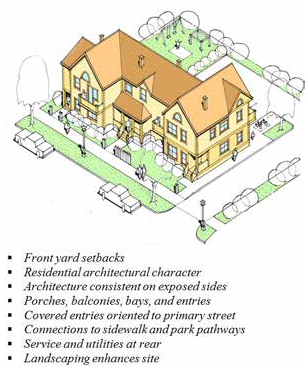
(6)
Parking. On-street parking provided throughout the Centennial Neighborhood should primarily serve visitors. On-site parking should be located to the sides and rear of buildings and never between buildings and a primary street. Resident parking may include well-screened surface lots, private garages or underground structures located beneath the buildings. Proximity to transit stops should be closely evaluated and the inclusion of "car-shares" or other methods of reducing auto needs should be considered.
(7)
Project review criteria. The City will evaluate proposed projects in the Centennial Neighborhood sub-district based on the following considerations in addition to all of the other standards contained in Section 16-18-1260 of this Article:
a.
Does the project take appropriate advantage of site assembly opportunities?
b.
Does the project contribute to the revitalization of this neighborhood?
c.
Does the project preserve the residential character of this area?
d.
Is the proposed level of density consistent with the opportunities presented by the site and the need to increase residential development in the downtown?
e.
Does the project take appropriate advantage of its proximity to Centennial Park?
f.
If a commercial use is being proposed, is the use and its location/configuration compatible with the residential neighborhood character? (Ord. 11 §15, 2011)
Sec. 16-18-730. - Site design standards.
The site design standards listed in Table 16-18-730 shall apply to all projects located within the Centennial Neighborhood sub-district. See Division 5 of the CBD Glossary for illustrations and definitions of the concepts and terms used in the Table.
Table 16-18-730
1 Except where no other options exist, in which case it shall be discouraged.
2 Except where the safety of the public is an issue (such as protection from high voltage equipment), in which case it shall be discouraged.
3 Accessory structures for single-family homes and homes that have been converted into commercial uses shall be governed by the standards in Sections 16-3-230, 16-3-240 and 16-3-340 of this Code.
(Ord. 11 §15, 2011)
Sec. 16-18-740. - Building design standards
The building design standards listed in Table 16-18-740 shall apply to all projects located within the Centennial Neighborhood sub-district. See Division 6 of the CBD Glossary for illustrations and definitions of the concepts and terms used in the Table.
Table 16-18-740
1 Uses that are permitted in the downtown whose function requires reduced or no fenestration, such as a movie theater, may have fenestration requirements waived through a Tier 2 review.
(Ord. 11 §15, 2011)
Sec. 16-18-810. - Setbacks.
Nothing in this Section shall be interpreted as requiring any existing structure that does not comply with the setback requirements to meet these requirements as part of a proposed improvement project, except that expansions may be required to comply as described in Paragraph 16-18-1140(e)(3).
(1)
Principal building setbacks from streets and parks are required as listed in the table below. The following shall also apply:
a.
For public plazas meeting the site design standards for the applicable sub-district, the building may be setback the depth of the public plaza.
(2)
Setbacks for side yards, rear yards and building separation. All principal structures located within the Central Business District shall be subject to the following:
a.
The minimum side yard setback shall be zero (0) feet.
b.
Minimum building separation is zero (0) feet with a party wall; or ten (10) feet without a party wall.
c.
Minimum rear setback is zero (0) feet with an alley; or eight (8) feet without an alley.
(3)
Permitted intrusions into required setbacks.
1 For single-family homes, the regulations in Sections 16-3-230, 16-3-240 and 16-3-340 of this Code shall apply.
2 All structures and features shall comply with the visibility requirements of Paragraph 16-7-140(i)(5) and Section 16-13-110 of this Code.
(Ord. 11 §15, 2011; Ord. 2 §2, 2017)
Sec. 16-18-820. - Building height.
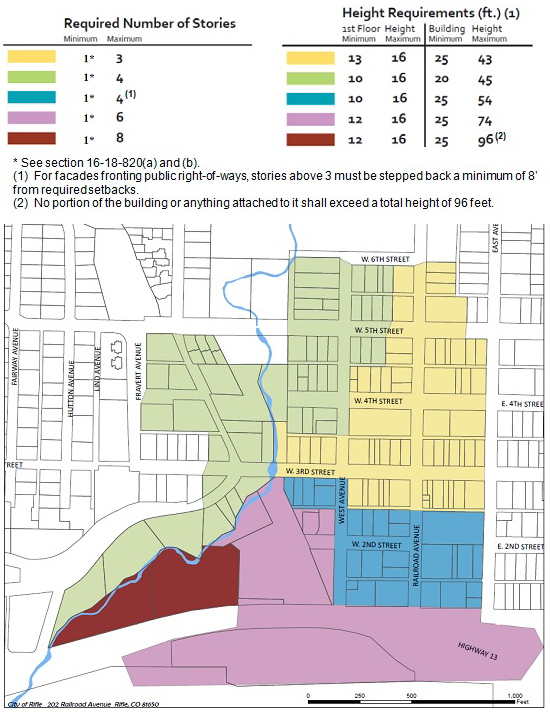
Principal structure building heights for the entire Central Business District are shown on Figure 16-18-830. See Section 16-3-250 of this Chapter for exemptions to building height. The following shall also apply:
(1)
In all sub-districts, new one-story residential buildings shall be "prohibited." New residential buildings shall be at least two (2) stories in height.
(2)
In all sub-districts, new one-story buildings or buildings less than twenty-five (25) feet tall intended for commercial use shall be "discouraged." The intent of the "discouraged" designation is to promote density in the downtown while allowing a Tier 2 review process to consider the approval of one-story commercial buildings that demonstrate a significant contribution to the objectives of the 2008 Downtown Master Plan, despite a lack of desired density.
Figure 16-18-830
(Ord. 11 §15, 2011)
Sec. 16-18-830. - Density/intensity standards.
The following density/intensity standards shall apply to principal structures located within the Central Business District.
Central Business District Sub-Districts
1 Applies to residential-only buildings. In mixed-use buildings, for every 1 sq. ft. of nonresidential space, a minimum of 1 sq. ft. of residential space must be provided.
2 Applies to residential-only buildings. In mixed-use buildings, for every 1 sq. ft. of nonresidential space, a minimum of 3 sq. ft. of residential space must be provided.
3 Applies to stand-alone commercial buildings only.
4 Within the Creekside Neighborhood, stand-alone commercial buildings are prohibited except for indoor commercial lodging.
5 Minimum building coverage is the largest single-floor area of the principal building as a percent of the lot size.
(Ord. 11 §15, 2011; Ord. 8 §2, 2014)
Sec. 16-18-840. - Lot requirements.
Central Business District Sub-Districts
1 Must comply with minimum gross density requirements in this Section.
(Ord. 11 §15, 2011)
Sec. 16-18-910. - Purpose and intent.
The purpose of this Division is to ensure that adequate parking is provided to cover the needs of downtown businesses, residents and visitors while also ensuring that the Central Business District can be developed to its fullest. This requires careful balancing and a high level of creativity on the part of developers, property owners, businesses, residents and the City. All parties must look for ways to address parking needs through a wide variety of cost-effective solutions while maintaining an attractive, pedestrian-friendly area. Accordingly, large surface parking areas are discouraged and parking partnerships are strongly encouraged through phased approaches. (Ord. 11 §15, 2011)
Sec. 16-18-920. - Applicability.
(a)
Sub-districts and conflicts. This Division shall apply within all Central Business District sub-districts. Where the site development regulations of a particular sub-district conflict with the regulations of this Division, the sub-district regulations shall prevail. Likewise, several cross references to the standards in Article VII, "Parking and Loading" are contained herein. Where the regulations in that Article conflict with this Division, the regulations of this Division shall prevail.
(b)
New development. The off-street parking and loading standards of this Division shall apply to any new building and to any new land use established.
(c)
Expansions. The off-street parking and loading standards of this Division shall apply when an existing structure or use is expanded. Additional off-street parking and loading spaces shall be required to serve only the expanded area.
(d)
Change in use. No additional off-street parking shall be required for any change of use except in the case of a change from one (1) nonconforming, nonresidential use to another as per Subsection 16-18-1110(d) of this Article, in which case the Planning and Zoning Commission may impose parking requirements as deemed appropriate and necessary to adequately accommodate the needs of the new use. (Ord. 11 §15, 2011)
Sec. 16-18-930. - Parking and loading requirements.
(a)
Exemptions.
(1)
The first five thousand (5,000) gross square feet of nonresidential use shall be exempt from all off-street parking and loading requirements. Parking for such buildings is intended to be absorbed by on-street parking and public parking facilities throughout the Central Business District.
a.
Parking requirements contained in this Division shall apply only to nonresidential portions of buildings larger than five thousand (5,000) gross square feet and to residential uses.
b.
For purposes of this Division, the first five thousand (5,000) gross square feet shall be that nonresidential area with the highest parking requirement as per Section 16-7-20.
(2)
Residential uses of any size or type are exempt from having to provide any off-street parking for guests.
(b)
Alternatives for developing parking calculations. For buildings with more than five thousand (5,000) gross square feet of nonresidential uses and all residential uses, the applicant may propose and the City may accept at its discretion any one (1) of the following three (3) alternatives for determining the number of off-street parking and loading spaces to be provided:
(1)
The standards listed in Section 16-7-20 of this Code. This standard shall represent both the minimum and maximum number of off-street parking spaces permitted; or
(2)
A blended ratio of one (1) parking space per two hundred fifty (250) gross square feet; or
(3)
For buildings with any land use or combination of uses, the applicant may prepare a project-specific parking demand analysis in accordance with Section 16-18-940.
(c)
City acceptance. The City reserves the right to accept, accept with conditions or deny any proposal for an alternative number of off-street parking spaces or loading spaces, regardless of the method or findings of a parking analysis. In no case, however, shall the City require more parking than that required in Paragraph (b)(1) or (2) above, whichever is less. In order to further the purpose and intent of this Division, the City may prepare its own parking demand analysis in accordance with Section 16-18-940 below for any project exceeding fifteen thousand (15,000) gross square feet should the applicant not elect to prepare one of his or her own. (Ord. 11 §15, 2011)
Sec. 16-18-940. - Parking and loading demand analysis.
(a)
Demand analysis content. Where a parking and loading demand analysis is prepared to determine the number of required parking spaces as per Paragraph 16-18-930(b)(3) above, the analysis shall:
(1)
Be prepared by a credentialed professional in the area of analyzing parking demand, using a professionally accepted methodology (such as that provided by the Institute of Traffic Engineers) and that takes into consideration local automobile usage patterns (rather than relying solely on national standards or patterns).
(2)
Be specific to the proposed uses and site conditions and describe in detail the methodology used to prepare the analysis, including all calculations and assumptions used.
(3)
Include a description of any and all strategies being used by the applicant to reduce parking demand (also see Subsection (b) below). Where a strategy relies on some form of ongoing operation (such as the provision of a community car, shuttle bus, shared parking between different property owners, etc.), the method of guaranteeing continuous service shall be indicated. Where existing public transit is used as part of a strategy, a guarantee of future service shall not be required.
(4)
Include a comparison of the parking space requirements under Section 16-7-20 of this Chapter to the proposed number of parking spaces.
(b)
Reduction strategies. Applicants are encouraged to explore a variety of strategies for reducing parking demand, including but not limited to the following:
(1)
Shared parking, on-site. This strategy works well in projects with a mix of uses that have different peak times. The strategy also may be employed with multi-phase projects where the parking requirements are recalculated with each phase to realize efficiencies as more uses are added.
(2)
Shared parking, off-site. A shared parking agreement between two (2) or more different project/property owners can be an effective method of reaching larger economies of scale to reduce the overall parking requirements of the individual projects. The agreement shall be prepared in a form acceptable to the City Attorney and recorded prior to the issuance of a building permit for any of the properties involved. The agreement shall be in effect for the life of the project or other time frame as agreed to by the City, and the City shall be included as an interested party to the agreement, such that the agreement cannot be amended or terminated without City approval.
(3)
Public transit. Larger developments that are likely to draw employees and/or visitors from outside of the City and that include transit stops within the project may be able to realize parking reductions. All proposed transit stops shall be approved by the transit provider.
(4)
Provision of a community or company car. This strategy may work for larger residential or employment projects. If used, the applicant will be required to provide some form of guarantee that the community or company car will be provided on a continuous basis for the life of the project or other time frame as agreed to by the City.
(5)
Provision of a shuttle bus. This too may be an acceptable strategy for larger residential or employment projects or for multiple projects that share in the cost. Again, some form of guarantee will be required that service will be provided on a continuous basis for the life of the project or other time frame as agreed to by the City.
(6)
Deed restrictions. Deed restrictions that limit the number of cars occupants may have at a project may be an effective strategy, particularly for residential units. The form of the deed restriction shall be subject to approval by the City, and the City shall be included as an interested party to the restriction, such that the restriction cannot be removed without City approval.
(c)
Fee in lieu of on-site parking. Should the City create a more formal parking system and accept fees in lieu of on-site parking, applicants are strongly encouraged to consider this option. The ratio of on-site spaces to those to be provided by the City shall be determined by the City on a project-by-project basis based on a variety of considerations including the location of the project, location of the City-provided parking, types of project land uses, existing parking demands in the area of the project and future parking demands in the area of the project, among others.
(d)
Parking location. For nonresidential land uses, required off-street parking spaces may be located anywhere in the Central Business District. Parking for residential uses shall be provided within six hundred (600) feet from the primary entrance to the residential structure or, in the case of multiple structures or multiple entrances, to the center of the project site. (Ord. 11 §15, 2011)
Sec. 16-18-950. - Parking and loading report.
All projects that require off-street parking shall submit, as part of their application, a parking report that includes the following information:
(1)
If no parking analysis is prepared, calculations showing how many off-street parking spaces are required based on one (1) of the other standards listed in Subsection 16-18-930(b) of this Article.
(2)
Description of how all parking needs will be met, including a discussion of available on-street parking; structured, shared and public parking facilities; and any fees in lieu of parking being paid by the applicant.
(3)
If development will be phased, how parking requirements and demand will be met over time. This includes strategies for phasing in structured parking to replace surface lot parking.
(4)
Any proposed alternative parking space and aisle dimensions (see Section 16-18-960 below). (Ord. 11 §15, 2011)
Sec. 16-18-960. - Dimensions and design standards for stacking, parking and loading spaces.
(a)
All off-street parking spaces and aisles shall be provided in accordance with the design standards contained in Section 16-7-140 of this Chapter.
(b)
All loading areas shall be provided in accordance with the standards contained in Section 16-7-150 of this Chapter.
(c)
All vehicle stacking areas shall be provided in accordance with the design standards contained in Section 16-7-120 of this Chapter.
(d)
All accessible parking for physically handicapped persons shall be provided in accordance with the design standards contained in Section 16-7-130 of this Chapter.
(e)
Applicants who wish to propose deviations from any of the above standards may do so through the required parking report described in Section 16-18-950 above. The City reserves the right to approve, conditionally approve or deny such proposals. (Ord. 11 §15, 2011)
Sec. 16-18-970. - General design and layout standards for surface and structured parking.
All surface and structured parking lots in the Central Business District shall comply with the design and layout standards listed in Table 16-18-970 below.
Table 16-18-970
1 Service and loading areas include areas for the parking of delivery or service vehicles, as well as building delivery/service entries
2 Except where no other option is feasible, in which case the location shall be classified as "Discouraged."
(b)
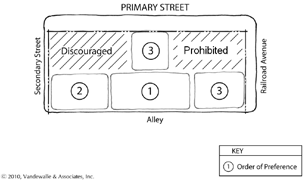
Parking lot locations. See the Site Design Standards of the applicable sub-district for more requirements. Parking lot locations shall be permitted as shown below:
(Ord. 11 §15, 2011)
Sec. 16-18-980. - Surface parking landscaping and screening standards.
Surface parking lots shall comply with all provisions of Chapter 16, Article XIII of this Code, with the following exceptions:
(1)
Exceptions to parking lot perimeter landscaping (Subsection 16-13-130(a)):
a.
Screening location. Screening is required only along streets, Centennial Park and Rifle Creek, not along interior property lines or alleys.
b.
Screening material. In lieu of a required hedge, a wall may be used that meets the requirements of Subparagraph d. below.
c.
Screening width. Where a hedge is used, the minimum width of area between the parking lot and the property line shall be eight (8) feet. Where a wall is used, the minimum width shall be the width of the wall, except that a landscape island shall be provided in the area of any required perimeter tree.
d.
Screen wall. A wall used to meet the requirements of this Section shall comply with all of the following:
1.
Entire wall and supporting structure/footer shall be located on the property;
2.
Material and design consistent with building architecture;
3.
Finished on both sides;
4.
Height of three (3) feet to four (4) feet;
5.
Break with a column, jog, landscaping and/or driveway every twenty-five (25) feet;
6.
In lieu of required perimeter trees, may include taller columns, trellises or similar features that visually extend the "street wall" across the parking area (this is particularly preferred where the parking lot has buildings on either side of it);
7.
Wall and columns shall comply with visual triangle requirements (see Section 16-13-110 of this Chapter);
8.
Where the wall and existing sidewalk are less than three (3) feet apart, area shall be paved consistent with streetscape design and materials; and
9.
Where the wall and existing sidewalk are three (3) feet or more apart, area shall be paved and/or landscaped consistent with streetscape design and materials. (Ord. 11 §15, 2011)
Sec. 16-18-990. - Residential parking standards.
The standards listed in Table 16-18-990 apply to the required parking spaces for the residents of a development.
Table 16-18-990
(Ord. 11 §15, 2011)
_____
Sec. 16-18-995. - Attached and detached residential garage standards.
(a)
Detached garage standards.
(1)
Each garage shall have no more than two (2) parking stalls, and the combined width of the doors shall not exceed eighteen (18) feet. Doors shall not exceed eight (8) feet in height. Separate doors for each stall are preferred.
(2)
Where an alley is adjacent or can be extended, garages shall be accessed from the alley.
(3)
Garages facing the street or the rear shall be located behind the principal building.
(4)
Garages facing the side shall be located a minimum of ten (10) feet behind the primary front wall of the principal building.
(5)
Garages on alleys shall be set back at least three (3) feet. Driveway lengths between five (5) and twenty (20) feet are discouraged in any location (alley or front) as they may encourage, but are not adequate for, parking.
(6)
Multiple private garages serving multiple dwelling units may be attached but the number of garages shall not exceed the number of units, plus one (1).
(b)
Attached garage standards.
(1)
Each garage shall have no more than two (2) parking stalls, and the combined width of the doors shall not exceed eighteen (18) feet. Doors shall not exceed eight (8) feet in height. Separate doors for each stall are preferred.
(2)
Where an alley is adjacent or can be extended, driveways and garages in the front are prohibited.
(3)
Garages for attached dwelling units may be located side-by-side on alleys if:
a.
Separate doors are used for each stall, or
b.
The face of one (1) garage is set back from the other a minimum of three (3) feet, or
c.
There is a break in the roofline between the garages.
(4)
Where an alley is not adjacent, the face of the garage may face the front but shall not project beyond the main portion of the front wall of the dwelling unit and shall be five (5) feet behind the furthest front projecting portion of the structure (e.g., front porch, bay window, etc.).
(5)
Where an alley is not adjacent, front-facing two-car garages for attached dwelling units may not be located side-by-side and must be separated by habitable living area. One-car garages may be attached to each other.
(6)
Garages on alleys shall be set back at least three (3) feet. Driveway lengths between five (5) and twenty (20) feet are discouraged in any location (alley or front), as they may encourage, but are not adequate for, parking. (Ord. 11 §15, 2011)
Sec. 16-18-1010. - Table of land uses.
(a)
Table 16-18-1010 lists the categories of land uses allowed in each sub-district of the Central Business District, subject to varying levels of review. See Section 16-1-220 of this Chapter for land use definitions and Section 16-18-1020 of this Chapter for standards specific to each land use.
(b)
Consistent with the provisions of Section 16-3-110 of this Chapter, the Planning Director shall review applications for uses not listed on Table 16-18-1010 and shall have the discretion to make the following findings or to defer the decision to the Planning and Zoning Commission:
(1)
The use is similar to a listed "P" use and requires a Tier 1 review;
(2)
The use is similar to a listed "C" use and requires a Tier 2 review;
(3)
The use is similar to a listed "discouraged" use and requires a Tier 2 review; or
(4)
The use is unlike any listed use and is a prohibited use.
(c)
Regardless of use, the scale and size of a project also affect the type of required review. See Section 16-18-1220 of this Chapter for more information.
Legend for Table 16-18-1010
Table 16-18-1010**
(Ord. 11 §15, 2011; Ord. 1 §2, 2020; Ord. 10, §2, 2020; Ord. 12 § 6, 2021; Ord. 13, § 3(Exh. B), 2022
Sec. 16-18-1020. - Specific land use regulations.
General regulations and standards applicable to each land use category listed in Table 16-18-1010 above have been listed in this Section. Definitions of each of the land use categories are provided in Section 16-1-220 of this Chapter. Section 16-3-110 of this Chapter empowers the Planning Director to make interpretations on matters regarding specific land use proposals that are not addressed by this Section.
(1)
Residential uses.
a.
Group care facilities (One [1] to eight [8] residents). Group care facilities with more than eight (8) residents shall be considered Indoor Institutional - General or Indoor Institutional - Intensive uses (depending on the size) and will be subject to the regulations associated with that land use category.
b.
Live-work unit.
1.
All commercial uses permitted in the underlying zoning sub-district shall be permitted in live-work units, with the exception of the following:
a)
All indoor commercial entertainment uses;
b)
All indoor commercial lodging uses;
c)
All bed and breakfast lodging (regulated under a separate land use category);
d)
All drive-in sales and service uses;
e)
Pet stores, kennels and animal hospitals;
f)
Gun and firearms sales, except businesses that involve the crafting and sale of one-of-a-kind, custom firearms only;
g)
Liquor sales; and
h)
Medical marijuana dispensaries.
2.
Live-work units are defined as a commercial use that occupies greater than twenty-five percent (25%) of the combined live-work square footage. A commercial use that is less than twenty-five percent (25%) of the combined square footage is considered a home occupation as regulated by Section 16-3-280 of this Chapter.
3.
Businesses involving the coming and going of customers, clients and/or patients shall not be permitted within a multi-family building in which units take access from a shared interior hallway.
4.
A wall dividing the living space from the work space is not required in any live-work unit, but each unit shall be separated from all other uses in the building and shall have separate access either from the building exterior or from an interior corridor that is separate from such other uses.
5.
Within each live-work unit, a maximum of two (2) employees from outside the household shall be permitted.
6.
Signage shall be permitted in accordance with the regulations for home occupation signage (see Paragraph 16-3-280(c)(6) of this Chapter).
7.
See the CBD Glossary, Section 330 for parking standards.
8.
In no instance shall the activities associated with the work component of a live-work unit emit levels of noise, dust, vibrations, odor or other nuisances detectable outside the confines of the live-work unit.
9.
Between the hours of 9:00 p.m. and 7:00 a.m., occupants of a live-work unit shall cease all externally detectable work operations, including the coming and going of customers, clients and employees, the delivery and shipping of goods and materials and the unloading or loading of vehicles.
(2)
Community facility uses.
a.
Indoor institutional - intensive. All structures shall be located a minimum of fifty (50) feet from any property zoned LDR, MDR, MDR-X or CBD-CN.
b.
Outdoor institutional. All structures and actively used outdoor recreation areas shall be located a minimum of fifty (50) feet from any property zoned LDR, MDR, MDR-X or CBD-CN, even if the outdoor institutional use is itself located on a property zoned CBD-CN.
c.
Public services and utilities. All structures shall be located a minimum of twenty (20) feet from any property zoned LDR, MDR-X or CBD-CN, even if the public services and utilities use is itself located on a property zoned CBD-CN.
(3)
Commercial uses.
a.
Office and personal services. For multi-tenant buildings with ground-floor areas larger than seven thousand five hundred (7,500) square feet within the CBD-HC and CBD-MU sub-districts, ground-floor office uses shall not occupy more than twenty-five percent (25%) of the total gross floor area of the ground floor of the building.
b.
Outdoor commercial entertainment. All activity areas shall be located a minimum of three hundred (300) feet from any property zoned LDR, MDR, MDR-X or CBD-CN.
c.
Bed and breakfast lodging.
1.
A bed and breakfast lodging facility shall have no more than twenty (20) rooms, per state statutes.
2.
A bed and breakfast lodging facility shall not sell malt, vinous or spirituous liquors by the drink and shall not serve alcoholic beverages for more than four (4) hours in any one (1) day, per state statutes.
3.
The dwelling unit in which the bed and breakfast lodging takes place shall be the principal residence of the operator/owner, and said operator/owner shall live on the premises when the bed and breakfast operation is active.
4.
The maximum stay for any occupants of bed and breakfast lodging shall be fourteen (14) days.
d.
Group child care center. Facilities with more than ten (10) children shall provide an off-street passenger loading and drop-off area.
e.
Artisan galleries and studios. All activities and equipment associated with the production of art (with the exception of loading) shall be conducted and stored entirely indoors and shall not emit noise, smoke, glare, odor, dust or vibrations at a level detectable by surrounding properties.
f.
Drive-in sales and service.
1.
Clearly marked pedestrian crosswalks shall be provided for each walk-in customer access to the facility adjacent to the drive-in lanes.
2.
The drive-in facility shall be designed so as to not impede or impair vehicular and pedestrian traffic movement or exacerbate the potential for pedestrian/vehicular conflicts.
3.
The setback of any overhead canopy or similar structure shall be a minimum of ten (10) feet from all street right-of-way lines; shall be a minimum of twenty (20) feet from all properties zoned LDR, MDR, MDR-X or CBD-CN; and shall be a minimum of five (5) feet from all other property lines. The total height of any overhead canopy or similar structure shall not exceed twenty (20) feet as measured to the highest part of the structure.
4.
Interior curbs shall be used to separate driving areas from exterior fixtures such as fuel pumps, vacuums, menu boards, canopy supports and landscaped islands. Said curbs shall be a minimum of six (6) inches high and be of a non-mountable design.
5.
Also see the CBD Glossary, Division 4 for additional standards applicable to service stations.
(4)
Accessory uses.
a.
Home occupation: See Section 16-3-280 of this Chapter.
b.
Drive-in sales and service incidental to on-site principal land use.
1.
Clearly marked pedestrian crosswalks shall be provided for each walk-in customer access to the facility adjacent to the drive-through lanes.
2.
The drive-through facility shall be designed so as to not impede or impair vehicular and pedestrian traffic movement or exacerbate the potential for pedestrian/vehicular conflicts.
3.
The setback of any overhead canopy or similar structure shall be a minimum of ten (10) feet from all street right-of-way lines; shall be a minimum of twenty (20) feet from all properties zoned LDR, MDR, MDR-X and CBD-CN; and shall be a minimum of five (5) feet from all other property lines. The total height of any overhead canopy or similar structure shall not exceed twenty (20) feet as measured to the highest part of the structure.
4.
Interior curbs shall be used to separate driving areas from exterior fixtures such as menu boards, canopy supports and landscaped islands. Said curbs shall be a minimum of six (6) inches high and be of a non-mountable design.
c.
Accessory structures, major and minor. See accessory structure regulations under the applicable sub-district site design elements.
d.
Garden roof - see Glossary.
e.
Building-mounted small wind system.
1.
Building-mounted small wind systems shall be attached to a principal building.
2.
A building-mounted small wind system may consist of an array with up to two (2), interconnected turbines in the Centennial Neighborhood and Historic Core sub-districts and up to five (5) interconnected turbines in all other sub-districts, provided that the combined output of an array does not exceed one hundred (100) kW.
3.
In all sub-districts, no more than one (1) system shall be permitted for building footprints less than ten thousand (10,000) square feet.
4.
In all sub-districts, no more than two (2) systems shall be permitted for building footprints greater than ten thousand (10,000) square feet.
5.
In all sub-districts, three (3) or more systems may be permitted subject to a Tier 2 review for building footprints greater than thirty thousand (30,000) square feet, at a ratio of one (1) system per each ten thousand (10,000) square feet of building footprint.
6.
All building-mounted small wind systems shall comply with minimum setbacks established for principal buildings within the applicable sub-district.
7.
The height of the entire system shall not exceed fifteen (15) feet, not including the height of the building upon which it is mounted and regardless of where on the building it is mounted.
8.
All wind systems shall be painted in a nonreflective, light grey or light blue hue, which blends with the sky and clouds.
9.
Wind systems shall be lighted only if required by the Federal Aviation Administration (FAA). Applicants shall provide a copy of the FAA's determination to establish the required markings and/or lights for the structure.
10.
No signs shall ever be placed on the small wind energy system, except that the manufacturer's identification and appropriate warning signs are allowed.
11.
An automatic braking, governing or feathering system shall be required to prevent uncontrolled rotation at wind speeds greater than forty (40) miles per hour. A manual brake also shall be provided.
12.
A building-mounted small wind system and associated equipment shall not generate noise in excess of ten (10) dB above ambient sound levels from all other sources at ground level at the property line. The project also shall meet all applicable state noise regulations
13.
Wind systems shall be sited in a manner to produce minimal shadowing or flicker impact on off-site habitable buildings. The applicant shall provide evidence that a proposed wind system does not negatively impact neighboring uses and incorporate appropriate mitigation measures as may be necessary to address this issue.
14.
The applicant shall maintain the wind system in good working order at all times. Such maintenance shall include, but shall not be limited to, upkeeping the appearance of the structure (e.g., refreshing the paint) and maintaining the structural integrity of the foundation and support structure.
15.
At such time as the use of a wind system is scheduled to be discontinued, the owner shall physically remove the system within ninety (90) days of discontinuation of use.
f.
Outdoor dining area.
1.
The dining area shall not reduce or inhibit the use or number of parking stalls provided on the property below the requirement established by the provisions of Section 16-18-930 of this Chapter.
2.
Dining areas shall be separated from any vehicular parking or circulation area by a physical barrier such as a greenway, curb, fence or line of planters or by a clearly marked paved area.
3.
A revocable permit shall be obtained prior to the establishment of any outdoor dining area located on a public sidewalk, per Chapter 11, Article II of this Code.
g.
Fleet vehicle storage.
1.
The overnight parking of four (4) or fewer delivery or service vehicles owned by a commercial establishment and not issued license plates based on gross vehicle weight (GVW) shall not be subject to review or regulation by the City, except with respect to the general parking regulations in Division 9.
2.
The overnight parking of vehicles issued license plates based on GVW shall be prohibited within the Central Business District.
3.
In no event shall the parking or storage of fleet vehicles reduce or inhibit the use or number of parking stalls provided on the property below the requirement established by the provisions of Section 16-18-930 of this Chapter.
4.
Inoperative vehicles or equipment shall not be stored with fleet vehicles.
5.
The on-site maintenance or repair of fleet vehicles shall be prohibited.
h.
Outdoor vending machines.
1.
Outdoor vending machines are only permitted as accessory to non-residential principal land uses or to the nonresidential components of a mixed-use development.
2.
No more than two (2) outdoor vending machines shall be permitted for each principal building.
3.
In no instance shall outdoor vending machines be placed in front of the principal building.
4.
All outdoor vending machines shall be completely screened from the public right-of-way with opaque materials that match the exterior of the principal building.
5.
Outdoor vending machines may be lit only when the principal use on the lot is in operation.
i.
Stand-alone ATMs (automated teller machines).
1.
Outdoor stand-alone ATMs are only permitted as accessory to nonresidential principal land uses or to the nonresidential components of a mixed-use development.
2.
Outdoor stand-alone ATMs located in the CBD-HC may be placed in the front or street yard of the lot, provided that they are inset into the wall of the principal building so they are flush with the facade and do not project into the public right-of-way or the yard.
3.
No more than one (1) stand-alone ATM shall be permitted per principal building.
j.
Outdoor display, removable.
1.
The total area of the outdoor display area shall not exceed five percent (5%) of the total lot area or five hundred (500) square feet, whichever is less.
2.
All items, including display racks and other fixtures, shall be stored in a fully enclosed building from 9:00 p.m. to 8:00 a.m. and at all times when the business is closed.
3.
Display areas shall not be located in any required landscaped areas, public rights-of-way or the visibility triangle (see Paragraph 16-7-140(i)(5) and Section 16-13-110 of this Chapter).
k.
Outdoor storage or display, permanent.
1.
The display of items shall not be permitted in permanently protected green space areas or required landscaped areas.
2.
The display of items shall not be permitted within required setback areas for the principal structure.
3.
In no event shall the display of items reduce or inhibit the use or number of parking stalls provided on the property below the requirement established by the provisions of Section 16-18-930 of this Chapter. If the number of provided parking stalls on the property is already less than the requirement, such display area shall not further reduce the number of parking stalls already present.
4.
Display areas shall be separated from any vehicular parking or circulation area by a minimum of ten (10) feet. This separation shall be clearly delimited by a physical barrier such as a greenway, curb, fence or line of planters or by a clearly marked paved area.
5.
Signs, screening, enclosures, landscaping or materials being displayed shall not interfere in any manner with either on-site or off-site traffic visibility, including potential traffic/traffic and traffic/pedestrian conflicts.
6.
Outdoor display shall be permitted during the entire calendar year; however, if goods are removed from the display area, all support fixtures used to display the goods shall be removed within ten (10) calendar days of the goods' removal.
7.
Inoperative vehicles or equipment or other items typically stored or displayed in a junkyard or salvage yard shall not be displayed for this land use.
8.
The area of outdoor display or storage shall not exceed fifteen percent (15%) of the total sales area of the principal use. Land uses with outdoor display or storage areas larger than fifteen percent (15%) of the sales area of the principal land uses are prohibited within the Central Business District.
l.
Outdoor entertainment incidental to on-site commercial.
1.
The area of outdoor entertainment incidental to on-site commercial land use shall not exceed fifteen percent (15%) of the floor area of the principal use. Outdoor entertainment incidental to on-site commercial land uses that exceed fifteen percent (15%) of the floor area of the principal use shall be considered outdoor commercial entertainment uses and shall be subject to the regulations associated with such land uses.
2.
The Planning Director may, even when a use is permitted, attach conditions for hours of use or other performance standards.
(5)
Temporary uses.
a.
General temporary outdoor sales.
1.
Up to two (2) garage sales per year on a given residential property, each lasting no longer than two (2) days, are exempt from the provisions of this Section.
2.
The display shall not obstruct pedestrian or vehicular circulation, including vehicular sight distances.
3.
If the subject property is located adjacent to a residential area, sales and display activities shall be limited to daylight hours.
4.
Display areas shall not be located in any required landscaped areas.
5.
A revocable permit shall be obtained prior to the establishment of any general temporary outdoor sales, per Chapter 11, Article II of this Code, if such sales areas will encroach on a public right-of-way.
b.
Temporary tents and soft canopies. Tents and soft canopies shall be erected for no longer than five (5) consecutive days unless the applicant is granted an extended temporary use permit, subject to a Tier 1 review, and shall not be erected for more than twelve (12) days in any calendar year, except as part of a larger event or festival.
c.
Mobile vendors. See Section 16-3-90 of this Chapter. (Ord. 11 §15, 2011)
Sec. 16-18-1110. - Applicability.
Existing uses, structures, sites and lots shall be considered nonconforming if the use, structure, site or lot does not meet all requirements of this Article. (Ord. 11 §15, 2011; Ord. 8 §3, 2014)
Sec. 16-18-1120. - Nonconforming uses - nonresidential uses.
(a)
Authority to continue. A lawful nonresidential use made nonconforming by the adoption of this Article may continue in the same use only for so long as such use continues unabated subject to the requirements of this Section. A change in ownership shall not be considered a discontinuation of use.
(b)
Maintenance and repair. The normal maintenance of a nonconforming, nonresidential use or land containing or related to a nonconforming, nonresidential use is permitted. Normal maintenance includes necessary repairs and incidental alterations that do not make nonconforming aspects of the use, structure or site improvements more nonconforming in relation to this Article. In no instance shall total expenditures for all repairs made after enactment of this Article exceed sixty-five percent (65%) of the existing value of the structure within any continual five-year period.
(c)
Expansion of nonconforming, nonresidential uses.
(1)
In the CBD-HC, CBD-MU, CBD-NG and CBD-RG sub-districts, a nonconforming, nonresidential use may expand within an established structure and/or outdoor operation or storage areas in existence and approved for such use at the time this Article was adopted. Expansions within existing structures or existing outdoor operation or storage areas shall not require review by the City.
(2)
In the CBD-CN and CBD-CS sub-districts, a nonconforming, nonresidential use may not be expanded within an established structure and/or existing outdoor operation or storage areas.
(3)
In the CBD-HC, CBD-MU, CBD-NG and CBD-RG sub-districts, any proposed expansions of a nonconforming use outside of an existing structure or existing outdoor operation or storage area shall require a Tier 2 level of review per Section 16-18-1240 of this Chapter. In these sub-districts, a nonconforming, nonresidential use may be expanded as follows:
a.
A nonconforming, nonresidential use on a property in compliance with all site and structural improvement provisions of this Article may expand structural floor area, outdoor operations/storage or a combination of the two (2) up to twenty percent (20%) of the existing total floor area and/or outdoor operation or storage use. A property shall be considered eligible for approval only if all site and building design standards of this Article are conformed with.
b.
Parking requirements shall be met per Subsection 16-18-920(c) of this Article.
c.
Expansions of nonconforming, nonresidential uses on lots where existing uses and structures prevent compliance with other site improvement requirements are not permitted.
(d)
Change of use.
(1)
Determination of change of use. For the purposes of this Article, a change in nonresidential use shall be deemed to occur when the majority of the use of a building or property no longer falls within the same land use category as defined in 16-18-310 of this Article.
(2)
Procedures for change of use.
a.
A nonconforming, nonresidential use in the CBD-CN or CBD-CS sub-district may not be changed to another nonconforming use.
b.
A nonconforming, nonresidential use in the CBD-HC, CBD-MU, CBD-NG and CBD-RG sub-districts may be changed to a permitted use, provided that it adheres to the parking regulations in Subsection 16-18-920(d) of this Article.
c.
A nonconforming, nonresidential use in the CBD-HC, CBD-MU, CBD-NG and CBD-RG sub-districts may be changed to another nonconforming use subject to a Tier 2 level of review per Section 16-18-1240 of this Article, provided that the following criteria have been met:
1.
The nature of the use as defined in Section 16-18-310 of this Article is deemed to be of an equivalent or lesser intensity than the existing use classification.
2.
The amount of area within and outside of structures devoted to a new nonconforming use shall not be increased from the areas used for the existing nonconforming use.
3.
Parking requirements shall be met per Subsection 16-18-920(d) of this Article.
4.
Total projected vehicular motor vehicle trips (cars and trucks) generated by the proposed use must be less than or equal to the existing use unless said trip generation would be compatible with the streets and/or permitted uses of the sub-district.
5.
The City shall require that the property be brought into full compliance with all other site and building design standards of the applicable sub-district, subject to the procedure for designation of design elements integral or necessary to the functioning of the structure or site.
6.
The change will not otherwise endanger health, safety or general welfare.
(e)
Reversion from conforming to nonconforming use prohibited. Any part of a building, structure or lot occupied by a nonconforming use that is changed to or replaced by a use conforming to the provisions of this Article shall not thereafter revert to the previous nonconforming use or be occupied by any other nonconforming use.
(f)
Abandonment.
(1)
A nonconforming use that has been discontinued for a period of twelve (12) months, for whatever reason, shall be considered to be abandoned and shall not be reestablished. All further use on the property shall be in conformance with all applicable provisions of this Article. Evidence of intent to abandon the nonconforming use is not required.
(2)
Failure to correct code violations that have been adjudicated and so ordered, in the manner and time frame so ordered, shall constitute intent to abandon a nonconforming, nonresidential use.
(g)
Destruction and replacement.
(1)
Any nonconforming, nonresidential use damaged by less than sixty-five percent (65%) of the pre-damaged value of the structure may be restored subject to a Tier 1 level of review per Section 16-18-1230 of this Article, provided that the following conditions are met:
a.
All portions of the structure were not or are not on or over a property line;
b.
The total structural footprint does not exceed its original area or create or increase any nonconformities with the standards of this Article;
c.
The reconstructed portion of the structure conforms with the building design standards of the applicable sub-district;
d.
All construction is in compliance with all construction, building and fire codes;
e.
A building permit is obtained within six months from the date of the damage;
f.
A certificate of occupancy or other final inspection is issued within one year of issuance of the building permit.
(2)
In the CBD-CN and CBD-CS sub-districts, if damage to a nonconforming, nonresidential use equals sixty-five percent (65%) or more of the pre-damaged value of the structure, restoration or improvement shall not be permitted unless restoration results in compliance with all use, structure, site improvement and all other applicable provisions of this Article.
(3)
In the CBD-HC, CBD-MU, CBD-NG and CBD-RG sub-districts, a nonconforming nonresidential use in either a conforming or nonconforming structure that is damaged to an extent equal to or greater than sixty-five percent (65%) of the pre-damaged value may be reconstructed or replaced following a Tier 2 level of review per Section 16-18-1240 of this Article if the following conditions are met:
a.
The property shall be brought into full compliance with all other site design standards of the applicable sub-district, such as landscaping, screening, lighting and stormwater management areas. On properties where it would be impossible to meet all site design standards due to inadequate lot area or other constraints, the City shall require compliance with site design standards to the extent practical and shall determine the extent to which each requirement is brought into compliance.
b.
The reconstructed use will not otherwise endanger health, safety or general welfare. (Ord. 11 §15, 2011)
Sec. 16-18-1130. - Nonconforming uses - residential uses.
(a)
Authority to continue. A lawful residential use made nonconforming by the adoption of this Article may continue in the same use only for so long as such use continues unabated, subject to the requirements of this Section. A change in ownership shall not be considered a discontinuation of use.
(b)
Maintenance and repair. The normal maintenance of a nonconforming residential use or land containing or related to a nonconforming residential use is permitted. Normal maintenance includes necessary repairs and incidental alterations that do not make nonconforming aspects of the uses, residential density or number of dwelling units or structure or site improvements more nonconforming in relation to applicable provisions of this Article.
(c)
Expansion, remodels and restorations.
(1)
In all CBD sub-districts, a nonconforming single-family home residential use may expand to up to twenty percent (20%) of the total (gross) existing floor area or twenty percent (20%) of the existing value of the structure in any five-year period, subject to a Tier 1 level of review per Section 16-18-1230 of this Article.
(2)
Expansion of nonconforming residential uses other than site-built or modular single-family homes shall be strictly limited in accordance with the following. Said expansion shall be subject to a Tier 2 level of review per Section 16-18-1240 of this Article:
a.
All portions of the structure are not located on or over a property line.
b.
The expanded portion of the structure conforms with the building design standards of the applicable sub-district.
c.
Expansions are limited to common areas only and limited to not more than three hundred (300) square feet in any continuous five-year period.
d.
All other provisions of this Article (including but not limited to site design standards such as landscaping) are brought into conformance.
e.
Parking requirements shall be met per Subsection 16-18-920(c) of this Article.
(d)
Destruction and replacement.
(1)
Any nonconforming residential use damaged by less than sixty-five percent (65%) of the pre-damaged value of the structure may be restored subject to a Tier 1 review per Section 16-18-1230 of this Article, provided that the following criteria are met:
a.
All portions of the structure were not or are not located on or over a property line.
b.
The total structural footprint does not exceed its original area or create or increase any nonconformities with the standards of this Article.
c.
The reconstructed portion of the structure conforms with the building design standards of the applicable sub-district.
d.
A building permit is obtained within six (6) months from the date of the damage.
e.
A Certificate of Occupancy or other final inspection is issued within one (1) year of issuance of the building permit.
(2)
A nonconforming site-built or modular single family home that is damaged to sixty-five percent (65%) or more of its pre-damaged value may be rebuilt to its full previous extent subject to a Tier 1 level of review per Section 16-18-1230 of this Article, and provided that all of the standards in Paragraph (1) above are met.
(3)
Other than site-built and modular single-family homes, a nonconforming residential structure damaged to sixty-five percent (65%) or more of the pre-damaged value of the structure may be rebuilt to its existing density or number of units, subject to a Tier 1 level of review per Section 16-18-1230 of this Article and provided that the following conditions are met:
a.
The existing units were constructed legally at the time they were built.
b.
All portions of the structure were not or are not located on or over a property line.
c.
The total structural footprint does not exceed its original area or create or increase any nonconformities with the standards of this Article.
d.
The reconstructed portion of the structure conforms with the building design standards of the applicable sub-district.
e.
The structure and site improvements are brought into compliance with all applicable site and building design standards of the applicable sub-district and other applicable provisions of this Article to the extent practical. If the property does not conform with, or cannot be made to conform to, all applicable requirements of this Article, rebuilding of the use shall require a Tier 2 level of review per Section 16-18-1240 of this Article. If the City finds that rebuilding the nonconforming residential use at the previous density or number of units cannot be achieved without seriously compromising the site and building design standards of this Article, the City reserves the right to require a reduction in the size and/or the residential density or number of units to that which can be reasonably accommodated on the property.
f.
A building permit is obtained within six (6) months from the date of the damage.
g.
A Certificate of Occupancy or other final inspection is issued within one (1) year of issuance of the building permit.
(e)
Reversion from conforming or more conforming residential use to previous nonconforming use prohibited. Any part of a residential building, structure or land occupied by a nonconforming residential use that is brought into complete or greater compliance with the provisions of the applicable sub-district shall not thereafter revert to the previous residential use or be occupied by any other nonconforming use.
(Ord. 11 §15, 2011; Ord. 26 §2, 2017)
Sec. 16-18-1140. - Nonconforming site and structure regulations.
(a)
Authority to continue.
(1)
A lawfully created structure existing as of the effective date of this Article may be used for any purposes permitted in the sub-district, so long as it is in conformance with the provisions of this Section.
(2)
A lawfully created parcel of land existing as of the effective date of this Article may be used for any purposes permitted in the sub-district, so long as it is in conformance with the provisions of this Section.
(b)
Maintenance of nonconforming structures or sites. The normal maintenance of a nonconforming site or structure is permitted. Normal maintenance includes necessary repairs and incidental alterations that do not make nonconforming aspects of the structure or site improvements more nonconforming in relation to this Article. In no instance shall total expenditures for all repairs made after enactment of this Article exceed sixty-five percent (65%) of the existing value of the structure within any continual five-year period; doing so shall categorize the structure as a remodel and subject to Subsection (d) below.
(c)
Procedure for review of nonconforming structures or sites. A restoration, remodel or expansion of a nonconforming structure or a conforming structure on a nonconforming site shall be subject to the following procedure for determining the necessary improvements to nonconformities:
(1)
The applicant shall review all applicable standards of this Article and submit to the Planning Department a list of all nonconformities of the site or structure. The list shall be reviewed by Planning staff for completeness.
(2)
Planning staff shall review the percentage valuation of the restoration or remodel or square footage of the expansion and determine the required improvements to nonconformities in accordance with Subsections (d) and (e) below.
(3)
Planning staff shall determine the necessary review process required in accordance with Subsections (d) and (e) below.
(4)
The applicant may request that specific nonconformities be considered "integral" and thus not required to be improved in accordance with Section (f) below.
(d)
Restoration and remodeling. The interior or exterior restoration or remodeling of nonconforming structures that do not involve an increase in the total gross square footage of the structure, and that are performed within any continuous twelve-month period, shall require correction of existing site and building nonconformities in accordance with the following:
(1)
Restoration or remodeling projects that cost a total of twenty-five percent (25%) or less of the pre-improved value of the structure shall not require correction of any nonconforming site or building design elements other than those that coincide with other construction and fire safety provisions of this Code.
(2)
Restoration or remodeling projects with total costs of between twenty-five percent (25%) and seventy-five percent (75%) of the pre-improved value of the structure shall be subject to the following, in accordance with a Tier 2 review process:
a.
The project shall improve, to the standards of the applicable sub-district, a designated number of the following priority design elements: (1) street-facing facades; (2) signage; (3) landscaping; (4) fencing; or (5) other nonconforming design elements as determined by the Planning Director.
b.
The number of priority design elements to be improved shall be determined as follows:
c.
The Tier 2 review process shall function as follows. Planning staff shall work with the applicant to assess improvement options. Staff shall recommend to Planning Commission priority design elements most in need of improvement. The Planning Commission shall make a decision (for example, a project with forty-two percent [42%] valuation shall be required to improve two [2] priority design elements, as chosen by the Planning Commission). Public notice shall not be required, and the applicant shall not be charged a fee.
(3)
Restoration or remodeling projects with total costs exceeding seventy-five percent (75%) of the pre-improved value of the structure shall require one-hundred-percent compliance with site and building design standards of the applicable sub-district. The only exception shall be that no additional parking spaces shall be required; however, other parking requirements, such as, but not limited to, stall and aisle dimensions and screening, shall apply. This shall be in accordance with a Tier 1 review.
(e)
Expansions. The expansion of nonconforming structures shall require correction of existing site and building design nonconformities in accordance with the following:
(1)
Expansion projects that result in less than a forty-percent increase in total gross square footage of the pre-expanded structure within any continuous five-year period shall be subject to the following, in accordance with a Tier 2 review process:
a.
The project shall improve, to the standards of the applicable sub-district, a designated number of the following priority design elements: (1) street-facing facades; (2) signage; (3) landscaping; (4) fencing; or (5) other nonconforming design elements as determined by the Planning Director.
b.
The number of priority design elements to be improved shall be determined as follows:
c.
The Tier 2 review process shall function as follows. The Planning Staff shall work with the applicant to assess improvement options. Staff shall recommend to the Planning Commission priority design elements most in need of improvement. The Planning Commission shall make a decision (for example, a project with twenty-two percent [22%] valuation shall be required to improve three [3] priority design elements as chosen by the Planning Commission). Public notice shall not be required, and the applicant shall not be charged a fee.
d.
The off-street parking and loading standards of Division 9 of this Article shall apply when an existing structure or use is expanded. Additional off-street parking and loading spaces shall be required to serve only the expanded area.
(2)
The complete replacement of existing structures or expansions of the existing structures that results in a forty-percent or greater increase in total gross square footage of the pre-expanded structure within any continuous five-year period requires the entire property to meet all of the site and building design standards of this Article. The same requirements also apply to increased or new outdoor areas used for outdoor operations or storage. The off-street parking and loading standards of Division 9 of this Article shall apply when an existing structure or use is expanded. Additional off-street parking and loading spaces shall be required to serve only the expanded area.
(3)
Expansion of structures with nonconforming setbacks. Any nonconforming structure that was legally established prior to the adoption of this Article that houses a conforming use and conforms to height requirements, but that includes nonconforming minimum setback requirements, may be expanded either horizontally or vertically, subject to the following conditions. Said expansion shall be subject to a Tier 2 level of review:
a.
The expansion does not further reduce the nonconforming minimum setback or increase the nonconforming maximum setback from any property lines.
b.
The expansion does not result in a nonconforming setback where existing setbacks are in compliance.
c.
The expansion complies with district height requirements.
(f)
Determination of "integral" nonconforming design elements. Subject to a Tier 2 review, an applicant may request that the Planning Commission permit the continuation of a prohibited design element or permit the exclusion of a required design element, subject to the following:
(1)
The Planning Commission must find that the design element is an integral part of the design or function of the existing structure or site. In addition to the Tier 2 review criteria of Section 16-18-1260 of this Article, the following standards shall apply:
a.
Prohibited design elements not already present on the existing structure or site shall not be introduced by the expansion, restoration or remodel.
b.
Integral design elements shall not include cosmetic elements such as, but not limited to, paint colors.
c.
Prohibited design elements shall not have a more prominent appearance on the expanded, restored or remodeled portion of the structure or site than it had on the previously existing structure or site.
d.
The cost of the expansion, restoration or remodeling project shall not exceed seventy-five percent (75%) of the existing value of the structure. In cases where the expansion, restoration or remodeling costs exceed seventy-five percent (75%) of the value of the existing structure, the entire structure shall be brought into conformity with this Article.
(g)
Destruction and replacement of nonconforming structures.
(1)
If a nonconforming structure sustains damages equal to or less than sixty-five percent (65%) of its pre-damaged value, said structure may be restored subject to a Tier 1 level of review per Section 16-18-1230 of this Article and the following criteria are met:
a.
All portions of the structure were not or are not located on or over a property line;
b.
The total structural footprint does not exceed its original area or create or increase any nonconformities with the standards of this Article;
c.
The reconstructed portion of the structure conforms with the building design standards of the applicable sub-district;
d.
All construction is in compliance with all current construction, building and fire codes;
e.
A building permit is obtained within six (6) months from the date of the damage;
f.
The Certificate of Occupancy or other final inspection is issued within one (1) year of issuance of the building permit;
(2)
If a nonconforming structure housing a conforming use sustains damages equal to or more than sixty-five percent (65%) of its pre-damaged value, repair of said structure shall not be permitted unless restoration results in a structure and site improvements conforming to all applicable requirements of this Article as if it were on a vacant or undeveloped lot. (Ord. 11 §15, 2011)
Sec. 16-18-1150. - Nonconforming lots.
(a)
Authority to continue. Any vacant nonconforming lot or parcel of land that was a lot of record at the time of adoption of this Article and that does not adjoin another vacant lot held in common ownership may be utilized for a permissible use, subject to the site and building design standards of the applicable sub-district and to the provisions of Section 16-18-1010 of this Article.
(b)
Nonconforming lots adjacent to lots in common ownership. If a nonconforming lot abuts one (1) or more lots under common ownership and that have continuous public street frontage, these lots shall be considered to be an undivided parcel for the purposes of this Article. No portion of said parcel shall be used or sold in a manner that diminishes compliance with the lot width and area requirements established by this Article. Any division of said parcel must result in lots that comply with the width, area and frontage requirements of the applicable zoning sub-district, except in the following situations:
(1)
If there is a single vacant nonconforming lot of record at the time of adoption of this Article adjacent to and held in common ownership with a lot or lots already occupied by a permitted use and both the occupied lot and the vacant lot have at least ninety percent (90%) of the minimum area and minimum width required for the use and applicable sub-district, the vacant nonconforming lot may be used for a permitted use.
(2)
If there are two (2) vacant, nonconforming lots of record at the time of adoption of this Article that have continuous public street frontage and are held in common ownership and both lots have at least ninety percent (90%) of the minimum area and minimum width required for the applicable sub-district, the vacant, nonconforming lots may be used for a permissible use.
(c)
Site and structural requirements for development of nonconforming lots. Any development on a vacant, nonconforming lot must comply with all use, density/intensity, bulk and site and building design standards of this Article. (Ord. 11 §15, 2011)
Sec. 16-18-1160. - Nonconforming use, site and structure time extensions.
The Planning Director may permit one (1) extension of up to twelve (12) additional months to the time periods for abandonment, obtaining a building permit and/or completing construction, provided that the applicant can demonstrate that circumstances out of his or her control have prevented a good faith attempt to reestablish or rebuild the nonconforming use and/or structure. Such circumstances may include, but are not limited to, health of the applicant or dependent family member, court proceedings, failure to reach insurance settlements, natural disasters or similar hardships. (Ord. 11 §15, 2011)
Sec. 16-18-1170. - Determination of value.
For the purposes of this Chapter, the existing value of a structure and/or property shall mean the current or most recent value based on the Garfield County market valuation or a third party appraisal acceptable to the City. For the purposes of this Division, the pre-damaged value means the value of the nonconforming land use or structure before damage occurred; the pre-improved value means the value of the nonconforming land use or structure prior to the initiation of any restoration or remodeling activities; and the pre-expanded value means the value of the nonconforming land use or structure before the construction of any building additions (i.e., increases in the total gross square footage of the structure). (Ord. 11 §15, 2011)
Sec. 16-18-1180. - Evidence of status - nonconforming lots, uses, sites, structures, residential density/number of units.
(a)
The nonconforming regulations of this Article apply only to legally established, nonconforming lots, uses, sites, structures or residential densities.
(b)
All property owners with nonconforming uses, lots, sites and structures at the time of adoption of this Article shall have twelve (12) months from the date of adoption to register with the City Planning and Development Department. At a minimum, the registration shall include details that apply to the nature of the nonconformity. This may include a description of the property's land use; the number, type and size of dwelling units on the property (for residential uses only); the size of the lot; building setbacks; building height; the amount of landscaped area; and/or the number of on-site parking spaces. The registration also shall include evidence that the nonconformity was legally established in accordance with the provisions of this Chapter. The form of the registration and the information required shall be determined by the Planning Director.
(c)
In accordance with Article V, Division 6 of this Chapter, the Board of Adjustment may hear appeals to determinations of established property status, property use, property value and other facts relevant to permit determinations made by the Planning Director or other designated City official. Owners who are unable to prove to the satisfaction of the Planning Director that nonconforming aspects of property were legally established prior to adoption of this Article may appeal to the Board of Adjustment for a variance as set forth in Section 16-5-530 of this Chapter. The Board of Adjustment shall consider the following when deciding the merit of such an appeal:
(1)
Any and all documentation regarding the development history of the property, both permitted and unpermitted.
(2)
The number, type and disposition of Article violations on the property; the length of time the current owner has had the property; and whether violations preceded that ownership.
(3)
The degree of nonconformity in use, structure, lots and/or site improvements, including but not limited to parking and landscaping.
(4)
The potential impacts that granting indefinite rebuilding rights would have on nearby properties. (Ord. 11 §15, 2011)
Sec. 16-18-1210. - General review procedures.
Review and approval procedures for development within the Central Business District differ depending on the nature of the development activity. In general, procedures for all projects have four common elements: 1) a preapplication meeting with City staff to review project requirements; 2) submittal of a complete application, including payment of any required fees; 3) review of the submittal by the applicable City staff, agencies and boards; and 4) action to approve, approve with conditions or deny the proposal. (Ord. 11 §15, 2011)
Sec. 16-18-1220. - Tier 1 and tier 2 overview.
Tier 1 review is administrative, with the decision made by City staff. Tier 2 review involves meetings before the Downtown Development Authority (DDA) and the Planning Commission, with the decision made by the Planning Commission.
(1)
Table 16-18-1220-1 describes procedures for Tier 1 and Tier 2 review.
Table 16-18-1220-1
DM = Decision Making Body
A = Appeal Body
O = Optional
R = Required
1 See Section 16-18-1250 for details.
2 Activities involving a discouraged land use or design element shall require a Tier 2 level of review.
(2)
Table 16-18-1220-2 lists the level of review required for each activity. Tier 1 and Tier 2 activities require approval of a Development Permit in the form of a building permit, site plan approval, encroachment permit, grading permit or other City permit as identified below.
Table 16-18-1220-2
1 Applies only to nonresidential uses in the CBD-HC, CBD-MU, CBD-NG and CBD-RG sub-districts; activity is prohibited in the CBD-CN and CBD-CS sub-districts.
2 Activities involving a discouraged land use or design element shall require a Tier 2 level of review
3 Desk approval means that Planning staff's verbal approval is required but no permit.
Note— The Planning Director may defer his or her decision-making authority regarding any proposal to the Planning and Zoning Commission whenever he or she determines that the purpose and intent of this Article would be better interpreted by the Planning and Zoning Commission and through a public hearing.
(Ord. 11 §15, 2011)
Sec. 16-18-1230. - Tier 1 review process.
For all activities requiring a CBD-Development Permit Tier 1 level of review, the following procedures shall apply:
(1)
Preapplication conference.
a.
Applicability. Applicants are required to meet with the Planning staff to review the proposed development prior to submitting an application. The applicant is responsible for scheduling the preapplication conference with the Planning staff. The Planning Department may waive the preapplication conference when the Planning Director finds substantial evidence to show that the purposes of this Article can be met without having to conduct such a conference.
b.
Purpose. The general purpose of a preapplication conference is to provide an opportunity for Planning staff to accomplish the following:
1.
Obtain a complete understanding of the proposed project and the applicant's critical deadlines, such as property closing dates and preferred construction and operation dates.
2.
Identify and explain to the applicant the approval process, submittal requirements, fees and other items necessary for a complete application and a project that meets the requirements of this Article.
(2)
Submittal of applications.
a.
Completeness. Applicants shall prepare and submit an application as per the requirements in Article VI, Divisions 1 and 2 of this Chapter, including any applicable fees. For all projects, the Planning staff shall have five (5) calendar days to review the application for the purposes of determining its completeness.
b.
Distribution for review and comment. The City and other referral agencies shall have fifteen (15) working days to review the application.
(3)
Tier 1 project review criteria. Staff shall use the following criteria when making a decision on a Tier 1 project:
a.
The project is consistent with the 2008 Downtown Master Plan and the Comprehensive Plan.
b.
The project contributes to the City's goal of enhancing the Central Business District as a vibrant, pedestrian-oriented and mixed-use environment as described in Section 16-18-20 of this Article.
c.
The project meets all applicable requirements of this Article for a Tier 1 review.
d.
The project will not impede the development and improvement of surrounding property in the manner intended by this Article.
(4)
Staff decision.
a.
Within thirty (30) calendar days of when the application is deemed complete, the Planning Director shall issue a decision to either approve, conditionally approve or deny the application. The applicant shall be notified in writing of the decision of the Planning Director, including the reasons for a denial.
b.
The Planning Director may impose conditions of approval to ensure compliance with the applicable standards stated in this Code. The Planning Director shall include a copy of the conditions with the record of decision.
c.
In instances where the Planning Director finds that the application does not meet all of the applicable criteria for approval, he or she may allow the applicant to revise and resubmit the application in response to staff findings and comments. For all resubmitted applications, the Planning Director shall have five (5) days to determine the completeness of the application and thirty (30) days to issue his or her decision. If an applicant fails to resubmit an application within six (6) months of receiving the staff comments, the application shall be deemed to have been withdrawn. In lieu of revising and resubmitting the application, an applicant may instead request a final decision of denial and then shall have the option of filing an appeal consistent with Subparagraph d. below.
d.
The applicant may appeal the Planning Director's decision to the Planning and Zoning Commission within ten (10) calendar days of the issuance of the Planning Director's decision, per the procedures in Section 16-18-1290. Filing an appeal shall stay the issuance of all other permits by the City and all construction on the project until the appeal is acted upon. (Ord. 11 §15, 2011)
Sec. 16-18-1240. - Tier 2 review process.
For all activities requiring a Tier 2 level of review, the following procedures shall apply:
(1)
Preapplication conference.
a.
Applicability. Applicants are required to meet with the Planning staff to review the proposed development prior to their submittal of an application. The applicant is responsible for scheduling the preapplication conference with the Planning staff. The Planning Department may waive the preapplication conference when, in the Planning Director's discretion, there is substantial evidence to show that the purposes of this Article can be met without having to conduct such a conference.
b.
Purpose. The general purpose of a preapplication conference is to provide an opportunity for the Planning staff to accomplish the following:
1.
Obtain a complete understanding of the proposed project and the applicant's critical deadlines, such as property closing dates and preferred construction and operation dates.
2.
Identify and explain to the applicant the approval process, submittal requirements, fees and other items necessary for a complete application and a project that meets the requirements of this Article.
(2)
Procedures. Projects requiring a Tier 2 level of review shall follow the procedures in Article 5 of this Chapter for subjects not addressed by this Section, including but not limited to Sections 16-5-220, 16-5-250, 16-5-260, 16-5-270 and 16-5-280 and Paragraph 16-5-290(a)(5).
(3)
Optional concept plan review. Prior to submitting a formal application, an applicant may choose to submit a concept plan for review by the Planning and Zoning Commission.
a.
A concept plan review provides an applicant with general, nonbinding direction regarding his or her proposal. Although it is the intent of this process to be as helpful as possible to an applicant in designing a proposed project, applicants should not rely on this direction as an indication of any future decision-making by the Planning and Zoning Commission on any subsequent requests for development approval. The City explicitly disclaims any direction on the outcome of any future decision-making.
b.
The individual members of the Planning and Zoning Commission may provide any and all comments, questions, critiques and direction they deem appropriate to assist the applicant with preparing a subsequent application. These comments are strictly advisory. The Planning and Zoning Commission shall not take a formal vote on any portion of the concept plan.
(4)
Planning Commission scope of review. During a Tier 2 review, the Planning Commission shall approve, approve with conditions or deny "discouraged" uses, "discouraged" design elements and other sections of this Article that require a Tier 2 review. The Planning Commission shall not review or make a decision on "preferred" uses, "preferred" design elements or other sections of this Article that are designated as Tier 1 review or are otherwise permitted without Tier 2 review (take, for example, a project that includes a permitted use, a structure that meets density and height standards and three [3] "discouraged" design elements. The Planning Commission may approve, approve with conditions or deny the "discouraged" design elements. The Planning Commission may not deny the project itself or any portion of the project that meets all applicable standards of this Article.). The intent of this limited scope of review is to provide, to the maximum extent possible, certainty within the review process.
(5)
Planning Commission review criteria. The Planning Commission shall review the application pursuant to the criteria listed in Section 16-5-280 of this Chapter and the following:
a.
The project is consistent with the 2008 Downtown Master Plan and the Comprehensive Plan.
b.
The project contributes to the City's goal of enhancing the Central Business District as a vibrant, pedestrian-oriented and mixed-use environment as described in Section 16-18-20 of this Article.
c.
The project will not impede the development and improvement of surrounding property in the manner intended by this Article.
(6)
Appeal to City Council. The applicant may appeal the Planning Commission's decision to City Council pursuant to Section 16-5-300 of this Chapter. (Ord. 11 §15, 2011)
Sec. 16-18-1250. - Downtown Development Authority meeting.
(a)
Applicability. Applicants submitting applications subject to a Tier 1 level of review are strongly encouraged, but not required, to have a meeting with the Downtown Development Authority (DDA) prior to the submittal of an application. Applicants submitting applications subject to a Tier 2 level of review are required to meet with the DDA following the preapplication conference, but prior to the submittal of an application.
(b)
Purpose. The general purpose of a DDA meeting is to improve communication between applicants, the public and the DDA. These meetings provide an opportunity for the public to gain a better understanding of the project and for the applicant to receive feedback on a proposed project in advance of submitting a formal application. The goal is to produce a project that better meets the needs and desires of both the applicant and the community.
(c)
Meeting time and location. Applicants shall notify the DDA of the need to arrange a meeting. Upon notification, the DDA shall have thirty (30) calendar days to establish and hold a meeting on a mutually agreed upon date and time. The meeting shall be held no more than six (6) months and no less than five (5) days prior to the submittal of an application for a development permit.
(d)
Public notice. The DDA shall be responsible for issuing public notice of the meeting.
(e)
Meeting content and conduct. At the meeting, the applicant shall present proposed development plans, describe projected impacts of development, describe plans to mitigate impacts as applicable and facilitate a discussion with members of the DDA and the public. The format and conduct of the presentation and discussion shall be determined solely by the applicant so long as all attendees are given an opportunity to comment both orally and in writing consistent with the purpose and objectives in having such meetings as stated herein. City staff participation shall be limited to observation and information gathering. Staff also may provide information on relevant regulatory requirements, as needed. Staff's role shall not be to organize, control or direct the meeting. Staff shall not present, evaluate or pass judgment on the merits of development proposals at DDA meetings.
(f)
Meeting summary. Along with all other required application materials, the applicant shall submit: a list of names and addresses of those who attended the DDA meeting; a written summary of comments received at the meeting; and a written response of how the applicant has or will address the comments, if at all. While it is hoped and intended that input from the DDA and the public will result in revisions/refinement to a project that are mutually beneficial to the applicant and the public, comments from the DDA and the public are strictly advisory to the applicant and City decision makers. (Ord. 11 §15, 2011)
Sec. 16-18-1260. - Criteria for review of discouraged land uses.
Projects involving the establishment of any land use designated as "discouraged" in Table 16-18-1010 of this Article shall be reviewed based on the following criteria.
(1)
Are preferred uses reasonably available for the site instead of the discouraged use?
(2)
The establishment, maintenance or operation of the discouraged use will not create a nuisance for neighboring uses or substantially reduce the values of other property (elements under consideration include buildings, outdoor storage areas and equipment, utility structures and mechanical equipment, building and paving coverage, vehicular and pedestrian access and circulation, vehicular parking and loading, landscaping and screening, lighting, glare, dust, signage, views, noise, odors, noxious emissions and other conditions not typical of land uses in the same zoning sub-district). (Ord. 11 §15, 2011)
Sec. 16-18-1270. - Criteria for review of discouraged design elements.
Building or site design elements listed as "discouraged" in this Article shall be reviewed in accordance with the following:
(1)
Is consistent with and appropriate to the overall design of the project;
(2)
Does not detract from the overall appearance or function of the project;
(3)
Does not detract from or diminish the visual or functional quality of any preferred element used in the project;
(4)
Is consistent with the purpose and intent of the Central Business District as described in Section 16-18-20 of this Article;
(5)
Is consistent with the described purpose, intent and character of the applicable sub-district; and
(6)
"Prohibited" elements may be determined to be "discouraged" if the long-term master plan for the site will remedy the "prohibited" element. (Ord. 11 §15, 2011)
Sec. 16-18-1280. - Appeals.
(a)
Appeals to any decision made under a Tier 1 level of review shall be made in accordance with the procedures in Section 16-5-530 of this Chapter, except that appeals will be heard by the Planning and Zoning Commission rather than the Board of Adjustment.
(b)
Appeals to any decision made under a Tier 2 level of review shall be made in accordance with the procedures in Section 16-5-300 of this Chapter. (Ord. 11 §15, 2011)
Sec. 16-18-1290. - Amendments to approved project plan.
(a)
Minor amendments. The Planning Director may approve the following amendments to an approved project plan, provided that all standards in this Article are met and the overall character, quality and appearance are not substantially altered:
(1)
Decreases in residential density and/or gross floor area of twenty percent (20%) or less;
(2)
Increases in residential density and/or gross floor area of up to ten percent (10%) or two thousand five hundred (2,500) square feet, whichever is less;
(3)
Changes in commercial and/or residential unit sizes or number of bedrooms, provided that the parking requirements are not altered beyond those classified as a minor amendment;
(4)
Parking increases or decreases of up to twenty (20) spaces or five thousand (5,000) square feet, whichever is greater;
(5)
Decreases in the amount of landscaped area/open space of twenty-five percent (25%) or less and increases of any amount;
(6)
Adjustments in the location and type of landscaping, provided that an overall equivalent level of screening is achieved;
(7)
Changes in the type of screening material, provided that an overall equivalent level of screening is achieved;
(8)
Adjustments to the footprint, but not complete relocation, of parking areas and vehicular and pedestrian circulation areas, provided that the effectiveness and character of the overall site circulation, parking and parking lot screening are maintained;
(9)
Adjustment to the footprint, but not complete relocation, of structures, provided that the character of the site is maintained; and
(10)
Adjustments in building design and materials, provided that the character and intent of the original design are maintained.
(b)
Major amendments. Any change not listed above as a minor amendment shall be deemed a major amendment. Further, the Planning Director shall reserve the right to classify a minor amendment as a major amendment, should it substantially alter the overall character, quality and appearance of the project.
(1)
Major amendments to projects that originally required a Tier 1 level of review shall be reviewed by the Planning Department following the same procedures required for the original approval.
(2)
Major amendments to projects that originally required a Tier 2 level of review shall be reviewed by the Planning and Zoning Commission following the same procedures required for the original approval. (Ord. 11 §15, 2011)
Sec. 16-18-1295. - Enforcement and compliance.
See Sections 16-1-150 and 16-1-160 of this Chapter. (Ord. 11 §15, 2011)

