
Rochelle City Zoning Code
ARTICLE X
- OFF-STREET LOADING AND PARKING
Sec. 110-400.- Purpose.
The purpose of this chapter is to promote successful business operations and enhance residential neighborhoods within the city by setting forth uniform standards for the amount, location and design of off-street parking and loading areas. Implementation of these standards is intended to provide an appropriate amount of parking, reduce traffic congestion, facilitate vehicle movement, enhance vehicle and pedestrian safety, and reduce adverse effects on other nearby land uses and surrounding neighborhoods.
(Ord. No. 21-5231, § 2, 4-12-2021)
Sec. 110-401. - Off-street parking required.
All new development shall be provided with adequate off-street automobile parking facilities, either within a private garage constructed on the lot or parcel of land occupied by the main building or use or within an open area properly located and improved in accordance with the requirements of this section.
(1)
All zoning districts. The provisions for off-street parking and loading specified in this section shall apply to all zoning districts.
(2)
Existing buildings. For existing buildings and existing land uses, the following provisions shall apply:
a.
At the time the ordinance is adopted. The minimum number of parking spaces designated for specific land uses in this section shall not be applied to existing structures or for structures that have an approved building permit on the date of the adoption of this zoning ordinance.
b.
Subsequent expansions. If such land, structures or uses are enlarged, expanded or changed, there shall be provided and maintained, for the increment of expansion only, at least the amount of off-street parking space that would be required if the increment were a separate structure or use established or placed into operation after the effective date of this zoning ordinance.
c.
Change in land use. Where land uses change in an existing building, the parking standards for the new land use shall apply.
(3)
New buildings. All buildings constructed after the effective date of this zoning ordinance shall provide for parking that conforms to the standards of this article.
(Ord. No. 21-5231, § 2, 4-12-2021)
Sec. 110-402. - Exemptions from off-street parking regulations.
(a)
The off-street parking regulations set forth in this article, except as required for residential uses, may be exempted by the planning and zoning commission for new buildings or structures, or any existing principal building or structure which is enlarged or increased in capacity after the adoption of the ordinance from which this chapter is derived, when located within the downtown area (section 110-120, B-1 central commercial district.
(b)
This provision in no way affects required off-street loading spaces.
(c)
Individuals or corporations may apply for variations from this chapter according to procedures established in section 110-29, variances.
(Ord. No. 21-5231, § 2, 4-12-2021)
Sec. 110-403. - Computations resulting in fractional parking spaces.
When units of measurement determining the number of required off-street parking and off-street loading spaces result in a requirement of a fractional space, any fractional result of a calculation shall be rounded up to the nearest whole number (section 110-6, interpretation) and shall require one off-street parking or off-street loading space.
(Ord. No. 21-5231, § 2, 4-12-2021)
Sec. 110-404. - Location of off-street parking facilities.
Off-street automobile parking facilities shall be located as specified in this article. Where a distance is specified, such distance shall be walking distance measured from the nearest point of the parking area to the nearest entrance of the building that the parking area is required to serve:
(1)
For residential uses, the required off-street parking spaces shall be on the same lot with the building they are required to serve.
(2)
For rooming houses, lodging houses, clubs, hospitals, sanitariums, asylums, orphanages, homes for the aged, convalescent homes, dormitories, sororities and fraternity houses, and for other similar uses, the off-street parking facilities required shall be on the same lot or parcel of land as the main building or buildings being served, or within 300 feet of the main building or buildings being served; provided that they are adjacent to, or across the street or alley from, the main building they are intended to serve, measured between the nearest point of the off-street parking area and the nearest entrance to the main building or buildings.
(3)
For uses other than those specified in this section, the off-street parking facilities shall be provided on the same lot or parcel of land as the main building being served, or on a separate lot or parcel of land, and not over 300 feet from the entrance of the main building; provided that they are adjacent to, or across the street or alley from, the main building, measured from the nearest point of the parking area; provided that the separate lot or parcel of land intended for the parking facilities is located in the same district as the principal permitted uses or in a less restricted district.
(Ord. No. 21-5231, § 2, 4-12-2021)
Sec. 110-405. - Shared parking.
(a)
Description. Shared parking is an arrangement whereby two or more owners of non-residential properties with different peak-hour parking demands use the same off-street parking spaces to satisfy their off-street parking requirements.
(b)
Approval. The zoning administrator is authorized to make an administrative adjustment (section 110-26, administrative adjustments) allowing shared parking arrangements for non-residential uses with different hours of operation. The zoning administrator may allow up to 100 percent of the parking required for a use with peak weekday daytime demand to be supplied with parking spaces provided for a use with peak weekday nighttime or Sunday demand and vice-versa. In order to approve such an administrative adjustment, the zoning administrator must find:
(1)
That, based on evidence provided by the property owners, that there is no substantial conflict or overlap in the principal operating hours for which the shared parking is proposed; and
(2)
That the shared parking facility is located within 300 feet walking distance of each of the uses, as measured from the entrance of each use to the nearest parking space in the facility.
(3)
That there are convenient, visible pedestrian connections between the facility and all of the sharing properties.
(c)
Agreement. The parties involved shall execute an agreement on the shared parking and file it with the zoning administrator. The shared parking shall remain in effect only so long as the agreement remains in force. If the agreement is no longer in force, then the property owners must provide parking as otherwise required by this zoning ordinance.
(Ord. No. 21-5231, § 2, 4-12-2021)
Sec. 110-406. - Collective parking and reduction in parking requirements.
(a)
Description. Collective parking is an arrangement whereby two or more commercial properties use the same parking lot to fulfill their off-street parking requirements.
(b)
Approval. For such an arrangement, the zoning administrator is authorized to make an administrative adjustment (section 110-26, administrative adjustments) that reduces the off-street parking requirements for each participating commercial property by 20 percent. In order to approve such an administrative adjustment, the zoning administrator must find that:
(1)
That the shared parking facility is located within 600 feet walking distance of each of the uses, as measured from the entrance of each use to the nearest parking space in the facility.
(2)
There are convenient, visible pedestrian connections between the facility and all of the sharing properties.
(c)
Agreement. The parties involved shall execute an agreement on the collective parking and file it with the zoning administrator. The collective parking shall remain in effect only so long as the agreement remains in force. If the agreement is no longer in force, then the property owners must provide parking as otherwise required by this article.
(Ord. No. 21-5231, § 2, 4-12-2021)
Sec. 110-407. - Use of off-street parking facilities.
(a)
A required off-street parking space, or a required off-street parking lot or facilities serving residential uses and in a residential district, including the driveway thereof, shall be used only for the parking of passenger automobiles of two axles or fewer, designed to carry nine or fewer passengers, trucks of less than seven feet, six inches in height, measured from the highest point to the ground with fully inflated tires, and recreational vehicles, the same being any vehicle originally designed or permanently converted and used for living quarters or for human habitation and not used as a commercial vehicle, including a house trailer, camper or private living coach. However, said recreational vehicle shall not be used for living quarters or for human habitation when parked in a residential district.
(b)
Notwithstanding any other provision of this article, no motor vehicle shall be parked in the required front yard in any residential zoning district unless said vehicle is parked upon a driveway. Said driveway shall be paved as provided for in the definition of the term "parking space, automobile" (article XIV, definitions). For the purposes of this subsection, a driveway must have an appropriate curb cut if connected to a street.
(Ord. No. 21-5231, § 2, 4-12-2021)
Sec. 110-408. - Reduction of existing off-street parking facilities.
Existing off-street parking facilities provided at the effective date of the ordinance from which this chapter is derived and actually being used for the parking of automobiles in connection with the operation of an existing building or land use, shall not be reduced in space or facility to less than that hereinafter required under the provisions of this chapter for a similar new building or new land use, except as provided in section 110-198, parking requirements for specific uses.
(Ord. No. 21-5231, § 2, 4-12-2021)
Sec. 110-409. - Change in intensity of use.
Wherever, in a building or structure erected prior to or after the effective date of the ordinance from which this chapter is derived, there is an increase in the intensity of use by increasing the number of dwelling units, guestrooms, floor area, seating capacity, number of employees, or in any other unit of measurement specified in this article, which creates a need for additional parking spaces or loading and unloading spaces as required hereinafter, off-street parking and loading facilities shall be provided on the basis of the increased units of measurement of the new use or of the altered or expanded existing use, and such parking and loading facilities shall be maintained thereafter in connection with such buildings or structures.
(Ord. No. 21-5231, § 2, 4-12-2021)
Sec. 110-410. - Floor area defined.
The term "floor area," as employed in this article, in the case of office, merchandising or service types of use, shall mean the gross floor area of a building or structure intended to be used for service to the public as customers, patrons, clients, patients or tenants, including area occupied by fixtures and equipment used for display or sale of merchandise. The term "floor area," for the purpose of this article, shall not include area used for storage accessory to the principal use of a building.
(Ord. No. 21-5231, § 2, 4-12-2021)
Sec. 110-411. - Parking requirements for unlisted or mixed-uses.
(a)
In the case of a use not specifically mentioned this article, the requirements for off-street parking facilities for a similar use, as determined by the zoning administrator, which is so mentioned shall apply.
(b)
In the case of mixed uses, the total requirements for off-street parking facilities shall be the sum total of the requirements of the various uses computed separately, in accordance with the requirements set forth in section 110-418, parking requirements for specific uses, and off-street parking facilities for any other use, except as specified in this article for shared parking (section 110-405, shared parking), or collective parking (section 110-406, collective parking).
(Ord. No. 21-5231, § 2, 4-12-2021)
Sec. 110-412. - Off-site parking facilities.
Where required parking facilities are provided off the site of the main building or structure generating the need for parking facilities, in accordance with the provisions of this section, the following additional regulations shall apply: The land upon which the parking facilities are located, or to be located, shall be in the same possession, either by deed or long-term lease, as the property occupied by the use to which the parking facilities are auxiliary, in which case the owner of the land shall be bound by covenants of record filed in the office of the county recorder of deeds requiring the owner, his heirs or assigns to maintain the required number of parking facilities through-out the existence of the principal use, or until such time as it is proved that the parking facilities are no longer needed in the interest of the public convenience, safety and general welfare.
(Ord. No. 21-5231, § 2, 4-12-2021)
Sec. 110-413. - Design standards for parking facilities.
All off-street automobile parking facilities shall be designed with appropriate means of vehicular access to a street or alley, in a manner which will least interfere with traffic movements. With the exception of single-family residential, all driveways, approaches, and parking areas shall have a cast in place, concrete, barrier-type curb, not less than six inches in height wherever the impervious surface meets green space, landscaping buffers, planted areas, etc., and along their entire perimeter. No driveway or curb cuts in any single-family residential district shall exceed 20 feet in width at the right-of-way line, and 24 feet in width at the back of curb approach meeting the roadway. No signs shall be displayed in any parking area within any residential district, except such signs as may be necessary for the orderly use of such facilities. Each parking space shall be not less than nine feet in width and 20 feet in length, as measured from the back of curb to the end of the stall. Aisles between parked vehicles shall be not less than 12 feet in width when serving automobiles parked in a 45 degree angle in one direction, nor less than 22 feet in width when serving automobiles parked at a 45 degree angle in both directions, nor less than 22 feet in width when serving automobiles parked perpendicular to the aisles and accommodating two-way traffic movements.
(Ord. No. 21-5231, § 2, 4-12-2021)
Sec. 110-414. - Setbacks for parking area.
The parking area, if on the same lot with a main building, shall not be located within the front yard required for such building, except that in the B-2 highway commercial district and B-3 neighborhood commercial district parking may be permitted in the front yards, provided it maintains not less than a 20-foot setback from the street right-of-way. If not on the same lot with the main building, the paved parking area shall not be closer to any street line than the established building line on adjacent properties, or less than the setback required for the district in which the parking area is located, whichever is closer, but never less than 20 feet. Further, any wall, fence, or hedge developed around the parking area shall observe the yard requirements of this article.
(Ord. No. 21-5231, § 2, 4-12-2021)
Sec. 110-415. - Surfacing of parking areas.
All open off-street parking areas shall be improved with a compacted type-B base course, not less than eight inches in thickness, surfaced with either an asphalt or concrete surface and with the exception of single family residential districts, shall be encompassed on all edges with a cast in place, concrete, barrier-type curb.
(Ord. No. 21-5231, § 2, 4-12-2021)
Sec. 110-416. - Screening and landscaping of parking areas.
(a)
Screening. All automobile parking areas shall be effectively screened on each side which adjoins or fronts any residential and/or institutional district and/or use, by a wall, solid fence or densely planted compact hedge. Such wall, fence or hedge shall be not more than six feet in height and shall be maintained in good condition.
(b)
Landscaping. All open off-street automobile parking areas either created or redesigned and rebuilt subsequent to the adoption of the ordinance from which this chapter is derived, containing 20 or more parking stalls and an area of 10,000 square feet or more, shall provide and maintain canopy-type shade trees along with other forms of vegetation hardy to this region, in tree islands and planting buffer strips totaling not less than three percent of the surfaced parking area. The minimum size of each tree island or planting strip shall be not less than 50 square feet. The size, type and location of the islands and planting strips and the plant material shall be indicated on the plans required for obtaining a building permit.
(Ord. No. 21-5231, § 2, 4-12-2021)
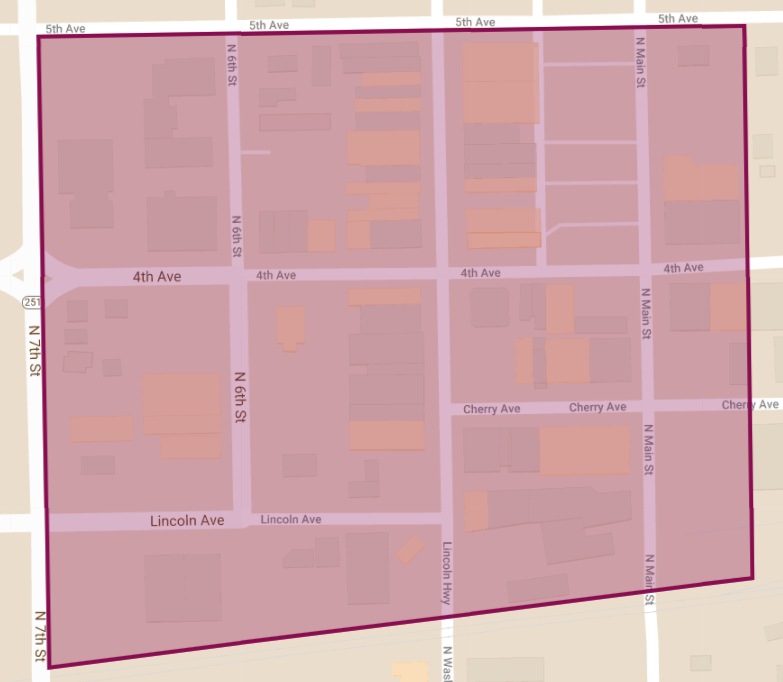
Sec. 110-417. - Downtown parking requirements.
(a)
Purpose. Downtown Rochelle is an area that historically has been occupied with older commercial and residential buildings on small lots. Such development, which occurred before the current level of automobile use in today's society, often means that parcels are not of an adequate size to accommodate the required number of off-street parking spaces. The relaxation in parking requirements is intended to encourage the preservation of older buildings, create a more pedestrian-friendly environment, and ensure robust economic activity for commercial establishments in the historic downtown area.
(b)
Downtown area. The downtown area is defined as: A tract of land situated in the City of Rochelle, County of Ogle, State of Illinois, said tract bounded as follows: Between the north side of the Chicago and Northwestern tracks on the south, the south side of Fifth Avenue on the north, the east side of North Seventh Street on the west, the alley between North Main Street and North Third Street on the east.
(c)
Standards.
(1)
Exemption from parking requirements. Residential and business land uses within the downtown are exempt from the minimum parking requirements of this section.
(2)
Inclusion of on-street parking. If a commercial land use has a gross floor area of 2,500 square feet or more, then the standards contained in (section 110-418, parking requirements for specific uses) shall apply. However, all on-street parking spaces within 150 feet, and any parking spaces within municipal parking lots within 300 feet, may be included in the calculation for the required number of off-street parking spaces. Such distances shall be measured from the customer entrance to the commercial use to the parking spaces.
(3)
Maximum off-street parking limits. Commercial establishments within the downtown shall not provide a number of off-street parking spaces that is greater than 100 percent of the parking requirement for that particular establishment's land use found in (section 110-418, parking requirements for specific uses).
(4)
Other parking arrangements. Shared parking (section 110-405, shared parking) and collective (section 110-406, collective parking) parking arrangements are permissible and encouraged.
(5)
Administrative adjustment. The zoning administrator may grant an administrative adjustment of parking requirements within the downtown area. In order to approve such an administrative adjustment, the zoning administrator must find:
a.
That, based on evidence provided by the property owner, parking demand for the property can be met with available on-street and off-street parking in the immediate vicinity; and
b.
Administrative adjustment of the parking requirements will have minimal adverse effects on other nearby land uses and surrounding neighborhoods; and
c.
Strict adherence to the parking requirements (section 110-418, parking requirements for specific uses) would cause undue hardship for the property owner.
(Ord. No. 21-5231, § 2, 4-12-2021)
Sec. 110-418. - Parking requirements for specific uses.
The following table of parking requirements for various uses shall be applied to all new developments. Allocation of said parking areas shall be indicated on the plans required for obtaining a building permit:
(Ord. No. 21-5231, § 2, 4-12-2021)
Sec. 110-419. - Administrative decisions and adjustments of parking standards.
(a)
Uses not listed. The zoning administrator shall make an administrative decision for parking requirements of uses not specifically listed. Such a decision shall be based on similar uses found either inside or outside the corporate limits of the city.
(b)
Administrative adjustments. Property owners may seek an adjustment of the minimum parking standards contained in this zoning ordinance. Requests for administrative adjustments (section 110-26, administrative adjustments) will be forwarded through the zoning administrator to the planning and zoning commission. In granting an administrative adjustment to the parking requirements, the planning and zoning commission shall produce findings of fact that state:
(1)
The property owner produced competent evidence that similar land uses with similar conditions (e.g., location near arterial road), either within or outside the corporate limits of the city, do not generate parking demand commensurate with the number of spaces specified in the schedule of off-street parking requirements.
(2)
That granting of an adjustment to the minimum parking requirements will not have significant adverse effects on nearby land uses and surrounding neighborhoods.
(Ord. No. 21-5231, § 2, 4-12-2021)
Sec. 110-420. - Loading and unloading.
In any commercial or industrial district and for all commercial, industrial and institutional uses, sufficient space for the loading and/or unloading of vehicles shall be provided on the lot in connection with any commercial or industrial use so that the public street shall at all times be free and unobstructed to the passage of vehicular and pedestrian traffic. Such loading and/or space shall be provided as follows:
(1)
Location of off-street loading facilities. All off-street loading facilities used to serve a building or land use constructed or established after the effective date of this zoning ordinance, or subsequently altered or enlarged, shall be located on the same lot as the building or land use served.
(2)
Central loading facilities. Central loading facilities may be substituted for off-street loading facilities on individual lots, provided that:
a.
Access. Each lot served shall have direct access to the central loading area without crossing a street or alley. Additionally, no lot served shall be more than 500 feet from the central loading facility.
b.
Required berths. The total number of off-street loading berths required shall be the sum total of berths required for all of the properties served by the central loading facility.
c.
Agreement. Whenever the required off-street loading facilities are collectively provided and used in a central loading facility, the parties concerned shall execute written covenants and easements assuring their retention, maintenance, and use for such purposes. Such covenants and easements shall be reviewed by the zoning administrator and city manager, and approved by the city attorney.
(3)
Yard requirements for off-street loading facilities. Off-street loading facilities located within the buildings they serve shall comply with the yard and setback requirements of the zoning district in which located. For unenclosed off-street loading facilities, the following provisions apply:
a.
The facilities shall not be located in any front yard or exterior side yard; and
b.
Loading facilities shall not be located within five feet of any property line.
(4)
Street access. All off-street loading facilities shall allow for appropriate vehicular access to a street or alley.
(5)
Off-street loading and off-street parking. Areas allocated for off-street loading shall not satisfy any portion of a requirement for off-street parking.
(6)
Schedule of loading requirements.
(Ord. No. 21-5231, § 2, 4-12-2021)

