
Rochelle City Zoning Code
ARTICLE VII
PLANNED UNIT DEVELOPMENTS
Sec. 110-250.- Purpose.
(a)
The development and execution of zoning regulations is based upon the division of the city into districts in which the use of land and buildings and the bulk and location of buildings and structures in relation to the land are substantially uniform. It is recognized by the city that new types, procedures, and relationships in land development are emerging and that the mixing of uses and variations in bulk regulations within districts can produce very satisfactory, desirable, and lasting results, if properly designed and planned, without adverse influence upon surrounding property. The following standards are established to provide flexibility to encourage sound and imaginative design, and to guard against the use of the planned unit development (PUD) technique solely as a means to intensify the use of land. A PUD is considered to be a subdivision of land.
(b)
A person, by choosing to develop property as a planned unit development, elects to submit a contemplated development proposal to a legislative and discretionary review by the planning and zoning commission and city council.
(Ord. No. 21-5231, § 2, 4-12-2021)
Sec. 110-251. - Objectives.
The PUD, as a subdivision of land, is intended to encourage improved design in the development of land by providing relief from traditional zoning requirements which may cause undue hardship or complication for desirable but unconventional development, and to establish standards and procedures for the issuance of a special use permit (section 110-31, special uses) for a PUD in order to achieve the following objectives:
(1)
To stimulate creative approaches to residential, commercial and industrial development of land.
(2)
To provide for more efficient use of land.
(3)
To preserve or enhance natural features and provide open space areas.
(Ord. No. 21-5231, § 2, 4-12-2021)
Sec. 110-252. - Modification of district regulations.
PUDs, as subdivisions of land, shall be constructed in each zoning district as a special use (section 110-31, special uses) subject to the standards and procedures set forth as follows:
(1)
The PUD designation is not intended to be attached to existing zoning districts as an overlay. The PUD designation as detailed in this article is a separate use district and may be attached to a parcel of land through the process of land subdivision (chapter 86) and zoning map amendments (section 110-30, amendments).
(2)
The ordinance approving the preliminary plat for the PUD may provide for such exceptions from the district regulations governing use, density, area, bulk, parking, signs, and the subdivision design standards as may be necessary or desirable to achieve the objectives of the proposed PUD, provided such exceptions are consistent with the standards and criteria contained in this article. No modifications of district requirements or subdivision design standards may be allowed when such proposed modification would result in:
a.
Inconvenient or unsafe access to the PUD.
b.
Traffic congestion in the streets which adjoin the PUD.
c.
An undue or disproportionate burden on public parks, recreational areas, fire and police protection, schools, and other public facilities which serve or are proposed to serve the PUD.
d.
A development which will be incompatible with the purpose of this chapter and the goals and objectives of the comprehensive plan.
e.
Alteration, destruction, or diminution of natural landscape features such as floodplains, wetlands, fens, woodlands, prairie, rock outcroppings, seeps, springs, or steep slopes.
f.
Alteration, destruction of archeological and historic features.
(3)
The planning and zoning commission may recommend to the city council and the city council may grant a special use permit (section 110-31, special uses) which modifies the applicable district zoning regulations and subdivision regulations upon a written finding by the planning and zoning commission that the PUD meets the applicable objectives and standards and criteria contained in this article. Such written finding shall set out the reasons supporting each finding and shall support each of the following standards and the applicable provisions of section 110-251, objectives; section 110-253, general standards and criteria for PUDs; and section 110-254, permitted uses and density.
(Ord. No. 21-5231, § 2, 4-12-2021)
Sec. 110-253. - General standards and criteria for PUDs.
No PUD shall be authorized by the city council unless the planning and zoning commission shall find evidence establishing that:
(1)
The proposed development will not injure or damage the use, value and enjoyment of surrounding property, nor hinder or prevent the development of surrounding property per the comprehensive plan.
(2)
The proposed development can be substantially completed within the estimated period of time specified in the schedule of development submitted by the applicant.
(3)
The entire tract or parcel of land to be occupied by the proposed development shall be held in a single ownership, or if there are two or more owners, the application for such proposed development shall be filed jointly by all such owners.
(4)
The PUD submissions shall contain such proposed covenants, easements, other provisions relating to the bulk and location of buildings, uses and structures and public facilities as are necessary for the welfare of the PUD and are consistent with the best interests of the city. Such covenants, easements, and other provisions, when part of the approved final development, may be modified, removed or released only with the consent of the city council after a planning and zoning commission public hearing and a recommendation by the planning and zoning commission as provided in this article.
(5)
Sanitary sewers, storm sewers and water supply to service the development are adequate to serve the proposed development and will not reduce existing capacity below that necessary to serve existing developments, or overload local facilities beyond design capacity.
(6)
The location and arrangement of structures, parking areas, walks, lighting, and appurtenant facilities are compatible with the surrounding land uses, and any part of a proposed development not used for structures, parking and loading areas, or accessways, is landscaped or otherwise improved.
(7)
The project area is adaptable to unified development and shall have within or through the area no physical features that will tend to destroy the neighborhood or character of the community. The minimum site size for any PUD shall be 20 acres, but within the B-1 central business district there is no minimum site size for a PUD.
(8)
The uses permitted in the development are necessary or desirable and the need for such uses is clearly demonstrated by the applicant.
(9)
The dominant land use of the proposed PUD is consistent with the recommendations of the comprehensive plan for the area containing the PUD.
(10)
Any modifications of the standards and specifications of this chapter or other regulations that would otherwise be applicable to the site are warranted by the design of the PUD, and the amenities incorporated in it, and are not inconsistent with the public general welfare.
(11)
Exceptional landscaping features such as larger caliper, varied species, and reduce spacing of trees and additional sodding above the minimum requirements as specified in article VIII, landscaping.
(12)
All proposed streets and driveways are adequate to serve the residents, occupants, visitors, or other anticipated traffic of the PUD. Entrance points or locations of streets and driveways upon previously existing public roadways shall be subject to the approval of the city, and if applicable, a county highway department, and the state department of transportation. If traffic control devices are required to prevent or relieve hazards or congestion on adjacent streets and the proposed control device is not within the normal or scheduled sequence of installations, the city council may require, as a condition of approval of a proposed PUD, such devices to be provided at the developer's cost. Any street improvement or construction whether in the PUD or adjacent to the PUD shall include improvements on both sides of the roadway.
(13)
Off-street parking (article X, off-street parking and loading) is conveniently accessible to all dwelling units and other uses in the PUD. Where appropriate, common driveways, parking areas, walks, and steps to parking and service areas are to be screened through ample use of trees, shrubs, hedges, land forms and walls.
(14)
An adequate pedestrian circulation network is provided.
(15)
The PUD provides for underground installation of utilities (including electricity and telecommunications) in public ways and the associated private extensions. Provisions shall be made for acceptable design and construction of storm sewer facilities including grading, gutter, piping, and treatment of turf to handle stormwater, prevent erosion, and the formation of dust. Utilities and maintenance of facilities shall be per the requirements and regulations of this Code.
(16)
The proposed PUD satisfies the applicable objectives as provided in section 110-251, objectives.
(17)
Existing ponds, creeks, rivers, lakes, wetlands, or fens on or adjacent to the PUD are enhanced and protected from development (section 110-547, shorelines and watercourses).
(Ord. No. 21-5231, § 2, 4-12-2021)
Sec. 110-254. - Permitted uses and density.
(a)
Land uses. The planning and zoning commission shall recommend, and city council shall authorize, that there be permitted in part of the area of a proposed PUD, and for the duration of such development, specified uses within the PUD. Proposed PUDs with a mix of land uses shall not be recommended or approved unless:
(1)
The proposed land uses are necessary or desirable and are appropriate with respect to the primary purpose of the PUD.
(2)
The proposed uses are not of such a nature or so located as to exercise a detrimental influence on the surrounding neighborhood.
(b)
Density. Proposed density within a PUD shall follow the following guidelines:
(1)
Consistency with comprehensive plan. The density of a PUD district shall be consistent with the intent of the comprehensive plan.
(2)
Residential density. The computation of density shall be based on dwelling units per net acre for the entire site. Net acreage is defined as the site area less all land allocated to street rights-of-way and preexisting wetlands and lakes, ponds, and waterways. In the case of private streets, the equivalent of public rights-of-way for these private streets shall be deducted from gross acreage. In the event that there is a question regarding the width and length of such equivalent rights-of-way, the city engineer or director of public works shall render a determination.
a.
Density bonus. Residential density within a PUD district may be increased by up to ten percent which shall be based on the following:
(3)
Commercial and industrial density. Commercial and industrial uses within a PUD may allow for increased density provided that the development plan must demonstrate compliance with four or more of the following performance criteria:
a.
Provide storm drainage detention/retention facilities having a capacity significantly and appreciably in excess of what is required and the ability to relieve current stormwater challenged areas of their excess stormwater.
b.
Install storm drainage detention facilities underground.
c.
Providing a release rate from a detention facility that is significantly and appreciably stricter than otherwise required.
d.
Increase parking lot landscaping by 50 percent more than otherwise required.
e.
Design of principal access to the development tract at an approved location that allows for shared access by an adjacent property.
f.
Provide for sufficiently screened loading and unloading areas that are located on side or rear yards.
g.
Provide for mixed-use developments that include community facilities that further the goals, objectives and policies of the comprehensive plan.
h.
Demonstration of a development using highly innovative architectural, site planning and land use design of a caliber not previously used in the area and of such quality as to set an excellent example for subsequent developments.
i.
Any other performance criteria that further the goals, objectives and policies of the comprehensive plan and that, in the opinion of the planning and zoning commission and city council, warrant the approval of a setback reduction.
(c)
Development phasing. If the sequence of construction of various portions of the development is to occur in stages, then the open space and recreational facilities shall be developed in reasonable proportion during any given stage of construction as approved on a final plat by the city council.
(Ord. No. 21-5231, § 2, 4-12-2021)
Sec. 110-255. - Signs.
Signage shall be in compliance with article IX, signs, of this chapter, unless the applicant for a PUD district designation elects to submit a comprehensive sign plan in addition to the submission of other required development plan documents. The planning and zoning commission may recommend, and the city council may approve, a comprehensive sign plan and such plan shall be made part of the ordinance approving the PUD district. That ordinance may contain conditions, requirements or standards regarding signs that may be stipulated by the city council. Comprehensive sign plans approved under this section shall be evaluated based upon the following criteria:
(1)
Placement. All signs shall be placed where they are sufficiently visible and readable for their function. Factors to be considered shall include the purpose of the sign, its location relative to traffic movement and access points, site features, structures and sign orientation relative to viewing distances and viewing angles.
(2)
Quantity. The number of signs that may be approved within any development shall be no greater than that required to provide project identification and entry signs, internal circulation and directional information to destinations and development subareas and business identification. Factors to be considered shall include the size of the development, the number of development subareas, and the division or integration of sign functions.
(3)
Size. All signs shall be no larger than necessary for visibility and readability. Factors to be considered in determining appropriate size shall include topography, volume of traffic, speed of traffic, visibility range, proximity to adjacent uses, amount of sign copy, placement of display (location and height), lettering style and the presence of distractive influences.
(4)
Materials. Sign materials shall be compatible with architectural and natural features of the site and proposed development. This may be accomplished through similarity of materials for sign structures and faces, the use of complementary colors, similarity of architectural style or the use of consistent lettering style and typography.
(5)
Comprehensive sign plan. A request for approval for a comprehensive sign plan shall accompany the request for PUD zoning classification and shall include, but is not limited to, the following:
a.
A site plan, depicting the proposed plan of development and illustration of proposed sign locations;
b.
Descriptions and drawings indicating size, qualities, materials and illumination; and
c.
A narrative description of the common theme for signage within the development, how it relates to architectural and landscaping elements of the development and how the comprehensive sign plan relates to each of the criteria set forth in this section.
(Ord. No. 21-5231, § 2, 4-12-2021)
Sec. 110-256. - Minimum site size.
The minimum site size for any PUD (except within the B-1 central business district) shall be 20 acres. This minimum site size may be waived by the city council upon recommendation by the planning and zoning commission if the parcel in question has certain unique characteristics such as, but not limited to, significant topographic change, significant trees or wooded areas, wetlands, floodplain areas, soil conditions, utility easements, or unusual shape or proportions; or, if it is determined that the use proposed is desirable or necessary in relationship to the surrounding neighborhood; or, if the city council should determine such waiver to be in the general public interest.
(Ord. No. 21-5231, § 2, 4-12-2021)
Sec. 110-257. - Common open space.
Common open space shall comprise at least 15 percent of the gross area of any PUD development that includes residential uses or be of a size equivalent to one acre for each 100 persons of expected population within the PUD development, whichever is more. For purposes of this section, the expected population shall be determined by multiplying the total number of dwelling units times the average citywide household size as provided in the most recent census. This common open space shall be used for recreational, park or environmental amenity purposes for the collective enjoyment by the occupants of the development; however, consideration will be given to having the required open space remaining on privately owned properties dedicated by easement to assure that the common open space will be permanent. In addition to these general open space requirements, the following regulates the use of this common open space in terms of physical surface characteristics, size, location and physical improvements therein.
(1)
Of the required common open space, no more than 50 percent of it may be covered by wetlands, stormwater management facilities, or left in a natural state.
(2)
The area of each parcel of open space shall not be less than 6,000 square feet in area nor less than 30 feet in its smallest dimension. Also, at least 50 percent of the common open space shall be contiguous or connected via pedestrian/bicycle paths.
(3)
Inasmuch as practical, common open spaces should be distributed equitably throughout the development in relation to the dwelling units in which such common open space is intended to serve. The open space must not be isolated in one corner of a development, but highly accessible (physically and visually) to the residents or employees within a development.
(4)
The use, operation, and maintenance of areas for common open space, common ground, and common buildings shall be guaranteed by the establishment of necessary open space covenants, such as a homeowners' association or similar entity, and further that the applicant shall agree to establish a special service area that, at the sole discretion of the city, can be activated to ensure that these areas are properly maintained.
(Ord. No. 21-5231, § 2, 4-12-2021)
Sec. 110-258. - Perimeter buffer requirements.
(a)
Where a PUD district containing residential development along the perimeter of the site that is higher in density than that of an adjacent residentially zoned property, there shall be a minimum 30-foot buffer area (section 110-314, buffer yards). The buffer area must be kept free of buildings or structures and must be landscaped or protected by natural features so that all higher-density residential is effectively screened from the view of the abutting lower-density residential property.
(b)
Where a PUD containing no residential uses abuts a residential district, there shall be a minimum 50-foot buffer area between any non-residential use and the adjacent residential district. This buffer area shall be landscaped (section 110-314, buffer yards).
(Ord. No. 21-5231, § 2, 4-12-2021)
Sec. 110-259. - Other development regulations.
Other development regulations for PUD districts are as follows:
(1)
The following parts of this chapter apply to development within a PUD district:
a.
Accessory uses (section 110-55, accessory buildings, structures, and uses of land).
b.
Screening requirements (sections 110-203, outdoor storage; section 110-301, general site development standards; section 110-302, site plan; article V, division 2, residential districts; and section 110-416, screening and landscaping of parking areas).
c.
Home occupations (section 110-536, home occupations).
d.
Antenna regulations (article XII, antennas and satellite dishes).
e.
Vision clearance triangle (section 110-58, vision clearance triangle).
f.
Off-street loading and parking (article XI, off-street parking and loading).
g.
Signs (article IX, signs) except as may be modified through a comprehensive sign plan.
h.
Traffic access and impact studies: these requirements are to be initiated by the city manager or his/her designee and will stipulate when a traffic access and impact study is required.
(2)
Utilities (chapter 98).
(3)
Streets (chapter 82).
(4)
Stormwater management regulations (chapter 22, article XIII).
(Ord. No. 21-5231, § 2, 4-12-2021)
Sec. 110-260. - Application procedures.
All PUDs shall be processed and reviewed in four steps leading to approval for recording and construction: 1) preapplication conference, 2) concept development plan, 3) preliminary plat, and 4) final plat. Prior to beginning the PUD review process, the applicant is encouraged to obtain a copy of this chapter and chapter 86, subdivisions, and application forms. Applications shall be made on forms supplied by the city.
PUD PROCEDURE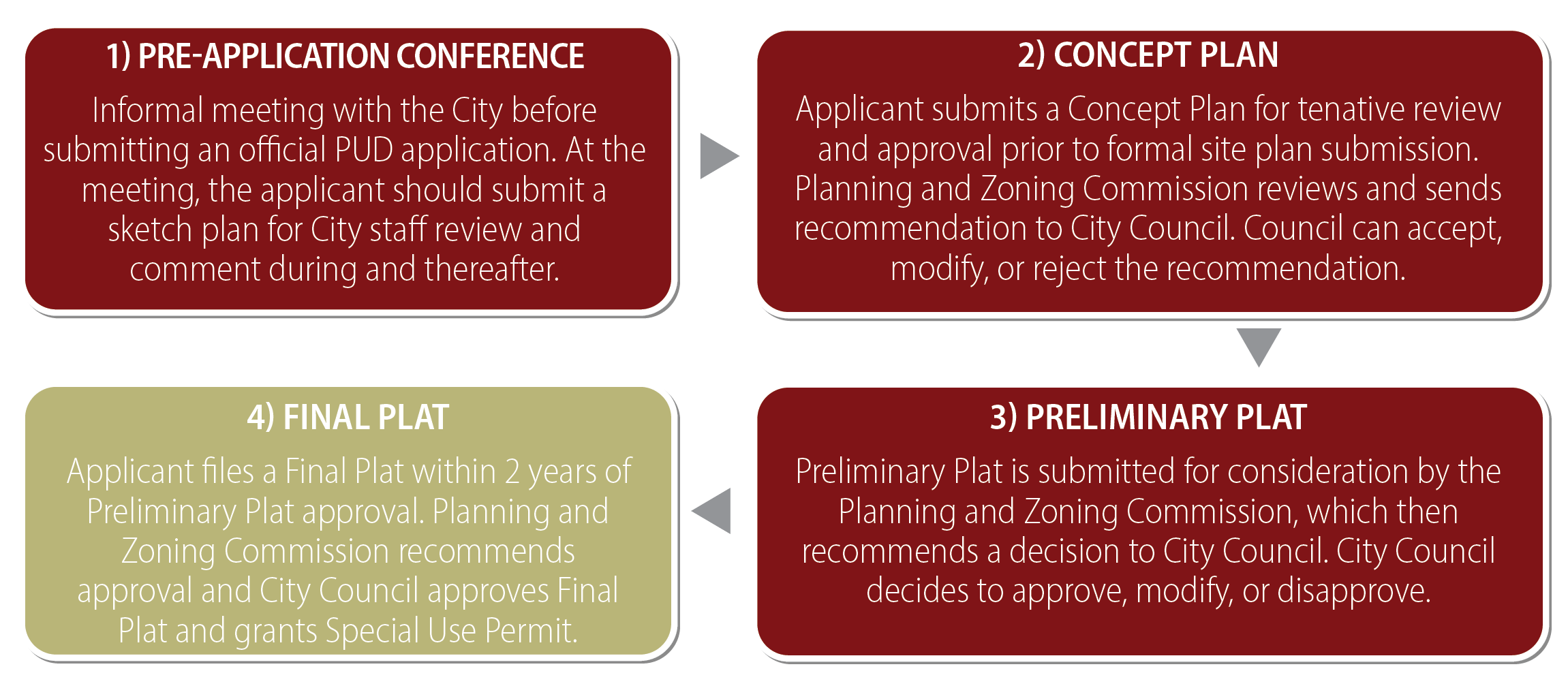
(1)
Preapplication conference. Before submitting an application for a PUD, the applicant shall schedule a meeting with the community development director to informally discuss with the city staff the proposed PUD and to obtain information and guidance before entering into binding commitments or incurring substantial expense. There is not a formal application for this conference or any associated fee. At the preapplication meeting, the applicant shall submit a site plan for review and comment by city staff. City staff shall review and evaluate the site plan and shall report to the applicant at the meeting or as soon as practicable thereafter, staff's opinion as to the merits and feasibility of the planned development and its improvements contemplated by the site plan. Staff shall also inform the applicant of the required standards, documentation submittals and procedures to follow should the applicant decide to submit a formal petition. The information that should be included with the site plan is as follows:
a.
Name of the PUD and a key map showing its location.
b.
Name, address, and telephone number of the owner, subdivider, engineer, and any other contact person.
c.
Acreage and current zoning classification of the PUD and the proposed number of lots.
d.
The location of the tract in relation to the surrounding area, including names of adjacent property owners.
e.
The approximate location of all existing land uses, structures, facilities, and wooded areas within the tract proposed to be retained or demolished and within 100 feet of the tract.
f.
Arrangement and dimensioning of all proposed lots, parks, and common areas.
g.
Proposed location and width of street right-of-way, street pavement, alleys, and their relationship to the existing adjacent street system.
h.
Proposed location of private access drives.
i.
Proposed location and size of sanitary sewers, storm sewers, water mains, detention areas, and their relationship to existing public utilities.
j.
A generalized drainage scheme.
k.
A north arrow and scale (recommended scale is one inch equals 100 feet).
l.
Building outlines (footprints) of all structures except single-family detached dwellings proposed on subdivided lots.
m.
Internal private circulation drives and parking areas.
n.
Conceptual landscaping plan, open space/common areas and buffer areas between the proposed development and adjacent properties.
o.
If the sketch plan covers only a part of the developer's contiguous land holdings, the developer shall submit a drawing showing the probable future street and drainage system of the remaining portions of the developer's land.
(2)
Concept plan.
a.
An applicant shall submit a concept plan per the provisions of this chapter to the city for tentative review and approval prior to incurring the expenses associated with formal site plan submission in order to discover whether the city will accept, or under what circumstances the city will accept, a PUD of the type proposed on the site. The following items shall be required:
1.
All of the information specified for the preapplication "sketch plan" meeting as modified by the discussion of that meeting.
2.
The character and approximate density of dwellings, if applicable.
3.
A written statement which shall contain a general explanation of the size and character of the PUD, including a statement of the present ownership of all the land within the PUD and anticipated schedule of construction.
b.
The planning and zoning commission shall review the concept plan within 45 days of its submission to the city and shall prepare a written report containing its recommendations to the city council and the applicant. Approval of the concept plan does not guarantee approval of the preliminary plat.
c.
The city council shall accept, modify, or reject the planning and zoning commission recommendation within 30 days following the date of action by the planning and zoning commission.
(3)
Preliminary plat.
a.
The preliminary plat shall contain all items required for a preliminary subdivision plat as enumerated in this chapter. The following additional items shall also be required:
1.
Net area of all parcels.
2.
Maximum number of dwelling units allowed per the existing zoning classification and the comprehensive plan.
3.
Number of dwelling units proposed.
4.
Number of off-street parking spaces required (section 110-418, parking requirements for specific uses) and proposed.
5.
The location, gross floor area of, and distance between building and structures. Floor area for nonresidential uses shall be identified by use type.
6.
The proposed location and general use of common ground, including recreational areas, plazas, pedestrian ways and major landscaped areas including buffer areas. Landscaping information shall include location and approximate size (at time of planting) of all plant material by type (such as deciduous/coniferous trees, ornamental trees, shrub masses and ground cover including grassed areas, ivies, etc.). Landscaping (section 110-416, screening and landscaping of parking areas) within parking areas shall be included.
7.
Quantification of site area by building coverage, parking, loading and driveways, and common open areas divided into usable open areas and areas to be dedicated to water detention, floodplain, and natural areas.
8.
The location and details of all retaining walls, fences and earth berms.
9.
The location of all refuse collection facilities including screening to be provided.
10.
Illustrative site cross sections (two minimum) indicating edge conditions and internal grade changes in relation to principal variations of building elevations and site lines to adjacent properties/structures.
11.
Typical building elevations of sufficient scale and detail to illustrate building mass, exterior construction materials and signage if applicable.
12.
Project report to include an explanation of the character of the proposed development, verification of the applicant's ownership or contractual interest in the subject site and proposed development schedule.
13.
An estimated development schedule indicating:
i.
The approximate date when construction of the project can be expected to begin;
ii.
The stages in which the project will be built and the date when construction of each stage can be expected to begin;
iii.
The date when the development of each of the stages will be completed; and
iv.
The area and locations of planned open space that will be provided at each stage.
14.
Proposed agreements, bylaws, provisions or covenants which govern the use, maintenance and continued protection of the PUD and any of its planned open space or other facilities.
15.
A list of all departures from the existing zoning district regulations and the subdivision design standards which will be required for the proposed PUD.
16.
A statement by the applicant demonstrating how the PUD conforms to the purpose and the standards and criteria of this section.
17.
A circulation diagram indicating the proposed movement of vehicles, goods and pedestrians within the development to and from existing city thoroughfares.
18.
A comprehensive drainage plan with analysis of the impact that the development creates on the site and on the surrounding area.
19.
The applicant may be required to provide, at the applicant's expense, additional clarification and further detail of the site plan as determined necessary by the community development director, city manager or the planning and zoning commission.
20.
In addition to meeting all of the preliminary plan submittal requirements in this section, the developer of each preliminary plan shall clearly show the location and general design of any collector and arterial streets, major stormwater drainage facilities, main utility lines and facilities, and other features deemed necessary by the city engineer, planning and zoning commission and city council on all of the contiguous property holdings of such developer, their agents, trustees, beneficiaries, or owners, whether or not said contiguous land holdings are intended for immediate development. The planning and zoning commission and city council shall take steps to assure that the developer is not omitting any contiguous holdings from the preliminary plan submittal and to prevent the circumvention of the purpose and intent of this section.
b.
The planning and zoning commission shall review the preliminary plat and shall recommend whether it is in substantial compliance with the concept plan and whether it complies with all other standards in this chapter which were not considered when the concept was approved.
c.
Upon completion of a staff review, the planning and zoning commission shall, within 60 days of the city receiving a preliminary plat for a PUD, hold a public hearing after due public notice, consider the preliminary plat, and recommend to the city council the approval, modification, or denial of the proposed PUD. If the recommendation is to disapprove, the report shall set forth the findings of fact related to the specific proposal and shall set forth particularly in what respects the proposal would or would not be in the public interest, including, but not limited to, findings of fact on the following:
1.
In what respects the proposed plan is not consistent with the stated purpose of the PUD regulations.
2.
The extent to which the proposed PUD departs from the zoning and subdivision regulations otherwise applicable to the subject property, including, but not limited to, the density, dimension, area, bulk, use and the reasons why such departures are or are not in the public interest.
3.
The extent to which the proposed PUD does not meets the requirements and standards set forth in this section.
4.
The physical design of the proposed PUD and the manner in which said design does not make adequate control over vehicular traffic, provide for and protect designated planned open space and schools, and further the amenities of light and air, recreation, and visual enjoyment.
5.
The PUD's lack of conformity with the recommendations of the comprehensive plan.
d.
Within 30 days of the planning and zoning commission recommendation, the city council shall approve, modify, or disapprove the preliminary plat.
e.
No plats shall be recorded and no building permits issued until a final plat has been approved by the city council.
f.
If the preliminary development plan is approved by the city council, it shall adopt an ordinance approving the preliminary plat, with conditions as specified and authorizing the preparation of the final plat. Simultaneously with the approval of the preliminary plat, the city council shall adopt an ordinance rezoning the property to the PUD district and said ordinance shall include all conditions imposed on the development plan.
g.
All conditions imposed as a part of any PUD shall run with the land and shall not lapse or be waived as a result of a subsequent change in tenancy or ownership of any or all of said area, provided, however, that nothing herein shall be construed to limit the right of the developer, his successors or assigns to sell property in said PUD, except for such conditions imposed upon said common open space areas.
h.
Approval of the preliminary plat by the city council does not constitute final approval of the PUD but is merely an authorization to proceed with the preparation of the final plat. Approval of the preliminary plat shall be valid for a period of two years from the date of city council approval. If an application for final plat approval for all or a geographic portion of the preliminary plat has not been filed within the two-year period, or if a developer has not requested and received approval of a one-year extension from the city council, then a resubmission of the preliminary plat shall be required if the applicant intends to pursue final plat approval. In no case shall a building permit be issued prior to final plat approval.
(4)
Final plat.
a.
Within two years following the approval of the preliminary plat, the applicant shall file with the city a final plat for the first phase of development, containing in final form the information required in the preliminary plan. The final plat shall also include all items required for a final subdivision plat and final engineering as enumerated in this chapter. In addition, the following items shall be required:
1.
A final land use plan, suitable for recording with the county recorder of deeds. The purpose of the final plat is to designate the land subdivided into lots as well as the division of other lands not so treated into planned open area and building areas, and to designate and limit the specific internal uses of each building or structures, as well as of the land in general.
2.
If subdivided lands are included in the PUD, a subdivision plat of all subdivided lands in the same form and meeting all the requirements of a subdivision plat.
3.
An accurate legal description of each separate unsubdivided use area, including planned open space.
4.
Designation of the location of all buildings to be constructed, and a designation of the uses for which each building is designated.
5.
Final agreements, bylaws, provisions or covenants which govern the use, maintenance and continued protection of the PUD and any of its planned open space or other facilities conveyed to a homeowners association or similar organization.
6.
Final development and construction schedule.
7.
Final architectural elevations for all structures and amenities, such as fences and walls, street furniture, and the like.
8.
The final landscape plan with specific location of all plant material, specifying size and species.
9.
A statement placed on the plat indicating that the operation and maintenance of designated common areas, common facilities, common buildings, and open spaces shall be under the control of a homeowners' association.
10.
An agreement with the city to establish a special service area (SSA) per state statutes (35 ILCS 200/27-35) to be activated should the city, in its sole discretion, determine that the common areas of the PUD, not conveyed to the city, are not being properly maintained.
b.
The final plat shall be approved as follows:
1.
The planning and zoning commission shall, within 45 days of the city receiving a final plat application, recommend approval if it is in substantial compliance with the preliminary plat. The planning and zoning commission shall certify to the city council that the final plat is in conformity with the previously filed preliminary plat and meets all the requirements for a final plat.
2.
If the planning and zoning commission finds that the final plat does not substantially conform to the preliminary plat or that it does not meet the requirements for a final plat, it shall so notify the applicant and the city council within seven days of such determination.
3.
The city council shall approve the final plat if it is in conformance with the preliminary plat and meets all the requirements for a final plat. It shall pass an appropriate ordinance granting the special use permit.
4.
Approval of a PUD does not constitute acceptance by the city of the offer of dedication of any streets, utilities, sidewalks, parks or other public facilities shown on the final plat. However, the city council may accept any such offer of dedication by resolution and may delay such acceptance until such time that the city engineer and director of public works determine that the public improvements have been completed in a satisfactory manner and accepted or approved by the appropriate authority.
(5)
Combined preliminary and final plat. The city may consider a combined application for preliminary and final plat approval. In such instance, the final plat shall include all the information required of a preliminary plat and a final plat.
(Ord. No. 21-5231, § 2, 4-12-2021)
Sec. 110-261. - Administration of PUDs.
(a)
Failure to begin development. If no substantial construction has begun or no use established in the PUD within the time stated in the approved final plat and construction schedule, the special use permit for the PUD shall lapse upon written notice to the applicant from the city manager or his/her designee and shall be of no further effect. The land use and development regulations applicable before the special use permit for PUD was approved shall then be in effect. In its discretion and for good cause, the city council may extend for a reasonable time, not to exceed one year, the period from the beginning of construction or the establishment of a use, provided such extension is granted during the original period.
(b)
Permits.
(1)
The community development director or his/her designee shall ensure the approval and issuance of permits for site or building construction (section 110-27, building permits) for that part of the development plan that has been approved in the area covered by the approved final plat for work in conformity with the approved final plat and with all other applicable ordinances and regulations.
(2)
A certificate of occupancy (section 110-28, certificates of occupancy) for any completed building or structure located in an area covered by the approved final plat shall be issued if the completed building or structure conforms to the requirements of the approved final plat and all other applicable regulations and ordinances of the city. The city reserves the right to deny approval of an occupancy permit for any building or structure shown on the final plat of any stage of the PUD if any planned open space or public facilities allocated to that stage of the development have not been conveyed by dedication, deed, or other means to the proper authorities.
(c)
Enforcement of development schedule.
(1)
The community development director or his/her designee shall ensure that periodic reviews of all permits issued for the PUD are conducted, all construction that has taken place on the PUD site has been examined, and actual development compared to the approved development schedule.
(2)
If the community development director or his/her designee shall find that the owners of the property in the PUD area have failed to meet the approved development schedule, or that the rate of construction of dwelling units is greater than the rate at which planned open space and public and recreational facilities have been constructed and provided, he shall notify the planning and zoning commission and city council.
(3)
Within 30 days of such notice, the city council shall either revoke the special use permit (section 110-31, special uses), and the land shall revert to its former zoning classification, or, for good cause shown by the landowner, the limits of the development schedule shall be extended for a reasonable period of time.
(d)
Procedure for amending final plat. No changes may be made to the approved final plat during the construction of the PUD except upon the application to the appropriate agency under the following procedures:
(1)
Minor changes. Minor changes in the location, siting and height of buildings and structures may be authorized by the community development director or his/her designee without additional public hearings (section 100-32, public hearings) if required by engineering or other circumstances not foreseen at the time the final plan was approved. No change authorized by this subsection may cause any of the following:
a.
A change in the use or character of the development.
b.
An increase in overall coverage of structures.
c.
An increase in the intensity of use.
d.
An increase in the problems of traffic circulation and public utilities.
e.
A reduction in approved open space.
f.
A reduction of off-street parking and loading space.
g.
A reduction in required pavement widths.
(2)
Other changes. All other changes in use, or rearrangement of lots, blocks and building tracts, or any changes in the provision of common open spaces and changes other than listed above, must be approved by the city council after report of the city staff and recommendation by the planning and zoning commission. Such amendments may be made only if they are shown to be required by changes in conditions that have occurred since the final plan was approved or by changes in city policy. Any changes to the approved final plat must be recorded as amendments per the procedures and requirements of section 110-30, amendments, of this chapter. Additionally, the city council shall require the applicant to refile his application subject to the requirements of this section as if it were an entirely new application.
(3)
Recording of changes. Any changes approved shall be recorded as amendments to the recorded copy of the final plat.
(e)
Post completion regulations.
(1)
Upon completion of the PUD, and as a condition of the city's acceptance of the final public improvements, the community development director or his/her designee shall certify that the PUD has been completed per the approved final plat.
(2)
After the community development director or his/her designee's certification has been issued, the uses of land and construction, modification or alteration of any buildings or structures within the PUD shall be governed by any other provision of this chapter.
(3)
After said certification has been issued, no changes may be made in the approved final plat except upon application to the city under the procedures for seeking changes or amendments (section 110-30, amendments), special uses (section 110-31, special uses), and variations (section 110-29, variances) with respect to this Code.
(Ord. No. 21-5231, § 2, 4-12-2021)
Sec. 110-262. - Previously approved PUDs.
PUDs which have been authorized by special or special use permit procedures of the city's former zoning ordinance prior to the enactment date of the ordinance from which this chapter is derived are still considered PUDs and all approved characteristics of such developments, such as lot sizes and configurations, setbacks, easements, dimensional characteristics, roads, utilities and other improvements, are made a part of the PUD district zoning classification as herein defined, whether conforming or legal nonconforming in character.
(Ord. No. 21-5231, § 2, 4-12-2021)

