
Rochelle City Zoning Code
ARTICLE III
GENERAL PROVISIONS
Sec. 110-50.- Use restrictions.
The following use restrictions and regulations shall apply:
(1)
Principal uses. Only those principal uses specified for a district (section 110-160, district use classification list) or on a planned unit development (PUD) plat (article VII, planned developments), their essential services, and those uses specified in this section, shall be permitted in that district.
(2)
Accessory uses and structures. Accessory uses and structures are permitted in any zoning district (section 110-55, accessory buildings, structures, and uses of land), but not until their principal structure is present and/or under construction.
(3)
Uses by special permit (special uses). Special uses and their accessory uses are permitted in zoning districts after review by the planning and zoning commission, according to the procedure set forth in (section 110-31, special uses). Any development within 500 feet of the existing or proposed rights-of-way of freeways, tollways, expressways, interstate and controlled access trafficways, or located along the intersecting streets and within 1,500 feet of the existing or proposed interchange or turning right-of-way, as measured along the center line of the intersecting street, shall be deemed to be a use by a special use permit, provided, however, that the aforesaid requirement shall not apply to any development within an I-3 zoning district.
(4)
Unclassified or unspecified uses. In case of uncertainty where the zoning administrator is unable to determine literally whether a use is permitted as a principal or accessory use, he/she shall consult the planning and zoning commission for an interpretation.
(5)
Temporary uses. Temporary uses, such as real estate field offices or shelters for materials and equipment being used in the construction of a permanent structure, may be permitted by the zoning administrator through the issuance of a certificate of occupancy (section 110-28, certificates of occupancy) for a period not to exceed six months. This temporary certificate may be renewed semiannually but in no case shall the effective period of the certificate exceed two years.
(6)
Performance standards. Performance standards listed in article VI, performance standards, of the zoning ordinance shall apply to all uses in all zoning districts unless specifically waived by the city council after consulting with the planning and zoning commission.
(Ord. No. 21-5231, § 2, 4-12-2021)
Sec. 110-51. - Site restrictions.
The following site restrictions and regulations shall apply:
(1)
Soil conditions.
a.
No land shall be used, or structure erected, where the land is held unsuitable for such use or structure by the planning and zoning commission by reason of flooding, concentrated runoff, inadequate drainage, adverse soil or rock formation, low percolation rate or bearing strength, high erosion potential, or any other feature likely to be harmful to the health, safety, prosperity, aesthetic and general welfare of the city. The planning and zoning commission may request expert advice from state and/or federal agencies, or other sources regarding the interpretation of soil conditions and data. The planning and zoning commission, in applying the provisions of this section, shall, in writing, recite the particular facts upon which it bases its conclusion that the land is not suitable for certain uses. The applicant shall have an opportunity to present evidence contesting such unsuitability, if he so desires.
b.
Thereafter, the planning and zoning commission may affirm, modify, or withdraw its determination of unsuitability.
(2)
Frontage on public thoroughfare. All lots shall abut upon a public thoroughfare.
(3)
Lots on undedicated portion of a street. No land use permit shall be issued for a lot that abuts a public street dedicated to only a portion of its proposed width and located on that side thereof from which the required dedication has not been secured.
(4)
Occupancy of basement or cellar. Basements and cellars may be occupied for residential purposes only as a related use to residential living on other stories of the same building, such as, but not limited to, bilevel residences. Such occupancy shall be permitted only if the cellar or basement conforms to the regulations pertaining to light, ventilation, area, height, fire restrictions, egress, etc., of the city's building code.
(5)
Dimensions of building sites. In no case shall the lot size be less than those specified as minimum requirements in article V, districts. However, the planning and zoning commission may require lots larger than the said minimum where site and/or soil conditions would require. All uses not served by public sewers shall also conform to other applicable state and city regulations. Septic tanks and other similar systems shall not be deemed as public sewer systems.
(6)
Reduction or joint use. No lot, yard, parking area or other space shall be reduced in area or dimension so as to no longer meet the requirements of the zoning ordinance. No part of any lot, yard, parking area or other space required for a structure or use shall be used for any other structure or use.
(7)
Utility easements. No structures, fences, trees, or shrubs shall be placed within established utility easements. The city shall not be liable for damages to property within said easements, where such damage results from required maintenance, installation or replacement of utilities.
(Ord. No. 21-5231, § 2, 4-12-2021)
Sec. 110-52. - General development procedure.
The planning and zoning commission and the city council shall continuously develop the city's comprehensive plan, including their planning policies to guide future decision. All comprehensive plan elements, in whatever degree of detail they may embody, shall provide the basis for approval of all development under this chapter, and no development shall be approved under this chapter which substantially conflicts with any comprehensive plan elements.
(Ord. No. 21-5231, § 2, 4-12-2021)
Sec. 110-53. - Permitted obstructions in required yards.
"Permitted obstructions in required yards" lists the items that are permitted in required yards and the locations (front yard, side yard, etc.) where they are permitted. A "P" denotes that the obstruction is permitted, and an "X" denotes that the obstruction is not permitted.
(Ord. No. 21-5231, § 2, 4-12-2021)
Sec. 110-54. - Building height and yards.
(a)
Height limits. Height limits shall be as set forth under each zoning district for all buildings, structures and uses of land. Exceptions to height limits include:
(1)
Architectural projections such as chimneys, ornamental towers, scenery lofts, monuments, cupolas, domes, spires, steeples, parapet walls, and similar structures shall count towards the height of a building or structure.
(2)
Essential services, utilities, water towers, electric power and communication transmission lines and necessary mechanical appurtenances, are exempt from the height limitations of this chapter.
(3)
Public or semipublic facilities, such as schools, churches, hospitals, monuments, sanitariums, libraries, governmental offices and stations, may be erected to a height of 60 feet; provided that all required yards are increased not less than one foot for each foot the structure exceeds the district's maximum height requirement.
(4)
Freestanding transmitting towers and freestanding radio towers in residential districts may extend to a height of 60 feet, as measured from the mean elevation of the finished lot grade; and
(5)
Transmitting towers and radio towers employing guide wires shall be permitted only as a special use (section 110-455, special uses).
(b)
Yards. The yard requirements stipulated elsewhere in this chapter may be modified as follows:
(1)
Yard requirements shall be minimum standards unless and where the city building code (chapter 22) imposes greater restrictions, then the requirements of the building code shall apply.
(2)
Where adjacent structures have front yard setbacks different from those required, the minimum front yard setback shall be the average setback of such structures, but in no case shall the front yard setback be less than 20 feet.
(3)
Where a business or industrial use in any business or industrial district other than B-1 abuts a residential district the minimum yard requirement of a yard abutting a residence district shall be 50 feet.
(4)
Buildings in districts other than the B-1 district, and over 2.5 stories in height, shall require five feet for each additional story in addition to the required minimum side yard.
(5)
In I-3 zoning districts, minimum front yard, rear yard, side interior yard, and corner yard requirements are not applicable where rail track facilities extend along the lot line of the property. In addition, notwithstanding anything contained herein to the contrary, signs and fences as well as the following facilities entering or leaving property in I-3 zoning district: rail racks, driveways, sidewalks, landscaping, utilities, overhead transmission lines and appurtenant facilities, and distribution lines, are specifically permitted within aforesaid yards for the purpose of entering or leaving property zoned I-3.
(6)
Uncovered stairs, porches, patios, balconies, landings and fire escapes may project into any yard, but not to exceed six feet and not closer than three feet to any lot line.
(7)
Architectural projections, such as chimneys, flues, sills, eaves, belt courses, and ornaments may project into any required yard; but such projection shall not exceed four feet, subject to the limitation that in no event shall the projection ever be closer than three feet from the applicable lot line.
(8)
Landscaping and vegetation are exempt from the yard requirements of this chapter, except vision triangle requirements (section 110-58, vision clearance triangle).
(Ord. No. 21-5231, § 2, 4-12-2021)
Sec. 110-55. - Accessory buildings, structures, and uses of land.
(a)
Location. Accessory buildings, structures may be attached or detached from the principal building, structure. Accessory uses may be within an accessory building or within the principal building. Detached accessory buildings, structures or uses may be located in the required rear yard or interior side yard of any zoning district as follows:
(1)
If located outside the (B-1 district), detached accessory buildings or structures shall not be placed within five feet of any rear or interior side lot line, or within ten feet from any alley line and any separate building/structure on the same lot, and shall not be located within an easement.
(2)
If located within the (B-1 district), detached accessory buildings shall not be placed within three feet of any rear or interior side lot line, and shall not be located within an easement.
(3)
Detached residential garages shall have a minimum yard setback of five feet from any property line, or ten feet from any alley line and any separate building/structure on the same lot. Detached residential garages may be rebuilt subject to section 110-83, additional regulations, standards and criteria.
(b)
Yard requirements. All accessory buildings, structures or uses shall comply with the front and corner side yard requirements of the zoning district in which they are located. Accessory buildings, structures or uses attached to or established within the principal building or structure shall comply with the rear yard and interior side yard requirements, and the maximum lot coverage requirements of the zoning district in which they are located. Detached accessory buildings, structures or uses may be located in the required rear yard or interior side yard in accordance with paragraph (a) of this section.
(c)
Height limits. All accessory buildings, structures or uses shall comply with the height limits of the zoning district in which they are located. In residential districts, detached garages shall not exceed 20 feet in height and storage sheds shall not exceed 12 feet in height.
(d)
Bulk regulations. All accessory buildings or structures shall be included in the computations for floor area ratio, maximum lot coverage, and maximum impervious surface coverage. The minimum floor area per dwelling unit shall not include accessory buildings, structures or uses.
(e)
Percentage of required yard occupied. Detached accessory buildings or structures shall not occupy more than 40 percent of the area of a required rear yard or more than 33 percent of all other combined yards. This requirement is in addition to any maximum lot coverage or maximum impervious area coverage requirements that may apply, and under no circumstances shall this requirement lower the minimum established yard setback requirements.
(f)
Time of construction. No accessory building, structure or use shall be constructed or established prior to the principal building, structure, or use on the lot.
(g)
Existing accessory structures. Accessory structures lawfully existing or permitted on or before the adoption of this zoning ordinance shall be regulated by article IV, nonconforming lots, structures, and uses, on nonconformities.
(Ord. No. 21-5231, § 2, 4-12-2021)
Sec. 110-56. - Buildings under construction.
Nothing in this chapter shall be deemed to require any change in the plans, construction or designated use of any building upon which actual construction was lawfully begun prior to the adoption of this zoning ordinance, and upon which building actual construction was diligently carried on; provided that such building was completed within one year from the date of passage and publication of this zoning ordinance.
(Ord. No. 21-5231, § 2, 4-12-2021)
Sec. 110-57. - Building moving.
(a)
No building or structure shall be moved in whole or in part to any other location on the same or any other lot unless every portion of such building or structure which is moved, and the use thereof, is made to conform to all of the laws and regulations of the city, including, but not limited to, the zoning ordinance, building code (chapter 22), fire code (chapter 42), mechanical code (chapter 22, article VI) and housing code (chapter 22, article V), including obtaining of the necessary permits.
(b)
No building or structure shall be moved as provided in this chapter without the approval of the planning and zoning commission given after public hearing and without the approval of the city council, with the exception of a garage or other accessory building which may be moved upon the lot upon which it is located, or an adjacent lot or lots under the same ownership.
(c)
No building or structure shall be moved as provided in this chapter unless bond is given in sufficient amount, as determined by the city council, to ensure that any repairs or other improvements required to be made under this chapter, or under any other applicable law or ordinance, be made within one year from the date such building or structure is moved.
(Ord. No. 21-5231, § 2, 4-12-2021)
Sec. 110-58. - Vision clearance triangle.
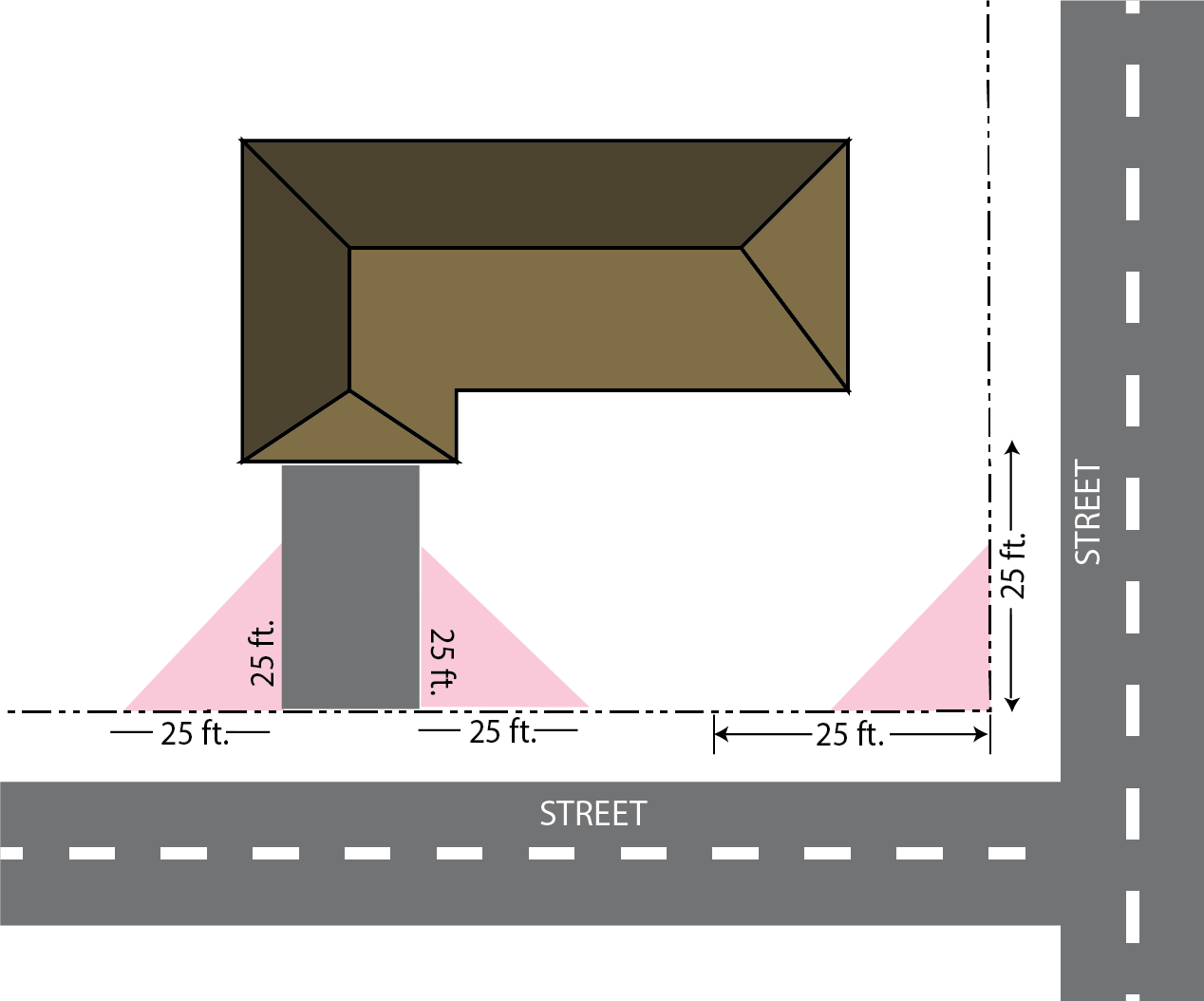
In each quadrant of every intersection of any arterial street shown on the city's comprehensive plan or master plan and any other streets not located in the B-1 central business district with a private or public driveway or accessway or alley providing egress for parking area of 1,000 square feet or more, there shall be designed a vision clearance triangle, bounded by the inner street lines (right-of-way), or the street line and driveway lines, as the case may be, and a line connecting them 25 feet from their intersection. Within this triangle no object shall be allowed above the height of 2.5 feet above the streets and/or driveways if it obstructs the view across the triangle. This provision shall not apply to tree trunks, posts or wire fences.
(Ord. No. 21-5231, § 2, 4-12-2021)
Sec. 110-59. - Zoning of annexed land.
Unless otherwise provided for in an annexation agreement, all land annexed into the city shall automatically be classified in the AG agriculture district. When land is automatically classified in the AG agriculture district, the annexation ordinance, upon passage, shall be referred to the planning and zoning commission, and the planning and zoning commission shall, within 60 days after the effective date of the annexation ordinance, schedule and hold a public hearing with respect to the zoning classification of the proposed annexed land. The conduct and notice of the public hearing shall be in accordance with the provisions of section 110-32, public hearings, of the zoning ordinance. The planning and zoning commission shall make findings of fact and recommendations with respect to the appropriate zoning classifications of the annexed land and the city comprehensive plan according to the process for a zoning map amendment established in section 110-30, amendments, and transmit the findings to the city council.
(Ord. No. 21-5231, § 2, 4-12-2021)
Sec. 110-60. - Interpretation by the zoning administrator.
(a)
Authority. Where there is ambiguity or dispute concerning the interpretation of this zoning ordinance, the decision of the zoning administrator shall prevail. Where a land use is not listed among the names and categories contained in the list of permitted uses and special uses (section 110-160, district use classification list), the zoning administrator may determine that such a land use is allowable in a particular zoning district, provided that the unlisted use is deemed to be similar in nature and clearly compatible with the listed permitted uses for that particular zoning district.
(b)
Appeal. Interpretations of the zoning administrator are subject to appeal in accordance with the provisions of section 110-33, appeals, of this zoning ordinance.
(Ord. No. 21-5231, § 2, 4-12-2021)

