
Rochelle City Zoning Code
ARTICLE IX
SIGNS
Sec. 110-350.- Purpose and goals.
(a)
Purposes. The purposes of these sign regulations include the following: to encourage the effective use of signs as a means of communication; to maintain and enhance the aesthetic environment and the city's ability to attract sources of economic development; to encourage signs that are compatible with their surroundings; to minimize the possible adverse effect of signs on nearby public and private property; to improve pedestrian and traffic safety; and to enable the fair and consistent enforcement of these restrictions:
(1)
Promote the health, safety, and general welfare of the city from signs that are unsafe, or interfere with drivers, bicyclists, or pedestrians.
(2)
Enhance the appearance and economic value of the city by avoiding sign clutter that can compromise the character, quality, and viability of commercial corridors.
(3)
Are compatible with surroundings and not a nuisance to occupants of adjacent and contiguous property due to brightness, reflectivity, bulk, or height;
(4)
Assist in wayfinding.
(5)
Are aesthetically pleasing, of appropriate scale, and integrated with the built environment, in order to meet the objectives related to the quality and character of development set forth in the city comprehensive plan.
(b)
Goals. The standards, procedures, exemptions, and other requirements of this article are intended to establish a permit system to allow a variety of types of signs in commercial and industrial zones, and a limited variety of signs in all other zones; to allow certain signs that are small, unobtrusive, and incidental to the principal use of the respective lots on which they are located, subject to the substantive requirements of this article, but without permits; to provide for temporary signs in limited circumstances; to prohibit all signs not expressly permitted or provided for by this article; and to provide for the enforcement of the provisions of this article.
(Ord. No. 21-5231, § 2, 4-12-2021)
Sec. 110-351. - Permits required.
(a)
It is unlawful for any person to erect, structurally repair, alter or relocate within the city any sign as defined in this chapter without first obtaining a sign permit from the building official and making payment of the appropriate fee. All illuminated signs shall, in addition, be subject to all the applicable electrical codes of the city. The routine maintenance or changing of parts is permissible, provided that such change does not alter the surface area, height, or otherwise make the sign nonconforming.
(b)
Upon receipt of a sign permit, the city may evaluate whether the existing signage and sign components are conforming to past permits issued or existing code, and if not, that the non-conforming or illegal signs (article IV, nonconforming buildings, structures, and lots) shall be removed prior to issuance of the new permit.
(c)
Any permit issued shall become invalid if the authorized work is suspended or abandoned for a period of six months after the time of commencing the work.
(d)
Upon the termination or revocation of the permits, the permittee shall remove the sign and supports without cost or expense of any kind to the city; provided that, in the event of failure, neglect or refusal on the part of the permittee to do so, the city, in addition to other remedies provided in this article, may proceed to remove the sign and charge expenses to the permittee.
(e)
In order for a permit to be issued to a tenant occupying the property of another, a written statement from the landowner permitting the installation of a sign on the property must be received by the zoning administrator.
(f)
All construction, relocation, enlargement, alteration, and modification of signs within the city shall conform to the requirements of this article, as well as all state and federal regulations concerning signs and advertising.
(Ord. No. 21-5231, § 2, 4-12-2021)
Sec. 110-352. - Sign measurement standard.
The following standards shall control the measurement of sign area and sign height.
(1)
Gross sign area.
a.
Gross sign area is calculated as the area within a continuous perimeter of four sides that encloses the limits of text and graphics of a sign, together with any frame or other material or color forming an integral part of the display or used to differentiate the sign's message from the background against which it is placed.
b.
Gross sign area excludes the structure upon which the sign is placed (unless the structure is an integral part of the display or used to differentiate it), but includes any open space contained within the outer limits of the display face of a sign, or between any component, panel, strip, or figure of any kind composing the display face, whether this open space is enclosed by a frame or border or not.
c.
For double-faced signs, both display faces shall be counted towards the area of the sign.
(2)
Sign face.
a.
Wall signs. A two-dimensional area on the facade of a building that describes the largest square, rectangle, or parallelogram which is free of architectural details.
b.
Window signs. The area of glass within a window frame.
c.
Other signs. The area of the face of the sign which is designed to be used for text and graphics (the signable area does not include the sign's supporting frame or structure, if any, provided that such frame or structure is not designed to display text or graphics).
d.
Signable area ratio. Signable area ratio is the sign area divided by the signable area. It is expressed as a percentage.
e.
Relationship between maximum sign area and maximum signable area ratio. Where both a maximum sign area and a maximum signable area ratio are set out, the standard that results in a polygon that encloses all of the text and graphics and framing that differentiates them from the wall.
f.
Measurement of height for freestanding signs. The vertical distance to the top of the sign face or sign structure, whichever is higher, measured from the elevation of the average grade around the base of the sign.
(Ord. No. 21-5231, § 2, 4-12-2021)
Sec. 110-353. - Replacement of signs or sign structures.
If existing conforming signs, or their structures, are damaged by an act of nature or vandalism, or only the flex panels are being replaced with identical panels, a permit is not necessary for replacement, so long as the size and style are not changed from the originals.
(Ord. No. 21-5231, § 2, 4-12-2021)
Sec. 110-354. - Temporary signs.
(a)
Permit required. Except as otherwise provided in this section, prior to any temporary sign being displayed or installed, the property owner must apply for and receive a permit from the community development director, or his designee, and provide the name of the sign's owner, the address of the sign's owner, a description of the sign, and the location of where the sign is to be installed.
(b)
Signs that do not require a permit. The following signs are allowable in all zoning districts and do not require a sign permit but may require a building permit or other related permit (if subject to building or electrical codes). Temporary signs that do not require permits shall still otherwise comply with the standards of the zoning ordinance:
(1)
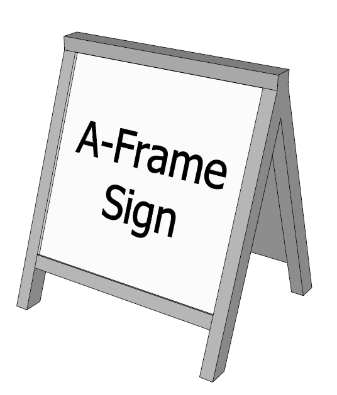
A-frame signs.
(2)
Bumper stickers. Bumper stickers on vehicles.
(3)
Carried signs. Signs that are being carried by people (however, such signs are not exempt if they are set down or propped on objects).
(4)
Interior signs. Signs intended to provide information for interior use of a property and that are not visible from abutting property or public rights-of-way.
(5)
Official and legal notice. Official and legal notice signs that are issued by any court, public body, person, or officer in performance of a public duty, or in giving any legal notice.
(6)
Signs with de minimus area. Signs that are affixed to a building or structure (even if wall signs are not permitted in the district or for the use), which do not exceed one square foot in sign area, provided that only one such sign is present on each elevation that is visible from public rights-of-way or neighboring property; and signs that are less than three-fourths of a square foot in area that are affixed to machines, equipment, fences, gates, walls, gasoline pumps, public telephones, or utility cabinets. Such signs shall not be included in the total sign area permitted on a zoning lot.
(7)
Traffic control signs. Traffic control signs and other signs related to public safety that the city or another jurisdiction installs or requires a developer to install.
(8)
Window displays. Merchandise, fixtures or models of products incorporated into a window display.
(c)
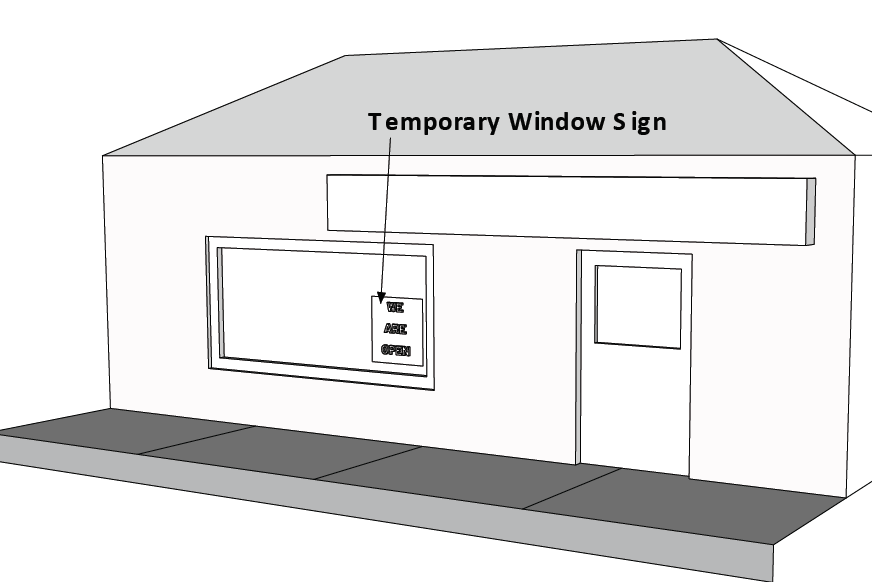
Time limitations. A permitted temporary sign, except as provided in subsections (e) and (f) of this section, shall be limited to being displayed no more than a combined total of 60 days per calendar year per temporary sign design. When the same temporary sign design is displayed on multiple signs on the property, each temporary sign shall count towards the total maximum allowed time for that sign design, so that two temporary signs of the same design displayed on one day would count for two days towards the total maximum 60 days for that specific design.
(d)
Seasonal banners, pennants, and display board. Property owners are limited to one seasonal banner, pennant, or display board per 200 feet of linear road frontage of the subject property. One additional seasonal banner, pennant, or display board is allowed for a subject property that supports more than one business. The maximum size of a seasonal banner, pennant, or display board is 32 square feet per side. Lots fronting on two or more streets are allowed the permitted signage for each street frontage; provided, however, that signage for each street front must be within the restrictions set forth in this section.
(e)
Inflatable signs, portable signs, and oversized temporary signs. Inflatable signs, portable signs, or other temporary signs that are larger than 32 square feet may be allowed so long as the zoning administrator finds them to be of a reasonable size and their display is otherwise consistent with the guidelines of this section.
(f)
Community event and special group event signs. Community event signs and special group event signs shall contain the date(s) of such event on the sign, and can be placed up to one week before the event and must be removed within three days after the event has concluded. No such sign shall exceed 32 square feet per side. No permit is required.
(g)
Construction signs. A permit is not necessary for temporary signs posted on property where construction will be taking place. A height of six feet shall be allowed, as measured from the ground to the center of the sign. Signs are allowed 32 square feet per side of sign and must meet all setback requirements as allowed by this Code. Temporary signs shall remain on the property for no longer than six months.
(Ord. No. 21-5231, § 2, 4-12-2021)
Sec. 110-355. - Nonconforming signs.
Existing nonconforming signs may remain, subject to the provisions of this article, if, following any inspection, they are ruled safe and in good repair. They shall not be enlarged, altered, moved or structurally repaired, nor shall any such sign or any part thereof that is blown down, destroyed to greater than 50 percent of its current value, or removed, be re-erected, reconstructed, structurally repaired or relocated unless it is made to comply with all applicable ordinances of the city. Nonconforming unlighted roof signs in existence on May 1, 2021, may be altered by a change in copy only. This section shall not apply to portable signs.
(Ord. No. 21-5231, § 2, 4-12-2021)
Sec. 110-356. - Unsafe and unlawful signs.
When any sign is in danger of falling, or otherwise unsafe, or if any sign becomes unlawfully installed, erected or maintained in violation of any of the ordinances of the city, the owner thereof or the person maintaining the sign shall upon written notice of the zoning administrator, within not more than ten days, make such sign conform to the ordinances of the city or remove it. If, following the ten days after notice, the order is not complied with, the zoning administrator shall notify the city attorney for action as prescribed by this article. In case of immediate danger, the zoning administrator shall take immediate action to prevent damage or injury. All costs incurred shall be paid by the owner of the premises.
(Ord. No. 21-5231, § 2, 4-12-2021)
Sec. 110-357. - Permit fee.
Every applicant, before being granted a permit hereunder, shall pay a fee as shall be established and modified from time to time by city council resolution, to the city for each sign regulated by this article. However, no fee shall be required for an alteration which consists solely of a change of copy and does not otherwise violate any provision of this article.
(Ord. No. 21-5231, § 2, 4-12-2021)
Sec. 110-358. - Denial of permit.
If an application for a sign permit is denied by the building official, notice of the denial shall be given to the applicant, together with the reason for the denial. Appeal of said denial shall be made to the planning and zoning commission. Such appeal shall be made by filing a petition requesting a hearing. Said request for a hearing shall be made in writing to the building official and accompanied with a nonrefundable fee of $75.00. The building official may suspend or revoke an issued permit for any false statement or misrepresentation of fact in the application.
(Ord. No. 21-5231, § 2, 4-12-2021)
Sec. 110-359. - Inspection.
Any person installing, altering or relocating a sign for which a permit has been issued shall notify the building official prior to construction, and upon completion of the work. A pre-construction site inspection is required to approve the location of a sign. Such pre-construction inspection requires the property line to be clearly represented with a string line, and the sign location and size must be clearly identified. The building official may also require a final inspection, including an electrical inspection and inspection of footings on freestanding signs.
(Ord. No. 21-5231, § 2, 4-12-2021)
Sec. 110-360. - Revocation of permit.
All rights and privileges acquired under this article, or any amendment thereto, are mere licenses revocable at any time by the enforcement official upon failure of the holder thereof to comply with the provisions of this article.
(Ord. No. 21-5231, § 2, 4-12-2021)
Sec. 110-361. - Removal of certain signs.
(a)
Any sign now or hereafter existing which no longer advertises a bona fide business conducted or product sold shall be taken down and removed by the owner, agent or person having the beneficial use of the building or structure upon which such sign may be found within 20 days after written notification by the building official. Upon failure to comply with such notice within the time specified in such order, in addition to any other remedies provided by this article, the enforcement official is authorized to cause removal of such sign, and any expense incident thereto shall be paid by the owner of the property, building or structure to which the sign is attached.
(b)
The owner of the property upon which the sign is located shall be presumed to be the owner of all signs thereon unless facts to the contrary are brought to the attention of the enforcement official.
(c)
For purposes of removal, the definition of sign shall include sign embellishments and structures designed specifically to support the sign.
(Ord. No. 21-5231, § 2, 4-12-2021)
Sec. 110-362. - Signs in residential zoning districts.
All signs are prohibited in all residential districts, unless expressly permitted in this chapter. A special use permit (section 110-31, special uses) may been granted for a sign in a residential district, provided such signs having a display area not greater than 16 square feet per side as an accessory use to a permitted special use.
(Ord. No. 21-5231, § 2, 4-12-2021)
Sec. 110-363. - Signs not to constitute traffic hazard.
No sign or other advertising structure as regulated by this article shall be erected within the right-of-way owned by the city and shall not be placed in such a manner as to constitute a traffic hazard. No sign shall be designed in such a manner or contain such a message so as to be confused with any authorized traffic, railroad or municipal sign.
(Ord. No. 21-5231, § 2, 4-12-2021)
Sec. 110-364. - Prohibited signs.
The following are prohibited signs and it shall be unlawful for any person to maintain any such sign as described below:
(1)
Any sign which extends over public property which is wholly or partially illuminated by floodlight or spotlight.
(2)
Any sign which displays any obscene matter, as defined in 720 ILCS 5/11-20(b), which is offensive to the average citizen in the community under contemporary community standards, or which displays any otherwise unlawful matter.
(3)
It shall be unlawful for any person to attach or maintain any sign to a tree, public building, private sign, utility pole, streetlight or street sign in the public right-of-way or on private property except as specifically authorized by this article.
(4)
It shall be unlawful for any person to erect or maintain an off-premises sign without first having obtained a special use permit (section 110-31, special uses) issued by the city council upon recommendation by the planning and zoning commission.
(5)
Any flashing sign, unless otherwise specified in this article (section 110-371, electronic message signs) subject to the provisions relating to nonconforming signs.
(6)
Any sign shall not be placed within any public right-of-way.
(7)
Attention getting devices, including searchlights, propellers, spinners, streamers, and similar devices.
(8)
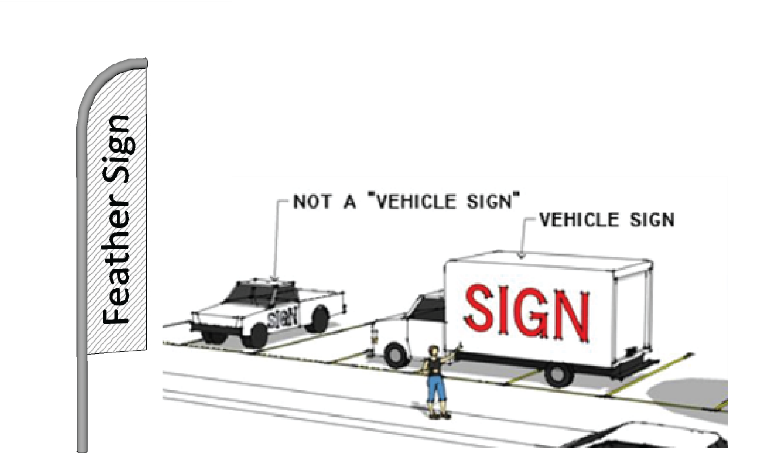
Feather signs.
(9)
Moving signs. Moving signs shall not include barber poles, electronic message signs, flags, street clocks, and other signs as established by this article.
(10)
Signs with more than two sign faces.
(11)
Signs that are a traffic hazard.
(12)
Vehicle signs.
(Ord. No. 21-5231, § 2, 4-12-2021)
Sec. 110-365. - General standards.
The rules set forth in this section apply to each parcel or lot of real property as described on a recorded plat or subdivision, regardless of common ownership of more than one building or parcel.
(1)
Permitted location. All signs shall comply with the following standards:
a.
Public property. Signs may only be placed on public property by a government agency or as authorized by this section. Any sign placed on public property without authorization may be removed without notice.
b.
Private property. Signs may only be placed on private property with prior consent of the property owner and, if applicable, pursuant to an approved building permit issued by the zoning administrator.
(2)
Prohibited locations. In addition to the setback requirements of this article, and the other restrictions of this zoning ordinance, all signs shall comply with the following standards:
a.
A minimum clear sight distance at all intersections, including driveways and approaches, shall be in accordance with provisions for a clear vision triangle (section 110-58, vision clearance triangle) as defined in this Code. Signs found to otherwise be a visual obstruction by the zoning administrator shall be removed.
b.
Signs shall not block or interfere with building features necessary for safety or convenient ingress or egress, including doors, windows, fire escapes, or required exit-ways.
c.
A sign mounted on the exterior of a building shall not conceal any windows, doors, or unique architectural features. This standard does not apply to window signs.
d.
Signs may not be in or over public rights-of-way, except:
1.
Traffic control signs installed by a governmental entity or which are required to be installed by a governmental entity;
2.
Signs posted by governmental entities that support event or emergency management, such as wayfinding to event or disaster relief locations;
3.
Banners posted by the city on utility or light poles; and
4.
signs constructed by the city or another governmental or quasi-governmental entity pursuant to terms and conditions set forth in an approved intergovernmental agreement with the city.
e.
Signs may not be located within easements for overhead utilities (placement in other utility easement areas is allowed only if approved by the utility service provider and if the other applicable requirements of this zoning ordinance are met).
(3)
Prohibited content. The following content is prohibited without reference to the viewpoint of the individual source (the narrow classifications of content that are prohibited by this subsection are either not protected by the United States or Illinois Constitutions, or are offered limited protection that is outweighed by the substantial governmental interests in protecting the public safety and welfare):
a.
Text or graphics that present a clear and present danger due to their potential confusion with traffic control signs or signs that provide public safety information (for example, signs that use the words "Stop," "Yield," "Caution," or "Danger," or comparable words, phrases, symbols, or characters in such a manner as to imply a safety hazard that does not exist);
b.
Text or graphics of an indecent or immoral nature and harmful to minors;
c.
Text or graphics that advertise unlawful activity; or
d.
Text or graphics that are obscene, fighting words, defamation, incitement to imminent lawless action, or true threats.
(4)
Setback. Each sign shall be set back from the public right-of-way a distance of at least one-half the required minimum setback building line, or ten feet, whichever is greater.
(5)
Area of ground, projecting or roof signs. The total sign area of any ground or projecting sign or roof sign shall be determined by the sign area table in subsection (6) of this section.
(6)
Sign area table. The following table shall be used to determine the total surface area of any ground or projecting sign oriented to any street in any business, commercial or industrial area. In the event of property having frontage on more than one street, with "frontage" being defined per this Code, only the footage of one street may be used to calculate allowable sign area. Only one ground sign shall be allowed on each parcel of real property, excluding traffic control or directional signs.
(7)
Wall signs. In addition to any ground sign, a wall sign located on any exterior side of the building shall be allowed having a total sign area of two square feet for each foot of building frontage.
(8)
Height of ground signs. No part of any ground sign shall exceed 26 feet in height above the public roadway in front of the property, unless expressly permitted in this section.
(9)
Signs located along highways. Signs located along Highway 38, from Caron Road east to Dement Road, may have a variable height restriction of 26 feet maximum at Caron Road, increasing incrementally to 100 feet maximum adjacent to the highway. The same scale shall be used on the east side of Highway 38, for a distance of 1.5 miles.
(10)
Roof signs. A roof sign shall only be allowed by the granting of a special use permit (section 110-31, special uses) by the city council upon a recommendation received by the planning and zoning commission. Application for a special use for a roof sign shall be accompanied by certificate of a licensed engineer or architect stating that the proposed roof sign and the roof of the building upon which the sign is to be located is engineered to safely accommodate the additional weight and stress from the proposed roof sign.
(11)
Corporate or franchise establishments. Gas stations, restaurants, and other corporate or franchise establishments may be allowed to exceed maximum sign requirements in order to comply with national franchise or corporate standards, or change signage to comply with changes to such corporate or franchise standards, by the zoning administrator after approval by the city manager.
(Ord. No. 21-5231, § 2, 4-12-2021)
Sec. 110-366. - Off-premises signs.
(a)
An off-premises sign is allowed only by the issuance of a special use permit (section 110-31, special uses) by the city council upon recommendation by the planning and zoning commission. The following minimal requirements must be met before the submittal of an application for an off-premises sign special use permit:
(1)
The off-premises sign must be located in the same subdivision as the location of business advertised on the off-premises sign.
(2)
The total square footage of signage both at the location of the business and on the off-premises sign would not be greater than the total signage allowed at the business location.
(3)
Proof of an agreement between the owner of the business being advertised and the owner of the property upon which the off-premises sign is to be located.
(4)
The off-premises sign would strictly comply with the requirements of this article as to height.
(5)
Applicable setbacks from adjacent roadways would be complied with.
(b)
The city council and planning and zoning commission on their recommendation may, in their sole discretion, deny a request for an off-premises sign even though the above minimum criteria have been met by the applicant, or they may add additional conditions or requirements to the issuance of a special use permit (section 110-31, special uses).
(Ord. No. 21-5231, § 2, 4-12-2021)
Sec. 110-367. - Projecting signs.
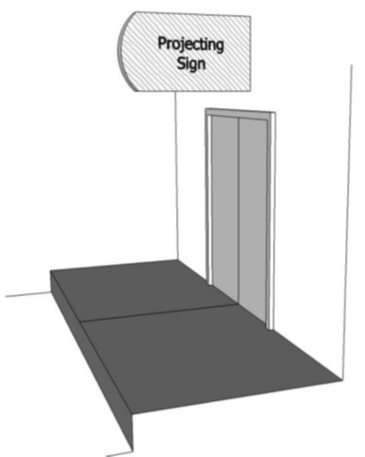
Projecting signs may be permitted in any business or industrial zoning district, and in all residential districts for multi-unit dwelling uses and non-residential uses only upon the following conditions:
(1)
A ground sign is not or cannot be located on the subject property.
(2)
Only one projecting sign may be permitted per building.
(3)
The projecting sign must be mounted perpendicular to the wall.
(4)
The leading edge of the projecting sign may not extend more than 48 inches beyond the surface of the building it is attached to.
(5)
The total area of the projecting sign shall count towards the total sign allotment for the building provided in section 110-365, general standards.
(6)
The projecting sign must provide a minimum overhead clearance of eight feet measured from the sidewalk and nine feet measured from vehicular rights-of-way, as applicable.
(7)
All structural supports shall be attached to the façade of the building and shall not be attached to the roof.
(Ord. No. 21-5231, § 2, 4-12-2021)
Sec. 110-368. - Window signs.
(a)
Location. Window signs are allowed in commercial and industrial zoning districts, and in all residential districts for non-residential uses and multi-family dwelling uses.
(b)
Size.
(1)
Window signs shall not occupy more than 25 percent (of the total ground floor window area on each building façade.
(2)
Total window area on which to define permitted 25 percent shall be defined as window area between the structural elements (pillars) defining the window area.
(c)
Additional regulations.
(1)
One window sign shall be permitted per designated window area.
(2)
Window signs shall not be located above the ground floor.
(3)
Internally illuminated window signs, including neon signs, shall not exceed six square feet in area. Only one internally illuminated window sign is allowed, however, said sign shall not count toward the limitation on number of signs.
(4)
Internal illumination of window areas may not exceed 25 percent of overall window area and shall be defined as windows between the structural elements (pillars) defining the window area.
(Ord. No. 21-5231, § 2, 4-12-2021)
Sec. 110-369. - Awning signs.
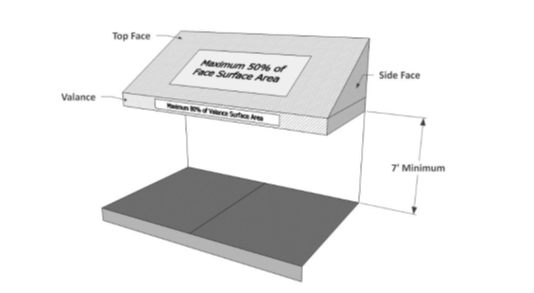
Awnings that display a message shall count towards the total allowable signage for the lot. Awnings that do not display a message are not subject to the regulations of this section.
(1)
Location. Awning signs are allowed in all commercial and industrial zoning districts, and in all residential districts for multi-unit dwelling uses and non-residential uses only.
(2)
Size.
a.
Eighty percent of maximum valance area for copy and graphics on valance;
b.
50 percent of maximum top surface area for copy and graphics on top surface areas.
c.
No signs shall be located on the side surface areas of an awning.
(3)
Additional regulations.
a.
One sign is permitted per awning top surface area.
b.
Awning signs shall be displayed on awnings constructed out of durable, weather-resistant material such as canvas, nylon, vinyl-coated fabric, or metal.
c.
Awning with signs and awning signs shall be generally aligned with awning and awning signs that are attached to adjacent storefronts or buildings to maintain a sense of visual continuity.
d.
Awning signs shall not be backlit or otherwise internally illuminated.
e.
All awnings shall be constructed and erected so that the lowest portion thereof shall be not less than seven feet above the level of the adjacent sidewalk.
(Ord. No. 21-5231, § 2, 4-12-2021)
Sec. 110-370. - Signs adjacent to drive-thru lanes.
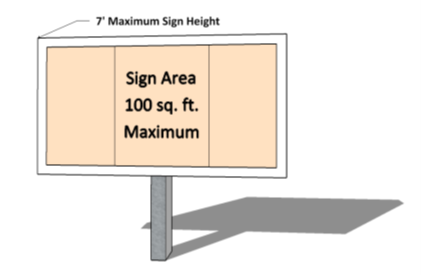
(a)
Location.
(1)
Signs adjacent to drive through lanes are allowed for any approved drive-thru establishment.
(2)
Menu board signs shall be located a minimum of 15 feet from any residential zoned lot line.
(b)
Size.
(1)
Signs adjacent to drive through lanes shall not exceed 100 square feet in area and seven feet in height.
(c)
Additional regulations.
(1)
Signs adjacent to drive through lanes signs may be displayed as wall, monument, or pole signs.
(2)
Up to two signs adjacent to drive through lanes are allowed per drive-thru lane and shall when added together not exceed the size allowed for one such sign.
(3)
Menu boards may include an electronic screen to display information to customers.
(Ord. No. 21-5231, § 2, 4-12-2021)
Sec. 110-371. - Electronic message signs.
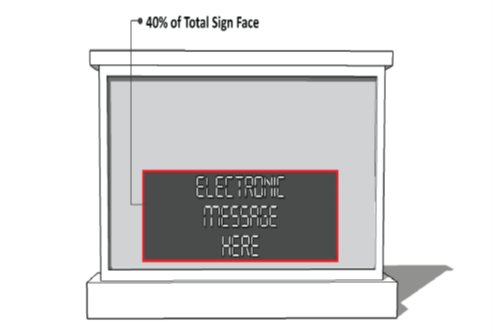
(a)
Location. Electronic message signs may be substituted for any permitted sign subject to the requirements of this section and article.
(b)
Size. An electronic message sign shall not occupy more than 40 percent of the total sign face of a permitted monument sign area.
(c)
Additional regulations.
(1)
One electronic message sign is allowed per property.
(2)
No sign containing a changeable copy sign may also contain an electronic message sign.
(3)
Electronic message centers are only permitted on monument signs which enclose the electronic message center component on all sides with a finish of brick, stone, stucco, powder coated (or comparably finished) metal, or the surface of the sign face.
(4)
Electronic message signs shall change messages no more than 12 cycles per one minute, or every five seconds.
(5)
Electronic message signs shall display static messages that do not contain a light source that flashes, blinks, strobes, travels, chases, rotates, or changes in intensity, brightness, or color.
(6)
Transitions between messages shall be instantaneous.
(7)
Every electronic message sign must have the capability to lower the intensity of the light being emitted after it is erected.
(8)
Electronic message signs shall be designed to default to a static display in the event of mechanical failure.
(9)
Photometric plan. The city may require applicants to submit photometric plans demonstrating compliance with this article as a condition to issue a sign permit.
(Ord. No. 21-5231, § 2, 4-12-2021)
Sec. 110-372. - Maintenance.
All signs shall be maintained by the owner and occupant of the property upon which they are located. If, in the opinion of the building official, a sign has deteriorated to a point where repair of the sign would exceed the current value of the sign, then the sign must be removed by the property owner within 30 days of written notice given by the building official.
(Ord. No. 21-5231, § 2, 4-12-2021)
Sec. 110-373. - Variances.
(a)
In obtaining a permit, the applicant may apply to the zoning administrator for a variance (section 110-29, variances) from certain requirements of this article. A variance may be recommended by the planning and zoning commission and granted by the city council where a literal application of this article would create a particular hardship for the applicant. In such a case, the following criteria shall be followed:
(1)
The granting of the requested variance would not be materially detrimental to the property owners in the vicinity;
(2)
The hardship caused the applicant under a literal interpretation of this article is due to conditions unique to that property and does not apply generally to the city; and
(3)
The granting of the variance would not be contrary to the general objectives of this article.
(b)
In granting a variance, the planning and zoning commission and city council may attach additional requirements necessary to carry out the spirit and purpose of this article in the public interest.
(Ord. No. 21-5231, § 2, 4-12-2021)
Sec. 110-374. - Penalty.
Any corporation, business, partnership, legal entity or person violating any of the provisions of this article shall be guilty of a violation of this Code, and upon conviction thereof be subject to punishment in accordance with section 110-35, enforcement and penalties. Each day such a violation is committed, or permitted to continue, shall constitute a separate offense.
(Ord. No. 21-5231, § 2, 4-12-2021)

