
Rochelle City Zoning Code
ARTICLE II
ADMINISTRATION AND ENFORCEMENT
Sec. 110-20.- City council.
(a)
Jurisdiction. The city council shall retain the following duties and responsibilities under the zoning ordinance:
(1)
Take final action on applications for text and map amendments (Section 110-30, amendments) to this chapter, and special use permits (section 110-31, special uses).
(2)
Take final action on appeals (section 110-33, appeals) and variances (section 110-29, variances) to the zoning ordinance.
(3)
Take action on applications for temporary buildings, structures, and uses of land.
(4)
Designate certain days and times at which businesses may conduct their business outside of a building or structure.
(5)
Receive and act upon all reports relating to the effectiveness of the zoning ordinance, with recommendations for changes.
(b)
Final actions by the city council. All decisions and findings of the city council related to the zoning ordinance shall be final, subject to judicial review as may be provided by law.
(Ord. No. 21-5231, § 2, 4-12-2021)
Sec. 110-21. - City manager.
The city manager shall retain the following duties and responsibilities under the zoning ordinance:
(1)
Approve all decisions of the zoning administrator relating to administrative adjustments (section 110-26, administrative adjustments).
(2)
The city manager may, at his/her discretion, establish a planned unit development (PUD) review committee for the purpose of participating in PUD pre-application meetings or, the review of PUD applications (article VII, planned developments).
(Ord. No. 21-5231, § 2, 4-12-2021)
Sec. 110-22. - Community development director.
The community development director shall retain the following duties and responsibilities under the zoning ordinance:
(1)
The community development director or his/her designee shall act as the zoning administrator.
(2)
Approve submittal requirements, review procedures and guidelines, as may be established from time to time, to supplement this zoning ordinance.
(3)
Make administrative decisions subject to section 110-26, administrative adjustments.
(Ord. No. 21-5231, § 2, 4-12-2021)
Sec. 110-23. - Building official.
The building official shall retain the following duties and responsibilities under the zoning ordinance:
(1)
Review and issue building permit applications (section 110-27, building permits).
(2)
Perform building and site inspections.
(3)
Issue building and code violations and maintain records of such violations.
(4)
Issue certificates of occupancy (section 110-28, certificates of occupancy).
(Ord. No. 21-5231, § 2, 4-12-2021)
Sec. 110-24. - Zoning administrator.
The zoning administrator shall develop and review procedures and guidelines, as may be established from time to time, to supplement the zoning ordinance.
(1)
Designation. The community development director, or his/her designee, shall act as the zoning administrator.
(2)
Duties. As the zoning administrator, the duly appointed community development director, along with any deputies, assistants, coordinators, and/or other designated personnel, shall enforce the regulations of the zoning ordinance. The zoning administrator shall:
a.
Provide zoning information upon request.
b.
Document all nonconformities (article IV, nonconforming lots, structures, and uses) as/when they are identified.
c.
Conduct inspections of buildings, structures and uses of land to determine compliance with the zoning ordinance.
d.
Issue violation notices that require compliance and advise those receiving a violation of the right to appeal such violation.
e.
Require that any construction or work of any type be stopped if it is determined to not be in compliance with the zoning ordinance, or if the construction would result in a situation that is not in compliance with the zoning ordinance.
f.
Review and forward to the planning and zoning commission all applications for text and map amendments (section 110-30, amendments) to the zoning ordinance, and applications for special use permits (section 110-31, special uses).
g.
Review and forward to the planning and zoning commission all applications for appeals (section 110-33, appeals) and variances (section 110-29, variances).
h.
Interpret the provisions of the zoning ordinance as questions arise.
i.
Determine which uses, though not contained by name in a zoning district's list of permitted uses, are similar in nature and clearly compatible with the listed permitted uses for that particular zoning district, and permit their establishment.
j.
Issue or deny sign permit (section 110-351, permits required) applications based on compliance of the proposed signage with the provisions of the zoning ordinance.
(Ord. No. 21-5231, § 2, 4-12-2021)
Sec. 110-25. - Planning and zoning commission.
(a)
Jurisdiction. The planning and zoning commission shall be responsible for the following duties and obligations under the zoning ordinance:
(1)
Review all applications for text and map amendments (section 110-30, amendments) to the zoning ordinance in the manner prescribed and report findings and recommendations to the city council in accordance with the zoning ordinance.
(2)
Review all applications for special uses and planned unit developments (article VII, planned developments) in the manner prescribed and report findings and recommendations to the city council.
(3)
Advise the city council on all matters referred to it and matters that it is required to review.
(4)
Periodically review and update the city's comprehensive plan.
(5)
Implement and uphold the goals and objectives of the comprehensive plan, as it may be amended from time to time.
(b)
Recommendations of the planning and zoning commission. All recommendations of the planning and zoning commission on applications for text or map amendments to the zoning ordinance, applications for special uses or planned unit developments (PUDs), or for any other matter shall, in all instances, be advisory in nature and shall be subject to final consideration, evaluation, and determination by the city council.
(Ord. No. 21-5231, § 2, 4-12-2021)
Sec. 110-26. - Administrative adjustments.
(a)
Authority. The zoning administrator is authorized to make, subject to approval by the city manager, administrative adjustments relating to the following zoning standards:
(1)
Maximum building height: up to ten percent over the maximum.
(2)
Minimum yard setbacks: up to ten percent of the minimum.
(3)
Maximum sign area: up to ten percent of the maximum.
(4)
After-the-fact encroachments into required yards: up to 12 inches.
(b)
Criteria. The zoning administrator shall not authorize an administrative adjustment unless the following criteria are satisfied:
(1)
The requested administrative adjustment is consistent with the stated intent and purposes of the zoning ordinance (section 110-4, purpose and intent);
(2)
The requested administrative adjustment eliminates an inconvenience to the applicant and will have no appreciable adverse impact on the health, safety, or general welfare of the surrounding property owners, or general public; and
(3)
Any adverse impacts resulting from the administrative adjustment will be mitigated to the maximum extent feasible.
(c)
Procedure. The property owner, or his/her agent, shall submit to the zoning administrator the following:
(1)
A map or elevation, as appropriate, depicting the difference between the zoning ordinance's standard, and the requested administrative adjustment;
(2)
A statement on why the administrative adjustment is necessary and why, if granted, it would meet the criteria of this section.
(d)
Prohibited. The zoning administrator shall not make an administrative adjustment for a planned unit development (article VII, planned developments) or a special use (section 110-31, special uses).
(Ord. No. 21-5231, § 2, 4-12-2021)
Sec. 110-27. - Building permits.
(a)
Permit required. No structure, on water or on land, shall hereafter be used, erected, moved, or structurally altered, without full compliance with the terms of this section and other applicable regulations, until a Land Use Permit has been issued.
(b)
Applications. All applications for a building permit shall be made to the community development director, and shall be accompanied by: plans, drawn to scale, showing the name and address of the property owner; location, shape and dimensions of the lot to be built upon; high water mark of any abutting watercourse; centerline of all abutting streets and highways; the exact size and location on the lot of the proposed or existing building and any/all accessory buildings; the lot coverage including all structures and impervious surfaces and shown as a percentage of the total lot area; the lines within which the building shall be erected, altered or moved; the existing and intended use of each building or part of a building; the number of families/occupants the building is intended to accommodate; and such other information with regard to the lot and neighboring lots or buildings as may be necessary to determine and provide for the enforcement of this chapter. Fees for building permits shall be required, as established in section 110-34, fees and charges).
(c)
Approval. The zoning administrator shall issue or refuse to issue a building permit within 30 days after receipt of a complete application, except in the case of utility permits for work within the right-of-way. Refusal to issue a building permit shall be given in writing, detailing the reasons for such refusal to the applicant. Unless otherwise stated in this chapter, a building permit shall be valid for one year, except for a commercial new construction permit which shall be valid for two years, from the date of issuance. In the event that construction has not started within three months after the issuance of the building permit, the permit shall be deemed invalid.
(d)
Regardless of the issuance of building permit, violations of the Rochelle Municipal Code shall continue to be enforced until such violations are abated.
(Ord. No. 21-5231, § 2, 4-12-2021; Ord. No. 21-5282, § 2, 8-23-2021)
Sec. 110-28. - Certificates of occupancy.
(a)
Certificate of occupancy required. No vacant land or building shall be occupied or used, and no building hereafter erected, altered or moved, and no existing building change in ownership or occupancy class, shall be occupied until a certificate of occupancy shall have been issued by the building official, after review by the building department and fire department. Such certificate shall show that the building or premises, or part thereof, and the proposed use thereof are in conformity with the provisions of the zoning ordinance. Such certificate shall be applied for when application is made for a building permit and shall be issued within 30 days after the completion of the work specified in such building permit application, but only if the building or premises and the proposed use conform with all of the requirements of the zoning ordinance.
(b)
Temporary certificate of occupancy. Under such rules and regulations as may be established by the city council, the building official may issue a temporary certificate of occupancy for part of a building.
(c)
Existing buildings. Upon written request from the property owner (including a calculation of square feet of each primary and accessory structure as compared to the allowable lot coverage), the building official shall issue a certificate of occupancy for any building or premises existing on the effective date of the zoning ordinance from which this section is derived; provided that on-site inspection shows that the existing building and use conforms to the provisions of this zoning ordinance.
(Ord. No. 21-5231, § 2, 4-12-2021)
Sec. 110-29. - Variances.
(a)
Intent and purpose. A variance is a grant of relief to a property owner from the literal requirements of the zoning ordinance, where literal enforcement would cause undue hardship. Additionally, a variance is intended to provide relief where the requirements of the zoning ordinance render the land difficult to use because of some unique physical attribute of the property itself, or some other factor unique to the property for which the variance is requested. A variance is not intended merely to remove an inconvenience or financial burden that the requirements of the zoning ordinance may impose on a property owner in general. A variance is not intended to allow the establishment of a use that is not otherwise allowed in a zoning district or that would change the zoning district classification of any or all of the affected property, and should not be granted where a special use permit or an amendment to the official zoning map would be more appropriate.
(b)
Initiation of a variance. A request for a variance may be initiated by:
(1)
The owner of the subject property; or
(2)
A contract purchaser of the subject property.
(c)
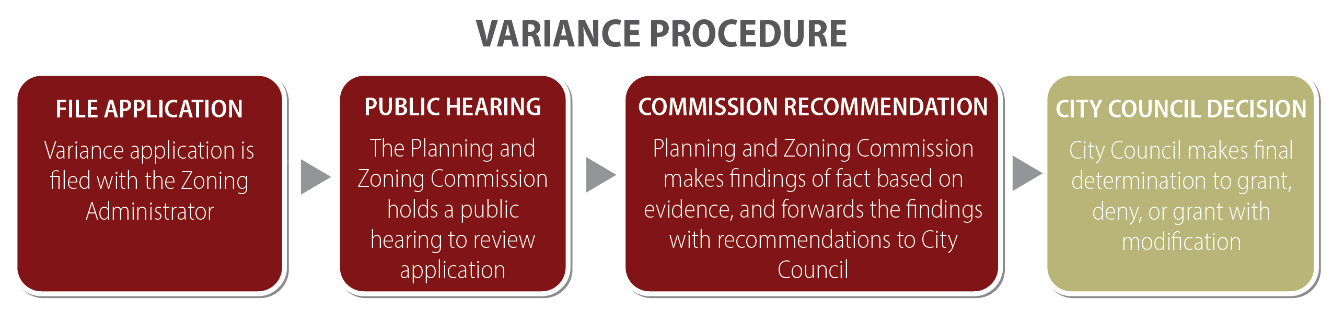
Application for a variance. An application for a variance shall be filed in writing with the zoning administrator and shall include a map of the property showing its dimensions, all streets and alleys, and other properties within 250 feet of the property. The zoning administrator shall transmit the application to the planning and zoning commission, as appropriate, for review and public hearing. The planning and zoning commission shall hold a public hearing within 60 days after the filing of a completed application.
(d)
Notice and conduct of the public hearing. The notice for, and conduct of, the public hearing shall be in accordance with the provisions of section 110-32, public hearings, of the zoning ordinance.
(e)
Findings and recommendations. The planning and zoning commission shall make findings of fact based on evidence presented to it and forward the findings with recommendations to the city council, within ten days of the public hearing.
(f)
Standards for a granting a variance. The planning and zoning commission shall not recommend, and the city council shall not grant, a variance from the regulations of the zoning ordinance unless it makes findings based on evidence presented to it in each specific case that:
(1)
The variance is in harmony with the general purpose and intent of the zoning ordinance;
(2)
The plight of the owner is due to unique circumstances (65 ILCS 5/11-13-4) and thus strict enforcement of the zoning ordinance would result in practical difficulties, or impose exceptional hardships, due to the special and unusual conditions that are not generally found on other properties in the same zoning district;
(3)
The property cannot yield a reasonable return if permitted only under the conditions allowed by the zoning ordinance; and
(4)
The variance, if granted, will not alter the essential character of the locality, and will not be a substantial detriment to adjacent property.
(g)
Burden of proof. In each case of a requested variance, the applicant must satisfy the proof that the proposed variance meets the standards of subsection (f) of this section, even if there is no testimony or other evidence opposing or rebutting the requested variance.
(h)
City council action. Within 45 days of the public hearing, the city council shall review the findings and recommendations of the planning and zoning commission. After reviewing the findings of the planning and zoning commission, the city council may grant, deny, or grant with modification, the proposed variance. If the city council grants the variance, it shall make a finding of fact specifying the reason for the variance in accordance with the standards of subsection (f) of this section. Additionally, if granting the variance, the city council shall adopt an ordinance approving the variance.
(Ord. No. 21-5231, § 2, 4-12-2021)
Sec. 110-30. - Amendments.
(a)
Authority. The city council, after receiving a findings and recommendations from the planning and zoning commission, may amend the regulations of this zoning ordinance, or amend the boundaries of the official zoning map.
(b)
Initiation of amendments. Text amendments may be initiated by the mayor, city council, planning and zoning commission, resident/property owner, or other interested party. Official zoning map amendments may be initiated by the city council, planning and zoning commission, owner of the property or his/her authorized agent, or contract purchaser of the property.
(c)
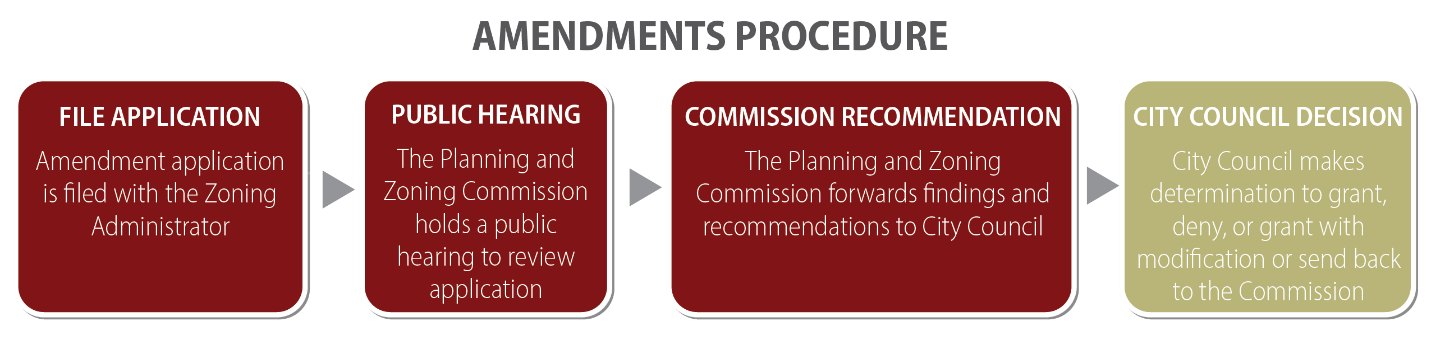
Application for map amendment. An application for an amendment to the official zoning map shall be filed, in writing, with the zoning administrator and shall include a map of the property showing its dimensions, all streets and alleys, and other properties within 250 feet of the property. The zoning administrator shall forward the application to the planning and zoning commission for review and public hearing. The planning and zoning commission shall hold a public hearing within 60 days after filing of a completed application.
(d)
Notice and conduct of public hearing. Notice for, and conduct of, the public hearing shall be in accordance with the provisions of section 110-32, public hearings, of the zoning ordinance.
(e)
Official zoning map amendments (rezoning). The planning and zoning commission shall not recommend, nor shall the city council grant, an amendment altering the zoning district boundary lines unless it shall find, based on the evidence presented to it in each specific case, that:
(1)
The amendment promotes the public health, safety, comfort, convenience and general welfare, and complies with the policies and official plans of the city;
(2)
The trend of development in the area of the subject property is consistent with the requested Amendment;
(3)
The requested zoning classification permits uses which are more suitable than the uses permitted under the existing zoning classification;
(4)
The property cannot yield a reasonable use if permitted only under the conditions allowed under the existing zoning classification; and
(5)
The amendment, if granted, will not alter the essential character of the neighborhood and will not be a substantial detriment to adjacent property.
(f)
Decision of the city council. Within 45 days of the public hearing, the city council shall review the findings and recommendations of the planning and zoning board. After recommendation by the planning and zoning commission, the city council may grant, deny, or grant with modification, the amendment, or may refer the proposed amendment back to the planning and zoning commission for further consideration. If the city council grants the amendment, it shall adopt an ordinance approving such amendment.
(Ord. No. 21-5231, § 2, 4-12-2021)
Sec. 110-31. - Special uses.
(a)
Purpose. The development of this zoning ordinance is based upon the division of the city into zoning districts within which the use of land, and the bulk and location of buildings and structures in relation to the land, is substantially uniform. However, there are certain uses that, because of their unique characteristics, cannot be properly classified in any particular zoning district or districts, without consideration in each case of the impact of those uses on adjacent properties, and of the public need for the particular use in the particular location. Case-by-case review is intended to ensure consideration of the particular special use's anticipated land use, site design, and impacts.
(b)
Initiation of a special use. A special use application may be filed by the owner, his/her designee, or contract purchaser of a property.
(c)
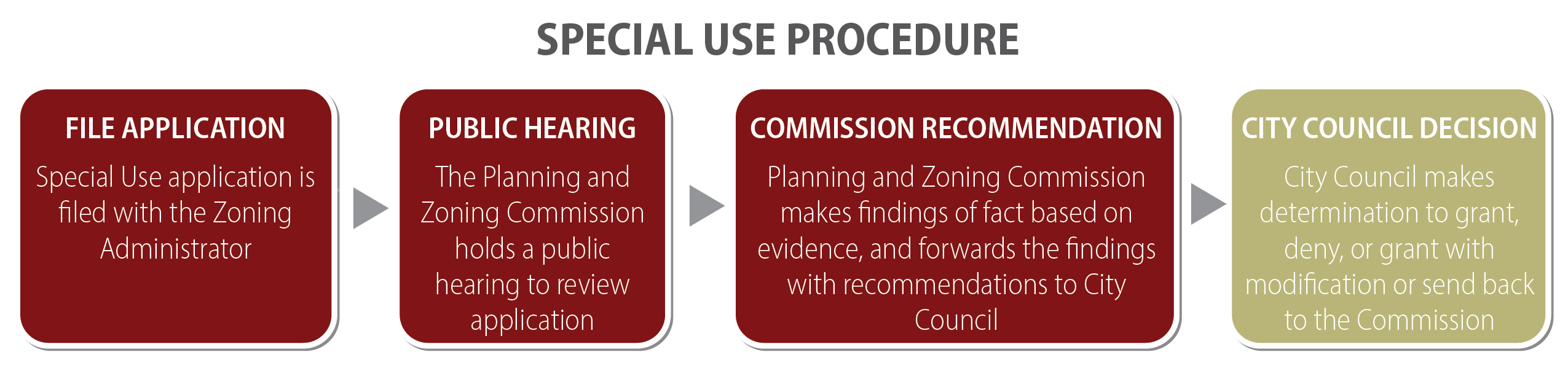
Application for a special use. An application for a special use shall be filed in writing with the zoning administrator and shall include a map of the property showing its dimensions, all streets and alleys, and other properties within 250 feet of the property. The zoning administrator shall forward the application to the planning and zoning commission, as appropriate, for review and public hearing. The planning and zoning commission shall hold a public hearing within 60 days after filing of the application.
(d)
Notice and conduct of public hearing. Notice for and conduct of the public hearing shall be in accordance with the provisions of section 110-32, public hearings, of the zoning ordinance.
(e)
Standards for special uses. The planning and zoning commission shall not recommend, nor the city council grant, a special use unless it shall make findings of fact based on the evidence presented to it in each specific case that:
(1)
The special use will not be injurious to the use and enjoyment of other property in the immediate area for the purposes already permitted, nor substantially diminish property values within the neighborhood; and
(2)
The establishment of the special use will not impede the normal and orderly development and improvement of the adjacent properties for uses permitted in the subject zoning district.
(f)
Burden of proof. In each case of a requested special use, the applicant must satisfy the proof that the proposed special use meets the standards of subsection (e) of this section, even if there is no testimony or other evidence opposing or rebutting the requested special use.
(g)
Decision of the city council. Within 45 days of the public hearing, the city council shall review the findings and recommendations of the planning and zoning commission. The city council may grant, deny, or grant with modification, the special use, or may refer the proposed special use back to the planning and zoning commission for further consideration. If the city council grants a special use, it shall adopt an ordinance authorizing such special use.
(h)
Conditions and restrictions. When a special use is determined to have the potential for adverse impacts, the planning and zoning commission may recommend, and the city council may impose, conditions on the approval to ensure that the adverse impacts will be mitigated. Such conditions may include impositions on the site planning, design, location, and operation of the special use.
(i)
Lapse of approval and discontinuance. An ordinance approving a special use is valid for up to 12 months from the date of the ordinance approving the special use unless a building permit is obtained, or the use is commenced. If a building permit is not obtained, or the use is not commenced within such time, the approval for a special use will lapse and shall become null and void. If a special use is discontinued for a period of six months or longer, the special use shall be considered abandoned, and shall become null and void. Reinstatement or re-establishment of the special use will require reapproval pursuant to the provisions of this section.
(j)
Amendments to a special use. A change in the area, bulk, size, use or intensity of use of an existing special use, or a change to the conditions specified for a special use at the time of approval, shall be deemed to be the same as a new special use, and shall require reapproval pursuant to the provisions of this section.
(Ord. No. 21-5231, § 2, 4-12-2021)
Sec. 110-32. - Public hearings.
(a)
Conduct of public hearing. Public hearings shall be conducted by the planning and zoning commission, and a record of such proceedings shall be preserved in such a manner as the appropriate body, by rule, prescribes from time to time.
(b)
Notice of public hearing. Unless otherwise expressly stated, notice of a public hearing for variances, amendments, and special uses shall be made in the following manner:
(1)
The city shall publish notice of the public hearing at least once in a newspaper of general circulation within the city; and
(2)
The applicant shall give written notice to the owners of record—as shown on the records of the Ogle County Assessor—of all property within two-hundred and fifty (250) feet of the subject property, to include property immediately across public rights-of-way from the subject property.
(c)
Timing of notice. All published notices shall appear not more than 30 days and not less than 15 days from the scheduled date of the public hearing. All written notices shall be delivered or mailed not more than 30 days and not less than 15 days prior to the scheduled date of the public hearing. All posted notices must be posted at least 15 days prior to the date of the scheduled public hearing and shall remain posted until the conclusion of the hearing.
(d)
Content of notice. Unless otherwise expressly stated, all notices of public hearings for variations, amendments, or special uses shall contain the following:
(1)
A description of the nature of the application;
(2)
The location, date, and time of the hearing;
(3)
A legal description of the property subject to the proposed zoning action;
(4)
A statement that additional information concerning the public hearing, including a legal description of the subject property, can be obtained from the office of the city clerk; and
(5)
The street and/or mailing address of the city clerk, and the name and telephone number of a person to contact for more information.
(e)
Delivery of notice. Unless otherwise expressly stated, the applicant shall deliver the notices of the public hearing via certified or registered mail, with return receipt requested. A minimum of seven days prior to the public hearing, the applicant shall file a sworn affidavit with a copy of the notice, showing the names and addresses of the persons to whom the notices were sent. If, after a bona fide effort to provide written notice, the owner of the property on which the notice is served cannot be found at the owner's last known address, or mailed notice is returned because the owner cannot be found at the owner's last known address, then the requirement for written notice of that owner will be deemed satisfied.
(f)
City-initiated map amendments. If an amendment to the official zoning map is initiated by either the mayor, city council, or planning and zoning commission, the following provisions shall apply:
(1)
The zoning administrator shall publish at least once, a notice of the public hearing in a newspaper of general circulation within the city;
(2)
The zoning administrator shall mail written notices of the public hearing via certified or registered mail to all property owners—as shown on the record of the local real estate tax collector—of all properties for which the amendment is sought;
(3)
The zoning administrator shall mail written notices of the public hearing via certified or registered mail to all the owners of record—as shown on the record of the local real estate tax collector—of all property adjacent to the subject properties, to include property immediately across public rights-of-way from the subject property; and
(4)
The zoning administrator shall post notice of the public hearing on a sign on all properties for which the amendment is sought; the size, coloring, and letters of the sign shall be clearly legible to the public view on all adjacent public rights-of-way.
(Ord. No. 21-5231, § 2, 4-12-2021)
Sec. 110-33. - Appeals.
(a)
Right to appeal. An appeal may be taken by any person, firm, or corporation, or by any officer, department or board of the city, aggrieved by a decision or action of the zoning administrator.
(b)
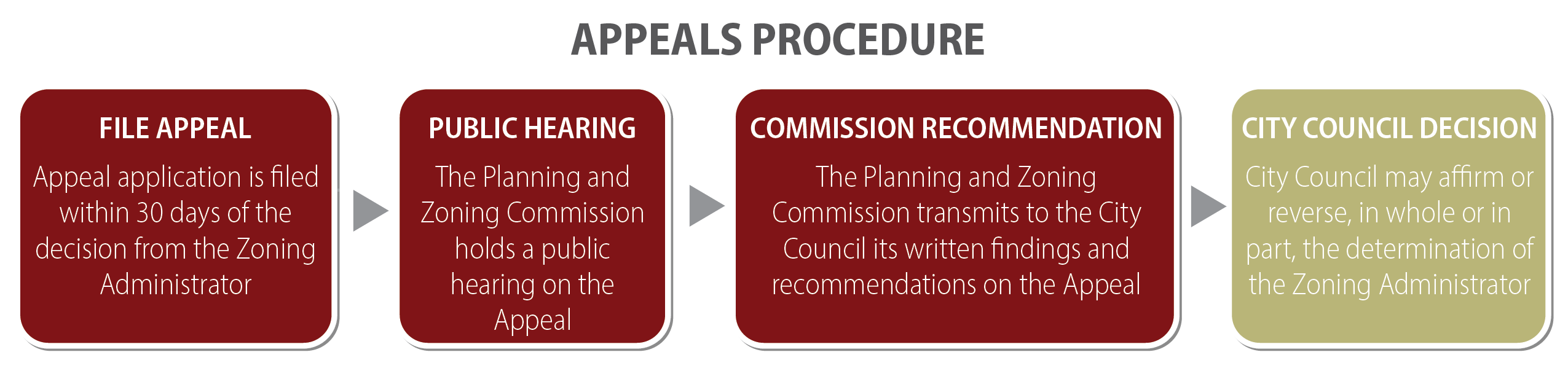
Procedure for appeals. An appeal may be taken from any order, requirement, decision or determination of the zoning administrator. The appeal shall be made within 30 days of the action by filing with the zoning administrator. Upon receipt of the notice of appeal, the zoning administrator must forward to the planning and zoning commission all papers which constitute a record of the action that is being appealed.
(c)
Effect of the appeal. A filing of a complete notice of appeal stays all further proceedings unless the zoning administrator certifies to the planning and zoning commission, after the appeal is filed, based on the facts stated in the certification/affidavit, a stay would cause imminent peril to life or property. In this event, the stay may only be effectuated by an order of the planning and zoning commission, or by a circuit court, upon notice to the officer and with due cause shown.
(d)
Public hearing. No more than 30 days after the filing of a complete notice of appeal, the planning and zoning commission shall hold a public hearing to consider the appeal. The notice for and conduct of the public hearing shall be in accordance with section 110-32, public hearings, of this zoning ordinance.
(e)
Decision of the city council. The planning and zoning commission shall transmit to the city council its written findings and recommendations of the appeal within a reasonable time, but in no event more than 60 days after the filing of the notice of appeal and shall promptly forward a copy of the decision to all concerned parties. The city council may affirm or may reverse, in whole or in part, or modify the order, requirement, decision, or determination of the zoning administrator.
(Ord. No. 21-5231, § 2, 4-12-2021)
Sec. 110-34. - Fees and charges.
The applicant for a building permit, variance, amendment, special use or planned unit development shall pay a fee as established by the city council by separate resolution.
(Ord. No. 21-5231, § 2, 4-12-2021)
Sec. 110-35. - Enforcement and penalties.
(a)
Violations. It shall be unlawful for the owner of any real property located within the city to violate, disobey, neglect, omit, refuse to comply with, or resist the enforcement of any of the provisions of this zoning ordinance.
(b)
Notification of violation. The zoning administrator shall investigate all alleged instances of violations. If the zoning administrator determines that a violation exists, the zoning administrator shall notify, in writing, the owner of the property. The property owner shall eliminate the violation within ten days of the notification by the zoning administrator.
(c)
Penalties. Any person who violates, disobeys, neglects, omits, refuses to comply with, or resists the enforcement of any of the provisions of the zoning ordinance shall, upon conviction, be fined not less than $50.00 nor more than $750.00 for each offense. Each day that a violation continues to exist shall constitute a separate offense.
(Ord. No. 21-5231, § 2, 4-12-2021)

