
Rochester City Zoning Code
ARTICLE 20
- SETBACK, AREA, BULK, HEIGHT AND PLACEMENT REGULATIONS
Sec. 2000.- Schedule of district regulations.
(a)
The area, height, bulk, and placement requirements for principal and accessory uses shall be as set forth below and following this schedule:
*Minimum setback from residential district: 30 feet in O-1, 20 feet in O-2.
**Except west side of Walnut Boulevard to the east right-of-way line of Pine Street, with an extension of said east right-of-way line of Pine Street, southerly from Second Street to First Street (properties currently zoned CBD, Central Business District). Reduced to 25 feet and two stories. See section 2010.
(Ord. No. 2005-08, 8-22-2005)
Sec. 2001. - R-3, R-4.
(a)
The minimum lot width indicated in the schedule may be further reduced to 65 feet in the R-3 District and to 70 feet in the R-4 District, provided that the average lot width of all the lots in the subdivision is 70 feet in the R-3 District and 80 feet in the R-4 District. This provision is only applicable where approved by the city as part of approving a preliminary plat that is consummated in a recorded final plat covering all the lots so averaged. See planned residential development provisions of article 25 regarding lot sizes.
Sec. 2002. - RM-1, RM-2.
(a)
In computing the bedroom (abbreviated BR) count of a dwelling unit, a "den," "library," or "family room" or similar extra room shall be counted as a bedroom.
(b)
The minimum distance between buildings on the lot shall be subject to site plan approval; see article 27.
Sec. 2003. - RM-2.
(a)
No building of two stories or less shall contain more than 16 dwelling units.
(b)
No part of a dwelling unit shall be below grade unless approved as part of the site plan by the city planning commission, their approval to be based on consideration of sloping topography affording unique design opportunities for amenities.
(c)
No building of two stories or less shall be closer than 40 feet to any perimeter lot line of the property unless a lesser setback is approved as part of the site plan by the city planning commission, their approval to be based on unique circumstances of topography, natural features, adjoining land use, or similar considerations.
(d)
Any building of more than two stories shall have front, side, and rear yard setbacks from the perimeter lot lines of the property at least equal to the height of the building; except that where such lot line(s) abut a street, alley, or other permanently reserved open space, one-half the width of such open space may be considered as yard setback; but in no instance shall any yard setback from a property lot line be less than 50 feet.
(e)
Any building of more than two stories shall be of fireproof construction, such as masonry and steel, reinforced concrete, or similar fireproof rated materials.
Sec. 2004. - CBD, B-1.
(a)
No side yards are required along interior lot lines, provided all requirements of the building code have been met with regard to fire protection and separation, adequate light, and adequate ventilation.
(b)
Mechanical equipment, such as heating/ventilation/air conditioning, for buildings in B-1 and CBD districts shall be provided with visual and acoustical screening by means of principal building features or components, such as roof structural members, parapet walls, and the like. These principal building features shall obscure at least 75 percent of the height of the equipment being screened but not less than five feet. The use of wood, metal, or similar screen fences to obscure mechanical equipment shall not be permitted. The building wall or parapet wall for a structure with a flat roof may be permitted to a maximum height of 40 feet in order to provide the required screening for mechanical equipment. Buildings with a pitched roof may not increase building height.
Sec. 2005. - B-1.
(a)
The minimum front yard setback shall be 15 feet, and the minimum side yard setback shall be ten feet, provided however that the city planning commission may in its discretion as part of site plan review and approval pursuant to article 27 of this ordinance approve lesser or no front and/or side yard setbacks, taking into consideration subsections (d)(1) through (3) of this section.
(b)
That portion of the front yard between the building and the front lot line shall not be used for vehicle parking and shall be mainly devoted to landscaped open space and pedestrian access.
(c)
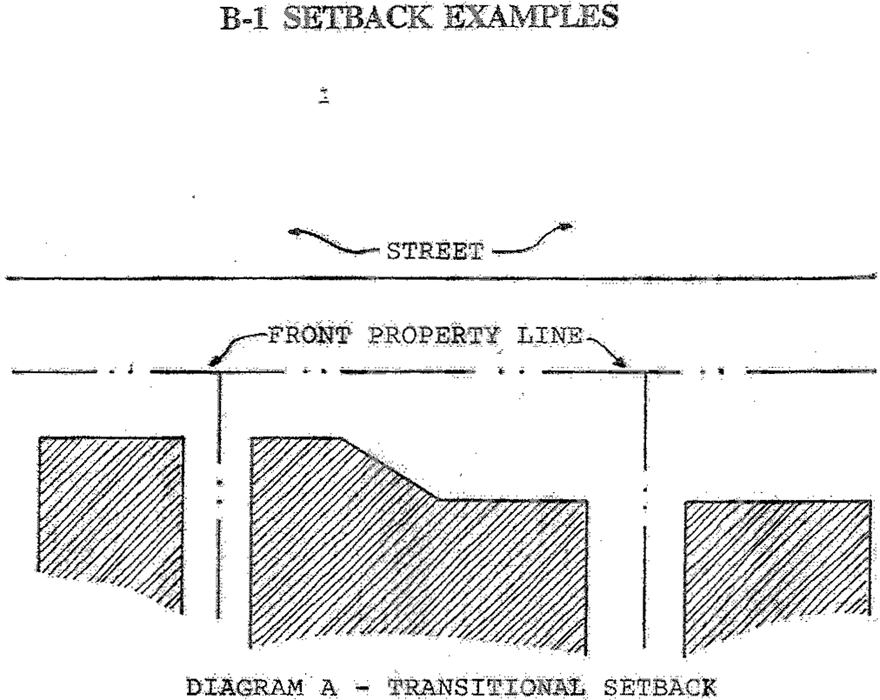
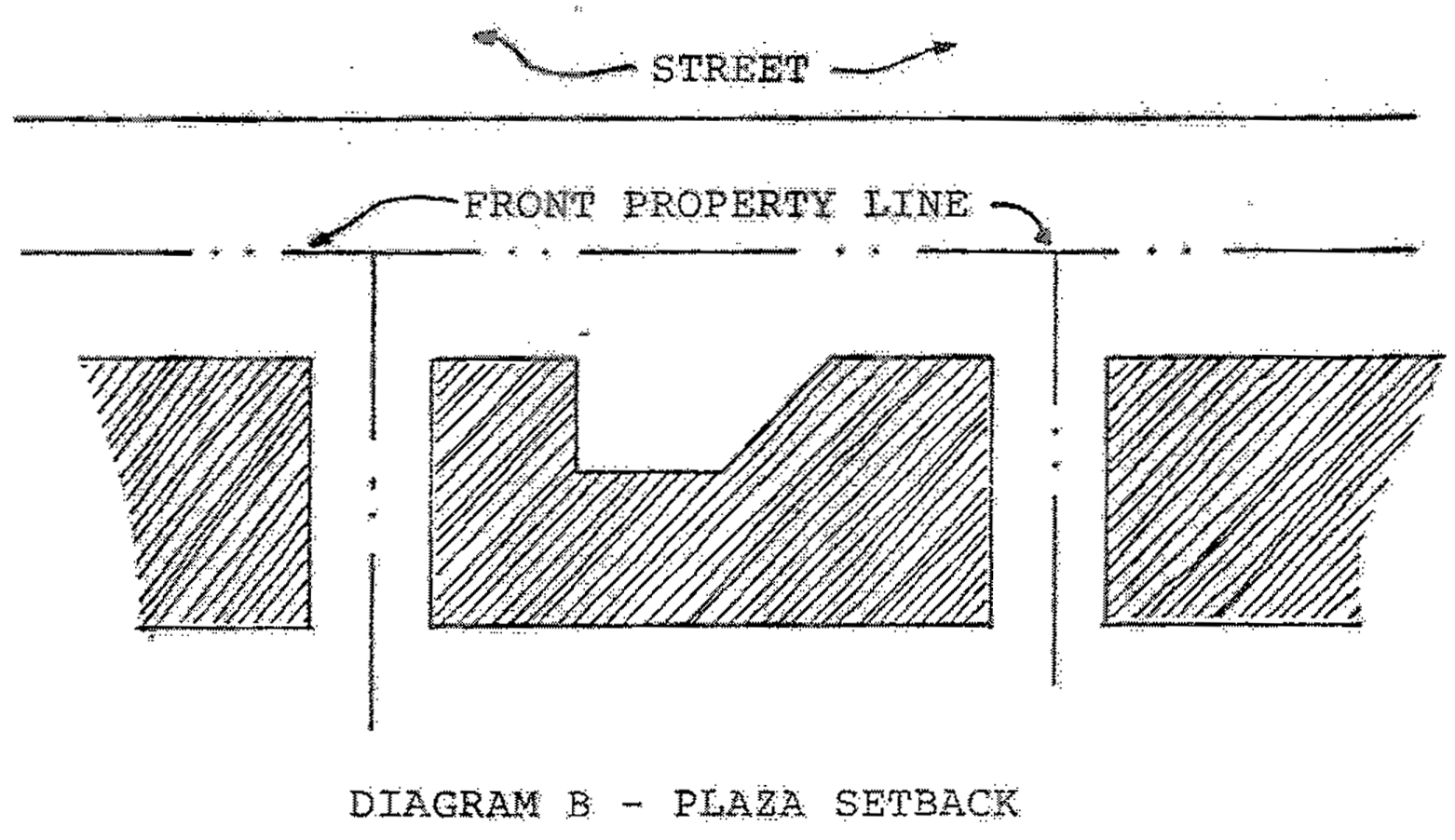
The established pattern of front setbacks on the same block and the same side of the street. The planning commission shall be guided by the intent that the required front yard setback should not result in poor visibility of the building from the street caused by the setbacks of existing buildings on adjoining lots. Similarly, the approved front yard setback for the subject building shall take into consideration the effect of the subject building on the visibility of adjoining buildings. In furtherance of this intent, the planning commission may, as the circumstances warrant, approve:
(1)
Transitional setback as illustrated in Diagram A below;
(2)
A plaza as illustrated in Diagram B below in the case where adjoining buildings have little or no front yard setback.
(d)
B-1 setback examples.
(1)
In establishing the front yard setback for a building in close proximity to existing buildings, the planning commission shall be guided by the design principal that a transitional setback or plaza as described in subsections (c)(1) and (2) of this section may be more appropriate to and compatible with the established pattern of setbacks than would be a setback of the subject building abruptly different from setbacks of existing buildings.
(2)
Provision for accessibility by service and other vehicles. The planning commission shall be guided by the intent of discouraging reliance upon public streets for loading and delivery activities, and encouraging such activities to be accommodated via service drives and alleys, with adequate truck loading space provided on the lot. On a small lot, the planning commission might accordingly find that the intent would be better served by reducing side yard requirements if the enhanced building site thereby facilitates provision of adequate truck loading at the rear of the building. Similarly, the reduction and consolidation of the number of driveways and parking areas might justify the reduction of side yards. Side yard reduction shall be consistent with fire fighting and other public safety considerations: narrow and deep side yards are generally undesirable.
(3)
Adequacy of side yard setback in relation to windows and doors of the subject and adjoining buildings. The planning commission shall take into consideration the effect of side yards on daylight, ventilation, and egress in relation to windows and doors of the subject and adjoining buildings; distances between buildings of less than eight feet are generally not desirable and a better building relationship in some circumstances might be achieved by no side yard setback.
Sec. 2006. - RP.
(a)
No building shall be closer to a Residential District than four times the building's roof height elevation over the Residential District boundary average elevation, but not less than 50 feet. For example, if the Residential District boundary average elevation is 730, the ground elevation of the building is 710, and the building roof is 810, the building would be 80 feet above the Residential District boundary, and would therefore be required to be 320 feet from the Residential District. The average elevation of the Residential District boundary shall be determined by the city for the sector of the boundary faced by the building, plus 50 feet beyond, along the boundary.
(b)
The maximum height of a building may be increased from 50 up to 125 feet provided that no building shall be closer to a property line of land under other ownership (excluding public right-of-way and railroad right-of-way) than the building's roof elevation over the average elevation of the property line, determined in the same manner as in the previous paragraph; the building shall be set back from any Residential District boundary as set forth in the previous paragraph.
Sec. 2007. - Minimum lot size.
(a)
Any other provisions of this ordinance notwithstanding, the minimum lot size of any lot in any district not served by public water supply and public sanitary sewer shall be established by the city engineer based on engineering requirements for safe and adequate water supply and sewage disposal, but in any event not less than:
(1)
RP District: 40,000 square feet lot area and 200 feet lot width.
(2)
All other districts: 20,000 square feet lot area 100 feet lot width.
(b)
The provisions of this section do not waive any provision of chapter 54 of the City Code, including section 54-236 thereof on discontinuance of a private sewage disposal system when a public sewer becomes available.
Sec. 2008. - All districts.
(a)
Screen walls shall be constructed in accordance with article 28 before a certificate of occupancy is issued for a nonresidential use.
Sec. 2009. - Parking in all districts.
(a)
The design, construction and operation of off-street parking shall be in accordance with article 24.
Sec. 2010. - West Walnut transition zone.
(a)
The West Walnut transition zone is intended to provide a buffer for the residential uses west of the downtown district. Uses within this zone must be respectful of the nearby residential neighborhood. Building height in this zone shall be limited to two stories on the west side of Walnut in order to provide an appropriate transition to the increased heights permitted on the east side of the street. This gradual transition is intended to prevent close-in single-family homes from feeling as if the downtown towers over them.
(Ord. No. 2005-08, 8-22-2005)

