
Rochester City Zoning Code
ARTICLE 39
- DEFINITIONS
Sec. 3900.- Intent.
For the purposes of this ordinance, certain terms or words used herein shall be interpreted as follows. Words and terms not herein defined shall have the meaning customarily assigned to them.
[Person.] The word "person" includes a firm, association, organization, partnership, trust, company, or corporation, as well as an individual.
[Tense.] The present tense includes the future tense, the singular number includes the plural, and the plural includes the singular.
[Shall, may.] The word "shall" is mandatory; the word "may" is permissive.
[Used, occupied.] The words "used" or "occupied" include the words "intended," "designed," or "arranged to be used or to be occupied."
[Lot.] The word "lot" includes the word "plot" or "parcel."
Sec. 3901. - Definitions A—C.
Accessory use of structure means a use of structure on the same lot with, and of a nature customarily incidental and subordinate to, the principal use or structure.
Adult bookstore means an establishment having as a substantial or significant portion of its stock in trade, books, magazines, and other periodicals which are distinguished or characterized by their emphasis on matter depicting, describing or relating to specified sexual activities or specified anatomical areas, or an establishment with a separate segment or section devoted to the sale or display of that material.
Adult cabaret means a restaurant or tavern serving alcoholic beverages and featuring topless or bottomless dancers, go-go dancers, exotic dancers, strippers, male or female impersonators, or similar entertainers.
Adult foster care facility. See definition of State licensed residential facility.
Adult motion picture theater means an enclosed building displaying film or materials, a significant portion of which includes matter depicting, describing or relating to specified sexual activities or specified anatomical areas, for observation by patrons of the building, or featuring topless or bottomless dancers, go-go dancers, exotic dancers, strippers, male or female impersonators, or similar entertainers.
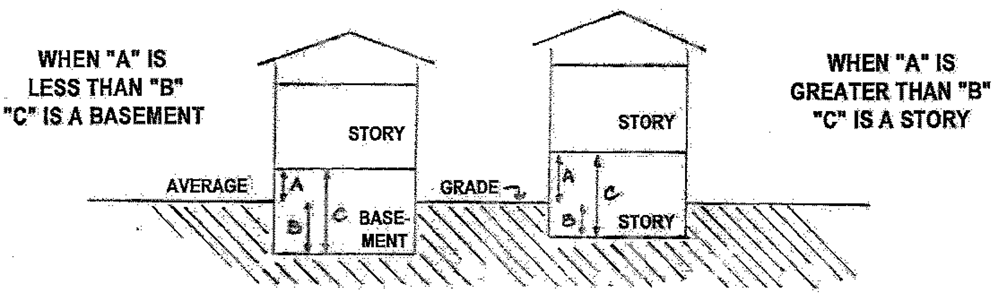
Basement means that portion of a building which is partly or wholly below grade but so located that the vertical distance from the average grade to the floor is greater than the vertical distance from the average grade to the ceiling. A basement shall not be counted as a story.
Bed and breakfast home means a single-family residential structure that has six or fewer sleeping rooms, including sleeping rooms occupied by the innkeeper, which are available for rent to overnight guests and serves meals at no extra cost to overnight guests.
Bistro means a restaurant with a full-service kitchen, limited interior seating, limited bar area and seating, and additional seating for outdoor dining.
Breezeway means a structure or addition to a structure, without heat or air conditioning equipment that is more than six feet wide with a permanent roof and sidewalls or screens that may or may not connect the principal residence with one or more accessory buildings.
Buildable area means the portion of a lot remaining after required yards have been provided.
Building means any structure, either temporary or permanent, having a roof, including among other things tents, canopies, and carports.
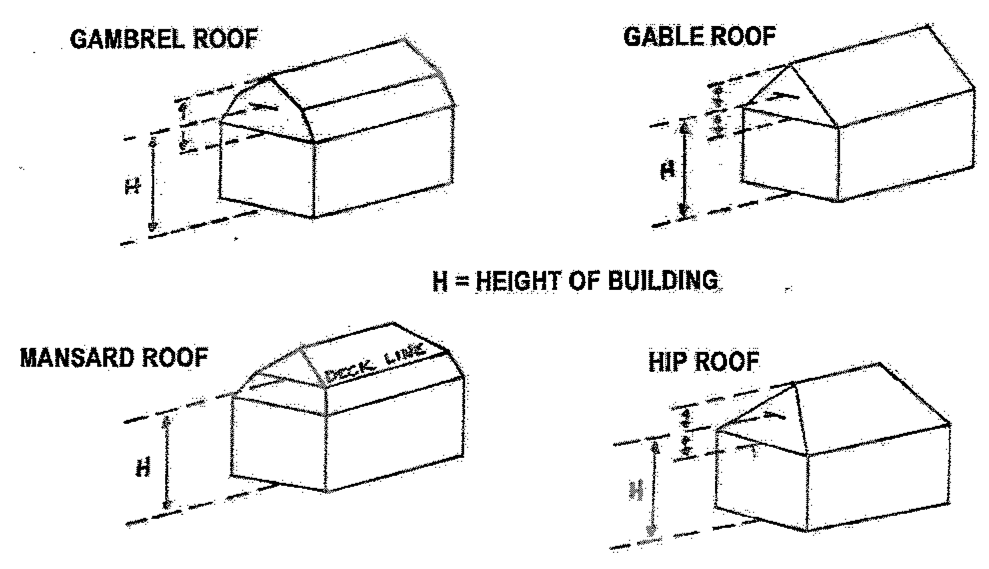
Building height means the vertical distance measured from the established grade to the highest point of the roof's surface for flat roofs; to the deckline of mansard roofs; and to the average height between eaves and ridge for gable, hip and gambrel roofs. Where a building is located on sloping terrain, height may be measured from the average ground level of the grade at the building wall.
Clinic, psychological, means any use that includes two or more psychiatrists, psychologists, and similar professional, paraprofessional, medical and non-medical psychological counselors.
(Ord. No. 2004-12, 9-13-2004; Ord. No. 2009-07, pt. 13, 3-9-2009; Ord. No. 2009-21, pt. 1, 11-9-2009; Ord. No. 2010-10, § 3901, 4-26-2010; Ord. No. 2012-11, 8-13-2012)
Sec. 3902. - Definitions D—E.
Deck means an exterior floor system supported on at least two opposing sides by an adjoining structure and/or posts, piers, or other independent supports.
Drive-in restaurant or refreshment stand means any place or premises used for sale, dispensing, or serving of food, refreshments, or beverages in automobiles, including those establishments where customers may also serve themselves and may eat or drink the food, refreshments, or beverages on the premises.
Dwelling, mobile home, means a detached residential dwelling unit designed for transportation, after fabrication, on streets or highways on its own wheels or on flatbed or other trailers and arriving at the site where it is to be occupied as a dwelling complete and ready for occupancy except for minor and incidental unpacking and assembly operation, location on jacks or other temporary or permanent foundations, connection to utilities, and the like. A mobile home shall be one story in height, with a minimum body width of ten feet, a minimum floor area of 576 square feet, a maximum floor area of 1,000 square feet, built on a chassis, and designed to be used as a dwelling for long-term, continuous occupancy. A travel trailer is not a mobile home. Floor area and body width shall be measured to the exterior face of the exterior walls.
Dwelling, multiple-family, means a residential building designed for or occupied by three or more families, with the number of families in residence not exceeding the number of dwelling units provided.
Dwelling, single-family, or dwelling, one-family, means a detached residential dwelling unit other than a mobile home, designed for and occupied by one family only.
Dwelling, two-family, means a detached residential building containing two dwelling units, designed for occupancy by not more than two families.
Dwelling unit means one room or rooms connected together, constituting a separate, independent housekeeping establishment for one-family occupancy, and physically separated from any other rooms or dwelling units which may be in the same structure, and containing independent cooking, bathroom, and sleeping facilities.
Entrance ramp means a roadway connecting a feeder road with a limited access highway and used for access to such limited access highway.
Essential services means the erection, construction, alteration, or maintenance by public utilities, municipal departments, or public commissions of underground, surface, or overhead gas, electric, steam or water transmission or distribution systems, collection, communication, supply or disposal systems, including streets, mains, drains, sewers, pipes, conduits, wires, cables, fire alarm boxes, police call boxes, traffic signals, hydrants, street lighting, poles and other similar equipment, and accessories in connection therewith reasonably necessary for the furnishing of adequate service by such public utilities, municipal departments, or public commissions, or for the public health, safety, or general welfare, but excluding the construction or erection of:
(1)
Buildings.
(2)
Any of the following structures, unless the particular structure(s) and its location, height, and character have been approved by the city in conjunction with its approval of a subdivision plat:
a.
Any tower or pole over 35 feet in height;
b.
Any tank or other structure over four feet in height.
However, the repair, maintenance, or emergency replacement of any of the foregoing shall be considered an essential service.
(Ord. No. 2004-13, 9-13-2004)
Sec. 3903. - Definitions F—H.
Family means one or more individuals, living together as a single housekeeping unit in one dwelling unit, all related by blood, marriage, or operation of law, and not more than three other individuals. Thus, if all of the individuals are unrelated, the maximum number shall be four.
Family child care home means a private home in which one but fewer than seven minor children are received for care and supervision for periods of less than 24 hours a day, unattended by a parent or legal guardian, except children related to an adult member of the family by blood, marriage, or adoption. [The term] "family child care home" includes a home in which care is given to an unrelated minor child for more than four weeks during a calendar year. The home must be the bona fide private residence of the operator of the family care home. Family child care homes are a principal permitted use in One-Family Residential Districts.
Farm [or]farming means, for purposes of this ordinance, a farm or farming means generally recognized farming, including livestock and poultry raising, dairying, horticulture, forestry; and similar agricultural uses of land and structures, except a farm operated wholly or in part for the disposal of garbage, sewage, rubbish, offal, and wastes from rendering plants.
Fence means any partition, structure or gate erected as a dividing marker, barrier or enclosure.
Floor area.
(1)
For the purpose of computing the minimum allowable floor area in a residential, one-family dwelling unit, the sum of the horizontal areas of each story of a building shall be measured from the exterior faces of the exterior walls. The floor area measurement is exclusive of areas of basements, unfinished attics, attached garages, or space used for off-street parking, breezeways, enclosed and unenclosed porches, and accessory structures.
(2)
In the case of two family or multifamily dwellings, the minimum allowable floor area of a dwelling unit is the horizontal floor area of the dwelling unit measured to the interior face of the dwelling unit's perimeter walls, excluding hallways and common areas.
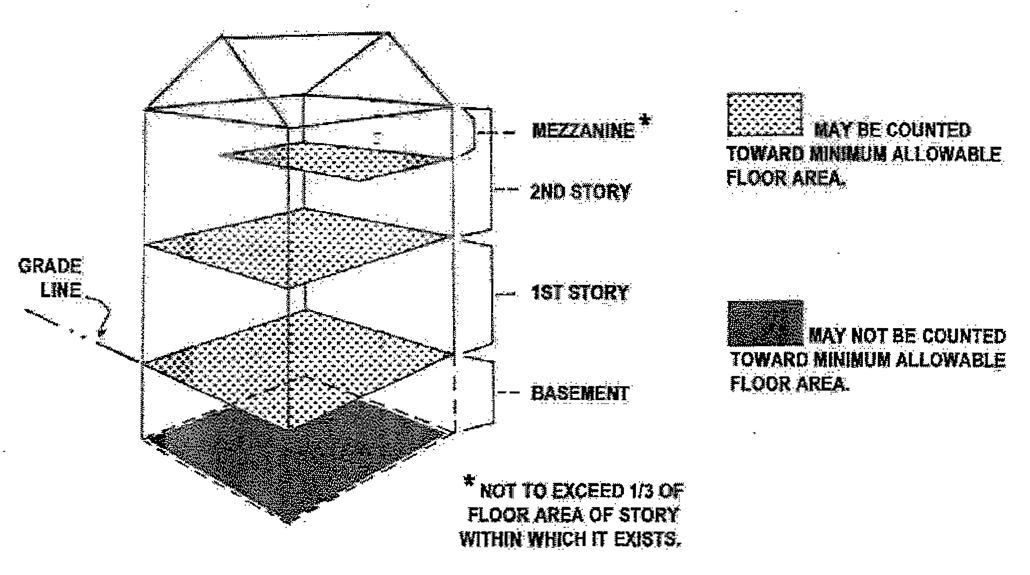
Floor area, gross (for purposes of computing parking requirements). [The term] "gross floor area" shall be the sum of the horizontal areas of the several floors of the building, including the basement, measured from the exterior faces of the exterior walls.
Garage, private. An accessory building or an accessory portion of the main building, designed and/or used primarily for the shelter and storage of vehicles owned or operated by the occupants of the main building.
Side-loaded garage means a garage where the garage door(s) face a side lot line.
Rear-loaded garage means a garage where the garage door(s) face the rear lot line.
Front-loaded garage means a garage where the garage door(s) face the front lot line.
Gasoline service station means a place for the dispensing and retail sale of motor fuels directly to users of motor vehicles, together with the sale of oil, grease, batteries, tires and vehicle accessories, and incidental repairs and services. Permissible uses do not include major mechanical and body work, straightening body parts, painting, welding, storage of automobiles not in operating condition, or other work involving noise, glare, fumes, smoke, or other characteristics to an extent greater than normally found in gasoline service stations. A gasoline station is not a repair garage nor a body shop.
Group child care home means a private home in which more than six but not more than 12 minor children are given care and supervision for periods of less than 24 hours a day unattended by a parent or legal guardian, except children related to an adult member of the family by blood, marriage, or adoption. [The term] "group child care home" includes a home in which care is given to an unrelated minor child for more than four weeks during a calendar year. The home must be the bona fide private residence of the operator of the group child care home. Group day care homes are permitted as a special exception use in the O-1, O-2, B-1 and CBD Districts.
Group housing means housing occupied by a group of individuals not constituting a family, such as fraternity, sorority, orphanage, religious order, and similar groups.
Home occupation means an occupation conducted in a dwelling unit, provided that:
(1)
No person other than members of the family residing on the premises shall be engaged in such operation;
(2)
The use of the dwelling unit for the home occupation shall be clearly incidental and subordinate to its use for residential purposes by its occupants, and not more than 25 percent of the floor area of the dwelling unit shall be used in the conduct of the home occupation; for purposes of this paragraph, the basement floor area shall be included in the dwelling unit's floor area to the extent of its usage by the home occupation;
(3)
There shall be no change in the outside appearance of the building or premises or other visible evidence of the conduct of such home occupation other than one sign, not exceeding one square foot in area, non-illuminated, and mounted flat against the wall of the principal building;
(4)
No home occupation shall be conducted in any accessory building;
(5)
There shall be no sales of goods on the premises in connection with such home occupation;
(6)
No traffic shall be generated by such home occupation in greater volumes than would normally be expected in a residential neighborhood, and any need for parking generated by the conduct of such home occupation shall be met off the street and other than in a required front yard;
(7)
No equipment or process shall be used in such home occupation which creates noise, vibration, glare, fumes, odors, or electrical interference detectable to the normal senses off the lot, if the occupation is conducted in a single-family residence, or outside the dwelling unit if conducted in other than a single-family residence. In the case of electrical interference, no equipment or process shall be used which creates visual or audible interference in any radio or television receivers off the premises, or causes fluctuations in line voltage off the premises.
(Ord. No. 2009-07, pt. 14, 3-9-2009; Ord. No. 2009-27, § 3903, 12-21-2009; Ord. No. 2017-06, pt. I, 6-12-2017)
Sec. 3904. - Definitions I—L.
Loading space, off-street, means space logically and conveniently located for bulk pickups and deliveries, scaled to delivery vehicles expected to be used, and accessible to such vehicles when required off-street parking spaces are filed. Required off-street space is not to be included as off-street parking space in computation of required off-street parking space.
Lot, for the purposes of this ordinance, means a parcel of land of at least sufficient size to meet minimum zoning requirements for use, coverage, and area, and to provide such yards and other open spaces as are herein required. Not more than 25 percent of the required lot area shall be under water. Such lot shall have frontage on a recorded or public street, and may consist of:
(1)
A single lot of record;
(2)
A portion of a lot of record;
(3)
Combination of complete lot of record, of complete lots of record and portions of lots of record, or of portions of lots of record;
(4)
A parcel of land described by metes and bounds; provided that in no case of division or combination shall any residual lot or parcel be created which does not meet the requirements of this ordinance.
Lot frontage means the front of a lot shall be construed to be the portion nearest the street. For the purposes of determining yard requirements on corner lots and through lots, all sides of a lot adjacent to streets shall be considered frontage, and yards shall be provided as indicated under [the definition for] yards in section [3907].
Lot measurements.
(1)
Depth of a lot shall be considered to be the distance between the midpoints of straight lines connecting the foremost points of the side lot lines in front and the rearmost points of the side lot lines in the rear.
(2)
Width of a lot shall be considered to be the distance between straight lines connecting front and rear lot lines at each side of the lot; provided, however, that in determining lot frontage on odd shaped lots, if the lot abuts on the outside curve boundary of a curving street and as a result the side lot lines diverge toward the rear, the measurement of width may be taken at the front building line of the principal building; and provided further that, if the lot abuts on an inside curve boundary of a curved street wherein the lot lines converge toward the rear, the measured width shall be taken at the rear line of the principal building or 30 feet behind the front setback line, parallel to the street or street chord.
Lot of record means a lot which is part of a subdivision recorded in the office of the county register of deeds, or a lot or parcel described by metes and bounds, the description of which has been so recorded.
Lot types. The diagram below illustrates terminology used in this ordinance with reference to corner lots, interior lots, and through lots.
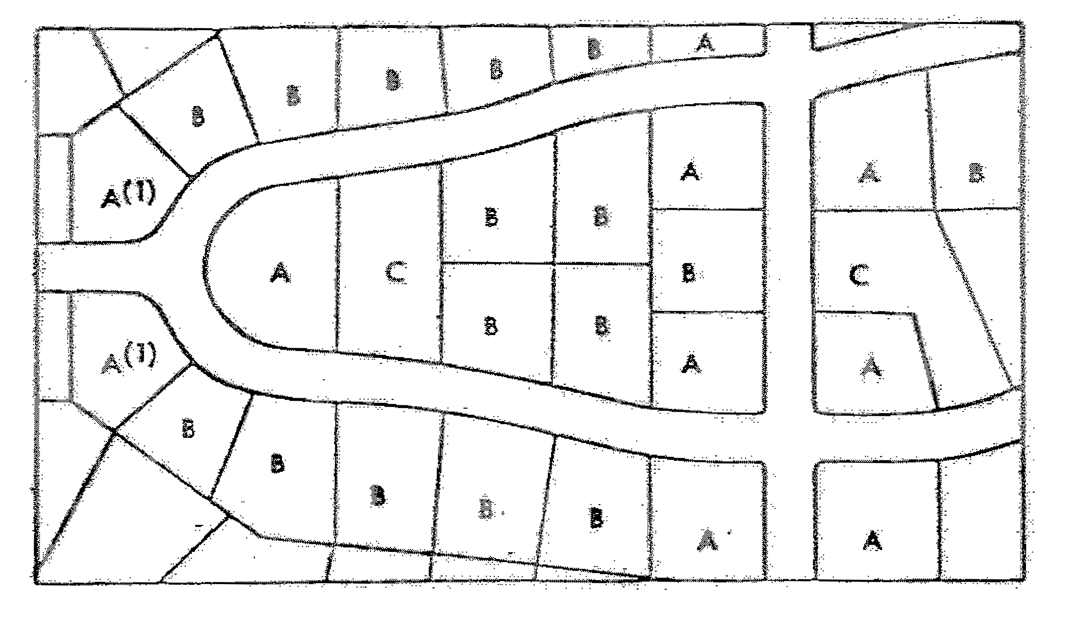
In the diagram, "A" equals corner lot, defined as a lot located at the intersection of two or more streets. A lot abutting on a curved street or streets shall be considered a corner lot if straight lines drawn from the foremost points of the side lot lines to the foremost point of the lot meet on an interior angle of less than 135 degrees. See lots marked A(1) in the diagram.
In the diagram, "B" equals interior lot, defined as a lot other than a corner lot with only one frontage on a street.
In the diagram, "C" equals through lot, defined as a lot other than a corner lot with frontage on more than one street. Through lots abutting two streets may be referred to as double frontage lots.
Sec. 3905. - Definitions M—R.
Mezzanine means an intermediate floor in any story occupying no more than one-third of the floor area of such story.
Open space means a tract or tracts of land set aside for the preservation and enjoyment of significant natural resources and/or natural features that is subject to public or private development restrictions or limitations.
Outdoor advertising business means provision of outdoor display space on a lease or rental basis only.
Overnight lodging facilities means commercial establishments including hotels, motels, inns and the like which provide lodging, meals, and other guest services.
Park means a tract of land, including any non-navigable water courses and water features located thereon, designated and used for active and/or passive recreation.
Parking space, off-street.
(1)
For the purposes of this ordinance, an off-street parking space shall consist of a space adequate for parking an automobile with room for opening doors on both sides, together with properly related access to a public street or alley and maneuvering room. Required off-street parking areas for three or more automobiles shall have individual spaces marked, and shall be so designed, maintained, and regulated that no parking or maneuvering incidental to parking shall be on any street, walk, or alley, and so that any automobile may be parked and unparked without moving another. Each parking space shall comprise a net area of at least ten feet by 20 feet.
(2)
For purposes of rough computation, an off-street parking space and necessary access and maneuvering room may be estimated at 300 square feet, but off-street parking requirements will be considered to be met only when actual spaces meeting the requirements above are provided and maintained, improved in a manner appropriate to the circumstances of the case, and in accordance with all ordinances and regulations of the municipality.
Permanent roof means a non-seasonal roofing or cover system intended to remain in place and to provide year-round protection from sun, rain, snow and the like. This definition is not intended to include canvas or vinyl awnings or retractable covers of any kind.
Public utility means any person, firm, corporation, municipal department or board duly authorized to furnish, and furnishing under state or municipal regulations to the public: electricity, gas, steam, communications, telegraph, transportation, or water.
Raised patio means an exterior raised system, other than a deck, generally constructed with a retaining wall of brick, masonry, wood timbers, or the like and backfilled with soil, sand, or similar earth material and topped with a durable walking surface.
Restaurant means a building in which food is prepared and sold for consumption within the building, as opposed to a drive-in restaurant establishment where food may be taken outside of the building for consumption either on or off the premises.
(Ord. No. 2004-14, 9-13-2004; Ord. No. 2009-22, pt. 1, 11-9-2009; Ord. No. 2010-02, 1-11-2010)
Sec. 3906. - Definitions S—T.
Satellite dish antenna means an accessory structure capable of receiving, for the sole benefit of the principal use, radio or television signals from a transmitter or transmitter relay located in planetary orbit.
Sign means any device designed to inform or attract the attention of persons not on the premises on which the sign is located.
Sign, off-site, means a sign other than an on-site sign.
Sign, on-site, means a sign relating in its subject matter to the premises on which it is located, or to products, accommodations, services, or activities on the premises. On-site signs do not include signs erected by the outdoor advertising industry in the conduct of the outdoor advertising business.
Significant portion, in the definition of Adult motion picture theater, shall mean or include either or both of the following:
(1)
Any one or more portions of the display having a duration in excess of five minutes; and/or
(2)
The aggregate of portions of the display having a duration equal to ten percent or more of the single display as a whole.
Special exception means a use that would not be appropriate generally or without special restriction throughout the zoning district, but which, if controlled as to number, area, location or relation to the neighborhood, and if subject to special restrictions, would promote the public health, safety, morals, order, comfort, convenience, appearance, prosperity, or general welfare. Such uses may be permitted in such zoning district as special exceptions, as provided for in this ordinance.
Specified anatomical areas means either human male genitals in a discernable turgid state, even if completely and opaquely covered, or the following if less than completely and opaquely covered:
(1)
Human genitals or pubic regions.
(2)
Human buttocks.
(3)
Human female breasts below a point immediately above the top of the areola.
Specified sexual activities means the following:
(1)
Human genitals in a state of sexual stimulation or arousal.
(2)
Acts of human masturbation, sexual intercourse or sodomy.
(3)
Fondling or other erotic touching of human genitals, pubic regions, buttocks, or female breasts.
State licensed residential facility means a structure constructed for residential purposes that is licensed by the state under the Adult Foster Care Facility Licensing Act, [Act 218, Public Acts of 1979,] MCL 400.701—400.737, or 1973 PA 116, MCL 722.111—722.128, and provides residential services for six or fewer persons under 24-hour supervision or care. Such facilities may include an adult foster care facility, foster family home, or foster family group homes and shall be considered a residential use of property for the purposes of zoning and a principal permitted use in all residential zones. This term shall not apply to adult foster care facilities licensed by a state agency for care and treatment of persons released from or assigned to adult correctional institutions.
Story means that part of a building, except a mezzanine, as defined herein, included between the surface of one floor and the surface of the next floor, or if no floor above, then the ceiling next above. A part of a building thus defined shall not be counted as a story when more than 50 percent by cubic content is below the height level of the adjoining ground.
Story, half, means an uppermost story lying under a sloping roof, the gross floor area of which does not exceed 50 percent of the floor area of the story immediately below it.
Street means a thoroughfare for vehicular traffic, generally includes everything found within the right-of-way.
Street line means the right-of-way line of a street or easement for ingress and egress.
Structure means anything constructed or erected with a fixed location on the ground, or attached to something having a fixed location on the ground. Among other things, structures include buildings, mobile homes, walls, fences, billboards, and signs.
Subdivision, mobile, means a legally platted residential subdivision approved by the planning commission and where residence is intended to be in mobile home or trailer coaches.
Trailer coach or travel trailer means a vehicular portable structure built on a chassis, designed to be used as a temporary dwelling for travel and recreational purposes, having a body width not exceeding eight feet and a body length not exceeding 30 feet.
Treatment station means any individual work station where an employee provides services to a customer. In the context of a beauty parlor, a treatment station shall include but not be limited to, hair cutting chairs; shampoo sinks/chairs; manicure, makeup or facial chairs; and the like.
(Ord. No. 2009-07, pt. 15, 3-9-2009)
Sec. 3907. - Definitions U—Z.
Use, accessory, a subordinate use which is customarily incidental to the principal use on the same lot.
Use, principal, means the primary and chief purpose for which a lot is used.
Variance means a relaxation of the terms of the zoning ordinance where such variance will not be contrary to the public interest and where owing to conditions peculiar to the property and not the result of the actions of the applicant, a literal enforcement of this ordinance would result in unnecessary and undue hardship. As used in this ordinance, a variance is authorized only for height, area, and size of structure or size of yards and open spaces; establishment or expansion of a use otherwise prohibited shall not be allowed by variance, nor shall a variance by granted because of the presence of nonconformities in the zoning district or uses in an adjoining zoning district.
Walkway, covered, means a structure six feet or less in width, with a permanent roof that connects a principal residence to one or more accessory structures.
Walkway, enclosed, means a structure six feet or less in width, with a permanent roof and sidewalks or screens that connects a principal residence to one or more accessory structures.
Yard means a required open space, other than a court, unoccupied and unobstructed by any structure or portion of a structure from 30 inches above the general ground level of the graded lot upward; provided, however, that fences, walls, poles, posts, and other customary yard accessories, ornaments, and furniture, but not including decks, may be permitted in any yard subject to height limitations and requirements limiting obstruction of visibility.
Decks may be permitted to occupy not more than 25 percent of a required rear yard, subject to the following:
(1)
The maximum projection into the required rear yard shall be 16 feet.
(2)
No part of a deck shall be located on the ground within any landscaped stabilization zone; however, a deck may be cantilevered not more than eight feet over any landscaped stabilization zone where it will not interfere with the normal growth of the vegetation used to stabilize the banks.
Yard, front, means a yard extending the full width of a lot across the front of a lot adjoining a public street or a private street approved by the board of appeals or the city planning commission in conjunction with approval of a site plan.
(1)
The depth of a front yard shall be measured at right angles to a straight line joining the foremost point of the side lot lines. The foremost point of the side lot line, in the case of rounded property corners at street intersections, shall be assumed to be the point at which the side and front lot lines would have met without such rounding. The front and rear lines of front yards shall be parallel.
(2)
In the case of through lots, unless the prevailing front yard pattern on adjoining lots indicates otherwise, front yards shall be provided on all frontages. Where one of the front yards that would normally be required on a through lot is not in keeping with the prevailing yard pattern, the administrative official may waive the requirement for the normal front yard and substitute therefor a special yard requirement which shall not exceed the average of the yards provided on adjacent lots.
(3)
For corner lots in a residential district, the front yard shall be the yard abutting the street which is designated as the front street in the plat and in the application for a building permit or zoning occupancy permit. If there is no such designation, the narrower lot frontage shall be considered the front in determining building siting and required setbacks. The other side abutting a street shall be considered a side yard, and shall meet the minimum setback for side yards in the district in which it is located, and is required to meet the larger of the side yard minimum requirements. On corner lots where the rear lot line of a parcel (parcel X) abuts the side lot line of a parcel (parcel Y) with frontage onto the other street, detached accessory buildings shall be placed in the rear yard of the parcel X, beyond the established front yard line for the parcel Y (as shown in fig. 4).
Yard, rear, means a yard extending across the full width of the lot, the depth of which is the required horizontal distance between the rear lot line and the nearest point of the principal building.
Yard, side, means a yard extending from the required front yard to the required rear yard. In the case of through lots, side yards shall extend from the rear lines of front yards required. Width of a required side yard shall be measured in such a manner that the yard established is a strip of the minimum width required by the district regulations with its inner edge parallel with the side lot line.
(Ord. No. 2004-15, 9-13-2004; Ord. No. 2014-04, 3-24-2014)

