
Rochester City Zoning Code
ARTICLE 23
- PERFORMANCE STANDARDS
Sec. 2300.- [Activity or operation producing irritants to sensory perceptions.]
(a)
It shall be unlawful to carry on or permit to be carried on any activity or operation or use any land, building, or equipment that produces irritants to the sensory perceptions or other physical results greater than the measures herein established which are hereby determined to be the maximum permissible hazards to humans or human activities. Such measures may be supplemented by other measures which are duly determined to be maximum permissible hazards to humans or to human activity.
(Ord. No. 2012-16, 11-12-2012)
Sec. 2301. - Sound.
(a)
At no point on the lot line shall the sound pressure level of any operation on the lot (other than background noises produced by sources not under the control of this ordinance, such as from essential services or street traffic) exceed the decibel limits in the octave bands designated below:
(b)
No person shall ignite or discharge sound producing consumer fireworks or display fireworks on any property in the city that are audible from any residential properties, except in strict compliance with fireworks regulations of the State of Michigan and the city, including chapter 22, article III of the City Code.
(Ord. No. 2012-16, 11-12-2012)
Sec. 2302. - Vibration.
(a)
All machinery shall be so mounted and operated as to prevent transmission of ground vibration exceeding a displacement of 0.003 of one inch measured at any lot line of its source, or ground vibration which can be readily perceived by a person standing at any such lot line. No stamping machine, punch press, press break, or similar machines shall be located closer than 300 feet to a residential district without written certification by the zoning administrator that a nuisance is not thereby caused to the residential district.
Sec. 2303. - Odor.
(a)
The emission of noxious, odorous matter in such quantities as to be readily detectable at any point along lot lines or to produce a public nuisance or hazard beyond lot lines is prohibited.
Sec. 2304. - Gases.
(a)
The escape of or emission of any gas which is injurious, destructive, or explosive shall be unlawful and may be summarily caused to be abated.
Sec. 2305. - Glare and heat.
(a)
Any operation producing intense glare or heat shall be performed within an enclosure so as to completely obscure and shield such operation from direct view from any point along the lot line, except during the period of construction of the facilities to be used and occupied.
Sec. 2306. - Light and illumination.
It is the intent of this section to regulate exterior lighting for such things as parking lots, buildings, and signs in a manner that establishes appropriate minimum levels of illumination, prevents unnecessary glare for drivers on adjacent thoroughfares, reduces spill-over onto adjacent residential properties and reduces unnecessary transmission of light into the night sky. The requirements of this section are not intended to apply to the city's "hook and bell" fixtures on Main Street nor to the city's historic-style acorn fixture, including the use of the approved acorn fixture on private property.
(1)
General requirements for exterior lighting in the CBD, B-1, O-1 and O-2 districts. Exterior lighting shall be designed to minimize glare, reduce spill-over onto adjacent properties, and provide appropriate levels of illumination, but shall not result in excessive nighttime illumination. The following conditions shall apply:
a.
Light levels shall meet the minimum need for safety, security and illumination of a specific use, as determined by the planning commission or the building official, based upon a lighting plan submitted with the applicant's site plan.
b.
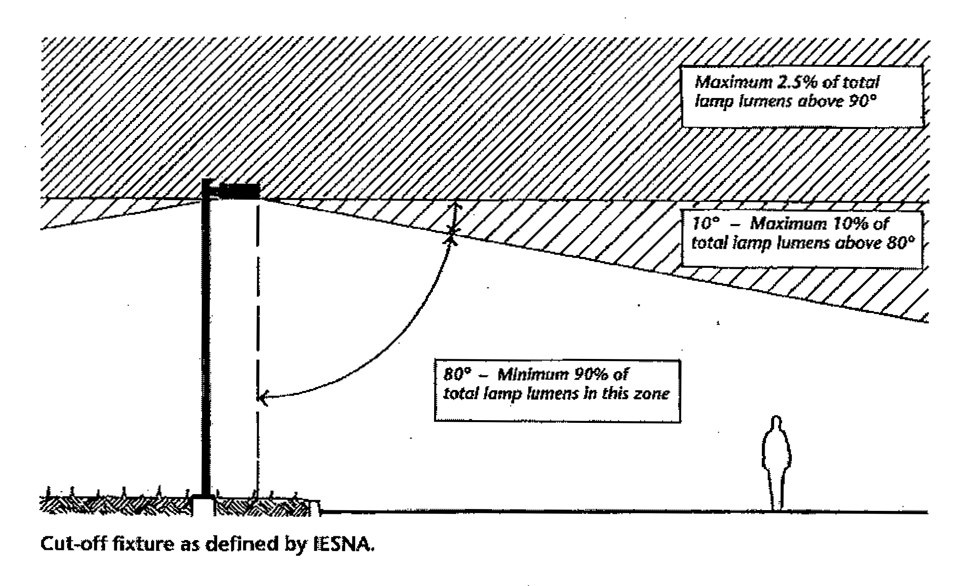
To control glare, all light fixtures shall have a cut-off angle of less than 90 degrees, except decorative pedestrian fixtures of 100 watts or less.
c.
The city may choose to waive or alter cut-off requirements of this section when appropriate historic or decorative fixtures are proposed (e.g., use of decorative up-lighting to illuminate the underside of a canopy or columns on a facade, where a canopy or roof projection restricts the projection of the light into the night sky).
d.
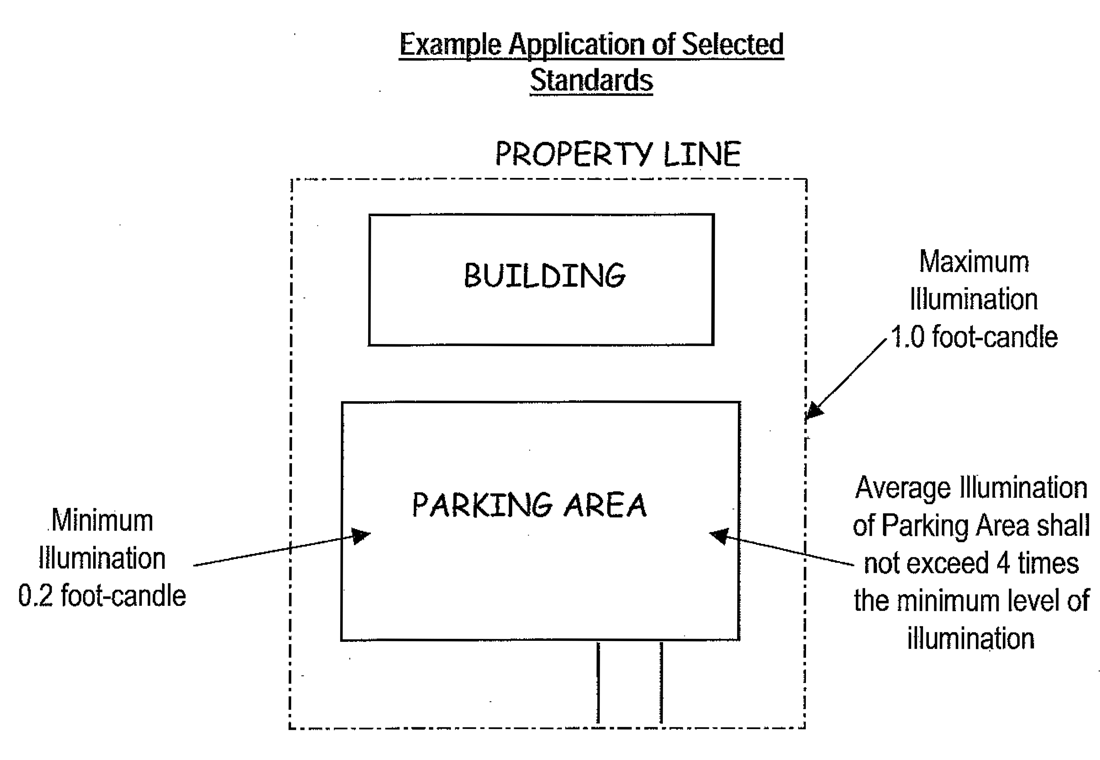
Light fixtures shall be located at least five feet from any property line and shall be directed and shielded to cast light away from adjacent properties and streets. The maximum illumination levels at any property line shall not exceed one footcandle.
e.
Glare control shall be accomplished primarily through the proper selection and application of lighting equipment. Only after those means have been exhausted shall landscaping, fencing and similar screening methods be considered acceptable means for reducing glare.
f.
Lamps with true color rendition are preferred, such as incandescent and metal halide lamps. The use of mercury vapor and low and high pressure sodium lamps are prohibited. However, the planning commission may permit the use of high pressure sodium lighting at the intersections of driveways with public streets when the average illumination level on the ground does not exceed six footcandles.
g.
Exterior lighting fixtures should be of a design and size compatible with the building. The use of floodlights, wall-pack lighting, or other types of diffused, unshielded lighting is prohibited.
h.
Artificial light shall be maintained stationary and constant in intensity and color at all times when in use. There shall be no flashing, oscillating, moving or intermittent type of lighting or illumination.
i.
Maximum permitted fixture height:
1.
Parking lot luminaires shall not exceed 20 feet.
2.
Unshielded pedestrian fixtures shall not exceed ten feet.
3.
All other light fixtures shall not be mounted in excess of the maximum height limitation of the district in which they are located.
(2)
Exterior lighting levels in the CBD, B-1, O-1, O-2 and P-1 districts. The intensity of exterior lighting shall be limited to the following minimum/maximum levels:
Minimum/Maximum 1 Footcandle Amounts for Various Land Uses
Notes to Table of Minimum/Maximum 1 Footcandle Amounts:
1 The maximum allowable footcandle levels shall be governed by the 4:1 ratio of average to minimum illumination of the surface being lit, expressed as the average across the total area of the site or building being lighted, or directly beneath a canopy, divided by the minimum from the table above. The planning commission may modify these requirements where they determine it is necessary to protect nearby residences or driver visibility on adjacent roads.
2 Apron areas are away from the gasoline pump island, used for parking or vehicle storage.
3 Light fixtures mounted on canopies shall be installed so that the lens cover is recessed or flush with the bottom surface (ceiling) of the canopy and/or shielded by the fixture or the edge of the canopy.
4 The planning commission may require special conditions for properties adjacent to residential uses and districts.
(3)
Exterior lighting in all districts.
a.
Exterior lighting shall be arranged as far as practical to reflect light away from any residential use, and in no case shall more than one footcandle power of light cross a lot line five feet above the ground in a residential district.
b.
Exterior lighting from a commercial building or multiple-family dwelling in any district that abuts and faces a single-family dwelling in a residential district shall have shielding that directs light downward such that light does not shine on the windowed side(s) of said single-family dwelling. Any light fixtures existing at the time of the enactment of this subsection b. that do not conform to this requirement must be removed or brought into compliance upon the first of the following to occur:
1.
The nonconforming light is damaged to the extent that the cost of repairing it to its former condition exceeds 50 percent of the cost of such light fixture;
2.
The nonconforming light is replaced; or
3.
Six months from the date subsection b. becomes effective.
c.
Standard lights from single family residences abutting other residences in a residential district are subject to the one footcandle power limitation in subsection (3)a. above, but are exempt from the remaining provisions of this subsection (3).
(4)
Exemptions. The following uses shall be exempt from the provisions of this section:
a.
Roadway lighting required by the appropriate public agency for health, safety and welfare purposes;
b.
Construction lighting approved by the building department as part of a building permit;
c.
Flag lighting, provided that the illumination is the minimum level necessary, and that the light source is aimed and shielded to direct light only onto the intended target and to prevent glare for motorists and pedestrians;
d.
Emergency lighting approved by the city, provided the lighting is discontinued upon the abatement of the emergency necessitating said lighting; and
e.
Other temporary lighting determined to be reasonable and appropriate by the City of Rochester.
(Ord. No. 2004-04, 3-22-2004; Ord. No. 2021-10, § 1, 12-20-2021)
Sec. 2307. - Smoke, dust, and other particulate matter.
(a)
For purposes of this section: "smoke" is any visible emission into the open air from any source, except emissions of an uncontaminated water vapor; a "smoke unit" is a measure of the quantity of smoke being discharged and is the number obtained by multiplying the smoke density in the smoke chart by the time of emission in minutes. Thus, the emission of smoke at a density of smoke chart number 1 for one minute equals one smoke unit. The Ringelmann Smoke Chart shall be the standard smoke chart, and shall be on file with the administrative official. The density of smoke emission shall not exceed smoke chart number 2, and the quantity of smoke shall not exceed ten smoke units per hour per stack.
Sec. 2308. - Drifted and blown material.
(a)
The drifting or airborne transmission beyond the lot line of dust particles, or debris from any open stockpile shall be unlawful and may be summarily caused to be abated.
Sec. 2309. - Nuclear radiation.
(a)
Nuclear radiation shall not be emitted to exceed quantities established as safe by the U.S. Nuclear Regulatory Commission.
Sec. 2310. - Water supply and sewage disposal.
(a)
Every building used or intended to be used for human habitation or human occupancy, including but not limited to dwelling, industrial, commercial, office, and institutional uses, shall be furnished with water supply and sewage disposal as provided for in the building code ordinance. Accessory buildings, such as garages or storage buildings, intended and used for incidental or no human occupancy are excluded from this requirement, except that if water supply and-or sewage disposal is furnished to such building, it shall comply with the standards of the building code.
Sec. 2311. - Open storage.
(a)
The open storage of any industrial or commercial equipment, vehicles, and all materials, including wastes, except new vehicles for sale and/or display, shall be screened from public view, from a public street, and from adjoining properties by an obscuring wall or fence not less than six feet nor more than eight feet high. The required height of the wall shall be determined by the planning commission so as to properly screen all materials, vehicles and wastes. Vehicles and equipment over eight feet high must be properly screened but need not be completely screened above eight feet. Materials must be completely screened if they are stored within 20 feet of the screen wall or fence. All wastes must be completely obscured from view. In no instance shall any open storage of equipment, vehicles and/or materials be permitted within a required front yard in any zoning district.

