
Rochester City Zoning Code
ARTICLE 21
- SUPPLEMENTARY DISTRICT REGULATIONS
Sec. 2100.- Visibility at intersections and corner clearance.
(a)
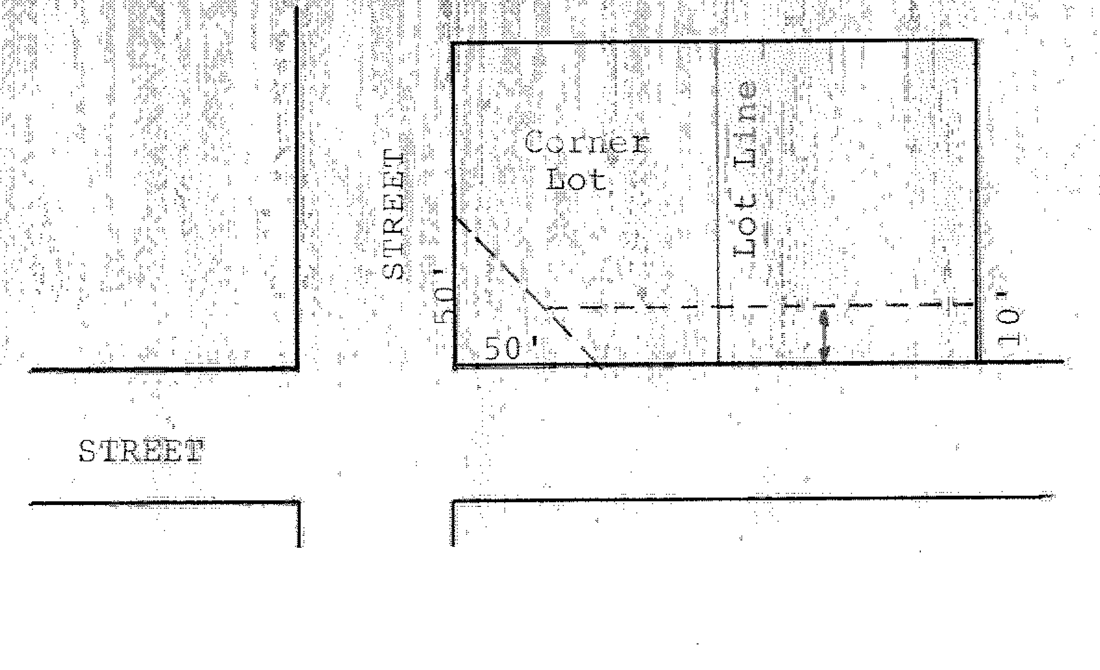
On corner lots in all districts, nothing shall be erected, placed, or allowed to grow in such a manner that it impedes vision between a height of 30 inches and ten feet in an area bounded by the street lines of such corner lots and a line joining points along said street lines 25 feet from the point of intersection.
(b)
Minimum sight distance for commercial, industrial, institutional, public road, and private road approaches onto city streets and county roads shall be in accordance with the American Association of State Highway and Transportation Officials' (AASHTO) standards for both vertical and horizontal alignment. Where AASHTO standards cannot be met, an alternative plan shall be developed in consultation with the city engineer and approved by the city council.
Unless otherwise specified by the city engineer, sight distance shall be measured 50 feet from the centerline of an existing city or county road. For intersection sight distance, the eye height shall be assumed to be 3.5 feet above road grade and the object height shall be 4.25 feet and shall be continuously visible within the specified limits.
Sec. 2101. - Walls and hedges.
(a)
In the front ten feet of any required front yard in a residential district, no wall shall be permitted which materially impedes vision across such yard above the height of 30 inches, and no hedge or other vegetation shall be permitted which materially impedes vision across such yard between the heights of 30 inches and five feet.
Sec. 2102. - Accessory buildings.
(a)
Location—Single-family residential. A building which is accessory to a single-family dwelling and which is not attached thereto shall not be located:
(1)
In the front yard or between the front building line of the principal building and the front lot line;
(2)
In any required side yard;
(3)
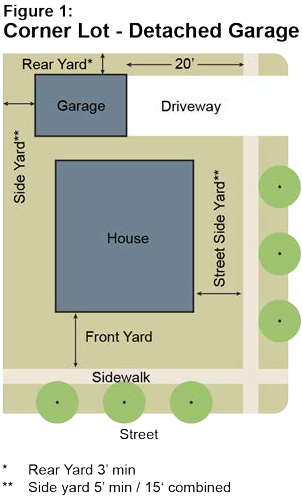
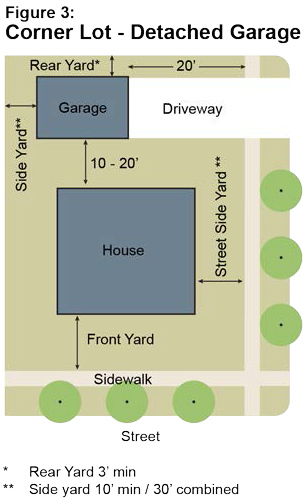
If on a corner lot, closer to the side street than the width of the side yard required for the principal building on such side street;
(4)
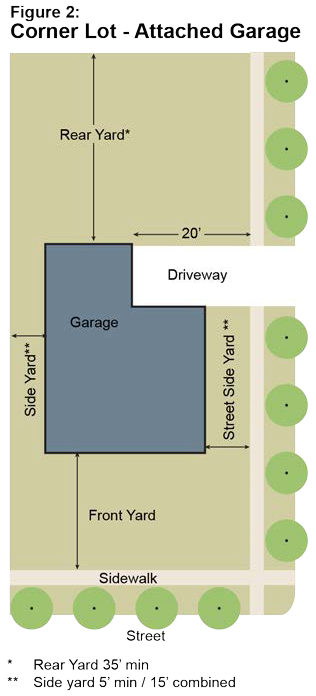
Closer than three feet to any rear lot line;
(5)
So that there is less than 20 feet in length of driveway between a garage or carport entrance and the street right-of-way providing access thereto;
(6)
In an R-4 or R-5 district:
a.
Closer to a side lot line than is allowed for a principal building;
b.
Closer than 20 feet to a principal building unless the accessory building has masonry walls, in which case it shall be located no closer than ten feet to a principal building.
(7)
All detached accessory structures, regardless of size, shall comply with detached accessory building setback requirements of this section. The following information and documents are required as the site plan submittal. The planning commission is authorized to reduce the information required in cases where it finds such information unnecessary or inappropriate for consideration of the particular application.
(b)
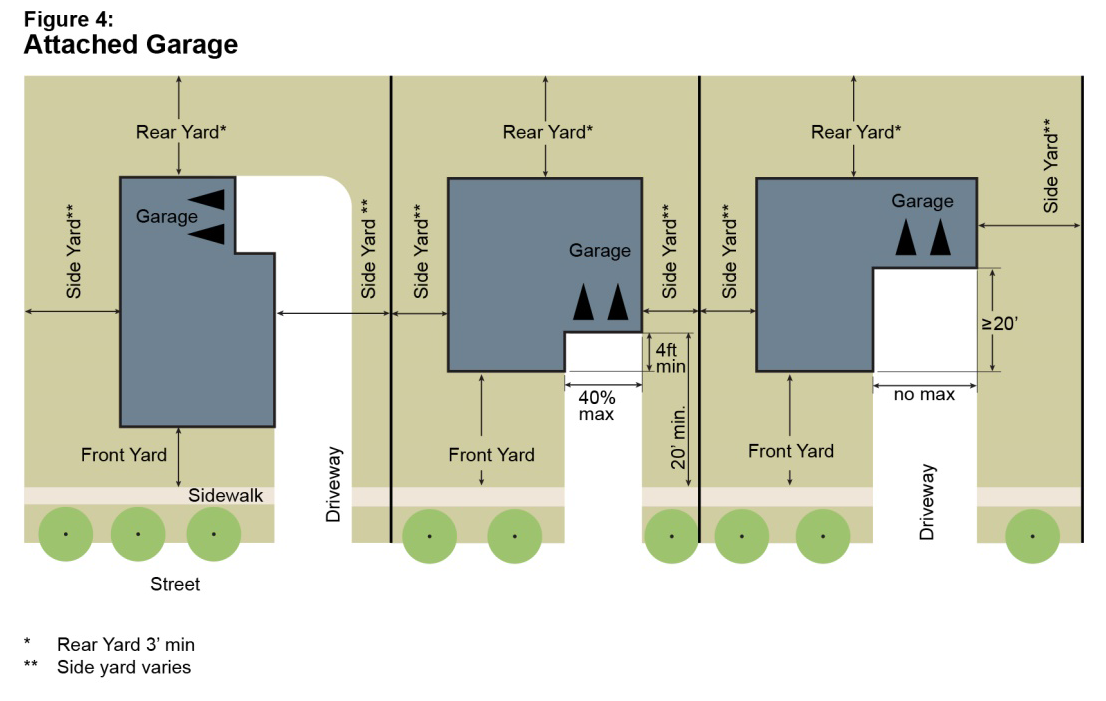
Same—Attached to dwelling. A building which is accessory to a single-family dwelling and attached thereto (such as attached garage or greenhouse) shall for purposes of location and setbacks be considered part of the principal building. Front entry garage doors shall be set back a minimum of four feet from the front wall of the principal dwelling, and may not comprise more than 40 percent of the width of any building façade that faces a street. Front entry garages may occupy a wider width when placed at or more than 20 feet behind the front wall of the principal dwelling. Side entry garages shall not be permitted in the front yard of parcels located in the R-1 and R-2 single family residential districts. There shall be at least 20 feet length of driveway apron between a garage or carport entrance and the street right-of-way providing access thereto. A detached garage may be connected to the principal residence by means of a covered walkway, enclosed walkway, or enclosed breezeway provided the covered walkway, enclosed walkway, or enclosed breezeway complies with all setback requirements enumerated in subsection (a) of this section for the principal residence.
(c)
Same—Uses other than single-family residential. The location of a building which is accessory to a principal building or use other than a single-family residential building (such as multifamily dwelling, commercial building, industrial building, or office building) shall be determined by the site plan which is approved by the city in accordance with the provisions of this ordinance.
(d)
Building height. The maximum building height of an accessory building in a One-Family Residential District shall be 13 feet. However, for every additional 20 feet of rear and side yard setback, the height of the accessory building can be increased by two feet. In no instance shall the height exceed 24 feet.
(e)
Floor area/lot coverage. In a One-Family Residential District the total coverage of all accessory buildings on a lot shall not exceed: ten percent of the lot's area; nor 25 percent of the rear yard; nor the ground coverage of the principal building. The total coverage by all accessory and principal buildings on a lot is set forth in the schedule of district regulations (article 20 of the zoning ordinance). Total lot coverage shall include the following:
(1)
There shall be not more than two detached accessory structures on any single-family homesite. All detached accessory structures over 100 square feet shall be included in total lot coverage.
(2)
Covered and/or enclosed walkways shall be included in total lot coverage.
(3)
Raised patios having 50 percent of their perimeter in excess of 30 inches above the average grade, as determined by the building inspector, shall be included in total lot coverage.
(4)
In-ground swimming pools with a walking surface in excess of 30 inches above grade for 50 percent or more of the combined perimeter shall be included in total lot coverage. Diving platforms are excepted.
(5)
Above-ground swimming pools with a sidewalk height of five feet or more for 50 percent or more of their perimeter shall be included in total lot coverage.
(6)
Any structure or area, including but not limited to a deck, porch, or patio with a permanent roof (regardless of size) attached to the principal residence shall be included in total lot coverage.
(f)
Other accessory use regulations.
(1)
No accessory building shall be constructed prior to the commencement of construction of its principal building.
(2)
In a residential district, the following are prohibited: storage of merchandise, and sale, repair, or service of motor vehicles. The parking of not more than two commercial vehicles within a garage is allowed.
(3)
Raised patios greater than 30 inches above the average grade shall not project into any required front or side yard and may project not more than 16 feet into a required rear yard.
(4)
In-ground swimming pools greater than 30 inches above the average grade and/or attached to or serviced by a raised patio shall not project into any required front or side yard and may project not more than 16 feet into a required rear yard.
(5)
Above-ground pools, regardless of height, attached to or serviced by a raised patio shall not project into any required front or side yard and may project not more than 16 feet into a required rear yard.
(6)
Heating elements are permitted for accessory buildings provided they meet all applicable building codes and manufacturers' specifications. Except for "plug-in" electric heaters, heating elements and ventilation systems shall be approved by the city building official before and after installation. Wood burning stoves, fireplaces and other elements with non-contained, non-furnace flames are prohibited. However, nothing in this section shall be deemed to prohibit a properly contained U.L. listed furnace device. Before any heating elements are utilized in accessory buildings, smoke detectors shall be installed and approved by the city building inspector. The use of heating elements shall not be in violation of any city, Michigan, federal regulations or manufacturers' specifications in any manner including, but not limited to, regulations restricting odor, emissions and discharging of particulate matter, as those regulations may be changed from time to time.
(7)
No accessory building shall be designed, built, or modified so as to create a separate, independent housekeeping establishment for occupancy (for example: containing independent cooking, bathroom, and sleeping facilities) nor shall such building be utilized as a habitable or tenantable living unit.
(g)
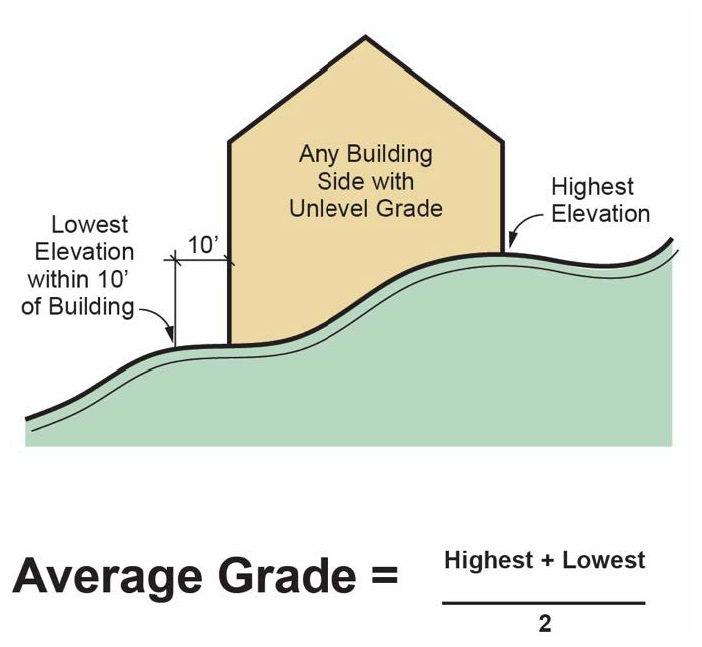
Average grade. Average grade, as referenced within this section, shall be determined by the building inspector based upon measurement of the existing grades at the perimeter of the proposed structure, patio, or pool.
(Ord. No. 2004-11, 9-13-2004; Ord. No. 2014-04, 3-24-2014;Ord. No. 2015-17, 10-12-2015; Ord. No. 2017-06, pt. II, 6-12-2017; Ord. No. 2019-13, pt. I, 7-22-2019; Ord. No. 2023-01, § 1, 1-23-2023)
Sec. 2103. - Swimming pool.
(a)
For purposes of this ordinance, a "swimming pool" is any manmade pool, whether or not portable, having a depth of two feet or more at any point, and having a surface area of 250 square feet or more. A "private" swimming pool is one that is not open to the public and is not owned publicly. As an accessory use in a residential district, no swimming pool shall be located closer than ten feet to any side or rear lot line, or in a required front yard.
Sec. 2104. - Erection of more than one principal structure on a lot.
(a)
In a One-Family Residential District, there shall not be more than one residential dwelling on a recorded lot. In these districts, every residential dwelling shall be on a recorded lot, except that in the case of a farm of more than ten acres, there may be a tenant dwelling on the same recorded lot as the principal dwelling, provided that a lot is designated in the application for a zoning compliance permit and approved in accordance with article 29 of this ordinance.
Sec. 2105. - Exceptions to height regulations.
(a)
The height limitations contained in the schedule of district regulations do not apply to spires, belfries, cupolas, antennas, water tanks, ventilators, chimneys, or other appurtenances usually required to be placed above the roof level and not intended for human occupancy.
Sec. 2106. - Radio, television, satellite dish and communications antennas and towers.
(a)
No guy wires or other accessories associated with any antenna or tower shall cross, encroach, or otherwise project beyond any lot line or over any electric power lines.
(b)
In a residential district, no antenna shall be located between the principal building and the front lot line. The maximum overall height for a ground-mounted antenna, including mounting hardware, shall be 15 feet. The maximum diameter for satellite dish antennas shall be three feet. Roof-mounted satellite dishes shall not exceed the height limit of the zoning district. Roof-mounted satellite dish antennas shall be located on the rear yard side of a building's roof, so as not to be visible from the front lot line. Ground-mounted satellite dishes shall be set back the installed height of the antenna from all lot lines and no satellite dish shall overhang any lot line. All satellite dishes shall be mounted at least 12 feet from any electric wires. If it is not possible for the satellite dish to be located as required, the property owner may seek a variance from the zoning board of appeals.
(c)
In a nonresidential zone, no satellite dish antenna shall be located between any principal building and the front lot line. All satellite dish antennas over 12 feet in diameter and all ground-mounted satellite dishes over 15 feet in overall height shall require special exception approval by the planning commission. Roof-mounted satellite dishes shall not exceed the zoning district height limit. Where placement of the satellite dish will cause it to be visible from a residential district or a public right-of-way, it shall be screened from view. The screening may consist of structures, plant materials, earth berms and/or fences. At least 75 percent of the antenna, to a height of six feet above the average ground elevation, must be screened from view of the abutting lot or right-of-way.
(d)
Wireless communications towers and antennas. Wireless communications towers and antennas shall be permitted as special exception uses in the B-1 General Business districts, CBD Central Business districts, RP Research Park districts, the I-1 Industrial and I-2 Industrial districts and upon any publicly owned land within the boundaries of the city. All wireless communication towers and antennas are subject further to the following conditions:
(1)
Operational requirements necessitate locating within the zoning district, and co-location on or joint use of any existing tower or similar antenna support facility is not possible.
(2)
The tower or antenna shall not be unreasonably injurious to the safety or aesthetics of any nearby properties. The design and appearance of the tower or antenna shall minimize distraction, maximize aesthetic appearance, and ensure compatibility with any existing structure(s) and other surrounding structures and properties. The city will not consider those areas of regulation preempted by federal law.
(3)
Co-location, or the provision of more than one antenna on a single tower at a single location, shall be required. Before approval is granted for a new facility, the applicant shall demonstrate that co-location at an existing site is not possible.
(4)
Co-location shall be deemed to be "possible" for the purposes of this section where all of the following are met:
a.
The applicant will undertake to pay fair market rent or other market compensation for co-location.
b.
The site on which co-location is being considered, including reasonable modification or replacement of a facility, is feasible.
c.
The co-location being considered is technologically reasonable, e.g., the co-location will not result in unreasonable interference, given appropriate physical and other adjustment(s) in relation to the structure, antennas, and the like.
d.
Existing towers or structures are located within the geographic area which meets the applicant's engineering requirements.
e.
The fees, costs, or contractual provisions required in order to share an existing tower or structure or to adapt an existing tower or structure for co-location are not unreasonable. For the purposes of this paragraph, costs exceeding those for new tower development are presumed to be unreasonable.
(5)
In furtherance of the city's objective of requiring co-location, where possible, should it be necessary to erect a new tower or similar structure, the applicant shall provide a letter of intent to lease excess space on a facility and commit itself to:
a.
Respond to any requests for information from another potential shared use applicant;
b.
Negotiate in good faith and allow for leased shared use, provided it can be demonstrated that it is possible; and
c.
Make no more than a reasonable charge, based upon fair market value, for a shared use lease.
(6)
The antenna/tower shall meet all current engineering and any other applicable standards of all federal, state and local governmental agencies. The applicant shall also provide evidence satisfactory to the planning commission demonstrating that the proposed tower and related facilities are consistent with the current state of technology in the wireless industry.
(7)
A condition of approval of a wireless communication antenna/tower shall be a provision acceptable to the city for the removal of all or part of the facility by users and/or owners upon the determination that the antenna has not been used for 180 days or more. Removal includes the proper receipt of a demolition permit from the building official and proper restoration of the site to the satisfaction of the building official after removal.
(8)
Should a new antenna or cellular repeater co-locate on an existing wireless tower or an existing electric transmission tower, special exception approval shall not be necessary and site plan approval for a new antenna, cellular repeater and any related equipment building may be granted administratively, pursuant to the provisions of article 27 of this ordinance. Where a new antenna, cellular repeater is co-located on a structure other than an existing wireless tower or electric transmission tower, special exception approval shall not be necessary and site plan approval for a new antenna, cellular repeater and any related equipment building may be granted by the planning commission pursuant to the provisions of this ordinance.
(9)
To ensure proper removal of the tower and/or antenna when it is no longer being used and/or abandoned, any application for a new tower and/or antenna shall include a description of security to be posted at the time of receiving a building permit for the facility. The security shall, at the election of the applicant, be in the form of cash, bank letter of credit, or surety bond acceptable to the city. An agreement to remove and maintain the tower/antenna, in a form approved by the city attorney and recordable at the office of the register of deeds, is also required, establishing a requirement of the applicant and the owner of the property to remove the facility in a timely manner with the applicant and owner being responsible for the payment of any costs and attorney's fees incurred by the city in securing removal. The applicant shall provide the city with a copy of its agreement with the tower owner, which shall include removal language acceptable to the city. In the event the applicant is proposing to place its facilities on an existing tower, then the agreement referred to above may be signed by the applicant only, and shall contain provisions satisfactory to the city attorney regarding timely removal of the facilities and adequate remedies. The requirements of this subsection shall be binding upon all successors, heirs, and/or assigns of the applicant.
(10)
All tower bases and related equipment shall be screened from view from any major arterial, public walking paths and any adjoining residential areas, consistent with article 28, landscaping, screen walls and woodlands protection. All ice bridges shall be located below the screening or base.
(11)
Monopole antenna structures and stealth support structures are the only acceptable types of structures, except in the CBD. Only roof-mounted structures are permitted in the CBD.
(12)
All towers, structures and related equipment shall be designed to be compatible and harmonious in terms of style and building materials to the surrounding area. When necessary to ensure compatibility with the surrounding area, a visual simulation may be required of the applicant. A visual simulation consists of an artist's or architect's rendering, or a suitable photo rendering of how the tower will appear in the area proposed, taking into account existing buildings and natural features.
(13)
The maximum height of any new wireless communication tower or antenna shall be as determined by the planning commission through the granting of special exception and/or site plan approval. The height permitted shall be the minimum height necessary to meet the applicant's engineering requirements for the site being considered, but in no instance shall it exceed a maximum height of 150 feet. It is understood that the height of a wireless communication tower or antenna may exceed the maximum permitted height specified in the Schedule of District Regulations found in article 20 of this ordinance. Should co-location be proposed upon an existing structure, thereby qualifying for administrative approval, the height proposed may be approved by the administrative official approving the site plan.
(14)
Cell tower site access:
a.
All trees and brush shall be kept cleared for a minimum width of 14 feet for the full length of all cell tower site access drives.
b.
All topsoil, stumps, and unstable soil shall be removed and backfilled with appropriate granular material and surfaced with gravel, crushed limestone, finely crushed concrete or similar material approved by the planning commission, for a minimum width of 12 feet for the full length of the driveway. The installation shall be reviewed and approved by the city's engineer and/or director of the department of public works.
c.
An appropriate area shall be provided for vehicles to turn around to exit the site such that ASHTO standards are met. The turnaround area may be incorporated as part of the parking area for service personnel.
(15)
Prior to and as a condition of granting approval for a new wireless communication tower on private property, it shall be necessary for the applicant to demonstrate that it is not feasible to:
a.
Locate the tower on any publicly owned land within the city upon which the public entity reasonably anticipates the need or desirability of a future wireless communication tower for public purposes; and
b.
Locate the tower on publicly owned land not owned by the city where such location would minimize the impact on other properties by providing a setback larger than the minimum requirements of the ordinance, while meeting all of the other requirements contained in this section.
c.
Use a cellular repeater to accommodate the demonstrated need for additional wireless communication service.
(16)
Applicants who erect a new wireless communication tower shall design the tower and site to accommodate future co-location of at least six platforms (and the antennas thereon) and associated accessory buildings, and shall make the tower available for use by public service agencies, provided that public service agency equipment mounted on the tower does not adversely affect any existing equipment and mounting the public service agency equipment is technologically possible.
(17)
New wireless communication towers shall be set back a minimum distance of one foot for each one foot of overall tower and antenna height, except that towers shall be set back a minimum distance of two feet for each one foot of overall towers and antenna height when adjoining property zoned for residential use. The setback shall be measured from the nearest point of the base of the tower to the nearest property line, or unit boundary line in the case of a site condominium development. In nonresidential zones with nonresidential adjoining property, the minimum setback distance may be reduced to not less than the minimum setback required in the zoning district at issue when it is clearly demonstrated by the applicant that the tower has been designed to fall within the leased area in the event of structural collapse. Antennas located on electric transmission towers, existing wireless communication towers, or other tall structures shall be considered to have complied with the setback and height requirements. The setback from a public right-of-way or public or private street may be reduced to one-half the height of the tower. A preexisting, nonconforming tower may be rebuilt to its nonconforming height if the tower owner demonstrates to the planning commission that technology requirements are such that the current height is necessary to maintain current levels of service.
(18)
Towers and equipment shall be regularly maintained, in accordance with a schedule or similar evidence submitted to the planning commission, in working order and in compliance with all governmental and regulatory agency regulations. Notices of any deficiencies, noncompliance or other violations of any laws, regulations or other requirements pertaining to the tower and its operation from any governmental agency shall be forwarded to the city manager and city attorney within 15 days of the owner's receipt of said notice.
(19)
The applicant shall be required to obtain and maintain general liability insurance with issuers and in such amounts acceptable to the city. The applicant shall provide the city with certificates of insurance, and all renewal certificates, demonstrating that any damages caused by the tower/antenna including, but not limited to, any collapse or malfunction, will be covered. Such insurance shall be maintained at all times that the tower, equipment and/or antenna are located at or on the property.
(20)
Applicants for a new wireless communications tower shall be required to demonstrate that the use of cellular repeaters is not feasible to accommodate the stated need for improved or additional wireless communications services. The city encourages the use of cellular repeaters to eliminate the installation of new towers and to reduce the number of existing towers, antennas and equipment. Cellular repeaters shall be designed and located to minimize their noticeablity and blend into current towers and structures. The size and height of location of any proposed repeater units shall be based upon practical considerations and technology that is currently available, and shall not be located within driving sight lines.
(Ord. No. 2011-16, 9-26-2011)
Sec. 2107. - Access required.
(a)
Every building shall be on a lot adjacent and having access to a public street, or to a private street approved and meeting conditions established by the board of appeals. All structures shall be so located on lots as to allow safe and convenient access for fire and police protection, required off-street parking, and municipal services.
Sec. 2108. - Public utilities and facilities as special exceptions.
Any use, structure or building of a public utility, municipal department or public commission which is not an "essential service" as defined by this ordinance may be allowed in any district as a special exception. However, none of the following shall be allowed in a residential district unless other locations outside residential districts cannot reasonable be substituted.
(1)
Any public utility building of greater than one story or 15 feet in height, or any building to be occupied by more than two employees, or any building in which business is conducted with customers, or any garage for storage or service of vehicles.
(2)
Any yard for storage of vehicles, building materials, construction equipment, road salt, sand, or gravel.
(3)
Any tower or pole of more than four feet in height.
Sec. 2109. - Minimum dimensions, floor areas, open space, and permanency requirements for dwelling units.
(a)
The following requirements apply to dwelling units in all districts except mobile homes which are located in a state licensed mobile home park that is zoned MHP, Mobile Home Residential District.
(1)
Every dwelling unit having direct access to the outside ground (such as a one-family dwelling or townhouse), without principal access through a common entrance area, shall have a minimum outside building width of 16 feet, and a minimum outside length of 16 feet.
(2)
Every dwelling unit shall be permanently attached to a permanent foundation.
(3)
The minimum allowable floor area (see definition of floor area under article 39) of a one-family dwelling shall be as follows:
a.
If the dwelling has a basement of at least 400 square feet floor area with at least 72 inches height clearance, the minimum allowable floor area (excluding basement) of the dwelling shall be 900 square feet;
b.
The minimum allowable floor area of all other one-family dwellings shall be 1,200 square feet.
(4)
The minimum allowable floor areas in two-family dwellings and multifamily dwellings as defined by article 39 shall be as follows:
(b)
The planning commission, in conjunction with site plan approval, may approve a reduction of up to 20 percent in the above floor area requirements for dwelling units in multifamily dwellings, based on one or more of the following conditions:
(1)
Occupancy permanently restricted to elderly and/or disabled persons, as determined by the city planning commission.
(2)
Common activity rooms and recreational facilities within the building or in close proximity.
(3)
Unusual or special housing situations in which occupancy limitations can and will be administratively enforced, as determined by the city planning commission, such as public housing, college housing, or hospital staff housing.
(c)
For purposes of this section, usable open space is defined as open space in the rear yard of a dwelling, or other space not located in a required front yard or required side yard, the least dimension of which is eight feet, and which is designated for and devoted to outdoor recreation such as play areas, patios, lawn, gardening or similar purposes, and which is not used for parking of vehicles or equipment, storage, or driveways. The minimum usable open space per dwelling unit shall be as follows:
(1)
One-family dwelling unit: 600 square feet.
(2)
All other dwelling units, per bedroom (including efficiency and studio units): 150 square feet.
(d)
The city planning commission shall grant 50 percent credit towards the above requirement for the floor area of balconies, porches, and roof patios which it finds serve the intent of this section. The provisions of this section do not reduce any other provisions of this ordinance in regard to required setbacks, lot coverage, open space, or off-street parking requirements.
Sec. 2110. - Dwelling esthetics compatibility.
(a)
The provisions of this paragraph apply to all dwellings except mobile homes located in a state licensed mobile home park that is zoned MHP, Mobile Home Park District. The dwelling shall have a roof overhang of not less than six inches on the building front, or alternatively shall have roof drainage concentrating drainage discharge at specifically designed outlets along walls of the dwelling. A single-family dwelling shall have at least two exterior doors, one of which shall be in either the side or rear of the building. No exterior building finish, except glass and incidental minor appurtenances, shall be used which has a tendency to reflect light glare. All exterior materials shall be, and visually appear to be, of a permanent and durable character, and constructed in a proficient manner of good quality, based on the commonly prevailing standards of the home building industry and building trades in Oakland County.
Sec. 2111. - Upper story apartments.
Special exception approval for upper story apartments is intended to improve the city's business district by lowering vacancies in upper stories and by bringing people back into the downtown. The city hopes to make quality apartments available, through the private sector, that are closer to the community's center of activity than the majority of the existing rental housing units.
(1)
Upper story apartments may be permitted in the CBD, B-1, O-1, and O-2 districts.
(2)
Upper story apartments shall require special exception approval subject to the requirements and procedures of article 26.
(3)
Upper story apartments may be permitted in existing multi-story buildings, new construction, and additions to existing one-story buildings.
(4)
Off-street parking shall be provided on-site in accordance with the requirements of article 24 for all upper story apartments except those located within the parking exempt zone. Upper story apartments located outside the parking exempt zone that do not have sufficient space for parking on-site may seek approval of one of the following options:
a.
Parking space on nearby private property by ownership or lease arrangement, provided such property shall not be zoned One-Family or Two-Family Residential, and said parking space shall be available for the exclusive use of the upper story apartment in perpetuity or until the upper story apartment use is terminated.
b.
Overnight permit parking in a city-owned public parking lot.
c.
Payment of a fee in lieu of parking equal to the current cost to the city of providing the equivalent number of public parking spaces, based on a size of 300 square feet per space.
(5)
All upper story apartments shall meet the minimum allowable floor area requirements of section 2109.
(6)
There shall be no open, exterior stairways providing access to upper story apartments, however, in circumstances where interior stairways would be difficult to provide, unique designs for open stairways may be considered where special design attention is given to safety and aesthetic appearance. Whenever possible, stairway entrances shall be located within the interior of the existing first floor area.
Sec. 2112. - Non-functional and/or non-structural towers.
(a)
Certain building elements which are non-functional or non-structural and typically take the form of a tower or similar monolithic element of greater height than the principal building elements whose only purpose is to attract attention are hereby declared to be out of character with the nature of the historical, present, and desirable future building development within the City of Rochester. This prohibition shall not apply to church steeples or similar building elements of a church or other house of worship.
Sec. 2113. - Nursery schools, child care and day care centers.
Nursery schools, child care centers, day care centers, and similar uses shall be permitted in the O-1, O-2, B-1, CBD, and I-1 districts, subject to special exception approval and the following standards:
(1)
All such uses shall provide adequate drop-off and waiting space so that parents' cars are not required to stand in a public right-of-way. At least one drop-off space, or its equivalent as determined by the planning commission, shall be provided for each five persons or children enrolled or cared for at the facility.
(2)
Outdoor play space shall be provided in the ratio of 50 square feet per child cared for, to a maximum required of 10,000 square feet. No outdoor play area shall be less than 1,000 square feet. An outdoor recreation area is recommended, but not required, for adult day-care facilities.
(3)
To ensure child safety, all outdoor use areas shall be enclosed by a four foot six inch high fence of a non-climbable design. On those sides abutting a residential zoning district or use, a six-foot-high obscuring fence of masonry or other material approved by the commission shall be required.
(4)
The site layout shall be designed to ensure pedestrian safety by separating play areas from parking and driveways.
(5)
Overnight and night time care after 8:00 p.m. may be permitted by the planning commission only after an affirmative finding regarding each of the following standards:
a.
The child care facility is operated in support of an existing business or institution in the city, principally for its own staff or employees, or is otherwise demonstrated to be targeted to serving existing businesses and institutions located within three miles of the city.
b.
The interior floor plan, fire prevention plan and equipment, fire exits, and emergency evacuation plan shall be reviewed and approved by the city fire marshal.
c.
The building shall include full fire suppression, as approved by the building inspector.
d.
The applicant shall file a proposed plan of operation addressing the following as illustrations only: security; staff to children ratios; parking/drop-off hours; staff training and certification; notification regarding transfer of ownership; 24-hour contact names and phone numbers for the person(s) with daily management responsibility; and other matters neither enforced nor regulated by the department of social services.
e.
Evidence of compliance with the department of social services child care center rules regarding night time care.
(6)
All day care facilities shall provide 50 square feet of indoor space for each adult or child in their care, based upon their current license and any conditions of their special exception permit. This space shall be exclusive of space for offices, restrooms, and kitchens.
(7)
Sufficient on-site parking shall be provided to satisfy the needs of the staff, visitors, and clients of all day care facilities, as determined by the planning commission based on review of the site plan. One space for each five persons cared for shall be provided on-site as the customary standard; however, this may be modified by the planning commission based upon site layout and plan of operation for larger facilities and those that include overnight care under subsection (5) of this section.
(8)
Annual inspections of proposed facilities may be required as a condition of approval.
(9)
Subject to a finding of no substantial adverse impact to nearby residential uses.
(Ord. No. 2007-03, 4-23-2007)
Sec. 2114. - Bed and breakfast homes.
Bed and breakfast homes are a principal permitted use in the CBD and B-1 districts and may be permitted as a special exception use in the O-1 and O-2 districts. They may also be permitted as special exception uses on residentially zoned properties that have frontage on and driveway access to North Main Street or West University. Bed and breakfast homes are subject to the following standards:
(1)
Bed and breakfast homes shall comply with licensing and inspection requirements of all state, county and local codes and regulations and shall submit all required fees to the city with an application for special use approval.
(2)
There shall be no separate cooking facilities in the bed and breakfast sleeping rooms.
(3)
Only one, non-illuminated sign of not more than four square feet shall be permitted and shall be located on the building in residential districts. In O-1, O-2, B-1 and CBD zones, signs shall comply with the requirements for that particular district.
(4)
The number of off-street parking spaces shall be provided as outlined in section 2403.
(5)
In commercial and office districts, the design and construction of off-street parking shall comply with the standards of section 2403.
(6)
In residential districts, the design and construction of off-street parking shall comply with the following:
a.
Parking is prohibited between the principal building and the front lot line.
b.
Parking lot lighting is prohibited in residential districts except for the use of residential porch and landscape lights.
c.
Parking shall not be permitted within a required rear yard setback unless the planning commission finds that adequate screening can be provided to ensure that there will not be a deterioration of the quality of life to the abutting residential property owners.
d.
In order to preserve the residential character of the area, the planning commission may permit stacking of the owners'/manager's vehicles.
e.
Screening for off-street parking shall be provided for abutting residential uses. Such screening shall consist of a dense evergreen planting with shrubs not less than 3½ feet tall at the time of planting. Screening shall be maintained by the operator of a bed and breakfast and shall be inspected annually as part of the license renewal process.
f.
The planning commission may limit the number of guest rooms otherwise permitted if it finds that the required parking for the requested number of guest rooms would be excessive for the site and significantly detract from the residential character of the neighborhood.
(7)
Bed and breakfast homes shall be confined to the dwelling unit, which is the principal dwelling unit on the property. No structure shall be modified or reconstructed for a bed and breakfast home in a manner inconsistent with its residential character and use, and adequate living space must be preserved for the owner's/manager's quarters. A common room for guest relaxation is required in these facilities.
(8)
In a residential district, bed and breakfast operations shall not be granted if the essential residential character of a lot or structure, in terms of use, traffic generation, or appearance will be changed in a manner inconsistent with the immediate neighborhood. The dwelling unit in which the bed and breakfast takes place shall be the principal residence of the owner/operator, and said operator shall live on the premises when the bed and breakfast operation is active.
(9)
The maximum stay for any guests at a single bed and breakfast home shall be 14 consecutive days to a maximum of not more than 30 days per year.
(10)
Rooms utilized for sleeping shall have a minimum size of 100 square feet for two occupants with an additional 30 square feet for each additional occupant to a maximum of four occupants per room.
(11)
A minimum of one full bathroom shall be provided for every two guest rooms.
(12)
In residential districts, a bed and breakfast home shall be limited to not more than two outside (non-resident) employees. Residential-type services, such as house cleaning and yard maintenance, are permitted.
(13)
In O-1, O-2, and residential districts, bed and breakfast homes shall meet all other standards for special exception approval outlined in article 26 of this ordinance.
(14)
Special exception approval for bed and breakfast homes may be transferred to subsequent owners with the approval of city council and issuance of a new annual license.
(Ord. No. 2009-21, pt. 4, 11-9-2009)
Sec. 2115. - Special projects approval standards.
(a)
The city's adopted master plan includes proposals for the development/redevelopment of a number of special projects. A "special project" means a development that is located within the special project overlay district or other non-residential or multiple family zoned property adjacent to the special project overlay district boundary line, subject to city council approval upon recommendation by the planning commission, that would not meet or fully comply with all of the zoning requirements or permitted uses applicable to that property and its underlying zoning district, but which the developer seeks approval and which the city will consider if certain conditions and requirements are met by the developer that would promote the public health, safety, morals, order, comfort, convenience, appearance, prosperity and/or general welfare. These special projects include a variety of land uses and sometimes involve mixed-use development proposals. The typical zoning district found in this Zoning Code is often too rigid to accommodate the type of innovative development proposals the city hopes to encourage within the special project areas. At the same time, it may not be possible to develop a zone or zones with the needed flexibility. In order to encourage the most creative approach to development of the special projects, the city has chosen to create special projects review process and standards.
(b)
Each applicant for special project approval must, to the extent applicable, submit the following as part of the application:
(1)
A detailed site plan of the proposed special project, including site location and surrounding buildings, zoning and uses;
(2)
Exterior building elevations and floor plans;
(3)
A statement providing the number of new employment opportunities to be created as a result of the project;
(4)
A statement indicating the applicant's ownership or leasehold interest in the property;
(5)
A statement as to why the proposed special project will be a positive improvement to the city;
(6)
Information showing the project's impact on the surrounding area, including, but not limited to, such things as parking, traffic, infrastructure and neighboring properties.
(7)
For special projects that involve historical preservation or rehabilitation as part of the application, or that becomes part of or a condition of special project approval, the applicant shall provide a report and documentation from a qualified historic architect, regarding the items proposed to be preserved and the means and methods of how the preservation and/or restoration will be accomplished. For purposes of this section, a qualified historic architect shall mean an architect who possesses professional qualifications including, but not limited to:
a.
Having a professional degree in architecture;
b.
Being a licensed architect in the State of Michigan;
c.
Having a significant amount of professional experience in historic preservation, restoration and adaptive re-use building projects, including detailed investigations of historic structures, preparation of historic structures research reports, and preparation of plans and specifications for preservation project; and
Such a report and supporting documentation shall clearly describe the project work, the project's compliance with the Secretary of the Interior Standards (see section 2115(c)(9)), a detailed explanation of the historic features of the property to be preserved/restored/rehabilitated/replaced, and the means and methods by which efforts will be accomplished. The city council and planning commission may require additional information and documentation deemed appropriate for historic preservation.
(8)
In addition to the foregoing, for special projects involving historical preservation or rehabilitation, the applicant shall deposit $1,000.00 with the city. Said deposit will be held by the city until such time as the project is completed and receives final certificate of occupancy, unless some or all of said deposit is utilized for dispute resolution provided for in subsection (c)(9) below.
(c)
In reviewing an application for special project approval, the following standards shall be applied:
(1)
Special project approval may be granted for development projects only if they are located on property designated as a special project on the city's adopted master plan or other non-residential or multiple family zoned property adjacent to the special project overlay district boundary line, subject to city council approval upon recommendation by the planning commission. The arrangement of uses shall be based upon a detailed site plan and rezoning for the individual uses approved shall not be necessary.
(2)
The appropriate mix and the specific land uses approved shall be determined by the city council after input from the planning commission, using the goals and objectives of the master plan as its guide, based upon the site plan submitted.
(3)
Residential densities in excess of ten units per acre may only be approved upon a finding that the site plan provides adequate light, air, open space, and off-street parking, and that the design and layout promotes the public health, safety and general welfare.
(4)
The opinions of local residents, area businesses and property owners presented at or before the public hearing.
(5)
The desirability of the proposed use(s) in the city.
(6)
The effects that the special project will have on the adequacy of parking in the area; vehicular circulation; pedestrian movement; infrastructure; city resources; and the health, safety and welfare of the general public.
(7)
The overall benefit of the applicant's proposed special project and plan of operation to the city.
(8)
Any other factor or factors that may affect the health, safety and welfare or the best interests of the city and its residents.
(9)
For all special projects that involve historic preservation or rehabilitation, the site plan and the report of the property (required in section 2115(b)(7)) provided by the applicant shall be evaluated utilizing, among other things, the Secretary of the Interior's Standards for Rehabilitation found in 36 CFR 67. Such standards are as follows:
a.
A property shall be used for its intended historic purpose or be placed in a new use that requires minimal change to the defining characteristics of the building and its site and environment.
b.
The historic character of a property shall be retained and preserved. The removal of historic materials or alteration of features and spaces that characterize a property shall be avoided.
c.
Each property shall be recognized as a physical record of its time, place, and use. Changes that create a false sense of historical development, such as adding conjectural features or architectural elements from other buildings, shall not be undertaken.
d.
Most properties change over time; those changes that have acquired historic significance in their own right shall be retained and preserved.
e.
Distinctive features, finishes, and construction techniques or examples of craftsmanship that characterize a historic property shall be preserved.
f.
Deteriorated historic features shall be repaired rather than replaced. Where the severity of deterioration requires replacement of a distinctive feature, the new feature shall match the old in design, color, texture, and other visual qualities and, where possible, materials. Replacement of missing features shall be substantiated by documentary, physical, or pictorial evidence.
g.
Chemical or physical treatments, such as sandblasting, that cause damage to historic materials shall not be used. The surface cleaning of structures, if appropriate, shall be undertaken using the gentlest means possible.
h.
Significant archeological resources affected by a project shall be protected and preserved. If such resources must be disturbed, mitigation measures shall be undertaken.
i.
New additions, exterior alterations, or related new construction shall not destroy historic materials that characterize the property. The new work shall be differentiated from the old and shall be compatible with the massing, size, scale, and architectural features to protect the historic integrity of the property and its environment.
j.
New additions and adjacent or related new construction shall be undertaken in such a manner that if removed in the future, the essential form and integrity of the historic property and its environment would be unimpaired.
The standards set forth above will be utilized regardless of whether the applicant is seeking tax credits or any specific historic preservation status. The planning commission and city council may utilize consultants, the "Guidelines for Rehabilitating Historic Buildings," produced by the Secretary of the Interior, and/or any such other resources as it may deem appropriate. The application may be referred to the historic district study committee, any other board or commission, or any qualified historical consultant deemed appropriate, to review and provide comments.
Once approved, should the applicant fail to comply with the approved historic preservation requirements, treatments and components, such failure shall constitute, among other things, violation of special project approval and the City Code pursuant to section 3700 of the Zoning Code, and the city may take any and all actions set forth therein.
In an attempt to arrive at an expeditious resolution, should there be a dispute between the applicant and the city as to the applicant's compliance with the approved historic preservation requirements and/or the application or interpretation of the Secretary of the Interior Standards for Rehabilitation to the project, the city may refer the issue(s) to a third-party historical consultant to provide an opinion/interpretation, with such opinion/interpretation being final and binding on both parties. The cost of the third-party historical consultant shall be deducted from the deposit required under subsection (b)(8) above.
(d)
The special project approval process shall be as follows:
(1)
Each application for special project approval, including site plan approval, shall be placed on the agenda of a regular meeting of the planning commission for review of the application content.
(2)
A preliminary report shall be requested from the city planning consultant for that initial planning commission meeting, which shall evaluate the quality and content of the materials submitted, shall compare the use(s) proposed with the goals and objectives of the city's master plan, and shall recommend whether or not the application materials are sufficient to present the proposed special project and site plan at a hearing for public comment.
(3)
After the planning commission finds that the special project and site plan application is sufficiently complete to present to the public, they shall schedule and hold a public hearing on the matter, in conformance with section 2602.
(4)
After public hearing, the planning commission shall consider not only the special project application, but shall proceed with consideration of the site plan in accordance with article 27 of the zoning ordinance. Any such site plan approval shall be conditioned on the applicant receiving special project approval from city council.
(5)
Following the hearing, if the planning commission approves the site plan, the planning commission shall transmit copies of the complete application, the approved site plan, the planning consultant's preliminary report, the draft minutes of the public hearing and the planning commission's recommendation on the special project application to the city council.
(6)
The application shall be placed on the agenda of a regular meeting of the city council.
(7)
If the city council believes that another public hearing on the application is appropriate, it may schedule and hold such a public hearing on the matter at its next regular meeting, or at a special meeting.
(8)
Approval of a special project shall be in writing, based upon findings of facts, may include any reasonable conditions determined by the city council after input from the planning commission to be necessary to ensure compatibility with neighboring uses, and shall be attached to the site plan for the special project.
(9)
For purposes of special projects, the applicant must obtain special project approval from city council within one year from the date the planning commission granted site plan approval under this section 2115. City council may extend this time in its discretion if it deems an extension to be appropriate. If special project approval is not obtained within this time, the applicant must seek site plan approval through the site plan approval process again.
(Ord. No. 2005-02, 4-25-2005; Ord. No. 2012-01, 3-26-2012; Ord. No. 2014-08, 7-14-2014; Ord. No. 2023-04, § pt. I, 5-22-2023)
Sec. 2116. - Residential infill housing development standards.
(a)
Infill development definitions.
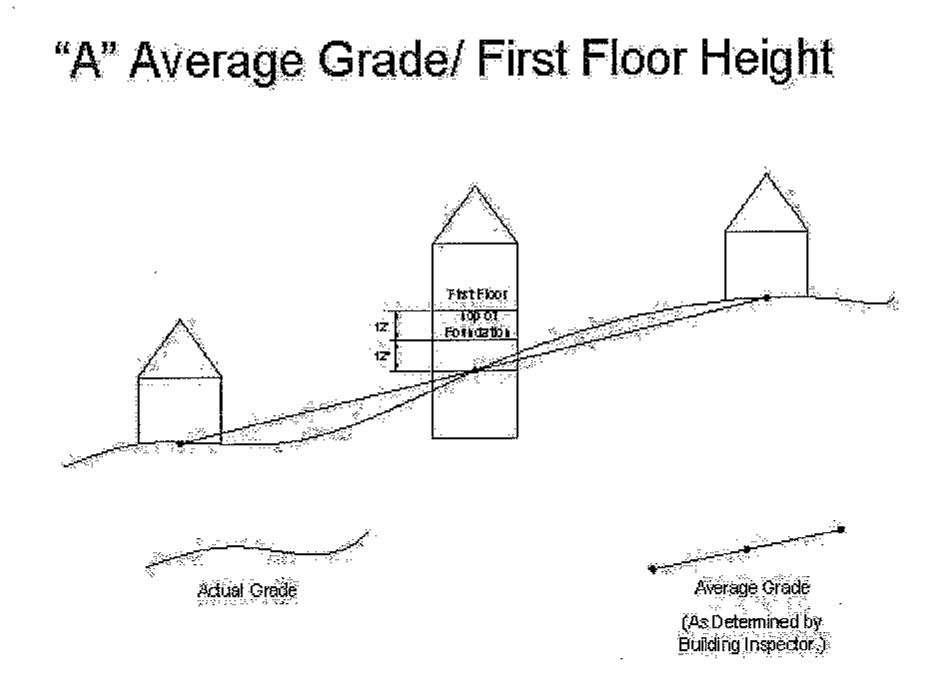
Average grade of an infill development lot means the average grade of the two lots immediately adjoining the infill development lot, measured at the front of the dwelling on each existing lot, as determined by the building inspector. The average grade for corner lots at the crest of a hill, lots at the bottom of a valley, and similar lots in non-standard settings shall be determined by the building inspector.
Infill development means demolition and replacement of an existing structure with one or more new structures; splitting of an existing developed lot to create an additional building site; construction on a vacant lot where the homes within 200 feet on the same side of the block are an average of at least ten years old; and/or the addition of 500 square feet or more to an existing home where the homes within 200 feet on the same side of the block are an average of at least ten years old.
Infill house means a house constructed on a vacant lot or a house constructed to replace a demolished house where the homes within 200 feet on the same side of the block are an average of at least ten years old.
(b)
Residential infill housing development standards.
(1)
The top of the basement wall of a residential infill house shall not be raised more than 12 inches above the average grade of the lot, as determined by the building inspector. In addition, the first-floor elevation of a residential infill house shall not be more than 36 inches above the average grade of the lot, as determined by the building inspector.
(2)
The average grade of a lot shall not be raised above the average of the grade of the lots on either side but may be lowered, as determined by the building inspector, even if removal of existing mature tree(s) would be required. Positive drainage shall be provided such that water drains away from the infill house and is not allowed to drain onto abutting lots, however, historical drainage patterns may be maintained, subject to approval by the building inspector.
(3)
Driveways for infill development shall not be raised above the grade of the immediately adjoining residential lot.
(4)
There shall be no retaining walls permitted in the front or side yards of an infill development lot except those previously existing or those required to correct drainage problems. Existing retaining walls may be required to be reduced in height, as determined by the building inspector. This shall not prevent landscape walls, raised planter, and the like, constructed during the ordinary landscaping of the homesite, as determined by the building inspector.
(5)
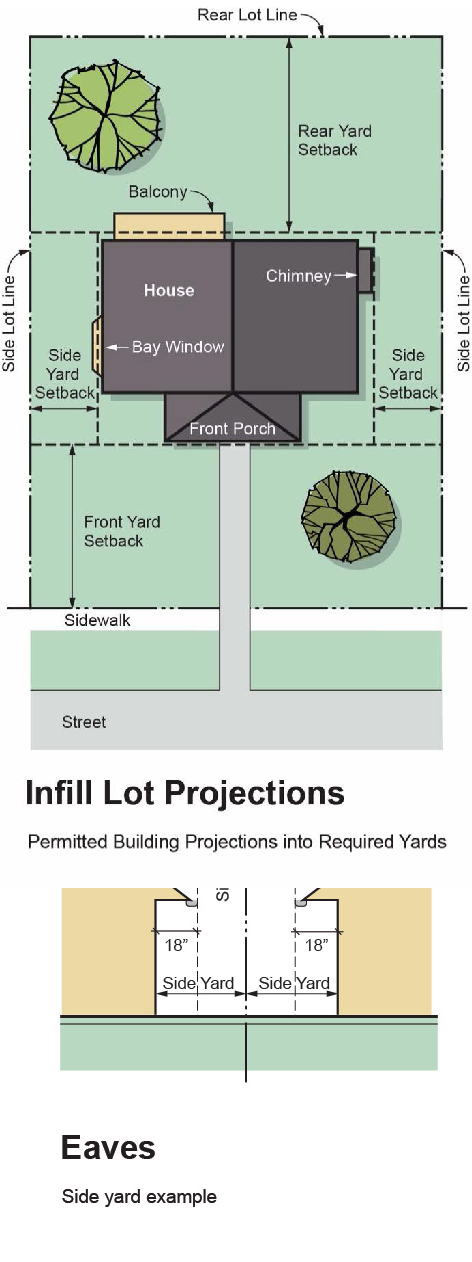
Architectural building features that are an extension of the building footprint shall not project into any required front, side, or rear yard.
(6)
A roof overhang, inclusive of gutters, may project into any required yard up to 18 inches.
(7)
Architectural building features cantilevered from the building wall, such as but not limited to bay windows, alcoves, and the like, may project up to 18 inches into a front or rear setback, provided such features do not exceed 20 percent of the front wall area or 50 percent of the rear wall area of the dwelling. Such building features may project into any required side yard up to 18 inches.
(8)
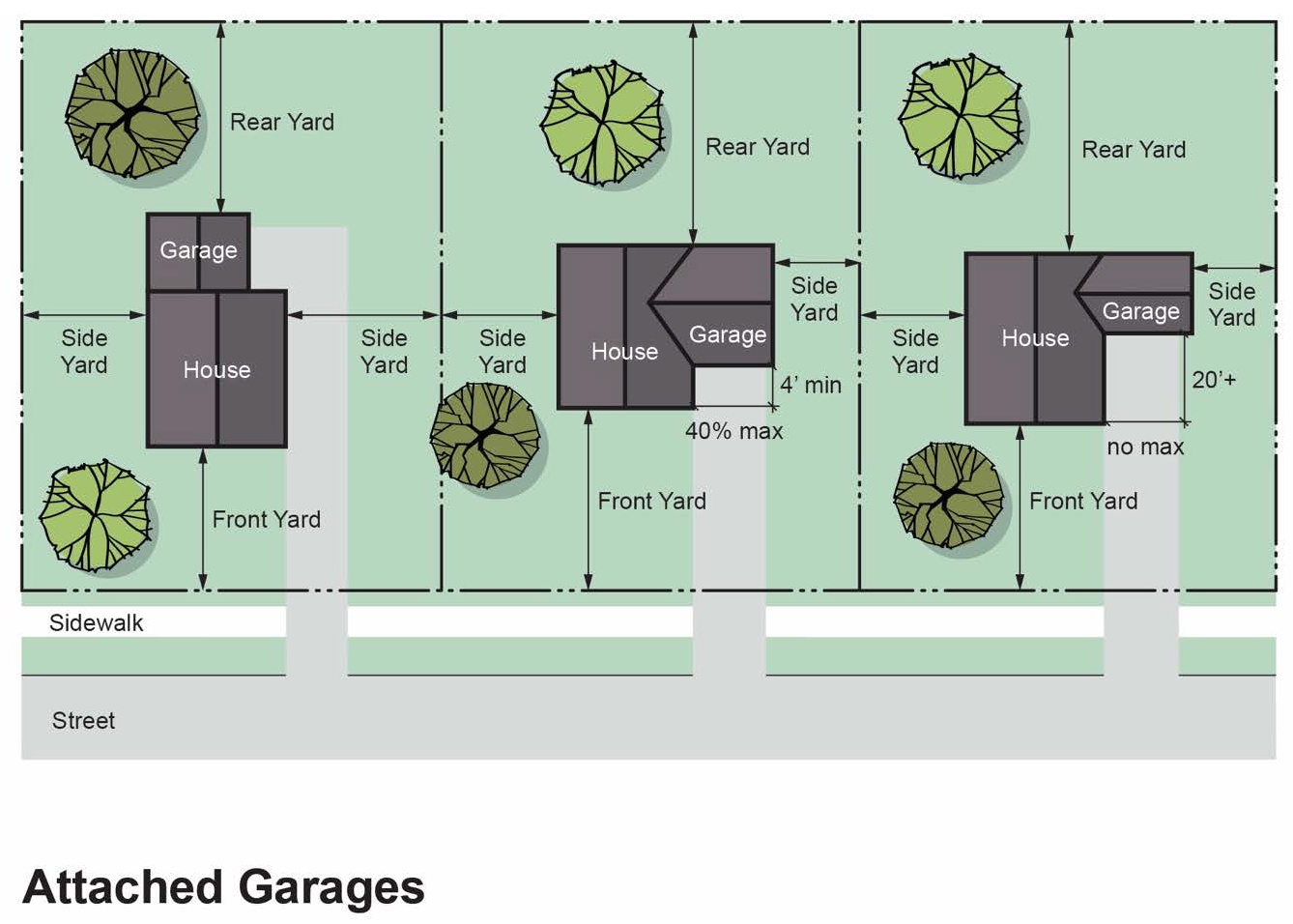
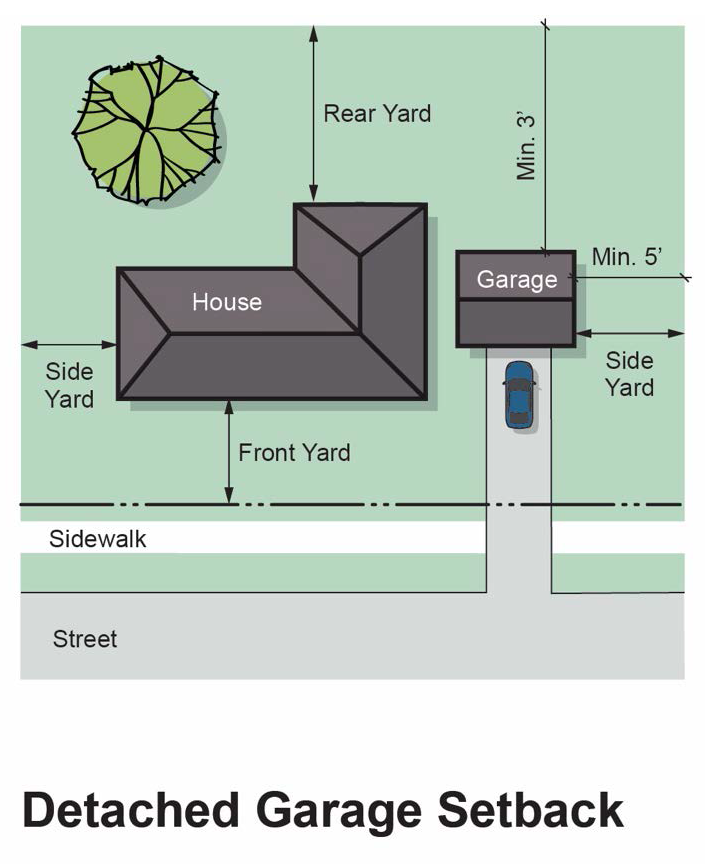
In single-family districts, detached and attached garages shall conform to the standards in section 2102, accessory structures.
a.
The front wall of an attached, front-entry garage shall be setback at least four feet behind the front wall of the dwelling to which it attaches, unless 20 percent of the existing homes within 500 feet on both sides of the street already fail to meet this standard.
b.
Detached garages on infill development homesites shall be setback not less than five feet from all side lot lines and three feet from rear lot lines.
(9)
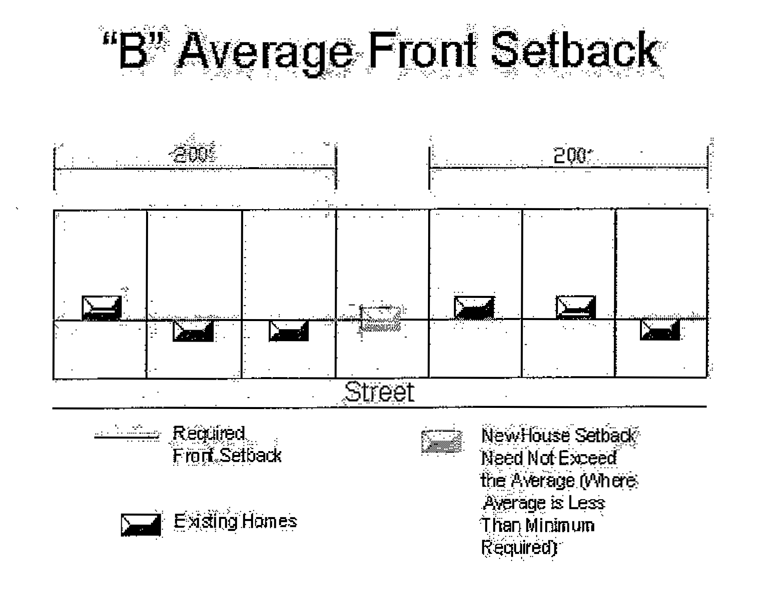
The front setback of an infill house need not be greater than the average front setback of the homes within 200 feet on the same side of the block, even if this average setback is less than the minimum required for the zoning district in question (see attached illustration "B" (in section 2117).
(10)
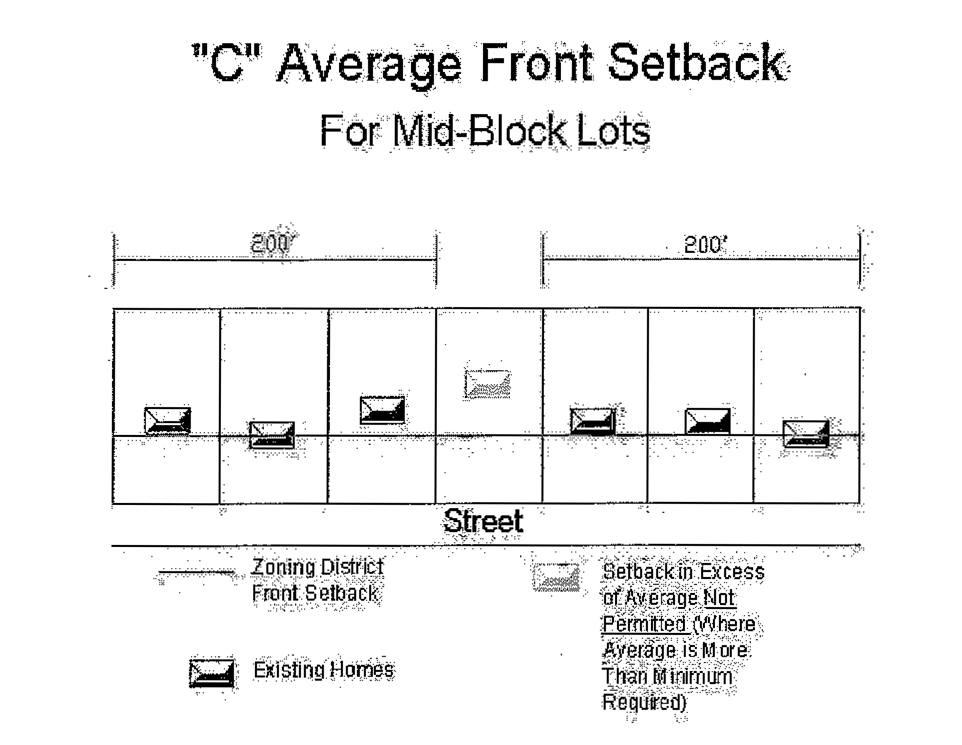
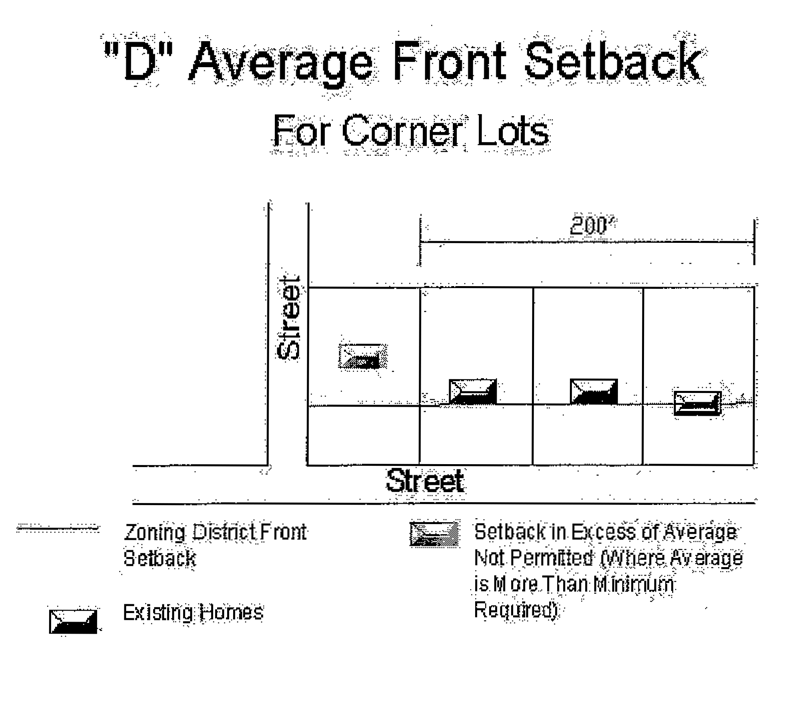
The front setback of an infill house shall not be greater than the front setback required in the zoning district in question unless the average front setback of the homes within 200 feet on the same side of the block is equal to or greater than the proposed setback. (See attached illustration "C" (in section 2117).) On corner lots the front setback of the homes within 200 feet in the interior of the block shall be used to establish the average front setback. (See illustration "D" (in section 2117.)
(11)
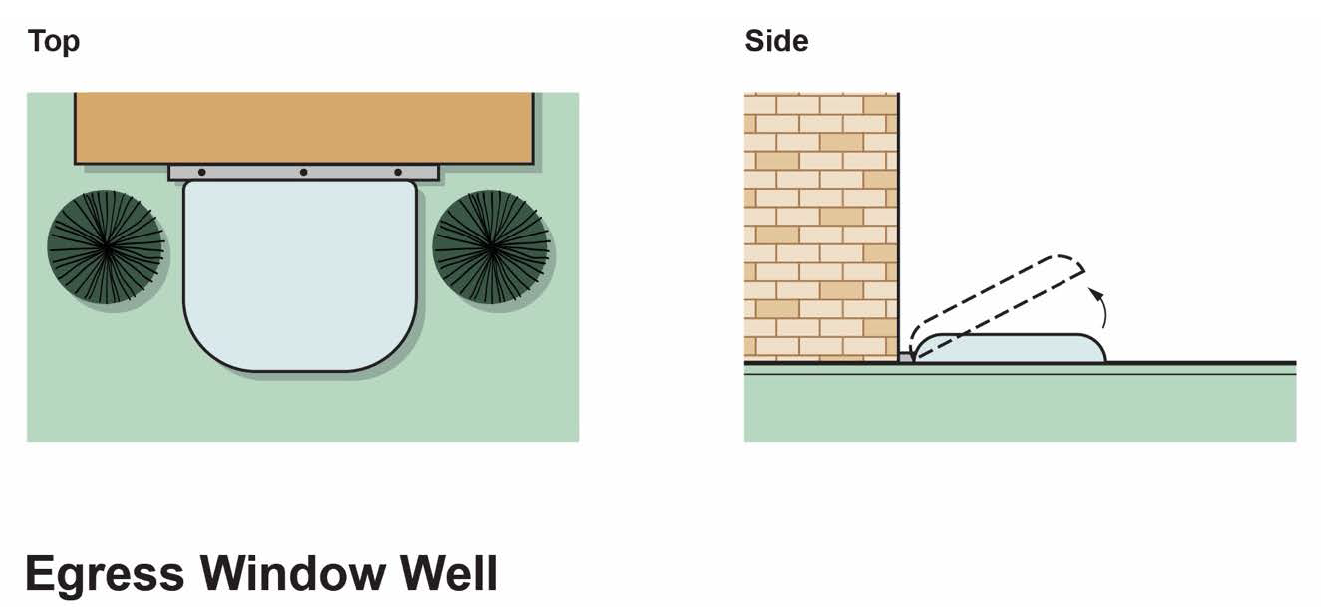
Egress window wells may project into any required side or rear yard provided they are set back a minimum of two feet from any side or rear property lines. Egress windows may not project into a required front yard.
a.
Egress window wells in side yards shall be provided with a permanently anchored, hinged cover. Covers shall be able to support a minimum of 40 pounds per square foot of surface area.
b.
Egress window wells shall comply with all applicable building codes.
(12)
Sunken patios may project into any required side or rear yard, provided they are setback a minimum of three feet from any side or rear property line. Sunken patios may not project into a required front yard.
(c)
[Request for site plan review and approval.] If an applicant for a building permit for a residential infill development objects to a decision of the building official with regard to the standards in subsection (b) above, the applicant may appeal that decision and/or seek a variance from the zoning board of appeals in accordance with section 3001.
(Ord. No. 2000-09, pt. 1, 12-11-2000; Ord. No. 2011-02, 2-14-2011; Ord. No. 2012-10, pt. I, 6-25-2012; Ord. No. 2021-01, 3-8-2021)
Sec. 2117. - Parcel width compatibility standard.
This ordinance recognizes that there are existing neighborhoods where the typical size of actual homesites exceeds the minimum lot width requirements of the zoning district. Within such neighborhoods, it is the intent of this ordinance to maintain and promote development patterns that are compatible with these existing neighborhood characteristics. Whenever existing parcels are proposed to be split and/or recombined to create two or more building sites, the minimum required parcel width shall be the greater of the following:
(1)
The minimum lot width required in the zoning district; or
(2)
The average width of the existing parcels on the same side of the street and within the same block or the average width of the existing parcels on the same side of the street within 200 feet on both sides of the subject parcel, whichever distance is less.
(Ord. No. 2001-12, 12-12-2001)
Sec. 2118. - Architectural guidelines and standards for nonresidential and mixed-use buildings and projects.
The requirements of this section are intended to promote architectural and site design treatments that will enhance and maintain the visual appearance and character of development within the City of Rochester. The standards are consistent with the City of Rochester's adopted design guidelines and represent the city's desire to create and maintain a strong community image and identity.
(1)
Development in the Central Business District.
a.
Applicability. Provisions of this section are applicable to all downtown development in the CBD, including new buildings as well as the redevelopment of an existing building that alters more than 50 percent of the gross floor area.
b.
Facade standards. All exterior building facades that face a public right-of-way shall be designed to maintain the rhythmic pattern of the street and to stimulate visual interest through the use of materials and architectural treatments. Architectural features shall be compatible with the established pattern of neighboring buildings.
1.
The size and shape of windows for new construction should be similar to the neighboring buildings in order to maintain the facade pattern of the block.
2.
Glass to wall percentages should reflect the different uses of the building.
(i)
Facades of first floor commercial uses shall incorporate display windows on a minimum of 40 percent to a maximum of 60 percent of the facade area. Non reflective clear glass windows shall be used on the first floor to prevent glare and to increase pedestrian interest.
(ii)
Upper story office and residential facades should have a glass area ranging from 15 percent to 50 percent of the facade area. Windows on upper stories should be vertically oriented.
3.
Well-defined, attractive entrances shall be encouraged to attract pedestrian interest. Main entrances shall incorporate design features such as canopies, recessed entrances, and architectural details such as moldings, unique door pulls and decorative tile work. Recessed entrances shall be set back approximately four feet for adequate space and to create a distinct threshold from the street. The building facade line shall be maintained on upper floors.
4.
Exterior building materials and colors contribute significantly to the visual impact of a building on the community. Wall materials shall be compatible with the character of existing neighboring buildings. The use of certain materials on facades in the Central Business District is restricted as follows:
(i)
Facade materials for developments shall use similar scaled elements and materials found in the district such as brick and modular stone.
(ii)
Exterior insulation finish systems (EIFS) or other synthetic materials may be approved by the planning commission for decorative or accent features. Such materials may be used as a primary facade material provided they are installed at a height of ten feet or greater above grade and provided that they constitute not more than 20 percent of the total facade area, excluding window areas. Whenever EIFS is used on the first floor as a decorative or accent feature, it shall incorporate high impact reinforcing mesh.
(iii)
Blank wall areas on any facade shall not exceed ten feet in vertical direction or 20 feet in horizontal direction.
(iv)
Material transitions and a minimum one- to 1½-inch variation in the wall plane shall be used to create interest on the facade surface.
5.
Development within the Central Business District must provide a minimum of three of the following building design treatments:
(i)
Raised parapet with cornice over primary customer entrance, integrated with the building's massing and style.
(ii)
Arches or arched forms.
(iii)
Canopies or porticos integrated with the building's massing and style.
(iv)
Ornamental and structural details that are integrated into the building structure such as but not limited to decorative coursework, pilasters or columns, corbeling, reveals or caps.
(v)
Recessed building entrance.
(vi)
Decorative urns or planters.
(vii)
Perimeter landscaping planted adjacent to and along the full length of the facade. The landscaping should be a minimum of four feet wide and shall be planted in accord with article 28.
(viii)
Artwork, including sculpture, stone or ceramic decorative tiles or similar features and excluding corporate logos or advertising.
6.
Alley facades should be maintained to provide an attractive face to rear entrances and parking areas. The following design requirements apply to alley facades:
(i)
Mixed-use buildings with residential uses shall have direct access to residential units from the alley facade.
(ii)
Alley facades shall maintain interest through the use of additive structures such as stairways, decks and outdoor terraces. Outdoor terraces should be encouraged as an amenity for residential units in mixed-use buildings.
(iii)
Buildings should step down to the more narrow scale of the alley.
(iv)
Glazing on alley facades shall be adequate to allow sufficient light and ventilation into the building.
c.
Building mass scale and form. The placement, mass and scale of buildings help to maintain the coherent visual image and character of the downtown. Large monolithic buildings are incompatible with the established character of the City of Rochester's Central Business District. The following requirements are intended to maintain and enhance that established character by providing for compatible new development.
1.
A maximum front yard setback of zero feet shall be maintained in the Central Business District to maintain the street wall, unless otherwise approved by the planning commission.
2.
In the Central Business District, a portion of the building wall may be set back from the sidewalk to provide for outdoor seating or public space if the front line of the building is maintained through the use of planters, railings, columns or similar features.
3.
Off-street parking shall be provided behind the building.
4.
Buildings shall be built out to the full width of the parcel.
5.
For buildings exceeding the typical downtown building width of 20 to 50 feet variations in design features shall be used to ensure compatibility with existing building widths in the district. Approved variations include:
(i)
Changes in facade materials, window design, facade height or decorative details intended to add interest to the facade.
(ii)
Use of structural bays to break down the mass of the building horizontally and vertically into a hierarchy of volumes.
(iii)
Variations in the wall plane shall be used to maintain a human scale.
6.
Rectangular forms should be dominant and should be vertically oriented consistent with existing development in the district.
7.
Where feasible a maximum distance of 150 feet should occur between pedestrian entrances to buildings.
8.
No side yards are required along interior lot lines, provided all requirements of the building code have been met with regard to fire protection and separation, adequate light, and adequate ventilation.
9.
Flat rooflines with detailed parapets and embellished cornice lines for architectural interest shall be the dominant roof form consistent with the character of the district.
10.
Parapets shall have horizontal emphasis and add interest to the facade.
11.
With the exception of corner buildings, parapets on side facades should step down toward the rear of the building.
12.
Corner buildings should exhibit similar two-story facades to those on the principal street, with slightly greater height allowed at the corner as an anchor feature of the block.
13.
Facade height of new buildings should fall within the established range of the block and respect historic proportions of height to width.
(2)
Office corridor development.
a.
Applicability. Provisions of this section are applicable to all O-1 and O-2 development, in the North Main and West University Office Corridors including new buildings as well as the redevelopment of an existing building that alters more than 50 percent of the gross floor area.
b.
Facade standards. All exterior building facades that face a public right-of-way shall be designed to maintain the rhythmic pattern of the street and to promote continuity through the use of materials and architectural treatments. The unique and desirable character of existing development of the district should be the basis for renovation and new construction.
1.
Buildings shall provide a primary entryway along the street frontage to maintain the pedestrian-scale environment of the area. Architectural details including but not limited to porches, pediments or raised points of entry shall be used to provide emphasis to the primary entryway.
2.
Secondary entryways shall be provided where parking is situated along the side or rear of the building.
3.
Exterior building materials and colors contribute significantly to the visual impact of a building on the community. Wall materials shall be compatible with the character of existing neighboring buildings. The use of certain materials on facades in the O-1 and O-2 District is restricted as follows:
(i)
Facade materials for developments shall use similar scaled elements and materials found in the district such as brick and modular stone.
(ii)
Exterior insulation finish systems (EIFS) or other synthetic materials may be approved by the planning commission for decorative or accent features. Such materials may be used a primary facade material provided it is installed at a height of ten feet or greater above grade and provided that it constitutes not more than 20 percent of the total facade area, excluding window areas. Whenever EIFS is used on the first floor as a decorative or accent feature, it shall incorporate high impact reinforcing mesh.
(iii)
Blank wall areas on any facade shall not exceed ten feet in vertical direction or 20 feet in horizontal direction.
4.
Development within the district shall incorporate the following building design treatments:
(i)
Ornamental details such as roof dormers, bay windows, stoops, porches and window shutters or similar architectural features consistent with the residential character of the neighborhood.
(ii)
Gable and cross-gable roof forms shall be the dominant roof form consistent with the character of the district.
(iii)
Prominent building entrances.
(iv)
Decorative urns or planters.
(v)
Perimeter landscaping planted adjacent to and along the full length of the facade. The landscaping shall be a minimum of four feet wide and shall be planted in accord with article 28.
(vi)
Artwork, including sculpture, stone or ceramic decorative tiles or similar features and excluding corporate logos or advertising.
(vii)
Shapes and sizes of architectural features shall be consistent with the established character of the area.
c.
Site design, building mass, scale and form. The placement, mass and scale of buildings help to maintain the coherent visual image and character of a district. Large monolithic buildings are incompatible with the established character of the City of Rochester's O-1 and O-2 Districts. The following requirements are intended to maintain and enhance that established character by providing for compatible new office development.
1.
Buildings proposed on corner lots shall built to the corner with parking located to the rear or side of the building.
2.
Parking areas shall not be located at the intersection. Parking frontage shall not be more than one-third of the frontage of adjacent buildings or no more than 64 feet, whichever is less. Landscaping and decorative screen walls shall be required along the street frontage of parking areas in accordance with article 28.
3.
Sites must provide for pedestrian connections from the parking area to the primary entryway at the front of the building.
4.
A landscape buffer shall be required for developments adjacent to residential uses in accordance with article 28.
5.
Traditional proportions of height to width shall be maintained.
6.
For buildings exceeding widths of 20 to 30 feet variations in design features shall be used to ensure compatibility with existing building widths in the district. Approved variations include:
(i)
Use of structural bays to break down the mass of the building horizontally and vertically into a hierarchy of volumes consistent with the mass of existing buildings in the district.
(ii)
Staggered setbacks and variation of materials.
(iii)
Attachments such as porches that provide variety in building form.
(Ord. No. 2004-02, 3-22-2004; Ord. No. 2008-04, art. 3, 3-10-2008)
Sec. 2119. - Awning standards in business and office districts.
Awnings which are functional and visually appropriate to the structure under consideration and provide an attractive addition to the building facade may be permitted in O-1, O-2, B-1, and CBD Districts, subject to the following standards:
(1)
Awnings may be approved by the building inspector if they serve a functional purpose based upon one or more of the following criteria.
a.
Provides shade or shelter for tenants, customers, shoppers or pedestrians.
b.
Reduces glare or serves as an energy saver by controlling the amount of light that penetrates to the interior of the office, retail store, or upper story apartment space.
(2)
The awning shall be consistent in design, materials, and color with the established character of the immediately surrounding district and neighborhood, based upon the following criteria.
a.
The color of the awning is compatible with the building on which it is to be attached. If the building under consideration contains more than one storefront, office, or apartment, each with a different color awning, the colors shall be compatible.
b.
In the Central Business District, awnings should be cloth, finish canvas, or similar in appearance to cloth or canvas. To that end, high gloss fabrics and coatings shall be avoided and translucent materials shall be prohibited. Glass or metal canopies may be permitted if they are integral to the facade design and compatible with the character of the district.
c.
Upper facade windows may incorporate box awnings or a similar style. First floor storefronts and offices shall incorporate slanted awnings with straight lines and flat planes or a similar style.
d.
When awnings are proposed on both upper and lower facades, they shall be of compatible color, material and design.
e.
Awnings which purport to reflect a proprietary, franchise or corporate color, design, and/or material will not be approved if they fail to conform with the criteria in subsections (2)a through d of this section.
f.
Awnings should be projected over individual doors and windows and shall not be continuous over the entire width of the facade in a manner that obscures architectural features of the building.
g.
The awning or canopy must be permanently attached to the building mounted on wood or metal framing of the door or window and not the wall surrounding the opening.
h.
Backlit awnings shall be prohibited.
i.
The minimum height of the awning shall be at least eight feet from the lowest point of the sidewalk to ensure clearance for pedestrian safety.
j.
Signs incorporated as a part of an awning may be approved by the planning commission if they comply with all other regulations of article 22 of the zoning ordinance and subsections (1) and (2) of this section.
(3)
If an applicant for an awning permit objects to a decision of the building inspector with regard to subsections (1) through (2)j of this section, the applicant shall request review by the planning commission. Building elevation drawings and awning construction plans, as well as fabric and color samples, shall be submitted for the planning commission's consideration. This step shall be completed before the building inspector's decision may be appealed to the zoning board of appeals. An awning so approved by the planning commission may be constructed without consideration of the awning by the zoning board of appeals.
(Ord. No. 2002-03, § 1, 3-25-2002; Ord. No. 2004-03, 3-22-2004)
Sec. 2120. - Screening of mechanical equipment.
Mechanical equipment shall be situated in a manner appropriate to the surrounding area. All uses, except single-family homes in R-1, R-2, R-3, R-4 and R-5 districts, shall provide sufficient visual and acoustical screening of mechanical equipment, demonstrating compliance with the standards below as well as the performance standards for sound as set forth in section 2301.
(1)
All transformers, climate control and other equipment not located within the building shall be indicated on the site and building plans and screened from view from any abutting street or adjacent property by a wall constructed of the same materials as the building and not less than the height of the equipment to be screened. As an alternative, the equipment may be screened by dense landscaped plantings and or some other method approved by the planning commission. Where feasible such equipment shall be located within service alleys or other locations not immediately adjacent to streets, driveways or public gathering areas.
(2)
Such equipment shall not be located in any required front yard nor in any required yard abutting a residential zoning district. Where mechanical equipment is proposed for a site that abuts an existing residential dwelling, the planning commission shall require additional methods of screening and or soundproofing deemed necessary to protect the residential use.
(3)
All rooftop climate control equipment, elevator towers, transformer units, and similar equipment shall be indicated on the site and building plans and screened from view of any abutting street or adjacent property. The materials used to screen the equipment shall be compatible in color and type with the exterior finish materials of the building. Where possible, a parapet wall or similar architectural feature should be selected as the preferred method. These building architectural features shall be designed to completely obscure the rooftop equipment from view along a public sidewalk abutting the property and/or from a residential district abutting the property viewed from a height of five feet. The planning commission may permit rooftop equipment to be less than completely obscured where the parapet wall or similar feature would be out-of-scale with the building's architectural character.
(Ord. No. 2008-04, art. 2, 3-10-2008)
Sec. 2121. - Outdoor dining standards.
Outdoor dining may be permitted as a non-transferable special exception use in the CBD and B-1 districts when incidental to a permitted restaurant or tavern, subject to the following special standards:
(1)
Outdoor dining is only permitted immediately adjacent to the principal use on the same property, except as may be expanded into a right-of-way in accordance with subsection (6) of this section.
(2)
Restaurants with outdoor dining shall comply with all licensing, permitting and inspection requirements of the City Code and shall submit annually all required fees with an application for approval. All initial applications for outdoor dining shall be submitted for city council approval once site plan and special exception use approval are granted by planning commission. Applications for subsequent years may be approved administratively by the city manager so long as the restaurant's outdoor dining application is the same as the previous year and there has not been any reported problems with said use. Notwithstanding, the application shall come before city council every fifth year for approval.
(3)
Outdoor dining areas shall be kept clean and free from refuse at all times.
(4)
All outdoor dining activity must cease at the close of business. However, when an outdoor dining area is immediately adjacent to any single-family or multiple-family residential district, all outdoor activity must cease at the earlier of close of business or 12:00 (midnight), unless the planning commission deems a different time more appropriate based on the particular circumstances of the applicant, such as the extent of buffering, sound and lighting reducing efforts, location of the outdoor dining on the property and its proximity to the residential units.
(5)
Table umbrellas shall be considered under site plan review and shall not impede sight lines into a retail establishment, pedestrian flow in the outdoor dining area, or pedestrian or vehicular traffic flow outside the outdoor dining area.
(6)
For outdoor dining located in any portion of the public right-of-way:
a.
All such uses shall be subject to a license agreement from the city, contingent upon compliance with all city codes including all conditions required by the planning commission in conjunction with site plan approval. A copy of the form license agreement may be obtained from the city clerk.
b.
After planning commission approval of the special exception, the proposed license agreement will be forwarded to the city council for its consideration. Nothing in this section shall be construed to require a license agreement for an establishment with a carry-out service, ice cream parlor, or similar use where patrons may leave the establishment before consuming the food purchased, unless said establishment chooses to operate an outdoor cafe and seeks approval as set forth herein.
c.
In order to safeguard the flow of pedestrians on the public sidewalk, such uses shall maintain an unobstructed sidewalk as required by the planning commission, but in no case less than five feet.
d.
No permanent fixtures may be erected or installed in the public right-of-way.
e.
Should the right-of-way involved be under the jurisdiction of the Michigan Department of Transportation or other governmental agency, the restaurant owner or operator must obtain any required permits from such department or agency.
f.
Insurance must be procured and maintained as required in the license agreement.
(7)
Outdoor dining is only permitted during the months of May through October, unless the applicant sufficiently demonstrates to the planning commission that this period should be expanded based on the particular circumstances of the applicant. For a business that has already been granted special exception for outdoor dining, such business may make a request to the city manager to allow for outdoor dining at other times if weather permits or for individual specific events. Any such temporary approvals shall be subject to all other terms and conditions of the current approval including, but not limited to, any license agreement and other governmental permits required for outdoor dining in the public right-of-way. No tables, chairs, platforms, fencing barricades, refuse containers or other items shall be permitted except during permitted operation days.
(8)
Outdoor dining at any location is not permitted without a city-issued permit or license.
(9)
All outdoor dining areas shall have a barricade, fencing, or other means of appropriately separating the dining areas from pedestrian and vehicular traffic, which shall be considered under site plan review.
(10)
Additional off-street parking as set forth in section 2403 c.
(11)
Restaurants with outdoor dining shall meet all other standards for special exception approval outlined in article 26 of this ordinance.
(Ord. No. 2009-12, 5-11-2009; Ord. No. 2011-10, 7-11-2011; Ord. No. 2019-15, 8-26-2019)
Sec. 2122. - Spacing standards for SDM-licensed establishments.
(a)
The City of Rochester recognizes that the number of specially designated distributor (SDD) licenses approved within the city is regulated by the Michigan Liquor Control Commission, based on a city population formula applied uniformly in Michigan. The city also recognizes that there are no similar limits placed on the number of specially designated merchant (SDM) licenses issued within the Rochester city limits. The city has determined that an over concentration of these establishments can have a deleterious affect on nearby residential uses and commercial areas. In order to prevent an over concentration of SDM-licensed establishments, the city requires the following minimum spacing standards:
(1)
Five hundred feet from all public or private schools providing education to any grade(s) K-12, whether located within the City of Rochester or on its perimeter.
(2)
Five hundred feet from any other establishment with a SDM or SDD license.
(3)
The distances set forth above between the school building or other establishment and the contemplated location shall be measured along the centerline of the street or streets of address between two fixed points on the centerline determined by projecting straight lines, at right angles to the centerline, from the part of the building nearest to the contemplated location and from the part of the contemplated location nearest to the building.
(b)
The following shall be exempt from the spacing standards in subsections (a)(1) and (2) of this section:
(1)
Any SDM-licensed establishment or proposed SDM-licensed establishment located in the CBD Central Business District; and
(2)
Any restaurant with sit-down, table food service located in a B-1 General Business district or approved by the planning commission as part of a downtown special project.
(c)
All proposed SDM license applications shall be reviewed by the building inspector, who shall determine whether the above spacing standards are met, based upon the parcel address on file for all K-12 schools in or adjoining the city, and all SDM and SDD-licensed establishments operating within the city.
(Ord. No. 2009-26, pt. 1, 12-14-2009)
Sec. 2123. - Valet parking operational standards.
A valet parking operation is defined as a parking service provided by a commercial business as a service to the patrons of the facility by personnel retained to drive the patrons automobiles from a designated drop-off area to and from privately owned or city-designated valet parking spaces. Valet parking operations in the CBD zoning district, or for an approved special project downtown shall require a revocable license issued by the city council, following a review and recommendation to [the city] council by the planning commission.
(1)
The following information must be provided/illustrated for review:
a.
Location of dropoff (valet ramping) areas, in a clear and understandable format that illustrates the proposed area and operational valet plan;
b.
Location and number of private valet parking spaces;
c.
General operating procedures;
d.
Proof of insurance covering the valet operation as proposed;
e.
An agreement that indemnifies and holds the city harmless from liability associated with the operation of the valet parking service on a form acceptable to the city;
f.
A list of the names, addresses and copies of driver's licenses of all valet drivers.
(2)
Each request shall be considered according to the individual circumstances of the location.
(3)
The city seeks to avoid multiple valet operations on adjoining properties, based on concerns of increased traffic congestion and confusion. When another valet parking license has already been issued for a valet parking area immediately adjacent to the proposed area, the issuance of a license will be on a case-by-case basis with the planning commission's review and recommendation to the city council to include the applicant's effort to coordinate valet operations with the adjoining property's valet license to use a single valet operation to service both properties.
(4)
A license shall not be issued where the drop-off and pick-up of vehicles interferes with the safe operation of driveways, street intersections or crosswalks.
(5)
A license shall not be issued where stacking of drop-off and pick-up of vehicles interferes with the safe traffic operation on adjacent streets or unduly delays normal traffic operations.
(6)
Mobile stands, tables, chairs, keyboxes, ramping area directional signs, traffic cones and other objects necessary for the valet parking operation shall be of a high quality design and shall not interfere with pedestrian circulation as shown in the required plans in subsection (1)a of this section. Such objects shall be maintained in good repair at all times, shall be removed at the close of business each day, and operational rules for the valets shall be clearly posted in an appropriate and easily understood format.
(7)
No advertising signs shall be permitted on the sidewalk or in the public right-of-way; this shall not prohibit the use of one business identification sign located on the sidewalk, bearing no advertising and not exceeding five square feet in area, to be affixed to the valet parking service stand to identify "Valet Parking" and the name of the valet service.
(8)
The valet ramping area shall comprise a minimum of three adjoining parking spaces (approximately 60 linear feet). If the valet ramping area requires the use of metered parking spaces, the licensee shall pay a valet ramping fee according to the rate established by the city council.
(9)
Valet ramping on public property shall not occur in any location other than the public alley or on-street curbside parking spaces designated for ramping. Ramping of vehicles shall consist of allowing the customer to enter or exit a vehicle and to turn it over to or retrieve it from a valet parking employee. There shall be no storage of vehicles in the area designated for ramping. A vehicle will be considered stored if it remains in the ramping area for more than ten minutes. Ramping from a moving lane of traffic is strictly prohibited and may subject the host business to loss of its valet parking license.
(10)
Customer and valet entry to the ramping area shall only be permitted from the adjoining travel lane and only from the same direction as the adjoining travel lane. The host business/license holder shall submit, as a component of its general operating procedure, the manner in which the travel direction will be identified and enforced, such as by: travel direction and wrong-way signs; placement of temporary traffic cones, and the like. A valet parking license shall be subject to revocation if host business customers or valets are permitted to enter the ramping area from the opposing direction or across the oncoming traffic.
(11)
All valet parking operations shall be kept clean and free of trash and debris, including valet tickets and stubs. An application for a valet parking license shall address the manner in which the licensee will comply with this standard.
(12)
Upon violation of any provision of this ordinance or conditions imposed by city council, a license for valet parking operation shall be subject to revocation by the city manager following written notification to the licensee. The licensee may request a show cause hearing before city council to present proof of compliance with the provisions of this Ordinance and any conditions of his/her license. A valet parking license shall be revoked if the city manager or city council determines that the operation of the service causes congestion which endangers the health, safety or welfare of persons, interferes with the appropriate use of other property; interferes with pedestrian or vehicular traffic; and/or interferes with the use of any pole, sign, fire hydrant, traffic signal or other object already permitted at or near the valet service.
(13)
Annual renewal of a license shall require a demonstration of compliance with all requirements and permit conditions.
(Ord. No. 2010-01, 1-11-2010)
Sec. 2125. - Fence standards.
The requirements of this section are intended to promote, enhance and maintain the visual appearance, aesthetics and character of the city as well as the safety of the residents and visitors of the city. Fences are permitted in the city, subject to the following standards:
(1)
Permits. No fence exceeding the height of 18 inches shall hereafter be erected or altered without first obtaining a permit from the city building inspector. A fee shall be paid for each permit applied for, which shall be set by resolution of the city council.
(2)
Restriction on fence construction.
a.
All fences located on property zoned for residential use of either a one-family, two-family or multifamily district shall be not more than six feet in height in any part and shall be subject to the approval of the city building inspector.
b.
Fences six feet in height or less may be constructed of a solid material and may be fully obscuring. No sharp spikes, nails or other sharp points or barbed, razor or concertina wire shall be placed on top of any fence.
c.
Fences four feet in height or less may be constructed of chainlink. No sharp spikes, nails or other sharp points or barbed, razor or concertina wire shall be placed on top of any fence.
d.
No fence over 18 inches in height shall be constructed nearer to the street than the front building lines as established by the zoning ordinance. However, for purposes of this section, corner lots shall have only one front building line, that being the side where the front door is located.
e.
Except where a higher height is permitted where a screen wall is required under section 2804, fences located on property zoned O-1 limited office, O-2 restricted office, CBD, central business district, and B-1, general business shall not exceed six feet in height, shall be decorative in nature, and shall be shown on a site plan for approval by the planning commission. No sharp spikes, nails or other sharp points or barbed, razor or concertina wire shall be placed on top of any fence.
f.
Fences constructed on property zoned I-1, industrial 1; I-2, industrial 2; or RP, research park may be solidly constructed not to exceed eight feet in height, and shall be shown on a site plan for approval by the planning commission. Barbed wire may be installed on the top of such fences or arms or supports projecting over the private property side of the fence and when used shall be at least seven feet above the adjacent grade. Exception: Property adjacent to a public playground or park may be higher with permission of the zoning board of appeals.
g.
Fences used in conjunction with outdoor dining are subject to the height, material, color and other requirements and conditions as approved by the planning commission and not subject to this section. Notwithstanding, no nails or other sharp points or barbed, razor or concertina wire shall be placed on top of any fence used for outdoor dining.
h.
Fences shall contain no electrical current or charge of electricity.
i.
All fences shall be maintained in good condition similar to their condition at [the] time of original construction, including that they be plumb and level. All deteriorated or missing sections shall be replaced.
j.
Fences are subject to the corner clearance requirement in section 2100.
k.
Properties with outdoor swimming pools, hot tubs and spas must meet and comply with all ordinance and state code requirements for fencing and barriers at all times, including swimming pools with powered safety covers.
(3)
Appeals. The zoning board of appeals shall hear and decide appeals from and review any order, requirement, decision, or determination made by the building inspector charged with the enforcement of this section. The zoning board of appeals shall not have the power of its own action to change or amend this section, but it shall have the power to authorize variations in height and extent of enclosure in the single-family residence district whereby the architectural and topographical design of properties warrant more detailed consideration in variation from this section, which in no way is detrimental to the health, welfare or public safety of the surrounding properties and the community at large. The zoning board of appeals shall not have the power to change or amend the decision of the planning commission regarding outdoor dining fencing, nor fencing approved as an element of a site development plan. The zoning board of appeals shall not have the power to grant approval or a variance that would allow a property with an outdoor swimming pool, hot tub or spa without the fencing/barriers required by state codes.
(4)
Nonconforming fences. The enactment of this section was for the purpose, inter alia, of relocating the fence regulations as set forth in sections 10-91 through 10-95 (of the City Code) into this zoning ordinance, to eliminate the fence viewing board and to transfer appeal authority to the zoning board of appeals. Any fence that was legal under the prior fence ordinance, but would not conform to this section, is to be considered a legal pre-existing nonconforming structure. However, the enactment of this section does not confer legal pre-existing nonconforming structure status to those fences that were not legal under the prior fence ordinance. Nonconforming fences, including repairs and replacement thereof, are subject to article 4 of this zoning ordinance.
(Ord. No. 2009-27, § 2125, 12-21-2009; Ord. No. 2021-09, § 1, 12-20-2021)
Sec. 2126. - Bistro standards.
Bistros are permitted as a non-transferable special exception use with the following conditions:
(1)
No direct connect additional bar permit is allowed;
(2)
Alcohol is served only to seated patrons, except those standing in a defined bar area;
(3)
No dance area is provided;
(4)
Bistros must have tables located in the storefront space lining any street, or pedestrian passage, unless rooftop or balcony outdoor dining is approved;
(5)
All building facades facing a street or pedestrian passage must be at least 70 percent glass, excluding from the calculation any portion of the facade or other features above eight feet from the ground. Such glazing requirement is to be calculated on a square footage basis. However, the planning commission may, in its sole discretion, reduce the glazing requirement under special circumstances, such as the bistro being located in an established structure that does not meet the glazing requirements and a modification would pose a hardship;
(6)
All bistro owners must execute a bistro contract with the city outlining the details of the operation of the bistro;
(7)
Outdoor dining must be provided, subject to section 2121, and is not permitted past 12:00 [midnight]; and
(8)
Bistros are only permitted in the Bistro Overlay District.
(9)
Interior seating shall be limited to service of 25—100 persons, with the maximum seating at a bar not to exceed six seats, unless a fewer number of bar seats is deemed more appropriate in the discretion of the planning commission.
(Ord. No. 2010-10, § 2126, 4-26-2010; Ord. No. 2012-11, 8-13-2012)
Sec. 2127. - Porches in residential districts.
(1)
Definition. A porch is defined as a roofed-over permanent addition to the front of a principal structure. The porch shall not be enclosed by any peripheral wall coverings or glazed window panels.
(2)
Setback. A porch can project up to eight feet into the required front yard setback, but shall maintain a minimum setback of ten feet from the front property line. Steps providing access to the porch shall be excluded from the setback requirement (see illustration). For corner lots with wraparound porches, there shall be deemed to be two front yards.
(3)
Size. A porch must have a minimum depth of six feet.
(4)
Design. A porch shall be in keeping with the architectural design of the dwelling structure to which it is attached. Further, the design of the porch shall be in keeping with the character of the community.
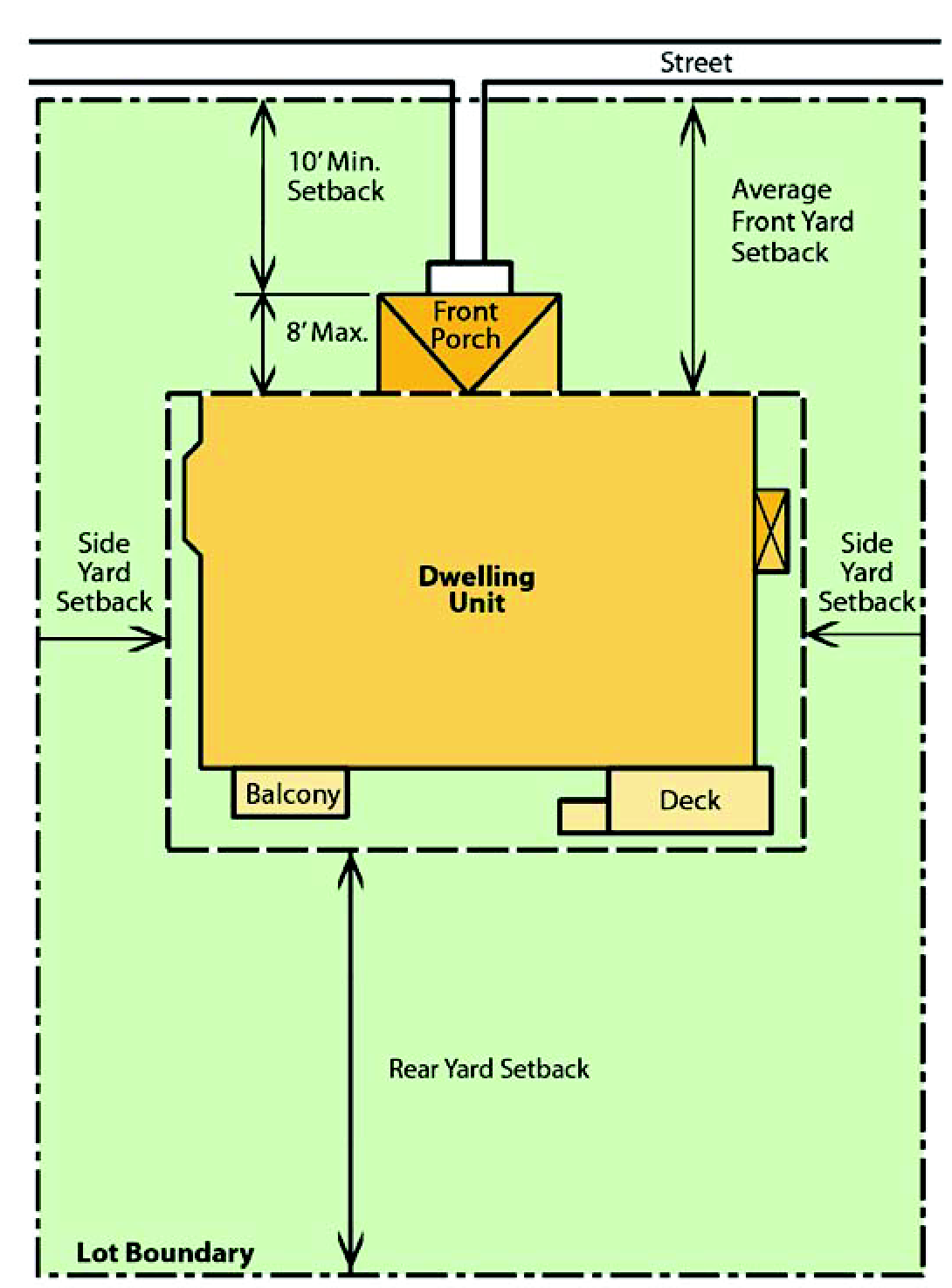
Permitted Building Projections Into Required Yards
(Ord. No. 2012-10, pt. II, 6-25-2012)
Sec. 2128. - Regulated outdoor smoking—Standards.
Outdoor smoking areas may only be permitted as a non-transferable special exception use in the CBD and B-1 Districts and only when incidental to a permitted restaurant or tavern, subject to the following special standards:
(1)
Outdoor smoking areas are only permitted immediately adjacent to the principal use on the same property, except as may be expanded into a right-of-way in accordance with subsection (6) of this section.
(2)
Properties with outdoor smoking shall comply with all licensing, permitting and inspection requirements of the city code and shall submit annually all required fees with an application for approval.
(3)
Outdoor smoking areas shall be kept clean and free from refuse and smoking debris at all times.
(4)
All outdoor smoking activity must cease at the close of business. However, when an outdoor smoking area is immediately adjacent to any single-family or multiple-family residential district, all outdoor activity must cease at the earlier of close of business or 12:00 [midnight], unless the planning commission deems a different time more appropriate based on the particular circumstances of the applicant, such as the extent of buffering, odor, sound and lighting reducing efforts, location of the outdoor smoking on the property and its proximity to the residential units.
(5)
Table umbrellas shall be considered under site plan review and shall not impede sight lines into a retail establishment, pedestrian flow in the outdoor smoking area, or pedestrian or vehicular traffic flow outside the outdoor smoking area.
(6)
For outdoor smoking located in any portion of the right-of-way:
a.
All such uses shall be subject to a license agreement from the city, contingent upon compliance with all city codes including all conditions required by the planning commission in conjunction with site plan approval. A copy of the form license agreement may be obtained from the city clerk.
b.
After planning commission approval of the special exception, the proposed license agreement will be forwarded to the city council for its consideration.
c.
In order to safeguard the flow of pedestrians on the public walkway, such uses shall maintain an unobstructed sidewalk as required by the planning commission, but in no case less than five feet.
d.
No permanent fixtures may be erected or installed in the public right-of-way.
e.
Should the right-of-way involved be under the jurisdiction of the state department of transportation or other governmental agency, the owner or operator must obtain any required permits from such department or agency.
f.
Insurance must be procured and maintained as required in the license agreement.
(7)
All outdoor smoking areas shall have a barricade, fencing, or other means of appropriately separating the smoking areas from pedestrian and vehicular traffic, which shall be considered under site plan review.
(8)
Additional off-street parking as set forth in section 2403.c.
(9)
Properties with outdoor smoking shall meet all other standards for special exception approval outlined in article 26 of this ordinance.
(10)
Outdoor smoking areas shall be configured in such a way to insure that persons entering or leaving the building or adjacent buildings will not be subjected to smoke, and to insure that smoke does not enter the building or adjacent buildings.
(11)
Neither food or alcohol service or consumption shall be permitted in approved outside smoking areas.
(12)
Outdoor smoking areas shall be in compliance with all state health department and other governmental regulations at all times, as those regulations may be amended or changed.
(Ord. No. 2013-17, 8-26-2013)
Sec. 2129. - Medical marihuana uses.
The city does not allow, and hereby specifically prohibits, any and all commercial and business uses/facilities pertaining to medical marihuana including but not limited to those uses identified in the Medical Marihuana Facilities Licensing Act, MCL 333.27101 et seq., as currently constituted or as may be amended in the future. While the city recognizes that any such uses are only possible if the city has ordinance provisions authorizing any facilities per MCL 333.27205, the city hereby ordains that it is specifically prohibiting any such uses/facilities, regardless of whether an applicant is otherwise eligible to get a license from the state department of licensing and regulatory affairs.
(Ord. No. 2014-12, 12-15-2014; Ord. No. 2017-11, 9-11-2017)
Sec. 2130. - Oil and gas wells.
(1)
Purpose and intent. The city believes that oil and gas exploration, drilling and extraction activities, including horizontal drilling, may pose public health, safety and welfare hazards to its residents without proper regulation. While there are some state and federal regulations in place addressing some of the possible negatives associated with such activity, the city deems them to be inadequate, and desires to exercise its police and zoning powers to further regulate said activities to the extent not preempted. Further, geological studies and reports show that due to the nature of the subsurface conditions in the Rochester area, hydraulic fracturing (or fracking) processes are unnecessary to extract oil and gas. These findings were confirmed by the oil and gas exploration and drilling companies presenting to the city in its attempts to obtain leases with the city, who went so far as to prohibit these processes from the leases presented. When determining where such activities would have the least amount of impact on its residents and potential areas of concern (i.e., water sources and higher concentrations of people), the Research Park, I-1 and I-2 Districts were identified as most appropriate. When reviewing the intents and allowable uses in those districts (i.e., radio studios and transmitting towers, public utilities, electric transformer stations, sewage disposal plants, etc.), the city finds that permitted oil and gas drilling activities would be most compatible and reasonably removed from most residential and downtown areas to minimize the negative impacts on its residents.
(2)
The drilling, completion, or operation of oil or gas wells or other wells drilled for oil or gas exploration purposes shall only be permitted in the RP, Research Park, I-1, Industrial 1 and I-2, Industrial 2, districts subject to the terms and conditions of this section and shall not be permitted in any other districts. Regulations and limitations in this section 2130 also apply to horizontal drilling activities, with or without surface activities. Further, hydraulic fracturing and/or fracking is expressly prohibited within the city.
(3)
Application. The applicant shall file an application with the city describing the proposed oil or gas well location and activities. The applicant shall also pay an application/inspection fee, which shall be set by the city council pursuant to a resolution that shall be reviewed annually. No drilling, completion, or operation of oil or gas wells or other wells drilled for oil or gas exploration purposes shall occur until the city building inspector has issued a permit and applicant has paid the application/inspection fee.
(4)
Permits and plans to be submitted. As part of the application, the applicant shall submit to the city a copy of all permits issued by any governmental agency, or applications for said approvals if a permit has not been issued. In addition, the applicant must provide the city a copy of the following at its own cost:
a.
Erosion and sedimentation control plan; *
b.
Grading plan; *
c.
Water management plan; *
d.
Water withdrawal plan;
e.
Pollution prevention plan;
f.
Waste disposal plan; *
g.
Timeline and activity schedule;
h.
A site restoration plan shall be submitted showing the nature, extent and timelines
for site restoration once the well equipment is removed as is required in subsection
(12); *
i.
A vehicle route as required in subsection (13)c.; *
j.
An emergency response plan as required in subsection (13)d.;
k.
Distance and testing results for water quality and quantity of surface, water and ground water surrounding the proposed well site or location of the horizontal drilling. The testing consultant must be agreeable to the city and shall certify the results;
l.
A survey of the drill site with all on-site associated equipment and/or horizontal drilling location showing locations and distances to property lines, adjacent zoning and uses; and
m.
A certified environmental audit performed by a Michigan licensed environmental engineer identifying all actual environmental impacts, all potential threats and impacts, and proper safeguards to eliminate same. Said audit shall include, but is not limited to, air, water and soil quality.
n.
A copy of all oil, gas and mineral rights leases/reservations under which authority applicant will be operating.
* These items are not required if surface activity is not involved on the property.
Should the applicant want or need to deviate from any of the plans and documents noted above in any manner for any reason after approval, it is incumbent on the applicant to submit replacement plans or documents to the planning commission for approval before effectuating said changes. This is an ongoing obligation of the applicant.
(5)
Compliance with laws and permit issuance. The drilling, completion, or operation of oil or gas wells or other wells drilled for oil or gas exploration purposes shall be done in conformity with all state and federal laws, statutes, rules, and regulations pertaining thereto, and particularly with the State of Michigan and the regulations of its supervisor of wells. This shall include obtaining the required permits from the supervisor of wells, which permits shall be provided to the city before the city issues a permit under this section. Conformance with state and federal laws, statutes, rules, and regulations including obtaining the required permit from the supervisor of wells shall also apply to, but are not limited to, the plugging of wells and all material used and work done in connection with the exploring for, producing, marketing, and transporting of petroleum products, as well as the disposition and removal of any byproducts utilized and associated with said activities.
(6)
Associated permits and approvals. The permit required by this section is in addition to and not in lieu of any permit or plan which may be required by any other provision of this zoning ordinance, Rochester City Code, building and fire codes, or by any other governmental agency. Such permit and approval are non-transferable without written consent of the city, and shall automatically terminate if drilling is not commenced within one year from the date of the permit. The applicant may apply for an extension, but the granting of an extension is within the sole discretion of the city based in part on then current conditions.
(7)
Spacing and well setbacks. In addition to the spacing and setback requirements of the State of Michigan and the regulations of its supervisor of wells, the drilling, completion, or operation of oil or gas wells shall not be located within 1,000 feet, and horizontal drilling lines shall not be located within 500 feet, of a residential zoned building (used for the purposes of residing in), religious institution, public or private school, child care facility, or hospital. The measurement of the setback shall be made from the center of the wellhead in a straight line, without regard to intervening structures or objects, to the closest exterior point of the adjacent building. The measurement for horizontal drilling lines shall be made from the closest part of the drilling line to the closest point of the adjacent building and/or its foundation. The edge of the well pad site (if any) shall meet the minimum building setback requirements of the zoning district or building and fire codes, or 300 feet from any lot line, whichever is greater. The spacing and setback requirements herein are in addition to any, and not in lieu of, required by state law, and may be increased based on physical characteristics of the site, including but not limited to topography, woodlands, and distance from structures, parks, schools, residential areas, and bodies of water or water sources.
(8)
Height. The completed wellhead structure (if any) shall not exceed 22 feet in height. The temporary drilling derrick/rig shall not exceed 110 feet in height.
(9)
Landscaping. Staggered 12-foot tall evergreen trees shall be placed around the perimeter of the well site with a minimum landscape greenbelt buffer of 25 feet in depth within 30 days of the removal of the temporary drilling derrick/rig. The landscape buffer and trees shall be irrigated, maintained, and materials replaced if dead. This provision is only applicable if surface activities are involved.
(10)
Lighting. Site lighting shall be directed downward, internally, and in compliance with all city lighting standards. Notwithstanding any other standard, lumen levels shall not exceed zero foot-candles at any property line abutting a residential use. This provision is only applicable if surface activities are involved.
(11)
Fencing. Prior to the installation or operation of any well, six-foot high chain-link fencing, wooden slats, or similar fencing/wall material shall be erected around the well site in such a way that prevents access by the general public. The fencing shall be anchored, attached or affixed to the ground, shall be of high quality material, and shall meet all City Code and Zoning Code requirements. The fencing shall be equipped with functioning locks that restrict access to only well operators and emergency personnel. This provision is only applicable if surface activities are involved.
(12)
Restoration. Upon cessation of the use of the oil or gas well, the operator shall remove all well equipment, underground lines, and any structures related to the oil and gas activities, and restore said area to the same (or improved) condition that existed prior to the start of the drilling activities.
(13)
Nuisance mitigation. The drilling, completion, or operation of oil or gas wells, or other wells drilled for oil or gas exploration purposes, including any horizontal drilling lines, shall comply with all parts of this Zoning Code, including article 23, performance standards, which address potential nuisances such as noise, smoke, dust, open storage, fire and explosive hazards, odors, wastes, and vibration. Due to the unique nature of this type of operation the following additional information and standards will be required.
a.
Noise. Prior to the issuance of a permit and the commencement of operations, the petitioner shall submit a noise management plan, as approved by the city, detailing how the equipment used in the drilling, completion, transportation, or production of a well complies with the maximum permissible noise levels of the Zoning Code. The operator shall be responsible for verifying compliance with this section and the noise management plan after the installation of the noise generating equipment. The noise management plan shall include:
1.
Identify operation noise impacts;
2.
Provide documentation establishing the ambient noise level prior to construction;
3.
Detail how the impacts will be mitigated. In determining noise mitigation, specific site characteristics shall be considered, including but not limited to the following:
i.
Nature and proximity of adjacent development, location, and type;
ii.
Seasonal and prevailing weather patterns, including wind directions;
iii
Vegetative cover on or adjacent to the site; and
iv.
Topography.
b.
Dust, vibration, and odors. All operations shall be conducted in such a manner as to minimize, so far as practicable, dust, vibration, or noxious odors, and shall be in accordance with the best accepted practices defined by the Michigan Department of Environmental Quality (MDEQ) for the production of oil, gas and other hydrocarbon substances in urban areas. All equipment used shall be constructed and operated so that vibrations, dust, odor or other harmful or annoying substances or effect will be minimized by the operations carried on at any drilling or production site or from anything incidental thereto, and to minimize the annoyance of persons living or working in the vicinity; nor shall the site or structures thereon be permitted to become dilapidated, unsightly, or unsafe.
c.
Vehicle routes for truck traffic. Commercial vehicles and trucks, excluding pick-up trucks, associated with construction, drilling, production operations and transport vehicles shall be restricted to Class A roads designated by the city department of public works. Said vehicles shall have all necessary state and/or federal permits for such uses, a copy of which shall be provided to the city public works director before operation on any city road. A vehicle route map shall also be provided to the public works director in advance and shall not be deviated from without prior approval of said director.
d.
Emergency response plan. Pursuant to state and federal law, the operator shall provide any information necessary to assist the city fire department and police department with an emergency response plan and hazardous materials survey establishing written procedures to minimize any hazard resulting from the operation.
e.
Waiver of requirements. The planning commission may waive any of these required showings if deemed inapplicable due to the nature of the activities sought for the particular property.
(14)
Inspection. The building official, and any other designee of the city manager, shall have the right and privilege at any time to enter upon the premises covered by any permit issued pursuant to this section for the purpose of making inspections thereof to determine if the requirements of this section or of any other code or ordinance of the city are met. The cost of any and all monitoring and inspections conducted by the city shall be borne by the applicant. The failure to pay said costs may result in the revocation of the permit.
(15)
Operator information and incident reporting. The operator shall notify the city of the following:
a.
Any changes to the name, address, and phone number of the operator within five working days after the change occurs;
b.
Any changes to the name, address, and phone number of the person(s) designated to receive notices from the city within five working days after the change occurs; and
c.
Any "incident reports" or written complaints submitted to the Michigan Department of Environmental Quality (MDEQ), the supervisor of wells, or other regulating agency within ten days after the operator has notice of the existence of such reports or complaints.
(16)
Injection wells. Injection wells used for brine disposal or other chemicals from production wells or from other sources are expressly prohibited within the city.
(17)
Pipelines. No operator shall excavate or construct any lines for the conveyance of fuel, water, oil, gas or petroleum liquids on, under, or through the streets, alleys or other properties owned by the city without an easement or right-of-way license from the city.
(18)
Insurance. No drilling, completion, or operation of oil or gas wells or other wells drilled for oil or gas exploration shall occur until the operator provides the city with a copy of operator's certificate of insurance for general commercial liability and pollution/environmental liability in an amount deemed appropriate under the particular circumstances by planning commission, but in any event not less than $2,000,000.00, covering the oil and gas well activities covered under the issued permit. Said insurance shall be placed with an insurance company acceptable to the city and shall remain in place so long as said activities are occurring. A copy of all renewals shall be sent to the city manager at least 30 days before the policy expiration.
(19)
Indemnification and hold harmless. No drilling, completion, or operation of oil or gas wells or other wells drilled for oil or gas exploration shall occur until the operator provides the city with a signed copy of the city's standard indemnification and hold harmless provisions pertaining to any and all activities occurring under the issued permit.
(20)
Cash bond. No drilling, completion, or operation of oil or gas wells or other wells drilled for oil or gas exploration shall occur until the operator provides the city with a cash bond in the amount of $250,000.00 per well and per horizontal drilling location to cover potential damage to roads and city property, and to ensure site restoration. Such bond shall be placed with a bonding company or other financial institution acceptable to the city.
(21)
Notice to adjacent properties. At least 30 days prior to drilling a permitted oil or gas well and/or horizontal drilling location, the operator shall provide written notice to all property owners within 2,000 feet of the boundaries of the parcel upon which the well will be located, or through which horizontal drilling activities will be located, identifying:
a.
The general description of the operations and equipment to be used;
b.
Contact information of the operator; and
c.
Anticipated duration (hours and dates) of installation.
(22)
Construction. All drill site construction, grading, and installation of erosion and sedimentation controls shall be done in compliance with the city's regulation of construction activities.
(23)
Violations. Should any permit holder and/or applicant having received approval as required by this section be determined by the city administration to have either violated this or other city ordinances, permit requirements or any planning commission condition of approval, a presumption shall arise such violation occurred and such persons must show cause before the city council that such a violation did not occur or, alternatively, that circumstances existed which should excuse the violation and/or lack of advanced notice to the city of the deviation. If city council concurs that a violation was committed, it may take any and all actions permitted under the City Code to address ordinance violations including, but not limited to, seeking injunctive relief in the court system and revoking or suspending the permit. Notwithstanding the foregoing, the city may issue an order to immediately stop any offending activities on the site if it deems that waiting for city council to take action is not in the best interest of the public health, safety and/or welfare to do so.
(Ord. No. 2015-07, 4-13-2015)
Sec. 2131. - Smoking and smoking retail products regulations.
(a)
Purpose and intent. On May 1, 2010, the Dr. Ron Davis Smoke-Free Air Law ("Smoke-Free Law") went into effect. The Smoke-Free Law, inter alia, prohibited smoking in numerous types of buildings, and generally including most places of employment. Smoking is defined in section 333.12601(r) of the Michigan Compiled Laws as the burning of a tobacco product. "Tobacco product" is defined in section 333.12601(t) of the Michigan Compiled Laws as a product that contains tobacco, including cigarettes, noncigarette smoking tobacco, smokeless tobacco and cigars. The purpose of the Smoke-Free Law was to preserve and improve the health, comfort, and environment of the public by limiting exposure to secondhand smoke.
At the time of the enactment of the Smoke-Free Law, other types of smoking, such as hookah, vaping and e-cigarettes, were either not in existence, or were in their infancy, or simply not prevalent. Thus, these other forms of smoking may not have been considered for direct inclusion in the Smoke-Free Law as they are not specifically identified therein, other than being applicable if tobacco is utilized. City council has been presented with significant evidence and concern from its police department of the wide use and abuse of such methods of smoking by younger individuals. Such use often involves not always knowing what products, chemicals and substances are being ingested. Having a significant distance between schools and establishments that sell smoking products and equipment is desirable in an effort to reduce the access of such products to underage persons.
The city believes that for the same reasons the Smoke-Free Law was enacted, other forms of smoking in areas that are likely to expose the public to second hand smoke should likewise be prohibited. One such area identified as a like source of second hand smoke is in multiple tenant commercial buildings. In such situations, smoke from adjacent tenant spaces can permeate through ventilation systems, walls, floors and ceilings. Such permeation can lead to negative health environments beyond the walls of the tenant space where the smoking occurs. Thus, for health, safety and welfare of the general public entering such establishments and/or adjacent units, the city believes that smoking of any substance should be prohibited from multiple unit commercial buildings. Single tenant buildings pose less of a concern, not because the substances are less harmful in any way, but persons in single tenant buildings are either the ones utilizing the products or otherwise have the choice to patronize said establishment, whereas employees and invitees of adjacent spaces are not in the same position. Any such regulation in this section is in addition to any other state, federal or local laws that would otherwise restrict or prohibit smoking of any substances. This section is in no way authorizing indoor smoking of any product.
(b)
Prohibition of smoking in multiple tenant buildings. The city hereby prohibits smoking of any substance and the use of any smoking devices, products and equipment within a multiple tenant commercial, retail or industrial building. Said prohibition applies whether or not the smoking involves tobacco, and whether or not smoking is intended to be a specific use of the property or simply incidental to an otherwise permitted use.
(c)
Smoking and litter in entrances. Businesses shall prohibit employees and patrons from smoking within 25 feet of any entrance, open windows or exterior ventilation intake components. Further, businesses shall be responsible for removing all smoking related refuse located on the business property, including from all entryways and other areas open to the public.
(d)
Businesses selling smoking products and equipment.
(1)
Permitted location. The wholesale or retail sale of smoking products (including but not limited to tobacco, nicotine substances, hookah, oils, vapor products, and smoking herbs) or smoking equipment (including but not limited to electronic cigarettes, hookah pipes, electronic cigar/cigarillo, vapor cartridge, bongs, rolling papers, etc.) as a principal use is permitted as a general retail use, but is not permitted in a building that fronts or has an address on University Drive or Main Street.
(2)
Distance requirements from schools. Businesses whose principal use is the selling of smoking products or smoking equipment devices shall not be located within 500 feet of a school (accredited by the state department of education) servicing students (pre-school through 12 th grade), Elizabeth Park, Halbach Field, Howlett Park, Municipal Park, Scott Street Park, the Rochester Hills Public Library, or the Rochester Area Recreation Authority as such locations are public areas where a significant number of underage persons are likely to be located.
(3)
Underage admittance. Businesses whose principal use is the selling of smoking products or equipment shall not permit persons under the age of 18 into said establishment without a parent or guardian.
(4)
Principal use determination. For purposes of this section, the determination of whether the business's "principal use" is the sale of smoking products or smoking equipment shall be made by the planning commission. Such determination shall be based on various factors including, but not limited to, whether such a sale is a primary or main product being offered for sale, the ratio of likely sales as compared to other products, how the business or products are advertised or offered for sale, city planner information and comments, and information regarding other similar businesses in the area.
(Ord. No. 2018-02, 4-9-2018; Ord. No. 2018-03, 4-9-2018)
Sec. 2132. - Temporary sales trailers.
Temporary sales trailers may only be permitted as a non-transferable special exception use and only when incidental to a construction development that has been, or is concurrently being, approved by the city, subject to the following special standards:
(1)
Temporary sales trailers are only permitted on the same property as the underlying development absent a sufficient showing to the planning commission that said placement on-site is not practical.
(2)
Temporary landscaping in the sales trailer vicinity may be required by planning commission and shall be installed prior to utilization of the sales trailer by the public or contractors.
(3)
For placement of temporary sales trailers for more than 30 days, not less than five paved parking spaces must be provided adjacent to the trailer, with at least one being ADA compliant.
(4)
Temporary sales trailers must have self-contained bathroom facilities that are part of the trailer (not porta-johns).
(5)
Temporary sales trailers shall be permitted for not more than one year from the date of special exception approval. Extension requests beyond one year must be brought back to the planning commission for re-approval.
(6)
The area around the temporary sales trailers must be kept in a safe, clean, and orderly condition at all times. All trash and refuse must be removed off-site by the developer.
(7)
Temporary sales trailers must be removed, and the property restored to the original condition (or as may otherwise be approved by the planning commission), within 30 days of the end of the sales period, or by the end of the approved term, whichever occurs first. If any curb cuts were created or modified, the developer shall restore the original condition and configuration.
(8)
Developer must post a cash bond with the city in an amount deemed appropriate by the city to ensure that full restoration of the property is completed once the temporary sales trailer is removed.
(9)
Off-site temporary sales trailers are not permitted in single family residential districts R-1 through R-5, multiple family residential districts, downtown core district, downtown edge 1 and 2 or the transition district.
(Ord. No. 2018-06, 8-27-2018)

