
Rochester Hills City Zoning Code
ARTICLE 1
ADMINISTRATION AND ENFORCEMENT
SECTION 138-1.100 - Title
This ordinance, enacted under the Michigan Zoning Enabling Act, PA 110 of 2006 (as amended), governing the incorporated portions of the City of Rochester Hills, Oakland County, Michigan, is to regulate and restrict the locations and use of buildings, structures and land for trade, industry, residence and for public and semipublic or other specified uses; and to regulate and limit the height and bulk of buildings, and other structures; to regulate and determine the size of yards, courts and open spaces; to regulate and to limit the density of population; and for such purposes to divide the City into districts and establish the boundaries thereof; to provide for changes in the regulations, restrictions and boundaries of such districts; to define certain terms used in this ordinance; to provide for enforcement; to establish a Zoning Board of Appeals; and to impose penalties for the violation of this ordinance.
SECTION 138-1.101 - Preamble
Pursuant to the authority conferred by the Public Acts of the State of Michigan in such case made and provided and for the purpose of promoting and protecting the public health, safety, peace, morals, comfort, convenience and general welfare of the inhabitants of the City by protecting and conserving the character and social and economic stability of the residential, commercial, industrial and other use areas; by securing the most appropriate use of land; preventing overcrowding the land and undue congestion of population; providing adequate light, air and reasonable access; and facilitating adequate and economical provision of transportation, water, sewers, schools, recreation, and other public requirements; and by other means, all in accordance with an adopted comprehensive plan, the City has ordained this ordinance.
SECTION 138-1.102 - Scope
No building or structure or part thereof shall be erected, constructed or altered and maintained, and no new use or change shall be made or maintained of any building, structure or land or part thereof, except in conformity with the provisions of this ordinance. No yard or open space surrounding any building shall be encroached upon or reduced in any manner, except in conformity with the regulations established for the district in which such building is located, unless otherwise addressed.
SECTION 138-1.103 - Short Title
This ordinance shall be known as the Zoning Ordinance of the City of Rochester Hills, and will be referred to herein as "this ordinance."
SECTION 138-1.104 - Validity and Severability
Sections of this ordinance shall be deemed to be severable and should any section, paragraph, or provision hereof be declared by the courts to be unconstitutional or invalid, such holdings shall not affect the validity of this ordinance as a whole or any part hereof, other than the part so declared to be unconstitutional or invalid.
SECTION 138-1.105 - Adoption and Effective Date
A.
Repeal of Prior Ordinance. The Zoning Ordinance adopted by the City of Rochester Hills City Council on October 29, 1986, and all amendments thereto, is hereby repealed insofar as it conflicts with this ordinance. The repeal of the ordinance and all amendments does not affect or impair any act done, offense committed or right accruing, accrued or acquired or liability, penalty, forfeiture or punishment incurred prior to the time enforced, prosecuted or inflicted.
B.
Adoption and Effective Date. This ordinance, which specifically includes the Zoning District Map, is hereby ordered to be given immediate effect and be in force from and after the earliest date allowed by law, and this ordinance is hereby ordered to be published, in the manner provided by law, in the Rochester Eccentric, on Sunday, the 26 th day of April, 2009.
This ordinance was adopted by the City Council of Rochester Hills by authority of Act 110 of the Public Acts of Michigan, 2006 (as amended) at a meeting thereof duly called and held on Monday the 20th day of April, 2009 and ordered to be published in the manner provided by law.
SECTION 138-1.106 - Conflicting Provisions
Whenever any section of this ordinance imposes more stringent requirements, regulations, restrictions or limitations than are imposed or required by the provisions of any other law or ordinance, the sections of this ordinance shall govern. Whenever the provisions of any other law or ordinance impose more stringent requirements than are imposed or required by this ordinance, the provisions of such law or ordinance shall govern.
In interpreting and applying the sections of this ordinance, they shall be held to be the minimum or maximum requirements for the promotion of the public safety, health, morals and general welfare. It is not intended by this ordinance to interfere with or abrogate or annul any ordinance, rules, regulations or permits previously adopted or issued, and not in conflict with any of the sections of this ordinance, or which shall be adopted or issued pursuant to law relating to the use of buildings or premises and likewise not in conflict with this ordinance; nor is it intended by this ordinance to interfere with or abrogate or annul any easements, covenants or other agreements between parties; provided, however, that where this ordinance imposes a greater restriction upon the use of buildings or premises or upon height of buildings or requires larger open spaces or larger lot areas than are imposed or required by such ordinance or agreements, the provisions of this ordinance shall control.
SECTION 138-1.107 - Vested Right
Nothing in this ordinance should be interpreted or construed to give rise to any permanent vested rights in the continuation of any particular use, district, zoning classification or any permissible activities therein and they are hereby declared to be subject to subsequent amendment, change or modification as may be necessary to the preservation or protection of public health, safety and welfare. EXCEPTION: if a site plan or plat has been submitted for general review under the site plan or plat review procedure on or before the effective date of this ordinance, the provisions of this ordinance shall not apply so far as they are more stringent or require more than the requirements in effect at the time of the site plan or plat was submitted for general review. All other requirements of this ordinance shall be in effect and followed from and after the effective date of this ordinance.
SECTION 138-1.200 - Amendments
A.
Initiation of Amendment. The City Council may, from time to time, on recommendation from the Planning Commission or on its own motion or on petition, amend, supplement, modify or change this ordinance in accordance with the authority of Public Act No. 110 of 2006 (as amended). Upon presentation to the City of a petition for amendment of such ordinance by an owner of real estate to be affected, such petition shall be accompanied by a fee as provided in Section 110-438. The amount of such fee shall be set by resolution of the City Council and shall be used to defray the expense of publishing the required notices and the expense of such Planning Commission.
B.
Amendment Review Procedure. The amendment and application materials shall be prepared in accordance with the provisions of this Section, and shall be reviewed in accordance with the following procedure. Amendments or application materials that do not meet the stipulated requirements shall be considered incomplete and shall not be eligible for consideration by the Planning Commission:
1.
Technical Review. Prior to Planning Commission consideration, the proposed amendment and application materials shall be distributed to appropriate City officials and staff for review and comment. The proposed amendment and application materials may also be distributed to applicable outside agencies and designated City consultants for review.
2.
Public hearing. The plannning commission shall hold a public hearing for all proposed amendments in accordance with the procedures set forth in the Michigan Zoning Enabling Act, PA 110 of 2006 (as amended) as summarized in Section 138-1.203.
3.
Planning Commission consideration of the proposed amendment. Subsequent to the hearing, the Planning Commission shall review the proposed amendment, together with any reports and recommendations from staff, consultants, other reviewing agencies and any public comments. The Planning Commission shall identify and evaluate all factors relevant to the petition, including the appropriate criteria listed in this Section, and shall report its findings and recommendation to the City Council.
4.
City Council action on the proposed amendment. Upon receipt of the report and recommendation from the Planning Commission, the City Council shall consider the proposed amendment. If determined to be necessary, the City Council may refer the amendment back to the Planning Commission for further consideration. In the case of an amendment to the official Zoning Map, the City Council shall approve or deny the amendment, based upon its consideration of the criteria contained herein this Section.
C.
Re-application. Whenever an application for an amendment to this ordinance has been denied by the City Council, a new application for the same amendment shall not be accepted by the Planning Commission for consideration for a period of 365 days, unless, upon recommendation by Staff, the Planning Commission determines that one or more of the following conditions has been met:
1.
There is a substantial change in circumstances relevant to the issues or facts considered during review of the application that might reasonably affect the decision-making body's application of the relevant review standards to the development proposed in the application.
2.
New or additional information is available that was not available at the time of the review that might reasonably affect the decision-making body's application of the relevant review standards to the development proposed.
3.
The new application is materially different from the prior application.
D.
Criteria for Amendment of the Official Zoning Map. In considering any petition for an amendment to the official zoning map, the Planning Commission and City Council shall consider the following criteria in making its findings, recommendations, and decision:
1.
Consistency with the goals, policies and objectives of the Master Plan and any sub-area plans. If conditions have changed since the Master Plan was adopted, consistency with recent development trends in the area shall be considered.
2.
Compatibility of the site's physical, geological, hydrological and other environmental features with the uses permitted in the proposed zoning district.
3.
Evidence the applicant cannot receive a reasonable return on investment through developing the property with one or more of the uses permitted under the current zoning.
4.
Compatibility of all the potential uses allowed in the proposed zoning district with surrounding uses and zoning in terms of land suitability, impacts on the environment, density, nature of use, traffic impacts, aesthetics, infrastructure and potential influence on property values.
5.
The capacity of City's utilities and services sufficient to accommodate the uses permitted in the requested district without compromising the health, safety and welfare of the City.
6.
The capability of the street system to safely and efficiently accommodate the expected traffic generated by uses permitted in the requested zoning district.
7.
The boundaries of the requested rezoning district are reasonable in relationship to surroundings and construction on the site will be able to meet the dimensional regulations for the requested zoning district.
8.
If a rezoning is appropriate, the requested zoning district is considered to be more appropriate from the City's perspective than another zoning district.
9.
If the request is for a specific use, rezoning the land is considered to be more appropriate than amending the list of permitted or conditional uses in the current zoning district to allow the use.
10.
The requested rezoning will not create an isolated or incompatible zone in the neighborhood.
SECTION 138-1.201 - Uses Not Listed
A land use that is not cited by name as a permitted use in a zoning district may be permitted upon a determination by the City Council that such a use is clearly similar in nature and compatible with the listed or existing uses in that district. In making such a determination, the City Council shall seek the advice of and recommendation by the Planning Commission. Consideration shall be given to the following:
A.
Determination of Compatibility. In making the determination of compatibility, the City Council shall consider specific characteristics of the use in question and compare such characteristics with those of the uses that are expressly permitted in the district. Such characteristics shall include, but are not limited to, traffic generation, types of service offered, types of goods produced, methods of operation, and building characteristics.
B.
Conditions. If the City Council determines that the proposed use is compatible with permitted and existing uses in the district, the Council shall then decide whether the proposed use shall be permitted by right, by special approval, or as a permitted accessory use. The proposed use shall be subject to the review and approval requirements for the district in which it is located. The City Council shall have the authority to establish additional standards and conditions applicable to the use.
No use shall be permitted in a district under the terms of this section if the use is specifically listed as a use permitted by right or special approval in any other zoning district.
SECTION 138-1.202 - Prohibited Land Uses
Uses that are not specifically listed in and permitted by this ordinance, or otherwise determined to be similar to listed and permitted uses, are hereby determined to be prohibited uses.
SECTION 138-1.203 - Public Hearing Procedures
The body charged with conducting a public hearing by this ordinance shall, upon receipt of a completed application, select a reasonable time and place for such hearing. Such hearings shall be subject to the procedures set forth in the Michigan Zoning Enabling Act, PA 110 of 2006 (as amended). The public hearing procedures of PA 110 in effect at the date of adoption are summarized as follows. Any further amendments to PA 110 that alter the public hearing procedure requirements following the date of adoption of this Zoning Ordinance will supersede the following procedures.
A.
General Public Hearing Procedures.
1.
The following procedures are applicable to all public hearings except zoning ordinance text and map amendments, which are described in subsection B below:
a.
Publication in a Newspaper of General Circulation. Notice of the request shall be published in a newspaper of general circulation not less than 15 days before the date the application will be considered for approval.
b.
Personal and Mailed Notice.
i.
Notice shall be sent by mail or personal delivery to the owners of property for which approval is being considered.
ii.
Notice shall be sent to all persons to whom real property is assessed within 300 feet of the property, regardless of municipal jurisdiction.
iii.
Notice shall be given to the occupants of all structures within 300 feet of the property regardless of municipal jurisdiction. Notification need not be given to more than one occupant of a structure, except that if a structure contains more than one dwelling unit or spatial area leased by different persons, one occupant of each unit or spatial area shall be given notice. If a single structure contains more than four dwelling units or other distinct spatial areas owned or leased by different persons, notice may be given to the manager or owner of the structure who shall be requested to post the notice at the primary entrance(s) to the structure.
iv.
All notice delivered by mail or personal delivery must be given not less than 15 days before the date of the public hearing. Notice shall be deemed given when personally delivered or when deposited during normal business hours for delivery with the US postal service or other public or private delivery service. If the name of the occupant is not known, the term "occupant" may be used for the intended recipient of the notice.
v.
The City shall prepare a list of property owners and occupants to whom notice was mailed.
c.
Content. Any notice published in a newspaper or delivered by mail shall:
i.
Describe the nature of the request.
ii.
Indicate the property that is the subject of the request.
iii.
Include a listing of all existing street addresses within the property. If no such addresses exist, other means of identifying the property may be used.
iv.
When and where the public hearing will occur.
v.
When and where written comments may be submitted concerning the request.
2.
The following procedures are applicable to public hearings required for zoning map amendments, conditional use requests and planned unit development requests.
a.
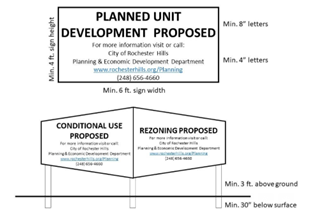
An applicant requesting a zoning map amendment, conditional use request or planned unit development request shall allow the City to place a sign(s) indicating the requested zoning map amendment, conditional use request or planned unit development request. The sign shall be placed on the site no less than 15 days prior to the scheduled public hearing. The sign shall be clearly visible from an adjoining roadway. Parcels with frontage on multiple roads, may have a sign placed along each road frontage or may have a single sign placed at the intersection of the two roadways that is clearly visible in each direction. The sign will not be placed within a public right-of-way, nor will the sign obstruct clear vision for motorists.
i.
ii.
Signs shall be removed by the City promptly following action by the City Council or withdrawal of the request.
B.
Zoning Ordinance Text and Map Amendments.
1.
Map or Text Amendments Requiring Notice to Ten or Fewer Parcels. If the proposed map or text amendment will require notice to ten or fewer parcels, notice shall be given as specified in Section 138-1.203.A.
2.
Map or Text Amendments Requiring Notice to 11 or More Parcels. If the proposed map or text amendment will require notice to 11 or more parcels, notice shall be given as specified in Section 138-1.203.A, with the exception that the notice need not list street addresses of properties that require notice.
3.
Notice to Other Entities. Notice of the time and place of the public hearing shall also be given by mail to any of the following entities that have registered their name with the City Clerk for the purposes of receiving public notice: any electric, gas, or pipeline public utility company; each telecommunication service provider; each railroad operating within the district or zone affected; and the airport manager of each airport.
C.
Conditional Use Requests.
1.
Public notice shall comply with the provisions listed in Section 138-1.203.A of this ordinance. A conditional use sign is not required for alcoholic beverage sales (for on-premises consumption) accessory to a permitted use.
2.
Reserved.
3.
Additional Information Required in Notice. Any notice required under this section shall include the places and times at which the proposed text or map amendment may be examined.
ACTIONS REQUIRING A PUBLIC HEARING
D.
Planned Unit Development Request.
1.
Planned Unit Development Requests Requiring Notice to Ten or Fewer Parcels. If the proposed planned unit development will require notice to ten or fewer parcels, notice shall be given as specified in Section 138-1.203.A.
2.
Planned Unit Development Requests Requiring Notice to 11 or More Parcels. If the proposed planned unit development will require notice to 11 or more parcels, notice shall be given as specified in Section 138-1.203.A, with the exception that the notice need not list street addresses of properties that require notice.
3.
Notice to Other Entities. Notice of the time and place of the public hearing shall also be given by mail to any of the following entities that have registered their name with the City Clerk for the purposes of receiving public notice: any electric, gas or pipeline public utility company; each telecommunication service provider; each railroad operating within the district or zone affected; and the airport manager of each airport.
4.
Reserved.
5.
Additional Information Required in Notice. Any notice required under this section shall include the places and times at which the proposed planned unit development may be examined.
(Ord. No. 182, § 1, 2-5-2018; Ord. No. 188, § 1, 12-14-2020; Ord. No. 190, § 1, 4-25-2022; Ord. No. 199, § 1, 3-17-2025)
SECTION 138-1.300 - Duties, Powers, and Limitations
A.
The building department shall have the power to grant zoning compliance and occupancy permits, and the building and public services, and fire departments shall have the authority to make inspections of buildings or premises necessary to carry out their respective duties in the enforcement of this ordinance.
B.
The City shall have the authority to conduct inspections as necessary to assure that landscaping and irrigation systems are installed according to approved plans and permits.
C.
The building, public services, and fire departments are under no circumstances permitted to make changes in this ordinance or to vary the terms of this ordinance in carrying out their duties.
SECTION 138-1.301 - Plot Plan
The building official shall require that all applications for building permits shall be accompanied by plans and specifications including a plot plan, in duplicate, drawn to scale, showing the following:
A.
The actual shape, location and dimensions of the lot.
B.
The shape, size and location of all buildings or other structures to be erected, altered or moved, and of any building or other structures already on the lot.
C.
Dimensions between property lines and all existing and proposed structures.
D.
Natural features and existing trees measuring six inches or greater in diameter, measured 4.5 feet above grade level.
E.
The existing and intended use of the lot and of all such structures upon it including, in residential areas, the number of dwelling units the building is intended to accommodate.
F.
Such other information concerning the lot or adjoining lots as may be essential in determining whether the provisions of this ordinance are being observed.
SECTION 138-1.302 - Permits
The following shall apply in the issuance of any permit under this ordinance.
A.
Permits not to be issued. No building permit shall be issued for the erection, alteration or use of any building or structure or part thereof, or for the use of any land, which is not in accordance with all sections of this ordinance.
B.
Permits required. No building or structure, or part thereof, shall be erected, altered, moved or repaired unless a building permit shall have been first issued for such work. The terms "altered" and "repaired" shall include any changes in structural parts; stairways; type of construction; type, class or kind of occupancy; light or ventilation; means of egress and ingress; or other changes affecting or regulated by the City building code, the housing law of the state, or this ordinance, except for minor repairs or changes not involving any of such features.
C.
Temporary permits. The building department may issue a temporary permit for a temporary building or use allowed in the zoning district for up to one year. The temporary permit may be renewed once by the Zoning Board of Appeals for a second one year period if the issuance of the permit would avoid an unreasonable hardship and not cause any undue or unreasonable disturbances to surrounding properties or in the general area.
SECTION 138-1.303 - Certificate of Occupancy
A.
Generally. A certificate of occupancy is required before any person may occupy or allow occupancy of any land, building or part thereof whenever:
1.
A building permit is required.
2.
Site plan approval is required.
3.
Additional parking in connection with the use is required.
4.
A nonconforming use is changed to a conforming use.
If a certificate of occupancy is not required by this section, a change of occupancy or use of any land, building or part thereof may be made without obtaining a certificate of occupancy.
B.
Certificates including zoning. A certificate of occupancy required for the erection or enlargement of buildings or structures; extension or alteration in whole or in part; or a change of use, occupancy, or a combination thereof shall also constitute a certificate of zoning as required by this ordinance. No such certificate shall be issued until there is compliance with all sections of this ordinance.
C.
Certificate for existing buildings and uses.
1.
Change of use or occupancy. A certificate of occupancy may be issued for a change of use or occupancy of existing buildings, structures, or parts thereof, if, after inspection, it is found that such buildings, structures or parts thereof, or such use of land, are in conformity with this ordinance.
A certificate of occupancy shall be obtained before there is any new use or modification of an existing use of a building or land or part thereof, or if any additional parking is required by Article 11 for the new or modified use. If additional parking is required by Article 11, the additional parking shall be provided and there shall be compliance with all of the requirements of this ordinance that are reasonably related to providing the additional parking. Paving of the entire parking area, as otherwise provided by this ordinance, shall not be required if the existing parking area is not paved and the number of the additional required parking spaces does not exceed the number of parking spaces existing on the property by more than 25 percent.
The Planning and Development Director and the directors of the building and public services departments may require a site plan in such detail as may be required to show compliance with this ordinance, and shall have discretion to determine what requirements of this ordinance shall apply.
2.
Upgrading an existing building or improved land. Whenever an existing building or improved land is upgraded or otherwise improved, where a building permit or site plan is required, there shall be compliance with the provisions of this ordinance that are reasonably related to the improvement or changes being made.
a.
Determination of which provisions of this ordinance shall apply shall be made by the Planning Commission if a site plan is required to be approved by the Planning Commission.
b.
When a building permit is required but site plan approval is not required, the determination of which provisions of this ordinance shall apply shall be made jointly by the planning and zoning director and the directors of the building and public services departments.
c.
Any such determination shall be documented with a written statement of findings stating the reasons for the determination.
d.
A property owner may appeal an adverse determination by City Staff to the Planning Commission, and an adverse determination by the Planning Commission may be appealed to the City Council.
D.
Temporary certificates of occupancy. A temporary certificate of occupancy may be issued if the property owner is entitled to a temporary certificate of occupancy under the building code, provided there is compliance with the additional requirements of this section. Any temporary certificate of occupancy issued shall specify a reasonable time for site improvements. Failure to comply with the time limit set forth shall be considered a violation of the time limit placed on the temporary certificate of occupancy for purposes of enforcing this ordinance and requiring completion of site improvements.
1.
Duration of temporary certificate of occupancy. A temporary certificate of occupancy shall not be effective for more than six months. Thereafter, occupancy may only be authorized under a final certificate of occupancy.
2.
Unfinished site improvements. All unfinished site improvements which are included on an approved site plan or which are otherwise required by this ordinance shall be constructed, installed or placed on the property and shall be approved by the City building or public services department within six months of obtaining a temporary certificate of occupancy. Failure to finish and obtain approval of such improvements shall constitute a violation of this ordinance giving rise to the penalties provided for in this ordinance and shall constitute a basis for relief in circuit court.
3.
Cash, letters of credit and bonds. Whenever an applicant seeks occupancy of premises prior to the completion of all improvements and construction in accordance with an approved site plan and the requirements of the City's ordinances, or when the applicant occupies the premises at the time of application for a building permit and continued occupancy is contemplated during the time of construction, the applicant shall deposit cash, a certified check, an irrevocable bank letter of credit or a corporate surety bond forfeitable to the City in an amount equal to the estimated cost of the remaining improvements pursuant to such site plan and the requirements of this ordinance and the City ordinances and requirements.
The estimate of such cost shall be solely in the discretion of the building and public services departments. As used in this subsection, the term "improvements" means those features and actions associated with a project which are considered necessary by the body or official granting zoning approval to protect natural resources or the health, safety, and welfare of the residents of the City and future users or inhabitants of the proposed project or project area, including roadways, lighting, utilities, sidewalks, screening, and drainage. The term "improvements" does not include the entire project which is the subject of zoning approval.
This subsection shall not be applicable to improvements for which a cash deposit, certified check, irrevocable bank letter of credit, or surety bond has been deposited pursuant to the land division act, PA 288 of 1967 (as amended) or the City drainage ordinance contained in Article II of ordinance 114 of the City Code of Ordinances.
4.
Administration of Sureties. Such cash deposit, certified check, irrevocable bank letter of credit or bond shall run to the City and shall be forfeitable by its terms and conditions, automatically, 15 days after notice to the applicant that the requirements of the site plan or this ordinance have not been met according to the terms of the temporary certificate or a time specified in the building permit in the case of occupancy at the time of applying for the building permit.
Such cash deposit, certified check, irrevocable bank letter of credit, or bond shall be considered posted with the condition that, upon passage of such 15 days after such notice in writing by first class mail at the last known address of the applicant, such amount shall automatically be transferred to the City fund, or otherwise enforceable by the City by any means available. Thereafter the City shall be authorized to go onto the property and complete the construction in accordance with the site plan requirements with the funds available.
The City may retain ten percent of the cost of such completion as the City administrative expense and refund any balance to the applicant. No part of an irrevocable bank letter of credit or surety bond shall be released until all of the work is completed. In the case of a deposit of cash or a certified check, portions of such amount may be rebated as work progresses, at reasonable intervals, provided that at all times the amount on deposit equals the cost of the work to be completed.
5.
Submittal of As-Built Drawings. When a property owner requesting a temporary certificate of occupancy has not yet made an initial submission of as-built drawings to the Department of Public Services, the property owner shall submit a minimum $10,000.00 cash deposit or submit the as-built drawings prior to issuance of a temporary certificate of occupancy.
E.
Final certificate of occupancy. No final certificate of occupancy shall be issued until all on-site improvements required by an approved site plan and by this ordinance shall be constructed, installed, or placed on the property in accordance with the approved site plan and this ordinance and approval for such has been obtained from the building and public services departments. In no case shall a final certificate of occupancy be approved until final as-built drawings are submitted to and approved by the public services department.
F.
Records of certificates. A record of all certificates issued shall be kept on file in the office of the building department.
G.
Certificates for dwelling accessory buildings. Buildings accessory to dwellings shall not require a separate certificate of occupancy but may be included in the certificate of occupancy for the dwelling when shown on the plot plan, and when completed at the same time as such dwellings.
H.
Applications for certificates. Application for certificates of occupancy shall be made in writing to the building department on forms furnished by the City, and such certificates shall be issued within ten days after receipt of such application if it is found that the building or structure, or part thereof, of the land use is in accordance with this ordinance. If such certificate is refused for cause, the applicant shall be notified of such refusal and cause thereof, within the ten-day period.
SECTION 138-1.304 - Final Inspection
The holder of every building permit for the construction, erection, alteration, repair or moving of any building, structure, or part thereof shall notify the building inspector immediately, upon the completion of the work authorized by such permit, for a final inspection.
SECTION 138-1.305 - Fees
Applicants for permits required by this ordinance shall pay to the City treasurer, at the time application for such permit is made, such fees as are set by resolution of the City Council.
SECTION 138-1.400 - Enforcement
The Mayor or his or her designee shall administer and enforce this ordinance. In the exercise of their duties, the directors, employees, representatives and deputies shall have authority provided by law for the enforcement of ordinances, including, but not by way of limitation, the authority to issue and serve municipal civil infraction citations and municipal civil infraction violation notices, as provided by Public Act No. 12 of 1994 (MCL 600.8701 et seq., MSA 27A.8701 et seq.), and the right to enter private premises as provided by law.
SECTION 138-1.401 - Municipal Civil Infraction
Any person violating any of the sections of this ordinance or the owner of any building, structure or premises or part thereof, where any condition in violation of this ordinance shall exist or be created, and who has assisted knowingly in the commission of such violation, shall be responsible for a municipal civil infraction, and upon a determination or admission of responsibility therefore shall be subject to a civil fine as provided in Section 66-37, the costs of prosecution, and such other costs, damages, expenses, sanctions and remedies authorized by law.
SECTION 138-1.402 - Public Nuisance
In addition to all other remedies, including the penalties provided in this Article, the City may commence and prosecute appropriate actions or proceedings in a court of competent jurisdiction to restrain or prevent any noncompliance with or violation of any of the sections in this ordinance or to correct, remedy or abate such noncompliance or violation. Buildings erected, altered, razed or converted, or uses carried on in violation of any section of this ordinance or in violation of any regulations made under the authority of the Michigan Zoning Enabling Act, PA 110 of 2006 (as amended) are hereby declared to be a nuisance per se, and the court shall order such nuisance abated.
SECTION 138-1.403 - Cumulative Rights and Remedies
The rights and remedies provided in this ordinance are cumulative and in addition to any other remedies provided by law.
SECTION 138-1.404 - Forbearance Not Condoned
Forbearance of enforcement of this ordinance shall not be deemed to condone any violation thereof.
SECTION 138-1.405 - Each Day of Violation a Separate Offense
A separate offense shall be deemed committed upon each day during or when a violation of this ordinance occurs or continues.

