
Rochester Hills City Zoning Code
ARTICLE 6
SUPPLEMENTAL DISTRICT STANDARDS
CHAPTER 1. - RM-1 - MULTIPLE-FAMILY RESIDENTIAL DISTRICTS
The following standards shall apply to all attached unit buildings and two-family (duplex) buildings in RM-1, Multiple-Family Residential Districts.
CHAPTER 3. - BD - BROOKLANDS DISTRICT[4]
Editor's note—Ord. No. 184, pt. 7, adopted Dec. 2, 2019, repealed the former Ch. 3, §§ 138-6.301—138-6.305, and enacted a new Ch. 3 as set out herein. The former Ch. 3 pertained to CI - Commercial Improvement Districts and derived from Ord. No. 169, §§ 1—4, adopted June 16, 2014; Ord. No. 182, § 5, adopted February, 5, 2018; and Ord. No. 183, § 14, adopted June 18, 2018.
CHAPTER 4. - RMH - MANUFACTURED HOUSING PARK DISTRICT[5]
Editor's note— Ord. No. 165, § 12, adopted Mar. 19, 2012, repealed Ch. 138, Art. 6, Ch. 4, §§ 138-6.400—138-6.416, in its entirety and enacted new provisions to read as herein set out. Prior to this amendment, Ch. 4 pertained to similar subject matter. See Code Comparative Table for derivation.
CHAPTER 6. - RESERVED[6]
Editor's note— Ord. No. 196, § 7, adopted June 19, 2023, deleted Art. 6, Ch. 6, §§ 138-6.600—138-6.602 entitled "REC - Regional Employment Center," which derived from Ord. No. 170, § 11, adopted June 16, 2014.
SECTION 138-6.100 - Density
A.
Two-family (duplex) units. Where development is exclusively of a two-family residential structure, there shall be provided a minimum lot area of at least 6,000 square feet of gross area for each unit (or 12,000 square feet per two-family residential structure).
B.
Attached dwelling units. The following minimum lot area per dwelling unit type shall be required in all RM-1 residential districts:
Plans presented that include a den, library, or extra room shall have such extra room counted as a bedroom for purposes of this ordinance.
C.
Natural features. In RM-1 districts, land which is within a floodplain, watercourse, floodway, drainage course and/or wetlands, as defined and/or delineated as such by the U.S. Army Corps of Engineers, City Consultants, and/or official City maps adopted pursuant to this ordinance and the City floodplains, watercourse and wetland protective ordinances, and subaqueous land as is not otherwise delineated shall be counted for density computations on the basis of only 50 percent of such land.
In no event shall the development upon the remaining part of any parcel exceed an average density of 167 percent of the average density allowed in the schedule of regulations per remaining acre.
SECTION 138-6.101 - Minimum Lot Standards
A.
Two-family (duplex) units. Two-family (duplex) units shall have a minimum lot width of 50 feet for each unit (or 100 feet per two-family residential structure).
B.
Attached dwelling structures. No attached unit structure (three or more dwelling units) shall be erected on a lot or parcel of land which has an area of less than one-half acre, or has a lot width of less than 150 feet.
SECTION 138-6.102 - Setbacks
For the purpose of yard regulations, all attached unit buildings shall be considered as one building occupying one lot, and each attached unit building located on a parcel of land shall comply with each of the following setback requirements.
A.
Perimeter setbacks.
1.
Front yard. The minimum front yard setback is 30 feet.
2.
Rear yard. The minimum rear yard setback is 30 feet.
3.
Side yard. A minimum side yard setback of 30 feet shall be provided along each side property line. The side yard shall be increased by one foot for each ten feet or part thereof by which length the multiple structure exceeds 40 feet in overall dimension along the adjoining plot line provided that no attached unit structure shall exceed 180 feet in length along any one face of the building or 250 feet in total length.
4.
Any yard abutting a major thoroughfare in RM-1 districts shall have a minimum depth of 50 feet.
5.
Where any yard abuts an RE, R-1, R-2, R-3, R-4, R-5, RCD, RMH or SP district, the minimum distance shall be 35 feet unless a larger setback is required by this chapter.
B.
Building separation. The following minimum separation shall be provided between buildings in the RM-1 districts.
The front and rear of an attached unit structure shall be considered to be the faces along the longest dimension of such structure, with the front of the attached unit building being the direction faced by the living rooms of the dwelling units in such building, the rear of the multiple-family building shall be considered to be the direction faced by the service entrance of the dwelling unit in such building, and the side of the multiple-family building shall be considered to be the face along the narrowest dimension of the such building. Attached unit buildings may be considered to have two or more front façades and no rear façade if living rooms or building entrances are located on more than one façade of the building.
(Ord. No. 186, pt. 10, 12-2-2019)
SECTION 138-6.103 - Minimum Floor Area
The minimum floor area for units in an attached unit building is as follows:
A.
Efficiency unit. The term "efficiency unit" shall mean a dwelling unit containing not over 500 square feet of floor area, and consisting of not more than one room in addition to kitchen, dining and necessary sanitary facilities. Any efficiency unit with an area greater than 500 square feet shall be considered a one-bedroom unit for the purposes of compliance with the density requirements for attached unit buildings.
B.
One-bedroom unit. The term "one-bedroom unit" shall mean a dwelling unit containing a minimum floor area of at least 600 square feet per unit, consisting of not more than two rooms in addition to kitchen, dining and necessary sanitary facilities.
C.
Two-bedroom unit. The term "two-bedroom unit" shall mean a dwelling unit containing a minimum floor area of at least 700 square feet per unit, consisting of not more than three rooms in addition to kitchen, dining, and necessary sanitary facilities.
D.
Three or more bedroom unit. The term "three or more bedroom unit" shall mean a dwelling unit wherein for each room, in addition to the three rooms permitted in a two-bedroom unit, there shall be provided an additional area of 150 square feet to the minimum floor area of 700 square feet.
E.
Two-family (duplex) units. Where two-family units are constructed within an RM-1 district the minimum floor area requirements of the R-4 one-family residential district shall be adhered to for each unit of the two-family structure.
F.
Unit mixture. In the RM-1 multiple-family districts, not more than ten percent of the total number of units shall be of the efficiency type. In no instance shall the number of one-bedroom units exceed 30 percent of the total number of units in the RM-1 districts.
SECTION 138-6.104 - Design Standards
A.
Building Height. The maximum building height for any structure in an RM-1 district shall be 2.5 stories and 30 feet.
B.
Architectural details. Walls visible from a street or other residential uses shall include windows and architectural features similar to the front facade of the building, including, but not limited to awnings, cornice work, edge detailing or other decorative finish materials. All buildings shall have pitched roofs, which may include functional dormer windows and varying lines customary with gable or hip style roofing. Standing seam metal roofing is prohibited.
C.
Garage Orientation. Where attached unit buildings contain attached or detached garages that are accessory to the dwelling unit, no more than 25 percent of all garage doors may be located at or in front of the front building wall of the building, with all other garage doors being located at least ten feet behind the front building wall of the unit or facing the side or rear of the unit. There is no limitation on the number or orientation of parking areas, garages and any other accessory structure or uses that may be located within the established rear yard, with access provided by an alley or access drive.
[D.]
Front Door Orientation. For attached dwelling types that have individual entrances directly to the exterior of the building (such as townhouse and stacked flat buildings), a minimum of 75 percent of the main entrances to the individual dwellings shall be located on the front façade of the building, and all shall include a front porch or stoop that is at least six feet in width and depth with a minimum area of 36 square feet. The front porch or stoop may encroach into the front yard setback area provided that it remains unenclosed.
[E.
]Street design and vehicular circulation. Street connections shall be provided to adjacent neighborhoods and parcels in residential districts. Ingress and egress from the public streets shall be designed to minimize congestion and interference with normal traffic flow. All interior roads, drives, and parking areas within a multi-family development shall be hard surfaced and provided with curbs and gutters. Roadway drainage shall be appropriately designed such that stormwater from the roadway will not drain onto the adjacent lots.
[F.]
Pedestrian circulation. Minimum five-foot wide concrete sidewalks shall be provided to connect parking areas, public sidewalks and recreation areas to all building entrances. Minimum six-foot wide concrete sidewalks shall be provided along collector roads and streets within the development. Sidewalks or minimum eight-foot wide asphalt pathways shall be provided along streets adjacent to the development in accordance with adopted City plans and policies.
[G.]
Parking.
1.
On-street parking on interior streets shall count towards the minimum parking requirement. Where on-street parking is permitted, the street shall have a minimum clear circulation lane of 16 feet and parking stalls shall have a minimum width of eight feet and a minimum length of 22 feet.
2.
All off-street parking spaces must be screened from view of any public road, pedestrian path, or adjacent single-family residential dwelling unit in compliance with Section 138-12.205.B. (Landscape Requirements).
3.
Off-street parking lots may occupy up to 50 percent of a required front yard and 75 percent of a required rear yard, provided that no portion of the parking lot is located closer than 15 feet to a perimeter property line.
[H.]
Recreation areas. Passive or active recreation areas (including but not limited to seating areas, playgrounds, swimming pools, walking paths and other recreational elements in accordance with the intended character of the development) shall be provided at a ratio of at least five percent of the gross area of the development. The minimum size of each area shall be not less than 5,000 square feet, and the length to width ratio of each area, as measured along the perimeter, shall not exceed four to one (4:1). Such areas shall be centrally and conveniently located to be physically and visibly accessible to residents, and shall not be located within any required yard setbacks or building separations.
[I.]
Utilities. All multiple-family dwellings shall be connected to the public sewer and public water system.
SECTION 138-6.200 - Permitted Development
At the property owner's option, development in the RCD one-family residential cluster district may be according to the provisions and requirements of the R-3 residential district, or according to the provisions and requirements of this Chapter 2. If part or all of the property is developed according to the R-3 residential district requirements, the density of limitations and the other provisions of the R-3 residential requirements shall apply for that part of the property so developed.
SECTION 138-6.201 - Attachment
No more than four units may be located in an attached unit building in the RCD district.
SECTION 138-6.202 - Yards
Yard requirements in the RCD one-family residential cluster district shall be as follows:
A.
Front yards shall not be less than 25 feet.
B.
At least 20 feet of combined side yards shall be provided between buildings in an RCD district.
C.
Rear yards to one-family attached units shall be at least 35 feet.
SECTION 138-6.203 - General Requirements
A site plan submitted under the RCD one-family residential cluster district shall comply with the following:
A.
All units that abut major thoroughfares of 120-foot right-of-way, or greater, shall have a rear yard or side yard relationship to such thoroughfares of at least 50 feet.
B.
A landscaped berm, at least five feet high, shall be provided along the entire property line abutting the major thoroughfare.
1.
This berm may be included within a required side or rear yard.
2.
The berm shall be landscaped with a minimum of one evergreen tree per 15 lineal feet and one deciduous canopy tree per 50 lineal feet.
3.
The slopes of such berms will be gentle enough so as not to erode when planted in grass and be suitable for mowing and typical lawn and landscaping maintenance.
4.
The design of the berm, as it relates to street intersections, will be such that the horizontal view of oncoming traffic is not obscured.
5.
The berm requirement may be waived by the Planning Commission if existing vegetation to be preserved will be sufficient to provide equal or greater screening than the berm.
C.
Street ingress and egress to the major thoroughfare shall be kept to a minimum, and, further, all main collector streets shall be dedicated road rights-of-way.
D.
Any area to be dedicated to the City for public park, recreation or open space purposes as a result of the application of this cluster approach shall be subject to the approval of the City Council, after review and recommendation by the Planning Commission, for minimum size, shape, location, access, the character of any improvements and assurance of the permanence of the open space and its continued maintenance.
E.
All other requirements of Section 138-2.103.C., pertaining to site plan review.
SECTION 138-6.204 - Change of Land
If the physical characteristics and the natural terrain and features which bring a parcel of land within the intent and provisions of this division are destroyed or substantially changed, the property shall not be developed according to the RCD provisions, but shall only be developed according to the provisions and requirements of the R-3 residential district. If such physical characteristics and natural terrain and features are destroyed and/or changed after the approval of a site plan, a stop work order may be issued by the City to all interested parties. At the written request of the property owners, the City Council shall hold a hearing to review the matter and to ascertain factually whether there was justification for the stop work order. The City may, at its option, apply to the circuit court for an injunction to prohibit further development pursuant to the approved site plan.
SECTION 138-6.205 - Ancillary Uses
Ancillary uses in the RCD one-family residential cluster district are home occupations under the terms and conditions as set forth under Section 138-4.414.
SECTION 138-6.206 - Floodplains, Subaqueous Areas or Wetlands
In RCD one-family residential cluster districts, other than a platted subdivision, land which is within a floodplain, watercourse, floodway, drainage course, and/or wetland, as defined and/or delineated as such by the U.S. Army Corps of Engineers, and/or official City maps adopted pursuant to this ordinance and the City floodplains, watercourse and wetland protective ordinances, and subaqueous lands as are not otherwise delineated, shall be counted for density computations on the basis of only 50 percent of such land. In no event shall the development of the remaining part of any parcel exceed an average density of five units per remaining acre.
SECTION 138-6.207 - Area and Bulk Requirements
In the RCD one-family residential cluster district, all other requirements pertaining to height, bulk, and any other site improvements shall be controlled according to the requirements for the R-3 district set forth in Section 138-5.100 Schedule of Regulations.
SECTION 138-6.300 - Principal Uses Permitted
Uses permitted in the BD district are listed in Section 138-4.300.
(Ord. No. 184, pt. 7, 12-2-2019; Ord. No. 196, § 6, 6-19-2023)
SECTION 138-6.301 - Required Conditions
Except as permitted, all businesses, servicing, storage and processing, except for off-street parking and loading, shall be conducted within a completely enclosed building.
The outdoor sales of goods in the BD district shall require a special events permit from the Building Department, and must apply with all applicable City codes and ordinance.
(Ord. No. 184, pt. 7, 12-2-2019; Ord. No. 196, § 6, 6-19-2023)
Editor's note— Ord. No. 196, § 6, adopted June 19, 2023, deleted former § 138-6.301 entitled "Conditional uses," which derived from Ord. No. 184, pt. 7, adopted Dec. 2, 2019, and renumbered remaining sections 138-6.302—138-6.306 as §§ 138-6.301—138-6.305 as herein set out.
SECTION 138-6.302 - Area, Height and Typology Requirements
A.
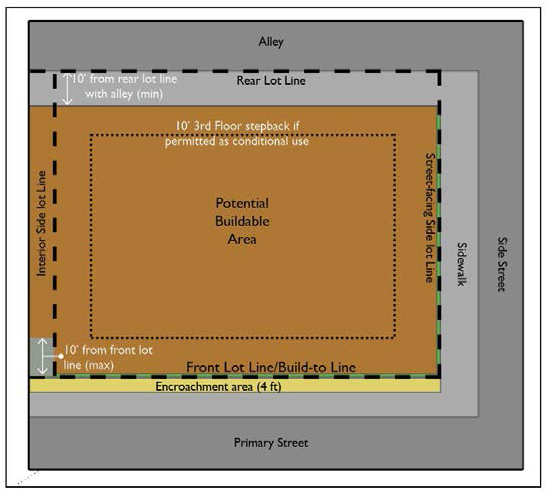
Area and Placement Requirements.
Figure: Setbacks, Façade Abutting Street, and Encroachments
B.
Height and Floor Area Requirements.
Figure: Height Requirements
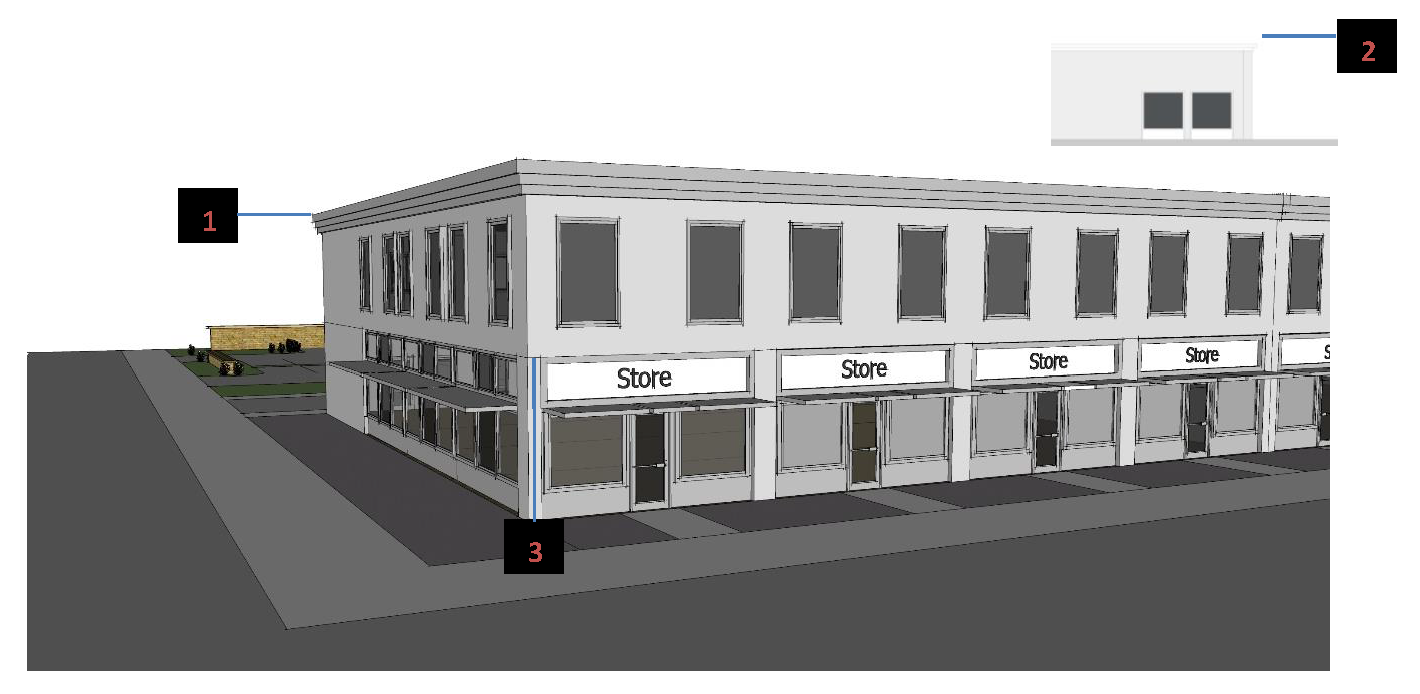
*NOTE: Conditional use standards for 45 feet; 3 stories:
1.
Submission of architectural perspective drawings that illustrate the relationship of the additional height with the nearest residential buildings on any residentially-zoned parcels sharing a boundary with the site. Sight lines from windows or other occupied areas of the subject building seeking additional height shall be indicated to minimize views from areas of additional height to adjacent residential buildings. Views should be minimized through the use of landscaping, additional step backs, building orientation, or other means as determined necessary by the Planning Commission.
2.
Submission of floor plans and elevations indicating the use of additional height areas, including any proposed outdoor uses on second or third floors, to determine potential noise nuisances.
3.
Outdoor dining shall be prohibited on any additional height areas on the rear or side of buildings adjacent to residentially-zoned parcels.
4.
Parking for the additional third story shall be provided completely on the site.
Primary and Side Streets
1.
A Primary Street is the street upon which the front lot line abuts.
2.
For corner lots, a side lot line abutting a street shall be considered a build-to line. Auburn Road shall always be designated as a Primary Street in the BD District, and any property abutting Auburn Road shall designate Auburn Road frontage as a front lot line.
Front and Exterior Side Yard Setbacks: Whenever a structure is setback from a front or street-facing side lot line, the setback area shall be either paved with concrete, brick pavers or similar material customarily found in the district. Landscaped areas and furnishings (benches, trash receptacles, and similar equipment) designed and constructed in a manner consistent with the district, with a focus on pedestrian flow and creating places of pedestrian interest, may also be provided.
C.
Building Typology.
1.
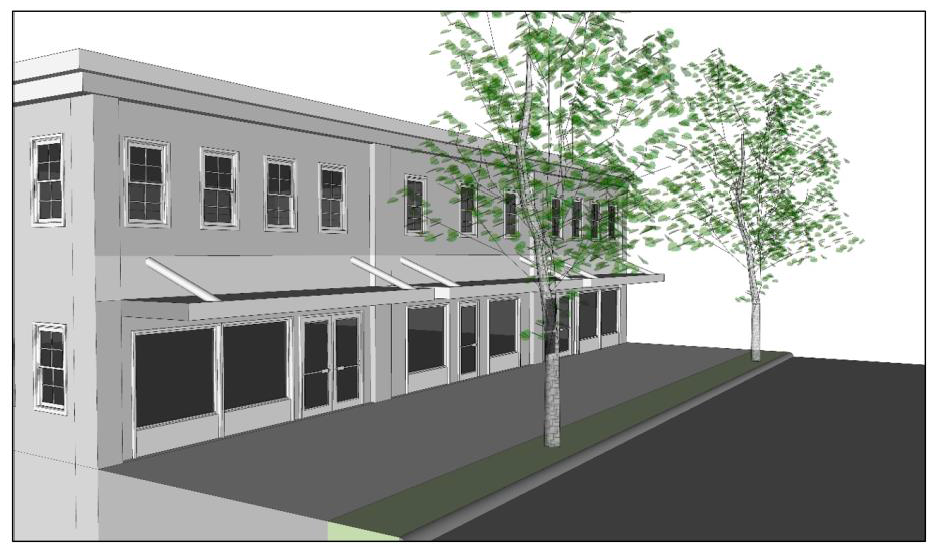
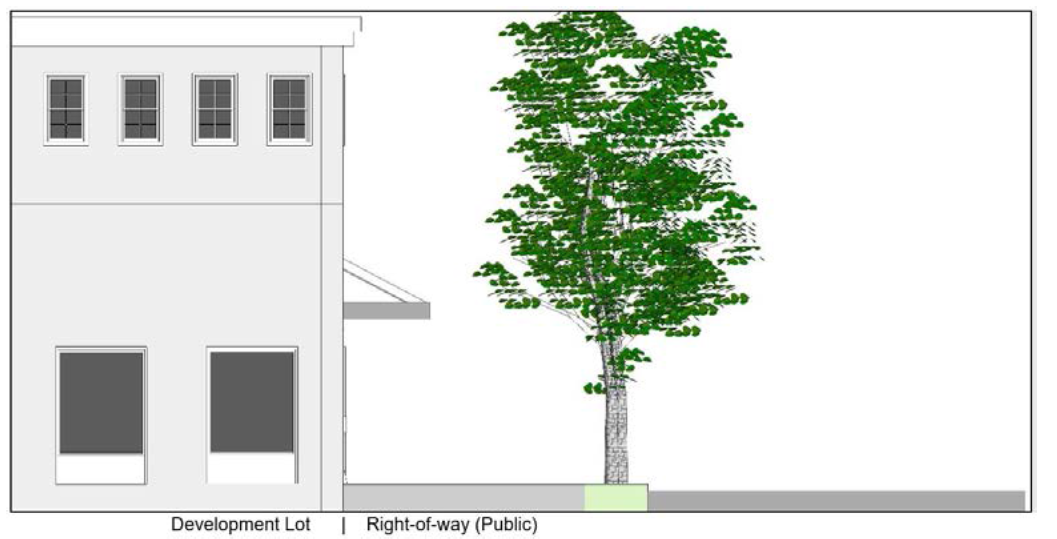
Shopfront. This frontage type is intended to encourage ground floor commercial uses in multiple story buildings that are typical in commercial main streets. Buildings feature ample windows for displays and open views to indoor activity on the ground floor. Primary entrances are prominent and street-facing, and they are either recessed at the doorway up to five feet or placed at the build-to line. Awnings are encouraged to shield pedestrians from the elements and minimize the impact of direct sunlight near storefronts.
Below: Shopfront axonometric view illustrating pedestrian-oriented storefront that encourages walking throughout the BD District. The storefront glazing, which allows views inside the building, is a critical element that encourages pedestrians to stroll the District.
Below: Section view of shopfront illustrating relationship of storefront to pedestrian walkway. Street trees and awnings provide protection from the elements and reduce the impact of high temperatures during warm weather months.
2.
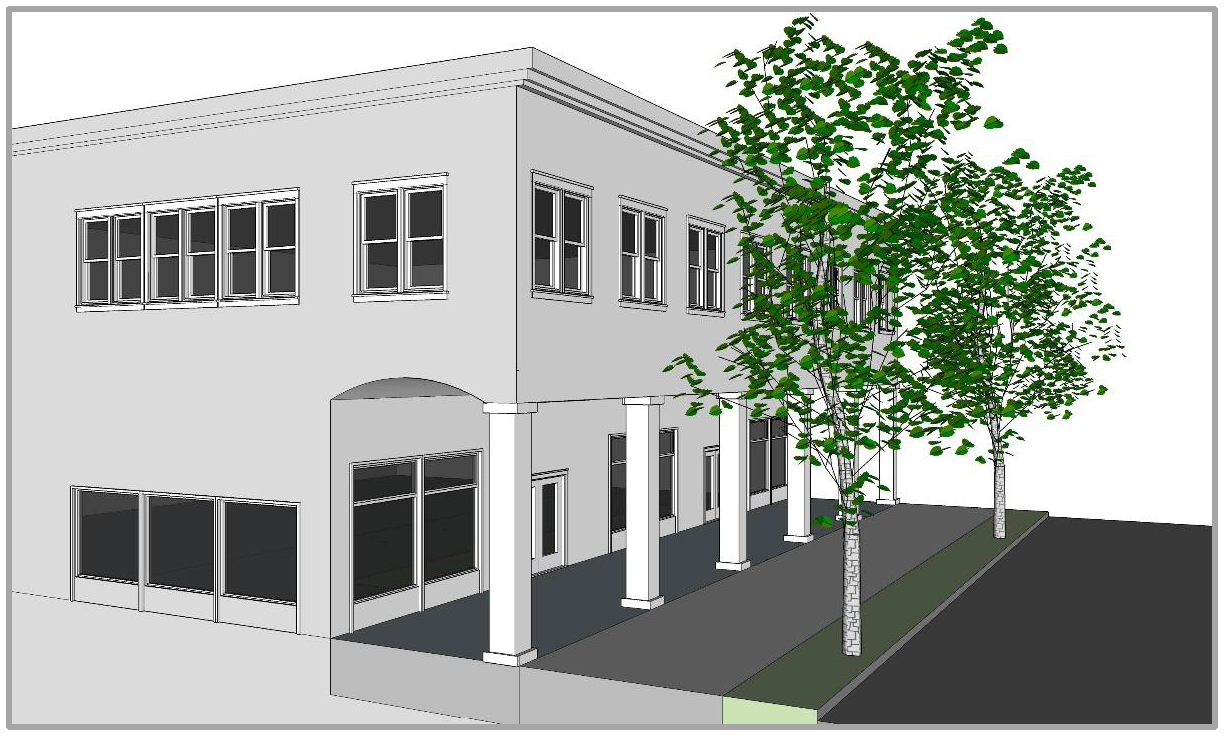
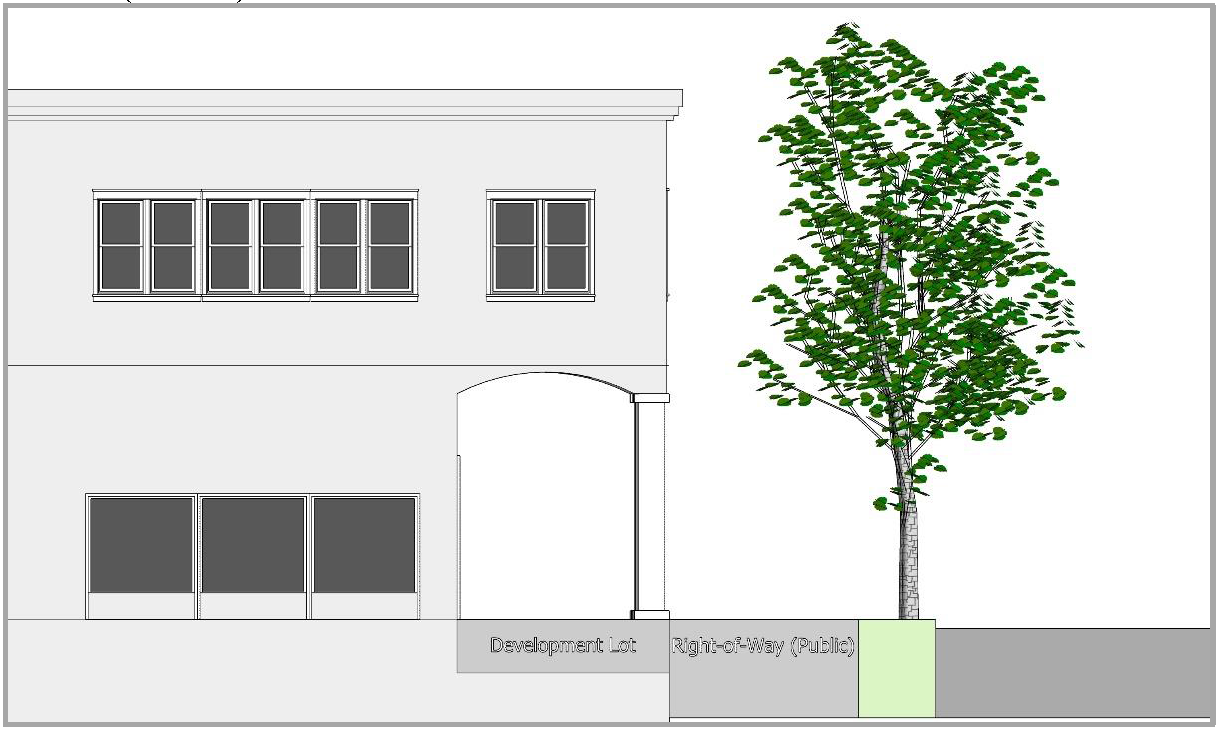
Arcade. With this frontage type, the upper floors of the façade project to the lot line, while the ground floor façade is recessed from the lot line. The maximum recess of the ground floor from the lot line shall be 10 feet. Arcades are ideal for retail use and outdoor dining.
Below: Arcade axonometric view shows how the building design creates a recessed ground floor shopfront area. The upper floors project over the pedestrian walkway to the front lot (build-to) line.
Below: Arcade section view shows the recessed pedestrian walkway and the upper floor area above. The entire structure is on private property, and the columns and upper floors extend to the front lot (build to) line.
3.
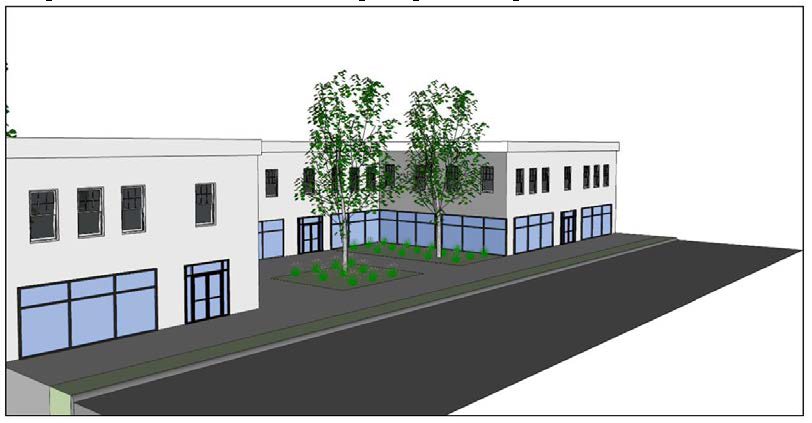
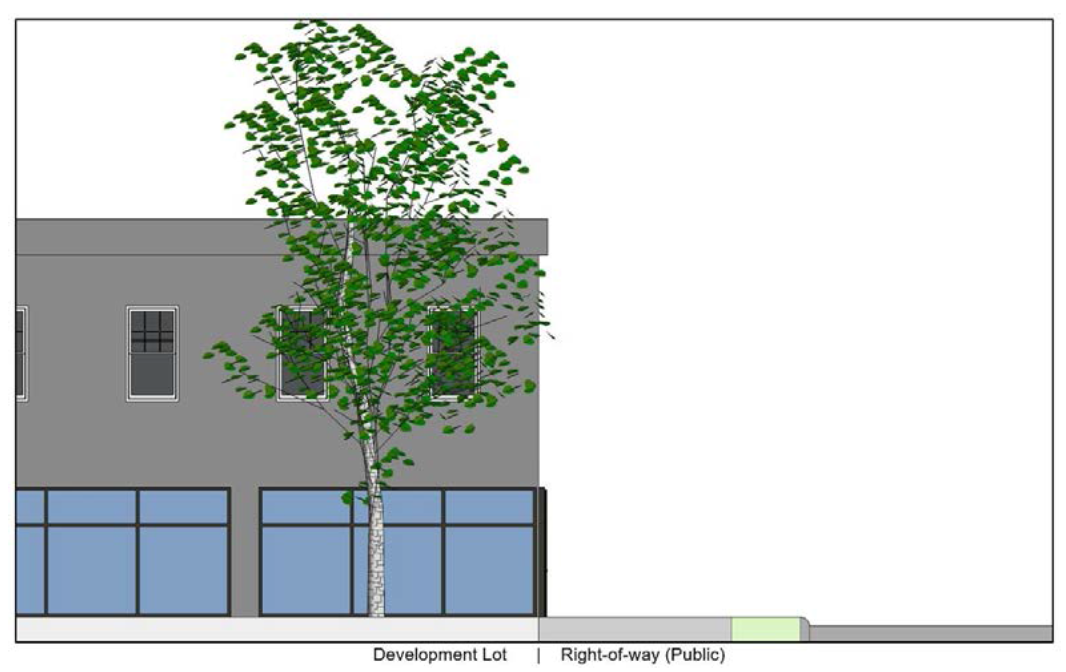
Forecourt. Forecourts are an additional design element incorporated into a shopfront or arcade frontage. The main façade of the building is at or near the build-to line, while a maximum of 50 percent of building frontage is set back up to 40 feet from the build-to line, creating a small court space. The space could be used as an entry court or shared garden space for apartment buildings, as an additional restaurant seating area within retail and retail service use areas, as a small park or plaza, or similar use.
Below: Forecourt axonometric view shows how the building design creates a recessed ground floor courtyard area. The courtyard is typically a combination of hardscape and landscape area. Examples of uses include outdoor dining and pedestrian plaza areas.
Below: Forecourt section view shows the relationship of the development lot to the right-of-way. The courtyard area is not visible from this angle, as it is behind the portion of the building placed at the build-to line.
Forecourts may be placed at any location along the frontage provided that the forecourt is enclosed on three sides by building walls. The forecourt area shall have a mix of paved areas (brick, stone or concrete pavers or concrete), landscaped areas (planted with a mix of flowers, plants, shrubs, and trees), and street furniture (such as chairs, tables, benches, and similar features). Lawn areas are not appropriate for courtyards and may only be used as a minor accent to an otherwise landscaped area. Outdoor dining is encouraged.
(Ord. No. 184, pt. 7, 12-2-2019; Ord. No. 196, § 6, 6-19-2023)
SECTION 138-6.303 - Building Design Standards
The following standards apply to all building facades fronting a public street, alley, or residential district.
A.
Building Elements.
1.
Buildings must include a top or cap element, such as a parapet, cornice or similar feature.
2.
The edge of each distinguishable storefront shall be defined by a vertical design element.
3.
Horizontal expression lines shall define stories of the building.
4.
A minimum of one pedestrian entrance onto Auburn Road for each building is required. For buildings with more than 150 feet of building frontage on the same street, provide one additional pedestrian entrance for each 75 feet of building frontage over the first 75 feet.
5.
Rear building pedestrian entrances are required for building areas containing retail sales or eating and drinking establishments that on sites with a rear parking lot and/or alley.
6.
All pedestrian entrances shall include elements such as: covered entries, integral planters, awnings, raised corniced parapets over the door, peaked roof forms having an average slope greater than or equal to a minimum 5:12 pitch, arches, or architectural details such as tile work and moldings that are integrated in to the building materials and design.
7.
Vacant storefronts shall not be boarded up, covered with paper or otherwise appear derelict or abandoned. Temporary displays of art, merchandise from other area businesses or similar displays shall be permitted. Temporary decorative covering of windows shall be permitted only during periods of active store renovations.
B.
Building Materials. Exterior materials that may be used on buildings in the BD district fall into two categories, primary and accent building materials. The building material requirement is based on the exterior wall surface area, excluding windows and doors. Primary building materials shall cover a minimum of 60 percent of the exterior wall surface area, while accent materials may be used on up to 40 percent of the exterior wall surface area.
1.
Primary Building Materials include:
a.
Durable natural building materials such as brick, stone, and other similar materials.
b.
Exposed logs, timbers, or wood trim.
c.
Any durable, relatively low-maintenance material that convincingly matches the appearance of the above natural building materials.
2.
Accent Building Materials include:
a.
Decorative precast concrete block.
b.
Metal panels and trim.
c.
Glass.
d.
Vinyl siding and non-durable building materials such as EIFS may be used as accent materials, but may cover a maximum of ten percent of any exterior building façade's wall area.
e.
Any other material except those specifically prohibited by the following subsection 3.
3.
Prohibited Building Materials include:
a.
Plain concrete block (both painted and unpainted).
b.
Plywood or T-111 panels.
c.
Vinyl and aluminum siding.
4.
Compliance with LEED-NC Standards. LEED certification for new buildings is encouraged. Absent certification for the entire building, compliance with the following building material credits is encouraged: MR 4.1 or MR 4.2, MR 5.1 or MR 5.2, MR 6, and MR 7.
C.
Façade Transparency.
1.
Window glazing shall be clear with a visible light transmittance of not less than 65 percent (0.65) on ground floors, and 45 percent (0.45) on upper floors, per glass manufacturer specifications.
2.
Ground Floor Nonresidential Uses shall maintain a minimum of 70 percent façade transparency, measured between two feet and eight feet above grade.
3.
Upper Floor Nonresidential Uses shall maintain a minimum of 30 percent façade transparency on street-side facades measured from floor to floor.
4.
Ground Floor Residential Uses shall maintain a minimum of 25 percent façade transparency measured from exterior grade level to the second story floor level.
5.
Upper Floor Residential Uses shall maintain a minimum of 20 percent façade transparency measured from floor to floor.
(Ord. No. 184, pt. 7, 12-2-2019; Ord. No. 196, § 6, 6-19-2023)
SECTION 138-6.304 - Parking and Loading
The following parking requirements are applicable in the BD, Brooklands district and replace similar requirements set forth in Article 11. Any requirement of Article 11 that is not superseded by one of the following parking requirements shall remain in effect in the district.
A.
Minimum Parking Required.
1.
Residential
i.
0.75 spaces per studio dwelling unit.
ii.
1 space per dwelling unit with 1 bedroom.
iii.
1.5 spaces per dwelling unit with 2 or more bedrooms.
iv.
1 visitor space shall be provided for every 3 units.
2.
1 parking space per 400 square feet of nonresidential building space.
B.
Maximum Parking Permitted. The maximum surface parking requirement shall be 200 percent of the minimum parking requirement. The maximum parking requirement may be modified by the reviewing authority if the applicant can submit evidence that additional parking will be required to accommodate maximum parking demand on a typical day. Parking spaces in parking garages are exempt from the maximum parking standard.
C.
On-Street Parking. Shall be counted toward the minimum parking requirement. On-street spaces that have at least 50 percent of the parking stall length fronting the site shall be counted.
D.
Public Parking. The minimum parking requirement for nonresidential building space only may be reduced by 20 percent if a public parking lot is located within 500 feet of the nonresidential use, as measured from property line to property line.
E.
The Planning Commission may further modify the numerical requirements for off-street parking in accordance with Section 138-11.202.
F.
Parking Lot Layout. Parking lot layout, maintenance, and construction shall comply with all of the requirements of Article 11. The Planning Commission may modify the dimensional requirements of Article 11 based on evidence submitted by the applicant indicating that the modification will result in superior site design, will achieve the same purpose as if the parking lot were designed according to conventional standards, and will function in a safe and efficient manner.
G.
Loading Space and Alleys. There are no specific loading requirements in the BD, Brooklands district; however, buildings and sites shall be designed such that trucks and large delivery vehicles may be accommodated on the site using alleys without encroaching directly onto a perimeter or interior street. Further, loading facilities such as truck docks shall be located and screened such that they are not visible from any perimeter or interior street.
H.
Shared Parking. (ZO Replacement).
1.
The Planning Commission may authorize a reduction in the total number of required parking spaces for two (2) or more uses jointly providing off-street parking when their respective hours of peak operation do not overlap. Shared parking shall be subject to the location requirements of the Zoning Ordinance and the following conditions:
i.
Computation. The number of shared spaces for two (2) or more distinguishable land uses shall be determined by the following procedure:
1.
Multiply the minimum parking required for each individual use, as set forth in the Specific Off-Street Parking Provisions by the appropriate percentage indicated in the Shared Parking Calculations table for each of the six (6) designated time periods.
2.
Add the resulting sums for each of the six (6) columns.
3.
The minimum parking requirement shall be the highest sum among the six (6) columns resulting from the above calculations.
4.
Select the time period with the highest total parking requirement and use that total as the shared parking requirement.
2.
Other uses. If one (1) or all of the land uses proposing to make use of shared parking facilities do not conform to the general land use classifications in the Shared Parking Calculations table, as determined by the Planning and Economic Development Director, then the applicant shall submit sufficient data to indicate the principal operating hours of the uses. Based upon this information, the Planning and Economic Development Director shall determine the appropriate shared parking requirement, if any, for such uses.
3.
Alternative procedure. An application may be submitted requesting that the Planning and Economic Development Director authorize a greater reduction in the total number of required parking spaces for two (2) or more uses where an applicant believes that the Shared Parking Calculations table does not adequately account for circumstances unique to the particular property or properties in question. The application shall include, at a minimum, a parking study with a detailed description of the proposed uses, their hours of operation, their anticipated peak parking demand, and anticipated hours that such peak parking demand would occur. Any study submitted shall be prepared with a parking professional with experience in shared parking studies and shall follow the Shared Parking methodology established by the Urban Land Institute's publication, Shared Parking, by Mary Smith. Based upon information demonstrating that the peak parking demand for the uses in question would not coincide, the Planning Commission may authorize a greater parking reduction than is authorized by the Shared Parking Calculations table. The Planning Commission may impose reasonable conditions to mitigate potential negative effects.
4.
Process. An application for shared parking shall be submitted on a form approved by the Planning Commission and, for parking lots with 1—100 parking spaces, by the Planning and Economic Development Director. (This will be a new form specific to this area based on the below table to be formalized at a later date if approved).
5.
Shared Parking Calculations.
(Ord. No. 184, pt. 7, 12-2-2019; Ord. No. 196, § 6, 6-19-2023)
SECTION 138-6.305 - Landscaping and Screening
A.
Buffer Requirements.Section 138-12.300 Buffer Requirements shall not apply in the BD, Brooklands district where an alley is present or planned along the rear of BD district sites. Where no alley is present or planned adjacent to parcel zoned or used as residential, a screening wall is required. All screen walls shall match existing adjacent walls. Where no wall is adjacent, the screen wall shall be six (6) feet in height, consist of decorative masonry or natural materials such as brick or stone, and capped with a stone or concrete cap. The color and material shall be coordinated with the materials of the principal building.
B.
Parking Lot Landscaping.
1.
Interior parking lot landscaping shall be provided in accordance with Section 138-12.301 for parking lots of 20 spaces or more. Tuck under parking spaces shall not be counted towards the 20 spaces or be required to provide interior landscaping.
2.
Perimeter parking lot landscaping shall be provided in accordance with Section 138-12.301 unless in the opinion of the Planning Commission, the parking lot will be sufficiently screened from view by buildings or other site features or improvements.
i.
All off-street parking areas with more than 10 parking spaces that are visible from a public road shall be screened with a two and one-half (2.5) foot high clay masonry brick wall, with a suitable stone cap, hedge row, or ornamental fence as determined by the Planning Commission along the lot line facing the adjacent street. This wall may be set back up to 20 feet from the lot line if the space between the lot line and the wall is designed, constructed and maintained as a park, plaza or outdoor dining area.
3.
Where any pond, retention basin, detention basin, or other constructed stormwater management facility is required, it shall comply with Section 138-12.303.
C.
Right-of-Way Landscaping. Landscaping shall be provided within the BD district Auburn Road right-of-way and along the front of BD district parcels in accordance with the Auburn Road Reconstruction Plan for the Brooklands corridor, which is on file in the City of Rochester Hills Planning and Economic Development Department. BD district parcels that do not contain right-of-way landscaping in accordance with the Auburn Road Reconstruction Plan shall install right-of-way landscaping in accordance with this plan and with the direction of the Planning Commission.
(Ord. No. 184, pt. 7, 12-2-2019; Ord. No. 196, § 6, 6-19-2023)
SECTION 138-6.400 - Relation to Manufactured Housing Commission Rules
The regulations established by state law (Michigan Public Act 96 of 1987, as amended) and the Manufactured Housing Commission Rules govern all manufactured home parks. When regulations in this Chapter 4 of Article 6 exceed the state law or the Manufactured Housing Commission Rules they are intended to insure that manufactured home parks meet the development and preliminary plan standards established by this Ordinance for other comparable residential development and to promote the health, safety and welfare of the City's residents.
(Ord. No. 165, § 12, 3-19-2012)
SECTION 138-6.401 - Operation of a Community
A manufactured housing community owner shall operate the community according to the standards established and referenced in the Act and Manufactured Housing Commission Rules.
(Ord. No. 165, § 12, 3-19-2012)
SECTION 138-6.402 - Permitted Uses
A.
Principal Permitted Uses. The following uses are permitted by right in the RMH district:
1.
Manufactured home parks.
2.
Municipal buildings and uses.
3.
Primary and secondary schools (public, private and parochial).
4.
Publicly owned and operated parks and recreational facilities.
5.
Home occupations, in accordance with the requirements of Section 138-4.414.
6.
Utilities, in accordance with the requirements of Section 138-4.441.
B.
Conditional Uses. The following uses may be permitted following conditional use approval:
1.
Nursery schools, day nurseries, and child care centers, in accordance with the requirements of Section 138-4.422.
2.
Places of worship, in accordance with the requirements of Section 138-4.431.
3.
Wireless telecommunication facilities, in accordance with the requirements of Section 138-4.444.
(Ord. No. 165, § 12, 3-19-2012)
SECTION 138-6.403 - Development Standards
Manufactured home parks shall be subject to all the rules and requirements as established and regulated by Michigan law including, by way of example, Act 96 of 1987, as amended, and the Manufactured Housing Commission Rules and, in addition, shall satisfy the following minimum requirements:
A.
Flood Areas. A manufactured home shall not be placed in a designated floodway, as determined by the Michigan Department of Environmental Quality.
B.
Minimum Site Area. A manufactured housing community shall be developed with sites averaging 5,500 square feet per manufactured housing unit. The 5,500 square foot average may be reduced by twenty percent (20%) provided that each individual site shall be equal to at least 4,400 square feet. For each square foot of land gained through the reduction of the average site below 5,500 square feet, at least an equal amount of land shall be dedicated as open space. This open space shall be in addition to that required under Rules R125.1946, R125.1941, and R125.1944, and this Chapter.
C.
Maximum Height. In the RMH manufactured home park district, all structures shall comply with the height requirements applicable in the R-1 zoning district. Refer to Section 138-5.100 (Schedule of Regulations).
D.
Setbacks from Perimeter Property Lines.
1.
Homes, permanent buildings and facilities, and other structures shall not be located closer than 20 feet from the property boundary line of the community.
2.
Homes, permanent buildings and facilities, or any other structures that abut a public right-of-way shall be set back at least 50 feet from the property line. If the property line runs through the center of the public road, then the 50 feet shall be measured from the road right-of-way line. This setback does not apply to internal roads dedicated for public use.
E.
Required Distances Between Homes and Other Structures.
1.
A home shall be in compliance with all of the following minimum distances, as measured from the wall/support line or foundation line, whichever provides the greater distance:
a.
Ten feet from an attached or detached structure or accessory of an adjacent home that may not be used for living purposes for the entire year.
b.
For a home sited parallel to an internal road, 15 feet from an adjacent home, including an attached structure that may be used for living purposes for the entire year if the adjacent home is sited next to the home on and parallel to the same internal road or an intersecting internal road.
c.
Ten feet from an attached or detached structure or accessory of an adjacent home that may not be used for living purposes for the entire year.
d.
Fifty feet from permanent community-owned structures, such as clubhouses or maintenance and storage facilities.
e.
One hundred feet from a baseball or softball field.
f.
Twenty-five feet from the fence of a swimming pool.
2.
Attached or detached structures or accessories that may not be used for living purposes for the entire year shall be a minimum distance of 10 feet from an adjacent home or its adjacent attached or detached structures.
3.
Any part of a home or an accessory structure, such as steps, porches, supported or unsupported awnings decks, carports or garages, or similar structures shall be set back the following minimum distances:
a.
Seven feet from the edge of the back of the curb or the edge of an internal road paving surface.
b.
Seven feet from a parking space on an adjacent home site or parking bay off a home site.
c.
Seven feet from a common sidewalk.
d.
Twenty-five feet from a natural or man-made lake or waterway.
4.
A carport shall be in compliance with both of the following setbacks if it is completely open, at a minimum, on the two long sides and the entrance side:
a.
Support pillars that are installed adjacent to the edge of an internal road shall be set back four feet or more from the closest edge of the internal road and two feet or more from the closest edge of a common sidewalk, if provided.
b.
Roof overhang shall be set back two feet or more from the edge of the internal road.
5.
Steps and their attachments shall not encroach into parking areas more than 3½ feet.
6.
A home sited on one side of the dividing line between a community constructed under a previous act and an expansion of the community constructed in compliance with the requirements of the act shall be a minimum of 13 feet from a home sited on the other side of the dividing line.
F.
Landscaping and Screening. Manufactured housing communities are subject to the landscaping requirements of R125.1945.
G.
Open Space.
1.
Open space shall be provided in any manufactured housing community containing fifty (50) or more manufactured home sites. A minimum of two percent (2%) of the park's gross acreage or 25,000 square feet of contiguous space, whichever is greater, shall be dedicated to well drained, usable open space complying with the drainage standards in State Rule R125.1714.
2.
Required property boundary setback areas may not be used in the calculation of open space.
3.
Optional improvements shall comply with state construction codes and applicable laws and ordinances pertinent to construction, including obtaining appropriate state or local permits for the facility or structure being built.
4.
If provided, recreational or athletic areas shall comply with the safety and setback standards of Rules R125.1705 and 125.1941(1), respectively.
H.
Lighting. Except in a seasonal manufactured housing community, all internal street and sidewalk systems within a manufactured housing community shall be lighted as follows:
1.
Access points shall be lighted. If the public thoroughfare is lighted the illumination level shall not be more than the average illumination level of the adjacent illuminated thoroughfare.
2.
At all internal road intersections and designated pedestrian crosswalks the minimum illumination shall be not less than .15 footcandles.
3.
Internal roads, parking bays, and sidewalks shall be illuminated at not less than .05 footcandles.
4.
Lighting fixtures for site-built buildings shall comply with the state electrical code.
I.
Swimming Pools. Swimming pools in manufactured housing communities shall comply with Michigan Administrative Code Rules R325.2111 [et seq.,] Public Act 368 of 1978, and Rule R125.1941(1)(f).
(Ord. No. 165, § 12, 3-19-2012)
SECTION 138-6.404 - Streets, Driveways, and Parking Areas
All streets, driveways, and parking areas in manufactured housing communities shall comply with the following design requirements:
A.
Access.
1.
The community's internal roads shall have access to a public thoroughfare or shall be connected to a public thoroughfare by a permanent easement.
2.
An additional access shall be provided to a public thoroughfare to allow a secondary access for emergency vehicles. A boulevard entrance extending to the first intersection of a community road shall satisfy this requirement.
B.
Composition and Surfacing. All internal roads shall be constructed of concrete or bituminous asphalt and supported by a suitable subgrade in compliance with the standards of the American Association of State Highway and Transportation Officials (AAASHTO), pursuant to Rule R125.1922. Roads shall be maintained in a reasonably sound condition, as required under Rules R125.1924 and 1925(2)(b).
C.
Curbing. If provided, internal road curbing shall be constructed of concrete or asphalt. Access to curbed sidewalks connecting to internal roads shall comply with Rule R125.1928 (a). (Rule R125.1923)
D.
Parking spaces; Streets. All internal roads shall be two-way and have driving surfaces that are not less than the following widths:
1.
Two-way, no parking 21 feet[.]
2.
Two-way, parallel parking, one side 31 feet[.]
3.
Two-way, parallel parking, two sides 41 feet.
E.
Road Configurations. An internal road that has no exit at one end shall terminate with a minimum turning radius of 50 feet. Parking shall not be permitted within the turning area, which shall be posted within the turning area. A safe-site distance of 250 feet shall be provided at all intersections. Offsets at intersections or intersections of more than two internal roads are prohibited.
F.
Road Widths, Street Names, Addresses [and] Traffic Control.
1.
All entrances to new communities or new entrances to expanded communities shall be a minimum of 33 feet in width. The entrance shall consist of an ingress lane and a left and right egress turning lane at the point of intersection between a public road and the community's internal road, and shall be constructed as indicated below in subsections 2 through 4.
2.
All turning lanes shall be a minimum of 11 feet in width and 60 feet in depth, measured from the edge of the pavement of the public road into the community.
3.
The turning lane system shall be tapered into the community internal road system commencing at a minimum depth of 60 feet.
4.
The ingress and right egress turning lanes of the ingress and egress road shall connect to the public road and shall have a radius determined by the local public road authority having jurisdiction. The intersection of the public road and ingress and egress road shall not have squared corners.
5.
Appropriate speed and traffic control signs shall be provided on all internal roads, and a regulation stop sign shall be installed at the point of intersection with a public road, unless a traffic control device is provided.
6.
School bus stops, if provided, shall be located in an area that is approved by the school district.
7.
Improved hard-surface driveways shall be provided on the site where necessary for convenient access to service entrances of buildings, and at delivery and collection points for fuel, refuse, and other materials, and elsewhere as needed. The minimum width of driveways shall be ten feet. The entrance to the driveway shall have the flare or radii, and horizontal alignment for safe and convenient ingress and egress.
(Ord. No. 165, § 12, 3-19-2012)
SECTION 138-6.405 - Sidewalks
A.
Common sidewalks shall be installed along one side of all internal collector roads within the community to the public right-of-way and to all service facilities including central laundry, central parking, and recreation areas.
B.
Common sidewalks shall be constructed in compliance with all of the following requirements:
1.
Sidewalks shall have a minimum width of 3 feet and shall be constructed in compliance with Public Act 8 of 1973, an act that regulates barrier-free sidewalk access.
2.
All common sidewalks shall meet the standards established in Rule R125.1928.
3.
Except in a seasonal community, an individual sidewalk shall be constructed between at least one entrance, or patio, porch, or deck, if provided, and the parking spaces on the home site or parking bay, whichever is provided, or common sidewalk, if provided.
C.
An individual site sidewalk with a minimum width of 3 feet shall be constructed to connect at least one entrance to the home, patio, porch, or deck and the parking spaces serving the home or a common sidewalk. These sidewalks shall meet the standards shall meet the standards established in Rule R125.1928.
(Ord. No. 165, § 12, 3-19-2012)
SECTION 138-6.406 - Parking
A.
Resident Parking. A minimum of two hard-surfaced parking spaces shall be provided for each manufactured home site. Parking may be either on or off the individual home site.
1.
If the two resident vehicle parking spaces required by this section are provided off the home site, the parking spaces shall be adjacent to the home site and each parking space shall have a clear parking width of ten feet and a clear length of 20 feet.
2.
If parking spaces are provided for resident vehicle parking, they shall contain individual spaces that have a clear parking width of ten feet and a clear length of 20 feet.
3.
If vehicle parking is provided on the home site it shall comply with the following provisions:
a.
The parking space shall be constructed of concrete or bituminous asphalt and supported by a suitable subgrade compliant with the standards of AASHTO.
b.
The parking spaces may be either in tandem or side-by-side. If spaces are tandem, the width shall not be less than ten feet and the combined length shall not be less than 40 feet. If spaces are side-by-side the combined width of the two parking spaces shall not be less than 20 feet and the length shall not be less than 20 feet.
B.
Visitor Parking. A minimum of one visitor parking space shall be provided for each three home sites.
1.
Visitor parking shall be located within 500 feet of the sites it is intended to serve, as measured along a road or sidewalk.
2.
Individual visitor parking spaces shall have a clear width of ten feet and a clear length of 20 feet.
(Ord. No. 165, § 12, 3-19-2012)
SECTION 138-6.407 - Utilities
The following utility standards apply to all manufactured home communities:
A.
Connections and Lines. All electric utilities shall be underground and installed and serviced by a licensed electrician. All local distribution lines for utilities (telephones, electric service, and cable television) shall be placed entirely underground throughout the manufactured housing community. Main lines and perimeter feed lines existing on a Section or Quarter Section Line may be above ground if they are configured or installed within the state codes.
B.
Drainage.
1.
All drainage outlet connections shall be subject to review and approval by the Drain Commissioner.
2.
Drainage systems shall be reviewed and approved by the Michigan Department of Environmental Quality, in accordance with MDEQ Rules R325.3341 to R325.3349, pursuant to the Act.
3.
Drain utility connections shall comply with Rule R125.1603(c).
C.
Electricity. Electrical systems shall be installed, maintained, operated and serviced according to the standards established in Rules R125.1603(d), R125.1603(e), R125.1603(f); R125.1708; R125.1710(2); R125.1932; R125.1933; and MDEQ Rule R325.3373(2)(c).
D.
Fuel and Gas Heating Service. The installation, maintenance, operation and service of manufactured housing community fuel and gas heating systems and connections shall comply with the standards contained and referenced in Rules R125.1603(b), R125.1710(1), R125.1934 through R125.1938, R125.1940(3) and MDEQ Rule R325.3373(2)(d).
E.
Telephone Communication Lines. All telephone systems shall be installed in accordance with standards approved by the Michigan Public Service Commission or utility provider, pursuant to Rule R125.1940(2), as applicable.
F.
Television. Television service installation shall comply with requirements of Rule R125.1940(1).
G.
Water and Sewage. All lots shall be provided with public water and sanitary sewer service, or water and sanitary services that shall be approved by the Michigan Department of Environmental Quality, pursuant to MDEQ Rules R325.3321 and R325.3331 through R325.3335. Water line connections shall meet the specifications contained in Rule R125.1603(a) and MDEQ Rule R325.3373. Water system meters shall comply with MDEQ Rule R325.3321 and Rule R125.1940a.
H.
Utility Cabinets. Public utility (water, sewer, electrical, etc.) cabinet design shall be approved by the City prior to development. Utility cabinets shall be deigned, located, and screened in a manner which minimizes their visibility and appearance, and which will not create sight-line conflicts for motorists or pedestrians.
(Ord. No. 165, § 12, 3-19-2012)
SECTION 138-6.408 - Disposal of Garbage and Trash
Each manufactured home site shall use approved garbage/rubbish containers that meet the requirements of Part 5 of the Michigan Department of Environmental Quality Health Standards, Rules R325.3351 through R325.3354. The containers shall be kept in a sanitary condition at all times. It shall be the responsibility of the community operator to ensure that all garbage/rubbish containers do not overflow and that all areas within the community are free of garbage/rubbish.
(Ord. No. 165, § 12, 3-19-2012)
SECTION 138-6.409 - Emergency and Safety
A.
Fire Protection. All manufactured homes built, sold, or brought into this state shall be equipped with at least one fire extinguisher approved by the national fire protection association and one smoke detector approved by the Michigan Bureau of Construction Codes. The homeowner of a manufactured home brought into this state for use as a dwelling shall have 90 days to comply with this requirement under Public Act 133 of 1974, as amended. The manufactured housing community shall provide its residents with written notification of this requirement, which may be published in the community rules.
B.
Disaster and Severe Weather. Each manufactured housing community shall provide each community resident immediately upon occupancy with written information indicating whether the local government provides a severe weather warning system or designated shelters. If a warning system or shelter is provided, the information shall describe the system and nearest shelter location.
(Ord. No. 165, § 12, 3-19-2012)
SECTION 138-6.410 - Required Conditions
A.
In-Community Home Sales. New or pre-owned manufactured homes which are to remain on-site in the manufactured housing community may be sold by the resident, owner, or licensed retailer or broker, provided that the manufactured housing community management permits the sale, as established in Section 28a of Public Act 96 of 1987, as amended, and Rules R125.2001a, R125.2005, R125.2006 and R125.2009(e).
B.
Installation and Anchoring. Manufactured homes shall be installed with anchoring systems designed and constructed in compliance with the U.S. Department of Housing and Urban Development's Manufactured Home Construction and Safety Standards (24 CFR 3280.306) and approved for sale and use within Michigan by the Michigan Construction Code, pursuant to Rules R125.1605 and R125.1607. The installation of manufactured housing on each site within a community shall conform to the requirements of Rules R125.1602 and R125.1602a.
C.
Utility Connections. All utility connections within the community shall comply with the requirements of Rule R125.1603. No manufactured home shall be occupied for dwelling purposes unless it is placed on a site or lot and connected to water, sanitary sewer, electrical, and other facilities as may be necessary.
D.
Storage.
1.
A manufactured home site shall be kept free of fire hazards, including combustible materials under the home.
2.
One storage shed that complies with the Michigan Residential Code may be placed upon any individual manufactured home site for the storage of personal property, if permitted by management. Storage sheds shall be constructed with durable weather and rust-resistant materials and shall be maintained to reasonably preserve their original appearance.
a.
Storage sheds that are attached to homes shall consist of materials similar to that of the home and shall have a fire-rated wall separation assembly in accordance with the Michigan Residential Code.
b.
A detached storage shed shall be at least 10 feet from all adjacent homes.
c.
All storage sheds shall be securely anchored in accordance with the Michigan Residential Code.
3.
Towing mechanisms shall be removed from all homes at the time of installation and stored so as not to be visible. Towing mechanisms, including axles, may, however, be stored under manufactured homes within a community.
E.
Skirting.
1.
Skirting to conceal the underbody of the home shall be installed around all manufactured homes, prior to issuance of a certificate of occupancy and shall be installed within 60 days of placement of the home on the site unless weather prevents compliance with this schedule. In the event that installation is delayed by weather, a temporary certificate of occupancy shall be issued pursuant to Section 13 of Public Act 230 of 1972, as amended.
2.
Skirting shall be vented as required by Rule R125.1604.
3.
Skirting shall be installed in a manner to resist damage under normal weather conditions and shall be properly maintained by the resident.
4.
Skirting shall be aesthetically compatible with the appearance of the manufactured home. All skirting shall meet the requirements established in the Manufactured Housing Commission Rules.
F.
Recreational Vehicles.
1.
If recreational vehicle storage is provided within the manufactured housing community, it should include, but not be limited to: class A, B, and C motor homes; fifth wheel travel trailers; travel trailers; folding tent campers; trailered boats; trailered all-terrain vehicles; trailered personal watercraft; historic vehicles; and seasonal equipment. The storage area shall be adequately locked, fenced, and permanently screened, using the same standards of screening provided at the property's perimeter, and surfaced in accordance with Rule R125.1922.
2.
The storage area shall be limited to use by the residents and management of the manufactured housing community.
(Ord. No. 165, § 12, 3-19-2012)
SECTION 138-6.411 - Licenses and Permits
A.
Site Plan Review Required for Community. The City shall review the preliminary plan for the manufactured housing community pursuant to Section 12 of the Act and Rules R325.33851-3385 of the Michigan Department of Environmental Quality's Mobile Home Park Health Standards.
B.
License. No manufactured housing community shall be operated without a license issued by the Michigan Bureau of Construction Codes, pursuant to Section 16 of the Act.
C.
Occupancy. Occupancy shall not occur until after local inspections, permit, and certificate of occupancy approvals, pursuant to Public Act 230 of 1972, the Stille-DeRossett-Hale Single State Construction Code Act.
[D.]
Site-Constructed Buildings. Site constructed buildings erected within the community, such as community buildings or laundries, but not including manufactured homes and their accessory storage buildings, shall be examined by the municipality for compliance with all appropriate inspection and permit requirements, pursuant to Public Act 230 of 1972, the Stille-DeRossett-Hale Single State Construction Code Act.
[E.]
Individual Homes. Site plan review is not required for individual homes in a manufactured housing community.
(Ord. No. 165, § 12, 3-19-2012)
SECTION 138-6.500 - Applicability
The mixed residential development standards are a development option that may be exercised by a landowner or developer in areas zoned MR - Mixed Residential Overlay District. A proposed development using the mixed residential development standards shall be reviewed following the same procedures applicable to development of the site as permitted by the underlying zoning district.
SECTION 138-6.501 - Permitted Uses
A.
Principal Uses Permitted. Any use permitted by right in the underlying zoning district shall be permitted by right in the MR district.
B.
Conditional Uses. The following uses may be permitted in the MR district subject to conditional use approval by the City Council:
1.
Any use listed as a conditional use in the underlying zoning district.
2.
Attached unit buildings.
3.
Nursing homes, convalescent homes and assisted living facilities, subject to the requirements of Section 138-4.423.
SECTION 138-6.502 - General Requirements
The following requirements apply to all development in a MR district:
A.
Parcel Area. Development using the mixed residential option may only occur on a parcel with a minimum area of ten acres located in a Mixed Residential Overlay District, unless the minimum area requirement is modified by the Planning Commission (see Section 138-6.507 below).
B.
Density. The maximum net density in the MR district is based on the underlying zoning district, and shall not exceed the following:
C.
Perimeter Setbacks. The minimum setback requirements for buildings in a MR development from a perimeter lot line or a perimeter street are as follows:
D.
Interior Setbacks. The minimum setback requirements for buildings in a MR development from an interior street, interior lot line, or other building within a MR development are as follows:
E.
Lot Area. There is no minimum lot area or width requirement for detached dwelling units in a MR development.
F.
Building Height. The maximum building height in a MR development is 2.5 stories and 30 feet.
G.
Garages. A minimum one car garage shall be provided accessory to each dwelling unit. No more than 25 percent of all garage doors may be located at or in front of the front building wall of the building. All other garage doors shall be located at least ten feet behind the front building wall of the unit, or shall face the side or rear of the unit. There is no limitation on the number or orientation of parking areas, garages and any other accessory structure or uses that may be located within the established rear yard with access provided by an alley or access drive.
H.
Unenclosed front porches. Unenclosed front porches that have an area of 80 square feet or greater and a roof may encroach up to eight feet into a required front yard setback.
SECTION 138-6.503 - Attached Unit Building Design Standards
All attached unit buildings in a MR development shall comply with the following standards:
A.
Individual Entrances Required. All dwelling units shall have entrances that are directly accessible from the exterior of the building that include a minimum 30 sq. ft. unenclosed porch. No unit shall gain access from an interior hallway within a building. The primary exterior entrance to all units shall have a connection leading from the roadside sidewalk to the front entrance of the building.
B.
Maximum number of units. No attached unit building shall contain more than four dwelling units.
C.
Stacked Flats Prohibited. In no case shall stacked flats be permitted in a mixed residential development. All attached units shall be separated by common vertical walls. In no case shall dwelling units be separated by a common horizontal wall.
D.
Minimum Floor Area. The minimum floor area required for any attached dwelling unit in a MR development shall be 1,250 square feet.
E.
Design Features. Any street-facing façade that is visible from a public right-of-way or private road easement shall include features such as, but not limited to columns, cornices, pediments, articulated bases, and fluted masonry covering a minimum of ten percent of the exterior wall area.
F.
Architectural Requirements.
1.
All walls that face a street other than an alley shall contain a minimum of 25 percent of the wall area in windows or doors (gabled roof areas are excepted).
2.
Windows shall be provided with trim detailing or shall be recessed. Windows shall not be flush with the exterior wall treatment. Windows shall be provided with an architectural surround at the jamb.
3.
Exterior finishes shall primarily consist of natural, durable materials such as brick or stone. Wood or vinyl siding may not consist of more than 33 percent of the wall area of any façade elevation (including gable ends). EIFS or stucco may not cover more than ten percent of the area of any façade elevation.
SECTION 138-6.504 - One-Family Dwelling Design Standards
A.
Design Features. One-family structures shall include a minimum of three of the following design features to provide visual relief along the front façade of the building:
1.
Dormers.
2.
Gables.
3.
Recessed entries, a minimum of three feet deep.
4.
Unenclosed front porches with a minimum area of 50 sq. ft. and a roof.
5.
Architectural pillars or posts.
6.
Bay window with a minimum projection of 24 inches.
B.
Entry Feature. Each one-family dwelling shall have a primary entrance feature such as a front door or front porch facing the street. The garage door shall not be the main entrance feature, and at a minimum, the front door should have the same prominence as the garage door.
C.
Garage Doors. Garage doors may not protrude more than 6 feet closer to the street than the front door of the house.
SECTION 138-6.505 - Open Space Required
A.
Formal or active open space. A minimum of five percent of the gross lot area shall be dedicated to planned open space designed to complement the development. The planned open space may be in the form of a formal green or plaza, or may be designed as a park containing active recreational activities. Areas covered by bark, mulch, and other ground covers that do not provide a suitable surface for human use may not be counted towards the open space requirement.
B.
Passive open space. Any natural features determined by the Planning Commission to be of significant aesthetic or natural value that are located on the site shall be preserved as part of the MR development. If evidence is presented that such natural features were willfully destroyed or impaired prior to development being proposed using these MR standards, development on the site shall be disqualified from using the MR standards and shall comply with the requirements of the underlying zoning district.
SECTION 138-6.506 - Landscaping and Screening
Development in a MR development shall comply with all applicable requirements of Article 12, and the following specific buffer requirements:
A.
A type C buffer shall be provided between any attached unit building and an adjacent one-family residential zoning district or use.
B.
A type B buffer shall be provided between any detached unit and an adjacent one-family residential zoning district or use.
C.
All other buffers shall be as required by Section 138-12.300 for the underlying zoning district.
SECTION 138-6.507 - Modification of Standards
The Planning Commission may modify the dimensional requirements of this Article 6, Chapter 5 if it finds that another standard would be more reasonable due to existing site or neighborhood conditions, or because the site cannot physically comply with one or more of the requirements listed herein. In making a determination that a modification is warranted, the Planning Commission shall review the proposed development against the standards for approving a conditional use listed in Section 138-2.302.
SECTION 138-6.700 - R-5 Allowed Building Types and District Regulations
Because of the importance of establishing proper pedestrian-oriented form and meeting the purpose and intent of this district, district regulations are established based on building type. Certain building types require additional lot width and lot area, as described below. Only the following building types are allowed in the R-5 District, and additional district regulations below shall apply.
A.
District Lot Regulations by Building Type.
Note: For all building types, an additional 15 feet of lot width is required for corner lots.
1 Minimum per dwelling unit.
2 The lot width and area regulations apply to a single lot developed under one owner with several detached units that are individually leased. If this building type is developed as a plat or a condominium, individual, court-facing lots shall have minimum lot width of 40 feet and minimum lot area of 5,000 square feet. Units may be no closer than 15 feet apart. The all units shall face a landscaped courtyard that is at least 25 feet wide and has five-foot wide sidewalks along the boundaries of the courtyard. Bungalow court building types may be located on a zoning lot containing up to six detached dwelling units.
3 Minimum per dwelling unit/minimum for two units. Two attached units shall be constructed.
4 Maximum does not apply to parks, playgrounds, tennis courts, similar public non-profit recreational uses, and similar public and nonresidential uses.
5 For any development site with more than four units, there shall be an additional 1,000 square feet of lot area for each unit beyond the first four.
6 Includes triplexes and quadplexes up to four units in a principal building.
B.
Number of Units—Building Type.
(1)
Single family: 1 per lot.
(2)
Two-family: 1 or 2 per lot.
(3)
Multiplex: 3 to 4 units per lot.
(4)
Bungalow Court: 3 to 6 units per lot.
C.
Building Size and Massing—Height/Stories.
(1)
Height in feet: 35 feet maximum.
(2)
Stories: 2½ maximum.
D.
Setbacks. [7]
(1)
Distance between principal buildings: 15 feet minimum.
(2)
Front Yard and Street-facing Side Yard: 15 feet minimum.
(3)
Interior Side Yard: 5 feet Minimum/15 feet total.
(4)
Rear Yard: 35 feet minimum.
E.
Building Dimensions and Lot Coverage.
(1)
Building Lot Coverage: 50 percent maximum.
(2)
Longest Building Dimension (Street-facing).
(a)
Detached single family, detached bungalow, multiplex and two-family units: 85 feet Max. [8]
(b)
All other types: 180 feet maximum.
F.
Allowed Building Frontages.
(1)
Porch, Projecting (All).
(2)
Porch, Integral (All).
(3)
Stoop (All).
(4)
Forecourt (Multiplex).
(5)
Flex door yard (Nonresidential uses).
G.
Allowed Roof Types.
(1)
Flat.
(2)
Pitched.
H.
Vehicle Parking.
(1)
Parking spaces shall be enclosed or covered.
(2)
Parking shall not be permitted in a front yard or any other street-facing yard.
(3)
Garages shall be freestanding, attached or tuck-under. Garage doors shall not face a street.
I.
Vehicular Access.
(1)
Parking may be accessed from alley, side street or front.
J.
Pedestrian Access—Main Entrance Location.
(1)
Street-facing or Courtyard: Bungalow Court.
(2)
Street-facing only: Single- and Two-Family Multiplex. [9]
K.
Other.
(1)
Attic space may be converted to a half story.
(2)
Floor to ceiling height: 9 feet minimum 1 st Floor; eight feet minimum above.
(a)
Building facades facing streets shall have a minimum of 10 percent clear glass on each story.
(b)
Upper floor windows shall be square or vertically proportioned.
(3)
Building facades not facing streets shall have a minimum of 5 percent clear glass on each story.
L.
Access to the rear of lots shall be from a public alley, a private backstreet or private drive. A private backstreet or drive may straddle a rear or side lot line to serve two or more properties as part of an approved site plan. In all cases where rear lot access is provided, the following shall apply:
(1)
Appropriate easements will be recorded or right-of-way will be dedicated,
(2)
The access plan will provide safe and reasonable access to the impacted lots,
(3)
The access proposal is consistent with safe and efficient traffic flow in the neighborhood,
(4)
Safe and sufficient emergency access is provided, and
(5)
There is at least 18 feet of non-obstructed pavement width provided in the backstreet, alley or any private access drive serving adjacent lots.
These backstreets and drives are intended to be low-volume, two-way access streets and they shall not be blocked with parking, trash receptacles or other obstructions.
M.
The following also apply to all building types:
(1)
Minimum Floor Area per Unit.
(a)
One-bedroom: 600 square feet.
(b)
Two-bedroom: 900 square feet.
(c)
Three-bedroom: 1,100 square feet.
(d)
Each additional bedroom over three: 200 square feet per bedroom.
(2)
Roadway and Parking Clearances—Access Drive or Parking Area Setbacks.
(a)
Property Line: 5 feet minimum.
(b)
Any Dwelling: 5 feet minimum.
(Ord. No. 186, pt. 11, 12-2-2019)
Note— Buildings with a principal use that is nonresidential shall be setback a minimum of 35 feet from a residentially-zoned lot.
--- (8) ---
Note— For bungalow court units, applies to front facade dimension of court-facing units. Multiplex buildings may be granted an additional 20 feet (105 feet total) provided an 85 foot width or less is maintained for at least a 10 foot depth from the front façade. For two-family units, the 85 foot maximum applies to each unit.
--- (9) ---
Note— One common street-facing entrance serving at least two units
SECTION 138-6.701 - R-5 Building Type Regulations
A.
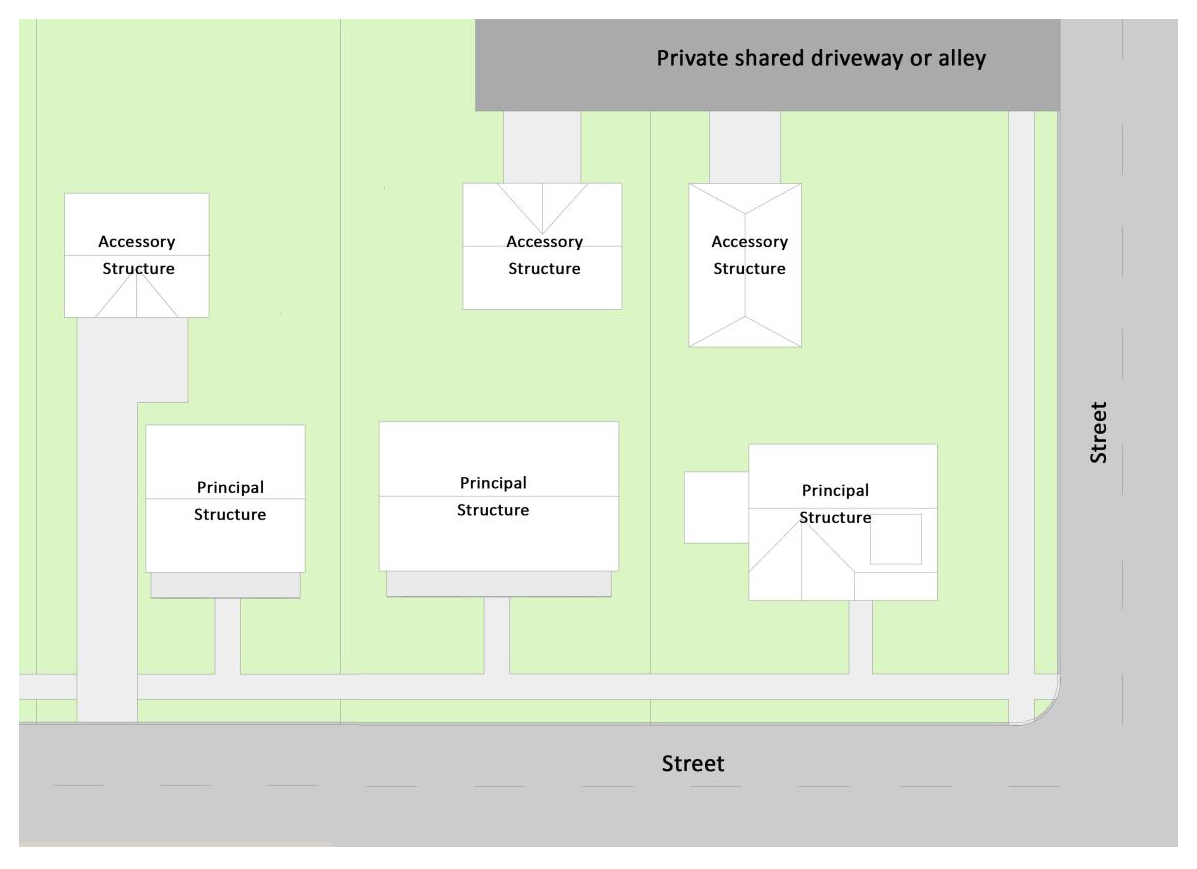
Single-Family Detached Dwellings.
(1)
Description. The single-family detached dwelling unit type consists of structures containing one dwelling unit surrounded by yard space on all four sides, where private open spaces are available for the exclusive use of the occupant.
(2)
Building Form. See Section 138.6.700 A.—M. above for form, placement, and other requirements.
(3)
Illustrative Concept Sketch. See below for illustrative concept sketch of the single-family detached building type in plan view. This is intended to illustrate development options in a generalized way; it is not to scale.
B.
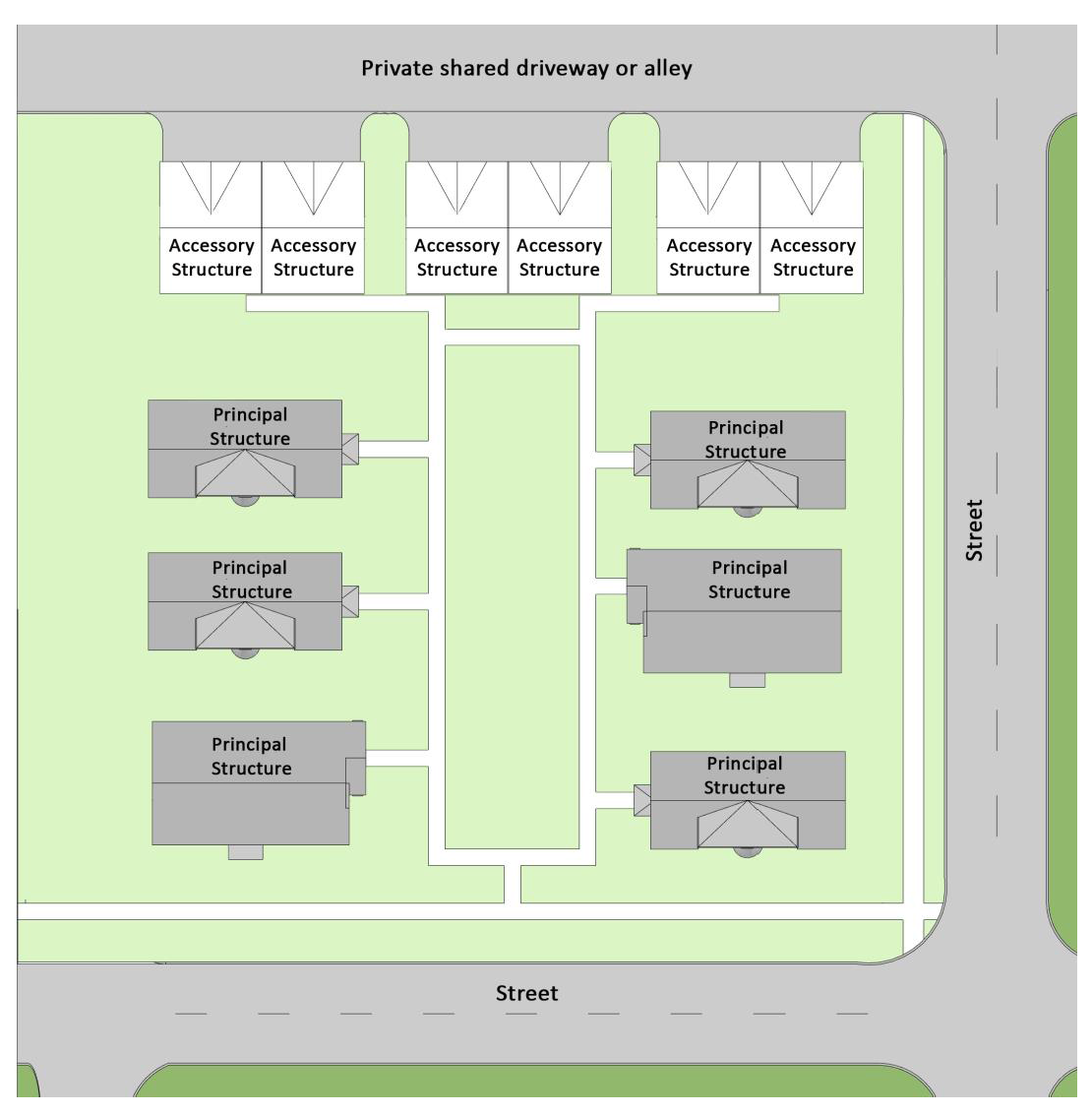
Bungalow Court.
(1)
Description. The bungalow court detached dwelling unit type consists of structures containing one dwelling unit surrounded by yard space on all four sides. All units front upon a common court that is landscaped and contains pedestrian paths.
(2)
Building Form. See Section 138-6.700 A.—M. above for form, placement, and other requirements.
(3)
Illustrative Concept Sketch. See below for illustrative concept sketch of the bungalow court building type in plan view. This is intended to illustrate development options in a generalized way; it is not to scale.
C.
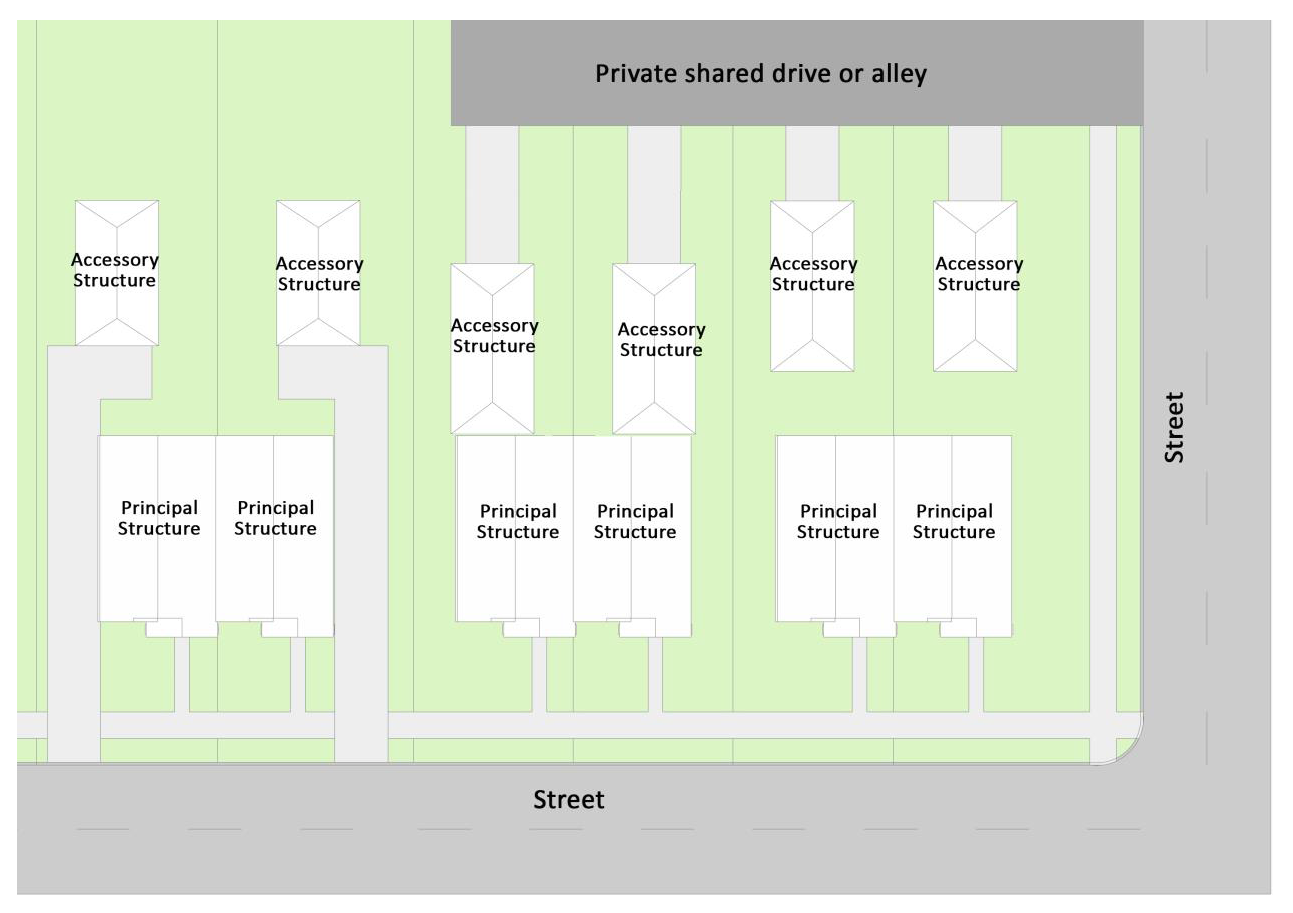
Two-family dwelling.
(1)
Description. The two-family detached dwelling unit type consists of structures containing two attached dwelling units surrounded by yard space on all four sides, where private open spaces is available for the exclusive use of the occupant. Two-family dwelling units are typically attached side-by-side with on common wall, but they may also be stacked vertically.
(2)
Building Form. See Section 138-6.700 A.—M. above for form, placement, and other requirements.
(3)
Illustrative Concept Sketch. See below for illustrative concept sketch of the two-family detached building type in plan view. This is intended to illustrate development options in a generalized way; it is not to scale.
D.
Multiplex.
(1)
Description. The multiplex residential building type consists of single structures that contain multiple attached side-by-side and/or stacked dwelling units. The units are accessed from one shared entry facing a street or at least two units are accessed from a shared entry facing a street and other are accessed from a side or rear door. This building type shall be designed to have the appearance of a detached single family dwelling unit. This unit type is modest in scale and mixes well with other building types allowed in AUH district.
(2)
Building Form. See Section 138-6.700 A.—M. above for form, placement, and other requirements.
(3)
Illustrative Concept Sketch. See below for illustrative concept sketch of the multiplex detached building type in plan view. This is intended to illustrate development options in a generalized way; it is not to scale.
(4)
Multiplex buildings are limited to occupy not more that 25 percent of the total number of lots on a single block.
E.
Other Building Types. For allowed nonresidential uses, buildings shall be designed to be complementary to other residential structures in the district. See Section 138-6.700 A.—M. above for form, placement, and other requirements.
(Ord. No. 186, pt. 11, 12-2-2019)
SECTION 138-6.702 - Building Frontages
The purpose of this section is to identify the frontage types allowed in the R-5 District, and for each type, provide a description, a statement as to the type's intent and design standards, to ensure that proposed development is consistent with the city's goals for walkability and residential character by providing proper building form, character, and quality.
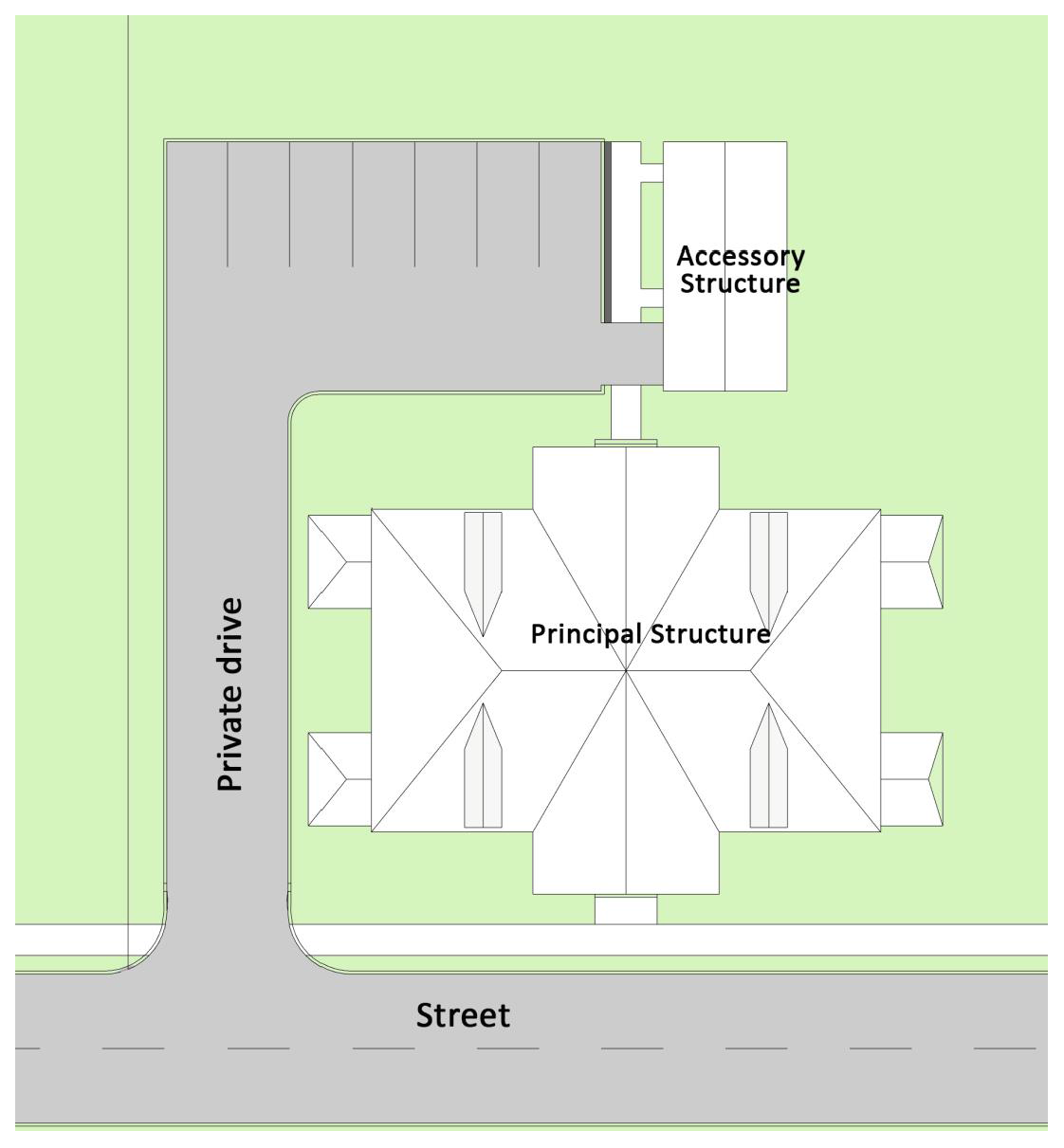
A.
Projecting Porches.
(1)
Description. The main facade of the building typically has a small-to-medium setback from the property line. The resulting front yard is typically small and may or may not be defined by a fence or hedge to separate the edge of the street right-of-way and private property.
(2)
Standards. The projecting porch shall be open on three sides and shall have a roof form that is separate from the main house. The porch may extend one or two stories. The minimum width is 10 feet, the minimum depth is 8 feet, and a minimum clearance of 8 feet is required from the floor to the lowest point of the roof structure. The porch should be elevated above the private sidewalk that connects the porch to the public sidewalk running along the lot frontage.
B.
Integral Porch.
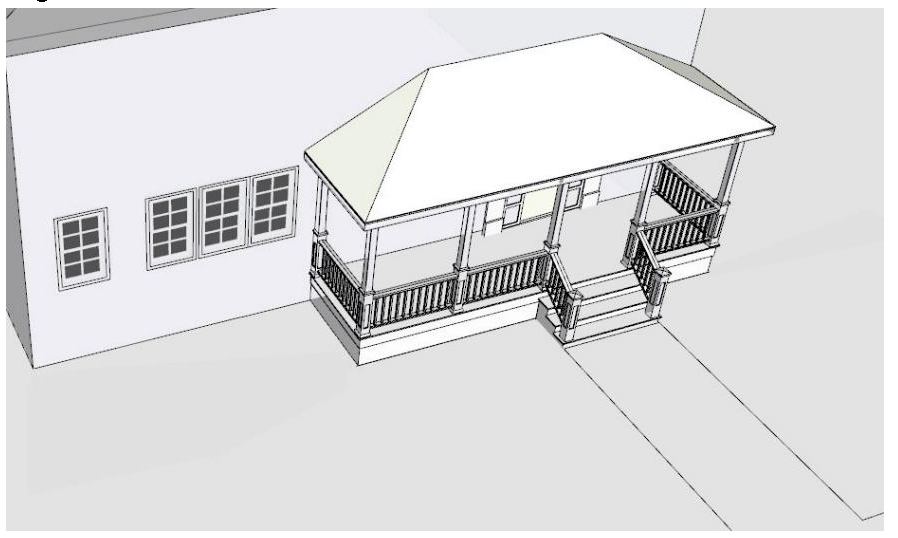
(1)
Description. The main facade of the building has a small setback from the property line. The resulting front yard is typically small and may be defined by a fence or hedge to spatially maintain the edge of the street. An integral porch is part of the overall massing and roof form of a building. With an integral porch it is not possible to remove the porch without major changes to the overall roof form.
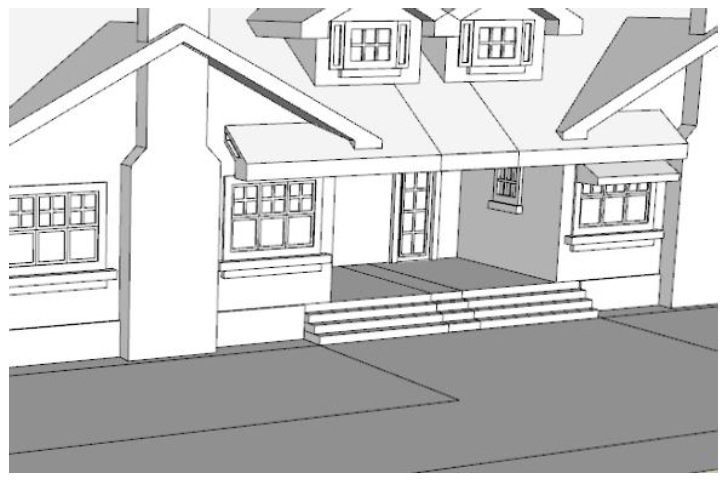
(2)
Standards. The integral porch shall be open on two or three sides and has a roof form that is part of the roof structure of the main building. The porch may extend one or two stories. The minimum width is 8 feet, the minimum depth is 8 feet, and a minimum clearance of 8 feet is required from the floor to the lowest point of the roof structure. The porch should be elevated above the private sidewalk that connects the porch to the public sidewalk running along the lot frontage.
C.
Stoop.
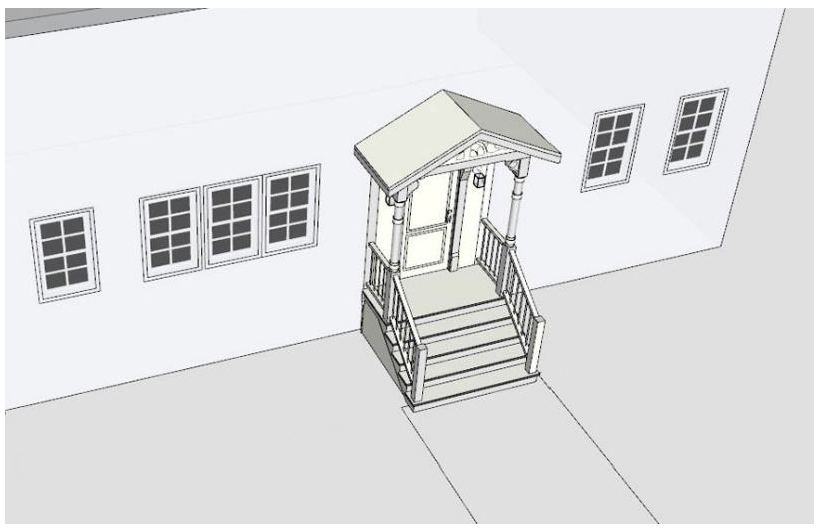
(1)
Description. The main facade of the building is near the property line and the elevated stoop engages the sidewalk. The stoop may or may not have a roof form.
(2)
Standards. The stoop should be elevated above the sidewalk to ensure privacy within the building. Stairs from the stoop may lead directly to the sidewalk or may be accessed from the side. The minimum width is 5 feet and the maximum is 10 feet; the minimum depth is 5 feet and the maximum is 10 feet; and a minimum clearance of 8 feet is required from the floor to the lowest point of the roof structure, when provided.
D.
Forecourt.
(1)
Description. A portion of the main facade of the building is at or near the property line and a small percentage is set back, creating a small court space. The space could be used as an entry court or shared garden space for multiplex. The proportions and orientation of these spaces should be carefully considered for solar orientation and user comfort.
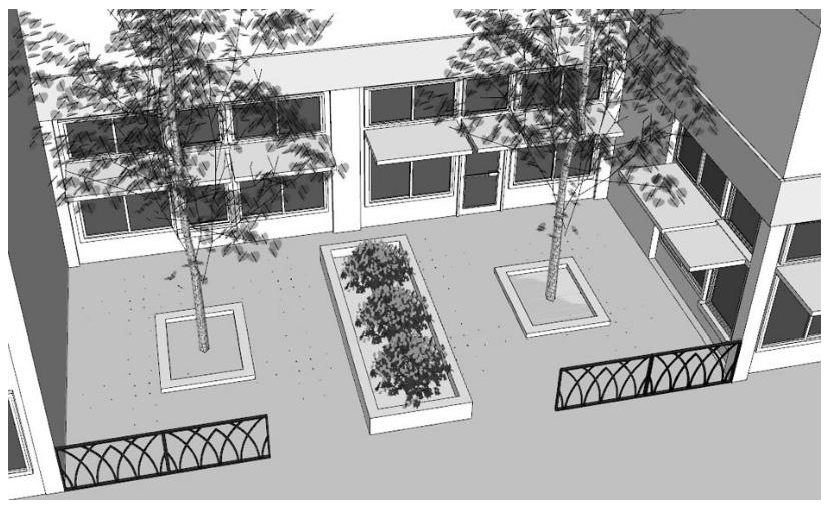
(2)
Standards. A forecourt shall be a minimum of 12 feet wide and 12 feet deep. A 30-inch to 36-inch high edge wall shall define the edge of the courtyard. The edge wall shall be located within 5 feet of the front lot line and shall be constructed of 1) brick or stone or 2) brick or stone piers, at least 24 inches wide and no more than 15 feet apart, connected by a black metal decorative fence of the same height, with supplemental shrub or ornamental grass plantings. All walls and piers shall have a suitable stone cap. This frontage type should be used sparingly along a block frontage.
E.
Flex Dooryard.
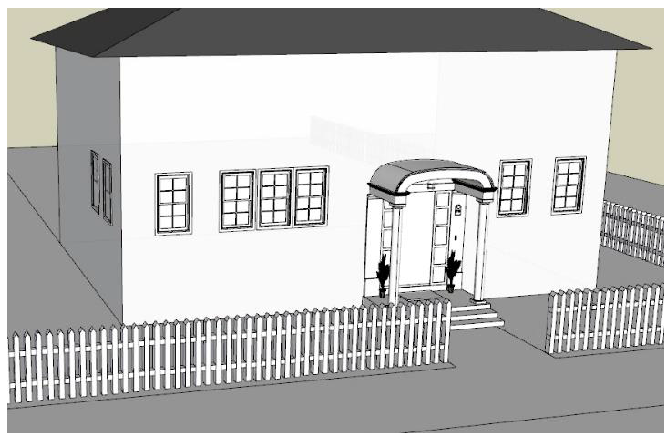
(1)
Description. The facade of the building that faces the front street is setback a small distance from the street, typically within a build-to-zone. The front property line is oftentimes defined by a low wall, fence, or hedge, creating a small dooryard. The dooryard shall not provide public circulation along the rights-of-way. The dooryard is most often intended for ground floor residential but can also be used for allowed nonresidential uses. The façade of the building that contains the main entry fronts on a greenspace area that may be a street-facing yard, as described above, or it may front on an internal greenspace or pedestrian plaza.
(2)
Standards. A dooryard shall be constructed for access at grade or it may be raised. There shall be a sidewalk connecting the flex dooryard entryway to an internal sidewalk. The internal sidewalk shall connect to a public sidewalk or internal private sidewalk system.
(Ord. No. 186, pt. 11, 12-2-2019)

