
Rochester Hills City Zoning Code
ARTICLE
10 GENERAL PROVISIONS
CHAPTER 1. - ACCESSORY STRUCTURES AND BUILDINGS
Accessory structures, except as otherwise permitted in this ordinance, shall be subject to the following:
CHAPTER 2. - EXTERIOR LIGHTING[11]
Editor's note— Ord. No. 190, § 7, adopted Apr. 25, 2022, amended Ch. 2 in its entirety to read as herein set out. Former Ch. 2, §§ 138-10.200—138-10.204, pertained to similar subject, and derived from Ord. No. 532 adopted April 20, 2009.
SECTION 138-10.100 - General Standards for All Accessory Structures
A.
Appearance. The exterior façade materials and architectural design of all accessory structures shall be similar to and coordinated with those of the principal building on the lot. The overall appearance of the structure shall be in accordance with the purpose of the district where it is located.
B.
Temporary Accessory Structures. Temporary accessory structures that do not require permanent attachment to the ground, but have similar characteristics as an accessory structure including, but not limited to, inflatable swimming pools and moveable carports shall comply with the setback requirements for detached accessory structures.
C.
Area. The combined floor area of detached and attached accessory structures shall not exceed the floor area of the first and second floor of the main building.
D.
Roof Structures.
1.
Any roof structure that is open 50 percent or more to allow the passage of the elements shall be considered an accessory structure and must meet all applicable standards for an attached or detached structure, this includes decks, enclosed porches, open porches, gazebos, and other accessory structures. Such a roof structure will not count toward lot coverage.
2.
Any roof structure that is open less than 50 percent and located within ten feet of the principal structure must comply with the setback requirements for the principal building. This includes enclosed porches, open porches, gazebos, and other accessory structures. Such a roof structure will count toward lot coverage.
(Ord. No. 183, § 19, 6-18-2018; Ord. No. 199, § 8, 3-17-2025)
SECTION 138-10.101 - Attached Accessory Structures
A.
Compliance with standards for main building.
1.
Where the accessory structure is attached to a main building, it shall be considered a part of the main building and shall be subject to the area, lot coverage and setback regulations of this ordinance applicable to main buildings.
2.
An accessory structure is considered attached when:
a.
The accessory structure is attached by a common wall through which a doorway provided direct access from the principal building into the accessory structure; or
b.
The accessory structure is attached by a breezeway with a floor area of 70 square feet or greater. The distance between the main structure and the accessory structure attached by a breezeway shall not be greater than ten feet.
c.
For the purpose of determining lot coverage and setback, an accessory structure located within ten feet of a main building shall be considered "attached".
3.
The maximum height for attached accessory structures shall be the maximum height permitted in the zoning district or the height of the principal structure, whichever is less.
(Ord. No. 183, § 19, 6-18-2018; Ord. No. 188, § 4, 12-14-2020)
SECTION 138-10.102 - Detached Accessory Structures
A.
Area. Detached structures accessory to a residential or non-residential building may be located in the side or rear yard. Such structures shall not be located in the front yard. The combined floor area of all detached accessory buildings on a single parcel shall not exceed the limits set forth in the following table, so long as total building area of all structures does not exceed the maximum lot coverage as provided in Section 138-5.100:
For purposes of this subsection, floor area of an accessory structure shall be defined as the exterior footprint of the structure supporting a roof measured from the exterior of the exterior walls, assembly or structural supports. A structure shall be considered detached when it is completely separate from the main structure and when it does not meet one of the conditions noted in Section 138-10.101.A.2, above.
1.
Exception: Decks constructed in the front yard shall be permissible provided such deck does not exceed the width of the residence and does not project more than ten feet from the front plane of the residence.
B.
Setbacks. A detached structure accessory to a residential building on properties less than two acres shall be located no closer than five feet to any side or rear lot line. A detached structure accessory to a residential building on properties two acres or larger shall be located no closer than 20 feet to any side or rear lot line. A detached structure accessory to a non-residential building shall be located no closer than ten feet to any side or rear lot line. A detached accessory structure shall not be located in any required side yard.
C.
Height.
1.
No detached accessory structure in an RE, R-1, R-2, R-3, R-4, R-5, RM-1, RMH or RCD district shall exceed one story or 14 feet in height when the roof pitch of the accessory structure is less than 4/12. If the roof pitch is 4/12 or greater, the maximum building height is 16 feet.
2.
Detached accessory structures in all zoning districts except for those listed in Section 138-10.102.F.1 above may be constructed to equal the permitted maximum height of structures in such districts, subject to site plan review requirements.
D.
Other Zoning Districts. Accessory structures in all other zoning districts may be constructed to equal the permitted maximum height of structures in such districts, subject to site plan review requirements.
(Ord. No. 182, § 7, 2-5-2018; Ord. No. 183, § 19, 6-18-2018; Ord. No. 186, pt. 12, 12-2-2019; Ord. No. 199, § 9, 3-17-2025)
SECTION 138-10.103 - Corner Lots
Buildings or structures accessory to a residential dwelling unit located on a corner lot shall comply with the greater of the following setbacks:
A.
Side street setback. The accessory structure shall be set back a minimum of ten feet from a right-of-way or utility easement.
B.
Front setback from side street required. Where a residential dwelling unit is located on a lot within 300 feet of the corner lot, is located on the same side of the street or across the street from the corner lot, and has a front yard relationship to a street upon which the corner lot has frontage, the accessory structure located on the corner lot may not be located closer to the street than the front yard setback required for the adjacent lot or lot across the street having the front yard relationship with said street.
Refer to the illustration on the following page for examples of corner lot accessory structure setback requirements.
SITUATION A - all adjacent and nearby houses have front yard relationship on street 1, no adjacent or nearby houses have front yard relationship on street 3. A front yard setback is required for accessory buildings from street 1, and a ten-foot setback is required for accessory buildings from street 3.
SITUATION B - There are adjacent and nearby houses that have a front yard relationship to streets 1, 2, and 3, so a front yard setback is required for accessory buildings from streets 1, 2, and 3.
SITUATION C - There are adjacent and nearby houses that have a front yard relationship to streets 2, and 3, so a front yard setback is required for accessory buildings from streets 2, and 3.
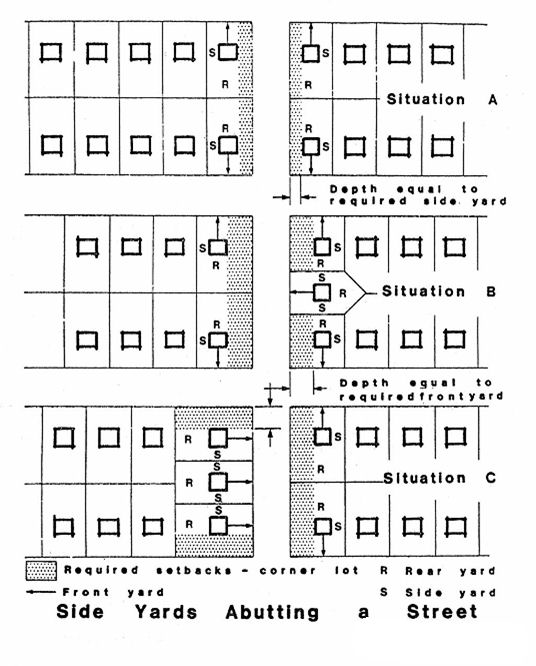
(Ord. No. 182, § 7, 2-5-2018; Ord. No. 183, § 19, 6-18-2018)
Editor's note— Ord. No. 183, § 19, adopted June 18, 2018 deleted former § 138-10.103 entitled "Height", and further renumbered §§ 138-10.104—38-10.108 as §§ 138-10.103—38-10.107 as herein set out.
SECTION 138-10.104 - Exceptions
A building accessory to a residential building may be constructed with a floor area or height greater than otherwise permitted, subject to the following limitations:
A.
Land division. Whenever a residential lot is divided or partitioned, the accessory structures located on such lot shall be removed or reduced in size in order that accessory structures located on the resultant parcels will conform to the maximum area and height limitations of this section.
B.
Historic districts. In regard to an accessory structure which is located on a lot designated under article II of chapter 118 of the City Code of Ordinances as a historic district, the Zoning Board of Appeals may permit the accessory structure to be constructed to a height greater than what is otherwise allowed under this section, subject to the following limitations:
1.
The accessory structure may not exceed the height of the main building;
2.
The accessory structure may not exceed the structure height limitation applicable to the zoning district under Section 138-5.100;
3.
The Historic Districts Commission must first approve the accessory structure and submit to the approving authority a written recommendation explaining specifically why the commission believes increased height is necessary in order to further the purpose and objectives of the commission and article II of chapter 118 of the Code of Ordinances;
4.
A greater height shall only be allowed if the accessory structure is built in the exact location on the property as shown on the site plan or application for a height increase.
(Ord. No. 183, § 19, 6-18-2018)
SECTION 138-10.105 - Decks and Patios
A.
Definitions. The following terms, as used in this Section, shall have the following meaning:
1.
Deck. A platform structure, either freestanding or attached to a building, without a roof that is elevated above the surface of the ground and supported by columns or posts. A deck is not intended to provide shelter or create an enclosure.
2.
Deck, Attached. A deck that is physically attached to and supported by the principal building.
3.
Deck, Detached. A deck that is not physically attached to or supported by the principal building.
4.
Patio. An area with a hard surface that is completely supported by the ground.
5.
Roofed Deck. Any deck that is either completely or partially roofed, inclusive of open beams or latticework.
B.
Decks.
1.
Attached and Detached Decks. Attached and detached decks are accessory structures and shall meet the setback requirements for detached accessory structures.
2.
Roof Structures.
a.
Any roof structure that is open 50 percent or more to allow the passage of the elements shall be considered an accessory structure and shall meet all applicable standards for an attached or detached deck.
b.
Any roof structure that is open less than 50 percent and located within ten feet of the principal structure shall comply with the setback requirements for the principal building.
C.
Patios. Patios may be located in any rear or side yard, provided that a five-foot setback is maintained from any property line.
(Ord. No. 183, § 19, 6-18-2018)
SECTION 138-10.106 - Gazebos
Gazebos are permitted in the RE, R-1, R-2, R-3, R-4, R-5, RCD, RM-1 and RMH districts, subject to the following limitations:
A.
Area. Gazebos shall not exceed 180 square feet in floor area. However, the floor area of gazebos shall not count toward the maximum allowable floor area for accessory structures.
B.
Height. Gazebos shall not exceed one story or 16 feet in height. If the gazebo is part of a deck attached to the main building, the height shall be measured as the vertical distance from the usable floor surface of the main building to the highest point of the gazebo roof.
C.
Setbacks. Gazebos shall comply with the yard and setback regulations applicable to detached accessory structures.
(Ord. No. 183, § 19, 6-18-2018; Ord. No. 186, pt. 13, 12-2-2019)
SECTION 138-10.107 - Fences
A.
Applicability.
1.
The standards for fences contained in subsections B and C below, shall apply to all fences installed or replaced in the city, subject only to those exceptions set forth in subsection A.2 below.
2.
This article shall not apply to the following fences installed or replaced:
a.
In accordance with an approved site plan; or
b.
Swimming pool enclosures as specified in the state construction code. Swimming pool enclosures shall meet the standards of Section 138-10.107.B.1 and Section 138-10.107.C.2.
B.
In General.
1.
Fences shall be installed and maintained free from defects, safety hazards and collapse, and shall be kept in good repair.
2.
No signs, words, letters, images or illustrations, except for those signs required in subsection C.5 of this section, may be painted or otherwise affixed to fences.
C.
Residential Fences. Fences in a residential district shall be subject to the following:
1.
Residential fences may be located along a property line if the other provisions of this section are met.
2.
Fences that are located along the side and rear lot lines shall be a maximum of six feet in height and may not extend closer to the front lot line than the front of the dwelling of the minimum front setback, whichever is less, unless otherwise provided for in this ordinance. In no instance shall an obscuring fence over three feet high be placed between the front of a residence and minimum front setback line, unless otherwise provided for in this ordinance. Fences on corner lots shall meet the standards for corner lots as provided in Section 138-10.103.
3.
Fences not to exceed three feet in height shall be permitted within a required front yard setback or a side street yard setback; provided, however, that corner clearance as provided in Section 138-5.204 has been met.
4.
Materials used shall be wood, metal, bricks, masonry or other solid natural or synthetic material that is all-weather resistant and designed for permanent and stationary fencing or screening. Fabric-type materials are not permitted. Wire fences, barbed or razor wire, spikes, nails or any other sharp pointed instruments of any kind are prohibited.
5.
Electrically charged fences are prohibited, except that the building department may approve electric fences for the purpose of retaining animals under the following circumstances:
a.
Sufficient proof has been presented that the fence will not be hazardous to persons or animals;
b.
The power source shall be obtained from a listed electric fence controller; and
c.
Signs shall be conspicuously located on the fence warning that the fence is electrified.
D.
Non-Residential Fences. Fences in non-residential districts shall comply with the following:
1.
The erection, construction or alteration of any fence, wall or other type of protective barrier shall be approved by the Building Official as to the fence conforming to the requirements of the zoning district in which it is located and to the requirements of this section.
2.
The maximum height for all fences shall be eight (8) feet, unless otherwise provided for in this Ordinance. Security fences made of anodized aluminum, or other approved ornamental material, may be permitted to a maximum height of ten (10) feet at the discretion of the Planning Commission. Barbed wire cradles that face inward may be permitted, at the discretion of the Planning Commission and City Council.
3.
Fence material and designs shall be decorative wood, metal, brick, masonry or other solid natural or synthetic material that is all-weather resistant and designed for permanent and stationary fencing or screening. The use of standard chain link fencing shall be prohibited except in instances where the Planning and Economic Development Department (or the Planning Commission if appropriate) determines that the fence will not be visible from an abutting roadway, highway or expressway. If allowed, chain link fencing shall be vinyl coated (or similar).
4.
Fabric-type materials hung on, or otherwise affixed to a fence are not permitted (unless as a part of a temporary construction fence). Plastic, vinyl, aluminum, or wood slates or similar devices placed through chain link wire fences, are not permitted.
5.
Fencing on a nonresidential property or for a nonresidential use shall only be permitted when necessary and in conjunction with a permitted principally permitted, approved conditional use, or permitted applicable accessory use within the specific district in which it is located.
6.
Fencing shall not be permitted within the required front yard. Fencing shall only be permitted within the non-required front yard. For those fences located in the non-required front yard, additional landscaping between the fence and the street right of way may be required by the Planning Department (or the Planning Commission if appropriate). Fencing may be permitted within the required side yard setback and within the required rear yard setback.
(Ord. No. 182, § 7, 2-5-2018; Ord. No. 183, § 19, 6-18-2018; Ord. No. 190, § 3, 4-25-2022; Ord. No. 199, § 10, 3-17-2025)
SECTION 138-10.200 - Purpose
The purpose of this Chapter is to preserve, protect, and enhance the lawful nighttime use and enjoyment of all properties in the City through the use of appropriate lighting practices and systems. Exterior lighting shall be designed, installed and maintained to control glare and light trespass, minimize obtrusive light, conserve energy and resources, maintain safety, security and productivity, and prevent the degradation of the nighttime visual environment. It is the further intent of this Chapter to encourage the use of innovative lighting designs and decorative light fixtures that enhance the character of the community.
(Ord. No. 190, § 7, 4-25-2022)
SECTION 138-10.201 - Applicability
A.
Existing Buildings and Uses. Any new outdoor lighting installed on a building or parcel shall meet the requirements of this chapter with regard to shielding and lamp type.
B.
Site Plans. Whenever a site plan is required, the applicant shall submit a complete inventory and photometric plan detailing all existing and any proposed new or modified outdoor lighting. If no changes to lighting are proposed, the photometric plan and inventory are not required.
1.
Where a site plan proposes a new use, a new building or an addition or change of use leading to an increase of 50 percent or more in terms of additional dwelling units, total gross ground floor area of an entire building, indoor seating capacity or parking spaces, all outdoor lighting on the site shall be brought into compliance with this Chapter.
2.
Where a site plan proposes to increase the number of dwelling units, total gross ground floor area of an entire building, indoor seating capacity or parking spaces by less than 50 percent, only new or modified outdoor lighting is required to be compliant with this chapter.
(Ord. No. 190, § 7, 4-25-2022)
SECTION 138-10.202 - General Provisions
The design and illumination standards of this chapter shall apply to all exterior lighting sources and other light sources visible from the public right-of-way, road easement or adjacent parcels, except where specifically exempted herein.
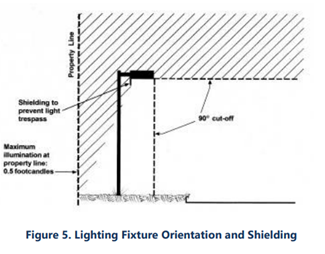
Figure 5. Lighting Fixture
Orientation and Shielding
A.
Shielding. Exterior lighting shall be fully shielded and directed downward at a 90 degree angle. Oblique lenses (such as many wall-pack fixtures) are prohibited. All fixtures shall incorporate full cutoff housings, louvers, glare shields, optics, reflectors or other measures to prevent off-site glare and minimize light pollution. Only flat lenses are permitted on light fixtures; sag or protruding lenses are prohibited.
B.
Glare. Exterior lighting sources in all districts shall be designed, constructed, located and maintained in a manner that does not cause off-site glare on neighboring properties or street rights-of-way. Except as otherwise permitted, the light emitting element of any light fixture shall not be directly visible from a neighboring property, as this is the primary cause of glare. The light emitting element of any light fixture that exceeds 400 lumens shall be fully shielded.
C.
Light trespass. Light levels shall not exceed 0.1 footcandles at the property line where the site abuts a public right-of-way or a lot with a residential use or zoning. Where the site abuts a non-residential use, light levels at the property line shall not exceed 0.3 footcandles.
D.
Lamps. All fixtures shall comply with Illuminating Engineering Society of North America standards.
E.
Required illumination. Lighting should be even throughout and shall not exceed an average illumination to minimum illumination ratio of 4:1. Specific areas on a site shall be illuminated in accordance with the following table:
F.
Hours of operation. All exterior lighting in non-residential districts shall incorporate automatic timers and shall be turned off between the hours of midnight and sunrise, except for lighting necessary for security purposes or accessory to a use that continues after midnight. Security lighting shall, to the extent practical, uses sensors and dim or turn off when there is no activity on site.
G.
Measurement. Light intensity shall be measured in footcandles on the horizontal plane at grade level within the site and on the vertical plane at the property or street right-of-way boundaries of the site at a height of five feet above grade level.
H.
Lighting height. Fixture height shall be measured from the grade of the illuminated surface directly below the fixture to the bottom of the fixture.
I.
LED light sources shall have a correlated color temperature that does not exceed 3,000K.
(Ord. No. 190, § 7, 4-25-2022)
SECTION 138-10.203 - Standards by Type of Fixture
A.
Freestanding pole and building mounted lighting. The maximum height of such fixtures is 20 feet. Where a pole or building mounted fixture is located in a residential district or within 50 feet of a residentially zoned or used property, the maximum pole height shall be 15 feet.
B.
Decorative light fixtures. The Planning Commission may approve decorative light fixtures as an alternative to shielded fixtures, provided that such fixtures would enhance the aesthetics of the site and would not cause off-site glare or light pollution. Such fixtures shall not exceed a maximum of 400 lumens.
C.
Edison bulbs. Edison bulbs, as defined in this ordinance, may be used outdoors individually or on strings to provide atmospheric lighting for outdoor dining areas, gathering spaces, alleys and other similar spaces. Such lighting shall be turned off outside of business hours and screened from abutting residential properties.
D.
Architectural lighting. Where lighting illuminates features on an above grade or vertical target, including but not limited to, architectural features, signs, landscaping, fountains and sculptures, luminaires shall be partially shielded and shall be installed and aimed to minimize their output past the object being illuminated, skyward or otherwise. Such lighting shall not cause light trespass as specified in this section, or glare.
E.
Signs. Signs shall be lit in accordance the standards of Chapter 134 Signs of the Rochester Hills Code of Ordinances.
F.
Indoor lighting. Indoor lighting shall comply with Section 138-204 and shall not be a source of glare or light trespass as regulated in Sections 138-10.201.C and 138-10.201.D above. Indoor lights visible from outdoors shall not flash.
(Ord. No. 190, § 7, 4-25-2022)
SECTION 138-10.204 - Exempt Lighting
The following exterior lighting types are exempt from the requirements of this Article, except that the Building Director may take steps to minimize glare, light trespass or light pollution impacts where determined to be necessary to protect the health, safety and welfare of the public:
A.
Holiday decorations.
B.
Pedestrian walkway lighting.
C.
Residential lighting.
D.
Instances where federal or state laws, rules or regulations take precedence over the provisions of this chapter.
E.
Temporary emergency lighting.
F.
Public Rights-of-Way Exempt. The provisions of this division shall not apply to streetlights installed in public rights-of-way.
(Ord. No. 190, § 7, 4-25-2022)
SECTION 138-10.205 - Prohibited Lighting
The following types of outdoor lighting are specifically prohibited:
A.
Lighting that could be confused for a traffic control device.
B.
Lighting that is oriented upward, except as otherwise provided for in this ordinance.
C.
Searchlights, beacons and laser source light fixtures.
D.
Lights that blink, flash, move, revolve, flicker, change intensity or change color.
E.
Strip lighting.
F.
Any lamp or bulb when not within a luminaire and which is visible from the property boundary line of the parcel on which it is located, except for landscape ornamental lighting; and lighting inside of an awning when the awning becomes illuminated.
(Ord. No. 190, § 7, 4-25-2022)
SECTION 138-10.206 - Exceptions
It is recognized by the City that there are certain uses or circumstances not otherwise addressed in this chapter, such as sports stadiums, street lighting or lighting from monuments and flags, that may have special exterior lighting requirements. The Planning Commission or the Planning and Economic Development Director may waive or modify specific provisions of this chapter for a particular use or circumstance upon determining that all of the following conditions have been satisfied. The Planning Commission shall be the deciding body in all cases where site plan or special use approval is required, while the Planning and Economic Development Director shall decide in all other cases.
A.
The waiver or modification is necessary because of safety or design factors unique to the use, circumstance or site.
B.
The minimum possible light intensity is used that would be adequate for the intended purpose. Consideration shall be given to maximizing safety and energy conservation and to minimizing light pollution, off-site glare and light trespass on to neighboring properties or streets rights-of-way.
C.
For lighting related to streets or other vehicle access areas, a determination is made that the purpose of the lighting cannot be achieved by installation of reflectorized markers, lines, informational signs or other passive means.
D.
Additional conditions or limitations may be imposed by the review authority to protect the public health, safety or welfare or to fulfill the purpose of this chapter.
(Ord. No. 190, § 7, 4-25-2022)
SECTION 138-10.207 - Compliance
Where a preliminary investigation indicates that a site is not compliant with this chapter, it shall be the responsibility of the owner to verify compliance.
(Ord. No. 190, § 7, 4-25-2022)
SECTION 138-10.300 - One-Family Residential Design Standards
A one-family dwelling and any additions or alterations thereto erected or placed in the City, other than mobile homes located in a licensed mobile home park approved under Article 6, Chapter 4, shall conform to the following in addition to all other regulations of this ordinance:
A.
It shall comply with all pertinent building, construction and fire codes for single-family dwellings.
B.
The plan outline of the dwelling, including heated living areas, shall be large enough to contain within it a square of 20 feet on a side. This size requirement shall not make any house existing at the date of amendment nonconforming so that they cannot be enlarged or improved.
C.
It shall be firmly attached to a permanent foundation constructed on the site in accordance with the state construction code and shall have a rat wall under the entire perimeter of the structure, and shall be constructed of such materials and type as required in the applicable building code for single-family dwellings. If the dwelling is a mobile home, as defined in this ordinance, such dwelling shall be installed pursuant to the manufacturer's setup instructions and shall be secured to the premises by an anchoring system or device complying with the rules and regulations of the state mobile home commission and shall have a perimeter wall as required in this section.
D.
If a dwelling is a mobile home as defined in this ordinance, each mobile home shall be installed with the wheels removed. Additionally, no dwelling shall have any exposed towing mechanism, undercarriage or chassis.
E.
It shall be connected to a public sewer and water supply, if available, or if not available to private facilities approved by the county health department.
F.
It shall comply with all pertinent zoning, subdivision and other ordinances regulating use, floor area, lot size, setback, yards, etc., in the zoning district in which it is located.
G.
It shall comply with all pertinent building and fire codes. If a mobile home, all construction and all plumbing, electrical apparatus and insulation within and connected to such mobile home shall be of a type and quality conforming to the Mobile Home Construction and Safety Standards as promulgated by the United States Department of Housing and Urban Development, 24 CFR 3280, and as from time to time such standards may be amended. Additionally, all dwellings shall meet or exceed all applicable roof snow load and strength requirements.
H.
It shall be in compliance with the standards contained in this subsection, and shall be aesthetically compatible in character, design and appearance to residential dwellings located outside of mobile home parks, as follows:
1.
If located in a platted subdivision with at least one existing home, it shall be compatible with homes in the particular plat of which it is a part.
2.
If not located in a platted subdivision and the area within 500 feet has existing homes, it shall be compatible with those homes within the 500 feet that might reasonably be considered to be an identifiable neighborhood of which it would be a part.
3.
Otherwise, it shall be compatible with homes generally located throughout the City.
4.
The determination of compatibility shall be based upon compliance with the following standards:
a.
The dwelling shall have a roof covered with composition asphalt organic felt shingles or a material of similar texture, malleability and coarseness, not to exclude copper, wood, slate or clay material, as on roofs of homes with which the dwelling is to be compatible.
b.
The roof of the dwelling shall have a slope of not less than two vertical units to each 12 horizontal units.
c.
The dwelling shall have steps and/or porches which provide access to exterior doors, which are permanently attached to the ground and to the structure, or which are comparable to steps and/or porches of homes with which the dwelling is to be compatible.
d.
The exterior surface of exterior walls of a dwelling and roof shall be covered with wood or stucco, or a material of metal, metal alloy, brick, masonry, vinyl or plastic with major actual or visual vertical or horizontal joints spaced at not more than eight inches apart.
e.
The dwelling shall have windows located on the front elevations, and shall have exterior doors either on the front and rear, or front and side as generally found in homes with which the dwelling is to be compatible.
f.
The dwelling shall not have a detached garage, if attached garages are typical to homes with which the dwelling is to be compatible.
g.
The ratio of the horizontal dimension of the front to side elevation of the structure shall not be more than three units to one unit.
5.
If no more than two of the standards in this subsection are not met, a dwelling may be approved as aesthetically compatible in character, design and appearance, provided it is determined that the dwelling and/or its site have other design features which make it aesthetically compatible with the homes with which it is to be compatible. This shall not be construed to prohibit innovative design concepts involving such matters as energy conscious devices such as solar energy, view, unique land contour or relief from the common or standard designed home.
6.
An applicant for a building permit aggrieved by an adverse decision by the building department may appeal to the Zoning Board of Appeals, which board shall make the determination, with findings, based upon its independent judgment, without reference to the standards for the granting of variances.
SECTION 138-10.301 - Basement Residency
Basement residency is expressly prohibited in the City; however, bedroom or kitchen facilities that are part of a principal single-family dwelling unit and that do not constitute a separate dwelling unit are permitted. Points of egress via daylight windows or walkout basements are also permitted, provided that they are not part of a dwelling unit located in a basement.
SECTION 138-10.302 - Signs
Signs shall be regulated by Chapter 134 of the City Code of Ordinances pertaining to signs. The minimum front yard setback for signs shall be as provided in Chapter 134 of the City Code of Ordinances.
SECTION 138-10.303 - Use Restrictions
No portion of a lot or parcel once used in complying with the sections of this ordinance for yards, lot area per family, density as for a development in the multiple-family district, or percentage of lot occupancy, in connection with an existing or proposed building or structure, shall again be used as part of the lot or parcel required in connection with any other building or structure existing or intended to exist at the same time.
SECTION 138-10.304 - Voting Places
This Chapter shall not be so construed as to interfere with the temporary use of any property as a voting place in connection with a municipal or other public election.
SECTION 138-10.305 - Access Through Yards
For the purpose of this ordinance, subject to Section 138-11.102.B.4.c, with respect to private roads, private drives and off-street parking areas, including maneuvering lanes, within required yards in the RM-1 and RCD districts where the adjacent property is zoned one-family residential, access drives may be placed in the required front or side yards so as to provide access to rear yards and/or accessory or attached structures. These drives shall not be considered as structural violations in front and side yards. Further any walk, terrace, or other pavement servicing the like function, and not in excess of nine inches above grade upon which placed, shall for the purpose of this ordinance not be considered to be a structure, and shall be permitted in any required yards.
SECTION 138-10.306 - Dual Use of Property
Except as otherwise specifically provided in this ordinance, no parcel of property may be used for more than one use at a time. An example, but not as a limitation, would be a parcel of property with a residential nonconforming use in a business or industrial district shall not also be used for a business or industrial use.
SECTION 138-10.307 - Essential Public Services and Utilities
Essential services buildings and structures shall be permitted as authorized under any franchise in effect within the City. Such essential services shall be subject to State laws, City ordinances and regulations in addition to being consistent with the list of uses permitted in each zoning district. It is the intent of this Section to ensure conformity of all buildings, structures, uses and storage yards to the requirements of this ordinance wherever such conformity shall be practicable and not in conflict with the specific requirements of such franchise, state legislation, or City ordinance. In the absence of such conflict, the ordinance shall prevail.
SECTION 138-10.308. - Parking and Storage of Commercial and Recreational Vehicles
A.
Commercial Vehicles and Equipment.
1.
Public Property. A person shall not park or store any commercial vehicle identified in paragraph A.2.a, below or commercial equipment on public property located in any zoning district, including but not limited to public streets, rights-of-way, bike paths, greenbelts, and planting areas between bike paths and streets, except as allowed in paragraph A.4, below.
2.
Residential Districts.
a.
A person shall not park or store any step vans, cube vans, buses, dump trucks, stake trucks, flatbed trucks, wreckers, semi trucks and trailers, tank trucks, commercial and construction equipment and trailers and any similar trucks and equipment in a residential district, except as allowed in paragraph A.4, below.
b.
Commercial vehicles other than as specified in paragraph A.2.a, above, such as pickup trucks, passenger/cargo-style vans with seating of up to 15 persons, sport utility vehicles, passenger cars, and similar type vehicles, with no more than allowed accessories as provided in paragraph A.2.d, below, may be parked or stored in a residential district.
c.
A maximum of one commercial vehicle of the type described in paragraph A.2.b, above, which is used for transportation by occupants of the home on the property shall be stored or parked outside of an enclosed building.
d.
Allowed accessories shall mean equipment attached to vehicles which does not extend a vehicle to more than nine feet in height or wider or longer than the manufacturer's specification for the vehicle without the equipment. Roof accessory racks, but not side racks, shall be allowed. A plow on the front and a spreader on the rear of a vehicle may be attached even if the length of the vehicle is extended beyond the manufacturer's specification.
3.
Nonresidential Districts. A person shall not park or store any commercial vehicle identified in paragraph A.2.a, above, or commercial equipment on private property in any nonresidential district except as is allowed in paragraph A.4, below, or unless such vehicle or equipment is parked or stored in relation to a permitted principal or accessory use of the property. In such event, parking or storage must comply with all other city codes and ordinances.
4.
Exception. The parking or storage of commercial vehicles identified in paragraph A.2.a, above, or commercial equipment shall be allowed in any zoning district, where such parking or storage is limited to vehicles or equipment engaged in the performance of a service on the adjacent or underlying property, for the period of time reasonably necessary to complete the service.
B.
Vehicle for Sale.
1.
A person shall not park any motor vehicle on any private property in the city without the expressed or implied consent, authorization or ratification of the owner, holder, occupant, lessee, agent or trustee of such property.
2.
A person shall not park any motor vehicle on any private property, with or without consent of the owner, within 100 feet of a street right-of-way with a speed limit greater than 25 mph for the principal purpose of displaying the vehicle for sale, displaying, advertising, or selling merchandise from such vehicle, except within the defined limits of a duly established new or used automobile dealership or sales lot, which shall not include bike paths adjacent to any automobile dealership or sales lot, or when so authorized or licensed under the ordinance code provisions of the city.
C.
Recreational Vehicles.
1.
A person shall not park and/or store a recreational vehicle, snowmobile, camper enclosure, utility trailer, boat or similar vehicle or equipment not owned by the occupant or owner of the premises for a period exceeding 72 hours on lands not approved for such parking or storage, except that the building department may grant a temporary permit allowing the parking of a recreational vehicle on private property not to exceed a period of two weeks. All recreational vehicles, snowmobiles, camper enclosures, utility trailers, boats, and similar vehicles or equipment owned by city residents stored in residential districts on their individual lots or premises shall not be stored within any front yard or any required side yard and shall further conform to the requirements of the zoning ordinance applicable to accessory buildings, insofar as distances from main buildings, lot lines, and rights-of-way are concerned.
2.
The parking and storage of recreational vehicles, snowmobiles, camper enclosures, utility trailers, boats and similar vehicles or equipment in residential districts shall be subject to the following restrictions:
a.
All such units parked or stored outside of a completely enclosed building shall be kept in a state of proper repair and secured to prevent unauthorized entry.
b.
The parking and storage of such units shall be limited to a lot or parcel upon which an occupied dwelling is located.
c.
All such units shall not be connected to electricity, gas, water or sanitary sewer facilities, except that a temporary electrical connection may be made for the purpose of recharging batteries.
d.
All such units shall not at any time be used for living or housekeeping purposes while on the premises.
e.
A person shall not park or store any such unit upon any public property, including public streets, stub streets, rights-of-way, bike paths and planting areas between pathways and streets, except as allowed in paragraph C.2.f, below.
f.
Notwithstanding any provisions to the contrary, such a unit may be temporarily parked or stored within any front yard or on a public street for a period not to exceed 72 hours for the purpose of loading, unloading, trip preparation or minor, routine maintenance and repair, although at no time shall any unmounted camper enclosure or any snowmobile or boat not mounted on a utility trailer be parked or stored within any front yard, required side yard or public street.
D.
Responsibility for Compliance. The owner of the vehicle, equipment or other unit and the owner or occupant of private property upon which the vehicle, equipment or other unit is parked or stored shall each be responsible for compliance with the terms of this section. In any proceeding for the violation of any section of this section, the person to whom the vehicle, equipment or unit is registered, as determined from the registration plate displayed on the vehicle, equipment or unit, shall be presumed in evidence to be the owner. If no registration plate exists, the owner shall be presumed in evidence to be the titleholder, lessee or other person with an immediate right of possession. For purposes of determining the ownership of real property, it shall be presumed in evidence that the person to whom the property is assessed on the city's most recent tax assessment roll is the owner of the property.
E.
Violations.
1.
Notice. A written notice of violation of this section shall be served on the person in violation directing the discontinuance and abatement of the illegal action or condition within 24 hours. For purposes of serving this notice on a commercial or recreational vehicle owner, it shall be sufficient to affix the notice in a conspicuous place on the vehicle.
2.
Failure to Comply. Failure to comply with the notice of violation shall constitute a violation of this section.
3.
Subsequent Violations. For subsequent or repeat violations by the same person, a written notice of violation shall not be required.
(Ord. No. 180/593, § 4, 8-8-2016; Ord. No. 188, § 5, 12-14-2020)
SECTION 138-10.309 - Excavation and Filling of Land
A.
Soil Excavation and Landfill Ordinance. Any permit issued pursuant to this ordinance shall be subject to compliance with and operations and/or activities under a permit shall conform with the City soil excavation and landfill ordinance in Article II of Chapter 126 of the Code of Ordinances.
B.
Exempt Activities. No permit under this ordinance (a land improvement permit may be required pursuant to Article II of Chapter 126 of the Code of Ordinances) shall be required for:
1.
Excavations for the construction of buildings or structures permitted in the City for which a building permit has been issued;
2.
The moving, grading or leveling of earth or rock materials by a property owner solely upon his own property and not removed to other noncontiguous property;
3.
The filling of land for purposes of construction where the land is low and in need of fill so long as the fill does not contain any refuse, the fill material does not exceed five inches in depth when spread on the area to be filled, it is not a commercial operation and not more than five acres are involved on any given site; or
4.
The removal of soil, etc., when no more than 20 cubic yards are removed in any calendar year.
C.
Site Work Not Incidental to Construction or an Exempt Activity shall require a land improvement permit pursuant to Article II of Chapter 114 of the City Code of Ordinances prior to any site work being completed. Clearing, excavation, filling, grubbing, disking or blading of land.
SECTION 138-10-310 - Building Mechanical Equipment
For all uses, except residential uses, heating, ventilation and air conditioning mechanical equipment located on the exterior of the building shall be screened from adjacent public or private streets and adjacent properties. If the equipment is mounted on the building, it shall be screened in a manner that is architecturally compatible with the building design. If the equipment is ground mounted, it shall be screened in a similar manner and/or with evergreen plant materials. The method of screening shall be approved by the Planning Commission or Zoning Administrator. Other types of mechanical equipment located on the exterior of the building, such as dust collectors, hoppers, stacks, etc., that cannot practicably be screened, shall be designed, located and/or painted to minimize the adverse visual impact.
(Ord. No. 190, § 4, 4-25-2022)
SECTION 138-10.311 - Dumpster and Trash Storage Screening
A.
The location of trash receptacles, trash compactors, recycle, shredding and grease bins shall be indicated on a site plan. All such trash receptacles, compactors, and bins shall be located on the site so as to facilitate collection and minimize any negative impact to persons occupying the development site, neighboring properties, site traffic circulations patterns or any public right-of-way.
B.
All trash receptacles and bins shall be screened on three sides by decorative masonry walls which are similar to or compatible with the exterior construction materials used elsewhere on the site. A door or gate of an enclosure screening trash receptacles or dumpsters shall be constructed of steel materials with a decorative wood or other decorative durable face material. Concrete or metal bollards shall be placed between the trash receptacle or dumpster and the rear wall of the enclosure.
1.
For sites that utilize a trash compactor, the trash compactor shall be appropriately screened with a decorative wall, matching the heights of the trash compactor and that matches the architecture of the building. Other suitable screening mechanisms may be approved by the Planning Department (or the Planning Commission as the case may be), provided the screening is equivalent to the required wall.
C.
Any screen around a trash receptacle or bin shall be six feet in height. The walls shall be maintained so as to remain structurally sound and neat and clean in appearance. Trash shall not be allowed to overflow from the receptacle. Trash receptacles shall be so located and arranged to minimize their visibility from adjacent streets and uses. All trash receptacles shall be located on the site so as to be as accessible as possible without interfering with vehicular traffic patterns.
(Ord. No. 581, § 3, 11-11-2013; Ord. No. 199, § 11, 3-17-2025)
SECTION 138-10.312 - Maximum Parapet Height
A.
The maximum parapet height of any structure is four feet.
(Ord. No. 190, § 5, 4-25-2022)
SECTION 138-10.400 - Wind Energy
A.
Purpose. It is the purpose of this Section to promote the safe, effective, and efficient use of wind energy systems to reduce or replace on-site consumption of utility supplied electricity. It is the purpose of this Section to standardize and streamline the review and permitting process for small wind energy systems.
B.
Findings. The City has found that wind energy is an abundant, renewable, and nonpolluting energy resource and that its conversion to electricity will reduce our dependence on non-renewable energy resources and decrease air and water pollution that results from the use of conventional fossil-fuel inputs. Wind energy systems will also enhance the reliability and power quality of the power grid, reduce peak power demands, and help diversify the City's energy supply portfolio.
C.
Definitions. The terms used in this section have the following meanings:
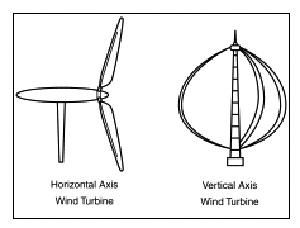
Figure 6. Horizontal and Vertical Axis Systems
Height. The vertical distance from grade level adjacent to the base of the structure to the center of the hub for a horizontal axis wind turbine or the highest point of a vertical-axis wind turbine.
Roof-Mounted Energy System. A type of small wind energy conversion system that is mounted on a roof with a height not greater than 15 feet above the ridgeline of a pitched roof or parapet of a flat roof.
Small Wind Energy System. A wind energy conversion system consisting of a wind turbine, tower or axis, blades or blade system, and associated control or conversion electronics primarily intended to reduce on-site consumption of utility power.
Tower Mounted Wind Energy System. A wind energy conversion system that is mounted on a freestanding or guyed tower attached to the ground, and not attached to any other permanent or temporary structure.
Utility Wind Energy System. A wind energy conversion system consisting of a wind turbine, tower or axis, blades or blade system, and associated control or conversion electronics primarily intended to provide wholesale or retail energy to the electric utility grid.
Wind Energy System. Any wind energy conversion device including all associated control or conversion electronics.
D.
Where Permitted.
1.
Small Wind Energy Systems are permitted by right in any zoning district, provided that the requirements of this Section are met.
2.
Utility Wind Energy Systems may be permitted in any zoning district as a conditional use by the City Council, provided that the requirements of this Section are met.
E.
Review Procedures and Standards.
1.
Small Wind Energy Systems.
a.
Submittal Requirements. Applications for small wind energy systems shall be reviewed administratively by the Planning and Development Department. The applicant shall submit a plan complying with the requirements of Section 138-2.208 for a sketch plan.
b.
Height Modification. If the applicant requests a height modification, the application shall be reviewed by the Planning Commission following a public hearing held in accordance with the requirements of Section 138-1.203.
2.
Utility Wind Energy Systems. The review process for any utility wind energy system shall follow the conditional use review process set forth in Article 2, Chapter 3.
F.
General Standards. The following requirements are applicable to all wind energy systems.
1.
Noise. A wind energy system shall not generate a noise level of 55 dB(A), measured at the property line, for more than three minutes in any hour of the day. EXCEPTION: if the constant ambient sound pressure level exceeds 55 dB(A), measured at the base of the wind energy system, a decibel level of the ambient dB(A) plus five dB(A) shall not be exceeded for more than three minutes in any hour of the day.
2.
Shadow Flicker. Shadow flicker is a term used to describe what happens when rotating wind turbine blades pass between the viewer and the sun, causing an intermittent shadow. The application for a wind energy system shall include a shadow flicker analysis demonstrating locations where shadow flicker will occur at sunrise and sunset, along with measures the applicant will take to eliminate or mitigate the effects of shadow flicker on adjacent or nearby affected properties.
3.
Lighting. No wind energy system shall be artificially lighted unless required by the Federal Aviation Administration.
4.
Appearance, Color, and Finish. The wind energy system shall be maintained in the color or finish that was originally applied by the manufacturer, unless otherwise approved in the building permit. All wind energy systems shall be finished in a non-reflective matte finished color.
5.
Signs. All signs other than the manufacturer or installer's identification, appropriate warning signs, or owner identification signs are prohibited.
6.
Electrical Wires. All electrical wires associated with a wind energy system other than wire necessary to connect the wind generator to the tower wiring, the tower wiring to the disconnect junction box, and grounding wires shall be located underground.
7.
Compliance With Electrical Code. Building permit applications for wind energy systems shall be accompanied by line drawings of the electrical components in sufficient detail to allow for a determination that the manner of installation conforms to the National Electrical Code.
8.
System Access. The tower shall be designed and installed such that step bolts, ladders, or other means of access readily accessible to the public are located at least eight feet above grade level.
9.
Wind Access. The City makes no assurance of wind access other than the provisions of this Section. The applicant may provide evidence of covenants, easement or similar documentation for abutting property owners providing access to wind for the operation of a wind energy system.
G.
Tower-Mounted Small Wind Energy Systems. The following standards are applicable to tower-mounted small wind energy systems:
H.
Roof-Mounted Small Wind Energy Systems. The following standards are applicable to roof-mounted small wind energy systems:
I.
Utility Wind Energy Systems. The following standards are applicable to large wind energy systems:
1.
Minimum Site Area. Utility wind energy systems may only be developed on a zoning lot with an area of 20 acres or greater.
2.
Setbacks. Any utility wind energy system shall be set back a distance equal to the height of the tower plus five feet from any property line, road right-of-way, or overhead utility line.
3.
Towers. Utility wind energy systems shall use tubular monopole towers, and shall not contain lettering, company insignia, advertising, or graphics on the tower or turbine that are visible beyond the property boundaries.
4.
Environmental Impact. The applicant shall submit an environmental impact analysis prepared by a qualified third party assessing any potential impacts on the natural environment including, but not limited to, wetlands and other fragile ecosystems, historical and cultural sites, wildlife, and antiquities. The applicant shall take appropriate measures, if possible, to minimize, eliminate or mitigate adverse impacts identified in the analysis. If the adverse impacts cannot be sufficiently mitigated or eliminated, City Council shall deny the request for a conditional use permit for the utility wind energy system.
5.
Community Impact. The applicant shall be responsible for repairing any public roads or other public infrastructure damaged or otherwise worn beyond typical usage by the construction of the utility wind energy system.
6.
Decommissioning. The applicant shall submit a decommissioning plan, including the following items of information:
a.
The anticipated life of the project.
b.
The estimated decommissioning costs and net salvage value in present dollars.
c.
The method of ensuring funds will be available for decommissioning and removal of towers, and restoration of the site to a pre-construction condition.
d.
Anticipated manner in which the project will be decommissioned and the site restored.
7.
Complaint Resolution. The applicant shall develop a process to resolve any potential complaints from nearby residents concerning the construction and operation of the project. The process may use an independent mediator or arbitrator and shall include a time limit for acting upon a complaint. The process shall not preclude any governmental body from acting on a complaint. The applicant shall maintain and make available to nearby residents a telephone number where a project representative can be reached during normal business hours.
SECTION 138-10.401 - Solar Energy Systems
A.
Definitions.
Solar Energy System. A solar photovoltaic cell, panel, or array that converts solar energy to usable thermal, mechanical, chemical, or electrical energy.
Solar Storage Battery. A device that stores energy from the sun and makes it available in an electrical form.
B.
Rooftop Solar Energy Systems. Rooftop and building mounted solar energy systems are permitted in all zoning districts., subject to the following regulations:
1.
Roof mounted systems shall not extend more than four feet above the surface to which it is affixed.
2.
No solar energy system may protrude beyond the edge of the roof.
3.
A building permit shall be required for installation of rooftop and building mounted systems.
C.
Ground Mounted Solar Energy Systems. Ground mounted solar energy systems, temporary and permanent, are permitted in all zoning districts, subject to the following regulations:
1.
Location. The solar energy system shall meet the required front yard setback requirement for the district in which it is located, and be set back a minimum of five feet from any side or rear property line.
2.
Height.
a.
The height of the solar energy system and any mounts shall not exceed ten feet when oriented at maximum tilt.
b.
If the solar energy system is located in the front yard between the required front setback line and front building wall of the principal building, the maximum height for the system shall be 42 inches (3.5 feet). Evergreen landscaping that is sufficient to buffer the equipment from view from nearby dwelling units or streets but that will not obstruct the energy collecting surface from solar energy shall be provided.
3.
Building Permit. A building permit shall be required for any ground mounted solar energy system.
4.
Area. No more than 20 percent of the total lot area may be covered by a ground mounted solar energy system.
D.
Batteries. When solar storage batteries are included as part of the solar collector system, they must be placed in a secure container or enclosure when in use, and when no longer used shall be disposed of in accordance with applicable laws and regulations.
E.
Removal. If a solar energy system ceases to perform its intended function for more than 12 consecutive months, the property owner shall remove the collector, mount, and associated equipment and facilities no later than 90 days after the end of the 12-month period.
(Ord. No. 199, § 12, 3-17-2025)

