
Rochester Hills City Zoning Code
ARTICLE 13
DEFINITIONS
SECTION 138-13.100 - Rules of Construction
The following rules of construction apply to the text of this ordinance:
A.
The particular shall control the general.
B.
In the case of any difference of meaning or implication between the text of this ordinance and any caption or illustration, the text shall control.
C.
The word "shall" is always mandatory and not discretionary. The word "may" is permissive and discretionary.
D.
Words used in the present tense shall include the future, and words used in the singular number shall include the plural, and the plural the singular, unless the context clearly indicates the contrary.
E.
A "building" or "structure" includes any part thereof. The word "dwelling" includes "residence". The word "lot" includes the words "plot" or "parcel".
F.
The phrase "used for" includes "arranged for," "designed for," "intended for," "maintained for" or "occupied for."
G.
The word "person" includes an individual, a firm, an association, an organization, a corporation (public or private), a partnership or co-partnership, a limited liability company, an incorporated or unincorporated association, a trust, or any other entity recognizable as a "person" under the laws of Michigan.
H.
Unless the context clearly indicates the contrary, where a regulation involves two or more items, conditions, provisions or events connected by the conjunction "and," "or" or "either ... or," the conjunction shall be interpreted as follows:
1.
"And" indicates that all the connected items, conditions, provisions or events shall apply.
2.
"Or" indicates that all the connected items, conditions, provisions or events shall apply singly or in any combination (i.e., "or" also means "and/or").
3.
"Either ... or" indicates that the connected items, conditions, provisions or events may apply singly.
I.
The terms "this Zoning Ordinance" or "this ordinance" includes the Zoning Ordinance of the City of Rochester Hills and any amendments there to.
J.
The terms "abutting" or "adjacent to" include property "across from", such as across a street, alley, or an easement. This term shall also apply to adjacent zoning districts in an adjacent community.
K.
The word "he" includes "she."
L.
The phrase "such as" shall mean "such as, but not limited to."
M.
The word "including" shall mean "including, but not limited to."
N.
Terms not defined in Article 13 (Definitions), or elsewhere in this ordinance shall have the meaning customarily assigned to them.
SECTION 138-13.101 - Definitions
The following words, terms and phrases, when used in this ordinance, shall have the meanings ascribed to them in this section, except where the context clearly indicates a different meaning:
ACCESSORY BUILDING. A type of structure that: has a roof which is supported by columns or walls; is intended for the shelter or enclosure of animals, goods or property; and is further intended to be used in a manner that is clearly incidental to, customarily found in connection with, subordinate to, and located on the same zoning lot as the principal use to which it is exclusively related.
Examples of accessory buildings include: garages, storage sheds, gazebos, play houses, greenhouses, pump houses, and dog houses.
ACCESSORY BUILDING, ATTACHED. An accessory building that is physically joined to the principal structure by a wall, roof, rafter, or other structural component.
ACCESSORY STRUCTURE. Anything constructed or erected, the use of which requires permanent location on the ground or attachment to something having such location, and that is intended to be used in a manner that is clearly incidental to, customarily found in connection with, subordinate to, and located on the same lot or parcel as the principal use to which it is exclusively related. Examples of accessory structures include: accessory buildings, swimming pools, play structures, HVAC units, generators, and tennis courts.
ACCESSORY USE. A use that is clearly incidental to, customarily found in connection with, subordinate to, and located on the same lot or parcel as the principal use to which it is exclusively related.
ADJACENT. Lots are adjacent when at least one boundary line of one lot touches a boundary line or lines of another lot. Exception: when the only touching boundary lines are located within a road easement or right-of-way.
AGRICULTURE. The carrying on of any agricultural activity or the raising of livestock or small animals as a source of income when conducted on at least five acres or more.
ALLEY. Any dedicated public way affording a secondary means of access to abutting property, and not intended for general traffic circulation.
ALTERATION.
[A.]
Structural. A change, addition or modification to; or enlargement, rearrangement, replacement or removal of the construction of structural parts, means of egress or supporting members of the building such as bearing walls, columns, beams, girders, roof or exterior walls.
[B.]
Building. A change, addition or modification to; or enlargement or rearrangement of the type of occupancy, height, area, location, design or approved method of functioning.
[C.]
Sign. A change, addition or modification to the design or function or a sign; or enlargement, rearrangement, replacement or removal of any part of any sign or billboard, including the sign copy area.
APARTMENT BUILDING. A residential structure containing three or more attached one-family dwellings.
ARTISAN MANUFACTURING. Means the shared or individual use of hand-tools, mechanical tools and electronic tools for the manufacture of finished products or parts including design, processing, fabrication, assembly, treatment, and packaging of products; as well as the incidental storage and distribution of such products. All artisan manufacturing uses shall have a storefront for sales, and the size and impact of the use shall be consistent with other retail and offices uses in the district. Typical artisan manufacturing uses include but are not limited to: electronic goods; food and bakery products; non-alcoholic beverages; printmaking; household appliances; glass blowing, leather products; jewelry and clothing/apparel; metal work; furniture; glass or ceramic production; paper manufacturing.
ASHES. The residue from the burning of wood, coal, coke or other combustible materials.
ASSISTED LIVING FACILITY. A facility providing responsible adult supervision or assistance with routine living functions of an individual in instances where the individual's condition necessitates that supervision or assistance.
AUTOMOTIVE FUELING STATION. A building or premises to be used for the retail sale of gasoline, other alternative motor fuel including electricity for the propulsion of motor vehicles and which may include facilities for minor services such as tuneups, brake adjustments and repair, shock absorber repair and replacement, wheel alignments, the changing and repairing of tires, washing, polishing, oil changes, lubrication and other minor servicing, but excluding painting, engine rebuilding and other major repairs. The provision of such activities and similar service activities on the premises shall not be permitted unless the premises are used primarily for the retail sale of gasoline or other alternative motor fuel. The retail sale of nonalcoholic beverages, cigarettes and other convenience store items shall be permitted within the gasoline service station provided such sales do not constitute the principal use of the premises.
AUTOMOTIVE REPAIR GARAGE. A building or premises where the following services may be carried out in a completely enclosed building: major repairs, including, but not limited to, engine rebuilding and the rebuilding of motor vehicles; application of paint preservation materials; radiator repair and replacement; transmission repair and replacement; collision service, such as body, frame or fender straightening and repair; the painting and rustproofing of automobiles; tire recapping; and upholstery work. Automotive repair garages may also include facilities and/or equipment allowing for the repair of other motor vehicles including trucks, recreational vehicles, vans and buses, among others.
AUTOMOTIVE SERVICE CENTER. A building or premises used primarily for the sale and installation of major automobile accessories, including, but not limited to, tires, batteries, sunroofs, radios, electronic devices, air conditioners, windows and mufflers, plus such services as brake repair and adjustment, shock absorber installation and repair, wheel alignment and balancing, oil changes and lubrication, tuneups, exterior reconditioning excluding paint or painting and major mechanical work, and vehicle inspection pollution compliance facilities, but excluding any major mechanical repairs, collision work, undercoating or painting.
BALCONY. An open portion of an upper floor that extends beyond or indents into a building's exterior wall.
BASEMENT. That portion of a building wholly or partly below grade, but so constructed that the vertical distance from the average grade to the basement floor is greater than the vertical distance from the average grade to the basement ceiling. A basement shall not be included as a story for height measurement, and shall not be used for dwelling units, offices, retail sales or manufacturing, but may be used for storage, heating and utility facilities, etc. Should the vertical distance between the floor and midpoint, and ceiling and midpoint, be equal the area shall be counted as a basement.
BED and BREAKFAST. A use which is subordinate to the principal use of a dwelling unit as a single-family dwelling unit in which transient guests are provided with a sleeping room and breakfast in return for payment.
BEDROOM. A room in a dwelling used for or intended to be used solely for sleeping purposes by human beings.
BERM. A mound of soil graded, shaped and improved with landscaping in such a fashion as to be utilized for screening purposes.
BLOCK. A property abutting one side of a street and lying between the two nearest intersecting streets; between the nearest such street right-of-way, unsubdivided acreage, river or live stream; or between any of such and any other barrier to the continuity of development. In the FB overlay district, a block shall be the aggregate of private lots, pedestrian pass-throughs, rear lanes and alleys, the perimeter of which abuts perimeter or internal streets.
BOARD OF APPEALS. The City Zoning Board of Appeals.
BOARDING HOUSE. A dwelling where meals, or lodging and meals, are provided for compensation for three or more persons by prearrangement for definite periods. A boardinghouse shall be distinguished from a hotel.
BUFFER. An area of land, including landscaping, walls, and fences located between land uses of different characters intended to mitigate negative impacts of the more intense land use on the less intense land use.
BUILD-TO AREA. The area at the front of the lot in which a front building façade must be located.
BUILDABLE AREA. The space remaining on a lot or parcel after yard, parking, or any other requirements of this ordinance have been met.
BUILDING. A structure having a roof supported by columns or walls for the housing or enclosure of persons, animals or chattels. This shall include tents, awnings, or vehicles situated on private property and used for purposes of a building.
BUILDING, ACCESSORY. See ACCESSORY USE, BUILDING, or STRUCTURE.
BUILDING, PRINCIPAL. A building in which is conducted the main or principal use of the premises upon which said building is situated.
BUILDING HEIGHT. The vertical distance from average grade to:
A.
The mean level of the highest gable or slope of a hip, gable, or gambrel roof.
B.
The top of the highest roof beam for flat roofs.
C.
The deck line for mansard roofs.
D.
The mean level for a shed roof, from highest point to lowest point of roof.
Where buildings have multiple or conflicting roof styles, the most restrictive method applies.
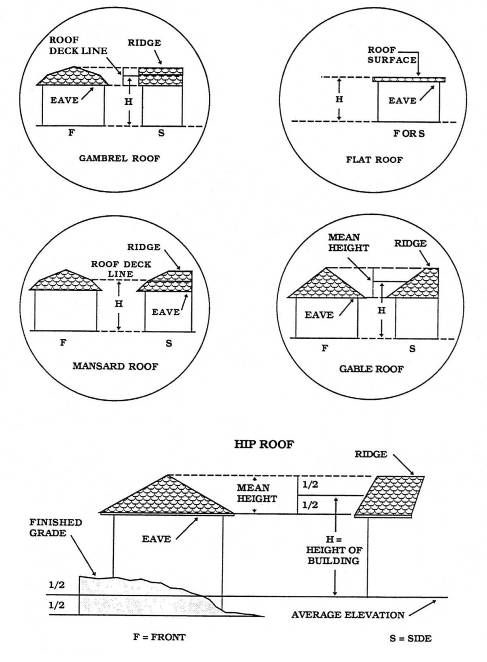
Figure 9. Building Height
BUILDING INSPECTOR. The building inspector or official designated by the City Council.
BUILDING LINE. A line formed by the face of the building, and for the purpose of this ordinance, a building line is the same as a front setback line.
CAMPER ENCLOSURE means a structure or enclosure designed for mounting on a pickup truck or truck chassis in such a manner as to provide temporary living or sleeping quarters, including but not limited to a slide-in camper or truck cap.
CHILD CARE CENTER. A facility, other than a private residence, receiving one or more preschool or school age children for care for periods of less than 24 hours a day, and where the parents are not immediately available to the child.
CLINIC. A place for the care, diagnosis and treatment of sick or injured persons, and those in need of medical or minor surgical attention. A clinic may incorporate customary laboratories and pharmacies incidental or necessary to its operation or to the service of its patients, but may not include facilities for inpatient care of major surgery.
CLUB. An organization of persons for special purposes or for the promulgation of sports, arts, science, literature, politics or the like, but not for profit.
COMMERCIAL COMMUNICATION TOWER. A tower, antenna, or similar structure used by a commercial enterprise to send and/or receive radio, television, or various other types of transmissions, but not including cellular telephone system towers or antennas.
COMMERCIAL EQUIPMENT means any machinery, parts, accessories, construction equipment or other equipment used primarily in the course of conducting a trade or business, and roll-off dumpsters and portable storage units in residential districts.
COMMERCIAL VEHICLE means any vehicle used to generate income or which has the appearance that it is used for business, due to size, type, signage and/or accessories. A pickup truck, passenger/cargo-style van with seating of up to 15 persons, sports/utility vehicle and passenger car without signage and accessories shall not be considered, for purposes of this chapter, as a commercial vehicle, even though used in business.
COMMUNITY FACILITY. A non-commercial facility, including non-profit organizations, for the benefit of and service to the general public, including, but not limited to, community centers, cultural facilities such as libraries or museums, police and fire stations, and municipal and government uses.
CONDITIONAL USE. A use specified in this ordinance as permissible in a specific use district only after special conditions are met.
CONSTRUCTION EQUIPMENT means a bulldozer, front-end loader, backhoe, power shovel, cement mixer, trencher, and any other equipment designed or used for construction, including parts and accessories thereto, and trailers designed for the transportation of such equipment.
CONVALESCENT or NURSING HOME. A home for the care of children, the aged, the infirm, or a place of rest for persons suffering serious bodily disorders, wherein two or more persons are cared for. A convalescent or nursing home is subject to the licensing requirements of applicable State laws (Public Act 139 of 1956, as amended).
DATA CENTER. A facility used primarily for the storage, management, processing, and transmission of digital data, which houses computer and/or network equipment, servers, data storage devices, and other associated components. This use includes the mechanical and electrical infrastructure necessary to support the facility's operation, and may also include, but is not limited to, cooling systems, uninterruptible power supplies (UPS), backup generators, electrical substations, and fuel storage. A Data Center is distinct from a professional office or warehouse use.
DEVELOPMENT. The construction of a new use or building or other structure on a lot or parcel, the relocation of an existing use or building on another lot or parcel, or the use of acreage or open land for a new use or building.
DISTRICT. A geographic area specified in the Zoning Ordinance of the City of Rochester Hills within which certain uses are permitted, and certain regulations apply under this ordinance. This term is synonymous with the term "zone" or "zoning district."
DRIVE-IN ESTABLISHMENT. A business establishment so developed that its principal retail or service character is dependent on providing a driveway approach or parking spaces for motor vehicles so as to serve patrons while in or momentarily stepped away from their motor vehicles, rather than within a building or structure, so that consumption within motor vehicles may be facilitated.
DRIVE-THROUGH FACILITY. An element of a commercial business designed to provide service to patrons while in their motor vehicles, rather than within a building or structure, so that consumption off the premises or within the vehicle may be facilitated.
DWELLING. A residential unit providing complete, independent living facilities for one family including permanent provisions for living, sleeping, cooking, eating and sanitation.
A.
Apartment. A suite of rooms or a room in a multiple-family or commercial building arranged and intended for a place of residence of a single-family or a group of individuals living together as a single housekeeping unit.
B.
Attached Dwelling. A dwelling unit attached to two or more dwelling units by common major structural elements. There are three types of attached dwelling unit:
1.
Apartment Building. A building divided into apartments and designed for residential occupancy by three or more families and so designed and arranged as to provide cooking and kitchen accommodations and sanitary facilities for three or more families with each floor having two means of egress, exclusive of an elevator. Dwelling units in a multiple family building may be directly accessible and independent for each dwelling unit, or accessible via an internal corridor or hallway.
2.
Stacked Flats Building. A type of attached dwelling unit building occupied by three or more families, where dwellings are divided by party walls in the horizontal plane and floor-ceiling assemblies in the vertical plane in an appropriate manner for multiple-family uses. Each dwelling unit is capable of individual use and maintenance without trespassing upon adjoining properties, and utilities and service facilities are independent for each property.
3.
Townhouse. A type of attached dwelling unit building that is divided from the dwelling adjacent to it by a party wall extending the full height of the building with no visible separation between walls or roof. Each townhouse dwelling shall be capable of individual use and maintenance without trespassing upon adjoining dwellings, and access, utilities and service facilities shall be independent for each dwelling.
C.
Detached Dwelling. A dwelling unit which is not attached to any other dwelling unit by any means.
D.
Efficiency Apartment. A dwelling unit with a bathroom and principal kitchen facilities designed as a self contained unit for living, cooking, and sleeping purposes, and having no separate designated bedroom.
E.
Manufactured Home Dwelling. A dwelling unit that is transportable in one or more sections, which is built upon a chassis and designed to be used as a dwelling with or without permanent foundation, when connected to the required utilities, and includes the plumbing, heating, air-conditioning, and electrical systems contained in the structure. Recreational vehicles as described and regulated herein shall not be considered "manufactured homes" for the purposes of this ordinance.
F.
Modular Dwelling. A dwelling which consists of prefabricated units transported to the site in two or more sections on a removable undercarriage or flat-bed and assembled for permanent location upon a permanent foundation on the lot, and to which such major elements as the heating system or a substantial portion of the siding are installed after transport, and shall not be considered a mobile home.
G.
Site Built Dwelling. A dwelling unit which is substantially built, constructed, assembled, and finished on the premises which are intended to serve as its final location. Site-built dwelling units shall include dwelling units constructed of precut materials, and paneled wall, roof and floor sections when such sections require substantial assembly and finishing on the premises which are intended to serve as it final location.
H.
Single-Family Dwelling. A building designed exclusively for residential occupancy by not more than one family.
I.
Two-Family (Duplex) Dwelling. A building designed exclusively for residential occupancy by two families, and arranged to provide separate kitchen and sleeping accommodations and sanitary facilities for each family.
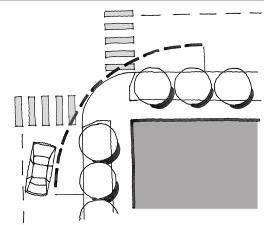
Figure 4. Effective Turning Radius
EFFECTIVE TURNING RADIUS. The minimum radius appropriate for turning from a through or turning lane on an approach street to an appropriate lane on the receiving street. See Figure 4
ERECT. To build, construct, reconstruct, move, attach, hang, place, suspend, affix, paint or undertake any physical operation on the premises required for development of a building, sign, site or structure; including, but not limited to construction, grading, excavations, fill and drainage activities.
ESSENTIAL SERVICES. The erection, construction, alteration or maintenance by public utilities or municipal departments of underground, surface, or overhead gas, electrical, steam, fuel or water transmission or distribution system, collection, communication, supply or disposal systems, including towers, poles, wires, mains, drains, sewers, pipes, conduits, cables, fire alarm and police call boxes, traffic signals, hydrants and similar equipment in connection therewith, but not including buildings which are necessary for the furnishing of adequate services by such utilities or municipal departments for the general health, safety or welfare. Wireless communication towers or antennas, utility buildings and storage yards are not considered essential services under this ordinance.
EXCAVATION. Any breaking of the ground to hollow out by cutting, digging, or removing any soil or rock matter, except for common household gardening and general farm care.
FAÇADE. The vertical plane of the exterior surface of a building, including all visible architectural, decorative and structural features, window openings, door openings and the outside surface of a parapet wall.
FAMILY.
A.
An individual or group of two or more persons related by blood, marriage or adoption, together with foster children and servants of the principal occupants, with not more than one additional unrelated person, who are domiciled together as a single, domestic, housekeeping unit in a dwelling unit; or
B.
A collective number of individuals domiciled together in one dwelling unit whose relationship is of a continuing nontransient domestic character and who are cooking and living as a single nonprofit housekeeping unit. This definition does not include any society, club, fraternity, sorority, association, lodge, coterie, organization, or group of students or other individuals whose domestic relationship is of a transitory or seasonal nature or for an anticipated limited duration of a school term or other similar determinable period.
FENCE. Structures or partitions of definite height and location intended to serve as: a physical barrier to property ingress or egress; a screen from objectionable vista or noise; a marker; an enclosure in carrying out the requirements of this ordinance; or for decorative use. Hedges, ornamental shrubs, trees and bushes shall be considered fences for the purpose of this ordinance when placed in a manner or position to serve as such.
FILLING. The depositing or dumping of any matter onto or into the ground, except common household gardening and general farm care.
FIREARM. An instrument which is capable of hurling a missile by means of exploding or burning powder.
FLOODPLAIN. The relatively flat area or lowlands adjoining the channel of a watercourse or a body of water, which may be covered by floodwater when high amounts of precipitation are experienced. Determinants of a floodplain are as follows:
A.
Contiguous areas paralleling major rivers or streams that constitute, at their maximum edge, the highest flood levels experienced in a period of 100 years.
B.
Principal estuary courses of wetland areas that are part of the river flow system.
C.
Contiguous areas paralleling major rivers or streams that exhibit unstable soil conditions for development.
FLOODWAY. The channels and area adjacent to the channels necessary to carry and discharge floodwater. Floodway channel limits shall be the ordinary high water mark boundaries of the channel.
FLOOR AREA. The sum total of the area of all buildings on a site excluding utility rooms and mechanical rooms, measured between the outer perimeter walls of the buildings, provided that space in a building or structure used for parking of motor vehicles shall not be computed in the floor area. Courtyards or balconies open to the sky and roofs which are utilized for recreation, etc., shall not be counted in the floor area but shall be a part of the recreational space.
FLOOR AREA, GROSS (GFA). The sum of the gross horizontal areas of the several floors of the building measured from the exterior faces of the exterior walls or from the centerline of walls separating two buildings. The "floor area" of a building, which is what this normally is referred to as, includes the basement floor area when more than one-half of the basement height is above the established curb level or finished lot grade, whichever is higher. Any space devoted to off-street parking or loading shall not be included in floor area. Areas of basements, utility rooms, breezeways, unfinished attics, porches (enclosed or unenclosed) or attached garages are not included.
FLOOR AREA RATIO (FAR). The ratio between the maximum allowable amount of floor space on all floors in a building and the total area of the lot on which the building is located. Example: a FAR of 2.0 would allow floor space of twice the lot area, or a four-story, building covering one-half of the lot. A FAR of 0.5 would allow floor space of one-half the lot area, or a two-story building covering one-quarter of the lot.
FLOOR AREA, USABLE (UFA). That portion of the floor area, measured from the interior face of the exterior walls, used for or intended to be used for services to the public or to customers, patrons, clients or patients, including areas occupied by fixtures or equipment used for the display or sale of goods or merchandise, but not including areas used or intended to be used for the storage of merchandise, utility or mechanical equipment rooms, sanitary facilities, or service hallways or corridors. In the case of a half story, the usable floor area shall be considered to be only that portion having a clear height above it of four feet or more.
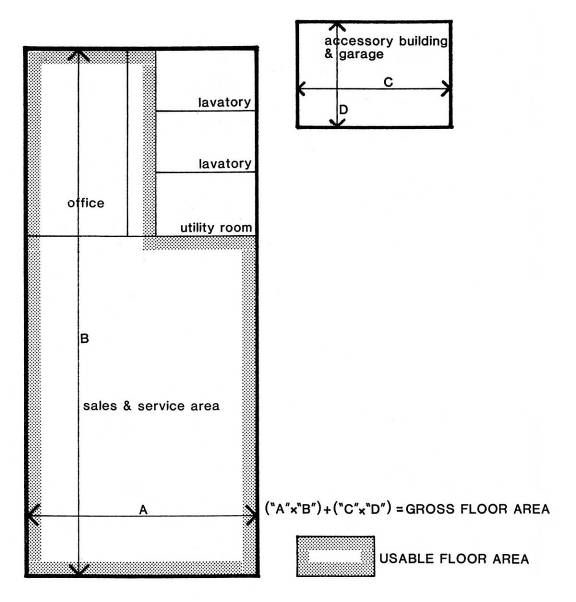
Figure 10. Floor Area Terminology
GARAGE, PRIVATE. An accessory building or portion of a main building designated or used solely for the storage of motor-driven vehicles, boats and similar vehicles owned and used by the occupants of the building to which it is accessory.
GARBAGE. Any putrescible solid and semisolid animal or vegetable wastes resulting from the production, handling, preparation, cooking, service or consumption of food or food materials.
GAZEBO. A roofed or sheltered structure which consists, generally, of open, screened or latticework construction and may be used for outdoor seating, but is not designed for year-round use.
GRADE. A reference plane representing the average of the finished ground level adjoining the building at all exterior walls established for the purpose of regulating the number of stories and the height of buildings. If the ground is not entirely level, the grade shall be determined by averaging the elevation of the ground for each face of the building/dwelling.
GREENBELT. A strip of land of definite width and location reserved for the planting of shrubs and/or trees to serve as an obscuring screen or buffer strip in carrying out the requirements of this ordinance.
GROSS FLOOR AREA. See FLOOR AREA, GROSS.
GROUND FLOOR CEILING HEIGHT. The vertical distance between the finished floor and the ceiling on the ground floor of a building.
GUN CLUB. Any club, organization, individual, group of individuals, or use, whether operated for profit or not, and whether public catering or private, which caters to or allows the use of firearms.
HEALTH, RECREATION AND PHYSICAL EDUCATION FACILITIES. Means an establishment which is equipped and arranged for recreational activities and/or provides for instruction or activities which improve or affect a person's physical condition through movement. This may include, but shall not be limited to, personal training facilities; yoga, Pilates and barre studios; martial arts; dance; sports training; bowling alleys, gymnastics centers, laser tag, and the like.
HOME OCCUPATION. An occupation or profession customarily carried on by the occupant of a dwelling unit at the dwelling unit as a secondary use which is clearly subservient to the use of the dwelling for residential purposes. Home occupation includes a bed and breakfast operation.
HOSPITAL. A building, structure or institution in which sick or injured persons are given medical or surgical treatment and operating under license by the health department and the state, and that is used for primarily inpatient services, and including such related facilities as laboratories, outpatient departments, central service facilities, and staff offices.
HOTEL or MOTEL. A series of attached, semidetached or detached rental units which provide overnight lodging and/or temporary residence and which are offered to the public for compensation and which units are accessible from interior corridors or directly from outdoor parking areas and, the establishment may offer or provide meals, entertainment and/or personal services.
INDUSTRY, LIGHT. Means a use that involves the manufacturing, production, processing, fabrication, assembly, treatment, repair, or packaging of finished products, predominantly from previously prepared or refined materials (or from raw materials that do not need refining). Warehousing, wholesaling, and distribution of the finished products produced at the site is allowed as part of this use. Light industry is capable of operation in such a manner as to control the external effects of the manufacturing process, such as smoke, noise, soot, dirt, vibration, odor, etc.
INDUSTRY, GENERAL. Means uses engaged in the basic processing and manufacturing of materials or products predominately from extracted or raw materials, or a use engaged in storage of, or manufacturing processes using flammable or explosive materials, or storage or manufacturing processes that potentially involve hazardous conditions. "General industry" shall also mean those uses engaged in the operation, parking, and storage, of vehicles, cleaning of equipment or work processes involving solvents, solid waste or sanitary waste transfer stations, data centers, recycling establishments, junkyards and truck terminals.
JUNKYARD. An open area where waste, used or secondhand materials are bought and sold, exchanged, stored, baled, packed, disassembled, or handled, including, but not limited to: scrap iron and other metals, paper, rags, rubber tires and bottles. A junkyard includes automobile wrecking yards, and includes any area of more than 200 square feet for storage, keeping or abandonment of junk, but does not include uses established entirely within enclosed buildings.
KENNEL. The boarding, breeding, raising, grooming, or training of three or more dogs, cats, or other household pets of any age either 1) not owned by the owner or occupant of the premises, or 2) for commercial gain.
LABORATORY. A place devoted to experimental study such as testing and analyzing, but not devoted to the manufacturing of a product or products.
LANDFILL. Any disposal area or tract of land, building, unit or appurtenance or combination thereof that is used to collect, store, handle, dispose of, bury, cover over, or otherwise accept or retain refuse as defined in this section.
LIGHTING. The following definitions are related to lighting:
A.
Canopy Structure. Any overhead protective structure which is constructed in such a manner as to allow pedestrians/vehicles to pass under.
B.
Edison Bulb. An incandescent light bulb with an exposed filament or an LED bulb simulating the appearance of such a bulb, meant to provide atmospheric lighting and producing a light output not greater than 400 lumens.
C.
Floodlight. Any light fixture or lamp that incorporates a reflector or refractor to concentrate the light output into a directed beam in a particular direction.
D.
Footcandle. A unit of illuminance, which is the quantity of light, or luminous flux, arriving at a surface divided by the area of the illuminated surface, amounting to one lumen per square foot.
E.
Fully Shielded Fixture. A luminaire constructed or shielded in such a manner that all light emitted by the luminaire, either directly from the lamp or indirectly from the luminaire, is projected below the horizontal plane through the luminaire's lowest light emitting part as determined by photometric test or certified by the manufacturer.
F.
Glare. Direct light emitted by a luminaire that causes reduced vision or momentary blindness.
G.
Light Fixture. The assembly that holds a lamp and may include an assembly housing, a mounting bracket or pole socket, a lamp holder, a ballast, a reflector or mirror and a refractor or lens. A light fixture also includes the assembly for luminous tube and fluorescent lighting.
H.
Light Pollution. Artificial light which causes a detrimental effect on the environment, enjoyment of the night sky or causes undesirable glare or unnecessary illumination of adjacent properties.
I.
Light Trespass. The shining of light produced by a luminaire beyond the boundaries of property in which it is located.
J.
Lumen. As used in the context of this Ordinance, the light-output rating of a lamp (light bulb).
K.
Luminaire. The complete lighting system including the lamp and light fixture.
L.
Luminaire Cut-Off Angle. The angle, measured up from the nadir, between the vertical axis and the first line of sight at which the bare source is not visible.
M.
Luminous Tube Lighting. Gas filled tubing which, when subjected to high voltage, becomes luminescent in a color characteristic of the particular gas used, e.g., neon, argon, etc.
N.
Outdoor Lighting Fixtures. Outdoor artificial illuminating devices, installed or portable, used for floodlighting, general illumination or advertisement.
O.
Strip Lighting. A device or devices installed that attracts attention to a non-residential use wherein a source or sources of light are arranged to be visible from the exterior of a building or structure including, but not limited to, strips of LED lights or neon tubes placed along the perimeter of building windows, along building edges and other locations that serve to attract attention to a non-residential use. This definition shall not include any device or devices classified as a sign by the definitions and regulations in the Zoning Ordinance. Temporary lights otherwise regulated by this ordinance are also excluded from this definition.
LINER SHOP. A building or part of a building specifically designed to front on a public space and provide an active use between the public space and a parking or storage facility.
LIVE/WORK UNIT. A dwelling unit that contains a commercial component.
LIVESTOCK. Cattle, sheep, goats, and other useful animals normally kept or raised on a farm.
LOADING SPACE. An off-street space on the same lot with a building or group of buildings, for temporary parking of a commercial vehicle while loading and unloading merchandise or materials.
LOT. The contiguous land in the same ownership which is not divided by any public highway or alley, including any part thereof subject to any easement for any purpose other than a public highway or alley, but excluding any part thereof severed from another lot where the severance creates any nonconformity of use or structure. The term "lot" includes the term "plot" or "parcel."
LOT AREA, GROSS. The total horizontal area within the lot lines of the lot.
LOT AREA, NET. Gross lot area minus any portions of the lot located within dedicated rights-of-way, drainage easements, or bodies of water.
LOT, CORNER. A lot where the interior angle of two adjacent sides at the intersection of the two streets is less than 135 degrees. A lot abutting upon a curved street shall be considered a corner lot for the purposes of this ordinance if the arc is a radius of less than 150 feet and the tangents to the curve, at the two points where the lot lines meet the curve or the straight street line extended form an interior angle of less than 135 degrees. See Figure 15.
LOT COVERAGE. The part or percentage of the lot occupied by buildings, including accessory buildings.
LOT DEPTH. The horizontal distance between the front and rear lot lines, measured along the median between side lot lines.
LOT, DOUBLE FRONTAGE. Any interior lot having frontage on two more or less parallel streets as distinguished from a corner lot. In the case of a row of double frontage lots, all sides of such lots adjacent to streets shall be considered frontage, and front yards shall be provided as required. See Figure 15.
LOT, INTERIOR. Any lot other than a corner lot. See Figure 15.
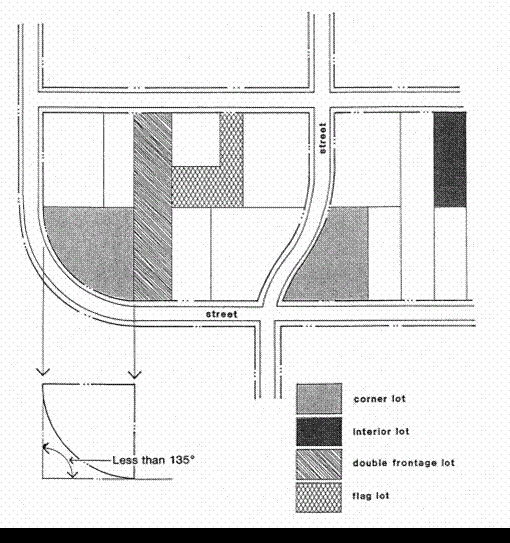
Figure 11. Interior and Corner Lots
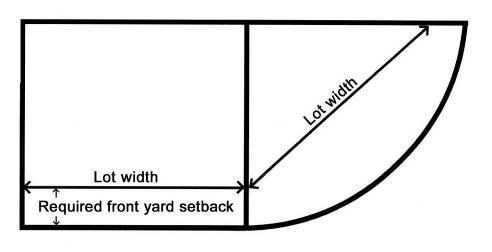
Figure 12. Lot Width
LOT LINE. Any line dividing one lot from another lot, or from a street right-of-way or from any public place:
A.
Front lot line.
1.
In the case of an interior lot, the line separating the lot from the street, except if the shape of the parcel, or some other reason, makes it impractical to use such line as the front line, another line may be used as the front upon approval by the Zoning Board of Appeals, if the placement of the structures and resulting yards are consistent with, and more easily blend with, the other buildings and development in the adjoining area.
2.
In the case of a corner lot, the front lot line is that line separating such lot from the street which is designated as the front street in the plat and in the application for a building permit or zoning occupancy permit. In the case of a double frontage lot the front line is that line separating such lot from that street which is designated as the front street in the plat, or in the request for a building permit.
B.
Rear lot line. The lot line opposite the front lot line. In the case of a lot pointed at the rear, the rear lot line shall be an imaginary line parallel to the front lot line, not less than ten feet long lying farthest from the front lot line and wholly within the lot. In any case where this definition does not apply, the Planning Commission shall designate the rear lot line.
C.
Side lot line. Any lot lines other than the front lot line or rear lot line. A side lot line separating a lot from a street is a side street lot line. A side lot line separating a lot from another lot is an interior side lot line.
D.
Side street lot line. In the case of a corner lot, the side street lot line is the line separating such lot from the street which is not designated as the front street in the plat or in the application for a building permit or zoning occupancy permit.
LOT OF RECORD. A parcel of land, the dimensions of which are shown on a document or map on file with the county register of deeds or in common use by City or county officials, and which actually exists as so shown, or any part of such parcel held in record ownership separate from that of the remainder thereof.
LOT WIDTH. The horizontal distance between the side lot lines measured at the two points where the building line, or setback, intersects the side lot lines. See Figure 12.
MAKERSPACE. A place in which people with shared interests, especially in arts, crafts, computing, technology and similar fields, can gather to work on projects while sharing ideas, equipment, and knowledge.
MANUFACTURED HOME. A structure, transportable in one or more sections, which is built on a non-motorized chassis and designed to be used with or without a permanent foundation as a dwelling when connected to the required utilities, and includes the plumbing, heating, air-conditioning, and electrical systems contained in the structure. A mobile home shall not include modular homes, motor homes, house trailer, trailer coach, or travel trailers.
MANUFACTURED HOUSING PARK. A parcel or tract of land under the control of a person upon which three or more mobile homes are located on a continual non-recreational basis and which is offered to the public for that purpose regardless of whether a charge is made therefore, together with any building, structure, enclosure, street, equipment, or facility used or intended for use incident to the occupancy of a manufactured home, subject to the rules and requirements of the Mobile Home Commission Act, Public Act 96, of 1987, as amended (MCL 139.2301 et seq.) and the Manufactured Housing Commission General Rules. A person, as used in this definition, means an individual, partnership, association, trust, corporation or any other legal entity or combination of legal entities.
MASTER PLAN. A comprehensive plan including graphic and written proposals indicating the general location for streets, parks, schools, public buildings and all physical development of the City and includes any unit or part of such plan, and any amendment to such plan or parts thereof.
MASTER THOROUGHFARE PLAN. The right-of-way and/or thoroughfare plan officially adopted by the City, the county and/or the intercounty highway commission.
MEDIA and ENTERTAINMENT PRODUCTION FACILITY. A facility for the creation, production, recording, editing, or finishing of film, television, print, sound, or other media. Excluded are facilities classified as major utility services or broadcasting or communication towers.
MEDICAL OFFICE. See OFFICE, MEDICAL.
MOBILE HOME. See MANUFACTURED HOME or MANUFACTURED HOUSING PARK.
MOTEL. See HOTEL or MOTEL.
NATURAL FEATURE. A wetland or watercourse.
NONCONFORMITIES.
A.
Nonconforming Structure. A structure or portion thereof lawfully existing at the effective date of this ordinance or amendments thereto that does not conform to ordinance provisions for the district in which it is located, but is otherwise in compliance with all other applicable federal, state, county and city laws, ordinances, regulations and codes.
B.
Nonconforming Use of Land. A use that lawfully occupied a parcel or contiguous parcels of land or structure and land in combination at the effective date of this ordinance or amendments thereto that does not conform to the use regulations of the district in which it is located, or does not have special approval where provisions of this ordinance require such approval, but is otherwise in compliance with all other applicable federal, state, county and city laws, ordinances, regulations and codes.
C.
Nonconforming Lot of Record. A platted or unplatted parcel of land lawfully existing at the effective date of this ordinance or amendments thereto that does not conform to ordinance provisions for the district in which it is located.
D.
Nonconforming Site. A parcel of land that was developed or improved with structures and other site improvements prior to the date of adoption of current zoning ordinance provisions for site design, landscaping, pedestrian access, exterior lighting, paving and other site elements.
E.
Illegal Structure. A structure or portion thereof, which is not a conforming or a nonconforming structure, or is not in compliance with all applicable federal, state, county and city laws, ordinances, regulations and codes.
F.
Illegal Use of Land. A use that occupies one or more contiguous parcels of land, or structures and land in combination, which is not a conforming or a nonconforming use, or is not in compliance with all applicable federal, state, county and city laws, ordinances, regulations and codes.
G.
Cessation. To terminate, abandon or discontinue a use of land for a period of time that, under the provisions of this ordinance, would prevent the use from being resumed.
NUISANCE. An offensive, annoying, unpleasant, or obnoxious thing or practice being a cause or source of annoyance.
NURSERY, PLANT MATERIAL. A space, building or structure, or combination thereof, for the storage of live trees, shrubs, or plants. The definition of nursery within the meaning of this ordinance does not include any space, building or structure used for the sale of fruits, vegetables or harvest and cut Christmas trees.
NURSING HOME. See CONVALESCENT or NURSING HOME.
OCCUPANCY LOAD. The number of individuals normally occupying a building or part thereof or for which the existing facilities have been designed.
OCCUPIED. Being in actual or constructive possession of a structure or land. The term "occupied" includes the term "intended, designed or arranged to be occupied."
OFFICE, MEDICAL. Offices for medical professionals and related occupations, such as doctors, dentists, chiropractors, osteopaths, and similar or allied professions.
OFFICE, PROFESSIONAL. Offices for executive, administrative, and professional occupations such as lawyers, accountants, architects, planners, engineers, financial advisors, media production, advertising, sales, and similar or allied professions.
OFFICE, SHOWROOM, or WORKSHOP ESTABLISHMENT. A service establishment that includes an office-showroom or workshop component, including but not limited to an electrician, decorator, dressmaker, tailor, shoemaker, baker, printer, upholsterer, or an establishment doing radio, television or home appliance repair, photographic reproduction, and similar establishments that require a retail adjunct. Automotive establishments such as muffler, shock-absorber or brake replacement businesses are not considered office, showroom, or workshop establishments.
OPEN AIR BUSINESS. The display and sale of products and services on a lot outside of a building including products and services that are displayed year round and those such as Christmas trees and flowers that are displayed and sold on a temporary or seasonal basis, excluding garage sales that are otherwise regulated in this ordinance.
OPEN AIR RETAIL. A retail sales establishment operated substantially in the open air, including but not limited to vending carts, kiosks, farmers or flea markets and the like. Not included are car sales, equipment sales, boat sales, and home and garden supplies and equipment.
OPEN FRONT STORE. A business establishment other than a restaurant, bank, automobile service or repair station, so developed that service to the patron may be extended beyond the walls of the building, not requiring the patron to enter such building.
ORTHOGONAL GRID. A grid system where the intersecting lines are perpendicular to each other, and intersect at 90-degree angles.
PARKING LOT. An area utilized for the off-street parking of automobiles which is constructed according to the standards of this ordinance or other City ordinances and which is built on the surface of the ground.
PARKING SPACE. An area of definite length and width exclusive of drives, driveways, aisles or entrances giving access thereto and fully accessible for the storage or parking of permitted vehicles.
PARKING STRUCTURE. An area utilized for the off-street parking of automobiles which is constructed according to the standards of this ordinance or other City ordinances and which may be one or more stories in height.
PERIMETER YARD. A yard area on the edge of a form-based zoning district where the form-based district abuts a conventional zoning district.
PERSONAL SERVICE ESTABLISHMENT. A business that performs services on the premises for persons residing in nearby residential areas including but not limited to shoe repair, tailoring, beauty parlors, nail salons, or barbershops.
PET BOARDING FACILITY. A business for the temporary boarding and care of common household pets generally during daytime hours, but in some cases including overnight boarding. Pet boarding facilities may provide related services such as grooming or training. No animals may be bred or sold at a pet boarding facility.
PLACE OF ASSEMBLY. A facility for public assembly including, but not limited to, arenas, auditoriums, conference facilities, convention centers, exhibition halls, places of worship, theaters, movie theaters, and performing arts centers.
PLACE OF WORSHIP. A religious institution, or a site used for the regular assembly of persons, for the conducting of religious services, and for related accessory uses, including offices and living quarters for church ministry and other members of the religious order who carry out their duties primarily on the site, religious education classes, day care and limited recreation facilities. Rescue missions, tent revivals and other temporary assemblies are not included in this definition.
PLANNING COMMISSION. The Planning Commission of the City as designated in Public Act No. 33 of 2008.
PORCH, ENCLOSED. A covered entrance to a building or structure which is totally enclosed, which projects out from the main wall of such building or structure and which has a separate roof or an integral roof with the principal building or structure to which it is attached.
PORCH, OPEN. A covered entrance to a building or structure which is unenclosed, except for columns supporting the porch roof, which projects out from the main wall of such building or structure and which has a separate roof or an integral roof with the principal building or structure to which it is attached.
POULTRY. Domestic fowl such as chickens, turkeys, ducks and geese.
PRINCIPAL USE. A use as specified and listed in this ordinance under each district as a principal use.
PROFESSIONAL OFFICE. See OFFICE, PROFESSIONAL.
PUBLIC PARK. Any place devoted to recreation or conservation purposes within the jurisdiction and control of a governmental agency.
PUBLIC SERVICE. Public service facilities within the context of this ordinance shall include such uses and services as voting booths, pumping stations, fire halls, police stations, temporary quarters for welfare agencies, public health activities and similar uses including essential services.
PUBLIC UTILITY. Any person, municipal department, board or commission duly authorized to furnish and furnishing under federal, state, or municipal regulations to the public: gas, steam, electricity, sewage disposal, communication, telegraph, transportation or water.
RECREATION FACILITIES, INDOOR. An establishment which provides indoor exercise facilities and indoor court sports facilities, and which may include spectator seating in conjunction with the sports facilities. For the purposes of this ordinance, a bowling establishment shall be considered a type of indoor recreation center.
RECREATIONAL FACILITIES, OUTDOOR. Playgrounds, parks, picnic areas, golf courses, ball fields, camps, swimming pools, nature preserves, or any other type of community space or equipment that is designed to provide the user with the opportunity to relax, engage in athletic activity, or engage in other leisure pursuits.
RECREATIONAL VEHICLE means a mobile structure or unit designed or altered to provide temporary living quarters for recreation, camping or travel use, but not for commercial use. It may be self-propelled or designed to be drawn by a motor vehicle. The term "recreational vehicle" includes, but is not limited to, a motor home, truck camper, travel trailer, folding camping trailer, or a converted van or bus.
REFUSE. Any putrescible or nonputrescible solid waste, except human excreta, but including garbage, rubbish, ashes, street cleanings, dead animals, offal and solid agricultural, commercial, industrial, hazardous and institutional wastes and construction waste resulting from the operation of a contractor.
RESEARCH FACILITY. A facility for research and development that does not involve the use of human testing, animal husbandry, incinerators, heavy equipment, mass manufacturing, fabrication, processing, or sale of products.
RESIDENTIAL INN. A series of attached, semidetached or detached rental units which provide temporary living units of rooms or suites that feature individual kitchen and dining facilities. Residential inns are distinguished from hotels and motels in that they are intended to provide temporary lodging for guests that require accommodations for longer periods of time, and in some instances for more than 30 days.
RETAIL SALES ESTABLISHMENT. Any generally recognized retail business that supplies commodities on the premises to the general public. Commodities supplied may include groceries and similar food products for consumption off the premises. Restaurants or any similar establishment that serves prepared food as its primary business is not considered a retail sales establishment.
ROADSIDE STAND and MARKET. The temporary use of property or facilities for the selling of produce.
RUBBISH. Any nonputrescible solid waste excluding ashes, such as paper, cardboard, plastic, metal, or glass food containers, rags, waste metal, yard clippings, small pieces of wood, glass, excelsior, rubber, leather, crockery and other similar materials.
SETBACK. The distance required to comply with front, side or rear yard open space provisions of this ordinance.
SHOPPING CENTER. Three or more commercial establishments which are contiguous and developed under one site plan.
SIGN. The use of any words, numerals, figures, devices, designs or trademarks by which anything is made known, other than billboards, such as are used to show an individual firm, profession or business, and are visible to the general public; accessory signs pertain to uses or activities conducted on the premises where the signs are located.
SMALL-SCALE BREWERY. A small-scale facility for the brewing of beer for sale on the premises, as well as for off-site sales, that produces less than 15,000 barrels of beverage annually and may include a restaurant/bar space, tasting room or retail sales.
SOIL EXCAVATION. Removal of any kind or nature from a site of gravel, clay, sand, soil or other similar materials.
STABLE, PUBLIC. A structure in which livestock used for pleasure riding or driving are housed or kept for hire, including a riding track.
STABLE, PRIVATE. A building and associated site improvements for the keeping of horses for the noncommercial use of the residents of the principal use and does not include the keeping of horses for others, or for commercial breeding.
STATE LICENSED RESIDENTIAL FACILITY. Any structure constructed for residential purposes that is licensed by the State of Michigan pursuant to Michigan Public Act 116 of 1973 (the Child Care Licensing Act) or Michigan Public Act 218 of 1979 (the Adult Foster Care Facility Licensing Act). This definition includes adult foster care facilities, foster family homes, foster family group homes, family day care homes, and group day care homes (see Human Services Facilities Subject to State Licensing Chart).
A.
Adult foster care facility means a residential structure that is licensed to provide foster care, but not continuous nursing care, for unrelated adults over the age of 17. Adult foster care facilities are subject to all applicable provisions, definitions, and regulations of Michigan Public Act 218 of 1979, as amended (MCL 400.701 et seq.).
1.
Foster care means the provision of supervision, personal care, and protection in addition to room and board, for 24 hours a day, five or more days a week, and for two or more consecutive weeks for compensation.
2.
Adult foster care facility does not include any of the following:
a.
A licensed child caring institution, children's camp, foster family home, or foster family group home, subject to the limitations contained in Section 3(4f) of Michigan Public Act 218 of 1979, as amended (MCL 400.703).
b.
A licensed foster family home that has a person who is 18 years of age or older placed in the foster family home under section 5(7) of Michigan Public Act 116 of 1973, as amended (MCL 722.115).
c.
An establishment commonly described as an alcohol or a substance abuse rehabilitation center; a residential facility for persons released from or assigned to adult correctional institutions; a maternity home; or a hotel or rooming house that does not provide or offer to provide foster care.
d.
A veterans' facility created by 1885 PA 152, MCL 36.1 to 36.12.
3.
The following types of adult foster care facilities are provided for by this ordinance:
a.
Adult foster care family home means a private home with the approved capacity to receive not more than six adults to be provided with foster care. The adult foster care family home licensee shall be a member of the household and an occupant of the residence.
b.
Adult foster care small group home means an adult foster care facility with the approved capacity to receive not more than 12 adults to be provided with foster care.
c.
Adult foster care large group home means an adult foster care facility with the approved capacity to receive at least 13 but not more than 20 adults to be provided with foster care.
d.
Adult foster care congregate facility means an adult foster care facility with the approved capacity to receive more than 20 adults to be provided with foster care.
B.
Family day care home means a private home in which one but fewer than seven minor children are received for care and supervision for periods of less than 24 hours a day, unattended by a parent or legal guardian, except children related to an adult member of the family by blood, marriage, or adoption. Family day care home includes a home in which care is given to an unrelated minor child for more than four weeks during a calendar year.
C.
Foster family home means a private home in which one but not more than four minor children, who are not related to an adult member of the household by blood or marriage, or who are not placed in the household under the Michigan adoption code, are given care and supervision for 24 hours a day, for four or more days a week, for two or more consecutive weeks, unattended by a parent or legal guardian.
D.
Foster family group home means a private home in which more than four but fewer than seven minor children, who are not related to an adult member of the household by blood or marriage, or who are not placed in the household under the Michigan adoption code, are given care and supervision for 24 hours a day, for four or more days a week, for two or more consecutive weeks, unattended by a parent or legal guardian.
E.
Group child day care home means a private home in which more than six but not more than 12 minor children are given care and supervision for periods of less than 24 hours a day unattended by a parent or legal guardian, except children related to an adult member of the family by blood, marriage, or adoption. Group child day care home includes a home in which care is given to an unrelated minor child for more than four weeks during a calendar year.
F.
Private home means a private residence in which the licensee or registrant permanently resides as a member of the household, which residency is not contingent upon caring for children or employment by a licensed or approved child placing agency.
STEEP SLOPE. Refer to Section 138-9.210 for definitions pertaining to steep slopes and their regulation.
STORY. That part of a building, other than a mezzanine, included between the surface of one floor and the surface of the floor next above, or if there be no floor above, that part of the building which is above the surface of the highest floor thereof. Specifically:
A.
Top Story Attic. A half story when the main line of the eaves is not above the middle of the interior height of said story.
B.
First Story. The highest story having its interior floor surface not more than four feet above the curb level, or the average elevation of the finished grade along the front of the building were it set back from the street.
C.
Basement. A story if over 50 percent of its height is above the level from which the height of the building is measured, or if it is used for dwelling purposes by other than a janitor or domestic servant employed in the same building, including the family of the same.
D.
Half-story. That part of a building between a pitched roof and the uppermost full story, such part having a floor area which does not exceed one-half of the floor area of such full story, provided the area contains at least 200 square feet, with a clear height of at least seven feet six inches.
E.
Mezzanine. A full story when it covers more than 33 percent of the area of the story underneath such mezzanine or if the vertical distance from the floor next below it to the floor next above it is 24 feet or more.
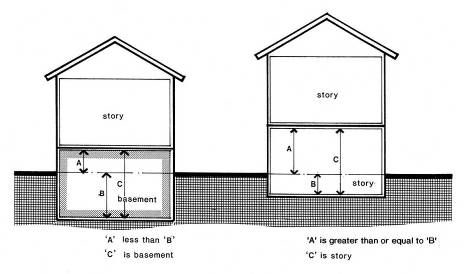
Figure 13. Basement and Story
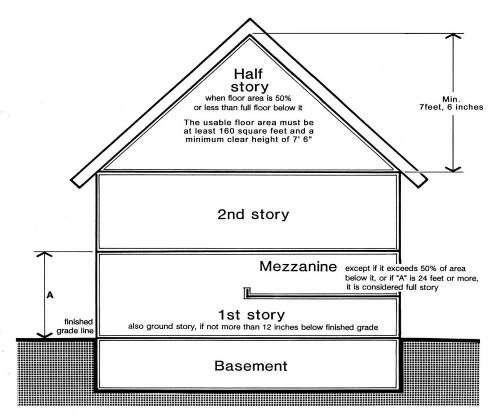
Figure 14. Basic Structural Terms
STREET. A public thoroughfare which affords the principal means of access to abutting property.
STREET, SIDE.
STRUCTURE. Anything constructed or erected and designed for a permanent location on the ground.
TEMPORARY BUILDING. A structure permitted by this ordinance to exist during periods of construction or special events.
TENT. A portable shelter of canvass, coarse cloth, etc., supported by one or more poles, but not including those used solely for children's recreational purposes.
THOROUGHFARE, MAJOR. An arterial street which is intended to serve as a large volume trafficway for both the immediate City area and the region beyond, and may be designated as a major thoroughfare, parkway, freeway, expressway, or equivalent term.
THOROUGHFARE, SECONDARY. An arterial street which is intended to serve as a trafficway serving primarily the immediate City area and serving to connect with major thoroughfares.
TRAILER means a vehicle, other than a utility trailer, designed for carrying property and for being drawn by a motor vehicle.
USABLE FLOOR AREA. See FLOOR AREA, USABLE.
USE. The purpose for which land or premises, or a building thereon, is designed, arranged or intended, or for which it is occupied, maintained, let or leased. Used includes the term "intended, designed or arranged to be occupied."
A.
Accessory Use. A use naturally and normally incidental to, subordinate to and devoted exclusively to the principal use or building of the premises.
B.
Conditional Use. An activity that may be detrimental to other land uses permitted within the same district, but that may be permitted subject to certain conditions or limitations designed to insure that the use is compatible with other permitted uses in the district.
C.
Permitted Use. A use permitted in each zoning district by right subject to site plan review approval.
D.
Seasonal Use. A temporary use permitted and regulated pursuant to this ordinance for a limited period of time conducted every year at the same time of year, such as, but not limited to, the sale of Easter flowers and Christmas trees.
E.
Temporary Use. A use permitted and regulated pursuant to this ordinance for periods of time that are limited in duration as specified by this ordinance, including, but not limited to carnivals, circuses, farmers market, art fairs, craft shows, sidewalk sales, antique sales, Christmas tree sales, flower sales, flea markets and similar events.
UTILITY ROOM. A room used primarily for storage, for housing a heating unit, or for laundry purposes.
UTILITY TRAILER means a vehicle designed to be towed by a motor vehicle in order to carry personal property, including but not limited to, firewood, refuse, snowmobiles, boats, motorcycles or recreational equipment, or used solely for noncommercial purposes.
VARIANCE. A variation or modification of this ordinance granted by the Zoning Board of Appeals relating to the construction, or structural changes in, equipment or alteration of buildings or structures or the use of land, buildings, or structures, where there is a practical difficulty or unnecessary hardship in the way of carrying out the strict letter of this ordinance.
VEHICLE means any device in, upon, or by which a person or property may be transported or drawn.
VETERINARY CLINIC. A place for the care, diagnosis and treatment of sick or injured animals, and those in need of medical or minor surgical attention. A veterinary clinic may include customary pens or cages which are permitted only within the walls of the clinic structure.
VOCATIONAL TRAINING FACILITY. A facility offering instruction or training in trades or occupations such as secretarial, paralegal, business, beauty, barber, bartender, acupuncture, massage, design, or other similar vocations. This classification excludes training and education in any activity that is not otherwise permitted in the zoning district.
WALL.
A.
Obscuring. An obscuring structure of definite height and location constructed of masonry, concrete or similar material.
B.
Decorative. A screening structure or wall of definite height and location constructed of an aesthetically pleasing masonry or rock material, such as face brick, stone or simulated stone, split-face CMU or other decorative block.
WATERCOURSE. Any waterway, river, stream, inland lake or pond or other body of water having definite banks, a bed, and visible evidence of a continued flow or continued occurrence of water. The term "watercourse" does not include lakes or ponds constructed, by excavating or diking dry land and maintained for the sole purpose of cooling or storing water, and does not include lagoons used for treating polluted water.
WETLAND. Land characterized by the presence of water at a frequency and duration sufficient to support and that under normal conditions does support wetland vegetation or aquatic life and is commonly referred to as a bog, swamp, or marsh and which is any of the following:
A.
Contiguous to an inland lake or pond or to a river or stream;
B.
Not contiguous to an inland lake or pond or a river or stream and is two acres or more in size; or
C.
Not contiguous to an inland lake or pond or to a river or stream, and less than two acres in size, if the protection of the area is essential to the preservation of the natural resources of the City from pollution, impairment or destruction for one of the following reasons:
1.
The wetland supports state or federal endangered or threatened plants, fish, or wildlife appearing on a list specified in MCL 324.36501, as amended;
2.
The wetland represents what the reviewing authority has identified as a locally rare or unique ecosystem;
3.
The wetland supports plants or animals of an identified local importance;
4.
The wetland provides groundwater recharge documented by a public agency;
5.
The wetland provides flood and storm control by the hydrologic absorption and storage capacity of the wetland;
6.
The wetland provides wildlife habitat by providing breeding, nesting, or feeding grounds or cover for forms of wildlife, waterfowl, including migratory waterfowl, and rare, threatened, or endangered wildlife species;
7.
The wetland provides protection of a subsurface water resource, a valuable watershed, or a groundwater recharge area;
8.
The wetland provides pollution treatment by serving as a biological and chemical oxidation basin;
9.
The wetland provides erosion control by serving as a sedimentation area and filtering basin, absorbing silt and organic matter; or
10.
The wetland provides sources of nutrients in water food cycles and nursery grounds and sanctuaries for fish.
YARD. An open space other than a courtyard located on the same lot as a main building or use, unoccupied and unobstructed from the ground upward, except as otherwise provided herein. In measuring to determine the width of a yard, the minimum horizontal distance between the lot line and the main building shall be used.
A.
Front yard. An open space extending the full width of the lot, the depth of which is the minimum horizontal distance between the front lot line, a right-of-way as indicated on the master thoroughfare plan, or a private road easement used for ingress and egress, whichever is closest to the building which is to be located on the property, and the nearest point of the main building.
B.
Rear yard. An open space extending the full width of the lot, the depth of which is the minimum horizontal distance between the rear lot line or zoning district line, whichever is closer to the building, except for changes in the zoning districts involving only residential zoning districts, a right-of-way as indicated on the master thoroughfare plan, or a private road easement used for ingress and egress, whichever is closest to the building which is to be located on the property, and the nearest point of the main building.
C.
Side yard. An open space between a main building and the side lot line, extending from the front yard to the rear yard, the width of which is the horizontal distance from the nearest point of the side lot line or zoning district line, whichever is closer to the building, except for changes in the zoning districts involving only residential zoning districts, a right-of-way as indicated on the master thoroughfare plan, or a private road easement used for ingress and egress, whichever is closest to the building which is to be located on the property, and the nearest point of the main building.
D.
Side street yard. The area extending between the front yard and the rear yard situated between the side street lot line and the face of the principal building which is parallel to, or most nearly parallel to, the side street lot line.
E.
Required yard. An open space of prescribed width or depth, adjacent to a lot or property line, on the same land with a building or group of buildings, which open space lies in the area between the building or group of buildings and the nearest lot line, and which is unoccupied and unobstructed from the ground upward, except as otherwise provided in this ordinance.
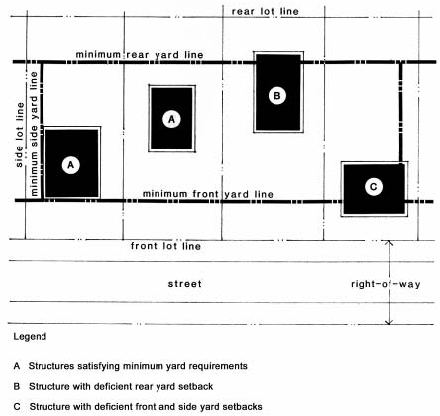
Figure 15. Yard Requirements
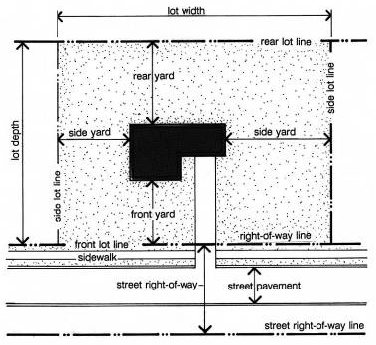
Figure 16. Open Space Terms
(Ord. No. 180/593, § 5, 8-8-2016; Ord. No. 182, § 9, 2-5-2018; Ord. No. 184, pt. 8, 12-2-2019; Ord. No. 190, § 8, 4-25-2022; Ord. No. 191, § 4, 9-26-2022; Ord. No. 195, § 3, 5-8-2023; Ord. No. 196, § 12, 6-19-2023; Ord. No. 201, § 1, 3-9-2026; Ord. No. 202, 4-27-2026)

