
Rose Township City Zoning Code
ARTICLE II
ADMINISTRATION AND ENFORCEMENT2
Cross reference— Administration, ch. 2.
DIVISION 2. - ZONING BOARD OF APPEALS[3]
Cross reference— Boards and commissions, § 2-101 et seq.
State Law reference— Zoning board of appeals, MCL 125.3601 et seq.
DIVISION 3. - SITE PLAN REVIEW[4]
Editor's note— Ord. No. 155, § 1, adopted Dec. 9, 2009, amended Div. 3 in its entirety to read as herein set out. Former Div. 3, §§ 38-110—38-115, pertained to similar subject matter, and derived from Ord. No. 151, §§ 16.01—16.06, adopted June 13, 2007.
State Law reference— Submission and approval of site plan, MCL 125.3501.
Sec. 38-35. - Enforcement.
The provisions of this chapter shall be administered and enforced by the building inspector and other officials as appointed by the township board.
(Ord. No. 151, § 21.01, 6-13-2007)
Sec. 38-36. - Duties of building inspector.
(a)
The official appointed by the township board shall have the power to grant zoning compliance permits. Building permits, occupancy permits and inspections of buildings or premises necessary to carry out the duties in the enforcement of this chapter shall be the duty of the building inspector. It shall be unlawful for the building inspector to approve any plans or issue any permits or certificates of occupancy for any excavation or construction until he has inspected such plans in detail and found them to conform to this chapter.
(b)
Under no circumstances is the building inspector permitted to make changes in this chapter or to vary the terms of this chapter in carrying out his duties as building inspector.
(c)
The building inspector shall not refuse to issue a permit when conditions imposed by this chapter are complied with by the applicant, despite violations of contracts, such as covenants or private agreements which may occur upon the granting of said permit.
(Ord. No. 151, § 21.02, 6-13-2007)
Sec. 38-37. - Application.
The building inspector shall require that all applications for building permits be accompanied by plans and specifications, including construction, manufacturing, assembly, setup or engineering plans of adequate detail to ensure compliance with the requirements of all applicable codes and requirements of this chapter, including the following:
(1)
The actual shape, location, and dimensions of the lot.
(2)
The shape, size, and location of all buildings or other structures to be erected, altered, or moved and of any building or other structures already on the lot.
(3)
The location and purpose of any easement for utilities, driveways, drainage or other purpose.
(4)
The existing and intended use of the lot and of all such structures upon it, including, in residential areas, the number of dwelling units the building is intended to accommodate.
(5)
Plans for drainage of existing and future surface waters during and after construction, including stormwater runoff to provide for safe on-site retention or off-site drainage which mitigates the impact on soil erosion and adjoining parcels and rights-of-way as well as natural features including lakes and streams.
(6)
Plans and provisions for a stable off-road (non-right-of-way) safe parking surface or driveway for vehicles and equipment during and after construction. Failure to supply adequate information as required in this section shall in the sole judgment of the building inspector be sufficient means to withhold issuance of a building permit.
(7)
If the building inspector deems it necessary that a survey is done by a professional surveyor or engineer for property at issue in order to ensure that all requirements of this chapter will be met, such survey and related information may be required by the building inspector and shall be paid for and provided by the property owner or applicant and no building permit or other township permit shall be issued or approved until and unless such survey and related information has been provided to the township.
(8)
Such other information concerning the lot or adjoining lots as may be essential for determining whether the provisions of this chapter are being observed.
(Ord. No. 151, § 21.03, 6-13-2007)
Sec. 38-38. - Building permits.
(a)
A building permit must be obtained for any construction subject to the state construction code and housing law prior to the building or structure being erected, altered, moved or repaired. The terms "altered" and "repaired" shall include any changes in structural parts, stairways, type of construction, type, class or kind of occupancy, light or ventilation, means of egress, and ingress, or other changes affecting or regulated by the state construction code, Michigan housing law (MCL 125.401 et seq.), or this chapter, except for minor repairs or changes not involving any of the aforesaid features. Construction plans for water mains, sanitary sewers, paving, storm drainage facilities and site grading, approved by the township engineer, shall also accompany an application for a building permit, when required by the township.
(b)
In addition to the state construction code requirements, an application for a building permit shall also be in conformity with this chapter and all of the following requirements shall be met:
(1)
The use shall be permitted within the zoning district.
(2)
For uses that require site plan or special land use approval from the planning commission, such approval shall be obtained prior to issuance of a zoning compliance permit and all site plan conditions complied with.
(3)
The lot shall conform to the requirements of the zoning district in which it is located and have been approved by the township through a land division, subdivision or site condominium or be a nonconforming lot of record that complies with the nonconforming lot provisions of article X of this chapter, pertaining to nonconforming lots, structures, and uses.
(4)
All structures shall comply with the dimensional requirements of the zoning district in which the lot is located.
(5)
Any single-family dwelling shall comply with section 38-402, pertaining to requirements for single-family homes.
(6)
All accessory structures shall comply with the requirements of article IV of this chapter, pertaining to supplemental regulations.
(7)
Any associated private road shall have final approval from the township board under the provisions of chapter 16, article IV, pertaining to road standards.
(8)
Copies of permits from the county health department shall be provided for any proposed well or sanitary drainfield.
(9)
Copies of permits from the road commission for the county shall be provided for any proposed driveway approach.
(10)
Applications involving nonconforming structures or lots shall be subject to compliance with article X of this chapter, pertaining to nonconforming lots, structures, and uses.
(c)
While certain structures do not require a building permit under the state construction code or a permit under this chapter, they shall still be required to comply with all requirements of this chapter, such as use, setbacks, height and yard location.
(Ord. No. 151, § 21.04, 6-13-2007)
Cross reference— Buildings and building regulations, ch. 8.
Sec. 38-39. - Certificates of occupancy.
No land, building, or part thereof, shall hereafter be occupied by, or for, any use unless and until a certificate of occupancy shall have been issued for such use. The following shall apply in the issuance of any certificates:
(1)
Vacant land. No land heretofore vacant shall hereafter be used or an existing use of land shall be hereafter changed to a use of a different class or type, unless a certificate of occupancy is first obtained for the new or different use.
(2)
Uses of different class or type. No building or structure, or part thereof, shall be changed to or occupied by a use of a different class or type, unless a certificate of occupancy is first obtained for the new or different use.
(3)
When not issued. No certificate of occupancy shall be issued for any building, structure, or part thereof, or for the use of any land which is not in accordance with all the provisions of this chapter.
(4)
Required. No building or structure, or parts thereof, which is hereafter erected or altered, shall be occupied or used or the same caused to be done, unless and until a certificate of occupancy shall have been issued for such building or structure. Where an addition is being added to an existing building, the restriction on occupancy shall only apply to the portion of the building being modified.
(5)
Certificates, including zoning. Certificates of occupancy as required by the state construction code for new buildings or structures, or parts thereof, or for alterations to or changes of use of existing buildings or structures, shall also constitute certificates of occupancy as required by this chapter.
(6)
Existing buildings, structures. Certificates of occupancy shall be issued for existing buildings, structures, or parts thereof, or existing uses of land if, after inspection, it is found that such buildings, structures, or parts thereof, or such use of land, are in conformity with the provisions of this chapter.
(7)
Records. A record of all certificates issued shall be kept on file in the office of the building inspector, and copies shall be furnished upon request to any person having a proprietary or tenancy interest in the property involved.
(8)
Accessory buildings, structures. Buildings or structures accessory to dwellings shall not require separate certificates of occupancy but may be included in the certificate of occupancy for the dwelling when shown on the plot plan and when completed at the same time as such dwelling.
(9)
Application. Application for certificates of occupancy shall be made in writing to the building inspector on forms furnished by him and such certificates shall be issued within five days after receipt of such application if it is found that the building or structures, or part thereof, or the use of land is in accordance with the provisions of this chapter. If such certificate is refused for cause, the applicant therefor shall be notified of such refusal and cause thereof, within the aforesaid five-day period.
(Ord. No. 151, § 21.05, 6-13-2007)
Sec. 38-40. - Final inspection.
The holder of every building permit for the construction, erection, alteration, repair or moving of any building, structure or part thereof, shall notify the building inspector immediately upon the completion of the work authorized by such permit, for a final inspection.
(Ord. No. 151, § 21.06, 6-13-2007)
Sec. 38-41. - Fees.
Fees for inspection and the issuance of permits or certificates or copies thereof required or issued under the provisions of this chapter must be collected by the township in advance of issuance. The amount of such fees shall be established by resolution of the township board and shall cover the cost of inspection and supervision resulting from enforcement of this chapter.
(Ord. No. 151, § 21.07, 6-13-2007)
Sec. 38-42. - Interpretation.
In the interpretation and application, the provisions of this chapter shall be held to be minimum requirements adopted for the promotion of the public health, morals, safety, comfort, convenience, or general welfare. It is not intended by this chapter to repeal, abrogate, annul or in any way to impair or interfere with any existing provision of law or ordinance other than this chapter, or with any rules, regulations or permits previously adopted or issued or which shall be adopted or issued pursuant to the law relating to the use of buildings or premises; provided, however, that where this chapter imposes a greater restriction than is required by existing ordinance or by rules, regulations or permits, the provisions of this chapter shall control.
(Ord. No. 151, § 21.08, 6-13-2007)
Sec. 38-43. - Planning commission approval.
In cases where the planning commission is empowered to approve certain uses of premises under the provisions of this chapter, the applicant shall furnish such surveys, plans or other information as may be reasonably required by said commission for the proper consideration of the matter. An application to the planning commission shall be accompanied by a fee. The amount of such fee shall be set by resolution of the township board and shall be paid to the township to defray the expense of reviewing the application and conducting any necessary public hearings. The planning commission shall investigate the circumstances of each such case and shall notify such parties, who may be affected thereby, as required by state law.
(Ord. No. 151, § 21.09, 6-13-2007)
Sec. 38-44. - Performance guarantee.
In the interest of ensuring compliance with this chapter and protecting the natural resources and the health, safety and welfare of the residents of the township and future users or inhabitants of an area for which a site plan for a proposed use has been submitted, the township board, planning commission or zoning board of appeals, as a condition of approval of the proposed use, may require the applicant to deposit a performance guarantee as set forth herein to ensure completion of improvements connected with the proposed use required by this chapter, including but not limited to roadways, lighting, utilities, sidewalks, drainage, fences, screens, walls, landscaping, and widening strips.
(1)
The term "performance guarantee," as used herein, shall mean a cash deposit or certified check in the amount of the estimated cost of the improvements to be made as determined by the applicant and confirmed and verified by a representative of the township.
(2)
Where the township requires a performance guarantee, said performance guarantee shall be deposited with the township prior to the issuance of a zoning compliance permit by the township for the development and use of the land. Upon the deposit of the performance guarantee, the township shall issue the appropriate building permit and the township clerk shall thereafter retain said deposit; however, if said deposit is in the form of cash or certified check, then it shall be transferred to the township treasurer for deposit in an interest-bearing account.
(3)
Where a performance guarantee is required by the planning commission as a condition of approval for a proposed use, the planning commission shall also prescribe the period of time within which the improvements for which the performance guarantee has been required are to be completed, said period to run from the date of the issuance of the building permit.
(4)
In the event the performance guarantee deposited is a cash deposit or certified check, the township shall rebate to the applicant amounts of money in reasonable proportions to the ratio of the work completed on the improvements by the applicant as confirmed by the township engineer, provided that a minimum of ten percent shall be held back on each element until satisfactory completion of the entire project. The township shall retain a portion of the guarantee after granting final approval to ensure final pavement wearing course is complete and that landscaping is established.
(5)
Upon the satisfactory completion, as determined by the township, of the improvement for which the performance guarantee was required, the clerk shall notify the treasurer of the township to return to the applicant the performance guarantee deposited. The township may retain up to ten percent to cover any administrative or consultant costs directly associated with review and inspection of the improvements.
(6)
In the event the applicant defaults in making the improvements for which the performance guarantee was required within the time period established by the township, the township shall have the right to use the performance guarantee deposited thereon to complete improvements through contract or otherwise, including specifically the right to enter upon the subject property to make the improvements.
(7)
In the event the applicant defaults in making the improvements and the performance guarantee is not sufficient to allow the township to complete the improvements for which it was posted, the applicant shall be required to pay to the township the amounts by which the costs of completing the improvements exceeds the amount of the performance guarantee deposited.
(Ord. No. 151, § 21.10, 6-13-2007)
State Law reference— Performance guarantee, MCL 125.3505.
Sec. 38-45. - Amendments and rezonings.
(a)
Procedure. The township board may from time to time, on recommendation from the planning commission, on its own motion, or on petition, amend, supplement or change this chapter in accordance with the procedure established by state law. Amendments to the provisions of this chapter (i.e., chapter text amendment) may be initiated by the township board, the planning commission or by petition from one or more residents or property owners of the township. An amendment to the official zoning map (i.e., rezoning) may be initiated by the township board, the planning commission or by the owner of the land that is the subject of the proposed amendment. All proposed amendments to the provisions of this chapter or the official zoning map shall be referred to the planning commission for public hearing and recommendation to the township board, prior to consideration thereof by the township board pursuant to the authority and procedure established in the Michigan zoning enabling act, Public Act No. 110 of 2006 (MCL 125.3101 et seq.).
(b)
Application. An amendment to this chapter text or the official zoning map shall be initiated by submission of a completed application on a form, including an application fee. The amount of the fee shall be set by resolution of the township board and shall be paid to the township to defray the expense of publishing the required notices of public hearings and the expenses of said public hearing. Amendments initiated by the township board or planning commission do not require an application or fee.
(c)
Rezoning. In the case of an amendment to the official zoning map, the application shall be accompanied by the following:
(1)
The name and address of the owner of the subject property, the signature of the owner on the application notarized or an affidavit notarized assigning authority to act on behalf of the owner or the applicant.
(2)
The street address of subject property if appropriate, the tax identification number and the nearest intersection.
(3)
A written response to subsection (e) of this section, pertaining to criteria for amendment of the official zoning map (rezoning). Said response should address all 12 criteria and address each one individually.
(4)
Existing and intended use of the property.
(5)
An aerial photograph of subject property with adjacent properties and an aerial photograph of subject property with Michigan Natural Features Inventory (MNFI) overlay, which may be obtained from the township.
(6)
A site analysis plan that includes all of the following information for the site and all adjacent parcels, which may be obtained from the township:
a.
Existing zoning;
b.
Master plan future land use designation;
c
Five-foot contours; and
d.
Names of all streets abutting the subject property.
(7)
An applicant for a rezoning may voluntarily offer certain conditions and limitations as part of the rezoning application (hereafter referred to as "zoning agreement"). The offer for a zoning agreement shall be submitted at the time the rezoning application is filed or in response to comments received at the public hearing. An election to file a rezoning with a zoning agreement shall be in writing and shall be pursuant to the Michigan zoning enabling act, Public Act No. 110 of 2006 (MCL 125.3101 et seq.), and subsection (e) of this section When necessary, the zoning agreement shall also include and incorporate, by reference, a conceptual site plan. This plan shall not replace the requirement for a site plan review and approval as outlined in article II, division 3 of this chapter, which shall be conducted following the township board's approval of the rezoning. The township may voluntarily accept the offer for a zoning agreement, but shall not be obligated to accept such offer. If the applicant offers conditions as part of the rezoning application, the applicant will be responsible for the costs incurred by the township in reviewing the offer and developing language for the zoning agreement.
(8)
The applicant may provide any additional information they feel would be of benefit in their rezoning request.
(d)
Public hearing and notice.
(1)
Upon submittal of a complete application for amendment to the township, the item shall be scheduled before the planning commission for a public hearing.
(2)
If an individual property or ten or fewer adjacent properties are proposed for rezoning, the township shall give a notice of the proposed rezoning in the same manner as required under section 38-46.
(3)
If eleven or more properties are proposed for rezoning, or if an amendment is proposed to the text of the ordinance, the township shall give a notice of the proposed rezoning in the same manner as required under section 38-46, except for the individual property notices required by section 38-46(2)b, and (2)c and except that no individual addresses of properties are required to be listed under section 38-46(1)b.
(4)
Where the applicant has offered a zoning agreement, the zoning agreement may be offered or amended in response to comments raised during the public hearing; provided that any amended or additional agreements are voluntarily offered by the applicant and they are in direct response to discussion at the public hearing. Should the petitioner offer substantial revisions to a zoning agreement or offer a new zoning agreement after the public hearing, the planning commission shall have the option to hold another public hearing on the zoning agreement if the planning commission determines that the new zoning agreement will have a significant effect on the conditions and ultimate use of the land. The petitioner shall be responsible for paying the cost of any additional public hearings.
(5)
Following the public hearing, the planning commission shall identify and evaluate factors relevant to the petition and the criteria in this article and shall make its recommendation to the township board. In the case of a rezoning, the application shall be forwarded to the county planning and economic development services for their review and recommendation, where the site borders another community.
(6)
A copy of the application, the planning commission's recommendation, minutes of the public hearing and the county's recommendation shall be provided to the township board to be placed on the agenda of the next regularly scheduled meeting of the township board to consider the proposed amendment.
(7)
The zoning agreement shall be reviewed by the township attorney prior to township board consideration of the rezoning application. The township attorney shall determine that the zoning agreement conforms to the requirements of subsection (e) of this section and the Michigan zoning enabling act, Public Act No. 110 of 2006 (MCL 125.3101 et seq.), and shall confirm that the zoning agreement is in a form acceptable for recording with the county register of deeds.
(8)
Following the submission of the planning commission recommendation, the township board may hold additional hearings if the township board considers it necessary. Pursuant to the Michigan zoning enabling act, Public Act No. 110 of 2006 (MCL 125.3101 et seq.), the township board may by majority vote of its membership:
a.
Adopt the proposed amendment, including any agreement provided for in subsection (d)(9) of this section;
b.
Reject the proposed amendment; or
c.
Refer the proposed amendment back to the planning commission for further recommendation. Thereafter, the township board may either adopt the amendment with or without the recommended revisions, or reject it.
(9)
If a zoning agreement has been offered by the applicant and recommended for approval by the planning commission, the township board may approve the zoning agreement if it meets all requirements of subsection (e) of this section. If an applicant proposes a zoning agreement after the planning commission has made a recommendation on the rezoning request, the township board shall first remand the application to the planning commission to hold another public hearing on the rezoning and proposed zoning agreement and resubmit a recommendation to the township board. The zoning agreement shall be incorporated by attachment or otherwise as an inseparable part of the ordinance adopted by the township board to accomplish the requested rezoning. All of the following shall apply to a rezoning that was approved along with a zoning agreement:
a.
The zoning classification of the rezoned property shall consist of the district to which the property has been rezoned, plus a reference to the zoning agreement. The zoning map shall specify the new district, plus a small letter "a" to indicate that the property is subject to a zoning agreement (i.e., R-1A-a).
b.
The township clerk shall maintain a listing of all properties subject to zoning agreements and shall provide copies of the agreements upon request. The approved zoning agreement shall be recorded by the applicant with the county register of deeds.
c.
Unless extended by the township board for good cause, the zoning agreement and associated rezoning shall expire two years after adoption of the rezoning and zoning agreement, unless substantial construction on the approved development of the property, pursuant to building and other required permits issued by the township commences within the two-year period and proceeds diligently towards completion.
d.
In the event that substantial construction on the approved development has not commenced within two years, the zoning agreement shall be void and of no effect.
e.
Notwithstanding the above, if the property owner applies in writing for an extension of the zoning agreement at least 50 days prior to the expiration date, the township board may, after recommendation by the planning commission, grant an extension of up to one year. No further extensions may be granted.
f.
Should the zoning agreement become void, all development on the subject property shall cease, and no further development shall be permitted. Until action satisfactory to the township is taken to bring the property into compliance with the zoning agreement, the township may withhold or, following notice to the applicant and being given an opportunity to be heard, revoke permits and certificates, in addition to or in lieu of any other lawful action to achieve compliance.
g.
If the rezoning and zoning agreement become void as outlined in this section, then the land shall revert back to its original zoning classification as set forth in section 405(2) of the Michigan zoning enabling act, Public Act No. 110 of 2006 (MCL 125.3405(2)). Such reversion shall be initiated by the township board with notice and hearing as required for rezonings by the Michigan zoning enabling act, Public Act No. 110 of 2006 (MCL 125.3101 et seq.) and this chapter.
h.
Any amendment to the zoning agreement following the original approval by the township board shall require a public hearing by the planning commission and a recommendation to the township board, in the same manner as was prescribed for the original rezoning.
(e)
Criteria for amendment of the official zoning map (rezoning). In considering any petition for an amendment to the official zoning map, the planning commission and township board shall consider the following criteria in making its findings, recommendations and decision:
(1)
Consistency with the goals, policies and future land use map of the township master plan. Change of zoning districts should be gradual and be based upon the township master plan. If conditions have changed since the master plan was adopted, the rezoning may be found to be consistent with recent development trends in the area.
(2)
Appropriate timing for the zoning change in consideration of any infrastructural improvements necessary to support the zoning.
(3)
Compatibility of the site's physical, geological, hydrological and other environmental features with all uses permitted in the proposed zoning district compared to uses permitted under current zoning.
(4)
Compatibility of all uses permitted in the proposed zoning district with surrounding uses and zoning in terms of land suitability, impacts on the environment, density, nature of use, traffic impacts, aesthetics, infrastructure and potential influence on property values compared to uses permitted under current zoning.
(5)
Capacity of the public infrastructure and services to accommodate all the uses permitted in the requested district without compromising the health, safety and welfare of the township.
(6)
Capacity of the street system to safely and efficiently accommodate the expected traffic generated by uses permitted in the requested zoning district.
(7)
Demonstrated demand for the types of uses permitted in the requested zoning district in the township, and surrounding area, in relation to the amount of land in the township, and surrounding area, currently zoned and available to accommodate the demand.
(8)
Ability of the site to meet the dimensional regulations for the requested zoning district.
(9)
The requested rezoning will not create an isolated and unplanned spot zone.
(10)
If a rezoning is appropriate, the requested zoning district shall be more appropriate from the township's perspective than another zoning district.
(11)
The request has not previously been submitted within the past one year, unless conditions have changed or new information has been provided.
(12)
Other criteria as determined by the planning commission or township board which would protect the health and safety of the public, protect public and private investment in the township, and enhance the overall quality of life in the township.
(f)
Zoning agreement. An applicant for a rezoning may voluntarily offer a zoning agreement along with an application for rezoning. An election to file a rezoning with a zoning agreement shall be pursuant to the Michigan zoning enabling act, Public Act No. 110 of 2006 (MCL 125.3101 et seq.), and this article. The conditions set forth in the zoning agreement must be voluntary and equally or more restrictive than the regulations that would otherwise apply under the proposed zoning district. The zoning agreement shall be a written agreement that is approved and executed by the applicant and the township and recorded with the county register of deeds. When necessary, the zoning agreement shall also include and incorporate, by reference, a site plan. This plan shall not replace the requirement for a site plan as outlined in division 3 of this article. The zoning agreement must be voluntarily offered by the applicant and the township shall not have the authority to require a petitioner for rezoning to offer such agreement and shall not have the authority to require modification to a zoning agreement without the consent of the petitioner; provided that the township shall not enter into a zoning agreement that is not found acceptable to the township board.
(1)
The zoning agreement may include limitations on the uses permitted on the property in question, specification of lower density or less intensity of development and use, or may impose more restrictive measures on the location, size, height, or other measure for buildings, structures, improvements, setbacks, landscaping, buffers, design, architecture and other features. The zoning agreement may not authorize uses or developments of greater intensity or density, or which are not permitted in the proposed zoning district; nor may a zoning agreement permit variances from height, area, setback or similar dimensional requirements that are less restrictive than the proposed zoning district. The zoning agreement may include conditions related to the use and development of the property that are necessary to:
a.
Serve the intended use of the property such as extension of or improvements to roadways, utilities or other infrastructure serving the site;
b.
Minimize the impact of the development on surrounding properties; and
c.
Preserve natural features, historic resources and open space.
(2)
Content of agreement. In addition to any limitations on use or development of the site, preservation of site features or improvements described in subsection (f)(1) of this section, the zoning agreement shall also include the following:
a.
Acknowledgement that the zoning agreement was proposed voluntarily by the applicant and that the township relied upon the agreement and may not grant the rezoning but for the terms spelled out in the zoning agreement.
b.
Acknowledgement that the zoning agreement and its terms and conditions are authorized by all applicable state and federal law and constitution, and that the zoning agreement is valid and was entered into on a voluntary basis.
c.
Agreement and understanding that the property shall only be developed and used in a manner that is consistent with the zoning agreement.
d.
Agreement and understanding that the approval of the rezoning and the zoning agreement shall be binding upon and inure to the benefit of the property owner and the township, and also their respective heirs, successors, assigns, receivers or transferees.
e.
Agreement and understanding that, if a rezoning with a zoning agreement becomes void in accordance with this section, that no further development shall take place and no permits shall be issued, unless and until a new zoning district classification for the property has been established.
f.
Agreement and understanding that no part of the zoning agreement shall permit any activity, use, or condition that would otherwise not be permitted in the new zoning district.
g.
A legal description of the land to which the agreement pertains.
h.
Any other provisions as are agreed upon by the parties.
(3)
Any uses proposed as part of a zoning agreement that would otherwise require approval of a special land use or site plan approval shall be subject to the applicable review and approval requirements of division 3 of this article and article IX of this chapter.
(4)
Nothing in the zoning agreement, nor any statement or other provision, shall prohibit the township from later rezoning all or any portion of the land that is the subject of the zoning agreement to another zoning classification. Any rezoning shall be conducted in compliance with this chapter and the Michigan zoning enabling act, Public Act No. 110 of 2006 (MCL 125.3101 et seq.).
(5)
Failure to comply with the zoning agreement at any time after approval will constitute a breach of the agreement and also a violation of this chapter, and further use of the property may be subject to legal remedies available to the township.
(Ord. No. 151, § 21.11, 6-13-2007)
Sec. 38-46. - Public hearings.
In instances where a public hearing is required under this chapter with the planning commission or the zoning board of appeals, written notice of the public hearing shall be as follows:
(1)
The notice shall do all of the following:
a.
Describe the nature of the request.
b.
Indicate the property that is the subject of the request. The notice shall include a listing of all existing street addresses within the property. Street addresses do not need to be created and listed if no such addresses currently exist within the property. If there are no street addresses, other means of identification may be used.
c.
State when and where the request will be considered.
d.
Indicate when and where written comments will be received concerning the request.
(2)
Notice shall be published and delivered not less than 15 days before the date of the public hearing, as follows:
a.
Notice of the request shall be published in a newspaper of general circulation in the township.
b.
Notice shall be sent by mail or personal delivery to the owners of property for which approval is being considered.
c.
Notice shall also be sent to all persons to whom real property is assessed within 300 feet of the property and to the occupants of all structures within 300 feet of the property regardless of whether the property or occupant is located in the zoning jurisdiction. If the name of the occupant is not known, the term "occupant" may be used in making notification under this subsection.
(3)
Public hearings for an amendment to the zoning chapter, or the zoning map that affects 11 or more properties shall only require notice in a newspaper, which shall not be required to indicate the property subject to the request under subsection (1)b of this section, and notice shall not be required to be mailed to individual properties under subsections (2)b and c of this section.
(4)
Public hearings for ordinance interpretations and appeals of administrative decisions by the zoning board of appeals shall only require notice in a newspaper, as required in subsection (2)a of this subsection and if the interpretation or appeal of an administrative decision involves a specific property, notice shall also be given to the person bringing the appeal, as required in subsection (2)b of this section.
(Ord. No. 151, § 21.12, 6-13-2007)
Sec. 38-47. - Violations.
Any person violating any of the provisions of this chapter shall be responsible for committing a municipal civil infraction and subject to the penalties set forth in chapter 18, article III, pertaining to municipal civil infraction.
(Ord. No. 151, § 21.13, 6-13-2007)
Sec. 38-48. - Public nuisance declared.
Any building or structure which is erected, altered or converted, or any use of premises of land which is begun or changed subsequent to the time of passage of the ordinance from which this chapter is derived and in violation of any of the provisions thereof is hereby declared to be a public nuisance per se, and may be abated by order of any court of competent jurisdiction.
(Ord. No. 151, § 21.14, 6-13-2007)
Sec. 38-49. - Fines, imprisonment.
The owner of any building, structure, or premises or part thereof where any condition in violation of this chapter shall exist or shall be created, and who assisted knowingly in the commission of such violation, shall be responsible for a separate offense and, upon conviction thereof, shall be liable to the sanctions herein provided.
(Ord. No. 151, § 21.15, 6-13-2007)
Sec. 38-50. - Each day a separate offense.
A separate offense shall be deemed committed upon each day during or when a violation occurs or continues.
(Ord. No. 151, § 21.16, 6-13-2007)
Sec. 38-51. - Rights and remedies are cumulative.
The rights and remedies provided herein are cumulative and in addition to any other remedies provided by law.
(Ord. No. 151, § 21.17, 6-13-2007)
Sec. 38-76. - Creation and membership.
(a)
Established; membership. There is hereby established a zoning board of appeals, which shall perform its duties and exercise its powers as provided in the Michigan zoning enabling act, Public Act No. 110 of 2006 (MCL 125.3101 et seq.), and in such way that the objectives of this chapter shall be observed, public safety and welfare secured and substantial justice done. The membership of the board of appeals shall be in accordance with the requirements of Public Act No. 110 of 2006 (MCL 125.3101 et seq.). The total number of board members shall be five. The first regular member of the zoning board of appeals shall be a member of the planning commission. The remaining members shall be selected from the electors of the township. The members selected shall be representative of the population distribution and of the various interests present in the township. One regular member may be a member of the township board. An elected officer of the township shall not serve as chairperson of the zoning board of appeals. An employee or contractor of the township board may not serve as a member of the zoning board of appeals.
(b)
Alternate members. The township board may appoint not more than two alternate members for the same term as regular members to the zoning board of appeals. The alternate members may be called upon as specified herein to sit as regular members of the zoning board of appeals in the absence of a regular member if a regular member is absent from or unable to attend two or more consecutive meetings of the zoning board of appeals for a period of more than 30 consecutive days. An alternate member may also be called to serve in the place of a regular member for the purpose of reaching a decision on a case in which the regular member has abstained for reasons of conflict of interest. The alternate having been appointed shall serve in the case until a final decision has been made. The alternate member shall have the same voting rights as a regular member of the zoning board of appeals.
(c)
Terms. Terms shall be for three years, except for members serving because of their membership on the planning commission, or township board, whose terms shall be limited to the time they are members of the planning commission, or township board, respectively, and the period stated in the resolution appointing them. A successor shall be appointed not more than one month after the term of the preceding member has expired. Vacancies for unexpired terms shall be filled for the remainder of the term.
(Ord. No. 151, § 22.01, 6-13-2007)
Sec. 38-77. - Meetings.
All meetings of the zoning board of appeals shall be held at the call of the chairman and at such times as such zoning board of appeals may determine. All meetings conducted by the zoning board of appeals shall be open to the public. The zoning board of appeals shall keep minutes of its proceedings showing the vote of each member upon each question, or if absent, or failing to vote, indicating such fact; and shall also keep records of its hearing and other official action. The zoning board of appeals shall have the power to subpoena and require the attendance of witnesses, administer oaths, compel testimony and the production of books, papers, files, and other evidence pertinent to the matters before it.
(Ord. No. 151, § 22.02, 6-13-2007)
Sec. 38-78. - Appeal.
(a)
Procedure. An appeal may be taken to the zoning board of appeals by any person or by any officer, department, board or bureau affected by the requirements of this chapter or a decision of the building inspector, zoning administrator or other official, or board charged with the administering of this chapter. An appeal from any decision or action shall be filed not later than 30 calendar days after the decision or action being appealed has been taken. Where an appeal has been filed, the zoning administrator shall transmit to the zoning board of appeals all of the papers constituting the record upon which the action appealed from was taken. An appeal shall stay all proceedings in furtherance of the action appealed from unless the building inspector certifies to the zoning board of appeals after notice of appeal has been filed with him that by reason of facts stated in the certificates a stay would, in his opinion, cause imminent peril to life or property, in which case the proceedings shall not be stayed, otherwise than by a restraining order, which may be granted by a court of record. The zoning board of appeals shall select a reasonable time and place for the consideration of the appeal and give due notice thereof to the parties and shall render a decision on the appeal without unreasonable delay. Any person may appeal and testify before the zoning board of appeals, either in person or by duly authorized agent or attorney.
(b)
Fee. A fee shall be paid to the township at the time the notice of appeal is filed. The fees to be charged for appeals shall be set by resolution of the township board.
(Ord. No. 151, § 22.03, 6-13-2007)
Sec. 38-79. - Notice.
Prior to the zoning board of appeals making a decision in a specific case, the zoning board of appeals shall conduct a hearing. Written notice of the public hearing shall be in accordance with section 38-46.
(Ord. No. 151, § 22.04, 6-13-2007)
Sec. 38-80. - Powers, duties and authority.
The zoning board of appeals shall have the following powers:
(1)
Hearing and deciding. To hear and decide on all matters referred to it upon which it is required to pass under this chapter.
(2)
Appeals. To hear and decide appeals where it is alleged there is error of law in any order, requirement, decision or determination made by the building inspector, zoning administrator, or the planning commission in the enforcement of this chapter. In exercising this power, the zoning board of appeals may reverse or affirm wholly or partly, or may modify the order, requirement, decision or determination appealed from and may make such order, requirement, decision or determination as ought to be made, and to that end shall have all the powers of the official or board from whom the appeal is taken. The zoning board of appeals may reverse an order of an administrative official or the planning commission only if it finds that the action or decision appealed meets one or more of the following requirements:
a.
Was arbitrary or capricious.
b.
Was based on an erroneous finding of a material fact.
c.
Constituted an abuse of discretion.
d.
Was based on erroneous interpretation of this chapter or zoning law.
(3)
Dimensional variances. Where, owing to special conditions, a literal enforcement of the provisions of this chapter would involve practical difficulties, within the meaning of this chapter, the zoning board of appeals shall have power to authorize such variation or modification of the provisions of this chapter with such conditions and safeguards as it may determine, as may be in harmony with the spirit of this chapter and so that public safety and welfare be secured and substantial justice done. No such variance or modification of the provisions of this chapter shall be granted unless reasonable evidence on the record indicates all the following facts and conditions exist:
a.
Compliance with the strict letter of the restrictions governing area, setbacks, frontage, height, bulk, density, or other dimensional provisions would create a practical difficulty and unreasonably prevent the use of the property.
b.
There are exceptional or extraordinary circumstances or conditions applicable to the property involved or to the intended use of the property that do not apply generally to other properties or class of uses in the same district or zone.
c.
Such variance is necessary for the preservation and enjoyment of a substantial property right possessed by other property in the same zone and vicinity.
d.
The granting of such variance or modification will not be materially detrimental to the public welfare or materially injurious to the property or improvements in such zone or district in which the property is located.
e.
The granting of such variance will not adversely affect the purpose or objectives of the master plan of the township.
(4)
Use variances not permitted. The zoning board of appeals shall not have the power to permit any use in a district in which it is not permitted.
(5)
Interpretations. The zoning board of appeals has the authority to:
a.
Interpret the location of district boundaries on the zoning map where said boundaries are unclear due to scale or legibility of the zoning map.
b.
Interpret the provisions of the chapter in such a way as to carry out the intent and purpose of the plan, as shown upon the zoning map fixing the use districts, accompanying and made part of this chapter, where street layout actually on the ground varies from the street layout as shown on the map aforesaid.
c.
Determine which zoning district permits a use not specifically addressed in any zoning district.
(6)
Temporary permits. The zoning board of appeals shall have the authority to permit temporary uses not otherwise permitted in any district, not to exceed 12 months with the granting of 12-month extensions being permissible, and uses which do not require the erection of any capital improvement of a structural nature. The zoning board of appeals in granting permits for the above temporary uses, shall do so as near as possible to the following conditions:
a.
The granting of the temporary use shall in no way constitute a change in the basic uses permitted in the district nor on the property wherein the temporary use is permitted. The use shall not be a temporary use permitted by right and not a special land use, which would require planning commission approval.
b.
The granting of the temporary use shall be granted in writing, stipulating all conditions as to time, nature of development permitted and arrangements for removing the use at the termination of said temporary permit.
c.
All setbacks, land coverage, off-street parking, lighting and other requirements to be considered in protecting the public health, safety, peace, morals, comfort, convenience and general welfare of the inhabitants of the township, shall be made at the discretion of the zoning board of appeals.
d.
In classifying uses as not requiring capital improvements, the zoning board of appeals shall determine that they are either de-mountable structures related to the permitted use of the land; recreation developments such as, but not limited to, golf-driving ranges, and outdoor archery courts, or structures which do not require foundations, heating systems or sanitary connections.
e.
The use shall be in harmony with the general character of the district.
f.
No temporary use permit shall be granted without first giving notice to owners of adjacent property of the time and place of a public hearing to be held as further provided for in section 38-79.
(7)
Conditions. In consideration of all appeals and all proposed variations to this chapter, the zoning board of appeals shall, before making any variations from this chapter in a specific case, first determine that the proposed variation will not impair an adequate supply of light and air to adjacent property, or unreasonably diminish or impair established property values within the surrounding area, or in any other respect impair the public health, safety, comfort, morals or welfare of the inhabitants of the township. The concurring vote of a majority of the zoning board of appeals shall be necessary to reverse any order, requirement, decision, or determination of the building inspector, or to decide in favor of the applicant any matter upon which it is authorized by this chapter to render a decision.
a.
The zoning board of appeals may attach conditions to the granting of all variances allowed under this section.
b.
The requirements of section 38-582 shall apply to all conditions imposed by the zoning board of appeals under this section.
(Ord. No. 151, § 22.05, 6-13-2007)
Sec. 38-81. - Limitation on powers.
(a)
The zoning board of appeals may grant dimensional or other site plan related variances for special land uses; however, the zoning board of appeals shall not have the power to reverse or modify the planning commission's decision to approve or deny a special land use permit, nor grant variances to any conditions placed on special land use approval.
(b)
The zoning board of appeals shall not have the authority to reverse the decision of the township board on a PUD site plan, change any conditions placed by the planning commission, or township board or grant variances to the PUD regulations. The zoning board of appeals shall have the authority to hear and decide appeal requests by individual lot owners for variances following final approval of the PUD, provided the variance does not impact any required common open space or natural area shown on the PUD site plan or violate any of the requirements of the PUD regulations.
(c)
The zoning board of appeals shall not have the power to permit any use in a district in which it is not permitted.
(d)
Nothing herein contained shall be construed to give or grant to the zoning board of appeals the power of authority to alter or change this chapter or the official zoning map, such power and authority being reserved to the township board in the manner hereinafter provided by law.
(Ord. No. 151, § 22.06, 6-13-2007)
Sec. 38-82. - Official record; findings of fact.
Minutes shall be kept of each meeting. The zoning board of appeals shall record into the minutes all relevant findings, conditions, facts and other relevant factors, including the vote of each member upon each question, or if absent or failing to vote, and all of its official actions. To this end the zoning board of appeals shall prepare an official record for all appeals and shall base its decision on this record. The official record shall, at a minimum, include the following items:
(1)
The relevant administrative records and orders issued relating to the appeal.
(2)
The notice of the appeal.
(3)
Such documents, exhibits, photographs or written reports as may be submitted to the zoning board of appeals for its consideration.
(4)
The findings of the zoning board of appeals, stating the facts of the appeal, the decision, any conditions of the decision and the reasons for reaching such a decision.
(Ord. No. 151, § 22.07, 6-13-2007)
Sec. 38-83. - Validity of orders; reapplication.
(a)
No order of the zoning board of appeals permitting the erection or alteration of a building shall be valid for a period longer than one year, unless a building permit for such erection or alteration is started and proceeds to completion in accordance with the terms of such permit.
(b)
No order of the zoning board of appeals permitting a use of a building or premises shall be valid for a period longer than one year, unless such use is established within such period; provided, however, that where such use permitted is dependent upon the erection or alteration of a building permit for said erection or alteration is obtained within such period and such erection or alteration is started and proceeds to completion in accordance with the terms of such permit.
(c)
When any application made under the provisions of this chapter shall have been denied by the zoning board of appeals, not less than one year must intervene before a new application of the same tenor, and relating to the same property or proposed use, may be accepted or acted upon by the building inspector, zoning administrator or by any other township employee or authority, unless a positive finding is made by the building inspector that the facts of the case have substantially changed since its previous consideration.
(d)
The decision of the zoning board of appeals shall be final. Appeals from decisions of the zoning board of appeals shall be to the circuit court, as provided by law, and shall be filed within 45 days of approval of the official minutes of the zoning board of appeals.
(Ord. No. 151, § 22.08, 6-13-2007)
Sec. 38-110. - Intent.
The site plan review procedures and standards set forth herein provide a consistent and uniform method for review of proposed development plans, to ensure full compliance with the standards contained in this chapter, other applicable local ordinances, standard engineering practices, and state and federal laws. The procedures set forth herein are further intended to:
(1)
Achieve efficient use of the land;
(2)
Protect natural resources both on the site and in the vicinity of the site, including priority resource protection areas as identified by Rose Township and the Shiawassee and Huron Headwaters Resource Preservation Project;
(3)
Minimize adverse impacts on adjoining or nearby properties;
(4)
Provide a mechanism for review of new development as well as redevelopment of existing sites and, to bring existing development into compliance with current standards; and,
(5)
Encourage cooperation and consultation between the township and the applicant to facilitate development in accordance with the township's land use objectives.
(Ord. No. 155, § 1, 12-9-2009)
Sec. 38-111. - Scope of application.
Site plan review and approval shall be required for the following list of proposed types of construction or improvement. The level of approval varies between the township board (TB), planning commission (PC) and administrative (Admin) approval depending upon the extent of construction proposed. Site plans shall include all detailed engineering drawings. Sketch plans are less detailed. Items that are exempt from site/sketch plan approval still require a land use permit. All construction or building modification is subject to building permit requirements.
Key:
Admin = Administrative approval
PC = Planning commission approval
TB = Township board approval based upon PC recommendation
(Ord. No. 155, § 1, 12-9-2009)
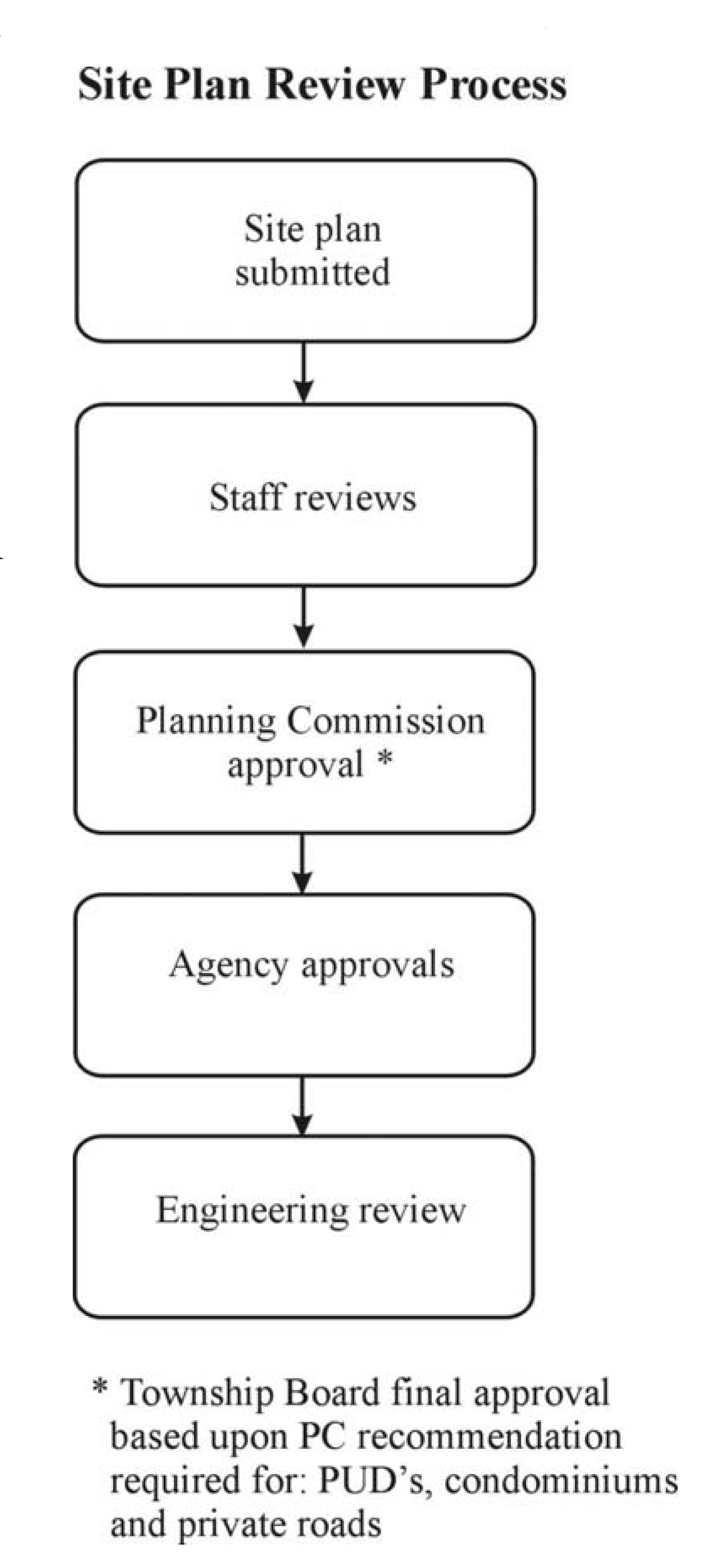
Sec. 38-112. - Site plan and sketch plan review procedures and requirements.
Site plans and sketch plans must be submitted in accordance with the following procedures and requirements:
(1)
Applicant attendance: The application shall be submitted by the owner of an interest in the land for which site plan or sketch plan approval is sought, or the designated agent of said owner, provided in writing. The applicant or a designated representative must be present at all scheduled review meetings or consideration of the plan shall be tabled due to lack of representation.
The township zoning administrator shall determine whether the application is required to include a site plan or a sketch plan.
(2)
Site plan submittal: The applicant shall submit ten copies of the following to the township. The application shall not be placed on the planning commission agenda until all application materials are complete.
a.
A complete application form supplied by the township;
b.
A written description of the proposed project or use;
c.
A complete site plan or sketch plan that includes the information listed in section 38-113.
(3)
Technical (staff) reviews: The application and site plan(s) or sketch plan shall be forwarded to the township planner, township engineer and fire department serving Rose Township for review. The petitioner may submit revised plans in response to technical reviews, which shall be re-reviewed prior to the planning commission meeting.
(4)
Planning commission consideration: Once the site plan or sketch plan has been reviewed and determined to be complete, it shall be placed on the agenda of the planning commission. Incomplete or deficient submittals shall not be placed on a planning commission agenda. The planning commission shall not consider material that has not been submitted for review by the township staff, planner and engineer. The planning commission shall review the application for site plan or sketch plan review, together with the reports and recommendations from the township staff, planner, engineer, fire department serving Rose Township, and other reviewing agencies, as appropriate. The planning commission is authorized to table, grant approval, approval subject to revisions, or denial as follows:
a.
Table: The application may be tabled if it is determined to be incomplete, the applicant has not fully responded to deficiencies identified in the review, an ordinance interpretation or variance is needed from the zoning board of appeals, or that revisions are necessary to bring the site plan or sketch plan into compliance with applicable standards and regulations. The planning commission shall direct the applicant to prepare additional information or revise the site plan or sketch plan. The applicant shall be required to prepare revised plans accompanied by a complete list of all changes, and revised site plans must be certified by the applicant's design professional. Amended plans or other material that show a diligent effort to address all reasons for tabling shall be placed on the agenda of the planning commission for further review and action.
b.
Approval: Upon determination that a site plan or sketch plan is in compliance with the standards of section 38-114 and requirements of this division and other applicable ordinances and laws, approval shall be granted.
c.
Approval subject to conditions: Upon determination that a site plan or sketch plan is in compliance except for minor revisions, said revisions shall be identified and the applicant shall be given the opportunity to correct the plan prior to applying for a building permit. The applicant shall re-submit the revised plan, accompanied by a complete list of all changes, and revised site plans must be certified by the applicant's design professional, for final approval by township staff, engineer and planning consultants.
d.
Denial: Upon determination that a plan does not comply with the standards of section 38-114 and requirements of this division or the applicant has not satisfactorily addressed all reasons for plan tabling, site plan approval shall be denied. The applicant must revise the plans and submit a new application if the applicant is still interested in pursuing the project. A re-submittal shall be considered a new site plan or sketch plan and be required to re-initiate the full plan review process. Any person aggrieved by the decision of the planning commission in denial of a site plan shall have the right to appeal the decision to the zoning board of appeals.
(5)
Agency approvals: The applicant shall be required to obtain all other necessary agency permits from the Michigan Department of Environmental Quality, the Road Commission for Oakland County, the Oakland County Drain Commission and the Oakland County Health Department. The planning commission may approve a site plan or sketch plan conditioned on obtaining necessary permits.
(6)
Township board approval: For projects that require township board approval, the planning commission shall recommend approval, approval subject to changes or denial to the township board. Where the site plan is recommended for approval subject to changes, the changes shall be made to the site plan and seven copies of the revised site plan shall be submitted to the township prior to being placed on the agenda for a township board meeting. The township board shall then grant approval or denial based upon the recommendation of the planning commission, the standards of section 38-114 and the requirements of this division.
(7)
Recording of site plan review action: Each action taken with reference to a site plan or sketch plan review shall be duly recorded in the minutes of the planning commission's meeting, and the township board where applicable. The grounds for action taken upon each plan shall also be recorded in the minutes. After action has been taken, copies of the application and plans, signed by the secretary of the planning commission or designee, shall be maintained on file at the township, with a copy provided to the applicant.
(8)
Engineering review: Following planning commission approval of a site plan or sketch plan if applicable, the township engineer shall make a full review of the engineering plans. A building permit shall not be issued until the township engineer issues final approval of the engineering plans. Approval shall only be granted upon determination that the engineering plans comply with township engineering standards and are consistent with the site plan approved by the planning commission. If the township engineer determines that the engineering plans do not comply with township engineering standards and would require revision to the extent that the basic site plan configuration approved by the planning commission would be altered, the applicant shall be required to revise the site plan and engineering plans and resubmit the site plan or sketch plan to the planning commission for review and approval as an amended plan.
(9)
Completion of site design:
a.
Following final approval of the site plan or sketch plan and final approval of the engineering plans by the township engineer and building official, a building permit may be obtained. It shall be the responsibility of the applicant to obtain all other applicable county, or state permits prior to issuance of a building permit.
b.
If construction has not commenced within one year of site plan or sketch plan approval, approval becomes null and void and a new application for site plan or sketch plan review shall be required. The applicant may request a one-year extension by the planning commission or board as applicable, provided a written request is received before the expiration date and the site plan complies with current standards (i.e. any amendments to the zoning chapter since the site plan was approved).
c.
It shall be the responsibility of the owner of a property for which site plan or sketch plan approval has been granted to maintain the property in accordance with the approved site design on a continuing basis until the property is razed, or until new zoning regulations supersede the regulations upon which site approval was based, or until a new site design approval is sought. Any property owner who fails to maintain an approved site design shall be deemed in violation of the applicable use provisions of this chapter and shall be subject to penalties.
d.
Minor changes to the approved final site plan or sketch plan may be approved by the zoning administrator without requiring a resubmittal to the planning commission or township board, as applicable, provided that the applicant or property owner notifies the zoning administrator of any proposed amendment to such approved site plan or sketch plan prior to making said change on the site and the zoning administrator determines the proposed minor revision does not alter the basic design, compliance with the standards of approval, nor any specified conditions of the approved site plan and does not impact any natural feature that was proposed to be preserved. Where the modifications are not determined to be minor, then the plan shall require resubmittal to the planning commission or township board, as applicable, for approval as a site plan or sketch plan amendment.
The zoning administrator may consider the following to be minor changes:
1.
Change in size of residential buildings containing three or more dwelling units by up to five percent, provided that the overall density of units does not increase.
2.
Change in square footage of non-residential buildings by up to five percent or 1,000 square feet, whichever is smaller.
3.
Movement of a building or buildings by no more than ten feet.
4.
Replacement of plantings approved in the site plan landscape plan by similar types and sizes of landscaping which provides a similar effect on a one-to-one (1:1) or greater basis.
5.
Changes of building materials to another of higher quality, as determined by the zoning administrator.
6.
Changes in floor plans which do not alter the character of the use.
7.
Slight modification of sign placement or reduction of size.
8.
Relocation of sidewalks and/or refuse storage stations.
9.
Internal rearrangement of parking lot which does not change the number of parking spaces by more than five percent or alter access locations or design.
10.
Changes required or requested by the township for safety reasons.
(Ord. No. 155, § 1, 12-9-2009)
Sec. 38-113. - Submittal requirements.
The following data shall be included with and as part of the site plan(s) or sketch plan(s) submitted for review. At the discretion and direction of the zoning administrator, certain data may not be required for any building, structure or use that is determined to have limited potential to create impacts, because of factors or characteristics such as: size, intended use and location relative to neighboring properties. Where any of the following data is not provided, the applicant shall advise the planning commission on the reasons for not requiring certain data to be provided.
(Ord. No. 155, § 1, 12-9-2009)
Sec. 38-114. - Standards for site plan or sketch plan approval.
(a)
Approval conditional on compliance. Site plan or sketch plan approval shall be granted only if the site plan or sketch plan meets all applicable standards set forth in this division as outlined below:
(1)
Adequacy of information: The site plan or sketch plan shall include all required information in sufficiently complete and understandable form to provide an accurate description of the proposed use(s) and structure(s).
(2)
Site design characteristics: All elements of the site design shall be harmoniously and efficiently organized in relation to topography, the size and type of lot, the character of adjoining property, and the type and size of buildings. The site shall be developed so as not to impede the normal and orderly development or improvement of surrounding property for uses permitted by this chapter. The site shall be designed to conform to all provisions of the zoning ordinance. Redevelopment of existing sites shall be brought into conformance with all site improvement provisions of the zoning ordinance which are relative to and proportionate to the extent of redevelopment, as determine by the planning commission.
(b)
Project design. Projects shall be designed to complement the visual context of the natural area. Techniques such as architectural design, site design, the use of native landscaping, and choice of colors and building materials shall be utilized in such manner that scenic views across or through the site are protected, and manmade facilities are screened from off-site observers and blend with the natural visual character of the area. Landscape plans for proposed developments shall incorporate native plant materials to create native landscapes. Signage may be incorporated to identify protected natural areas, wildlife movement corridors, buffer strips and waterways. Signs must be designed to meet township standards and be constructed of natural materials to be compatible with the rural character of the site.
(1)
Buildings: Buildings and structures will meet or exceed setback standards, height and other dimensional standards, and be placed to preserve environmentally sensitive areas. Redevelopment of existing structures shall meet or exceed all standards for which a variance has not been obtained. Building architecture shall comply with the standards of article 13.
(2)
Preservation of natural areas: The landscape shall be preserved in its natural state, insofar as practicable, by minimizing tree and soil removal, alteration to the natural drainage courses, and the amount of cutting, filling and grading. Insofar as practical, natural features and the site topography shall be incorporated into the proposed site design.
a.
Protective fencing: Prior to any development or site clearing, barrier fencing shall be installed at the limits of soil disturbance adjacent to priority protection areas identified in the Michigan Natural Features Inventory. Barrier fencing shall be a minimum of four feet in height and shall remain in place in good condition until the township authorizes the developer to remove the fencing. No filling, excavating or storage of materials, debris or equipment shall take place within the fenced area, except where permitted by the planning commission.
b.
Connections: If the development site contains high quality natural areas that connect to other off-site areas of a similar nature, the development plan shall preserve such connections. Such connections shall be maintained to allow for the continuance of existing wildlife movement between natural areas and to enhance the opportunity for the establishment of new connections between areas for the movement of wildlife. Breaks or gaps in wildlife movement corridors should be minimized and when possible re-established using appropriate native vegetation.
c.
Lakes, ponds and streams: If the development site contains a lake, pond or stream, the development plan shall include such enhancements and restoration as are necessary to provide wildlife habitat and improve aesthetic quality in areas of shoreline transition and areas subject to wave or stream-bank erosion. The development plan shall also include a design that requires uniform and ecologically and aesthetically compatible treatment among the lots or tracts surrounding a lake, reservoir, pond or stream with regard to the establishment of erosion control protection and shoreline landscaping on or adjacent to such lots or tracts.
(3)
Privacy: The site design shall provide reasonable visual and sound privacy for dwelling units located therein and adjacent thereto. Fences, walks, barriers, and landscaping shall be used, as appropriate, for the protection and enhancement of property and the privacy of its occupants.
(4)
Emergency vehicle access: All buildings or groups of buildings shall be arranged so as to permit emergency vehicle access by some practicable means to all vehicles. The fire service features required by section 13.08 shall be provided.
(5)
Ingress and egress: Every structure or dwelling unit shall be provided with adequate means of ingress and egress via public streets in accordance with section 12.12 and standards of the Road Commission for Oakland County. Safe and efficient traffic access to the site shall be provided in a manner that does not conflict with existing or future access to adjacent property.
(6)
Vehicular and pedestrian circulation layout: The arrangement of public or common ways for vehicular and pedestrian circulation shall respect the pattern of existing or planned streets and pedestrian or bicycle pathways in the area. The width of streets and drives shall be appropriate for the volume of traffic they will carry. The pedestrian circulation system shall be insulated as completely as is reasonably possible from the vehicular circulation system
(7)
Drainage and soil erosion control: All stormwater drainage and erosion control plans shall meet all generally accepted best management practices as reviewed and approved by the Township Engineer for design and construction.
Stormwater management system and facilities shall preserve the natural drainage characteristics and enhance the aesthetics of the site to the maximum extent possible and shall not substantially reduce or increase the natural retention or storage capacity of any wetland, water body, or water course, or cause alterations which could increase flooding or water pollution on or off the site. Where feasible, nonstructural control techniques shall be utilized, including but not limited to:
a.
Limitation of land disturbance and grading;
b.
Maintenance of vegetated buffers and natural vegetation;
c.
Minimization of impervious surfaces;
d.
Use of terraces, contoured landscapes, runoff spreaders, grass or rock-lined swales; and,
e.
Use of infiltration devices.
(8)
Exterior lighting: Exterior lighting shall be designed so that it is deflected away from adjacent properties and so that it does not impede the vision of drivers on public streets. Lighting shall be directed downward and confined to the site to minimize impact on the night sky.
(9)
Public services: The scale and design of the proposed development shall facilitate the adequate provision of services currently furnished by or that may be required of the township or other public agency including, but not limited to, fire and police protection, stormwater management, utilities, traffic control and administrative services.
(10)
Traffic impact: The expected volume of traffic to be generated by the proposed use shall not adversely impact the capacity or safety of existing roads. The site plan or sketch plan complies with the thoroughfare plan contained in the master plan.
(11)
Hazardous materials: Sites which include storage of hazardous materials or waste, fuels, or chemicals shall be designed to prevent spills and discharges of polluting materials to the surface of the ground, groundwater or nearby surface water bodies. Such sites shall be designed to meet all applicable state and federal regulations and shall be approved by the fire department that serves the township.
(Ord. No. 155, § 1, 12-9-2009)
Sec. 38-115. - Residential developments.
(a)
Where a private road or new public road is proposed in conjunction with a residential development, through land division, subdivision or condominium, the township shall consider the overall development with the review of the site plan for the road. The site plan for the road shall meet all requirements of chapter 16, article IV, pertaining to road standards, and all lots proposed in conjunction with the road shall meet all applicable requirements of this chapter. The township shall also consider other site improvements that are associated with the road and development of the overall site, including tree removal, grading and drainage. The township may attach conditions to the approval of the road site plan related to development of the overall site to ensure compliance with the requirements of this chapter and minimize impact of the proposed development on wetlands, woodlands, topography, vulnerable aquifers, threatened or endangered flora, or fauna, surface water, drainage or other environmental concerns.
(b)
Approval of the site plan for the road shall not be construed to have the effect of approving the proposed lots, which shall instead be subject to final approval under chapter 16, pertaining to land division and subdivision or the condominium regulations of article VIII of this chapter, as applicable. Lots shall not be considered accessible until the road is constructed and receives final approved from the township or is accepted by the road commission, in accordance with chapter 16, article IV, pertaining to road standards.
(Ord. No. 155, § 1, 12-9-2009)
Sec. 38-116. - Hazardous waste sites.
Any proposed land disturbance adjacent to or part of a confirmed, suspected or discovered during environmental due diligence of hazardous waste site shall:
(1)
Provide an indication of the construction type and method to insure that action will not create/disturb existing hazardous waste.
(2)
Including a plan for disposal of any contaminates found on site and process for handling said materials within pertinent local, state, and national standards.
(3)
Prepare an environmental review/site assessment report prepared by a recognized professional environmental firm showing that the location of the construction will not adversely affect the site or surrounding areas.
(4)
Document any approvals or clearances required for the action to be taken on or near any hazardous waste site.
(5)
Provide safeguards for soil erosion on site in regards to containing hazardous waste to location.
(Ord. No. 170, 2-14-2018)

