
Rose Township City Zoning Code
ARTICLE V
- DEVELOPMENTAL REGULATIONS
Sec. 38-440.- Off-street parking—Requirements.
There shall be provided in all districts at the time of erection or enlargement of any main building or structure, automobile off-street parking space with adequate access to all spaces. The number of off-street parking spaces, in conjunction with all land or buildings uses, shall be provided prior to the issuance of a certificate of occupancy as hereinafter prescribed.
(1)
Off-street parking may be located within any nonrequired yard and within the rear yard setback, unless otherwise provided in this chapter. Off-street parking shall not be permitted in a required front or side yard setback, unless otherwise provided in this chapter.
(2)
Off-street parking for other than residential use shall be either on the same lot or within 300 feet of the building it is intended to serve, measured from the nearest point of the building to the nearest point of the off-street parking lot. Ownership shall be shown of all lots or parcels intended for use as parking by the applicant.
(3)
Residential off-street parking shall consist of a parking strip, parking bay, driveway, garage, or combination thereof and shall be located on the premises it is intended to serve. Detached garages shall be subject to the requirements of section 38-397.
(4)
Any area once designated as required off-street parking shall never be changed to any other use unless and until equal facilities are provided elsewhere.
(5)
Off-street parking existing at the effective date of the ordinance from which this chapter is derived, in connection with the operation of an existing building or use, shall not be reduced to an amount less than hereinafter required for a similar new building or new use.
(6)
Two or more buildings or uses may collectively provide the required off-street parking, in which case the required number of parking spaces shall not be less than the sum of the requirements for the individual uses computed separately, unless otherwise approved by the planning commission. The planning commission may reduce the parking requirements based upon a finding that there will be a lower demand for parking due to shared parking by multiple uses where there will be a high proportion of multipurpose visits or uses have peak parking demands during differing times of the day or days of the week. If shared parking is approved pedestrian and vehicular connections shall be maintained between the lots and shared parking agreements shall be filed with the county register of deeds and the township.
(7)
Where an applicant demonstrates the parking requirements for a proposed use would be excessive, the planning commission may defer some of the parking, provided the site plan designates portions of the site for future construction of the required parking spaces. Areas reserved for future parking shall be maintained in a landscaped appearance and not used for building area, storage, or other accessory use. The deferred parking shall be required to meet chapter requirements, if constructed, and may not occupy required greenbelts. Construction of the deferred parking area to add parking spaces may be initiated by the owner or required by the township, based on parking needs or observation, and shall require administrative approval of an amended site plan. A performance guarantee meeting the requirements of section 38-44 shall be provided to the township prior to issuance of a building permit for the cost of constructing the deferred parking. The performance guarantee shall be refunded to the applicant one year following issuance of a certificate of occupancy if the township determines that the deferred parking is not required or upon construction of the parking lot if the township determines within the first year that the deferred parking is needed.
(8)
The storage of merchandise, motor vehicles for sale, trucks, or repair of vehicles is prohibited within or on any off-street parking area.
(9)
For those uses not specifically mentioned, the requirements for off-street parking facilities shall be in accord with a use which the planning commission considers is similar in type.
(10)
When units or measurements determining the number of required parking spaces result in the requirements of a fractional space, the fraction shall require one parking space.
(11)
For the purpose of computing the number parking spaces required, the definition of the term "usable floor area," as specified in section 38-6, shall govern.
(12)
In order to minimize excessive areas of pavement which reduces aesthetic standards and contribute to high rates of stormwater runoff, exceeding the minimum parking space requirements by more than 20 percent shall require approval by the planning commission. In granting such additional space, the planning commission shall determine that such parking will be required, based on documented evidence, to accommodate the use on a typical day.
(13)
The minimum number of off-street parking spaces by type of use shall be determined in accordance with the following schedule:
(Ord. No. 151, § 13.01, 6-13-2007)
Sec. 38-441. - Same—Space layout, standards, construction and maintenance.
Wherever the off-street parking requirements in section 38-440 require the building of an off-street parking facility, such off-street parking lot shall be laid out, constructed and maintained in accordance with the following standards and regulations:
(1)
No parking lot shall be constructed until a permit is issued by the building inspector or official. Applications for a permit shall be submitted in such form as may be determined by the building inspector or official, and shall be accompanied with two sets of plans for the development and construction of the parking lot showing that the provisions of this section will be fully complied with.
(2)
Plans for the layout of off-street parking facilities shall be in accord with the following minimum requirements:
(3)
All spaces shall be provided adequate access by means of maneuvering lanes. Backing directly onto a street shall be prohibited.
(4)
Adequate ingress and egress to the parking lot by means of clearly limited and defined drives shall be provided for all vehicles. Ingress and egress to a parking lot lying in an area zoned for other than single-family residential use shall not be across land zoned for single-family residential use.
(5)
All maneuvering lane widths shall permit one way traffic movement, except that the 90-degree pattern may permit two-way movement.
(6)
Each entrance and exit to and from any off-street parking lot located in an area zoned for other than single-family residential use shall be at least 25 feet distance from any adjacent property located in any single-family residential district.
(7)
Where an off-street parking lot abuts a residential zoning district, a continuous and obscuring wall not less than four feet six inches in height, measured from the surface of the parking area, shall be provided between the parking lot and all adjacent residential districts. Variations from the requirement of a masonry wall may be permitted by the planning commission in accordance with section 38-443.
(8)
In all cases where a wall extends to any alley which is a means of ingress and egress to an off-street parking area, it shall be permissible to end the wall not more than ten feet from such alley line in order to permit a wider means of access to the parking area.
(9)
When a front yard setback is required, all land between said wall and the front property line or street right-of-way line shall be kept free from refuse and debris and shall be landscaped with deciduous shrubs, evergreen material and ornamental trees. The ground area shall be planted and kept in lawn. All such landscaping and planting shall be maintained in a healthy, growing condition, neat and orderly in appearance.
(10)
The entire parking area, including parking spaces and maneuvering lanes, required under this section shall be provided with asphalt or concrete surfacing in accordance with specifications approved by the township board. However, it is the intent of this chapter to minimize the amount of impermeable paved surface; therefore the planning commission may approve alternative paving materials, such as permeable/grass pavers, based upon the review and recommendation of the township engineer. The parking area shall be surfaced prior to the issuance of a certificate of occupancy, or, in case of seasonal difficulties, a performance guarantee shall be provided in accordance with section 38-44.
(11)
Off-street parking areas shall be drained so as to dispose of all surface water accumulated in the parking area in such a way as to preclude drainage of water onto adjacent property or toward buildings, and plans shall be approved by the township engineer.
(12)
All lighting used to illuminate any off-street parking area shall be so installed as to be confined within and directed onto the parking area only and shall comply with the requirements of section 38-445.
(Ord. No. 151, § 13.02, 6-13-2007)
Sec. 38-442. - Same—Loading and unloading.
On the same premises with every building, structure, or part thereof, involving the receipt or distribution of vehicles or materials or merchandise, there shall be provided and maintained on the lot, adequate space for dedicated right-of-way. Such space shall be provided as follows: standing, loading and unloading in order to avoid interference with public use of dedicated right-of-way. Such space shall be provided as follows:
(1)
Loading areas shall be provided in the following ratio of spaces to floor area:
(2)
All spaces shall be laid out in the dimension of at least ten by 50 feet, or 500 square feet in area, with clearance of at least 14 feet in height. Loading dock approaches shall be provided with a pavement having an asphalt or Portland cement binder so as to provide a permanent, durable and dustless surface.
(3)
The planning commission may modify the required size of loading spaces for uses that will involve smaller delivery trucks, such as offices.
(Ord. No. 151, § 13.03, 6-13-2007)
Sec. 38-443. - Greenbelt landscaping and plant materials.
This section is intended to establish minimum standards for the design, installation, and maintenance of landscaping, greenbelts and buffer zones. Landscaping, greenbelts, and buffer zones are necessary for the continued protection and enhancement of all land uses. Landscaping and greenbelts enhance the visual image of the township, preserve natural features, improve property values, and alleviate the impact of noise, traffic, and visual distraction. Buffer zones protect less intense uses from the noise, light, traffic, litter and other impacts. It is also the intent of the township to preserve existing plant material, in accordance with the township master plan and to achieve the goals of this section through the preservation of existing plant material to the maximum extent practical.
(1)
Preservation of existing plant material. All site plans shall be required to identify the canopy outline of existing stands of woodlands, existing tree lines and the location of any individual landmark trees. The design of the site plan shall consider the location of trees on the site and preserve these trees to the maximum extent practical. Prior to any development or site clearing, tree protection fencing shall be installed around the dripline of any woodlands to be preserved. Tree protection fencing shall be a minimum of four feet in height and shall remain in place in good condition until the township authorizes the developer to remove the fencing. No filling, excavating or storage of materials, debris or equipment shall take place within the tree protection area. Existing vegetation that is preserved may be credited towards the landscaping requirements of this chapter.
(2)
Nonresidential greenbelt along street frontage. For all nonresidential uses subject to site plan approval, a 20-foot-wide greenbelt shall be planted along each public street right-of-way, including the equivalent of one canopy tree, rounded upward, for every 40 linear feet of frontage, which shall be arraigned in natural groupings. The planning commission may approve substitution of evergreen trees for up to 50 percent of the required trees. All greenbelt trees shall be arranged to simulate a natural setting such as staggered rows or massings. The remaining greenbelt shall include only living materials with the exception of permitted driveways, sidewalks, signs, and utilities.
(3)
Residential greenbelts and street trees. For all subdivision plats, condominiums and multiple-family residential site plans, a 25-foot-wide greenbelt shall be planted along each public street right-of-way, including the equivalent of one canopy tree, one evergreen tree and four shrubs, rounded upward, for every 40 linear feet of frontage. Within the development, two canopy street trees shall be provided along a public street or private road for each residential unit. The trees may be located along the road or in the front yard on each lot. The planning commission may allow existing trees with a three-inch caliper or greater, preserved in good condition, to be counted towards this requirement. Where the installation of trees is deferred until after construction of housing units, the township shall require a performance guarantee for tree planting. The planning commission may also require landscaping within culs-de-sac, road medians, and at site entrances.
(4)
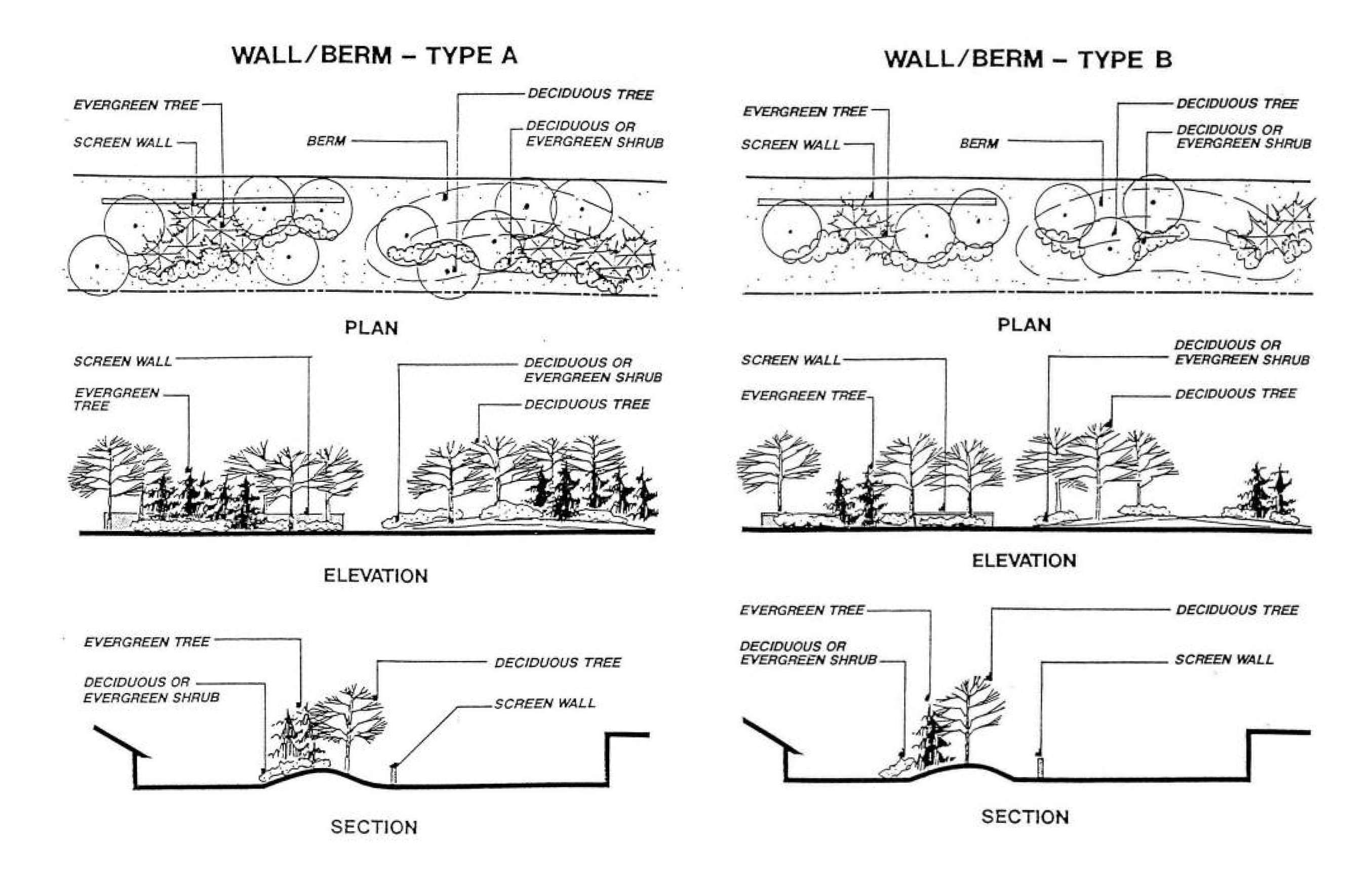
Required buffer zones. The following buffer zones shall be required where a proposed use shares a common lot line with an adjacent use as required in the following table:
Description of Required Buffer Zones
Note: The planning commission may waive or reduce the above requirement if equivalent screening is provided by existing woodlands on the lot, topographic or other natural conditions. The planning commission may also permit the substitution of evergreen and deciduous tree requirements. Existing quality trees (hickory, oak, maple) that will be preserved may be credited towards the above requirements at a rate of one new tree credit for each eight inches of existing tree caliper being preserved.
Footnotes:
A Berms shall have a maximum slope of one foot of vertical rise to three feet of horizontal distance (1:3) with a crest area at least four feet wide.
B Canopy trees shall have a minimum caliper of 2.5 inches at time of planting.
C Evergreens shall have a minimum height of six feet at time of planting.
D At least 50 percent of the shrubs shall be 24 inches tall at planting, with the remainder over 18 inches.
(5)
Required parking area landscaping.
a.
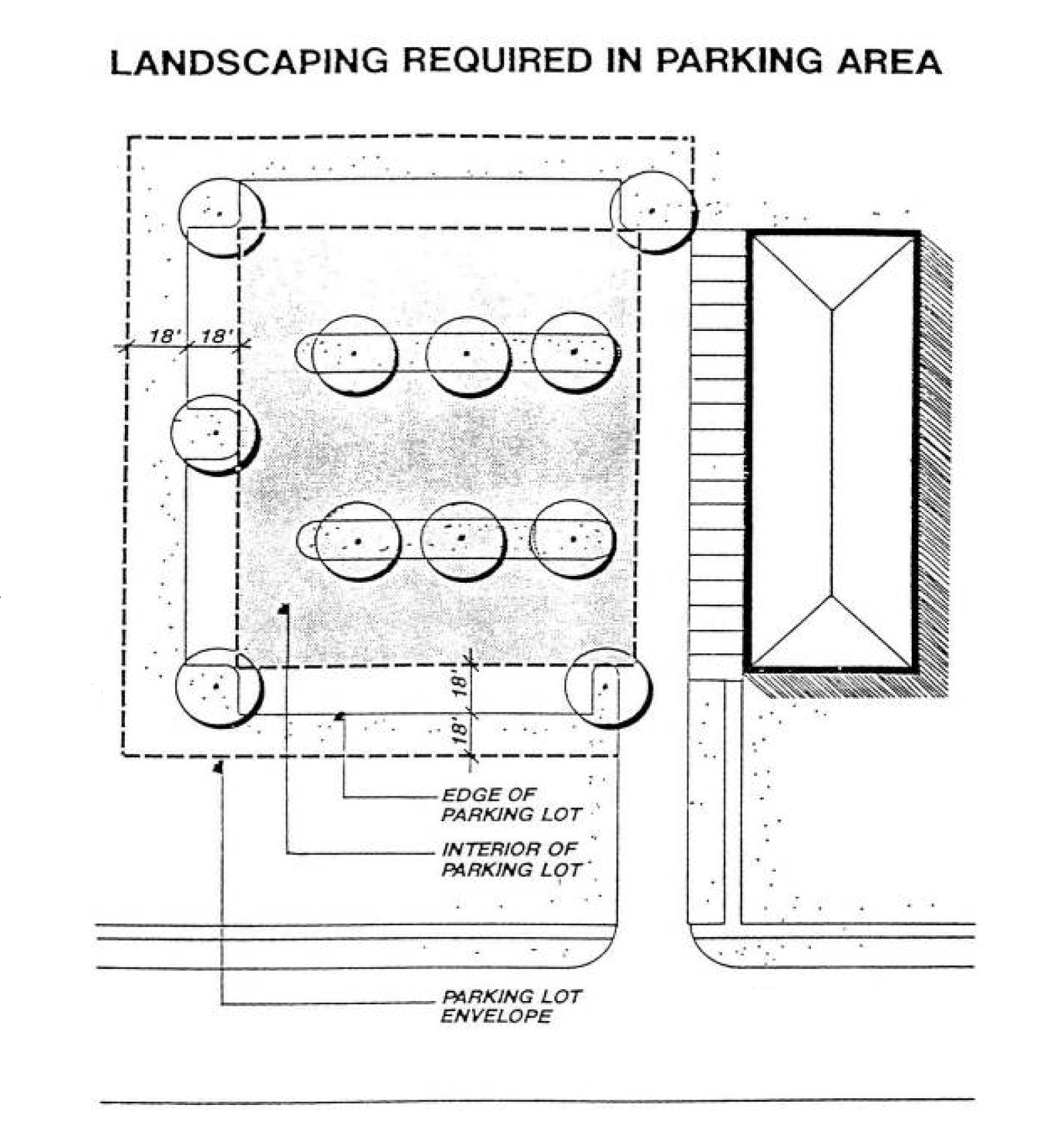
Off-street parking areas containing ten or more parking spaces shall be provided with landscaping at the rate of one tree for every ten parking spaces. A minimum of one-third of the trees shall be placed on the interior of the parking area and the remaining may be placed surrounding the parking lot within 18 feet.
b.
Where off-street parking areas are located within the front yard, a hedge row or berm shall be provided between the parking spaces and the roadway. The hedge row shall be planted with two foot tall evergreen or deciduous shrubs, 2½ feet on center.
c.
Where a parking lot is located on a site that is adjacent to a residential zoning district, a screening wall shall be required between the parking lot and the residential property line. The wall shall be high-quality masonry material compatible with the material used on the main building. The planning commission may substitute the screening wall requirement for a 20-foot-wide greenbelt landscaped with one evergreen tree for every ten feet of greenbelt length.
d.
In no case shall any buffer zones or greenbelts be calculated toward meeting the required parking area landscaping.
e.
Landscaping shall be installed such that, when mature, it does not obscure traffic signs, fire hydrants, lighting, drainage patterns on site or adjacent properties, or obstruct vision for safety of ingress or egress.
f.
Landscaping shall be dispersed throughout the parking lot in order to break up large expanses of pavement.
g.
All landscaped areas shall be protected by a raised standard or rolled concrete curb, except where landscape islands are being utilized as part of a stormwater detention or conveyance system.
h.
The minimum standards for landscaped islands are provided as follows:
(6)
Detention/retention pond landscaping. Detention/retention ponds shall be landscaped to provide a natural setting in open space areas.
a.
Detention ponds shall not be located adjacent to an existing county road right-of-way unless it is not feasible to locate the pond in another area of the site due to topography.
b.
Where possible, ponds or basins shall be freeform following the natural shape of the land to the greatest practical extent. Side slopes shall not exceed one foot vertical for every five feet horizontal.
c.
One deciduous shade or evergreen tree and ten shrubs shall be planted for every 50 lineal feet of pond perimeter as measured along the top of the bank elevation. The required trees and shrubs shall be planted in a random pattern or in groupings. The placement of required landscaping is not limited to the top of the pond bank, where the plant species is adapted to saturated soil conditions.
d.
Detention and retention ponds shall be landscaped in character with properties and shall be required to provide lawn areas, shrubs and trees to accomplish a suitable appearance compatible with development on the property and on nearby properties. Landscaping shall be required on all areas disturbed by grading to establish detention/retention ponds.
(7)
Accessory structure landscaping. The planning commission may require accessory structures and utility structures such as waste receptacle enclosures, air conditioning units, transformers, utility substations and clustered mailboxes that are in a visible location on the site to be landscaped with shrubs.
(8)
Plant material standards. All plant material shall be of a species that is native to the county. Plant material shall be free of disease and insects and conform to the American Standard for Nursery Stock of the American Association of Nurserymen.
(9)
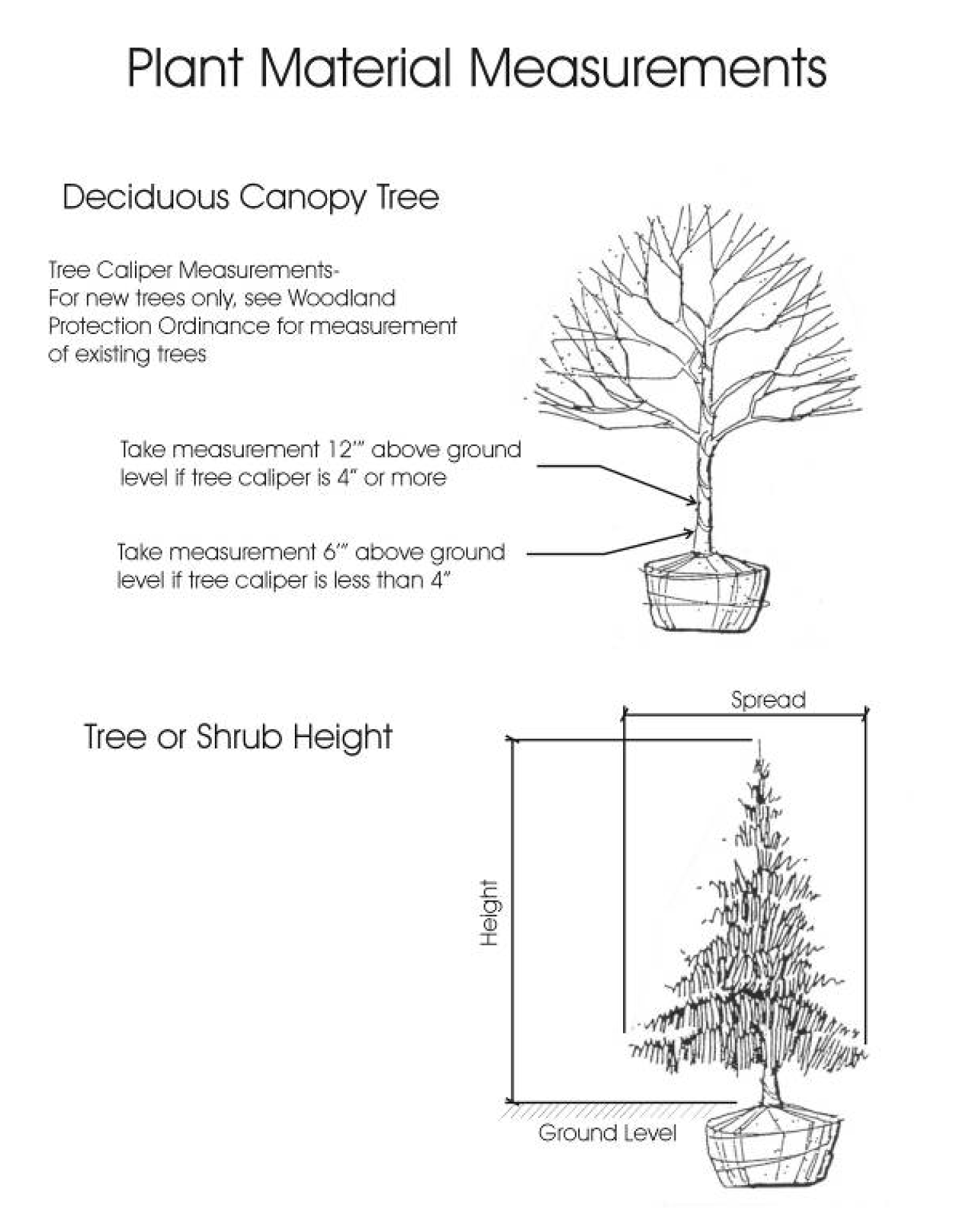
Minimum sizes. Minimum plant sizes at time of installation shall be according to the following:
a.
Deciduous canopy tree: 2½-inch caliper.
b.
Deciduous ornamental tree: two-inch caliper.
c.
Evergreen tree: six-inch height.
d.
Deciduous shrub: two-inch height.
e.
Evergreen shrub (upright): two-inch height.
f.
Evergreen shrub (spreading): 18 to 24-inch spread.
(10)
Mixing of species. The overall landscape plan shall not contain more than 33 percent of any one plant species. The use of trees native to the area, and mixture of trees from the same species association, is encouraged.
(11)
Prohibited species. The following trees are not permitted as they split easily; their wood is brittle and breaks easily; their roots clog drains and sewers; and they are unusually susceptible to disease or insect pests:
(12)
Installation and maintenance provisions. All landscaping shall be maintained in a healthy, neat and orderly state free from refuse and debris. Any dead or diseased plants shall be removed and replaced within six months. Landscaped areas shall be covered by grass or other living ground cover. Irrigation shall be provided for all landscaped areas. Trees required on the site plan must be maintained so long as they remain healthy and shall not be removed unless approved by the planning commission as a site plan amendment.
(13)
Screening wall requirements. Where required by this chapter, obscuring walls shall be subject to the following regulations:
a.
Required obscuring walls shall be placed on the lot line, except where underground utilities interfere with placement of the wall on the property line. Where located adjacent to a side street, the wall shall be set back eight feet from the side property line. The area between the wall and the property line shall be landscaped in accordance with the greenbelt provisions set forth in subsection (4) of this section.
b.
Required obscuring walls shall be continuous with no interruptions, except for vehicular and pedestrian access.
c.
Required obscuring walls shall be a minimum of four feet, six inches in height or taller if necessary to screen storage of vehicles, and shall be constructed of the materials that are architecturally compatible with the materials used on the facade of the principal structure on the site. The maximum height of a screening wall shall be eight feet unless the planning commission determines that a taller wall is necessary for screening purposes.
d.
Masonry walls shall be erected on a concrete foundation which shall have a minimum depth of 42 inches and shall not be less than four inches wider than the wall to be erected.
e.
The planning commission may permit the substitution of a wood screening fence a minimum of four feet six inches tall.
(14)
Performance guarantee. The planning commission may require a performance guarantee of sufficient amount to ensure the installation of all required landscaping. The township may hold the performance guarantee for up to one year following installation of landscaping to ensure the survival of all plant material during the first growing season.
(15)
Waiver from landscaping and screening requirements. The planning commission during site plan review may determine that existing landscaping or screening intended to be preserved would provide adequate landscaping and screening. The planning commission may also determine dimensional conditions unique to the parcel would prevent development of off-street parking area landscaping, greenbelts or buffer zones. If such determination is made, the planning commission may waive, in whole or in part, the landscaping provisions of this section. Criteria which shall be used when considering a waiver shall include, but shall not be limited to:
a.
Existing natural vegetation;
b.
Topography;
c.
Existing wetland, floodplain and poor soils areas;
d.
Existing and proposed building placement;
e.
Building heights;
f.
Adjacent land uses;
g.
Distance between land uses;
h.
Dimensional conditions unique to the parcel;
i.
Traffic sight distances;
j.
Traffic operational characteristics on and off site;
k.
Visual, noise and air pollution levels;
l.
Health, safety and welfare of the township.
(Ord. No. 151, § 13.04, 6-13-2007)
Sec. 38-444. - Commercial, office, industrial and multiple-family architecture.
(a)
Intent. The intent of this section is to provide exterior building wall material standards that enhance the visual environment of the township. Furthermore, the review of exterior building wall design and the consistent administration of standards can help to maintain the township's sense of place by encouraging consistent quality and character when structures are built or redeveloped. All proposed commercial development shall utilize quality architecture to ensure that a building is compatible with surrounding uses, protects the investment of adjacent landowners, blends harmoniously into the streetscape, and maintains a positive image for the township.
(b)
Applicability. This section shall apply to all new construction for all exterior building walls and shall consist of those materials and combinations of materials as set forth in this section. This section shall also apply to major expansion or renovation to existing buildings that require site plan approval by the planning commission. Architecture shall be reviewed by the planning commission as a part of site plan review under the requirements of this section. This section shall not apply to single-family residential and agricultural structures.
(c)
Wall materials. The use of exterior wall materials on walls that face a public road shall be in compliance with the maximum percentages permitted in the following schedule:
Schedule of Regulating Front Building Wall Materials
(1) Does not include areas of front facade consisting of doors and windows.
(2) For multiple-family dwellings, concrete block shall not be visible from the public street, provided the foundation may be concrete block if it is screened with foundation plantings.
(3) Within business districts, the facade facing the public street shall be a minimum of 25 percent brick or stone.
(4) Includes fiberglass, reinforced concrete, polymer plastic (fypon), exterior insulation and finishing systems (EIFS), plaster, stucco and similar materials. Such materials shall not be used where contact with vehicles may occur, such as parking areas, traffic ways, and loading areas, unless such walls are adequately protected to prevent damage.
(d)
Allowance for other materials. When a particular building design and the materials or combinations of materials proposed to be used are found by the planning commission to be in keeping with the intent and purpose of this section, in consideration of the character of surrounding uses and the design recommendations of the master plan, but which may differ from the strict application of the schedule regulating materials use (e.g., use of new materials not covered in the building wall materials schedule), the planning commission may waive the requirements of this section pertaining to materials.
(e)
Existing buildings. Where additions or remodeling of existing buildings is proposed, the planning commission may allow the use of existing wall materials for the addition provided that the design of the alteration is consistent with the existing building wall design.
(f)
Compatible design. Building and sign materials and colors shall relate well and be harmonious with the surrounding area. Commercial architecture shall incorporate traditional architecture and be consistent with the recommendations of the master plan in creating a rural, small-town environment. Buildings shall consider the scale and proportion of existing structures in the area. Roof shape and materials shall be architecturally compatible with adjacent buildings. Subtle earth tone colors shall be used for building and roofing material.
(g)
Design standards. Buildings shall possess architectural variety, but enhance the overall cohesive community character. All buildings shall provide architectural features, details and ornaments such as archways, colonnades, cornices, peaked rooflines or towers. Building walls over 100 feet in length shall be broken up with varying building lines, windows, architectural accents and trees. Building entrances shall utilize windows, canopies and awnings; provide unity of scale, texture, and color; and provide a sense of place. Building rear facades shall be constructed to a finished quality comparable to the front facade.
(Ord. No. 151, § 13.05, 6-13-2007)
Sec. 38-445. - Exterior lighting.
(a)
Purpose. The purpose of this section is to permit reasonable uses of outdoor lighting for night-time safety, utility, security, productivity, enjoyment and commerce while minimizing the impact of excessive or uncontrolled light to:
(1)
Minimize glare, obtrusive light, and artificial sky glow by limiting outdoor lighting that is misdirected, excessive, or unnecessary.
(2)
Minimize light pollution and light trespass from light sources onto adjacent properties.
(3)
Preserve the restful quality of nighttime by eliminating intrusive artificial light and lighting that unnecessarily contributes to sky glow.
(4)
Curtail and reverse the degradation of the nighttime environment and the night sky.
(5)
Preserve the dark night sky for astronomy.
(6)
Conserve energy and resources to the greatest extent possible.
(b)
Light levels. All outdoor lighting in all nonresidential districts used to light the general area of a specific site shall be shielded to reduce glare and shall be arranged to reflect light away from all adjacent residential districts or adjacent residences. Light shall not exceed more than 0.1 footcandle at a residential lot line. Light shall not exceed more than 1.0 footcandle at a nonresidential lot line, except along the road frontage. The maximum light level on the site shall be ten footcandles. All lamps shall be metal halide, or other light type approved by the planning commission.
(c)
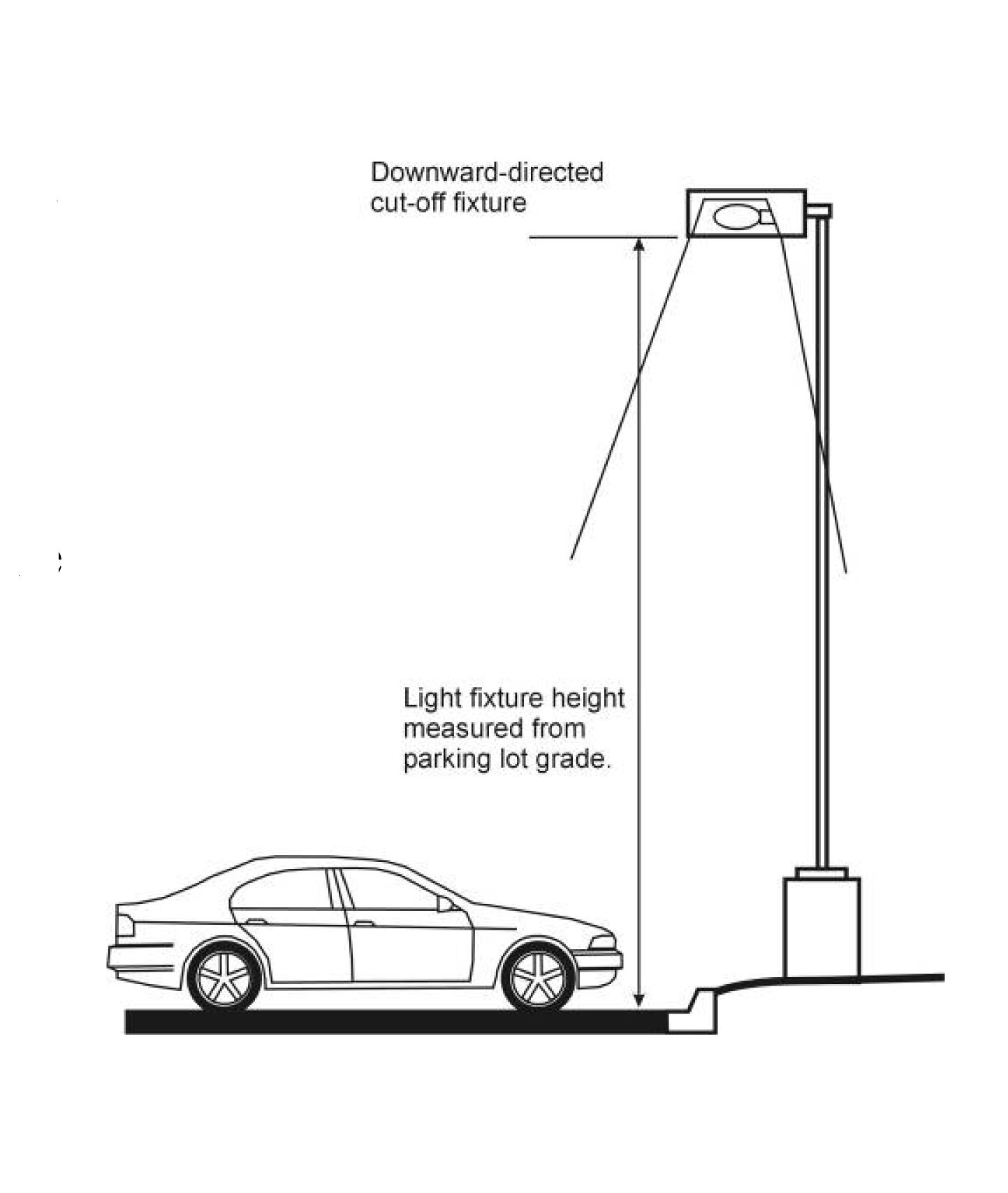
Light fixtures. Outdoor lighting in all nonresidential zoning districts shall be directed toward and confined to the ground areas of lawns or parking lots except as noted elsewhere in this section. Lighting shall utilize cutoff fixtures that are recessed sufficiently such that the light source is not visible from off site. Bollard lights are permitted to light driveways and pedestrian areas. Floodlight-type fixtures shall not be permitted except for building accent and sign lighting.
(d)
Fixture height. Light fixtures shall have a maximum height of 20 feet.
(e)
Ornamental lighting. The requirement for downward directed may be waived for ornamental lighting which is part of an overall architectural theme, as approved by the planning commission.
(f)
Floodlighting prohibited. The use of floodlighting for external illumination of buildings to feature said buildings or to illuminate a signs, shall be prohibited.
(g)
Sign lighting. Illumination of signs shall comply with the requirements of article VI of this chapter, pertaining to signs. Internally illuminated signs shall be permitted and light fixtures directed at a sign may be permitted where the fixtures are downward directed and shielded so not to cause visible glare to persons on adjacent roadways or adjacent property.
(h)
Photometric plan. For sites adjacent to a residential district, the planning commission may require the submission of a photometric plan prepared by an electrical engineer graphically illustrating the planned layout and footcandles of the site lighting. The evaluation of the photometric is intended to permit the planning commission to determine potential adverse effects the site lighting may have on adjoining properties and motorists. Compliance with the lighting design criteria shall be demonstrated by submitting the following for review:
(1)
Lighting plan showing light fixture locations and type designations;
(2)
Photometric plan showing horizontal luminance levels in a point by point format with contour lines. Canopy lighting will also be included in luminance levels;
(3)
Lighting equipment specifications and data sheets; and
(4)
Any other presentations required to convey the intent of the design.
(Ord. No. 151, § 13.06, 6-13-2007)
Sec. 38-446. - Waste receptacles.
Large waste receptacles, such as dumpsters and trash compactors, shall be designed, constructed and maintained according to the standards of this section. Waste receptacle location and details of construction shall be shown on site plans. A change in dumpster location or size shall require modification to the enclosure, as warranted by this section.
(1)
Location. Waste receptacles shall be located in the rear yard or nonrequired side yard, unless otherwise approved by the planning commission. For commercial and industrial sites adjoining residential district, the waste receptacle enclosure shall be as far as practical, and in no case be less than 20 feet from any adjacent residential district.
(2)
Access. Waste receptacles shall be easily accessed by refuse vehicles without potential to damage automobiles parked in designated parking spaces.
(3)
Base. The waste receptacle base shall be at least nine feet by nine feet, constructed of six inches of reinforced concrete pavement. The base shall extend six feet beyond the dumpster pad or gate to support the front axle of a refuse vehicle. Where grease disposal receptacles are used, curbing shall be provided around the enclosure base to contain any spillage.
(4)
Screening. Waste receptacles shall be enclosed on three sides by a screening wall with a wood gate on the fourth side. The enclosure shall be constructed of brick or decorative concrete material with a maximum height of six feet or at least one foot higher than the dumpster and spaced at least three feet from the dumpster. A berm may also be used as part of the enclosure. The planning commission may approve a wooden enclosure provided the lumber is determined to be durable and suitable for outdoor use. Waste receptacles shall have an enclosing lid or cover.
(5)
Other waste receptacles. The planning commission may require small waste receptacles at entrances to commercial buildings for use by customers.
(Ord. No. 151, § 13.07, 6-13-2007)
Sec. 38-447. - Fire service feature.
(a)
Firefighting resources are limited in terms of manpower and adequate water availability for firefighting due to the rural character of the township and the township desire to maintain this character, as reflected in the descriptions of zoning districts. Because of this, many of the infrastructure items developers are accustom to in fully developed areas are absent in the township, making compliance with the International Fire Code adopted by the township more difficult or expensive than may first appear. To provide for the safety, health and welfare of residents, no alteration to the land, as contained in section 38-4 will be made without submitting to the board and the fire department a plan on how the required fire protection features contained in the International Fire Code, including appendices B, C and D, will be met.
(b)
Special attention is brought to the following and shall be reflected in and site plan, private road or development application to the township:
(1)
The minimum water supply requirement for firefighting must meet the requirements of the currently adopted fire code and related regulations.
(2)
In areas without a water supply system, such as a municipal water system, community well system, or private systems, NFPA 1142 will be the primary guide.
(3)
In areas with a proposed water supply system such as a municipal water system, community well system, or private system, the fire flows should be based on appendix B and the ISO method contained in the American Water Works Association Manual of Water Supply Practices AWWA 31.
(c)
Regardless of the method used above, in no case shall the available water supply be less than an approved source, supplying 250 gpm for two hours. Approved methods are as follows:
(1)
A six-inch-minimum diameter well capable of sustaining a flow of 250 gpm for two hours.
(2)
A combination cistern and well capable of sustaining a flow of 250 gpm for two hours.
(3)
This requirement applies to all occupancies and use groups, except single/double family residential located outside of a subdivision or PUD.
(d)
Where chapter 5 of the International Fire Code needs additional clarification concerning site design and layout, appendices C and D along with NFPA 1141 Standard for Fire Protection in Planned Building Groups, 2003 edition, will be used.
(Ord. No. 151, § 13.08, 6-13-2007)
State Law reference— State fire prevention code, MCL 29.1 et seq.

