
Rose Township City Zoning Code
ARTICLE III
DISTRICT REGULATIONS
DIVISION 5. - RECREATIONAL, PUBLIC AND SEMIPUBLIC OVERLAY DISTRICT[5]
Cross reference— Parks and recreation, ch. 24.
DIVISION 8. - COMMUNICATION CORRIDOR OVERLAY DISTRICT[6]
Cross reference— Telecommunications, ch. 30.
Sec. 38-144. - Districts.
For the purpose of this article, the township is hereby divided into the following districts:
(1)
AG/RP agricultural and rural preserve.
(2)
R-1R rural residential.
(3)
R-1E estate residential.
(4)
R-1A single-family residential.
(5)
R-1B single-family residential.
(6)
RM multiple-family residential.
(7)
MH manufactured housing.
(8)
RPS recreation, public and semipublic overlay.
(9)
C-1 local business.
(10)
C-2 general business.
(11)
M-1 industrial.
(12)
CCOD communication corridor overlay district.
(Ord. No. 151, § 2.01, 6-13-2007)
Sec. 38-145. - Boundaries.
The boundaries of the districts enumerated in section 38-144 are hereby established as shown on the official zoning map of the township zoning ordinance, which accompanies this chapter, and which, with all notations, references, and other information shown thereon, shall be as much a part of this chapter as is fully described herein.
(1)
Unless shown otherwise, the boundaries of the districts are lot lines, section lines, the centerlines of streets, alleys, roads, or such lines extended, and the unincorporated limits of the township. Zoning districts shall extend to the center of all lakes, streams, ponds and wetlands; and all bottomland, islands, shoreline accretions, fill, and structures extended over the water shall be subject to the zoning district requirements of the adjacent shoreline.
(2)
Where, due to the scale, lack of detail, or illegibility of the zoning map accompanying this chapter, there is any uncertainty, contradiction, or conflict as to the intended location of any district boundaries, shown thereon, interpretation concerning the exact location of district boundary lines shall be determined, upon written application, or upon its own motion, by the zoning board of appeals.
(Ord. No. 151, § 2.02, 6-13-2007)
Sec. 38-146. - Zoning of vacated areas.
Whenever any street, alley or other public way within the township shall have been vacated by official governmental action, and when the lands within the boundaries thereof attach to and become a part of the land formerly within such vacated street, alley or public way, such street alley or other public way shall automatically and without further governmental action thenceforth acquire and be subject to the same zoning regulations as are applicable to the lands to which same shall attach, and the same shall be used for that same use as is permitted under this chapter for such adjoining lands.
(Ord. No. 151, § 2.03, 6-13-2007)
Sec. 38-147. - District requirements.
(a)
Zoning districts generally. Uses allowed within each zoning district and all uses, buildings, and structures shall be subject to the requirements of the zoning district of the subject site in accordance with the following articles:
(b)
Additional provisions. In addition to the requirements of the zoning district, sites shall comply with the provisions of division 9 of this article, pertaining to general exceptions; article IV of this chapter, pertaining to supplemental regulations; article V of this chapter, pertaining to development regulations; and article VI of this chapter, pertaining to signs.
(c)
Planned unit development. Development options are provided for planned unit developments in all districts, which shall meet the requirements and obtain necessary approvals contained in article VII of this chapter.
(d)
Review and approval. Prior to initiating construction, expansion, or modification of any building, or structure or the establishment of any use, all necessary approvals shall be obtained as required by article II, division 3 of this chapter, pertaining to site plan review. Prior to establishing a condominium, all necessary approvals shall be obtained as required by article VIII of this chapter, pertaining to condominium regulations.
(e)
Special land uses. All requirements of article IX of this chapter, pertaining to special land uses, shall be met with prior to establishing or expanding a use which is allowed only after special land use approval.
(Ord. No. 151, § 2.04, 6-13-2007)
Sec. 38-178. - Intent.
(a)
AG/RP agricultural and rural preserve district. The AG/RP agricultural and rural preserve district is intended to preserve areas best suited for agriculture rural preservation from the encroachment of incompatible uses including overly dense residential development. Areas designated in this district may include areas identified as unsuitable for septic disposal systems or land otherwise determined to be undesirable for development due to soils conditions or slopes. The AG/RP district has two general applications; to provide for agricultural operations and to preserve the rural areas of the township with sensitive natural features. These are more specifically described as follows:
(1)
The AG/RP district is intended to preserve lands best suited for agricultural use from the encroachment of incompatible uses and to preserve agricultural land. Vacant land, fallow land and wooded areas also are included where such areas are interspersed among farms. Certain resource-based land uses are also listed as principal or special land uses and require large land areas to serve the use and buffer from residential development. Extractive land uses may be permitted as a special land use to the extent that such uses are found to be compatible with surrounding land uses and preserve natural features of township-wide importance. Some areas zoned for the AG/RP district may be planned for eventual development in other uses, pending proper timing, provision of utilities, streets and other necessary facilities; however, change of zoning districts should be gradual based upon a demonstrated need for additional residential land, relative to supply and in accordance with the recommendations of the township master plan.
(2)
The AG/RP district is also intended to preserve areas of the township with sensitive natural features. These areas generally encompass high quality natural sites identified by the Michigan Natural Features Inventory and the Shiawassee and Huron Headwaters Resource Preservation Project, some of which have been identified as being among the highest quality natural feature areas within the county. These areas contain major wetland complexes and high-quality upland habitat. Areas designated as AG/RP are also intended to preserve areas which aid the minimization of potential threats to public health by preserving groundwater recharge areas and wetland natural features which minimize potential flooding threats.
(b)
R-1R rural residential district. The R-1R rural residential district is intended to provide a suitable environment for residential development at a low density. Areas designated R-1R may be characterized by sites of environmental sensitivity, marginal soils for development, septic suitability or where denser concentrations could compromise the goals, objectives or policies of the township master plan. The district is also intended to permit agricultural activities, while remaining compatible with adjacent single-family uses. This district is intended to encourage continued farming, but also a low density rural residential development with large lot sizes to help maintain adequate setbacks between residences and adjacent farming operations and sensitive natural areas.
(c)
R-1E estate residential district. The R-1E estate residential district is intended to provide a suitable environment for residential development at a low density in circumstances where natural conditions could be impacted by more intense development, and which will promote the most desirable use of land in accordance with the goals, objectives and policies of the township master plan. The district is intended to serve as a transition between the rural areas of the township and the smaller lot single-family residential development. This district is also intended to serve as a transitional district between predominantly residential areas and adjacent farming operations and areas with sensitive natural features.
(d)
R-1A single-family residential district. The R-1A single-family residential district is intended to encourage a suitable environment for families typically with children. To this end, uses are basically limited to single-family dwellings, together with certain other uses such as schools, fire stations, parks and recreation areas which provide a neighborhood environment. Commercial and other uses which tend to be incompatible with the intent are prohibited.
(e)
R-1B single-family residential district. The R-1B single-family residential district is intended to maintain the character of existing, older neighborhoods along lakes and within other developed areas of the township. This district is intended to allow continuation of these neighborhoods and allow limited infill development where it is compatible with the established neighborhood character. This district is not intended for development of new subdivisions.
(f)
Use of planned unit developments. It is further the intent of this chapter to encourage innovation in design with new residential development where clustered planned unit developments (PUDs) can be used to minimize impact on natural features, adjacent land uses and the rural character of the township. To achieve this goal, the township encourages all new development proposals to consider use of the incentives offered by the PUD regulations of article VII of this chapter to realize the benefits of this form of development for the community.
(Ord. No. 151, § 3.01, 6-13-2007)
Sec. 38-179. - Schedule of uses.
No building or land shall be used and no building shall be erected except for one or more of the following specified uses, unless otherwise provided for in this chapter. Land and/or buildings in the districts indicated at the top of table 38-179 may be used for the purposes denoted by a "P" in the column below by right. Land and/or buildings in the districts indicated at the top of table 38-179 may be used for the purposes denoted by "S" after special land use approval in accordance with the general and specific standards of article IX of this chapter, pertaining to special land uses. A notation of "N" indicates that the use is not allowed within the district. The "Other Standards" column indicates additional requirements or conditions applicable to the use.
Notes:
A. Farms shall be located on parcels of at least three acres and be operated according to the most recent suggested generally accepted agricultural management practices.
B. The keeping of horses and livestock shall be permitted in all districts as follows:
1.
The keeping or boarding of horses shall be permitted as an accessory use to farms or residential uses in all districts. The keeping or boarding of horses shall require at least three acres for the first horse plus one acre for each additional horse. The keeping or boarding of horses permitted in all districts does not include lessons, exhibitions rental/sale of equestrian products or other services, which are considered under the commercial riding academies and stables use and regulated under section 38-582(11).
2.
The raising of livestock shall be permitted as part of a farm, when conducted on at least three acres or more. Nothing in this ordinance shall prohibit a family from raising livestock on a residential lot for the utilization by the family. Keeping of livestock shall be in accordance with the most recent suggested generally accepted agricultural management practices.
(Ord. No. 151, § 3.02, 6-13-2007; Ord. of 9-5-2008(1), § 1; Ord. No. 169, 2-14-2018; Ord. No. 171, 5-8-2019; Ord. No. 176, 3-18-2020)
Sec. 38-180. - Area and bulk requirements.
All lots, buildings, and structures shall comply with the area height and bulk requirements in table 38-180.
Footnotes to table 38-180:
A. Lots: References to lot in this section and throughout this chapter also refer to parcels and building sites. All lots shall be required to meet the accessibility requirements of section 38-406.
B. Site condominiums: Design principles for subdivisions and residential condominium projects shall be as stated in chapter 16, pertaining to land divisions and subdivisions.
C. Corner/double frontage lot driveway access: Any lot, parcel or building site that is a corner lot or a through/double frontage lot and has frontage on both an existing public road and a new private road or new public road, access to all lots, parcels or building sites shall be required from the new public or private road.
D. Recreational area: All residential development containing 20 or more dwelling units, either as a single development or as a group of adjacent developments offered by a single proprietor, shall provide recreation space in a ratio of 1,000 square feet of play area per dwelling unit. Said recreational area shall be usable upland, safe from hazard, accessible to all dwellings, and the location shall be approved by the planning commission. Reservation of the recreational area shall be achieved through deed restrictions or dedication to a subdivision homeowner's association. Such recreation space shall be maintained by the homeowner's association or management so as to provide adequate, healthful recreation for residents living in the development.
E. Conventional developments and planned unit developments (PUD):
1. Applications for approval of a tentative preliminary plat, a tentative preliminary site condominium or a PUD shall be reviewed by the planning commission at a public hearing. Notice of the public hearing shall be provided in accordance with section 38-46.
2. If the development is being proposed as a PUD, then the public hearing under this section shall be the same hearing as required under article VII of this chapter. With the PUD, the number of dwelling units allowable within a PUD project shall be determined through preparation of a parallel plan under article VII of this chapter. Modifications to dimensional requirements may be permitted by the township under article VII of this chapter. If the development will not be a PUD, then the lot size requirements of this section shall be complied with.
F. AG/RP building height and lot coverage: Agricultural buildings, such as barns, silos and the like, may exceed the maximum height limitation in the AG/RP district provided any building exceeding the height limit shall be set back a minimum of 100 feet from all property lines. Maximum lot coverage shall not apply to agricultural buildings located on a farm in the AG/RP district.
G. Residential floor area: The minimum first floor area of any single-family two-story dwelling shall be no less than 700 square feet of living area. Such living area shall be exclusive of floor area dedicated to garages, utilities, closets and other storage. For the purpose of this section, a basement shall not be considered a first floor. Where a single-family home is constructed without a basement, an additional 50 square feet shall be added to the minimum required first floor area requirement.
H R-1-A lakefront lots: Residential lakefront lots in the R-1A district in existence as a lot of record before June 13, 2007, shall be required to have a minimum side yard setback of five feet on the least of the two sides with a total combined minimum setback of fifteen feet on both side yards (i.e., five feet on one side and ten feet on the other).
(Ord. No. 151, § 3.03, 6-13-2007; Ord. of 9-5-2008(1), § 2)
Sec. 38-199. - Intent.
While the township is a rural community that is primarily occupied by farms and single-family residences on larger lots, it is recognized that there is a limited need in the community for other forms of housing to meet the needs of different age groups and family sizes. The RM multiple-family residential district is intended to serve the need for the apartment type of units or attached condominium units in an otherwise single-family residential community. The RM district is also intended for the development of a planned complex of buildings on acreage parcels; however, the density and extent of multiple-family development in the township will be limited by the lack of public water or sewer to serve this type of housing. The RM district is designed to provide sites for multiple-family dwellings with height restrictions compatible with single-family residential districts.
(Ord. No. 151, § 4.01, 6-13-2007)
Sec. 38-200. - Schedule of uses.
(a)
No building or land shall be used and no building shall be erected except for one or more of the following specified uses, unless otherwise provided for in this chapter. Land and/or buildings in the districts indicated at the top of table 38-200 may be used for the purposes denoted by a "P" in the column below by right. Land and/or buildings in the districts indicated at the top of table 38-200 may be used for the purposes denoted by "S" after special land use approval in accordance with the general and specific standards of article IX of this chapter, pertaining to special land uses.
(b)
The "Other Standards" column indicates additional requirements or conditions applicable to the use. Some uses permitted by right in the multiple-family district have other standards that are applicable to the use. These uses are permitted by right, but they must still comply with the use specific standards noted.
(Ord. No. 151, § 4.02, 6-13-2007)
Sec. 38-201. - Area and bulk requirements.
All lots, buildings, and structures shall comply with the area height and bulk requirements in table 38-201.
Footnotes to table 38-201:
A. Lots: References to lot in this section and throughout this chapter also refer to parcels and building sites. All lots shall be required to meet the accessibility requirements of section 38-406.
B. Condominiums: Design principles for subdivisions and residential condominium projects shall be as stated in chapter 16, pertaining to subdivisions.
C. Corner/double frontage lot driveway access: Any lot, parcel or building site that is a corner lot or a through/double frontage lot and has frontage on both an existing public road and a new private road or new public road, access to all lots, parcels or building sites shall be required from the new public or private road.
D. Recreational area: All residential development containing 20 or more dwelling units, either as a single development or as a group of adjacent developments offered by a single proprietor, shall provide recreation space in a ratio of 1,000 square feet of play area per dwelling unit. Said recreational area shall be usable upland, safe from hazard, accessible to all dwellings, and the location shall be approved by the planning commission. Reservation of the recreational area shall be achieved through deed restrictions or dedication to a subdivision homeowner's association. Such recreation space shall be maintained by the homeowner's association or management so as to provide adequate, healthful recreation for residents living in the development.
E. Planned unit development (PUD): The number of dwelling units allowable within a PUD shall be determined through preparation of a parallel plan under article VII of this chapter. Modifications to dimensional requirements may be permitted by the township under article VII of this chapter, pertaining to planned unit development.
F. RM setbacks: For the purpose of yard regulations, multiple-family dwellings shall be considered as one building occupying one lot. The setbacks in table 38-201 shall be from the perimeter of the site. Front, side and rear yards related to the spacing between buildings within a development shall have the following minimum overall dimensions:
Footnotes:
1. Where dwellings have individual garages, the setback shall not apply to individual driveways.
2. Where a sidewalk is provided along a road, garages shall be set back a minimum of 20 feet from the sidewalk.
G. RM minimum floor areas: Minimum floor areas for apartments shall be as follows:
1. One-bedroom and efficiency/studio units: Any dwelling unit consisting of not more than two rooms in addition to kitchen, dining and necessary sanitary facilities shall contain a minimum floor area of at least 600 square feet per unit.
2. Two-bedroom or more units: Any dwelling unit consisting of three or more rooms in addition to the kitchen, dining, and necessary sanitary facilities shall contain a minimum floor area of at least 750 square feet per unit, plus an additional 150 square feet for each bedroom in excess of two.
(Ord. No. 151, § 4.03, 6-13-2007)
Sec. 38-226. - Intent.
(a)
The intent of the MH manufactured housing district is to provide an affordable housing alternative where placement of such a development would be appropriate and consistent with the general character of the township. The standards required in this district are intended to be consistent with the adopted standards for other types of housing in the township. All manufactured home parks shall comply with the applicable requirements of Public Act No. 96 of 1987 (MCL 125.2301 et seq.). However, some standards of this chapter are more stringent than the typical standards promoted by the manufactured housing commission. These more strict standards reflect the overall nature of the township, in contrast with some other areas of the state where the universal rules of the manufactured housing commission may be appropriate. These adopted standards are designed to foster and encourage development that complements and protects the investment on adjacent properties, and promotes preservation of important natural features.
(b)
Since the characteristics, densities and impacts of a manufactured housing development typically simulate those of multiple-family residential developments, and because they typically are served by private streets and utility systems that intercept the local street system and utility systems, manufactured housing parks are not necessarily considered to be completely compatible with other types of single-family neighborhoods. Therefore, manufactured housing developments are intended to be located in areas of the township where these public services can be provided and serve as a transition from higher intensity land uses. Public sewer systems shall be required in a manufactured home development, if available within 200 feet at the time of preliminary approval. If a public sewer system is unavailable, the development shall connect to a state-approved sewage system.
(Ord. No. 151, § 5.01, 6-13-2007)
Sec. 38-227. - Statutory provisions.
Regulations established by Public Act No. 96 of 1987 (MCL 125.2301 et seq.) and the state manufactured housing commission rules shall govern all manufactured home communities in the township. When regulations and standards in this section exceed said Public Act or the rules of the state manufactured housing commission, the higher standards and regulations set forth in this chapter shall govern. The higher standards and regulations established in this chapter are intended to ensure that manufactured home communities meet the development and site plan standards established for comparable residential developments. They are also established to promote the health, safety and the welfare of all township residents.
(Ord. No. 151, § 5.02, 6-13-2007)
Sec. 38-228. - Definitions.
The following words, terms and phrases, when used in this article, shall have the meanings ascribed to them in this section, except where the context clearly indicates a different meaning:
Manufactured housing community, manufactured home park means a parcel of land that is subdivided into rental lots for the placement of manufactured housing units and regulated by the state manufactured housing commission.
Manufactured housing unit, manufactured home unit means a structure, transported in one or more sections, built on a chassis and designed as a dwelling when connected to the required utilities (gas and electric and sanitary and water) and includes the plumbing, mechanical and electric systems contained in the unit.
On-site water source means:
(1)
A cistern (type I-30,000 gallon, type II-20,000 gallon) with proper piping coupling, and an approved method of refill, constructed to National Fire Protection Association (NFPA) standards.
(2)
A dry hydrant capable of supplying a flow of 250 gallons of water per minute, constructed to NFPA standards.
(3)
A driven well or water-jetted well constructed to state, local and NFPA standards, producing a minimum 250 gallons of water per minute for two hours at 50 pounds of pressure.
(4)
Other on-site water systems as reviewed and approved by the local fire authority and meeting the standards of NFPA.
(Ord. No. 151, § 5.03, 6-13-2007)
Cross reference— Definitions generally, § 1-2.
Sec. 38-229. - Schedule of uses.
No building or land shall be used and no building shall be erected except for one or more of the following specified uses, unless otherwise provided for in this chapter. Land and/or buildings in the districts indicated at the top of table 38-229 may be used for the purposes denoted by a "P." Land and/or buildings in the districts indicated at the top of table 38-229 may be used for the purposes denoted by "S" after special land use approval in accordance with the general and specific standards of article IX of this chapter, pertaining to special land uses. A notation of "-" indicates that the use is not permitted within the district. The "Other Standards" column indicates additional requirements or conditions applicable to the use.
(Ord. No. 151, § 5.04, 6-13-2007)
Sec. 38-230. - Manufactured housing park standards.
Manufactured housing communities shall be designed and maintained in accordance with the following regulations:
(1)
Park area. The minimum manufactured housing park area shall be 15 acres.
(2)
Manufactured home sites.
a.
Lot area. Each manufactured home lot, exclusive of streets, shall have a minimum area of 5,500 square feet and this may be reduced by up to 20 percent, provided that the individual site shall be equal to at least 4,400 square feet and for each square foot of land gained through the reduction of a site below 5,500 square feet, at least an equal amount of land shall be dedicated as open space. This open space shall be in addition to that required under R125.1946, Rule 946 and R125.1941 and R125.1944, Rules 941 and 944 of the Michigan Administrative Code.
b.
One home per lot. No more than one manufactured home shall be parked on any one lot.
c.
Required distances between homes and other structures.
1.
A home shall be in compliance with all of the following minimum distances, as measured from the wall/support line or foundation line, whichever provides the greater distance:
i.
For a home not sited parallel to an internal road, 20 feet from any part of an attached structure of an adjacent home that is used for living purposes.
ii.
For a home sited parallel to an internal road, 15 feet from any part of an attached structure of an adjacent home that is used for living purposes if the adjacent home is sited next to the home on the same internal road or an intersecting internal road.
iii.
Ten feet from either of the following:
(a)
A parking space on an adjacent home site.
(b)
An attached or detached structure or accessory of an adjacent home that is not used for living purposes.
iv.
Fifty feet from permanent community-owned structures, such as either of the following:
(a)
Clubhouses.
(b)
Maintenance and storage facilities.
v.
One hundred feet from a baseball or softball field.
vi.
Twenty-five feet from the fence of a swimming pool.
vii.
Attached or detached structures or accessories that are not used for living space shall be a minimum distance of ten feet from an adjacent home or its adjacent attached or detached structures.
2.
Any part of an accessory, such as steps, porches, supported or unsupported awnings, decks, carports or garages, or similar structures, shall be set back the following minimum distances:
i.
Ten feet from the edge of an internal road.
ii.
Seven feet from a parking bay off a home site.
iii.
Seven feet from a common sidewalk.
iv.
Twenty-five feet from a natural or manmade lake or waterway.
3.
A carport shall be in compliance with both of the following setbacks if it is completely open, at a minimum, on the two long sides and the entrance side:
i.
Support pillars that are installed adjacent to the edge of an internal road shall be set back four feet or more from the edge of the internal road or two feet or more from the edge of a sidewalk.
ii.
Roof overhangs shall be set back two feet or more from the edge of the internal road.
4.
Steps and their attachments shall not encroach into parking areas more than 3½ feet.
5.
The length of a home site may vary depending on community design and layout and the home to be installed; however, the minimum standards pertaining to the distance between homes shall be complied with.
6.
The dividing line between an existing community and an expansion of the community shall be treated as a property line for the purpose of siting homes adjacent to the dividing line.
d.
Setbacks from property boundary lines.
1.
Homes, permanent buildings and facilities, and other structures shall not be located closer than ten feet from the property boundary line of the community or home condominium and shall not be required by a local ordinance, unless approved by the commission, to be more than ten feet from the property boundary line.
2.
If homes, permanent buildings and facilities, and other structures abut a public right-of-way, then they shall not be located closer than 50 feet from the boundary line. If the boundary line runs through the center of the public road, then the 50 feet shall be measured from the road right-of-way line. In addition, the homes, permanent buildings and facilities, and other structures shall not be required by a local ordinance to be more than 50 feet from the boundary line, unless the commission approves the ordinance. This rule does not apply to roads dedicated for public use.
e.
Manufactured unit. All manufactured housing units shall be in compliance with the construction standards promulgated by the United States Department of Housing and Urban Development, 24 CFR 1700 et seq., and CFR 3280 and 3282, under the National Manufactured Housing Construction and Safety Standards Act of 1974, as amended, 42 USC 601 et seq. The maximum height of any community or similar building shall not exceed 35 feet, or two stories in height, whichever is less. Storage or service buildings shall not exceed 15 feet, or one story in height.
f.
Skirting and anchoring. Each unit shall be installed in compliance with the standards established in R125.1602, Rule 602 of the manufactured housing commission's general rules. All areas between the manufactured home and ground shall be enclosed by a skirt, providing said skirting is constructed or installed and is fire resistant and in conformity with the requirements under R125.1604, Rule 604 of the Manufactured Housing Commission's General Rules. A home anchoring system shall be provided that is designed and constructed in compliance with the United States Department of Housing and Urban Development standards entitled Manufactured Home Construction and Safety Standards and shall be installed in compliance with its manufacturer's specifications.
g.
Occupancy. No manufactured housing unit shall be occupied without first being connected to a permanent sanitary system and water source, and in accordance with part 2 of the MDEQ Mobile Home Park Standards.
(3)
Access and circulation and parking.
a.
Interior street widths. Minimum street widths within the manufactured home park shall be accordance with the following schedule:
b.
Street construction. All streets within the manufactured home park shall be of concrete or bituminous aggregate meeting American Association of State Highway and Transportation Officials (AASHTO) street construction specifications, and may be provided with concrete curbing. Streets shall be crowned with drainage directed to the outside edges. Interior roads shall be required to end in a 60-foot in diameter cul-de-sac. Stop signs shall be located at ingress and egress and all intersections of interior streets. The location of speed limit signs will be so located to promote safety for all occupants and visitors to the park.
c.
Access. The manufactured housing community shall provide for egress and ingress off of a public road.
d.
Signage. All road signs (name and traffic control) shall be installed and maintained by the community in accordance with the state manual of uniform traffic control devices.
e.
Sidewalks. Concrete walkways are to be at least 36 inches wide. If a developer provides sidewalks, the sidewalks are to be designed, constructed, and maintained for safe and convenient movement from all home sites to principal destinations within the community and connection to public sidewalks outside the community. Individual sidewalks shall be constructed between at least one entrance or patio, porch, or deck, if provided, and the parking spaces on the home site or parking bay, whichever is provided, or common sidewalk, if provided.
f.
Unit parking. Each site shall provide paved off-street and/or on-street parking that will accommodate a minimum of two vehicles.
g.
Visitor parking. Parking for visitors shall be provided at a ratio of one space per three unit lots.
(4)
Landscaping.
a.
A landscape plan shall be incorporated in the preliminary plans submitted for site plan review. The plan shall indicate the type, number and size of landscape plantings to be completed in the proposed manufactured housing development.
b.
All areas of circulation, parking, recreation facilities, open space areas, buildings for service and areas of storage shall be completely and permanently landscaped and maintained in good condition.
c.
One shade tree shall be provided for every two lots.
d.
If a manufactured home park district abuts residentially zoned land, the district shall be required to provide screening along the boundary abutting the residentially zoned land. In all cases a district shall provide screening along the boundary abutting a public right-of-way.
e.
The required screening shall consist of evergreen trees or shrubs, at least three feet in height, which are spaced so they provide a continuous screen at maturity. Alternative screening devices may be utilized if they conceal the manufactured home development as effectively as the required landscaping described in this subsection.
f.
The manufactured home park shall have a 50-foot minimum setback from any public right-of-way exterior to the development, which shall be properly landscaped with grassed area and maintained by the owner and operator of the manufactured home park. A landscape berm measuring 2½ to three feet in height shall be constructed along the public right-of-way on which the manufactured housing development fronts. The berm shall be constructed with slopes no steeper than one foot vertical rise for each four feet horizontal run. A minimum of one deciduous shade tree, one evergreen tree and four shrubs shall be planted for each 30 lineal feet, or portion thereof, of required greenbelt length. At time of planting, canopy trees shall have a minimum caliper size of three inches and evergreen trees shall have a minimum height of six feet. Trees may be planted at uniform intervals, at random, or in groupings. All existing trees four inches or greater in diameter (DBH) within the greenbelt shall be preserved, except where their removal is necessary to install access points.
g.
Dead, damaged or diseased landscaping shall be replaced, within one year, so as to maintain the approved screening originally approved.
(5)
Waste receptacles. A location for the storage and removal of daily waste shall be established and maintained by the park.
a.
A storage container for garbage shall be watertight and shall preclude infestation of insects and rodents.
b.
Rubbish shall be properly contained and stored. The area for storage shall be kept in a manner suitable to preclude infestation of insects and rodents. Where dumpsters are used, they shall be placed on a paved area that shall extend a minimum of two feet in all directions from the dumpster. Water used in cleaning a dumpster shall be discharged to a sanitary sewer system.
c.
A storage container for garbage and rubbish shall be cleaned with sufficient frequency to preclude the attraction of insects and rodents.
d.
The storage of garbage and rubbish shall not create a harborage or food source for insects or rodents.
e.
Garbage and rubbish shall be removed from the mobile home park at least once a week or more often if necessary.
(6)
Utilities and fire protection.
a.
Health department approval. The local health department shall grant preliminary approval, under the guidance of the department of public health, for on-site water and sewerage service and general site suitability.
b.
Utilities. Each manufactured housing unit shall be equipped with utilities that comply with the HUD code, or the ANSI code for homes built prior to June 15, 1976. The sanitary sewer and water system of the manufactured housing community shall comply with MDEQ and local health department specifications.
c.
Utility installation. All utilities, including telephone, cable, electric and, where available, water and sewer service, shall be placed underground throughout the community in accordance with R125.1932 to R125.1940 of the manufactured housing commission's general rules.
d.
Fire protection. The manufactured housing community shall provide on site water sources for fire protection. Fire protection shall comply with Rule R125.1702a, MDEQ Rule 1105(2) and section 3280 of the HUD Manufactured Home Construction and Safety Standards. Each on-site water source shall be so located to provide the optimal area of coverage, as determined by review and approval of the fire department. The community management shall notify each resident, upon occupancy, of all of the following:
1.
The home site shall be kept free of fire hazards, including combustible materials under the home.
2.
On-street parking is prohibited within 15 feet of a fire hydrant.
3.
Each home site shall be numbered and clearly marked for positive identification. Each number shall be easily readable from the road servicing the home site.
4.
Each home is to be provided with at least one fire extinguisher approved by the national fire protection association and one smoke detector approved by the state construction code authority.
(7)
Accessory buildings and uses.
a.
Accessory buildings. Site-built buildings within a manufactured housing development shall be constructed in compliance with the state construction code and shall require all applicable permits. Any addition to a manufactured housing unit that does not comply with the standards of the U.S. Department of Housing and Urban Development for manufactured homes shall comply with the state construction codes. Site plan approval shall be required prior to construction of any on-site building within a manufactured home development, except for storage sheds or garages for individual manufactured homes. Storage sheds, carports and garages shall require a building permit or zoning compliance permit from the township prior to construction.
b.
Storage. If the owner of the manufactured housing development permits storage of boats, motorcycles, recreation vehicles, and similar equipment in the manufactured housing development, common areas for the storage of that equipment shall be provided by the owner within the development. Such storage shall be limited to use only by residents of the manufactured housing development. If proposed, the location of such storage areas shall be shown on the preliminary site plan. No part of any such storage area shall be located in a required yard on the perimeter of the manufactured housing development. A storage area shall be screened from view from existing residences adjacent to the manufactured housing development. Manufactured housing development owners who prohibit storage of boats, off-road motorcycles, recreation vehicles and similar equipment are not required to construct common areas for storage.
(Ord. No. 151, §§ 5.05, 5.05.1—5.05.7, 6-13-2007)
Sec. 38-231. - Site plan approval.
(a)
A preliminary plan shall be submitted for approval by the planning commission for all manufactured housing communities. Preliminary approval shall not be issued by the township until a rezoning application to the manufactured housing district for the manufactured home park has been approved by the township board.
(b)
The application for the expansion, alteration, or construction of a manufactured housing park shall be accompanied by a preliminary plan of the proposed development and all permanent buildings indicating the proposed methods of compliance with these requirements.
(Ord. No. 151, § 5.06, 6-13-2007)
Sec. 38-232. - Area and bulk requirements.
All lots, buildings, and structures not located within a manufactured housing community (manufactured home park) approved by the state manufactured housing commission and the township shall comply with the area height and bulk requirements in table 38-232. All structures placed within a manufactured housing park shall be subject to the requirements of section 38-230 and the rules of the state manufactured housing commission.
Footnotes to table 38-232:
A. Lots: References to lot in this section and throughout the zoning chapter also refer to parcels and building sites. All lots shall be required to meet the accessibility requirements of section 38-406.
B. Site condominiums: Design principles for subdivisions and residential condominium projects shall be as stated in chapter 16, pertaining to subdivisions.
C. Corner/double frontage lot driveway access: Any lot, parcel or building site that is a corner lot or a through/double frontage lot and has frontage on both an existing public road and a new private road or new public road, access to all lots, parcels or building sites shall be required from the new public or private road.
D. Recreational area: All residential development containing 20 or more dwelling units, either as a single development or as a group of adjacent developments offered by a single proprietor, shall provide recreation space in a ratio of 1,000 square feet of play area per dwelling unit. Said recreational area shall be well drained, graded, seeded or sodded, safe from hazard, accessible to all dwellings and the location shall be approved by the planning commission. Reservation of the recreational area shall be achieved through deed restrictions or dedication to a subdivision homeowner's association. Such recreation space shall be maintained by the homeowner's association or management so as to provide adequate, healthful recreation for residents living in the development.
E. Planned unit development (PUD): The number of dwelling units allowable within a PUD project shall be determined through preparation of a parallel plan under article VII of this chapter, pertaining to planned unit development. Modifications to dimensional requirements may be permitted by the township under article VII of this chapter.
(Ord. No. 151, § 5.07, 6-13-2007)
Sec. 38-258. - Intent.
The RPS recreation, public and semipublic overlay district is intended to provide areas for the development of recreational facilities and outdoor recreational uses. Maximum preservation of the land in its natural state through the protection and preservation of open spaces in the development of permitted uses is a further intent of the RPS zoning district. Areas designated for this zoning district should be consistent with the goals, objectives, policies and recommended future land use pattern of the township land use plan. The RPS is an overlay district which is applied to the AG/RP agricultural and rural preserve district. For parcels zoned RPS that are no longer used for a use permitted in the district or where a change in use is desired by the property owner, the RPS overlay district may be removed following the procedures for amending the zoning map, thereby reverting to the underlying AG/RP district.
(Ord. No. 151, § 6.01, 6-13-2007)
Sec. 38-259. - Schedule of uses.
No building or land shall be used and no building shall be erected except for one or more of the following specified uses, unless otherwise provided for in this chapter. Land and/or buildings in the districts indicated at the top of table 38-259 may be used for the purposes denoted by a "P." Land and/or buildings in the districts indicated at the top of table 38-259 may be used for the purposes denoted by "S" after special land use approval in accordance with the general and specific standards of article IX of this chapter, pertaining to special land uses. The "Other Standards" column indicates additional requirements or conditions applicable to the use.
(Ord. No. 151, § 6.02, 6-13-2007)
Sec. 38-260. - Area and bulk requirements.
All lots, buildings, and structures shall comply with the area height and bulk requirements in table 38-260.
Footnotes to table 38-260:
A. Lots: References to lot in this section and throughout the zoning chapter also refer to parcels and building sites.
B. Corner/double frontage lot driveway access: Any lot, parcel or building site that is a corner lot or a through/double frontage lot and has frontage on both an existing public road and a new private road or new public road, access to all lots, parcels or building sites shall be required from the new public or private road.
C. Lot dimensions: In the RPS recreation, public and semipublic district the minimum lot area and width requirements may be waived where a lot is being dedicated for conservation, or recreational purposes only and there will be no buildings placed on the lot. Such restriction on use and buildings shall be recorded as a deed restriction.
D. Parking location: Parking may be provided in the front yard after approval of the parking plan layout and points of access by the township board after review by the planning commission. The setback shall be measured from the nearest side of existing and/or proposed right-of-way lines.
(Ord. No. 151, § 6.03, 6-13-2007)
Sec. 38-284. - Intent.
(a)
C-1 local business district. The C-1 local business district is designed to give the township a business district that is more restrictive than a general business district, and to provide for the establishment of neighborhood shopping areas, personal services and professional office areas that are primarily compatible with, and of service to, township residential uses. The township encourages the use of architectural treatment on buildings in C-1 districts which promote a rural small-town character in accordance with the master plan.
(b)
C-2 general business district. The C-2 general business district is designed to provide for more diversified business types and serves a larger geographic area than the immediate neighborhood. It is also the intent of this district to allow for mixed-use development with office or residential on the second floor above commercial uses. This district is intended to create mixed-use nodes of activity consistent with the desired small-town character in accordance with the master plan.
(Ord. No. 151, § 8.01, 6-13-2007)
Sec. 38-285. - Schedule of uses.
(a)
No building or land shall be used and no building shall be erected except for one or more of the following specified uses, unless otherwise provided for in this chapter. Land and/or buildings in the districts indicated at the top of table 38-285 may be used for the purposes denoted by a "P." Land and/or buildings in the districts indicated at the top of table 38-285 may be used for the purposes denoted by "S" after special land use approval in accordance with the general and specific standards of article IX of this chapter, pertaining to special land uses. A notation of "N" indicates that the use is not allowed within the district. The "Other Standards" column indicates additional requirements or conditions applicable to the use.
(b)
All uses shall be subject to the following limitations:
(1)
All business establishments shall be in retail or service establishments dealing directly with consumers. Limited production of goods, such as crafts or artwork, may be permitted accessory to a retail use, provided all goods produced on the premises shall be sold at retail on the premises where produced.
(2)
All business, servicing or processing, except for off-street parking or loading, shall be conducted within a completely enclosed building, except as provided in subsections (b)(3), (4) and (5) of this section.
(3)
Outdoor sales shall be allowed on a temporary basis as an accessory use to a principal permitted business use on the site. Outdoor sales will require a temporary use permit approved by the township. Temporary use permits will be effective for each calendar year and will allow a maximum of 14 days for the temporary use.
(4)
The planning commission may approve a limited permanent outdoor storage and sales area accessory to a permitted retail use as part of site plan approval under article II, division 3 of this chapter, pertaining to site plan approval requirements. Merchandise displayed shall be accessory to the retail business conducted within the building and shall be owned and operated by the same merchant within the building. Outdoor display areas shall be limited to the paved area within ten feet of the building and the area shall not exceed ten percent of the footprint of the principal building. Display areas shall not consume required parking nor block vehicular or pedestrian accessibility or circulation through the site.
(5)
The planning commission may approve a permanent outdoor storage and sales area exceeding the limitations allowed in subsections (b)(3) and (4) of this section only by special land use approval in accordance with the general standards of article IX, division 7 of this chapter, pertaining to special land uses and specific requirements of section 38-582(24).
(Ord. No. 151, § 8.02, 6-13-2007; Ord. No. 161, 5-11-2011; Ord. No. 176, 3-18-2020)
Sec. 38-286. - Area and bulk requirements.
All lots, buildings, and structures shall comply with the area height and bulk requirements in table 38-286.
Footnotes to table 38-286:
A. Lots: References to lot in this section and throughout this chapter also refer to parcels and building sites. All lots shall be required to meet the accessibility requirements of section 38-406.
B. Lot sizes: The lot area and lot width in commercial and industrial districts may be reduced to the amounts indicated in the table below where the lot has a recorded easement for a shared driveway and service drive connecting the lot to all adjacent lots zoned or master planned for commercial.
In order to qualify for the above lot area and width reductions, the shared driveway must meet the following requirements:
1.
The centerline of the shared driveway shall be located a minimum of 200 feet from the centerline of the intersection of two public roads.
2.
The centerline of the shared driveway shall be directly aligned with any commercial driveway or private road on the opposing side of the road or offset a minimum of 200 feet.
3.
The centerline of the shared driveway shall be located a minimum of 200 feet from the centerline of any other commercial driveway or private road on the same side of the road.
4.
The shared drive and service drive shall be constructed on each lot to the property lines as a condition of granting site plan approval for each respective lot.
C. Building height: Planned developments involving three acres or more under one ownership or providing for a mixture of uses with residential on upper floors above commercial shall be subject to the approval of the township board after review by the planning commission regarding modifications with respect to height regulations in C-1 and C-2 districts. The township board may attach conditions necessary to minimize any visual impacts on adjoining uses.
D. Parking: Parking shall be provided in the rear or side yard of a site. Parking may be provided in the front yard after approval of the parking plan layout and points of access by the planning commission; provided, a 20-foot greenbelt is maintained along the lot frontage. Parking lots, including all circulation aisles loading areas and other paved areas, shall be setback a minimum of ten feet from all side and rear lot lines, provided the planning commission may reduce the parking setback where shared access or service drive connections are provided with adjoining sites.
E. C-2 front build-to line: Buildings shall be required to be built close to the front lot line with a front yard setback between zero and 15 feet. The planning commission may allow a larger setback where parking is located in the front yard; provided the site shall be designed to provide convenient and safe pedestrian access and a 20-foot-wide landscape greenbelt shall be provided between the parking lot and the front lot line.
F. Side yard: No side yards are required along the interior side lot lines, except as otherwise specified in an applicable state construction code
G. Loading: Loading space shall be provided in accordance with article V of this chapter in the rear yard. Where an alley exists or is provided at the rear of buildings, the rear building setback and loading requirements may be computed from the center of said alley. Loading area locations shall not conflict with access to parking spaces and shall not be visible from the street.
H. Planned unit development: Mixed use development with residential units on the same site as business uses may be allowed under the PUD regulations contained in article VII of this chapter.
(Ord. No. 151, § 8.03, 6-13-2007)
Sec. 38-287. - Senior apartments.
Footnotes to table 38-287:
A. RM minimum floor areas: Minimum floor areas for Senior Apartments shall be as follows:
1.
Efficiency/studio units: Any dwelling unit consisting of not more than two rooms in addition to a kitchen, dining area and necessary sanitary facilities shall contain a minimum floor area of at least 350 square feet per unit.
2.
One-bedroom: Any dwelling unit consisting of not more than two rooms in addition to a kitchen, dining area and necessary sanitary facilities shall contain a minimum floor area of at least 440 square feet per unit.
(Ord. No. 161, 5-11-2011)
Sec. 38-306. - Intent.
The M-1 industrial district is designed so as to primarily accommodate wholesale activities, warehousing, and industrial operations whose external, physical effects are restricted to the area of the district, and in no manner affect in a detrimental way any of the surrounding districts. The M-1 district is so structured as to permit along with any specified uses, the manufacturing, compounding, processing, packaging, assembly, and/or treatment of finished or semifinished products from previously prepared material. As the township is a rural residential community, this district is further intended to permit only industrial uses that are compatible with surrounding residential uses, will have minimal impact on natural features and are within the capacity of the limited land areas set aside for industrial use.
(Ord. No. 151, § 9.01, 6-13-2007)
Sec. 38-307. - Schedule of uses.
No building or land shall be used and no building shall be erected except for one or more of the following specified uses, unless otherwise provided for in this chapter. Land and/or buildings in the districts indicated at the top of table 38-307 may be used for the purposes denoted by a "P." Land and/or buildings in the districts indicated at the top of table 38-307 may be used for the purposes denoted by "S" after special land use approval in accordance with the general and specific standards of article IX of this chapter, pertaining to special land uses. A notation of "N" indicates that the use is not permitted within the district. The "Other Standards" column indicates additional requirements or conditions applicable to the use.
(Ord. No. 151, § 9.02, 6-13-2007; Ord. No. 171, 5-8-2019)
Sec. 38-308. - Area and bulk requirements.
All lots, buildings, and structures shall comply with the area height and bulk requirements in table 38-308.
Footnotes to table 38-308:
A. Lots: References to lot in this section and throughout this chapter also refer to parcels and building sites. All lots shall be required to meet the accessibility requirements of section 38-406.
B. Lot sizes: The lot area and lot width in commercial and industrial districts may be reduced to two acres in area and 175 feet in width where the lot has a recorded easement for a shared driveway and service drive connecting the lot to all adjacent lots zoned or master planned for industrial or commercial. In order to qualify for the above lot area and width reductions, the shared driveway must meet the following requirements:
1.
The centerline of the shared driveway shall be located a minimum of 200 feet from the centerline of the intersection of two public roads.
2.
The centerline of the shared driveway shall be directly aligned with any commercial driveway or private road on the opposing side of the road or offset a minimum of 200 feet.
3.
The centerline of the shared driveway shall be located a minimum of 200 feet from the centerline of any other commercial or industrial driveway or private road on the same side of the road.
4.
The shared drive and service drive shall be constructed on each lot to the property lines as a condition of granting site plan approval for each respective lot.
C. Parking: Parking, loading and other paved areas shall be setback a minimum of 20 feet from the front lot line and ten feet from any side or rear lot line.
D. M-1 setback: No building shall be closer than 50 feet to the outer perimeter (property line) of such M-1 district when said property line abuts any residential district.
E. Loading: Loading space shall be provided in accordance with article V of this chapter in the rear yard. Where an alley exists or is provided at the rear of buildings, the rear building setback and loading requirements may be computed from the center of said alley. Loading area locations shall not conflict with access to parking spaces and shall not be visible from the street.
(Ord. No. 151, § 9.03, 6-13-2007)
Sec. 38-335. - Intent.
The purpose of the communication corridor overlay district (CCOD) is to provide for expanded accommodation for communications facilities (especially cellular communication facilities). The overlay district establishes procedures to enable the applicant and planning commission to achieve the mutually compatible objectives of reasonable use of land and protection of vital natural resources.
(Ord. No. 151, § 10.01, 6-13-2007)
Sec. 38-336. - Applicability.
(a)
The communication corridor overlay zone shall apply to all land areas located within the RPS recreation, public and semipublic overlay district, and the M-1 industrial district and all parcels in existence at the effective date of the ordinance from which this chapter provision is derived, which are wholly contained within the boundaries of an existing Michigan Public Service Commission (MPSC) regulated electric power corridors.
(b)
The regulations of this section shall apply to commercial wireless communication facilities such as cellular antenna and commercial broadcasting antenna and shall not apply to radio or television antennas that are accessory to the principal permitted use of the lot, including satellite dishes and television, radio, and shortwave radio antennas.
(Ord. No. 151, § 10.02, 6-13-2007)
Sec. 38-337. - Permitted wireless communication facilities.
Wireless communication facilities that are collocated on existing structures or a new tower shall be permitted in the communication corridor overlay district (CCOD) based upon the underlying zoning as follows:
(Ord. No. 151, § 10.03, 6-13-2007)
Sec. 38-338. - Required regulations and conditions.
The following site and development requirements shall apply to communication towers and collocation of antennas on existing structures within the communication corridor overlay district (CCOD).
(1)
Lot area.
a.
The parcel size lot width or frontage requirements of the underlying zoning district shall apply to any lot created for a wireless communication facilities within the CCOD.
b.
Leased areas for communication antennae and equipment shelters within the CCOD shall not be subject to the provisions of chapter 16, pertaining to land division.
(2)
Setbacks.
a.
Communication towers must be set back from all property lines a distance equal to its height. This setback may be reduced to one-half the tower height from a nonresidential property line where a professional engineer licensed by the state has certified that the structure is designed as a self-collapsing device and the area in which the proposed structure will fall in the event of damage (i.e., fall zone) can be accommodated within the setback area.
b.
Accessory structures including guyed wire bases, are limited to uses associated with the operation of the tower and may not be located any closer to any property line than 30 feet. No part of any tower or antenna shall be constructed, located, or maintained at any time, permanently or temporarily, on or upon any required setback area for the district in which the antenna or tower is to be located. In no case shall a tower or antenna be located within 30 feet of a property line.
c.
The use of guyed wires is strictly prohibited within 1,000 feet of an existing residential zoning district.
(3)
Height of communication towers.
a.
The height of a communication tower shall not exceed 175 feet from grade if located within 1,000 feet of an existing residential zoning district; and shall not exceed the minimum height necessary to meet documented need in any event.
b.
Communication towers in excess of 100 feet in height above grade level shall be prohibited within a two-mile radius of a public airport or one-half-mile radius of a helipad.
(4)
Landscaping, accessory building and signs.
a.
Existing on-site vegetation shall be preserved to the maximum extent practicable.
b.
Landscaping shall be provided to screen the structure base, accessory buildings and enclosure from adjacent uses and public rights-of-way. Where the property is within 1,000 feet of any existing residential zoning district, the developer shall plan two alternating rows of evergreen trees with a minimum height of five feet on 20-foot centers along the entire perimeter fenced enclosure of the tower and related structures. In no case shall the evergreen be any closer than ten feet to any structure.
c.
Accessory structures shall not exceed 600 square feet of gross building area. Where the property is within 1,000 feet of any existing residential zoning district or is visible from a public road, the accessory buildings shall be constructed of brick with a pitched shingled roof.
d.
There shall not be a displayed advertising or identification of any kind intended to be visible from the ground or other structures, except as required for emergency purposes.
(5)
Access.
a.
The base of the tower and wire cable supports shall be fenced with a minimum six-foot-high chainlink fence.
b.
An access exclusive to the communication tower shall be required and shall be gated to prevent unauthorized entry by unauthorized vehicles.
c.
All towers shall be equipped with an anti-climbing device to prevent unauthorized access.
d.
Towers shall be located so there is room for vehicles doing maintenance to maneuver on the property owned and/or leased by the applicant.
e.
There shall be no employees located on the site on a permanent basis to service or maintain the tower and antenna. Occasional or temporary repair and service activities are excluded from this restriction.
(6)
Collocation.
a.
To the extent possible, towers shall be constructed to facilitate collocation. Collocation shall be required unless an applicant demonstrates that collocation is not feasible. Collocation shall be deemed feasible for the purpose of this section where all of the following are met:
1.
The wireless communication provider or property owner where collocation is proposed will accept market rent or other market compensation for collocation.
2.
The site on which collocation is being considered, taking into consideration reasonable modification or replacement of a facility, is able to provide structural support.
3.
The collocation being considered is technically reasonable (e.g., the collocation will not result in unreasonable interference with the structure, existing antennas or other similar facilities).
b.
All applications to construct new towers shall be accompanied by a written demonstration of need (including height) at the proposed location and why collocation on an existing structure is not feasible. A permit for the construction and use of a new wireless communication tower shall not be granted until the applicant demonstrates a feasible collocation is not available for the coverage area and capacity needs. This shall include a map that illustrates existing and known proposed wireless communication facilities within the township and adjacent communities, which are relevant in terms of potential collocation or to demonstrate the need for the proposed facility. Any such information which is trade secret and/or other confidential commercial information which, if released, would result in commercial disadvantage to the applicant, may be submitted with a request for confidentiality in connection with the development of governmental policy MCL 15.243(l)(g). This chapter shall serve as the promise to maintain confidentiality to the extent permitted by law. The request for confidentiality must be prominently stated in order to bring it to the attention of the community.
c.
All new and modified wireless communication facilities shall be designed and constructed to accommodate collocation, with a written agreement to allow such collocation in a format approved by the township attorney.
(7)
Engineering standards for new towers. Engineering standards for new towers shall be as follows:
a.
The plans of the tower construction shall be certified by a registered structural engineer. The applicant shall incur all costs associated with township engineering review.
b.
The demonstrated need, tower height and type (monopole, skeleton framework, guyed wire) and any other technical claims shall be subject to independent verification at the applicant's cost.
c.
Metal towers shall be constructed of, or treated with, corrosive-resistant material.
d.
Towers with antennas shall be designed to withstand uniform wind loading, as prescribed in the state construction code.
e.
Antennas and metal towers shall be grounded for protection against a direct strike by lightning and shall comply as to electrical wiring and connections with all applicable local statutes, regulations, and standards.
f.
Periodic verification of tower structural integrity may be required.
(8)
Engineering standards for antenna collocation. Engineering standards for collocation shall be as follows:
a.
The antenna shall be treated to match the exterior treatment of the tower. The chosen scheme should be designed to minimize off-site visibility of the antenna.
b.
The applicant shall provide verification that the antenna mounts and structure have been reviewed and approved by a professional engineer and that the installation is in compliance with all applicable codes.
(9)
Expiration of special land use.
a.
Special land uses shall be limited in duration to the active use of the subject antennae and any associated accessory building.
b.
The tower shall be removed by the property owner or lessee within six months of being abandoned and the site shall be restored, including removal of all accessory structures.
c.
A performance guarantee, bond or satisfactory financial surety at the discretion of the planning commission shall be required to provide for tower removal and site reclamation.
(10)
Federal requirements.
a.
All towers must meet the standards of the Federal Aviation Administration (FAA) and the Federal Communications Commission (FCC).
b.
Towers shall not be artificially lighted except as required by the FAA. Any aviation hazard lighting required by the FAA shall be detailed on the site plan.
c.
The operator shall comply with applicable federal and state standards relative to the environmental effects of radio frequency emissions. Towers and antennas shall be located and operated so that they do not interfere with receptions in nearby residential areas.
(11)
Variances. The zoning board of appeals may consider a variance from the standards of this section, based upon a finding that one or more of the following factors exist, as appropriate for the type of variance requested:
a.
The applicant has demonstrated the standards of this section will not allow the facility to reasonably meet the coverage or capacity needs.
b.
A feasible collocation is not available for the coverage area and capacity needs because existing structures cannot support the facility or that collocation would result in unreasonable interference.
c.
The applicant has proposed means to mitigate any negative impacts through provision for future collocation, if found to be appropriate by the township, and special design of the facility and site.
d.
The wireless communication and accessory facilities shall be designed to be compatible with the existing character of the proposed site, neighborhood and general area such as a steeple, bell tower, or similar form.
e.
In addition to subsections (11)(a) through (d) of this section, for a setback variance, the applicant has provided engineering information that documents the tower is self-collapsing and the setback area provided shall accommodate the structure should it fall or break and provide a reasonable buffer in the event the structure fails.
f.
In addition to subsections (11)(a) through (d) of this section, for a height variance, the height requested is due to signal interference due to topography, or other obstructions, or would reduce the number of towers to the benefit of the township.
(Ord. No. 151, § 10.03, 6-13-2007)
Sec. 38-365. - Essential services.
Essential services shall be permitted as authorized under any franchise in effect within the township, subject to regulation as provided in any law of the state or in any ordinance of the township. It is the intent of this section to ensure conformity of all structures and uses to the requirements of this chapter, wherever such conformity shall be practicable and not in conflict with the specific requirements of such franchise, state legislation or township ordinance. In the absence of such conflict, this chapter shall prevail. This chapter will treat essential public services under a hierarchy of facilities, in terms of how they are allowed in the various zoning districts:
(1)
Utility distribution facilities such as water mains, sewer mains, electrical, gas, telephone and cable television distribution lines and associated structures that are designed to serve the immediate vicinity are permitted in all districts to serve individual uses, subject to any franchise agreement with the township. With new developments, utility easements will be approved as part of the subdivision plat, condominium plans or site plan.
(2)
Substations, including pump stations and transformer substations that are necessary to serve the immediate vicinity are permitted in all districts, subject to site plan and special land use approval.
(3)
Transportation pipelines for gas, petroleum, and other materials, high-voltage electrical power transmission lines and other similar utility corridors that pass through the township and serve a larger geographic area are permitted in all districts, subject to site plan and special land use approval.
(4)
Public sewage treatment plants, public water plants, power plants, transmission substations, essential public service buildings, public works garages, storage yards and similar uses are only permitted in the M-1 industrial district, subject to site plan and special land use approval.
(Ord. No. 151, § 11.01, 6-13-2007)
Sec. 38-366. - Voting places.
The provisions of this chapter shall not be so construed as to interfere with the temporary use of any property as a voting place in connection with a township or other public election.
(Ord. No. 151, § 11.02, 6-13-2007)
Sec. 38-367. - Height limit.
The following kinds of structural appurtenances may be permitted to exceed the height limitations set forth in the zoning district regulations:
(1)
Schools, churches and other institutional buildings may be erected to a height not exceeding 60 feet; provided the front, side and rear yards shall not be less than the height of the building wall facing that yard.
(2)
Chimneys, church spires, towers, water tanks, monuments may be erected to a height that is 25 percent greater than the building height. Flagpoles may be up to 40 feet tall. The township shall be provided with sufficient evidence to ensure that adjacent uses and structures are not threatened due to a collapse of the structure for any reason.
(3)
Any mechanical equipment, including water and gas meters, elevator housings, stairways, tanks, heating, ventilation and air conditioning equipment, and other similar equipment, located on the roof of any building shall comply with the following standards:
a.
All such equipment shall be screened by a solid wall, fence, landscaping and/or architectural feature that is constructed of the same material and compatible in appearance with the principal building.
b.
Roof-mounted equipment shall not exceed a height of ten feet above the surrounding roof surface, and shall occupy no more than 15 percent of the total roof area. When roof-mounted equipment is located on a building that is adjacent to a residential use or is in view from the adjacent roadway, appropriate architectural screening shall be required.
(4)
The height limitations of this chapter shall not apply to farm buildings.
(Ord. No. 151, § 11.03, 6-13-2007)
Sec. 38-368. - Access drives permitted through required yards.
For the purpose of this chapter, access drives may be placed in the required front or side yards so as to provide access to rear yards and/or accessory or attached structures. These drives shall not be considered as structural violations in front and side yards. Further, any walk, terrace, or other pavement servicing the like function, and not in excess of nine inches above grade upon which placed, shall for the purpose of this chapter not be considered to be a structure, and shall be permitted in any required yard.
(Ord. No. 151, § 11.04, 6-13-2007)
Sec. 38-369. - Corner clearance.
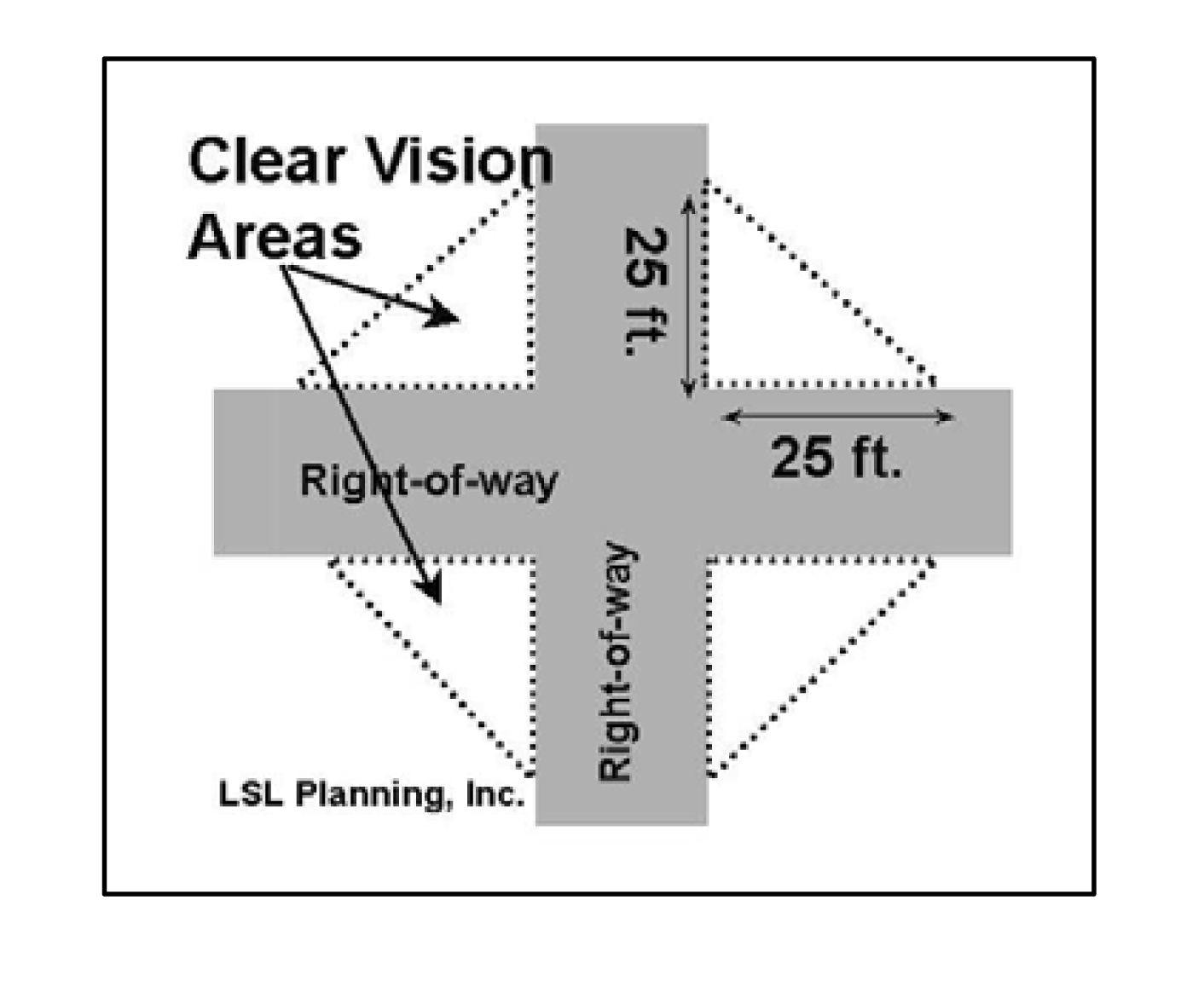
In all districts, no fence, wall shrubbery, sign or other obstruction to vision above a height of 30 inches from the established street grades shall be permitted within the triangular area formed by the intersection of any street right-of-way lines or private road easements by a straight line drawn between said right-of-way lines at a distance along each line of 25 feet from their point of intersection.
(Ord. No. 151, § 11.05, 6-13-2007)

