
Rose Township City Zoning Code
ARTICLE VII
PLANNED UNIT DEVELOPMENT8
State Law reference— Planned unit development, MCL 125.3503.
Sec. 38-509.- Regulatory purpose.
(a)
The planned unit development (PUD) option is intended to permit clustered development that will preserve natural features and the rural character of the township. It is the intent of this section to offer an alternative to conventional development through the use of PUD as authorized by section 503 of the Michigan zoning enabling act, Public Act No. 110 of 2006 (MCL 125.3503) for the following purposes:
(1)
Encouraging the use of land in accordance with its character and adaptability;
(2)
Ensuring the permanent preservation of open space, agricultural lands, and natural resources;
(3)
Providing recreational facilities within a reasonable distance of all residents of the PUD;
(4)
Allowing innovation and greater flexibility in the design of residential developments;
(5)
Facilitating the construction and maintenance of streets, utilities, and public services in a more economical and efficient manner;
(6)
Ensuring compatibility of design and use between neighboring properties; and
(7)
Discouraging sprawling forms of development, thus preserving open space as undeveloped land.
(b)
The regulations of this article are further intended to preserve a traditional rural character to the land use pattern in the township through the creation of small residential areas with open space and less intensive land uses. This article is not intended as a device for avoiding this chapter, the standards set forth therein, nor the planning concepts, upon which this chapter has been based, nor the goals, objectives and strategies of the township master land use plan.
(c)
It is further the intent of this chapter to encourage innovation in design with all new residential development where clustered PUDs can be used to minimize impact on natural features, adjacent land uses and the rural character of the township. To achieve this goal, the township encourages all new development proposals to consider use of the incentives offered by the PUD regulations to realize the benefits of this form of development for the community. These regulations are intended to result in a specific development substantially consistent with the standards of this chapter, yet allow for modifications from the general standards to ensure appropriate, fair, and consistent decision making.
(Ord. No. 151, § 15.01, 6-13-2007)
Sec. 38-510. - Definitions.
The following words, terms and phrases, when used in this article, shall have the meanings ascribed to them in this section, except where the context clearly indicates a different meaning:
Parallel plan means a plan that illustrates how many dwelling units could feasibly and practically be constructed on the subject site with a conventional subdivision plan that meets the dimensional requirements of the zoning district, as may be modified in this article, identifies adequate area for stormwater detention, septic drainfield and reserve area and complies with the township's subdivision design standards set forth in chapter 16.
Planned unit development (PUD) means a predominately single-family residential development in which dwelling units are placed together into one or more groupings within a defined project area. The dwelling units are separated from adjacent properties or other groupings of dwellings by substantial open space that is perpetually protected from development.
Site area means the total horizontal land area within the lot lines of the original parcel, exclusive of any abutting public street right-of-way, or the submerged area of any lake, stream or pond (below the ordinary high-water mark of a permanent body of water).
Undeveloped state means a natural state preserving natural resources, natural features, or scenic or wooded conditions; agricultural uses; open space; or a similar use or condition. The term "undeveloped state" could also include a recreational trail, picnic area, children's play area or linear park.
(Ord. No. 151, § 15.02, 6-13-2007)
Cross reference— Definitions generally, § 1-2.
Sec. 38-511. - Criteria for eligibility.
To be eligible for PUD consideration, the applicant must present a proposal for residential development that meets each of the following:
(1)
Project benefit. The project shall demonstrate that benefits can be provided through site design elements in excess of the requirements of this chapter, such as extensive landscaping, provide transition areas from adjacent residential land uses, unique site design features, unified access (minimize number of access points to public roads), preservation of woodlands and open space, particularly along major thoroughfares, and buffering development from lakes, rivers, streams, and wetlands.
(2)
Project minimum acreage. The minimum size of a PUD shall be five acres of contiguous land.
(3)
Benefit of open space. The proposed development shall provide at least one of the following open space benefits:
a.
Natural features. The site contains significant natural assets such as woodlands, individual trees over eight inch diameter, measured at breast height, rolling topography with grades exceeding 15 percent, significant views, natural drainageways, water bodies, floodplains, regulated or nonregulated wetlands, or natural corridors that connect quality wildlife habitats which would be in the best interest of the township to preserve and which might be negatively impacted by conventional residential development. If animal or plant habitats of significant value exist on the site, the planning commission, as a condition of approval, may require that the PUD plan preserve these areas in a natural state and adequately protect them as nature preserves or limited access areas.
b.
Facilities for recreation. If the site lacks natural features, the site can qualify if the development will preserve an existing recreation facility or provide usable recreation areas to which all residents of the development shall have reasonable access. Such recreation facilities may include a neighborhood park, passive recreational facilities such as trails, soccer fields, ball fields, bike paths or similar facilities which provide a feature of communitywide significance and enhance residential development, but excluding golf courses.
c.
Woodland features. If the site lacks existing natural features, the site can also qualify if the development will create significant woodland features. The creation of significant woodland features shall be considered such as providing perimeter buffer plantings and interior street tree plantings at a rate of twice what is required by this chapter.
(4)
Open space assurance. The applicant shall guarantee to the satisfaction of the township planning commission that all open space portions of the development will be maintained in the manner approved. Such guarantees of open space shall be provided through conservation easements or other legally binding mechanisms found acceptable to the township. Documents shall be presented that bind all successors and future owners in fee title to commitment made as a part of the proposal. This provision shall not prohibit a transfer of ownership or control, provided notice of such transfer is provided to the township and the land uses continue as approved in the PUD plan.
(5)
Neighborhood concept. The proposed development shall be designed to create a cohesive community neighborhood through common open space areas for passive or active recreation and resident interaction. All open space areas shall be equally available to all residents of the PUD. Where a PUD is adjacent to another PUD or public recreation area, open space connections shall be provided between the adjoining open space areas.
(6)
Control. The proposed development shall be under single ownership or control, such that there is a single person or entity having proprietary responsibility for the full completion of the project. The applicant shall provide sufficient documentation of ownership or control in the form of agreements, contracts, covenants, and/or deed restrictions that indicate that the development will be completed in its entirety as proposed.
(7)
Density impact. The proposed type and density of use shall not result in an unreasonable increase in the need for or impact to public services, facilities, roads, and utilities in comparison to the intensity of use that would otherwise be permitted by this chapter, as depicted in the parallel plan, and shall not place an unreasonable impact to the subject and/or surrounding land and/or property owners and occupants and/or the natural environment.
(8)
Master plan implementation. The proposed development shall be consistent with and further the implementation of the township master plan.
(Ord. No. 151, § 15.03, 6-13-2007)
Sec. 38-512. - Location, uses.
(a)
Location. Clustered PUDs and lot averaging PUDs may be approved within any zoning district that allows single-family residential. A mixed-use PUD shall only be permitted as an overlay of a site that is zoned C-1 local business district or C-2 general business district.
(b)
Uses. A PUD is restricted to principal and special land uses allowed in the zoning district. Special land uses are required to follow the requirements and procedures of article IX of this chapter.
(Ord. No. 151, § 15.04, 6-13-2007)
Sec. 38-513. - Density determination.
The number of dwelling units allowable within a PUD project shall be determined through preparation of a parallel plan. The parallel plan is intended only to illustrate the allowable density for a site based upon the reduced lot sizes listed in the table following subsection (1)b of this section, which are intended as an incentive to utilization of the clustered PUD option. Once the density is determined, then the same number of units shall be incorporated into a site plan for a cluster or lot averaging PUD.
(1)
The applicant shall prepare, and present to the planning commission for review, a parallel design for the project that is consistent with state, county, and township requirements and design criteria for a tentative preliminary plat or a land division under the Michigan land division act (MCL 560.101 et seq.). The parallel plan shall provide a buildable are for each lot that meets all dimensional standards of the underlying zoning district with sufficient area for septic drainfield and reserve area, provide sufficient right-of-way for roadways, and contain an area which conceptually would provide sufficient area for stormwater detention.
a.
Where the lot averaging PUD option is proposed, the minimum lot area and width on the parallel plan for the purpose of determining residential density shall be as normally required under article III of this chapter.
b.
Where the clustered open space PUD option is proposed, the minimum lot area and width on the parallel plan for the purpose of determining residential density shall be as shown in the following table:
c.
For the purpose of calculating lot area on the parallel plan, land areas occupied by regulated wetlands and areas designated in the township master plan as natural areas by the Michigan Natural Features Inventory (MNFI) shall be discounted at 50 percent (e.g., two acres of wetland equals one buildable acre). Lots in the parallel plan shall provide sufficient building envelope size without impacting regulated wetlands and areas designated in the township master plan as natural areas under the MNFI. The buildable upland area of each lot on the parallel plan shall be a minimum of one acre or 75 percent of the above minimum lot area requirement, whichever is less.
d.
For a mixed-use PUD, a parallel plan shall not be required and the density and dimensional standards shall be as provided for in section 38-518.
(2)
The parallel plan is only used to determine allowable density for a PUD. Allowable density is not necessarily the maximum density in the underlying zoning district. The planning commission reserves the right to alter the allowable density based upon the presence of natural features and sufficiency of the plan to mitigate impact upon such natural features and any design features which further the purposes of the township master land use goals, objectives and policies.
(3)
The planning commission shall review the design and determine the number of lots that could be feasibly constructed according to the objectives of the township master plan and purposes of this chapter. This number, as determined by the planning commission, shall be the maximum number of dwelling units allowable for the PUD project.
(4)
In computing the number (density) of single-family residential lots, building sites or condominium units, or dwelling units in a PUD, land under water shall not be used for computation purposes.
(Ord. No. 151, § 15.05, 6-13-2007)
Sec. 38-514. - Regulatory flexibility.
(a)
Base zoning regulations. Unless modified by the planning commission, according to the PUD standards, all requirements of this chapter for the zoning district shall remain in full force.
(b)
Authority of planning commission. To encourage flexibility and creativity consistent with the PUD concept, the planning commission may grant specific departures from the requirements of this chapter as a part of the approval process for the following:
(1)
Yard, lot width, and bulk standards may be modified, provided that such modifications result in enhanced buffering from adjacent land uses or public rights-of-way, or preservation of natural features.
(2)
Standards that apply to entryway features such as decorative gates (nonclosable), walls and signs may be modified, provided that the overall entranceway design is reviewed by the planning commission and found to be consistent with the proposed PUD and the character of the surrounding area in terms of size, materials, color, lighting, and landscaping.
(c)
Approval of modifications. Any regulatory modification shall be approved through a finding by the planning commission that the deviation shall result in a higher quality of development than would be possible using conventional zoning standards. Regulatory modifications are not subject to variance approval of the zoning board of appeals. No part of a PUD plan may be appealed to the zoning board of appeals. This provision shall not preclude an individual lot owner from seeking a variance following final approval of the PUD, provided such variance does not involve alterations to open space areas as shown on the approved PUD site plan or the requirements of the article.
(d)
Table of modifications. A table shall be provided on the site plan which specifically details all deviations from the established zoning district's lot area, height and setback regulations, off-street parking regulations, general provisions, subdivision (or condominium) regulations or other provisions of this chapter which would otherwise be applicable to the uses and development proposed in the absence of this article. This specification should include chapter provisions from which deviations are sought, and the reasons and mechanisms to be utilized for the protection of the public health, safety, and welfare in lieu of the regulations from which deviations are sought. Only those deviations consistent with the intent of this chapter and the township master land use plan shall be considered.
(Ord. No. 151, § 15.06, 6-13-2007)
Sec. 38-515. - Development options.
PUDs may be developed under one of the following three options:
(1)
Cluster PUD. A clustered open space PUD may be allowed where the number of dwelling units that could otherwise be developed on the overall parcel is clustered on 50 percent of the land with the remaining 50 percent of the land area preserved as open space, remaining in an undeveloped state in perpetuity. The requirements for this option are provided for under section 38-516.
(2)
Lot averaging. A lot averaging PUD may be allowed where lot areas and lot widths are varied such that the average lot area is equal to that required in the underlying zoning district for the respective zoning district. The requirements for this option are provided for under section 38-517.
(3)
Mixed-use PUD. A mixed use PUD shall be permitted as an overlay of any site that is zoned C-1 local business district or C-2 general business district. The intent is to facilitate the development of a traditional, pedestrian-oriented hamlet with mixed-use buildings containing retail and service uses on the first floor and residential on upper floors, complemented by surrounding residential following traditional neighborhood design principles. The requirements for this option are provided for under section 38-518.
(Ord. No. 151, § 15.07, 6-13-2007)
Sec. 38-516. - Open space cluster.
(a)
Standards. A clustered open space PUD that proposes to preserve a minimum of 50 percent of the site area as open space, remaining in an undeveloped state in perpetuity by means of a conservation easement, plat dedication, restriction covenant, or by other legal means, shall meet the following standards:
(1)
Modifications. Yard, lot width, and bulk standards may be modified, provided that such modifications results in enhanced buffering from adjacent land uses or public rights-of-way, or preservation of natural features.
(2)
Lot area and width. Lot area and width may be reduced below the minimum requirement of article III of this chapter; provided that the area of lot reduction shall be set aside as common open space. All lots shall meet requirements of the county health department for well and septic. Lots with both well and septic shall not be reduced to less than one acre; provided however, the township board may permit lots no less than 35,000 square feet where the petitioner submits with the preliminary site plan a letter from the county health department stating that soils are suitable for septic systems and that the lots are adequate for primary and reserve drainfields and well-septic separation. Such documentation shall be provided prior to the township board consideration of the preliminary site plan.
(3)
Open space. All land within a development that is not devoted to a residential unit or road right-of-way shall be set aside as common land for neighborhood use, recreation, conservation or agriculture.
(4)
Areas not considered open space. The following land areas are not included as dedicated open space for the purposes of meeting the requirements of this section:
a.
Area proposed as single-family residential lots or site condominiums;
b.
Area proposed to be occupied by multiple-family dwellings, including the minimum required setbacks around buildings;
c.
The area of any road right-of-way or private road easement;
d.
Area occupied by a golf course; and
e.
Any submerged land area of a pond, lake or stream, located below the ordinary high-water mark, as defined by part 301 of Public Act No. 451 of 1994 (MCL 324.30101 et seq.) on inland lakes and streams.
(b)
Wetlands and stormwater ponds. Protected wetlands and stormwater ponds designed to appear and function similar to a natural wetland may be counted as open space, provided at least 50 percent of the minimum required open space shall be in the form of usable park area or upland nature preserves.
(1)
Open space location. Common open space shall be planned in locations visible and accessible to all in the PUD. The common open space may either be centrally located, along the road frontage of the development, located to preserve natural features, located to buffer adjacent farmland, link with adjacent open space or recreation land or located to connect open spaces throughout the development, provided the following areas shall be included within the open space area:
a.
The open space along the exterior public roads shall have a depth parallel to the right-of-way of at least 100 feet, either landscaped or preserved in a natural wooded condition meeting the requirements of section 38-521.
b.
Open space shall be situated to maximize the preservation of any existing site woodlands.
c.
The master deed shall specify that within all open space areas, a minimum 25-foot-wide undisturbed setback shall be maintained from the edge of any lake, stream or wetland. The township may permit trails, boardwalks, observation platforms or other similar structures that enhance passive enjoyment of the site's natural amenities within the setback.
d.
Where adjacent land includes open space or public land, open space connections shall be provided between the site and adjacent open space. Trails between adjoining open space development shall be constructed to allow future interconnection between neighborhoods.
(2)
Open space protection. The dedicated open space shall be set aside in perpetuity by the developer through a conservation easement that is found acceptable to the township. The conservation easement shall ensure that the open space will be protected from all forms of development, except as shown on an approved site plan, and shall never be changed to another use. The conservation easement shall provide the following:
a.
Allowable use of the dedicated open space shall be indicated. The township may require the inclusion of open space restrictions that prohibit the following:
1.
Dumping or storing of any material or refuse;
2.
Activity that may cause risk of soil erosion or threaten any living plant material;
3.
Cutting or removal of live plant material except for removal of dying or diseased vegetation;
4.
Use of motorized off-road vehicles;
5.
Cutting, filling or removal of vegetation from wetland areas;
6.
Use of pesticides, herbicides or fertilizers within open space.
b.
The dedicated open space shall be maintained by parties who have an ownership interest in the open space. Standards for scheduled maintenance of the open space shall be provided. The township shall be permitted to conduct inspections of the open space and may require restoration of any damage to natural features by parties who have an ownership interest in the open space. The conservation easement shall provide for maintenance to be undertaken by the township in the event that the open space is not adequately maintained, or is determined by the township to be a public nuisance, with the assessment of costs upon the owners of the open space.
c.
The dedicated open space shall forever remain open space, subject only to uses approved by the township on the approved site plan. Further subdivision of open space land or its use for other than recreation, conservation or agricultural purposes shall be strictly prohibited. Any change in use of the open space from what is shown on the approved site plan shall require township board approval, based upon a recommendation by the planning commission and shall not diminish compliance with the requirements of this chapter.
d.
The open space or a conservation easement for the open space may be conveyed to a conservation organization or to a public agency for recreational or conservation use.
(Ord. No. 151, § 15.08, 6-13-2007)
Sec. 38-517. - Lot averaging.
(a)
The township recognizes that certain parcels provide wildlife habitat, plant life and/or other natural characteristics (e.g., slopes, wetlands, woodlots) in need of preservation and protection and that varying lot sizes may assist in preserving these priority resources. These characteristics must be the basis for lot averaging. The intent of this section is to permit the applicant to vary lot sizes and lot widths so as to average the minimum size of lot per building site as required in the schedule of regulations of the underlying district. However, lot averaging shall not create an attendant increase in the number of lots or building sites otherwise provided under the terms of this chapter.
(b)
To the maximum extent feasible, any PUD proposed for lot averaging shall be designed and arranged to ensure that disturbance to any priority resource protection area as a result of development will be minimal. Negative impacts and disturbances to such areas and the plant and animal life of such areas shall be minimized through the use of natural buffer areas, conservation easements, deed restrictions, restrictive covenants, creative lot arrangements or other means acceptable to the township board.
(1)
In order to meet the average minimum lot size, lot area or width shall be reduced by not more than 25 percent below the area or width otherwise required by the underlying zoning district.
(2)
All computations which are used in determining lot area and the average resulting through this technique shall be indicated on the drawing which accompanies the PUD application.
(3)
Approval of a PUD lot averaging under this section shall be conditioned upon recordation with the county register of deeds, an appropriate conservation easement and/or other instruments for the purpose of providing for longterm maintenance of any private roads, drainage features and/or fire suppression features and preservation of open space areas, wooded areas, natural features and/or other priority resource protection areas to be preserved on the property proposed for division or for creation of building sites. Such instrumentation shall be in a form and content approved by the township.
(4)
The existence of natural features and priority resource protection areas are subject to verification and acceptance by the planning commission.
(5)
Use of lot averaging may be required by the planning commission for building sites, in order to meet the purposes of this subsection (b).
(Ord. No. 151, § 15.09, 6-13-2007)
Sec. 38-518. - Mixed-use PUD.
A mixed-use PUD shall be permitted as an overlay of a C-1 local business district or C-2 general business district zoned site meeting all of the following requirements:
(1)
Uses. The planning commission shall determine the appropriate mixture of uses based upon compatibility with surrounding land uses and the intent of creating a pedestrian-oriented, fully integrated, mixed-use development. The PUD may include all permitted uses in the underlying business district and all special land uses; except automobile, and recreational vehicle sales, and rental, drive-in restaurants, automotive repair establishments and autowashes. Single-family residential dwellings and multiple-family dwellings shall be permitted at a density of up to six dwelling units per acre, subject to meeting state and county health department requirements.
(2)
Dimensional standards. The dimensional standards of the underlying zoning district shall apply, except as follows:
(1) Where the side or rear perimeter of a mixed use PUD side abuts a residential zoning district, a 50-foot setback and buffer zone B shall be provided in accordance with article V of this chapter.
(2) An unroofed stoop and steps shall be allowed to project into the front yard setback up to the front lot line.
(3) Nonresidential and mixed use buildings shall be required to be built to the front lot line. Awnings may encroach upon the frontage line and sidewalk, but shall provide at least eight feet of clearance above the sidewalk, be set back a minimum of three feet from the road curb and not interfere with street trees.
(4) Parking shall not be permitted between the front of the building containing the pedestrian entrance and the front lot line. Parking shall be to the side or rear of the building. Where side yard parking is visible from the street, a streetwall shall be provided consisting of a picket fence, ornamental wrought iron fence, a brick wall or a continuous evergreen hedge.
(5) A zero side setback may be permitted where a firewall is provided along the side lot line. Where a firewall is not provided, buildings shall be set back a minimum of ten feet.
(3)
Open space. The proposed development shall be designed to create cohesive community neighborhoods through a network of spaces such as parks, plazas and common open space areas for passive or active recreation and resident interaction.
a.
A minimum of 25 percent of the site shall be set aside for open space, which shall contain some form of active recreational facility such as plazas, common greens or parks.
b.
The common open space shall be located to preserve significant natural features, central to the residents of the development and to connect open spaces throughout the development.
(4)
Design standards. All uses shall be designed in keeping with traditional neighborhood design principles and shall comply with the following:
a.
Residential buildings shall utilize high-quality traditional architectural styles characteristic of the midwestern United States. All residential units shall provide a pedestrian door facing the front lot line. The front facade of all residential units shall be at least 15 percent windows or doors, excluding garage doors. All dwellings shall include a front porch or front stoop with steps. Townhouses shall be designed with the front door at least three feet above the grade of the sidewalk in front of the dwelling and at grade from the rear; provided that garage doors and basement entrances shall be permitted below this grade. The planning commission may permit a portion of the units to have front entrances at grade.
b.
Residential facades shall not be dominated by garages, but shall instead utilize recessed garages, attached rear-entry garages, garages that are accessed via a rear service drive or detached garages located in the rear yard. Garages facing towards the front lot line may be permitted where both of the following requirements are met:
1.
The length of the garage wall facing the street is less than 50 percent of the length of the street-facing building facade; and
2.
The front of the garage is set back at least five feet behind the front building line of the living portion of the dwelling.
c.
Nonresidential buildings shall be designed with traditional styles of architecture, consistent with a rural, small-town environment and consistent with the recommendations of the master plan. Buildings shall front onto the sidewalk with windows, doors, and architectural detailing customary of traditional storefronts and contain varying materials, and appearances.
d.
All buildings shall utilize high-quality building materials, which shall be approved by the planning commission as part of an architectural design pattern book. Residential buildings shall utilize building materials that are in keeping with traditional architectural styles. Nonresidential architecture shall comply with the requirement of article V of this chapter, except all facades that face a street shall utilize brick or stone as the primary building material.
e.
An interconnected street network shall be provided:
1.
Roads shall meet the minimum requirements of the road commission for county. Private roads shall be permitted, provided they meet the requirements of chapter 16, article IV, pertaining to roads standards for a type I private road, and provided that the township may require wider roads to accommodate on-street parking.
2.
Rear alleys shall be permitted to be a minimum of 20 feet wide.
3.
Culs-de-sac and other dead-end streets shall be discouraged. Where it is not possible or desirable to provide a through street, the planning commission may allow a looped drive with a common green in the center. The circular drive around the green shall be at least 20 feet wide and the central green shall be no less than 20 feet at its narrowest dimension and be landscaped.
f.
A continuous pedestrian circulation system shall be provided throughout the PUD. Minimum four-foot-wide concrete sidewalks shall be required along all residential streets within the PUD. Minimum eight-foot-wide concrete sidewalks shall be required along all commercial frontages in the PUD and where designated in the pathways plan in the township master plan.
g.
All site design requirements of article V of this chapter shall be met, provided that the planning commission may modify the landscape greenbelt and buffer zone requirements or article V of this chapter and section 38-521(b) where consistent with the intent to create a mixed use development with a traditional small-town/hamlet streetscape. For commercial lots, frontage greenbelt canopy tree requirements may be met by planting street trees within the street right-of-way. Buffer zone requirements between commercial parking lots and residential uses within the PUD may be satisfied through the provision of brick screening walls a minimum of four feet six inches tall.
h.
The conceptual PUD plan shall include specifications and standards for overall design features, including architecture, lighting, street furniture, landscaping, signs and other site features to be approved by the planning commission. These standards shall be included in a design pattern book that is provided as an exhibit to the site plan.
(Ord. No. 151, § 15.10, 6-13-2007)
Sec. 38-519. - Roads.
(a)
Private roads in PUDs shall meet the minimum requirements and specifications of a class I, II or III road, or combination thereof, based on criteria set forth in chapter 16, article IV, pertaining to road standards.
(b)
Public roads shall comply with the requirements of the road commission for the county.
(Ord. No. 151, § 15.11, 6-13-2007)
Sec. 38-520. - Natural features.
(a)
Limits of tree clearing. The development shall be designed so as to preserve natural resources. Every effort shall be made to preserve high-quality woodland areas with native trees such as native species of birch, apple, aspen, basswood, beech, birch, box-elder, cherry, chestnut, cottonwood, dogwood, elm, fir, hackberry, hemlock, hickory, larch, linden, maple, oak, pine, poplar, spruce, sumac, sycamore, tamarack, and walnut. The limits of tree clearing and grading shall be clearly shown on the preliminary site plan or plat. The planning commission may require a woodland inventory for areas near proposed roads and other construction areas.
(b)
Wetlands. All site wetlands shall be preserved to the maximum extent possible, as determined by the planning commission. Stormwater drainage may be direct to wetlands provided that there shall not be significant disturbance to wetland and proper detention and sedimentation is provided to maintain a natural flow to wetlands.
(c)
Animal or plant habitats. If animal or plant habitats that are characteristic of presettlement habitat exist on the site, the township, as a condition of approval, may require that the site plan preserve these areas in a natural state and adequately protect them as nature preserves or limited access areas.
(Ord. No. 151, § 15.12, 6-13-2007)
State Law reference— Natural resources management, MCL 324.30101 et seq.
Sec. 38-521. - Landscaping.
The following landscaping requirements shall be met in addition to other landscaping requirements contained in this chapter:
(1)
Street trees. Both sides of all internal roads shall be landscaped with street trees. For road frontages of individual lots or condominium sites, a minimum of two canopy trees shall be provided per dwelling. For sections of road that do not abut lots or condominium sites, one canopy tree shall be provided on each side for every 40 feet of road. Existing trees to be preserved within ten feet of the road right-of-way or easement may be credited towards meeting this requirement.
(2)
Frontage greenbelt. A minimum 100-foot-deep greenbelt shall be maintained along the exterior public roads. This greenbelt shall be landscaped with the plant material required for a residential greenbelt under article V of this chapter arranged in natural groupings. Preservation of existing trees within the greenbelt may be credited towards meeting the landscaping requirement, provided that such trees are inventoried and preservation methods are detailed on the site plan.
(3)
Natural landscaping. Landscaping shall be designed to provide a natural appearance and plant materials shall be native to the state.
(Ord. No. 151, § 15.13, 6-13-2007)
Sec. 38-522. - Stormwater management.
(a)
All ponds and stormwater management facilities shall be designed to fit into the natural landscape and provide a natural appearance. The overall stormwater drainage for the site shall be designed to minimize the impact of site drainage on adjacent land and the hydrology of adjacent watercourses and wetlands. Wet ponds/constructed wetlands and retention ponds should be used wherever possible. The use of on-site retention is encouraged except in instances where natural water flow from the site must be maintained to preserve the natural hydrology of an adjacent stream or wetland.
(b)
Landscaping shall be provided around the perimeter of stormwater ponds to create the appearance of a natural pond or wetland. Landscaping shall include a combination of canopy trees, shrubs and grasses that are adapted to saturated soil conditions and native to the state. Canopy trees may be dispersed around the perimeter, but should provide greater clusters in locations that will provide shade and minimize the heating effect of the sun on the stormwater pond.
(c)
Stormwater ponds shall be designed with shallow side slopes that do not require fencing.
(d)
The development agreement shall provide for longterm maintenance of the stormwater ponds by the homeowner's association.
(Ord. No. 151, § 15.14, 6-13-2007)
Cross reference— Stormwater management, § 12-86 et seq.
State Law reference— Soil erosion and sedimentation control, MCL 324.9101 et seq.; soil conservation districts law, MCL 324.9301 et seq.
Sec. 38-523. - Pedestrian circulation.
(a)
A pedestrian trail system shall be provided within the open space to allow for passive recreation and shall provide pedestrian connections to any existing or future planned trail.
(b)
Where the site fronts on a road designated for a pathway in the township master plan's pathways plan, an eight-foot-wide asphalt pathway shall be required within the master planned right-of-way for the road; provided that the township board may, based upon the recommendation of the planning commission, permit an alternative surface for uses such as equestrian trails. Pathways in the road right-of-way shall be permitted with approval from the road commission for the county.
(Ord. No. 151, § 15.15, 6-13-2007)
Sec. 38-524. - Development agreement.
The applicant shall submit an agreement stating the conditions upon which approval is based, for review and approval by the township attorney. The agreement, after review by the planning commission and approval by the township board, shall be entered into between the township and the applicant and be recorded with the county register of deeds. Approval shall be effective upon township board approval and subsequent recording. The agreement shall provide:
(1)
A survey of the acreage comprising the proposed development.
(2)
The manner of ownership of the developed land.
(3)
The manner of the ownership and of dedication or mechanism to protect any areas designated as common areas or open space.
(4)
Provision ensuring that those open space areas shown on the plan for use by the public or residents of the development will be or have been irrevocably committed for that purpose. The township may require conveyances or other documents to be placed in escrow to accomplish this.
(5)
Satisfactory provisions have been made to provide for the future financing of any improvements shown on the plan for site improvements, open space areas and common areas which are to be included within the development and that maintenance of such improvements is ensured by a means satisfactory to the township board.
(6)
The cost of installing and maintaining all streets and the necessary utilities has been ensured by a means satisfactory to the township board.
(7)
Provisions to ensure adequate protection of natural features as required by section 38-520.
The preliminary site plan shall be incorporated by reference and attached as an exhibit.
(Ord. No. 151, § 15.16, 6-13-2007)
Sec. 38-525. - Review and approval procedures.
(a)
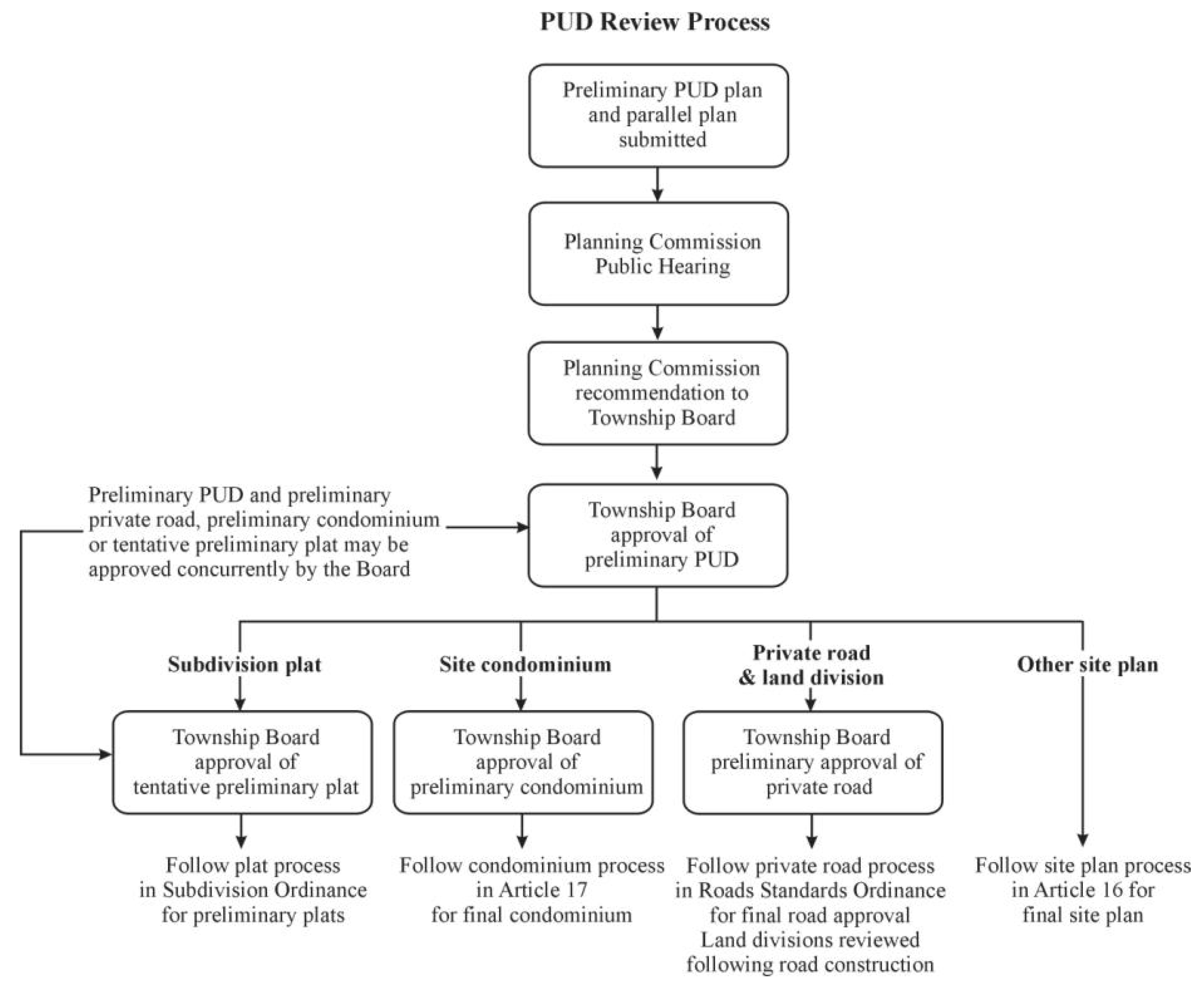
Review process. A PUD may be approved by the township board, based upon a recommendation by the planning commission following the review procedures and approval standards of this article and chapter 16, pertaining to land divisions and subdivisions, where a land division or a subdivision is being proposed; article VIII of this chapter, where a condominium is being proposed; or the site plan review regulations, where a private road is being proposed.
(b)
Preliminary PUD site plan submittal. The preliminary PUD site plan submittal shall include all of the following information:
(c)
Public hearing. The commission shall conduct at least one public hearing for the purpose of receiving public comments on the proposed PUD. Notice of the public hearing shall be provided in accordance with section 38-46. At the public hearing, the planning commission shall review both the PUD preliminary site plan and the parallel plan. Upon conclusion of the public hearing the planning commission shall direct the applicant to revise the PUD to address public comments.
(d)
Planning commission recommendation to the township board. Following the public hearing, the commission shall review both the PUD preliminary site plan and the parallel plan and make a recommendation to the board for approval, denial, or approval with conditions, based upon the following:
(1)
The PUD shall satisfy the eligibility criteria of section 38-511.
(2)
The PUD shall comply with the requirements of this article, other applicable sections of this chapter and the land division, subdivision or condominium standards of the township, as applicable.
(3)
The PUD shall be designed and constructed in a manner harmonious with the character of adjacent property and the surrounding area.
(4)
The PUD shall meet all requirements of the county health department for well and septic systems. The PUD shall not have an adverse impact on the quality and quantity of groundwater.
(5)
The proposed PUD shall be adequately served by essential public facilities and services, such as roads, pedestrian facilities, police and fire protection, drainage systems and schools. The design shall minimize the negative impact on the street system in consideration of items such as vehicle trip generation, access location and design, circulation, roadway capacity, traffic operations at proposed access points and nearby intersections.
(6)
The proposed PUD shall not result an adverse effect on the quality of the natural environment in comparison to the impacts associated with a conventional development.
The commission shall state its reasons for such recommendation. The minutes containing the record of the public hearing and the commission's recommendation shall be forwarded to the board and to the applicant prior to the board's consideration of the PUD. The planning commission shall also concurrently make a recommendation to the township board regarding the tentative preliminary plat or preliminary site plan, as applicable. The township board shall consider the planning commission's recommendation at a public hearing to approve, deny, or approve the PUD with conditions. The preliminary approval shall be valid for one year. If final site plans or subdivision plats for at least the first phase of the project are not submitted and approved within the one-year period, the right to develop under the approved preliminary planned unit site plan shall terminate and a new application must then be filed and processed.
(e)
Conditions. Reasonable conditions may be required with the approval of a PUD, to the extent authorized by law, for the purpose of ensuring that public services and facilities affected by a proposed land use or activity will be capable of accommodating increased demand caused by the land use or activity, protecting the natural environment and conserving natural resources, ensuring compatibility with adjacent uses of land, promoting the use of land in a socially and economically desirable manner, and further the implementation of the township master plan.
(f)
Final approvals.
(1)
Following preliminary approval, the application shall follow the procedures and requirements for final approvals, following the land division, subdivision, condominium or site plan review process, as applicable. Final site plans shall meet all requirements of article II, division 3 of this chapter. Final condominiums shall meet all requirements of article VIII of this chapter. Final preliminary plats shall meet all requirements of chapter 16, pertaining to subdivisions. Final land divisions shall be approved by the land division committee following the procedures and requirements of chapter 16, pertaining to land division.
(2)
All final site plans or final preliminary plats subsequently submitted shall conform with the preliminary PUD plan, all conditions attached to preliminary approval and the requirements of this chapter. Where changes to the final site plan or final preliminary plat significantly deviate from the preliminary PUD plan, the planning commission shall conduct another public hearing and review the plan as an amended resubmission of the preliminary site plan under the standards of this article.
(3)
A zoning compliance permit may be obtained following approval of all engineering plans by the township engineer. If construction has not commenced within 24 months of final approval, all township approvals become null and void. Any property owner who fails to maintain the approved site design shall be deemed in violation of the use provisions of this chapter and shall be subject to penalties for such violation. The planning commission may require that a performance guarantee be deposited with the township to ensure completion of improvements.
(Ord. No. 151, § 15.17, 6-13-2007)

