
Rose Township City Zoning Code
ARTICLE IV
SUPPLEMENTAL REGULATIONS
Sec. 38-397.- Accessory buildings.
Accessory buildings, except as otherwise permitted in this chapter, shall be subject to the following regulations:
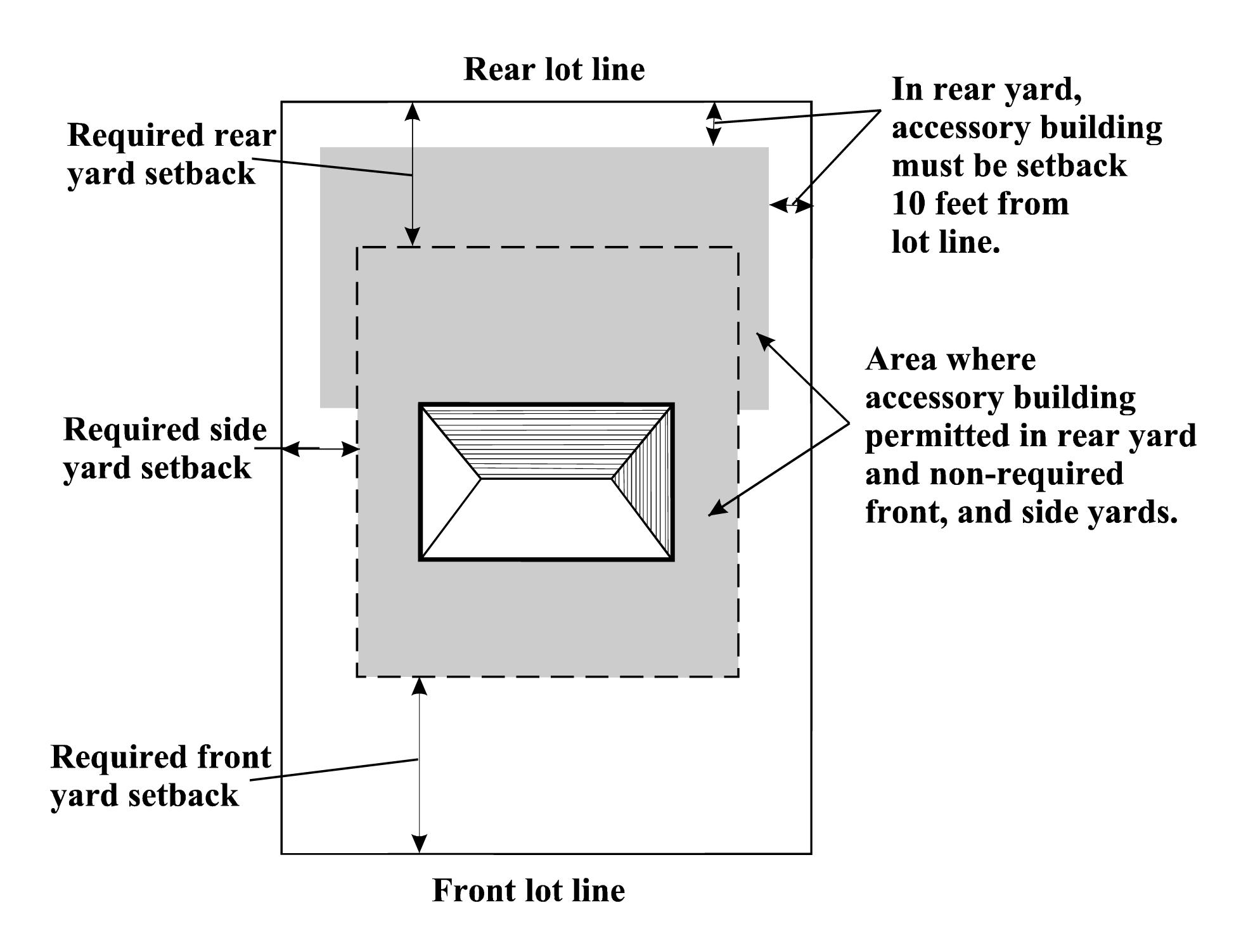
(1)
Location. Detached accessory buildings shall only be located as follows:
a.
Buildings accessory to residential buildings shall not be erected in any required yard space, except when located in the rear yard. Accessory buildings in the front or side yard shall meet both front and side yard setbacks for the district (sections 38-180, 38-201 and 38-232). Accessory buildings in a rear yard that are up to 200 square feet in area must be setback at least ten feet from any side or rear lot line. Accessory buildings greater than 200 square feet in area meet the rear setback required for the district (sections 38-180, 38-201 and 38-232).
b.
Within platted residential subdivisions and residential site condominiums, buildings accessory to residential buildings may occupy not more than 35 percent of a required rear yard.
c.
When a building accessory to a residential building is located on a corner lot, the accessory building shall not be located closer to either street frontage than the required front yard setback.
2.
Height. Detached accessory buildings up to 200 square feet in area shall not exceed one story and 15 feet in height. Those buildings greater than 200 square feet are subject to the height requirements of the district (Sections 38-180, 38-201 and 38-232).
(3)
Floor area. Within platted residential subdivisions and residential site condominiums, accessory buildings shall not exceed the ground floor area of the main building.
(4)
Attached accessory buildings. Where the accessory building is structurally attached to a main building, it shall be subject to and must conform to all regulations of this chapter applicable to main buildings except minimum floor area.
(5)
Principal structure required. No accessory building may be constructed and/or used until such time as a building permit for the principal building is issued. If a principal building is already in place on the subject property, accessory buildings may be constructed in accordance with this chapter and the state construction code.
(6)
Accessory dwelling. One attached dwelling unit may be considered accessory to the principal dwelling subject to issuance of a special land use permit in accordance with article IX of this chapter. The term "attached" means structurally an integral part of the principal structure.
(7)
Basement and garage dwellings prohibited. Buildings erected after the effective date of the ordinance from which this chapter is derived as garages or accessory buildings shall not be occupied for dwelling purposes. Basements or cellars shall not be used or occupied for dwelling purposes at any time.
(Ord. No. 151, § 12.01, 6-13-2007; Ord. No. 175, 2-12-2020)
Sec. 38-398. - Private swimming pools.
(a)
Private swimming pools may be permitted provided a building permit is obtained. Plans and construction shall meet the requirements of the state health department. Swimming pools shall not be constructed or placed nearer to the street than the established front building line. In-ground pools shall be securely fenced with a chainlink or other nonclimbable fence and have self-closing fence gates which shall be kept locked when the pool is not in use. Aboveground pools shall have swing up steps or a similar method of controlling entry to the pool which shall be kept locked when the pool is not in use.
(b)
All electrical installation or wiring in connection with swimming pools shall conform to the provisions of the National Electrical Code. If service drop conductors or other utility wires cross under or over a proposed pool area, the applicant shall make satisfactory arrangements with the utility involved for the relocation thereof before a permit shall be issued for the construction of a swimming pool. No portion of a swimming pool or associated structure shall be permitted to encroach upon any easement or right-of-way which has been granted for public utility use.
(Ord. No. 151, § 12.02, 6-13-2007)
Sec. 38-399. - Fences.
(a)
Fences and walls shall be permitted in all yards. When located in required yards (i.e., between lot line and minimum setback) fence heights shall be as follows:
(b)
Farms in any zoning district and all lots located in the AG/RP district shall be exempt from the fence regulations of this section.
(c)
Fences located in the front yard of any residential lot shall be at least 50 percent opaque.
(Ord. No. 151, § 12.03, 6-13-2007)
Sec. 38-400. - Recreational vehicle storage.
In all residential districts, recreational vehicles shall be permitted in the side and rear yard areas of any zoning lot. Recreational vehicles shall not be stored in the required side yard setback area (i.e., between the side lot line and minimum side yard setback). Recreational vehicles shall not be permitted to be stored in the front yard. Any recreational vehicle or boat stored on a residential lot shall be titled to the occupant of the residential dwelling on that lot.
(Ord. No. 151, § 12.04, 6-13-2007)
Sec. 38-401. - Temporary structure and use permits.
(a)
The granting of a permit for a temporary structure shall in no way constitute a change in the basic uses permitted in the district nor on the property wherein the temporary structure is permitted.
(b)
Temporary structure permits for use during construction shall be issued in writing stipulating all conditions as to time, nature of development permitted and arrangements for removing the structure at the termination of said temporary structure permit.
(1)
Temporary dwelling regulations. Regulations for temporary dwellings shall be as follows:
a.
No person shall place or occupy a temporary dwelling without first obtaining a permit for such placement or occupation from the township. The township may permit the placement and occupancy of a temporary dwelling unit anywhere in the township on a temporary basis for a period of not exceeding one year during the time that the occupant of the temporary dwelling is constructing, with intent to occupy, a permanent dwelling on the same premises. Prior to issuance of a permit, the township building official or his designee must determine that the placement and occupancy of such dwelling does not constitute a threat to the general health, safety and welfare of the occupants of the property or the occupants of surrounding properties.
b.
The conditions under which a permit for a temporary dwelling must comply are as follows:
1.
To guarantee removal of the temporary dwelling and compliance with this chapter, a cash bond must be posted with the township, in an amount to be determined by the township board. The township board may waive this requirement upon written request.
2.
Temporary dwelling permits shall be for a period not to exceed one year from the date of approval by the building official or his designee and may be renewed for a period of six months upon approval of the building official or his designee.
3.
Temporary dwellings must be served by and properly connected to an approved public or private sewage, water system and electrical service.
(2)
Nonresidential temporary structure regulations. Regulations for nonresidential temporary structures shall be as follows:
a.
No person shall place or utilize a nonresidential temporary structure without first obtaining a permit for such placement or use from the township building official or his designee. The township may permit the placement and use of a nonresidential structure anywhere in the township on a temporary basis for a period not in excess of one year; provided that said building official or his designee determines that the placement and use of such structure does not constitute a threat to the general health, safety and welfare of the occupants of the property or the occupants of surrounding properties.
b.
The conditions under which a permit for a nonresidential temporary structure may be issued are as follows:
1.
Nonresidential temporary structures are permitted exclusively for the storage of equipment and materials associated with construction. Such nonresidential temporary structures and uses shall be limited to the period of construction and be located on the construction site.
2.
Nonresidential temporary structures shall not be used until a permit has been issued and the building official or his designee has conducted an inspection and approved use of the building for storage of equipment and materials associated with construction.
3.
To guarantee removal of the temporary structure and compliance with this chapter, a cash bond must be posted with the township in an amount to be determined by the township board. The township board may waive this requirement upon written request.
(3)
Application. A person or entity seeking a temporary structure or temporary use permit in the township must first file an application, provided by the township, with the township building official or his designee. Said application shall contain the following:
a.
The name and address of the property owner and occupant if different from the property owner.
b.
The property identification number.
c.
A plot plan showing the proposed placement of the temporary structure or dwelling and the location of the septic and well that will serve the dwelling, if applicable.
d.
The reason for requesting a permit.
e.
Permission for township officials to enter upon the property for inspection purposes.
f.
An affidavit signed by the property owner confirming that the information provided is true and correct and that the conditions of issuing a permit are understood by the signer/applicant.
g.
All fees required by order of the township board.
(Ord. No. 151, § 12.05, 6-13-2007)
Sec. 38-402. - Requirements for single-family homes.
(a)
The purpose of this section is to provide reasonable standards which ensure that all single-family homes regardless of construction type (e.g., site-built or factory built) are compatible and compare aesthetically within the same residential zone.
(b)
Sufficient evidence must be submitted to the township building inspector to ensure that the following standards are met by single-family homes prior to location on a site in the township:
(1)
All homes permitted under this section shall meet all requirements imposed under the zoning district in which the lot is located.
(2)
All manufactured homes shall be manufactured after January 1, 1978, and be in compliance with all state and federal laws and regulations pertaining to mobile home construction a well as plumbing and fire codes.
(3)
All homes shall be firmly attached to their foundations in compliance with the provisions of the state construction code and state law. No skirting shall be permitted for homes permitted under this section.
(4)
All homes shall be connected to public sewer and water facilities when these utilities are available within 300 feet.
(5)
Any accessory uses involving the construction of accessory buildings and/or additions to the home shall meet the requirements of this chapter and the state construction code.
(6)
All homes permitted under this section shall be aesthetically compatible in design and appearance with homes within the area, including a roof with compatible pitch and overhang, appropriate siding or exterior finishes, front and rear or front and/or exterior doors, permanently attached steps or porch areas constructed in a manner consistent with the design of other homes within the area.
(7)
All homes shall have a minimum width of 20 feet as measured across any front, side, and rear elevation.
(8)
The standards contained in this section do not apply to mobile homes located in a mobile home park or manufactured housing community approved by the state manufactured housing commission.
(9)
The standards do not allow or permit the placement or construction of a home in those areas where deed restrictions or other covenants prevent it.
(Ord. No. 151, § 12.06, 6-13-2007)
State Law reference— Standards for mobile homes to be compatible with site-built homes, MCL 125.2307.
Sec. 38-403. - Home occupation.
(a)
It is the intent of this section to allow for and regulate the establishment of home occupations that are compatible with the neighborhood in which they are located and which will preserve the peace, quiet, and domestic tranquility within all residential districts in the township. Home occupations shall be permitted subject to the following conditions:
(1)
No more than 20 percent of the usable floor area of the principal and accessory buildings shall be dedicated to the occupation.
(2)
There shall be no significant traffic volume increase associated with the occupation.
(3)
No storage of materials, goods, supplies or equipment related to the occupation shall be visible from the outside of any structure located on the premises or adjacent premises.
(4)
There shall be no change in the outside appearance of the building or premises, no structural alterations, or visible evidence of the conduct of such occupation.
(5)
No equipment or process shall be used in such occupation, which creates noise, vibration, glare, fumes, toxic/hazardous substances, odors, or electrical interference. No equipment or process shall be used which creates visual or audible interference in any radio or television receivers off the premises.
(6)
No more than two clients or customers shall visit the premises at any one time.
(7)
Any need for parking shall be met off the street and in other than the front yard.
(8)
There shall be no exterior advertising.
(9)
These regulations shall not apply to farms or other nonresidential uses allowed in the district.
(b)
Medical marihuana home occupation regulations.
(1)
Intent. It is the intent of this section to give effect to the intent of the Michigan Medical Marihuana Act, Initiated Law 1 of 2008, MCL 333.26421 et seq. (hereinafter "Act") as approved by the electors and not to determine and establish an altered policy with regard to marihuana. These provisions are designed to recognize the fundamental intent of the Act to allow the creation and maintenance of a private and confidential patient-caregiver relationship to facilitate the statutory authorization for the limited cultivation, storage, distribution and use of marihuana for medical purposes; and to regulate this fundamental intent in a manner that does not conflict with the Act so as to address issues that would otherwise expose Rose Township and its residents to significant adverse conditions.
In consideration of this concern, local regulations enumerated below generally provide that: the primary caregiver must reside on the property where his/her medical marihuana is cultivated and/or stored; medical marihuana primary caregiver activity only occur within a single-family dwelling and/or accessory building, as authorized by the township; and, the distribution and use of medical marihuana occur on the lot occupied by the qualifying patient. Nothing in this section shall be construed as allowing persons to engage in conduct that endangers other or causes a public nuisance, or to allow the use, cultivation, growth, possession or control of marihuana not in strict accordance with the express authorizations of the Act and these regulations; and nothing in this section shall be construed to undermine or provide immunity from federal and state law as it may be enforced by the federal or state government relative to the cultivation, storage, distribution or use of marihuana.
(2)
Definitions. The following definitions shall apply for the purposes of this section:
Collective ingestion facility means a facility that allows multiple qualifying patients to consume or ingest medical marihuana upon the premises. This term does not encompass the consumption or ingestion of medical marihuana by a qualifying patient at his/her residence or at a hospital or hospice at which the qualifying patient is receiving care.
Dispensary means any operation where marihuana is distributed to a qualifying patient by someone other than his/her designated primary caregiver.
Enclosed locked facility means a closet, room, or other comparable, stationary, and fully enclosed area equipped with secured locks or other functioning security devices that permit access only by a registered primary caregiver or registered qualifying patient.
Marihuana means the substance defined as such in Section 7106 of the Public Health Code, 1076 PA 368 MCL 333.7106.
Michigan Medical Marihuana Act or Act means the Michigan Initiated Law 1 of 2008, MCL 333.26421 et seq.
Primary caregiver means a primary caregiver as defined under MCL 333.26423(h) of the Act, and who has been issued and possesses a registry identification card under the Act.
Qualifying patient means a qualifying patient as defined under MCL 333.26423(i) of the Act, and who has been issued and possess a registry identification card under the Act.
Registry identification card means the document defined as such under MCL 333.26423(j) of the Act and which is issued by the State of Michigan to identify a person as a registered qualifying patient or registered primary caregiver.
(3)
Remainder of article; effect of permit approval. In recognition of the unique nature of the medical marihuana home occupation provided for hereunder, the conditions and requirements set forth in paragraph (a) above for home occupations shall not be applicable to medical marihuana home occupations. In addition, the issues of a medical marihuana home occupation permit hereunder shall relieve the applicant from any obligation of site plan review or a land use permit for the activity authorized thereunder.
(4)
Regulations.
a.
Medical marihuana home occupation permit requirement.
1.
The cultivation, storage and/or distribution of marihuana by a primary caregiver conducted in accordance with the Act shall be allowed as a permitted use on a conforming lot and within a conforming building (principal or accessory) in the AG/RP agricultural and rural preserve district subject to the terms and conditions set forth in this section. The growing of marihuana plants outdoors is expressly prohibited. Except as set forth in subsection (5) below, no such cultivation, storage and/or distribution shall be lawful in Rose Township unless and until the location of the premises in which such primary caregiver activity is conducted has received a medical marihuana home occupation permit under this section.
2.
The requirement of this section is to require a permit for a location and not to license persons. A confidential application for a medical marihuana home occupation permit on a form approved by the township board shall be submitted to the zoning administrator. An application shall:
(i)
Not require the name, home address or date of birth of a qualifying patient.
(ii)
Include the name of the primary caregiver (or medical marihuana home occupation permit holder, if different), and the address of the premises.
(iii)
Describe the enclosed locked facility in which any and all cultivation of marihuana is proposed to occur or where marihuana will be stored, with such description including the location of the facility in the building.
(iv)
For safety and other code inspection purposes, describe and provide detailed specifications of equipment proposed to be used to facilitate the cultivation and harvesting of marihuana plants including, but not limited to, lighting, HVAC, electrical service, and plumbing.
(v)
Include a description of the odor mitigation systems and a ventilation plan that provides for adequate ventilation so as to prevent pesticides, insecticides or other chemicals used in the cultivation of marihuana from being dispersed or released outside of the building.
(vi)
Include an operations plan that addresses water use, water discharge, and the disposal of waste, as well as a description of type, quantity, location and method of containment for any herbicides, pesticides, or fertilizers that will be used for growing, cultivating, and harvesting marihuana.
(vii)
Demonstrate that the applicant holds a valid registry identification card.
(viii)
Contain such other information as the township board determines is needed for the administration of this section or to ascertain satisfaction of the standards for the granting of a permit hereunder.
3.
No application for a permit hereunder shall be approved without payment of a non-refundable application fee to help defer a portion of the cost of administering and enforcing this section. The application fee shall be set by resolution of the township board and may be adjusted from time to time thereafter as the township board deems appropriate.
4.
It is the intent of this section that the information acquired through the permitting procedure prescribed herein shall be accessible to the zoning administrator, Michigan Construction Code, fire code enforcement officials, and law enforcement officials and their support personnel, in the performance of their duties and shall otherwise remain confidential and not subject to public discloser except as otherwise required by law.
b.
Requirements and standards for approval of permit and for the activity permitted.
1.
There shall be not more than one primary caregiver operating upon the lot for which a permit is requested. The primary caregiver shall reside within the dwelling located upon the lot for which a permit is requested. A primary caregiver may assist the number of qualifying patients allowed under the Act with their medical use of marihuana.
2.
The lot for which a permit is requested shall not be located:
(i)
Within 1,000 feet of a public or private elementary or secondary school, public or private preschool or licensed daycare facility.
(ii)
Within 300 feet of public park or public recreational area.
(iii)
Within 1,500 feet of another lot for which a medical marihuana home occupation permit has been issued pursuant to this section.
Measurements for purposes of this subsection shall be made from the lot line to the public park, public recreational area, or a lot which previously received a medical marihuana home occupation permit.
3.
Subject to the exceptions set forth in subsection (6) below, the medical marihuana primary caregiver activity shall occur only within a single-family dwelling or approved accessory building. The primary caregiver activity shall at all times be subordinate and incidental to the use of the dwelling as a residence.
4.
The primary caregiver shall be allowed to cultivate the number of marihuana plants allowed under the Act for each of his/her qualifying patients. All marihuana and marihuana plants shall be contained inside the main residential structure or an approved accessory building, except when being delivered by the primary caregiver to a qualifying patient off-site.
5.
That portion of the single-family dwelling unit used for the growing, processing, or storage of medical marihuana shall not exceed a gross floor area of 150 square feet.
6.
All medical marihuana must be kept in an enclosed locked facility to which only the registered patient and/or primary caregiver have access.
7.
The primary caregiver shall not distribute or allow the use of marihuana by the qualifying patients he/she is designated to serve upon the lot for which a permit is issued hereunder unless the qualifying patient resides therein.
8.
If a residential room with windows is utilized as a marihuana growing location, any lighting methods that exceed usual residential use between the hours of 10:00 p.m. and 6:00 a.m. shall employ shielding methods to prevent ambient light spillage that causes or creates a distraction or nuisance to any adjacent residential properties.
9.
No equipment or process shall be used in growing, processing, or handling marihuana which creates additional noise, vibration, glare, light, fumes, odors or electrical interference detectable to the normal senses at or beyond the property line of the property. In case of electrical interference, no equipment or process shall be used which creates visual or audible interference with any radio, television, broadband, or similar receiver off the premises or cause fluctuation in line voltage off the premises.
10.
All necessary building, electrical, plumbing and mechanical permits shall be obtained for any portion of a premises in which electrical wiring, lighting and/or watering devices are located, installed or modified that support the cultivation or harvesting of marihuana. Prior to a permit issued hereunder taking effect and the commencement of primary caregiver activities, the premises shall be inspected for compliance with applicable provisions of the Michigan Construction Code and the Michigan Fire Code. The premises shall be inspected annually thereafter for continued compliance with all applicable zoning ordinance and construction code and fire code requirements.
Furthermore, the applicant shall submit a load sheet to the planning, design and engineering department of the applicable energy provider.
The load sheet will determine load limits and capability of the electrical system, and set safety standards such that the growing operation does not impact the electrical service for surrounding properties.
The applicant must include approval of the load sheet from the energy provider as part of its application for an electrical permit. A permit will not be issued without this approval.
The applicant shall be responsible for any costs associated with the preparation and submittal of this information, which is not included in the review fee established by the township board for a medical marihuana home occupation permit.
11.
There shall be no sign identifying the premises as a site at which medical marihuana is cultivated, harvested or distributed.
12.
The primary caregiver activities conducted on the premises for which a medical marihuana home occupation permit is granted hereunder shall be in conformance with the application approved hereunder, the Act, and the administrative rules promulgated pursuant to the Act.
13.
Nothing in this section shall be deemed to allow dispensaries or collective ingestion facilities, which are hereby strictly prohibited.
(5)
Disclaimer of immunity. Nothing in this section shall be construed as allowing the use, cultivation, distribution or possession of marihuana not in strict compliance with the express provisions of the Act and the provisions of this section. Further, nothing in this section shall be construed to undermine or provide immunity from federal or state law as it may be enforced by the federal or state government relative to the use, cultivation, distribution or possession of marihuana or to prevent prosecution thereunder.
(6)
Exceptions. This section shall not be deemed to prohibit or restrict or require a permit for the following:
a.
The cultivation, storage and/or use of marihuana by a qualifying patient solely for his/her personal use at his/her residence or at a hospital or hospice at which he/she is received care and in accordance with the provisions of the Act and the administrative rules adopted thereunder.
b.
The cultivation, storage and/or distribution of marihuana in accordance with the Act by a primary caregiver solely to provide services to not more than one qualifying patient who is a member of the primary caregiver's household and whose residence is shared with the primary caregiver.
c.
The provision of assistance to a qualifying patient by his/her designated primary caregiver relating to medical marihuana use, including distribution or other assistance, in accordance with the Act and the administrative rules adopted thereunder, at the residence of the qualifying patient or at a hospital or hospice at which the qualifying patient is receiving care.
(7)
Enforcement. Any violation of this section shall be considered a civil infraction.
(Ord. No. 151, § 12.07, 6-13-2007; Ord. No. 177, 12-8-2021)
State Law reference— Single-family residence, instruction in craft or fine art as home occupation, MCL 125.3204.
Sec. 38-404. - Use restriction.
No portion of a lot or parcel once used in complying with the provisions of this chapter for yards, lot area per family, density as for a development in the multiple-family district, or percent rate of lot occupancy, in connection with an existing or proposed building or structure, shall again be used as part of the lot or parcel required in connection with any other building or structure existing or intended to exist at the same time.
(Ord. No. 151, § 12.08, 6-13-2007)
Sec. 38-405. - Lot limitations.
No lot, parcel or building site shall be occupied by more than one principal building, and in the case of condominium projects, each building site shall be limited to one principal building. This restriction shall not apply to multifamily projects, commercial shopping centers, and office/industrial parks with multiple buildings.
(Ord. No. 151, § 12.09, 6-13-2007; Ord. of 9-5-2008(1), § 3)
Sec. 38-406. - Access requirements.
(a)
All uses in every use district shall abut and have direct access to a certified and improved public street or an approved private road that meets the requirements of chapter 16, pertaining to road standards. Private road access may include lots that front on a conforming private road or a class A nonconforming private road, in accordance with chapter 16. Developments shall provide multiple points of access/egress where required by chapter 16, article IV. Projects which have (or could have according to the land division act or condominium act) 25 parcels or building sites shall be required to have direct access which adjoins a major thoroughfare.
(b)
Two adjacent residential lots that both have frontage along the same paved county primary road may be accessed by a single shared driveway meeting the following standards:
(1)
The driveway surface shall be a minimum of 16 feet wide. The shared portion of the driveway shall not exceed a length of 50 feet.
(2)
The driveway shall be constructed of materials suitable to accommodate emergency vehicles.
(3)
There is a recorded shared access agreement and easement that is a minimum of 33 feet wide. This easement may be included in the calculation for minimum lot area and width.
(4)
Both lots shall have the minimum required frontage on the same road and a shared driveway shall not be used to access flag lots or stacked lots.
(Ord. No. 151, § 12.10, 6-13-2007)
Sec. 38-407. - Access management for commercial driveways.
The intent of this section is to establish standards for the number and spacing of commercial driveways for application during the site plan review process. The standards of this section are intended to promote safe and efficient travel within the township; minimize disruptive and potentially hazardous traffic conflicts; separate traffic conflict areas by reducing the number of driveways; provide efficient spacing standards between driveways, and between driveways and intersections; protect the substantial public investment in the street system; and to ensure reasonable access to properties, though not always the most direct access. The following regulations shall apply to commercial driveways serving nonresidential uses, including retail businesses, industrial uses and institutional uses. These regulations shall not apply to residential or agricultural driveways.
(1)
The number of commercial driveways serving a property shall be the minimum number necessary to provide reasonable access and access for emergency vehicles, while preserving traffic operations and safety along the public roadway. Access shall be provided for each separately owned parcel; provided that this access may be an individual driveway, shared driveway or a service drive. Additional driveways may be permitted for property only as follows:
a.
One additional driveway may be allowed for properties with a continuous frontage of over 300 feet, and one additional driveway for each additional 300 feet of frontage.
b.
The planning commission may determine that an additional access is justified if it will not compromise traffic operations along the public street.
(2)
Driveways shall be located to minimize interference with the free movement of traffic, to provide adequate sight distance, and to provide the most favorable driveway grade.
(3)
Minimum spacing requirements between a proposed commercial driveway and an intersection either adjacent or on the opposite side of the street may be set on a case-by-case basis, but in no instance shall be less than the distances listed in this section. The following measurements are from the near edge of the proposed driveway, measured at the throat perpendicular to the street, to the near lane edge of the intersecting street or pavement edge for uncurbed sections.
(4)
Minimum spacing between commercial driveways shall be determined based upon posted speed limits along the parcel frontage. The minimum spacing indicated as follows is measured from centerline to centerline.
(5)
To reduce left-turn conflicts, new commercial driveways shall be aligned with those across the roadway where possible. If alignment is not possible, driveways shall be offset a minimum of 250 feet along arterial streets and 150 feet along collector and local streets from those on the opposite side of the roadway. These standards may be reduced by the planning commission if approved by the road commission for the county.
(6)
For sites with insufficient street frontage to meet the requirements of this section, the planning commission may require construction of the driveway along a side street, a shared driveway with an adjacent property, access by a service road or construction of a driveway along the property line farthest from the intersection or nearest adjacent driveway.
(7)
Where a driveway is shared between two adjacent sites, a shared access easement and maintenance agreement shall be provided between the lots having access to the driveway.
(8)
Where the planning commission determines during site plan review that reducing the number of access points may have a beneficial impact on traffic operations and safety while preserving the property owner's right to reasonable access, a shared commercial driveway, frontage road or rear service drive connecting two or more commercial properties or uses shall be required. In particular, service drives shall be required along major thoroughfares with high traffic volumes and along segments with a relatively high number of crashes, or limited sight distance.
a.
The service road shall be within an access easement permitting traffic circulation between properties. This easement shall be a minimum of 40 feet wide.
b.
Service roads shall have a base, pavement and curb with gutter in accordance the road commission for the county standards for public streets, except the width of the service road shall have a minimum pavement width of 24 feet.
c.
Each property owner shall be responsible for maintenance of the easement and service drive within their respective lot.
(Ord. No. 151, § 12.11, 6-13-2007)
Sec. 38-408. - Private road standards and procedures.
All roads required to provide for access or development pursuant to this chapter shall comply with chapter 16, article IV, pertaining to road standards.
(Ord. No. 151, § 12.12, 6-13-2007)
Sec. 38-409. - Common use riparian access lots.
(a)
The use of any waters, streams, ponds, and drainageways of all types shall be restricted to that right of use enjoyed by the owner or occupant of a riparian parcel which is contiguous to the water and has riparian rights as of the effective date of the ordinance from which this chapter is derived. If a riparian parcel is proposed to be used by persons other than the owner residing thereon or occupant residing thereon, for boat launching, docking or mooring, dockominium or similar access for boating, then a special land use permit shall be required as provided for in article IX of this chapter. Where a riparian lot is proposed to be developed as a multiple-family use with more then one dwelling unit for boat launching, docking or mooring, the establishment of the lake access shall require a special land use permit. An easement over a residential riparian lot utilized to provide boat access or docking for an individual who is not a resident of such residential riparian lot shall also be subject to the special land use permit requirements.
(b)
Common use riparian access lots shall meet the requirements of sections 38-579 and 38-582(13).
(c)
Existing common use riparian lots (keyholes) that existed prior to the effective date of the ordinance from which this chapter is derived and were improved with facilities to provide common use access to a water body may continue to provide such riparian access. Any improvements to the keyhole that increases the number of boats be moored or docked shall be subject to the special land use requirements of sections 38-579 and 38-582(13).
(Ord. No. 151, § 12.13, 6-13-2007)
Sec. 38-410. - Performance standards.
No use otherwise allowed shall be permitted within any district which does not conform to the following standards of use, occupancy, and operation, which standards are hereby established as minimum requirements to be maintained within said area:
(1)
Smoke, dust, dirt and fly ash. It shall be unlawful for any person to engage in any use or operation which causes the emission of smoke, fumes, airborne solids and the like in excess of the maximum allowable limit as regulated by all applicable state and federal laws and regulations.
(2)
Open storage. The open storage of any industrial or commercial equipment, industrial or commercial vehicles and all industrial or commercial materials including wastes, except new merchandise for sale and/or display, shall be screened from public view, from a public street and from adjoining properties by an enclosure consisting of an obscuring wall or obscuring fence not less than the height of the equipment, vehicles and all materials to be stored. Whenever such open storage is adjacent to a residential zone or mobile home park in either a front, side or rear lot line relationship, whether immediately abutting or across a right-of-way from such zone, there shall be provided an obscuring wall or obscuring fence of at least six feet in height.
(3)
Fire and explosive hazards. The storage and handling of flammable liquids, liquefied petroleum, gases, and explosives shall comply with all applicable state laws and regulations.
(4)
Wastes. No wastewater shall be discharged in the public sewer system or any public or private storm drainage facilities or to the ground that is dangerous to the public health and safety.
(5)
Noise. Objectionable sounds, including those of intermittent nature, shall be controlled so as not to become a nuisance to adjacent uses, said noise level not to exceed 80 decibels as measured with appropriate scientific equipment at the property line.
(6)
Vibration. All machinery shall be so mounted and operated as to prevent transmission of ground vibration beyond the property line.
(Ord. No. 151, § 12.14, 6-13-2007)
State Law reference— Natural resources and environmental protection act, MCL 324.101 et seq.
Sec. 38-411. - Groundwater contamination prevention.
Any principal use or special land use which, in the determination of the planning commission, involves the use of substances in large quantities potentially harmful to groundwater may be subject to a requirement for submission and approval of a materials management plan for the safe use, recycling and disposal of such substances. In addition to any other requirements, such uses shall be required to obtain a special land use permit prior to receiving a building permit, zoning compliance permit or occupancy permit. Any use that involves fuel services and use or storage of large quantities of hazardous materials shall comply with the following requirements:
(1)
Secondary containment. Establishments using, storing or handling hazardous material shall provide secondary containment facilities and documentation of compliance with state and federal regulations, as required. Underground storage tanks shall be provided with noncorrosive double linings and leak detection systems.
(2)
Materials management plan. A materials management plan shall be submitted that provides documentation for the following, with appropriate correspondence from the Michigan Department of Environmental Quality (MDEQ), state police fire marshal, local fire department, and the county health department:
a.
Description of any discharge of any type of wastewater to a storm sewer, drain, lake, stream, wetland, other surface water body or into the groundwater;
b.
Description of storage of any potentially hazardous materials, including common name, name of chemical components, material safety data sheets, location, maximum quantity expected on hand at any time, type of storage containers or base material, and anticipated procedure for use and handling;
c.
Description of any transportation, on-site treatment, storage or disposal of hazardous waste generated in quantities of 250 gallons or 2,200 pounds per month;
d.
Description of any secondary containment measures proposed including design, construction materials and specifications, volume and security measures;
e.
Name and phone number of person responsible for materials and available 24 hours, in case of detected spill.
(3)
Permits. Any discharge of wastewater to a storm sewer, drain, lake, stream or other surface water shall be documented and appropriate permits obtained from the MDEQ surface water quality division. Any discharge of liquids, sludge, wastewater and/or wastewater residuals into or onto the ground shall be documented and appropriate permits obtained from the MDEQ waste management division. If flammable or combustible liquids are to be stored in fixed aboveground storage containers with a capacity greater than 1,100 gallons, this shall be documented and appropriate permits obtained from the state police fire marshal division. Storage of pesticide or fertilizer in quantities greater than 55 gallons or 100 pounds shall be documented and appropriate permits obtained from the state department of agriculture, pesticide and plant pest division.
(Ord. No. 151, § 12.15, 6-13-2007)
State Law reference— Water resources protection, MCL 324.3101 et seq.
Sec. 38-412. - Sewer and septic systems.
(a)
Requirement for water and sanitary facilities. No permit shall be issued for the construction of a building that is to have drinking water and sanitary facilities unless such facility is connected to a public sanitary sewer system approved by the township, a septic system approved by the county health department, or a common community sanitary drainfield approved by the township.
(b)
Reservation of alternative drainfield. For sites with individual septic systems or private community wastewater system, an area of land shall be designated on the site plan as reserved as an alternate location for a septic disposal system to provide for the possible failure of a septic disposal system.
(Ord. No. 151, § 12.16, 6-13-2007)
State Law reference— Sewage disposal, MCL 324.4101 et seq.
Sec. 38-413. - Special assessment districts for privately owned systems.
The township may require the establishment of a special assessment district for any development that has some form of privately owned infrastructure, such as a private road, private utilities, private sewage system, private stormwater system or other similar private facility that is commonly owned by the residents or property owners in the development. The developer shall also be required to prepare a maintenance agreement assigning responsibility of maintaining the private system or infrastructure with the owners of the development.
(1)
Prior to the township granting final approval for the development, the applicant shall petition the township board to establish a special assessment district for the development. The purpose of the special assessment district shall be to provide for assessment of the units, lots or parcels in each development by the township for the costs of inspection, monitoring, maintenance, repair, operation or replacement of the private system or infrastructure in the event the association shall fail to properly perform such work. The township may elect to collect all costs it may incur in connection with the private system through the special assessment.
(2)
The private system maintenance agreement shall be in the form approved by the township attorney and shall be recorded at the office of the county register of deeds after approval by the township. The maintenance agreement shall not be changed without township approval and shall contain language to that effect.
(3)
The provisions of the maintenance agreement and special assessment district shall be included in a separate disclosure document and shall be delivered to the prospective purchaser of a unit, lot or parcel served by a private system prior to the execution of a purchase agreement.
(4)
A permanent and irrevocable easement shall be granted by the applicant, owner and association to the township and its employees, agents, and assigns authorizing the township to enter on the development upon which the private system is located for the purpose of inspections.
(Ord. No. 151, § 12.17, 6-13-2007)
Cross reference— Any ordinance levying or imposing any special assessment saved from repeal, § 1-11(a) (12).

