
Roselle City Zoning Code
SECTION 2
- GENERAL PROVISIONS
2-1. - How to Use this Section.
2-1-A. This Section lists general zoning rules applicable for structures and uses of a property throughout the Village. It has provisions for the items shown in the Table of Contents above.
2-1-B. This Section complements specific zoning district regulations in other sections of this ordinance. Users should know the specific zoning district where a subject property is located and be familiar with any special regulations in this Section in order to understand requirements to improve or develop property.
2-1-C. Specific questions about this Section should be directed to the Roselle Community Development Department.
2-2. - Lots.
2-2-A. Number of Buildings on a Zoning Lot. Except in the case of a Planned Unit Development, not more than one principal building shall be located on a zoning lot.
2-2-B. Access to Public Streets. Every lot shall abut and have access to an existing public street, and every principal building or garage constructed upon such lot of land shall be located and designed for vehicles and pedestrians to safely reach a public street.
2-2-C. Limits to Access Across Residential Lots. No lot or portion thereof located in a Residence District shall be used for driveway, walkway, or access purposes to any land which is located in a Business, Office Research, or Industrial District or used for any purpose not permitted in a Residence District, unless otherwise approved as part of a Planned Unit Development.
2-2-D. Division of zoning lots. No improved zoning lot shall be divided into two (2) or more zoning lots unless all improved zoning lots resulting from such division conform with all the applicable regulations of the zoning district in which the property is located, and the other applicable requirements of the Village Code are met.
2-2-E. Nonconforming lots:
1. Contiguous Lots in Single Ownership. If two (2) or more contiguous lots in single ownership are nonconforming with respect to lot area or width for the zoning district in which they are located, and their merger will create a single conforming zoning lot, then upon any application for zoning relief under this ordinance, the contiguous lots will be merged to enable improvement of the newly created conforming zoning lot. Otherwise, each lot will be used only in accordance with the requirements of Section 8 Nonconforming Lots, Buildings, Structures, and Uses of this ordinance.
2. Single Lots or Parcels of Land. When any single lot is nonconforming with respect to lot area or width for the use district in which it is located, it shall be used only in accordance with the requirements of Section 8 Nonconforming Lots, Buildings, Structures, and Uses of this ordinance.
3. Minimum Lot Size. Every structure constructed after the effective date of this ordinance shall be on a lot of land that meets the lot size requirements of the zoning district within which it is located.
2-2-F. Reserve Lots.
Reserve lots are prohibited. Reserve lots in existence as of the date of adoption of this ordinance shall be maintained in accordance with the following:
1. All lots shall be a minimum of one acre, exclusive of the portion of the lot used as the reserve strip;
2. Each reserve strip providing access to a lot shall be not less than twenty (20) feet in width;
3. When any part of two (2) or more reserve lots or the reserve strips by which they are accessed abut a lot fronting a dedicated street, it must have a frontage of not less than one hundred twenty-five (125) feet wide along the street;
4. All reserve lots shall have been subdivided in accordance with the Subdivision Regulations (Appendix B of the Village Code); and
5. Where more than one reserve lot exists adjacent to another, and the two (2) reserve strips are abutting, the reserve strips shall be maintained as a private access easement to the lots. In addition, the reserve strips shall create only one permitted entrance to the dedicated street.
2-2-G. Sight Triangle.
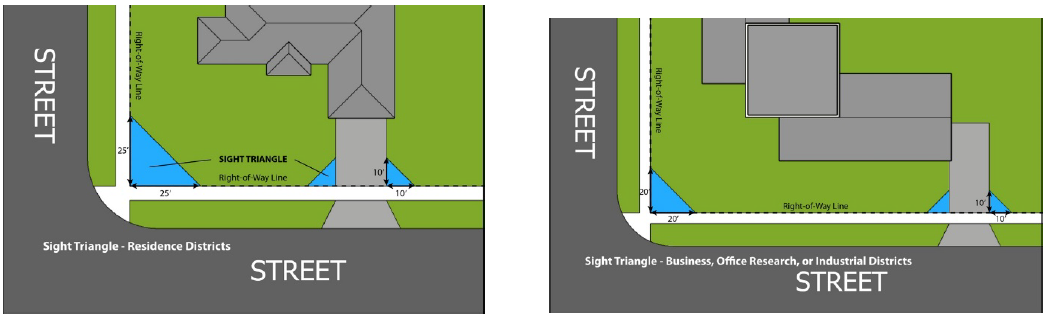
At the intersection of two (2) streets or the intersection of a street and a driveway, no Structure, planting or other visual obstruction may exceed a height of three (3) feet above Grade within the following Site Triangles (With distances equivalent to "x" as indicated in Figure 3-1):
1.
All Residence Districts: Within twenty-five (25) feet of the intersection of right-of-way lines.
2.
All Business, Office Research, or Industrial Districts: Within twenty (20) feet of the intersection of right-of-way lines.
3.
All driveways: With ten (10) feet of the intersection of the right-of-way line and driveway edge.
2-3. - YARD REQUIREMENTS.
2-3-A. Yards, General.
1. All yards and other open spaces allocated to a building, buildings, or dwelling group shall be located on the same zoning lot as such building, buildings, or dwelling group.
2. No lot shall be reduced in area so that the yards or spatial dimensions become less than required by this ordinance.
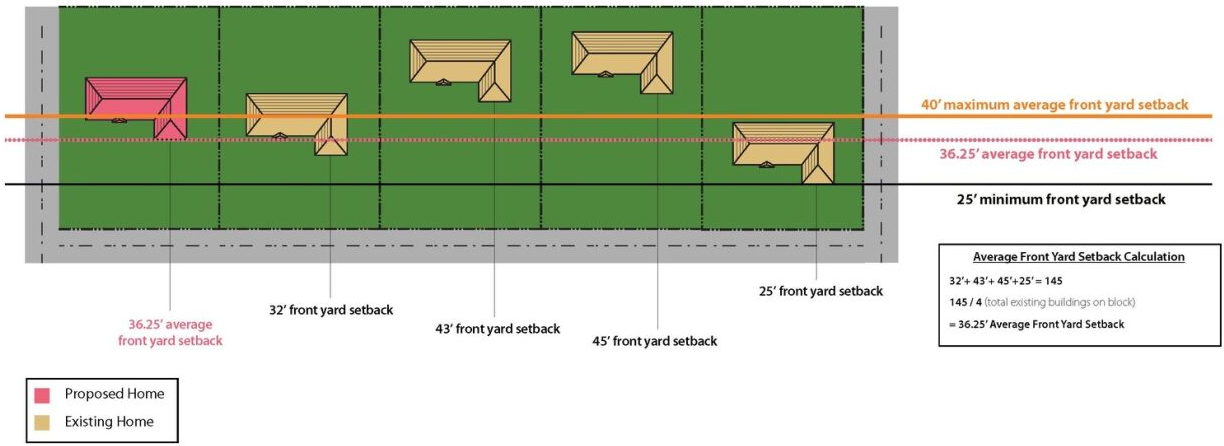
3. Where fifty (50) percent or more of the frontage of a block has been developed with existing buildings, there shall be maintained a front yard setback for new construction of not less than the average existing setback or forty (40) feet, whichever is shallower.
4. Vacant Corner Lots: For a vacant Corner Lot, the front lot line shall be designated as the shortest of the lot lines abutting a street right-of-way. That designation is permanent and may not be subsequently changed.
5. Vacant Through Lots.
a. For a through lot, the front yard setback established for the zoning district in which the property is located shall be provided along any lot line abutting a street.
b. On a vacant through lot, the property owner may designate either of the lot lines abutting a street right-of-way as its front lot line prior to issuance of a building permit for a new principal building, except as described in subsection 5 c below. That designation is permanent and may not be subsequently changed.
c. Where any lot along a block frontage has duly established a front lot line, the same street lot line shall be deemed to be the front lot line of all lots on that block frontage.
6. For the purpose of establishing permitted obstruction and setback lines, any yard which adjoins a street shall be considered a Front Yard.
2-3-B. Permitted Encroachments in Required Yards.
The following accessory buildings, structures, and uses are permitted and may encroaching required yards as follows:
1. F—Denotes permitted encroachment in front yards and side yards adjoining streets.
2. S—Denotes permitted encroachment in interior side yards.
3. R—Denotes permitted encroachment in rear yards.
4. Table of Permitted Yard encroachment
2-3-C. Screening of Permitted Encroachments in Required Yards.
Central air conditioners and generators located in required yards shall be screened with an evergreen landscape hedge if otherwise visible from a public right-of-way, as determined and approved by the Zoning Administrator to accomplishing screening and not create a safety hazard.
2-4. - Fences.
2-4-A. Purpose.
Fences provide privacy, security, boundary definition, aesthetic appearance, and safety for the residential and business properties in the Village. These regulations provide a framework for installation, construction and placement of fences to support health, safety, and welfare of the community.
2-4-B. General Provisions.
1. No fence may be located in the Sight Triangle as regulated in Section 4-2-G of this Section.
2. Fences shall be erected with the finished side of the fence facing away from the property (posts, supporting members and the rough part of a fence shall face the interior of the property), expect as described in subsection B-3 below.
3. The finished side of a fence may face the interior of the property when erected on a residentially zoned property lot line abutting a, business, office-research or industrial district, or in the case of a residential property abutting an alley separating a residential district from a nonresidential district.
4. The height of a fence shall be measured from the existing Grade at the location where the fence is installed.
5. Fences shall be designed and constructed to be in keeping with the requirements of Article III: Village Building Code of the Village Code and to resist a horizontal wind pressure of not less than thirty-five (35) pounds per square foot in addition to all other forces to which they may be subjected.
6. No fence, wall or landscaping may be erected, constructed or maintained on any portion of a lot where the natural stormwater runoff would be impeded or where such fence would interfere with drainage of contiguous properties.
7. The use of electrically charged fences is prohibited.
8. Spikes, sharply pointed pickets (of any material), broken glass, or other materials that presents potentially hazardous surfaces are prohibited as part of fences.
9. No fence may located within any street right-of-way.
10. Fire hydrants shall not be blocked by fence or landscaping.
11. Temporary Fences are exempt from the provisions of this Section.
12. Construction and maintenance of fences shall be the duty of the occupant and/or owner of the property upon which such fence is located. All fences erected shall be well maintained. Proper maintenance shall include but is not limited to painting, resetting of nails, trimming of natural fences, and repair of broken or weak boards, posts, torn chain link, etc.
13. All permanent fences in existence at the time of adoption of this Chapter, but not conforming to one or more of its applicable provisions, shall be allowed to remain until such time as they are damaged or removed. Such fences shall be subject to the nonconforming provisions of this Chapter, Section 7: Nonconforming Uses and Structures.
14. Permits. No fence shall be erected or altered until a permit (in a format and including information as specified by the Zoning Administrator) has been secured from the Village by the property owner and the required permit fee paid.
15. Variation requests related to fences shall be addressed per Section 4-4-C Variations.
2-4-C. Permitted Fences.
Fences allowed under this Chapter shall be either Decorative Fences, Privacy Fences, or Dog Runs.
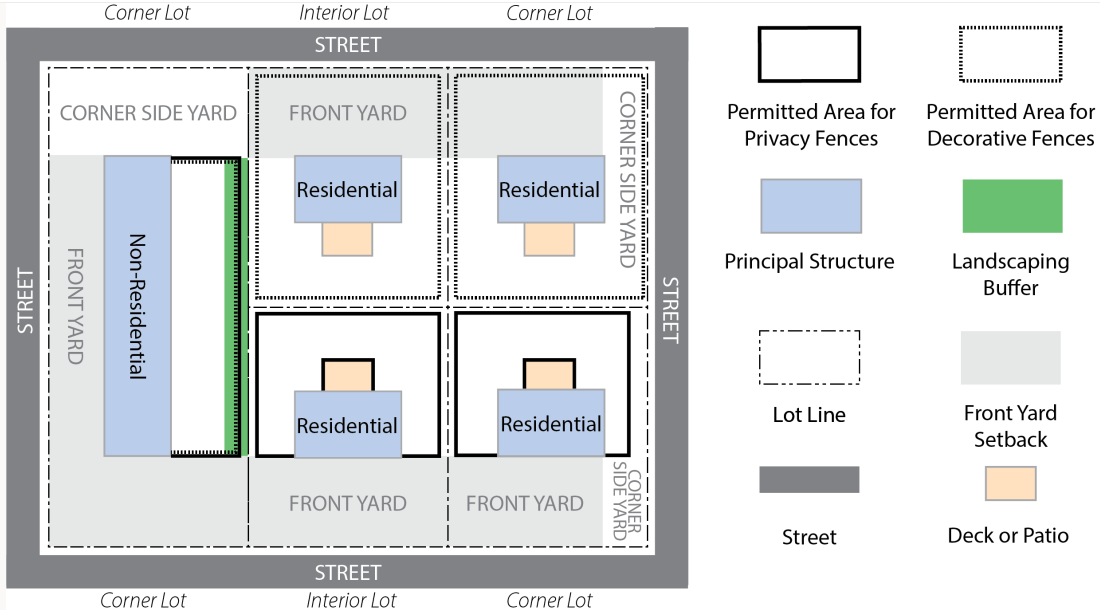
1. Decorative Fences shall be at least fifty percent (50%) open.
2. Privacy Fences may be one hundred percent (100%) opaque.
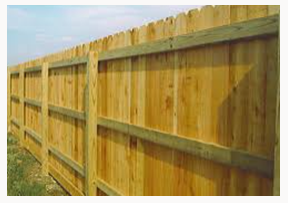
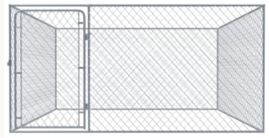
3. Dog Runs maybe constructed as decorative fences.
2-4-D. Fences Permitted in Residence Districts.
1. Decorative Fences:
a. may be constructed in a side, corner side, or rear yard up to a height of five (5) feet.
b. may be constructed in a front yard up to a height of four (4) feet.
2. Privacy Fences shall be allowed in keeping with the following:
a. May be located in a required side or rear yard up to a height of six (6) feet.
b. May be constructed in a corner side yard up to a height of six (6) feet provided that said fence is not located any closer to a corner side yard property line than a distance of 50% of the required corner side yard setback (as shown in the figure below).
c. Privacy Fences used to screen a deck or patio shall be allowed in keeping with the following:
i. may be up to eight (8) feet in height.
ii. may not extend more than five (5) feet beyond the perimeter of the deck or patio.
3. Fences around private recreational areas shall conform to the following requirements:
a. Private residential swimming pools shall be completely enclosed by a Privacy Fence so as to safely control access to the pool.
b. Tennis courts may be totally enclosed with a decorative (e.g., chain-link or woven wire fence without slats) not to exceed ten (10) feet in height and located in conformance with the accessory buildings requirements of this Chapter.
4. Dog runs shall be located in rear or side yards, not within five (5) feet of a side lot line. A dog run shall be limited to not more than seven (7) feet in height.
2-4-E. Fences in the Business, Office-Research and Industrial, and Manufacturing districts.
1. Decorative or Privacy Fences may be located in rear or side years up to ten (10) feet in height. Fences are not allowed in front yard or corner side yards.
2. When a property line in a Business, Office-Research and Industrial, or Manufacturing districts abuts a lot in residential use, a fence shall be required in the abutting yard with sufficient distance to install landscaping to screen the fence from residential lot. Also see Section 6-3 on Transitional Landscaping Requirements.
3. All fences exceeding six (6) feet in height shall have regularly spaced apertures to provide adequate wind passage and aesthetic appearance.
4. Barbed wire may be part of a fence for security purposes when the fence is accessory to Utility and Public Service uses otherwise allowed in the Manufacturing Zoning District. Where allowed, the barbed wire shall be placed at least eight (8) feet above grade and shall not be placed over a property line.
2-5. - Accessory Buildings, Structures and Uses.
2-5-A. Time of Construction. No accessory building, structure, or use shall be constructed or established prior to the time of construction or establishment of its associated principal building, structure, or use.
2-5-B. Yard Regulations. Unless otherwise determined in specific zoning districts, accessory buildings, structures, and uses shall comply with the following yard requirements:
1. Accessory buildings, structures, or uses may be attached or detached from the principal building, structure, or use of land.
2. All accessory buildings, structures, or uses shall comply with all yard requirements of the zoning district in which located unless allowed as an encroachment per Section 4-3-B above.
3. Detached accessory buildings, structures or uses shall not be located within a corner side yard.
4. Accessory buildings, structures, or uses shall not be located on or within any utility or drainage easement created by a duly recorded document.
2-5-C. Bulk Regulations. All accessory buildings or structures shall comply with the bulk regulations of the zoning district in which they are located (see Section 3) and the following requirements:
1. All structures located on a lot shall be counted toward the Lot Coverage (comprehensive), as defined by this Chapter, for the lot on which they are located.
2. The area of all the accessory building or structures shall be added to the area of any primary structure in the computation of the Floor Area Ratio and Comprehensive Lot Coverage.
3. Garages. One garage may be permitted per on zoning lots that are less than one (1) acre in area. A second garage may be permitted on zoning lots greater than one (1) acre in area as a Special Use subject to the Special Use provisions of Section 3-1 of this Chapter. In addition, garages shall conform with the following requirements:
a. Attached garages. The maximum building footprint area shall not exceed eight hundred (800) square feet.
b. Detached garages. The maximum building footprint area shall not exceed eight hundred (800) square feet.
4. Sheds. One shed, a maximum size of one hundred twenty (120) square feet shall be permitted per zoning lot.
5. Height Regulations. All accessory buildings, structures, or uses shall comply with the height limitations of the zoning district in which located, except that:
a. In all Residence Districts the height of an accessory building, structure, or use shall not exceed fifteen (15) feet.
b. Parapet walls, steeples, flagpoles, chimneys, cooling towers, elevator bulkheads, fire towers, water towers, stacks, and necessary mechanical appurtenances shall be permitted to exceed the maximum height provisions when erected in accordance with all other requirements of this ordinance.
2-5-D. Swimming Pools, Hot Tubs, And Outdoor Spas.
1. Swimming pools, hot tubs or outdoor spas and any deck attached thereto, may be located no closer than five feet (5') to any property line or easement.
2. Swimming pools, hot tubs and outdoor spas shall be set back from all overhead electric distribution, aboveground service utility transformer, pedestal, meter, and any buried electric distribution or service utility line as required by Chapter 6: Buildings of this Code.
3. All swimming pools, hot tubs, and outdoor spas, shall provide an adequate and secured enclosure when not in use or supervised. Said enclosure shall comply with Building Code regulations as identified in Chapter 6: Buildings of this Code.
2-5-E. Trash/Recycling/Grease Enclosures.
1. Applicability. A permanent enclosure for storage of trash, recycling, grease and other waste materials shall be provided for every use in an industrial, commercial, or business zoning district, and multiple family dwellings of more than four (4) units.
2. Location and Placement. Trash/Recycling/Grease enclosures shall:
a. not be located in any front yard or corner side yard.
b. be located to allow for unobstructed access to each dumpster and the unobstructed opening of the gates;
c. be located in such a manner that any service vehicle will not block any street intersection or principal drive aisle;
d. be located so as not to be readily visible from adjoining properties and the public right-of-way; and
e. when on a property adjacent to residentially zoned properties, Trash/Recycling/Grease enclosures shall be placed as far as possible from the adjacent residential property line.
3. Materials, Construction, and Design.
a. The Trash/Recycling/Grease enclosure shall be one or more of the following types of materials:
i. Solid stockade or solid decorative wooden fencing;
ii. Face brick wall;
iii. Decorative concrete block wall;
iv. Reinforced wall with applied decorative finish; or
v. Materials determined by the Zoning Administrator to be comparable and in keeping with the intent of this Section.
b. Trash/Recycling/Grease enclosure area shall be:
i. enclosed on three (3) sides with permanent materials and on the fourth side with an access gate;
ii. be of sufficient height to conceal contents on all sides including containers, and in no case shall be less than four (4) feet or greater than six (6) feet in height above grade;
iii. placed on a concrete surface; and
iv. consistent with the color, material and texture of the principal building.
2-5-F. Chicken Coops.
1. "Coop" shall be defined as in Chapter 4Section 11 of the Village Code as an enclosure, building, or pen that is designed, constructed, and maintained to confine fowl within and prevent access by predators and trespassers.
2. Coops and enclosures shall be maintained in clean, dry, and sanitary conditions at all times.
3. An enclosed run shall not exceed a maximum size of sixty (60) square feet of floor area.
4. A coop shall not exceed a maximum size of twenty-five (25) square feet of floor area.
5. A coop shall have a minimum setback of fifteen (15) feet from all neighboring property lines.
6. A coop shall have a minimum setback of thirty (30) feet from the nearest neighboring primary dwelling unit.
7. A coop shall have a maximum height of six (6) feet.
8. Coops must be located in the rear yard of a property as defined in Section 1-3-B of the Zoning Ordinance.
9. Chicken coops shall not be allowed to be in any part of the home or garage.
10. Rear yard must be fenced.
(Ord. No. 2024-4335, § 2, 6-10-24)
2-6. - Outdoor Business Activities.
2-6-A. General Requirements.
1. Any outdoor business activity conducted in conjunction with a use permitted by the applicable zoning district shall be accessory to the principal use and done in accordance with this Section and other applicable requirements of the Roselle Village Code.
2. Outdoor business activity shall be designated as either permanent or temporary.
2-6-B. Permanent Outdoor Business Activity:
Such activity is subject to the following:
1. Permanently located vehicles, semi-trailers, truck bodies and drop storage containers shall not be stored or used as storage containers for any part of a Permanent Outdoor Business Activity.
2. Requirements for Permanent Outdoor Business Activity in Business Zoning Districts (B2, B3, B4, B5) and subject to the following:
a. Display area may not be larger than ten percent (10%) of the indoor gross floor area of the principal structure on the site or 800 square feet, whichever is greater.
b. All other applicable regulations shall be met.
c. Storage of materials or goods other than those on display for sale to the public is not allowed.
d. Permanently placed vending machines are permitted provided:
i. No more than one vending machine per 5,000 square feet of lot area is allowed, but in no event not to exceed a total of six vending machines.
ii. Placement must be adjacent to the wall of the principal structure.
3. Outdoor Storage as a Permanent Outdoor Business Activity: Outdoor Storage areas are permitted only in the B2, B3, B4, B5, ORI, and M Zoning Districts and subject to the following:
a. Areas used for the Outdoor Storage shall be permanently defined and screened with walls or fences as required in Section 6: Landscape and as required through Section 4-4-G Site Plan Review.
b. Materials, colors, and design of screening walls or fences and the cover shall be consistent with the predominant materials and colors on the principal building, and as approved through Section 4-4-G: Site Plan Review.
c. Outdoor Storage within five hundred feet (500') of a Residence District shall be screened and enclosed by a solid wall or fence at least eight feet (8') high. If materials to be stored outdoors are in excess of eight feet (8') in height, then landscape screening must be provided in accordance with Article 6-8: Landscaping and Tree Preservation.
d. Areas for outdoor storage shall be located away and out of view from public streets and screened, as necessary, to minimize such views in accordance with this Section.
2-6-C. Temporary Outdoor Business Activity.
Conditions applicable to all temporary outdoor business activities are as follows:
1. A permit issued by the Zoning Administrator is required for each structure, use, or event.
2. All material or product stored and displayed must be maintained in a safe, orderly, and tidy manner.
3. Contractors' offices and equipment sheds are permitted on the premises only in association with ongoing construction and shall conform to the following:
a. only allowed for the duration of the project while building permits are in effect and provided that such office or equipment shed or trailer is located on the premises undergoing construction.
b. not have any sleeping accommodations or cooking facilities.
c. immediately removed upon the lapse of building permits or issuance of the last occupancy certificate.
d. screened from public view with a fence or landscaping.
4. Christmas tree sales shall conform to the following:
a. located on a lot of not less than one acre.
b. operate for a period not to exceed thirty (30) days.
c. Need not comply with the yard requirements of this Chapter, provided that no trees shall be displayed within:
1. ten feet (10') of any driveway or street right-of-way; or
2. thirty feet (30') of the intersection of the rights-of-way of any two (2) streets.
5. Garage sales, yard sales, estate sales, house auctions and similar functions shall conform to the following:
a. A property is limited to have two such sales in a 12-month period; and
b. each sale will not be held for more than three consecutive days.
6. Portable storage containers shall conform to the following:
a. Only one portable storage container shall be permitted on a lot at any one time and not for longer than forty five (45) days.
b. Extensions of time may be granted by the Zoning Administrator in instances where the portable storage container is used in connection with construction occurring on a lot but in no event shall the total elapsed time exceed one hundred twenty (120) days.
7. Seasonal sales and displays are allowed only for landscape items, arts and crafts and retail products normally found within the premises' building, and holiday decorations with the following conditions:
a. not occupy more than two percent of the lot area or 3,000 square feet, whichever is less with any associated tent or canopy not occupying;
b. not occupy more than 1% of the lot area or 1,500 square feet, whichever is less;
c. the duration shall be for not more than 120 days per calendar year, with any one storage or display period not exceeding 90 days;
d. not occupy more than 20 percent of the required Parking Area and not obstruct any parking designated for the persons with disabilities; and
e. the location and arrangement is subject to the approval of the Zoning Administrator in keeping with site design and safety standards of the Village Code.
8. Sidewalk sales are allowed as follows:
a. operated by the business on the public right-of-way immediately in front of that business;
b. location and arrangement are subject to the Zoning Administrator's approval to ensure compliance with all applicable site design and safety standards of Village codes, ordinances, rules, and regulations;
c. no more than four (4) sidewalk sales will be permitted per calendar year and each sidewalk sale may not exceed four (4) days; and
d. maintain at all times a five (5) foot open pedestrian access way on the public right-of-way access.
9. Subdivision or model home sales offices must conform to the following:
a. located in a trailer or in a model home on the subject property;
b. incidental to a new housing development;
c. May not be used for sleeping or cooking purposes.
d. May continue only until all dwelling units in the development have been sold or leased.
e. Fences located on lots used for subdivision sales offices and model homes shall comply with the provisions of subsection 2-4 of this Article, and shall conform to the following:
i. Points of access shall be provided, as required by the Zoning Administrator, for emergency personnel, equipment and vehicles
ii. Fences used to control and direct sales pedestrian traffic may exceed the maximum height for fences in the yard in which they are located, as may be allowed by the Zoning Administrator, to ensure safety and security of the premises and visitors.
iii. The Zoning Administrator may require a fence plan for the sales area prior to issuing a zoning certificate to ensure safety and security of the premises and visitors.
10. Temporary Seasonal Outdoor Seating. Temporary seasonal outdoor seating is permitted subject to the following conditions:
a. applications for outdoor seating shall be submitted to the Zoning Administrator for review on forms provided by the Village and in keeping with the requirements of this Section and other relevant Sections of the Village Code;
b. approved applications for Temporary Seasonal Outdoor Seating may be renewed, subject to annual reconsideration by the Zoning Administrator for compliance with the standards of this Section;
c. all Temporary Seasonal Outdoor Seating areas are subject to the following:
i. Applications for outdoor seating shall be valid from April 1 to October 31 and may be renewed each year.
ii. An application for temporary seasonal outdoor seating shall include a site plan clearly identifying the area to be used for outdoor seating in relation to the existing restaurant and all tables, chairs, waste containers and other items shall be clearly marked and to scale.
iii. The outdoor seating area shall be accessory to the operation of a restaurant, appropriately located on the premises.
iv. Landscaping or other form of screening a temporary outdoor seating area may be required by the Zoning Administrator in keeping with site planning and safety standards of the Village Code.
v. All outdoor seating areas shall be placed on an all-weather hard surface area.
vi. The outdoor seating area shall be immediately adjacent to the principal building and located directly adjacent to the space which is occupied by the restaurant.
vii. Temporary outdoor seasonal seating areas shall be exempt from applicable parking requirements.
viii. No smoking shall be allowed as part of Temporary Seasonal Outdoor Seating areas.
ix. Temporary Seasonal Outdoor Seating areas shall be contained within a barrier designating the area, said barrier provided by landscaping, planters, fencing, ropes, or other material providing equally safe conditions as may be approved by the Zoning Administrator.
x. Temporary Seasonal Outdoor Seating areas shall be subject to all applicable DuPage or Cook County health and sanitation codes.
xi. No additional signage may be displayed as part of a Temporary Seasonal Outdoor Seating area.
xii. Seating may be located on sidewalks or pedestrian walkways (public or private) provided that five (5) feet of the sidewalk or walkway remains unobstructed.
xiii. All seating shall be a minimum of five feet from drive aisle, point of vehicular access, or any vehicular area. Reduced distance may be allowed with installation of fencing to ensure safety, approved by the Fire Marshall.
xiv. The seating shall not occupy or interfere with the use of required parking spaces, aisles, driveways, fire lanes and fire exits unless otherwise approved by the Zoning Administrator.
xv. The seating shall not occupy or interfere with the use of building entrances, exits and pedestrian walkways.
xvi. Amplified music and music speakers are prohibited unless otherwise approved by the Village Board. Any other music shall remain at a conversational level and be discontinued by 10:00 p.m.
xvii. Exterior lighting shall be inwardly directed with light sources not directly visible from adjacent properties so that no direct lighting or glare is cast off-premises.
xviii. Hours of outdoor operations shall coincide with the hours of operation of the principal establishment.
xix. All tables, chairs and other items are to be removed, and stored other than outdoors on site, by November 1 st or at such time as the applicant ceases serving at the outdoor area.
xx. Tables, chairs and trash receptacles shall be maintained and in good condition at all time. Broken, rusting, torn or tattered furnishing shall be removed promptly.
xxi. Sidewalks or pedestrian walkways shall be kept clean and free of refuse and clutter at all times by the permit holder regardless of the sources of such refuse and clutter.
xxii. Any other conditions deemed necessary by the Village to protect the public health, safety and welfare may be imposed.
xxiii. Any permit holder granted a Temporary Seasonal Outdoor Seating permit and allowed to sell alcohol in conformance with Section 9-756 of the Village Code shall include in its plan, and shall maintain during operations, a clear physical delineation of the permit area. A clear physical delineation shall include non permanent: fencing, posts and roping or other physical delineation approved in the permitted plans. All physical delineations shall be maintained in good condition. The Village Liquor Commissioner may order any permit holder to replace its physical delineation with an alternative if it is determined that the physical delineation is inadequate based on experience in the permit and surrounding areas.
xxiv. All alcoholic beverages delivered in a sidewalk seating area shall be in clear reusable not to go containers. Permit holders shall inform patrons that alcoholic beverages may not be removed from the sidewalk seating permit area except to bring them inside the permit holder's premises.
xxv. In addition to the requirements in Section 9-753 of this article, any liquor license holder wishing to deliver alcohol in a permitted sidewalk seating shall obtain the written approval of the liquor commissioner and chief of police prior to the delivery of alcoholic beverages in the permitted sidewalk seating area. The permit holder shall be responsible for ensuring that alcoholic beverages are not possessed, delivered or consumed by minors in a permitted sidewalk seating area and shall monitor the area as if it were inside the permit holder's establishment.
d. If Temporary Seasonal Outdoor Seating is provided on public property, the following shall apply in addition to the requirements of subsection c above:
i. Provide general commercial liability insurance with coverage not less than one million dollars ($1,000,000.00). The insurance shall be issued by a company licensed to conduct business in Illinois and the Village shall be named as an additional insured. Claims made policies shall be unacceptable. The permittee shall submit to the Village Administrator or his designee any and all documentation including exclusion riders, necessary to determine coverage requirements. The policy shall not be cancelable unless thirty (30) days prior written notice is given to the Village.
ii. Items permitted on the sidewalk shall be limited to tables, chairs and trash receptacles.
iii. Approval by the Village building inspector of a dimensioned plan drawn to scale including the sidewalk and all public improvements such as light poles, benches, planters, tree and tree grates in the area, location of the curb relative to the building, and the proposed placement of tables, chairs, and trash receptacles to ensure safe and sufficient space for pedestrian traffic and access to parked vehicles.
iv. An inspection of the property to document existing conditions of public improvements shall be performed by the Village prior to issuance of a permit.
v. All public improvements located on the sidewalk and on the Village's right-of-way, including, but not limited to, benches, light poles and trees shall be maintained in the condition in which they existed immediately prior to the issuance of the permit, excluding normal wear. Permit holder shall immediately report any damage to such improvements to the Village Administrator. The Village shall repair or replace such improvements at its discretion and shall charge the cost of repair or replacement to the permit holder unless the damage can be clearly shown to have resulted from a cause not related to the issuance of the sidewalk use permit.
vi. Under no circumstances shall tables, chair, or trash receptacles be secured by drilling and bolting into the sidewalk or any other public improvement.
vii. Permit holder shall wash the entire sidewalk fronting on the establishment at which the sidewalk seating is located not less than once each week in such a manner to remove all substances that may stain the sidewalk.
2-7. - Home Occupations.
2-7-A. Purpose. This Section regulates Home Occupations so that such activities are compatible with the residential character of the neighborhood and the residential and other Permitted Uses in the residential zoning district, and are subordinance and incidental to the primary use of the dwelling unit in which they are located.
2-7-B. Location. A Home Occupation may be conducted in any dwelling unit in any zoning district in which dwelling units are permitted.
2-7-C. Standards. The following standards govern operation of Home Occupations:
1. The dwelling in which the Home Occupation is located shall be subject to the regulations of the zoning district in which it is located;
2. There shall be no sign or other exterior indication of such Home Occupation located on the premises, including but not limited to outside display of goods and outside storage of equipment or materials utilized in the Home Occupation.
3. The Home Occupation shall be conducted completely within the dwelling unit, and not from an accessory building or structure, whether attached or detached, except that a fenced-in yard may also be used for babysitting, Day Care Homes, and Group Day Care Homes. A garage may be used for a Home Occupation only for passive incidental storage related to the business
4. No persons other than permanent residents of the dwelling unit shall be employed in the Home Occupation.
5. The Home Occupation shall be subordinate and incidental to the principal use of the buildings or structure for residential purposes. Not more than four hundred (400) square feet in area shall be devoted to the home occupation, except that a Day Care Home or Group Day Care Home may provide a minimum thirty five (35) square feet of floor space for each child in care.
6. Automotive repair as all or part of a Home Occupation shall be prohibited.
7. Customer Sales and Pick Up: Direct sales of products produced in relation to the Home Occupation from the dwelling unit are prohibited.
8. Parking: The Home Occupation shall not require more vehicle parking space than exists on the residential driveway on the property, or on assigned parking spaces serving the dwelling unit. The site of the Home Occupation may not serve for staging of parking for which employees park personal vehicles on the site and work elsewhere.
9. The Home Occupation shall not generate noise, vibration, glare, fumes, odors, or electrical interference beyond that which normally occurs in the zoning district in which it is located.
10. The Home Occupation shall not have a separate entrance from outside the building.
11. The Home Occupation shall not produce noxious or toxic materials.
12. No traffic shall be generated by such Home Occupation in greater volumes than would normally be expected in a residential neighborhood.
2-8. - Lighting Standards.
2-8-A. Luminaire Design Factors.
Figure 2-1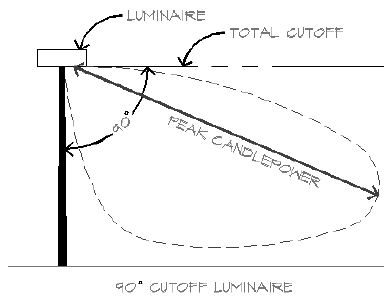
1. All lighting fixtures for security or aesthetics shall include glare controls and shall be shielded. Floodlighting shall be shielded to prevent disability glare for drivers or pedestrians, light trespass beyond the property line, and light above a ninety-degree horizontal plane.
2. All lighting fixtures should minimize glare by using recessed, shielded or cut off fixtures, with a cut off angle of 90 degrees or less as shown in Figure 2-1. The illuminated face of all fixtures shall be parallel to the ground to create a total 90 degree cut off. Tilted fixtures are prohibited.
3. All lighting fixtures used to illuminate the ground beneath gas station canopies shall have lenses that are recessed or flush with the surface of the canopy to reduce glare on surrounding properties.
4. Any lighting used to illuminate off-street Parking Areas shall be directed or shielded away from residential properties and public streets such that the light source is not visible from the property line (so as to eliminate glare). In no case shall lighting exceed 1 foot candle measured at the property line. No lighting used to illuminate off-street Parking Areas shall create a nuisance.
5. Lighting system designs shall be evaluated part of the Site Plan Review process.
6. Lighting on any structure shall be directed away from surrounding properties.
2-8-B. Glare: All lighting shall meet the following requirements.
1. All lighting sources, on properties other than those zoned for single-family residential use, shall be arranged to reflect light away from adjoining properties in a manner that does not produce glare clearly visible beyond a property line so as to cause nuisance or impairment of vision. Glare is best reduced when the light source is not visible from adjacent properties. Therefore, the use of lenses, deflectors, shields, louvers, or prismatic control devices shall be used to eliminate nuisance and hazardous lighting to facilitate compliance with this requirement.
2. In all residential zoning districts, no light source shall cause illumination in excess of one (1) foot-candle in residential districts at any property lot line.
2-8-C. Light Pole Height Limits. Poles supporting lights shall be no taller than twenty-three (23) feet in a residential zoning district; twenty-five (25) feet in a commercial district, a commercial portion of a residential planned unit development, or in office/business park districts, and thirty-two (32) feet in any industrial district.
2-8-D. Parking Lot Lighting: In addition to the other standards related to lighting in this subsection or other parts of the Village Code, all parking lot light shall meet the following criteria, to be reviewed and approved through the Site Plan Review process. All lighting plans shall include a table confirming compliance with the standards below in Table 2-8-D:
2-8-E. Exceptions and Variations.
1. Because of their unique requirement for nighttime visibility and their limited hours of operation, ball diamonds, playing fields, tennis courts, and other outdoor recreational facilities shall be exempted from the general standards of this Section. Lighting for outdoor recreational facilities shall be shielded to minimize light and glare from spilling onto adjacent residential properties. The maximum permitted illumination at adjoining residential property lines shall be one foot candle. The maximum permitted illumination at adjoining nonresidential property lines shall be two (2) foot-candles.
2. Luminaries used for public roadway illumination by a public transportation agency shall be exempt from the requirements of this Section.
3. Temporary emergency lighting used by police, firefighters, and other emergency services, as well as all vehicular luminaries, shall be exempt from the requirements of this Section.
4. Hazard warning lights that are required by local or federal regulatory agencies shall be exempt from the requirements of this Section.
5. Transportation facilities shall be exempt from the requirements of this Section.
6. Public walkways shall be exempt from the requirements of this Section.
7. When site characteristics are unique and the requirements of this Section cannot be met, the Planning and Zoning Commission in the Village of Roselle may, at its discretion, approve nonconforming lighting designs if the illumination levels and/or uniformity ratios are not greater than twenty (20) percent of the values set forth in this Section. All other nonconforming designs shall be subject to the approval of the Village Board of Trustees through either annexation or development agreement.
8. Exceptions and variations may be granted as part of a Planned Unit Development.
2-8-F. Nonconforming Luminaries. Exterior lighting luminaries in existence on the effective date of this Section shall be exempt from the standards of this Section and shall be considered legally nonconforming. Such fixtures may be repaired and maintained. However, if any legal nonconforming luminaire is moved or damaged by any means to an extent that its total replacement is necessary, the luminaire, or replacement, shall comply with this Section. For development activity involving an improved property, luminaires shall be required to comply with this Section when the floor area of any building or structure, or parking areas, or any combination thereof, is increased by ten (10) percent or greater.
2-8-G. Sustainable Energy Systems:
1. Solar Energy Systems (SES): Purpose: The purpose of this Section is to encourage safe and efficient use of solar energy and reduce the use and impact of fossil fuels. The Section also seeks to ensure that Solar Energy Systems are compatible in character and appearance with the principal structure and surrounding area in which they are located.
2. General Provision:
a. SES are permitted as an accessory structure mounted to a principal or other accessory structure.
i. SES shall be subject to the development standards specified in this Section.
ii. Energy produced by SES shall be used on site, except that surplus energy may be delivered to the power grid.
iii. Solar panels may only be located on the roof of a structure and shall be mounted flush with the slope of the roof.
iv. Solar shingles are permitted and shall be integral to the roof of the structure on which they are installed.
v. Solar collection devices may not extend beyond the roof edge or the exterior perimeter of a structure.
vi. Solar collection devices may not be located on the vertical portion of a mansard roof.
vii. SES shall be subject to the yard, height and any other bulk requirements of the zoning district in which it is located.
3. Appearance and Materials: Solar energy systems shall be neutral in color and generally matching the roof color of the principal structure. All such devices shall have the following characteristics:
a. Not be plastic or other non-UV stable material.
b. Include frames, where applicable, of anodized aluminum or painted steel.
c. Where devices are encased with glass, the glass shall be nonreflective tempered glass.
d. Solar panels must be placed so that concentrated solar radiation or glare is not directed onto any nearby properties or roadways.
4. Height: SES shall be subject to the following height requirements:
a. SES shall not exceed the maximum structure height requirements for the district in which they are located.
b. SES on sloped roofs shall not exceed the highest point of roof on which they are mounted.
c. SES located on sloped roof buildings shall not extend beyond one foot (1') above the roof surface at any point in residential zoning districts and fifteen inches (15") for all other zoning districts.
d. SES located on flat roofed buildings shall not extend beyond two feet (2') in overall height above the roof on which they are mounted in residential zoning districts or eight feet (8') in all other districts. In no case shall solar collection devises extend above the parapet wall of the structure.
5. Wind Energy Systems (WES):
a. Purpose: The purpose of this Section is to encourage safe and efficient use of wind energy and reduce the use and impact of fossil fuels. The Section also seeks to ensure that Wind Energy Systems are compatible in character and appearance with the principal structure and surrounding area in which they are located.
b. General Provisions: Wind energy systems are permitted as an accessory structure to a principal Permitted or Special Use subject to the standards of this Section and the Village Code.
c. No more than one WES is permitted per residential zoning lot.
d. No more than one WES is permitted per Commercial or Industrially zoned properties, unless approved as a Special Use.
e. WES may be permitted on a Commercial or Industrially zoned property adjacent to a residential zoning lot only upon approval by as a Special Use.
f. WES structures shall comply with all regulations of the Village Code regarding their construction, design, operation and maintenance.
g. Energy produced by WES shall be used on site, except that surplus energy may be delivered to the power grid.
h. WES shall be designed to withstand a minimum wind velocity of one hundred (100) miles per hour, with an impact pressure of forty (40) pounds per square foot.
i. As part of a building permit submitted for a WES, a statement and evidence shall be provided by the applicant that the proposed WES will not adversely impact adjacent properties.
j. In no event shall the noise level produced by a WES continuously exceed sixty-five (65) decibels as measured at the property line or otherwise be determined to be a nuisance under the regulations of the Village Code.
k. No WES shall cause electromagnetic degradation in performance of other electromagnetic radiators, receptors, or generators of quality and proper design. The Village may revoke any permit for a WES system should electromagnetic interference from the WES be evident and cannot be corrected.
l. WES shall not be artificially lighted, except to the extent required by the FAA or other applicable government authority.
m. All wind turbines shall have an automatic braking, governing or feathering system to prevent uncontrolled rotation, overspeeding and excessive pressure on the tower structure, rotor blades and turbine components.
n. Abandonment: If a WES is inoperable or abandoned for a period of six (6) consecutive months; the owner may be notified by the Village that the energy system must either be repaired or removed within an established cure period.
o. Rooftop mounted WES:
i. Rooftop mounted WES shall be set back at least twenty feet (20') from front or exterior building lines, and at least ten feet (10') from side building lines. Setbacks shall be measured to the widest point of blade rotation or to the side of the WES, whichever is greater.
ii. Rooftop mounted WES shall be limited to a height of no more than fifteen feet (15') above the roof peak or top of a parapet wall, whichever is greater. Total height shall be measured from the highest point of blade rotation or the highest point of the WES, whichever is greater.
p. Ground mounted WES:mc
i. Ground mounted WES shall be allowed only in the Industrial zoning district, after having received approval by as a Special Use.
ii. Ground mounted WES shall be permitted only in a rear yard.
iii. The WES tower or any associated structure shall comply with the minimum setback requirements of the zoning district in which the WES is located or be set back a distance equal to 1.1 times the total height of the structure from any property line, whichever distance is greater. Total structure height shall be measured from the highest point of blade rotation to the ground.
iv. A WES tower shall be set back a minimum of twenty feet (20') from any principal structure on the property.
v. The maximum permissible height of a WES tower shall not exceed seventy feet (70').
vi. Rotor blades or airfoils must maintain at least twelve feet (12') of clearance between their lowest point of rotation and the ground.
vii. All climbing apparatus affixed to a WES tower shall terminate twelve feet (12') short of ground level.
viii. All WES facilities shall be surrounded by a six foot (6') high safety fence.
ix. All WEC towers shall be constructed with an approved concrete foundation.
2-9. - Recreational Vehicles.
2-9-A. The following words and terms related to camping and recreational vehicles are defined in Article I Definitions:
1. Camping and recreational vehicle.
2. Camper or travel trailer.
3. Pick-up coach.
4. Motorized home or camper.
2-9-B. Trailer camps prohibited: It shall be unlawful for any person to remove the wheels or other transportation device from any house-car trailer or travel trailer, or to otherwise fix the house-car or travel trailer, except for normal maintenance and seasonal storage, or to otherwise fix the house-car trailer or travel trailer, to the ground as to prevent ready removal of the trailer.
2-9-C. Habitation: No camper or travel trailer, pick-up coach or motorized home or boat shall be used for living or sleeping or housekeeping therein with the limits of the Village of Roselle.
2-9-D. Parking and storage generally: It shall be unlawful for any person, firm or corporation to keep, maintain or store any camping vehicle or house trailer on any real property within the Village of Roselle, except as hereinafter provided:
1. If a camper or travel trailer, pick-up coach, motorized home, or other trailer, or boat shall not exceed the overall width of eight (8) feet and shall not exceed the overall length of twenty-nine (29) feet, including hitch, and shall not exceed an overall height of ten (10) feet, excluding mast, it may be parked or stored within the driveway section for a period not to exceed forty-eight (48) hours within one calendar week for the purpose of loading and unloading said vehicle.
2. If a camper or travel trailer, pick-up coach, motorized home or other trailer or boat shall not exceed the overall width of eight (8) feet, shall not exceed overall length of twenty-nine (29) feet, including hitch, and shall not exceed an overall height of ten (10) feet, excluding mast, it may be parked or stored on single-family dwelling property to the rear of the building setback, screened by landscaping or a privacy fence so that it cannot be viewed from the street, or inside a garage.
3. At no time shall parked or stored vehicles be occupied or used for living, sleeping or housekeeping purposes.
4. The owner of a camper or travel trailer, pick-up coach, motorized home or other trailer or boat shall not park or store such camper or travel trailer, pick-up coach, motorized home or other trailer or boat in such a manner as to create a dangerous or unsafe condition on the property where parked or stored. Parking or storage in such a fashion that the camper or travel trailer, pick-up coach, motorized home or other trailer or boat, whether loaded or not, may readily tip or roll or shall obstruct any exit-way from all structures by a minimum of three (3) feet, or a street or the free and easy access of any emergency, fire or police personnel to any portion of a residence shall be considered a dangerous and unsafe condition.
5. A vehicle parked or stored on a licensed business premise for the purpose of repair, rental or sale shall not be considered in violation of this Section.
2-9-E. Service connections: No camper or travel trailer, pick-up coach, motorized home or other trailer or boat shall have a connected gas, electric, water or sewer service, except for temporary hook-up for cleaning and maintenance.
2-9-F. Derelicts: No vehicular equipment shall be stored out of doors on residential premises unless it is in condition for safe and effective performance of the function for which it is intended.
2-9-G. Parking permit: An owner of a camper, travel trailer, pick-up coach, motorized home or other trailer or boat who does not reside within the Village of Roselle may obtain a permit to park said vehicle on a specified single-family dwelling premise, for a period of not to exceed thirty (30) days in any calendar year, by paying the sum of one dollar ($1.00) for such permit, to be obtained from the police department. Permits shall designate the owner's address, where the vehicle is to be stored, permanent occupant of said premises, dates on which the parking shall begin and end, and name and address of person obtaining the permit.
2-9-H. Registration:
1. An owner of a camper, travel trailer, motorized home or other trailer who resides within the Village and maintains, keeps or stores said vehicle in the Village shall apply for and obtain from the Village Clerk a registration of said vehicle. See Section 10-20-102 of the Village code for fees.
2. The applicant for registration under the provisions of this article, upon payment of the fee, shall be given a plate or sticker which shall be affixed to the vehicle in a conspicuous location.
2-9-I. Penalties: Any person, firm or corporation violating any provision of this article shall be subject to a fine. See Section 10-20-102 of the Village code for penalties. Each day a violation is permitted to exist shall be deemed a separate offense.
2-10. - Parking of Commercial Vehicles in Residential District.
In addition to other relevant requirements of the Village Code including but not limited to Chapter 12 Section 18: Nuisance Vehicle Parking, the following requirements shall apply to parking of Commercial Vehicles in Residential Zoning Districts.
2-10-A. Commercial Vehicles may be parked in a side yard provided the vehicle is not closer than ten percent (10%) of the lot width or ten feet (10') away from the side property line (whichever is less).
2-10-B. If the property has a driveway that leads to a detached garage located within the rear yard, a Commercial Vehicle may be stored on said driveway only if parking of the vehicle complies with the side yard parking requirements in Section 5-5-D-1:
2-10-C. Vehicles with Refrigeration or Compressor Units: Parking of a Commercial Vehicle containing a refrigeration unit or other motorized compressor shall be prohibited outdoors within a Residential Zoning District. Such vehicle may be parked completely within a garage if said refrigeration unit is not audible outside the garage.
2-10-D. Commercial Trailer and Equipment Storage Limitations:
1. Any trailers or equipment that can be attached to a Commercial Vehicle may only be parked in a fully enclosed garage or stored behind landscaping or a privacy fence that blocks its view from the street.
2. No engine, compressor, or other equipment that is or can be attached to a Commercial Vehicle may be allowed to idle while stored in a Residential Zoning District.
3. No equipment stored on a trailer shall be loaded or unloaded from the trailer upon any public right-of-way unless having rubber tires or treads.
2-11. - Community Residences.
2-11-A. Licensure. Where a community residence or a community residence's operator is required to be licensed or certified by a State of Illinois agency or department to operate a community residence, the applicant shall: a) provide the Village proof of such licensure or certification; and b) maintain at all times a current and valid license or certificate. The Zoning Administrator may revoke a certificate of occupancy for a community residence if its license or certification is revoked. A community residence that is not licensed or certified by the State of Illinois may only be established if a Special Use permit is approved in accordance with this Code.
2-11-B. Occupancy. Full time staff shall be included when determining the number of individuals that may occupy a community residence pursuant to the Building Code. For the purposes of this Section, "full time staff" shall mean staff that occupies the residence overnight.
2-11-C. Location. No community residence may be located within 660 feet of an existing or approved community residence, as measure from lot line to lot line, except when a Special Use permit is approved in accordance with this Code.
2-12. - Telecommunications.
2-12-A. Personal Wireless Services.
1. Purpose. The purpose of this Section is to provide specific regulations for the placement, construction and modification of personal wireless service facilities. In order to accommodate the communication needs of residents and businesses while protecting the public health, safety, and general welfare of the community, the Corporate Authorities finds that these regulations are necessary to:
a. Facilitate the efficient provision of personal wireless services to the residents of the Village, as well as to other persons, firms, and/or corporations in the vicinity of the Village;
b. Minimize adverse visual effects of personal wireless service facilities, through careful design, siting, screening, and landscape buffering standards;
c. Minimize the impacts of personal wireless service facilities on, and reduce conflicts with, the architectural, historical, tourism and economic significance of historic structures and districts designated by the Federal, State and local governments;
d. Minimize the impacts of personal wireless service facilities on, and reduce conflicts with, the architectural, historical, tourism and economic significance of the Village's principal commercial and tourist areas;
e. Avoid potential damage to adjacent properties from falling ice and tower failure through structural standards and setback requirements;
f. Promote, encourage and maximize the shared use of existing and approved buildings and antenna support structures to accommodate new personal wireless service facilities in order to reduce the number of towers needed to serve the community; and
g. Promote, encourage and maximize the use of existing tall structures that have been established within the community for the collocation of new personal wireless service facilities.
2. Authorization. Subject to the limitations of this Section, all uses and structures that are classified in the North American Industry Classification System No. 517312, except small wireless facilities, shall be subject to the following standards, regulations, and requirements at all times in those zoning districts in which they are permitted or special permit uses.
3. Location. Personal wireless services antennas shall be located on lawfully pre-existing antenna support structures or other lawfully pre-existing buildings or structures wherever possible and as a permitted or specially permitted use in accordance with the following table:
P = Permitted Use, S = Special Use
4. No Special Use permits authorizing construction of a new antenna support structure or addition to or expansion of an existing antenna support structure or existing building or structure shall be authorized unless the applicant is able to demonstrate that no lawfully pre-existing antenna support structure or lawfully pre-existing building or structure is available, on commercially reasonable terms, and sufficient for the location of an antenna necessary for the provision of personal wireless services.
5. Design of New Antenna Support Structures for Co-Location. Unless otherwise authorized by the Board of Trustees for good cause shown, every new personal wireless services antenna support structure of a tower design shall be designed, constructed, and installed to be of a sufficient size and capacity to allow the location of additional personal wireless services antennas to accommodate at least one additional personal wireless service provider on such structure in the future. Any Special Use permit for such a support structure may be conditioned upon the agreement of the applicant to allow co-location of other personal wireless service providers on commercially reasonable terms specified in such special permit.
6. Tower Design. Every new personal wireless services antenna support structure that is of a tower design shall:
a. be a monopole, rather than latticework, unless otherwise authorized by the Board of Trustees for good cause shown;
b. not be illuminated or have any signs installed thereon unless otherwise required by federal law or regulations; and
c. be separated from any principal building by a distance that is not less than 110 percent of the height of the tower. For the purposes of this requirement, this distance shall be measured horizontally from the center of the base of the supporting structure of the tower to the point where the ground meets a vertical wall of such principal building.
Any deck on such a tower shall be centered on the tower and the radius from the center of the tower to the outside of the deck shall not exceed six feet. Each side of the deck shall not exceed six feet vertically.
7. Antennas on Buildings and Structures. Personal wireless services antennas that are installed on buildings and structures must conform with one of the following:
a. Such antennas shall be located only on a lawfully pre-existing building and shall not exceed the following dimensions:
i. omnidirectional or whip antennas shall not exceed six inches in diameter and 12 feet vertically; and
ii. directional or panel antennas shall not exceed three feet horizontally and six feet vertically.
b. Such antennas and any necessary antenna support structure are fully enclosed or shielded from view from any point located off the zoning lot on which they are located by a structure otherwise permitted on the zoning lot and all electronic equipment is fully enclosed in a structure otherwise permitted on the zoning lot.
All such antennas shall not exceed the maximum height authorized by applicable zoning district regulations, and shall not extend above the highest point of the building or structure to which they are attached or more than two feet from the exterior of any wall or roof of the building to which they are attached. In no event shall a total or more than six antennas of the types and sizes described in Paragraph 1 of this subsection be located on any building in the B-1 District.
8. Color. Every personal wireless services antenna and antenna support structure shall be neutral colors that are harmonious with, and that blend with, the natural features, buildings, and structures surrounding such antenna and antenna support structures; provided, however, that directional or panel antennas and omnidirectional or whip antennas located on the exterior of a building that will also serve as an antenna support structure shall be of colors that match, and cause the antenna to blend with, the exterior of the building.
9. Landscaping and Fencing. In addition to any other applicable buffer and landscaping requirements of this Code, all ground-mounted antennas, antenna support structures, related electronic equipment, and equipment enclosures shall be subject to the following:
a. In order to minimize the visibility of such facilities, a natural screen or fence shall be erected if not already provided, so as to provide the maximum reasonable achievable screening as determined by the Board of Trustees.
b. Any natural screen shall be a minimum of six feet in height when planted, with dense plantings spaced no more than two feet apart.
c. Any fence shall be a minimum of eight feet in height, except where fence height is otherwise limited by this Code, and shall be of a style of construction that provides a visual shield of the facilities.
10. Protection Against Climbing. Every personal wireless services antenna and antenna support structure shall be protected against unauthorized climbing or other access by the public.
11. Equipment Enclosures. All electronic and other related equipment and appurtenances necessary for the operation of any personal wireless services antenna shall, whenever possible, be located within a lawfully pre-existing structure or completely below grade. When a new structure is required to house such equipment, such structure shall be harmonious with, and blend with, the natural features, buildings, and structures surrounding such structure. Any freestanding structure that is not attached to or within an existing building or located completely below grade shall not exceed a maximum height of fifteen feet.
12. Licenses and Permits. The operator of every personal wireless services antenna shall maintain all licenses and permits required by other agencies and governments with jurisdiction over the design, construction, location and operation of such antenna. In addition, any such operator shall annually provide copies of such licenses and permits, and provide evidence of renewal or extension thereof, to the Zoning Administrator.
13. Compliance with Plans. Every personal wireless services antenna and antenna support structure shall comply with all plans approved by the Village.
14. Limited to Applicant. Every ordinance granting approval of a special permit for a personal wireless services antenna or antenna support structure shall state that any assignment or transfer of the special permit or any of the rights thereunder may be made only with the approval of the Board of Trustees.
15. Term Limitation. Unless otherwise provided by ordinance, every Special Use permit for a personal wireless services antenna or antenna support structure is subject to the following conditions:
a. where the provider of personal wireless services is not the owner of the land on which such antenna or structure is located, the term of the Special Use permit is limited to the term of the lease or other agreement granting rights to use the land; and
b. the Special Use permit shall be subject to review by the Board of Trustees, at ten year intervals, to determine whether the technology in the provision of personal wireless services has changed such that the necessity for the Special Use permit at the time of its approval has been eliminated or modified, and whether the Special Use permit should be modified or terminated as a result of any such change.
16. Abandonment and Removal. When one or more antennas, an antenna support structure, or related equipment are not operated for the provision of personal wireless services for a continuous period of twelve months or more, such antenna, antenna support structure, or related equipment may be deemed to be abandoned and must be removed. The Village will be entitled to remove such an antenna, antenna support structure, or related equipment if the owner does not remove such items within ninety (90) days following the mailing of written notice that removal is required. Such notice shall be sent by certified or registered mail, return receipt requested, by the Village to such owner at the last known address of such owner. If two or more providers of personal wireless services use the antenna support structure or related equipment to provide personal wireless services, then the period of non-use under this provision shall be measured from the cessation of operation at the location of such antenna support structure or related equipment by all such providers.
17. Security Fund. The owner of every personal wireless services antenna shall establish a security fund in a form and in an amount as set forth in this subsection. The security fund shall serve as security for the removal of the antenna. The security fund shall be continuously maintained in accordance with this subsection at the owner's sole cost and expense until the antenna is removed.
a. Form. The owner shall provide the security fund to the Village in the form of cash, unconditional letter of credit, or surety bond, in a form acceptable to the Village.
b. Amount. The dollar amount of the security fund shall be equal to the Village Engineer's reasonable estimated removal cost for the antenna.
c. Withdrawals. Following a removal notice provided under subsection 16 above, the Village may withdraw an amount from the security fund, provided that the owner or operator has not removed the antenna within the 90-day notice period.
d. Return. Upon removal of the antenna, the Village will return the security fund, or such portion remaining on deposit, to the owner within a reasonable time after account is taken for all offsets necessary to compensate the Village for the owner's failure to remove the antenna upon notice provided by subsection 16 above.
e. Rights not limited. The rights reserved to the Village with respect to the security fund are in addition to all other rights of the Village, whether reserved by this subsection or otherwise authorized by law, and no action, proceeding or exercise of right with respect to said security fund shall affect any other right the Village may have.
18. Insurance. The operator of every personal wireless services antenna must tender to the Zoning Administrator, on an annual basis, proof of public liability insurance covering the facility in an amount not less than One Million Dollars ($1,000,000.00).
2-12-B. Small Wireless Facilities.
1. Compliance with Laws. All small wireless facilities must comply with Section 18 in the Village Code, and all other applicable federal, state, and local laws.
2. Districts. Small wireless facilities are allowed as permitted or Special Uses in the following districts:
P = Permitted Use, S = Special Use
3. Special Use. Small wireless facilities allowed as a Special Use must be:
a. designed so as to completely conceal all components of the small wireless facility within a new or existing structure that is architecturally compatible with its surroundings; including, but not limited to, an antenna behind louvers, or in a false roof on a building, or inside a steeple, clock tower, flagpole (with a maximum diameter of 15 inches), campanile or bell tower; or
b. camouflaged so as to blend into its surroundings to such an extent that it is no more obtrusive to the casual observer than the structure on which it is
i. placed, such as a rooftop, lighting standard or existing tower; or
ii. replacing, such as a school athletic field light standard, or other similar structure.
c. Height.
i. The maximum height of a small wireless facility collocated on an existing structure shall be limited to 10 feet above the structure on which the small wireless facility is collocated.
ii. The maximum height of a new small wireless facility which is not collocated on an existing structure may not exceed:
1. 10 feet in height above the tallest existing utility pole that is in place on the date the application is submitted, that is located within 300 feet of the small wireless facility and that is in the same right-of-way within the Village; or
2. 45 feet above ground level.
d. Special Floor Area Ratio Exception. A small wireless facility collocated on an existing structure shall not count toward any required floor area ratio.
2-13. - Adult Uses.
2-13-A. Purpose. The purpose of this Section is to provide specific regulations for adult uses, in order to accommodate constitutionally-protected non-obscene sexual expression, while protecting the public health, safety, and general welfare of the Village. The Village's Corporate Authorities find that:
1. adult uses require special supervision from the Village's law enforcement and public safety agencies to protect and preserve the public health, safety, morals, and welfare of the patrons and employees of businesses as well as the Village's citizens; and
2. adult uses are frequently used for unlawful sexual activities, including prostitution and sexual liaisons of a casual nature; and
3. sexually transmitted diseases are a legitimate health concern for the Village that demands reasonable regulation of adult uses by the Village in accordance with this Ordinance; and
4. this Ordinance's regulations are a legitimate and reasonable means of accountability to ensure that operators of adult uses comply with reasonable regulations and to ensure that operators do not allow their establishments to be used as places of illegal sexual activity or solicitation; and
5. there is convincing documented evidence that adult uses, because of their outward appearance and very nature, have a deleterious effect on both the existing businesses around them and the surrounding residential areas adjacent to them, cause increased crime, particularly during the overnight hours, and reduce property values; and
6. the Corporate Authorities desire to minimize and control these adverse effects by regulating adult uses in accordance with this Ordinance; and
7. by minimizing and controlling these adverse effects, the Corporate Authorities seek to protect the health, safety, and welfare of the citizenry; protect citizens from increased crime; preserve quality of life; preserve property values and the character of the Village's neighborhoods; and deter the spread of urban blight; and
8. the Corporate Authorities do not enact this Ordinance to suppress or authorize the suppression of any speech activities protected by the First Amendment; rather, this Ordinance establishes content-neutral regulations that address the secondary effects of adult uses; and
9. the Corporate Authorities do not enact this Ordinance to restrict, deny, or authorize the restriction or denial of access by adults to sexually oriented materials protected by the First Amendment, or to deny, or authorize denial of, access by the distributors and exhibitors of adult entertainment and adult materials to their intended market; and
10. evidence concerning adult uses' adverse secondary effects on communities is readily available in many court decisions, including, but not limited to: Township of Littleton, Colorado v. Z.J. Gifts D-4, LLC, 541 U.S. 774 (2004); City of Los Angeles v. Almaeda Books, Inc., 535 U.S. 425 (2002); Township of Erie v. Pap's A.M., 529 U.S. 277 (2000); Barnes v. Glen Theatre, Inc., 501 U.S. 560 (1991); Township of Renton v. Playtime Theatres, Inc., 475 U.S. 41 (1986); Young v. American Mini Theatres, 426 U.S. 50 (1976); California v. LaRue, 409 U.S. 109 (1972); Illinois One News, Inc. v. City of Marshall, 477 F.3d 461 (7th Cir. 2007); Andy's Restaurant & Lounge, Inc. v. City of Gary, 466 F.3d 550 (7th Cir. 2006); Joelner v. Village of Washington Park, 378 F.3d 613 (7th Cir. 2004); G.M. Enterprises, Inc. v. Town of St. Joseph, 350 F.3d 631 (7th Cir. 2003); Pleasureland Museum, Inc. v. Beutter, 288 F.3d 988 (7th Cir. 2002); Shultz v. City of Cumberland, 288 F.3d 831 (7th Cir. 2000); Genusa v. City of Peoria, 619 F.2d 1203 (7th Cir. 1980); Excalibur Group, Inc. v. City of Minneapolis, 116 F.3d 1216 (8th Cir. 1997); and XLP Corporation v. County of Lake, 359 Ill. App. 3d 239 (2d Dist. 2005) (collectively, the "Cases"); and
11. many cities and other units of government throughout the country have studied and found significant adverse secondary effects associated with adult uses, including, but not limited to: Phoenix, Arizona (1984); Minneapolis, Minnesota (1980); Indianapolis, Indiana (1984); Amarillo, Texas (1977); Whittier, California (1978); St. Croix County, Wisconsin (1993); Bellevue, Washington (1998); Beaumont, Texas (1982); and Des Moines, Iowa (1984) (collectively, the "Studies"); and
12. the United States Congress has heard testimony detailing the negative secondary effects associated with adult uses on numerous occasions, including 136 Cong. Rec. S. 8987; 135 Cong. Rec. S. 14519; 135 Cong. Rec. S. 5636; 134 Cong. Rec. E. 3750 (collectively, the "Testimony"); and
13. based on secondary effects discussed and found to exist in the Cases, Studies, and Testimony, as well as all evidence presented and matters discussed during all public hearings and meetings conducted by the Village, and all other relevant information, including the Corporate Authorities' own knowledge and experience, the Corporate Authorities find that:
a. Adult uses can contribute to increased crime in the area where such businesses are located and burden local law enforcement and public safety efforts. Crimes associated with adult uses include, but are not limited to:
i. prostitution and other sex related offenses;
ii. drug use and dealing; and
iii. money laundering.
b. Adult uses can contribute to significant public health concerns, including the spread of HIV/AIDS and other sexually transmitted diseases.
c. Adult uses and their outward appearance can significantly:
i. contribute to the deterioration of residential neighborhoods;
ii. increase neighborhood blight;
iii. impair the character and quality of residential housing in the surrounding area; and
iv. reduce overall housing appeal for potential residents.
d. The concentration of adult uses in any one area can greatly impact the area by causing blight, decreasing property values, reducing the Village's tax base, making the area less attractive to non-adult uses (i.e., marketability), and increasing crime.
e. Adult uses can produce higher levels of noise, traffic, and glare as compared to other businesses by virtue of adult uses' hours of operation.
f. Serving or otherwise allowing the consumption of alcoholic liquor at adult uses can lead to increased criminal activity and exacerbate neighborhood deterioration.
g. Requiring adult use owners and operators to obtain a Special Use permit from the Village and comply with basic Special Use permit conditions will promote clear communication between the parties and enhance the Village's ability to address negative externalities related to adult uses.
h. The findings set forth above constitute substantial governmental concerns.
i. Adult uses have operational characteristics that require reasonable governmental regulation to address those substantial governmental concerns.
j. This Ordinance will promote and protect the public health, safety and welfare.
2-13-B. Application. A Special Use permit is required to establish or operate an adult use in the Village.
1. Form. The Special Use application for an adult use must be made on forms provided by the Village and, in addition to the requirements of Section 36-14-3, must include the following information:
a. proof of age indicating that the applicant is at least twenty-one (21) years of age;
b. a specific description of the proposed adult use, including all goods, services, and activities offered and/or associated with the adult use;
c. an executed affidavit:
i. stating the adult use does and will comply with all federal, state, and local laws, codes, rules, and regulations, including, without limitation, those concerning health, safety, building, zoning, and inspections;
ii. acknowledging that failure to comply with all federal, state, and local laws, codes, rules, and regulations may result in the Village suspending or revoking the Special Use, or exercising any right or remedy provided to the Village at law or in equity;
iii. stating that all information provided on the application is truthful and accurate and acknowledging that the applicant and property owner must immediately update any application information provided to the Village that later changes or becomes inaccurate;
iv. stating that the property owner and applicant will cooperate fully with the Zoning Administrator's review of the Special Use permit application and supporting materials including, without limitation, responding to requests by the Zoning Administrator for information necessary to determine compliance with this Code, state law, and federal law;
v. acknowledging that the adult use can only be approved after the Village's approval of a Special Use permit and the applicant's compliance with all Special Use criteria;
d. floor plans, site plans, building elevations, and related documents detailing the proposed internal configuration of the structure containing the adult use, the configuration of the property on which the adult use is located, and the external appearance of the property on which the adult use is proposed to verify compliance with this Code; and
e. twenty-four (24) hour contact information for the on-site manager(s) of the adult use.
2. Non-Individuals. Applications submitted by corporations, limited liability companies, trusts, partnerships, or other legal entities shall provide the information required this Section, as well as written proof satisfactory to the Village attorney that the entity is in good standing with the Illinois Secretary of State. Affidavits may be submitted by a legally authorized representative of the legal entity.
3. Expansions or changes to any Special Use shall be processed in accordance with the procedures for a new Special Use permit.
2-13-C. Standards.
1. In addition to the Zoning Ordinance's Special Use standards, conditions, and procedures, the following standards also apply to a Special Use application for an adult use. No Special Use shall be approved for an adult use that is located within:
a. two hundred (200) feet of any R zoning districts or uses as provided for under this ordinance;
b. two hundred (200) feet of the property line of another adult business use;
c. five hundred (500) feet of a church, school, library, park, or other publicly operated recreational facility;
d. has more than one outdoor sign;
e. has an outdoor sign exceeding ten feet (10') in length or three feet (3') in width;
f. displays the stock in trade of adult entertainment establishments to the public view from outside the establishment, including graphics, decorations, displays, pictorial depictions, photographs, silhouettes, flashing lights, or drawings of materials and services offered; or
g. paints the exterior of the premises any color other than a single achromatic color.
2. Measurement. For the purposes of this subsection, measurements shall be made in a straight line, without regard to intervening structures or objects, from the lot line of the lot containing the adult use to the lot line of the lot containing the nearest adult use, school, religious institution, day care center, public park, or residentially-zoned property.
2-13-D. Conditions. In addition to those Special Use permit conditions required under this Chapter, each Special Use permit for an adult use shall be subject to the following conditions, in order to prevent or minimize substantial or undue adverse effects upon neighboring and adjacent properties and improvements, and substantial or undue or upon public facilities and services:
1. No permittee or any other person shall hold a liquor license for the property subject to the Special Use permit for an adult use, or sell, serve, and/or allow the consumption of alcoholic liquor on the property.
2. No adult use offering live performance of adult entertainment shall allow exposed or uncovered specified anatomical areas.
3. No adult use shall permit persons under the age of nineteen (19) on the property subject to the adult use, and all adult uses shall post a notice at the door that entry by persons under the age of nineteen (19) is prohibited.
4. All adult uses shall maintain a buffer measuring at least six (6') feet wide between all patrons and any individual conducting live performance of adult entertainment.
5. No adult use shall allow or permit the occurrence of any specified sexual activities or permit the occurrence of any act constituting the offense of obscenity under the Illinois Criminal Code on property subject to the adult use.
6. No adult use shall allow, permit, or authorize physical contact between any adult use personnel and any patron.
7. Adult entertainment employees may not receive tips from patrons except as follows:
a. An adult use that desires to provide for tips from its patrons for adult entertainment employees shall establish one or more boxes or other containers to receive tips.
b. All tips for adult entertainment employees must be placed by the patron into the tip box.
c. An adult use that provides tip boxes for adult entertainment employees must post one or more signs to be conspicuously visible to the patrons on the premises in letters at least one inch (1") high to read as follows: "All tips are to be placed in tip box and not handed directly to the entertainer. Any physical contact between the patron and the entertainer is strictly prohibited."
8. No adult use offering adult entertainment on the premises may open before 11:30 a.m. or close after 1:00 a.m., except that cleaning and maintenance activities necessary for the property's operation may occur before or after the hours specified in this subsection.
9. No adult use offering adult entertainment on the premises shall open or operate on Sunday, on any federal holiday, or on any state holiday.
10. No animals, excluding animals trained and used to assist a person with a disability, are permitted at any time on property subject to an adult use, and any animal assisting a person with a disability must remain with that person at all times.
11. No adult entertainment shall occur in any restroom located on a property subject to an adult use.
12. Patrons shall not enter any non-public portions of a property subject to an adult use, including, without limitation, any storage areas, dressing rooms, or other rooms provided for the primary benefit and use of adult use personnel.
13. No adult use shall utilize loudspeakers or other sound equipment that is audible outside of the structure in which the adult use is conducted.
14. Each adult use shall have at least one (1) manager's station allowing direct, unobstructed, and uninterrupted view from the manager's station to every part of the premises accessible to patrons, excluding restrooms.
15. All adult uses shall comply with all provisions of this Code, their Special Use permit, and all federal, state, and local laws, rules, and regulations, as amended.
16. During the pendency of any application for, or during the term of, any Special Use permit for an adult use, the applicant or permittee shall promptly notify the Zoning Administrator in writing of any change in the information given by the applicant or permittee in the application for such Special Use permit, including, but not limited to, any change in the individuals identified in the application, or if any of the events constituting grounds for suspension or revocation occur.
17. Upon the Village's request, permittee shall allow the Village to inspect the adult use's books, records, and payroll information to allow the Village to verify compliance with this Code, state law, and federal law, as amended.
2-13-E. Penalty.
1. Every act or omission constituting a violation of this Code by any adult use granted a Special Use permit, adult use personnel, or patron shall be deemed to be an act or omission by the permittee, and such permittee shall be punished in accordance with the provisions of this subsection.
2. Any person found guilty of violating any provision of this Section shall be fined not more than seven hundred fifty dollars ($750.00) per violation, and each day a violation exists shall constitute a separate offense. Nothing in this Section shall prohibit the Village or any person or entity from pursuing any claims at law or in equity, including, without limitation, revoking a Special Use approval, against any person or entity that violates this Section or any other Village ordinance, rule, or regulation.
3. Any adult use established, operated, or maintained in violation of any of the provisions or requirements of this Code or of any Special Use permit for an adult use shall be, and the same is, declared to be unlawful and a public nuisance. The Village may, in addition to or in lieu of any other remedies set forth in this subsection, commence an action to enjoin, remove, or abate such nuisance in the manner provided by law and may take such other steps and apply to such court or courts as may have jurisdiction to grant such relief as will abate or remove such public nuisance, and restrain and enjoin any person from establishing, operating, or maintaining an adult use contrary to the provisions of this Code.
2-13-F. Severability. If any part, subsection or clause of this Section shall be deemed to be unconstitutional or otherwise invalid, the remaining Section, subsection and clauses shall not be affected thereby.
2-14. - Cannabis Business Establishment Conditions and Requirements.
2-14-A. That cannabis business establishments as defined in the Cannabis Regulation and Tax Act (Public Act 101-0027) (hereinafter "Cannabis Act"), as of the date of the adoption of this ordinance, which currently includes cultivation centers, craft growers, processing organizations, dispensing organizations, and transporting organizations, and any future amendments to the definition of cannabis business establishments under the Cannabis Act, are hereby designated as special uses in Section 8.00 Business Districts, Section 9.00 Office Research Districts, and Section 10.00 Industrial District of the Roselle Zoning Ordinance.
2-14-B. That any cannabis business establishment that applies for a special use permit in compliance with 13.11 "Special Uses", in addition to the requirements specified in Appendix A for special uses, shall submit the following:
1. A security plan for review and approval by the Roselle Chief of Police or their designee prior to a public hearing being scheduled before the planning and zoning commission.
2. A site plan showing compliance with the off-street parking regulations in Section 11.05 "Parking and Stacking Schedule." No variations from Section 11.05 may be requested for a cannabis business establishment.
2-14-C. The permitted hours of operation for a cannabis business establishment shall be from 6:00 a.m. to 1:00 a.m. on any day except Saturday, Sunday, or a federally designated legal holiday when the closing hour shall be no later than 2:00 a.m.
2-14-D. On-site consumption of cannabis at any permitted cannabis business establishment is prohibited.
2-15. - Short-Term Rental Conditions and Requirements.
2-15-A. The definition of short-term rentals contained in Section 3.02 of this ordinance shall be substantive provisions and requirements of all short-term rentals in the Village of Roselle.
2-15-B. The following additional terms shall be mandatory terms and conditions of short-term rental:
1. Short-term rentals shall be a permitted use in all zoning districts where residential uses are a permitted or special use.
2. Guests or visitors of residential abodes shall not qualify to act as short-term renters or Hosts on short-term rentals.
3. Short-term rentals shall allow a maximum occupancy of two (2) persons per bedroom as permitted by the occupancy permit for the short-term rental abode, but in no event more than ten (10) persons at any one time. This occupancy limitation shall include invitees of the short-term rental tenants, and social guests. Short-term rental occupants shall occupy bedrooms in the short-term rental overnight for the entire term of the short-term rental lease.
4. Short-term rentals shall not be used solely to hold parties.
5. An Owner shall not have, at any one time, more than one abode in the Village available for short-term rental.
6. Prior to occupancy by any Guests or visitors, the Owner(s) of short-term rental properties shall register with the Village on a form prepared by and available from the Village Zoning Administrator. The form shall only require the Owner's identity, permanent address, telephone number, a secondary emergency contact person's name, address and telephone number and the identity of the Hosting Platform utilized by the Owner.
7. All short-term rentals shall be subject to a written lease agreement or contract identifying the Owner, the Hosting Platform involved in the rental relationship between the Owner and the renters, and the names, addresses and telephone numbers of the Owner, the Hosting Platform, and the Guests name, address and telephone number. The Owner or the Hosting Platform shall be responsible for determining the Guest or visitor's identification information and the accuracy of that information. The lease shall require that the renter include a copy of their driver's license as part of the lease, exclusive of the driver's license number which may be redacted. The Owner or the Hosting Platform shall only be required to provide a copy of the lease to the Village if the police, based upon a disturbance complaint or other complaint or incidence of criminal activity occurring at the short-term rental, during its occupancy.
8. That the lease between the Guest and the Owner of the property shall require that the short-term guest park short-term renter guest vehicles on the short-term rental property, except where on-street parking is lawfully available. Short-term renters shall not park vehicles on Village streets at any time between the hours of 2:00 a.m. and 5:00 a.m. on any day.
2-16. - Electric Vehicle Charging Stations.
2-16-A. Electric vehicle charging stations may be constructed in any non-residential or multi-family residential zoning district. Such facilities shall require a building permit from the Village of Roselle and be installed in keeping with all other requirements of the Village Code. Such facilities shall also be required to be in keeping with the following requirements:
1. Electric vehicle charging may be installed anywhere a vehicle may be parked within a designated parking lot or structure.
2. Electric vehicle charging station equipment may not block the public right-of-way unless approved by the Zoning Administrator.
3. Vehicle charging equipment must be designed and located so as to not impede pedestrian, bicycle or wheelchair movement or create safety hazards on sidewalks or driving areas.
4. Equipment protection: Adequate protection of charging station equipment from vehicles must be provided, such as curbing, bollards, or wheel stops.
5. Signage: Public electric vehicle charging stations must be posted with signage indicating that the space is reserved for electric vehicle charging purposes only. For purposes of this provision, "charging" means that an electric vehicle is parked at an electric vehicle charging station and is connected to the battery charging station equipment. Such signage shall be located on or immediately adjacent to the charging station and be no more than six square feet in size.
6. Electric vehicle charging spaces may not be counted towards off-street parking requirements.
7. Height: The height of charging stations and related equipment and signage shall be the lowest practicable size as determined by the Zoning Administrator upon review of information requested of the installer regarding installation options. In no instance shall that height exceed six feet.
8. Screening: Charging station equipment shall be screened from adjacent properties in a manner approved by the Zoning Administrator, upon finding that such screening is adequate to mitigate views from adjacent properties and does not create any safety hazard.
9. Maintenance: Electric vehicle charging stations must be maintained in all respects, including the functioning of the equipment. A phone number or other contact information must be provided on the equipment for reporting when it is not functioning, or other problems are encountered.
10. Equipment Removal: Any inactive equipment shall be removed by the property owner where an electric vehicle charging station is located within 90 days of said equipment becoming inactive (except for periods of maintenance and repair). Following removal, the inactive station area shall be established as a parking space(s), in keeping with the requirements of the Village Code.

