
Roselle City Zoning Code
SECTION 5
- OFF-STREET PARKING AND LOADING
5-1. - How to Use this Section.
Zoning questions related to parking generally revolve around two points: how many parking spaces are needed and what design standards are there for the lot. Those questions are addressed in this Section for buildings and uses of land that are new or expanding.
5-1-A. How Many? How many parking spaces are required is a good first question to ask, but not always a straightforward one. The Schedule of Required Parking, a table in Section 5-13, tell how much parking is need for various uses of a property. Yet in some instances, parking spaces can be shared, located off site, or not built right away. Also, parking needs to be considered for visitors in multiple-family residential buildings, and in some cases, parking is required for bicycles. The sections with answers to these questions can be found in the table of contents.
5-1-B. What are Design Standards for Parking Lots? The design of parking lots is important, especially large ones, as they can have a significant effect on the appearance of a property and the area in which they are located. Just as important, parking lots must be safe of those driving into, out of and within them; safety of pedestrians also is essential. Most of the design standards listed in this Section are for commercial and industrial parking lots, but rules for driveway and garage locations for single family homes also are provided - again, focusing on safety and community aesthetics.
5-2. - Purpose and Scope.
5-2-A. The purpose of this Section is to alleviate or prevent traffic congestion on public streets, provide safe and logical vehicular access and parking to and within developments, and to promote the safety and welfare of the public by establishing minimum requirements for off-street parking and loading of motor vehicles.
5-2-B. Applicability:
1. The provisions for off street parking and loading specified in this Section shall apply to all zoning districts.
2. The provisions for off street parking and loading specified in this Section shall apply to all buildings and structures constructed and all uses of land established after the effective date of this Chapter.
3. For all buildings and structures existing prior to the effective date of this Chapter, the following shall apply:
a. Where a building permit has been issued prior to the effective date of this Chapter, and provided that construction is begun within six months of such effective date and is diligently prosecuted to completion, parking and loading facilities shall be required per the requirements in place at the time of permit issuance.
b. Parking for an existing use of property shall not be reduced below the requirements of this Section, or if already less than said requirements, shall not be reduced further.
c. Expansion or Change of Use:
i. For nonresidential uses of a property in the B-3 Town Center District, when a use of the property is replaced with another use having a higher parking requirement (per Section 5-13: Schedule of Required Parking), no additional parking shall be required.
ii. Where the total square footage of a structure is increased by more than twenty (20) percent, all requirements of this Section shall apply.
iii. Requirements for new parking also may be met through alternative measures in Section 5-6: Shared Parking and Section 5-8: Land Banking.
d. Nonconforming Parking Conditions:
i. When a property is legally non-conforming as to parking and/or loading and the use of the building is changed, parking and loading standards shall be provided as required in this Section.
ii. Where a use is served by legal nonconforming parking or loading, and the total square footage of the structure is increased by twenty (20) percent or less, the parking standards of this Section shall be applicable to the increased square footage, and the parking standards applicable at the time the legal nonconforming parking status occurred shall be applicable to the remainder of the structure.
e. Damage or Destruction.
i. When a property is legally non-conforming as to parking or loading and the use or the improvement is damaged and repaired or replaced with a use or improvement with the same parking requirement (per Section 5-13), the minimum parking standards applicable at the time the use became legally non-conforming may continue.
ii. In the case of a conforming or legally nonconforming building being damaged or destroyed by fire, collapse, explosion or other cause and reconstructed, reestablished or repaired:
1. The number of off-street parking spaces and loading berths in place at the time of such damage or destruction shall be restored and continued.
2. Should such damage or destruction exceed fifty percent (50%) of the value of the building or use, sufficient off-street parking and loading facilities shall be provided as required by this Section as if the facility were newly built, with the exception of properties located in the B-3 Zoning District.
5-3. - General Standards.
All parking areas shall meet the following general standards:
5-3-A. Access. All parking facilities shall be designed so as to provided safe and efficient means of vehicular and pedestrian access that will least interfere with on-site and off-site traffic movements.
5-3-B. On-site. Required parking spaces shall be located on the same zoning lot as the use served, unless otherwise approved pursuant to a Variation or Special Use.
5-3-C. Distance. No required parking space for a residential building shall be more than three hundred (300) feet from the principal residential structure. No required parking space for a nonresidential use shall be more than one thousand (1,000) feet from the principal structure.
5-3-D. Control of off-site parking facilities. When required parking facilities are provided on land other than the zoning lot on which the building, structure, or use served by the facility is located, they shall be and shall remain in the direct long-term control or ownership as the zoning lot occupied by the building or use to which the parking facilities are accessory.
5-4. - Design and Maintenance of Parking and Loading Areas.
All parking and loading areas for new or expanded multi-family, mixed use or nonresidential property shall meet the following requirements:
5-4-A. Parking and Loading Design Plan Required: Any application for development or building permit for new or expanded multi-family, mixed use or nonresidential property shall include a Parking and Loading Design Plan drawn to scale and fully dimensioned showing all parking or loading facilities, lighting, landscaping, signs and other improvements accessory thereto provided in compliance with this Section. Additional requirements for parking and loading design to be considered as part of a Planned Development approval can be found in Article 7. Administration and Enforcement.
5-4-B. Parking Lot Design Requirements: All parking areas for new or expanded multi-family, mixed use or nonresidential property shall meet the following design requirements:
1. Clearance: All parking spaces shall have a minimum vertical clearance of seven (7) feet and all loading spaces shall have a minimum vertical clearance of ten (10) feet.
2. Screening and Landscaping: All open loading areas and all parking areas providing space for five (5) or more vehicles shall be effectively screened in accordance with the landscaping requirements of Section 6 of this Chapter, Landscape Regulations.
3. Open and Enclosed Parking Spaces and Loading Berths: Accessory parking spaces and loading berths may be open to the sky or enclosed in a building.
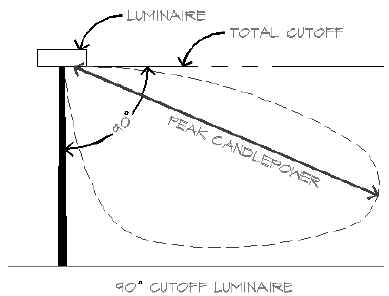
4. Lighting Design. Lighting for all parking, loading or other outdoor function areas for any non-single-family residential use shall meet the following criteria:
a. Any lighting used to illuminate off-street parking or loading areas shall be directed or shielded away from residential properties and public streets such that the light source is not visible from the property line (so as to eliminate glare).
b. All lighting should minimize glare by using recessed, shielded or cut off fixtures, with a cut off angle of 90 degrees or less.
c. In no case shall lighting exceed zero-foot candle measured at any property line.
d. No lighting used to illuminate off-street parking, loading or other outdoor function areas shall create a nuisance.
e. All lighting shall be extinguished no later than thirty (30) minutes after the close of business of the use being served, except as otherwise may be approved by the Zoning Administrator or through a Special Use.
5. Curbing: A continuous concrete barrier curbing, minimum six inches by eighteen inches (6" x 18") shall be located around the perimeter of all loading berths or parking areas for five (5) or more vehicles. Design of curbing shall prevent vehicles from blocking any pedestrian path of travel, potentially damaging landscape plantings, or crossing any property line. If in the determination of the Zoning Administrator such interference cannot be avoided, parking wheel stops may be authorized by the Zoning Administrator to prevent such occurrence.
6. Striping:
a. Parking pavement surface shall be permanently striped to define each required space.
b. Striping shall be a minimum of four (4) inches in width for the length of each space and be painted in yellow or white thermoplastic pavement markings or an acceptable alternative.
c. All areas designated as fire lanes shall be marked by signage and yellow markings on pavement.
d. Other markings such as stop bars and lane striping may be required by the Village.
7. Yards. Required off-street parking spaces may be located in required yards except as follows:
a. Residence districts: There shall be no parking in required front or corner side yards.
b. Business districts: There shall be no parking within the first five (5) feet of the required front yard or corner side yard, as measured from the property line.
i. In the B-5 Arterial District there shall be no parking, nor service drive-through, within the first twenty (20) feet of the required front yard or corner side yard, as measured from the right-of-way line.
c. Office research district and industrial district. There shall be no parking within the first ten (10) feet of the required front yard or corner side yard, as measured from the property line; and if across the street from a Residential Zoning District there shall be no parking within the first twenty (20) feet.
d. Transitional yards: No parking or access aisle shall be located in a required transitional yard in any zoning district.
8. Signs: Signs placed in parking and loading areas shall be in keeping with Chapter 17: Signs and Advertising, of the Village Code.
9. Maintenance. The surface, striping, landscaping, landscape islands, driveways and all other appurtenances constructed to serve off-street parking facilities shall be kept in a good state of repair and shall be maintained free of all hazardous conditions.
10. Limitations on Use of Off-Street Parking and Loading Areas:
a. Repair and Service: Motor vehicle repair work of any kind shall not be conducted in conjunction with accessory open off-street parking or loading facilities in any zoning district.
b. Gasoline and Oil Sales: The sale of gasoline and motor oil in conjunction with accessory off street parking or loading facilities shall not be permitted in any zoning district.
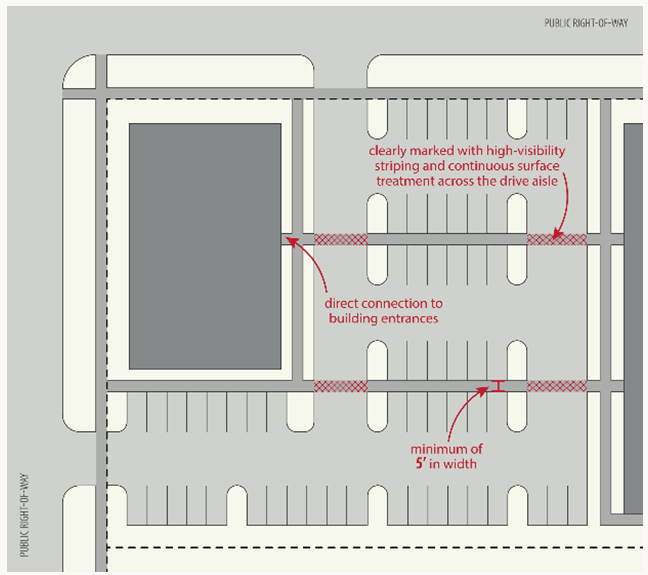
11. Pedestrian Access.
a. All parking lots with two or more double-loaded rows must provide internal pedestrian walkways within the parking area and outside of the parking rows.
i. The walkway must be a minimum of five (5) feet in width.
ii. One walkway is required for every two double loaded aisles.
iii. The walkway must be located within the parking area to serve the maximum number of parking stalls.
b. All walkways must meet all ADA accessibility requirements.
c. All parking lots must include walkways that provide direct connections to building entrances from the spaces furthest from the entrance. At least one walkway must provide a direct connection between the building entrances and the adjacent public rights-of-way and associated sidewalk.
d. All pedestrian walkways must be clearly marked with high-visibility striping, through the use of alternative materials, such as pavers. Where walkways cross a drive aisle, the walkway must have a continuous surface treatment across the drive aisle.
5-5. - Development Standards for Parking Areas.
All parking areas for new or expanded multi-family, mixed use or nonresidential property shall meet the following development standards:
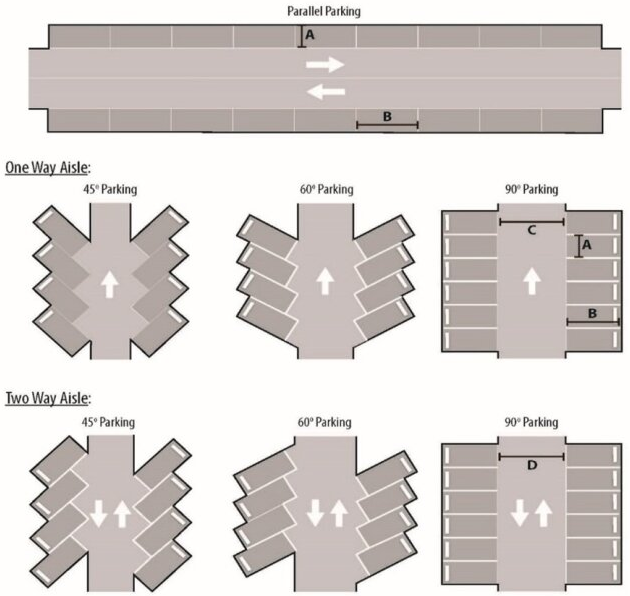
5-5-A. Module size. The minimum dimensions of parking spaces and aisles shall be as follows:
5-5-B. Driveways. The dimensions of driveways and parking pads shall be as follows:
1. Driveway Access in Single Family Residential Districts
a. Front Loaded Driveway Access (One or Two Car Garage)
i. The driveway shall have a minimum width of ten (10) feet and a maximum width equivalent to the exterior of the garage, plus a flare of 3 feet on each side.
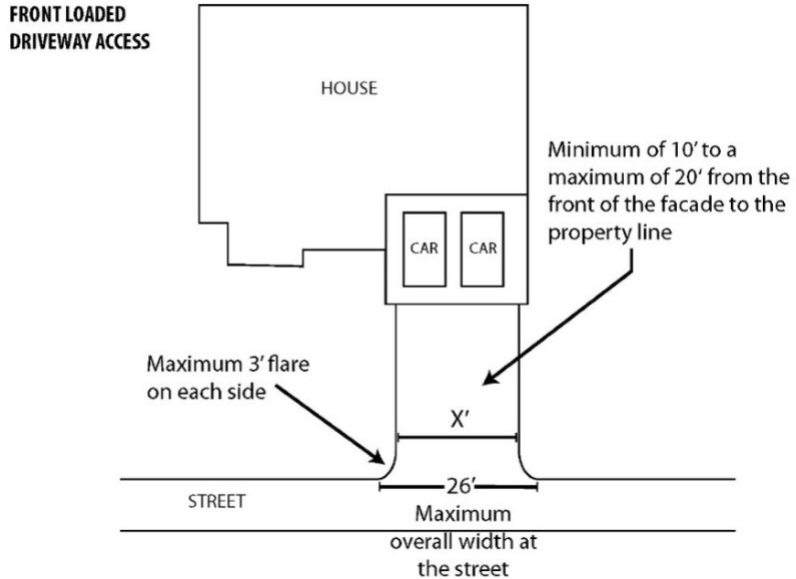
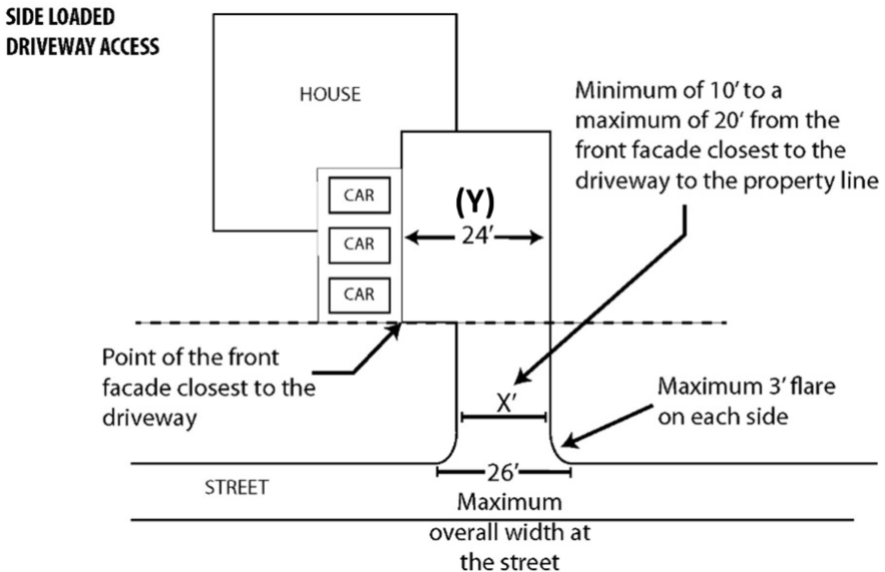
b. Side Loaded Driveway Access.
i. The driveway pad (shown as (Y) below) shall be a maximum width of 24 feet from the front of the garage doors.
ii. The driveway shall be a minimum of 10 feet to a maximum of 20 feet in width to the property line, starting at the point of the front facade closest to the driveway.
iii. The driveway shall have a maximum width of 26 feet at the street with a maximum flare width of 3 feet on each side.
2. Parking Pads.
a. In the R-2, R-3, and R-4 Districts, a one-car parking pad may be located in front of the principal structure, under the following conditions:
i. The parking pad shall be no wider than twelve (12) feet.
ii. Parking setback: The full width of the parking pad may be no closer to the front property line than twenty (20%) of the required front yard setback.
iii. Site Plan Review: Final approval of parking pad location shall be subject to site plan review per section 4-4-G.
b. In all R districts, a one-car parking pad can be located either behind the principal structure or in the interior side yard, no closer than two (2) feet from the property line.
3. Commercial Driveway Access.
a. All commercial entrances and exits shall have a maximum lane width of 12 feet. Overall driveway width and number of curb cuts shall be determined by the Zoning Administrator to ensure proper ingress and egress on to the site.
4. Approaches. One per lot except:
a. If otherwise approved as part of site plan review and necessary to provide safe access to the property.
b. For circular drives for detached single family provided that not more than seventy (70) percent of front yard is impervious surface.
5. Apron.
a. Either twenty-five-foot radius of curb or sixty-foot width at street whichever is less.
b. Angle of intersection for private drives intersecting public streets and two (2) private driveway access aisles.
i. Two-way drive: Seventy (70) degrees minimum.
ii. One-way drive: Sixty (60) degrees minimum.
c. Turnaround. Single driveways accessing to arterial streets shall provide sufficient pavement on-site to allow turnaround so that vehicles do not have to back out onto public right-of-way.
5-6. - Shared Parking.
5-6-A. Description. Shared parking is an arrangement whereby two (2) or more owners of nonresidential properties or uses with different peak hour parking demands use the same off-street parking spaces to satisfy their off-street parking requirements.
5-6-B. General. The Zoning Administrator may approve shared parking, subject to the following standards:
1. Eligible Uses. Shared parking is allowed among different use types or among uses with different hours of operation.
2. Allocating Parking to Other Properties: Only those properties having and able to maintain parking in excess of minimum parking requirements for uses located on that property may participate in shared parking arrangements to make parking in excess of the minimum required available to other properties.
3. Ineligible Uses. Accessible parking spaces (for persons with disabilities) may not be shared and must be located on-site.
4. Location. Shared parking spaces shall be located within 750 feet of the primary entrance of all uses served, unless shuttle bus service is provided to the parking lot.
5. Shared Parking Study. Applicants wishing to use shared parking as a means of satisfying parking requirements shall submit a shared parking analysis to the Zoning Administrator that clearly demonstrates the feasibility of shared parking. It shall address, at minimum, the size and type of the proposed development, the composition of tenants, the anticipated rate of parking turnover and the anticipated peak parking and traffic loads for all uses that will be sharing parking spaces.
6. Agreement. Applicants must use the form of shared parking agreement, on file in the Zoning Administrator's office, and as approved from time to time by the Village attorney, and executed by the parties establishing the shared parking spaces and the Village of Roselle. Shared parking privileges will continue in effect only as long as the agreement, binding on all parties, remains in force. Should the agreement cease to be in force, parking must be provided as otherwise required within this Section. Shared parking agreements shall be recorded for all properties involved in the agreement with the County Recorder of Deeds.
5-6-C. Shared Parking within Shopping Centers. Cumulative parking requirements for mixed-use occupancies may be reduced if it can be determined that the peak requirement of the several occupancies occurs at different times during the day. As part of a shared parking arrangement, the Zoning Administrator may make an administrative determination that off-street parking requirements for the overall property are met even if the number of parking spaces provided is less than the cumulative number of spaces required for each use upon finding that:
1. The collective parking area is located within 750 feet walking distance of each of the uses, as measured from the entrance of each use to the nearest parking space in the shared parking area.
2. Convenient, safe, accessible and visible pedestrian connections are located between the facilities and all of the shared properties.
3. A shared parking study shows that the commercial properties do not have the same hours of operation.
4. Applicant provide a shared parking agreement in a form approved by the Village attorney or lease codicil between the parties sharing parking spaces.
5-7. - Bicycle Parking.
5-7-A. Bicycle parking shall be provided in accordance with the following:
1. No development, except detached single-family, attached single-family, and townhomes, shall have fewer than three (3) bicycle parking spaces. No development shall be required to exceed a maximum of ten (10) such spaces.
2. All nonresidential developments which provide automobile parking facilities shall provide bicycle parking facilities (bike racks) at a ratio of at least one (1) bicycle parking space for every ten (10) automobile parking spaces.
3. Multi-family developments shall provide interior bicycle parking facilities for building residents at a ratio of at least one (1) bicycle parking space for every three (3) dwelling units. Such bicycle parking facilities must be provided near the building entrance accessible to the street. Multi-family developments shall also provide bicycle parking facilities for visitors/public at a ratio of at least one (1) bicycle parking space for every twenty (20) automobile parking spaces provided.
4. Bicycle parking facilities for nonresidential developments and bicycle parking facilities provided for the visitors and/or public shall be located a maximum distance of fifty (50) feet from the building entrance, or shall be located at least as close as the closest automobile space.
5. Each bicycle parking facility shall be securely anchored to the ground and designed to secure the bicycle frame when used in conjunction with a user supplied lock.
5-8. - Land Banked Future Parking.
5-8-A. Land Banking Future Parking. The Village Board may grant relief from Village parking requirements to allow land banking up to twenty-five (25) percent of the required parking spaces, provided that:
1. Sufficient evidence is provided by the applicant that supports the reduced parking needs.
2. The area proposed for land banking of parking spaces shall be an area suitable for parking at a future time.
3. Landscaping of the land-banked area shall be in full compliance of the zoning regulations and, at a minimum, landscaped with turf. As a result of site plan review, additional landscaping of the land-banked area may be required.
4. The land banking area will not be used for any other use. The land banked parking area cannot be used to fulfill other landscaping requirements within this Chapter.
5. As part of the site plan review process, the applicant shall show the area to be banked on the site plan and marked as "Land-Banked Future Parking."
6. The Zoning Administrator in their sole discretion, on the basis of increased parking demand for the use, or provided parking proving to be inadequate, may require the conversion of all or part of the land-banked area to off-street parking spaces. The owner may convert the land-banked area to parking prior to Village notification, subject to all required permits.
5-9. - Accessible Parking.
5-9-A. ADA Compliance. All Off-Street Parking Facilities must comply with the State of Illinois Accessibility Code and the Americans with Disabilities Act of 1990 (ADA) concerning the number and design of accessible vehicle parking spaces required in parking lots and structures. Any update to State of Illinois or National regulations regarding Accessible Parking shall supersede these requirements.
5-9-B. Required Spaces. Parking spaces for persons with disabilities shall be provided in all off-street parking facilities where parking is provided for employees, visitors or both, with the exception of single family detached and townhomes uses. The number of accessible parking spaces shall be included in the total number of required parking spaces and shall be in accordance with the applicable requirements of the Illinois Accessibility Code, as amended from time to time, and all additional governing codes and applicable laws.
5-9-C. Dimensions and Design. Such spaces shall comply with the design standards presented in the State of Illinois Accessibility Code, provided that in no instance shall the width of any one (1) space be less than sixteen (16) feet, nor the length less than twenty (20) feet. Such spaces shall be identified by a sign and pavement markings indicating parking for persons with disabilities only. Such spaces shall be those closest to the entrance of the building or structure, and shall be connected by a paved surface designed to provide safe and easy access. Such spaces shall otherwise be in accordance with the Illinois Vehicle Code.
5-9-D. Table 5-1: Accessible Parking Space Requirements (source:www.IllinoisAttorneyGeneral.gov)
5-10. - Cross-Access Between Adjacent Lots.
Where parking lots for separate uses are adjacent to one another and the opportunity for connected cross-access exists, such access is in encouraged. Cross-access should be done in a logical manner that results in safe and efficient circulation between adjacent Parking Areas.
5-11. - Residential Visitor Parking Spaces.
5-11-A. Visitor parking spaces. All residential developments listed in the Table 5-2 below shall provide the following number of off-street visitor parking spaces in addition to the parking required for the residents:
1. Any fractional requirement of a visitor parking space shall be rounded up to the one (1) parking space.
2. Visitor parking spaces shall be grouped in a location that is convenient to visitors and shall be accessible at all times. Visitor parking spaces shall not be located within a secured private or common parking garage that requires a key, handset, or other electrical or mechanical device to gain access to such spaces.
5-12. - Standards for Drive-Thru Facilities.
5-12-A. Required Stacking Spaces. Every drive-thru establishment, constructed after the effective date of this ordinance, shall provide a minimum of five (5) stacking spaces per drive through facility lane, unless otherwise stated within this Article or determined by the Village Board as part of a Special Use review.
5-12-B. Design and layout.
1. The stacking spaces shall be designed so as not to interfere with the ingress and egress to the off-street parking, traffic circulation on- or off-site, and traffic visibility. Applicants shall provide the Village with data regarding peak time usage from other stores of their brand or type of business to indicate that the proposed stacking will meet this standard. More stacking spaces may be provided as indicated by the data or required as part of a Special Use or Site Plan Review approval.
2. Drive-thru facilities shall not be located in the front of the principal building and the maneuvering space shall be provided in the side or rear yard.
3. Drive-thru establishments shall provide a bypass lane in a width and configuration approved by the Village Engineer.
4. Stacking spaces should be separated from pedestrian paths or marked with signs to indicate such path to drivers and requirement to yield to pedestrians.
5-12-C. Additional standards.
1. Stacking spaces shall not be used for the sale, repair, dismantling or servicing of any vehicles, equipment, materials, or supplies.
2. Each off-street stacking space shall not be less than eight (8) feet in width and 18 feet in length, exclusive of access drives.
5-13. - Schedule of Required Parking.
5-13-A. General Requirements.
1. Similar Uses. Uses not specifically designated in Table 5-3: Off-Street Parking Ratio Requirements but similar to those that schedule shall conform to the minimum parking requirements for similar use. The Village Zoning Administrator, upon review of all relevant materials, shall determine which of the designated uses is most similar to the non-designated use in establishing the minimum number of required spaces.
2. All references to "square feet" are calculated as "gross square feet of building floor area."
3. Mixed uses. When two or more uses are located on the same lot or within the same building, parking spaces equal in number to the sum of the separate requirements for each such use shall be provided unless otherwise authorized by Section 5-6 Shared Parking or approved by the Village in connection with a special use.
4. Computation. When determining the number of off-street parking spaces required by this Section results in a requirement of a fractional space, any fraction of one-half (½) or less may be disregarded while a fraction in excess of one-half (½) shall be counted as one parking space. Parking shall be based on square footage of gross floor area.
5-13-B. Number of parking spaces. The uses specified in Table 5-3: Off-Street Parking Ratio Requirements shall provide parking spaces at a minimum in conformance with the following schedule.
1. The minimum number of usable off-street parking spaces shall be provided as noted in Table 5-3 below.
2. For all uses in the Town Center District (B-3):
a. For changes of commercial uses in an existing structure, no additional parking is required.
b. For new construction, new residential uses must provide parking as required in Table 5-3.
c. For new construction, new commercial use must provide parking as required in Table 5-3 unless otherwise provided through alternative measures in Section 5-6: Shared Parking and Section 5-8: Land Banking or approved through a planned development.
3. Table 5-3 - Off-Street Parking Ratio Requirements.
5-14. - Off-Street Loading Regulations.
All off street loading for new or expanded mixed use or non residential property shall meet the following requirements:
5-14-A. Location.
1. All required berths shall be located on the same zoning lot as the use served.
2. No loading berth shall be closer than fifty (50) feet to any property in a Residential Zoning District unless completely enclosed by building walls, or a uniformly painted solid fence or wall, or any combination thereof, not less than six (6) feet in height.
3. No portion of a permitted or required loading berth shall be located in any required front or side yard.
4. No permitted or required loading berth shall be located within twenty-five (25) feet of the nearest point of intersection of any two (2) streets.
5-14-B. Size. Unless otherwise specified, a required loading berth shall be sized as follows:
1. At least twelve feet (12) in width
2. At least fifty fifty-five (55) in length, exclusive of aisles and maneuvering space.
3. Have a vertical clearance of at least sixteen feet (16).
5-14-C. Design and Maintenance.
1. Construction and Surfacing: The design of all off-street loading berths and access thereto shall be reviewed as part of the Site Plan Review Process to determine that such are constructed in accordance with a minimum structural number of 3.25. A concrete surface shall be required for each loading berth that serves a dock, ramp or elevator.
2. Circulation and Access: Off-street loading areas shall be so designed as to not require the use of any arterial or collector street for maneuvering space into or out of the loading berth. Adequate space to accommodate the turning radii of trucks and trailers, exclusive of any parking spaces and landscaping shall be provided.
5-14-D. Utilization: Space allocated to any off-street loading berth shall not also be used to satisfy the space requirements for any off street parking facilities or portions thereof.
5-14-E. Central Loading Facilities. Central loading facilities may be substituted for off-street loading facilities on individual lots in keep with the following:
1. Each lot served shall have direct access to the central loading area without crossing streets.
2. The total number of off-street loading berths provided shall meet the minimum requirements of this Section, based on the sum of the several uses served.
3. No lot served shall be located more than 300 feet from the central loading area.
4. Collectively provided and used central loading facilities shall be managed through written covenants and easements assuring their retention, maintenance, and use; such agreement to be executed by the parties concerned and the Village of Roselle. Such covenants and easements shall be reviewed by the Zoning Administrator and approved as to content and form by the Village Attorney and filed for record in the County Recorder.
5-14-F. Measurement of Berth: When determination of the number of required off street loading berths results in a requirement of a fractional berth, any fraction of one-half ( 1 / 2 ) or less may be disregarded, while a fraction in excess of one-half ( 1 / 2 ) shall be counted as one loading berth.
5-14-G. Yards: Off street loading berths may be located in required rear, side or transition yards, except no loading berth may be located within twenty feet (20') of adjacent Residential Zoning Districts. No off-street loading berth may be located within a required front or corner side yard.
5-14-H. Schedule of Loading Requirements: Off street loading berths shall be provided for nonresidential land uses based on the following:
1. Loading Berth Basis: The number of loading berths required shall be based upon the maximum net floor area devoted to such use.
2. Schedule: Unless otherwise indicated, in the Business or Manufacturing Zoning Districts, the loading requirements shall be based on the floor area of the building(s) as shown herein:
5-15. - RECREATIONAL VEHICLES.
5-15-A. "Camping and Recreational Vehicle" Defined. For the purpose of this article, a "camping and recreational vehicle" shall mean and include any boat, boat mounted on a trailer, any camp trailer, travel trailer, or other unit built or mounted on a vehicle or chassis, without permanent foundation, which may legally be driven or towed by a motor vehicle on a highway.
5-15-B. Definitions Generally.
1. Camper or travel trailer is a vehicle, portable in structure, built on a chassis, designed to be used as a temporary dwelling for travel, recreational and vacation uses, and which is drawn by a motor vehicle.
2. Pick-up coach is a structure designed primarily to be mounted on a pick-up truck chassis and with sufficient equipment to render it suitable for use as a temporary dwelling for travel, recreational and vacation uses.
3. Motorized home or camper is a portable dwelling designed as an integral part of a self-propelled vehicle.
4. Trailer is a closed or open vehicle designed to be pulled or propelled by a truck or car to be used primarily for the hauling of materials, tents, boats or other similar uses, has no living quarters, and is licensed as a trailer.
5. Boat trailer shall include every vehicle designed or utilized for the transportation of any boat having the gross weight of less than five thousand (5,000) pounds, without motive power, designed for being drawn by another vehicle.
6. Boat means any device used or capable of being used for navigation on water.
7. Trailer camp is a plot of ground where any house-car trailer, with or without wheels, used as living and sleeping quarters may be located, regardless of whether or not a charge is made for such accommodations.
8. Building line means the front of a building structure.
9. means an established and surfaced portion of the lot, the use of which is for the purpose of ingress and egress to a carport, garage, parking area or loading and unloading station for vehicles.
10. Lot line means the property line bounding a lot.
11. Side yard means a yard extending around the side lot line between the front and rear yards.
12. Rear yard means an open space on the same lot with a building between the rear line of the building and the rear line of the lot, for the full width of the lot.
13. Derelicts means any vehicular equipment no longer capable of the function intended.
14. Owner means a person other than a lienholder having the ownership of property or title to recreational equipment as defined above.
5-15-C. Trailer Camps Prohibited. It shall be unlawful for any person to remove the wheels or other transportation device from any house-car trailer or travel trailer, or to otherwise fix the house-car or travel trailer, except for normal maintenance and seasonal storage, or to otherwise fix the house-car trailer or travel trailer, to the ground as to prevent ready removal of the trailer.
5-15-D. Habitation. No camper or travel trailer, pick-up coach or motorized home or boat shall be used for living or sleeping or housekeeping therein with the limits of the Village of Roselle.
5-15-E. Parking and Storage Generally. It shall be unlawful for any person, firm or corporation to keep, maintain or store any camping vehicle or house trailer on any real property within the Village of Roselle, except as hereinafter provided:
1. If a camper or travel trailer, pick-up coach, motorized home, or other trailer, or boat shall not exceed the overall width of eight (8) feet and shall not exceed the overall length of twenty-nine (29) feet, including hitch, and shall not exceed an overall height of ten (10) feet, excluding mast, it may be parked or stored within the driveway section for a period not to exceed forty-eight (48) hours within one calendar week for the purpose of loading and unloading said vehicle.
2. If a camper or travel trailer, pick-up coach, motorized home or other trailer or boat shall not exceed the overall width of eight (8) feet, shall not exceed overall length of twenty-nine (29) feet, including hitch, and shall not exceed an overall height of ten (10) feet, excluding mast, it may be parked or stored on single-family dwelling property to the rear of the building setback or inside a garage.
3. At no time shall parked or stored vehicles be occupied or used for living, sleeping or housekeeping purposes.
4. The owner of a camper or travel trailer, pick-up coach, motorized home or other trailer or boat shall not park or store such camper or travel trailer, pick-up coach, motorized home or other trailer or boat in such a manner as to create a dangerous or unsafe condition on the property where parked or stored. Parking or storage in such a fashion that the camper or travel trailer, pick-up coach, motorized home or other trailer or boat, whether loaded or not, may readily tip or roll or shall obstruct any exit-way from all structures by a minimum of three (3) feet, or a street or the free and easy access of any emergency, fire or police personnel to any portion of a residence shall be considered a dangerous and unsafe condition.
5. A vehicle parked or stored on a licensed business premise for the purpose of repair, rental or sale shall not be considered in violation of this section.
5-15-F. Service Connections. No camper or travel trailer, pick-up coach, motorized home or other trailer or boat shall have a connected gas, electric, water or sewer service, except for temporary hook-up for cleaning and maintenance.
5-15-G. Derelicts. No vehicular equipment shall be stored out of doors on residential premises unless it is in condition for safe and effective performance of the function for which it is intended.
5-15-H. Parking permit. An owner of a camper, travel trailer, pick-up coach, motorized home or other trailer or boat who does not reside within the Village of Roselle may obtain a permit to park said vehicle on a specified single-family dwelling premise, for a period of not to exceed thirty (30) days in any calendar year, by paying the sum of one dollar ($1.00) for such permit, to be obtained from the police department. Permits shall designate the owner's address, where the vehicle is to be stored, permanent occupant of said premises, dates on which the parking shall begin and end, and name and address of person obtaining the permit.
5-15-I. Registration.
1. An owner of a camper, travel trailer, motorized home or other trailer who resides within the Village and maintains, keeps or stores said vehicle in the Village shall apply for and obtain from the Village Clerk, for an annual fee as determined and specified in Section 13-110 of the Village Code, with the exception of vehicle-stickered vehicles.
2. The applicant for registration under the provisions of this article, upon payment of the fee, shall be given a plate or sticker which shall be affixed to the vehicle in a conspicuous location.
5-15-J. [Sec. 13-111.] Penalties. Any person, firm or corporation violating any provision of this article shall be subject to a fine of not less than two-hundred dollars ($200.00), nor more than seven hundred and fifty dollars ($750.00). Each day a violation is exist shall be deemed a separate offense.
5-16. - Parking of Commercial Vehicles in Residential Districts.
5-16-A. Applicability.
1. The location and condition of Commercial Vehicles in Residential Zoning Districts shall be permitted as prescribed in this Section.
2. The following regulation of this Section shall not apply to Commercial Vehicles used by and for school activities on school grounds or those performing business services at a location within a Residential Zoning District, provided that no such vehicle may be parked for more than ten (10) consecutive hours nor be parked overnight.
5-16-B. Number and Location of Vehicles.
1. On a Single-Family Residential Lot:
a. Only one Commercial Vehicle may be parked outdoors.
b. Any additional Commercial Vehicle shall be parked entirely within an enclosed garage.
c. Any Commercial Vehicle outdoors shall be parked only in the rear or side yard.
d. Exception: A Commercial Vehicle may be permitted in the front yard if the property is developed in a manner that would physically prohibit parking in the rear or side yard, as determined by the Zoning Administrator. If front yard storage is therefore required, the vehicle shall be parked as near to the front of the garage as is physically possible and shall not extend beyond the front property line.
5-16-C. Surfacing: In all cases, Commercial Vehicles shall be parked on an approved hard surface of concrete, asphalt, or paving brick.
5-16-D. Parking Regulations for Commercial Vehicles.
1. Commercial Vehicles may be parked in a side yard provided the vehicle is not closer than ten percent (10%) of the lot width or ten feet (10') away from the side property line (whichever is less).
2. If the property has a driveway that leads to a detached garage located within the rear yard, a Commercial Vehicle may be stored on said driveway only if parking of the vehicle complies with the side yard parking requirements in Chapter.
3. Size of Commercial Vehicles: Commercial Vehicles that exceed any of the following size criteria, or requiring higher than a "D" license plate, may not be parked outdoors in a Residential Zoning District and must be placed completely within an enclosed garage:
a. Seven feet (7') in height for open bed trucks when measured from the ground to the top of the roof,
b. Nine feet (9') in height for enclosed vans when measured from the ground to the top of the roof;
c. Seven feet (7') in width when measured from the widest point of the vehicle (mirrors are not included within the 7-foot width limitation); or
d. Twenty-two feet (22') in length when measured from the front bumper to back bumper, excluding snowplow blades as permitted herein.
4. Exterior Attachments on Commercial Vehicles: Commercial Vehicles parked outdoors shall comply with the following restrictions:
a. Rear of Vehicle: Trailers or other attachments shall be prohibited on the rear of a Commercial Vehicle.
b. Front of Vehicle: Snowplows shall be permitted on the front of Commercial Vehicles during the winter season and shall be removed and stored indoors by May 15.
c. Sides of Vehicle: No storage of any equipment, storage racks or materials shall be permitted on the sides of Commercial Vehicles.
d. Top of Vehicle:
i. Storage racks may not exceed eighteen inches (18") in height, inclusive of ladders and other equipment,
ii. Overall height of the Commercial Vehicle may not exceed nine feet six inches (9'6") when measured from the ground to the top of the storage rack, inclusive of equipment stored on said racks.
e. Pickup Truck Bed:
i. Equipment not permanently attached or stored materials may not be visible above the top of the trailer and pickup truck bed.
ii. Storage of landscaping material or other organic debris in the trailer or bed of a vehicle shall be prohibited.
5. Vehicles with Refrigeration or Compressor Units: Parking of a Commercial Vehicle containing a refrigeration unit or other motorized compressor shall be prohibited outdoors within a Residential Zoning District. Such vehicle may be parked completely within a garage if said refrigeration unit is not audible outside the garage.
6. Commercial Trailer and Equipment Storage Limitations:
a. Any trailers or equipment that can be attached to a Commercial Vehicle may only be parked in a fully enclosed garage.
b. No engine, compressor, or other equipment that is or can be attached to a Commercial Vehicle may be allowed to idle while stored in a Residential Zoning District.
c. No equipment stored on a trailer shall be loaded or unloaded from the trailer upon any public right-of-way unless having rubber tires or treads.

