
Roselle City Zoning Code
SECTION 4
- ADMINISTRATION AND ENFORCEMENT
4-1. - How to Use this Section.
4-1-A. This section provides the procedural requirements for obtaining relief under this code, including special use permits, planned unit developments, variations, appeals, amendments, and site plan approval. In addition, this section explains the authority of the planning and zoning commission, as well as the administrative officers with specific authority to interpret, apply, and enforce the provisions of this code. The provisions that follow are complex, but are designed to ensure for a fair, predictable process for property owners and people wanting to improve and develop property.
4-1-B. Specific questions about this section should be directed to the Zoning Administrator.
4-2. - Administrative Officials and Bodies.
4-2-A. General Provisions. The administration of this ordinance is hereby vested in the following:
1. Zoning Administrator;
2. Planning and Zoning Commission; and
3. Board of Trustees
4-2-B. Zoning Administrator.
1. General Powers. The Zoning Administrator will be charged with the administration and enforcement of this code, and such other responsibilities as may be delegated by the board of trustees from time to time. In addition to the jurisdiction, authority and duties conferred on the Zoning Administrator by state statutes and village codes and ordinances, the Zoning Administrator will have all powers necessary to such administration and enforcement, and will, in particular, have the jurisdiction, authority and duties set forth in this subsection 4-2-B.
2. Rules, Regulations; Application Forms. The Zoning Administrator will prepare, adopt and issue procedural rules, regulations and forms that, in the Zoning Administrator's opinion, are necessary for the effective administration and enforcement of this code
3. Staff Assistance to the Planning and Zoning Commission. The Zoning Administrator will make staff and consulting assistance available to the planning and zoning commission.
a. Attend the meetings of the planning and zoning commission;
b. Inform the planning and zoning commission of all relevant facts and information with respect to any matter brought before either body;
c. Assist the planning and zoning commission with research and making recommendations on matters brought before either body; and
d. Perform such other duties as may be assigned to the Zoning Administrator by this code, the board of trustees, or by the direction of the Village Administrator.
4. Records. The Zoning Administrator will, subject to Village record retention policies, maintain:
a. Permanent and current records of this code, including all maps; amendments; special use permits; planned development and site plan approvals and denials; interpretations; and decisions rendered by the planning and zoning commission, village attorney, and the Zoning Administrator, together with relevant background files and materials and final disposition of the board of trustees; and
b. A current file of all certificates of zoning compliance, certificates of occupancy, and notices of violations, terminations, discontinuance or removal, issued by or in the possession of the Zoning Administrator's office, for such times necessary to ensure continuous compliance with the provisions of this code.
5. Zoning Text; Zoning Map. The Zoning Administrator will prepare and have available for public sale on or before March 31 of each year:
a. The compiled text of this code in book or pamphlet form, including all amendments through the preceding December 31; and
b. The official zoning map, showing the zoning districts, divisions and classifications in effect on the preceding December 31.
c. The Zoning Administrator will, at all other times, maintain, and have available for reproduction, at least one up-to-date copy of both this code text and the zoning map, showing all amendments through the most recent meeting of a board of trustees for which official minutes have been approved.
6. Applications: Receipt, Processing, Referral to Interested Parties and Agencies. The Zoning Administrator will receive all applications required to be filed pursuant to this code and determine when any application is complete. Upon receipt of an application, the Zoning Administrator will process it, including referral to and retrieval from each department, board, or commission of the village, or other government, with any interest or duty with respect to such application. Unless otherwise provided, the Zoning Administrator may waive any application requirements that require the submission of supporting information where the applicant demonstrates to the satisfaction of the Zoning Administrator that the information required is not relevant to or necessary for the determination of the application submitted.
7. Investigation of Applications. Whenever the planning and zoning commission, or the board of trustees will, by general rule or specific direction, so request, the Zoning Administrator will conduct or cause to be conducted surveys, investigations and field studies, and will prepare or cause to be prepared reports, maps, photographs, charts and exhibits, as will be necessary and appropriate to the processing of any application filed pursuant to this code.
8. Zoning Certificates. Pursuant to subsection 4-2-B of this section, the Zoning Administrator will review all applications for certificates of zoning compliance and certificates of occupancy and approve or disapprove such applications and issue or refuse to issue such certificates based on compliance or noncompliance with the provisions of this code.
9. Interpretations. Pursuant to the provisions of subsection 4-2-B of this section, the Zoning Administrator will issue written interpretations of the meaning and applicability of this code. Any interpretation of this code that may be rendered by the Zoning Administrator will be kept on file with the Zoning Administrator and will be a public record of the village.
10. Approval of Site Plans. Pursuant to subsection 4-2-B.9 of this section, the Zoning Administrator will have authority to review and approve or deny applications for site plan approval as specified in subsection 4-2-B.10.
11. Planned Development and Site Plan Modifications. Pursuant to the provisions of this section, the Zoning Administrator will have authority to permit adjustments to final plans for planned developments and to site plans.
12. Extensions of Time.
a. The Zoning Administrator may, upon written request, for good cause shown and without any notice or hearing, grant extensions of any time limit imposed on an applicant or permittee by this code unless state law, or a village ordinance or resolution expressly provides otherwise. The total period of time granted by any extension or extensions will not exceed the length of the original period or 90 days, whichever is less.
b. The board of trustees may, upon written request, for good cause shown, and without any notice or hearing, grant extensions of any time limit imposed on an applicant or permittee by this code by ordinance duly adopted. The total period of time granted by such extension or extensions will be specifically stated in the ordinance
13. Inspection and Enforcement. The Zoning Administrator will undertake regular and continuing programs of inspection of work approved and under way and of existing structures and uses as may be feasible and proper; will undertake additional inspections as may be necessary to the performance of his or her duties under this code; will receive from any person complaints alleging, with particularity, a violation of this code; and when appropriate will cause investigations and inspections as may be warranted under the circumstances. Upon finding the existence of any violation of this code, the Zoning Administrator will take or direct all actions necessary or appropriate to promptly end and correct the violation, and ensure future compliance with this code.
14. Reports. The Zoning Administrator will, from time to time, prepare and submit a report to the board of trustees, planning and zoning commission concerning the administration of the land use and development regulations of the village, with information and statistical data useful in advancing and furthering the goals and purposes of these regulations and recommendations for the improvement of these regulations and their administration.
4-2-C. Planning and Zoning Commission.
1. Establishment and Membership. A planning and zoning commission is hereby established and its membership and their respective terms determined as provided in chapter 15 of the village code of ordinance, as amended.
2. Membership. The planning and zoning commission will consist of seven (7) member appointed by the mayor with the advice and consent of the board of trustees. Each member must be a resident of the village. The mayor, with the advice and consent of the board of trustees, will select one (1) member to serve as the chairperson. The mayor, subject to approval by the board of trustees, will have the power to remove, after a public hearing, any member for cause. Vacancies will be filled as soon as possible for the unexpired term of any member who vacates their position. In the event that the office of chairperson is vacated, the mayor will, as soon as practicable, appoint, (a) in the mayor's sole discretion, one of the current commissioners, or, (b) with the advice and consent of the board of trustees, appoint a newly appointed member to fill the chairperson vacancy.
3. Term. Planning and zoning commission members will be appointed to the following terms one for one (1) year, one for two (2) years, one for three (3) years, one for four (4) years, one for five (5) years, one for six (6) years, and one for seven (7) years, the successor to each member so appointed to serve for a term off five (5) years.
4. Planning and Zoning Commission Authority and Procedures. The planning and zoning commission is hereby vested with the following powers and duties:
a. To hear, consider and recommend to the board of trustees matters dealing with amendments to this code.
b. To hear, consider and recommend to the board of trustees matters dealing with the granting of special uses.
c. To consider and recommend to the board of trustees matters dealing with the granting of planned developments
d. To hear and decide, as a final decision of the village, appeals from any order, requirement, decision, or determination to be made by the zoning administrator under this ordinance;
e. To hear and decide, as a final decision of the village, variations from the terms provided in this ordinance in the manner and subject to the standards set forth in this section, including any variation requested in connection with special uses, rezoning, subdivisions, annexation requests, or other zoning approval request; and
f. To prepare and recommend to the board of trustees a new comprehensive plan for the present and future development or redevelopment of the village and contiguous unincorporated territory within one and one-half (1½) miles of the corporate limits of the village and not located in any other municipality.
g. To designate, subject to final consideration, evaluation and approval of the board of trustees, land suitable for annexation to the village and the recommended zoning classification for such land upon annexation.
h. To recommend to the board of trustees, from time to time, amendments to the comprehensive plan or any part thereof.
i. To prepare and recommend to the board of trustees, from time to time, plans or recommendations for specific improvements in furtherance of the comprehensive plan's goals and objectives.
j. To give aid to the officials of the village charged with the direction of projects for improvements set forth in the comprehensive plan, or parts thereof.
k. To consider and recommend to the board of trustees all matters which it is required to act upon under the terms of this code or under the law.
l. To recommend, subject to final consideration, evaluation and approval by the board of trustees, reasonable standards of design for subdivisions and for resubdivisions of unimproved land and of areas subject to redevelopment with respect to public improvements.
m. To recommend, subject to final consideration, evaluation and approval by the board of trustees, reasonable standards governing the location, width, course and surfacing of public streets and highways, alleys, ways for public service facilities, curbs, gutters, sidewalks, streetlights, parks, playgrounds, school grounds, size of lots to be used for residential purposes, storm water drainage, sanitary sewers, and sewage collection.
n. To study and make recommendations regarding matters dealing with the planning of the community.
o. To direct and review, from time to time, studies of the provisions of this code, and to make recommendations to the board of trustees regarding any changes to the ordinance.
p. To cooperate with the municipal or regional planning commissions and other agencies or groups to further local planning initiatives and to assure harmonious and integrated planning for the area.
q. To hear and decide all matters referred to it or upon which it is required to pass under this ordinance.
5. Meetings and procedures.
a. All meetings and hearings of the planning and zoning commission will be held on dates as determined by annual resolution of the board of trustees and pursuant to the requirements of the Illinois Open Meetings Act, 5 ILCS 120/1 et seq., as the same may be amended from time to time. Additional meetings of the planning and zoning commission may be held on the call of the chair, or upon a majority of the commissioners then holding office, and upon proper notice
b. Testimony. All testimony given at any public hearing by the applicant, applicant's witnesses, or the public, both for and against, will be under oath.
c. Minutes and Records. The planning and zoning commission will keep minutes of its proceedings summarizing said meeting and showing the vote of each commissioner upon questions considered. Findings of fact will be included in the minutes of each case and the reasons for recommending or denying any matter will be specified.
d. Necessary Vote. The concurring vote of at least a majority of the currently appointed commissioners will be necessary to take any action or adopt any motion to recommend approval of any matter or application. Any lesser vote on any such motion, even if a majority of those voting, will be considered a final decision to recommend denial of such matter or application.
e. Rules of Procedure, The planning and zoning commission may adopt rules of procedures for the conduct of its meetings and hearings
6. Records and Decisions.
a. The transcript of testimony, if any; the minutes of the staff secretary; all applications, requests, exhibits and papers filed in any proceeding before the planning and zoning commission; and the decision of the planning and zoning commission will constitute the record. The planning and zoning commission may rely on the personal knowledge of its members, on its inspections of the property and on any reports available to it; provided, however, that the planning and zoning commission will make the particular knowledge, inspection or report a matter of record at the public hearing and afford every party reasonable time to respond to it.
b. Every decision of the planning and zoning commission that is deemed to be a final decision on a matter will be in writing and include findings of fact; refer to all the evidence in the record and to the exhibits, plans or specifications upon which the decision is based; specify the reason or reasons for the decision; contain a conclusion or statement separate from the findings of fact setting forth the specific relief granted or denying relief; and expressly set forth any limitations or conditions imposed on any relief granted or work or use authorized.
c. The planning and zoning commission will take no final or binding vote on a decision unless it first has before it the written resolution; provided, however, that where special circumstances warrant it, as determined by the planning and zoning commission, it may take final action prior to the preparation of the resolution but before taking such action, first state its findings and conclusions at a meeting open to the public and will, in addition, state the special circumstances.
d. Every decision of the planning and zoning commission that is deemed to be a recommendation to the board of trustees may be made by written resolution or by written report of the chairperson to the corporate authorities in accordance with the provisions of this subsection 4-2-C.
e. In any case where this code provides that the failure of the planning and zoning commission to act within a fixed period is deemed to be a denial of an application, the failure will, notwithstanding the absence of required findings and conclusions, be considered to be a decision of the planning and zoning commission rendered on the day following the expiration of such fixed period.
f. All records and decisions of the planning and zoning commission will be subject to the provisions of the Illinois Freedom of Information Act, 5 ILCS 140/1 et seq., as amended, and the village's freedom of information policies and procedures, as amended and on file with the village clerk's office.
7. An appeal from any final decision of the planning and zoning commission may be taken in the manner provided in Article III of the Illinois Code of Civil Procedure pertaining to Administrative Review, 735 ILCS 5/3-101 et seq., as amended.
4-2-D. Board of Trustees.
1. Board of Trustees Authority and Procedure. Except in the case of any matter decided by the planning and zoning commission for appeals from decisions and interpretation by the Zoning Administrator under subsection 4-2-B.1 and variations under subsection 4-4-C of this code, the board of trustees has reserved for itself final decision making authority, by ordinance duly adopted, for any matter recommended to it by the planning and zoning commission under the following subsections of this code:
a. adoption of or amendment to the comprehensive plan or official map;
b. amendments under subsection 4-4-D of this code;
c. special use permits under subsection 4-4-E of this code;
d. planned unit development under subsection 4-4-F of this code; and
e. any other matter under this code determined, from time to time, to be in the exclusive legislative discretion of the board of trustees.
2. Meeting and Procedures.
a. All final decisions of the board of trustees under this code will be made in a regular or special meeting of the board of trustees conducted pursuant to the Illinois Open Meetings Act, 5 ILCS 120/1 et seq., as amended.
b. Necessary Vote.
i. The concurring vote of at least a majority of the currently elected trustees will be necessary to adopt any ordinance making a final decision approving any matter under subsection 4-2-E.1 of this code. Any lesser vote on any such motion, even if a majority of those voting, will be considered a final decision to recommend denial of such matter.
ii. Frontage Protest. In the event a duly signed and acknowledged protest against a proposed amendment filed under subsection 4-4-D of this code is filed with the village clerk before the adoption of an amendment by the owners of twenty percent (20%) or more of the frontage to be affected by the proposed amendment, or by the owners of twenty percent (20%) or more of the frontage immediately adjoining or across an alley therefrom, or by the owners of twenty percent (20%) or more of the frontage directly opposite the frontage to be affected, the amendment will not be passed except by a two-thirds (2/3) vote of the board of trustees.
c. Ordinances. Any ordinance adopted by the board of trustees approving any matter under subsection 4-2-E.1 of this code will be recorded against the subject property in the office of the county recorder where the subject property is located. The person or entity that is granted the approval will bear the cost of the recording.
4-3. - Zoning Applications and Notice Requirements.
4-3-A. Applications.
1. General Requirements for All Applications.
a. Place of Filing. All applications required pursuant to this code will be filed with the Zoning Administrator.
b. Form, Number, Scale. In addition to any specific application requirements for zoning procedures set forth in subsection 4-4-A.4 of this code, all applications filed pursuant to this code will be on forms supplied by the village and will be filed electronically as a PDF, or similar format, and in such number of physical duplicate copies as the Zoning Administrator designates. All plans filed as part of any application will be at a scale sufficient to permit a clear and precise understanding of the contents of the plan and the proposal being made and will be folded to a convenient size for handling and filing in standard, legal size file drawers. Every application submitted pursuant to this code will contain at least the following information
i. The owner's name and address.
ii. The applicant's name and address, if different than the owner, and the applicant's interest in the property.
iii. The names, addresses and telephone numbers of all professional consultants, if any, advising the applicant with respect to the application.
iv. The name and address and the nature and extent of the interest of any officer or employee of the village in the owner, the applicant, or the property.
v. The address and legal description of the property.
vi. A description or graphic representation of the proposal for which approval is being sought and of the existing zoning classification, use and development of the property. The scope and detail of such description shall be appropriate to the subject matter of the application, with special emphasis on those matters likely to be affected or impacted by the approval being sought in the application.
vii. Proof of control or ownership, in the case of site-specific applications, and the owner's signed consent to the filing of the application if the owner is different than the applicant.
c. Filing Deadlines. Filing Deadlines.
i. Applications Requiring Hearings. Applications requiring a public hearing will not be scheduled for such hearing unless and until, in the determination of the Zoning Administrator, the application is complete, filed in proper form and number, and containing all required information. The hearing will be set no later than sixty (60) days following the submission of a complete application
ii. Applications Not Requiring Hearing. Applications that do not require a public hearing will be filed, in proper form and number and containing all required information, as determined by the Zoning Administrator, at least thirty five (35) days prior to the time when action on the application is requested. Applications will be processed on a first-filed, first-processed basis.
iii. Supplemental Data. Whenever supplemental data in connection with a previously filed application is required by the village or offered by the applicant, it will be submitted at least seven (7) days prior to the date on which it is to be considered at a hearing or a meeting or acted upon in connection with such application. The filing of such data will, in the discretion of the Zoning Administrator and of the body hearing the application, because to delay a requested or scheduled hearing date.
d. Fees.
i. Fee Established. Every application filed pursuant to this code will be subject to a non-refundable application and filing fee established by the village, by annual resolution duly adopted by the board of trustees, plus all recoverable costs, as established in subsection 4-3-A.1. of this code, incurred by the village in processing such application.
ii. Village Lien. The applicant and, if different, the owner of the property, will be jointly and severally liable for the payment of the fee and recoverable costs. By signing the application, the owner will be deemed to have agreed to pay the fee and recoverable costs and to consent to the filing and foreclosure of a lien on the subject property to ensure collection of any such fee and recoverable costs, plus the costs of collection, which has not been paid within thirty (30) days following the mailing of a written demand for such payment to the owner at the address shown on the application. Any lien filed pursuant to this subsection 4-3-A.1. may be foreclosed in the manner provided by statute for mechanics liens.
e. Recoverable Costs. For purposes of calculating the fee due pursuant to subsection 4-3-A.1. of this code, the actual costs incurred by the village in processing an application will be deemed to consist of the following items of direct and indirect expense:
i. Legal Publication (direct cost);
ii. Recording Secretarial Services (direct cost);
iii. Court Reporter (direct cost);
iv. Administrative Preparation and Review (hourly salary times a multiplier to be established from time to time by the Zoning Administrator at a level sufficient to recover 100 percent (100%) of the direct and indirect cost of such service);
v. Document Preparation and Review (hourly salary times a multiplier to be established from time to time by the Zoning Administrator at a level sufficient to recover 100 percent (100%) of the direct and indirect cost of such service);
vi. Professional and Technical Consultant Services (direct cost);
vii. Legal Review, Consultation and Advice (direct cost)
viii. Copy Reproduction (direct cost); and
ix. Document Recordation (direct cost)
f. Recoverable Costs Payment and Escrow.
i. Initial Payment and Escrow. Every application filed pursuant to this Code shall be accompanied by the required application fee plus an additional amount for recoverable costs as provided in subsection 4-3-A.1., to be deposited in an application fee escrow. No interest shall be payable on any escrow.
ii. Charges Against Escrow. From the date of filing of any application pursuant to this code, the village will maintain an accurate record of the recoverable costs of processing the application. The Zoning Administrator will, from time to time, draw funds from the escrow account to pay recoverable costs.
iii. Additional Escrow Deposits. In the event the Zoning Administrator determines the escrow account is, or is likely to become, insufficient to pay recoverable costs, the Zoning Administrator will demand from the applicant an additional deposit in an amount deemed sufficient to cover foreseeable additional recoverable costs. Unless and until such additional amount is deposited by the applicant, the Zoning Administrator may direct that processing of the application be suspended or terminated.
iv. Final Settlement. As soon as practicable following final action on an application, the Zoning Administrator will cause a final accounting to be made of the escrow deposits with an application and make a final charge against the escrow deposits. A copy of the accounting will be provided to the applicant. If the amount in the escrow account is insufficient to pay the total actual costs, a written demand for payment of the balance due will be mailed to the applicant and owner. Any unused balance remaining in the escrow account after paying the all recoverable costs will be returned to the applicant.
g. Condition of All Applications, Approvals, and Permits; Time Periods.
i. No application filed pursuant to this code will be considered complete unless and until all fees and deposits due pursuant to this subsection 4-3-A.1. have been paid. Every approval granted and every permit issued pursuant to this code will be deemed to be conditioned upon payment of fees as required by this subsection 4-3-A.1.
ii. Where this Code provides that the passage of time without decision or action is deemed an approval or a recommendation for approval, time periods will be tolled during any period of non-payment, but will otherwise continue to run. The failure to fully pay any fee or deposit, when due, will be grounds for refusing to process an application and for denying or revoking any permit or approval sought or issued with respect to the land or development to which the unpaid fee or deposit relates.
h. Specified Public Bodies Exempt. The provisions of this subsection 4-3-A.1. will not apply to, and no fee will be required of, any public body or agency deriving the majority of its revenues from taxes levied within the village.
2. Concurrent Applications. Where a proposed use or development requires more than one approval pursuant to this code, applications for all approvals may be filed concurrently notwithstanding the fact that approval of one application may be a precondition to approval of other applications. The applications may, in the discretion of the official, officials, body or bodies charged with review of the applications be processed together; provided, however, that no application will be approved unless all applications that are a precondition to its approval have first been approved.
3. Withdrawal of Application. An applicant may withdraw an application in writing addressed to the Zoning Administrator at any time prior to a final decision having been rendered; provided that the applicant will have paid all applicable application fees and village incurred recoverable costs pursuant to the Village Code. The applicant will have the right to refile with a new application, but any refilling will be an entirely new filing and subject to the procedures and fees of this code in the same manner as any other new application.
4. Successive Applications.
a. Second Applications Without New Grounds Barred. Whenever any application filed pursuant to this code has been finally denied on its merits, a second application, seeking essentially the same relief will not be brought unless, in the opinion of the Zoning Administrator substantial new evidence is available or a mistake of law or fact significantly affected the prior denial.
b. New Grounds to be Stated. A second application must include a detailed statement of the grounds justifying consideration of such application.
c. Exception. Whether or not new grounds are stated, a second application filed more than two years after the final denial of a prior application will be heard on the merits as though no prior application had been filed. The applicant will, however, be required to place in the record all evidence available concerning changes of conditions or new facts that have developed since the denial of the first application. In the absence of this evidence it will be presumed that no new facts exist to support the new petition that did not exist at the time of the denial of the first application.
4-3-B. Public Meetings and Hearing Notices.
1. Notice to be Given. Notice of public hearings and meetings set pursuant to this code will be given by the Zoning Administrator or the applicant, as the case may be, in the form and manner and to the persons specified in this subsection 4-3-B.
2. Content of Notice. All notices will include:
a. the date,
b. name and address of the applicant(s)
c. name and address of the legal title owner(s), or beneficial owner(s), if different from the applicant(s),
d. the village body or commission that will conduct the hearing or meeting
e. time and place of the hearing or meeting,
f. a description of the matter to be heard or considered,
g. the common street address or particular location, as well as the parcel index number of the property, and
h. any additional information deemed necessary and appropriate by the Zoning Administrator to ensure that the public adequately apprised of the matter to be considered.
3. Persons Entitled to Notice.
a. All Hearings and Meetings. Notice of every hearing or meeting set pursuant to this section 4-3-B.3. will be given not less than five (5) days in advance of any scheduled public hearing or meeting in the following manner by the Zoning Administrator:
i. By mail or personal delivery to the applicant and, if a specific parcel is the subject of the application, to the owner of the property;
ii. By mail to any newspaper or person that shall have filed a written request, accompanied by an annual fee as established from time to time by the board of trustees to cover postage and handling, for notice of all hearings or meetings held pursuant to this code. Such written request shall automatically expire on December 31 of the year in which it is made unless a written request for renewal, accompanied by the annual fee, is submitted prior to such date; and
iii. By mail, personal delivery or interdepartmental delivery to affected village boards, commissions, departments and officials. Notice by mail as herein required, shall be mailed no less than five days in advance of the hearing or meeting date by regular United States mail.
b. All Hearings. Notice of every hearing set pursuant to this section 4-3 will be given not less than fifteen (15) nor more than thirsty (30) days in advance of any scheduled public hearing in the following manner and in the form approved by the Zoning Administrator:
i. By the applicant via first class mail, or other personal or express delivery to all surrounding property owners as determined by the most current taxpayer records in the county where the subject property is located, within two hundred and fifty (250) feet, exclusive of right-of-way, of the subject property. Where a multi-family property is within the personal notice area and that property has a homeowners' association, notice only needs to be sent to the homeowners' association's president, or similar official, and its registered agent, if any. Supplemental or additional notices may be required by the Zoning Administrator and may include, but not be limited to, all taxing jurisdictions that serve the property, including the village. Proof of mailing will be provided by the applicant in the form of an affidavit of mailing, in format approved by the village attorney.
ii. By the applicant via a sign provided by the Zoning Administrator at the subject property. The sign will remain until after a final determination on the matter is made by the board of trustees, after which the applicant will promptly remove the sign. Proof that the sign was posted will be provided by the applicant in the form of an affidavit, in a form approved by the village attorney; and
iii. By the Zoning Administrator in a newspaper of general circulation in the village.
4-3-C. General Public Meetings and Hearing Procedures. General Public Meetings and Hearing Procedures.
1. Setting Hearing or Meeting; Time Limitation. When the provisions of this code require a public hearing or meeting in connection with any application, the body charged with conducting the hearing or meeting will, upon receipt of a properly completed application, fix a reasonable time and place for the hearing or meeting; provided, however, that the hearing or meeting will be commenced no later than 60 days, and concluded no later than 120 days, following the receipt of the subject application unless the applicant agrees to an extension or unless the hearing or meeting agenda of the body is completely committed during that time.
4-4. - Zoning Procedures.
4-4-A. Interpretations.
1. Authority. The Zoning Administrator, subject to the provisions of this subsection 4-4-A, may render interpretation of the application of the provisions of this code.
2. Purpose. The Zoning Administrator's interpretation authority recognizes that the provisions of this code do not address every specific situation to which they may have to be applied. However, many situations can be readily addressed by an interpretation of specific provisions of this code based on the general and specific purposes for which those provisions have been enacted and the specific facts of a given situation.
3. Parties Entitled to Interpretations. Applications for interpretations may be filed by any person having an interest in the circumstances giving rise to the need for an interpretation; provided, however, that interpretations shall not be sought by any person based solely on hypothetical facts or where the interpretation would have no effect other than as an advisory opinion.
4. Procedure.
a. Application. Applications for interpretations of this code will be filed with the Zoning Administrator on an application form, approved in form and substance by the Zoning Administrator, available in the Zoning Administrator's office.
b. Action on Application. Within thirty-five (35) days following the receipt of a properly completed application for interpretation, the Zoning Administrator will inform the applicant in writing of his or her interpretation, stating the specific precedent, reasons and analysis upon which the determination is based. Failure of the Zoning Administrator to act within 35 days, or such further time to which the applicant may agree, will be deemed to be a decision denying the application.
c. Appeal. Appeals from the Zoning Administrator's interpretation may be taken to the planning and zoning commission as provided in subsection 4-4-B of this section.
d. Standards for Use Interpretations. The following standards will guide the Zoning Administrator and, in the case of an appeal of the Zoning Administrator's interpretation, the planning and zoning commission in issuing use interpretations:
e. Limitations on Favorable Use Interpretations.
i. No use interpretation finding a particular use to be permitted or specially permitted in a particular district will be valid for a period longer than six months from the date of the interpretation unless a building permit is issued, and construction is actually begun within that period and is diligently pursued to completion, or a certificate of occupancy is obtained and a use commenced within that period.
ii. A use interpretation finding a particular use to be permitted or specially permitted in a particular district will only authorize the particular use for which it was issued, and will not be deemed to authorize any similar use for which a separate use interpretation has not been issued.
iii. The interpretation will automatically expire and cease to be of any force or effect if the use for which it was issued is, for any reason, discontinued for a period of six (6) consecutive months or more.
4-4-B. Appeals
1. Authority. The planning and zoning commission has exclusive jurisdiction over appeals from decisions of the Zoning Administrator made under this code.
2. Purpose. This appeal process is provided to mitigate against arbitrary or erroneous applications of this code by the Zoning Administrator and to avoid the need for litigation in resolving such actions. However, the planning and zoning commission will give proper deference to the determination of the Zoning Administrator and those charged with applying the standards and intent of this code.
3. Parties Entitled to Appeal. An appeal may be taken to the planning and zoning commission by any person, firm or corporation aggrieved by a decision of the Zoning Administrator made under this code.
4. Procedures.
a. Applications. Applications for appeals from decisions of the Zoning Administrator made under this code will be filed with the Zoning Administrator on an application form, approved in form and substance by the Zoning Administrator and village attorney, available in the Zoning Administrator's office. In addition to the general requirements for all applications set forth in this section the following additional information must be submitted with an application for appeal:
i. A description and, as appropriate, a graphic illustrating the situation for which the appeal is being sought, as well as the existing zoning classification, use and development of the property.
ii. The section of this code and the written determination from which an appeal is sought.
iii. A narrative of any specific situation giving rise to the original determination and the appeal.
iv. A statement of the applicant's position as to alleged errors in the determination or failure to act being appealed, and why the relief sought is justified and supported by this code.
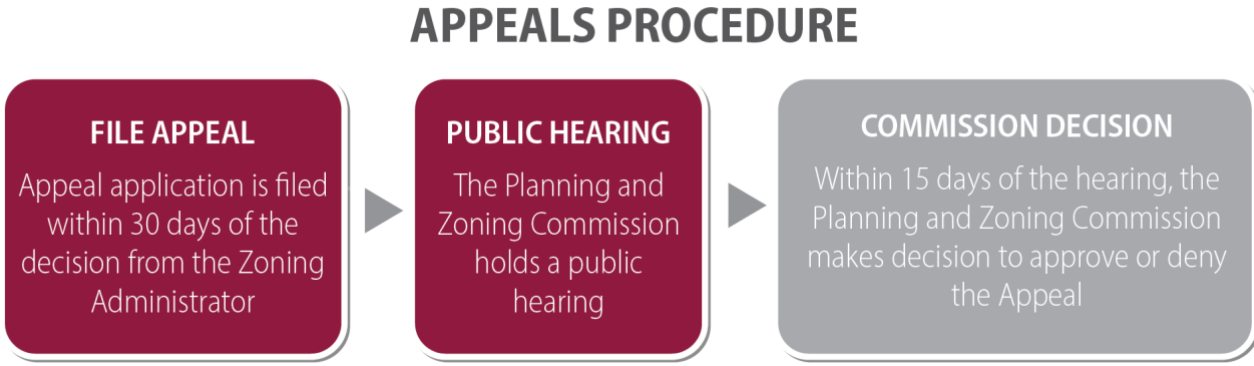
b. Timing to File Appeal. An appeal must be filed within thirty (30) days of a written determination by the Zoning Administrator. The Zoning Administrator will promptly transmit to the planning and zoning commission the application for appeal together with all materials constituting the record upon which the action appealed from is taken.
c. Automatic Stay. An appeal will stay all actions in furtherance of the matter appealed from; unless the Zoning Administrator determines that current conditions cause imminent danger to life or property, in which case the proceedings will not be stayed, absent a restraining order, and actions needed to mitigate such danger will be taken as soon as possible.
d. Planning and Zoning Commission Public Hearing. The planning and zoning commission will hold a public hearing regarding the appeal at a regular or special meeting and give written notice of no less than fifteen (15) days to the applicant. Any person may appear and testify at the public hearing, either in person, in writing or by duly authorized agent.
e. Timing for Decision. Within thirty-five (35) days after the close of the public hearing, the Planning and Zoning Commission will issue a written final decision on the appeal.
4-4-C. Variations.
1. Authority.
a. The planning and zoning commission has exclusive jurisdiction over granting variations from the provisions of this code in any residential district, and not otherwise defined as administrative variations.
b. The board of trustees has exclusive jurisdiction over granting variations, by ordinance duly adopted, in any non-residential district only after receiving a recommendation from the planning and zoning commission, and not otherwise defined as de minimis variations.
c. The Zoning Administrator has exclusive jurisdiction over granting administrative variations that are not objected to by an adjoining property owner.
d. The planning and zoning commission has exclusive jurisdiction over granting administrative variations that are objected to by an adjoining property owner.
2. Purpose. In certain circumstances, strict application of the regulations of this code may cause practical difficulties or a particular hardship relating to construction or alteration of buildings or structures. Variations will not be granted as temporary measures or to permit a use of land not otherwise authorized by a district's use or special use provisions.
3. Parties Entitled to Variations. Applications for variations may be filed by the owner of, or any person, firm, or corporation having a contractual interest in, the property.
4. Variations to be Considered.
a. The only variations that may be considered from the regulations of this code are those pertaining to the dimensional bulk regulations applicable to properties by each zoning district that are not otherwise de minimis variations.
b. An administrative variation is a change in any dimensional bulk regulation that does not exceed five-percent of the required dimension measurement.
5. Procedures - Planning and Zoning Commission and Board of Trustees Granted Variations.
a. Applications. Applications for variations from the requirements of this code will be filed with the Zoning Administrator on an application form, approved in form and substance by the Zoning Administrator, available in the Zoning Administrator's office. In addition to the general requirements for all applications set forth in this Section, the following additional information must be submitted with an application for variations:
i. Current plat of survey locating lot lines and all existing structures.
ii. A description and, as appropriate, a graphic illustrating the situation for which the variation is being sought, as well as the existing zoning classification, use and development of the property.
iii. The section(s) of this code from which the variation is sought.
iv. A narrative of any specific situation giving rise to the variation and how the variation is consistent with the standards and the guidelines for variations in this Section.
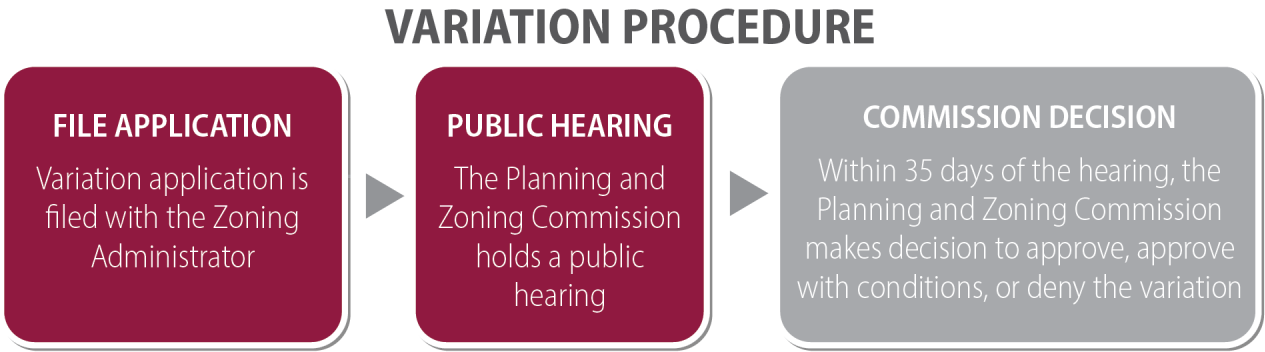
b. Planning and Zoning Commission Public Hearing. The planning and zoning commission will hold a public hearing regarding a variation at a regular or special meeting. Any person may appear and testify at the public hearing, either in person, in writing or by duly authorized agent.
c. Timing for Decision or Recommendation by Planning and Zoning Commission.
i. In all instances where the planning and zoning commission has exclusive jurisdiction over granting a variation, within sixty (60) days after the close of the public hearing, the planning and zoning commission will issue a written final decision on the variation. The failure of the planning and zoning commission to act within 60 days, or such further time to which the applicant may agree, will be deemed to be a decision denying the variation.
ii. In all instances where the board of trustees has exclusive jurisdiction over granting a variation, within 35 days of the close of the public hearing, the planning and zoning commission will make a recommendation that is forwarded to the next available board of trustees meeting for approval, approval with modification, or denial of the variation. Failure to do so within 35 days, or longer period if agreed to by the applicant, will be deemed a recommendation for denial of the variation.
d. Decision by the Board of Trustees. Within sixty (60) days following receipt of a recommendation by the planning and zoning commission, or such longer time as may be agreed to by the applicant, the board of trustees will either approve the variation, approve the variation with modifications, deny the variation by ordinance duly adopted, or remand the matter back to the planning and zoning commission for further deliberation. Failure of the board of trustees to act within 60 days following receipt of a recommendation from the planning and zoning commission, or such longer time as many be agreed to by the applicant will be deed a denial of the variation.
e. Special Variations Procedures in Connection with Other Applications. Whenever any other application is filed for relief under subsections 4-4-C.4. or 4-4-C.5. pursuant to this code as a companion to an application for a variation and such companion application requires final approval by the board of trustees, the authority to hear and decide the application for variation may, pursuant to the request of the applicant made at the time of the filing of the applicant's application, be reserved to the board of trustees. For such purposes, the Board of Trustees shall have all of the authority granted to, and shall be subject to all of the limitations imposed on, the planning and zoning commission by this subsection 4-4-C.5.
6. Procedures for Administrative Variations.
a. An administrative variation is a change in any dimensional bulk regulation that does not exceed five-percent of the required dimension measurement.
b. Applications. Applications for administrative variations from the requirements of this code will be filed with the Zoning Administrator on an application form, approved in form and substance by the Zoning Administrator, available in the Zoning Administrator's office. In addition to the general requirements for all applications set forth in subsection 4-4-A.1 and those for variations set forth in subsection 4-4-C-5, the following additional information must be submitted with an application for administrative variations:
i. Notarized letters from all adjoining property owners stating the following:
1. Name of the applicant seeking the variation.
2. Legal description and address of the subject property.
3. Name and address of adjoining property owners.
4. Statement of variation request.
5. Statement that the adjoining property owner understands the request and does not object to the variation request.
ii. Adjoining Property Owner Objection. In the event that an adjoining property owner objects to the administrative variation, the application for an administrative variation under this section will be subject to the requirements for a public hearing for a variation with the planning and zoning commission.
iii. Approval. If the Zoning Administrator finds the administrative variation request to meet the standards contained in section 4-4-6.a.iv, the Zoning Administrator will:
1. (1) Provide notification to the applicant via certified mail.
2. (2) Provide notification to the mayor and board of trustees.
3. (3) Record the variation with the office of the Cook or DuPage County recorder of deeds, as appropriate. The applicant will bear all costs of recording the variation.
iv. Standards For Administrative Variations. Administrative variations will only be granted when the request is consistent with the general purpose and intent of this Ordinance and the applicant has demonstrated in writing the satisfaction of the following standards:
a. Hardship Or Unintentional Human Error. That a particular hardship or practical difficulty exists that is unique to the subject property and does not apply generally to properties in the zoning district, and that the strict enforcement of the zoning requirement deprives the applicant of the reasonable use of the property.
b. Prohibitions. That the granting of the variation will not:
i. Impair an adequate supply of light and air to the adjacent property;
ii. Increase the hazard from fire or other dangers to said property;
iii. Diminish the value of land and buildings in the immediate neighborhood;
iv. Unduly increase traffic congestion in the public streets and highways;
v. Increase the potential for flood damages to adjacent property;
vi. Otherwise impair the public health, safety, comfort, morals or general welfare of the inhabitants of the City;
vii. That the granting of the variation will be in harmony with the essential character of the neighborhood.
7. Standards for Non Administrative Variations. No application for variation from the requirements of this code will be approved without an affirmative written finding regarding the following standards:
a. That the property in question cannot yield a reasonable return if permitted to be used only under the conditions allowed by the regulations governing the district in which it is located;
b. That the plight of the owner is due to unique circumstances; or
c. That the variation, if granted, will not alter the essential character of the locality.
d. That the particular physical surroundings, shape or topographical conditions of the specific property involved would bring a particular hardship upon the owner as distinguished from a mere inconvenience if the strict letter of the regulation were to be carried out;
e. That the conditions upon which the petition for variation are based would not be applicable generally to other property within the same zoning classification;
f. That the purpose of the variation is not based exclusively upon a desire to make more money out of the property;
g. That the alleged difficulty or hardship has not been created by any person presently having an interest in the property;
h. That the granting of the variation will not be detrimental to the public welfare or injurious to other property or improvements in the neighborhood in which the property is located; and
i. That the proposed variation will not impair an adequate supply of light and air to adjacent property, or substantially increase the danger of fire, or otherwise endanger the public safety, or substantially diminish or impair property values within the neighborhood.
8. Conditions on Variations. The planning and zoning commission may require such conditions and restrictions upon the property benefited by a variation necessary to comply with the standards set forth in this section to reduce or minimize the injurious effect of such variation upon other property in the neighborhood and to implement the general purpose and intent of this ordinance. Failure to comply with or maintain such conditions will be grounds for the Village Board to revoke the variation.
9. Terms and Property Rights.
a. The terms of relief granted shall be specifically set forth in resolution, duly adopted by the planning and zoning commission, with the findings of fact. The approval of a variation does not grant any rights related to the property other than those specified in the resolution approving the variation. All other village processes and approvals must be met including, without limitation, building permits, subdivision approval, authorization of occupancy, and authorization of zoning.
b. A variation will automatically expire and be of no force and effect six (6) months after approval by the planning and zoning commission unless the applicant applies for and obtains a building permit and construction or alteration of the building is started or the use is commenced within this 6-month period; provided, however, that a time extension may be granted in keeping with the following:
i. The Zoning Administrator may grant an extension of 180-days within which a permit is to be issued and construction begun, provided the applicant provides evidence of the delay being caused by factors beyond their reasonable control.
ii. The planning and zoning commission may grant a second 180-day extension if a building permit and work on the project has not commenced within eighteen (18) month time frame, if the applicant provides evidence of the delay being caused by factors beyond their control.
c. Every variation granted under this subsection 4-4-C will not be transferable and run with the land.
4-4-D. Amendments.
1. Authority. The regulations established, and the districts created by this code may, from time to time, be amended in the legislative discretion of and by an ordinance duly adopted by the board of trustees, only after receiving a recommendation from the planning and zoning commission.
2. Purpose. Amendments to this section are intended to revise or refine the zoning code or zoning map as needed to keep it a current and effective tool for development regulation. Amendments should reflect new conditions or newly identified situations, technologies, business approaches or unexpected conditions. The amendment process is not appropriate solely to relieve a particular inconvenience for an individual applicant, as such amendments affect other aspects of the code or surrounding properties.
3. Parties Entitled to Amendments. Applications for amendments may be filed by:
a. the owner of, or any person, firm, or corporation having a contractual interest in, a property to be benefitted by the amendment; or
b. by the village, through the Zoning Administrator, on the Zoning Administrator's own initiative or at the direction of the planning and zoning commission, or board of trustees.
4. Procedures.
a. Applications. Applications for amendments to this code or to the official zoning map will be filed with the Zoning Administrator on an application form, approved in form and substance by the Zoning Administrator, available in the Zoning Administrator's office. In addition to the general requirements for all applications set forth in subsection 4-4-A.1 of this section, the following additional information must be submitted with an application for an amendment:
i. All applications for amendments must include:
1. Property owners within 250 lineal feet, excluding street rights-of-way, in all directions from the subject property as shown in the records of the Offices of the Assessor of Cook County and DuPage County, as appropriate.
2. Property owners located on the same frontage or frontages as the front lot line or corner side lot line of the subject property or on a frontage directly opposite any such frontage or on a frontage immediately adjoining or across an alley from any such frontage, as shown in the records of the Offices of the Assessor of Cook County and DuPage County, as appropriate.
3. A statement of how the Amendment sought would satisfy each of the standards in subsection 4-4-D.5. of this section.
4. Other materials deemed necessary by the Zoning Administrator for the City to conducted a thorough assessment of the proposed Amendment.
ii. Map Amendments applications must include:
1. A graphic depicting proposed development or future use of the subject property.
2. A current survey, certified by an Illinois registered land surveyor, of the subject property.
3. Description of the property characteristics preventing compliance with the existing zoning.
4. A narrative describing any proposed use or development of the subject property, as well as such development's compliance with the proposed zoning district.
5. Description of the length of time, if any, that the subject property has been vacant, considered in the context of the pace of development in the vicinity of the subject property.
5. Standards for Amendments. The decision whether to approve or deny an amendment to the village's zoning text or to the zoning map is left to the legislative discretion of the board of trustees. However, in no event will any application for amendments to the village's zoning text or zoning map will be approved without a satisfactory finding regarding the following standards:
a. Potential Impacts. The amendment will not adversely impact existing land uses in proximity to the property, or, in the case of a text amendment, the overall zoning district purpose or intent of a code section proposed for amendment. The amendment should not unreasonably affect the value, use and enjoyment of nearby properties.
b. Trend of Development and Consistency. Map amendments should be a logical extension of the trend of development in the area around the property, or consistent with the current village comprehensive plan. In the case of a text amendment, the amendment will be consistent with the overall zoning district purpose or intent of a code section proposed for amendment.
c. Externalities. Relevant physical or market conditions that may have changed to make the existing zoning of a property inappropriate, or that make the proposed text amendment necessary for this section to be in keeping with the desirable development of the village will be specified.
d. Village Plans. Amendments will be consistent with the village's current comprehensive plan, official map, and all other plans and policies adopted by the village.
e. Zoning Appropriateness. The extent to which use of the property (or relevant properties in the case of a text amendment) is diminished by the current zoning standards or designation and is no longer suitable for the underlying zoning shall be specified.
4-4-E. Special Use Permits.
1. Authority. The districts created by this code include those uses permitted by right and those authorized by special use permit. Special use permits may be approved and authorized by ordinance duly adopted by the board of trustees, only after receiving a recommendation from the planning and zoning commission.
2. Purpose. The development and execution of the zoning code is based upon the division of the village into districts, within any one of which the use of land and buildings and structures, as related to the land, are essentially uniform. It is recognized, however, that there are special uses which, because of their unique character, cannot be properly classified in any particular district or districts without consideration, in each case, of the impact of those uses upon neighboring lands and upon the public need for the particular use at the particular location. Special uses fall into two (2) categories:
a. Uses operated by a public agency or publicly regulated utilities or uses traditionally affected with a public interest, or
b. Uses entirely private in character, but of such a nature that the operation may give rise to unique problems with respect of their impact upon neighboring property or public facilities. These include planned unit developments, as more specifically addressed in subsection 4-4-F. of this section.
3. Parties Entitled to Special Use Permits. Applications for special use permits may be filed by the owner of, or any person, firm, or corporation having a contractual interest in, the property.
4. Procedures.
a. Applications. Applications for special use permits to this code will be filed with the Zoning Administrator on an application form, approved in form and substance by the Zoning Administrator, available in the Zoning Administrator's office. In addition to the general requirements for all applications set forth in subsection 4-4-A.1, the following additional information must be submitted with an application for a special use permit:
i. A current survey, certified by an Illinois registered land surveyor, of the subject property.
ii. Identification of existing zoning on subject property and within one hundred (100) feet.
iii. A site plan meeting the requirements of subsection 4-4-G of this section.
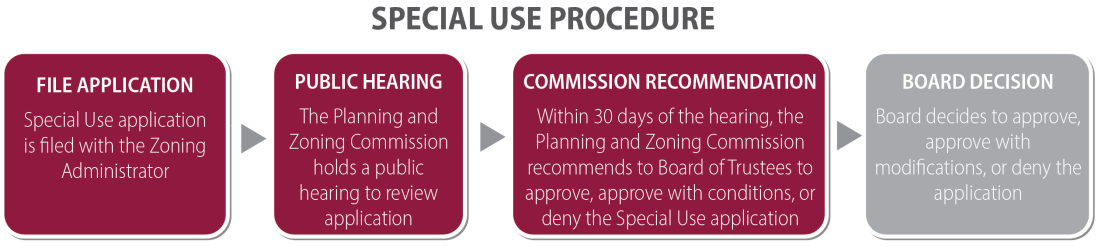
b. Planning and Zoning Commission Public Hearing. The planning and zoning commission will hold a public hearing regarding the special use permit at a regular or special meeting. Any person may appear and testify at the public hearing, either in person, in writing or by duly authorized agent.
c. Timing for Recommendation. Within 35 days of the close of the public hearing, the planning and zoning commission will make a recommendation that is forwarded to the next available board of trustees meeting for approval, approval with modification, or denial of the special use permit. The planning and zoning commission will include any recommended conditions on the issuance of the special use permit. Failure to do so within 35 days, or longer period if agreed to by the applicant, will be deemed a recommendation for denial of the special use permit.
d. Decision by the Board of Trustees. Within sixty (60) days following receipt of a recommendation by the planning and zoning commission, the board of trustees will either approve the special use permit with conditions, approve the special use permit with modifications, including modification to or addition of conditions, deny the special use permit, or remand the matter back to the planning and zoning commission for further deliberation. Failure of the board of trustees to act within 60 days following receipt of a recommendation from the planning and zoning commission, or such longer time as many be agreed to by the applicant will be deed a denial of the special use permit.
5. Standards for Special Use Permits. No application for a special use permit will be approved without an affirmative written finding regarding the following standards:
a. The approval of such special use is in the public interest and not solely for the interest of the applicant;
b. That the proposed use at that particular location requested is necessary or desirable to provide a service or a facility which is in the interest of public convenience and will contribute to the general welfare of the neighborhood or community;
c. That such use will not under the circumstances of the particular case be detrimental to the health, safety, morals or general welfare of persons residing or working in the vicinity or injurious to property values or improvements in the vicinity; and
d. That the proposed use will comply with the regulations and conditions specified in this ordinance for such use, and with the stipulations and conditions made a part of the authorization granted by the village board of trustees.
6. Conditions on Special Use Permits. The planning and zoning commission and board of trustees may require such conditions and restrictions upon the special use permit necessary to comply with the standards set forth in this section to reduce or minimize the injurious effect of the special use permit upon other property in the neighborhood and to implement the general purpose and intent of this ordinance. Failure to comply with or maintain such conditions will be grounds for the board of trustees to revoke the special use permit.
7. Terms and Property Rights.
a. The terms of relief granted will be specifically set forth in the ordinance duly adopted by the board of trustees, with the findings of fact. The approval of a special use permit does not grant any rights related to the property other than those specified in the ordinance approving the special use permit. All other village processes and approvals must be met including, without limitation, building permits, subdivision approval, authorization of occupancy, and authorization of zoning.
b. A special use permit will automatically expire and be of no force and effect six (6) months after approval by the board of trustees unless the applicant applies for and obtains a building permit and construction or alteration of the building is started or the use is commenced within this 6-month period; provided, however, that a time extension may be granted in keeping with the following:
i. The Zoning Administrator may grant an extension of 180-days within which a permit is to be issued and construction begun, provided the applicant provides evidence of the delay being caused by factors beyond their reasonable control.
ii. The board of trustees may grant a second 180-day extension if a building permit and work on the project has not commenced within eighteen (18) month time frame, if the applicant provides evidence of the delay being caused by factors beyond their control.
c. A special use permit is granted to and personal to the applicant and is not transferable to any other party and will not run with the land. However, as more specifically provided in this subsection 4-4-F, special use permits for planned unit development will run with the land and be transferable to other parties.
d. A special use permit will automatically expire and no longer be in effect if the use to which it was granted, for any reason, is discontinued for a period one year.
4-4-F. Special Use-Planned Developments.
1. Authority. The districts created by this code include the ability to creatively address unique development concepts that may include single land use categories or mixed land uses through a planned development process. Special use planned developments may be approved and authorized by ordinance duly adopted by the board of trustees, only after receiving a recommendation from the planning and zoning commission.
2. Purpose.
a. Planned developments are complex and of a different character than other special uses, requiring the establishment of more specific procedures, standards, and exceptions in order to guide the recommendations of the planning and zoning commission and to facilitate appropriate action of the village board of trustees.
b. Planned developments allow greater design flexibilities than is permitted by the standard regulations for land developments where the planned development would better utilize the topographic and natural character of the site and would produce a more economical and stable development while encouraging the conservation of natural features.
c. Planned developments are generally intended to provide for projects incorporating a single type of use or a variety of related and complementary uses which are planned and developed as a unit. Planned developments may provide for a wide range of development techniques and ownership methods, including conventional subdivisions, cluster developments, condominium ownership of land and buildings, or other ownership techniques. The entire development will be controlled by means of a special use planned unit development ordinance and site plan which establishes densities and the approximate location of buildings and extent of the features of the planned unit development in keeping with the land use policies of the Roselle comprehensive plan.
d. The following objectives may be obtained through the use of the planned development procedure:
i. To ensure that the future growth and development which occurs is in accordance with the current comprehensive plan and planning policies of the village;
ii. To provide a more desirable living environment by preserving and integrating the natural environmental and landscape features of the property into land development;
iii. To encourage developers to use a more creative approach to site design by recognizing and respecting the natural limitations and constraints of sites;
iv. To encourage a more aesthetic, efficient and ecologically compatible use of land through a site design process which incorporates and integrates natural site features in a manner which minimizes development costs and services;
v. To encourage the provision of usable open space within a reasonable distance of all dwelling units;
vi. To facilitate in a cost-effective manner the development and maintenance of adequate public services such as transportation, water, sewage, storm drainage, usable open space and parks;
vii. To encourage patterns of land use which decrease trip lengths of automobile travel and encourage trip consolidation;
viii. To increase public access to mass transit, bicycle routes and other alternative modes of transportation;
ix. To reduce energy demand and consumption;
x. To provide for usable and suitably located recreation facilities, schools, and other public and private facilities;
xi. To encourage the introduction of related and complementary uses that best promotes the public health, safety and general welfare; and
xii. To allow clustering of residential uses on smaller lots to conserve open space.
3. Parties Entitled to Special Use Planned Developments. Applications for special use planned developments may be filed by the owner of, or any person, firm, or corporation having a contractual interest in a property.
4. General Requirements for all Planned Developments. The basic provisions and requirements concerning planned development are as follows:
a. A planned development will initially be under single ownership or unified control at the time of filing the application.
b. A planned unit development will not be subject to the bulk regulations of the zoning district where it is located, unless the planned unit development is a mixed use or commercial planned unit development that abuts residentially zoned land, in which case the perimeter yards of the entire planned unit development must adhere to the applicable yard setbacks of the zoning district.
c. Public improvements will be constructed in accordance with existing ordinances and regulations of the village.
d. Residential planned developments will provide for dedication or reservation of land for park and recreational purposes, and land for school sites, or cash contributions in-lieu-of actual land dedication, or a combination of both in accordance with the subdivision regulations of the village.
e. The board of trustees may, upon recommendation of the planning and zoning commission as to benefits to the village, grant waivers and departures from standards for the lot, yard, and bulk regulations of this ordinance for planned developments if such waivers and departures are consistent with the general purpose of the ordinance and will result in better site planning and be of greater benefit both to the occupants of the planned development, to the surrounding neighborhood, and to the village as a whole.
f. The planned development will not have negative impacts on existing or proposed transportation systems and generally consistent with the comprehensive plan. The planned development will not create any negative impact on public services.
g. All planned unit developments, except commercial redevelopment planned unit developments, will contain at least one (1) acre of land as an integral unit. However, the planning and zoning commission may, upon an applicant presenting information and plans demonstrating that a smaller area is appropriate, recommend and the board of trustees may, in its sole and absolute discretion, grant exceptions to this minimum land requirement as part of the special use ordinance authorizing the planned development. Commercial redevelopment planned unit developments will have no minimum size requirements.
5. Procedures - Optional Preapplication Conference.
a. The extent and scope of planned developments requires a significant investment of time and resources on the part of the applicant. The village offers planned development applicants an opportunity to have a preapplication conference with the Zoning Administrator and board of trustees. The pre-application conference is coordinated with the Zoning Administrator and is conducted in a public meeting before the board of trustees.
b. The preapplication conference enables the applicant to present the planned development concept before investing significant time and resources into a planned development project and obtain useful information and suggested guidance on aspects of the proposed planned development. The preapplication conference in no way whatsoever binds, or otherwise legally obligates, the applicant or the village to any part of the proposed planned development and is advisory only. Among the purposes of the preapplication meeting, aside from the overall concept, are:
i. Procedures to be followed to review a proposed development;
ii. Information to be submitted with an application to facilitate review of the proposed planned development; and
iii. Any special or unusual concerns that may affect the design of the development.
6. Procedures - Preliminary Plan. Regardless of whether an applicant uses the preapplication process set forth in subsection 4-4-F.5 of this section, planned development are formally processed in two stages, the preliminary plan stage and final plan stage. The following explains the preliminary plan process.
a. Preliminary Plan Purpose. The preliminary plan stage provides the applicant an opportunity to submit a plan showing the basic scope, character and nature of the entire proposed planned development without incurring undue cost. The preliminary plan is the basis on which the required public hearing is held, permitting public consideration of the proposal at the earliest possible stage. In order to permit the village and the applicant to proceed with some assurance, approval of the preliminary plan binds the applicant and the Village with respect to the following basic elements of development:
i. Categories of uses to be permitted;
ii. location of residential and nonresidential land uses;
iii. maximum density of residential uses and intensity of nonresidential uses;
iv. architectural style of the proposed development;
v. General location and extent of public and private open space, including recreational amenities;
vi. Anticipated location of vehicular and pedestrian circulation systems;
vii. Staging of development; and
viii. Nature, scope and extent of public dedications, improvements or contributions to be provided by the applicant.
b. Applications. Applications for preliminary plan approval will be filed with the Zoning Administrator on an application form, approved in form and substance by the Zoning Administrator, available in the Zoning Administrator's office. In addition to the general requirements for all applications set forth in subsection 4-4-A.1, the following additional information must be submitted with an application for a special use permit, unless waived by the Zoning Administrator or planning and zoning commission, in their sole and absolute discretion:
i. Maps. The following maps and surveys that must be drawn at a scale of one hundred (100) feet to the inch (one inch equals one hundred (100) feet) and show an additional two hundred (200) feet on adjacent property around the perimeter of the proposed development:
1. Boundary survey. A boundary line survey of the property that must be prepared and certified by a registered land surveyor.
2. Topography. A topography map showing existing topographic features of the land with contours shown at intervals no greater than two (2) feet. Topographic data will refer to the U.S.G.S. North American Datum—Mean Sea Level Elevation.
3. Site analysis. A detailed site analysis of the property which shall show the following information:
4. Physical factors information:
(i) Existing land uses both on the site and adjacent to it;
(ii) Soil survey and report from the Kane-Du Page Soil and Water Conservation District or the North Cook County Soil and Water Conservation District.
(iii) Portions of the site in any floodway and floodplain fringe area;
(iv) Streams, drainage ditches, culverts, and standing water;
(v) Isolated preservable trees six (6) inches or more in diameter at one foot above ground level; and
(vi) General directions of the stormwater run-off across the property.
5. Other information.
(i) Preliminary land use plan. A proposed land use plan which shall be drawn upon a print of the topographic map for the site. The proposed land use plan shall contain the following information:
6. Identification and description:
(i) Name of the planned unit development;
(ii) Location of the subject site by section, town and range or by other approved legal description;
(iii) Name and address of the site planner and or engineer;
(iv) Name and address of legal title owner or beneficial owner, and developer if different;
(v) Scale, north point, and date of preparation; and
(vi) Acreage.
7. Design feature information showing:
(i) Right-of-way alignments, widths and proposed names for all streets. Streets should have a simple phonetic spelling and not duplicate or create confusion with the names of existing village streets. All street names will be approved by the village police and fire departments;
(ii) The location and height of all nonresidential, multifamily, or single-family attached buildings and structures;
(iii) Off street parking and service areas;
(iv) All areas to be dedicated as common open space and all sites to be conveyed, dedicated, or reserved for parks, playgrounds, school sites, public buildings, and similar public and quasi-public uses;
(v) All other information necessary to clearly show the proposed elements of the planned development.
(vi) Preliminary engineering plan. Preliminary engineering plans for all public or private improvements. The preliminary engineering plans will be approved by the village engineer.
(vii) Preliminary plat. A preliminary plat prepared in accordance with the procedures of the village's subdivision control ordinance.
ii. Written Documents. Written documents that will be included as part of the application for approval of the preliminary plan are:
1. Statement of Objectives. A statement of planning objectives to be achieved by the particular approach proposed by the applicant. This statement should include a description of the character of the proposed development and the rationale behind the assumptions and choices made by the applicant.
2. Statement of Ownership and Occupancy Intentions. A statement of the applicant's intentions with regard to the future selling or leasing of all or portions of the land areas or structures.
3. Statement of Public Benefits. A statement on the benefits of the planned unit development for the village, including unique uses, design.
4. Private Facilities and Improvements; Owners' Association Declaration. When private improvements and facilities are made part of a planned development, the applicant will submit, as part of the application, the method and arrangement whereby these private improvements and facilities will be operated and maintained. When there are private improvements and facilities to be held in common ownership, a draft owners' association declaration that must include, in substantially similar and relevant form, the following association covenants, conditions, and restrictions:
(i) The membership in the owners' association shall be mandatory for each and every owner, and successive owner, of all located on the property.
(ii) The owners' association will be responsible for the continuity, care, conservation, maintenance and operation, in a first-rate condition, and in accordance with predetermined standards, of the common areas, including without limitation all equipment, appurtenances, ponds, detention facilities, and perimeter fencing located on or within the common areas and the cost of power required for the affected equipment and appurtenances.
(iii) The owners' association shall be responsible for casualty and liability insurance, and the city will be named as an additional insured on all policies of liability insurance obtained by the owners' association.
(iv) The owners on the property or the owners' association, as applicable, will be responsible real estate taxes for the common areas.
(v) The owners on the property will pay their pro rata share of all costs and expenses incurred by the owners' association by means of an assessment to be levied by the owners' association that meets the requirements for becoming a lien on the property in accordance with the statutes of the state of Illinois.
(vi) The owners' association will have the right to adjust the assessment to meet changed needs except any assessment imposed by the city. The membership vote required to authorize an adjustment shall not be fixed at more than 51% of the members voting on the issue.
(vii) The owners' association shall be created and established prior to the sale of any portion of the property.
(viii) The city, as well as the owners on the property, will have the right to enforce the declaration.
(ix) The city will have the right, but not the obligation, after 10 days written notice to the owners' association, (i) to perform any maintenance or repair work that, in the sole opinion of the city, the owners' association has neglected to perform on the common areas, (ii) to assess the membership for that work, (iii) to file a lien against the property of the owners' association or the property of any member failing to pay the assessment, and (iii) and to enforce the lien in the manner provided by law for mortgage foreclosure proceedings.
(x) The declaration will run with and bind any and all portions of the property, and will be binding on the developer, and its successors in interest, to all portions of the property; provided, however, that the declaration may provide for its amendment, modification, or termination at any time upon obtaining the prior consent of the city to said amendment, modification, or termination.
5. Quantitative summary. A quantitative summary including, but not limited to, the following:
6. Acreage and square footage of the property;
(i) Residential density;
(ii) Total square footage of coverage by principal buildings;
(iii) Total square footage of coverage by accessory buildings;
(iv) Square footage of roads;
(v) Square footage of exterior parking areas;
(vi) Number of parking spaces;
(vii) Percentage of ground cover for principal buildings, accessory buildings, parking areas, roads, and recreational facilities, individually and collectively;
(viii) Square footage of uncovered ground on site; and
(ix) Square footage of commonly owned and maintained open space.
7. Open space statement. A statement describing why the area for usable common open space was chosen, the unique advantages it offers, and how it is envisioned that residents will utilize the space either actively or passively.
8. Staging; Construction Schedule. The stages in which the project will be built and the approximate dates when construction of each stage can be expected to begin and to end, with emphasis given to area density, use, and public facilities such as open space to be developed in each stage.
9. Market research report. If retail development is planned, adequate evidence to establish the demand for the retail development will be provided in the form of a market research report examining retail supply and demand.
10. Other information. Other information may be requested if the planning and zoning commission finds that the planned development may create special problems for traffic, parking, landscaping, or economic feasibility. The information may include, but is not limited to, any of the following:
(i) An off street parking and loading plan;
(ii) A traffic study indicating the volume of traffic to be generated by the planned development or a phase of it and proposing any special engineering design features or traffic regulation devices needed to ensure the proper safety of traffic circulation to, through, and around the planned development or a phase of it;
(iii) A tax impact study detailing the impact which the planned development will have upon all taxing bodies. In addition, the expected number of students to be generated by any residential portion of it will be quantified in accordance with the village subdivision regulations; and
(iv) A landscaping planting plan, indicating the height, size, location, quantities, and variety of stock to be planted, using botanical and common names.
11. Planning and Zoning Commission Public Hearing on Preliminary Plan. The planning and zoning commission will hold a public hearing regarding the preliminary plan at a regular or special meeting. Any person may appear and testify at the public hearing, either in person, in writing or by duly authorized agent.
12. Timing for Recommendation on Preliminary Plan. Within 35 days of the close of the public hearing, the planning and zoning commission will make a recommendation that is forwarded to the next available board of trustees meeting for approval, approval with modification, or denial of the preliminary plan for the special use planned development. The planning and zoning commission will include any recommended conditions on the approval of the preliminary plan and issuance of the special use planned development ordinance. Failure to do so within 35 days, or longer period if agreed to by the applicant, will be deemed a recommendation for denial of the preliminary plan and special use planned development ordinance.
13. Decision by the Board of Trustees on Preliminary Plan.
(i) Within sixty (60) days following receipt of a recommendation by the planning and zoning commission, the board of trustees will either approve the preliminary plan and special use planned development ordinance with conditions, approve with modifications, including modification to or addition of conditions, deny the special use planned development ordinance, or remand the matter back to the planning and zoning commission for further deliberation. Failure of the board of trustees to act within 60 days following receipt of a recommendation from the planning and zoning commission, or such longer time as many be agreed to by the applicant will be deemed a denial of the special use planned development ordinance.
(ii) If the preliminary plan is disapproved, the board of trustees will file a written decision that will be filed with the clerk, and a copy sent to the applicant.
(iii) If the preliminary plan is approved, the board of trustees will authorize the applicant to submit a final development plan for the planned unit development, which final plan must be submitted for approval not more than one year from the date of approval of the preliminary plan and special use planned development ordinance.
14. Standards for Special Use Planned Developments. No application for a special use planned development will be approved without an affirmative written finding regarding the following standards:
(i) Each of the standards for special use permits set forth in subsection 4-4-F.6.i.13 of this section.
(ii) General. The following general standards:
(a) The uses permitted by such exceptions as may be requested or recommended are necessary or desirable and appropriate to the purpose of the development.
(b) The uses permitted in such development are not of such a nature or so located as to exercise an undue detrimental influence or effect upon the surrounding neighborhood.
(c) The site plan effectively treats the developmental possibilities of the property, making appropriate provisions for the preservation of streams, wooded areas, floodplain areas, and similar physical features.
(d) All minimum requirements pertaining to business, office research, residential, industrial or other uses established in the planned development will conform to the requirements for each individual classification as established elsewhere in this ordinance. These minimum requirements, however, may be specifically varied in the ordinance granting and establishing a planned unit development use.
(e) The suitability of the arrangements for operating and maintaining private improvements facilities and whether the owners' association declaration meets the minimum requirements set forth in this section.
(f) Any waiver or departures from standards from applicable bulk regulations will be solely for the purpose of promoting an integrated site plan which is more beneficial to the occupants of the planned development as well as the neighboring property, that would be obtained under the bulk regulations of this ordinance for buildings developed on separate zoning lots.
(g) Off-street parking and loading shall be provided in accordance with the provisions set forth in this ordinance.
(h) All signs shall follow the provisions of this ordinance.
(i) All planned unit developments shall comply with the performance standards set forth in this ordinance.
(j) The planned development will be accessible from public roads which are adequate to carry the traffic that will be imposed upon them by the planned development. The streets and driveways on the site of the planned development will be adequate to serve the enterprises located in the proposed development. Traffic-control signals will be provided without expense to the village when the board of trustees, or other agency having jurisdiction over adjacent rights-of-way, determine that signals are required to prevent traffic hazards or congestion in adjacent streets.
(k) Planned developments must provide for underground installation of utilities (including electricity and telephone) in both public ways and private extensions thereof. Provisions shall be made for acceptable design and construction of stormwater facilities including grading, gutter, piping, and treatment of turf to handle stormwaters.
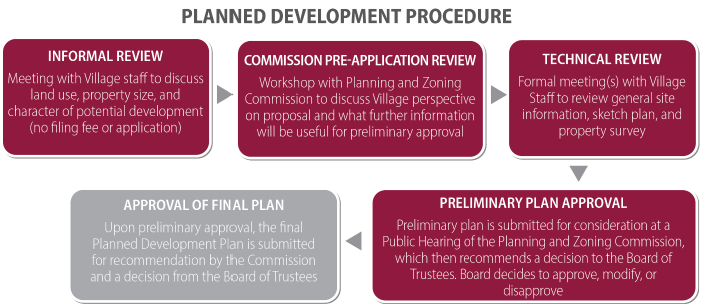
(l) Limitation on Preliminary Plan Approval. Approval of the preliminary plan will not constitute approval of the final plan. Rather it is deemed an expression of approval of the layout submitted on the preliminary plan as a guide to the preparation of the final plan or plans. No building permit will be issued for any structure until a final plan has been approved and filed with the Cook County or DuPage County recorder of deeds, as appropriate.
(m) Optional Submission of Final Plan. The applicant may, at its option, submit a final plan for the proposed planned development pursuant to the requirements of subsection 4-4-F.6 of this section simultaneously with the submission of the preliminary plan pursuant to the requirements of this subsection 4-4-F.5. The planning and zoning commission and the board of trustees will consider the plans simultaneously and will grant or deny final plan approval in accordance with the provisions of subsection 4-4-F.6 of this section.
7. Procedures - Final Plan.
a. Final Plan Purpose. The final plan is intended to particularize, refine and implement the preliminary plan and to serve as a complete, thorough and permanent public record of the planned development and the manner in which it is to be developed.
b. Application. Upon or within one year after approval of the preliminary plan and special use planned development ordinance, the applicant will file with the Zoning Administrator an application for final plan approval. Applications for final plan approval will be filed with the Zoning Administrator on an application form, approved in form and substance by the Zoning Administrator, available in the Zoning Administrator's office. An application for final plan approval may include the entire area included in the approved preliminary plan or one or more phases, stages or units of the preliminary plan. In addition to the general requirements for all applications set forth in this section, the following additional information must be submitted with an application for final plan, or the first phase, stage, or unit submitted for final plan approval:
i. All public improvements required or proposed for the entire area included in the approved preliminary plan.
ii. All open space required or proposed for the entire area included in the approved preliminary plan.
iii. approved preliminary plan.
iv. The payment of all fees required by this ordinance.
v. Preliminary plan action by planning and zoning commission.
c. Planning and Zoning Commission Final Plan Process
i. Public Meeting. A public meeting will be set, noticed and conducted by the planning and zoning commission to determine whether the final plan substantially complies with the preliminary plan.
ii. Timing for Recommendation. Within sixty (60) days following the filing of an application for approval of a final plan, or one or more phases, stages or units of the preliminary plan, the planning and zoning commission will, with such aid and advice of village staff and consultants as may be appropriate, review and make a recommendation on the final plan.
iii. Final Plan Evaluation. The planning and zoning commission will consider the following when evaluating the final plan, or one or more phases, stages or units of the preliminary plan:
1. Whether the final plan is in substantial conformity with the approved preliminary plan;
2. The merit or lack of merit of any departure of the final plan from substantial conformity with the approved preliminary plan;
3. Whether the final plan complies with any and all conditions imposed by approval of the preliminary plan; and
4. Whether the final plan complies with the provisions of this code and all other applicable federal, state and village codes, ordinances and regulations.
iv. Forms of Recommendation.
1. Approval Based on Substantial Conformity. If the planning and zoning commission find substantial conformity between the final plan and the approved preliminary plan and further finds the final plan to be in all other respects complete and in compliance with any and all conditions imposed by approval of the preliminary plan and with the provisions of this code and all other applicable federal, state and village codes, ordinances and regulations, it will transmit the plan to the board of trustees with its recommendation that the board of trustees approve the final plan, with or without modifications and conditions to be accepted by the applicant as a condition of approval.
2. Recommendation of Denial. In any case where the planning and zoning commission finds that the final plan is not in substantial conformity with the approved preliminary plan and does not merit approval, or in any case where it requires modifications of a final plan that are not accepted by the applicant, the planning and zoning commission will transmit the final plan to the board of trustees together with its recommendation and specific reasons in support of its recommendation that the final plan not be approved.
3. Failure to Act. The failure of the planning and zoning commission to act within the 60 day period specified in subsection 4-4-F.7.B of this section, or such further time as the applicant may agree, will be deemed to be a recommendation to the board of trustees to approve the final plan as submitted.
4. Board of Trustees Final Plan Process.
(i) Action by Board of Trustees. Within sixty (60) days following the receipt of the recommendation of the planning and zoning commission, or its failure to act, the board of trustees will take action in accordance with the following:
(a) Approval Based on Substantial Conformity. If the planning and zoning commission has recommended approval of a final plan, the board of trustees will, unless it specifically rejects one or more of the findings of the planning and zoning commission on the basis of expressly stated reasons, approve the final plan by ordinance.
(b) Approval Notwithstanding Planning and Zoning Commission Recommendation of Denial. If the planning and zoning commission has recommended denial of a final plan, the board of trustees may, if it finds that the final plan merits approval and otherwise conforms to the requirements of this code, approve the final plan by ordinance.
(c) Referral Back to Planning and Zoning Commission. The board of trustees may refer the final plan back to the planning and zoning commission for further consideration in a duly noticed public hearing of specified matters.
(d) Conditions on Final Plan Approval. The approval of any final plan may, in addition, be granted, with or without modifications and conditions to be accepted by the applicant as a condition of approval.
(e) Failure to Act. The failure of the board of trustees to act within sixty (60) days, or such further time to which the applicant may agree, will be deemed to be a decision denying final plan approval.
5. Coordination With Subdivision Ordinance. When a subdivision of land subject to the subdivision ordinance is proposed in connection with a planned development, review of the final plat of the proposed subdivision will be carried out simultaneously with review of the final plan by both the planning and zoning commission and board of trustees.
6. Post Final Plan Procedures.
(i) Recording of Final Plan. When a final plan is approved, the Zoning Administrator will cause the final plan, or the or one or more phases, stages or units of the final plan, to be recorded with the Recorder of Deeds of Cook or DuPage County, as appropriate.
(ii) Limitation on Final Plan Approval. Construction will commence in accordance with the approved final plan within one year after its approval, or within such shorter time as may be established by the approved development schedule. Failure to commence construction within any such period will, unless an extension of time has been granted by the board of trustees pursuant to this section, automatically render void the final plan approval and all approvals of the planned development and all permits based on such approvals, and the Zoning Administrator will, without further direction, initiate an appropriate application to revoke the special use permit for all portions of the planned development that have not yet been completed.
(iii) Building and Other Permits.
(a) Appropriate officials of the village may, upon, but not before, receiving notice from the Zoning Administrator that the documents required for final plan approval have been approved, and upon proper application by the applicant, issue building and other permits to the applicant for the development, construction and other work in the area encompassed by the approved final plan; provided however, that no permit will be issued unless the appropriate official is first satisfied that the requirements of any codes or ordinances of the village, in addition to this code, that are applicable to the permit sought have been satisfied.
(b) Building permits may, however, be withheld at the discretion of the Zoning Administrator or the board of trustees at any time it is determined that the development of the planned development is not proceeding in strict compliance with the approved final plan.
7. Changes After Final Plan Approval.
a. De Minimus Change. The Zoning Administrator, in consultation with other village departments, as appropriate, may authorize de minimus changes to an approved final plan when the adjustments are necessary in light of technical or engineering considerations.
b. Minor Change. Any adjustment to an approved final plan, that does not result in a change to the concept or intent of the planned unit development, and which changes are less than a five percent (5%) change in any restriction set forth in the final plan or pursuant to any relevant ordinance or agreement for the planned unit development, will be considered a minor adjustment and will be granted only after application to, and approval by, the board of trustees, by ordinance duly adopted. A minor change will not require a public hearing before the plan commission.
c. Major Change. Any adjustment to an approved final plan that results in alteration of the concept or intent of the planned unit development, or which changes are greater than five percent (5%) change in any restriction set forth in the final plan or pursuant to any relevant ordinance or agreement for the planned unit development, will be granted only after application to, and approval by, the board of trustees, by ordinance duly adopted. Application for a major adjustment will be considered at a public hearing before the plan commission.
4-4-G. Site Plan Review.
1. Authority. The Zoning Administrator will perform a site plan review for uses and developments requiring building permits for construction in the zoning districts and other instances noted in subsection 4-4-G.4 of this section. This will not include cases in which building permit applications are made only for to the interior or facade of a structure. In cases where a building permit application includes site development and interior or facade construction, proposed improvements to the interior or facade will not be part of the site plan review consideration. Site plan review approval is not required for applications considered through a special use process, as those matters are reviewed during the village's review of the special use application.
2. Purpose. Site plan review addresses uses, developments, and redevelopments appropriate for a zoning district, but considers that there may be potential adverse impacts for how a site is designed or used, and that require a more detailed evaluation than is otherwise incorporated to building permit, life safety, and related considerations. The standards and procedures in this subsection 4-4-G are designed to provide a thoughtful and efficient evaluation of such development applications.
3. Parties Who may submit for Site Plan Review. Applications for site plan review may be filed by the owner of, or any person, firm, or corporation having a contractual interest in, the property.
4. Site Plan Review Required. The Zoning Administrator will conduct site plan review for sites located in the following zoning districts and in the following instances:
a. The following zoning base and overlay districts:
i. Any development or redevelopment in a Redevelopment Overlay District;
ii. Any development or redevelopment in the B-3 Town Center District;
iii. Any development or redevelopment in the B-4 General Business District and B-5 ;
iv. Any development or redevelopment in the ORI District
b. Any development or redevelopment, other than for one single family detached dwelling unit, involving a parcel under single ownership or control having an area in excess of 20,000 square feet.
c. Any development or redevelopment involving the creation or expansion of a parking lot or garage or a loading space.
d. Any nonresidential development on a lot abutting or across a right-of-way from any residential district.
e. Any development or redevelopment involving a personal wireless services antenna, with or without an antenna support structure, that is not a special permit use
5. Procedures.
a. Applications. Applications for site plan review will be filed with the Zoning Administrator on an application form, approved in form and substance by the Zoning Administrator, available in the Zoning Administrator's office. In addition to the general requirements for all applications set forth in subsection 4-3-A.1, the following additional information must be submitted with an application for site plan review:
i. Plans/Drawings:
1. A graphic depicting proposed development of the property.
2. A current survey, certified by a registered land surveyor, of the subject property.
ii. A description and graphic describing the proposal for which site plan approval is being sought and of the existing zoning classification, use and development of the property.
iii. A graphic rendering of the existing conditions, which depicts all significant natural, topographical and physical features of the subject property including, drainage structure and pattern, relevant soil conditions, and topographical contours at one-foot intervals;
iv. The location, use, size and height in stories and feet of structures and other land uses on adjacent properties.
v. Data and related calculations concerning proposed structures and existing structures that will remain, including:
1. (a) Location, size, use and height;
2. (b) Where relevant, gross floor area and floor area ratio;
3. (c) Where relevant, number and size of dwelling units, by dwelling unit type and number of bedrooms; and
4. (d) Building coverage.
vi. Yard and setback dimensions and dimensions related to the height, width and depth of any structure, as well as proximity to property lines.
vii. A vehicular and pedestrian circulation plan showing the location, dimensions, gradient and number of all vehicular and pedestrian circulation elements.
viii. All existing and proposed drainage, retention and detention facilities, and existing and proposed utilities and easements.
ix. Location, size and arrangements of all outdoor signs and lighting.
x. Location and height of fences or screen plantings and the type or kind of building materials or plantings to be used for fencing or screening.
xi. Location, designation and total area of all usable open space.
xii. A detailed landscaping plan, showing location, size and species of all trees, shrubs and other plant material.
xiii. A traffic study, if deemed necessary by the Zoning Administrator.
b. Decision by Zoning Administrator. Within sixty (60) days following receipt of an application for site plan review, the Zoning Administrator will either:
i. approve the site plan as submitted;
ii. approve it subject to conditions based on the standards noted below, with a written explanation to the applicant; or
iii. deny approval of the site plan with written findings provided to the applicant pursuant to the standards below. The failure of the Zoning Administrator to act within sixty (60) days, or such further time to which the applicant may agree, will be deemed to be a decision approving the site plan as submitted. In reviewing a submitted site plan regarding the standards below, the Zoning Administrator may suggest alternative site plan or design approaches that could address specified deficiencies or may note that such deficiencies that cannot be avoided would have a minimal adverse impact on the property or nearby properties.
c. Effect of Zoning Administrator Action. Approval of a site plan by the Zoning Administrator, acceptance of required modifications by the applicant, or agreement by the applicant and Zoning Administrator on an approach to address required modifications will constitute final action regarding site plan review. All other village building permit and village code requirements must still be met for the proposed construction.
d. Appeals. If the Zoning Administrator denies a site plan review application and the applicant wishes to appeal that denial, the applicant will file such appeal in accordance with this section.
e. Standards for Site Plan Review. In considering a site plan submitted for review pursuant to this subsection 4-4-G, the Zoning Administrator will consider the following standards:
i. The application must be complete as specified in this chapter, other village regulations, or other requirements specified by the village.
ii. Any other application for approval by the village or other jurisdiction relevant to items considered under site plan review must be successfully secured.
iii. The proposed site plan or design is internally logical and safe and facilitates clear understanding of travel and circulation within the property, as well as to and from the site by vehicles, pedestrians, and bicyclists.
iv. The proposed site plan and design do not interfere with easements or rights-of-way, or create traffic hazards or congestion on surrounding public streets.
v. The proposed site plan or design does not adversely impact use and enjoyment of surrounding properties.
vi. Outdoor storage is adequately screened.
vii. The proposed site plan, or design, does not create adverse impacts related to drainage or erosion for the subject site or nearby properties, and complies with all local, county, state and federal requirements.
viii. The proposed site plan or design should not place unreasonable burdens on village or other utility systems serving the site or area. The site plan should integrate site utilities into the overall existing and planned utility systems serving the village.
ix. The proposed site plan or design must provide for required public improvements as may be directed in this section, the comprehensive plan, village planning documents, or other aspects of this code.
x. The proposed site plan or design shall not adversely impact the public health, safety or general welfare of the village.
6. Time Constraints. Unless an extension is granted by the Zoning Administrator as a result of written request by the applicant showing good cause and external factors necessitating an extension, no site plan or design approval will be valid for a period longer than six months (6) unless a building permit is issued. Within one year of site plan review approval, construction must have begun and (if not completed) be actively pursued to completion.
7. Modifications.
a. During development of the site, the Zoning Administrator may approve an adjustment to the approved site plan if such change could been have authorized in the course of the original review.
b. Amendments to Site Plan Following Completion of Development. After a site is developed in accordance with an approved site plan, the site plan may be altered, if in the determination of the Zoning Administrator and based on the standards for review in subsection 4-4-G.5.E, in the same manner and subject to the same limitations as provided for the original approval of site plans.
4-4-H. Certificate of Zoning Compliance.
1. Authority. The Zoning Administrator will have authority to issue certificates of zoning compliance, but only in accordance with the provisions of this section 4-4-H.
2. Purpose. The certificate of zoning compliance is intended to serve two general purposes. First, it provides a procedure for reviewing plans for conformance with this code and a means for evidencing such conformance. Second, it serves as an adjunct to, and must be filed prior to or with, all other applications filed pursuant to this code with respect to a specific use or development proposal. When so filed, it serves as a vehicle for routine plan review by the Zoning Administrator prior to consideration of special requests by other officials, boards, and commissions, avoiding needless special reviews of defective plans.
3. Except where expressly waived by another provision of this code, unless a certificate of zoning compliance is first been obtained from the Zoning Administrator:
a. the construction, repair, structural alteration, remodeling, alteration, or moving of any structure shall not be commenced;
b. no land vacant on the effective date of this Code shall be used or occupied for any purpose, except the raising of crops;
c. the grading, excavation, or improvement of land preliminary to any construction on or use of such land shall not be commenced; and
d. building or other permits pertaining to the construction, repair, remodeling, structural alteration, or moving of any structure or the use of any land or structure shall not be issued by the Village.
e. In any case where a certificate of zoning compliance is not required under this code, the Zoning Administrator will, upon written request, issue a certificate verifying this fact.
4. Relation to Other Applications. No application for a zoning variation, special use permit, map amendment, or formal application for approval of a planned unit development will be processed, unless an application for a certificate of zoning compliance is first received, processed, and approved, or denied solely on one or more grounds that form the basis for the application. It is the intent of this section 4-4-H.4 that no application filed for a specific use or development proposal will be processed until the Zoning Administrator is satisfied that the proposed use or development complies with the provisions of this code in all respects except those within the scope of such application.
5. Procedure.
a. Application. Applications for certificates of zoning compliance will be filed with the Zoning Administrator on an application form, approved in form and substance by the Zoning Administrator, available in the Zoning Administrator's office. In addition to the general requirements for all applications set forth in subsection 4-2-A.1, the following additional information must be submitted with an application for site plan review:.
i. A description or graphic representation of any development or construction that will occur or any use that will be established or maintained if the requested relief is granted.
ii. A table showing the following, if applicable:
1. The total lot area of the subject property, in acres and in square feet;
2. The total existing and proposed lot area, expressed in acres, in square feet and as a percent of the total development area, devoted to residential uses, by type of structure, commercial uses, office uses, industrial uses and institutional uses, open space, rights-of-way, streets, and off-street parking and loading areas; and
3. The existing and proposed:
(i) Number of dwelling units, by number of bedrooms and dwelling unit gross
(ii) Gross and net floor area devoted to residential uses, commercial uses, office uses, industrial uses, institutional uses and recreational uses.
iii. A table listing all bulk, space and yard requirements, all parking requirements, and all loading requirements applicable to any proposed development or construction and showing the compliance of such proposed development or construction with each such requirement. Where any lack of compliance is shown, the reason therefor shall be stated and an explanation of the village's authority, if any, to approve the application despite such lack of compliance shall be set forth.
iv. The certificate of a registered architect or civil engineer licensed by the state of Illinois, or of an owner-designer, that any proposed use, construction or development complies with all the provisions of this code and other village ordinances or complies with such provisions except in the manner and to the extent specifically set forth in said certificate.
b. Action on Application. Within 21 days following receipt of a completed application for a certificate of zoning compliance, the Zoning Administrator shall cause the application and related submissions to be reviewed for compliance with this code and will inform the applicant whether the application has been granted or denied. In any case where an application is granted, the Zoning Administrator will issue a certificate of zoning compliance, which will state on its face, in bold type, that: "THIS CERTIFICATE DOES NOT SIGNIFY BUILDING CODE REVIEW OR APPROVAL AND IS NOT AUTHORIZATION TO UNDERTAKE ANY WORK WITHOUT SUCH REVIEW AND APPROVAL WHERE EITHER IS REQUIRED. BEFORE ANY STRUCTURE TO WHICH THIS CERTIFICATE IS APPLICABLE MAY BE OCCUPIED OR USED FOR ANY PURPOSE, A CERTIFICATE OF OCCUPANCY MUST BE OBTAINED." In any case where an application is denied, the Zoning Administrator will state specific reasons for the denial and cite the specific provisions of this code upon which the denial is based. If relief from such demand would be available pursuant to a companion application filed in connection with the application for a certificate of zoning compliance, the Zoning Administrator will inform the applicant and promptly process the companion application. If the application is approved, the Zoning Administrator will issue the requested certificate of zoning compliance in accordance with the terms and conditions of such approval. If relief from the Zoning Administrator's denial of a certificate of zoning Compliance would be available by variation, special use permit, or site plan review, but no application has been filed, the Zoning Administrator will state this and refer the applicant to the appropriate provisions of this code.
6. Contents of Certificate. Each certificate of zoning compliance issued pursuant to this section will state the specific use of the property for which it is issued; will identify the specific plans; if any, pursuant to which it is issued; and will set forth any conditions imposed in connection with any approval granted pursuant to this code.
7. Filing of Certificates. Every certificate of zoning compliance issued pursuant to this section will be kept on file with the Zoning Administrator and will be a public record open to inspection in accordance with the provisions of the Illinois Freedom of Information Act.
8. Effect of Issuance of Certificate of Zoning Compliance. The issuance of a certificate of zoning compliance will not authorize the establishment, expansion, or extension of any use nor the development, construction, relocation, alteration, or moving of building or structure, but will merely authorize the preparation, filing, and processing of applications for any additional permits and approvals that may be required by the codes and ordinances of the village, including, but not limited to, a building Permit, a certificate of occupancy, and subdivision approval.
9. Limitations on Certificates. Subject to an extension of time granted by the Zoning Administrator pursuant to section 4-2-B, a certificate of zoning compliance will become null and void six months after the date on which it was issued unless within such period construction, repair, remodeling, structural alteration, or moving of a structure is commenced or a use is commenced.
10. Void Certificates. Any certificate of zoning compliance issued in violation of the provisions of this code, whether intentionally, negligently, or innocently, will be void from issuance and will give rise to no rights whatsoever.
4-4-I. Certificate of Occupancy.
1. Authority. The Zoning Administrator will have authority to issue certificates of occupancy; provided, however, that no certificate will be issued except in accordance with the provisions of this section 4-4-I and the provisions of the village municipal code governing development, building, and related matters.
2. Purpose. For the purposes of this code, the certificate of occupancy provides a procedure for the inspection of completed premises to ensure their compliance with this code and approved plans prior to commencement of the use or occupancy of such premises. The certificate of occupancy may also evidence compliance with other provisions of the village municipal code, as set forth in those provisions.
3. Certificate Required. Unless a certificate of occupancy has been obtained certifying compliance with the provisions of this code:
a. No structure, or addition thereto, constructed, reconstructed, remodeled, altered, or moved after the effective date of this code will be occupied or used for any purpose;
b. No land vacant as of the effective date of this code will be used or occupied for any purpose;
c. Except for changes involving only substitution of occupants in existing dwelling units, no use or occupancy of any land or structure will be changed to any other use or occupancy, whether or not construction, remodeling, alteration, or moving is involved.
4. Procedure.
a. Application. Where no certificate of zoning compliance is required, applications for certificates of occupancy will be filed in accordance with the requirements of section 4-4-I.3. Where a certificate of zoning compliance has been issued, the application for that certificate will also be treated as the application for a certificate of occupancy and will be processed as such at such time as the applicant notifies the Zoning Administrator in writing that the subject structure or use is ready for a certificate of occupancy in accordance with the certificate of zoning compliance. In any case where the structure or use involved has been constructed or established pursuant to any approval granted pursuant to this code, the application will be accompanied by "as built" plans depicting the structure or use as built and bearing the certificate of a surveyor, engineer, architect, land planner, or owner-designer, as may be appropriate, certifying that the structure or use as built conforms in all respects to the approval granted.
b. Action on Application. Within ten days following the receipt of a completed application, the Zoning Administrator will cause the subject structure or premises to be inspected and will take on the following actions based on such inspection:
i. If all work has been completed and the structure and use thereof are in full and complete compliance with all applicable provisions of this Code, other relevant codes and ordinances of the village, the applicant's plans as approved and any conditions attached to any approval issued pursuant to this code, the Zoning Administrator will issue a certificate of occupancy;
ii. If, however, all work is not complete or is in any manner not in full compliance with all applicable requirements, the Zoning Administrator will deny the application and will inform the applicant in writing of the specific deficiencies on which such denial is based, citing the particular provisions of the codes and ordinances of the village, the particular items in the applicant's plans or the applicable special approval conditions with respect to which compliance is lacking.
5. Contents of Certificates. In addition to the matters required to be contained in a certificate of occupancy pursuant to other applicable provisions of the village municipal code, each certificate of occupancy issued pursuant to this section 4-4-I.5 will state the specific use of the subject property for which it is issued; will identify the specific plans, if any, pursuant to which it is issued and will set forth any conditions imposed in connection with any approval granted pursuant to this code.
6. Filing of Certificates. Every certificate of occupancy issued pursuant to this section 4-4-I.6 will be kept on file with the Zoning Administrator and will be a public record open to inspection pursuant to the provisions of the Illinois Freedom of Information Act.
7. Temporary Certificate of Occupancy. Notwithstanding the provisions of section 4-4-I, where construction, repair, remodeling, or structural alteration of a structure does not require the vacating of the structure, or where parts of the structure are finished and ready for occupancy before the completion of construction, repair, remodeling, or structural alteration and are certified upon inspection to be safe for use or occupancy and to be in full compliance with all applicable provisions of this code, other relevant codes, and ordinances of the village, the applicant's plans as approved and any conditions attached to any approvals issued pursuant to this code with respect to such structure or its premises, a temporary certificate of occupancy may be issued for a period not to exceed six months from its date, which temporary certificate shall bear on its face, in bold type, a statement of its temporary nature; provided, however, that no such temporary certificate will be issued pursuant to this code unless the structure also qualifies for a temporary certificate of occupancy issued pursuant to the village building code.
8. Certificate of Occupancy for Existing Uses. The Zoning Administrator may issue a certificate of occupancy certifying the lawful existence and use of any existing structure or use in the same manner, and subject to the same standards and limitations, as authorized by this section 4-4-I.8 with respect to new structures and uses. A certificate of occupancy will be prima facie evidence of the facts contained in it with respect to any structure or use as of the date of its issue and remain effective for that purpose for so long as neither the use or structure nor the applicable provisions of this code are changed.
9. Certificate of Occupancy for Legal Nonconformities. The Zoning Administrator may issue a Certificate of Occupancy certifying the lawful existence and use of any nonconforming use, structure, lot, or sign in the same manner, and subject to the same standards and limitations, as authorized by this section 4-4-I.9 with respect to new structures and uses and subject also to the additional standards and limitations set forth in section 4-3-1.A of this code.
10. Void Certificates. Any certificate of occupancy issued in violation of the provisions of this code, whether intentionally, negligently, or innocently, shall be void ab initio and give rise to no rights whatsoever.
4-4-J. Enforcement and Penalties.
1. General Enforcement Authority and Duty. Upon finding the existence of any violation of this code, the Zoning Administrator will have the authority and duty to take or direct all actions necessary or appropriate to punish and abate such violation.
2. Civil and Administrative Enforcement.
a. Stop and Cease-and-Desist Orders. Upon finding the existence of any violation of this code, the Zoning Administrator will notify, in writing, the person responsible for the violation, indicating the nature of the violation and ordering the action necessary to correct it; specifically, the Zoning Administrator will order the discontinuance of any illegal use of land or structures; the removal of illegal structures, additions or alterations; and the discontinuance of illegal work being done.
b. Legal Actions. In the enforcement of this code, the Zoning Administrator will exercise all the powers authorized by the statutes of the state of Illinois and the codes and ordinances of the village to ensure compliance with, or to prevent or abate any violation of, the provisions of this code, and in particular, will, where necessary or appropriate, institute or cause to be instituted by the village attorney in the name of the Village of Roselle any and all actions, legal or equitable, including appeals, that may be required for the enforcement of this code.
c. Abatement; Liens. Where authorized by state statute, the Zoning Administrator may order any work necessary to abate any violation of this code and will assess the cost of such work to the property owner. Upon the failure of the owner to pay such cost, the Zoning Administrator will file a lien for the costs, and for all costs of collection, against the property in question.
d. Revocation of Permits. The violation of any provision of this code, or of any permit or approval granted pursuant to it, or of any condition imposed pursuant to it will be grounds for the revocation of any approval granted pursuant to this code and affecting the property involved in the violation. The Zoning Administrator may recommend and the board of trustees may order such revocation; provided, however, where the original approval was granted following a public hearing required pursuant to this code, the revocation will be preceded by a public hearing before the board of trustees.
e. Fines. In the enforcement of this code, the Zoning Administrator will, where necessary and appropriate, order the issuance and enforcement of citations to recover fines and penalties for the violation of this code as authorized by state law and this code.
3. Penalties. Any person who violates, disobeys, omits, neglects, or refuses to comply with, or who resists enforcement of, any provision of this code will be subject to a fine of not less than $375 nor more than $750 for each offense. Each day violation continues to exist will constitute a separate offense.
4. Private Remedies Preserved. Nothing in this Part shall be interpreted to prevent any person entitled to relief in law or equity by reason of a violation of the provisions of this Code from bringing an appropriate action to secure such relief.

